The Campus Through the Years north side; the south side matched Lucy Rowland Hall and Rector Hall. On the site of W. C. DePauw’s Gentlemen’s (Middle College) Hall, torn down along with West College in the 1930s, came Harrison Hall in 1940, named after Danville, Ill., alumnus John Harrison. It was similar to and faced Asbury Hall – three stories, red brick, wide chimneys and dormer windows – but the roof gables ran in a different direction. It was to house the botany, zoology, geology and psychology departments. Harrison Hall had the first elevator on campus. Blackstock Stadium, built in 1941, was unique in its use but still maintained the brick-and-limestone, Colonial Revival look. The World War II era brought us some oddities with temporary barracks,
Quonset huts and prefabricated houses to accommodate increased enrollment of married veterans and, later, junior faculty members. The Memorial Student Union in 1952 memorialized those lost to the Second World War. It continued DePauw’s use of Colonial Revival architecture; impressive and L-shaped, its broad front portico and six famous columns faced the Rector Quad, and an outside patio faced East College. The Union introduced a ballroomauditorium, cafeteria, dining room, large central reception hall, alumni office, faculty lounge, WGRE radio station and more. In 1956 Roy O. West Library, designed by library architectural specialists Wheeler and Bailey, departed radically from Colonial Revival. The reason was cost; it was a large, flat-roofed cube of reinforced concrete and brick.
The library has since been renovated and enlarged, with columns added to the front of the building and a decorative belfry on top for a more Colonial Revival look. The old Carnegie library was remodeled into the Emison Art Center. The last of the Colonial Revival structures, Roberts Hall, a men’s dormitory, was built in 1961. A new bookstore added to the Union building didn’t stray too far, but Roberts Hall marked the end of Colonial Revival architectural style on campus.
A shift in perspective A new student residence, Hogate Hall, was added in 1968. This unusual, accordion-style building was constructed with brick, stone and glass walls. The first floor featured a large reception room, kitchen and dining room. The University
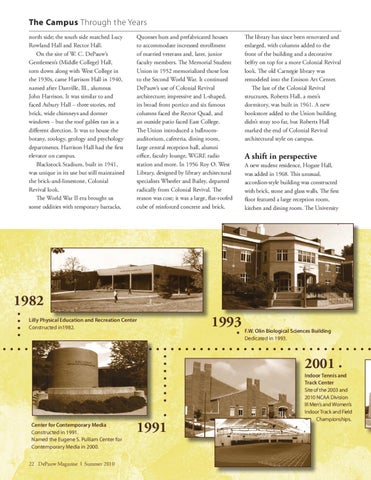
1982 Lilly Physical Education and Recreation Center Constructed in1982.
1993
F.W. Olin Biological Sciences Building Dedicated in 1993.
2001
Center for Contemporary Media Constructed in 1991. Named the Eugene S. Pulliam Center for Contemporary Media in 2000. 22 DePauw Magazine I Summer 2010
1991
Indoor Tennis and Track Center Site of the 2003 and 2010 NCAA Division III Men’s and Women’s Indoor Track and Field Championships.