
In Darkness and Light CD Booklet

Page 1


without rhythm, just the essence of harmonies, floating, like a memory. Until we are led out of the depths and up to the dizzying heavens. The register is high, we have lost a clear sense of rhythmic activity to anchor us, instead we are up in the stratosphere with a large sense of time. There is a measure of time but we don’t know where we are in it. The repetition creates stasis.

Beethoven moves into uncharted territory; the theme increasingly abstracted, time suspended. The voyage is an inward voyage, deeper and deeper, further from the outward shape of the theme, seemingly lost and even on the edge of sanity. Brilliant forte trills appear, a bold fragment of the theme seems to ground us in an arrival, only to disappear.

For long stretches the music paradoxically wanders in place, a suspended nowhere. And then, after having been gone for so long as to seem forgotten, miraculously — as when one turns the corner in a dream and finds oneself home — the theme reappears. Expansively filled out by arpeggio accompaniment, gaining strength and confidence, blooming into ecstatic fullness. We rise to the highest register of the keyboard, and then hang by a thread, suspended on one trill until, surrounded by celestial shimmering sounds, bright and luminous, the theme again appears, gentle, tender…and then trails off, seemingly lost forever in the heavenly heights. Only to descend to earth briefly in the last three

bars.

This stupendous work closes with one of the most modest final measures in all of Beethoven. For the writer Thomas Mann, “a farewell to the sonata.” Beethoven is famous for his extended endings; but here, following these remarkably extended variations, the end is abbreviated. There are three repetitions of the final C major chord, and the rests are explicit. Beethoven forbids our lingering at the end.

What is the significance of this humble farewell? The lack of answers and the acceptance of such; the humility of ending a piece this massive with a sixteenthnote rest. The composer insists on curtness. The final rest admonishes us: no gesture of finality. No knowing answer. Two sighs and a gasp. The rest at the end becomes an intake of breath. Beethoven disappears behind the curtain without a bow.

As the world began to reopen in spring of 2021, I began to think about an unusual juxtaposition, programming Beethoven’s last sonata and Feldman’s final piano work together. The metaphysical and spiritual journey that Beethoven leads us on in Op. 111, filled with questions, finds a strange continuity in the contemplation and suspended time of Morton Feldman.

I realized I also wanted the voice of someone who had lived through this era with us, and turned to

jazz pianist and composer Vijay Iyer, whose music increasingly defies genre and reflects his own thoughtful perspectives. And so yet another juxtaposition is created: Beethoven’s Sonata No. 32 in C Minor, composed in 182122, is preceded by a work written exactly 200 years later, in 2021.

Iyer writes eloquently about his piece’s deeply personal meaning, which neither of us knew it would take on when we first met to discuss his writing a new work for me. The two movements of For My Father, structured classically as a prelude and fugue, open a subtle dialogue with the Beethoven. In Beethoven’s work, the first movement has fugal elements, and the second movement is songful with variations. In Iyer’s For My Father, we find the song and variations first, in the prelude; and Iyer’s second movement brings us a deeply ruminative fugue, the form organically arrived at through contemplative development, meeting a climax with jagged rhythms recalling Beethoven’s wildly syncopated variation. There are other discreet connections across two hundred years.

Vijay Iyer: For My Father (2022)

In memoriam Y. Raghunathan (1933-2021)

Composed for Sarah Rothenberg

My father, Y. “Raghu” Raghunathan, came from India to the U.S. in 1963, followed soon after by my mother Sita. Dad enjoyed a substantial career as a pharmaceutical chemist, but he drew satisfaction from a simple life among family and friends, never allowing professional demands to overshadow his devotion to loved ones. Modest, compassionate, and ardently egalitarian, he was careful not to take anything too seriously, especially himself. He embraced his own ordinariness because it connected him to everyone else; it made him no better or worse than his neighbor, no more or less deserving of friendship or kindness than any of his fellow human beings. He showed us how to live with dignity, compassion, grace, and boundless love. His last piece of advice to me: “Go slow.”

Several weeks after his passing, I happened upon a recording of Shostakovich’s 24 Preludes and Fugues, opus 87. I couldn’t understand why at the time, but the sixteenth prelude and fugue took hold of me and would not let go. I completely immersed myself in that piece for ten days, until it became a mystical conduit for something else: in this semi-trance state I produced a prelude and fugue of my own, in prayer (orison) and in praise (upastuti). It shadows Shostakovich’s form, but it somehow expresses my father’s unhurried, loving spirit. I’ve come to believe that he sent me this piece as a blessing. I hope you feel his presence in it as I do.

Vijay Iyer

My performance of Beethoven’s Op. 111 is dedicated to Adam Zagajewski, luminous poet and friend who passed away suddenly in 2021. Over the years, we shared many programs interweaving music and poetry in Houston, Krakow, and Chicago...

Music was deeply important to Adam, and central to his writing, from his first published poem, entitled “Music,” to the opening pages of his prose book, Two Cities, and everything that followed. It offered him inspiration, but also a kind of liberation: a writer and thinker of tremendous intellect, music was a place where Adam could wander freely, lost in the mystery of a language in which he was not himself fluent, but which spoke to him directly. He understood music’s connection to the human soul.

Subtle shifts of harmony in a musical phrase can move us from minor to major with just the shift of a half-step, the piano’s smallest interval. This tiny change redefines our world, and we move from darkness to light. This also happens in Adam’s poetry.

TRY TO PRAISE THE MUTILATED WORLD

Try to praise the mutilated world. Remember June’s long days, and wild strawberries, drops of rosé wine. The nettles that methodically overgrow the abandoned homesteads of exiles. You must praise the mutilated world. You watched the stylish yachts and ships; one of them had a long trip ahead of it, while salty oblivion awaited others. You’ve seen the refugees going nowhere, you’ve heard the executioners sing joyfully. You should praise the mutilated world. Remember the moments when we were together in a white room and the curtain fluttered. Return in thought to the concert where music flared. You gathered acorns in the park in autumn and leaves eddied over the earth’s scars. Praise the mutilated world and the gray feather a thrush lost, and the gentle light that strays and vanishes and returns.

Adam Zagajewski (1945-2021) Translated by Clare Cavanagh

Sarah Rothenberg has a unique career as pianist, writer, and creator of interdisciplinary performances connecting music with visual art and literature. She is recognized internationally as a “trailblazing pianist” (Boston Globe) who plays with “power and introspection” (New York Times), and as a “a prolific and creative thinker” (Wall Street Journal). Performances include Great Performers at Lincoln Center, Park Avenue Armory, Barbican Centre, La Philharmonie Paris, the Concertgebouw, Palais des Beaux-Arts, 92NY, Gilmore Piano Festival, Ojai and Big Ears festivals, and series across the U.S.

A champion of new music and neglected repertoire of the past, she has performed over 85 premieres, with recent solo works from Tyshawn Sorey and Vijay Iyer. Her critically acclaimed recordings include the U.S. premieres of Fanny Mendelssohn’s Das Jahr; Rediscovering the Russian Avant-Garde: Roslavetz, Lourié, Mosolov; and Shadows and Fragments: Brahms and Schoenberg; as well as works of Messiaen, Satie, Feldman, Cage, Carter, Wuorinen, Picker, Tsontakis, Sorey. Original productions conceived, directed and performed by Sarah Rothenberg include A Proust Sonata; The Blue Rider: Kandinsky and Music; In the Garden of Dreams (fin-desiècle Vienna); the films The Departing Landscape (Feldman) and, forthcoming, Door of No Return (Sorey); as well as a five-season series at Lincoln Center, Music and the Literary Imagination. Her essays appear in literary journals, art monographs and music publications.

Sarah Rothenberg has led DACAMERA, the vanguard music organization in Houston, since 1994, and was co-founding artistic director of the Bard Music Festival. A graduate of the Curtis Institute of Music, she also studied in Paris with Yvonne Loriod. She received the French medal of Chevalier des Arts et des Lettres in 2000. She lives in Houston and New York.

Vijay Iyer has carved out a unique path as an influential, prolific, shape-shifting presence in twenty-first-century music. A composer and pianist active and revered across multiple musical communities, Iyer has created a consistently innovative, emotionally resonant body of work over the last three decades. His honors include a MacArthur Fellowship, a Doris Duke Artist Award, a United States Artist Fellowship, three Grammy nominations, and the Alpert Award in the Arts.

Iyer’s creative work is documented on thirty acclaimed albums, including Fifteen (Nonesuch, forthcoming in 2026), Defiant Life (ECM, 2025), Iyer’s second suite of duets with composertrumpeter Wadada Leo Smith; Compassion (ECM, 2024), featuring his celebrated trio with drummer Tyshawn Sorey and bassist Linda May Han Oh. Iyer is also a prolific composer of concert music, with works premiered by London Philharmonic, Oregon Symphony, American Composers Orchestra, Orpheus Chamber Orchestra, East Coast Chamber Orchestra, Manchester Collective, Brentano Quartet, Imani Winds, Parker Quartet, Bang on a Can All-Stars, Silk Road Ensemble, Sō Percussion, The Knights, International Contemporary Ensemble, and virtuosi Jennifer Koh, Matt Haimovitz, Curtis Stewart, Mishka Rushdie Momen, Claire Chase, Inbal Segev, Sarah Rothenberg, and Shai Wosner. Iyer has served as composerin-residence at London’s Wigmore Hall, music director of the Ojai Music Festival, and artist-in-residence at New York’s Metropolitan Museum of Art. His scores are published by Schott Music. He teaches at Harvard.

Founded in 2026, DACAMERA Editions is the recording label dedicated to disseminating the distinctive mix of new works, surprising juxtapositions, and diverse musical styles that have defined DACAMERA, the Houston-based presenter and producer of chamber music and jazz, for over 35 years. These recordings will champion new compositions, encompassing both notated and improvised music; unjustly neglected works of the past; and repertoire from the classical canon presented in new contexts. We seek to make illuminating connections between past and present; between music, art and literature; and to offer informative viewpoints that deepen the listening experience and connect music to the complex world in which we live. Opening ears, hearts and minds through music.

Recorded December 9-11, 2022, at Stude Concert Hall, Shepherd School of Music, Rice University, Houston, TX

Produced by Judith Sherman

Engineered by Judith Sherman and Francis X. Schmidt

Editing assistant: Jeanne Velonis

Piano technician: Jim Kozak

Mastered by Jeanne Velonis and Judith Sherman

Designed by Aaron C. Lazar

Executive producer: Sarah Rothenberg

My deepest gratitude to Lillie Robertson for making this recording possible.

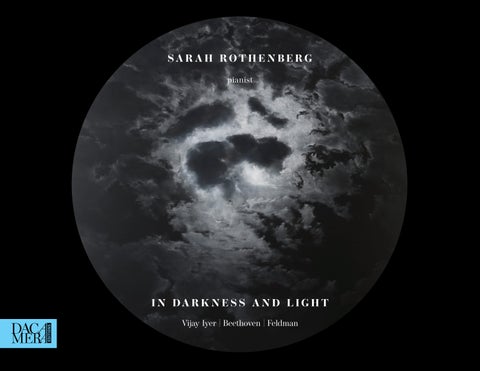
Cover art: Tacita Dean Delfern Tondo, 2024 (Chalk on blackboard paint on Formica, Diameter: 10 ft. (120 in. (304.8 cm)) Courtesy private collection. Image courtesy: the Artist and Marian Goodman Gallery New York/Paris/Los Angeles; Frith Street Gallery, London. Photo credit: Fredrik Nilsen Studio ©Tacita Dean Artist photo: Elizabeth Conley

Vijay Iyer For My Father (2021) Published by Schott Music Corporation, New York, NY

Morton Feldman Palais de Mari (1986) Published by Universal Edition AG, Vienna

Adam Zagajewski, “Try to Praise the Mutilated World” from Without End: New and Selected Poems. Copyright © 2002 by Adam Zagajewski. Used by permission of Farrar, Straus & Giroux, LLC, http://us.macmillan.com/ fsg. All rights reserved.

Liner notes: Copyright © Sarah Rothenberg 2026

© 2026 DACAMERA Editions www.dacameraeditions.com DE2602

Distributed by Meyer Media LLC

DACAMERA Editions

Turn static files into dynamic content formats.
Create a flipbook
In Darkness and Light CD Booklet by DOTDOTDOTMUSIC - Issuu