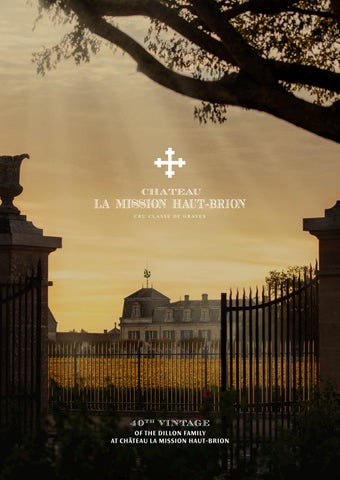
40th vintage OF THE DILLON FAMILY AT CHÂTEAU LA MISSION HAUT - BRION
The Dillon family is presenting its 40th vintage at Château La Mission Haut-Brion.
These past four decades have been decisive for this Grand Cru Classé de Graves, as they are part of four centuries of rich history, characterized by the devotion of those who made this property of sacred charm shine.
An exceptional terroir
Similar to its immediate neighbour, Château Haut-Brion, the history of La Mission is amongst the oldest in Bordeaux. In 1540, Arnaud de Lestonnac bought a parcel of land named “Arregedhuys” that would become the starting point for Château La Mission Haut-Brion. This parcel is anchored in a very unique type of soil: gravel. These small pebbles of quartz varieties rest on a unique subsoil of clay, sand, limestone and falun dating from the Tertiary and Quaternary eras.
Plant by plant, plot by plot, Arnaud de Lestonnac constantly strived to establish a vineyard on these gravelly soils with their excellent exposure and slopes ensuring natural drainage reinforced by a network of small streams.
1540 was also the year that linked Château La Mission Haut-Brion to its already established neighbour, Château Haut-Brion, as Jean de Pontac's only sister, Marie, married Arnaud de Lestonnac. His brother-in-law Jean, one of the fathers of Château Haut-Brion, had already discovered the prodigious potential of this gravelly terroir. Two generations later, Arnaud's granddaughter, Olive de Lestonnac, gave birth to La Mission Haut-Brion: after a life devoted to both good works and the administration of her land, she bequeathed the property to the Lazaristes de Bordeaux, also known as the Priests of La Mission.
An extraordinary personality: Olive de Lestonnac
“Married three times, widowed three times, and yet she never became a mother…(…) During the long eighty years of her life, Olive de Lestonnac was undoubtedly an extraordinary person,” writes Caroline Le Mao*, a historian specialised in 17th century French history. Olive de Lestonnac was, during the first half of the 17th century, the leading founder and guardian of convents in the Bordeaux region. The study of Olive de Lestonnac’s life shows that she was able to gain far greater freedom than that generally granted to widows in books of that time stating moral guidance and standards of virtuous conduct, but it also points out that her work greatly surpassed the religious and charitable scope of widows, to gain access to the sphere of economic activity. Olive de Lestonnac was a true businesswoman. An astute negotiator and attentive manager; her work took her far beyond La Mission, because she was actively involved in the Médoc winegrowing area, in Margaux. Her order books and contracts show that she knew about all the stages of vine growing and wine making, managing personally the purchase of barrels, as well as wooden stakes for the vineyard. She could have let her successive husbands handle her business or even have entrusted it to a right-hand man, but this pious businesswoman chose to take on this work herself and accomplished it with a certain verve.
When the Dillon family bought the property in 1983, they initiated its rebirth with the same objective the Lestonnac family had four centuries earlier: make its priceless terroir shine. Over a period of ten years, the vineyard was restructured, uprooted and replanted in order to perpetuate the plant material and sublimate this unique terroir.
A jewel with sacred charm
The Dillon family's approach pays tribute to the dedicated work of the Lazarist Fathers, who governed the estate from 1682 until the French Revolution. During this period, the Fathers expanded the vineyard and perfected both vine cultivation and wine-making. They gave this sacred jewel its letters of nobility and endowed it with a Frontenac stone chapel in 1698.
Mission Haut-Brion also owes a great deal to the work of the Chiapella family in the 19th century. After enclosing the vineyard, they installed a flamboyant wrought-iron gate at the entrance to the property, inspired by a design from the archives of the Pères Lazaristes and now listed on the Inventaire Supplémentaire des Monuments Nationaux. The Chiapellas were the first American owners to fall under the spell of La Mission. To symbolize the special ties between France and the United States, this family of
The making of a cru
The winegrowing history of these lands dates back to the middle of the 1st century A.D., when the Romans taught the art of viticulture to the Bituriges Vivisques, the Gallic tribe who founded Burdigala, the ancient Bordeaux. During the 20th and 21st centuries, two major additions were made to the La Mission Haut-Brion vineyard. In 1928, the Woltner family added Clos Laville to the estate, giving birth to the white wine Château Laville Haut-Brion, renamed Château La Mission Haut-Brion blanc in 2009. In 2006, the Dillon family added a new stone to the edifice with the integration of the smallest of the Graves red crus classés, La Tour Haut-Brion, into the estate. Grapes from this terroir are now included in the blend for La Chapelle de La Mission Haut-Brion.
merchants had a model ship built, the original of which can be admired at the estate. A miniature version adorns the roof of the château, serving as a weather vane. The Woltner family, the last dynasty to own the property before the Dillon family, acquired the property in 1919 and also contributed to this great common edifice by renovating the exteriors and installing the superb Toledo arches.
La Mission Haut-Brion, a veritable jewel polished through the centuries, was completed with the refurbishment and decoration of the interiors by Joan Dillon, Duchesse de Mouchy in the 2000’s.
Innovation over the centuries
Over the course of history, generations of owners and managers, certainly inspired by the enchanting charm of the site, have never ceased to modernize and innovate in order to sublimate the fruits of La Mission Haut-Brion’s terroir. The Lazaristes' dedication to the vineyard lives on, while the Chiapellas are credited with the beginnings of the worldwide renown of the wine produced within the property's sacred walls. As of 1926, The Woltners instilled a taste for innovation and modern winemaking, with the installation of glass-lined enamelled steel tanks, while celebrating the spiritual past of La Mission Haut-Brion: we have them to thank for inscribing the greatest vintages in gold letters in the chapel.
It was in this pioneering spirit that Domaine Clarence Dillon started investing as soon as the estate was integrated in 1983, renovating the premises, installing a new, modern vat room, and acting as builders in their own right, under the initiative of Prince Robert de Luxembourg, representing the fourth generation of the Dillon family.
In a vibrant tribute to the Lazarist Fathers, a new 1000m² winery, designed as a veritable modern wine cathedral, was inaugurated in 2009. Built of Frontenac stone, like the finest monuments in Bordeaux, it is completed by a cloister and a new tasting room, now decorated with a collection of engravings by Albrecht Dürer. There's no end to the work involved in perfecting production facilities, and the Dillon family is planning a number of major renovations over the coming years.
Acquisition
The signing of the sale of Château La Mission Haut-Brion on November 2, 1983, between Joan Dillon, president of Domaine Clarence Dillon, and the Woltner family, may not have been immortalized in pictures, but it was nonetheless a pivotal moment in the history of the family business. Indeed, to mark the importance of this event, in the spring of 1983, Joan Dillon brought her son Prince Robert de Luxembourg, who was 15 years old at the time and attending boarding school in London, to a meeting that was a historic moment for the Dillon family: that of the certification of the signing of the deeds of sale for Château La Mission Haut-Brion.
The collection of etchings
The members of the Dillon family, owners of Châteaux Haut-Brion and La Mission Haut-Brion, have always been art lovers. Mr Clarence Dillon developed a passion for etchings and in particular those of the intaglio technique. A century later, sharing the same interest for this art as his great-grandfather, Prince Robert de Luxembourg decided to put together a magnificent collection of prints to be displayed in a place that lends itself especially to this: Château La Mission Haut-Brion.
Albrecht Dürer, a 16th century artist, emblematic of this art form, as well as Rembrandt, are the two artists who form this collection of 71 works.
Among them, the complete series of 37 prints of the most impressive “Petite Passion” on wood by Dürer. By the same artist, three other famous series are represented in the collection: “L’Apocalypse” (2 etchings), “La Passion” on copper, (also 2 etchings) and “La Vie de la Vierge”, with 9 different etchings of the 19 from the original work. One of the treasures of this collection is undoubtedly “L’Homme de Douleur aux mains liées”, an extremely rare work of art, because it is one of the artist’s three colourised works, enhanced with gold afterwards, as part of its veneration. Lastly, to complete the collection, 4 intaglio works by Rembrandt, also with biblical themes, created between 1635 and 1656.