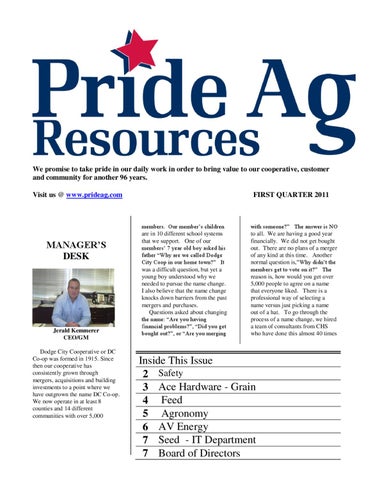
We promise to take pride in our daily work in order to bring value to our cooperative, customer and community for another 96 years. Visit us @ www.prideag.com
MANAGER’S DESK
Jerald Kemmerer CEO/GM Dodge City Cooperative or DC Co-op was formed in 1915. Since then our cooperative has consistently grown through mergers, acquisitions and building investments to a point where we have outgrown the name DC Co-op. We now operate in at least 8 counties and 14 different communities with over 5,000
FIRST QUARTER 2011
members. Our member’s children are in 10 different school systems that we support. One of our members’ 7 year old boy asked his father “Why are we called Dodge City Coop in our home town?” It was a difficult question, but yet a young boy understood why we needed to pursue the name change. I also believe that the name change knocks down barriers from the past mergers and purchases. Questions asked about changing the name: “Are you having financial problems?”, “Did you get bought out?”, or “Are you merging
with someone?” The answer is NO to all. We are having a good year financially. We did not get bought out. There are no plans of a merger of any kind at this time. Another normal question is,”Why didn’t the members get to vote on it?” The reason is, how would you get over 5,000 people to agree on a name that everyone liked. There is a professional way of selecting a name versus just picking a name out of a hat. To go through the process of a name change, we hired a team of consultants from CHS who have done this almost 40 times
Inside This Issue 2 Safety 3 Ace Hardware - Grain 4 Feed 5 Agronomy 6 AV Energy 7 Seed - IT Department 7 Board of Directors
with cooperatives all over the Midwest. They understand the business that we are in because they are in the same core businesses, and they get what we do every day. The process of changing the name started with a complete profile and audit of all our facilities by the consultants over the last five months. We started out with around 50 names and worked it down to about 12 names. Then we went to work with the management team of employees and board of directors to tie it back with the results of the profile and the audit. Pride Ag Resources was selected because of its direct tie to our promise of taking pride in our daily work in order to bring value to our cooperative, our customers and our community. The Dodge City Cooperative Board of Directors approved a new marketing name and brand for the cooperative that took effect January 1, 2011, Pride Ag Resources is the new marketing name but our legal name is still Dodge City Cooperative Exchange. You will only see the legal names on legal documents and the dba as Pride Ag Resources. I would also like to point out that cost of changing the name is not millions or hundreds of thousands of dollars in expense; in fact it was very reasonable for a cooperative of our size. I hope this article helps clear up the name change. I am not for sure if I have answered all of your questions, but feel free to call me if you have any questions. I hope you have a good spring, and thanks for your business!
Safety Division
Skyler Hayes Safety Director
ELECTRICAL SAFETY Electricity serves a multitude of functions in and around our homes, farms and ranches. As a matter of fact, electricity is so commonly used that we sometimes take it for granted and forget its potential dangers. Following are some electrical safety tips. Use the recommended fuses or circuit breakers for circuits. Do not overload circuits, and if a fuse or circuit breaker continues to “blow�, do not replace it with a larger one. Protect wiring from corrosive or abrasive conditions by placing it in conduit or other protective shield. Keep rodent populations down, as rats and mice can damage wires and wire insulation. Replace extension cords that have damage such as fraying, cuts or missing ground plugs. Keep cords off the ground or floor to keep them from being driven over or stepped on. Extension cords are meant to be a temporary electrical conduit. If you use an extension cord in the same place for months or years at a time, you might want to consider
permanent wiring to that piece of equipment. If an extension cord feels warm after use, it may be defective or too small for the piece of equipment it is powering. Use a Ground Fault Circuit Interrupter (GFCI) in moist environments such as kitchens, bathrooms, laundry rooms, dairies or outdoors. GFCIs can be either hard wired in the wall outlet or can be portable to use with an extension cord when working with power tools. GFCIs are a very effective means of preventing electric shock. GFCIs and GFCI testers are inexpensive and can be purchased at hardware stores. If at all possible use a fiberglass instead of aluminum ladder when working around electricity. Aluminum is a conductor of electricity, and standing on an aluminum ladder instead of a fiberglass ladder while servicing electrical wiring or equipment could increase your chances of electrical shock. Be aware of overhead power lines, especially when working with ladders, augers, truck hoists, tractor scoops, irrigation pipe, etc. Before opening a high voltage power panel, brush the back of your hand against the panel. This will allow you to free yourself from the panel if it is electrified. If you grab the panel and it is 2
electrified, the current may not allow you to let go of the panel. If you are planning to go into a high voltage panel, consider purchasing personal protective equipment such as lineman’s gloves (both rubber and gauntlet), goggles, face shield and even an arc flash suit. Also, a kit of insulated tools made specifically for electrical work will help prevent electric shock or an arc flash. Turn electrical power off and lock out power boxes (disconnects or breakers) when repairing or maintaining electrically powered devices. This will prevent someone from turning the piece of equipment on when you are working on it. Know where underground power lines are located before digging with a backhoe or shovel. Before using standby generators for emergency power install a transfer switch to prevent power from entering the power utility lines, which present a hazard to linemen working on the line. The switch also protects your generator. Do not put light bulbs into a lamp that is not rated for that wattage. Lamps and other electrical fixtures are marked with the wattage they are rated for. If you need more light, put in another lamp with a higher wattage rating. Label breakers, fuse boxes and disconnects. This will
allow you to quickly and easily identify a circuit that has been disconnected or that you wish to disconnect. Lastly, if you suspect a problem with the wiring or you are not certain about what you are doing, call in a professional. Certified electricians are trained to do the job correctly, and the cost of an electrician is a small price to pay for peace of mind, especially when your safety and the safety of your family and coworkers are concerned.
------------
ACE HARDWARE
Jack Lane, Ace Manager I know it is hard to believe but it is time to start thinking about the spring crabgrass and fertilizer application. Ace carries several different brands of fertilizer including Ace brand, Scott’s and Ultimate. Stop by and talk to Tami. With spring around the corner it is a great time to apply Ace brand paint for all your needs. Ace has a paint for virtually all applications from equipment oil paint to interior and exterior latex flat, satin, semi gloss and gloss paints. Ace has a paint that will fit the bill. Ace also provides custom computer color matching for about any color. Call or come by and talk to Ashley in the paint department or any of our
knowledgeable sales staff. Ace is the place for all your spring needs.
------------
GRAIN DIVISION
Troy Presley Grain Originator Risk Management Advisor
2008 vs 2011 We don’t have to think back too terribly far to remember grain prices even higher than current levels.. In early 2008, we had a market environment that could best be described as chaotic. So what differentiates the two years? There is no questions the “funds” are just as active in 2011 as they were in 2008. We have seen the “funds” hold long positions well over 500,000 contracts this year just like we did in 2008. The difference in the index funds from 2008 to the current year is the way they are investing. In 2008 I would generalize that the money was more invested in a raw way, they were just buying corn futures. In today’s market, the index funds are more managed. Still investing dollars into commodities however, they are being more creative than they used to be. Frank/Dodd Bill and outcry over speculative positions driving prices higher, led to a closer scrutiny of OTC transactions and general commodity positions. This forced market participants to diversify their assets. That might be in the way of owning storage facilities, owning land, maybe buy owning shares of major equipment manufacturer. Any way you look
3
at their commodities portfolios have become more diverse. The overall outlook on grains is a much different from a supply and demand picture as well. Let’s take a look back in 2008 and try to remember the driving forces of the markets. The index funds were a big part of that year like we mentioned earlier. There was a very tight supply of global wheat. EU wheat crop was horrible, Australia had a drought, Ukraine/Russian crop realized an early frost. A smaller than expected wheat acre year coupled with a very low beginning stocks number helped push prices higher. Global wheat carryout was sub 120 mmt, while recent estimates now have it over 170 mmt. 2008 also turned out to be the year for ethanol facilities construction. With crude prices rising to $150/barrel there was plenty of incentive for ethanol. Ethanol plants were paying millions of dollars just to move up in the line of construction projects. The driving force was a government mandate for ethanol usage. The problem was, production capacity was on pace to exceed those mandates thus making the margins dependent on economic conditionswhich we realized the market would quickly correct. The corn market was trying to find as many acres as possible to keep up with the demand from the ethanol sector. In 2008 we had a 1.6 billion bushels corn carryout number, so there was plenty of corn to make it thru that year. However if we didn’t continue to see big acres with good to excellent production it would not have been able to sustain adequate carryout in the corn market to keep everyone comfortable. In 2008 we had plenty of stocks on hand but yet concern over the 2009 carryout numbers given the demand at the time. Bottom line: corn went from a situation in 2008 of having to protect next years’ supply versus this year when the market is protecting the current stocks. The closer comparison to this year form a fundamental supply and demand perspective is 1996.
2011 has given us a much different look than 2008 fundamentally speaking. The US is sitting on healthy stocks of wheat. We have good quality milling wheat readily available. The rest of the world is in a different scenario. Australia’s wheat crop was hit very hard with flooding and has turned to feed quality. Stocks for milling quality are very hard to find- but overall production is one of the best in recent years. Our planted wheat acres are up from last year, however conditions right now are not the best. SRW conditions have rebounded with better acreage and good conditions. Our current carryout on corn is project at 850 million bushels. THAT’S TIGHT! It has the traders in the corn market scrambling to ration corn to make sure we make it to the new crop time frame. Therefore you see the futures markets rallying and closely monitoring South America’s crop as well. The market will remain very sensitive to any production scares from Global market production. Crude oil in 2011 is much lower than we were in 2008 currently the price is $92/barrel. This has made things much tough from the ethanol side to deal with +$6 corn and $92/barrel oil. Compared to 2008 when it was $6 corn and $150/barrel oil. There are ethanol plants right now not running at full capacity due to margins. So are we rationing demand? Possibly, the USDA has yet to recognize the slower pace by the ethanol sector into the current Supply and Demand. So as you can see there are many differences in the two years as far as fundamentals. However both years have a very bullish tone to them. How will you market your grain this year compared to 2008? That’s a big question. Last time we saw the rally, recognized it, and then watched it disappear. Let’s be proactive this time around. Forward contracting grain and then adding a long call to the position can sure make a producer feel better at night knowing there is a floor under this market. With many inputs already purchased and a lot
of people knowing there breakeven cost, having a sale to cover those cost is a solid marketing strategy. Still wanting to take advantage or a rally? Call your broker to find out the most cost effective way to do that.
------------
Date
Wheat Corn Milo Soybean
10/5/10
5.81
4.53
4.16 9.75
11/3/10
6.27
5.43
5.06 11.36
11/19/10
5.90
4.83
4.46 11.00
12/23/10
7.28
5.68
5.29 12.52
Last Year –Feb.. 2010 AVG.
4.08
3.20
2.75 8.33
FEED DIVISION
Galen Frick, Livestock Advisor
Cattle Management Ideas To Accomplish Night Time Feeding (To Encourage Day Time Calving) Research and ranch experience has shown that the management procedure of feeding pregnant cows late in the day (or even better in the evening) has decreased the percentage of cows calving during the middle of the night. The percentage of adult mature cows that need assistance at calving is extremely low compared to the percentage of first calf heifers. Therefore, the heifers, of course, are the group of females that are of greatest need of observation during the calving season. On many large ranches, it is physically impossible to feed all of the cows after 5:00 pm. In those instances, the ranch manager should plan to feed the mature cows earlier in the day, then 4
feed the first calf heifers at dusk. What about the situation where large round bales of hay are being fed to the cows and heifers? If the cows have unrestricted access to the hay around the clock, then the best method of influencing the time of calving is via the time of day that the supplement is being fed. At Oklahoma State University, the switch from supplement feeding in daytime to late afternoon/early evening feeding encouraged 72% of the cows to calve between 6 AM and 6 PM. These cows had 24/7 access to large round bales of grass hay. Before the change was made, when supplement was fed during the morning hours, the ratio of night time versus day time calving was nearly even, with half of the calves born at night and half during the day. Some ranchers (usually with small herds) have reported success controlling access to the large round bales. The hay is fed within a small enclosed pasture or lot near a larger pasture where the cows graze during the day. In the evening, the gate to the area where the hay is placed is opened and the cows are allowed to enter and consume hay during the night. The next morning, they are moved back to the daytime pasture to graze until the following evening. In this manner, the nighttime feeding is accomplished with hay or silage only. Whatever method fits your operation should be utilized. The advantages of heifers/cows being observed with daylight during calving is obvious. Also during winter months, baby calves born in the warmer part of the day with radiant heat from the sun to reduce cold stress, have a better chance for early colostrum consumption and therefore survival. Source: Glenn Selk, Oklahoma State University Emeritus Extension Animal Scientist -----------
AGRONOMY DIVISION
David Seymore Sales / Agronomist
significant yield reductions are possible. Volatilization N loss is not an issue for topdress N applications made during cool weather. Additionally, if the wheat will be grazed this fall and winter, producers should add an additional 30-40 lbs N/acre for every 100 lbs of beef weight gain removed from the field. For heavy grazing, it may be necessary to apply some N preplant or as an early topdress, then make an additional N application to compensate for N removed by grazing.
Spring Wheat Production There are producers in Kansas who topdress their wheat with nitrogen (N), and possibly use a broadleaf residual herbicide, during the winter or early spring. As always, it is important for producers to properly plan their N fertilization programs in order to make sure they get the highest possible net return. The most important factor in getting a good return on topdress N is usually timing. On all soils, nitrogen should be applied early enough that it has time to move down into the root zone of the wheat before jointing begins. Surface-applied nitrogen moves into the soil with rain and/or snow, and that can be unpredictable. In drier regions the best strategy on most soils is to apply the N as early as possible to have the best chance of getting a rain that will move the N into the root zone. Another reason to apply N as early as possible on most soils is that wet and muddy fields may make timely topdress applications impossible if the applications are delayed too late in the growing season. As temperatures warm in the early spring, there is a greater likelihood of getting significant leaf burn from topdress N applications. This leaf burn generally does not reduce yield prospects if applications are made before the last, uppermost leaves are developed. If the leaf burn occurs at a very late stage of growth – such as flag leaf emergence or boot stage –
One common question is whether topdress N rates should be cut back, or eliminated entirely, if the wheat looks like it will have belowaverage yield potential. In general, the answer is to not be too pessimistic at this point and cut N applications too much. If environmental conditions are more favorable in winter and spring, the N that is topdressed will be needed for this wheat to reach its yield potential. If application is not made until after the wheat has jointed, will the top- dressed N still have any impact on yields? In most cases, yes. Even though we would prefer to have the N in the root zone before jointing, N can still increase yields on N-deficient wheat if it is taken up as late as the boot stage. Having said that, I believe the earlier is almost always better. About one-half of the total N utilized by wheat is already in the plant by early boot stage. Nitrogen taken up at or after boot stage will not increase tiller numbers or maximum potential head size, but it can increase kernel weight and help maintain potential kernel numbers per spikelet. In this way, N taken up at a later growth stage by Ndeficient wheat can help protect yields. SPRING HERBICIDE APLICATIONS IN WHEAT Residual herbicides applied to wheat in early spring can provide good weed control for several weeks after harvest, in some situations. This strategy should only be used in a wheat/row crop/fallow, 5
wheat/fallow, or continuous wheat cropping system. The application timing and length of residual activity depends on the herbicide being used, the weeds present, soil pH level, and moisture conditions. The residual activity from Amber, Finesse, and Rave will be longer on soils with higher pH levels, and where conditions have been dry. Rave (a premix of Dicamba and the active ingredient in Amber herbicide) can be applied up until the start of jointing. Amber and Finesse can be applied slightly later, until early jointing. These herbicides will provide residual control of many winter annual and summer annual broadleaf weeds, but not ALSresistant weeds. The residual activity means that row crops cannot be double-cropped after the wheat. In a wheat/row crop/fallow system, there is usually enough time to allow grain sorghum and soybeans to be safely planted the following spring. Producers have to be more careful when planting corn the following spring. Corn is more sensitive to sulfonylurea herbicide carryover, and it is planted earlier in the spring than grain sorghum and soybeans. Consult the respective herbicide labels for specific crop rotation guidelines. Agility SG herbicide is a premix of three sulfonylurea herbicide Harmony, Express, and Ally plus Banvel. The sulfonylurea herbicides are all inhibitors of the ALS enzyme and Dicamba is a synthetic Apply Agility SG herbicide from the two-leaf stage of wheat to jointing. Add 2, 4-D to broaden the range of weeds controlled including mustards, Kochia, and Russian thistle. Agility SG herbicide provides up to five weeks of residual control of susceptible weeds and the Dicamba provides control of sulfonylurearesistant weeds such as Kochia, prickly lettuce, and Russian thistle. Ally Extra herbicide is a premix of Harmony, Express, and Ally XP. Ally Extra provides weed control similar to Ally XP, but it has a shorter soil residual, which allows
for shorter re-crop intervals. Ally Extra can be applied from the 2-leaf stage of wheat until the flag leaf appears. Affinity BroadSpec herbicide is a premix of Harmony and Express. Affinity BroadSpec has equal parts of both chemicals Like Harmony Extra and Express, Affinity BroadSpec will primarily be used for situations where a grower wants to leave their crop rotation options open, Apply Affinity BroadSpec to wheat from the two-leaf stage to before flag leaf emergence. For questions referring to Nitrogen rates, timing, and weed control contact: Bryan 620-682-5416, Jim 620-338-5506, or David 620-338-5553. We will be glad to help you obtain the maximum yield for the least possible cost.
----------
AV Energy
Chris Klein AV Energy
be around $86, with this move we believe it is the best time to lock in your summer fuel. Granted there could be some more downside for crude, but we believe if you wait too long you might miss out on the very small window to lock in a workable price. Most of the people I talk to are projecting $100 crude by this summer and some are saying we could see $4.00 gas and Dyed Diesel being around the $3.50 to $3.75 range. With the higher price of grain and cattle I can see where they are coming from. If you want to take a look at a fuel contract for the summer give Terry Summers or myself a call @ 620-225-4994. We have a wide range of contracts to offer and we will customize our contracts to fit your needs. We finally have our web site (www.avenergy.com) up and running. On our site we have information about our fuel contracts and the fuel products we deliver. We also have information on Propane and Bulk Oils. Go and check it out, it is very informative and gives you an inside look at our operation. I would also like to introduce Jason Lonnberg as the newest employee of AV Energy. Jason will be working out of our Jetmore-Ness City locations hauling refined fuels and propane. Jason lives in Jetmore with his wife and two children. Jason replaced Jesse Jones who is moving into a maintenance position within the company. As always if there is anything we can do for you please feel free to give us a call.
Today, as I set here and write this article the weather forecast is for the temperatures to be in the mid 50’s today and in the mid 60’s tomorrow. I think it’s time for a little golf and some outdoor grilling! With the milder weather it is also time to start thinking about your fuel needs for the spring and summer. We have been very busy the last couple of weeks contracting our customers for the upcoming farming season. We have seen crude come off its high of $92.50 to 6
SEED DIVISION
Bryan Brauer Sales Aronomist Well, here we are the start of top dressing season, and we are still looking at a wheat crop that doesn’t look the best in a lot of our trade territory. We have some fields that are looking good and some that haven’t come out of the ground yet. Be patient, we have a lot of time yet and we will want to top dress starting anytime, from now up until the first of April. If you are concerned about cropping rotations, put on your dry or liquid nitrogen fertilizer only and save your herbicide options until later. We will have Jerry seed oats in stock at Howell, Jetmore and bags at the warehouse, if you are interested in getting some reserved; call Jim, David, Bryan, or one of our branch locations, and we can get you set up. It is time to start thinking about milo and feed seed for this year. We are handling Garst and Sorghum Partners brands. These two companies have just about every base covered for cropping options and yields are comparable to the competition. We have been very pleased with using a cream and a red or bronze on many farms. The reason we recommend the two different hybrids is to spread risk, we never know what the weather will do. This last year most cream color hybrids out yielded the reds. The key this year is going to be selecting what maturity to plant. We have a good selection of hybrids from short to full season, with short to early mediums being
the preference. The soil being short on sub-soil moisture we need to play our cards right. On the feed seed side there are several options to look at; early sumac will not be the cheap alternative this year. This is the year to step out of the box and plant a forage or sorghum/sudan that provides more nutritional benefits than our older versions of feed. BMR’s consistently show better feed utilization with less waste than conventional products. The cattle will eat more per day and be in better condition at calving. Better condition at calving means more milk and calves off to a better start. This also ties in with re-breeding and better conception rates. Cows in poor condition have a harder time calving, milking and rebreeding. There are several BMR’s on the market; we have both single cut and double cut or grazing hybrids. Contact us with any questions about your seed needs.
coop news, employment opportunities. Use it to look at your local Grain and Overnight cash bids. (These prices reflect a 10 minute delay). • Access your accounts 24/7, with the ability to view multiple accounts. • Summary and detail information and the ability to print copies of A/R tickets. • Grain tickets available when YOU have time (after daily updates are complete).
IT Department
BOARD OF DIRECTORS
Richard Broz rbroz@prideag.com Pride Ag Resources IT Manager
Pride Ag Resources would like to invite you to browse our new website www.prideag.com Please make sure you have saved this in your favorites. This site is updated daily with local and national news. We try to inform you what is happing at our local branch locations. The website will provide you information on our departments,
Scott Mac Nair ........................ Chairman Tony Bleumer... .............. Vice-Chairman Larry D Scott .......... Secretary-Treasurer Steve Riegel .............................. Director Jeremy Derstein ........................ Director Butch Irsik ................................. Director Clint Hamilton ............................ Director Kyle Feirkert…..….....Associate Director Josh Koehn………….Associate Director Jerald Kemmerer………………CEO/GM Debby Kennedy….......Newsletter Editor
7
Pride Ag Resources 1st Quarter 2011 Published quarterly by the Pride Ag Resources 710 West Trail, Dodge City, KS 67801
PRSRT STD U.S. POSTAGE
PAID DODGE CITY, KS PERMIT #399
(620) 225-4193
8