Visit us @ www.prideag.com
MANAGER’S DESK
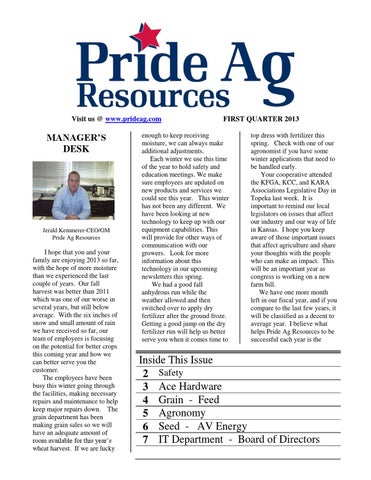
Jerald Kemmerer-CEO/GM Pride Ag Resources
I hope that you and your family are enjoying 2013 so far, with the hope of more moisture than we experienced the last couple of years. Our fall harvest was better than 2011 which was one of our worse in several years, but still below average. With the six inches of snow and small amount of rain we have received so far, our team of employees is focusing on the potential for better crops this coming year and how we can better serve you the customer. The employees have been busy this winter going through the facilities, making necessary repairs and maintenance to help keep major repairs down. The grain department has been making grain sales so we will have an adequate amount of room available for this year’s wheat harvest. If we are lucky
FIRST QUARTER 2013
enough to keep receiving moisture, we can always make additional adjustments. Each winter we use this time of the year to hold safety and education meetings. We make sure employees are updated on new products and services we could see this year. This winter has not been any different. We have been looking at new technology to keep up with our equipment capabilities. This will provide for other ways of communication with our growers. Look for more information about this technology in our upcoming newsletters this spring. We had a good fall anhydrous run while the weather allowed and then switched over to apply dry fertilizer after the ground froze. Getting a good jump on the dry fertilizer run will help us better serve you when it comes time to
top dress with fertilizer this spring. Check with one of our agronomist if you have some winter applications that need to be handled early. Your cooperative attended the KFGA, KCC, and KARA Associations Legislative Day in Topeka last week. It is important to remind our local legislators on issues that affect our industry and our way of life in Kansas. I hope you keep aware of those important issues that affect agriculture and share your thoughts with the people who can make an impact. This will be an important year as congress is working on a new farm bill. We have one more month left in our fiscal year, and if you compare to the last few years, it will be classified as a decent to average year. I believe what helps Pride Ag Resources to be successful each year is the
Inside This Issue 2 Safety 3 Ace Hardware 4 Grain - Feed 5 Agronomy 6 Seed - AV Energy 7 IT Department - Board of Directors
strong balance sheet, the diversification it has to help maintain constant growth, and an experienced team of employees. Change is inevitable in agriculture because it will need to continue to change, and maybe even at a faster pace as the American Farmer takes on the challenges of feeding a growing world population. Our fiscal year will close on February 28th, and at that time, we will take inventory and go through the audit procedures to bring you the final numbers. Go ahead and mark your calendars; our 98th annual meeting will be May 21st, 2013. Look for additional Annual Meeting information as we get closer to the date. I hope you have a great spring and thank you for your business. It is always appreciated! ------------
Safety Division
Skyler Hayes Safety Director
Jack Safety Jacks are used to raise a piece of heavy equipment off the ground to fix, maintain or move it. Jacks come in many sizes or lift capacities. There are many types of jacks, and you should choose the type and
size of jack best suited for the job you wish to do. Following is a list of the more commonly used jacks: Bottle jacks are either pneumatic or (more commonly) hydraulic. Ratchet jacks, such as high lift jacks, use a gear and pivoting mechanism to move the jack up or down incrementally Scissor jacks are shaped like a square balanced on one of its points when at its midway lifting point. From this it either flattens out as it is lowered or brings its side together as it rises. It is moved up or down by turning a bolt that runs through its center from side to side. Floor jacks or trolley jacks are often used in commercial shops. They are easily rolled across a shop floor and usually have a low profile to allow the user to move the jack into tight places. When using a jack you must take precautions: Each jack should have a capacity plate or other marking that will indicate the lifting capacity of the jack. Never use a jack to lift a load greater than its lifting capacity.
Every jack should be inspected before each use. If the jack is hydraulic, fluid leaking from the jack is sufficient reason to remove it from service. Any jack that is defective should be repaired or removed from service. Removing from service does not mean moving it off to the side of the shop. It should be disassembled and discarded. Jacks should be set on a firm and level foundation. A concrete floor in good repair is the best. If you must provide the firm foundation, the base of the jack should be blocked or cribbed. Place a wooden block between the jack head and the contact point of the load. This will help avoid slippage of the jack. When jacking from a floor, make certain that the load limit of the floor is not exceeded. When placing the jack under the load, make certain that the lift will be vertical and that the jack will be perpendicular and at a right angle to the load. 2
If you will be working under a raised load, place jack stands so that the load will not accidentally fall. Cinder blocks should not be used, as they are brittle and can easily break under the pressure of the load. This could injure or kill someone working under the load. Bricks or blocks of wood are not much better. Jack stands are not expensive and should be a part of any well equipped shop. Most jacks that come with vehicles are scissor jacks and are meant to be used when changing a tire. If you will be working under the vehicle, use a different jack than the scissor jack, as it cannot be trusted to securely raise and hold the vehicle while you are under it. Jacks should be maintained, inspected, and operated according
to the manufacturer’s specifications. This includes regular lubrication. When you purchase a new jack, be sure to retain the owner’s manual and keep it in a place where you can easily and readily access it. When jacking up any vehicle, be sure to chalk the wheels so that the vehicle does not roll off the jack when it is lifted. When jacking up a vehicle, refer to the owner’s manual to find the points on the vehicle where you should place the jack. Remember that many vehicles, especially pickups and trucks, are much heavier than in the past. The jack that lifted your pickup easily and safely ten years ago may not be large enough to do the job for the larger pickup you now own.
Jacks are a very common item in any well equipped shop. Almost every vehicle carries a jack. It is important that you, your family and your employees follow these safety rules when using jacks.
-----------
ACE HARDWARE
Jack Lane, Ace Manager
Ace Hardware has instant savings for Ace Rewards members. No more hassles with mail-in rebates and waiting for the money to be returned to the customer. If you are an Ace Rewards member you will receive an instant rebate when you check out. The savings will be taken off the retail price. Every month Ace will offer different products with an instant savings tag. If you are not an Ace Rewards member you will still receive a copy of the mail in form. Come in and sign up for the Ace Rewards. It only takes a few minutes and you will be eligible for instant saving at that time. 3
GRAIN DIVISION
Tim Lehman Grain Merchandiser
Markets have continued the erratic behavior that has been persistent since the drought started last summer. The USDA January crop report left as many questions unanswered as it answered. With the current projected corn carry out the of markets, we could see wild price swings until the 2013 crop gets close to harvest. USDA’s outlook conference will be closely watched for early indications for corn & soybean plantings. Crop acreage and early yield estimates will cause big swings in prices if estimates vary from expectations. The market is looking for something close to 99 million acres of corn for 2013 plantings. Several factors will continue to influence prices in corn, soybeans and wheat. Corn exports are still very sluggish with little hope of increasing in the near term. The South American crop is being watched closely as world exports are still being dominated by sales from the southern hemisphere. Feed wheat is another drag on corn exports as the world substitutes feed wheat in animal rations.
India has become a large player in wheat trade as both milling quality and feed wheat enter the export channels. India has not traditionally been a significant participant in world wheat trade but the higher world prices coupled with a good crop has allowed them to be a significant participant this year. Domestic demand continues to be hampered by poor or negative margins for cattle feeders and ethanol producers. The fight for bushels will continue as prices work to curtail demand enough to insure a carry out at the end of the current crop year. The delicate balancing act must ration usage without destroying demand. The bean market is and will be driven by two factors. Chinese demand and South American production. The South American crop is projected to rebound after last year’s crop was reduced by drought. Early harvest has begun in Brazil with early reports of good yields. Export markets will be dominated by this region until North American beans are harvested this fall. The demand side is all about China. Most bean trade in the world involves China as they prefer to import beans and concentrate on corn and wheat production in their own country. South American harvest followed by the US growing season will be the major drivers of bean prices for the next few months. The wheat market seems to be focused on keeping the US prices above the rest of the world but not significantly higher as to stop all demand. Some export business is being done but not enough as to spur a large price rally. World prices are high enough to encourage
exports and production elsewhere providing stiff competition for the US. Last but not least of the market influences is weather. After the drought last year had a major impact it will be watched even closer this year.
Date
Wheat
Corn
Milo
Soybean
7/6/12 8/4/12 8/24/12
8.41 8.37 8.48
8.04 8.10 7.55
7.39 7.45 6.95
16.47 16.68 15.10
9/21/12
8.61
7.58
6.98
15.22
6.50
5.99
10.84
Last Year –Nov`., 2011 AVG. 6.49
FEED DIVISION
Galen Frick, Livestock Advisor
Some Advice on Rebreeding Two-YearOld Heifers (Iowa State University, Purdue University)
A frequent problem seen in reviewing herd records is a difficulty getting nursing, twoyear-old heifers bred back for their second calf. Excellent research over the past decade 4
shows that improving body condition score (BCS) in these heifers before they deliver their first calf is the most important factor in getting them bred back. The first response to the suggestion of a pre-calving BCS of 6.5 is usually: "Won't that make the calves bigger and increase calving difficulty?" While the birth weight may increase slightly (some studies show no difference) when precalving BCS is improved in heifers, calving difficulty remains the same. This study of 240 first-calf heifers in three states not only showed the "non-issue" of dystocia, but points out how important precalving BCS is to the rebreeding rate. Only 56% of heifers calving in a BCS 4 were rebred after a 60-day breeding season, while 96% of heifers in a BCS 6 were rebred in the same timeframe. Another way to improve total herd fertility is to breed heifers for a shorter period of time than you breed the cows. When heifers are bred for only 30-42 days (as opposed to 65 days for cows), the possibility of late-calving heifers is eliminated. Generally, a late-calving heifer has two fates in the herd - she continues to be a latercalving cow or she becomes an open cow. Neither option is desirable. In examining the economics of a shorter breeding time for heifers, it becomes obvious why it's better to have her open as a yearling than as a two-year old. A basic, often overlooked, factor is that weaning weight mostly depends on a calf's age. This puts even more of a premium on early calving. When a shortened breeding
season for heifers is first mentioned as a way to improve herd fertility, owners' typical objection is: "A shorter breeding season equals fewer heifers bred, so how does this help our fertility?" After going through the economics, however, it totally makes sense. If your calving season is too long and/or not enough calves are born in the first 42 days (goal is 88%) of the calving season, these proven practices can help improve your herd's fertility. Here are some additional measures to improve heifer fertility: Have your herd health veterinarian perform reproductive tract scoring on heifers 30-60 days pre-breeding. Vaccinate heifers with a modified-live IBRBVD-Lepto vaccine at least 30 days prebreeding. This should be part of a comprehensive vaccination program in which this is not their first exposure to this vaccine. Choose high-fertility, crossbred heifers for replacements. Use a synchronization program to get more heifers bred the first few days of the breeding season. Breed heifers 14-21 days before breeding cows so heifers have more "lag time" between calving and rebreeding.
AGRONOMY
Lawrence Baxa Agronomy Sales
The Importance of a balanced diet in crop production! A steer in a feed lot requires the right balance of protein and roughage and supplements to produce an efficient and timely rate of gain. You and I require a balanced diet to maintain good health and be productive. A crop growing in the field is no different. It takes the right fertilizer blend, the right timing of application, not to mention you will need to throw in a little rain and some luck, to maximize the economic benefits of producing a good crop. However with current commodity prices where there at now and forecast to stay strong in 2013 any investment in fertility now needs to be figured on how much an application will pay, not on how much it will cost. With these thoughts in mind let’s take a look at a couple scenarios. At the time of this writing the wheat top dress season is getting started So a lot of decisions have been made, whether to go with dry or liquid or will I need to treat for weeds or not, but taking a look at a late season shot around flag leaf 5
and grain fill time of a N-S and CL type of blend will give that wheat plant a shot of N that will help in protein production and grain quality and the S an CL will aid in making the synergy of the whole fertility program come together. A few dollars an acre invested at this time with $8.00 wheat means this is no time for fertility to be a limiting factor in yields. But make no mistake even though I write this, I still know that under Irrigated conditions this is good, but it has to rain on the dryland. That’s enough about wheat. I will take a few lines here and dedicate them to corn, milo, soybeans etc. Much like cereals, row crops and oil seeds need a balanced blend to get the plants off to a healthy start, whether you are going to go in furrow with a little pop up or go 2X21/2 or some other application strategy. A planting time application is getting more and more important. It seems guys are wanting to start planting earlier and earlier and it seems some hybrids can be planted in cooler soil so it is more important than ever to give a plant a boost, to get started, until it can develop the root mass it needs to draw the nutrients from the surrounding soils. You can figure many different blends of N-P-K-S-Z. Pride Ag will have the products you need not only from early season but throughout the season clear through to pivot blends as well, for those tassel applications on corn, or between cuttings on alfalfa. Be sure to talk to your Pride Ag agronomist or check with a location near you to find out the latest, be sure to check out our line of Kugler products, from the slow release KQ-XRN to a variety of recipes for ground
rig, planter or pivot applications. Kugler products are clear clean blends that are good quality products, low corrosive and excellent handling properties which means it’s easier on nozzles and screens. What that translates into is that you won’t be spending all your time unplugging nozzles which lead to you getting more acres done. Spring and summer is a busy time. You can count on your Pride Ag Resources team to have the products, knowledge and support, to help you get the job done and return value to you bottom line. -------------------
SEED DIVISION
out but you do need to get the foreseeable problems that you are sure to face, nipped before the problems turn around and bite you. Something as simple as getting your milo and feed bookings in before the influx of orders, that can come with the procrastinating crowd; will help lock in supply of the product desired. It is important to get with one of our agronomist or branch managers to help organize your planting schedule as soon as you can; we are here to help you succeed. The moisture that fell across Kansas has caused the wheat to start perking up, with that being said make sure you are keeping up with the winter annuals and other unwanted weeds in the field. Working together and planning ahead will help you succeed throughout the year
----------
AV Energy
Jacqueline Kahlich-Romero Sales/Agronomist
This year is starting out with Mother Nature putting a little moisture on our fields in most of Southwest Kansas. This does not mean we are getting away from the drought that we have been facing, this does mean that we need to start looking ahead to tomorrow and more into the future. The only way that we are going to beat this troubling time is planning ahead. Proper planning can give you an advantage during challenging times. I am not saying that you have to have every detail ironed
Chris Klein
Wow, where does the time go! It’s already February and everyone will soon be heading to the field to start preparing for spring planting. We have been very busy contracting fuel for the upcoming farming season and we look forward to talking to you about your 2013 fuel needs. 6
If you would like to discuss contracting fuel, call the office at 620-225-4994 and ask for Terry or myself. We have also started emailing customers daily contract prices to give them a closer look at what the market is doing. If you would like to be put on the email list let us know and we will get you setup. The Pride Ag branch managers also receive our contract pricing, so if you happen to be at one of the branches ask the managers and they can give you the morning price quote. Please remember we only write contracts from 8:30 to 1:30 Monday-Friday, and contract prices are subject to change throughout the day. Below is an article about the Cenex Tanks of Thanks program, this program was launched in 2012 and it has been a big hit with people all around the Midwest. If you know someone who goes above and beyond in their community go to www.tanksofthanks.com and nominate them to receive a free $50 Cenex Gift Card. Tanks of Thanks WE’RE WITH YOU is the Cenex brand campaign launched in 2012. The power of the campaign stems from the key insight that Cenex is more trusted as a brand because Cenex branded retailers are locally owned and operated. The owners are active in their communities. As part of the WE’RE WITH YOU campaign, the Cenex Tanks of Thanks program provides a great way for the Cenex family to celebrate those who make the world a better place. It’s also a way to give back to the communities we rely on for our business success. How it works Individuals are nominated at www.tanksofthanks.com for
the chance to win a Cenex Gift Card in recognition of their good deeds. Each month, 100 nominees are randomly drawn from the pool of nominations to receive a $50 Cenex Gift Card. With each monthly drawing, CHS mails a media alert to the community of each gift card recipient to generate local media interest and recognition for recipients. Thanks for your continued patronage; we look forward to working with you in 2013!
accounts. • Summary and detail information and the ability to print copies of A/R tickets. • Grain tickets available when YOU have time (after daily Updates are complete).
IT Department
Richard Broz rbroz@prideag.com Pride Ag Resources IT Manager Pride Ag Resources would like to invite you to browse our website www.prideag.com. This site is updated daily with local and national news. We try to inform you what is happening at our local branch locations. The website will provide you information on our departments, coop news, and employment opportunities. Use it to look at your local Grain and Overnight cash bids. (These prices reflect a 10 minute delay). Our feature this month will be Patron Access. Features: • Access your accounts 24/7, with the ability to view multiple
BOARD OF DIRECTORS Scott Mac Nair ........................ Chairman Tony Bleumer... .............. Vice-Chairman Larry D Scott .......... Secretary-Treasurer Steve Riegel .............................. Director Jeremy Derstein ........................ Director Butch Irsik ................................. Director Clint Hamilton ............................ Director Jeff Reinert.…...........Associate Director Bruce Giessel……….Associate Director Jerald Kemmerer………………CEO/GM Debby Kennedy….......Newsletter Editor
7
Pride Ag Resources
Published quarterly by the
PRSRT STD U.S. POSTAGE
Pride Ag Resources
PAID
1st Quarter 2013
710 West Trail, Dodge City, KS 67801
DODGE CITY, KS PERMIT #399
(620) 225-4193
8