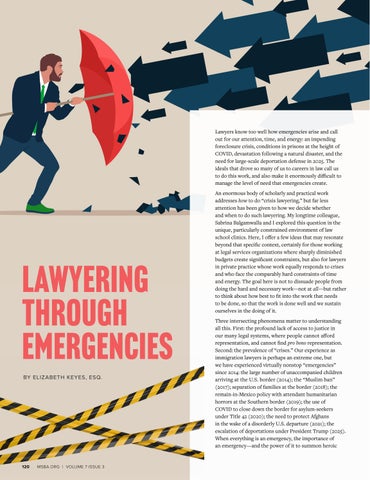
Lawyering Through Emergencies

BY ELIZABETH KEYES, ESQ.
Lawyers know too well how emergencies arise and call out for our attention, time, and energy: an impending foreclosure crisis, conditions in prisons at the height of COVID, devastation following a natural disaster, and the need for large-scale deportation defense in 2025. The ideals that drove so many of us to careers in law call us to do this work, and also make it enormously difficult to manage the level of need that emergencies create.
An enormous body of scholarly and practical work addresses how to do “crisis lawyering,” but far less attention has been given to how we decide whether and when to do such lawyering. My longtime colleague, Sabrina Balgamwalla and I explored this question in the unique, particularly constrained environment of law school clinics. Here, I offer a few ideas that may resonate beyond that specific context, certainly for those working at legal services organizations where sharply diminished budgets create significant constraints, but also for lawyers in private practice whose work equally responds to crises and who face the comparably hard constraints of time and energy. The goal here is not to dissuade people from doing the hard and necessary work—not at all—but rather to think about how best to fit into the work that needs to be done, so that the work is done well and we sustain ourselves in the doing of it.
Three intersecting phenomena matter to understanding all this. First: the profound lack of access to justice in our many legal systems, where people cannot afford representation, and cannot find pro bono representation. Second: the prevalence of “crises.” Our experience as immigration lawyers is perhaps an extreme one, but we have experienced virtually nonstop “emergencies” since 2014: the large number of unaccompanied children arriving at the U.S. border (2014); the “Muslim ban” (2017); separation of families at the border (2018); the remain-in-Mexico policy with attendant humanitarian horrors at the Southern border (2019); the use of COVID to close down the border for asylum-seekers under Title 42 (2020); the need to protect Afghans in the wake of a disorderly U.S. departure (2021); the escalation of deportations under President Trump (2025). When everything is an emergency, the importance of an emergency—and the power of it to summon heroic
responses from the bar—diminishes dramatically. Third: our own personal limitations. In our longer work, we share our stories of the toll taken by our endless efforts to rise to each occasion, and in such experiences, we know we are not alone. We therefore designed a set of prompts and questions to help lawyers reflect on their choices. A first critical piece is about our own goals and motivations. Often, the goals are



What is my capacity to respond?
When everything is an emergency, the importance of an emergency— and the power of it to summon heroic responses from the bar— diminishes dramatically.
idealistic and laudable, but we also criticize (humorously, we hope) our own grandiosity about being able to solve the world’s problems singlehandedly. We also recognize how we personally benefit from doing this work. (Again with humor: The time I had my library fines waived when I started to explain in 2017 that I was an immigration lawyer was a small but mighty example of this.) A certain mindfulness of our own tendencies and character helps us be more clear-eyed as we answer the following questions:
What would it take for me to be competent in this area?
Lawyers are apt to take humble Md. Rule 19-301.1 (competence) a bit for granted. And yet, the reports from the Attorney Grievance Commission should motivate us all to think of it often. In the context of an emergency response, competence certainly includes subject-matter experience but can also encompass knowledge of specific processes, institutions, and relationships. We can become competent in subject matter through study and training. In many situations, we can also find mentors to help us understand the idiosyncratic institutions and processes that affect lawyering—or simply support the work of lead lawyers in areas new to us. Organizations like the Maryland Volunteer Lawyers Service, the Pro Bono Resource Center, and the many nonprofits seeking volunteers through the Maryland Legal Services Corporation, as well as professional bar associations and committees, make this training and mentorship possible. If we are contemplating helping in an emergency, thinking through what it takes to be competent and finding the means to do so are critical first steps.
Here, we could think of capacity in terms of our time, energy, and health, as well as our duties to existing clients. We can consider reprioritizing or delegating some of our obligations, or decide that, for a certain period of time, we can put in longer hours, and so forth. (When an emergency is truly short-term, that expansion of capacity is absolutely on the table. When it becomes months and years, most of us realize we are less infinite than we hoped.) A different way of framing this question is “what might I be giving up by taking on this work?” So much is to be gained from meaningful involvement in work we are passionate about—and this question helps us be slightly more complete and intentional by reminding us of what we already have.
Is this a good fit for me?
We often want to be the best and most valuable at so many things, and this question helps us focus on where we are the best fit. Alternative framings of the question: Is someone else better positioned to be of use? Are my skills more valuable somewhere else? Right now, I have a tremendous amount of immigration expertise, which is in high demand. I could certainly take on many client cases—but so could others who would do so to build their own capacity (force multipliers) while I advise and train. My “fit” right now is better with training and community education.
Although neither my colleague nor I is Jewish, we both draw inspiration from the idea of Tikkum Olam (repairing the world) and from this rabbinical quote, which has many different attributions: “You are not obligated to complete the work, but neither are you free to abandon it.” We take heart in being members of legal communities that never abandon the work, and we hope that this brief essay helps you think well about how you are part of the work as well.

Elizabeth Keyes is associate dean for academic affairs at the University of Baltimore School of Law. She directed the school’s Immigrant Rights Clinic for a decade and has been involved in immigration and immigrant rights for more than 20 years.