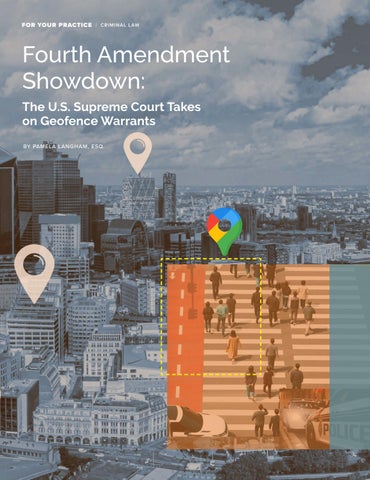
Fourth Amendment Showdown:
The U.S. Supreme Court Takes on Geofence Warrants
BY PAMELA LANGHAM, ESQ.






THE UNITED STATES COURT SYSTEM has done its best to keep pace with the rapid evolution of digital technology when interpreting Fourth Amendment protections against unreasonable searches and seizures. Fourth Amendment protections developed in an era of physical paper and tangible property often fit awkwardly with modern realities such as smartphones, cloud storage, location tracking, and mass data collection. Despite these challenges, the core principles of the Fourth Amendment remain unchanged.
On January 16, 2026, the U.S. Supreme Court granted a petition for writ of certiorari to review the constitutionality of geofence warrants, a controversial law enforcement tool. These warrants enable broad, location-based searches by collecting cell phone data from all devices within a defined geographic area, raising privacy concerns. At issue is whether such dragnet surveillance—often executed without individualized suspicion or probable cause—violates constitutional protections against unreasonable searches and seizures. The U.S. Supreme Court’s decision in this case will likely set boundaries for law enforcement’s use of technology in investigations, making it important for legal professionals to understand the nuances and implications.
Chatrie filed a petition for rehearing en banc, which was granted. However, the Fourth Circuit ultimately upheld the district court’s ruling in April 2025. Chatrie then petitioned the U.S. Supreme Court, which agreed to review the case solely on the issue of whether the execution of the geofence warrant violated the Fourth Amendment.
Geofence Primer
Geofence warrants are used by law enforcement to identify suspects when the crime location is known, but the suspects’ identities are not. These warrants request judicial approval to access location data from services like Google’s location history, which logs cell phone locations every two minutes for users who opt in. Other companies, such as Apple, Lyft, Snapchat,
The U.S. Supreme Court’s decision in this case will likely set boundaries for law enforcement’s use of technology in investigations, making it important for legal professionals to understand the nuances and implications.
Procedural History
The case under review involves Okello Chatrie (Chatrie), who was indicted for a robbery in Virginia. Chatrie challenged the evidence obtained through a geofence warrant, arguing it violated the Fourth Amendment. The U.S. District Court for the Eastern District of Virginia denied his motion to suppress the evidence, citing the good-faith exception to the exclusionary rule.1
Chatrie subsequently entered a conditional guilty plea and was sentenced to 141 months in prison. After losing his appeal to the Fourth Circuit Court of Appeals,
and Uber, also collect similar data, but Google is the most common recipient of geofence warrant requests. Google follows a three-step process to respond to these warrants. First, law enforcement provides specific geographical and temporal details of the crime, and Google searches its Sensorvault database, containing 592 million accounts, to identify anonymized device IDs within the specified area and timeframe. This data includes timestamps, latitude, longitude, geolocation sources, and confidence intervals. Next, law enforcement reviews the anonymized data and requests additional de-identified positional data for relevant devices.

Google requires law enforcement to narrow its focus before providing extended data to prevent overly broad searches. Finally, law enforcement requests user identity details, such as names and email addresses, for devices deemed pertinent to the investigation. This data enables further investigative actions, including tracking devices or issuing additional warrants.
While Google’s location data is highly accurate, pinpointing locations within 60 feet, or even specific building floors, it is not infallible. False positives can occur, implicating innocent individuals based on their location. However, false negatives are rare due to the data’s precision.
Fourth Amendment
The Fourth Amendment guarantees the “right of the people to be secure in their persons, houses, papers, and effects, against unreasonable searches and seizures.”2 The Fourth Amendment also provides that “no Warrants shall issue, but upon probable cause, supported by Oath or affirmation, and particularly describing the place to be searched, and the persons or things to be seized.”3 The good-faith exception to the exclusionary rule allows evidence obtained through an unlawful search to be admissible if officers reasonably believed they were acting within their legal authority, such as when they rely on a search warrant later found to be legally defective. The illegally seized evidence may be admissible under this exception.
Even though the U.S. District Court for the Eastern District of Virginia found good faith in the application for and execution of the geofence warrant in Chatrie, it stated, “the court nonetheless strongly cautions that this exception may not carry the day in the future. This court will not simply rubber-stamp geofence warrants. If the Government is to continue to employ these warrants, it must take care to establish particularized probable cause.”
Facts
The Chatrie case stems from a robbery at a credit union in Virginia on May 20, 2019. Surveillance footage revealed that the suspect, later identified as Chatrie, carried a cell phone during the crime. After initial investigative efforts failed, law enforcement obtained a geofence warrant to access Google’s location data for all devices within a 150-meter radius (longer than 1.5 football fields) of the crime scene during the hour of the robbery.
Google followed its standard three-step process, providing anonymized data for 19 devices in the area. Law enforcement then requested expanded location data for nine of those devices
Geofence warrants are used by law enforcement to identify suspects when the crime location is known, but the suspects’ identities are not.
and ultimately sought identifying information for three accounts, including Chatrie’s. This data led to his arrest and subsequent conviction.
Fifth Circuit Court of Appeals
The constitutionality of geofence warrants has been debated in other courts. In 2024, the United States Court of Appeals for the Fifth Circuit ruled in U.S. v. Smith that geofence warrants are unconstitutional under the Fourth Amendment, likening them to modern-day general warrants.4 Broadly speaking, general warrants are search or arrest warrants that do not specify exactly who or what is being sought or where the search will occur, effectively giving officials open-ended discretion. They are unconstitutional under the Fourth Amendment because they lack the required particularity and probable cause showing for specific places, persons, or things.
Summary
In Chatrie v. United States, the U.S. Supreme Court accepted a petition for a writ of certiorari to review the constitutionality of geofence warrants, a surveillance technique that compels technology companies to disclose anonymized location data for all devices within a defined geographic area and time window. These broad sweeps of cell phone data by law enforcement from companies such as Google, Apple, and Uber can collect the date, time, and location of a potential criminal suspect within a specified range of a crime scene and have proven effective in identifying suspects, but also raise concerns about the privacy of innocent bystanders. The U.S. v. Smith decision, like Chatrie, highlights the growing legal scrutiny of geofence warrants. The U.S. Supreme Court’s decision in Chatrie will have far-reaching implications for privacy rights and law enforcement practices. Legal professionals should closely follow the case.