
Next Generation Advanced Conductor.
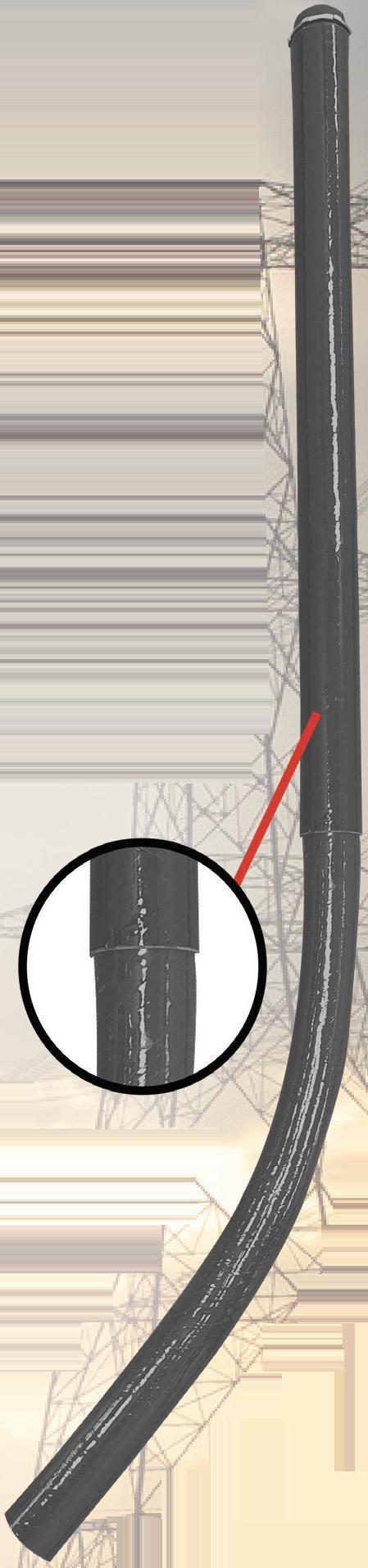
TS Conductor’s patented Aluminum Encapsulated Carbon Core (AECC) design eliminates the problems of first-generation advanced conductors. It is fully compatible with ACSR/ACSS installation and maintenance practices.














UTILITIES PROJECT SOLUTIONS FROM CHAMPION FIBERGLASS®
No burn-through eliminates elbow repairs
Lower material and installation costs
Mechanical strength protects conductors
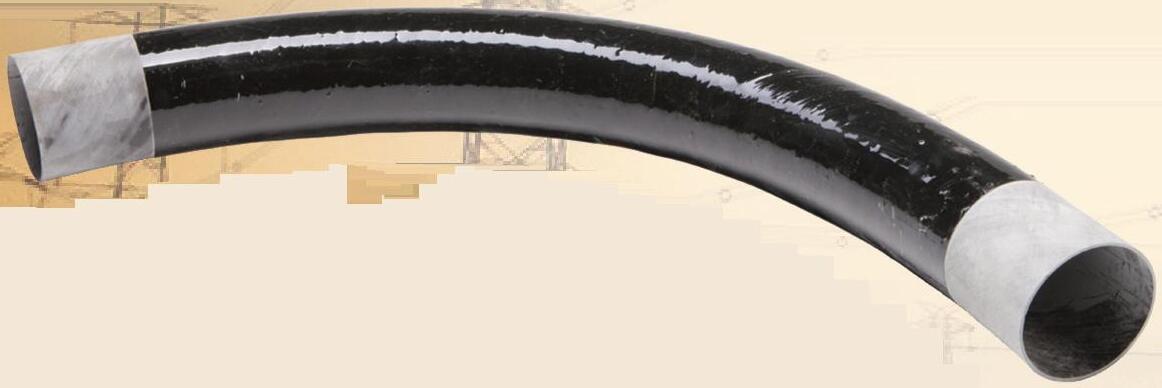
Low coefficient of friction for smooth pulls
Height adjustable utility risers
Operable in temperatures of -40° to +230°F










AI and data centers are rapidly increasing
By JEFF POSTELWAIT, Managing Editor
Strategic budgeting approaches prioritize innovation while maintaining fiscal responsibility.


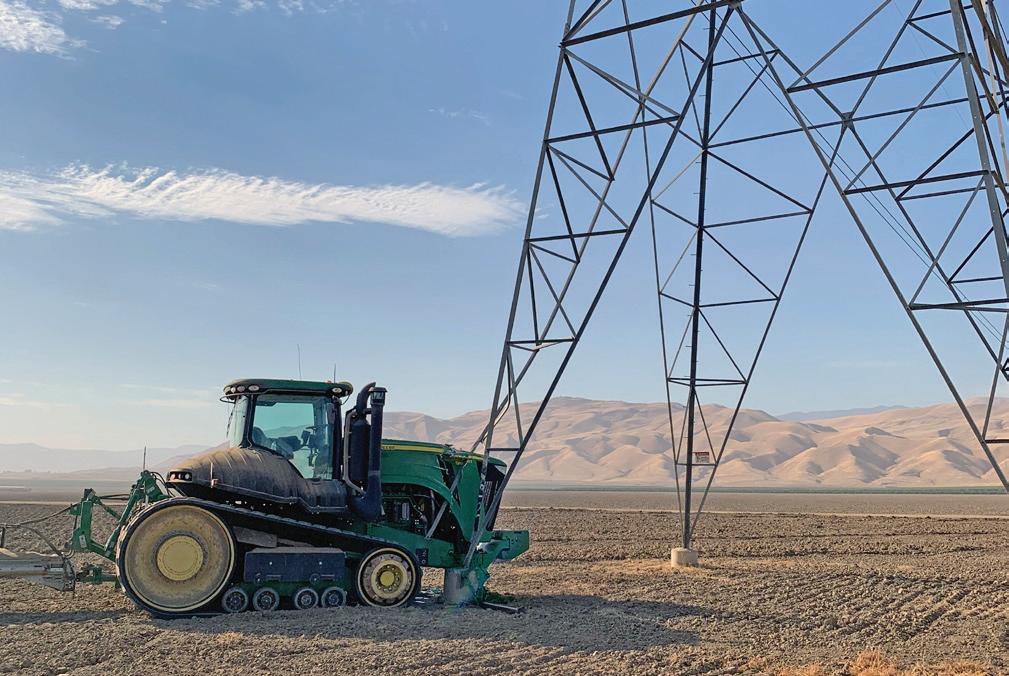
Maintaining safety while unlacing lattice towers during repair and strengthening efforts.
By JASON KILGORE, ELLIOTT THAXTON, Mesa Associates Inc.
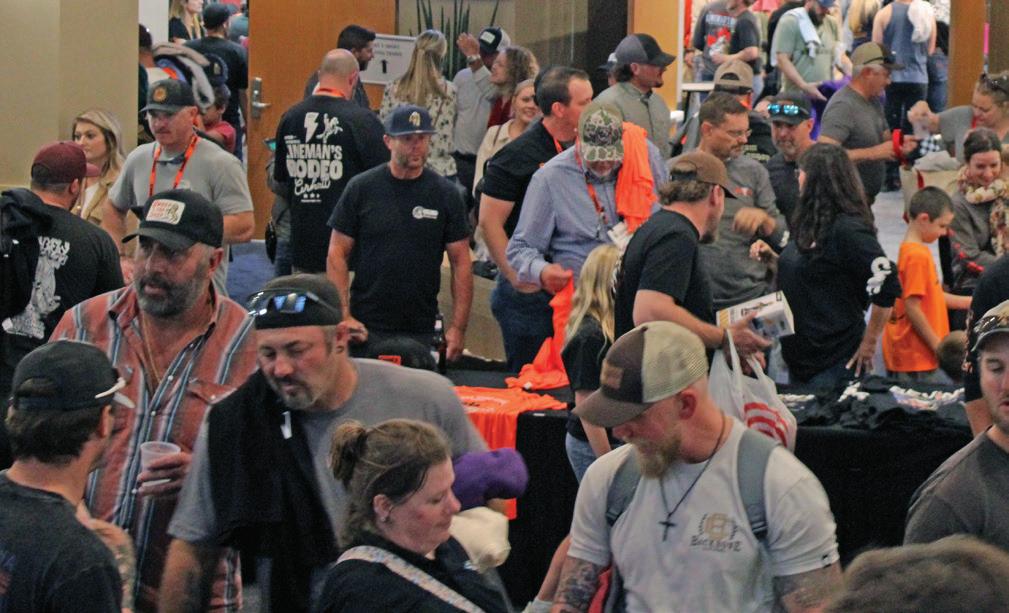
The 41st International Lineman’s Rodeo experienced explosive growth with more than 5,000 in attendance.
The utility shares its blueprint for layering AI onto millions of smart meter data points and how it translated those insights into improvements.

Prepay
By CHAD LYNCH, Ocala Electric Utility and, DAVID CONN, Exceleron


Is it time for standards to replace fragmented and inconsistent practices?
PRASAD YENUMULA, Duke Energy
Designing the largest transmission line in U.S. history.
By JILLIAN EDWARDS, AARON WHITE, DAVID GELDER, Invenergy
As structures get larger, ensuring quality foundations gets more challenging!
GEORGE
PISCSALKO, Pile Dynamics, Inc.





on page 6





















Group Editorial Director Nikki Chandler nchandler@endeavorb2b.com
Managing Editor Jeff Postelwait jpostelwait@endeavorb2b.com
Senior Editor Christina Marsh cmarsh@endeavorb2b.com
Art Director Julie Whitty jwhitty@endeavorb2b.com
Field Editor Amy Fischbach EOUeditor@endeavorb2b.com
Technical Writer Gene Wolf GW_Engr@msn.com
Senior Editor-at-Large Geert de Lombaerde gdelombaerde@endeavorb2b.com
VP, Customer Marketing Angie Gates agates@endeavorb2b.com
Senior Production Operations Manager Greg Araujo garaujo@endeavorb2b.com
Ad Services Manager Shirley Gamboa sgamboa@endeavorb2b.com
Audience Marketing Manager Sonja Trent strent@endeavorb2b.com
Audience Development Manager James Marinaccio jmarinaccio@endeavorb2b.com
Endeavor Business Media, LLC
CEO: Chris Ferrell
COO: Patrick Rains
CRO: Paul Andrews
CDO: Jacquie Niemiec
CALO: Tracy Kane
CMO: Amanda Landsaw
EVP Endeavor Business Intelligence: Paul Mattioli
EVP Water & Energy Group Diana Smith
VP of Content Strategy, Water & Energy Group Bob Crossen
T&D World (USPS Permit 795-660, ISSN 1087-0849 print, ISSN 2771-6651 online) is published 10 times a year (January to June, August to October and December) by Endeavor Business Media, LLC. 201 N Main St, 5th Floor, Fort Atkinson, WI 53538. Periodicals postage paid at Fort Atkinson, WI, and additional mailing offices. Canadian GST #R126431964.
POSTMASTER: Send address changes to T&D World, PO Box 3257, Northbrook, IL 60065-3257.
SUBSCRIPTIONS: Publisher reserves the right to reject non-qualified subscriptions. Subscription prices: U.S. ($137.50); Canada/Mexico ($170.00); All other countries ($210.00). All subscriptions are payable in U.S. funds.
Send subscription inquiries to T&DWorld, PO Box 3257, Northbrook, IL 600653257. Customer service can be reached toll-free at 877-382-9187 or at tdworld@ omeda.com for magazine subscription assistance or questions.
REPRINTS: To purchase custom reprints or e-prints of articles appearing in this publication, contact Reprints@endeavorb2b.com
PHOTOCOPIES: Authorization to photocopy articles for internal corporate, personal or instructional use may be obtained from the Copyright Clearance Center (CCC) at 978-750-8400. Obtain further information at copyright.com
PRIVACY POLICY: Your privacy is a priority to us. For a detailed policy statement about privacy and information dissemination practices related to Endeavor products, please visit our website at www.endeavorbusinessmedia.com
CORPORATE OFFICE: Endeavor Business Media, LLC, 30 Burton Hills Blvd, Ste. 185, Nashville, TN 37215, U.S.; www.endeavorbusinessmedia.com.
© Copyright 2025 Endeavor Business Media, LLC. All rights reserved. Printed in the USA.







When AI Meets the Grid
My husband is a bit concerned that our college-age kids won’t have the careers they are dreaming of because artificial intelligence will take over. I tell him that AI won’t be able to take all our jobs any time soon because there isn’t enough electricity for that yet.
We are probably both being a bit dramatic or hyperbolic, but in this exchange lies a few lingering questions. And this is one of the biggest topics of discussion everywhere I go now: the consumer media, the industry conferences and our kitchen tables.
On one hand, I’m thrilled that electric utilities are seeing more demand than ever in some regions; this bodes well for the business. On the other hand, I am concerned that they won’t be able to meet the increasing demand for electricity, thereby threatening the security, resiliency and reliability of power. But maybe this is one way we balance how fast our future is coming.

In our November issue, Managing Editor Jeff Postelwait wrote on rising electricity prices. Because there had been such a recent furor over new data centers causing rates to rise, he decided to dig in and find out if this was completely true and to take a look at the bigger picture. Rate setting is complicated in our industry (at least I think so), so the answer, to me, is simply: it’s not that simple. Jeff asked this question in that story: Could AI hit a wall? Improvements in hardware efficiency can cut AI’s power demand, and researchers expect these improvements to continue to net savings in electricity consumption, but the overarching expansion of AI activity means overall demand is likely to continue — perhaps even resulting in the industry hitting a predicted “wall” imposed by power generation limits, he wrote.
Working on that report led Jeff to write our cover story for this month: “Could AI Find Its Limit in the Power Grid?” This turned into a good overview of how utilities are working with big tech to figure all this out (or not). We know AI’s growing energy appetite is reshaping load forecasts and challenging every stakeholder in the industry. And big tech and utilities operate on different timelines, which slows down everything. I don’t want to say “time will tell” in answering anything, as I have confidence in this industry and I know we will make a way forward. It is a challenge, for sure, but we have some bright and energetic people working on this. Just come to any industry conference!
Rodeo Wrap-Up
We also celebrate another segment of our industry this month with our coverage of the 41st International Lineman’s Rodeo that happened in mid-October. This is one year, thank
goodness, that we didn’t have teams out on hurricane duty. It was a record-setting year for attendance, and we enjoyed seeing even more lineworkers bring their families, from babies to grandparents, to cheer them on in the competition. As usual you can catch our photos from the safety conference, exhibition and competition at tdworld.com/ electric-utility-operations.
Despite forecasts of rain, clear skies and early morning fog set the stage for competition day, where nearly 300 teams and more than 350 apprentices competed. Duke Energy and Sturgeon Electric/IBEW Local 47 teams claimed top honors in the journeyman divisions, while Flint Energies’ Hunter Walton swept the apprentice category. See Field Editor Amy Fischbach’s “2025 Rodeo Rewind” story on page 26, along with her story “Living and Loving the Line Life” on page 48.
Structures from ASCE
One of my favorite supplements of the year is included in this issue: the American Society of Civil Engineers’ Structures supplement. It includes four in-depth technical articles that have been presented in sessions at the ASCE Electrical Transmission & Substation Structures Conference, and the content is core to the T&D World audience.
We published our first “lines and structures” supplement in 2011, and in 2015, ASCE partnered with us to provide the articles and distribute it at the ETS conference every three years. This year you will see articles on maintaining safety while unlacing lattice towers during repair and strengthening efforts; on standards contributed by Duke Energy; the construction of the Grain Belt Express; and ensuring quality foundations.
2026 Buyers Guide
December is also the month that we publish our annual print Buyers’ Guide. This is our 57th issue, which provides a comprehensive directory and reference guideto help utilities plan their purchasing needs for the upcoming year. You will find it bagged with the December issue. For a continously updated version, you can go online at https://www.tdworld.com/directory. The online version also features product stories, so check in out.
Every issue we put together reminds me how much this industry is built on people: those solving tomorrow’s grid challenges and those climbing poles in the early morning fog. Technology will keep evolving, but our resilience, ingenuity, and shared purpose remain constant.
So while we may not have all the answers about AI or future demand, I’m confident that, as always, this community will figure it out together.
Keeping Up with Technology is Worth It
Have you noticed how complicated the newest tech-toys have gotten lately? Today’s keyboards and mice have advanced features like programmable buttons, customizable micros and personalized settings. My wireless, ergonomic mouse looks like it would be more at home on the bridge of the Starship Enterprise than sitting at my desk! My mouse came with a 40-page searchable PDF user manual, and we will not talk about my keyboard and its enhanced capabilities, but that’s what users want.
Back in October I wrote about needing to replace my old computer with a new one compatible with upgrading to Windows 11. After a couple of months with the upgrade, I can say it was worth the effort. It’s taking some adjustment getting comfortable with the increasing sophistication of the upgraded software.
those long, drawn-out emails, and it’s proving to be worthwhile.
One last thing about the upgrade, some ancillary devices were not compatible with the new operating system like my webcam. Still, that led to converting to a 4K webcam with better video, improved low-light performance and some other interesting features. There are other devices, but that’s enough for now. The remote office will definitely benefit from this type of advancing technology, but what about the power grid?
Verbally Questioning Management Systems
It hasn’t been left behind. Everyday my inbox is full of press releases about the latest digital technologies for the power grid. The suppliers are focused on the increasing use of AI in the power grid’s

The experts say it’s driven by consumer demand. That might be true, or it could be the normal technological advancement.
Learning about all of the new updates to my software after moving to Windows 11 has been intriguing. There’s no way I would go back to that old video conferencing app. My updated app includes an AI attribute that provides a transcript immediately following the session. It’s a godsend to anyone taking notes for minutes of a meeting or a journalist like me for interviews with experts. Another feature I wasn’t sure of at first was the revision of the email app. It’s AI feature summarizes
applications. One of the most intriguing of these applications isn’t really trending yet, but it’s just may have an enormous positive impact. It comes from the DOE’s PNNL (Pacific Northwest National Laboratory) and it’s called ChatGrid. According to the news releases, it’s a generative AI tool utilizing a natural language interface, which is why it caught my attention.
ChatGrid provides an interactive experience for grid operators using a question-and-answer format, which makes it easier and faster for them to understand complex grid data. Users can ask spoken language questions about power flow,

voltage characteristics, generation, etc. ChatGrid answers them in real-time with visual and textbased answers. It’s currently in the testing and development stages, but it’s showing real promise for helping operators’ decision making.
It’s not a big jump to see this approach being applied to other systems like energy storage, dynamic line rating equipment, smart meters, or grid control equipment. The potential of this conversational approach is staggering because it complements other technologies and human operators rather than replacing them. It’s an important concept. After all, how many science fiction shows do we see the humans engage in question-and-answer conversations with their computers?
Emerging Careers
Somewhat related was an interview with an executive from LinkedIn I found researching ChatGrid. It started off with him discussing trending digital technologies and their impact on businesses. I got hooked when he started talking about people being upset with AI taking jobs. He didn’t agree and defended his position nicely. One point he made struck a chord. He said that 1 in 5 of today’s professional jobs didn’t exist in 2000. To put that in a power grid perspective, the smart grid, renewable energy, data science, grid analytics, etc. are producing jobs/careers that didn’t exist or were slowly emerging in 2000.
I can relate to what he said. When I graduated from engineering school FACTS (flexible AC transmission systems) technology didn’t exist. As a substation engineer, I joined IEEE and became fascinated by power electronics. I started reading everything published about the subject. I attended all the sessions associated with it and was able to move into the field as it developed, which provided a rewarding career. Today there are even more opportunities with trending technologies, but we have to keep up with technologies to take advantage of them!

Is the Grid Going Tech-Agnostic?
Imagine adding megawatts without adding transmission or powerplants!
Have you noticed how many technologies utilities use and depend on daily to keep the lights on? These applications manage assets, support operations, and assist in a wide variety of tasks that were once busy-work eating up resources. It’s an ever-changing world of technology and innovative approaches that keeps pushing the envelope as well as us. There’s an approach that’s been getting mixed reviews for some time now, but that’s been changing lately. Are you familiar with the term “technology agnosticism” or tech-agnostic for short?
There’s been an uptick in interest when it comes to interoperability and the open-source aspect of the digital technologies, which has been good for the proponents of tech-agnostic applications. So what is tech-agnostic anyway? It’s biggest selling point is it blends numerous systems, platforms, and elements without needing to modify any of them. Tech-agnostic, if you will, is a strategy that’s not tied to any single technology, platform or vendor. In other words, it’s users are not locked into a vendor or technology.
That may sound a little like interoperability, but it’s not. Interoperability is the ability for systems and/or applications from multiple vendors to communicate, share data, and work together effectively. Tech-agnostic is an approach that’s neutral to the specific technology, platform or vendor being used. Interoperability works by complying with shared standards and using common data formats. Tech-agnostic, however, use open standards and APIs (Application Programming Interfaces) for flexibility and adaptability.
It’s All About Standards
Instead of continuing to discuss tech-agnostic in generalized terms, let’s look specifically at a segment of the power grid like distributed energy resource (DER) technologies. DER applications are ideal for the integration of tech-agnostic standards.
Authorities have said DERs are non-wire alternatives for addressing the growing demand for electricity we are witnessing lately, which also adds timeliness to this discussion. There are, however, a great deal of DERs already installed on the grid that for the most part, are not tech-agnostic, but can be included in our discussion.
Our discussion emphasizes DERs that are part of this techagnostic movement. One of the keys for DERs to join the techagnostic category is standards. That brings us to standards produced by IEC and IEEE. They focus on the technical specifications developed for the interconnection itself rather than the specific DER technology. IEC TS 62786-1, for example, addresses general requirements, performance and testing of a variety of DERs. IEEE 1547 series cover tech-agnostic standards outlining mandatory performance criteria for how DERs are interconnected with the power grid. Both organizations have comprehensive websites for more detailed information.
One final standard, IEEE 2030 series contain communication protocols for enabling communications between DERs and distributed energy resource management systems (DERMS). DERMS platforms are an important part of structuring DERs into utility-scale power assets. Open protocols like the IEEE 2030 series standardize the communication language that allow all manufactures’ DERs to communicate and interoperate smoothly through management systems. The emphasis is shifted to utility methodologies that focus on ancillary services. The tech-agnostic approach also makes compatibility a non-issue within the technologies.
It’s Getting Complicated
Envision the impact these DER technologies will have once they no longer have the traditional restrictions related to combining them into older vintage technologies. That’s a win for utilities,
CHARGING AHEAD
grid operators and the owners of the DERs. It also provides yet another approach for adding more power and ancillary services to the grid. AI (artificial intelligence) is being integrated into tech-agnostic DER and DERMS platforms. That’s leading to some unconventional approaches. It’s proving worthwhile for utilizing the best technological approaches rather than accepting what’s the easiest way, but it’s a subject for later.
Getting figures concerning the amount of power being provided to the grid by DERs is complicated due to the decentralized nature of this technology. A quick “AI Overview” query revealed that the DERs capacity in the U.S. was estimated at being over 100 gigawatts in early 2025. Still, the power grid is a mixture of tech-agnostic and technology-specific DERs with the majority being the former, but it has to start somewhere. And don’t forget, the technology-specific assets are capable of being aggregated. It’s just that they have a plethora of criteria and conditions.
With the grid facing load growth of over 2% annually for the next 25 years, we can’t be picky. Regrettably, there’s also steadily increasing pressure from governmental sources for the power delivery system to utilize expensive coal and gas generation over efficient renewables. Adding to the complexity is the fact that both coal and gas facilities are not exactly trouble free.
Coal-fired generation can be extremely finicky as witnessed at Sandy Creek a single unit 932-megawatt powerplant. It’s the newest large coal-fired powerplant in the U.S. and it’s already had two major failures since going online. The latest happening was this year, and it’s not expected to be in-service until sometime in 2027. Gas turbines are said to be a fast-fix for generation shortages, but delivery timelines for new gas turbines are five years or more. In addition, permitting and development are also becoming issues at state and local levels.
Streamling Aggregation
Getting back to the DER conversation, both the tech-agnostic and technology-specific DER applications are benefiting from the growth and advancement of DERMS platforms. As more tech-agnostic DERs come online, DERMS will streamline the process of managing their growing numbers. These small-scale energy sources are available, but it’s challenging turning them into utility-scale assets, which is where DERMS platforms come to play. They can aggregate both the DER assets and the real-time data they produce. That gives the utility’s grid operators the ability to see real-time demand and apply the energy resources where they’re needed the most.
This trending technology is necessary for the energy landscape as it becomes more the dynamic and requires faster reaction times. Some authorities are calling these DERMS platforms the central nervous system the modern electric utility. Others see them as the digital brain connecting the utility with its diverse resources. It may be a combination of both, but it’s needed for ensuring grid stability in an unstable world. Whichever it is, it’s starting to trend and that’s what we’re interested in.
A press release from the Business Research Company reported that “the DERMS market size has grown rapidly in recent years.” They are expecting that market to reach US$1.1 billion
in 2025. They are also expecting it will grow to US$1.95 billion in 2029 at a compound annual growth rate of 15.4%. They attribute rising energy demand and the need for energy efficiency as major reasons for this expansion.
A Tech Neutral Framework
Last June, NREL (National Renewable Energy Laboratory) published a narrative titled “FAST-DERMS: An Architecture to Control the Grid of the Future.” Summarizing, NREL said their FAST-DERMS program is a lab tested architecture using a tech-agnostic DERMS solution. It’s a federated approach to grid management for higher levels of customer-owned energy sources. NREL said, “It does not rely on direct utility control over all DERs; rather, they can be managed either directly by the distribution utility, or indirectly through aggregators or a transactive market.”
Recently, the Electric Power Research Institute (EPRI) launched their FLEXIT initiative to standardize and simplify the integration of aggregated DER technologies into utility operations. According to their press release, FLEXIT is designed to increase grid flexibility as electricity demand increases. EPRI said the initiative has more than two dozen utility members representing about 45% of the U.S. electricity customers. EPRI also has more than 40 technology providers including DER aggregators, manufacturers, and DERMS providers.
This tech-agnostic approach is focusing on a standardized, interoperable framework that offers scalability, enhanced resilience, and a greater market participation. The release continued saying, “Under FLEXIT, EPRI is facilitating a working group to understand all perspectives and develop consensus in support of its workstreams. By harmonizing existing standard services, communication protocols, and cybersecurity requirements, findings can enable stakeholders to leverage and integrate reliable, accurate, timely, and actionable DER services into grid operations without compromising safety or security.”
It’s Challenging
If all the studies, surveys, and analyses are correct, the benefits of tech-agnostic applications far outweigh the effort associated with applying them. Tech-agnostic DERs and DERMS applications were picked as discussion topics because they’re important to the power grid, but other technology branches face similar challenges. They have aging infrastructures with a mixture of technological systems too. Everyone can benefit from techagnostic approaches.
Tech-agnostic acceptance is challenged with outdated regulatory frameworks, regulatory understanding, security issues, data privacy, and there is always the reluctance to try newfangled technologies. Diversity also introduces significant challenges. Some see tech-agnostic as being unpredictable and uncomfortable. On the flip side, they offer cost savings, greater flexibility, and more resilience to users. They also defer infrastructure upgrades and in most cases they’re already on the power grid. Overall, the benefits outweigh the drawbacks and those using them will have a huge advantage over non-users at keeping the lights on!
QUICK CLIPS
Xcel Energy Plans First-of-Its-Kind Distributed Capacity Procurement in Minnesota
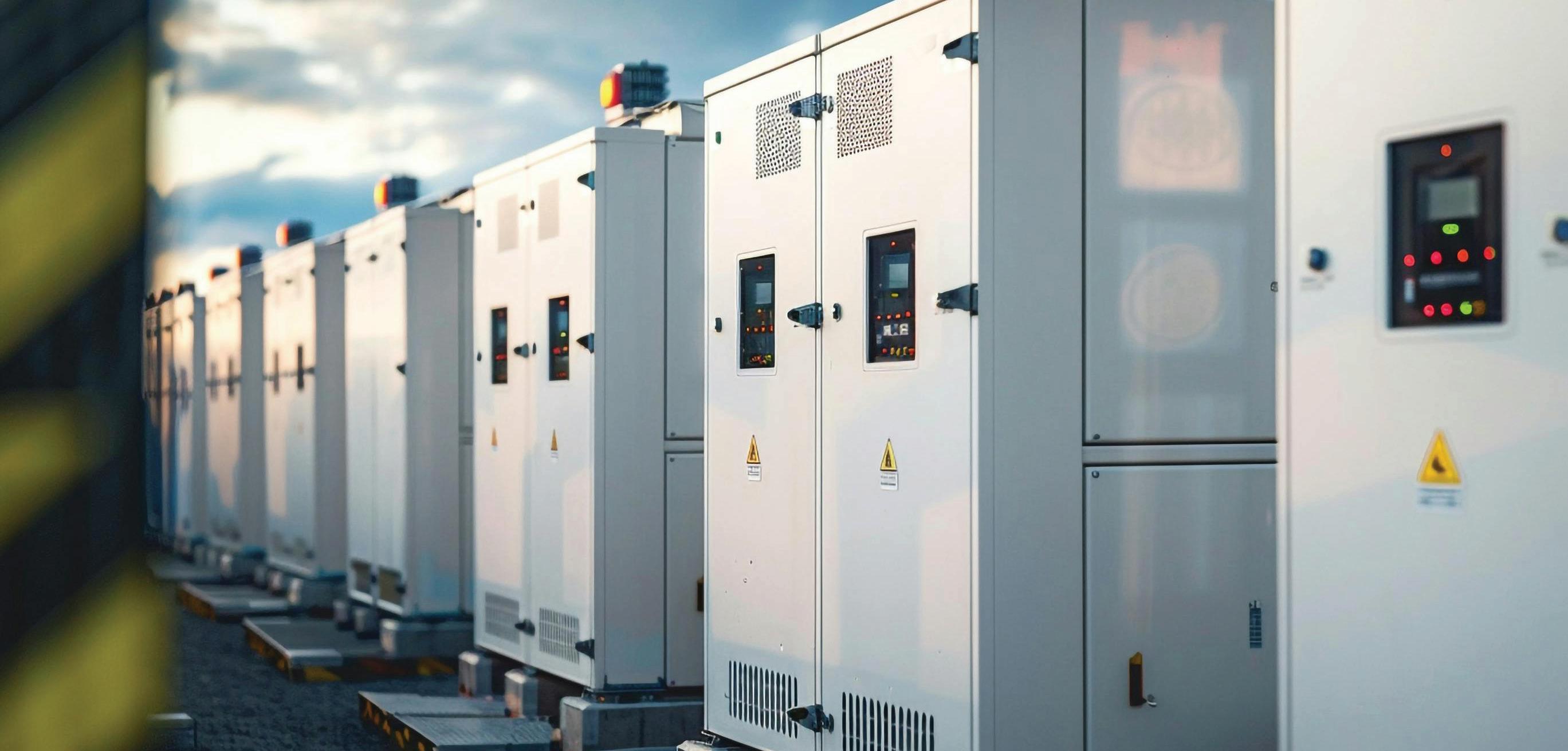
Xcel Energy has proposed a program to build a distributed battery storage network across Minnesota to help meet growing electricity demand and improve grid operations.
Under the Capacity Connect plan, Xcel Energy would install up to 200 megawatts of battery storage at strategically selected locations by 2028. Working in partnership with Sparkfund, these distributed energy resources are intended to support efficient use of existing infrastructure, maintain reliable service, and contribute to local employment.
“We’re focused on supporting economic growth and the needs of our communities by building out and modernizing our energy grid,” said Ryan Long, president of Xcel Energy–Minnesota, North Dakota and South Dakota. “We believe distributed energy resources are an important part of that strategy. They will complement our current plans for additional renewable and firm dispatchable generating resources to meet our customers’ needs.”
Xcel Energy will integrate the battery storage into its system operations by charging when energy is less expensive and dispatching energy during peak periods, aiming to optimize grid performance. The company plans to choose customer sites — such as commercial, industrial, or nonprofit
hosts — including in environmental justice communities. Each host would receive payments for participation. Typical battery installations would range from one to three megawatts per site (about the size of a shipping container).
“By storing energy when it’s cheap, delivering it when it’s needed most and placing assets where they maximize grid value, Xcel Energy is delivering reliable energy to customers today and building a grid that is ready for tomorrow,” said Pier LaFarge, CEO of Sparkfund.
“Sparkfund will help Xcel Energy deploy distributed energy resources to meet growing customer energy needs, support economic growth in Minnesota and unlock the full value of the U.S. electric grid.”
This distributed capacity procurement is intended to contribute toward Minnesota’s energy storage goals.
Xcel Energy’s Upper Midwest Energy Plan, recently approved, calls for installing 600 megawatts of energy storage by the end of 2030, and the proposed program would advance that effort.
Xcel Energy and Sparkfund plan to monitor performance, costs, and customer experience as the
deployment scales, to ensure the approach remains cost-effective while contributing to a reliable, safe, and clean grid.
Western Farmers Electric Cooperative (WFEC) seeks to identify possible contractors for future Emergency Electric Power Restoration and Debris Removal Services in 2026. Work could be performed across the State of Oklahoma, as well in portions of Texas and Kansas. More information about our service territory can be found at www.wfec.com.
Please submit your contact information via email to bids@wfec.com or send a letter to Procurement Services, 3000 S. Telephone Road, Moore, OK 73160.
Small Businesses, Minority-Owned Businesses,
Woman-Owned Businesses, and Labor Surplus Area Firms are especially encouraged to submit their information. WFEC accepts new contractors throughout the year; however, to establish an agreement for 2026, please submit your information by December 31st, 2025.
Entergy Arkansas Powers Google’s $4 Billion Data Center Investment in Arkansas
Entergy Arkansas announced it will supply power for Google’s planned $4 billion technology investment in Arkansas. The investment includes a new data center in West Memphis — Google’s first facility in the state — focused on cloud and artificial intelligence infrastructure. The company also announced a $25 million Energy Impact Fund to support energy affordability efforts in Crittenden County and nearby communities. The fund will target home weatherization, energy efficiency technologies, and workforce development.
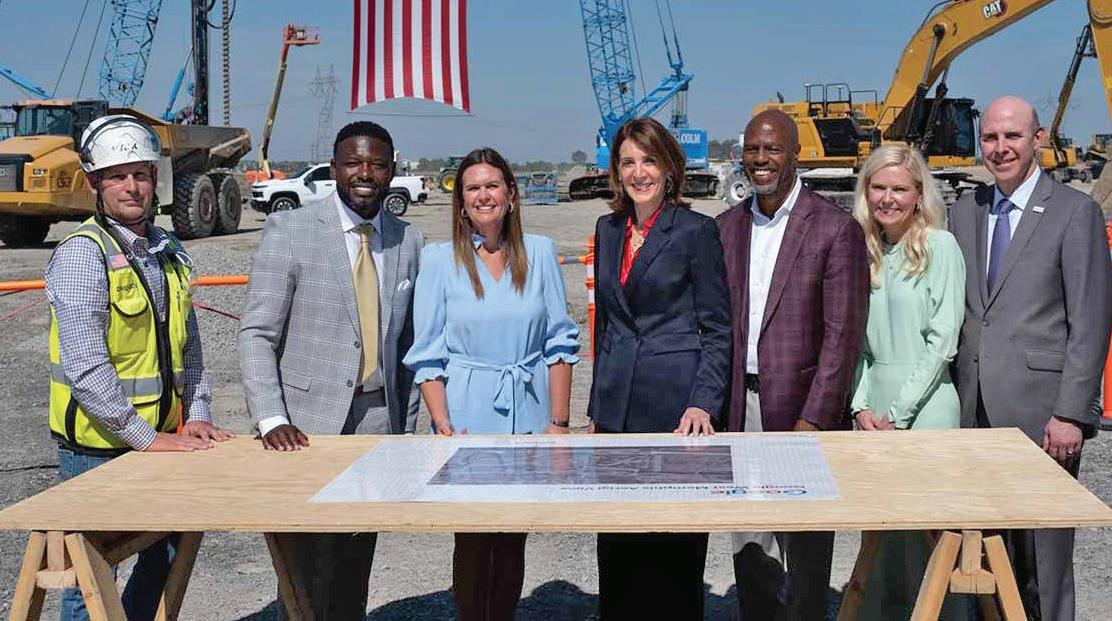
Entergy Arkansas President and CEO Laura Landreaux said, “Google’s $4 billion investment in its new facility, its $25 million Energy Impact Fund, and its investment in the future of our students demonstrates what lasting community impacts a project of this magnitude can have,”
Google will pay the full energy costs of operating the facility. Entergy Arkansas said the agreement will generate more
than $1.1 billion in net benefits over the life of the contract and could help reduce electricity rates for all customers by spreading fixed costs across a larger base.
The new facility will draw from Entergy Arkansas’s existing generation portfolio and transmission network, which will be expanded by a proposed 600-MW solar project paired with a 350-MW battery system in Jefferson County. Entergy has filed the resource for approval with the Arkansas Public Service Commission, saying it will enhance grid reliability, resiliency, and affordability.
“Large industrial and technology companies are increasingly looking at our state because we offer reliable power at affordable rates, and we plan to keep it that way,” Landreaux said. “Large customers, such as Google, help support investments in infrastructure additions that not only help power their facilities but also result in improved grid reliability that benefit all customers.”
Potomac Edison’s New Substation to Reduce Power Outages for 1,900 Customers
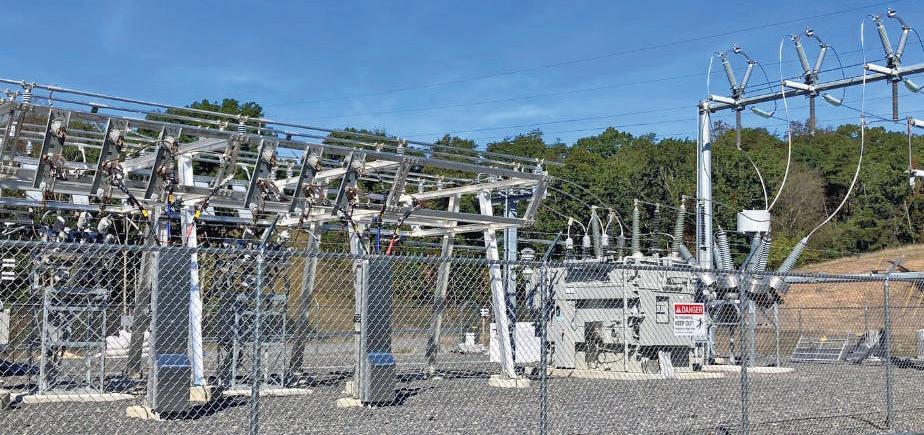
Potomac Edison, a FirstEnergy electric company, has introduced a new substation in Morgan County, West Virginia, bringing improved power reliability for nearly 2,000 residents and businesses served by the
and new technology. While construction on the project started in summer 2025, the substation began serving customers in September.
The new substation in Great Cacapon has replaced an older facility, which was dependent on a six-mile-long power line. The substation, located on a 20-acre site owned by Potomac Edison, is served by a safer, easily reachable power line less susceptible to service interruptions.
Completion of the work will serve nearly 1,600 customers in the Great Cacapon

The new substation is equipped with smart grid technology, including automated devices that:
• Detect and isolate problems automatically.
• Restore service remotely without dispatching a crew.
• Pinpoint outage locations to speed up repairs.
The upgrades will help deliver fewer, shorter and less widespread outages for customers. The substation project is part of Energize365, FirstEnergy’s $28 billion investment program across its five-state footprint to modernize the electric grid between 2025 and 2029.
FirstEnergy
Entergy Arkansas
Georgia Power Deploys Advanced Phase Balancing Device to Improve Power Quality
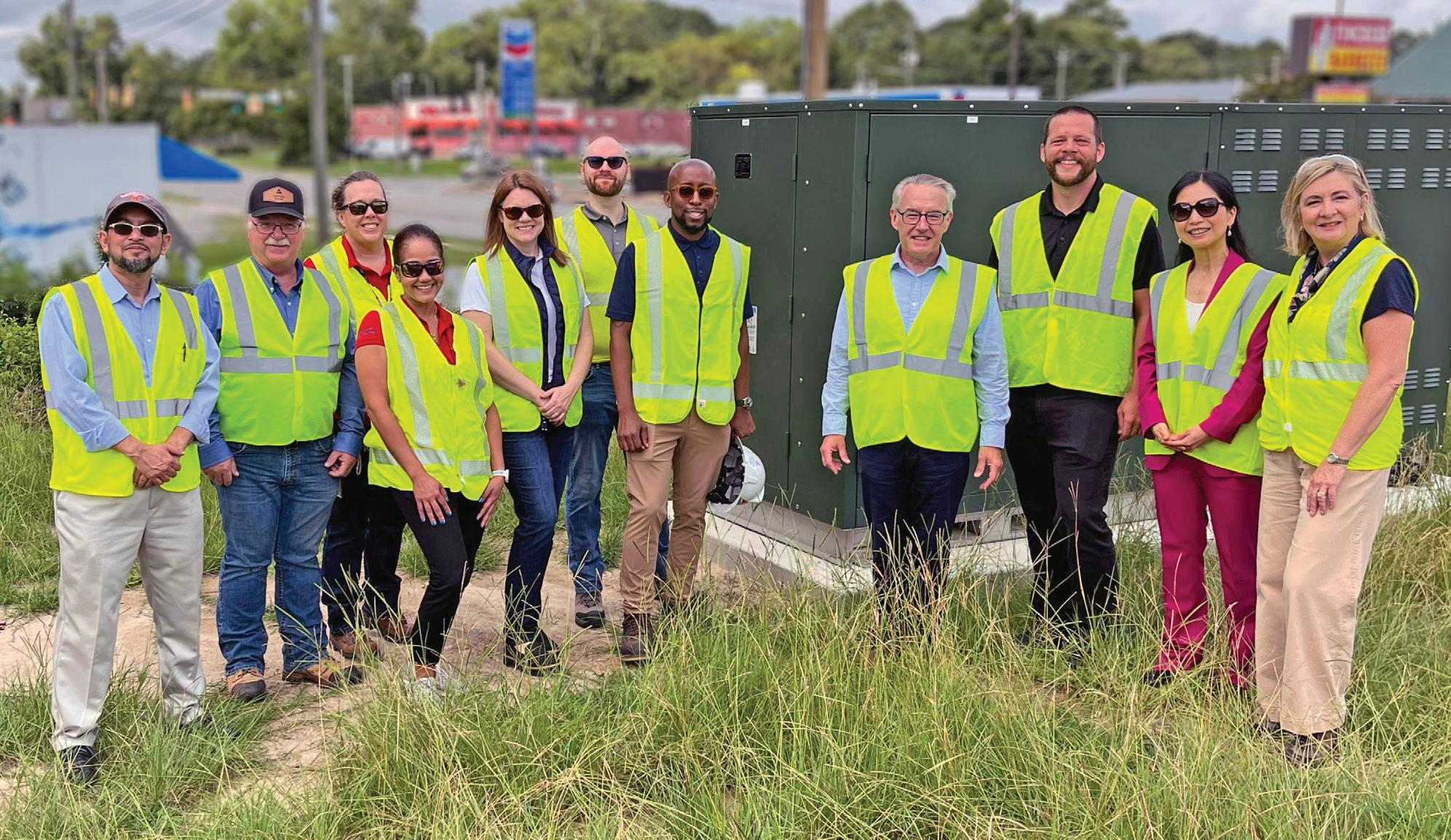
A new grid technology has been installed in Macon, Georgia, as utilities explore options to increase the capacity of existing power lines and improve reliability. Switched Source has deployed its Phase-EQ device in partnership with Georgia Power, a subsidiary of Southern Company, with support from the U.S. Department of Energy’s Advanced Research Projects Agency-Energy (ARPA-E).
The Phase-EQ is designed to increase usable capacity from existing lines by up to 20% by balancing electricity flow across phases. Georgia Power provided site access, engineering input, and operational data for the demonstration, which is being evaluated under real-world conditions.
Southern Company’s research and development group worked with Switched Source to refine and test the technology before installation. Early data indicates the device is operating smoothly, with initial modeling suggesting the potential to reduce
Utility and project partners recently visited the Macon site to see the Phase-EQ installation firsthand.
load imbalance by half and voltage imbalance by more than 30%. Georgia Power is continuing to collect substation-level performance data to assess the device’s effectiveness.
“This deployment represents Georgia Power’s continued efforts to partner with industry and use new technologies to improve grid performance while reducing costs for our customers,” said Robin Lanier, director of grid strategy and solutions at Georgia Power.
Switched Source was founded in 2016 and has focused on technologies that help utilities manage reliability and capacity on the distribution grid. The Phase-EQ functions as a controllable gateway, dynamically balancing power between phases to ease congestion and improve power quality. The project is part of ARPA-E’s SCALEUP program, which provided funding for the company’s early technology development.
Switched Source
AI and data centers are rapidly increasing electricity demand, straining existing power grids and highlighting the need for infrastructure upgrades, collaboration, and accurate forecasting to ensure reliability.
By JEFF POSTELWAIT, Managing Editor
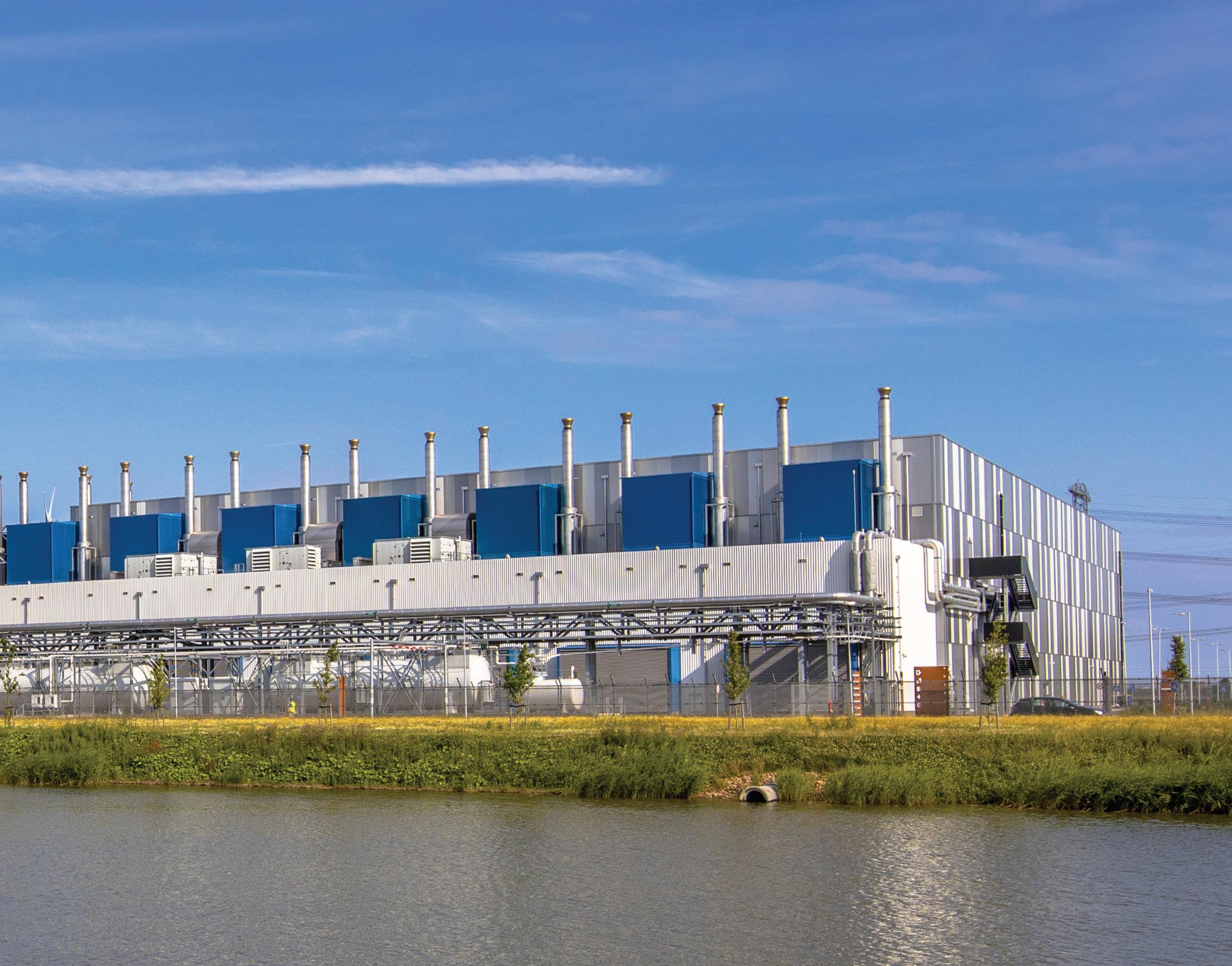
Artificial intelligence is touted as the answer for every inefficiency in business, every work- or liferelated headache, and the friend to every parent who can’t think of what to do with the two pounds of boneless chicken breasts they thawed out earlier in the day. The technology is supposed to also make an absolute ton of money. So far, it appears to be costing a lot of money. But here in the electricity realm, the big question with AI seems to be how quickly is Big Tech going to need all those data centers they are planning on building, and how are they going to power them?
Electricity peak demand and energy growth forecasts over the 10-year assessment period continue to climb higher than at any point in the past two decades, according to the North American Electric Reliability Corporation’s (NERC) 2024 Long-Term Reliability Assessment. The energy demand picture, in short, has been rather boring for the past few decades. Now, business is starting to pick up, leading some in the industry to wonder how quickly things can pivot.
Growing large commercial and industrial loads, electrification of household appliances and increasing electric vehicle
they may outpace the data centers in the long run. However, a small but growing slice of the pie is represented by the emerging large load of data centers, particularly those involved with cryptocurrency mining and artificial intelligence. These, according to NERC, present challenges to forecasting and planning for increased demand.
“The overall speed and magnitude of the growth in and of itself is causing strain on the existing resources. But there’s this additional component, which is the uncertainty of forecasting the demand growth and how it affects your assessments and the certainty of your demand forecasts,” said Evan Mickelson, Power Systems Modeling and Analysis Engineer at NERC.
In a July 24, 2025 webinar, Mickelson drew from a NERC report titled “Characteristics and Risks of Emerging Large Loads,” saying the speed and volatility of these large loads coming online can exhaust reserve margins.
“When utilities have a large interconnection queue for their really large loads, they have to assume that some of them aren’t going to materialize. The assumptions there are really, really important. The increased uncertainty is one of the big drivers of the risks to your resource
Shared Goals, Different Timelines
Big Tech and the power grid share a similar problem: if either the internet or the electricity get knocked down, people start complaining quickly. Both need to maintain reliable, uninterrupted service around the clock. However, things tend to move a lot more quickly in Silicon Valley than they ever do for people who maintain the power grid.
“The scale and speed with which the tech industry operates is on a different time spectrum than the electricity ecosystem. And so, what we’re faced with is what I like to call a growing pain between where our tech companies need to be to serve our customers and to serve this demand and what we’re really capable of doing as an electric industry,” Briana Kobor, Head of Energy Market Innovation at Google, said in a June 18, 2025 EPRI Current podcast episode posted by the Electric Power Research Institute.
Kobor identified aging infrastructure, the need to build increased long-haul transmission and clogged power generation queues as issues hyperscalers such as Google need those who operate in the power sector to solve, adding that collaboration between Big Tech and power engi-
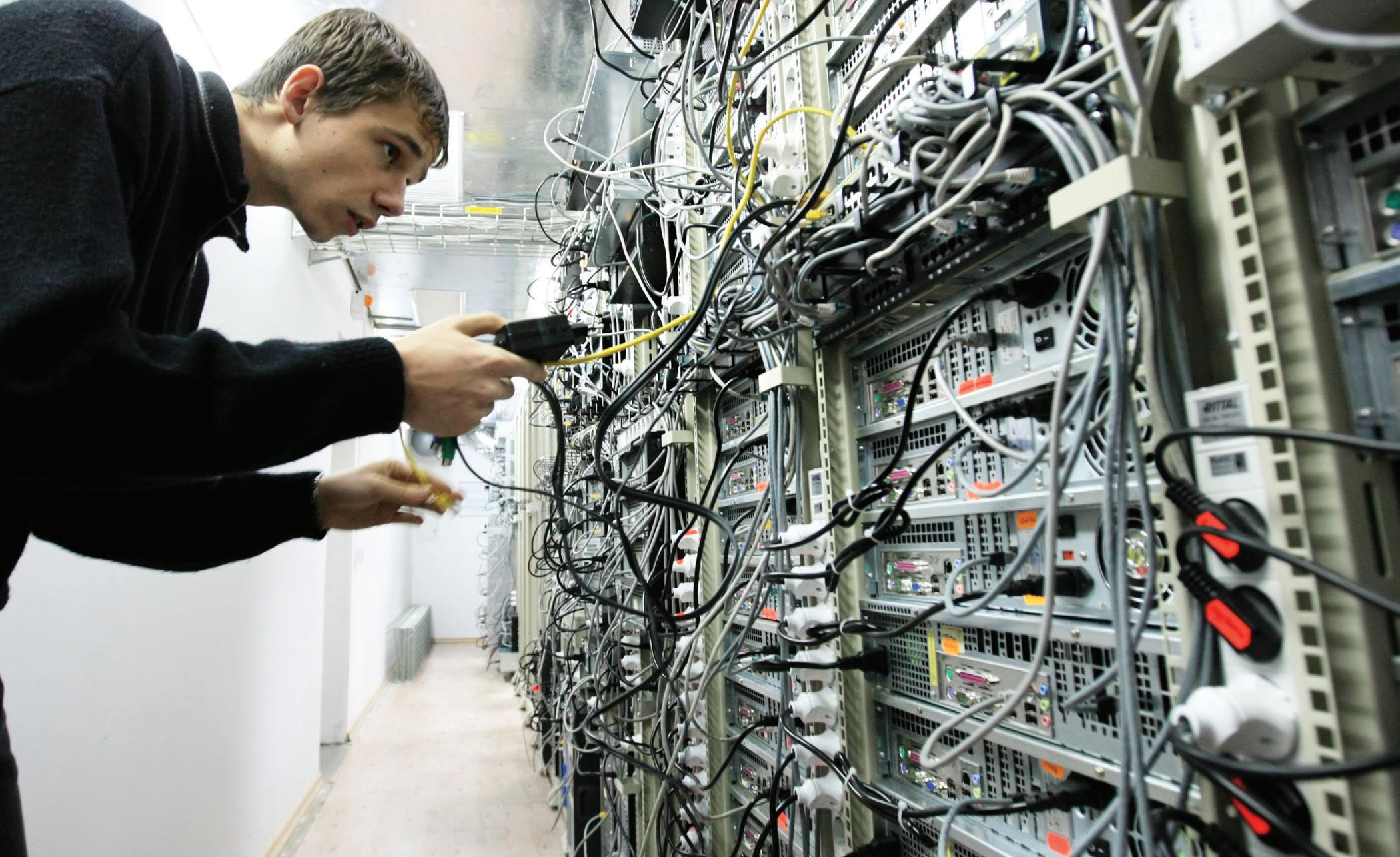
“We are seeing scaled increase in demand from data centers and other parts of the industry,” Kobor said, adding that data centers and the products that they deliver to people have become central to people’s personal lives and businesses. “I like to think of data centers as the backbone of our modern economy.”
A Growing Energy Hunger
An EPRI study found that data centers could consume up to 9% of US power generation by 2030 — more than double the amount currently used.
Data centers are already having issues securing enough power generation to meet their growing demands. Load growth from data centers is placing strain on regional power grids and more than 100 GW of new data center projects could come online over the next decade in the U.S., said James Russell, a principal in Charles River Associates’ Energy Practice.
“Any system headroom that was available prior to 2023 is likely allocated to new projects – meaning that each incremental MW of load requires an incremental MW of generation and transmission capacity,” Russell said. “Years-long load queues are present in most Tier 1 data center markets with adjacent markets becoming congested as well. Utilities and independent system operators (ISOs) need to ensure a permissible rate of load growth that can be matched by new grid infrastructure such that new load doesn’t infringe on system reliability and affordability.”
The limits that exist on how many power plants and power lines can be available in a particular area is already imposing a limit on the growth of AI and the data centers that fuel it, he said.
“The limiting factor for most data center projects is the ability to secure interconnection and power supply. Cumulative load queues across the country currently exceed 400 GW with U.S. peak electricity demand around 760 GW – this scale of load growth is driving delays across all aspects of supporting supply chains,” he said.
Underscoring the disconnect in time scale between the two industries, a 500 MW data center can be up and running in 1-3 years, while the transmission and generation infrastructure it would need
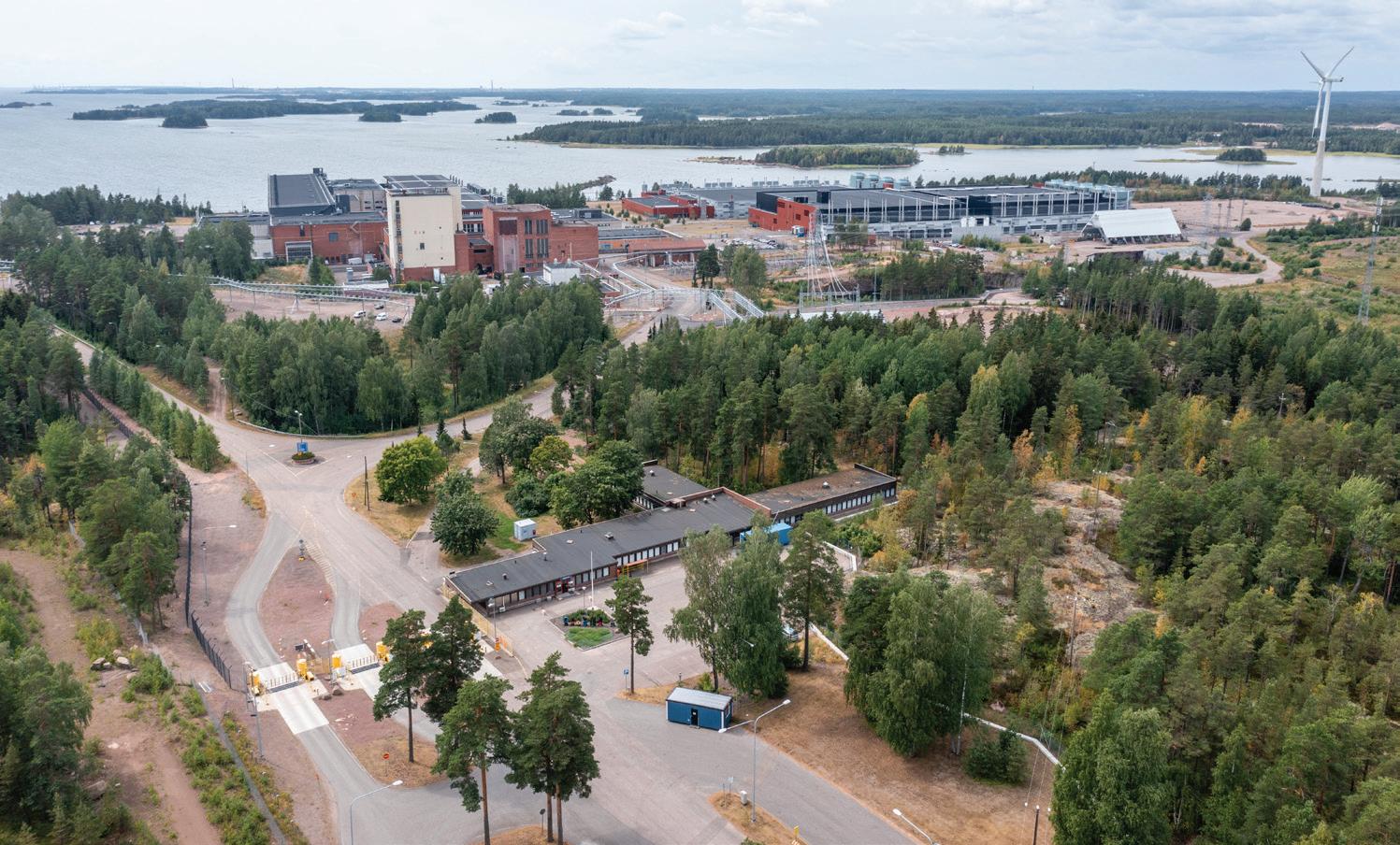

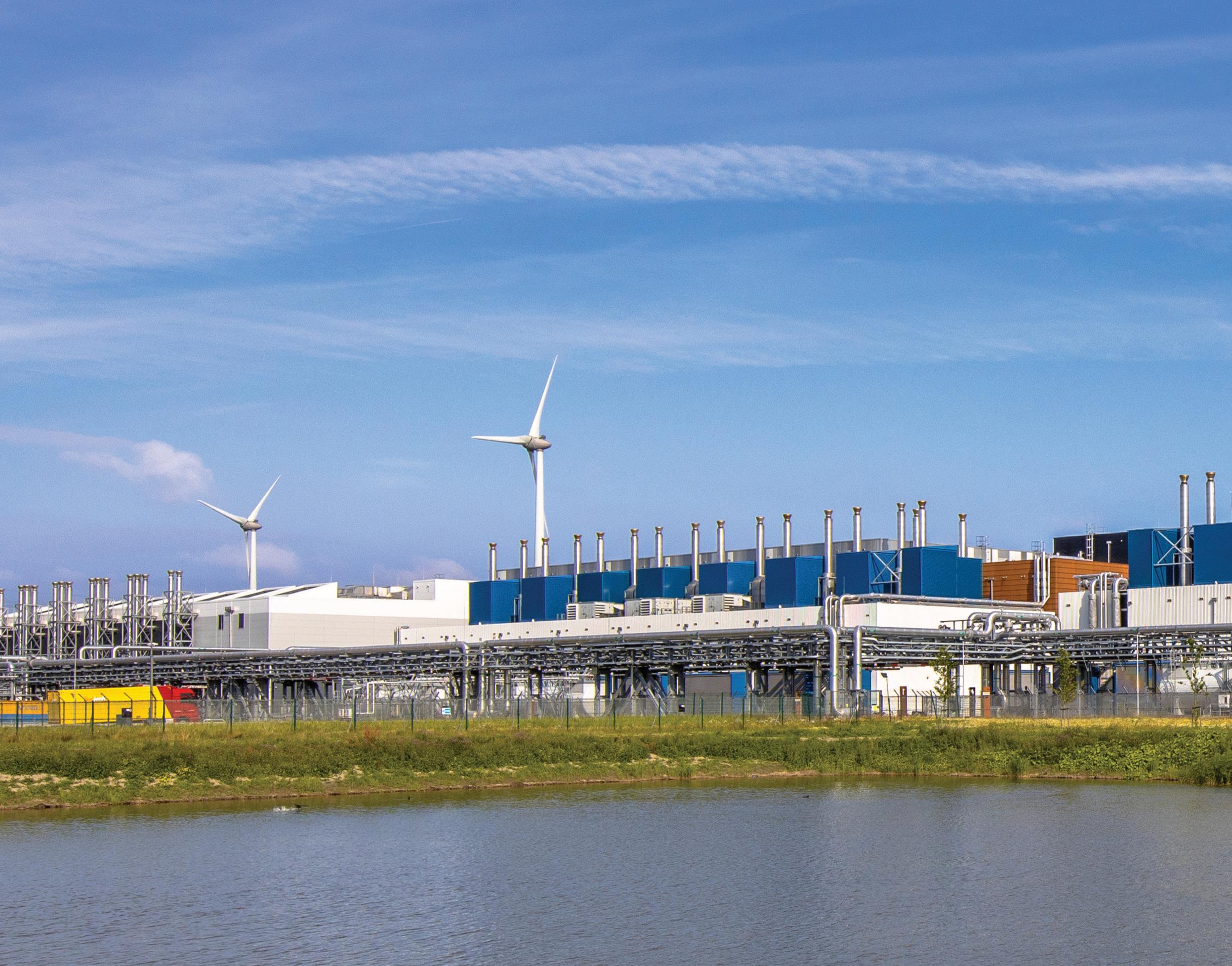
A Google data center in Hamina, Finland.
Workers servicing the power grid in Johannesburg, South Africa.
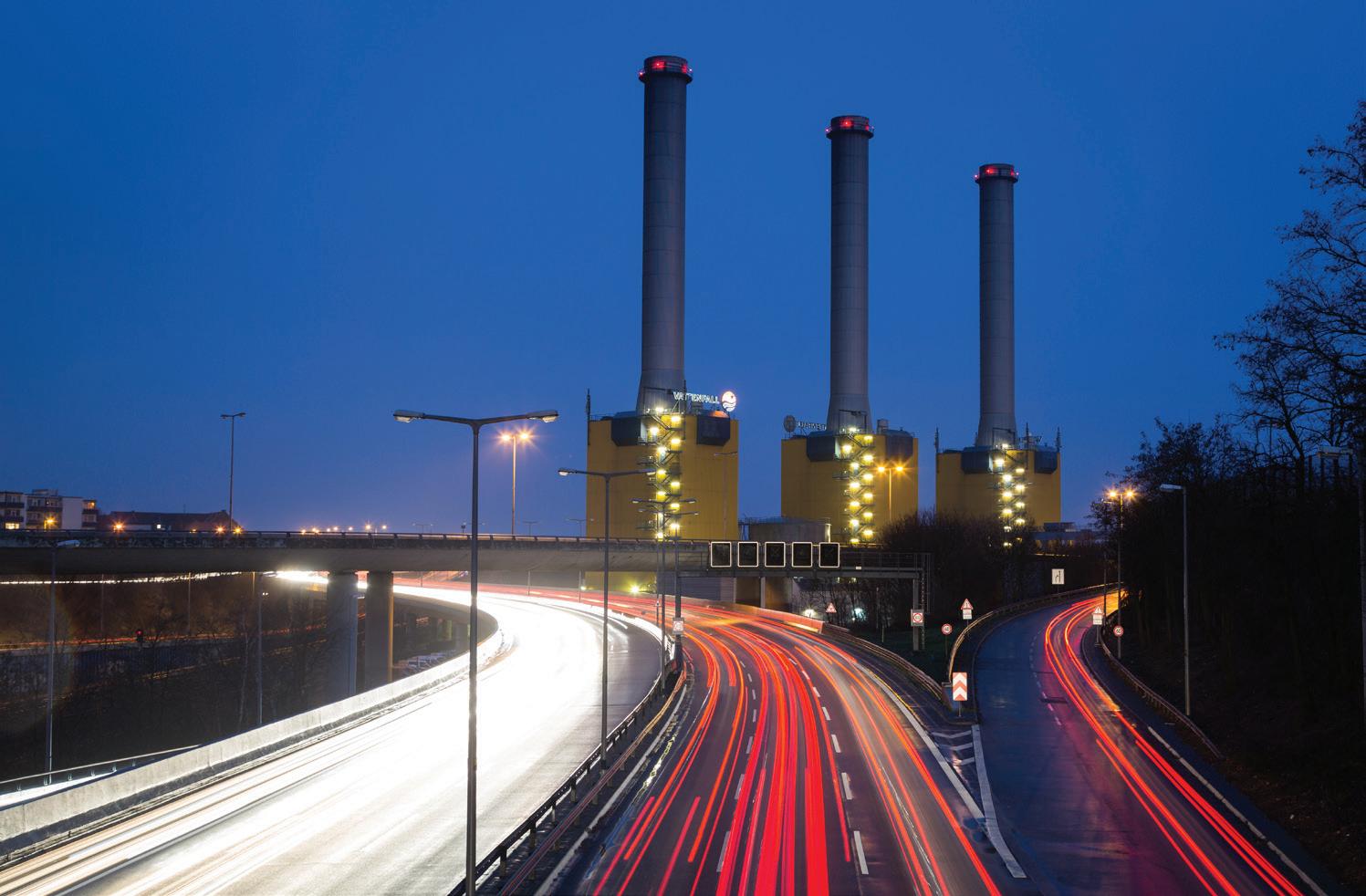
cogeneration power plant at Berlin-Wilmersdorf.
to function could take 5-10 years, or perhaps longer.
Big Tech: A New Power Partner?
In response to this mismatch, Big Tech is getting more involved in the power sector, and that involvement may deepen in the future.
When asked if we might get to a point where tech companies take more of an interest in power grid infrastructure and maybe even invest in it, Matt DeCourcey, vice president in Charles River Associates’ Energy Practice, said we are already there.
“In most cases, connecting a new data center now requires new generation or transmission capacity to be built specifically to serve that load. The mechanics vary: some are structured through PPAs, others through service contracts with minimum-take provisions, and in some cases through direct ownership. But the principle is the same: the data center is making a long-term, binding financial commitment to cover the cost of the resource and the infrastructure needed to deliver it,” DeCourcey said.
This leaves planners and regulators with two options: Do they wait to determine how much G&T resources will be needed for a particular data center project before one is allowed to connect, or do they let data centers connect while requiring that they be interruptible. The former method is favored in Nevada,
Arizona and other states. The latter is being applied in Texas, Utah and elsewhere, DeCourcey said.
Tony Tewlis, Senior Vice President of T&D Operations for Arizona Public Service (APS), said during T&D World Live 2025 that dealing with the power demand from data centers was among his top challenges.
“With data centers and Big Tech, meter sets are now much larger. 500 MW is the average size of the request for one of these customers, which is comparable in size to a large Walmart,” Tewlis said, going on to add that his utility will need an estimated $6.25 billion in extra capital expenditures over the next decade to serve this load growth.
Tewlis said his utility is exploring new rate structures that are based on how much demand a particular customer class is causing, so data centers might be more responsible for load growth than residential customers.
“Even though a customer may demand something that is impossible, we have to be realistic on what we can do,” Tewlis said, adding that he has had to learn more about data centers in the past 12 months than he ever imagined he would need to.
“On the community side, the dynamic is more complex. Data centers can be both an opportunity and speculation. They bring construction jobs, tax base, and investment in local infrastructure,
but they can also strain local systems. The most successful projects are the ones where developers engage early and transparently: partnering with local governments on siting and permitting, investing in transmission or water reuse infrastructure, and clearly communi cating the broader economic benefits,” DeCourcey said.
hyperscalers and utilities deal with one another, said Anant Kumar, vice presi dent of Charles River Associates’ Energy Practice.
utilities like any other large customer, re questing service and waiting for the utility to deliver capacity. That model doesn’t work anymore. The scale and timing of today’s data center growth, often hun dreds of megawatts at a time, are forcing much closer coordination,” Kumar said.
ers are trying to co-plan years in advance, Kumar said.
sites with available transmission capac ity, co-developing new substations or generation, and exploring long-term power agreements that blend reliabili ty, sustainability and flexibility,” he said. “We’ve witnessed this firsthand with sev eral data center developers we work with. They identify community relations as a key point of differentiation.”


Clouded Forecasts
A question remains: How quickly will these data centers be built and ramped up to their full electricity demand? The fact that nobody knows for sure engenders much


uncertainty in an industry that must submit regular reports on resource adequacy and demand forecasts.
There is a crisis of confidence in load forecasts, particularly the further out you look.
“Grid operators, regulators, and stakeholders are becoming concerned about the accuracy of load forecasts that project a significant amount of data center load growth. These load forecasts are increasingly regarded as highly uncertain,” said Oliver Stover, associate principal in Charles River Associates’ Energy Practice.
Regulators, ratepayer advocates and others are concerned that inaccurate load forecasts can needlessly increase costs to existing electric customers by increasing planning reserve requirements and driving infrastructure investments that won’t ultimately be needed, Stover said.
Stakeholders want utilities and grid operators to increase the accuracy and transparency of their load forecasts. In September 2025, FERC Chairman David Roser requested information about load forecasting from RTOs/ISOs, asking them how they coordinate with utilities, whether the individual utility load forecasts within their RTO/ISO are developed consistently, and whether they share best practices and ensure large load interconnection
OneLiner
ENGINEERING SOFTWARE

Short circuit, relay coordination and breaker rating for transmission networks.
Power Flow
Full-featured power flow for transmission systems.
DistriView
Fault simulation, relay and fuse coordination, voltage drop, harmonic analysis, and reliability calculation for distribution networks.
Relay Database
Customizable database for relays and related equipment.
Line Database
Customizable database for overhead lines and underground cables with built-in electrical parameters calculation engine.
EDX Module
Customizable platform for collaborative OneLiner/Power Flow model building and database-driven model data management.
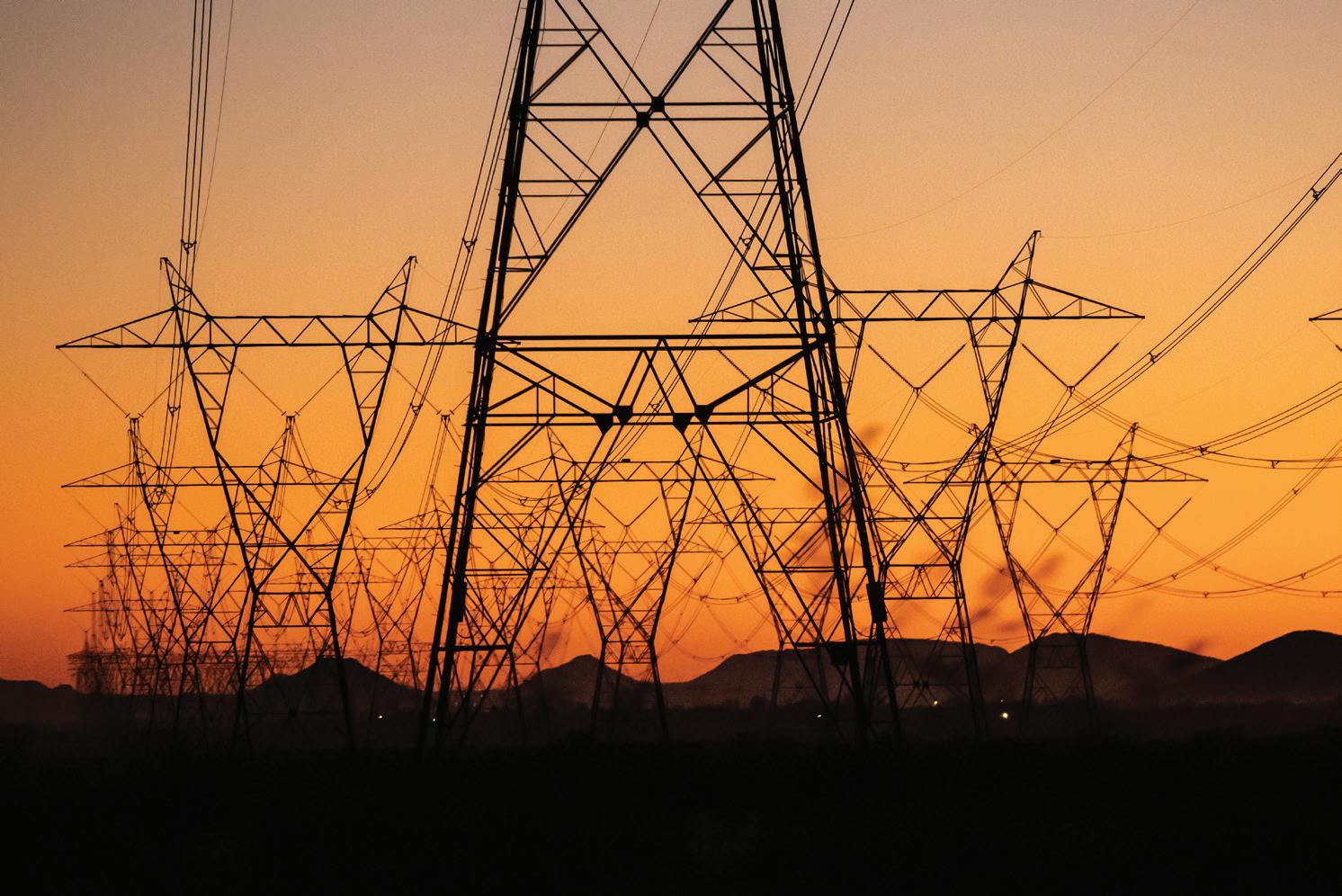
LEFT: High voltage lines near Phoenix, Ariz., connecting the Palo Verde Nuclear Generating Station to Tonopah.
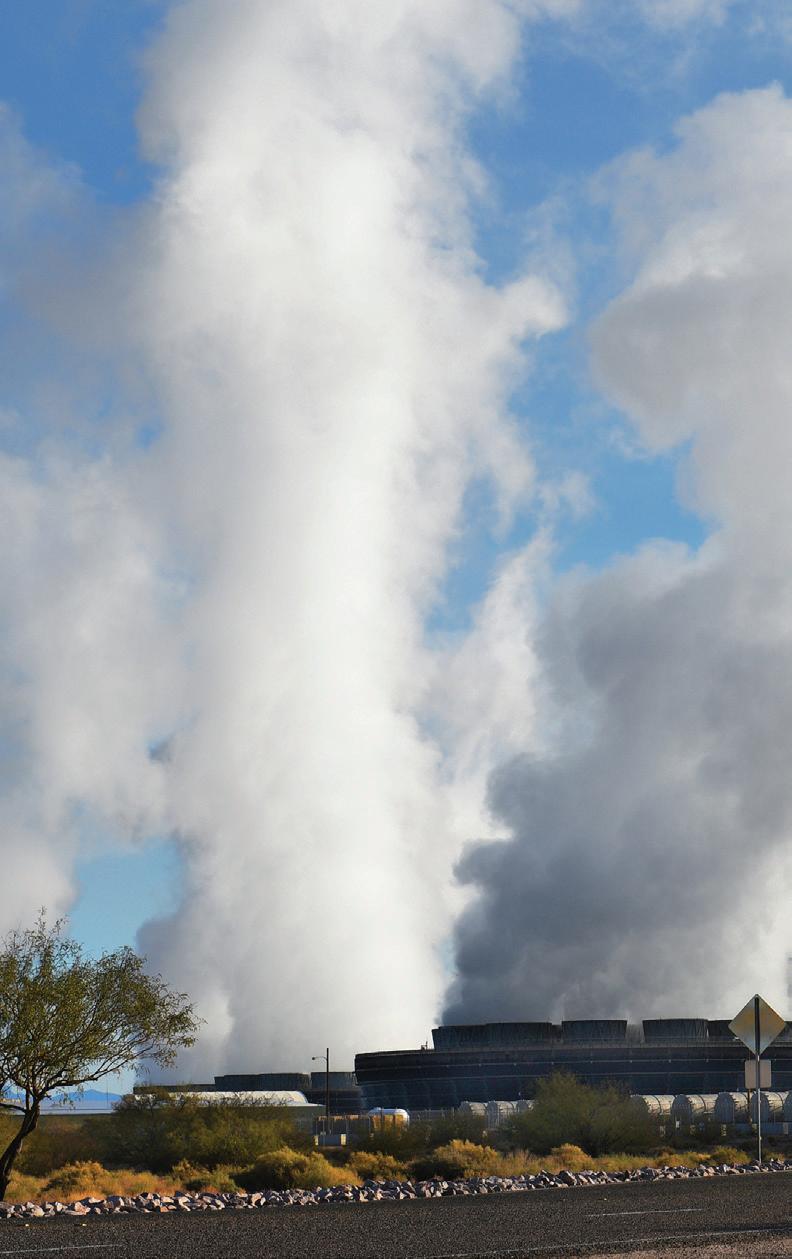
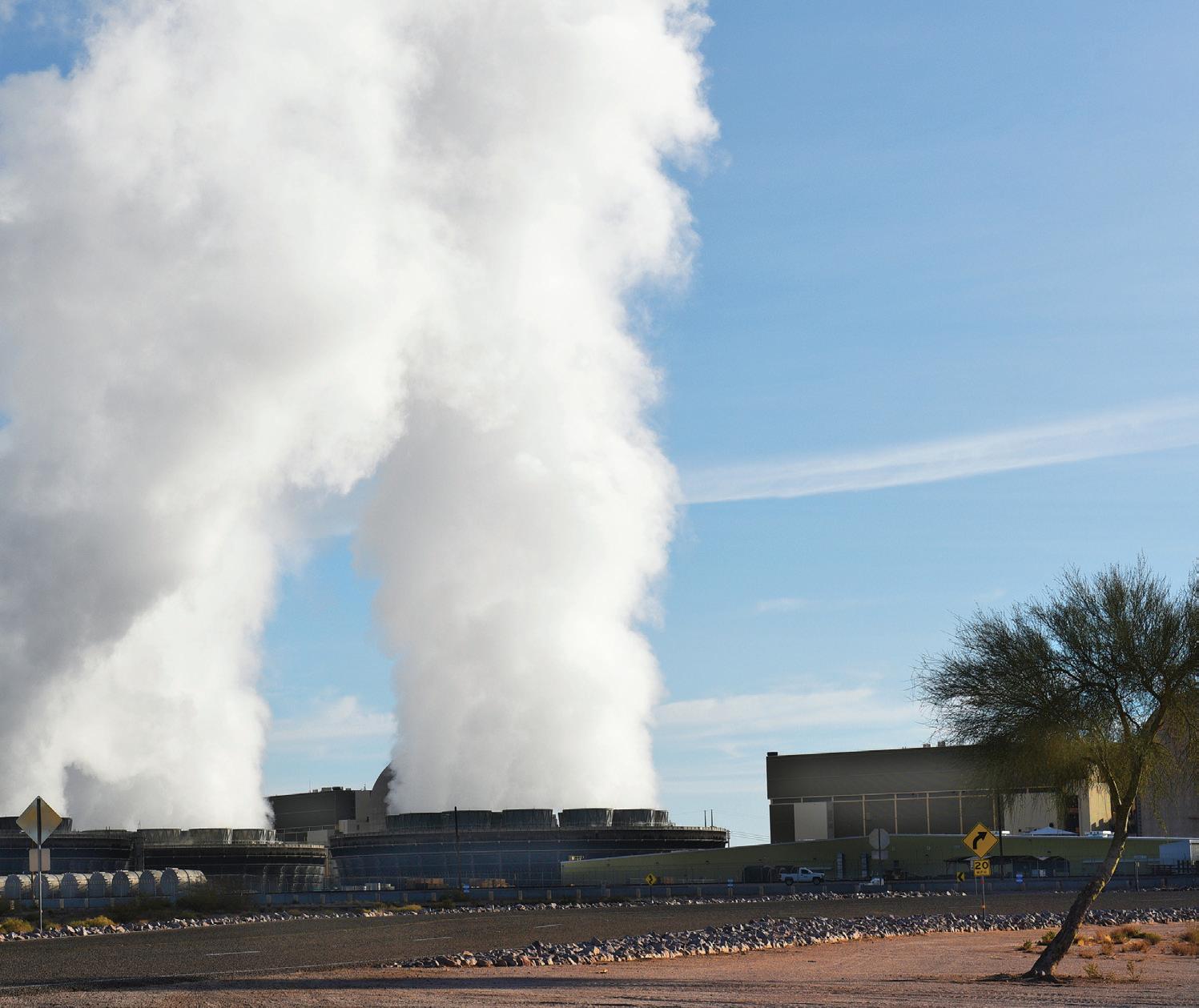
RIGHT: Steam rising from cooling mechanisms at Palo Verde Nuclear Generating Station, west of Phoenix, Ariz.
ID 212509193 © Steven Cukrov | Dreamstime.com
requests aren’t double counted across utility service areas.
An extra factor in sharpening the forecast is asking what can materially be built. Instead of assuming every data center that has financial backing and motivated stakeholders, supply chain and other restrictions on construction are also being considered in forecasts.
Constraints on computer chips, transformers, labor, available interconnections and capital are each real potential bottlenecks to getting data centers built. These considerations make nearer-term forecasts more reliable than those further out.
Getting Along
With data centers asking so much of power producers, it is understandable to wonder whether power utilities are truly that thrilled to have them as customers. Certainly, some may see opportunities as well as challenges, but some of the predicted spikes in load growth are truly daunting. How well the two get along will differ on a case-by-case basis.
“When a data center and a utility are engaged in discussions about whether the data center should interconnect and become a utility customer, the two parties are partners or counterparties. The degree to which they collaborate closely and get along well varies from case to case,” Kumar said.
If the data center gets interconnected, it is now a utility customer and each party has obligations. Usually, that includes the utility providing a reliable energy supply and the data center operating within certain parameters and paying the utility for that service.
Some utilities are actively seeking new data center entries, while others are more reluctant, DeCourcey said.
“We have found that the regulatory regime where the utility does business has a strong effect on the utility’s enthusiasm for data centers. Many of the strategies to attract data centers are oriented towards shortening timelines to having the project online, including timelines for interconnections, study periods, regulatory
approvals, etc.” DeCourcey said.
The idea of offering discounted rates to data centers, while initially popular for those wanting to attract data center developers, has fallen by the wayside in favor of redesigning rate structures and other solutions.
“Several states have tax incentives to attract data centers. Although data centers consider several factors when deciding where to locate, such as electricity costs and land values, state tax incentives have played a role in where data centers locate. For example, Georgia, Illinois, and Virginia offer relatively generous tax incentives to data centers, and vertically integrated utilities in these states plan to build a significant amount of electric generation capacity to serve new data centers. The retail electric rate designs, not the tax breaks, garner the most attention from ratepayer advocates, who have been active data center tariff proceedings before state public utility commissions,” said Emma Nicholson, energy economist with Charles River Associates.
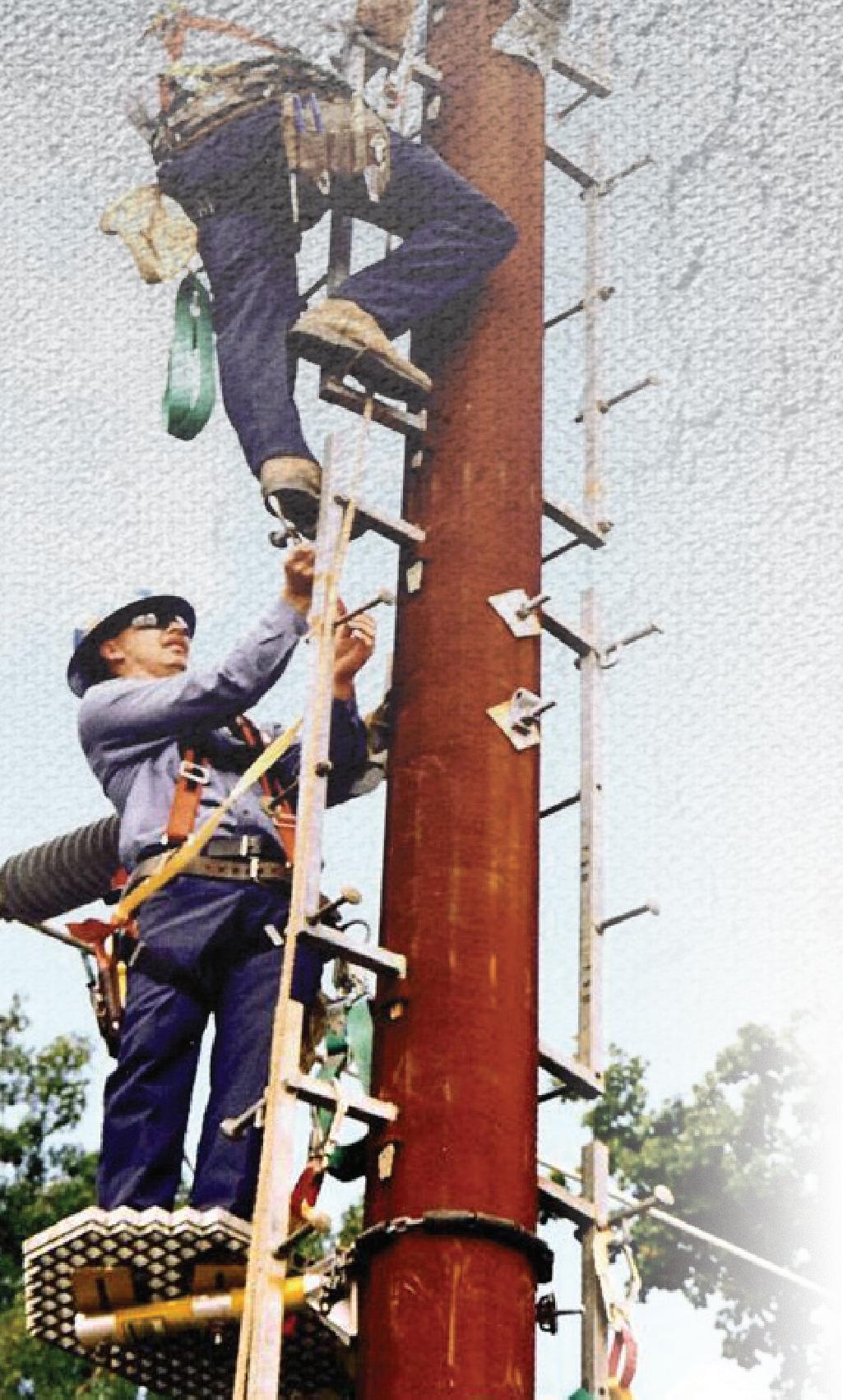
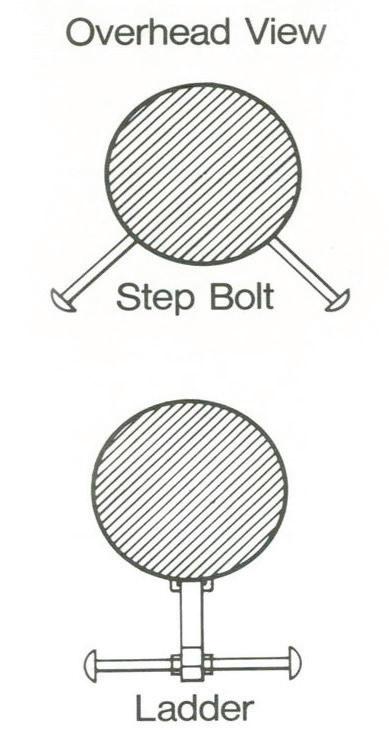
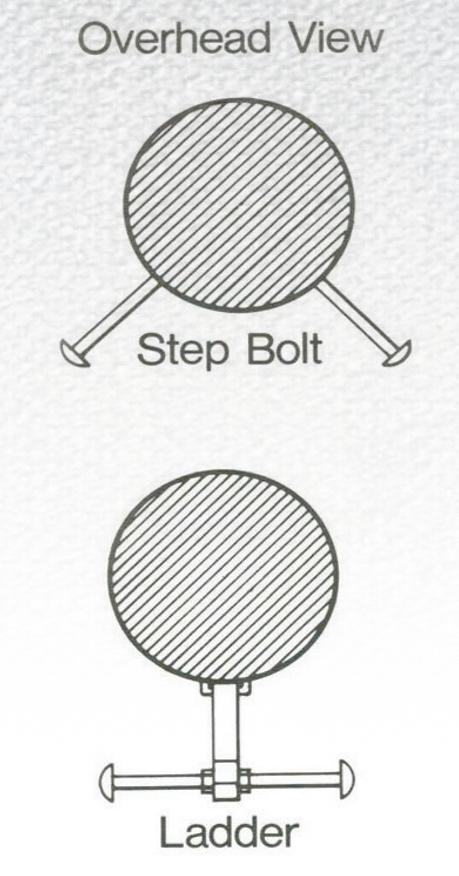
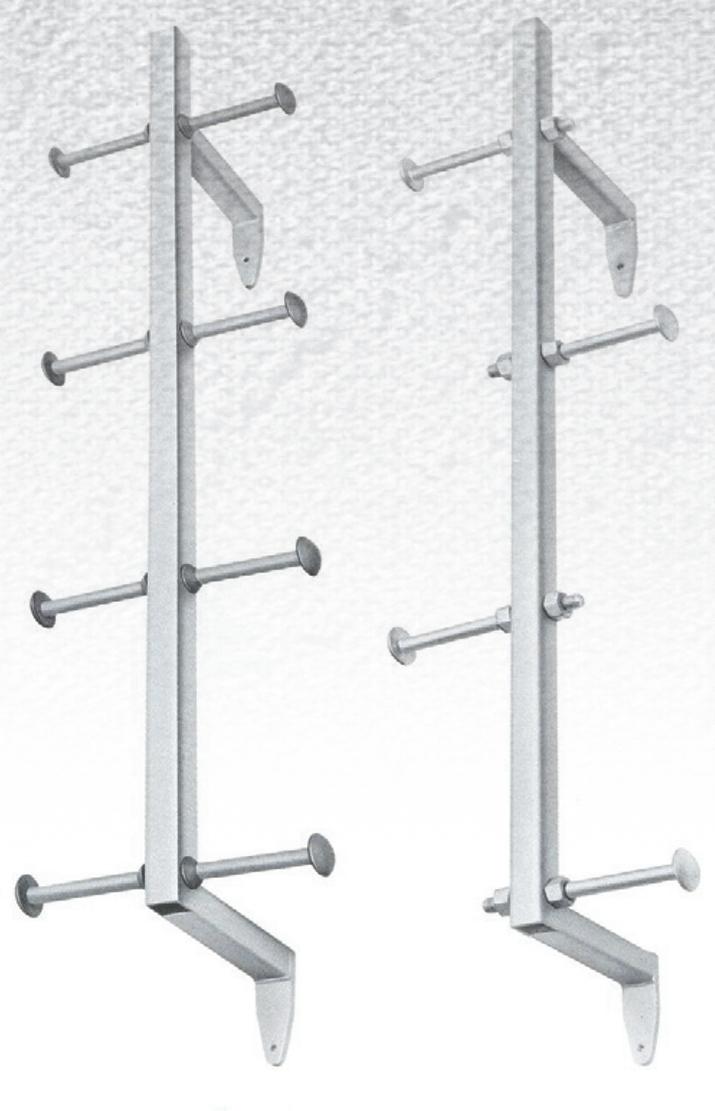
THE SAFEST WAY
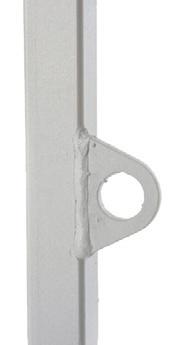
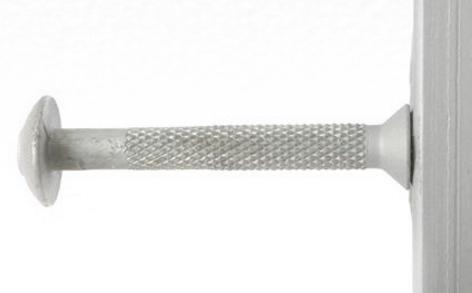
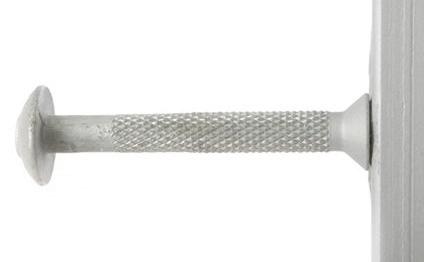
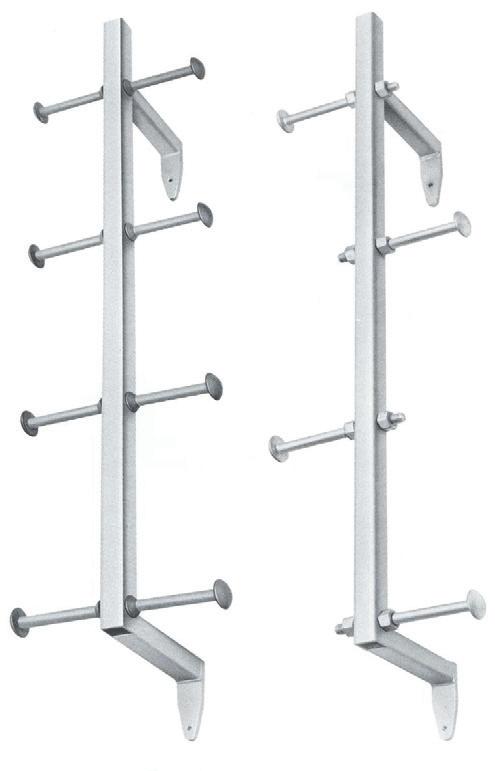
POLE
UTILITY ANALYTICS














































HighNoon® Herbicide: A Powerful New Option for Weed Control

If you’ve ever felt like you’re playing whack-a-mole with invasive and undesirable vegetation, you know how important it is to have effective, easy-to-use options for weed and brush control. With its recently expanded label for nationwide use in vegetation management applications, HighNoon® herbicide from Corteva Agriscience gives you and your contractors that option. HighNoon herbicide combines two powerful active ingredients, Rinskor® and aminopyralid, to provide selective activity that helps maintain desirable grasses and forbs while controlling some of your most troublesome weeds like annual and biannual thistles, poison hemlock and wild parsnip. But simply controlling weeds and undesirables is only one of the benefits of an integrated vegetation management (IVM) program using HighNoon herbicide. One Result. Countless Benefits. Used as part of a larger IVM program, HighNoon herbicide can allow native grasses and forbs to become established in rights-of-way. In turn, this helps:
1. Improve biological control. Native ground covers that are allowed to flourish can quickly grow to crowd out invasive or undesirable vegetation species, reducing stem counts over the long term with no additional labor required. HighNoon herbicide controls over 140 broadleaf weeds and annual grasses, and provides a valuable tank-mix partner for enhanced control of woody species like salt cedar and Russian olive, all while allowing valuable native grasses and ground covers to become established.
2. Reduce fuel for fire. Annual and invasive grasses that don’t germinate don’t contribute fuel for potential wildfires. An IVM program using HighNoon herbicide offers highly selective control of some of the most dangerous annual grasses, reducing the overall fuel load and helping mitigate the risk and spread of fire
3. Improve habitat, with less danger to native species. Use of selective herbicides such as HighNoon preserves the vegetation that serves as habitat for birds, pollinators and other species. In addition, control with herbicides means less mowing — and that means less risk to groundnesting birds and other wildlife.

4. Reduce regrowth and spreading. If the weed seed never germinates in the first place, it obviously can’t regrow, and it can’t go to seed later in the year. HighNoon herbicide offers extended residual control, helping prevent regrowth of broadleaf weeds and annual grasses.
Easy-To-Use, Reduced-Risk Control
Along with effective control of broadleaf weeds, HighNoon also gives vegetation managers an easy-touse liquid formulation that mixes well, offers low use rates and low odor, can be used up to water’s edge and, for those who spray sites close to pastures, carries no grazing restrictions. Add the fact that the proprietary Rinskor® active ingredient earned the Green Chemistry Challenge Award from the American Chemical Society’s Green Chemistry Institute, and you have a product that gives the industry a powerful, reduced-risk option for control of brush and weeds.
For more information on the benefits of HighNoon herbicide as a foundation component of an IVM program, reach out to your Corteva Vegetation Management Specialist, or visit HighNoonHerbicide.com.



Now approved across the country, HighNoon® herbicide targets over 140 broadleaf weeds and annual grasses—including poison hemlock, wild parsnip, and thistles—while protecting native vegetation.
As part of an Integrated Vegetation Management program, HighNoon helps:
> Simplify application — Low odor, easy mixing, and flexible use
> Protect habitat — Support pollinators and wildlife
> Block regrowth — Long-lasting residual keeps weeds from returning quickly
Learn more at HighNoonHerbicide.com or get in touch with your Corteva Vegetation Specialist.
Find your Specialist at VegetationMGMT.com/Specialist.

The 41st International Lineman’s Rodeo experienced explosive growth with more than 5,000 in attendance.
By AMY FISCHBACH, Field Editor
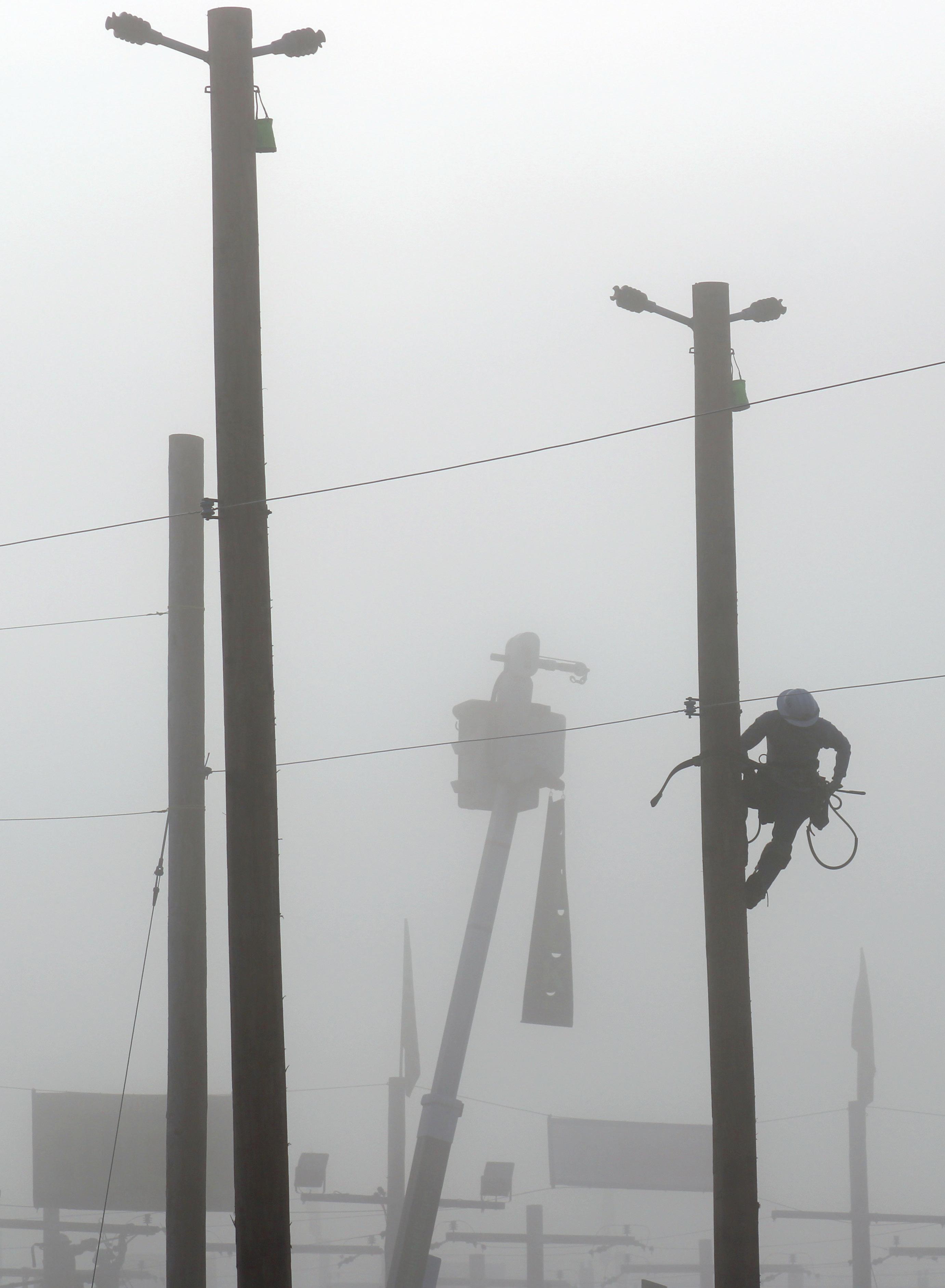
The Rodeo grounds disappeared into a fog during the morning of the competition.

ith a storm in the forecast for the 41st International Lineman’s Rodeo, the competitors and spectators arrived prepared to navigate the muddy terrain. Instead, the early morning began bright and warm followed by a fog that rolled into the Rodeo grounds, making the competition virtually disappear into a cloud.
For more than four decades, the International Lineman’s Rodeo has given lineworkers the opportunity to compete and their families a way to connect. From the start, it has focused on safety, tradition and the craftmanship of the line trade.
“Safety is important to everyone, and everything about this Rodeo is safety,” said Dale Warman, cochairman of the International Lineman’s Rodeo Association (ILRA) and one of the founders of the International Lineman’s Rodeo back in 1984. “If you’re a lineman and you’re going to climb in this Rodeo, you’re going to work safe, and when you go back, you’re going to work safe. There are bold linemen and there are old linemen, but there’s no bold old linemen.”
This year, 290 teams and 364 apprentices competed to be the best of the best by engaging in a pole climb, hurtman rescue and mystery events designed to showcase their skills in line work. While the lineworkers were competing in the events, their families were cheering on the sidelines, taking a ride in the bucket truck or participating in the second annual International Kids Lineman Rodeo.
To keep the competitors safe on the Rodeo grounds, the ILRA continued to require full fall protection on all the 40-ft wood poles, a change that was made a few years ago. Michael Stremel, Chief of Safety for the 2025 International Lineman’s Rodeo, said he and his safety committee members were responsible for keeping everyone safe on the Rodeo grounds and responding to incidents if needed.
“I’ve been involved with the Rodeo for a number of years,” said Stremel, who retired from Midwest Energy and now volunteers with the ILRA. “It’s a little foggy and hazy out, but there’s no wind and no rain, and the crews look like they are getting after it.”
Apprentices in Action
As in past years, the apprentice lineworkers competed solo and took their written test at the Overland Park Convention Center the day before the competition. Hunter Walton of Flint Energies swept the apprentice division with 499 event points and a total time of 15:43:00, followed by two PG&E apprentices: Dennis Spars and Austin Prendez.
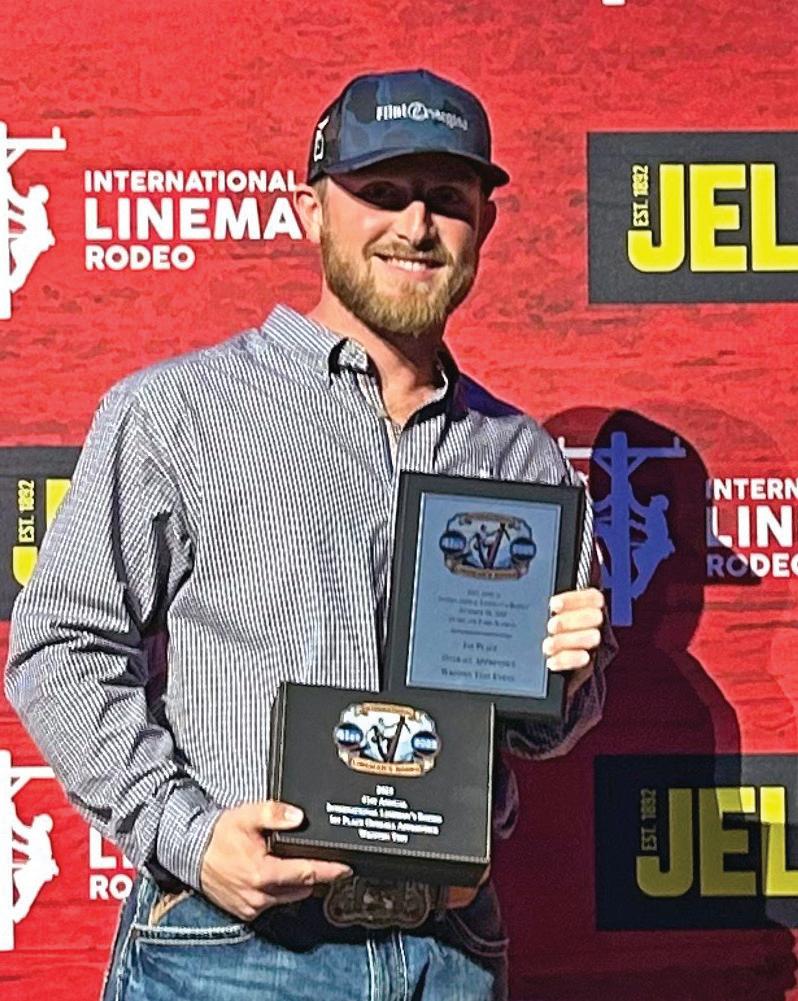
Walton, who also placed first in the written test event with 99 event points, said he prepared for the International Lineman’s Rodeo by studying the Lineman’s & Cableman’s Handbook every single day.
“I took notes and would go over them anytime I could,” he said. “My coach made questions over the book’s content, which helped even more.”
To practice for the hands-on events, he put in time after work or on his days off to run known events and perform different tasks, which could be part of the mystery events. Flint Energies also gave the competitors working days to dedicate to Rodeo practice, which he said was very helpful. He said his strategies for success were to stay calm and trust the work he put into practice.
“Nerves will get the best of you sometimes, so it’s better to remain calm during pressure situations,” Walton said. “I tried to watch the other competitors who went before me and pick up on tricks that could speed my time up in the event. Although it is important for me to show up and win, I try and remember to have fun. Sometimes I can put too much pressure on myself causing me to get in my head and then it’s a negative impact on my performance.”
Walton said he was honored to achieve such success, especially at the level of the International Lineman’s Rodeo.
“I have been dreaming of walking across that stage and receiving that belt buckle for four years now,” Walton said. “To realize that all my hard
Hunter Walton of Flint Energies topped the apprentice division by scoring the highest number of points in the lowest total event time.
work has paid off, and I am able to bring home the trophy to my company and fellow linemen who helped me over the years is very rewarding. However, I am humbled. I truly believe God gave me this opportunity and guided my hands and feet on competition day. I give all the credit and glory to Him.”
On the day of the Rodeo, the apprentices also had to compete in two mystery events, which were unknown to the participants until the International Lineman’s Rodeo Week. During the first mystery event titled, “My Mistake, Wrong Wire,” the apprentices had up to 15 minutes to swap all the connections and hardware simulating the wrong wire was made the phase wire.
The ILRA provided each competitor with a grunt sack, spare bugs, a spare Fargo or one bolt and a throw line. Apprentices could earn two-point deduction for infractions such as not making proper connections, dropping tools or material, making an incorrect bowline knot or failing to attach the grunt sack to the wire or structure. Ryne Syra, an apprentice for CenterPoint Energy, walked away with a victory with a perfect score of 100 event points and a time of 02:29:90.
During the second mystery event, “How low can you go?,” the apprentices had to climb to the neutral, remove the installed wire brush from one side of the pole and brush the other side of the neutral. Jacob Fintelman, an apprentice for Hydro. One Canada, edged out the competition with a score of 100 event points at a time of 00:21:12.
Team Tradition
While the apprentices compete on their own, the journeymen lineworkers must work together in teams of three to complete four events — the pole climb, hurtman rescue and two mystery events. The IBEW Local 47/Southern California Edison team of Fabian Gutierrez, Jose Leon and Fernando Valenzuela placed 13th out of 290 teams. While the team said they practice the skills of the line trade every day, the International Lineman’s Rodeo gives them the opportunity to incorporate everything they’ve learned into the events and have fun doing it.
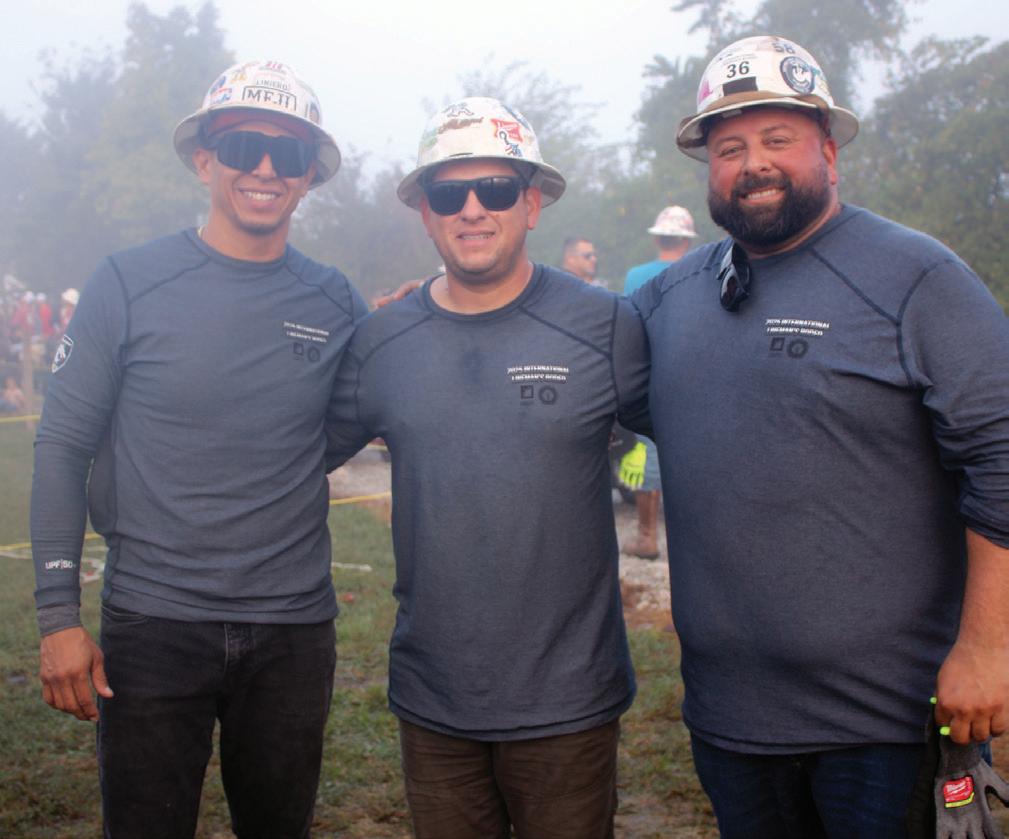
“We love it,” Guiterrez said. “We start in May and practice day in and day out. We look forward to it every year to try to make it out to the international championships. We try to enjoy every minute of it.”
Like the other journeymen teams, they didn’t know what they would be doing for the mystery events until they arrived in Kansas City for the 2025 Lineman’s Rodeo Week. For this year’s first mystery event, the trios had to untie and replace the downhill side of the double buck crossarm. Supplied with two new PLP double support ties, the teams had up to 13 minutes to complete the event.
While two journeymen scaled the 40-ft pole, the groundman was responsible for raising and lowering the crossarm. By working as a team, they tried to finish the event on time and avoid any infractions such as failure to wear PPE, cutting out on the pole or failing to use the new tie. The overall winning team was the Front Line Power Construction trio of Jerimy Matheny, Michael Luksch and Rodney Greims, who had a perfect score of 100 event points and the fastest time of 04:03:50.
For the second mystery event, “Flashed Bells Changeout,” both climbers had to work as a team to apply the required cover, install a crossarm link stick and change out the bells. Because it was a simulated energized 4 kV event, they had to wear Class 2 rubber gloves and use other protective cover such as three hoses and one split and one solid blanket. To change out both poly bells, they were provided with a Chance Ribbon hoist, Klein grip, Poly Bells and Crossarm Link Stick.
Duke Energy’s International Lineman’s Rodeo competitors, who could not attend in 2024 due to back-to-back hurricanes, finished strong in the journeyman division at the 2025 Rodeo. Case in point: the Duke Energy team of Tyler Manick, Joshua Buckner and Tyler Nickols, finished first in not only this event, but also in the entire IOU division with a total time of 13:03:44. With 400 total event points, this team also came in third overall in the journeymen best of the best category.
Duke Energy’s journeyman team of Jay Tipton, Keith Griffin and Sandy Barnhill, who were featured on the T&D World Line

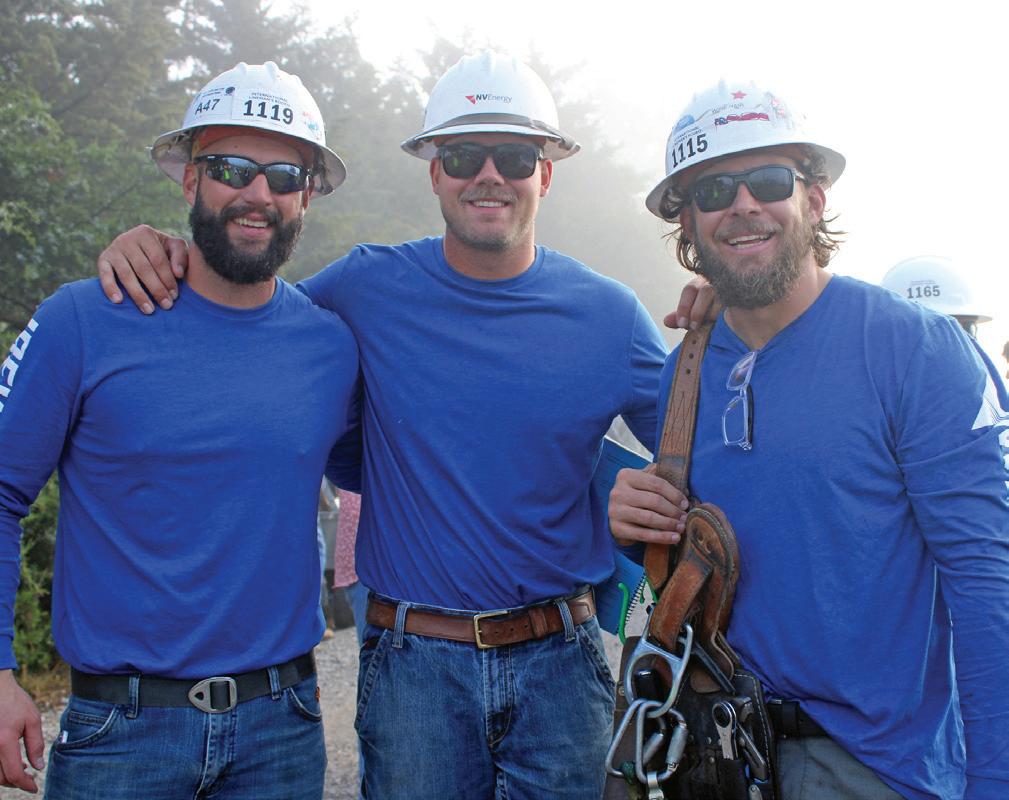
This NV Energy journeyman team worked together to showcase their skills at the 2025 International Lineman’s Rodeo.
This journeyman team of Fabian Gutierrez, Jose Leon and Fernando Valenzuela finished 13th out of 290 teams.

Life Podcast after the last time they won the senior division, won it again in 2025 with the time of 18:33:93.
Top Rodeo Champions
The competition may have grown to hit its highest numbers yet, but the events still started on time and wrapped up ahead

of schedule. Before the winners were honored on stage, Dennis Kerr, scholarship chair for the ILRA recognized the scholarship winners and a new annual $10,000 scholarship for an aspiring lineworker in honor of Warman for his dedication to the International Lineman’s Rodeo. Stremel and Doug Fllck also recognized the winner of their fourth annual gun raffle,



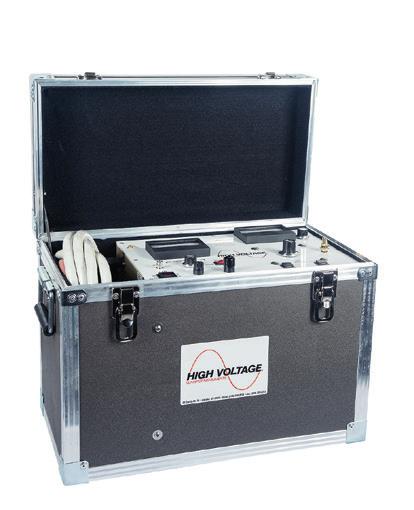




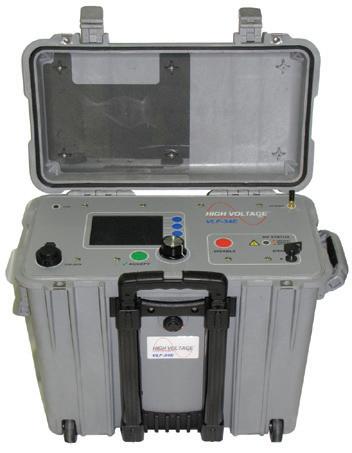
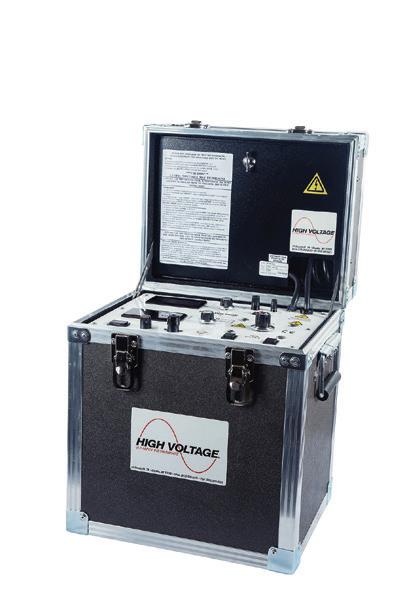
Very Low Frequency AC Technology • Cable Diagnostic TD & PD Testing • Cable Fault Locating with Controlled Energy • AC & DC Hipots, Aerial Lift Testers, Oil Testers • Ω-CHECK® Concentric Neutral Testing • Custom Engineered & Fabricated Van Pkgs.
The Sturgeon Electric California/IBEW Local 47 team of Dan Jameson, Enoc Verdin and Joe Maynes won the championship title in the journeyman division at the 2025 International Lineman’s Rodeo.
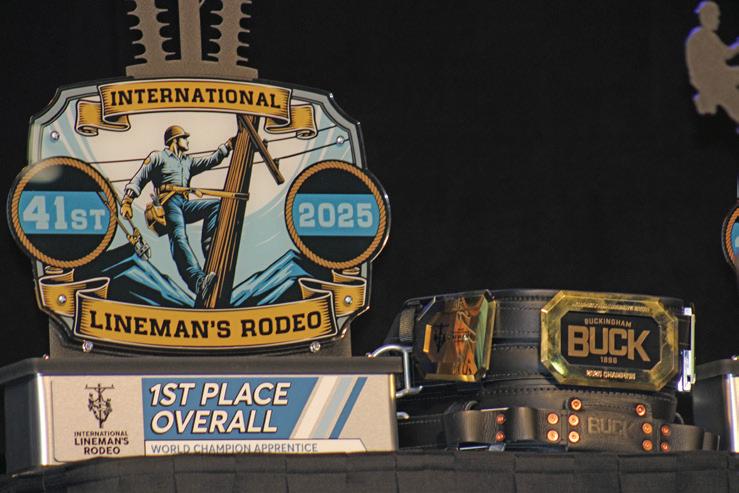
The top competitors won a championship belt and a trophy at the International Lineman’s Rodeo awards ceremony.
which benefits the ILRA scholarship fund to support students in technical training programs for the line trade.
In addition, the International Lineman’s Hall of Fame honored the inductees for 2024: Andy Batty, owner of Buckingham Manufacturing; Mike Benton of Georgia EMC; George Brooks, former president of IBEW Local 77 and owner of Brooks Hooks; Danny Raines of Raines Utility Safety Solutions; Melvin Tipsord, founder of Tips Tools; and Willie Warren of PG&E.
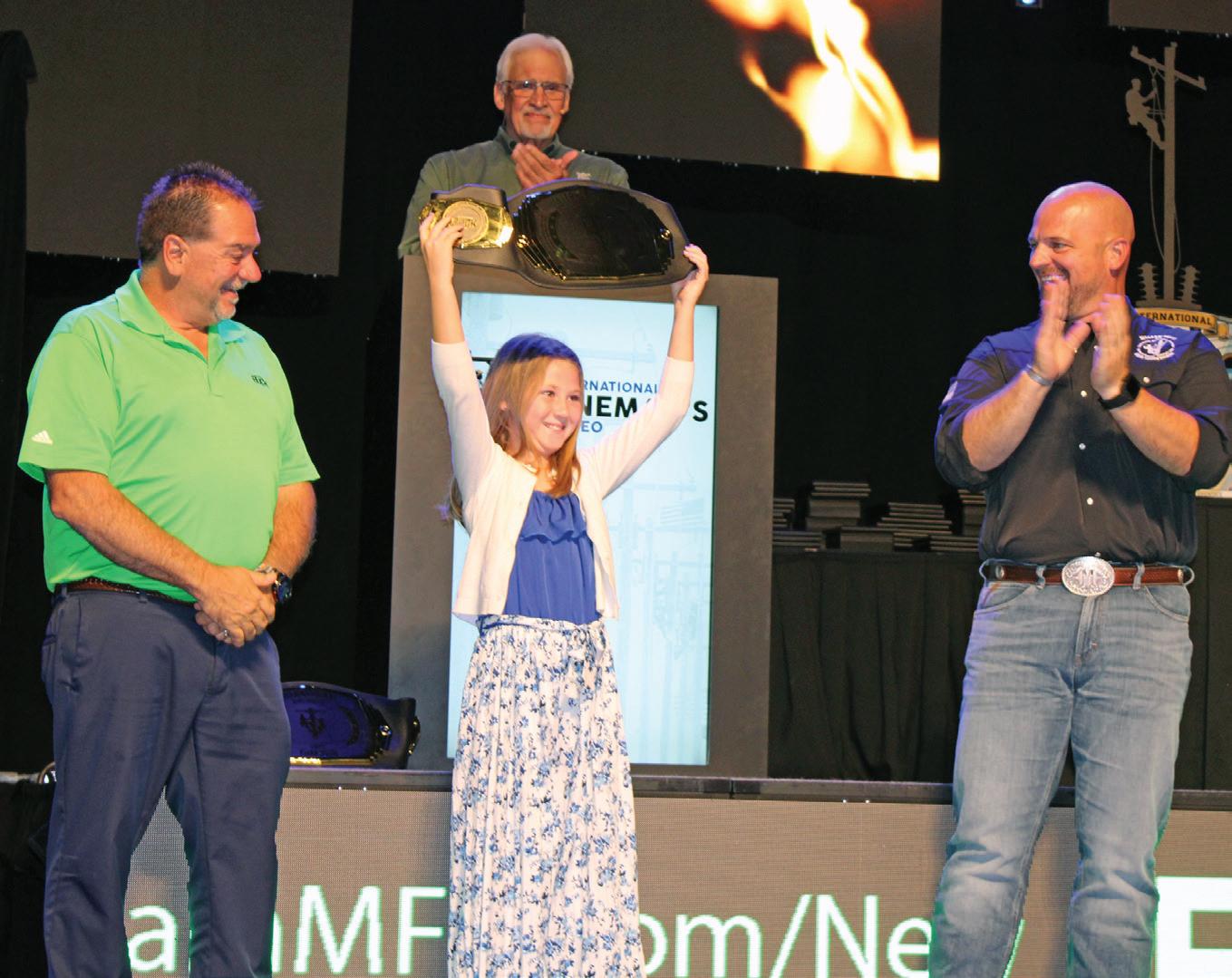
During the annual awards banquet, the ILRA also revealed the total donation amount of $83,484 for the 2025 Climbin4kids fundraiser, which benefits St. Jude Children’s Research Hospital. Next, the Missouri Valley JATC brought the top winners of its second annual Lineman’s Kids Rodeo up on stage. The organizers awarded championship belts to Adda Thomas in the 1st Step Apprentice (ages 8 to 10) category; Logan Meyers in the Future Lineman (ages 11-13) category and Parker Schleiden for Fastest Overall Aerial Rescue.
After the future lineworkers were honored, the announcer moved the spotlight to the adult competitors. Following the day of competition, the apprentices and

journeyman lineworkers donned everything from flannels and jeans to cowboy hats and boots and matching two-piece suits for their stroll on the red carpet and across the awards stage. As their names and companies flashed across the screen,

their families, friends, teammates and colleagues roared in the crowd to show support and celebrate their victory.
The journeyman team from Sturgeon Electric/IBEW Local 47 of Dan Jameson, Enoc Verdin and Joe Maynes were honored on stage at the end of the awards banquet as the champions of the 2025 International Lineman’s Rodeo with 400 total event points and a time of 12:19:39. This team also climbed to the top of the Contractor Division ahead of 50 other journeyman teams.
During the awards presentation, Kerr congratulated all the competitors and the winners of the 41st International Lineman’s Rodeo, which was the biggest event in its history.
“We put together a great event, the grounds were perfection and everyone had a great time,” he said.
Editor’s Note: For more 2025 International Lineman’s Rodeo coverage, stay tuned to the Line Life Podcast at linelife.podbean.com and check out videos, photo galleries, stories and more at tdworld.com/electric-utility-operations.
AMY FISCHBACH (amyfischbach@gmail.com) is the Field Editor for T&D World magazine and the host of the Line Life Podcast.







The winner of the 1st Step Apprentice division in the Kids Lineman Rodeo was Adda Thomas, who earned a championship belt during the awards banquet.
The International Lineman’s Rodeo finished earlier than scheduled, even with the most competitors in the history of the event.





















Inside Avista’s AI-Driven Customer Revolution
The utility shares its blueprint for layering AI onto millions of smart meter data points and how it translated those insights into improvements.
By ANDREW BARRINGTON, Avista Corp., and GAUTAM AGGARWAL, Bidgely
For most people, flipping a power switch is an unconscious act, yet it takes calculated effort by utilities to provide reliable power for millions of diverse energy habits and needs. This balance is only growing more complicated, and utilities are faced with making thousands of critical decisions across multiple teams and systems every day.
To achieve faster, more precise decision-making, utilities are increasingly relying on data to better understand each customer as an individual contributor to the grid.
For most utilities today, data sources include a combination of smart and non-smart meters, supervisory control and data
acquisition (SCADA) systems, historical and real-time weather records, and even distributed energy resources. But what does using data really look like? In its raw and unprocessed form, much of this data is a vast, uncontextualized stream of numerical entries.
For Avista Utilities, an electric and natural gas provider with 30,000 sq miles (77,700 sq km) of service territory across three states, this question ignited a multiyear exploration into what is possible when layering AI onto smart meter data. Embracing a mindset where innovation begets innovation, Avista explored the potential power of granular customer insights hidden within millions of data points and how those learnings could be applied
across three core business pillars: customers, workforce and the grid.
High Bill Inquiries
Oftentimes, customer engagement and workforce enablement go hand in hand. Thanks largely to nonintrusive load monitoring (a sophisticated combination of advanced algorithms and machine learning to dissect a home’s total energy usage), AI analytics give utility employees and customers new appliancelevel consumption insight into individual homes.
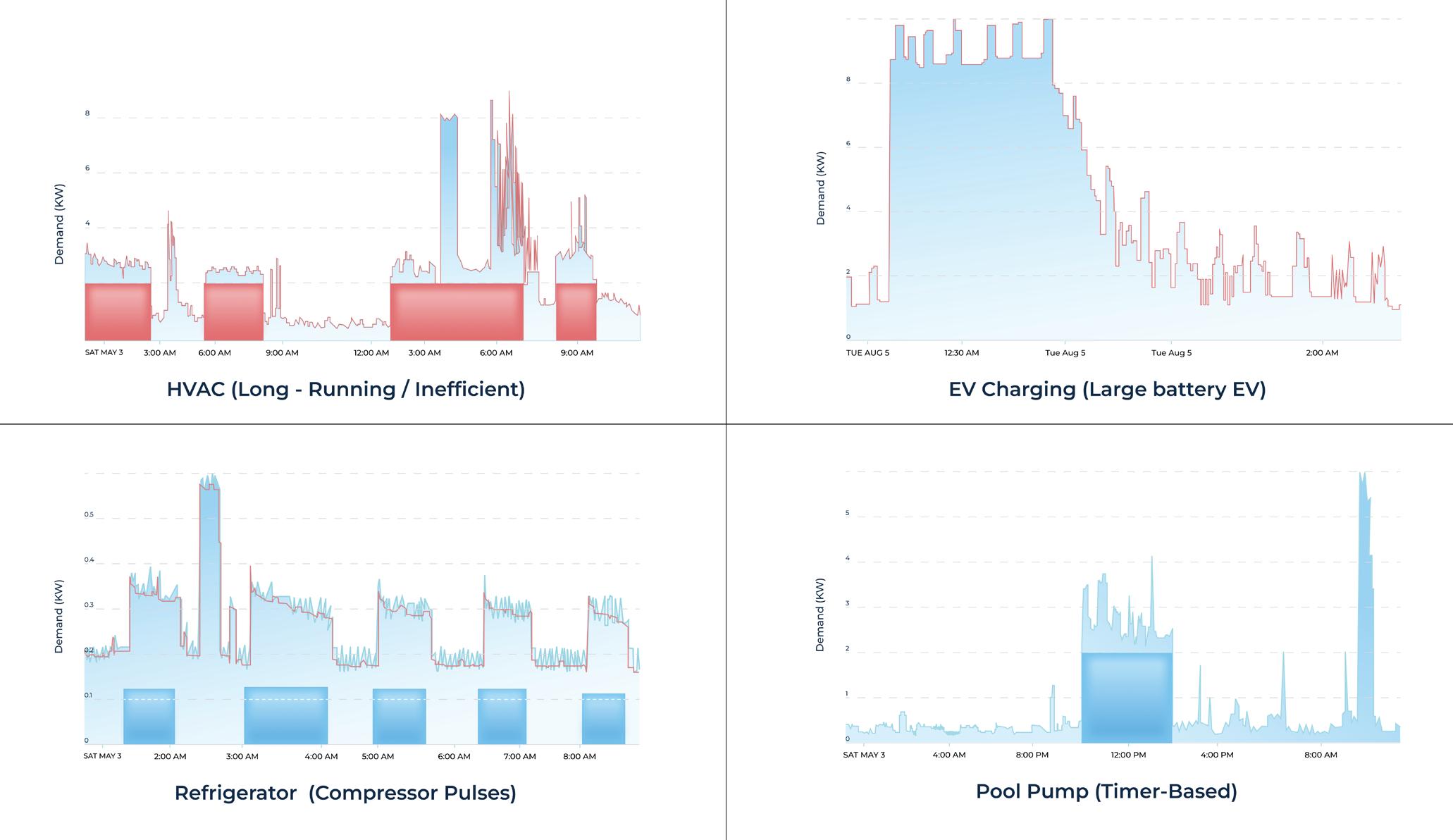
Traditional data analytics is applied to aggregate energy consumption. AI, however, identifies the unique fingerprints of individual appliances to recognize subtle on/off changes and accurately determine what is in use, how much energy it is consuming and when. This information enables utilities to build detailed usage profiles for everything from refrigerators to washing machines, revealing not just energy consumption and cost but also typical usage patterns and even anomalies that could signal a faulty appliance.
For Avista, this new intelligence unlocked an opportunity to address a critical priority: reducing the volume of high bill inquiries to its call centers.
While some high bill questions start and end with a customer service representative (CSR) conversation, Avista — like other utilities — often dispatches a crew for costly, resource-intensive on-site meter tests to investigate further. Typically, the meter functions properly, revealing customers’ limited awareness of their energy consumption. It is not that customers fail to grasp the link between usage and cost; the problem is that a monthly
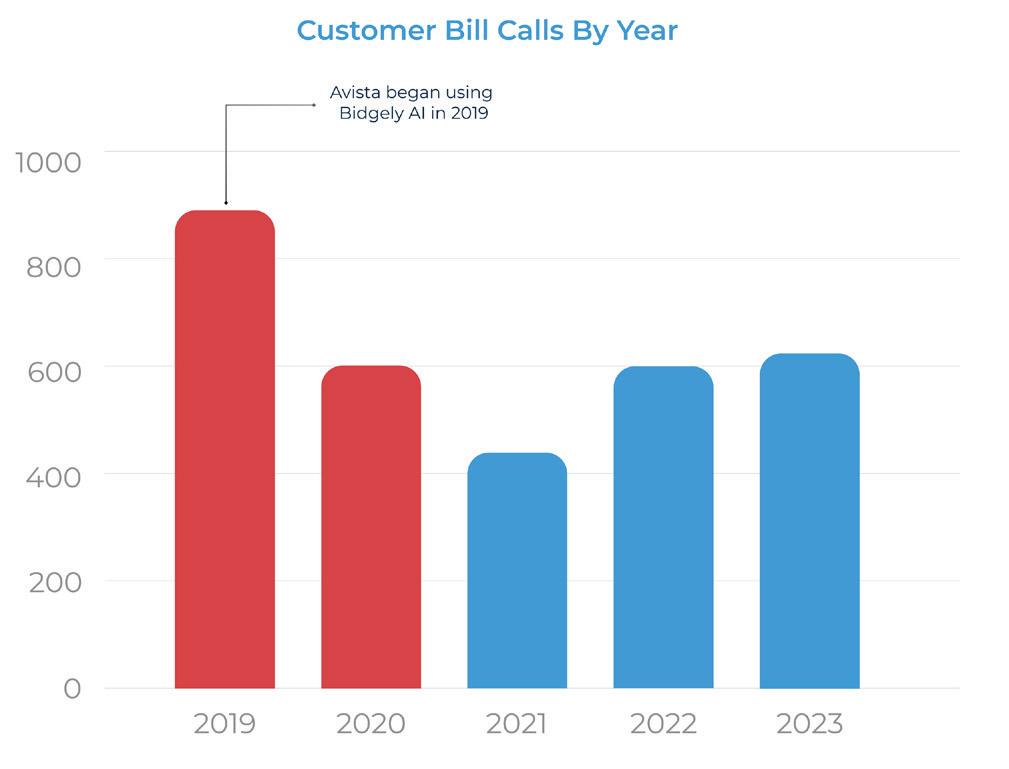
total kilowatt-hour (kWh) reading offers no relatable insight. By equipping CSRs with one-click access to appliance-level consumption insights for every home, Avista’s service teams achieved faster call resolution times and significantly improved satisfaction among customers. High bill investigation truck rolls decreased by nearly 27% in 2020 alone.
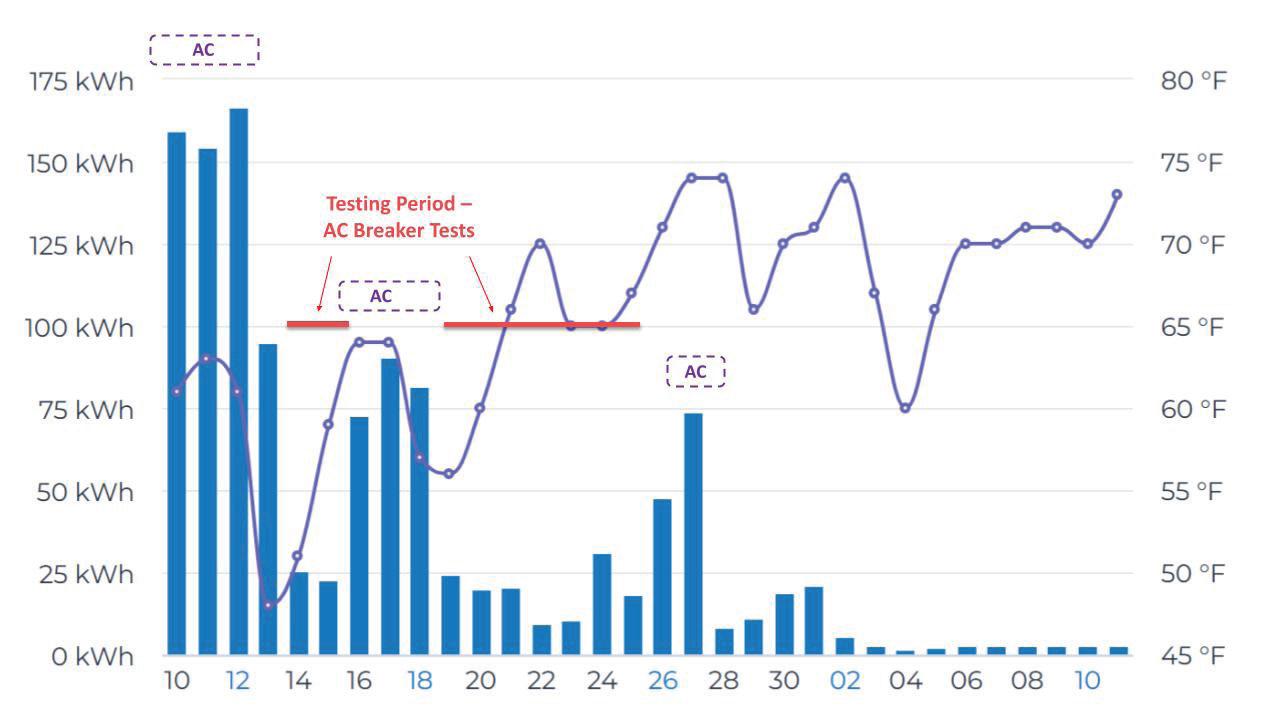
For example, the CSR can look at a breakdown of the customer’s consumption and see if a specific appliance was acting up or if weather conditions were a factor. If the spike was due to increased cooling usage during a recent heat wave, the CSR can recommend specific thermostat adjustments or an insulation upgrade program.
Direct To Customers
This success gave Avista the confidence to extend these capabilities directly to its customers, with the overarching goal now to reduce high bill situations altogether. The utility made the following resources available to customers on its web portal:
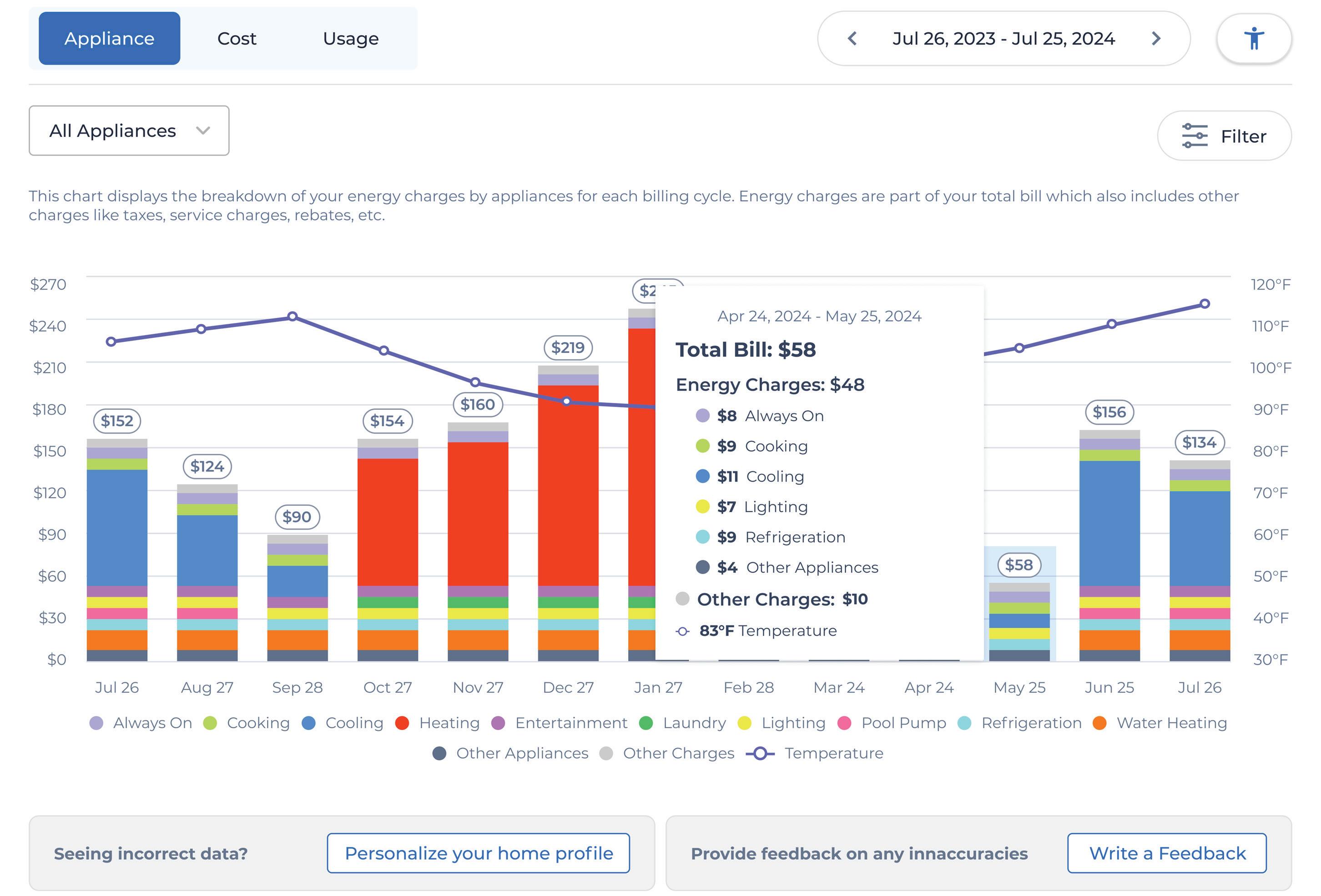
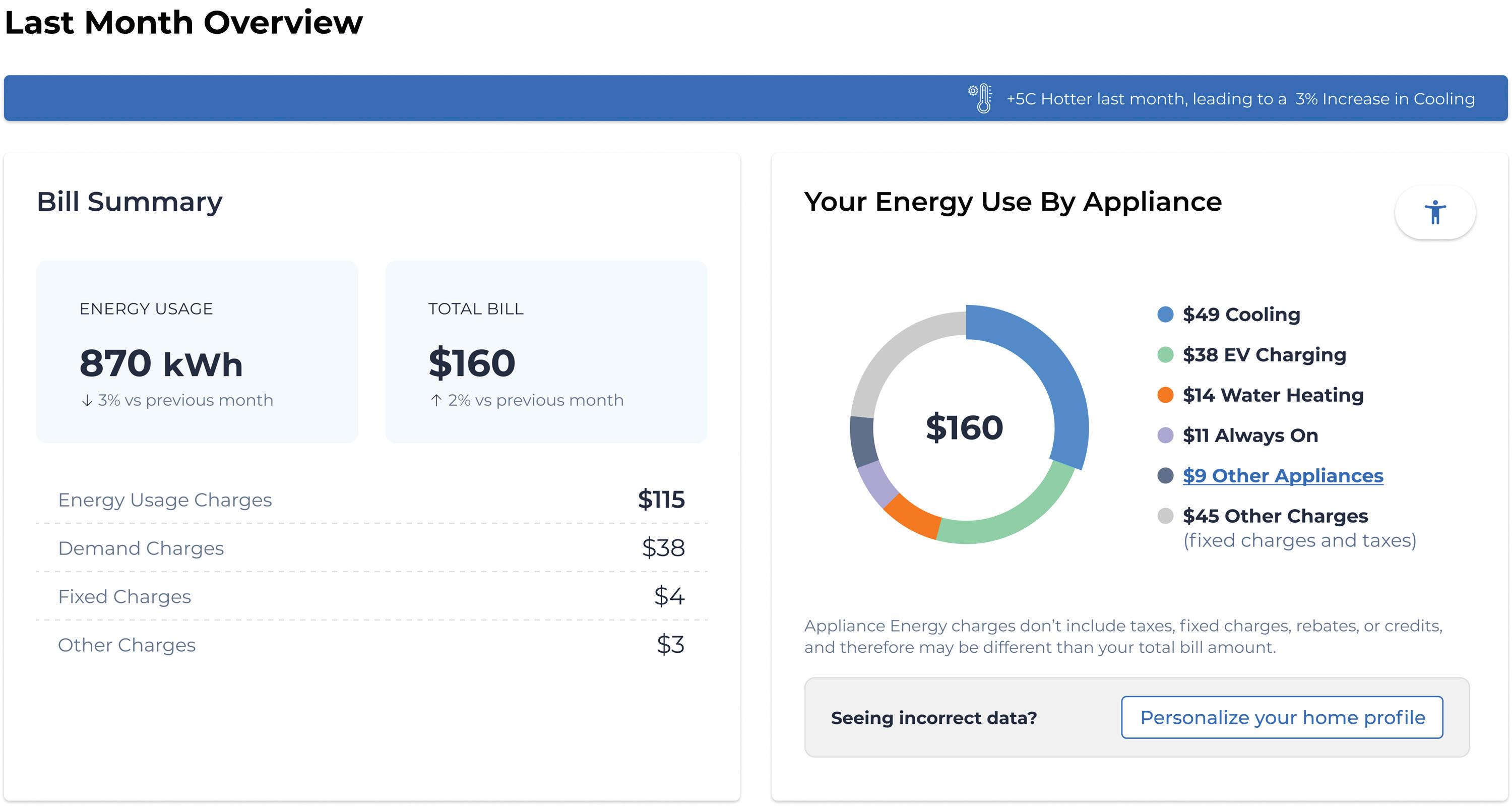
• Bill itemization reports, detailing energy consumption each month by appliance (cooling, heating, laundry, dishwashing, lighting and even electric vehicle charging, if applicable).
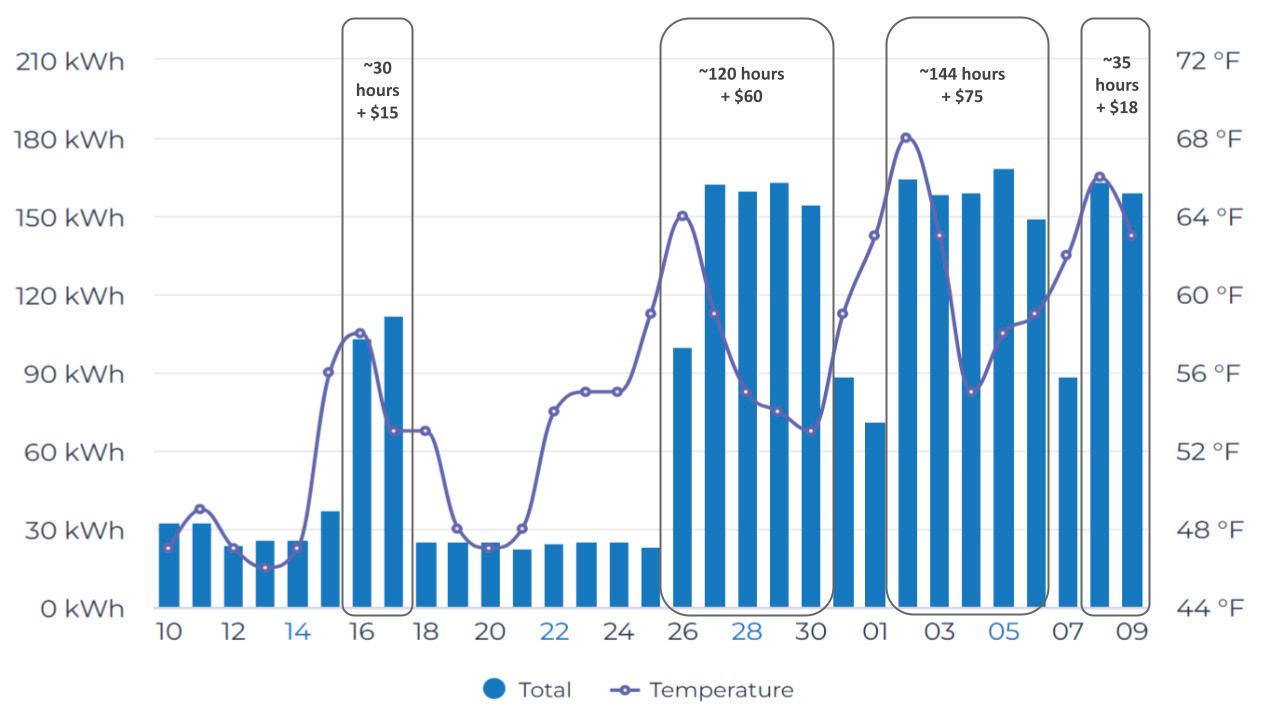
• Month-after-month and year-over-year usage comparisons, overlaid with localized temperature history.
• Bill comparison tool, analyzing customers’ top five highest-use appliances in any given month with detailed financial and usage breakdowns for each.
These accessible, easy-to-digest communications empowered customers to self-serve their energy data for a deeper
understanding of their consumption and the ability to make smarter energy decisions independently. By tracking typical usage patterns and detecting anomalies, Avista has been able to resolve issues related to appliance inefficiencies. For example, one customer noticed a dramatic spike in energy costs, jumping from US$77 to $287 between consecutive
months with an alarming $600 projected bill for the upcoming cycle. Leveraging AI energy insights to investigate the appliance usage, Avista detected a faulty heat pump where a fused relay caused both the heat pump and air conditioner to run concurrently. These immediate, data-driven insights enabled Avista to pinpoint the problem quickly and save the customer from an exorbitant and ongoing financial burden.
Underserved Communities
But this is not where enhanced customer support ends. In fact, it opens doors to better serve all customers, including traditionally underserved or harder-to-reach customer communities.
As part of its partnership with SNAP, a local nonprofit aiding vulnerable neighbors, Avista was made aware of a customer with unusually high energy usage (over 38,000 kWh in 12 months) for a 1700-sq ft (158-sq m) house.
While previous meter inspections had not identified any issues, this time Avista used its AI-powered energy insights to identify inefficient heater usage and an unknown “envelope” issue. A subsequent home inspection confirmed the attic had insufficient insulation, below building codes. After installing additional insulation in the attic and to the water heater, the home’s overall energy bill was cut nearly in half, reducing heating costs from $424 to $163. In the three months following the bill reduction, energy consumption decreased by 6500 kWh, saving approximately $700 compared to the previous year.
The Energy Insights chart displays the breakdown of a customer’s energy charges by appliances across the selected timeframe.
Avista began using Bidgely AI in 2019, leading to an immediate drop in high bill calls. A notable spike in 2022-2023, driven by record-low winter temperatures, highlights customers' persistent challenge in understanding the direct impact of increased heating on their energy bills.
Segmentation and Targeting
By fostering greater energy literacy and empowering both CSRs and customers to make informed, data-driven decisions, Avista learned that addressing an immediate challenge — like high bill inquiries — could be the path to preventing them in the future.
Beyond reactive customer support, AI is empowering Avista to explore proactive grid strategies that improve load management and energy efficiency through more precise customer segmentation and targeting.
By gaining deeper insight into individual customers’ usage patterns, Avista optimized its outreach through new program initiatives, including a home energy audit offer aimed at households with above-average consumption (11,500 kWh annually). Filtering by key characteristics such as home age and square footage, the utility successfully narrowed a pool of 210,000 customers to 75,000 with the greatest po tential to benefit. These customers then received more targeted, personalized messaging.
The audits also identified 22,000 homes served by a constrained feeder. The utility sends personalized energy-efficiency tips and recommendations to these customers in the hopes of reducing significant strain.
Avista was even able to detect differences in average winter home energy usage, discerning between homes with efficient shells (good insulation, windows, roof, etc.) and those with poor thermal performance or equipment degradation.
Avista also launched a bill assistance program offering discounts of up to 90% to eligible households to support its most vulnerable customers. While Avista
always knew these customers existed, AI analytics now allows it to more accurately pinpoint and connect with those who need help the most.
This targeted approach proved highly effective. By identifying
Avista successfully used AI analytics data in its email campaigns to more accurately target customers who could benefit from a bill assistance program.

Personalized Bill Itemization allows customers to understand how each appliance category contributes to their monthly energy bill.
Avista customer service agents are able to use AI analytics to detect and resolve appliance inefficiencies. In this example, an agent detected abnormal spikes and worked with a customer to perform various tests to determine their air conditioner was drawing the extra power. The agent then was able to recommend that an HVAC technician come out to inspect the unit.
the right recipients, Avista achieved a 4.8% click-through rate on program emails (significantly higher than the 1.8% industry average) — proving that meaningful data can yield tangible, positive outcomes.
The Potential of GenAI
When it comes to empowering a utility’s workforce to deliver superior service and operate with stronger decision-making, AI has already proven exceptionally capable. Now, generative AI (GenAI) is emerging to further enhance these capabilities with a new dimension of operational efficiency and insight.
Shifting from traditional analytics to a more conversational interface, GenAI
empowers employees to easily access complex information and generate actionable recommendations by asking their own questions to the data — without needing to be a data analyst. This capability promises to streamline workflows, lighten staff’s cognitive burden and cultivate a more agile, responsive workforce prepared for the increasingly complex demands of modern energy management.
Building on its existing AI-powered CSR tools, Avista is now piloting GenAI implementation to further reduce call times and ultimately prevent repeat calls from the same customers.
Through what the utility is calling a GenAI energy assistant proof of concept (POC), Avista’s CSRs have a GenAI copilot during customer interactions. This assistant instantly compiles all relevant

OUR WUNPEECE TRANSMISSION SPACERS REDEFINE THE INDUSTRY STANDARD FOR UNDERGROUND POWER TRANSMISSION INSTALLATIONS. WITH PRECISION ENGINEERING AND UNMATCHED QUALITY,
information into a single high-bill-analyzer report, eliminating the need for CSRs to jump between multiple platforms for meter reads, billing history and appliance-level data. It also prompts the CSR with relevant questions and handles the heavy data lifting (that is, breaking down usage by previous month or year and clarifying what percentage or dollar amount is due to consumption vs. factors
like taxes or kilowatt-hour rate changes) rather than requiring the CSR’s manual computation.
These days, Avista’s CSRs using the GenAI assistance gladly welcome high bill calls because they are now some of the easier calls to manage.
Future of Data-Driven Utilities
As the grid continues to grow more

complex in the years ahead, the ability to make critical decisions with data-driven confidence will be invaluable. By exploring the possibilities of AI, Avista is paving a path to potentially save time and build efficiencies organization-wide. Learning to work within AI parameters and observing the iterative evolution of these tools will be integral parts of an ongoing journey, but one worth taking to create a more intelligent, customer-centric energy ecosystem.
ANDREW BARRINGTON is director of customer service at Avista Corp., where he leads strategic initiatives to enhance customer experience and operational efficiency. With a focus on innovation and team development, he drives service excellence across the organization.
GAUTAM AGGARWAL is chief revenue officer at Bidgely, where he spearheads the company’s mission to accelerate the adoption of a clean energy future with energy data and AI — empowering global utilities and energy providers with smart energy decisions and delivering a reliable, sustainable and resilient grid.



Ocala Electric Helps Customers Beat Back Bills with Prepay
Prepay allows customers to pay into a credit balance.
By CHAD LYNCH, Ocala Electric Utility and DAVID CONN, Exceleron


The City of Ocala, Florida is almost in the dead center of the state, about an hour and a half drive northwest of the town with the big theme parks. About 64,000 people live there — up almost 13% since the last census. The poverty rate is substantially higher than the national average, and in Florida generally residents saw electric rates rise 10% in the past year.
Ocala, and its municipal utility, Ocala Electric Utility (OEU), care about the cost of the vital services they provide. In 2010,
ID 183617188 © Popa Sorin | Dreamstime.com
379404065 © Swathi Chirra | Dreamstime.com


city leadership heard about the voluntary prepay service and decided they wanted it for their customers.
This was about a year after Ocala had deployed its Advanced Metering Infrastructure (AMI) system. At the time, the business driver for prepay was customer debt, which had climbed into the millions by then. Ocala decided to work with prepay provider Exceleron, using that company’s MyUsage prepay platform in what would become one of the oldest modern prepay programs in North America.
How It Works
With prepay, customers don’t receive a bill for a month’s worth of usage. Instead, they pay into a credit balance — as much and as often as they like. Each day, as they use energy their balance is decreased by the daily cost. Payments immediately “top up” their balance. Frequent alerts tell customers how much they have left before
they need to make a payment. If service stops after they’ve exhausted their funds, a minimal payment can restore it. And if they were past due when they enrolled, they can reduce their arrearage gradually over time with a percentage of each new payment they make; Ocala chose 20% as the “debt recovery” share.
Prepay promises complete avoidance of new debt, and no need for security deposits or disconnect/reconnect fees — all major benefits for Ocala’s customers. And prepay customers employ those frequent usage and cost alerts to better manage their residential energy and in aggregate reduce consumption between 5% and 14% nationally.
Success Stories
After its AMI network went live, Ocala turned to working with Exceleron to stand up the new prepay system. It launched in 2011, with a small pilot of about 25 employees. Soon afterward, the project leaders learned about a customer, Theresa Cavanaugh, who was facing a very tough financial situation. They decided to let her enroll, becoming the first non-employee in the program.
“It gave me the ability to be able to move into my new residence which, without this program, I would definitely would not have been able to accomplish,” Cavanaugh relates in an interview she did about the new Pay As You Go program. “There’s no doubt in my mind that I would not be living here had the City of Ocala not permitted me to join this power program.”
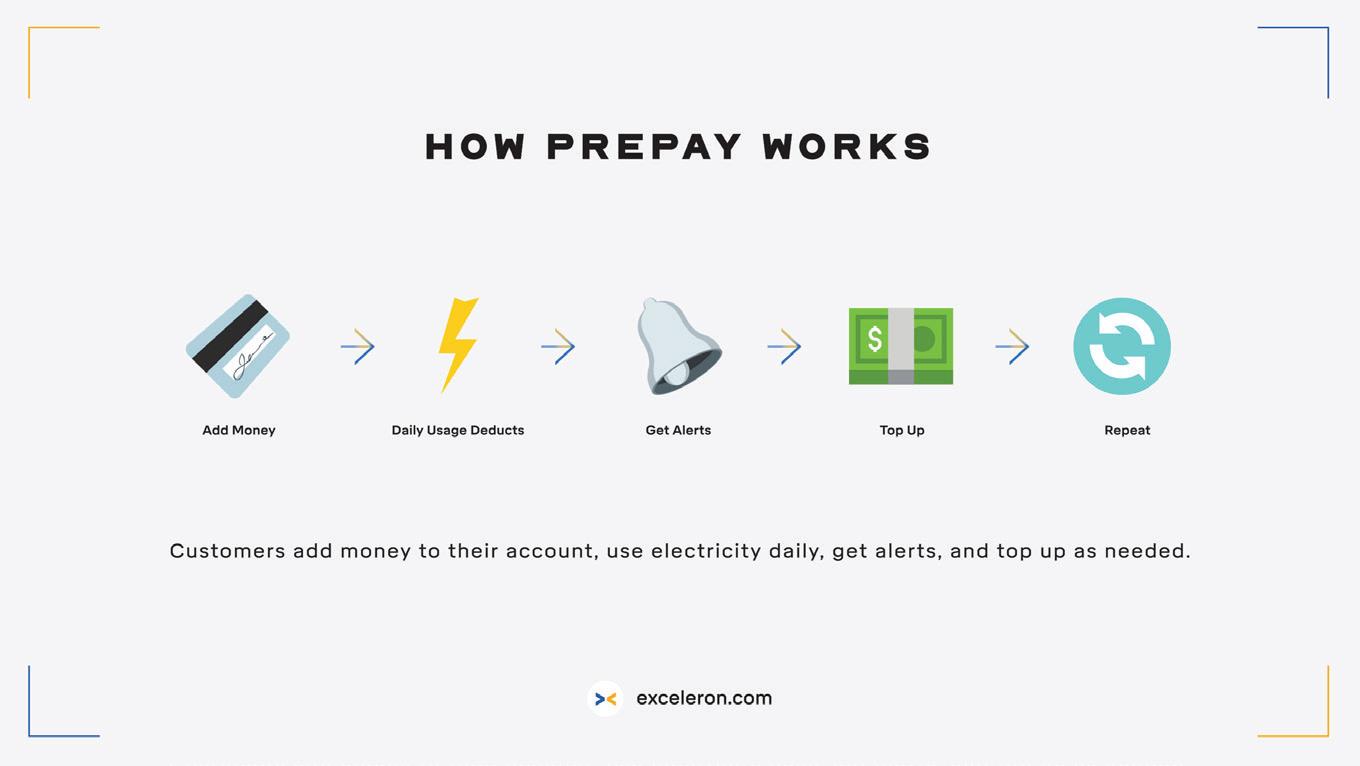
Scenes from Ocala: Power lines crossing the Ocala National Forest. Swamp boat tours at Silver Spring State Park, Ocala, Florida. An equestrian statue at the World Equestrian Center in Ocala, Florida.


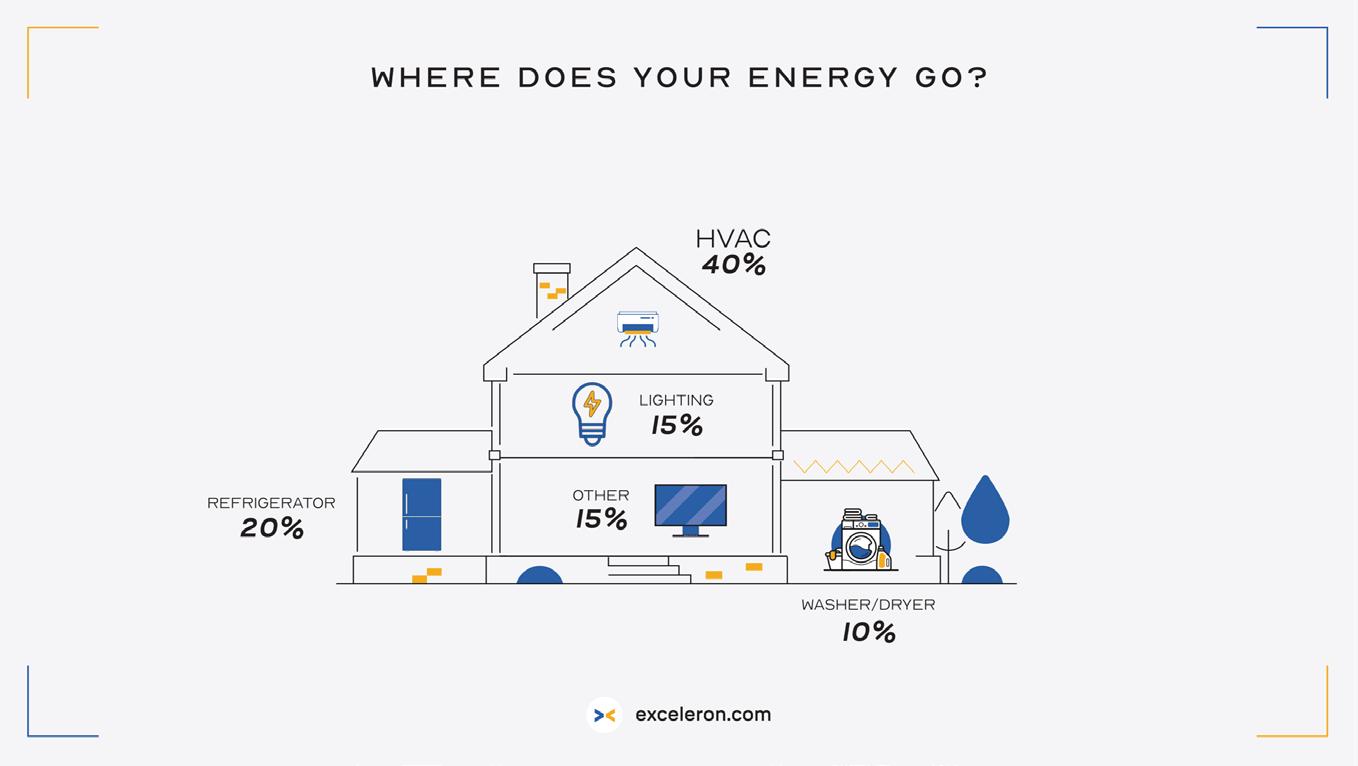
Beyond the waived deposits and gradual debt paydown, Cavanaugh found the program awakened her to ways to save energy at home. “Every single day I look at that [prepay] report and it’s like, ‘Oh, wow, I spent an extra 50 cents yesterday; I’m going to turn that fan off.’ It sounds silly, but you really start thinking about those things.”
Almost immediately customers started seeing the benefits. Ocala in 2008 had locked in gas prices as they were rising. But then they started falling, briefly leaving the utility with among the highest rates in Florida. But prepay customers like Theresa Cavanaugh could watch their usage more closely, and take reasonable steps to reduce it.
The implementation process went smoothly, with seamless integrations into Ocala’s PeopleSoft customer information system (later updated to their current
Prepay promises complete avoidance of new debt, and no need for security deposits or disconnect/reconnect fees.
Cogsdale CIS). The biggest challenge was the need to obtain AMI usage data to send to Exceleron. Ocala had no meter data management (MDM) system at the time, and sent the data in XML files to Exceleron, which did the work of validating and “scrubbing” the data to make the daily rate calculations.
Moving to MDM
The next project was to work with Exceleron to build the utility’s first MDM system in 2012. Ocala still uses that system today, and almost immediately they began to track the cost savings from the alerts the system generated to flag problems as they emerged.
In 2024, proactive monitoring and maintenance helped prevent issues on the OEU system and at customer homes, resulting in an estimated total savings of approximately $170,000 for both customers and the City.
The new disaggregation pilot with Exceleron will help customers isolate energy uses in the home and conserve even more.
OEU customer Theresa Cavanaugh in a 2011 YouTube video relating her experience as the company’s first prepay customer.
Conservation through prepay gives the customers the tools they need to make energy-saving decisions.
Today, nearly 15 years after launching their Pay As You Go program, Ocala is still looking to innovate. Exceleron is working to help Ocala become one of the first to integrate energy disaggregation into its prepay program later this year. With “disagg” they’ll use proprietary algorithms to break down a customer’s energy usage by device. Then personalized alerts will tell customers how they can extend their “days remaining” by addressing specific energy users in the home.
CHAD LYNCH is Deputy Director at Ocala Electric Utility, where he started nearly 26 years ago as a draftsman in the engineering department. Among other efforts, Lynch led the projects to implement Ocala’s geographic information system (GIS), its Outage Management System, and an Interactive Voice System (IVR). He also helped implement Ocala’s MDM system, and its “Pay As You Go” prepay program.
DAVID CONN is Vice President of Business Development and Policy at Exceleron, the leading provider of utility prepay service and related payment services. Before joining Exceleron in 2024, Conn served for nearly 16 years as Energy Assistance Program Manager at Baltimore Gas and Electric Co., where he led a prepay pilot program in 2020. Before BGE Conn was a nonprofit lobbyist, and a business journalist at several newspapers.




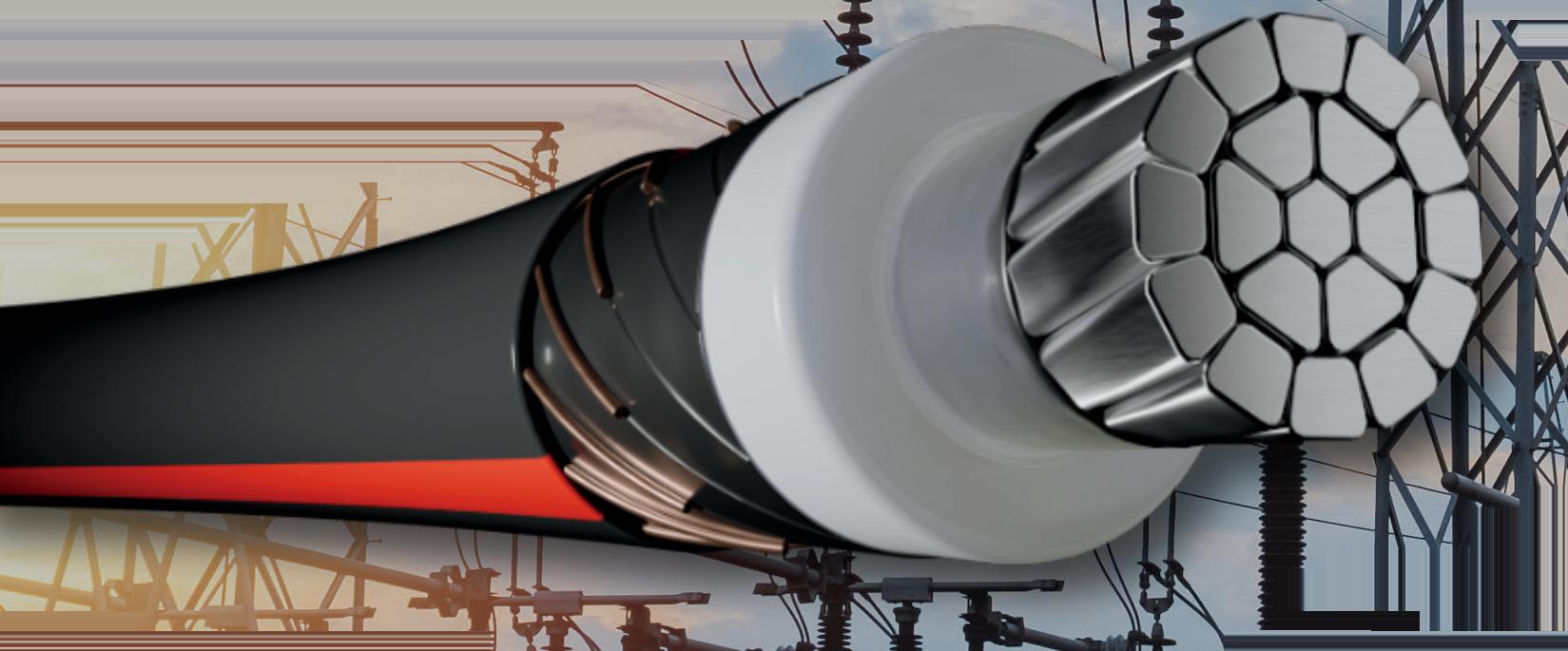

Physical substation attacks could lead to serious injury or death for perpetrators, workers and first responders, as well as high repair costs for owners and operators.
Strategies for Budgeting Substation Security
Strategic budgeting approaches prioritize innovation while maintaining fiscal responsibility.
By CHRIS OTT, POWER Engineers, member of WSP
Substations are vital to the power grid, ensuring electricity reaches homes, businesses and essential services. However, they are facing constantly evolving threats ranging from cyberattacks to physical attacks. As these risks grow in sophistication and frequency, securing substations becomes more critical than ever.
For utility budgeters, the challenge lies in integrating advanced security technologies within existing financial constraints. To navigate this complex landscape, substation owners and operators must adopt strategic budgeting approaches that
prioritize innovation while maintaining fiscal responsibility.
Current Challenges
The traditional budgetary cycle in utilities often spans several years, requiring long-term planning that can inadvertently hinder the adoption of cutting-edge security technologies. While this foresight is intended to align funding with strategic priorities, it presents significant challenges in an industry where technological advancements occur at a rapid pace.
One major limitation is the risk of obsolescence. Technologies identified and
earmarked for investment during initial planning stages may no longer represent the most effective solutions by the time they are implemented. This gap between planning and execution leaves utilities vulnerable, as older technologies might not suffice against increasingly sophisticated threats.
Rigid operational and maintenance budgets exacerbate this issue. These budgets are typically inflexible, making it difficult to allocate funds for unexpected upgrades or innovations unless emergency
Chris Ott and colleague Charlie Koenig discuss strategic substation security upgrades.
or urgent circumstances arise. In such cases, resources must be reallocated swiftly — often at the expense of other critical projects — to address immediate vulnerabilities.
Moreover, the financial ecosystem within which utilities operate requires meticulous alignment with regulatory requirements and fiscal constraints. This dynamic creates a delicate balancing act: ensuring robust protection while navigating preplanned budgeting cycles that may not accommodate emerging needs or adjustments prompted by new threat landscapes.
To mitigate these challenges, utilities must explore more flexible budgeting strategies that allow for timely integration of forward-thinking solutions without sacrificing fiscal responsibility. By adopting agile approaches and fostering cross-departmental collaboration during budget planning processes, utilities can better anticipate technological shifts and ensure their security measures remain effective against evolving threats.
Flexible Budgeting Approaches
The following approaches can help utilities to navigate financial constraints without compromising on timely solutions.
• Phased installations: Breaking down security upgrades into phases enables utilities to manage costs over time. By prioritizing immediate needs and gradually implementing additional measures as funding becomes available, utilities can deploy critical protections without overwhelming budgets.
• Infrastructure-first strategy: Laying essential conduits and raceways during initial construction phases prepares substations for future technology integration. This method minimizes disruptions and offers a cost-effective foundation for substation security enhancements farther down the line.
• Collaborative planning: Engaging cross-departmental teams during budget planning cycles fosters a unified approach to security challenges. Utilities can optimize resource use and enhance overall resilience by sharing insights and
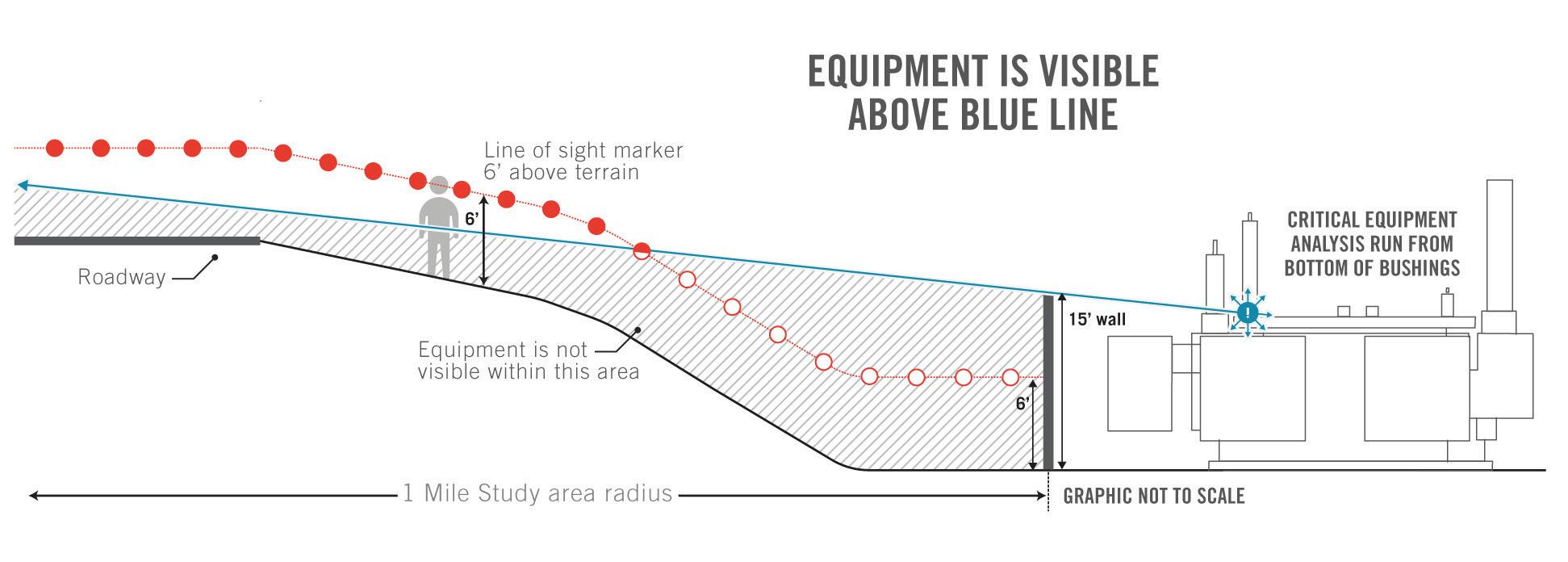













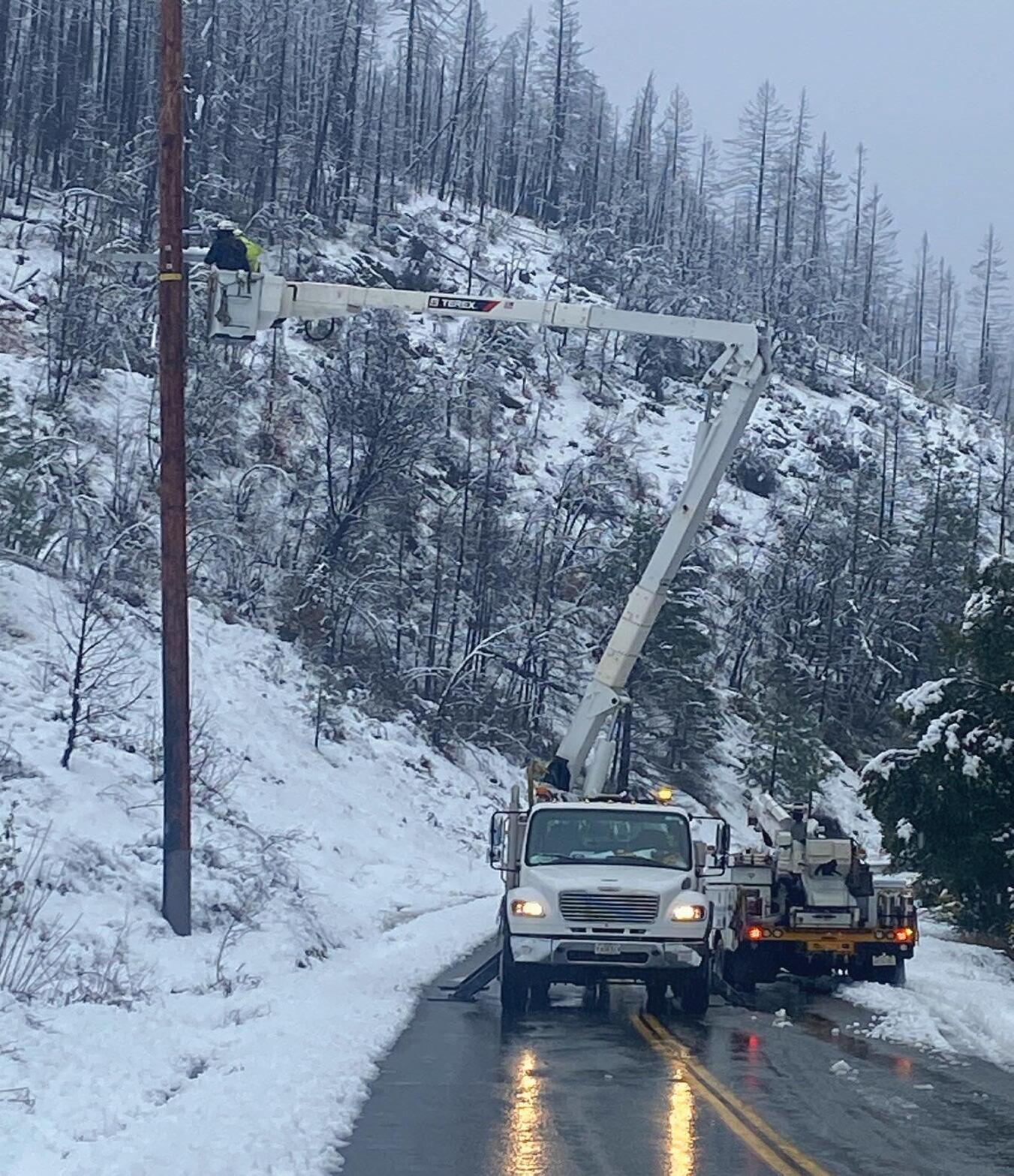




Leveraging tools and methods that reduce line of sight to critical assets can reduce security upgrade costs.
aligning financial allocations with strategic goals. Additionally, establishing a security-focused culture that is supported by all levels within an organization is essential to the successful implementation of robust protective strategies.
By adopting phased installations, prioritizing infrastructurefirst planning and fostering collaboration, utilities can more effectively facilitate the timely implementation of advanced substation security solutions.
Risk-Based Prioritization
It is not always possible to mitigate every vulnerability within the available budget. Focusing on realistic risks through detailed analyses allows protective measures to align with the most pressing vulnerabilities unique to each facility.
Granular evaluations considering geographic factors, historical data and infrastructure specifics enable targeted interventions where they are needed most. This precision not only maximizes the effectiveness of enhancements but also prevents wasting resources on unnecessary or ineffective solutions.
However, traditional security assessment methodologies can be subjective and miss crucial vulnerabilities, leaving many utilities searching for more comprehensive data-backed assessment strategies.
Embracing Digital Transformation
The digital transformation is revealing many powerful new tools for enhancing substation security, particularly in the realm of security assessments. These tools leverage emerging technologies to identify and mitigate vulnerabilities more quickly, efficiently and comprehensively than ever before. Following are some notable driving technologies in the security sector:
• Real-time analytics: Digitized reports enable continuous system updates through live data feeds, offering accurate snapshots of current conditions within a substation. This immediacy allows swift identification of vulnerabilities or anomalies requiring attention.
• Advanced modeling: Digital models can provide dynamic visualizations that illustrate complex scenarios and line of sight clearly, facilitating informed decision-making processes among stakeholders regarding any potential impacts on operations or finances. Combined with realtime analytics, these advanced models can facilitate realtime assessment and mitigation testing, enabling teams to virtually test proposed solutions and make strategic decisions long before construction begins on a project.
• Artificial intelligence: AI also has the potential to enhance real-time data analytics, improve threat detection and response times, optimize resource allocation through predictive modeling and facilitate more accurate risk assessments.
By leveraging these types of technologies, utilities can enhance the precision and efficiency of vulnerability assessments, ultimately improving protection strategies and often minimizing costs.
However, according to experts like Jason Pfaff, chief innovation officer at POWER Engineers Inc., member of WSP, “Technology alone is not a solution. Without active expert involvement, its impact is limited. To make meaningful progress, we must leverage the expertise of subject matter experts and use the technology not just as an add-on but as part of a holistic strategy.”
Collaborative Industry Practices
Collaboration among utilities also has proven to be a powerful tool for enhancing substation security. By sharing insights, strategies and emerging technologies, utilities can collectively strengthen their defenses against sophisticated attacks.
Industry forums and working groups provide invaluable platforms for utilities to exchange knowledge and experiences. These collaborations foster innovation by exposing utilities to diverse perspectives on security challenges and solutions. Engaging with peers allows utilities to learn from successful implementations elsewhere, identifying what works effectively and why.
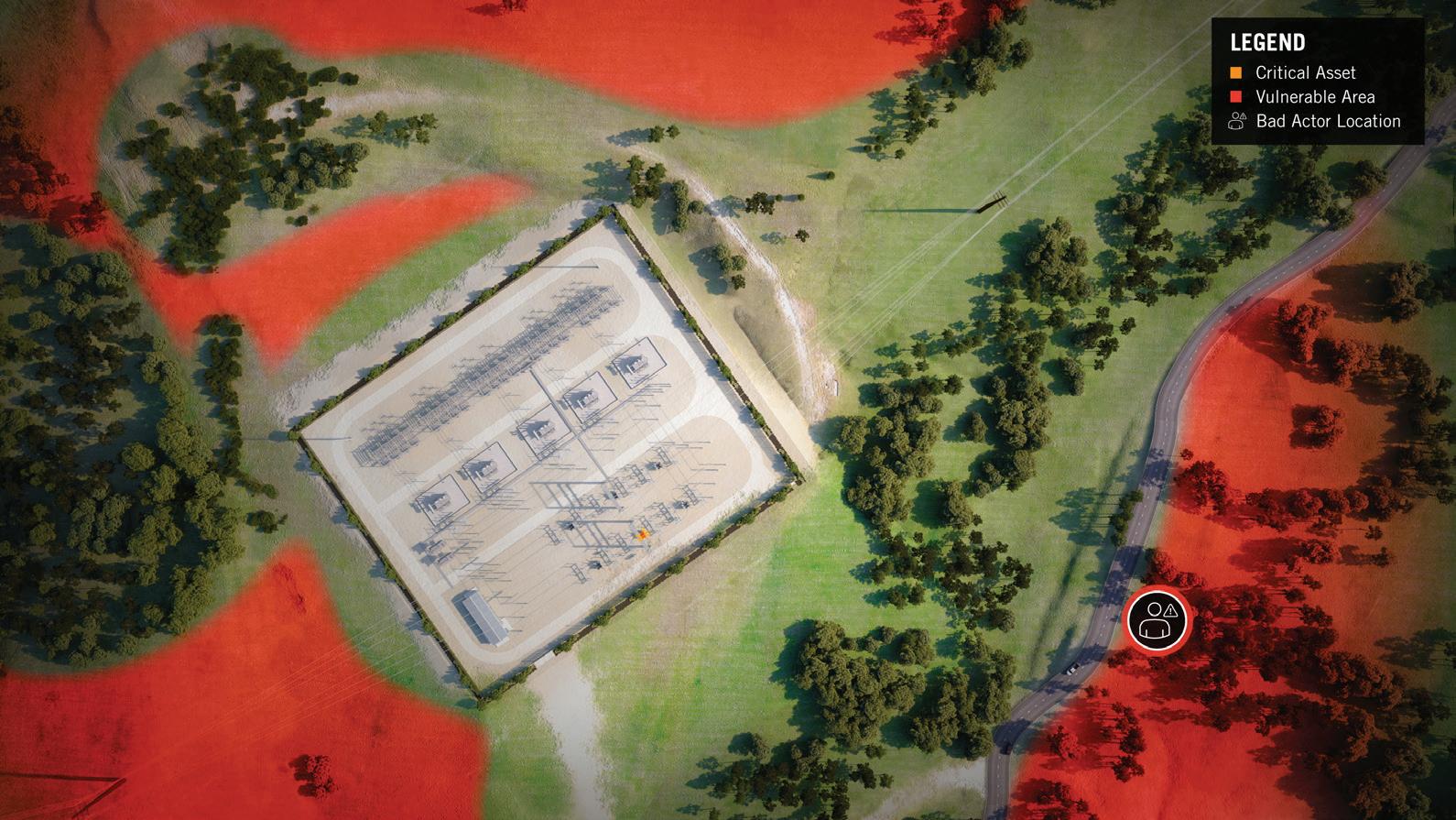
Additionally, collaborative efforts extend beyond sharing ideas; they involve joint initiatives such as emergency equipment-sharing programs that facilitate rapid recovery in case of critical component failures. Such alliances offer access to resources that might otherwise be unavailable individually, bolstering resilience across the sector.
Meerkat by POWER Engineers, member of WSP, uses cuttingedge line-of-sight technology to identify where critical assets are vulnerable and how to best protect them from physical attacks.
By leveraging collective expertise through collaboration, utilities can refine their approaches based on proven methods while avoiding potential pitfalls encountered by others.
Moving Forward
Utility budgeters play a pivotal role in driving innovation in substation security efforts. By adopting flexible strategies, focusing on risk-based prioritization and embracing digital transformation, they can position their organizations to stay ahead of evolving threats and achieve robust and reliable power delivery systems. Through commitment to continuous progress and collaboration, industry leaders and experts alike can safeguard
infrastructure and create a more secure future for generations to come.
CHRIS OTT is a principal engineer and physical substation security expert at POWER Engineers, member of WSP, with more than two decades of experience in power delivery. With specialized military training in both crippling and defending critical infrastructure, he provides a valuable and unique perspective when it comes to keeping the power grid secure. Ott also has nine years of leadership experience in corporate security operations at a prominent utility as well as a bachelor’s of applied science degree in electronics engineering from the University of Oregon.










Meerkat
FACES OF THE FUTURE
BY AMY FISCHBACH, FIELD EDITOR
Hunter Walton
He recently topped the apprentice division at the 2025 International Lineman’s Rodeo.
Getting His Start
I attended Southeast Lineman Training Center in Trenton, Georgia. It was a 15-week program where I learned very valuable skills and knowledge that I believe prepared me to excel when I entered the trade. I was a very well-rounded climber and knew a lot of material that allowed me to pick up tasks quickly.
Training in the Trade
I have just recently completed my apprenticeship, and I am now transitioning into a lineman and the everyday tasks that come with that level — from being the everyday guy in the bucket to learning more of how to lead the job for the day. The next step at my company is to become a journeyman, so I’m now going through the stages of that process to earn that title. We have a climbing yard that is always open to anyone who wants to sharpen their skills. Our apprenticeship is challenging compared to other companies around us; however, it prepares you for future tasks and allows you to be ready to move up the ladder confidently.
Day in the Life
I am now moving around to different crews to see how to operate and run a crew both efficiently and safely. I help complete pole change outs, line re-conducts and maintenance line equipment. We are trained hands-on with everything we do. We have competency tests at different stages throughout the apprenticeship. You are trained on each task, tested on your knowledge and then ultimately perform the tasks in front of the safety department and line management before moving to the next step.
Overcoming the Challenges of Line Work
I believe for some they may not end up in a good work environment. As an apprentice, we should receive tons of knowledge and advance our skill sets but in a safe work environment. However, this can also highly depend on the individual. This trade is demanding and can be overwhelming if you make it that way. You have to be determined and willing to want to learn this trade. It’s not a trade that will be just handed to you but earned.
Working Storms
After the hurricanes hit, you are going into the places that are a disaster zone. These are the worst conditions, and many people are affected. We worked 16-plus hour days, only had sandwiches to eat and would sleep on cots due to the lack of hotels. The ice/snowstorms are different in terms of destruction. The lines get so heavy due to the ice and snow that there are massive outages, but the hotels are still operational so at least we have a warm shower and a bed to lay down in a night. You just must fight through the below freezing temperatures.
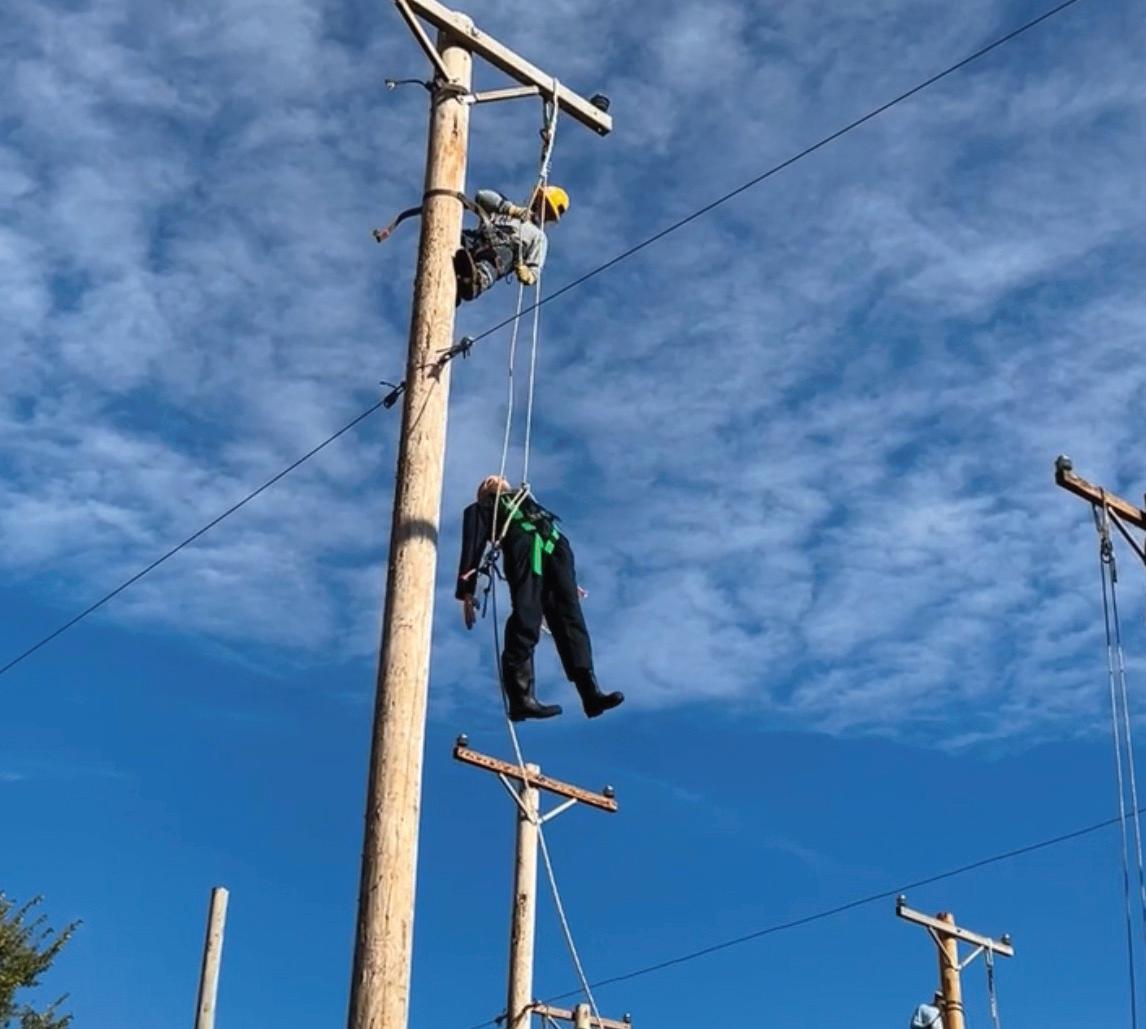
• Works for Flint Energies in Georgia.
• Just finished his apprenticeship and is working toward topping out as a journeyman lineworker.
• Is married and has two children.
• In his spare time, he loves hunting, fishing and being outdoors. He also enjoys going to church for fellowship with friends and to increase his knowledge of God’s word.
• Is learning how to use new linework equipment and tools, which allow him to do the job more efficiently and safely. For example, some of the automation devices help in outage situations or day-to-day work to isolate the work zones faster.
• Always follows safety rules and makes it priority number one. He realizes it is not just his life that could be impacted, but also those he works with.
• In the future of the line trade, he says there is still much more to come with improvements in technology and equipment to improve infrastructure. With that, it means there is always expansion that will take place in learning the new developments.
For hurricane storm work, we basically are starting the rebuilding process from ground zero. I feel blessed to be a part of a team who brings light into a time of darkness. These people sometimes lose everything or go without power for weeks, even months. To be able to help someone in need is important to me and gives me a sense of purpose.
Life in the Trade
I feel like it is a community and a brotherhood. I have developed many relationships with my coworkers. They have become like family because sometimes you spend more time with them than your family. Though most days you may do the same type of work, there is always room for improvement. You are always expanding and bettering your efficiency and knowledge of the skills. My favorite thing about line work is the room for consistent growth in the field, whether it is improving your skill or climbing the ladder in title.
Editor’s Note: If you would like to nominate an apprentice for Faces of the Future, please email Field Editor Amy Fischbach at amyfischbach@gmail.com . All profiled apprentice lineworkers will receive a tool package from Milwaukee Tool. Also to listen to other stories about apprentices in the line trade, tune in to the Faces of the Future series for T&D World’s Line Life Podcast on Podbean at linelife.podbean.com.

Hunter Walton of Flint Energies topped the apprentice division by scoring the highest number of points in the lowest total event time.






370° Rotation x 135° Tilt
Wireless or Hard-Wired Remote Control Options
Living and Loving the Line Life
The record-breaking 2025 International Lineman’s Rodeo Week brought lineworkers and their families together in Kansas City.
By AMY FISCHBACH, Field Editor
Back in 1984, a dozen teams competed to be the best of the best at the Lineman’s Rodeo. More than four decades later, more than 5,000 people joined forces in Kansas City for a week of connecting, competing and showcasing the skills of the line trade.
What began as a hands-on competition has expanded into a week of events including a safety and training conference, multi-day trade show, Trade Night and day of competition. The event brings lineworkers from all over the world together to learn about safety practices, discover new products out on the market for the line trade and compete on the international stage at the International Lineman’s Rodeo.
Bringing Lineworkers Home Safely
For the last 22 years, the week has kicked off with a safety and training conference. For 2025, more than 300 students, apprentices, journeymen lineworkers, field and safety supervisors and instructors filled the conference room.
“Safety is evolving, and our industry is evolving, and that is what this conference is all about,” said Chad Schimpf of Ameren Illinois and the
International Lineman’s Rodeo Association (ILRA) safety committee. “We take a lot of pride and time in handpicking the speakers, so they bring something different every year.”
As in past years, the event featured a variety of speakers and presentations, but this year’s conference had one central theme — self-preservation in the line trade. The message was clear: work safely so you can come home to your loved ones every night.
To drive this point home, the conference kicked off with a personal message from Dale Warman, the co-chairman of the ILRA, who talked about having to tell six line wives that their husbands weren’t coming home following an incident.
“There’s nothing you can say,” he said. “All you can do is sit, pray and cry together. I remember it like it was yesterday, and it rips your heart out. We need to keep working on safety. If we work safely, the guys around us will work safely.”
Next, Michael Starner, the director of outside line safety for the National Electrical Contractors Association (NECA), one of the sponsors for the conference spoke.
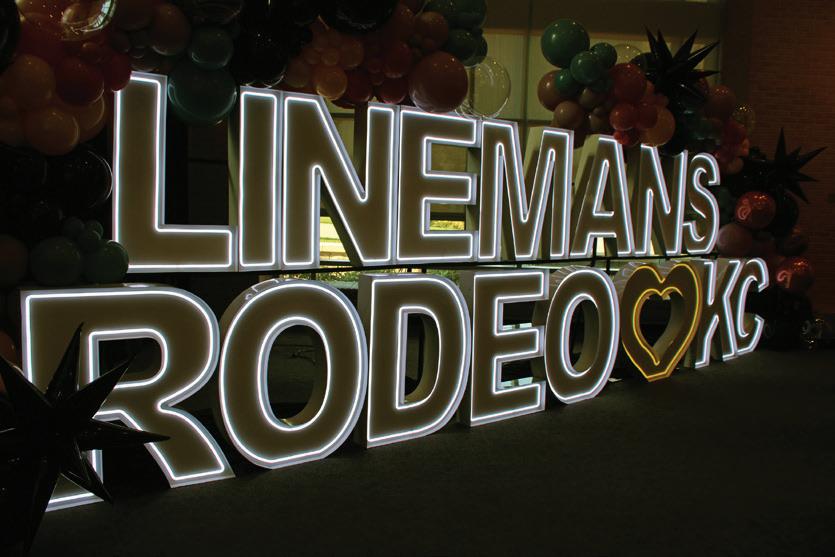
“If you’re at the safety conference, that means you’re committed to the industry,” Starner said to the attendees. “We’re going to teach you some things that you can take back to your teams. While you’re here, engage,
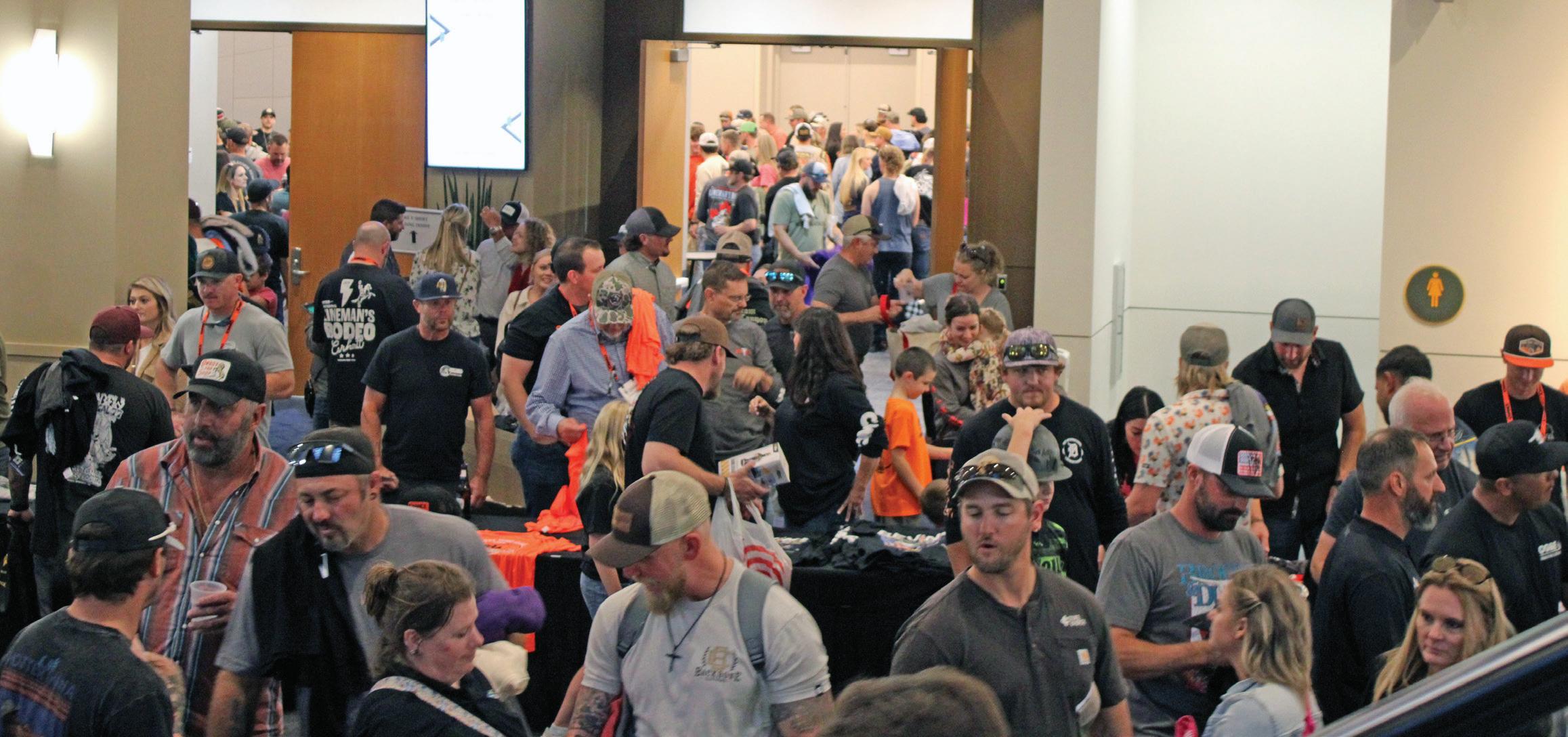
With record attendance, the International Lineman’s Rodeo Association opened up a new room for trading everything from Tshirts to caps, stickers and prints.
A neon sign greeted the long line of lineworkers and their families waiting to get into the 2025 International Lineman’s Expo.
participate, listen, watch and learn. Ordinary people don’t want to do what we do every day, so just the fact that you come ready to work every day to keep the lights on makes you exceptional.”
For the keynote session, Lito Wilkins of Leading Safe Lineworkers shared his personal injury presentation. After surviving a life-changing conductive contact in 2015 on a barehand crew, he dedicated his life to challenging assumptions and fighting complacency and high-risk work. Today, the U.S. Marines veteran and certified utility safety professional said he was grateful to be able to be at the conference and share his story.
“Four days from now, it will be 10 years that that tower right there would have been my last work location — not because I was going home or had a safety error and got let go, but because I made a mistake and almost kicked back over,” he said. “I didn’t hear the electricity in my head, and somehow, I had the wherewithal to not let go. I was 125 ft in the air with no fall protection. Because of the induction, it locked me up, and as soon as it went away, it came back.”
Following Wilkins’ presentation, Jennifer Lavin of Utility Care Solutions explored the topic of mental health in the line trade with her talk, “Protection Under the Hard Hat: Mental Health and Safety in the Utility Industry.” She educated the audience on how to recognize signs that they or their coworkers may need help with their mental health.
“This is a really tough industry, and there are a lot of wonderful, capable people who are in it,” Lavin said. “They keep going, and you see the effects on families and the things they bring home. It’s time for address some of these other things in an honorable and respectful way so that people can get the help that they need.”
To remind the audience that help is just a phone call away, Lavin passed out special yellow coins with the number, “988,” so that lineworkers would know how to reach the national suicide and crisis hotline. By calling this number, it can help them or their loved ones by listening to their struggles, developing a safety plan and connecting them with local mental health resources in their community.
After her talk, the first day concluded
with presentations about the opportunities for military veterans in the line trade by Edward Finnegan of Sturgeon Electric; brotherhood, safety and resilience in the line trade by Kevin Rindal of Vimocity and Ryan Lucas of Quanta Services; the ABCs of Fall Protection by Justin Tate of FallTech and Stored Energy Tree Removal by Dustin Brighton of Great Lakes
Training Solutions. The next morning’s conference included talks on evolving trends in head protection and ergonomics from Mike Dumoit and Matthew Vegh of Milwaukee Tool; the importance of a pre-job briefing by Elif Erkal of the Construction Safety Research Alliance; and AED programs from Chip Georges of Marelly AED and Safety.






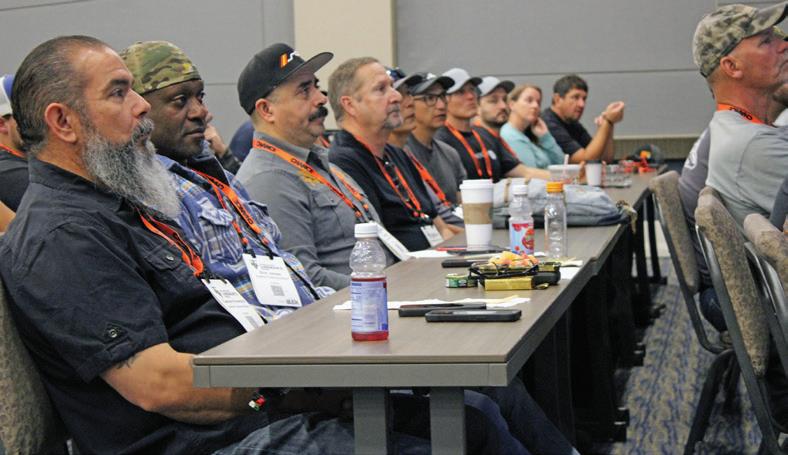
Discovering Tools and Technologies
By attending the safety conference, the attendees could earn a yellow dot on their badges, which gave them a “fast pass” into the exhibit hall for the opening of the 2025 International Lineman’s Expo. This year’s sold-out trade show was bigger than ever before with 205 exhibiting companies representing 600 booth personnel, said Sam Posa, exhibit and sponsorship sales manager for Endeavor Business Media.
“I have noticed that the exhibitors are upping their level of participation with more displays as opposed to just showing off equipment,” he said. “I think we’re seeing a little bit of one-upmanship on the exhibit floor, which may be a little different than what we’ve seen. We’ve also got a huge number of exhibitors who like to hand out T-shirts and trinkets to kids because it really is kind of a family event.”
The attendees also line up to watch the PLP Armor Rod Install Challenge on the show floor. The first winner scored six million views on Facebook in 2017, and previous competitors racked up more than 40 million views across social media. This year, Keaton Augustine (who is featured in our December Faces of the Future) swept the competition with a time of 33.50 seconds, earning not only a trophy, but also a Blackstone Products griddle with a custom lineman cover, Omaha Steaks gift card, a Carhartt winner’s jacket and more.
By walking around the show floor, the attendees could also compete in raffles for other prizes. For example, at the T&D World booth, which was situated in the breezeway between the large hall and smaller ballroom, lineworkers and their families could spin the wheel to win
everything from a hat to a cooling towel and enter a drawing for a tool package worth more than $1,000 from Milwaukee Tool. Tom Jeffers, training director for IBEW Local 17 in Detroit, Michigan, won the tool package and will be featured in the February 2025 Lineworker Focus department.
At this year’s Lineman’s Expo, attendees could also test out tools, try on the latest flame-retardant garments and PPE and discover new technology to boost their productivity and safety in the field. They could even see a superhero flying up and down in his cape on the Ronin powered ascender device and pose with the Kansas City Chiefs’ very-own KC Wolf mascot by the Evergy booth.
Swapping Shirts
After a day of exploring the trade show floor, lineworkers and their families returned to the Overland Park Convention Center for one of their favorite annual traditions — Trade Night. With thousands in attendance, the International Lineman’s Rodeo Association opened up a new room for trading for the 2025 event.
“I’ve had more people starting to ask about what takes place at the Trade Night, and I just tell them it’s organized chaos,” Posa said. “It’s elbow to elbow, and there’s no room to move. They are exchanging hats and shirts with one another, and if someone has a hot shirt for the year, they want to make a trade. It’s a fun night.”
At this event, lineworkers pack duffle bags and backpacks with their team shirts, which are splashed with designs celebrating the line trade. Oftentimes, the T-shirts honor the communities they serve and show pride in their home service territories.
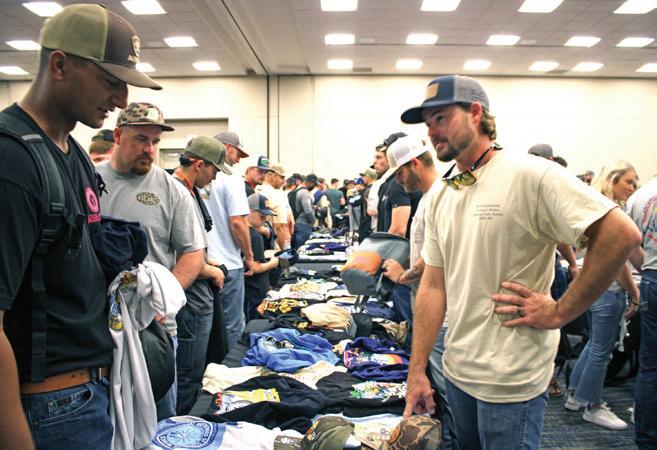
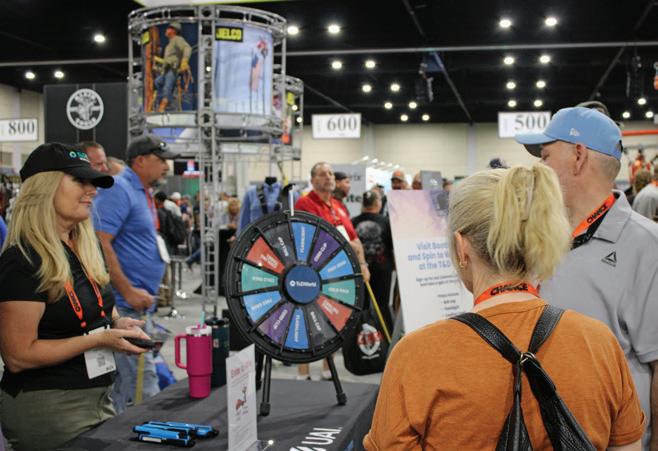
“We decided to go with the classic American flag and the state of Virginia to show people where we’re from,” said Austin Lambert from Rappahannock Electric Cooperative in Virginia. “It’s got a couple of linemen on a pole, but the main point of the shirt is just the International Lineman’s Rodeo and the American flag.”
Many of the designs paid tribute to the line trade with silhouettes of lineworkers climbing up poles and towers or working in bucket trucks. One even included Elvis playing the guitar in a Mississippi state outline. Another illustration depicted a lineworker standing by Superman and his Super Dog following a storm with the message, “We’ll take it from here.” James Respeto, lead supervisor, power delivery for overhead and underground for Avangrid, worked with a designer on the illustration, which he also had made into a laminated print to swap at the Trade Night.
“This is a concept I came up with after the Superman movie,” Respeto said. “I saw they had a dog in the movie, so I said, ‘everyone loves dogs. Let me put him in there.”
After celebrating with their teams and relaxing with their loved ones, they then got ready for the big event of the 2025 International Lineman’s Rodeo Week — the competition. At the “Super Bowl” of Lineman’s Rodeos, the lineworkers compete to be the best of the best and showcase their skills in front of their families and friends. To learn more about the 41st International Lineman’s Rodeo and week of activities, check out photo galleries, videos, stories and more at tdworld.com/electric-utilityoperations and stay tuned to the Line Life Podcast.
Lineworkers listen and learn during the 2025 International Lineman’s Rodeo Safety and Training Conference.
Lineworkers lay out their T-shirts on a long table in a new area open for the 2025 Trade Night.
Sonja Trent from Endeavor Business Media gave the attendees the opportunity to spin the wheel for prizes and to enter a raffle drawing for a Milwaukee Tool package in the T&D World booth.
MEDIA SALES
Account Manager
Brent Eklund
Phone: 303-888-8492
Email: beklund@endeavorb2b.com
Account Executive
Andreja Williamson
Phone: 630-721-0712
Email: awilliamson@endeavorb2b.com
INTERNATIONAL SALES
Europe
Sarah Howell
Phone: +44 7935 299 884
Email: showell@endeavorb2b.com
South America, Central America
Fernanda Vega
Phone: +55 21 97673-9692
Email: fvega@endeavorb2b.com
Middle East, India, Asia, Australia, Africa
Saurabh Kapoor
Email: skapoor@endeavorb2b.com
EVENT SALES
Account Manager
John Blackwell
Phone: 518-339-4511
Email: jblackwell@endeavorb2b.com
Account Manager
Denne Johnson
Phone: 607-644-2050
Email: djohnson@endeavorb2b.com
International Linemen’s Rodeo, and Events
Sam Posa
Phone: 913-515-6604
Email: sposa@endeavorb2b.com
MEMBERSHIP SALES
ANALYTICS INSTITUTE
Membership Development Manager
James Wingate
Phone: 404-226-3756
Email: jwingate@endeavorb2b.com
Utility Analytics Institute, Smart Utility Summit and Smart Water Summit
Customers Need Supply Solutions on Energy Affordability
At the PJM summit in Philadelphia in late September, I had the opportunity to listen, share and engage with state leaders and stakeholders about the core challenges facing our region’s energy ecosystem. Hoping to gain some acknowledgment and reassurance that positive change was coming, I unfortunately left that meeting alarmed at the lack of concrete solutions and urgency to address affordability and supply concerns that are straining our customers and our energy grid.

As the largest utility in PJM’s territory, serving more than 10.7 million customers, Exelon sees firsthand the impact of the current environment on those we serve. Rising prices are hard for households to navigate, and customers — our friends and neighbors — are rightfully frustrated and demanding solutions. Alongside increasing costs are PJM admissions that threats to service reliability are close behind. Just this year, PJM Executive Director of State Government Policy Jason Stanek called Maryland’s energy outlook “dire,” and the operator requested an emergency order with the U.S. Department of Energy for an “imminent electric reliability emergency” in BGE’s territory. Without new supply sources, customers will continue to face rising, unpredictable costs that are already stretching finances and will be at greater risk of brownouts. It’s time for us to come together to identify and implement real solutions. Allowing utilities to produce energy and add it directly to the grid, a process known as regulated generation, must be at the top of the list.
Our customers are counting on us to meet this moment by reigning in costs and providing certainty that needed supply will be planned and built. We are already using the tools we currently have available, whether demand response, energy efficiency, enabling distributed energy resources, or building transmission to connect new supply resources. Regulated generation will help us fill in where the market response has been flat-footed and as a complement to the PJM market.
A Deep Supply Challenge
At the heart of today’s crisis is PJM’s gap between energy supply and demand. PJM does not have enough energy to meet current needs — and demand will only grow in the coming years as data centers come online and the electrification process continues. This gap sends prices for limited resources soaring and jeopardizes our ability to deliver reliable energy service. As an example, customers across PJM are forced to pay over $16 billion for the latest capacity auction, even though it resulted in less overall supply than the year before
We’re already feeling the effects that insufficient supply has on the costs utilities, such as Exelon, pay for electricity. Year-todate supply portions of PJM’s total wholesale costs are up over 60% compared to the same period in 2024. For comparison, transmission costs across PJM increased by only 5%.
Proposed projects to address this shortfall are limited, and
many are already stalled due to permitting, financial or supply chain challenges. PJM-approved projects that could power 40 million homes are currently stuck in limbo.
The discussion at the recent summit clarified for me that the current system is unprepared to deliver solutions. Instead of acknowledging this acute supply and generation problem and taking accountability for our responsibility to address it on behalf of customers, I heard circular debates about governance and defense of the status quo and attempts to normalize high prices that will only perpetuate inaction.
Right now, no one is accountable for making sure there’s enough energy supply — not PJM, not the Federal Energy Regulatory Commission, not the North American Electric Reliability Corporation, and not the states — customers are paying the price.
Regulated Generation Will Enhance Supply and Affordability
To overcome supply shortfalls, states must allow utilities to produce the energy and lower prices our customers need when the market fails to deliver. Regulated generation will provide needed cost relief, establish certainty that new sources will be built — instead of languishing in the permitting process or failing to be proposed — and allow each state to align generation plans with their policy goals.
PJM’s proposed solution would require forced curtailments of new large loads. This approach is equivalent to throwing in the towel – saying that new supply is too hard to build in PJM, even though other regions have figured out how to build in this moment. Supporting economic development and helping PJM’s 13 states and the District of Columbia grow requires real supply solutions.
By expanding supply through complementary regulated generation approaches, we can reduce costs and minimize volatility, delivering the long-term relief and predictability families and businesses expect. We can also ensure new generation sources are completed by making utilities responsible for the capacity needed to serve their customers, all under state oversight.
While current power producers are unable to meet demand in the PJM region and meaningfully expand capacity, Exelon is ready to invest in new power sources as part of our commitment to providing essential energy services to the communities we serve.
Allowing the supply challenge to continue unchecked treats electricity as a commodity. But families adjusting the heat to stay comfortable and businesses keeping their lights on know it’s more than that – it’s a necessity.
Customers deserve a system that treats them as such. That’s what regulated generation delivers, and the promise Exelon is ready to keep.
WILL SAUER is Vice President of Federal Regulatory Affairs for Exelon.

LINES & STRUCTURES
FA Bright Future for Overhead Power Line Structures
By OTTO J. LYNCH, Power Line Systems
resh off the ASCE/SEI Electrical Transmission and Substation Structures (ETS) Conference in Dallas, I’m energized by what has become the premier gathering in our industry. With over 2,200 professionals in attendance, this triennial event is a true Who’s Who of overhead power line and substation experts. The Conference Steering Committee, under the leadership of Conference Chair Ronald Carrington and the dedicated American Society of Civil Engineers (ASCE) staff, delivered a record-breaking experience. The ASCE staff confirmed the 2025 conference was the most attended ASCE/ SEI conference of all time across all its sectors.
Mr. Carrington’s Opening Plenary remarks, which you can read about in the closing column of this article, set the stage for what I heard all week: we are all busy. For those of you who remember my column last year, I described the Perfect Storm that we find ourselves in. Only this year, the storm is even bigger. We are facing unprecedented load growth with demand projected to increase 2% annually through 2050. Our grid’s average age is almost another year older. Although the transition to renewable energy has slowed, it remains ongoing. Despite repeated political promises, permitting remains a major hurdle to building the new transmission lines needed to meet reliability and climate goals. Even approved projects face labor and material shortages, further delaying progress.
The much-anticipated Edison Electric Institute was just released this week. The report noted that U.S. electric EEI member companies are projected to invest more than $1.1 trillion between 2025 and 2029. The funding will support the growing electricity demand driven by artificial intelligence and data center expansion, industrialization, the reshoring of manufacturing activity, and the electrification of the broader economy.
ASCE released its quadrennial Report Card on America’s Infrastructure last March. Primarily due to this Perfect Storm, our Energy infrastructure dropped to a D+ from the C- it received in 2021. Amongst the findings was that an increase in electric vehicles and a rise in data centers will demand 35 gigawatts (GW) of electricity by 2030 alone.
It’s not all doom and gloom. ASCE’s Structural Engineering Institute (SEI) continues to publish essential Manuals of Practice (MOPs) and Standards that support the reliability of both upgraded and newly built grid infrastructure. These resources ensure rigorous design and analysis across every structural component of overhead power systems:
• Lattice steel towers – Standard 10
• Tubular steel poles – Standard 48
• Wood pole structures – MOP 141
• Concrete pole structures – MOP 123
• Fiber-reinforced polymer (FRP) poles – MOP 104
• Substation structures – MOP 113
Supporting these structures, MOP 160 Design of Overhead Line and Substation Foundations is nearing completion.
ASCE is modernizing structural loading standards for overhead power lines to reflect today’s climate and reliability demands. MOP 74, Guidelines for Electrical Transmission Line Structural Loading, guides how wind, ice, temperature, and construction loads are applied, and has undergone a major five-year revision. The result: ASCE/SEI Standard 84, Minimum Design Loads for Structures Supporting Overhead Power Lines, will be published in 2026. This new standard expands beyond transmission lines to cover all overhead power structures, marking a significant step toward more resilient and universally applicable design practices across the entire electric grid.
Additionally, MOP 123, Prestressed Concrete Transmission Pole Structures: Recommended Practice for Design and Installation, is also being updated to ASCE/SEI Standard 81, Design of Prestressed Concrete Pole Structures Supporting Overhead Power Lines.
All current MOPs, Standards, and related publications can be found in the ASCE Library. Look for updates to other MOPs and Standards in the next few years.
A notable shift in the titles of these latest updates is the move from “transmission” to “overhead power line” — a more inclusive term that reflects structural consistency across voltages. While many existing MOPs and Standards still reference “transmission” in their titles, they apply to all overhead power lines, even those less than 60’ tall. ASCE is embracing this broader scope, with ETS now transitioning to OPS: Overhead Power Line Structures. The 2028 OPS Conference will be held October 1-5 at the Gaylord Opryland in Nashville, TN. It’s not too early to start planning your paper submissions.
One last thing, this supplement features highlights from several of the 49 peer-reviewed papers presented at the conference. If you missed it, the peer-reviewed papers are in Proceedings of the Electrical Transmission and Substation Structures Conference 2025.
There’s no doubt - we have serious work ahead. But we also have the tools, the talent, and the shared commitment to meet the moment. Or as another classic ’80s anthem reminds us: the future’s so bright, I gotta wear shades.
OTTO J. LYNCH is Vice President of Bentley Systems and Head of Power Line Systems. He is a member of the American Society of Civil Engineers, IEEE, and the National Electrical Safety Code. He is a registered professional engineer.


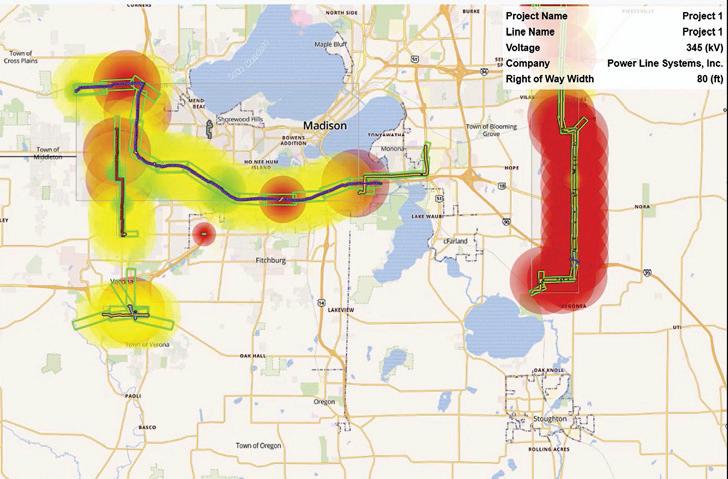
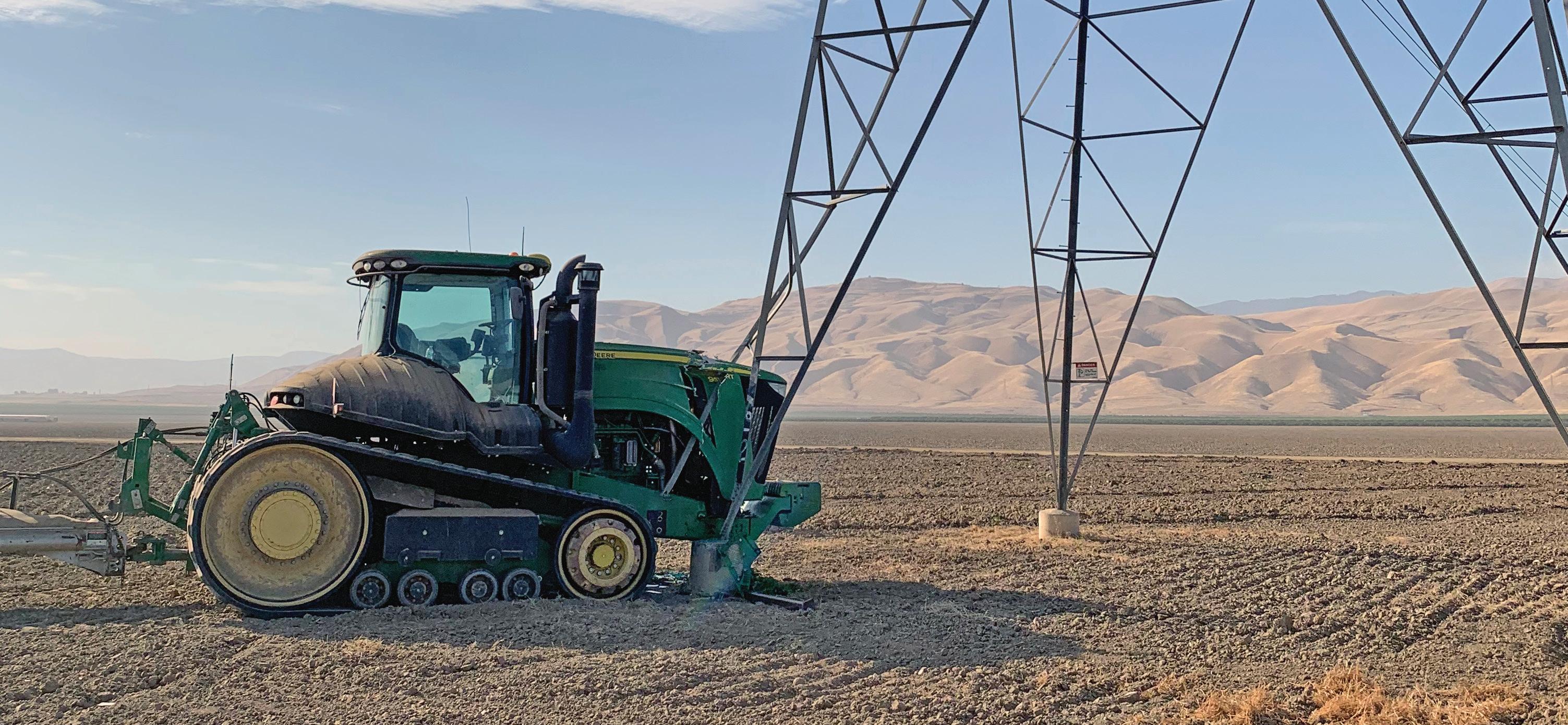
Maintaining safety while unlacing lattice towers during repair and strengthening efforts.
By JASON KILGORE and ELLIOTT THAXTON, Mesa Associates, Inc.
While it is good that expanding the capacity of the electrical grid is receiving lots of attention these days, maintaining our existing infrastructure must not be ignored. Thousands of lattice towers, the structure of choice for mid- and high-voltage transmission lines for a century, are long past their original design service life. Many of these structures require maintenance to repair corrosion or damage to avoid costly outages. In addition, most were not designed for increasingly extreme weather events and require strengthening to be brought into compliance with modern load and resilience requirements.
To accomplish this, partial disassembly of in-service lattice towers is an option that can be considered. Unfortunately, while lattice towers were designed and tested to be stable while intact, none were checked for partial disassembly while fully loaded and energized. An engineering analysis is required to mitigate the risks associated with this type of work.

This impactdamaged tower required replacement of a primary post leg, leg diagonals, and multiple redundant braces.
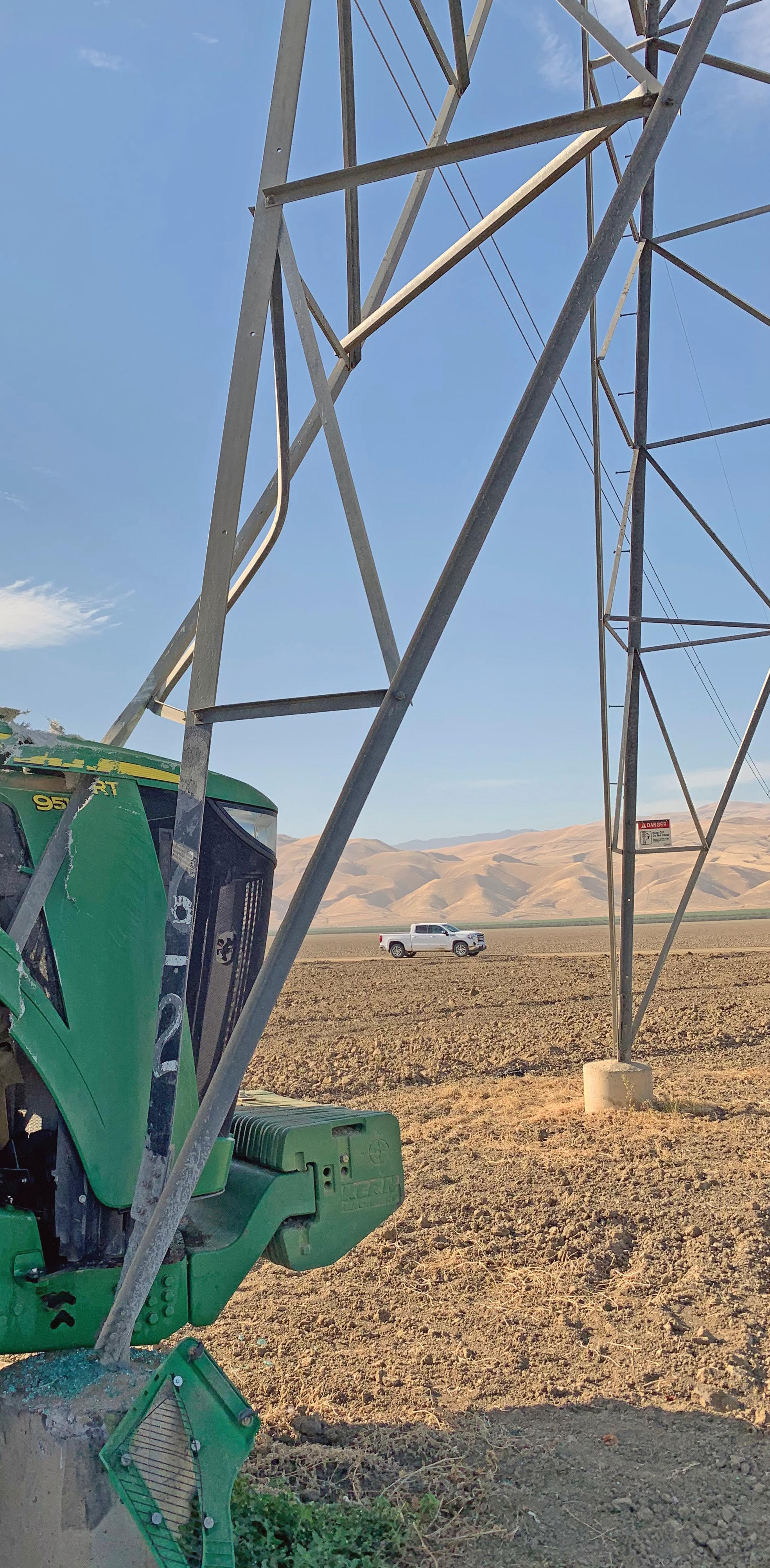
Strengthen In-Place VS. Remove and Replace
This article will not go into a detailed financial analysis, but it is often more costeffective to repair or strengthen existing lattice towers versus replacing them with new structures. Most utilities have their own cost data regarding new structure costs. Those costs must be compared against key factors for repair or strengthening which include:
• Can the work be performed with the line energized, or is an expensive outage required?
• Are internal or external supplemental supports required?
• Can the work be performed with wires attached to the structure?
• What will the final design life be as compared to a new structure?
• What are the current and future liability risks, factoring in worker safety?
Part of the decision on whether to keep or replace the entire structure must include whether the damaged piece will be patched while it’s still on the tower or re -
“A careful analysis and using safety-first field processes can ensure a high level of confidence for the engineer, owner, and field personnel with minimal risk to all involved.”
moved and replaced with a new one. Each utility has different levels of risk tolerance and assigns different weights to the liabilities associated with either option. Placing too high of a weight on the risk involved with removing damaged pieces opens up other sources of liability and may require replacing a tower that can be saved. Going with a repair-only approach may help in limiting immediate liability, but it also limits future options. Many utilities have language in right-of-way agreements requiring landowners to pay for any damage they cause to structures. Restoring a long-damaged tower to a like new condition makes it easier to require the
landowner to pay for future damage. In addition, an obviously damaged and repaired tower near the site of a wildfire ignition could be used as evidence of liability during litigation.
Structure Evaluation
Worker safety is paramount during any field activity. Even if a structure has remained standing for an extended period with significant damage, the engineering evaluation and analysis will show whether it is safe for work to start. The damaged member(s) may be providing just enough strength for stability and cannot be removed, or a worker on the structure could slip and apply a fall arrest load at the wrong place.
The evaluation must determine whether the source of the damage was transient or if it is still present and applying load to the structure. Examples of transient loads include vehicle impacts,
bullet holes, or cows that have used the tower as a scratching post. Broken wires that have damaged a crossarm must always be mitigated before proceeding. Damage caused by shifting foundations is especially dangerous. Such shifts could place the entire tower in a state of extreme stress that could cause serious injuries to workers in the area if the wrong pieces are removed.
The engineer must establish reasonable maintenance weather conditions for the repair work; the work will not be performed during a hurricane or blizzard. Locations with constant high winds require a higher maintenance wind pressure than a sheltered southern swamp. The engineer must then establish whether
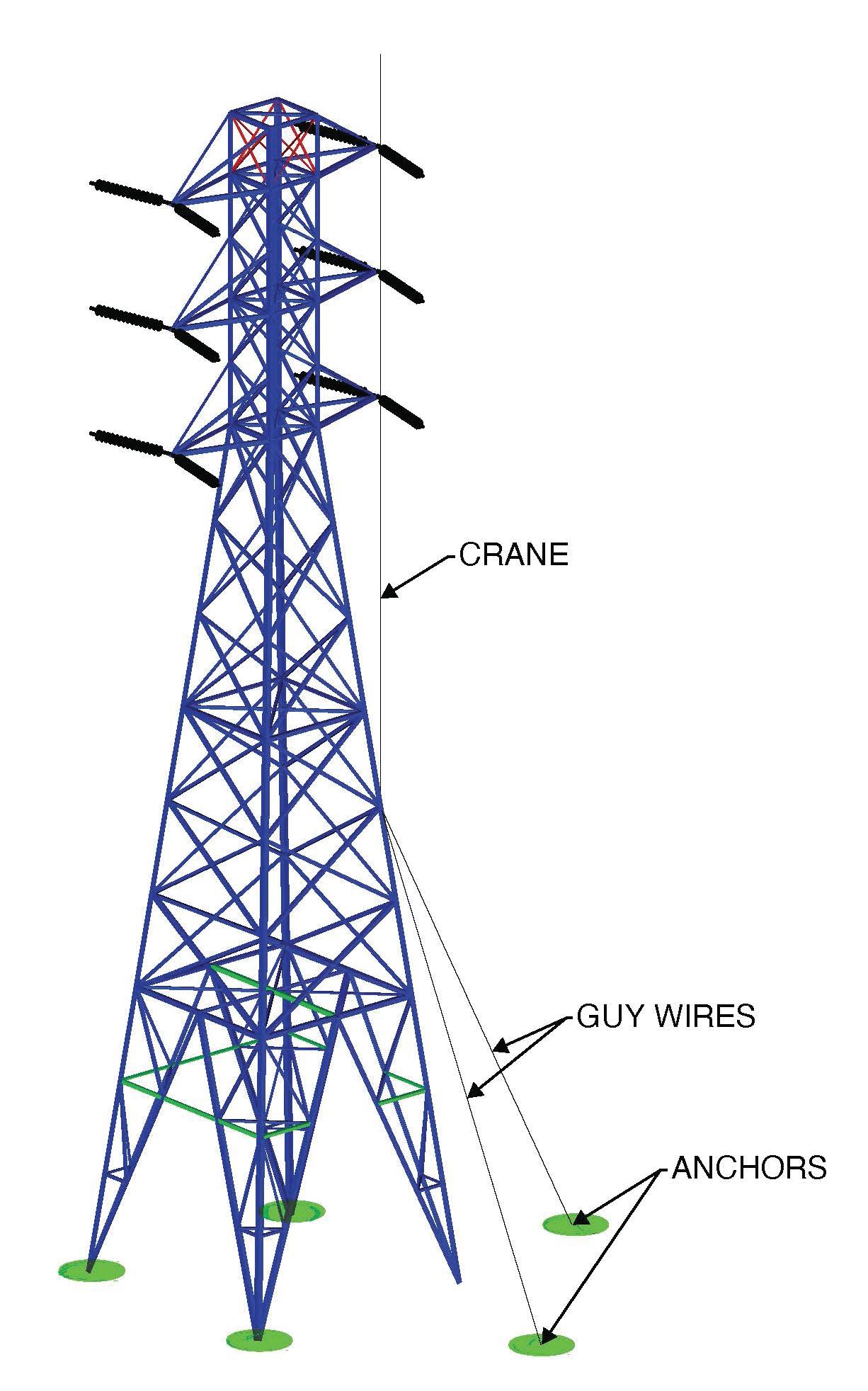
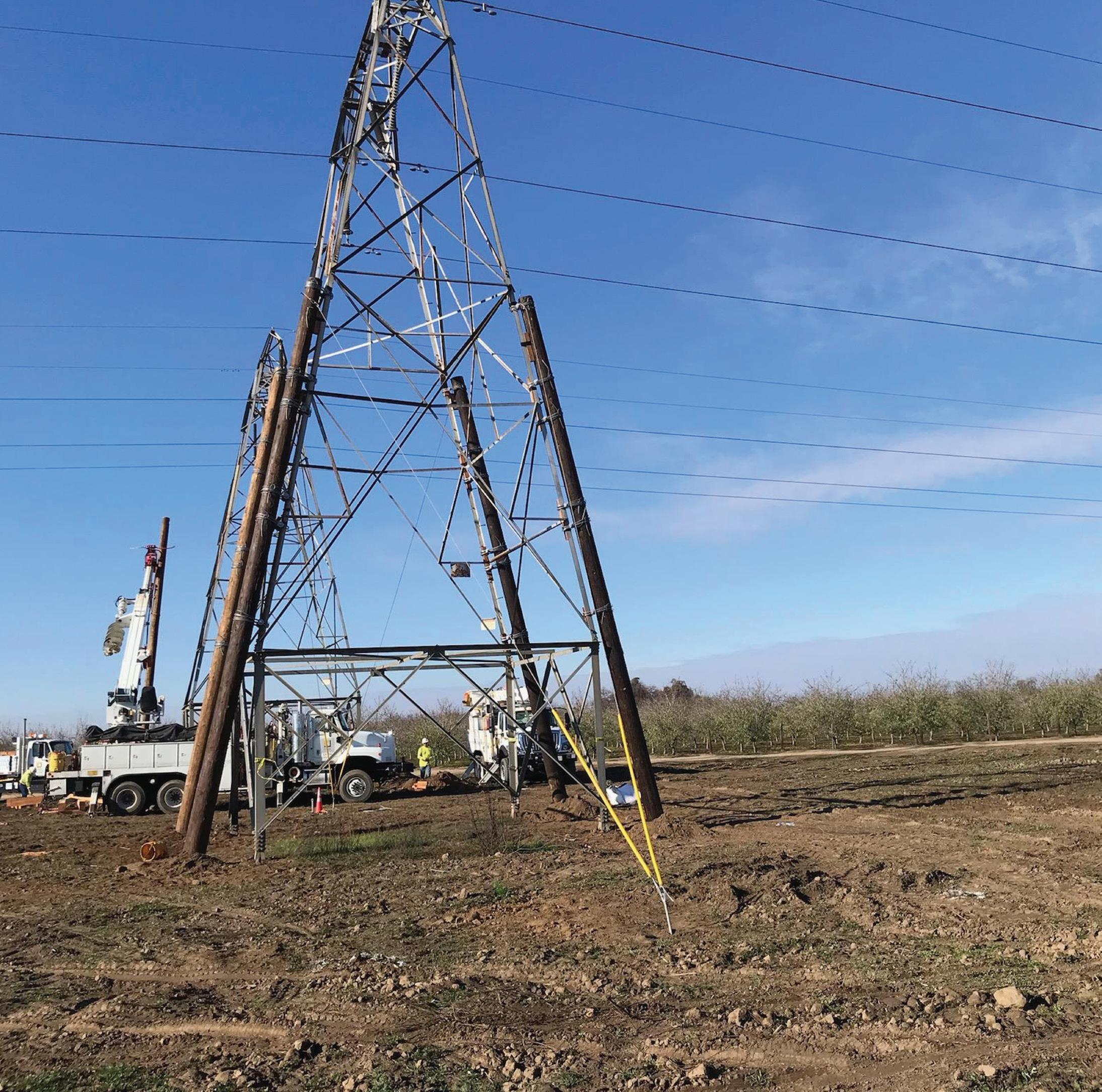
A tower with severe damage is stabilized with distribution poles and side guys before repair starts.
the tower will remain stable under the chosen wind pressures with any pieces removed and must identify the location(s) of safe fall arrest attachment points or whether direct climbing is allowed at all.
If the evaluation and analysis show that it is not safe to work on the structure, or that the cost to make it safe would be prohibitive, replacement may be the best option.
Stablization Options
Several stabilization options are available to ensure that structures remain stable and safe when removing pieces of a loaded
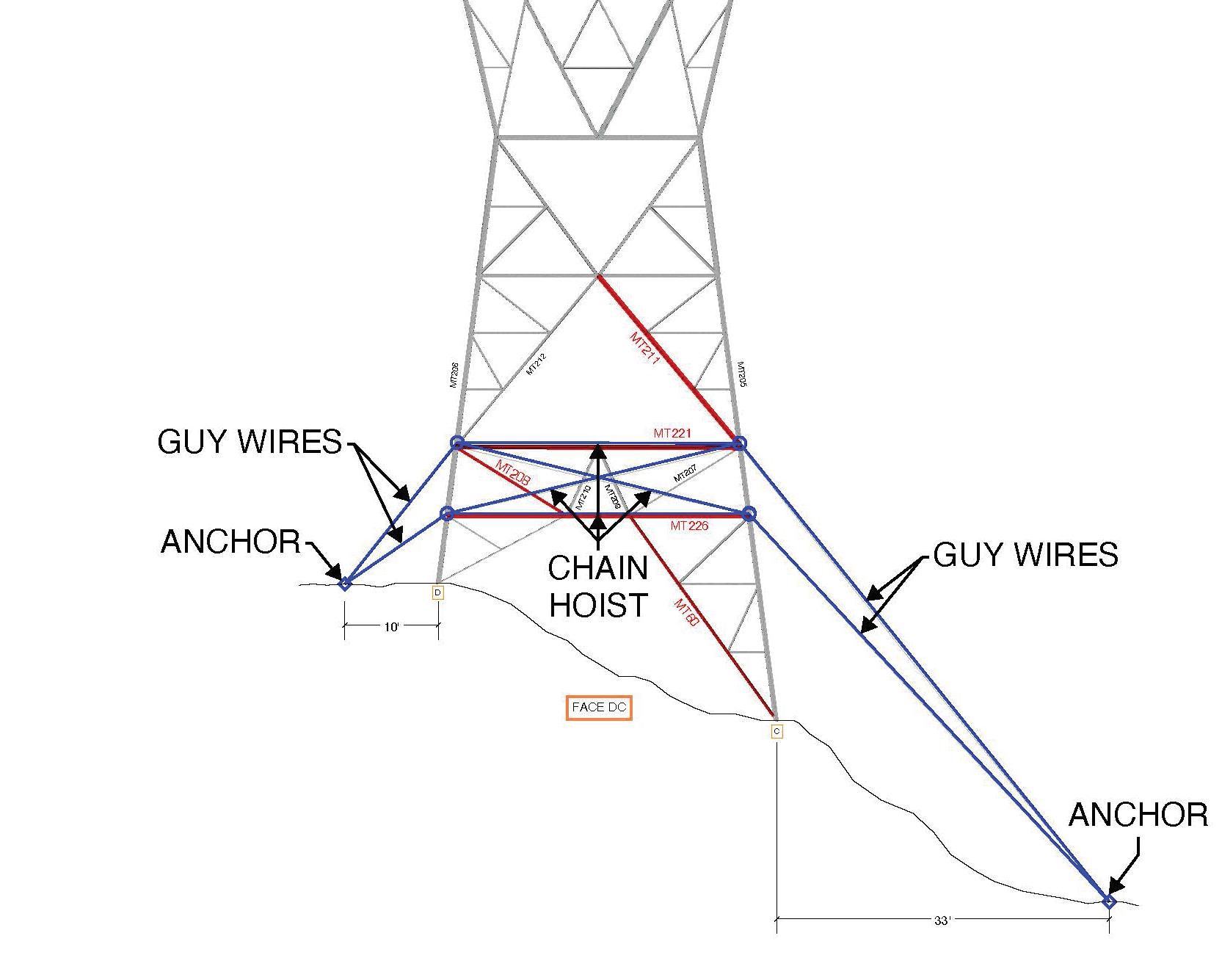
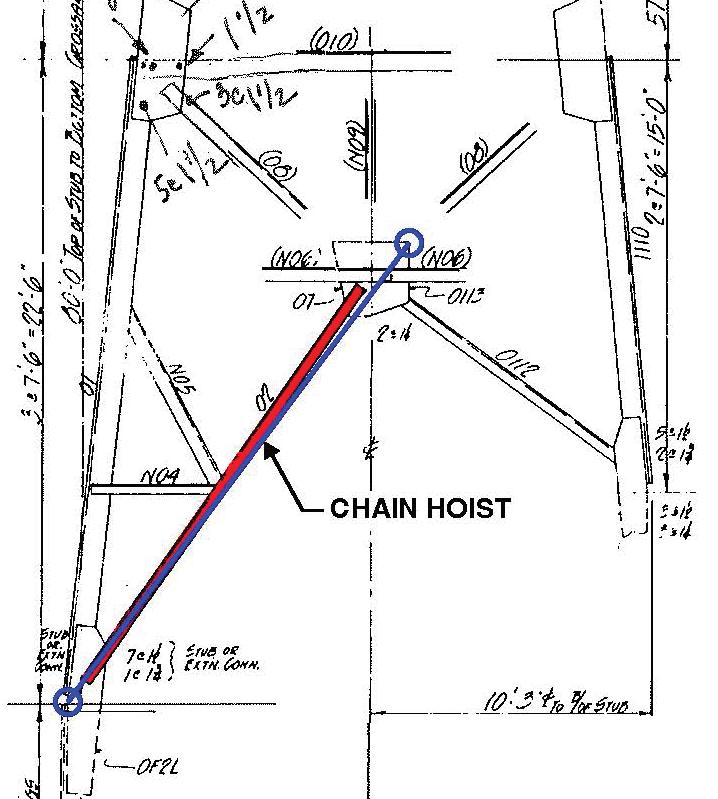
tower. All are temporary and are only installed for enough time to perform the work before being removed. In some cases they can be used to quickly stabilize a critically damaged tower to give the engineer time to design a permanent repair.
The easiest and cheapest to install is internal bracing composed of chain hoists or hand winches. They can replace the full strength of a piece in tension or adjust the tower to remove the stress from a piece in compression.
External stabilization is more expensive but is sometimes required. Down guys are common, but installing the anchors can be problematic in environmentally sensitive or rocky areas. Guyed stub poles can be used to replace the strength of a main post leg or as a temporary “field crane” to support a tower. The most expensive option is a crane because using one usually requires a circuit outage. A crane large enough to carry the entire weight of the tower and wires may be required, or a smaller one that only needs to provide a small uplift force to a single leg.
Regardless of overall tower stability, no piece under active load must ever be removed without removing the load first. This is easy to spot; if the bolt doesn’t slide easily out of its hole, it is under stress, and things could go very wrong very fast if it is removed. The load in the piece must be redistributed before removal.
Common Replacement Scenarios
Redundant braces are used to provide bracing to other pieces; they are not designed to carry any load on their own, and they are the easiest to replace. Stabilization is rarely required to replace a redundant brace on light tangent structures under maintenance conditions; simply remove the damaged piece and replace it. Heavily loaded structures such as anchor towers may require supplemental support. Either way, the effects of removing even the smallest brace should be evaluated before the work is performed.
Leg diagonal braces are by far the most damaged piece on lattice towers because they are near the ground, usually slender, are frequently hit by right-of-way maintenance equipment or
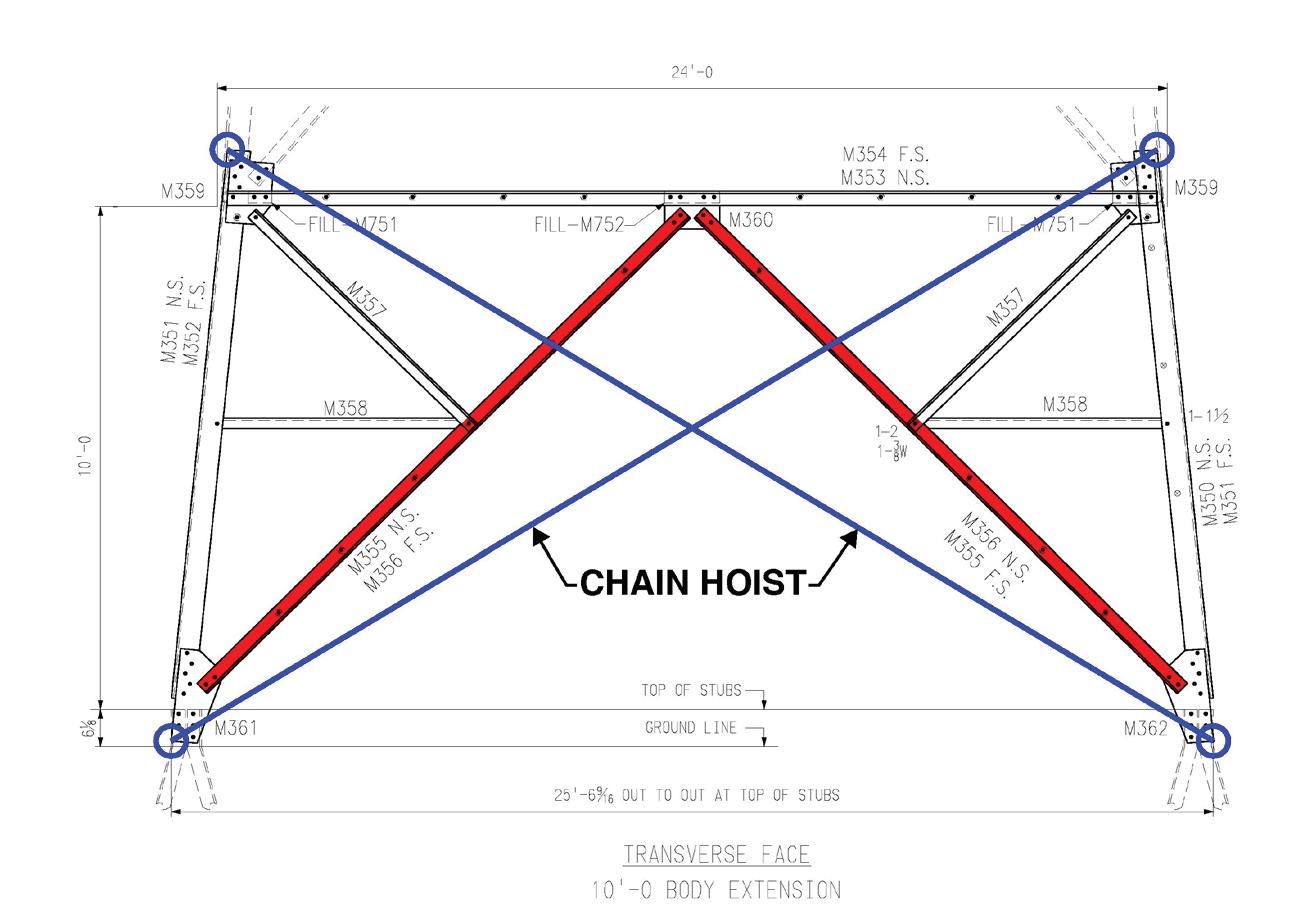
Modeling crane and guy anchors; multi-point supports.
other vehicles, and can be easily damaged by corrosion. Removal of leg diagonals requires two types of checks. First, any redundant braces between the leg diagonal and the main post leg will be removed along with the diagonal. As leg buckling is not recommended, the reduced capacity of the now-unbraced leg must be checked. This may require supplemental external support to remove load from the area. Second, establishing a replacement load path for the damaged member is required before removing the piece. It is frequently possible to find an alternate load path within the remaining tower, but an inexpensive internal support such as a chain hoist could be the answer.
A special case with leg diagonals is the inverted “V” or “Delta” configuration. The two adjacent diagonals work as a pair, with one in tension and the other in compression, balanced against each other. If you remove one you remove the entire capacity of the panel. Finding an alternate load path through the remaining pieces on the tower may be possible, but it’s safer to install a pair of chain hoists across the panel in an “X” configuration.
Replacing a main post leg is not as common because they are harder to damage, but is still sometimes required. In addition
to resisting the weight of the tower and wires, uplift and transverse supports are often required to resist overturning forces from line angles. Replacing some long post leg pieces requires “unlacing” a large portion of the tower which can eliminate most of the tower’s stability and strength. Careful analysis and external supports are always required, sometimes even lifting the entire tower.
Member replacement becomes more difficult as the member being removed gets higher up in the structure. Evaluating replacement load paths for the member itself, along with any additional members unlaced during the removal, becomes increasingly difficult. Supplemental supports are usually required as well as a detailed finite-element analysis (FEA).
Analysis Methods
Manual spreadsheet calculations are all that are required to replace some piece types for many standard structures. First establish conservative forces from wires and the structure itself, then use basic statics to calculate the forces in whichever piece is being analyzed. This can often be performed much more rapidly than modifying a full FEA model, especially if the FEA model must be created from the start.
But for more complicated structures and scenarios, the most accurate and
reliable type of analysis is a finite-element analysis model of the structure. It allows the engineer to quickly analyze the tower under multiple weather or loading conditions and accurately size any temporary supports. This method is required in some scenarios, such as verifying the tower’s stability with multiple members removed. The FEA model being used must accurately represent reality. Lattice towers are almost always designed as pure trusses that resist forces through axial loads, using relatively slender pieces that are weak in bending. Despite this, bending elements must be used in most FEA models to provide localized stability. For a well-triangulated lattice tower model these bending elements do not make a significant difference in the analysis results. However, for a detailed analysis of a tower with key pieces removed, too many bending elements can create false stability. The model could converge and show acceptable stress levels when the slender pieces would actually fail in bending causing a tower collapse. As many sources of frame action as possible must be eliminated from the FEA model. This may require eliminating some redundant braces that are not braced out-of-plane. A few isolated bending elements that are not connected to other bending elements are acceptable. The best way to calculate support requirements is to model the support within
Nonfunctioning redundant brace.
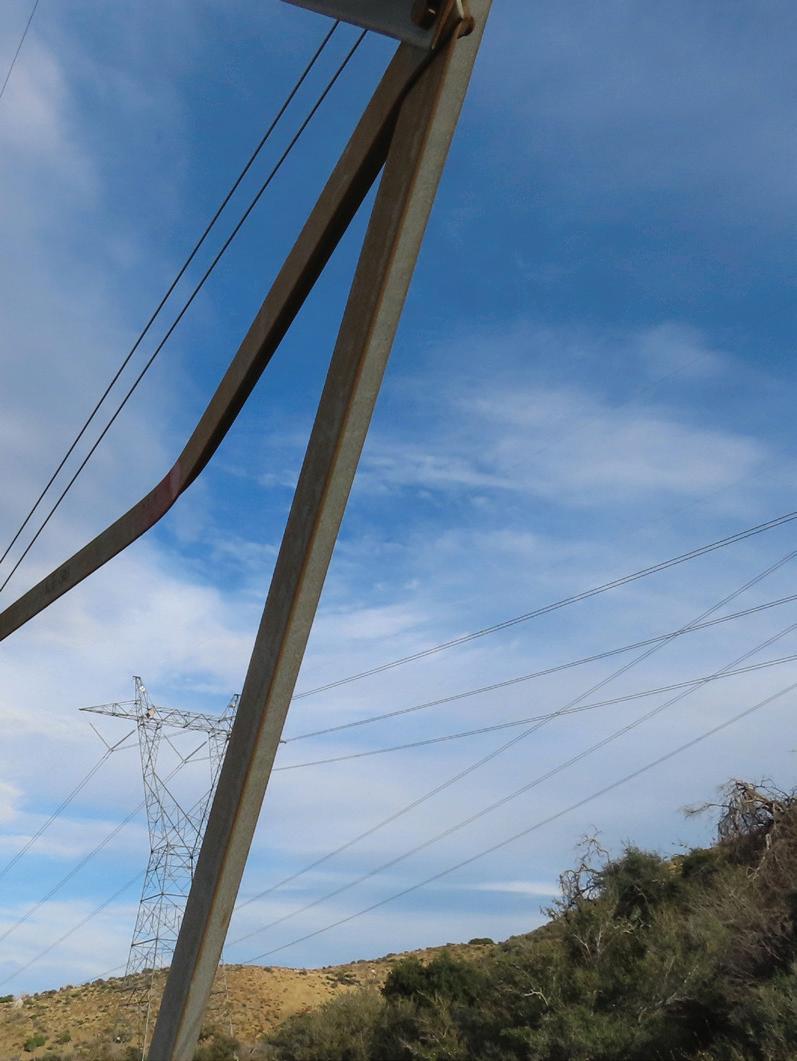
the FEA model. Internal tension supports, whether pre-tensioned or slack, can be modeled using Cable elements in most commercially available software. Guyanchor supports and cranes can likewise be modeled as Cable elements. Crane supports can also be modeled as guys; anchor the guy to a primary joint some distance directly above the attachment point. Finally, care must be taken to model the wind loads applied to the structure. Old “wind on face” loadings that mimic old hand calculation methods and are re quired by most design codes should be supplemented by additional load cases us ing fluid dynamics based wind models. These modern wind models more accu rately apply wind to all pieces.
Conclusion
It must be stressed again that the safest op tion is always to attempt strengthening or repair of in-service lattice towers by adding additional members, or to remove existing members after adding the new ones. But strengthening or repair can safely occur even when members must be removed from an in-service lattice tower, resulting in significant cost savings versus installing a new structure. A careful analysis and using safety-first field processes can ensure a high level of confidence for the engineer, owner, and field personnel with minimal risk to all involved.
JASON KILGORE is a structural principal engineer in Mesa’s Power Delivery - Transmission and Distribution business unit. He has 19 years of experience with electrical power transmission, plus experience in industrial, commercial, and residential design. As Mesa’s primary subject matter expert in transmission structures and foundations he is involved with solving the more complicated problems discovered by Mesa’s internal design groups and external clients.
ELLIOTT THAXTON is a licensed PE and has worked for Mesa Associates, Inc. for 8 years with 10 years of experience in engineering. He is a Group Lead in the Power Delivery: Transmission and Distribution (PDTD) Business Unit. He led the tower repair, damaged footing, corrosion mitigation, and fall protection analysis programs for several years. While at Mesa he has gained extensive knowledge in line design, TOWER modeling, structural analysis, and foundation design.
A CENTURY OF TRUST. A FUTURE OF STRENGTH.
and Still Made in Seward, Nebraska, USA
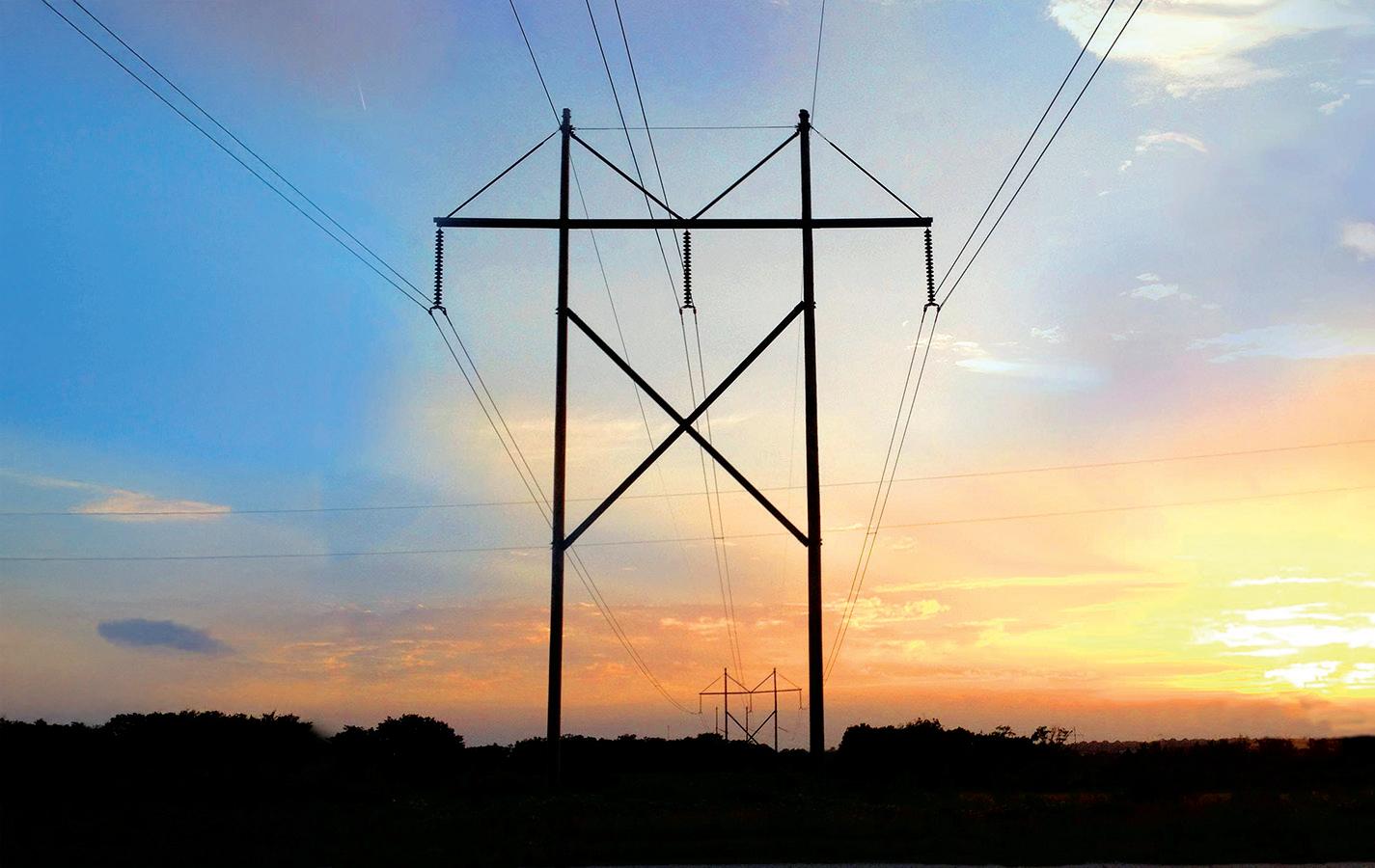
Is it time for standards to replace fragmented and inconsistent practices?
By PRASAD YENUMULA, Duke Energy
Foundations are a critical part of the grid, but they are hidden from view. It’s the old out of sight, out of mind saying that comes to mind whenever the subject comes up. Consider, however, when an overhead powerline pole leans or a latticed tower shifts, the problem usually starts below ground. Foundations may be invisible, but they determine whether the grid stands strong or fails under extreme weather. Without consistent foundation design standards for the overhead power line and substation industry, utilities have faced a patchwork of practices and unpredictable outcomes. A new Manual of Practice (MOP) from the American Society of Civil Engineers (ASCE) aims to change that. It is offering best practices guidance document for anchor reliability from the ground up.
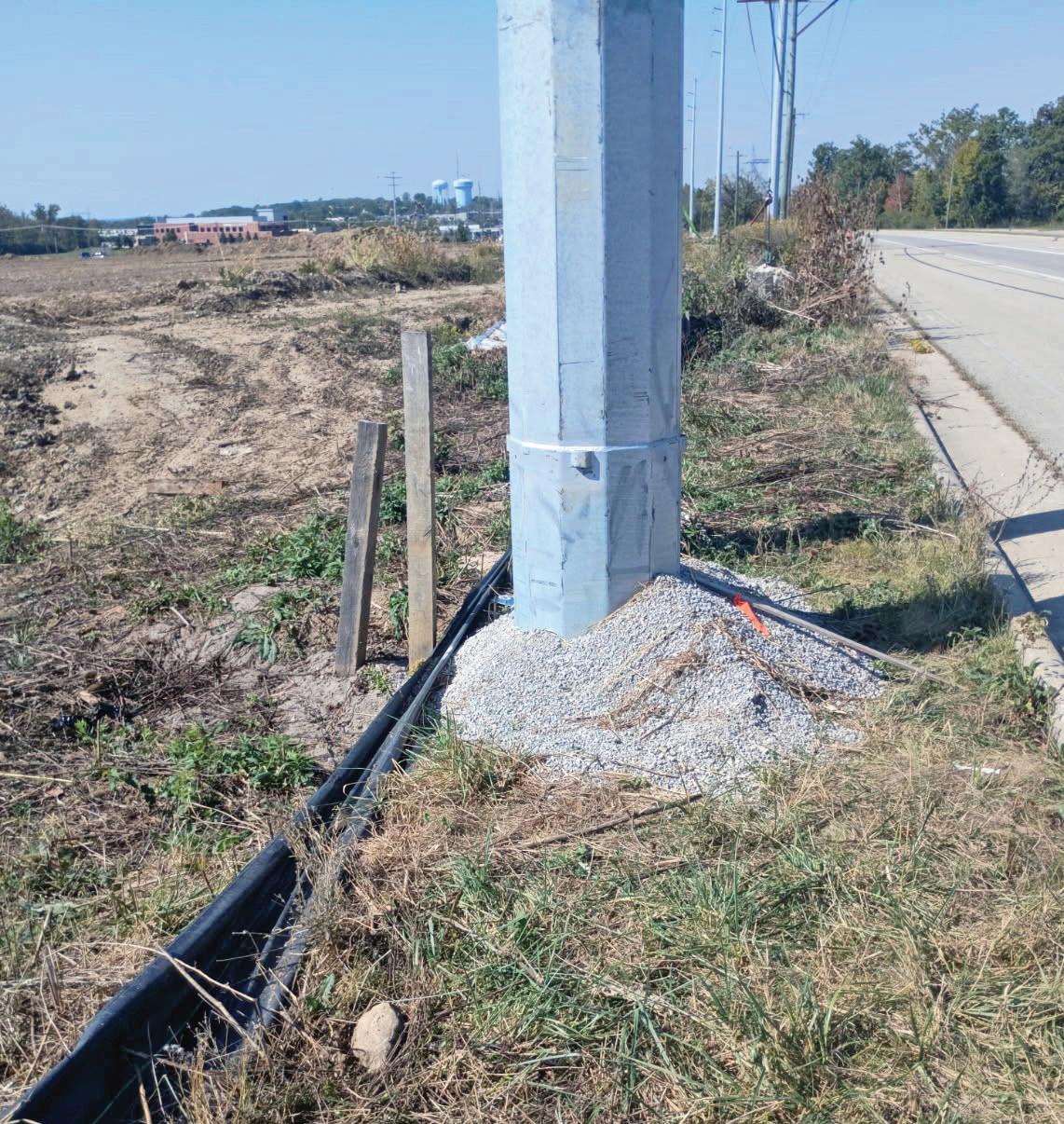
For decades, the electric utility industry lacked a uniformly accepted standard for analyzing and designing these foundations and then global climate change with its extreme weather events changed everything! Practices varied between regions and utilities, leading to inconsistent reliability, higher costs, and, in some cases, unexpected failures.
Recognizing this gap, the ASCE task committee on the Design of Overhead Power Line and Substation Foundations developed the first MOP devoted entirely to overhead power line and substation foundations. Drawing from surveys, research, and decades of field experience, MOP offers utilities a comprehensive guide to best practices.
Why It Matters
The new ASCE manual doesn’t just dive into equations and soil mechanics — it tells the story of what really makes foundations succeed or fail. It starts with the basics of overhead power line
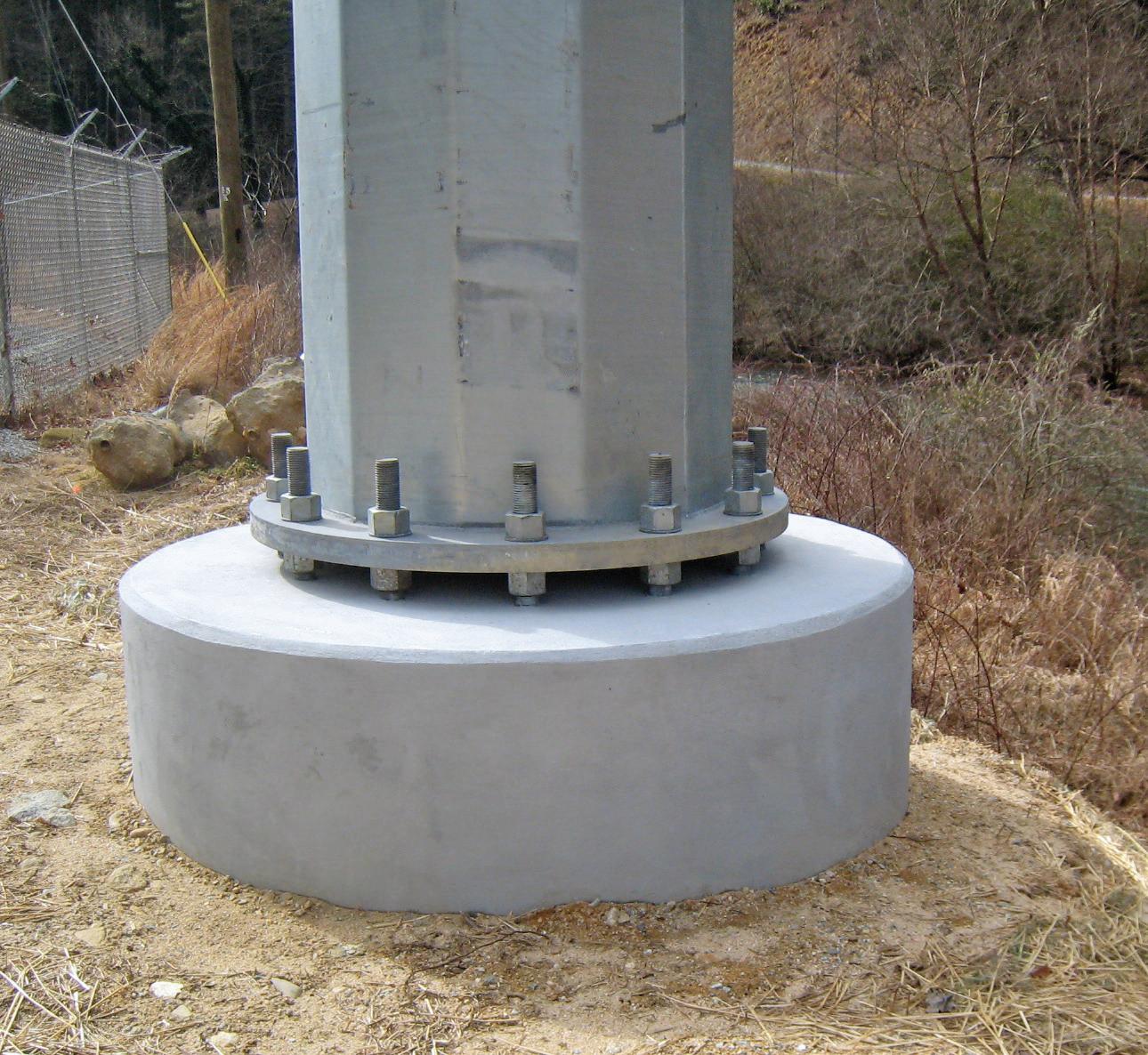
Concrete drilled shaft foundation supporting galvanized steel pole.
galvanized steel pole with crushed rock backfill.
and substation design, then walks readers through the choices every utility must make.
From there, it goes deeper — literally — into the ground. The story explains how geotechnical exploration, like test borings and soil sampling, feeds into smarter designs. Factors like what type of foundation to use, or what type of load it must carry are important. Even something like what design philosophy makes foundations more reliable play an important part of that story.
What makes this story unique is its balance between the familiar and the specialized. It covers conventional options like drilled shafts, shallow foundations, and direct-embedded poles — the workhorses of the industry — but also shines light on specialty approaches such as vibratory caissons, helical piles, and micropiles, which can save the day in tough soils.
It also offers practical advice on construction aspects, so that what looks good on paper actually performs in the field.
“By consolidating decades of research, survey results, and practical experience, the latest ASCE MOP gives utilities a roadmap for foundation design that is consistent, reliable, and ready for the future.”
Rather than leaving engineers with scattered “best practices,” MOP weaves them into a roadmap: clear guidance that utilities can actually apply in the field, whether they’re reinforcing a tower in flood-prone wetlands or anchoring a substation on rocky ground.
Consistency Was Needed
The electric grid is expanding rapidly, but foundation design practices remain fragmented and inconsistent. The foundations that carry power lines and substations face challenges very different from those of buildings or bridges. Yet, unlike the building and transportation industries, transmission still lacks a single, modern manual that brings everything together. There’s no unified code that speaks directly to the wide range of foundation types used to keep electrical structures standing strong.
ASCE MOP task committee survey revealed striking inconsistencies in how foundations are designed. Without clear consensus, utilities often end up with overdesign, as each step in the design–bid–build process adds extra safety factors for the same uncertainties. The result is unnecessary conservatism that drives up costs.
The new ASCE Manual of Practice changes that. It sets a consistent baseline for design methods, geotechnical practices, and performance criteria — helping reduce risk, cut waste, and modernize foundation design for today’s evolving grid.
Shifting Design Philosophy
The new manual promotes modern approaches like ReliabilityBased Design (RBD) for the deep foundations, which bring
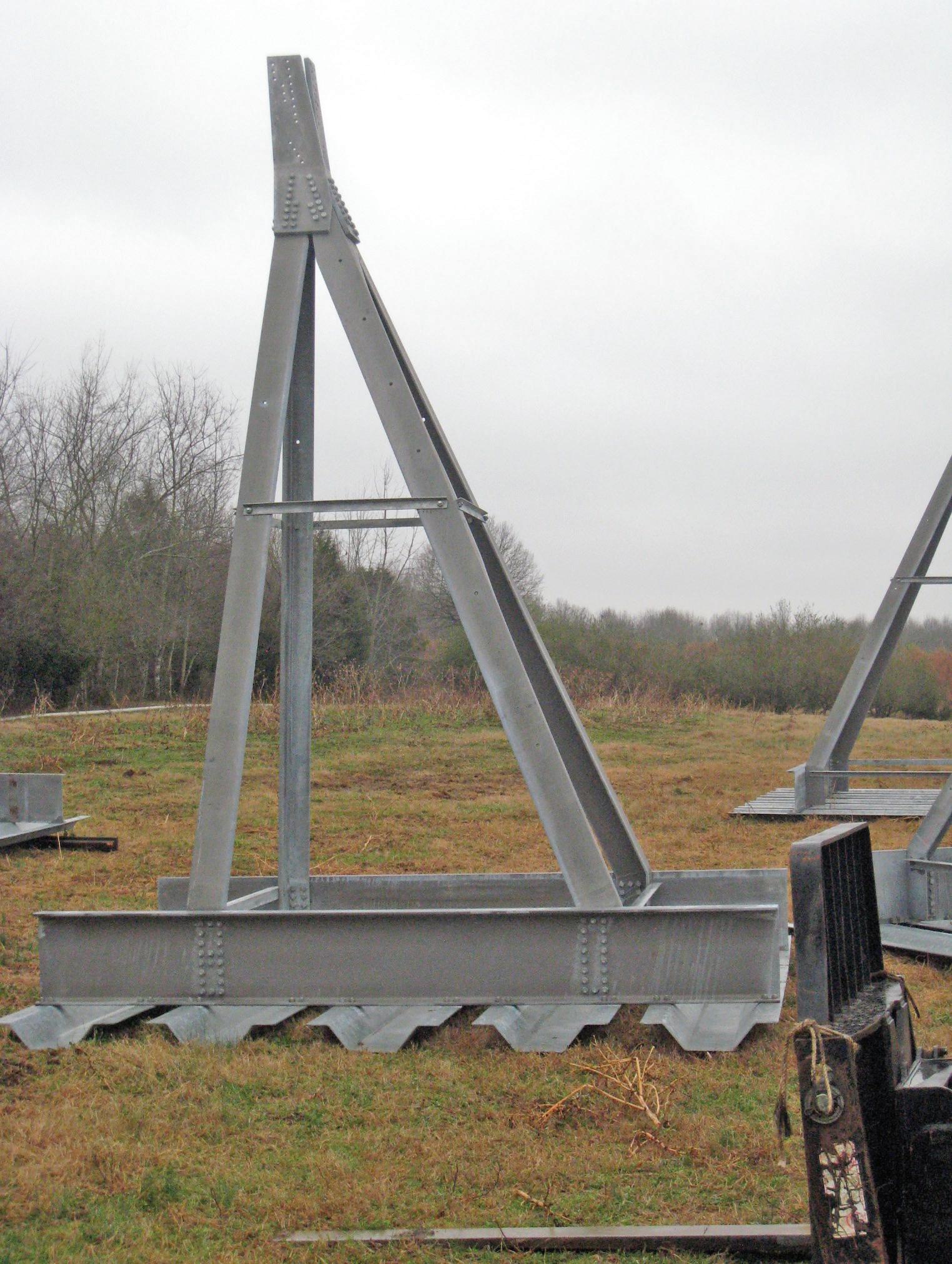
science to what was once largely guesswork. A simplified version, Load and Resistance Factor Design (LRFD), assigns strength factors to account for uncertainties in capacity calculations. For decades, utilities relied on Allowable Stress Design (ASD), which applies safety factors. Selecting an adequate safety factor requires considerable professional judgment and experience and can vary significantly among foundation designers; consequently, the reliability of foundations designed using ASD can be highly variable.
RBD takes a more refined approach. By quantifying risk, it adjusts strength factors to reflect actual conditions, showing where a smaller foundation is sufficient and where a stronger one is essential. This balances costs against risk, giving engineers confidence in performance and managers some assurance that investments are spent wisely. In short, ASD is “one-size-fits-all,” while RBD is “fit-for-purpose.” For shallow foundations, RBD approaches can complement ASD, helping utilities avoid both overdesign and underperformance.
Geotechnical Exploration
The new ASCE manual puts strong emphasis on geotechnical exploration. It calls for a layered approach. It starts with desktop
Pyramid type steel grillage foundation used for steel latticed towers.
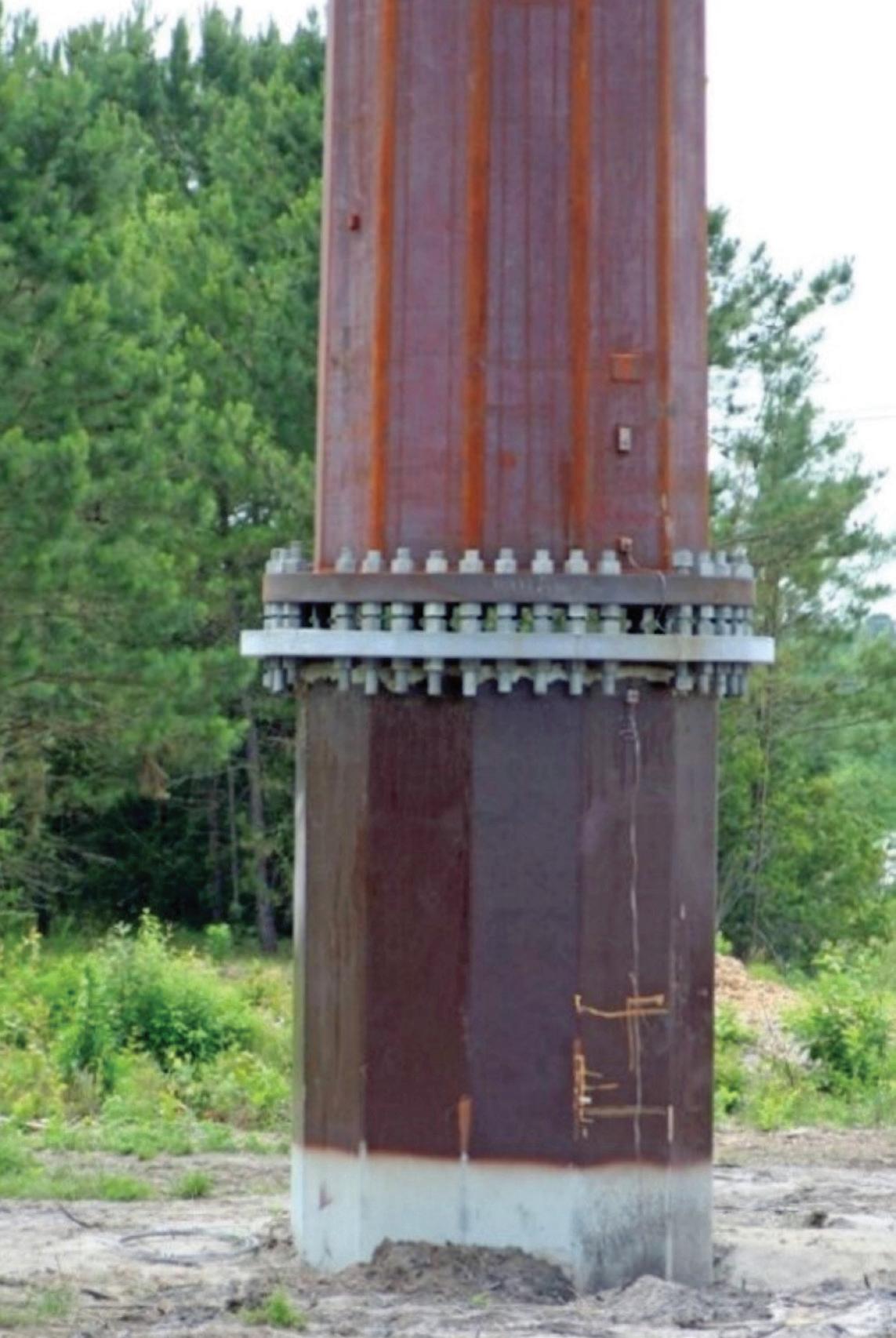
studies of maps and geology. Those are followed by field investigations such as test pits or borings. Then it is all confirmed with laboratory tests to understand soil strength and behavior. Each step adds another piece to the puzzle, reducing uncertainty and sharpening the design.
The MOP provides a comprehensive summary of soil and rock properties, along with their associated geotechnical design parameters.
The payoff is clear. For utilities, it means fewer mid-project redesigns, fewer surprises in the field, and foundations that perform as expected when the next storm hits.
Foundations Differ
Direct-embedded poles remain the workhorse of overhead power lines. Users need to take into consideration the requirements of embedment depths. In addition, there are limitations to predetermined depth methods, which is where the MOP is so valuable.
MOP cautions that determination of embedment depth alone isn’t enough. Depending on whether sand, gravel, or native soil is
used, the backfill can control foundation capacity. Foundations may fail in the backfill, the surrounding native soil, or both. The manual provides guidance for analyzing these interactions. Drilled shafts are a mainstay of utility construction because they can handle both the heavy vertical weight of a structure and the strong lateral forces it faces in service. How much movement a shaft is expected to undergo — its side-to-side displacement and rotation — plays a big role in both the performance and cost of the foundation. The MOP offers a more balanced design approach that helps engineers set realistic limits: firm enough to prevent significant movement under maximum loads, but not so conservative that it drives up costs without adding real value.
The MOP also underscores the importance of getting construction right the first time. Non-Destructive Integrity Testing (NDIT) is highlighted as a best practice to verify concrete shafts are free of defects before they go into service. That assurance is critical, since repairing a defective shaft after installation is extremely difficult and costly.
At first glance, shallow foundations sound straightforward. After all, they sit close to the surface and are often the first choice for supporting substation equipment like transformers, breakers, or control houses. But “simple” doesn’t always mean “easy.”
One challenge comes from the way equipment loads are applied. Imagine trying to balance a heavy box on a seesaw — if the weight isn’t centered, the pressure beneath shifts unevenly. Shallow foundations sometimes face a similar problem when loads are off-center, creating uneven stress in the soil below.
The soil itself can pose another risk. A utility once discovered that a new control house door wouldn’t shut properly. The cause wasn’t the hinges — it was the foundation slowly settling into soft soil. If the near-surface material is weak or compressible, the foundation may slowly sink or tilt over time, much like a chair leg sinking into soft ground. Careful planning and soil investigation are essential to avoid costly settlement problems. From uplift to compression to lateral loading, the new MOP highlights how to evaluate shallow foundations under the full range of forces they face, ensuring both reliability and cost-effectiveness.
Anchors
Anchors are a critical part of keeping structures stable, and they come in many forms — from steel plates and screw-like helicals to grouted and buried systems. Their performance depends on several factors, including soil conditions, geometry, and installation angle. Because no two sites are the same, design decisions can’t be left to guesswork. The new MOP gives engineers practical guidance on when straightforward approaches are sufficient and when more advanced analysis is needed to ensure both safety and cost-effectiveness.
Special Foundations & Conditions
Not every transmission line crosses firm, level ground. Many are built in wetlands, floodplains, mountains, or remote corridors where standard foundations simply don’t work. In these environments, engineers rely on creative solutions. Vibrated steel caissons perform in high-water sites where soil removal must be
Vibratory caisson supported steel pole.
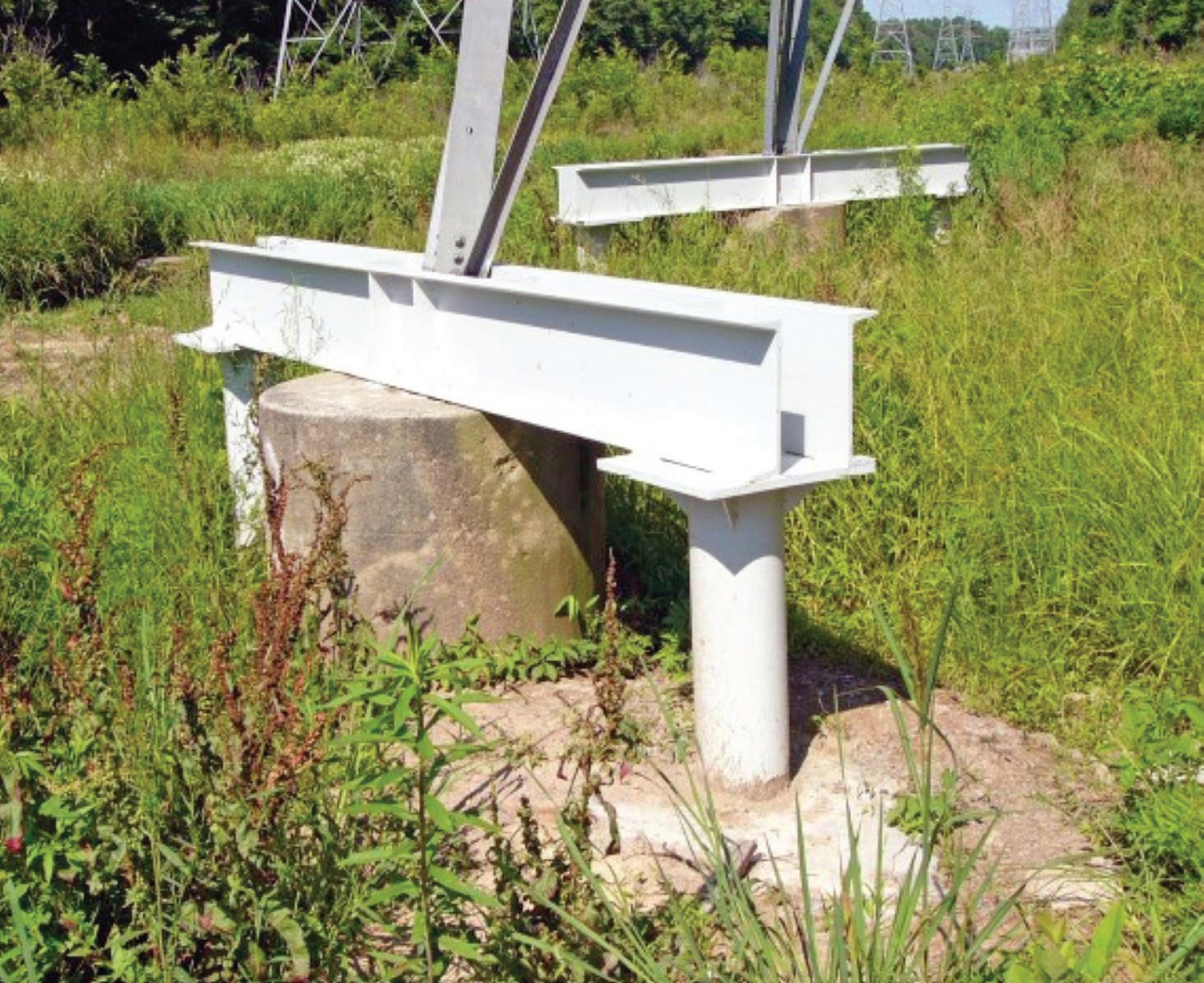
limited, while helical piles — giant screw-like anchors — are often the choice in coastal regions where uplift resistance is critical.
One project in the Blue Ridge Mountains showed just how adaptable these methods can be. After a landslide cut off access, crews stabilized towers with slender micropiles drilled into rock and tied into a surface grillage. The system provided deep support with a small footprint, protecting both reliability and the surrounding environment. As reported in T&D World in May 2023, it became a model of how urgent fixes can inspire long-term best practices.
The MOP captures these lessons, combining design guidance with construction know-how to help engineers apply the right solution in the field. It also highlights that foundations rarely sit in ideal soil. Frost, erosion, and human activity can weaken support; in some cases, frozen ground has even caused tower failures, as seen in Ontario in 2008. Add to this the risks of landslides, avalanches, adjacent excavations and slopes, underground utilities, or even stray currents on buried steel, and the picture becomes clear: successful projects depend on adapting to the site, not just following a standard recipe.
Extending Guidance
Although full seismic analysis is rarely performed for transmission structures, earthquakes can still cause foundation failures through landslides or liquefaction. MOP offers practical guidance, summarizing code references, modeling approaches, and reinforcement details, while also outlining strategies to mitigate liquefaction, settlement, and lateral spreading.
Existing drilled shaft foundation reinforced with micropile foundation due to the increased loads from reconductoring.
Utilities also face the challenge of reusing and upgrading existing foundations. When loads increase due to system upgrades or when deterioration is discovered, retrofits may be required. The MOP provides a systematic way to evaluate older foundations and recommends reinforcement or refurbishment methods to ensure they can safely carry new demands.
The appendices add further practical resources: survey results on current utility practices, corrosion protection strategies, guidance on concrete and grout, and anchorage design procedures. Corrosion in particular has proven costly — for example, a T&D World article in November 2021 described severe groundline corrosion on steel poles that required reinforcement and replacement to restore structural capacity. By highlighting such risks, MOP equips engineers with both preventive measures and corrective approaches to safeguard reliability.
Building for the Future
The electric grid faces unprecedented demands: renewable integration, climate resilience, aging assets, and evolving regulations. The strength of foundations plays a significant role in the reliability of overhead power line structures and substations. By consolidating decades of research, survey results, and practical experience, the latest ASCE MOP gives utilities a roadmap for foundation design that is consistent, reliable, and ready for the future.
As one task committee member noted: “Every pole and tower starts in the ground. With this manual, we now have the tools to build reliability from the bottom up.”
DR. PRASAD YENUMULA (prasad.yenumula@duke-energy.com) is a Principal Engineer at Duke Energy and a recognized industry leader. He chairs ASCE’s OPS Task Committee on Foundations and EPRI’s Line Design Task Force. He serves as an adjunct professor in Gonzaga University. A co-author of a textbook and author of numerous research papers, he has received 27 industry awards, including the James B. Duke Career Achievement Award and multiple EPRI Technology Transfer Awards.
Stronger Connections with Grain Belt Express
Designing the largest transmission line in U.S. history.
By JILLIAN EDWARDS, AARON WHITE, and DAVID GELDER, Invenergy
Grain Belt Express (GBX) will be the largest transmission line in U.S. history. An 800-mile High Voltage Direct Current (HVDC) transmission megaproject, GBX is designed to deliver 5 gigawatts (GW) of power from southwest Kansas to load centers in Missouri, Illinois, and Indiana. Notably, GBX will be the first U.S. transmission line to connect four grid regions with domestic energy resources, including Associated Electric Cooperative Inc. (AECI), SPP, MISO, and PJM.
Designing An HVDC Megaproject
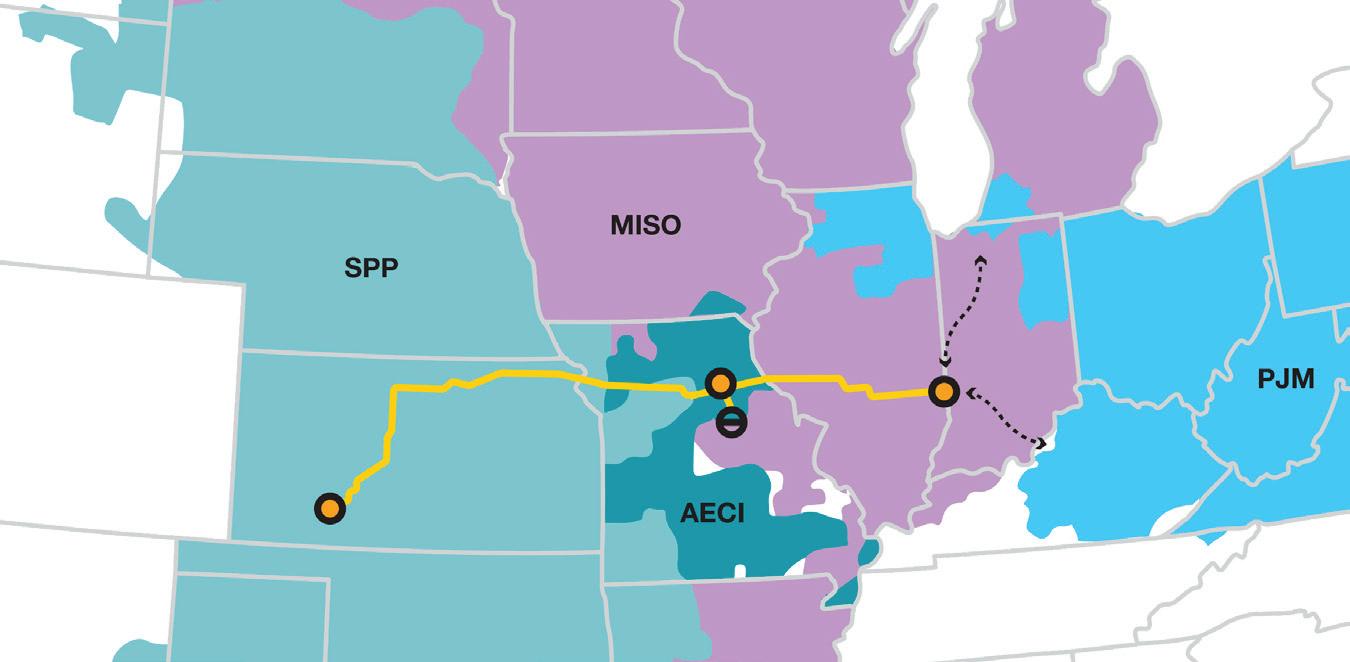
The unprecedented scale of GBX makes it a pivotal investment for today’s U.S. power grid. GBX will address 5 of the 35 GW of interregional transmission needs identified by the North American Electric Reliability Corporation (NERC).
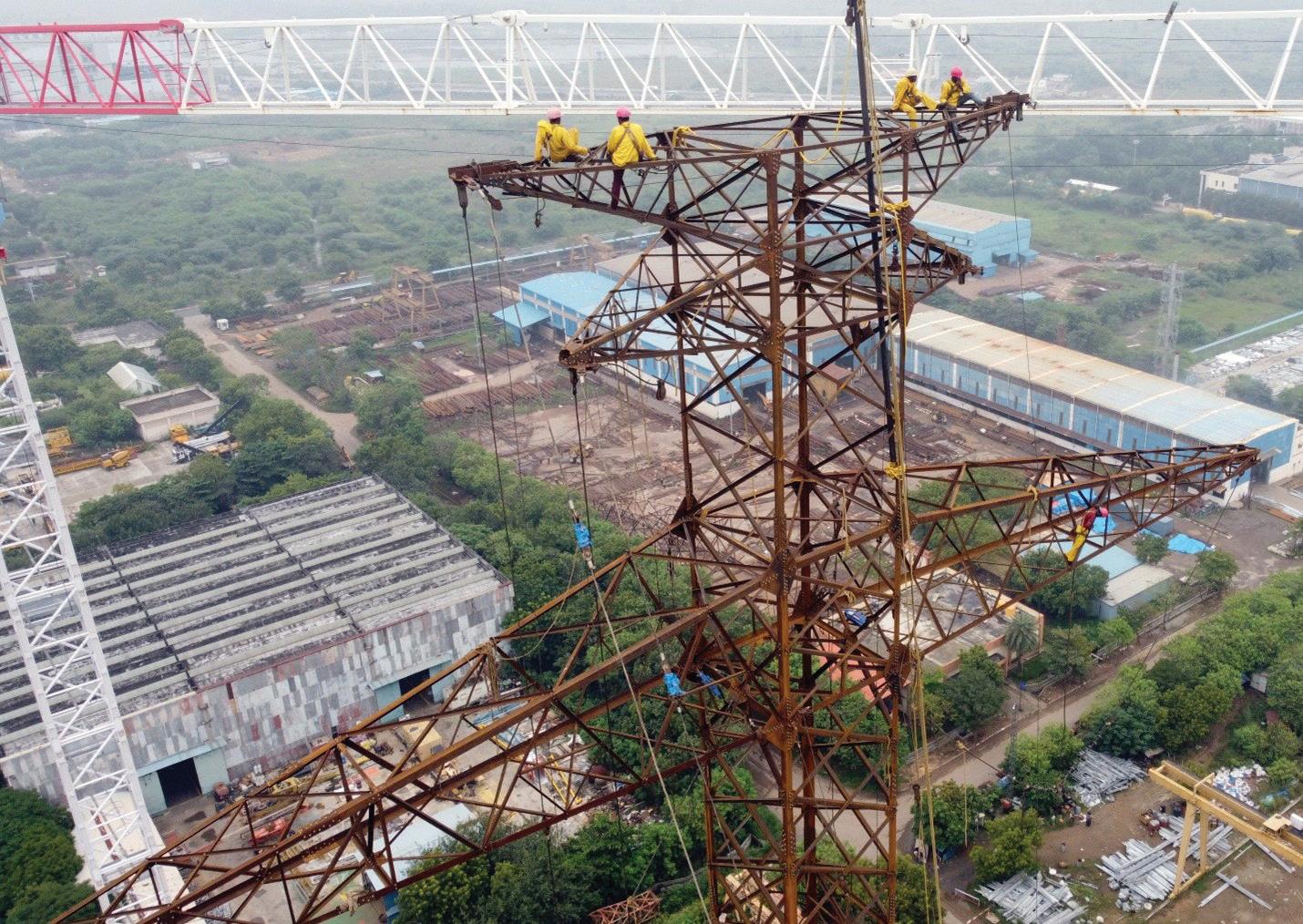
As an open access and merchant transmission line, GBX has been developed with a clear focus on certainty — attentively managed technical, financial, regulatory, procurement, and schedule factors. Also as discussed in this article, being the largest domestic deployment of HVDC, GBX adopted state-of-the-art design practices to meet interrelated electrical, structural, and mechanical requirements to enhance long-term project performance. By leveraging advanced HVDC technology with a Voltage Sourced Converter (VSC) station design, GBX delivers a vital transmission backbone that strengthens grid connections. To illustrate, GBX’s ability to reverse power flow enhances resilience under extreme power demand conditions; its integrated black start capability provides a stable pathway for power restoration during widespread outages. These features can help keep the lights on and reduce the risk of long, costly disruptions for households and businesses. Such far-reaching benefits are achieved with greater efficiency than conventional
Crews atop the tallest Grain Belt Express test tower during full-scale testing.
GBX Project Route – Four interconnecting grid regions.
alternating current (AC) systems, which still make up most of the grid, underscoring why HVDC was the technology of choice for a project of this scale.
Building Certainty Early
Central to GBX development has been a focus on innovation that underpins diverse project scope definition and reliability outcomes. This was accomplished via a broad set of engineering efforts to safeguard performance and collectively de-risk the transmission line:
1. Wire galloping — a high-amplitude, low-frequency oscillation which causes wires on transmission lines to move in a “jump rope” motion, sometimes even coming into physical contact with each other. Galloping posed both reliability and schedule risks, such as potential wire degradation, transmission tower and equipment damage, and even outages. Through a novel design approach, the project team reduced galloping risk to near-negligible levels while meeting GBX’s elevated reliability standards, thereby avoiding the need for approximately 180,000 antigalloping devices or costly tower redesigns.
2. Transmission tower foundations. Nearly 1,300 soil borings were completed along the 542-mile Phase I route, providing both confidence and cost certainty in foundation design while preserving flexibility for construction.
3. Insulator testing. Placing a strong emphasis on defining testing requirements for the insulator assemblies that hold up and separate the electrical wires on each tower. These components are critical — they prevent electricity from ‘jumping’ to the towers or other wires, keeping the power safely contained within the lines. Each insulator assembly was carefully studied and sized to withstand extreme conditions, including powerful electrical surges, without failing.
4. Multiple aerial survey flights. These captured detailed terrain and aboveground data across four states, enabling optimized tower placement and route planning.
5. Proactive wire procurement. A longterm supply and manufacturing agreement was reached with Prysmian that includes a $22.5 million investment to expand its Williamsport, Pennsylvania
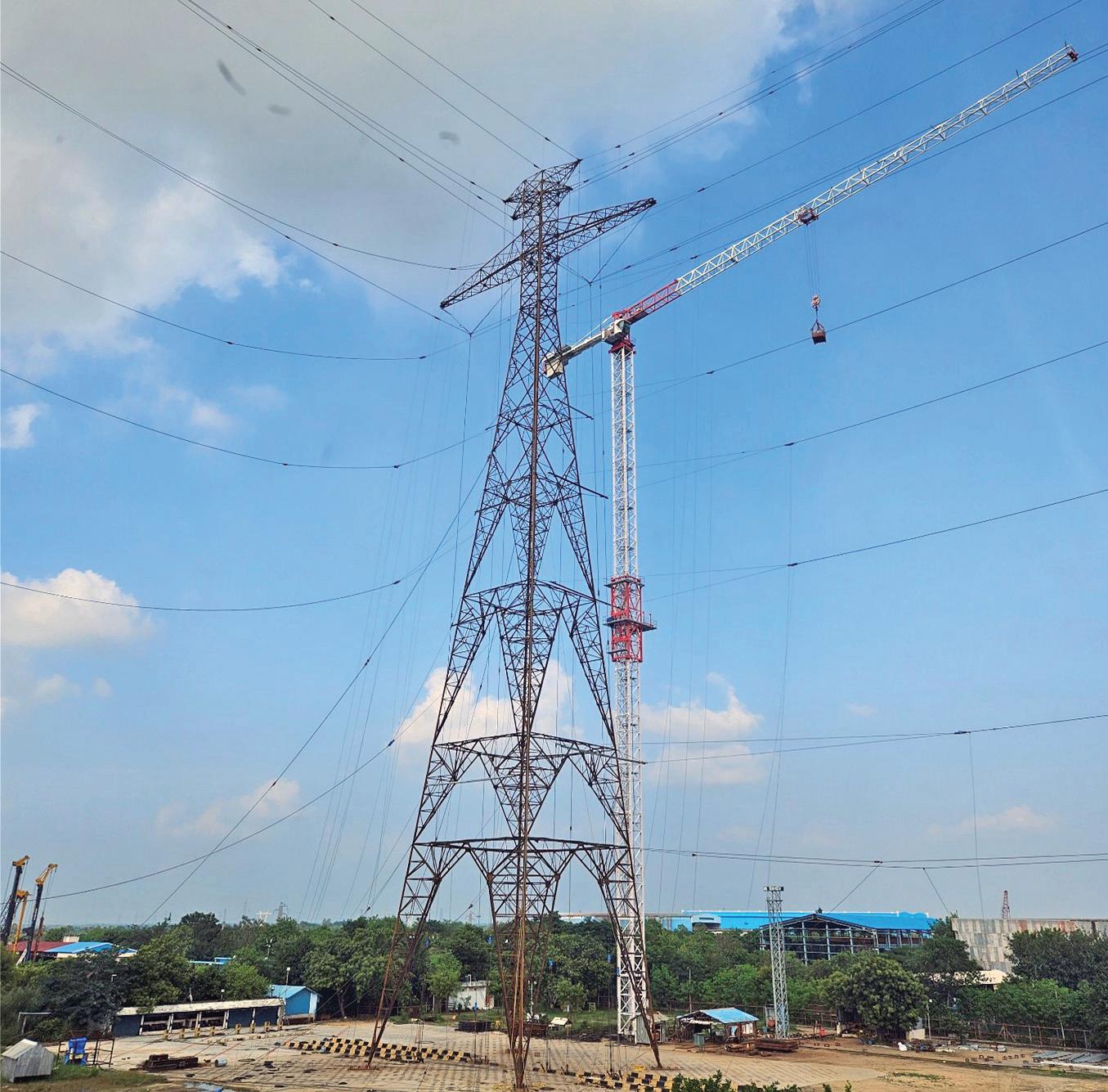
Testing
a Fully Erected 315-ft GBX River Crossing Test Tower.
overhead conductor facility. Notably, GBX’s first order of conductors will be manufactured exclusively using U.S. steel and aluminum and according to projectdefined conductor specifications, including E3X® Technology. The total length of conductor exceeds 22 million feet. Working in partnership with Prysmian, GBX also developed a custom Optical Ground Wire (OPGW) for the project — an innovation that proved critical in mitigating wire galloping, as discussed in detail later in this article.
6. Rigorous tower testing. Each of the project’s 9 unique tower types underwent full-scale testing to confirm they could reliably support the line and withstand controlling construction and operational load cases. This process not only confirmed structural integrity but also reduced the risk of late-stage design changes, helping keep the overall schedule on track.
Robust Towers, Reliable Transmission
GBX’s custom-designed steel transmission towers feature a symmetric, vertical
design. From the top, two OPGWs provide lightning protection for conductor wires below, two Dedicated Metallic Return (DMR) conductors enhance stability, and two Pole Conductors carry the bulk of electricity safely across the line. GBX is a ±600 kV HVDC system with a bipolar design — meaning one pole is operated at a positive voltage and the other at a negative voltage. The DMR provides a path to redirect extra current, keeping the two poles in balance and power flowing reliably. This configuration sets the GBX towers apart from conventional three-phase AC towers.
The GBX transmission line also uses a family of 9 free-standing lattice tower types, including 6 “containment” towers designed to prevent cascading failures in the unlikely event of a tower collapse, conductor break, or severe weather damage. Two towers were specially designed for the 3,700-foot Missouri River crossing. Average tower heights range from roughly 120 to 220 feet above ground, with rivercrossing structures reaching up to 315 feet. Each tower type underwent extensive
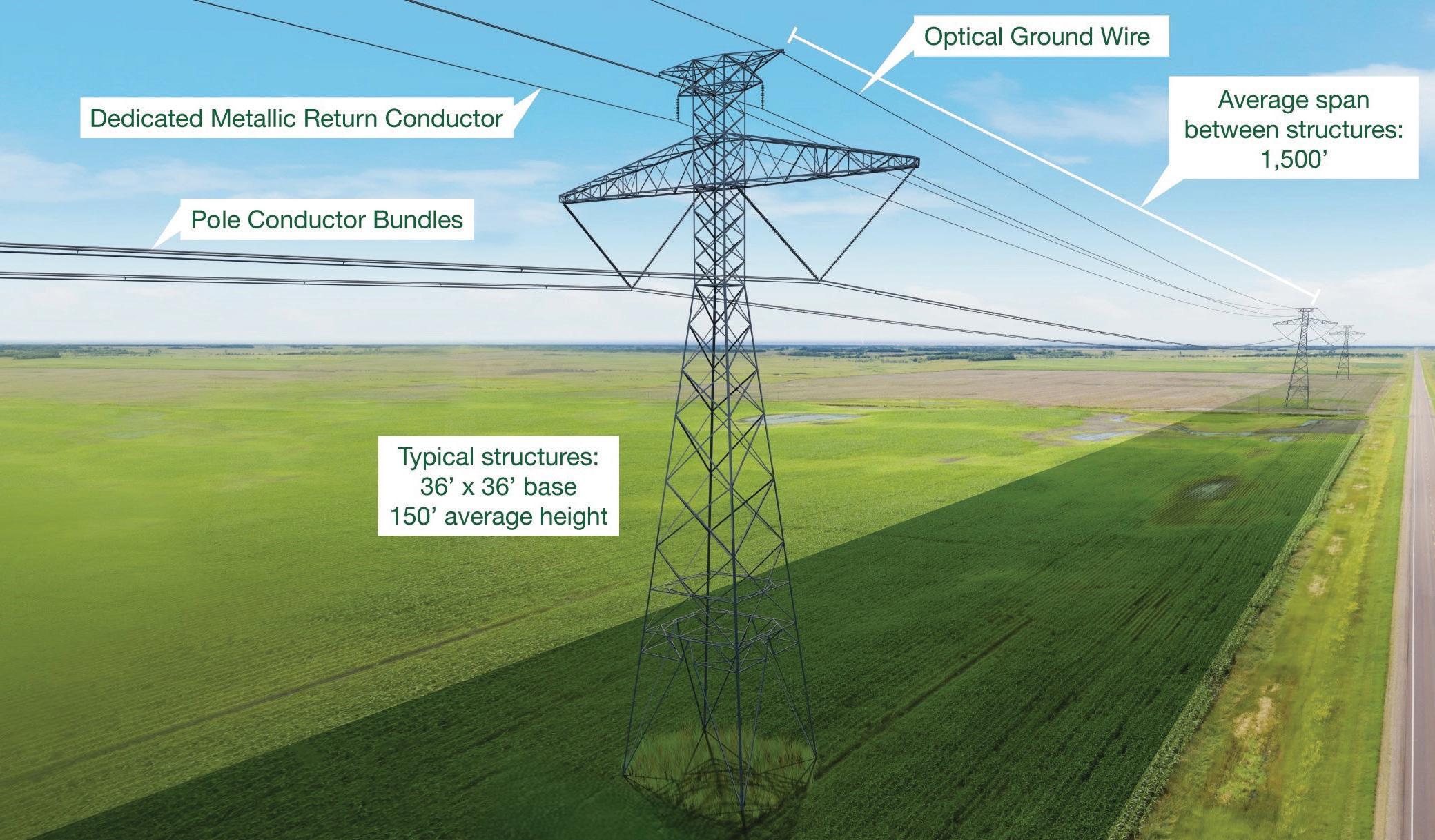
“GBX’s ability to reverse power flow enhances resilience under extreme power demand conditions; its integrated black start capability provides a stable pathway for power restoration during widespread outages.”
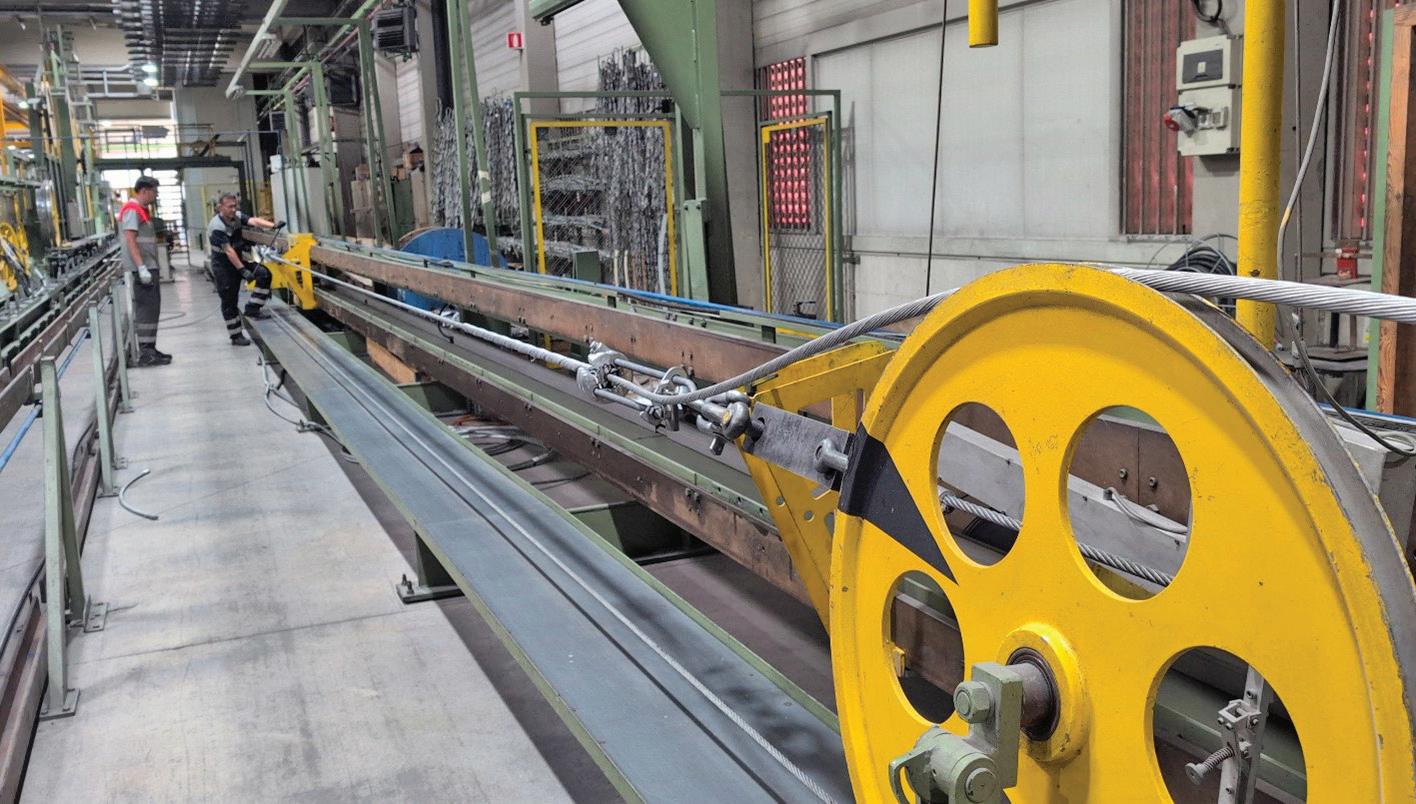
full-scale testing to build confidence it could handle extreme loads and weather conditions, thus validating performance and reducing risk.
Full-scale testing of each unique tower type over 18 months included hundreds of tons of steel and more than 100 worstcase loading scenarios. Loads ranged from unbalanced broken wires to concurrent extreme wind and ice weather conditions. Early testing provided critical insight, allowing timely adjustments and keeping the overall project schedule on track. These
milestones not only confirmed the towers’ structural integrity but also streamlined construction planning and reduced the risk of costly design changes later in the project.
Tackling Galloping via Innovative OPGW
The project route passes through areas with steady winds, occasional ice, and spans averaging 1,500 feet, all of which increase the likelihood of wire galloping and the need for reliable engineering
solutions to manage this phenomenon. Because the DMR is a critical component of the line’s reliability, galloping and potential contact with other wires can lead to service interruptions. Addressing this risk was therefore essential to maintain safe and efficient operation of this backbone transmission line.
After Invenergy assumed ownership the project underwent significant design upgrades in an attempt to broadly de-risk the project, including the formal addition of galloping as a design criterion.
GBX Typical Tower Configuration highlighting the critical Dedicated Metallic Return Conductor positioned between the OPGW and Pole Conductors.
GBX’s Custom OPGW set up for one of fourteen code mandated design qualification tests.
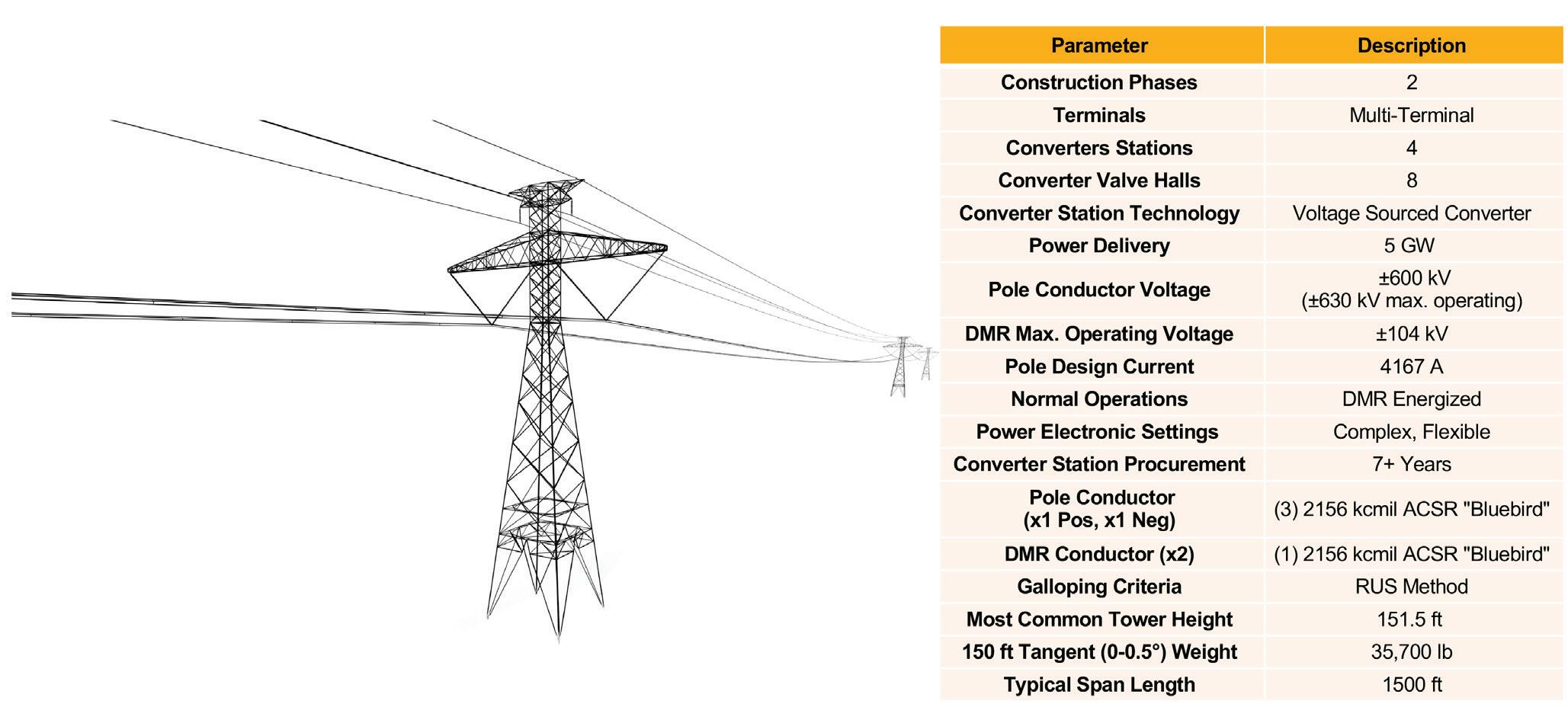
Preliminary engineering analyses indicated potential physical contact between wires due to galloping across nearly 75% of the line, with the DMR emerging as a key concern.
Protecting this critical wire demanded creative solutions under pressure. Despite an accelerated schedule for parallel tower design and full-scale testing, the team successfully navigated the overlapping wire risks, transforming a major technical challenge into a demonstration of engineering resilience and innovation.
The breakthrough to the galloping wire challenge came through a custom OPGW. The cable was refined to be slimmer, stronger and lighter, which reduced sag — the natural dip a line takes between towers. With less sag, the swinging wire galloping motions caused by ice and wind were also reduced, dramatically lowering the risk of wires overlapping. Remarkably, it was a minor adjustment in the fiber coating — something almost invisible — that allowed for this new wire design to be effective, ultimately shaping the reliability of the nation’s largest transmission line project.
The results were striking. The percentage of the transmission line experiencing galloping and wire overlap dropped from roughly 75% to 2%, with many of the remaining spans with this issue showing much smaller galloping overlap amplitudes. Targeted anti-galloping devices will manage these few remaining spans, but
most of the line now benefits from a solution integrated directly into the OPGW design. The custom cable solution proved to be the most effective approach: simpler to integrate and more cost-effective than modifying tower designs or adding a large amount of additional hardware to the line, which are more traditional strategies.
Raising the Reliability Bar
The efforts presented highlight the importance of custom solutions for complex long-distance transmission lines. Standard OPGW can sometimes be insufficient for large-scale projects and tailoring cable characteristics can mitigate dynamic behavior and wire interaction. Combined with proactive measures — targeted geotechnical analysis, extensive aerial surveys, rigorous tower testing, and wellvetted insulator designs — these and other risk-mitigating solutions provide a model for future high-capacity lines.
Beyond individual design details, GBX further highlights HVDC’s growing role as key infrastructure for the U.S. grid. High-capacity, long-distance HVDC lines deliver power more efficiently and reliably than traditional AC systems, minimizing losses over hundreds of miles. In addition to efficiency, HVDC provides unique operational advantages, offering unmatched flexibility, resilience, and control, establishing a new standard for domestic bulk power transmission.
The integrated and future-focused approach to critical large-scale transmission projects showcased by GBX will deliver the certainty needed to enhance reliability, support construction readiness, and ultimately strengthen the U.S. grid in this period of historic energy demand growth.
JILLIAN EDWARDS, PE (jyedwards@invenergy. com) serves as a Project Engineer at Invenergy where she supports HVDC projects in pre-construction and early development, as well as numerous generationtie line projects. She has been a member of ASCE and the Structural Engineers Association of Illinois since college. She earned a bachelor’s degree in civil engineering from the Illinois Institute of Technology.
AARON WHITE, PE (awhite@invenergy.com) serves as a Senior Director at Invenergy where he has led several key initiatives, including positioning Invenergy as a leader in HVDC, negotiating long-term supply agreements with strategic partners, and leading team members in contributing technical content for CIGRE, IEEE, ASCE, and APLIC. He earned a bachelor’s degree in civil engineering from the University of Utah
DAVID GELDER, PE, PMP (dgelder@invenergy.com) serves as a Senior Manager at Invenergy where he manages a portfolio of several dozen “gentie” projects in development and construction across 25 states and 2 provinces. He earned a bachelor’s and master’s degree in civil engineering from Brigham Young University and an M.B.A from the University of Utah.
Table 1 – Grain Belt Express Major Design Parameters.
As structures get larger, ensuring quality foundations gets more challenging.
By GEORGE PISCSALKO, Pile Dynamics, Inc.
The recent increased demand on the US power grid led by the growth in AI (artificial intelligence) and data centers is leading to the construction of many new highperformance high-voltage transmission line structures. Drilled shaft foundations are increasingly used to support these transmission line structures. These foundations must handle large lateral overturning loads that come from tall monopole and lattice tower structures resisting wind and line tension.
The industry trend is toward larger diameter and deeper shafts, often constructed below the groundwater table with slurry to stabilize the excavation. These larger and more complex founda-
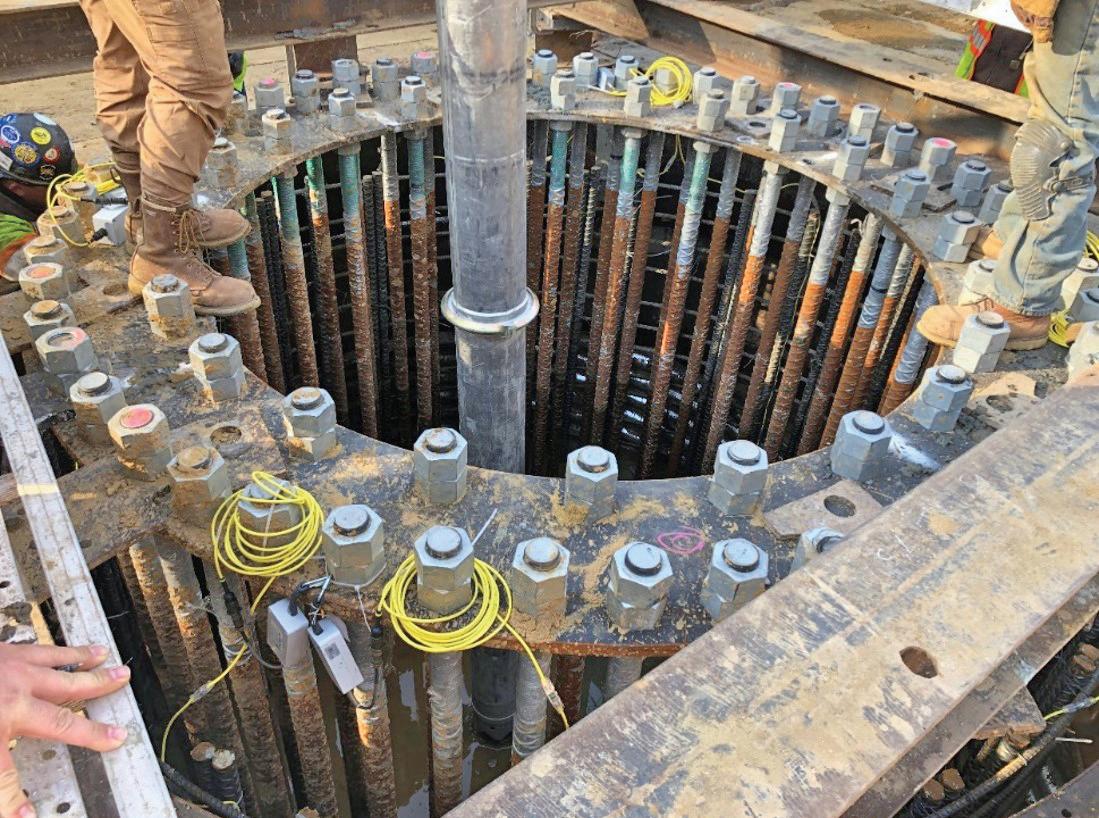
tions are here to stay as the transmission towers continue to get bigger and more complex, requiring the foundations to support much greater loads. Visual shaft inspection is not possible when these bigger shafts are cast under slurry or below groundwater, allowing defects to potentially go undetected. This requires much greater emphasis on the quality control efforts as a single foundation failure could be catastrophic.
These large diameter shafts are generally designed with a high amount of steel as part of the connection to the transmission line structure. The reinforcing cage effectively transmits larger laterals loads through the foundation. They also include stiffeners to support the entire reinforcement and anchor system for lifting and placement into the excavation.
Why Transmission Line Foundations Are Especially Difficult
This high concentration of steel can restrict the flow of concrete to the area outside of the reinforcing cage. Durability and performance of the foundation can be adversely impacted when insufficient concrete cover occurs between the reinforcing cage and the surrounding soils. Having adequate concrete cover around the outside of the reinforcing cage is essential to protecting the reinforcing steel. Exposure to groundwater and caustic soils can cause corrosion of the steel, which may reduce the ability of the shaft to resist the overturning loads.
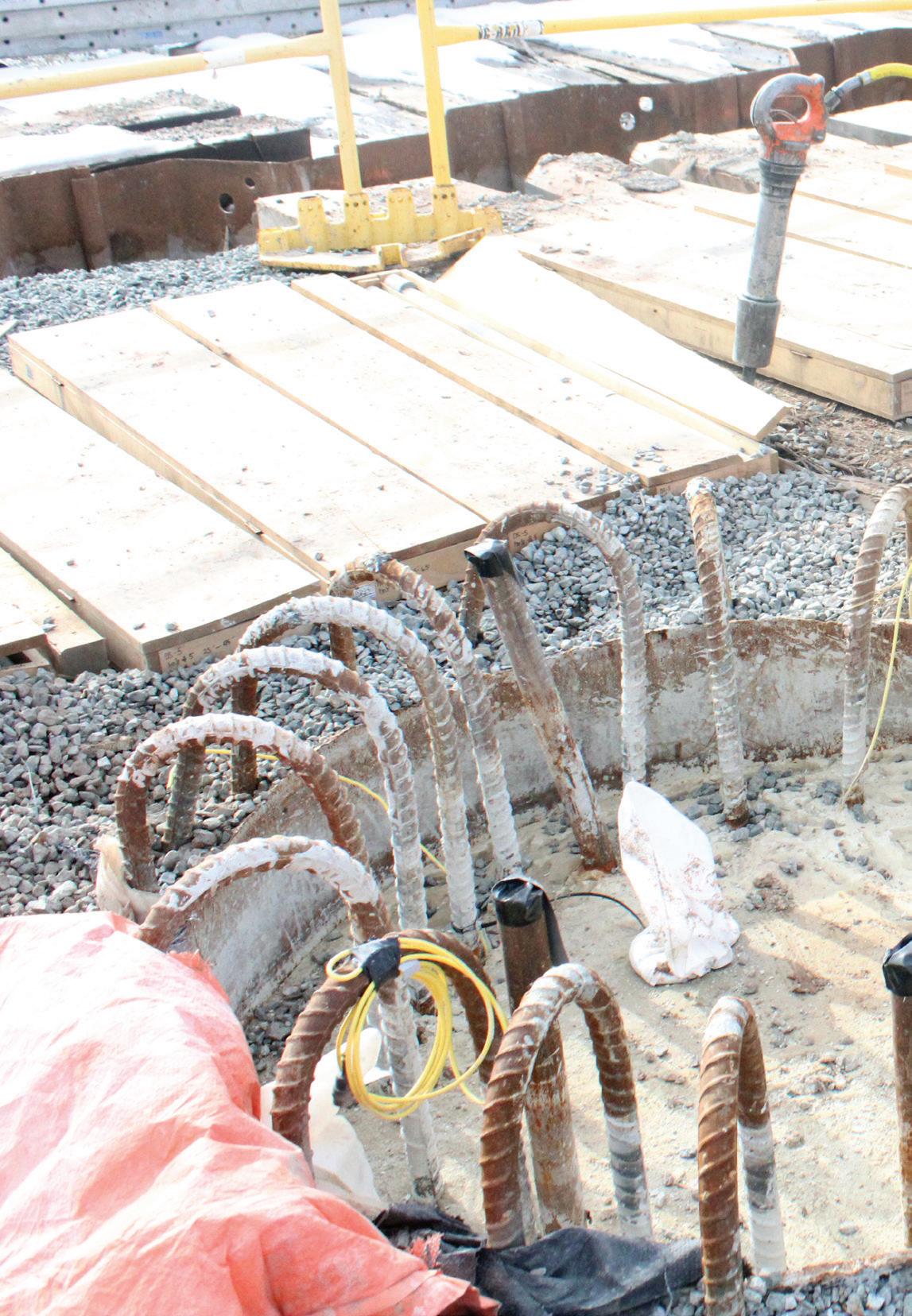
Congested cage being installed in an excavation.
TIP wires installed on Transmission Tower Shaft.
The connections of transmission line structures to supporting drilled shaft foundations typically are very different from those used in other industries. With pole-type foundations, there is a significant array of anchor bolts that can function either as shaft reinforcement or be placed nominally within the upper ten feet of the shaft and surrounded by a separate reinforcement cage.
These anchor bolts are needed to transfer large overturning moment reactions to the foundation. Internal steel anchor bolt templates and their associated stiffeners are used to maintain tight installation tolerances and are also incorporated into foundations. Lattice tower-type structures can use either base plated foundations with anchor bolts or bent angle steel (stub angles) for load transfer within a reinforcement cage. In both cases, the interior of the drilled shaft is occupied by steel elements that have cross sections more than the exterior reinforcement.
Additionally, shafts are generally cast using slurry methods in open excavations with unstable soil conditions. If not sufficiently stabilized, sidewalls can collapse into the reinforcing cage. That reduces or eliminates the expected concrete cover, resulting in little or no protection for the steel from the surrounding soil and groundwater.
Non-Destructive Testing (NDT) in the deep foundations field is used to test the in-place structures during or just after the foundations have been constructed. The NDT testing is
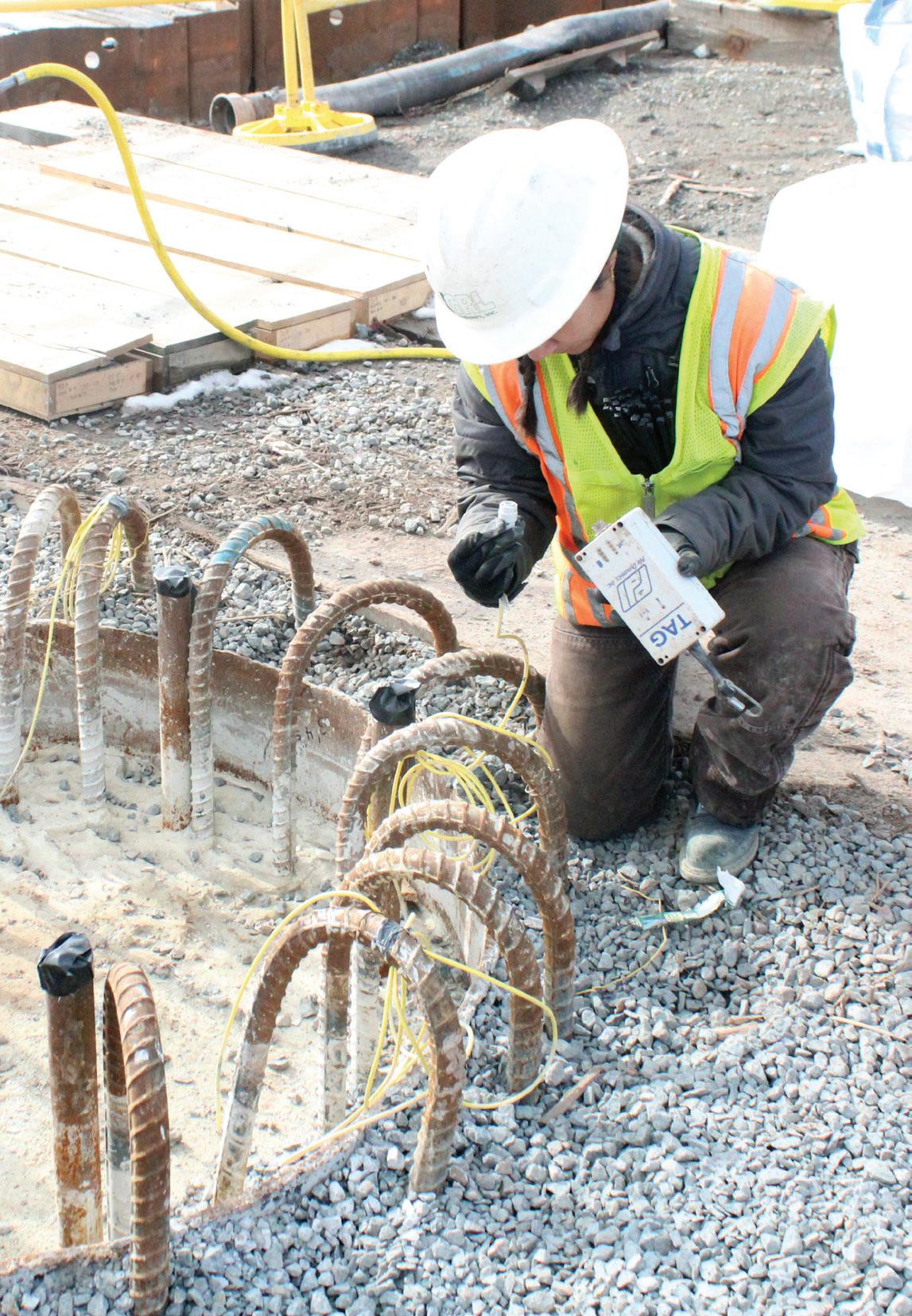
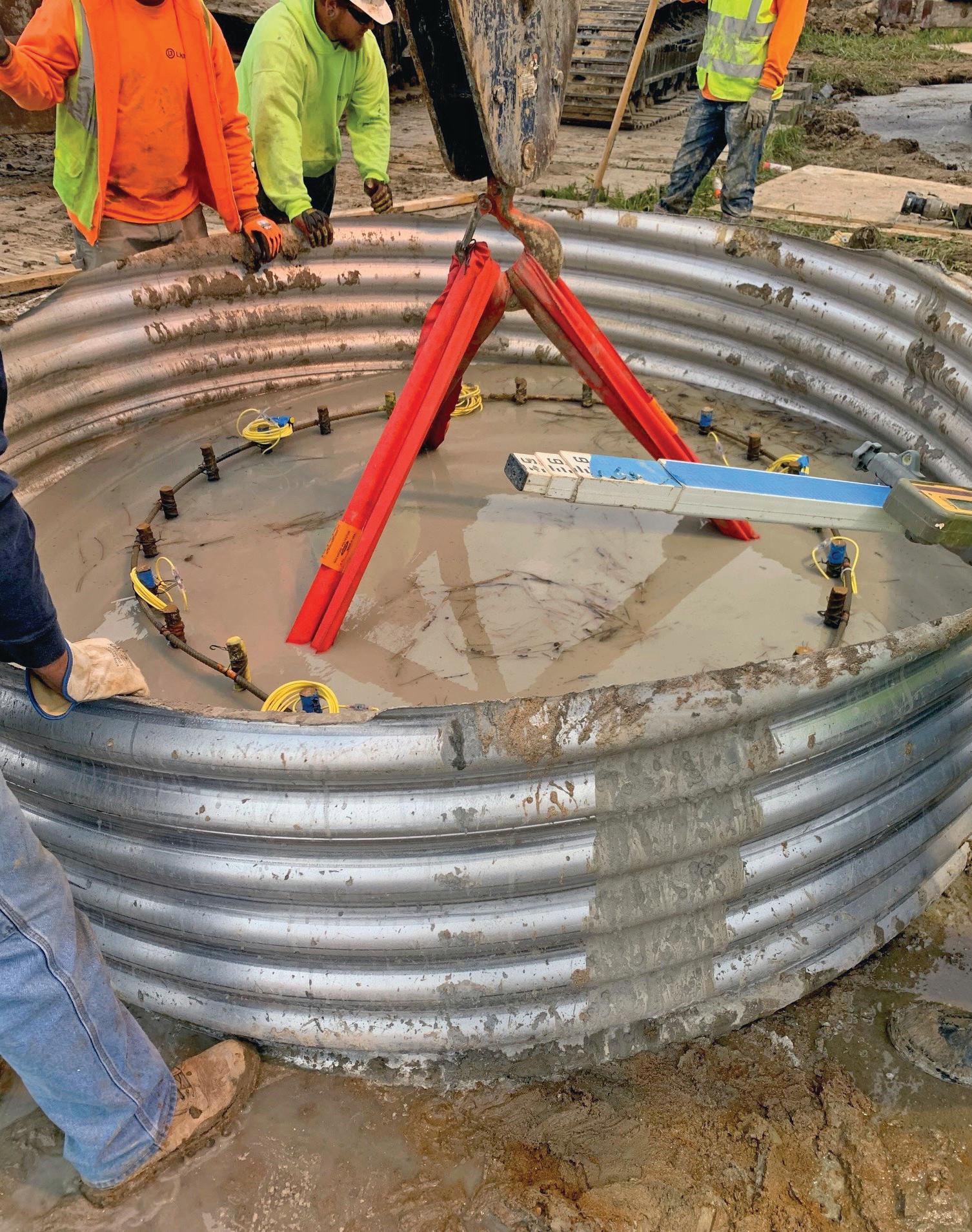
used to address the uncertainty related to shaft geometry and concrete quality after casting. There are different methods used for various purposes, but for this article they will all be considered NDT.
Legacy NDT Methods: Why They Fall Short
The NDT industry has been trying to find the best approaches to accurately assess shaft conditions after construction to help ensure that the constructed foundations satisfy the design intent. Historically, NDT methods have not been well suited for these massive, steel-congested shafts.
Modern testing methods have surpassed the older methods, although there are still many older methods in use. Each has certain advantages, but all have characteristics that generally limit their use with electrical transmission line foundation quality control. The electric power industry has historically relied heavily on visual inspection and soundings with weighted lines to “feel” the base condition of the excavation where the individual must estimate how easily the weight advances into the bottom of the shaft often from distances greater than 50 feet away. But these methods offer little insight into the quality of the shaft if it is not possible to inspect concrete when casting under slurry and vary greatly depending upon the experience of the individual making the measurements. Problems like soil caving, cage misalignment, or blocked concrete flow remain hidden.
The verticality and overall shape of the excavation prior to casting is of interest in many foundation designs but historically has not been routinely inspected because of lack of equipment
Reinforcing cage with TIP wires installed in a slurry filled excavation.
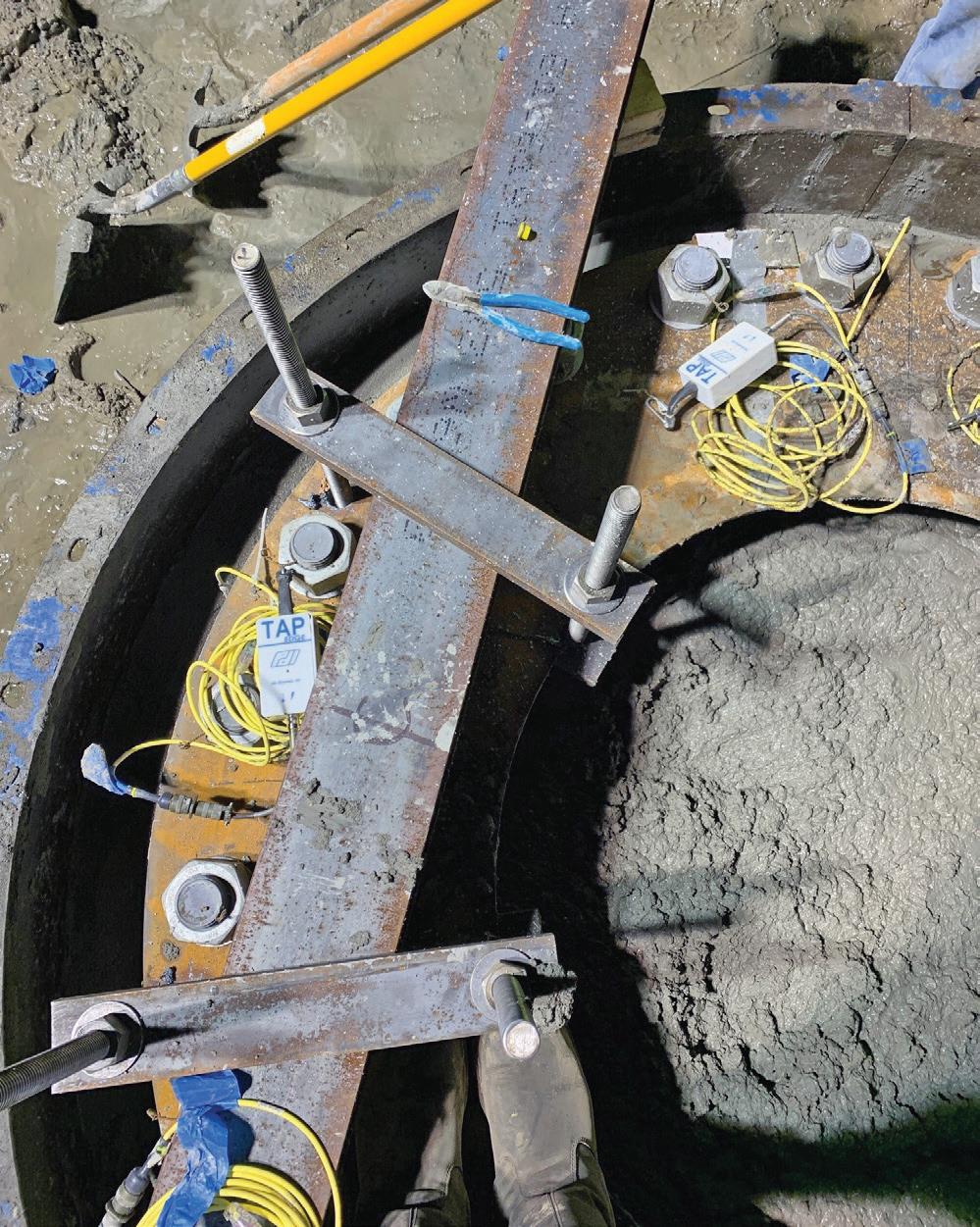
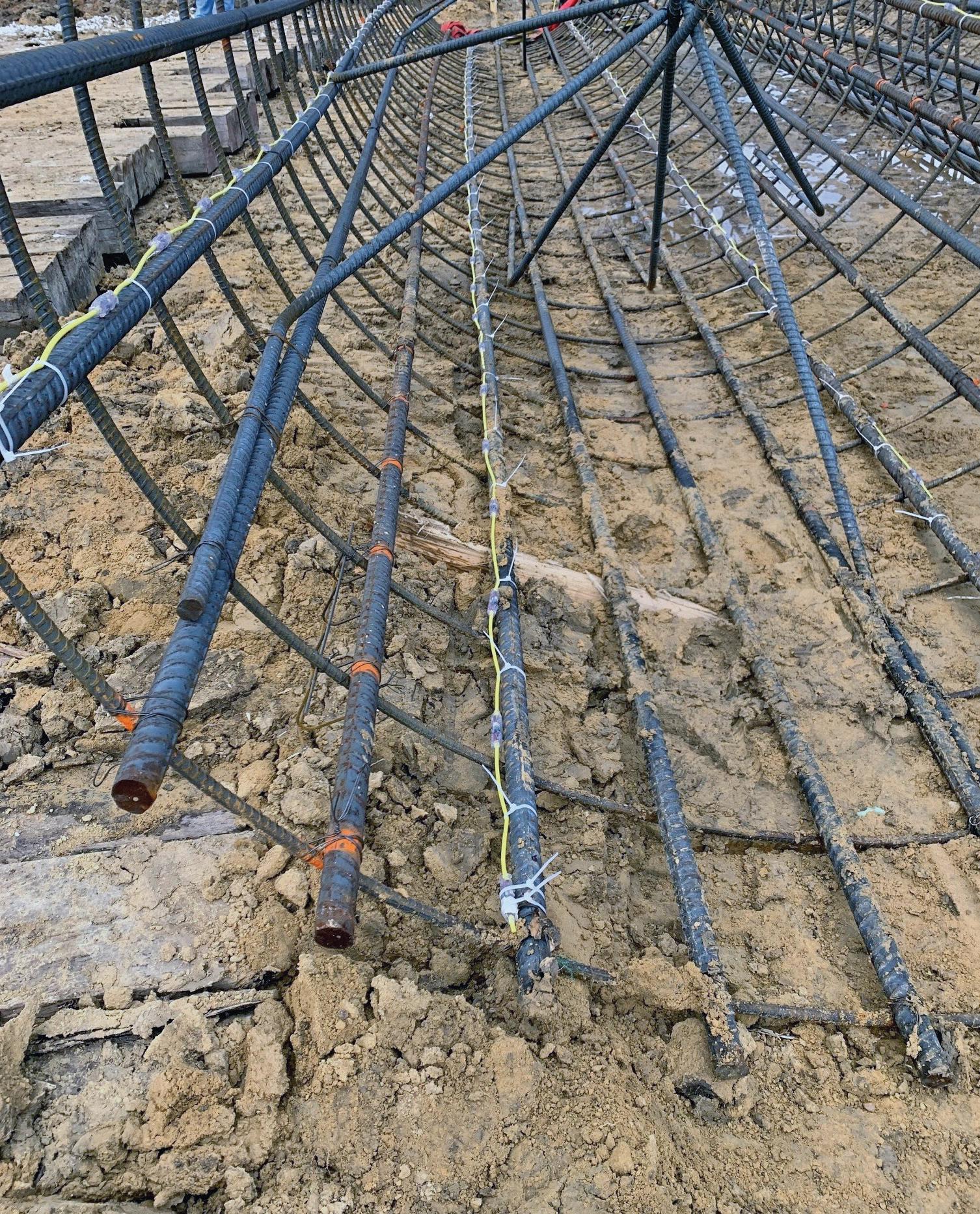
available. Mechanical calipers can be used for shape profiling, but they don’t provide meaningful information about the excavation. They are rarely used in the electric power industry.
Concrete volume logs are sometimes plotted as a function of elevation to conceptualize the shape of the excavation. This method relies on an individual with a weighted tape measuring the height of concrete after each truck has completed pouring its load. This method offers limited quantitative data and requires personnel to work adjacent to an open excavation.
For post installation inspection the legacy methods include the Low Strain Pulse Echo method and the Cross Hole Sonic Logging (CSL) method. The Low Strain Pulse Echo test is fast and economical but has many limitations which severely limit its use in electrical transmission line foundations. The CSL test requires the installation of many 2-inch steel tubes within the foundation and attached to the interior of the reinforcing cage. This is generally problematic for congested cages, especially where anchor bolt templates block access. In short, legacy methods give partial information and don’t fit the geometry and steel congestion of transmission line foundations.
Modern NDT Methods: Closing the Gap
Over the last decade, new tools have emerged to provide fast, quantitative, and remote-friendly testing for drilled shafts. These include pre-cast geometry and verticality checks, base-cleanliness devices, and post-cast thermal integrity profiling (TIP).
The three-dimensional shape of a drilled shaft can be obtained immediately after excavation is complete by deploying an ultrasonic measurement device. These devices make it possible,
prior to casting, to measure and assess the verticality and shape of the excavation and identify possible cave-in locations along the shaft profile in either dry or wet conditions. The devices scan the excavation sidewalls during lowering, with sonic data fed to the surface data logger and interpreted to give a realtime picture of shaft geometry. This eliminates the guesswork of calipers or concrete volume logs.
“Visual shaft inspection is not possible when these bigger shafts are cast under slurry or below groundwater ... This requires much greater emphasis on the quality control efforts as a single foundation failure could be catastrophic.”
The cleanliness of the base of a drilled shaft can be obtained immediately after excavation is complete by deploying a downhole device attached to the drill rigs Kelly bar (The SQUID (Shaft Quantitative Inspection Device)). The SQUID device makes it possible, prior to casting, to measure and assess the condition of the soil and debris at the base of a drilled shaft excavation, identifying areas that need further cleaning prior to concrete placement. The penetrometers at the bottom of the device can be forced into the soil at the base of the drilled shaft to assess
TIP data collection begins on a freshly poured shaft.
TIP wires installed on a reinforcing cage.
the thickness of the debris layer at the base of the excavation as well as the strength of the bearing layer. The measurements result in a force versus displacement for each penetrometer. This device can quickly and quantitatively sample multiple locations at the base of a drilled shaft excavation to determine the thickness of the debris layer typically under 15 minutes.
This addresses a key failure point: dirty shaft bases reduce end-bearing and long-term performance.
The thermal integrity profiling (TIP) method is an NDT approach used widely over the past decade to assess the integrity of drilled shafts after casting the shaft. Temperature measurements are obtained along the length of the reinforcing or outside anchor bolt cage from cables with thermal sensors cast into the shaft. Data collection begins during the casting process, or immediately after the casting has been completed. The thermal method measures the naturally occurring heat of hydration within the curing concrete to determine the integrity of drilled shafts. The Thermal Wire cables are tied to outside vertical bars at regular intervals (one wire for every 12 inches (305mm)) of shaft diameter rounded up to a whole number.
The TIP method overcomes the limitations of legacy methods as it does not require installed tubes, provides a virtual thermal image in wet conditions of the shaft shape relative to the reinforcing or anchor bolt cage, and provides an estimate of the outside concrete cover thickness. Interior steel within the shaft reinforcement is not an obstacle for this type of NDT method. The TIP method can identify significant anomalies in the shaft at a very early stage, and in some cases these anomalies can be identified while the concrete is still being poured. Each wire is sampled at regular intervals (typically every 15 minutes during the curing process) to obtain a 3-dimensional thermal image of the shaft, showing where concrete cover is inadequate and where anomalies exist.
TIP works even in congested cages since it doesn’t rely on ultrasonic transmission. It provides:
• Cover thickness estimates.
• Detection of soil inclusions or voids.
• Cage eccentricity (if it shifted off-center).
• Results are typically within 24 hours.
The limitation is timing: data loggers must be installed quickly after casting to capture the hydration phase. But its benefits — speed, remote monitoring, and full-section coverage — make it ideal for transmission foundations.
At a site in the southwest U.S., thermal NDT testing was used in conjunction with concrete volume logs measured after placement of each ready-mix transit truck. The monopole transmission line foundation was nominally 10 feet (3.05 m) in diameter and 40.83 (12.5 m) long in relatively dry sands. The shaft was flooded, and polymer slurry was used to stabilize the shaft walls. Permanent casing was placed in the upper 9 feet (2.7 m) of the shaft (7 feet (2.1 m) below grade). 10 thermal cable wires were evenly spaced around the reinforcement. The contractor did not report any unusual conditions during concrete placement but reported a deficit of about 2 yards3 (1.5 m3) from nominal values where an overage of 4 to 8 yards3 (3 to 6 m3) was anticipated from experience on adjacent foundations. A concrete rise graph
was developed from the field report and was then compared to the thermal readings taken 28.75 hours after placement, where both showed an anomalous condition in the same general range (lower 17 feet (5.2 m) of the shaft).
The engineering team developed shaft cross sections along the shaft section where insufficient concrete cover was suspected. It was determined that the shaft sidewalls had caved around most of the west-southwest half of the shaft at about 32 to 33 feet (9.8 to 10.1 m) below the top of the foundation, with the caved material deposited in a progressively larger area of the west-southwest portion of the shaft from 35 to 40.8 feet (10.7 to 12.4 m) below top of shaft. Additionally, the thermal data suggested that the reinforcement cage was offset a few inches to the southwest and not within the center of the shaft, resulting in
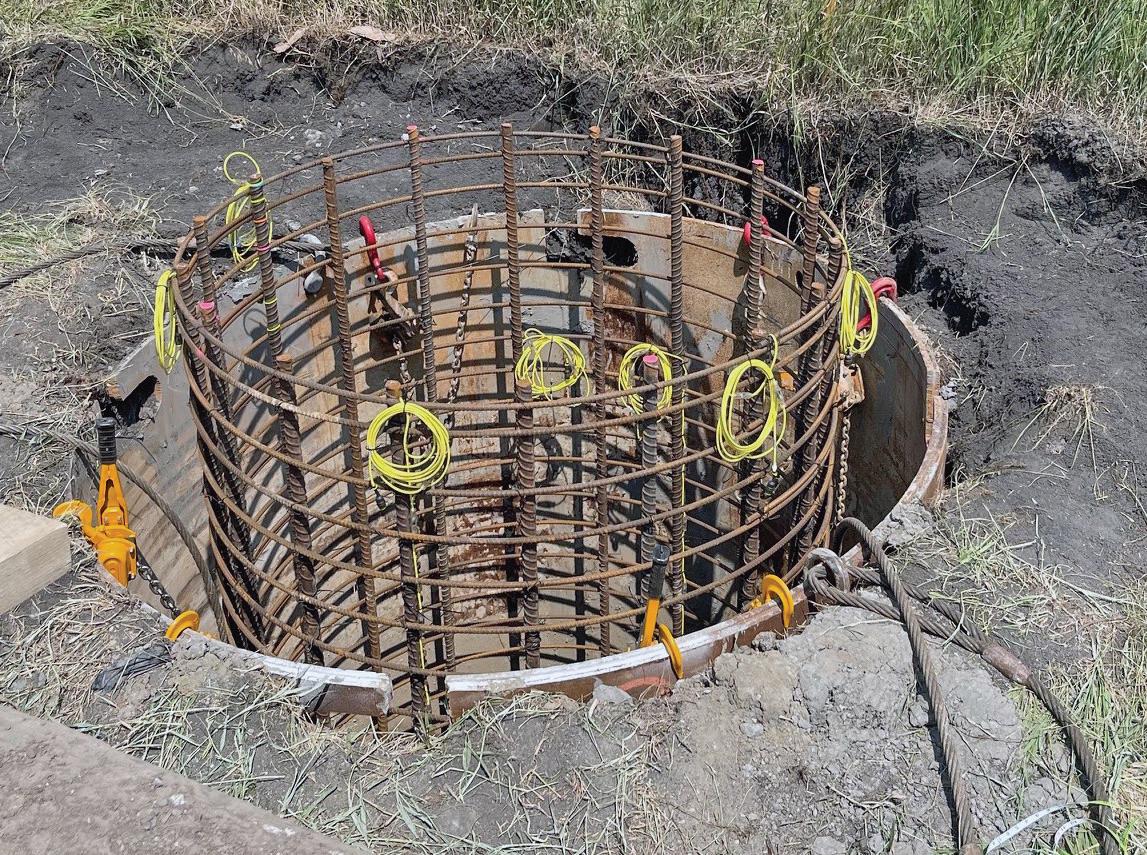
less cover on the southwest region of the shaft below the casing and exacerbating cover loss. The data inferred that there is little to no concrete cover over vertical reinforcement present in the identified west-southwest portion of the shaft for the bottom 5 to 6 feet (1.5 to 1.8 m). Remedial action was needed.
For decades, transmission foundations relied on inadequate QC methods or no QC testing at all. Advances make it possible to:
• Verify shaft geometry and verticality before casting.
• Quantify base cleanliness to ensure strong end-bearing.
• Monitor thermal profiles during curing to confirm adequate cover and detect anomalies.
These methods are fast, quantitative, and remote-friendly, reducing scheduling risks while giving owners confidence that shafts meet design intent.
The bottom line: modern NDT gives transmission engineers and utilities a practical path to reliable drilled shaft foundations, something legacy methods simply are unable to provide.
GEORGE PISCSALKO is the President for Pile Dynamics, Inc. He is a registered Professional Engineer in the States of Ohio, Michigan, and New Jersey. He has over 40 years’ experience in designing test equipment for the deep foundation industry. He holds ten US Patents and has co-authored more than 25 peer reviewed papers.
TIP wires installed in an excavation awaiting concrete.

How Will We Do it All?
By RONALD J CARRINGTON, ETS 2025 Conference Chair
As more than 2200 engineers, scientists, technicians, managers, manufacturers, innovators, producers, and consultants of the powerline structures industry gathered in Dallas, Texas for the 2025 Electrical Transmission and Substation Structures (ETS) conference, they were faced with the following facts and projections:
• The average age of the transmission assets in the US is 60 years old. Which means that 120,000 miles of transmission lines and 33,000 substations are beyond their planned design life.
• The record peak demand for electricity in the lower 48 US states, of 759,000 MW was set on July 29, 2025
J Carrington.
enthusiasm how the principals of the “wingman” and the commitment to excellence captured in the phrase “Push It Up” will enable our industry to meet and overcome the challenges and willingly accept the opportunities we are currently facing.
The fundamental principles behind the concept of the “wingman” originated from successful strategies developed by fighter pilots as a means of defense and protection and grew to include teamwork and support. A fighter pilot, especially when flying a single-pilot plane, has a blind spot behind the plane. However when flying in formation, as a team, with another plane or “wingman”, each pilot can cover or see the other pilot’s blind spot. In dangerous skies, this mutual protection and support saves lives and dramatically increases the odds of a successful mission.

• Experts are predicting 2.5% to 3.5% compound annual growth in US electricity demand through 2035. This translates to about 440 Gigawatts of additional generating capacity required in just 10 short years. And as everyone in this industry knows, the grid has to grow along with this generating capacity!
• Annual capital spending on the US transmission system tripled in the 20 years from 2003 to 2023, and now in the 4 years from 2023 to 2027, it is expected to go from US$27B to US$50B — which is a near doubling in only 4 years!
The question on everyone’s mind is How will we do it all? How will we rebuild or refurbish our aging infrastructure while at the same time expanding the grid to meet increasing demands for electricity from data centers, increases in domestic manufacturing, and electrification of transportation and buildings all which must be aligned to new and expanded generation and battery storage?
In the Opening Plenary, I opined that the solutions to these challenges are not a specific set of programs or initiatives, although these are surely needed, instead we will need to stand strong on the foundation we have built over many decades. A foundation of teamwork and collaboration. A foundation of forward thinking and pushing ourselves outside our comfort zone. Through this teamwork and collaboration, we will also need to drive innovation with improvements in education, training, tools, products, and processes.
Our keynote speaker, Lt. Col. Bo McGowan followed this question of How will we do it all? with two overarching themes from his career as a combat decorated Air Force fighter pilot, squadron commander, and peak performance expert. Lt. Col. McGowan, call sign, “Guvner”, described with energy and
Bo encouraged those in attendance to apply the “wingman” approach to the challenges we are and will be facing in the power delivery industry. Similar to a fighter jet duo, two or more people working together are a force multiplier and are much more likely to complete a “successful mission”. The “wingman” approach increases the chances of success with teammates covering each other’s blind spots and holding each other accountable to the goals and objectives of the “mission”.
The highlight of the Guvner’s presentation was the motivational phrase “Push It Up”. This phrase and associated hand gesture originated with the 35th Fighter Squadron in South Korea as a direct command for jet pilots to push the throttle forward for maximum power. Over time, “Push It Up” has evolved in the 35th Squadron fighter pilot community and business/ life to imply giving maximum effort and taking action with passion and discipline.
Bo combined the teamwork, collaboration, and mutual support embodied in the “wingman” approach with the attitude, maximum effort, and discipline exemplified in the motivational phrase “Push It Up” as a roadmap for our industry to meet the challenges highlighted in current headlines. This approach will enable us to meet these ever increasing demands for reliable electricity benefiting our communities and country.
Lt. Col. Bo McGowan concluded his presentation by exhorting the more than 2200 of the best and brightest of the power delivery industry to “Push It Up”. Following Bo’s lead, the packed auditorium thrust their left hand in the air with pinky finger and thumb extended with a thunderous “Push it Up”.
For more information on Lt. Col. Bo McGowan and the Never Fly Solo program, contact Wingman Enterprises at www.yourwingman.com
RONALD J CARRINGTON, P.E., ETS 2025 Conference Chair, POWER Engineers (ret.)
Lt. Col. Bo McGowan and Ronald