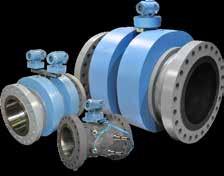
Learn more at www.Emerson.com/RosemountUltrasonic.
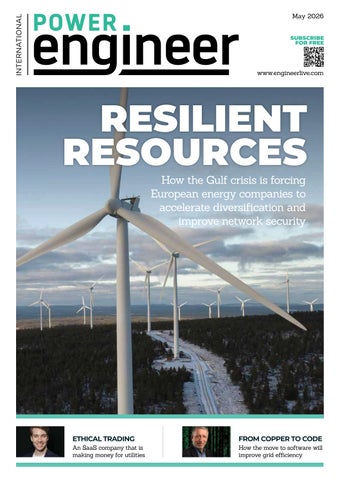
This May issue of International Power Engineer is the largest in several years. In part because of increased activity during trade show season, with All Energy and Global Offshore Wind taking place over the next few weeks. But another, perhaps bigger, reason is the general acceleration of innovation and activity in the energy sector. Although this has been catalysed by recent geopolitical tensions related to the oil supply, there is also the ongoing push to move away from fossil fuels and towards clean energy. The 2050 Net Zero deadline and interim targets are looming ever closer for European countries and as the renewables industry matures, the call for work to upgrade the grid and increase collaboration between governments, regulators and suppliers is increasing. There is also an ongoing push to develop cyber security around energy systems that are increasingly reliant on software. This will involve new jobs, standards and training. Some of the measures being proposed are explored in the cover story ‘Resilient resources’ (page 3).
As stated in Ethical trading (page 10), there were 72,000 renewable energy start ups at the end of 2024, according to the IEA, and the number will have grown significantly since then. Energy trading; grid upgrades, smart appliances and use of AI to limit infrastructure volatility are all energy specific developments. But other more general advances mirror similar engineering sectors. For example, From copper to code (page 56), details the move from hardware to software and how the energy industry is currently at a tipping point as a result.
Nicola Brittain Editor
PUBLISHER
Jerry Ramsdale
EDITOR
Nicola Brittain nbrittain@setform.com
STAFF WRITER
Lydia Arundel larundel@setform.com
DESIGN – Dan Bennett, Jill Harris
HEAD OF PRODUCTION
Luke Wikner production@setform.com
HEAD OF SALES & PARTNERSHIPS
David Pattison
ACCOUNT DIRECTORS
John Abey | Peter King
SENIOR ACCOUNT MANAGERS
John Davis | Darren Ringer | Roy Glasspool
ACCOUNT MANAGERS
Paul Maher | Iain Fletcher | Marina Grant
e advertising@setform.com
Setform’s international magazine for engineers is published twice annually and distributed to senior engineers throughout the world. Other titles in the company portfolio focus on Process, Design, Transport, Oil & Gas, Energy and Mining.
Setform Limited | 18 Alban Park, Hatfield Road, St Albans, AL4 0JJ, United
t +44 (0) 207 253 2545 e mail@setform.com
Ball valves from Böhmer have been providing safe shut-off in plants, pipelines & machinery for more than 65 years.
We have always met the challenges of the most diverse applications with the right valve solution. Also in the future Böhmer ball valves keep their product promise: Highest quality & absolute reliability.
www.boehmer.de
The crisis in the Middle East and the ongoing war in the Ukraine is forcing European energy providers to diversify and defend their infrastructures. Nicola Brittain looks at the solutions on offer
RESILIENT RESOURCES
The crisis in the Middle East combined with the closure of the Strait of Hormuz has sent the price of fossil fuels for European businesses and consumers skyrocketing. This spike is the third in less than a decade following the initial outbreak of war in the Ukraine in 2021 and the purported weaponisation of the oil supply by Russia in 2022.
Since the escalation of the conflict in the Gulf, the EU has spent an additional €24bn on energy imports owing to higher prices – without receiving any additional energy.
There has also been a spate of cyber attacks on the energy system in recent years, both because of increased geopolitical tensions and because a newly electrified softwarebased system increases vulnerability to such attacks.
These events have led to a chorus of voices calling for the enhanced diversification of the energy supply, acceleration of the energy transition, and a better defended infrastructure.
EASAC ADVICE
During a webinar hosted by the European Academies Science Advisory Council (EASAC) entitled ‘Energy System Integration’ professor Neven Duik a national and European policy adviser and expert in power engineering said: “Europe is facing simultaneous compounding pressure on energy security, the cost of living and the impact of climate change. All demand urgent policy action.”
He went on to say, optimistically, that meeting Europe’s Net Zero greenhouse gas emissions target by 2050 will be the solution to all these issues. The pledge will see European states move towards local renewable energy sources while integrating their energy systems including electricity, heating transport and industry; as he explained these have traditionally operated separately. He added: “The grid is a critical component of this transition. We need to double its size to keep pace with deployment.”
A DIFFERENT PERSPECTIVE
Duic argued that every connected part of the grid will play a role. “Buildings will act as active participants since
they have thermal inertia, smart control and energy storage can be utilised there.” Similarly, the electrification of transport will help with the transition via smart and bidirectional charging. He said: “0.6% of global demand for oil is falling away every year as a result of the electrification of transport. Over five years this amounts to a significant reduction in need for fossil fuels.”
The use of tariffs and smart grids will allow consumers and small businesses to actively participate in electricity markets via heat pumps, EVs or managed industrial processes.
The main challenges to the transition, Duic said, are resistance from fossil fuel champions, grid congestion, inadequate infrastructure and cyber security attacks.
“Increased digitalisation of the energy system raises the risk of attacks significantly. ICT systems for grid management must be procured only from trusted suppliers and
operators will require regularly updated cyber protection training,” he concluded.
CYBER SECURITY
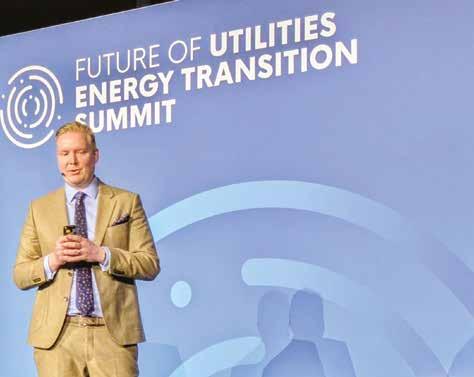
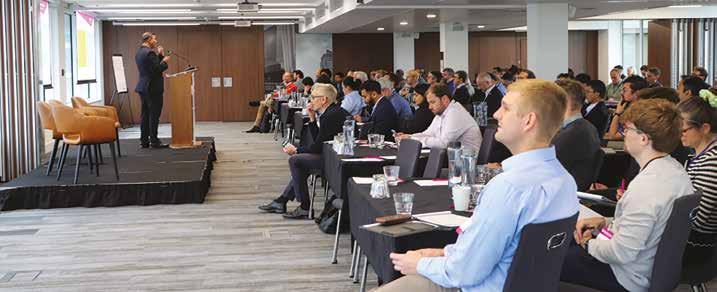
At the recent Future of Utilities conference in Amsterdam Jari Stenius, vice president of corporate safety and security from state-owned Finnish energy company Fortum, gave a presentation regarding a recently launched ‘Safer Together’ proposal. This proposal was a response to several waves of cyber attack where pernicious forces had targetted transmission and centralised assets; and RES collection points; they were also operating an ongoing wave of mass drone and missile strikes on the energy system.
PREPAREDNESS
He says: You need to fix the roof before it rains,” and the recent Safer Together paper argues for situational awareness and preparedness against further or heightened attacks before
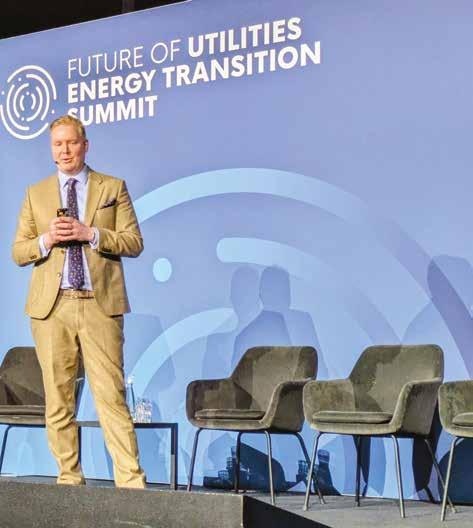
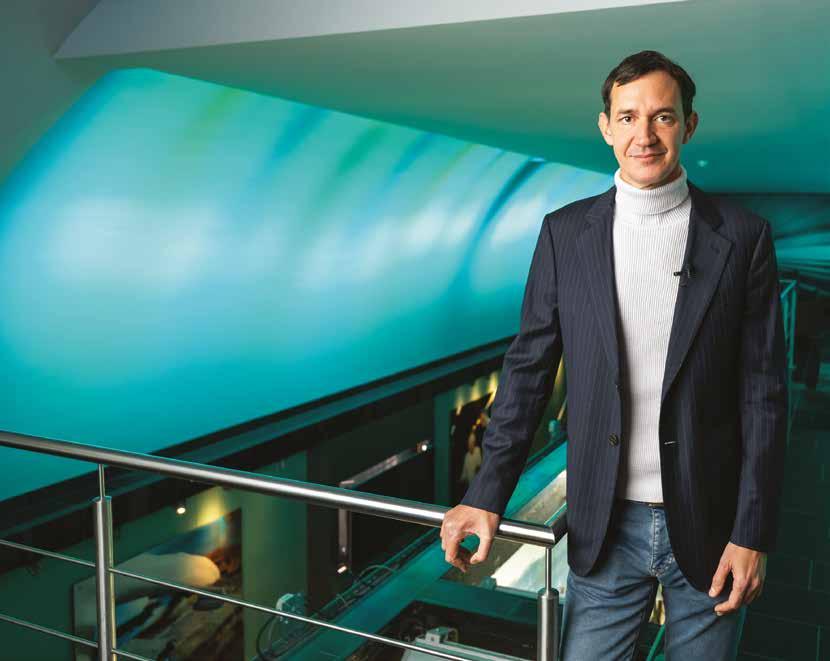
Jari Stenius, VP of corporate safety and security from Finnish company Fortum
they happen. Such defence will include the fortification of assets, cyber security training for people working in power, enhanced cyber security overall, stockpiles of energy and recovery plans.
Fortum has a diverse portfolio comprising hydro (44%), nuclear (52%), and a small amount of wind power (2%).
THE IMPORTANCE OF DIVERSIFICATION AND THE LIKELIHOOD OF EU INDEPENDENCE
A panel at the same Future Of Utilities event entitled ‘Towards a diversified, secure energy mix’ saw four energy experts discuss the necessity of diversification across the energy system as a defensive position.
Sven Bontenbal director of strategy at Vattenfall said that although a move to absolute European independence was unrealistic, genuine diversification would help prevent further shocks. Francesca Bodini, policy advisor at Eurogas, agreed: “We need the energy system to function even when there are wider geopolitical problems,” she said.
FOCUS ON REGIONAL STRENGTHS
The panel agreed that Europe should double down on its strengths in wind, hydro, solar or hydrogen, and further develop transmission routes across the region, particularly for the transportation of hydrogen. Declan Burke director of group strategy at SSE argued that nuclear energy is a big but often overlooked part
of the mix and should therefore be considered. “France gets 70% of its power from nuclear,” he said. “It developed the capacity in response to the OPEC oil embargo in 1973..“ In addition, independence may not provide the best price point, Burke argued. European operators working on infrastructure build out of solar or wind, for example, are likely to get better priced solar photovoltaic (PV) elements from China, or wind turbine parts from the US than from homegrown developers.
The panel concurred that dependence on other regions for manufactureed goods was a bigger issue for the region. That despite Europe’s wealth it didn’t have much export leverage. Bontenbal said: “A century ago coal and steel were produced here. Perhaps in time we will generate similar strength with decarbonisation and electrification.”
GRID DEVELOPMENT PLANS
The panel agreed that underdevelopment of the grid was an ongoing issue for Europe. Matthew Hinde head of international policy and engagement at the National Grid said: “no-one talked about grids 15 years ago meaning Europe is behind the curve globally. “We need connection reform, strategic planning, careful use of AI, and sensors that enable flexibility. We would like a a 10 year strategic plan from governments detailing how these elements fit together in an evolving system.”
ACCELERATEEUSTRUCTURAL ENERGY PLANS
The EC recently launched AccelerateEU, a plan comprising a series of structural measures to reduce dependency on volatile international fossil fuel markets.
Proposed measures include increased coordination of member European states including refilling of underground gas storages and use of flexibilities in filling rules.
A Fuel Observatory will track EU production, imports, exports and stock levels of transport fuels. Additional measures will include income support schemes, energy vouchers and social leasing schemes, lowering excise duties on electricity for vulnerable households.
By the summer, the Commission will present an Electrification Action Plan including an ambitious electrification target. The plan will also help improve the grid system, ensure that current legislation is fully implemented and that negotiations on the European Grids Package are concluded swiftly. Additionally, the launch of a series of measures such as the Clean Energy Investment Strategy will raise funds for the transition.
For more information visit: www. easac.eu group.vattenfall.com www.fortum.com ec.europa.eu/commission/ presscorner/detail/en/ip_26_629
Speakers (left to right): Sven Bontenbal (Vattenfall); Matthew Hinde (National Grid); Declan Burke (SSE); Francesca Bodini (Eurogas); Anandarup Bonnerjee (TCS)
ETHICAL TRADING
Nicola Brittain explores how SaaS software company Podero is helping utility companies make the most of smart assets in their networks
An unprecennted surge in growth of renewables related start-ups in recent years can be attributed to the many opportunities afforded by the energy transition.
In fact, an analysis released by the International Energy Associate (IEA) last year found that of the approximately 3.5 million start-ups worldwide in 2024, 72,000 were energy related.
One such company is Austriabased Podero, an energy transition company set up three and a half years ago that trades excess energy from smart devices for utilities using a Software-as-a-Service (SaaS) solution. We caught up with co-founder Chris
Podero’s solution can be accessed via app stores
Bernkopf at the recent Future of Utilities conference in Amsterdam.
With a background in physics, Bernkopf worked at CERN and then as a data scientist before moving into installation and then energy trading following a conversation with E.ON Sweden. The company now operates across most of Europe. “I wanted to work to help mitigate climate change as this seemed like the most important challenge to tackle.”
ABOUT PODERO’S SOFTWARE
Podero’s SaaS solution steers smart assets such as heat pumps, batteries, electric vehicles and chargers. Some 40% of the connected assets are
inverter and batteries, 30% are electric vehicles and chargers, and roughly 30% are heat pumps. The spread of connected devices varies per region, with Austria and Germany operating more EVs, Belgium more batteries and the Nordic countries more heat pumps. The company also has plans to connect to air conditioning units and thermostats in the coming months.
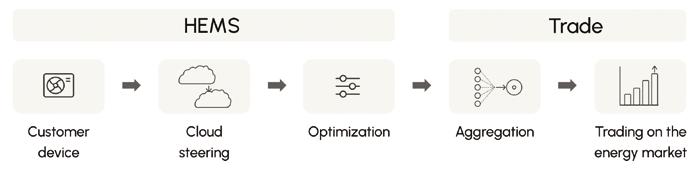
The SaaS product controls the asset according to energy market prices, then Podero tells the utility what the best trades would be. The utility then makes that trade on an energy trading market such as Trayport Joule or Vattenfall Energy Trader, which facilitate OTC (Over-the-Counter) and exchange trading. the tool provides
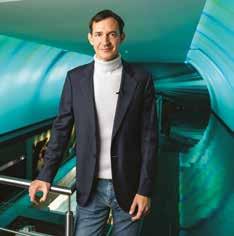
Chris Bernkopf is the co-founder of Podero
Captions to go here
real-time market data and automated risk management.
“A consumer can set an electric vehicle to be charged for 70% at 8 in the morning. The utility provides us with this information. We consider that in our trading proposal calculation. The utility does the trade and makes the money, some is passed onto the consumer and we get a cut too.”
CUSTOMERS
The company works with E.ON in four countries as well as several medium sized utilities, it also has collaborations with several software companies for municipal utilities elsewhere. The company isn’t yet active in Spain or Poland, but Bernkopf says it is only a matter of time before this happens. “We are a really fast growing company, we’ve completed four new integrations already this quarter,” he said.
Podera provides all the software integration required for a utility to launch a proposition it also has a web app and and apps on the Apple and Google app store. The company is integrated into most major trading platforms too meaning a company doesn’t have to integrate anything itself. The solution defends utilities against companies like Octopus to retain users since it provides guaranteed savings which can be passed onto customers. There’s also the halo effect of being one of the smart utilities making use of renewable energy.
SIZE OF MARKET
There are over 120 million flexible devices in Europe right now and this is growing quickly. In future it is expected that every household (there are 200-250 million in Europe) will have approximately three devices, so a heat pump an AC and an EV charger,
for example. This will total around 600 million devices across Europe. Obviously this will mean increased energy consumption but solar, wind, nuclear and other renewable sources are coming on line at a rapid rate.
CHALLENGE OF GETTING OLD UTILITIES TO ADOPT A NEW MODEL
“Utilities are very risk averse,” Bernkopf explains. “If they have an outage they’ll be in the news since a power outage is a national emergency. But not all departments need to be this way. The consumer proposition, marketing and trading teams are more open minded. A different mindset is needed to develop a proposition than to keep the lights on.”
INFRASTRUCTURE
A key issue for people managing the energy transition is intermittent energy flows to the grid (solar, wind and thermal are inconstant energy supplies). By the end of the year, the company will be working in the grid balancing markets. The use of excess, unused energy will help flatten out peaks and troughs of demand and supply. Bernkopf explains: “We’ll be paid to stabilise the grid,” he added, “we provide utilities, the grid and customers with access to the flexibility of the assets within the system, and unlocking this means more profitable trades and a more efficient energy system. Each profitable trade leads to a reduction in volatility for the grid which will benefit the whole infrastructure.”
A flow chart to demonstrate the Podero SaaS system’s workflow
RELIABLE AC/DC DIN RAIL CONVERSION
An overview of a portfolio of diodes and e-Fuses that provide reliable AC/DC conversion for power engineers
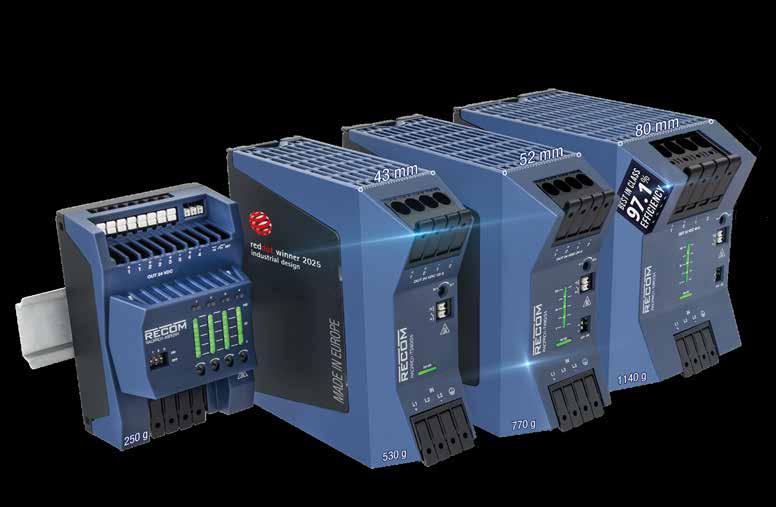
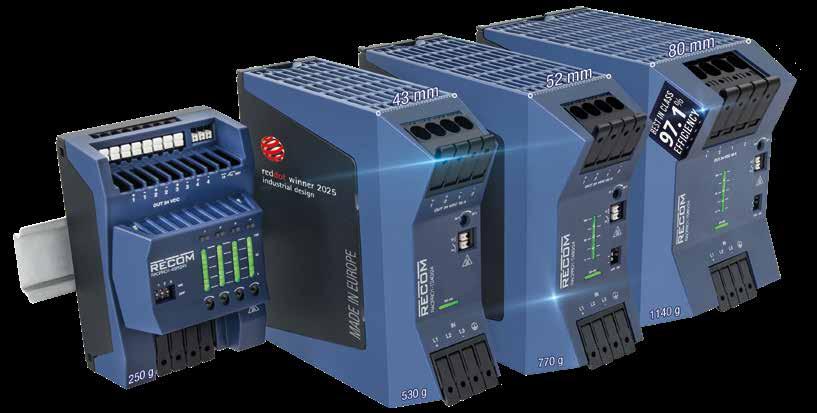
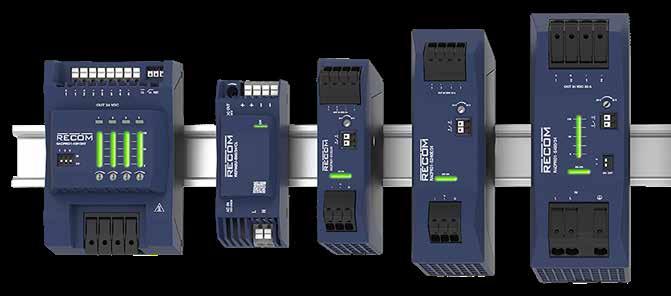
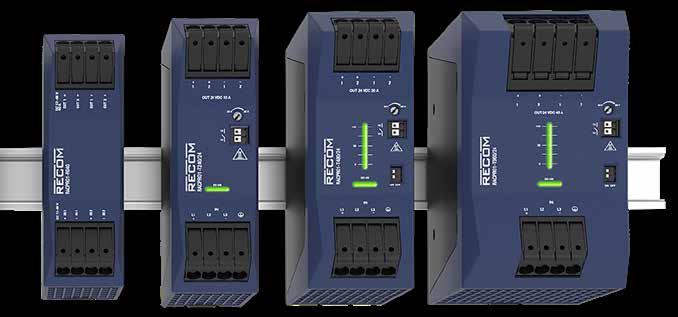
An illustration of the RACPRO1 family
Some industrial systems, such as those distributing power, need more than reliable AC/ DC conversion; RECOM’s RACPRO1 DIN-rail power portfolio is designed for just that. It combines compact, high-efficiency DIN-rail power supplies with redundancy modules and intelligent e-Fuse protection, giving engineers a complete platform for building robust and resilient 24V, 48V and mixedvoltage control architectures.
The range covers single-phase and three-phase models from 120W up to 960W, with output options across 12V, 24V and 48V, depending on series and model. In the threephase segment, RACPRO1-T power supplies achieve efficiencies of up
to 97.1%, according to the company, helping reduce energy losses, cabinet heat and cooling effort in demanding industrial installations. High conversion efficiency across the portfolio supports lower power dissipation, simplified thermal management and more compact panel layouts.
BROAD RANGE OF EQUIPMENT
The power supply range itself is broad enough to cover everything from compact panels to highpower industrial installations. The RACPRO1-S120 series offers 120W in an ultra-slim housing with 12V, 24V or 48V outputs. The RACPRO1S240E provides 240W with the same
nominal output voltage options. The RACPRO1-S240 targets 24V systems at 240W, while the RACPRO1-S480 extends the single-phase range to 480W with 24V or 48V outputs. On the three-phase side, RECOM offers the RACPRO1-T240 at 24V/240W, the RACPRO1-T480 with 24V or 48V options at 480W, and the RACPRO1-T960 up to 960W with 24V or 48V outputs.
These figures matter because industrial power supplies are increasingly expected to handle dynamic loads, inrush events and harsh operating environments without oversizing the system. Several RACPRO1 models are specified for full-power operation across wide temperature ranges with convection
cooling only. Selected models also offer thermal power bonus and shortterm boost capability for inductive or capacitive loads.
A major advantage of the portfolio is that RECOM does not stop at the PSU. The RACPRO1-RD40 redundancy module is designed for 12V, 24V and 48V systems, supports 2 x 20A inputs and up to 40A output in parallel operation, and is optimised for DIN-rail installations where system uptime is essential. By using MOSFET technology instead of classic diode decoupling, it minimises voltage drop and heat generation while enabling efficient n+1 redundancy or power-path decoupling. With 99.5% typical efficiency and only 140mV voltage
drop, it adds resilience without introducing unnecessary losses.
The other key building block is RECOM’s RACPRO1-4SP e-Fuse family for 24V systems. These modules provide four-channel selective protection, with versions offering 5A and 10A channel current, 150% power boost for five seconds, overload tolerance up to 120ms, sequenced start-up to reduce in-rush, and reversesequence disconnect logic to keep essential functions running as long as possible. They also add diagnostics and current monitoring benefits that conventional protection concepts typically lack. Importantly for industrial users, the e-Fuses are specified with a lifetime expectancy
of more than 80,000 hours at 40°C. Taken together, RECOM’s DIN-rail portfolio gives system designers a modular approach to industrial power: compact AC/DC conversion from 120W to 960W, standard output rails from 12V to 48V, high-efficiency operation, redundancy support, and intelligent selective protection in one coordinated ecosystem. For automation, machine building, infrastructure and energy applications, that means easier integration, better fault management and a more resilient power architecture from the outset.
For more information visit: https://recom-power.com
The range covers single phase and three phase models with output from 120W up to 960W
COMPONENTS vs SYSTEMS
Jonathan Balmforth from JB Valves urges us to rethink the configuration of the hydrogen energy infrastructure
Hydrogen is often positioned as a new energy vector, but much of the engineering behind it is built on familiar ground. Across production, compression, storage, and dispensing, systems are assembled from established components – valves, fittings, instrumentation – and designed according to conventional process-industry principles.
At first glance, this seems entirely reasonable. Individual components are increasingly well-qualified for hydrogen service, with genuine advances in material selection, sealing technology and high-pressure performance. Certification standards have evolved, and manufacturers have responded with more rigorous testing and validation.
But optimising individual components does not automatically deliver reliable systems. That distinction matters more with hydrogen than with almost any other medium.
Hydrogen’s small molecular size makes leakage more likely than with larger molecules. High-pressure cycling – routinely in the 350 to 1378 bar range – places sustained, repeated demands on sealing and structural integrity. Embrittlement is not a single-variable problem; it is a function of stress, environment and material condition interacting over time. Under these circumstances, system performance cannot simply be read off from the sum of its parts.
FOCUS ON THE INTERFACE
This is most visible at the interface level. The connections between components – threads, seals, fittings – represent the majority of potential leak paths in any hydrogen system. Yet interfaces are routinely treated as secondary engineering concerns, even as system complexity grows and the number of those interfaces multiplies. More components mean more boundaries, and more boundaries mean more points where tolerance,
alignment and sealing must all be managed correctly, every time.
The deeper problem is that hydrogen systems are often assembled rather than designed. Modular architectures offer real flexibility, but they can also lead to overcomplexity. Every additional component introduces not just a function but a boundary – another point of vulnerability to vibration, thermal cycling, and the ordinary variability of real-world installation.
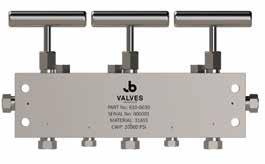
A different approach is gaining ground, one that starts with architecture rather than component selection. The goal is to reduce the number of interfaces, integrate functions where possible, and simplify flow paths throughout. In practice, this frequently leads toward manifold-based designs, where multiple functions are consolidated into a single block. Fewer discrete components and connections mean fewer potential leak paths, more consistent assembly and measurably greater system robustness.
Sealing philosophy is shifting in the same direction. Traditional compression-based sealing relies on
sustained mechanical loading applied at assembly – a condition that is difficult to verify and degrades over time. Pressure-energised sealing arrangements, by contrast, improve performance as operating pressure increases, making the seal more effective precisely when it matters most.
Defining what ‘performance’ means is itself changing. Hydrogen systems operate under variability – pressure cycles, transient states, long-term material interaction – that static component specifications were never designed to capture. The relevant metric is increasingly resilience: whether a system can tolerate and adapt to changing conditions, not just whether it passes a qualification test.
The question is not whether conventional approaches work. Many do. The question is whether they scale – and whether the assumptions embedded in them are appropriate for infrastructure that must operate reliably across decades and millions of cycles.
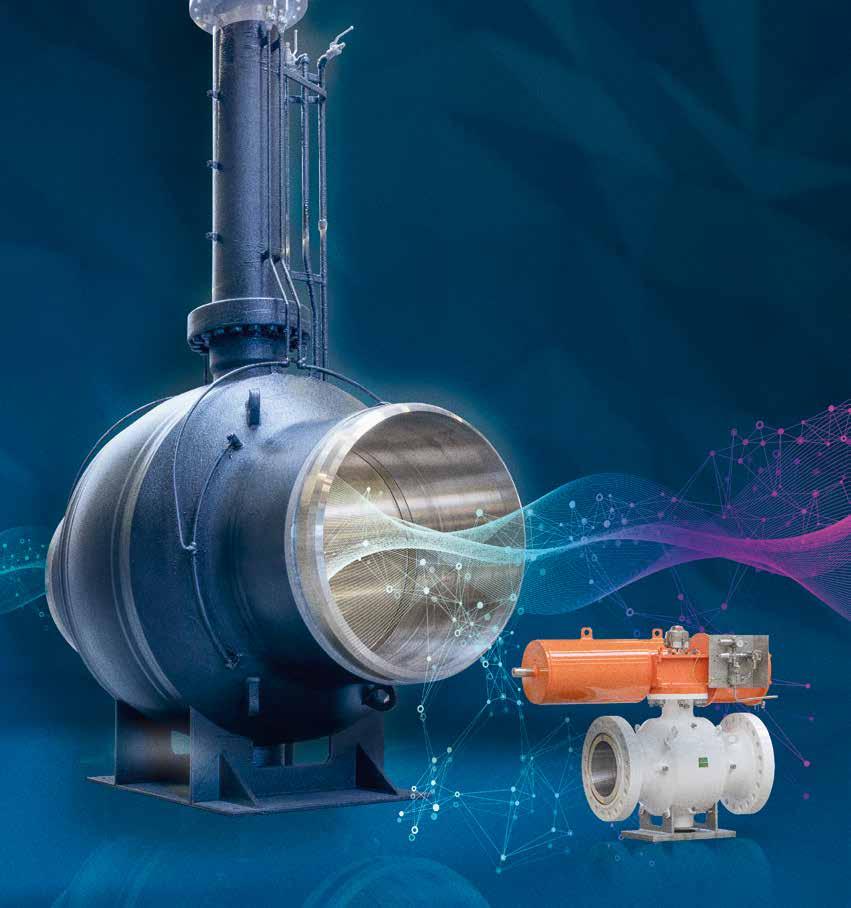
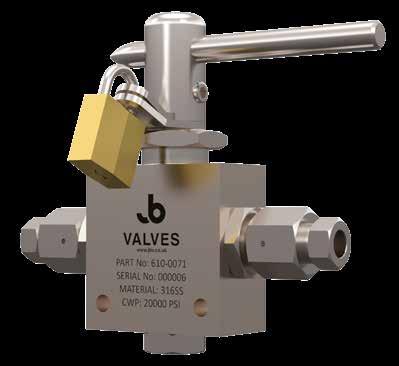
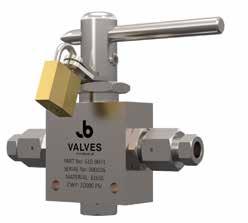
A high pressure ball-valve from JB Valves
PROTECTING THE GRID
Mike Torbitt, managing director of resistor manufacturer Cressall, explains why grid readiness must now match renewable ambition to secure a stable energy transition
The UK has recently confirmed a record number of solar and wind contracts as part of its 2030 renewable energy strategy, showing rapid growth in the sector. However, there are concerns that many of these projects could struggle to connect to the grid or face significant delays because the existing grid infrastructure capacity is limited. Here, Mike Torbitt, managing director of resistor manufacturer Cressall, explains the challenges of connecting high volumes of renewable energy sources to the grid and how the right engineering can ensure a stable transition.
The government’s latest Contracts for Difference auction secured 4.9 gigawatts of solar capacity alongside 1.3 gigawatts of onshore wind and tidal projects: enough to power around 16 million homes. While this marks significant progress, expanding generation alone is not enough without a system capable of handling variable power safely and reliably.
As reported by energy insights company Montel, the lack of modern grid infrastructure in the UK and Ireland has led to an estimated 10 terawatt hours of renewable electricity being curtailed in 2025. This is
enough power to support one million homes for a year. The key is that as the amount of renewable energy capacity increases, the lack of adequate infrastructure to transmit and distribute this power is leading to financial losses and unnecessary carbon emissions.
THE VARIABILITY CHALLENGE
At the heart of the issue is intermittency. Solar and wind power output is dependent on the weather and can change from minute to minute. These unpredictable ramps in power flow can lead to sudden dips in
Grid readiness will be key to a succesful transition
voltage, trigger curtailment and stress equipment across an entire region if not properly managed.
Even as onshore wind and solar power become cheaper than building a new gas-fired power station, cost competitiveness does not equate to system stability. Without proper protection and flexibility, variable power can put more stress on equipment, reduce their lifespan and lead to more frequent curtailment events, which is already costing the UK renewable industry hundreds of millions of pounds a year, with the eventual burden falling on consumers. Another technical shift compounds the challenge: system dynamics. As conventional thermal plants retire, the grid is losing the inherent inertia once provided by large rotating machines. Inverter-based renewable generation behaves differently, responding faster but offering less natural damping during disturbances. This makes networks more sensitive to voltage fluctuations and fault conditions. The transition to renewables is not simply about replacing one power source with another. It requires reengineering how the entire system responds under stress.
fault management is an essential component of grid stability
ENGINEERING SOLUTIONS FOR A HIGH RENEWABLE GRID
Addressing these challenges requires more than expanding transmission lines. As renewable penetration increases and conventional generation retires, the grid is becoming more sensitive to disturbances.
One of the most important, but often overlooked, aspects of grid stability is controlled fault management. In inverter-dominated systems, fault currents are less predictable, sometimes lower in magnitude but longer in duration or influenced by control settings. Traditional protection schemes may no longer respond reliably, making controlled fault management essential.
When a ground fault happens in a renewable energy system or a connected network, the fault current that is created has to be constrained in order to avoid damage to transformers, switchgear and cables. In a highly renewable, decentralised system, the configuration of protection is more complicated. If fault currents are not controlled, they can cause cascading failures and prolonged outages.
Engineering solutions that account for inverter behaviour, asset distribution and real-time control are key to maintaining a stable and resilient system.
THE ROLE OF NERS
Neutral earthing resistors (NERs) are a simple yet essential protection method. By controlling the fault current to a safe and predetermined value, they can ease thermal and mechanical stresses on equipment while enabling protection systems to simply isolate the affected part of the network. This means fewer surprise outages, lower repair costs and a more stable electricity supply: just the kind of operational reliability that renewable energy companies require.
As renewable integration accelerates, collaboration between developers, network operators and specialist engineering partners will be essential to ensuring the transition delivers not just installed capacity but secure and dependable electricity.
With the continued growth of renewable energy, fault levels in networks are evolving. It is essential for engineers to reevaluate protection schemes to ensure that the grid is robust under the new conditions of operation. Therefore, investing in effective current limiting solutions is not merely a regulatory requirement but a way of ensuring that the growth of renewable energy translates into a stable electricity supply.
The recent auction results are an encouraging milestone, but they also underline the need for a stronger focus on operational resilience. Without appropriate protection technologies embedded across renewable and grid-side infrastructure, projects risk avoidable downtime and asset damage that undermine their long-term performance.
A modern SMR facility
ENABLING SMR DEPLOYMENT
Martin Froborg, global segment manager from MCT Brattberg, explores how to optimise use of small modular reactors
Small modular reactors (SMRs) are widely positioned as a plug-and-play solution for the energy transition, promising scalability, reduced construction timelines and greater deployment flexibility. However, this perspective can overlook a critical aspect of implementation: the infrastructure systems that ultimately determine whether these reactors can operate safely and reliably over time.
As SMRs move from concept to deployment, it is already clear that success will not be defined by reactor design alone, but by how well the surrounding systems perform under real-world conditions.
THE PROMISE AND THE ASSUMPTION
The appeal of SMRs lies in their modularity. Factory-built components, standardised designs and repeatable installation processes are expected to reduce both cost and complexity. In theory, this enables faster
rollout across multiple sites and regions. However, this approach is built on an implicit assumption: that supporting infrastructure can be standardised to the same degree as the reactor itself. In practice, this assumption often breaks down. Each installation environment introduces its own constraints, ranging from regulatory requirements to environmental conditions and spatial limitations. These factors place significant demands on how infrastructure systems are designed, integrated and verified in practice.
THE OVERLOOKED LAYER
While reactor technology remains at the centre of industry discussions, less attention is given to the systems that ensure containment, separation and protection between different operational zones. This is rarely the focus of early design discussions. But it should be, in our view.
Cable and pipe penetrations, sealing
systems and transit solutions may appear secondary in complexity, but they serve a fundamental role in maintaining the integrity of physical barriers. These interfaces must simultaneously prevent the spread of fire, gas and water, while also withstanding pressure differentials and mechanical stress over extended operational lifetimes.
In nuclear environments, seemingly minor interfaces can become critical points of failure if not engineered correctly. And when they fail, the consequences are rarely isolated; they tend to cascade. Despite this, they are often treated as standard components rather than as integral elements of the overall safety strategy.
NEW CHALLENGES INTRODUCED BY SMR DEPLOYMENT
The shift towards smaller, more compact reactor units introduces new engineering realities. Increased system density leads to more complex routing of cables and
Each installation environment introduces its own constraints, ranging from regulatory requirements to environmental conditions and spatial limitations
services, which in turn raises the demands on sealing performance and installation accuracy.
At the same time, prefabrication and modular assembly reduce the margin for on-site adjustments. Infrastructure systems must therefore be designed for precision and repeatability from the outset. There is little room for improvisation once installation begins.
A further challenge comes from the ambition to deploy SMRs across diverse geographies. While standardisation remains a key objective, variations in local regulations, environmental exposure and site conditions require solutions that can adapt without compromising performance or certification.
Taken together, these factors make it difficult to treat infrastructure as a secondary consideration. It needs to be part of the core engineering discussion from the beginning.
ENGINEERING FOR RESILIENCE, NOT JUST COMPLIANCE
In long-life energy infrastructure, compliance with minimum standards is rarely sufficient to ensure longterm reliability. This is particularly true in nuclear applications, where infrastructure components are expected to perform consistently over decades, often with limited opportunities for maintenance or replacement.
In these environments, failure is rarely sudden; it tends to develop at the interfaces.
Meeting certification requirements is not enough. These systems must also maintain functionality under combined stresses, including thermal loads, mechanical vibration and environmental exposure. This
makes it necessary to focus on verified performance, robust material selection and proven engineering principles.
Failure at a single interface can have disproportionate consequences, affecting not only safety systems but also operational continuity. In this context, resilience is a fundamental requirement.
CONCLUSION
The development of SMRs represents a significant step forward in the evolution of nuclear energy. However, the industry’s ability to deliver on this promise will depend on more than advancements in reactor technology.
Critical infrastructure systems, often overlooked in early discussions, play a decisive role in ensuring safe, reliable and economically viable operation over the full lifecycle of an installation.
As SMR projects transition from design to deployment, a broader engineering perspective will be required, one that extends beyond the reactor itself. For
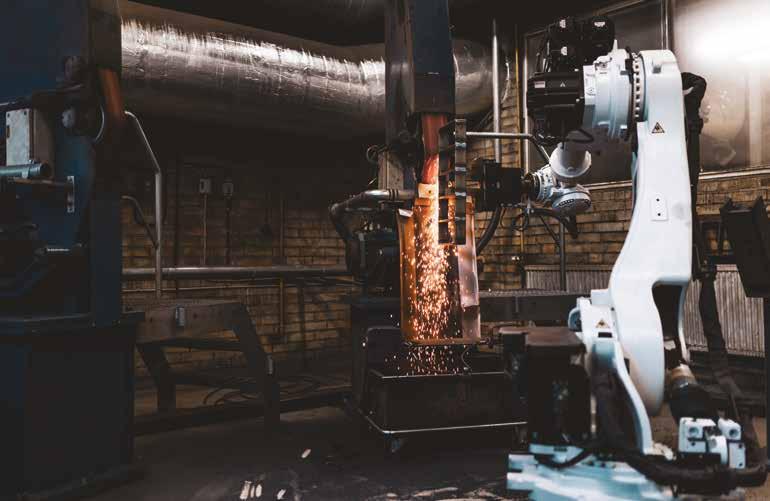
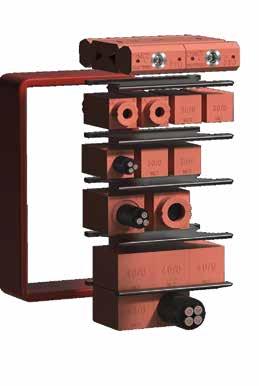
Robot grinding a multi cable and pipe frame
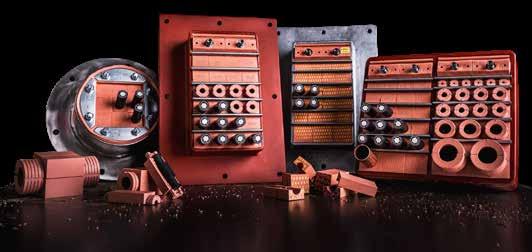
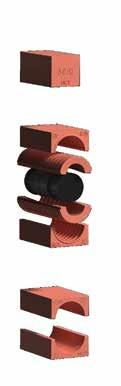
Two multi cable and pipe transits
AN INDUSTRY TRANSFORMED
In this Q&A, Anthony Flanagan managing director of GBE UK, talks to International Power Engineer about his experience at the helm of a transformer business
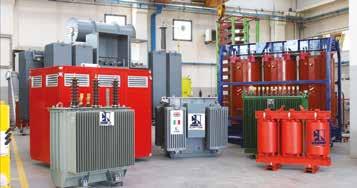
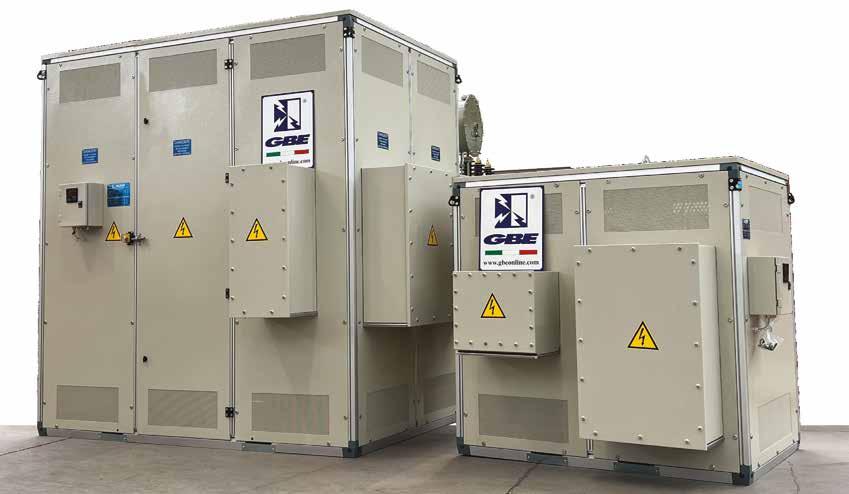
Transformers form a critical component of the power industry infrastructure. They change the voltage of alternating current (AC) electricity, thereby enabling efficient longdistance transmission and safe distribution to homes and industry. GBE UK, an established manufacturer of such transformers, currently provides several models to its global customer base. These comprise oil, cast resin distribution and power transformers.
The company also manufactures oil, dry type reactors, Shunt, Fault, Limiting and De-Tunning products. All the transformers and reactors and manufactured at the company’s plants in Northern Italy.
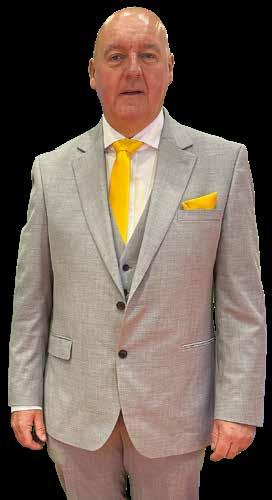
Anthony Flanagan has been an engineer for more than 40 years
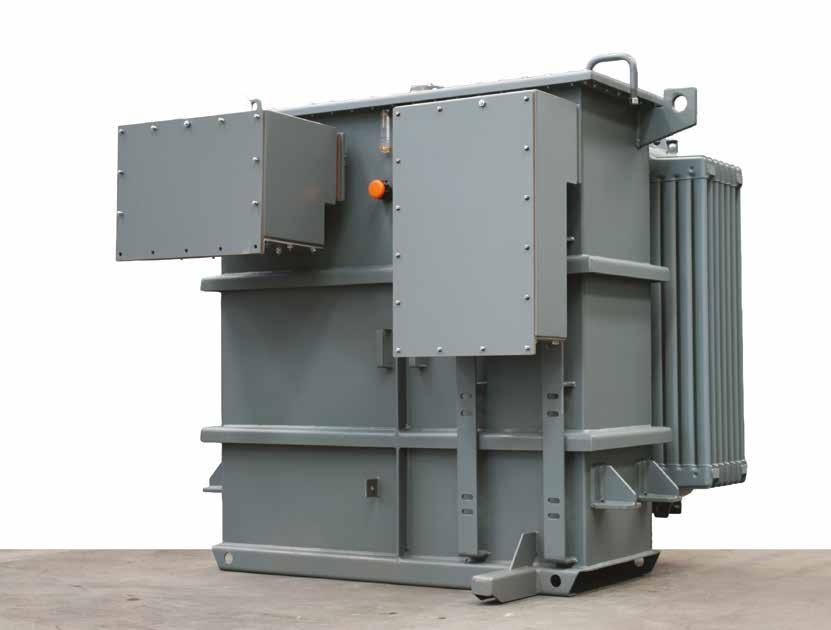
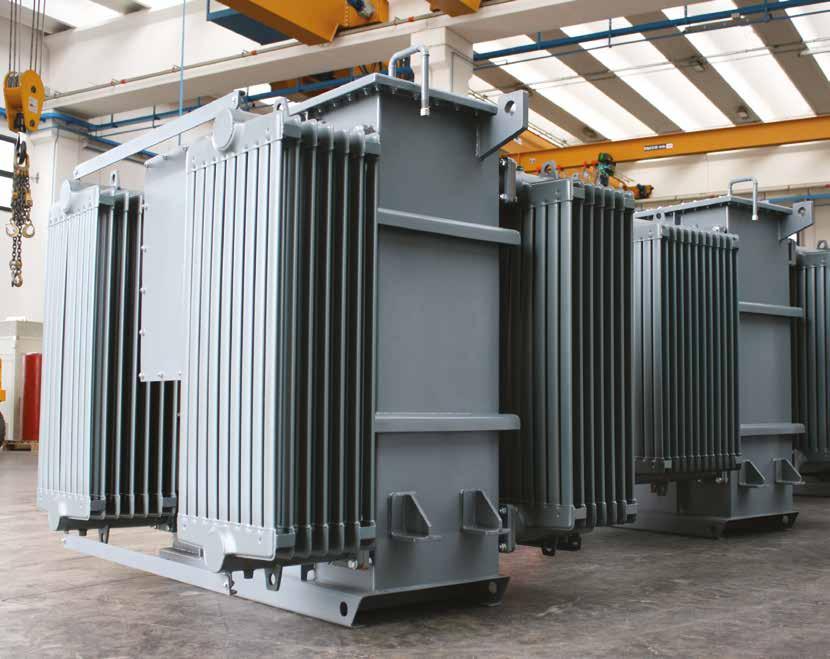
A standard 11kV ONAN Unit Type Transformer
The compression unit
Placed anywhere in the frame
The PTG-120 compresses the system and completing the penetration steel.
The transit frame
Can be bolted or welded Hardware and material in the highest quality for the toughest of applications.
Stayplates
Placed between each row blocks, they ensure even blasts can’t make it through the penetration seal.
Spareblock
The unused space in the frame is filled with solid spare blocks. This allows for the option of fitting new cables/ pipes in the future.
HandiBlock
Available in four sizes to fit cables/pipes or tubing from 4 to 54 mm (0.16” to 2.13”), inserts marked with designated cable/pipe dimensions. A safe, flexible and easy-to-install block module.
Standard Block
Each block consists of two halves and can seal cables/ pipes with diameters from 3.5 – 110 mm. (0.14–4.33”).
We were provided with an opportunity to ask Anthony Flanagan, managing director of UK-based transformer supplier GBE UK, a few questions about his business. We got the low down on his background as an engineer, the types of challenges and opportunities faced by GBE UK and how he expects the industry to change over the next few years.
Please tell us about your background in engineering and how you came to be managing director of GBE UK
I started my engineering journey 43 years ago this August with an electrical engineering apprenticeship at a medium and low voltage switchgear company called Whipp and Bourne (1975) in Rochdale.
This was a hand’s on apprenticeship and I spend the first year in a training school and college before moving into
a factory environment where I worked a few months in all the departments,. These included the drawing office which I felt gave me the best overview of engineering. My Dad had completed a very similar apprenticeship in Glasgow where he was from; like every young lad. My Dad was my biggest hero, and I wanted to be just like him.
What are the biggest challenges and opportunities currently faced by GBE UK and how are these different from, say, five years ago?
Like every other business we have faced many challenges over the years. Transformers are made up of steel, copper and aluminium meaning volatile metal markets can affect their production and price. Customers on bigger projects often want to put quotes on hold for 12 or more which can be difficult. We get around this problem
by investing in material stock. We also have our own production plant in Italy and ths means we can keep quotations valid and allow our customers to keep up to date with their projects.
How has the business changed in recent years and what changes do you anticipate down the line?
One of the biggest changes I have seen in recent years has been in advertising. We have always used trade magazines such as Engineer Live and similar, but now social media is a key driver meaning there is a constant need to create content. So not only do we manufacture transformers, but we must take pictures from every angle, video the process and spread it across all the platforms. The way things are going, we’ll need a film studio in the factory to keep up to speed!
Bespoke voltage ONAN Transformers ready to despatch from the GBE manufacturing plant to UK workshops
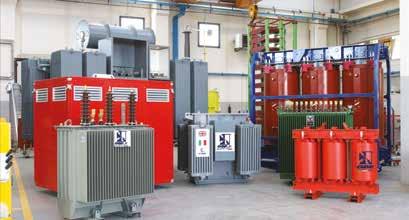
Selection of ONAN, Dry Type, Distribution and Power Transformers that GBE UK can manufacture
Let’s work together! Scan to learn more.
PROTECTIVE POWER
This Q&A with Dinko Cudic, head of market and application development at Henkel, explores how the company’s sealing solution has become essential for power industry engineers
In this Q&A we asked Dinko Cudic head of market and application from sealing solutions company
Henkel Adhesive Technologies to give us the low down on the company’s products, how customer requirements have changed, and what the likely developments for the sealing solutions industry will be going forwards.
Please tell us about your main product?
Henkel’s product, Stopaq, offers permanent corrosion prevention and sealing solutions for a wide range of applications in a broad selection of industries. The core product is a Polyisobutene (PIB) based coating that ‘mimicks the natural behaviour of tree sap, with self-healing properties,’ according to the company. The
coating forms an impervious layer to oxygen, water and bacteria, protecting the asset underneath, from corrosion.
Who founded STOPAQ and what was their expertise?
Stopaq was founded by Frans Nooren, who started a construction company specialising in waterproofing and sealing in 1973. This initial foray in the field of sealants gave rise to
EQ requires a simple wire brush and wipe to apply
an understanding of sealing and corrosion prevention. Stopaq was then founded in 1988 with its own R&D centre and production facilities.
What problem did it aim to solve?
We wanted to create a solution that would meet, or exceed the lifetime of the asset it was protecting, a ‘seal for life’ – this is where the name came from.
How has the product changed over the years, and why?
Stopaq was developed using rigorous research and development; with the demands of customers in mind. The company often goes beyond industry standards because reality does not always comply with lab conditions. The company started with a sealing solution for water proofing but now
Dinko Cudic is head of market and application development at Henkel provides applications for atmospheric, underwater, buried, renewable and other parts of an infrastructure.
The WSH product, a patent protected visco-elastic corrosion prevention wrap, was designed to meet demand for a product that would be wet submerged or damp, yet still able to perform at a higher maximum temperature rating of 70ºc. After careful development and testing the product launched in 2019, replacing two existing products. and has been used in many projects since.
Similarly, a Vapour Barrier product has been developed for corrosion under insulation and this is transforming applications in the Liquified Natural Gas (LNG) industry where insulation must be kept dry.
The EasyQote range was developed for the renewables sector – it provides
Seal For Life helps extend the life of our aging power infrastructure
a long lasting solution to corrosion on wind turbines. These structures are located in some of the most aggressive climate conditions, either onshore or offshore. Over-exposure to wind, salt spray, changing temperatures, UV and abrasion all make corrosion more likely. The EasyQote range is designed to withstand such conditions for decades.
Have your products been modified in response to regulations or other market pressures, and in what way?
EasyQote (EQ) meets and exceeds ISO 20340, an accelerated weathering test simulating salt spray, UV, freezing temperatures and condensation. This was important to demonstrate its viability within the sector, but it also takes more than that for a coating to be truly successful in these harsh conditions.
The demands of the wind sector pose the following challenges:
• Limited access – working at height, surface preparation is difficult to achieve if you consider other solutions that may require blasting. Lifting tools and personnel into position, protecting surrounding areas, capturing waste and transporting this all back down. EQ only requires a simple wire brush and wipe for a successful application to take place. Application is simply with a roll of product and a hand roller.
• Flexibility – a wind turbine will move with the wind, and this means the ideal coating will need to be
able to flex with that movement, maintaining adhesion without cracking. Since EQ has visco-elastic behaviour and yet it stays flexible and non-curing, it maintains permanent adhesion. It’s self-healing nature means that any defect upon impact is immediately repaired.
How do you expect the market to change in the future?
If you step back, a lot of the infrastructure we rely on only gets noticed when something goes wrong. Pipelines, tanks, refineries, industrial plants, even renewables like wind farms all have to keep working in the background, day in and day out. From our point of view, it’s not enough to just keep fixing things as they fail. Operators need confidence that assets will continue to perform years from now. That means thinking ahead—protecting against corrosion early, sealing issues quickly when they appear and reinforcing structures so they can safely stay in service.
Corrosion and failure have a serious impact on operational budgets. While trends may change and new markets may open providing opportunities, the need for maintenance will never cease. At the end of the day - just because we can’t see corrosion, it doesn’t mean it’s not there.
MANAGING COMPLEXITY
Rafal Chmielewsk from Emerson explains how built-in artificial intelligence support is helping operators navigate more complex power operations
The energy transition is moving quickly, and it is making day-today operations more demanding. As more renewable generation is added, operators are working in an environment with more variability, more information, and less time to search for the right answer when issues arise. Artificial intelligence (AI) is beginning to help, not by taking control of the plant, but by making it easier for people to access system knowledge, understand potential issues, and work more efficiently within the control environment. Emerson’s Ovation Automation Platform now enables AI through the Ovation Virtual Advisor, an AI-enabled assistant designed to provide knowledge-driven, real-time system guidance and contextual
support. Integrated directly with the Ovation platform, it gives users faster access to relevant information, troubleshooting support, and plantspecific knowledge without changing the deterministic control philosophy operators rely on.
IMPROVING ACCESS TO CRITICAL SYSTEM KNOWLEDGE
Control systems are built on clear, deterministic logic and that is not changing. What often slows people down is not the control system itself, but the time it takes to locate the right supporting information. Operators, technicians and engineers may need to reference user manuals, knowledgebased articles, system history or configuration information before they can move forward with confidence. Ovation Virtual Advisor helps address
that challenge by providing a userfriendly interface where users can ask questions in plain language, use pre-defined query topics, and retrieve sourced information relevant to the system. It also documents query history and results, helping users return to prior searches and reference information more easily over time.
SUPPORTING FASTER TROUBLESHOOTING
A second area where the Ovation Virtual Advisor adds value is troubleshooting. The assistant is designed to help investigate and address potential system issues by monitoring system health and identifying anomalies or impending problems. For example, it can detect anomalies on workstations and controllers based on performance-related metrics
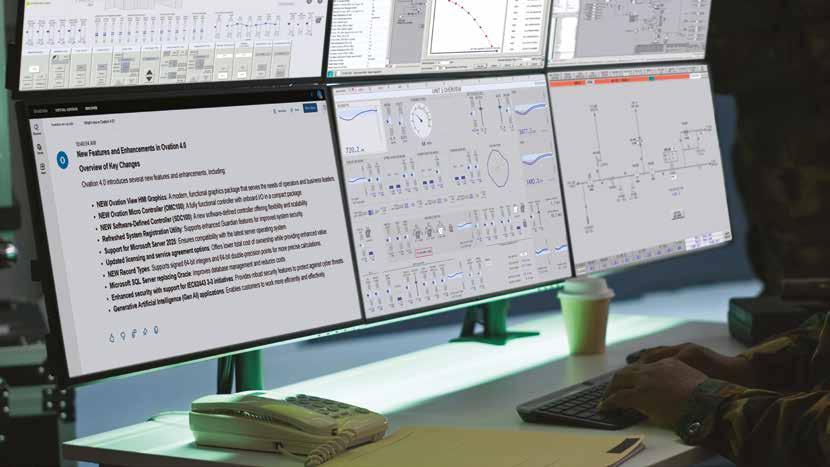
The Ovation Virtual Adviser provides AI enabled assistance to operators
such as CPU utilisation, memory usage, hard disk space, operating system patches, and drop alarms. When thresholds are exceeded, the troubleshoot capability helps the user examine the anomaly, review a curated summary of potential causes, and access recommendations to mitigate the issue. It also enables operator actions related to the issue to be entered and tracked, with reports created for queries, recommendations, and actions taken.
DESIGNED FOR SECURE, PLANT-SPECIFIC DEPLOYMENT
The Ovation Virtual Advisor uses local, pre-trained models with embedded Emerson and customerprovided system information, helping organisations avoid exposing sensitive operational data to public cloud architectures. The system runs through a dedicated AI server and is tightly integrated with Ovation software release 4.0 or later. This architecture allows customers to introduce AI-enabled assistance into the control environment in a way that aligns with the security, reliability, and governance expectations of missioncritical operations.
CUSTOMISING THE ASSISTANT TO THE PLANT ENVIRONMENT
Another important capability is customisation. To keep pace with changes after deployment, the AI models that power Ovation Virtual Advisor can be further tuned using new domain-specific information and operator feedback. Users can upload single or multiple files, including text, images, and tables, using drag-and-drop functions. The system organises data into smaller ‘chunks’ that can be viewed, annotated, labelled, and grouped into protected collections for easier management and tuning. This allows the assistant to be extended with plant-relevant information while maintaining a structured and manageable approach to model refinement.
HELPING TEAMS WORK MORE EFFICIENTLY
As plant operations become more complex, even small reductions in search time and troubleshooting effort can make a meaningful difference. Ovation Virtual Advisor serves as an always-available digital assistant for plant operators, instrumentation technicians and control engineers by
delivering instant answers to common or complex system or process questions, helping identify potential issues and guiding users through troubleshooting with step-by-step precision. Rather than replacing operator judgment, it supports the people already responsible for running and maintaining the system by improving access to information and making technical guidance easier to use in the moment.
The shift to a lower-carbon energy system is not only about adding new generation resources. It is also about giving plant personnel better tools to manage more complex operations with confidence. Ovation Virtual Advisor is a practical example of that approach. By improving access to system information, supporting faster troubleshooting, and enabling plantspecific AI customisation, it helps teams work more effectively while preserving the secure, deterministic foundation of the control system.
Rafal Chmielewsk is Industry Sales Director Power & Renewables Europe at Emerson.
The Ovation Virtual Adviser can detect anomolies on workstations according to performance-related metrics
ON THE FAST TRACK
This interview provides insight into several key products from Heico Fasteners as well as the reason for the company’s longevity
In this piece, we interviewed Sven Heggemann from Heico Fasteners, regarding the reasons for the company’s longevity, we also got some insight into a few of its recently launched products and how they benefit the power industry.
Heico recently celebrated its 125th anniversary, can you tell us why the company has lasted for so long?
I would attribute it to our ability to evolve whether by investing in cuttingedge technology - by expanding our capabilities with high performance machinery via an in-house tool factory, and a company-owned technical test laboratory, for example - or by
continuously improving our processes and optimising the synergy effects between our two company divisions (fastening and cold forging technology).
Of course there is also the dedication and passion of our team. It is this special spirit that has empowered us to constantly reinvent ourselves and emerge stronger from challenging times.
The recently launched Heico-Lock reaction appears to play a key role in your operations. Please tell us a bit more about the product
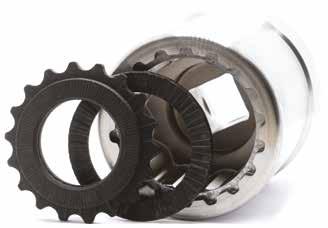
The Heico-Lock reaction washers are an addition to our wide range of bolt locking solutions. The product line includes not only the classic wedge
lock washers but also offers a broad portfolio of innovative variations and practical, user-friendly combination products that meet the different needs of our customers.
These new washers are engineered specifically for use with electric, pneumatic and hydraulic hightorque tools.
Like all Heico Lock products, the reaction washers effectively prevent self-loosening of bolted joints caused by dynamic loads. The major advantage for users is that the washers can be used with almost every high-torque tool from leading tool manufactures. The Heico Dual Sockets mean they can integrate the washers with the tools they already own.
Heico Fasteners attributes its longevity to the ability to evolve
HYDROGEN DEMANDS PRECISION
JB Valves deliver:
• Proven high-pressure sealing performance
• Material selection suited for hydrogen service
• Configurable manifold solutions for reduced leak paths
• Built for reliability in critical topside systems
JB Valves Limited, Majestic House, 29 Green Street, Huddersfield, West Yorkshire, HD1 5DQ, UK www.jbv.co.uk – enquiries@jbv.co.uk – Tel: +44 1484 509 888 - Registered in England No. 8994615
What benefit has this provided to sectors such as the wind industry (that need to secure bolting joints)?
The new reaction washers mean no reaction arms or external support points are required for the tool. The reaction torque is absorbed via a special dual socket that engages with the gear-shaped outer contour of the Heico-Lock reaction washers. As a result, the tightening torque is applied purely axially, without introducing additional bending moments into the bolt during tightening.
Since no reaction arms or external supports are needed, the overall assembly process becomes significantly safer for the operator. Accidents such as pinched or crushed fingers, as well as serious injuries caused by tool slippage, can be effectively prevented.
In addition, component surfaces are protected, as damage and deformation caused by support points are avoided.
This system is particularly advantageous in wind turbine applications, where numerous largebolted joints, often with repeated identical metrical sizes, are used. It offers substantial time savings,
reduces assembly costs and provides sustainable protection against selfloosening of the bolt connection.
How has the product helped other industries (such as the hydrogen storage sector) and what practical difference has it made to providers?
The advantages of our Heico-Lock reaction washers are essentially independent of special industries. Wherever large-bolted joints above M24 are used, particularly in applications involving repetitive assembly of identical fasteners in high volumes, the system provides significant benefits.
For industries such as oil and gas, hydropower, hydrogen, pump and suction technology or mining our new washers are predestined for the use of our washers. The range of industries and application fields are extremely broad.
Customers can increase their efficiency through a faster and economical assembly process, improved safety for operators, reduced risk of damage to components, and consistently reliable bolt locking.
What safety benefits does this product have for engineers working with high-torque tools?
As already mentioned, the safety benefits of our Heico-Lock reaction washers are substantial. The use of high-torque tools always involves the risk of accidents resulting from tool slippage owing to improvised or inadequate reaction setups and crushing hand injuries.
By combining Heico dual sockets and the corresponding reaction washers, bolted joints can be tightened precisely controlled and safely, without the need for additional external support points. This reduces the risk of injuries.
Do you modify your products on an ongoing basis (in response to feedback) and, if so, how does this work?
The Heico-Lock product range helps demonstrate a high level of innovative strength and continuous product development. Based on the proven wedge locking principle, our portfolio has systematically expanded to include advanced bolt locking solutions that offer advantages in handling, as well as integrated combination products.
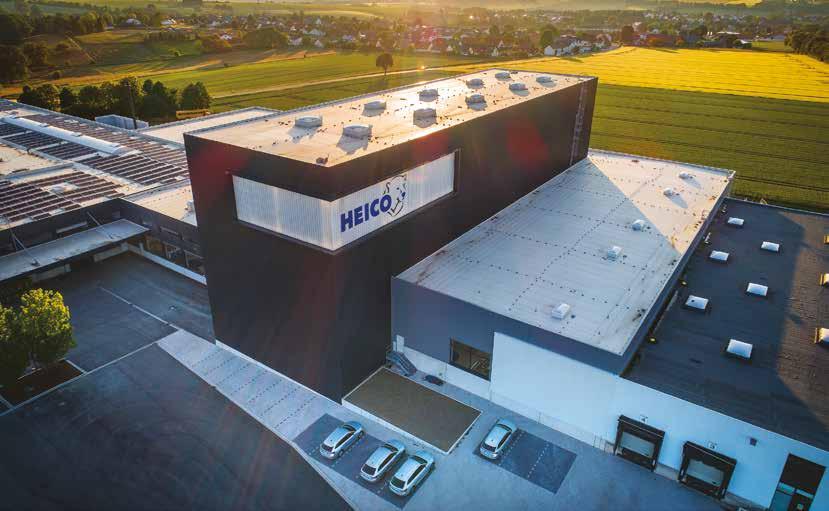
The Heico Group headquarters in Germany
We place great importance on understanding the specific challenges faced by our customers in real-world applications. Their requirements and expectations for reliable and efficient bolt securing are carefully considered and play a decisive role throughout our product development processes.
A representative example of this approach is our Heico-Lock CombiWashers. These washers work according to the proven wedge locking principle and incorporate a blue polymer ring with small labs at the inner side of the washer pair. These labs lightly engage with the bolt threat, enabling a preassembly of the washers and bolts. This simplifies the handling and improves the installation assembly. As the combiwashers can be combined with all standard bolt types providing an advantage over other preassembled solutions such as SEMS bolts.
What role does Heico play in the wider push for renewable energy? Providing advanced bolt locking and pre-tensioning systems, Heico is
The Heico Lock Wedge Locking System forms a key part of the business
already today a reliable partner of the wind energy sector and serves as an expert for all questions related to safe bolted connections.
As an official member of the WindEurope association for many years, we are firmly established within the wind power industry. Our products are widely used in large wind turbines, both on and offshore. They are successfully applied in foundation bolting, rotor blade connections, as well as in access
systems like ladders.
Across Germany and also internationally, the renewable energy industry is experiencing rapid growth and continued expansion. Heico actively supports this development by ensuring safe, reliable and longlasting bolted connections.
FROM SLINGSHOP TO GLOBAL PARTNER
Igor Egaña reflects on Slingsintt’s development over the years and its current role as an engineering and manufacturing lifting solutions partner for industries worldwide
Igor Egaña is the strategic account manager for Slingsintt
Slingsintt’s objective, when it was initially founded in 1980, was to supply safe and reliable lifting equipment. As industries expanded and grew increasingly complex, there was demand for advanced lifting solutions, driving the continued development of the company’s engineering capabilities. Today, Slingsintt has more than 40 years of experience in the engineering and manufacturing of lifting solutions primarily for the wind industry.
Tell us how the company collaborates with clients when approaching a lifting challenge?
Every Slingsintt project starts with the following four fundamentals: what needs to be lifted, its size, its weight, and the quantity involved and everything else grows from there. Client demands tend to vary. Some customers provide extensive technical input from the start, while others prefer a more reserved approach. In both cases, Slingsintt develops the concept step by step
together with the client.
Then the initial ideas are sketched and translated into detailed designs. No concept moves forward without detailed scrutiny. Early in the process, our engineers analyse how the lifting tool and the object interact, using simulations to assess movement, forces, and safety margins. Once the design is finalised, our engineering, sales, and production teams begin to collaborate. The materials are sourced, planning is defined, and manufacturing begins.
A high degree of experience and expertise is required to work with operators in the wind industry
Safety remains the guiding principle throughout. From the first sketch to the final bolt, every detail is checked, tested and verified.
In custom engineering, trust is not assumed, it is designed. If required, Slingsintt also supports shipment and on-site assistance. We can be on a plane almost immediately if a customer needs support. We believe that customer service is what sets us apart.
DEVELOPMENTS IN THE INDUSTRY
Please elaborate on the latest industry developments and how Slingsintt incorporates these into its solutions and approach?
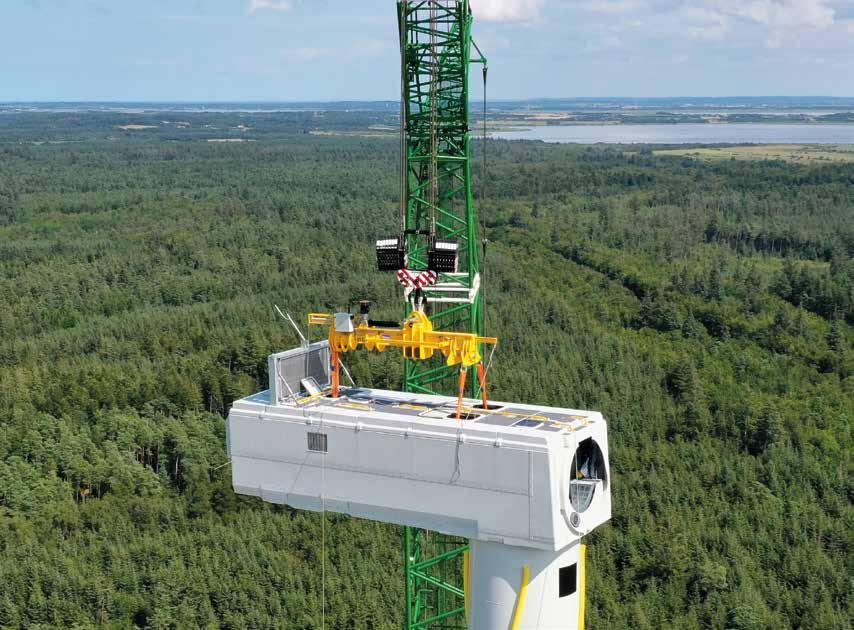
Safety remains a key priority in the wind industry. One important principle is the “no man under suspended side-loaded movements”
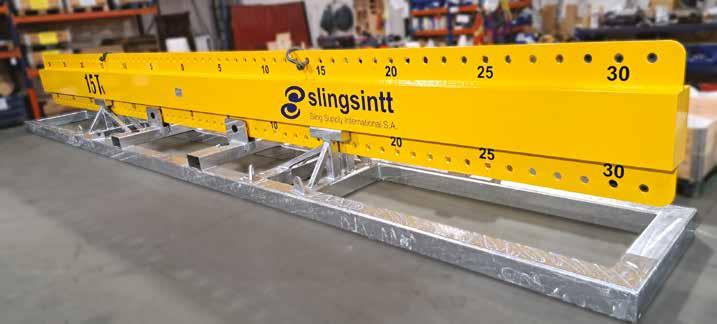
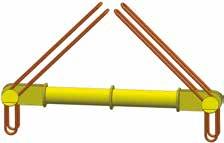
A modular spreader beam
policy. During the installation of wind turbine components, it is common for personnel on the ground to guide or observe the movement. However, we decided to engineer our tools in such a way that this human intervention is no longer required, significantly reducing risk and improving safety.
At the same time, the industry is pushing for more cost-effective
COMPANY MILESTONES
1980: Slingsintt began operations as a local slingshop in the Basque country, with the aim of providing safe and reliable lifting equipment. Over time, that focus evolved. As customer requirements grew larger and more complex, so did the demand for advanced lifting solutions.
1996: Slingsintt took its first step onto the international stage with its initial global project for the wind industry, a move that marked the beginning of a long-standing presence in renewables. Since then, the company has expanded steadily across multiple sectors including wind, foundries, automotive, rail, ports, shipyards, and construction worldwide.
2022: Slingsintt became part of the Royal Van Beest Group and has continued its growth and international expansion since then.
maintenance solutions. Historically, each wind turbine brand required its own dedicated lifting tools, leading to inefficiencies, long lead times, and higher costs. That’s changing and the industry is now looking for more standardised, versatile tools that can work across multiple turbine platforms. Slingsintt has responded by developing tools that function like a ‘Swiss army knife’ for wind turbine maintenance. This reduces the need for multiple, brand-specific tools while remaining safe and compliant.
This philosophy also led to the introduction of two new standardised products: the Modular Spreader Beam and the Multi-Purpose Lifting Beam. These tools were developed because not every lifting operation requires a fully customised solution. In many cases, a well-designed standard tool does the job just as well.
The goal was versatility, tools that can be deployed across a wide range of lifting scenarios without the long lead times, high design costs, or complexity associated with custom builds.
Experience really matters in this industry. Not just experience with lifting tools, but experience with how turbines are built, maintained, and serviced over time. That combined with our engineering capabilities is our strength.
Slingsintt works with safety precision and reliability
Slingsintt develops, manufactures, and supplies lifting systems for wind turbine components. With 40+ years of experience, we design ergonomic tools that reduce assembly time and enhance safety.
Trusted by Vestas, SGRE, General Electric, and Nordex, we guarantee: Innovative lifting solutions
Reliable delivery & global service Inspection & maintenance for safety
www.slingsintt.com slingsintt@slingsintt.com
At Slingsintt, we don’t just provide tools—we sell safety. Contact us today to optimize your lifting processes!
DEMAND QUALITY DATA
Maria Silenti from Jumo explores how the renewable energy sector is embracing digital twins, AI-driven analytics and smart grid architectures but wonders why the quality of the physical data feeding those systems is rarely questioned
Renewable energy is one of the fastest-moving engineering sectors today, and right now its attention is fixed firmly on software. Global investment in energy transition technologies exceeded US$2trn in 2024 for the first time, with a growing share directed at predictive maintenance platforms, cloud-based monitoring systems, and digital twin modelling of wind farms, solar storage arrays and hydrogen facilities. It is an exciting development. It is also, potentially, a dangerous distraction.
UNANSWERED QUESTIONS
The question that remains unanswered is this: how good is the physical data feeding all of those intelligent systems? Advocates of software-led intelligence argue that machine learning can compensate for imperfect sensor data and that drift can be corrected algorithmically. Engineers who have learned otherwise – often expensively – know that no analytics platform can recover a fundamentally corrupted data stream. Studies suggest poor data quality costs industrial operators between 15-25% of their revenue in operational inefficiencies. In capital-intensive renewable energy, that is not an acceptable margin for error.
Nowhere is this more consequential than in hydrogen. PEM electrolysers and fuel cells operate within thermal windows as narrow as ten degrees Celsius before efficiency degrades or safety margins are breached. Temperature measurement points inside a fuel cell stack are not data points for a performance dashboard – they are real-time inputs to safetycritical decisions. A sensor that drifts or fails silently is not a software problem to be corrected upstream. It is a direct operational and safety risk.
WIND ENERGY
Wind energy tells a similar story with a sharper commercial edge. Offshore turbines are engineered to run for 20 to 25 years in locations where access is difficult and costly. A single unplanned maintenance visit in the North Sea can exceed £30,000 in vessel and logistics costs alone. Many of those call-outs are driven not by genuine mechanical failure, but by drifting sensors issuing false signals to predictive maintenance systems that cannot distinguish between a real fault and a measurement error. The software is doing its job. The instrumentation is not.
Battery energy storage, deployed at scale alongside solar PV to meet grid balancing obligations, raises the stakes further. Global installed capacity is forecast to exceed 1,500 gigawatt-
hours by 2030. In large-format lithiumion arrays, temperature uniformity is safety-critical, and as energy densities increase, acceptable measurement tolerance shrinks. A sensor reading just two or three degrees outside its calibrated range is not a rounding error – in a system storing megawatt-hours of energy, it is a potential pathway to thermal runaway.
Hydrogen, wind and solar storage share one fundamental vulnerability: they all depend on physical measurement as the foundation of safe, efficient operation. Sensors and transmitters embedded in these systems are not legacy components waiting to be superseded by smarter software. They are the point where the physical world meets the digital one. If that point is unreliable, everything built above it is compromised.
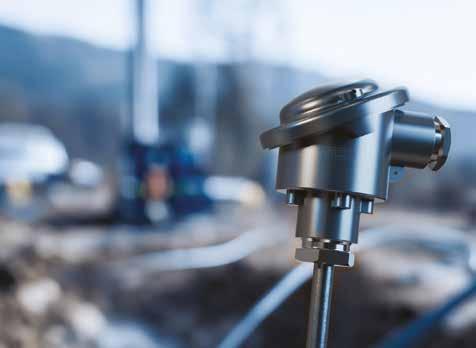
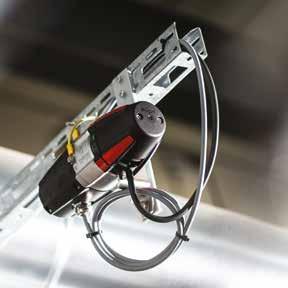
Jumo Temperature Sensor: built for the field
Clean Energy Safety Solutions
—
Supporting a Safer Journey to Net Zero
Dräger, with a legacy spanning over 100 years, is your trusted safety partner in this journey. We deliver comprehensive safety solutions tailored for the evolving clean tech landscape. From gas detection and respiratory protection to service and rental, we’re dedicated to protecting your team and assets in the face of new challenges across various sectors — be it hydrogen, carbon capture, battery production, offshore wind, waste-to-energy, or nuclear. We are not just a supplier; we are a partner in your journey towards a safe and sustainable future.
INTEGRATION BENEFITS
SubCtech’s acquisition by the Gabler Group signals a shift from discrete systems and towards full integration. Lydia Arundel reports
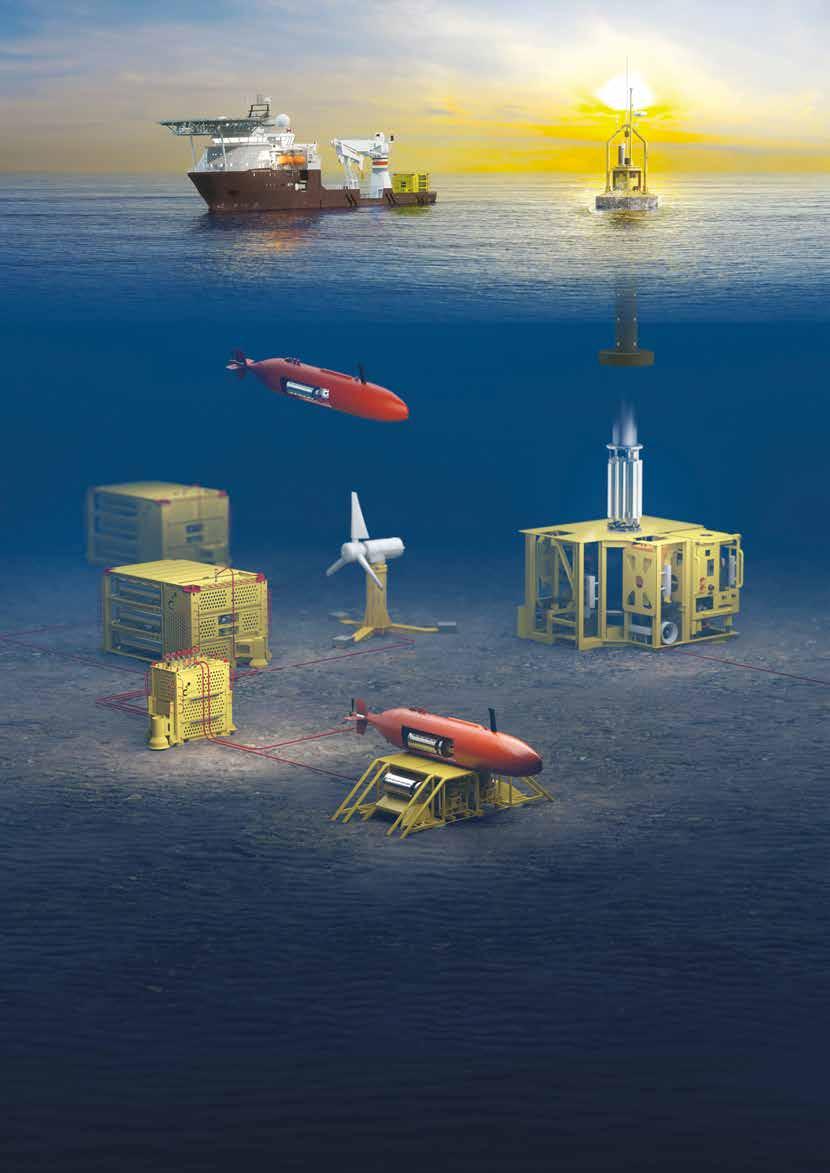
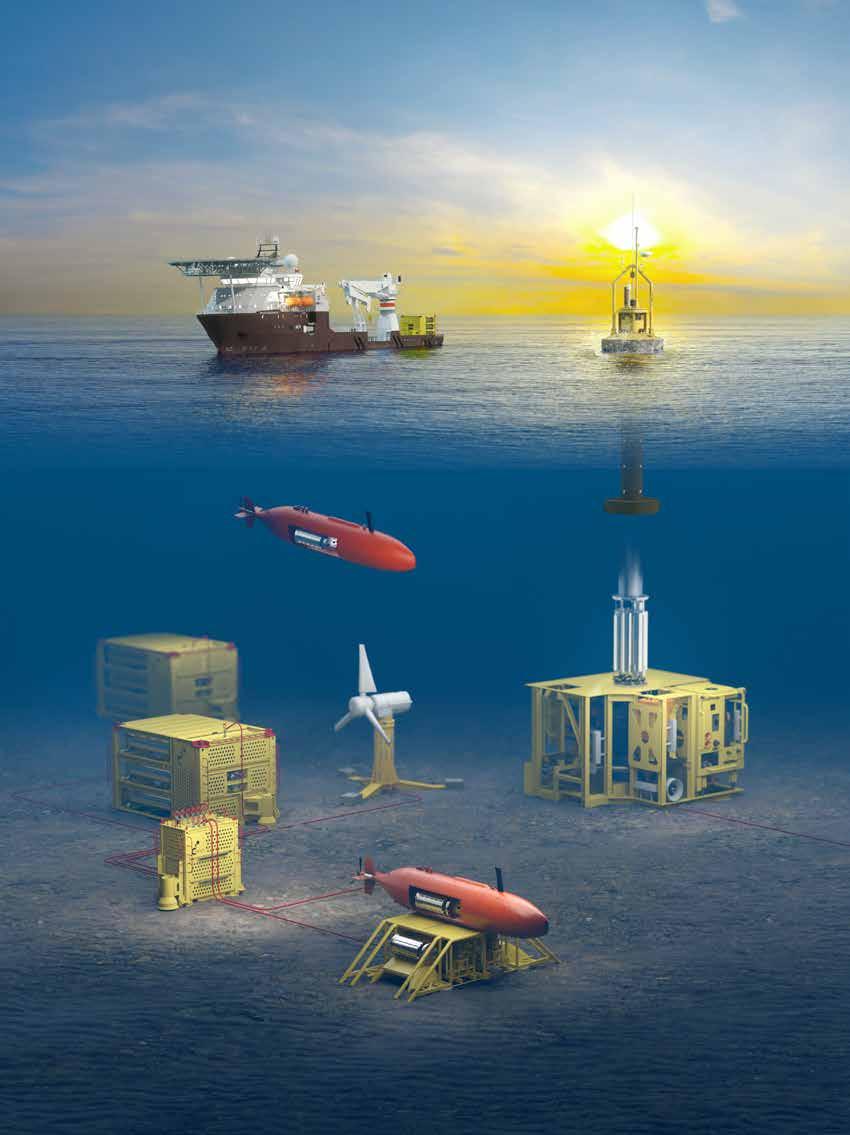
SubCtech was acquired by Gabler Maschinenbau in August 2025,. The deal was agreed because both companies saw overlap in the field of maritime technology, and the move aimed to leverage shared sales channels, merge technology and respond to market changes including the energy transition and resulting expansion in offshore wind, solar, and wave technology leading to an increased need for ocean data and environmental monitoring.
GROWTH IN NEW AREAS
SubCtech also expects the move will lead to growth in the following areas: offshore traditional energy, oil and gas; renewable energy and CCS; subsea security and defence; ocean monitoring and climate science; and autonomous underwater and surface systems. The merged company will also be better able to respond to defence demands as a result of ongoing geopolitical tensions.
FULLY INTEGRATED SUBSEA SYSTEMS
The newly enlarged company is currently preparing to develop fully integrated subsea ecosystems, which will entail scaling production and global delivery capabilities, investing in data-driven and autonomous solutions, as well as expanding international market access.
A FOCUS ON MANAGEMENT CONTINUITY
Since joining Gabler and becoming part of the Gabler Group, SubCtech has maintained continuity in its management, with founder Stefan Marx remaining in place as the managing director. This has helped ensure strategic and operational stability while also aligning with group-level governance structures.
Sören Johannsen, chief operating officer and marketing at SubCtech, said, “Integration into the group enhances alignment in governance, reporting, and strategic decision-making in accordance with Gabler’s established integration model, while leveraging common sales and marketing approaches to drive further growth and market presence.”
NO MAJOR STRUCTURAL CHANGES SO FAR
In addition to maintaining continuity in its management, no major structural downsizing or relocation has been indicated so far. Both companies are continuing to operate at their existing sites, with Gabler in Lübeck and SubCtech in Kiel.
However, Johannsen explained that, from SubCtech’s perspective, teams are becoming increasingly functionally integrated, with strong growth driven by projects, expanded market reach, and a rapidly growing market, with departments becoming generally more interconnected across the group.
and procurement efficiencies; crossselling opportunities and shared research and development resources, thereby reducing duplication and accelerating innovation. These benefits help the group to scale faster than if they were standalone entities.
A STRATEGIC SHIFT IN FOCUS
Since the acquisition, SubCtech’s focus has largely remained the same, with subsea power and ocean monitoring, but Johannsen explained there has been a clear strategic shift in emphasis, reflecting alignment with the Gabler Group’s broader subsea systems strategy. This includes providing an end to end system, from component provider to integrated solution provider; stronger positioning in defence and security-related subsea applications, according to current market dynamics; and an increased role in large-scale multi-system projects.
FUTURE DEVELOPMENTS
WHY THE DEAL MAKES SENSE
The alliance between the two groups is complementary: SubCtech provides subsea power systems and ocean monitoring systems, whereas Gabler’s expertise lies in submarine systems and mechanical platforms, as well as subsea communications, data, and analytics.
Johannsen added that the combined value proposition of the pair will be end-to-end subsea solutions – power, sensing, data, and platform integration, as well as the ability to serve offshore energy, defence, and ocean science markets holistically. This directly addresses the growing demand for integrated subsea systems rather than standalone components.
OPERATIONAL BENEFITS
The merged group will see economies of scale since SubCtech provides access to Gabler’s global sales infrastructure; shared supply chains
The deal was designed to help pave the way for several future developments that will include joint product development, expansion of global sales channels via Gabler’s network, an increase in production and innovation capacity, as well as cross-company technology integration across SubCtech, Develogic, and north.io. Johannsen said: “These initiatives are explicitly part of the Gabler’s growth strategy, including increased research and development as well as investment in sales.”
LOOKING AHEAD
As integration progresses, the focus will centre on delivering the developments outlined as part of the deal, including joint product development, expanded global sales channels, and scaling production and innovation capacity.
With technology integration across SubCtech, Develogic and north.io, the combined company is moving towards fully integrated subsea ecosystems that bring together power, sensing, data and platform solutions.
Plant operators are increasingly using scenario-based models as well as traditional gas mapping tools
GAS MAPPING MYTHS BUSTED
Murray Farmer, head of FGDS business development MENA at Dräger, dispels five myths about gas mapping and how the geographical approach can lead to conservative designs
In energy production facilities where hazardous materials and processes are present, fire and gas detection systems (FGDS) form a vital safeguard. They are essential for protecting personnel working in high-risk operational areas as well as for preserving critical plant assets. When installing these systems, scenario-based models are increasingly being used alongside traditional geographical gas mapping. But do they really guarantee lower investment costs? Incidents involving hazardous releases or flame formation usually result in production downtime and cost the operator a great deal of money. Consequently, flame and gas detection systems that are as effective as possible are of great interest to operators not only from a compliance but also from an economic perspective.
Gas mapping ensures that detection devices are positioned precisely and effectively to provide the best possible protection for all personnel, work processes, and the plant itself. There are essentially two approaches here: geographical and scenario-based mapping. But there are various myths still circulating around the best approach to use and why. In this article, Murray Farmer, Head of FGDS business development MENA at Dräger, dispels five of these myths.
MYTH 1: CFD GIVES ONE CORRECT ANSWER
It does not. Computational Fluid Dynamics (CFD) is a method used in scenario mapping. It aims to predict the behaviour of certain substances on the basis of mathematical calculations.
To deliver appropriate results, the method always requires specific performance targets to be set. Parameters, such as the potential intensity of a fire or the extent of a gas cloud, and various environmental conditions must be defined. Based on that, scenario analysis is a valuable tool for determining the probability that a gas cloud could reach that extent.
In reality, however, the number of possible scenarios is usually vast. The mathematical calculation then becomes a purely probabilistic model, with outcomes heavily dependent on assumptions. This alone does not
When executed professionally, geographical or volumetric mapping provides a consistent and transparent baseline leading to a more efficient and compliant design
An entire site is mapped via geographical mapping
provide a basis for an effective safety design. Within a holistic approach, CFD should always be supplemented by other methods and executed by specialists.
MYTH 2: GEOGRAPHICAL MAPPING LEADS TO MORE CONSERVATIVE DESIGNS THAN SCENARIO MAPPING
Not in general. Classic geographical or volume-specific mapping analyses the individual characteristics of the industrial plant and its surroundings: the entire site is mapped to identify blind spots, for example, and thus determine the optimal number and distribution of sensors.
The risk of inefficient sensor placement arises if it is carried out too simplistically. A simple grid-based approach, for example, can easily lead to an unnecessary increase in the number of detectors. However, this is not the same as a professional, performance-based design with clear objectives. When executed professionally, geographical or volumetric mapping provides a consistent and transparent baseline leading to a more efficient and compliant design. They also benefit from reduced cabling and installation costs, installation complexity, which usually saves time, and less maintenance burden throughout the system’s entire lifecycle.
MYTH 3: MORE DETECTORS AUTOMATICALLY MEAN INCREASED SAFETY
This is not the case. More detectors primarily mean higher costs – for procurement, installation, and maintenance. If complete coverage is achieved with a specific number of sensors, any additional devices are superfluous. Detection effectiveness is determined by how well the system meets the defined performance targets, not the number of devices installed.
Selecting the correct technology for the application and determining the optimal number and distribution of sensors requires a competent team of engineers with extensive experience. Their goal is always to achieve maximum safety at minimum cost to the customer: as many sensors as necessary, as few as possible.
MYTH 4: COMPLIANCE MEANS THE DESIGN IS GOOD
No, this is not the case. Regulatory compliance is indeed the starting point; however, the real question is whether the design achieves the intended performance in practice.
Legislation generally prescribes
safety measures, but it does not define how effective these must be. Some regions have highly developed regulations, whilst others are still in the development stage. Industry standards alongside health, safety, and environment (HSE) guidelines provide direction, but on their own do not offer sufficient detail to design a compliant system.
What is required is a thorough understanding of the underlying hazards and associated risks, possible escalation scenarios, combined with a deep understanding of the capabilities, strengths, limitations, and environmental sensitivities of the detectors, the triggers for false alarms, and their suitability for the specific application. This is what experienced partners and expert engineers bring to the table, leading to clear safety and performance targets.
MYTH 5: ALARM-ONLY DETECTION
PROVIDES THE SAME VALUE AS A FULLY INTEGRATED
PROTECTIVE FUNCTION
Modern technology has its limits – yet in some areas it is faster, more efficient and more accurate than manual intervention. A simple
alarm-only system that relies on an operator’s intervention cannot compete with a well-designed, integrated safety system.
Such systems do not completely replace the human factor but support it, creating a balanced interplay between individual decision-making ability and modern automated protection.
The crucial question when it comes to fire and gas mapping is therefore neither ‘geographical or scenariobased?’, but rather how effectively the engineering approach defines the risk and the required safety objectives. What is crucial is to understand the existing infrastructure and its specific challenges before the modelling begins.
Based on this understanding, appropriate performance targets can be defined and the most suitable mapping approach selected. If companies follow this principle and the five myths presented here, they will design their fire and gas detection systems to deliver both maximum safety and optimal cost efficiency.
REFLECTIVE RECYCLING
Reflective glass strips used in safety workwear were not always suitable for recycling, here we look at how a new technology from Alsico resolved the problem
Anew technology from manufacturer of protective workwear, Alsico, overcomes a significant barrier to recycling hi-vis clothing: reflective strips that have traditionally forced garments into incineration due to their tightly bonded composite construction.
A NEW STRUCTURE
The product, developed in in collaboration with Stuff4Life and Coats, makes use of Stuff4Life’s patented polyester depolymerisation process. Developed with technical validation from Teesside University, the product has been shown to separate and preserve the glass beads from hi-vis safety strips during processing. Laboratory analysis confirms that the recovered beads remain intact, spherical and optically effective, retaining up to 80% of their reflectivity compared with new material.
Through this approach, up to 100% of glass beads can be captured through filtration, and that more than 75% of the total reflective strip material can be recovered by weight when reflective strips are manufactured on PET backing fabric. The findings pave the way for future hi-vis strips containing 100% recycled beads, helping manufacturers create genuinely circular safety garments without compromising safety or compliance. Performance testing by Coats confirms the recovered beads meet the criteria required for reuse in new reflective tapes and materials.
CIRCULAR DESIGN
The breakthrough supports Alsico’s long-term approach to circular design, recovery and reuse through arx, reinforcing its ambition to create closed-loop solutions for complex workwear garments and reduce endof-life incineration.
Vincent Siau, head of the Alsico academy, said: “Recycling reflective
strips has long been a critical challenge for hi-vis workwear. Until now, garments containing these materials were typically destined for incineration. These results show that a closed-loop pathway is technically achievable and brings us closer to making circular hi-vis garments a reality. By actively investing in recovery solutions and setting clear standards for recyclability, recycled content and closed-loop operations, we are continuing to build the infrastructure required to make circular workwear a reality at scale.”
The recovery of reflective glass beads opens new design opportunities and provides garment manufacturers, trim specialists, laundries and distributors with a clear technical pathway for designing hi-vis components with recovery and reuse in mind. The work also aligns with alsico’s 3CL by arx
project, which aims to deliver a fully closed-loop workwear solution.
Joerg Jakobi, Global Trims Director at Coats, shared: “Maintaining bead integrity and optical performance is fundamental. The Stuff4Life process delivers recovered beads that remain suitable for use in advanced reflective systems.”
John Twitchen, Director of Stuff4Life, added: “This work shows that we can close the loop not only on polyester, but on complex components such as reflective beads. It’s a major step toward genuinely circular protective garments.” For more information about alsico’s circular initiatives, visit www. alsico.com/sustainability.
Alsico has an ambition to create closed-loop solutions for complex workwear
Fire and gas detection systems are designed to provide early warning of dangerous events
HIDDEN DANGERS
Megan Hine a gas safety expert from Draeger Safety UK explores the problem of false alarms in fire and gas detection
In high-hazard environments such as power generation and energy infrastructure facilities, fire and gas detection systems are designed to provide an early warning of potentially catastrophic events. Their effectiveness, however, depends not only on the sophistication of the technology deployed but also on the confidence that operators place in the alarms that are generated. When that confidence is eroded, often because of poor maintenance or system mismanagement, the consequences can be severe.
Repeated false alarms result in a loss of trust, creating a ‘cry wolf’ scenario in which genuine alerts risk being delayed, dismissed, or misinterpreted.
CAUSES OF FALSE ALARMS
False alarms with flame detection, sometimes brought about by reflected sunlight or flare reflection for example, are often caused by initial poor detector placement with the tilt angle not being ideal. Similarly, if gas detection sensors are hard to reach, they may fall out of the calibration owing to the extra effort required to reach them.
Both scenarios could be avoided by better initial system design and improved technology selection. Fire and gas mapping seeks to avoid false alarm triggers - a correct technology selection from the outset provides a robust foundation.
ENGINEERED DESIGNS FOR SPECIFIC SCENARIOS
While engineered designs for specific scenarios might take more set up effort, they reap rewards when it comes to operational efficiency. A good example is enabling permanent remote calibration of gas detectors with the sensor mounted at height and the transmitter located lower down. The addition of calibration tubing installed between the two means calibration gas can be applied to the sensor without leaving the ground. This can be particularly relevant for hydrogen, which is the lightest gas, so sensors are often mounted at the highest points possible to detect re-accumulations of gas from
Megan Hine is a gas safety expert from Draeger Safety UK
leaks. False positives also cause disruptions to production uptime, and for green hydrogen systems, which use electrolysers, this can have bigger effects than just lost production.
FLAME DETECTION
Hydrogen’s more ‘exotic’ properties are well documented; the wide flammability range, extremely low ignition energy and the propensity to self-ignite, which is the reason why flame detection is so important when it comes to hydrogen safety.
Hydrogen jet fires are invisible to the human eye, have a high flame temperature and produce no carbon which creates that ‘smell of smoke’ that humans have evolved to associate with fire. All these characteristics can mean trust of your own senses may, initially, be in direct conflict with trust in the flame detection system. Radiation-based flame detection is the only option, and this can be Ultraviolet (UV)/ Infrared (IR) or 3IR.
3IR COMPARED WITH UV/IR
Of the two technologies, 3IR is more robust than UV/IR. While UV/IR relies on two different sensors, each contributing its own signal, 3IR uses three infrared sensors. As the name suggests, these three sensors work
together with an intelligent algorithm that analyses the relationship between the three signals to determine whether they are characteristic of a fire. The algorithm is looking at radiation characteristics, in addition to random flicker pattern which can only be attributed to a flame, as opposed to two ‘on’ signals from two different sensors without the ability to analyse flame ‘flicker’ behaviour. This means the 3IR flame detector is less likely to be tricked by IR radiation sources which might meet wavelength parameters, but don’t behave like a fire, for example vibration hot pipework (black body radiation) or reflected sunlight.
HYDROGEN’S BURNING VELOCITY
Hydrogen’s laminar burning velocity is approximately seven times greater than methane, significantly increasing the potential size and pressure of an explosion, should an unburnt cloud of hydrogen gas reach explosive concentration. Consequently, using the correct method of leak detection is very important.
While using the right technology is crucial, human factors are also central to effective safety management. Even the most advanced detection systems rely on appropriate response from trained
personnel. As a result, having clear procedures, regular training and safety drills are all essential to ensure that alarms are understood and acted upon correctly.
Added to this, a strong safety culture, where employees trust and engage with safety systems, is important. Reliability plays a role; when systems perform consistently and accurately, confidence increases, and personnel are more likely to respond appropriately.
For power engineers and operators, the message is clear: by selecting robust detection systems, prioritising maintenance, optimising system design, and ensuring that teams are fully trained and briefed, organisations can avoid the ‘cry wolf’ scenario and can ensure that when an alarm sounds, it is heard, trusted, and acted upon without hesitation.
Megan Hine is an experienced gas safety practitioner whose work in the safety sector spans over a decade. Her current role with Draeger Safety UK involves advising and supporting operators in gas safety monitoring and detection across a wide range of industry sectors, including pharmaceuticals, utilities, food and drink and manufacturing.
While using the right technology is crucial, humans are also central to effective safety management
REDEFINING BOILER EFFICIENCY
This case study from Explosion Power explains how shock pulse technology helps mitigate fouling of heat transfers
The thermal utilisation of sustainable fuels and the recovery of waste heat are key pillars of modern energy generation and industrial decarbonisation. Industrial boilers play a central role in this transition; however, fouling and deposit formation on heat transfer surfaces significantly degrade their performance. These deposits reduce heat transfer efficiency, increase emissions, and may lead to unplanned shutdowns and elevated maintenance costs.
Shock Pulse Technology, developed by Explosion Power, provides an advanced solution to this challenge. By enabling safe, automated, and continuous cleaning of boiler heat exchanger surfaces during operation, the technology effectively mitigates fouling without requiring process interruptions, thereby improving operational reliability and overall system efficiency.
APPLICATION RANGE AND TECHNOLOGY ADVANTAGES
Wherever fuels are thermally utilised in boiler systems, residual deposits such as ash, slag, and other particulate
matter are inevitably generated. These deposits accumulate on heat exchanger tube surfaces, leading to a deterioration of heat transfer performance. This not only reduces overall thermal efficiency but, in severe cases, may result in unplanned shutdowns and operational interruptions of the entire plant. Maintaining clean heat transfer surfaces is therefore essential to ensure efficient and reliable boiler operation.
Conventional cleaning methods, such as the injection of water or steam under high pressure, are often associated with limited efficiency and may contribute to mechanical or thermal damage of boiler components. Another commonly applied method involves the use of explosive cleaning techniques; however, these approaches pose significant safety risks related to the transportation, storage, and handling of explosive materials.
Shock Pulse Technology has been developed as an alternative cleaning approach, utilising controlled Shock Pulses to remove deposits from boiler tubes in a non-invasive and efficient manner, thereby preserving component integrity while maintaining optimal heat transfer conditions.
Shock Pulse Generators are
designed to keep tube bundles clean from the very start of each operating cycle – not merely as a corrective measure after heavy fouling has built up. This proactive approach increases boiler load, improves throughput, and extends operating periods. The technology applies across waste incineration, biomass, coal-fired, and industrial boiler applications. More than 1,300 units have been delivered worldwide since 2009.
WORKING PRINCIPLE
Combustible gas (methane or natural gas) and high-pressure compressed air are dosed simultaneously into a combustion chamber. A glow plug initiates combustion; a piston mechanism then opens the chamber and releases the energy in form of a Shock Pulse through a nozzle into the boiler interior. The resulting spherical pressure wave sets both the flue gas flow and the heating surfaces into brief vibration while simultaneously inducing structure-borne oscillation within deposits – efficiently dislodging fouling from tube bundles.
The latest SPGr series operates on compressed air rather than oxygen, reducing combustion aggressiveness
The Shock Pulse Generator in operation
A Shock Pulse Generator system overview and extending maintenance intervals. An integrated air compressor unit is optimally matched to the series. All units are CE-certified under the Pressure Equipment Directive (PED) 2014/68/
EU. Cycle control is managed by a PLC ready for integration into the operator’s Distributed Control System (DCS), enabling adaptive cleaning patterns based on actual fouling conditions.
PROVEN PERFORMANCE: CASE STUDY RESULTS
A detailed boiler analysis conducted by Explosion Power demonstrates the technology’s measurable impact. Prior to installation, the plant operated with a traditional Shower Cleaning System (SCS), producing a characteristic sawtooth temperature profile at the superheater inlet – a sign of cyclical fouling and incomplete cleaning. After installing Shock Pulse Generators (SPG), both average and peak flue gas temperatures at this critical transition point were significantly reduced, and the fluctuating temperature pattern was completely eliminated.
Using digital boiler models and plantspecific data, Explosion Power creates a digital twin of each boiler. This enables precise analysis of boiler behaviour over time and provides targeted recommendations for optimal SPG deployment – helping operators achieve more efficient operation, reduced CO2 emissions, longer operating cycles, and, in many cases, increased plant capacity.
A stable and low flue gas temperature after installing the Shock Pulse Generator
An operation period with Saw Tooth profile due to Shower Cleaning System
Captions to go here
FROM COPPER TO CODE
Frédéric Godemel from Schneider Electric explores the safety and efficency benefits of the energy infrastructure’s move to software
Twenty years ago, the launch of the first Apple iPhone marked the start of a new technological era, not simply because of one new device, but because it arrived at a system-wide tipping point where cloud adoption and the growth of data centre infrastructure, meant advances in communication technology that made it cheaper and easier to connect to the internet. As such changing consumer behaviour converged to enable a new platform model. Phones went from communication products to adaptable digital platforms, capable of being personalised and continuously improved through software updates and connection to powerful computing resources far beyond the device itself. That model now sits in the hands of billions of people worldwide.
Frédéric Godomel is vice president of energy management at Schneider Electric
METAL AND THE ENERGY INFRASTRUCTURE
Energy is approaching a similar moment. For more than a century, power systems have been built with a simple philosophy: install once, operate reliably, and change as little as possible.
Electrical infrastructure became synonymous with solidity. Steel cabinets, copper conductors, hardwired logic, and designs were meant to last for decades without modification. But the world around power systems has changed faster than the systems themselves.
Today, electricity demand is accelerating as transport, buildings, industry, and digital infrastructure shift toward electrification. At the same time, energy supply is becoming more distributed, more variable, and more complex. Solar panels, batteries, electric vehicles, data centres, and smart buildings are no longer edge cases; they are becoming the norm. In this context, systems designed to remain static are being asked to operate in an environment defined by constant change.
This is where software defined energy begins—not as a new layer of complexity, but as a necessary revolution for energy systems to adapt at the speed of change.
WHAT SOFTWAREDEFINED ENERGY REALLY MEANS
Software defined energy represents a fundamental shift in how electrical systems are architected and managed.
At its core, it is about decoupling intelligence from hardware. Instead of hard coding functionality into electrical devices and wiring, features like protection, safety, control, and optimisation are increasingly defined by software that can be deployed, updated, and coordinated across the system. The physical realities of electricity do not disappear. Power must still obey the laws of physics, flow through conductors, and be protected with absolute precision. What changes is how intelligence is applied. Software makes it possible to continuously modify the way energy is distributed, protected, and optimised without redesigning the entire system every time conditions change. The result is an energy system that behaves less
like a fixed installation and more like a platform that can evolve rapidly. Rather than oversizing infrastructure to anticipate every future scenario, organisations can adapt as those scenarios actually unfold.
THE CASE FOR CHANGE
In traditional electrical architectures, responding to change often meant interruption. Adding a new production line, integrating onsite generation, adjusting to new tariffs, or tightening safety and cybersecurity requirements typically required bespoke engineering, physical reconfiguration, and planned downtime.
Software defined architectures replace bespoke designs with standardised physical building blocks whose behaviour is governed by software. Electrical components are standardised and purpose built, while intelligence is introduced through software that configures how those components behave together. Functions can be enabled, adjusted, or extended through software updates instead of physical redesign.
With softwaresdefined energy, the response is shaped by realtime context
BENEFITS OF SOFTWARE-DEFINED ENERGY IN INDUSTRY
In power-critical industrial environments, where downtime directly impacts profitability, software defined energy enables a fundamentally different operating model. When grids, tariffs, or capacity constraints demand immediate action, such as shedding a large amount of kW, traditional systems treat it as a simple arithmetic exercise, cutting load evenly and hoping nothing critical is affected. Too often, that approach disrupts essential processes
like cooling or production support, triggering cascading failures and costly penalties.
With software defined energy, the response is shaped by realtime context. Non-critical loads are selectively reduced first, critical operations remain protected, and targets are met without disruption. Production lines and supporting systems can be coordinated immediately to avoid demand peaks, making better use of existing electrical capacity instead of defaulting to costly infrastructure upgrades.
At the same time, edge-level intelligence enables faster fault detection, isolation, and coordinated response, preventing local disturbances from cascading into wider disruptions. Maintenance strategies also change: software driven configurations of standardised architectures reduce commissioning time, simplify testing, and allow many updates to be performed without shutting systems down. For example, Schneider Electric’s Smart Bloc, a pre-engineered power block for datacentre and critical power infrastructure, replaces complex, custom-wired panels with a standard base and software-controlled plug-in modules. This can cut build and commissioning from four weeks to one and enables routine tests and software updates with power on, reducing the 1 or 2 day maintenance windows to zero.
As production requirements, compliance rules, and energy markets evolve, electrical infrastructure becomes an enabler of flexibility rather than a constraint on growth. Software-defined energy transforms panels and distribution systems into intelligent control points. Energy use can be prioritised, shifted or optimised automatically, based on price, comfort, and availability of renewable power or user preferences. At scale, this flexibility is essential. The safety and efficiency of the future grid will depend not only on generation and transmission, but on millions of intelligent, responsive endpoints.
SPECIALIST BOILER MAINTENANCE
Lech Biegus, operations lead at Integrated Global Services (IGS), explores how to manage corrosion and extend asset life in European waste-to-energy boilers
Waste-to-energy (WtE) boilers operate in environments where corrosion is an inherent and ongoing consideration. The combination of chlorine-rich fuels, variable feedstock composition, and elevated steam conditions accelerates material degradation compared with conventional power generation. This abbreviated article looks at how to circumvent the issue. To read the full article visit www.engineerlive.com
THE FOCUS FOR MAINTENANCE TEAMS
For maintenance teams, the focus is on effective corrosion management throughout the asset’s operational life. This requires a clear understanding of degradation mechanisms, supported by appropriate inspection strategies and timely intervention.
In this context, material selection and the application of weld overlay, including re-overlay, are established approaches to maintaining component integrity. When implemented correctly, these measures can help manage degradation rates, support planned maintenance strategies, and extend the service life of critical boiler components.
THE ROLE OF CHLORINE IN HIGH-TEMPERATURE BOILER CORROSION
In European WtE boilers, chlorineinduced high-temperature corrosion is the primary driver of fireside damage.
Municipal solid waste contains significant amounts of chlorine, largely
Maintenance teams must focus on effective corrosion management
from PVC and other chlorinated materials. During combustion, chlorine forms hydrogen chloride (HCl) and reacts with alkali and heavy metals such as zinc, lead, sodium, and potassium. These reactions produce low-melting-point metal chlorides, including ZnCl2 and PbCl2
These compounds form molten deposits on tube surfaces and Flux and destabilise protective oxide layers (e.g. Cr2O3)
Promote active oxidation mechanisms
Accelerate metal wastage
In practice, this manifests as general wall thinning, localised pitting, and, in severe cases, rapid loss of tube integrity, particularly in hightemperature regions.
THE ROLE OF FUEL VARIABILITY
Unlike conventional fuels, waste streams are inherently inconsistent. Variations in chlorine content, alkali metals, moisture, and ash composition can significantly alter deposit chemistry. Biomass co-firing, now increasingly common in Europe,
Many WtE boilers experience erosion corrosion
introduces additional potassium and sodium, further influencing deposit melting behaviour.
This variability means that corrosion rates are not constant. A boiler may experience relatively mild conditions during one run and aggressive degradation in the next.
From an operational standpoint, corrosion behaviour in WtE boilers is highly plant-specific and cannot be reliably predicted from design conditions alone.
UNDERSTANDING EROSION-CORROSION
In addition to chemical attack, many WtE boilers experience erosioncorrosion, particularly in areas exposed to high-velocity, particleladen flue gases.
This is commonly observed in:
Superheater banks
Economisers
Gas flow turning zones
In these regions, fly ash particles remove protective oxide layers from tube surfaces. The freshly exposed metal is then subjected to accelerated corrosion, creating a self-reinforcing degradation mechanism.
The severity of erosion-corrosion depends on gas velocity, ash loading, and local flow geometry, and is often intensified in modern plants operating at higher efficiencies.
INSPECTION STRATEGIES AND CORROSION MONITORING
Given the variability of both fuel composition and operating conditions, regular inspection is essential.
Effective inspection programmes typically include:
Visual assessment of exposed surfaces
Ultrasonic thickness (UT) mapping
PROTECTION STRATEGIES FOR WTE BOILERS
1) PANEL REPLACEMENT
Full panel replacement remains the most invasive option. It involves removing sections of waterwall tubing and installing new prefabricated panels, often with shop-applied overlay, followed by additional on-site welding.
While this approach effectively resets the asset’s condition, it introduces significant logistical complexity, costs, and outage duration.
2) ON-SITE WELD OVERLAY
Weld overlay has become the industry standard for protecting carbon steel components in WtE boilers.
In this process, a corrosion-resistant nickel-based alloy, most commonly Alloy 625, is deposited onto the tube surface. The overlay acts as a sacrificial barrier, protecting the base material from aggressive combustion environments.
On-site application offers flexibility since it means operators can extend the life of existing components and target specific high-risk areas.
Evaluation of protection system (weld overlay, thermal spray) condition and integrity
Identification of pitting and localised attack
Establishing corrosion trends is critical. In many cases, operators observe measurable wear rates in protective overlays, while base material degradation can accelerate rapidly once exposure occurs.
Without structured inspection, maintenance strategies tend to become reactive, often leading to unplanned repairs or premature component replacement.
CONCLUSION
As European WtE plants continue to evolve, operators who adopt a
proactive, lifecycle-focused approach, supported by high-quality welding capabilities, will be best positioned to maintain reliability and optimise performance over the long term.
Lech Biegus is a senior operations and quality professional with over 20 years of experience delivering complex welding, weld overlay, and Coke Drum repair projects across Oil & Gas, Power, and Waste-to-Energy facilities worldwide.
As Regional Operations Lead at Integrated Global Services (IGS), he specialises in largescale turnaround execution and quality control leadership.
For more information visit: https://integratedglobal.com/en
Corrosion behaviour in WtE boilers is highly plant specific
RETHINKING REFUSE
Two key European bodies in the WtE sector have released a policy document arguing that modifications need to be made if WTE is to join other renewable resources in the emissions trading system
The Confederation of European Waste-to-Energy Plants (CEWEP) and The European Suppliers of the Waste to Energy Technology (ESWET) have released a policy document stating that they fully support the reduction of greenhouse gasses in the waste sector but that this will not be achieved by integrating Waste-toEnergy (WtE) into the EU Emissions Trading System in its current form, since this would create unintended environmental and economic consequences without delivering the expected climate gains.
To ensure a climate neutral waste system the paper argues for the following adjustments within a new framework, stating these would be necessary to enable a successful transition to climate neutrality.
1. CARBON PRICING IN WASTE MANAGEMENT NEEDS TO RUN ALONGSIDE MEASURES TO ENSURE REALISATION OF THE EU WASTE GOALS AND THE CIRCULAR ECONOMY ACT WITH A FOCUS ON LANDFILL REDUCTION
Despite several efforts to reduce landfilling over the past decades, landfill rates in many EU member states remain persistently high, resulting in significant and problematic methane emissions.
Diverting recoverable waste from landfills to higher levels of the waste hierarchy, such as recycling and WtE, will substantially reduce methane emissions, save primary raw materials and deliver greater CO2-equivalent savings than carbon capture technologies or carbon pricing alone. Carbon pricing for WtE may result in
more waste going to landfills (waste leakage) because WtE and recycling would become more expensive.
2. CARBON CAPTURE, UTILISATION AND STORAGE (CCUS) IS A CONCRETE VISION AND PART OF THE ULTIMATE SOLUTION, BUT THERE IS NO BUSINESS CASE YET FOR THE WTE SECTOR
The development of CCUS in the WtE sector is still at an early stage.
While the potential for carbon use and long-term carbon storage is significant – and may ultimately contribute to negative emissions –progress is currently hindered by the absence of CO2 transport and storage infrastructure, high upfront costs, a lack of effective financial support and a robust regulatory framework.
3. APPLY THE ‘POLLUTER–PAYS’ PRINCIPLE WHERE IT WORKS
WtE plants are not the origin of the fossil carbon contained in waste; rather they represent the final treatment option for nonrecyclable plastics and other fossil carbon containing materials, which are a growing global challenge. Responsibility for the climate impacts associated with the thermal treatment of virgin, fossil-based, nonrecyclable materials should therefore be shared with producers.
4. FORESEE A FUTURE WHERE CARBON IS MADE CIRCULAR AS A RESOURCE AND WHERE WASTE IS VALORISED VIA MATERIAL AND ENERGY RECOVERY
To ensure the emissions trading scheme can effectively contribute to a climate-neutral waste system, substantial adjustments are essential. The sector stands ready to work with policymakers to develop a tailored, future-proof framework that enables a successful transition to climate neutrality.
Scan QR Code, to read the full policy document
To read the full policy document visit: eswet.eu/wp-content/uploads/2026/03/CEWEP-ESWET_Joint-Policy-Brief_WasteEU-ETS_March26.pdf
Carbon pricing for WtE might lead to more waste going to landfills
The meeting place of the global wind industry – onshore & offshore
• 1,600 exhibitors from 40 countries
• First-rate conference programme on six open stages
• Networking with 45,000 international participants
• Recruiting Days on 24 and 25 September
NEW An entire hall dedicated to energy storage windenergyhamburg.com
THE ALL ENERGY TRADE SHOW
The 25th All Energy show will take place on the 13th and 14th May in Glasgow
The All Energy show will take place, as usual, at the SEC in Glasgow. The two-day show will run on the 13th and 14th May and be an opportunity for CTOs, project directors, grid planners, asset managers, engineers, and senior executives from wind, hydrogen, solar, storage, and grid infrastructure sectors across the world to meet and
discuss developments.
The show will see 300+ key exhibitors, including turbine manufacturers, EPCs, SaaS providers, digital energy specialists and more.
Partners will include Scottish Power Renewables, SP Energy Networks, and SSE who will be demonstrating next-generation turbine tech, AI asset tools, smart
grids, and hydrogen storage platforms.
The Innovators’ Hub will include presentations on solar, storage, and the built environment, as well as senior executive roundtables.
GLOBAL OFFSHORE WIND
The event will run on the 16th and 17th June 2026 in Manchester
Global Offshore Wind will take place at Manchester Central and is billed as an event that will bring the entire offshore wind value chain together. This year, the conference programme centres on the theme ‘securing the future’. Offshore wind is vitally important
to securing a sustainable future. As one of largest electricity generators this ressource is a cornerstone of the UK’s long-term strategy for energy security, economic growth and global leadership, according to the show organisers with renewed momentum following a recent highly
successful auction round.
Conference sessions will include ‘Contracts to construction: offshore wind delivery at scale’; Scaling offshore wind from Canada to Poland to the Philippines; and Unlocking the next wave of FOW and ODOW capacity.
Networking sessions include the North Sea’s 300GW challenge: building the grid. This session is sponsored by Hitachi Energy, and designed to bring together key stakeholders to explore how coordinated planning, cross border cooperation and accelerated network development can turn ambition into action and power Europe’s clean energy future. There will be an opportunity to participate in workshop topics too. For more information visit: www.renewableuk.com
THE HYDROGEN INNOVATION AND TECH CONFERENCE
The Hydrogen Innovation and Technology Conference, hosted by the Institution of Chemical Engineers (IChemE) in partnership with the American Institute of Chemical Engineers (AIChE), will take place on 14–15 October 2026 in Manchester and bring together a cross-section of the global energy community at a pivotal moment for the hydrogen economy.
Set against intensifying net zero commitments across Europe, the conference reflects a broader shift: hydrogen is moving from long-term aspiration to an emerging pillar of industrial decarbonisation. As global strategies mature and investment accelerates, the conference aims to move beyond vision-setting to practical implementation involving regulation, planning and collaboration.
NATIONAL STRATEGIES EXPANDING
With national strategies expanding and deployment challenges becoming clearer, the conference aims to move beyond high-level vision and focus on practical implementation grounded in today’s realities.
DIVERSE AUDIENCE
The event is expected to attract a diverse audience of leaders
ICHEME’s hydrogen conference: uniting a cross section of the global energy community at a pivotal moment
from industry and academia, including policymakers, technology developers, and regulators, creating a multidisciplinary forum. Attendees are expected to span the full hydrogen value chain, from production and storage to infrastructure and end-use applications, reflecting the complexity of deploying hydrogen at scale.
TECH CONFERENCE AGENDA
While the detailed agenda is still being finalised through the open call for content, the structure will combine keynote presentations, panel discussions, and technical sessions. The programme will be designed not only to showcase innovation but also to address the practical barriers to deployment – policy alignment, cost reduction, and infrastructure development among them.
COLLABORATION BETWEEN ICHEME AND AICHE
The conference also builds on a relatively recent but rapidly growing collaboration between IChemE and the American Institute of Chemical Engineers (AIChE), reflecting hydrogen’s global significance. Previous iterations and related initiatives have laid the groundwork
for an annual platform that connects engineering expertise with policy and investment communities, positioning the 2026 event as part of a longer-term effort to accelerate hydrogen adoption worldwide while acknowledging the gaps between ambition and delivery.
Importantly, the event is not purely technical. With sponsorship and exhibition opportunities available, it will also be a marketplace for ideas and partnerships, enabling companies to showcase emerging technologies and forge commercial relationships.
Steve Flynn, steering committee chair said “Hydrogen will play an essential role in our future energy systems and now is the time to begin to home in on the critical roles and the roadblocks to implementation. This event will bring together industry, business, policy makers and innovators to share progress updates, international perspectives and the latest breakthroughs. But the aim is to do more than simply share – our goal is to drive progress and help shape policy to enable the transition to net zero.”
For more information visit: www.icheme.org/hydrogen26 Email: hydrogen@icheme.org
The event will bring together a cross section of the global energy community
APROVIS Energy Systems
Innovative gas and exhaust gas treatment. Since its foundation in 2000, APROVIS has been operating successfully as a medium-sized company on the national and international market. We are constantly developing further.
T +49 9826 / 65 83 – 040
E info@aprovis.com
W www.aprovis.com/en/home-en/
Integrated Global Services (IGS)
Headquartered in Virginia, U.S., IGS is an international provider of surface engineering solutions. It executes projects around the world and has 35+ years of experience helping customers solve metal wastage and reliability problems in mission-critical equipment.
T +1 888 506 2669
E info@integratedglobal.com
W www.integratedglobal.com
GET INVOLVED
Barnbrook Systems
A leading provider of problem-solving innovative solutions for the aerospace, defence, and industrial sectors. Delivering highquality systems and advanced technologies, ensuring reliability and performance across all applications. Partner with us for excellence.
T +44 1329 847722
E sales@barnbrook.co.uk
W www.barnbrooksystems.com
HILLIARD
Hilliard offers a diversified product line for industrial applications in a wide variety of industries. Hilliard products are designed, manufactured and sold according to our customers' applications.
T +1 607 733 7121
E sales@hilliardcorp.com
W www.hilliardcorp.com
OPSIS
OPSIS AB is a globally active manufacturer of innovative systems for air quality monitoring and industrial gas analysis. We provide our customers with reliable and cost-effective measurement systems and services for a wide range of applications.
T +46 46 72 25 00
E info@opsis.se
W www.opsis.se
Rotork
A market-leading global provider of mission-critical flow control solutions for the industrial actuation and flow control markets. We help customers improve efficiency, reduce emissions, minimise their environmental impact and assure safety.
T +44 (0) 1225 733200
E information@rotork.com
W www.rotork.com
SafeLane Global Limited
With 30+ years’ experience in demining, explosive and unexploded ordnance disposal, SafeLane Global provides end-to-end consultancy in explosive risk mitigation on land or at sea. Services include: Threat assessments, surveys, investigation, clearance, and ALARP certification.
T +44 1594 368 077
E info@safelaneglobal.com
W www.safelaneglobal.com
RICHWOOD
Richwood designs innovative solutions for the worldwide bulk material handling industry. Clean conveyors and sealed and protected load zones from site specific solutions mean lowered maintenance costs, safer work areas and more productive operations.
T 304-525-5436
E info@richwood.com
W www.richwood.com
Seal For Life Industries
Seal For Life, part of the Henkel Adhesive Technologies Group, offers the most diversified protection, maintenance and repair solutions in the market. With fourteen distinct brands offering a broad range of products servicing multiple industries across the globe.
T +31 599 696 170
E info@sealforlife.com
W www.sealforlife.com
WINDENERGY HAMBURG
WindEnergy Hamburg is a biennial event due to take place on 22nd to 25th September 2026 at the Hamburg Messe, Germany.
ADDRESSING MAJOR INDUSTRY ISSUES
The show aims to address the major issues facing the international wind energy sector, and provide a space for a high-calibre, professional audience and exhibitors to discuss their concerns as well as demonstrate
their innovations and solutions from across the industry’s value chain. The organisers expect to welcome 1,600 exhibiting companies from 40 countries and 43,000 total attendees from 100 countries.
REGISTRATIONS
The organisers have said that registrations are 5% higher than they were ahead of the 2024 event, and that they expect the exhibition floor to exceed 80,000 m2 for the first time. The new Hall A2 will be dedicated to
energy storage, a key area of interest for the industry.
INTEGRATION
The integration of energy storage technology is crucial for the long-term success of renewable energy. Exhibitors will showcase large-scale battery arrays as well as smart energy management technologies in this dedicated area:
Clean Energy Safety Solutions
—
Supporting a Safer Journey to Net Zero
Dräger, with a legacy spanning over 100 years, is your trusted safety partner in this journey. We deliver comprehensive safety solutions tailored for the evolving clean tech landscape. From gas detection and respiratory protection to service and rental, we’re dedicated to protecting your team and assets in the face of new challenges across various sectors — be it hydrogen, carbon capture, battery production, offshore wind, waste-to-energy, or nuclear. We are not just a supplier; we are a partner in your journey towards a safe and sustainable future.