
Title: Into the Blue: Material Considerations for Contemporary Art in the Face of Climate Change
Author: Evie Rose Thornton
Publication Year/Date: May 2024
Document Version:
BA Fine Art Hons dissertation
License:
CC-BY-NC-ND
https://creativecommons.org/licenses/bync-nd/4.0/
DOI:
Take down policy:
https://doi.org/10.20933/100001303
If you believe that this document breaches copyright please contact us providing details, and we will remove access to the work immediately and investigate your claim.
Contents Acknowledgements 4 List of Figures 5 Abstract 6 Introduction 7 Chapter 1: Curatorial Thesis 9 Climate Change 9 Industry 9 Eco Materialism 11 Chapter 2: Curatorial Choices 13 Location 13 Artists 15 Legacy 19 Intended Audience 20 Chapter 3: Curatorial Influences 21 Chapter 4: Other Influences 24 V&A Dundee: Plastic 24 Venice Architecture Biennale 25 Slow Praxis 25 Conclusion 26 References 28
Acknowledgements
Iwould liketo thankmy Academic Advisor,Gair Dunlop,whoguidedmethroughthis dissertation with patience and kindness, and with whom I shared a lot of interesting conversations about my subject matter.
I would like to acknowledge Helen Gorrill, the course leader of this dissertation module, for her enthusiasm, kindness and passion throughout this whole process.
I would also like to thank Kate Hendry from Scotland + Venice for giving me the opportunity to work as a senior invigilator at the 2023 Venice Architecture Biennale this summer. This allowed me to gain first-hand experience of this important festival, the inner workings of the art of curation and the chance to learn from the curators of the Scotland exhibition.
And lastly, a massive thank you to both Michael Owers and Jenny Triggs, who supported me throughout this whole process.
List of Figures
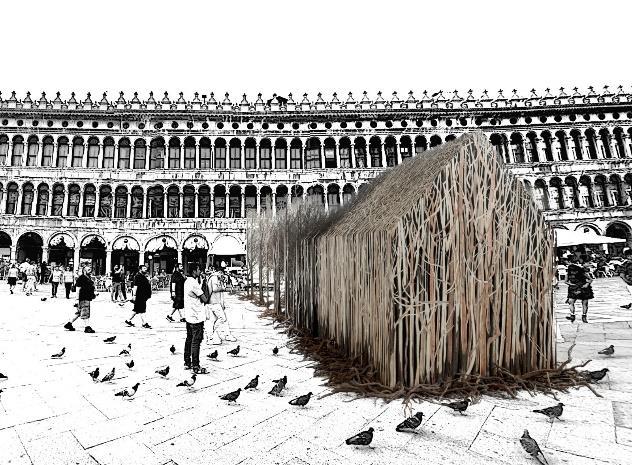
Fig 1. Page 16, arrangement of installation in San Marco’s Square [aerial view of exhibition, includes artist placement] Evie Rose Thornton. 2024
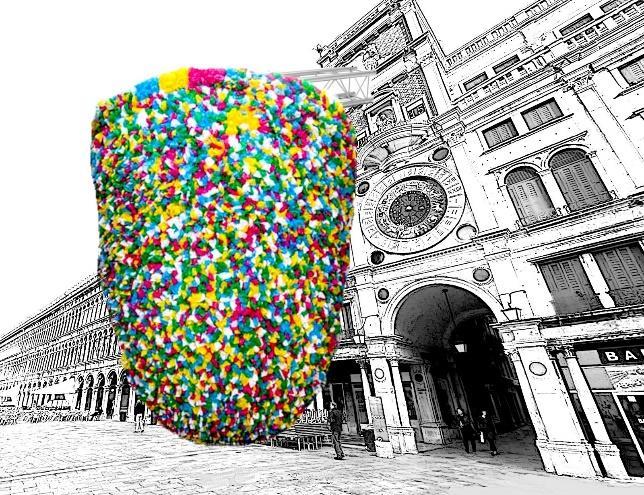
Fig 2: Page 17, Proposed installation shot 1 [view of the entrance from Merceria to San Marco’s Square, presenting Pascale Marthine Tayou, ‘Plastic Bags’, (2013)] Evie Rose Thornton. 2024
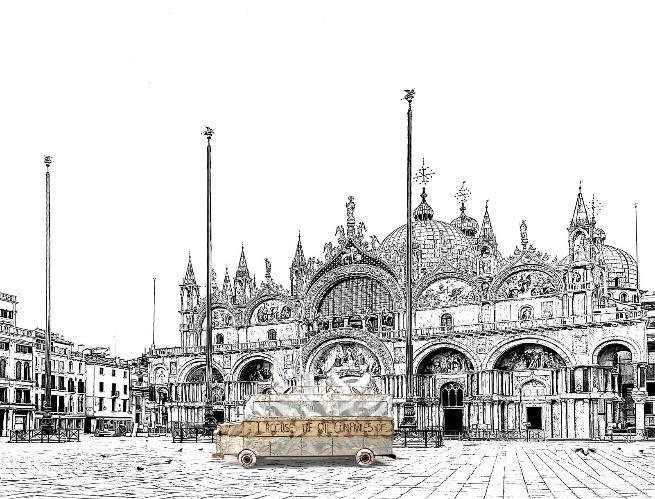
Fig 3: Page 17, Proposed installation shot 2 [view of the Basilica di San Marco, presenting Sokari Douglas Camp, ‘Battle Bus’ (2006)] Evie Rose Thornton. 2024
Fig 4: Page 18, Proposed installation shot 3 [view of the North side in the middle of San Marco’s Square, presenting Doris Salcedo, ‘Uprooted’ (2020)] Evie Rose Thornton. 2024
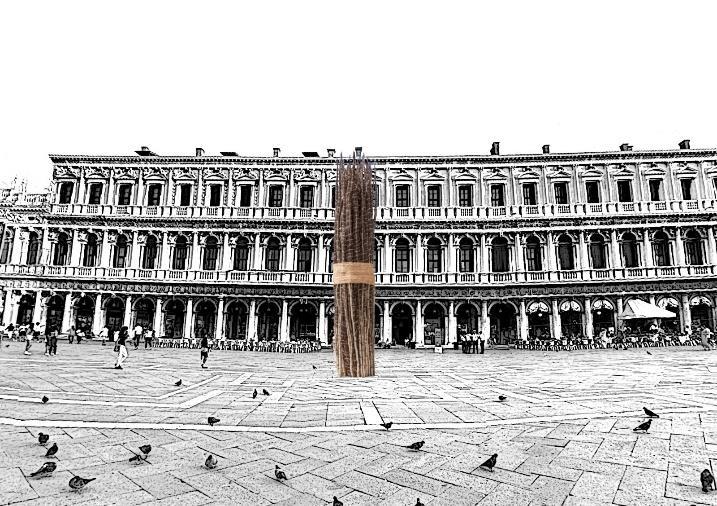
Fig 5: Page 18, Proposed installation shot 4 [view of the South side in the middle of San Marco’s Square, presenting Jackie Winsor, ‘Bound Trees’ (1971-72, destroyed in 1972, remade 2016)] Evie Rose Thornton. 2024
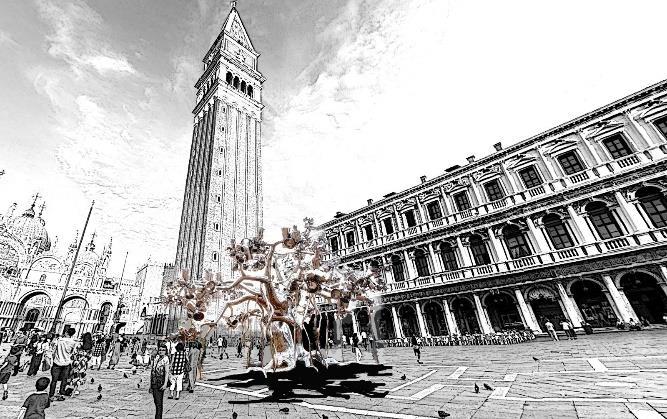
Fig 7: Page 20, Proposed installation shot 5 [view of the North side of San Marco’s Square next Tayou, presenting Ai Weiwei, ‘Life Cycle’ (2018)] Evie Rose Thornton. 2024
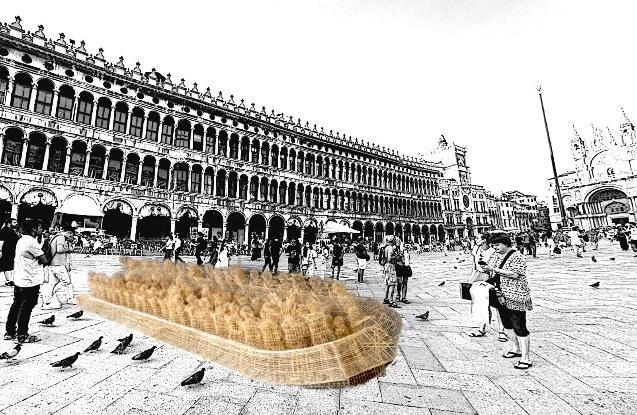
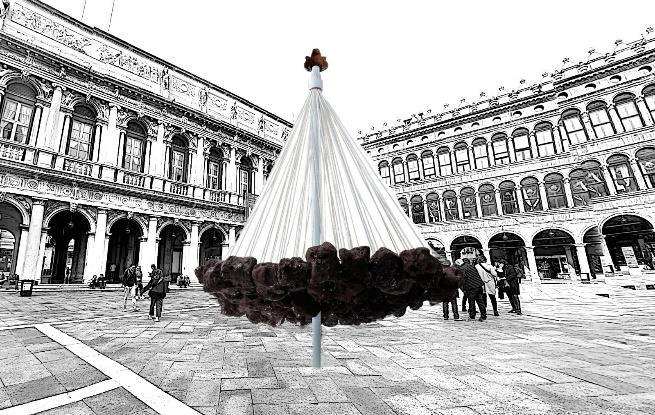
Fig 6: Page 20, Proposed installation shot 6 [view of the South side of San Marco’s Square next to the tower, presenting Subodh Gupta, ‘People Tree’ (2018)] Evie Rose Thornton. 2024
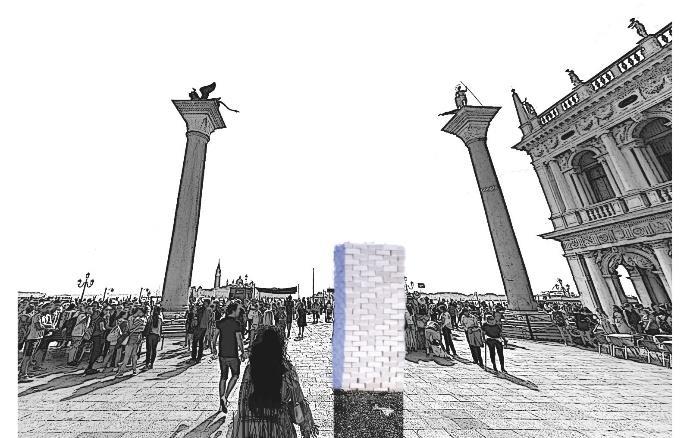
Fig 8: Page 21, Proposed installation shot 7 [view of the entrance to San Marco’s Square by the Colona di San Torado and San Marco, presenting Anya Gallaccio, ‘Into the Blue’ (1993)] Evie Rose Thornton. 2024
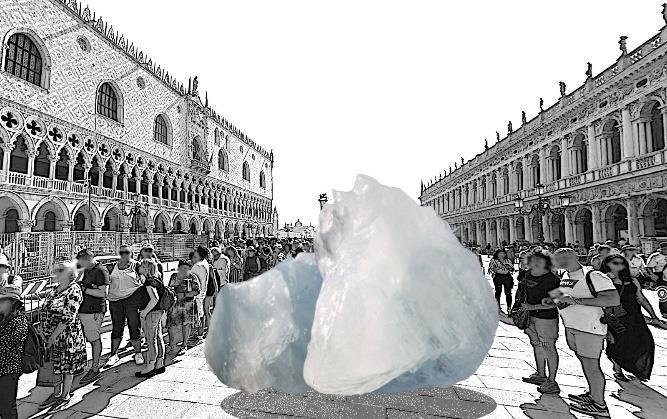
Fig 9: Page 21, Proposed installation shot 8 [view Outside the Palazzo Ducale in San Marco’s Square next to the tower, presenting Olafur Eliasson, ‘Ice Watch’ (2015)] Evie Rose Thornton. 2024
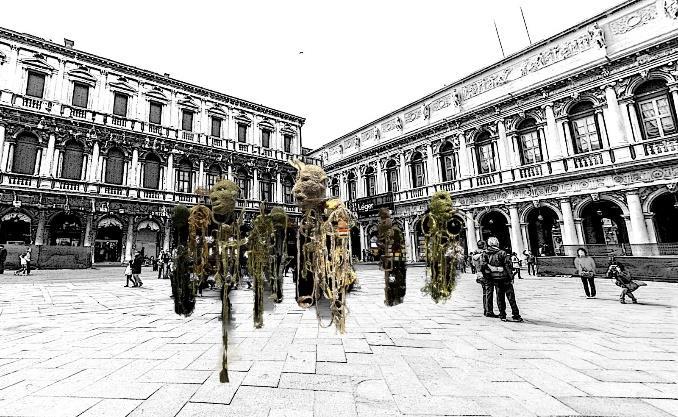
Fig 10: Page 22, Proposed installation shot 9 [view of the Southwest corner of San Marco’s Square at the entrance from Academia, presenting Fiona Hall, ‘All the King’s Men’ (2015)] Evie Rose Thornton. 2024
Fig 11: Page 22, Proposed installation shot 10 [view of the Northwest corner of San Marco’s Square, presenting Chris Booth, ‘Te Haa o Te Ao’ (2023)] Evie Rose Thornton. 2024
Abstract
This proposed exhibition investigates artists’ material choices in the face of climate-change and posits a potential future of contemporary art if action is not taken to tackle global-warming. Into the Blue aims to open the conversation of climate-change by focusing on ten artists from around the world that address material concerns throughout their work.
This exhibition is set during the Venice Biennale in San Marco’s Square. This location attracts the exhibition’s target-market of cultural tourists and the resident population of Venice. The works are large-scale public sculptures that are placed throughout the square. Due to flooding events, the artworks will be regularly immersed in water. Each piece is made from materials that will withstand water or that will not harm the environment if submerged.
This exhibition examines and investigates environmental artworks from around the world through an Eco Materialist lens, combined with influences from the 2023 Venice Architecture Biennale and the 2009 exhibition Radical Nature, among others. Through environmental thinking, equal representation and a global platform, Into the Blue will explore the significance of material considerations,legaciesandclimate-changethroughpublicsculptural-artworks,andbringmaterial responsibility to the forefront of the conversation about the future of contemporary art.
Introduction
In the words of curator, critic and historian Hans Ulrich Obrist, “the task of curating is to make junctions, to allow different elements to touch” (Obrist & Raẓā, 2014, p.1). The themes of climatechange, material choices and legacies are combined to offer up a potential future for environmental-representationincontemporaryart.Thisexhibitionproposal explorestheeffectthat climate-change has already had on the planet through the evaluation of news articles, journals and the 2023 COP28 summit in the United Arab Emirates. These effects are then expanded upon in relation to contemporary art and architecture, discussing their contribution to global-warming throughmaterial-extractionandprocessing.Acriticalevaluationofhowcontemporaryarthasbeen evolving in responseto climate-changecomesthrough areviewofenvironmentalexhibitions, such as ‘Radical Nature’ and ‘Slow Praxis’, and a proposed artistic movement entitled ‘Eco Materialism’. This movement aims to subvert material consumption and pollution in favour of artistic practices that cause little to no harm to the environment. Taking inspiration from these past exhibitions and texts, Into the Blue will gather artworks from ten artists, two from each of the five inhabited-continents, and exhibit them within the Venice Biennale as a collateral event in San Marco’s square. This exhibition investigates the responsibility of the artist when considering the environmental impact of the materials they choose to utilise. It will address the idea of materials holistically, starting from extraction from the ground, through processing into their final form, and ending at their impact on the planet.
Representation is imperative to this exhibition, so aspects such as location, gender, skin-colour and disabled-access have all been considered during its development. Artists were selected by assessing their practice, mediums, materials and their depiction of climate-change. Each work was then evaluated to ensure they differed from each other and that there was a wide variety of materials/work on display. It was important to include different ways in which climate-change is affecting different countries, and to display each piece with as little manipulation as possible, so that the stories being told were from the artist and not altered to fit an alternative agenda.
Theexhibition will featuresculptural public-artworks, rejecting mediums such as photography and video due to the harmful nature of the materials used to make the equipment necessary for those artforms. It also allows the exhibition to rely on powerful, physical imagery to explore climatechange, mirroring the enormity of the effects of global-warming. San Marco’s Square floods on average 250 times a year (Basilica di San Marco, 2024), which will result in every artwork in this exhibition being intermittently immersed in water, allowing people to visually experience what the future of contemporary art potentially looks like if nothing is done about global warming in the coming years. The exhibition will live on in a published booklet that contains descriptions of the artists, their works and commissioned poems made in response to each artwork. The exhibition will also endure digitally, through printed marketing materials from the Biennale and reviews (from journalists and the art-press, and from tourists/visitors through social-media channels).
Climate-change is happening quickly and if nothing changes then the damage to our planet will be irrevocable. This terrifying sentiment is difficult to comprehend and often leads people to ignore it as a way of coping. This exhibition looks to put climate-change at the front of the conversation in a confrontational and unavoidable way. The effects of global-warming are felt differently from country-to-country and is what this exhibition intends to portray through a selection of art from aroundtheworld. It also aims to address issues ofhumancomplicity in thecauseofclimate-change, as well as to offer hope and propose ways of adapting to a changing climate.
Climate-change
In thepast decadetherehavebeen dramatic changes to ourplanet, including sea-level rise, weather changes, a rise in global temperatures exceeding all records to date, an uptick in extreme weather events such as droughts, floods and tsunamis, along with an increase in wildfires (Borunda, 2020). Recently the news has been littered with reports of major flooding-events in places such as Spain, Greece and Libya (Rafferty, 2023), decimating households, communities and resources, and contributing to a new phenomenon of ‘climate refugees’ (European Parliament, 2023). Countries around the world are looking at how to decelerate the progression of climate-change, as seen in the latest COP 28 UAE meeting where oil and gas companies have addressed the issues surrounding methane emissions, promising a near eradication by 2030, and a record-breaking 116 countries all pledged to treble their renewable energies (COP 28 UAE, 2023). Safeguarding measures against the effects of climate-change are already being implemented worldwide. There is no other city in the world more at risk from sea-level rise and flooding than the city of Venice, as it is under threat both from the sea and its sinking foundations. It is also one of the first cities to invest billions into flood-prevention technology with the implementation of submerged sea-walls. Venice developed ‘Mose’, which is a series of gates that lie underneath the water and canals until the sea reaches any level above 110cm, where they rise and prevent the sea from entering the water systems and stops the potential for floods (Mose, 2023). This was in response to the increase in floods that Venice has seen over recent decades, including its most significant and devastating flood since 1966, in 2019 (Oceanography, 2020). This caused San Marco’s Square to be submerged in up to 6ft of water, with vaporettos, water buses, thrown over the edge and on top the square itself, “like children’s toys” and residents left hanging on to the nearest buildings waiting to be rescued (Viviano, 2022). Thus, it is unsurprising that Venice has earned its moniker as, “as the canary in the coal mine” for climate-change (Ibid.). Every country in the world will be affected by climate-change in one way or another, be it from flooding, wildfires or other extreme weather incidents, or from the effects that these events cause, like the relocation of communities or the destruction of resources or materials.
Industry
This worrying increase in extreme weather events has prompted a shift in direction of all industries when it comes to material use and extraction, with pressure from consumers and activist groups who want to see businesses engage with more environmentally-conscious practices. Architecture has been under scrutiny for its role in building pollution coming from the use of concrete and other materials that are not only harmful to the planet from an extraction point of view, but also cause many environmental problems from the processing of materials like concrete or steel. The industry
Chapter 1: Curatorial Thesis
has started to address its environmental impact through many different avenues, such as material selection. Gonzalez& Navarro (2006)details theproductionofthreeresidential-buildings in Spain and evaluates the environmental impact of conventional building-processes versus proposed environmentally-conscious methods that put material selection at the forefront of its design. Alternativeenvironmentally-friendlybuildingmaterialsarenowfeaturedin exhibitionsworldwide, including ‘Material Legacies’ in Berlin (Staatliche Museen zu Berlin, 2023), where it showcased more sustainable methods of obtaining materials and environmentally-conscious alternatives to the commercial materials that dominate this industry. Divided out into its most basic form, materials like sand, water, eggshells, rubber and others are explored in different material forms, touching upon their past, present and future (e-flux Education, 2022).
Materials were also a prevalent feature of the 2023 Venice Architecture Biennale in ‘The laboratory of the Future’, which looked to discuss the future of architecture in a world increasingly affected by climate-change and proposed many different solutions to the detrimental effect that this industry has on the planet (La Biennale, 2023). Through multiple exhibitions, countries from around the world produced a litany of alternative building materials that emphasised the importance of responsibility and care towards the environment. The German Pavilion highlighted the issue of waste by utilising discarded materials from last year’s Biennale exhibit (Frearson, 2023). At the entrance to the pavilion, the audience was confronted with piles of material: wood, textiles and metal, all stacked in high piles. It was a stark and honest insight into the immense amount of waste produced every year from each pavilion. The German Pavilion fellows were situated in an area called, ‘the workshop’ and instead of using their time to escort visitors round the exhibition, they were recycling the materials into accessible ramps for other pavilions that did not cater for disabled access. This highlighted the need for taking responsibility and ownership in the complicity of mankind in the production of waste and the subsequent detrimental effect on the environment, emphasising the need for a change in attitude towards material consumption.
Architecture and art have been challenging the way we think about the planet through movements suchasLandArtandEnvironmentalArt,influencedbypioneeringfiguresincludingJosephBeuys, Hans Haacke and Agnes Denes. ‘Radical Nature’ was an exhibition held in 2009 at the Barbican in London, England, that explored issues of environmentalism and activism within the arts, as seen in thesubsequent publicationoftheexhibitionbyManacorda(2009). It brought together25artists’ works from between 1969 and 2009, all of whom made groundbreaking contributions to the arts and who put nature and the environment at the forefront of their practices. Under one roof, this exhibition displayed the shift in direction from romanticised landscapes to the more thoughtprovoking critical evaluation of mankind’s impact on the planet. The publication features work by theartists thatwerenot includedwithintheexhibitionandthatcould not havebeen installedwithin a gallery setting, including Ant Farm’s ‘50 x 50 pillow’ and Robert Smithson’s ‘Spiral Jetty’. As with many environmental exhibitions, ‘Radical Nature’ fell prey to criticism about its own environmental impact, from its installation to its transportation of artwork and subsequent CO2
pollution (Bayley, 2009). If ‘Radical Nature’ was made today under the same guidelines as the latest Architectural Biennale, it would have needed to address these issues of its carbon footprint and environmental impact. While this exhibition successfully documented the development of environmental concerns throughout Contemporary Art, the future of artwork production and material use is still under consideration. There is a question of the burden of responsibility when it comes to artists’ choices of material and whether the production of artworks will harm the environment (or planet) during production or on completion of the artwork. While the direction of art is unclear, it is imperative that artists start to question their material choices and the legacies thattheyleaveintheworldandstarttoconsideralternativemethodsormeansofproducingartwork.
Eco Materialism
Eco Materialism is a movement proposed by Linda Weintraub (2019) where she outlines a framework in which to evaluate contemporary and historical art, and the material legacies these works leave behind on the planet and the environment. While encompassing the ‘reduce, reuse, recycle mantra’, this movement considers the holistic impact of materials from their extraction and production, right through to their expiration and subsequent carbon footprint. In this sense, material responsibility applies to all disciplines within the arts, regardless of whether the waste produced is physical or ephemeral. The production of film and video relies heavily on the use of technology that requires the extraction of precious metals and materials from the Earth to make cameras, laptops and other devices, as well as depending on the use of data farms for storage of the work and the internet as its transportation. All these tools and requirements for this type of artwork harm the environment, as real as the waste produced from more physical disciplines such as painting or sculpture (Monserrate, 2022). It also separates the viewer from some elements of sensory contact with the artwork, foregoing the amalgamation of multiple senses for an audiovisual experience. Eco Materialism proposes a return to the physical, eschewing video and technological artworks in favour of the tangibility and physicality of artwork in person. This will be reflected in the use of public art within this current exhibition, featuring large-scale sculptures that aim to engage and envelop people within its towering, unavoidable presence.
“Eco Materialism reunites people with their Earthly homeland by situating New Material principles within the context of ecology and environmentalism” (Weintraub, 2019, p.11). By combining these schools of thought, Eco Materialism offers a new way in which to evaluate an artistic practice and emphasises the responsibility that the artist has to pursue more sustainable materials. This movement’s core tenets for the production of artwork include the following: inclusion of, “environmental consequences when selecting their mediums”, examination of, “all by-products of their material manipulations”, acknowledgement of the “responsibility for the environmental costs of maintaining their works after they leave the studio”, among others (Ibid., p.22). While this framework can be applied to an artist’s practice, Into the Blue will utilise a select few principles from which to build the framework for this exhibition, including the use of physical
work overtheephemeral, theenvironmentallegacy oftheartworkoncetheexhibitioniscompleted, the use of environmentally conscious materials when selecting the artwork, and an emphasis on a holistic approach to the selection of artworks. This exhibition will focus on materials and build on environmental exhibitions, such as ‘Radical Nature’, while taking influence from the 2023 Venice Architecture Biennale and its emphasis on climate-change and the development of new and sustainable materials. It will also aim to represent a planet wide viewpoint, incorporating artwork from a variety of different countries.
Chapter 2: Curatorial Choices
Location
Venice has been chosen as the location for this exhibition as it is facing some of the most severe consequences from sea-level rise caused by global-warming, making it the most appropriate place to showcase the potential future of material choice and legacy in contemporary art. It is also home to the Venice Biennale, which is the most famous arts festival in the world.
The Venice Biennale is made up of three sections; the Giardini, the Arsenale and the collateral events. The Giardini is located within a public garden and contains pavilions that belong to different countries, with a central exhibition that houses work chosen by the curator. The Arsenale is located within the walls of a former fortress. The collateral events are made up of other exhibitions dotted around the city in singular individual buildings (Russeth, 2019). In the 2023 Venice Architecture Biennale, Saudi Arabia featured an exhibition by NEOM, a conglomeration ofbusinessesand architecturefirms, thatshowcasedtheirlatest project entitled‘TheLine’ (Florian, 2023). As a collateral event it was included in the festival’s marketing campaigns, programme literature and maps, whilst remaining separate from the regulations that surround the core events of the Biennale. Into the Blue will follow suit as a collateral event in order to take full advantage of the Biennale marketing while remaining true to its own agenda.
Most collateral events are held indoors in private buildings. Many different buildings were considered during the selection process for Into the Blue, including the Scuola Grande San Giovanni Evangelista Di Venezia, where the 2022 Pan-European Sea-level Rise Conference was held (JPI Climate, 2022). This would grant the audience access into this exclusive building where discussions about climate-change in Venice were held behind closed doors by people in positions of power, which in turn would allow the public access to those conversations surrounding this issue. When more people around the world start to experience the reality of climate-change and are living through the effects of extreme weather events, it will be a visceral, physical and emotional experience, rather than an academic or abstract theory. The exhibition had to reflect this in a visual way, and as such has been located in the most flooded area of Venice: San Marco’s Square. Despite the implementation of Mose, the square still regularly floods, which will allow visitors to experience the artworks within the context of climate-change and be visually and physically exposed to a potential future of what contemporary art is going to look like in a world ravaged by global-warming.
With a focus on sustainable, environmentally-friendly materials and a rejection of video and technological mediums, Into the Blue will centre around outdoor public sculptural artworks. As each work is situated in the flood zone, they must be made of materials that will withstand submersion from water damage. San Marco’s Square is rarely closed, with local shops providing
plastic galoshes for tourists to protect them from the floods. An exhibition in this public square allows access to everyone that visits Venice, regardless of whether they are there to see art or architecture. It is also one of the few locations in Venice accessible to wheelchairs and people with disabilities, as the water buses and taxis can access the square directly.
Due to the fact that climate-change will affect the entire planet, the exhibition has a responsibility to reflect this. Into the Blue has taken inspirationfrom the2009curationof‘Radical Nature’,where the works were meant to be conceived, “as a single natural landscape, an artificial garden which dramatically invades the exhibition space” (Manacorda, 2009, p.7). It will feature ten artists whose artworkswillberepresentingtheplanetasawhole.ThisexhibitionwillutilisetheOlympicCharter framework that features the five inhabited continents, rather than the full seven. Two artists will be selected as representatives from Africa, the Americas, Asia, Europe and Oceania.
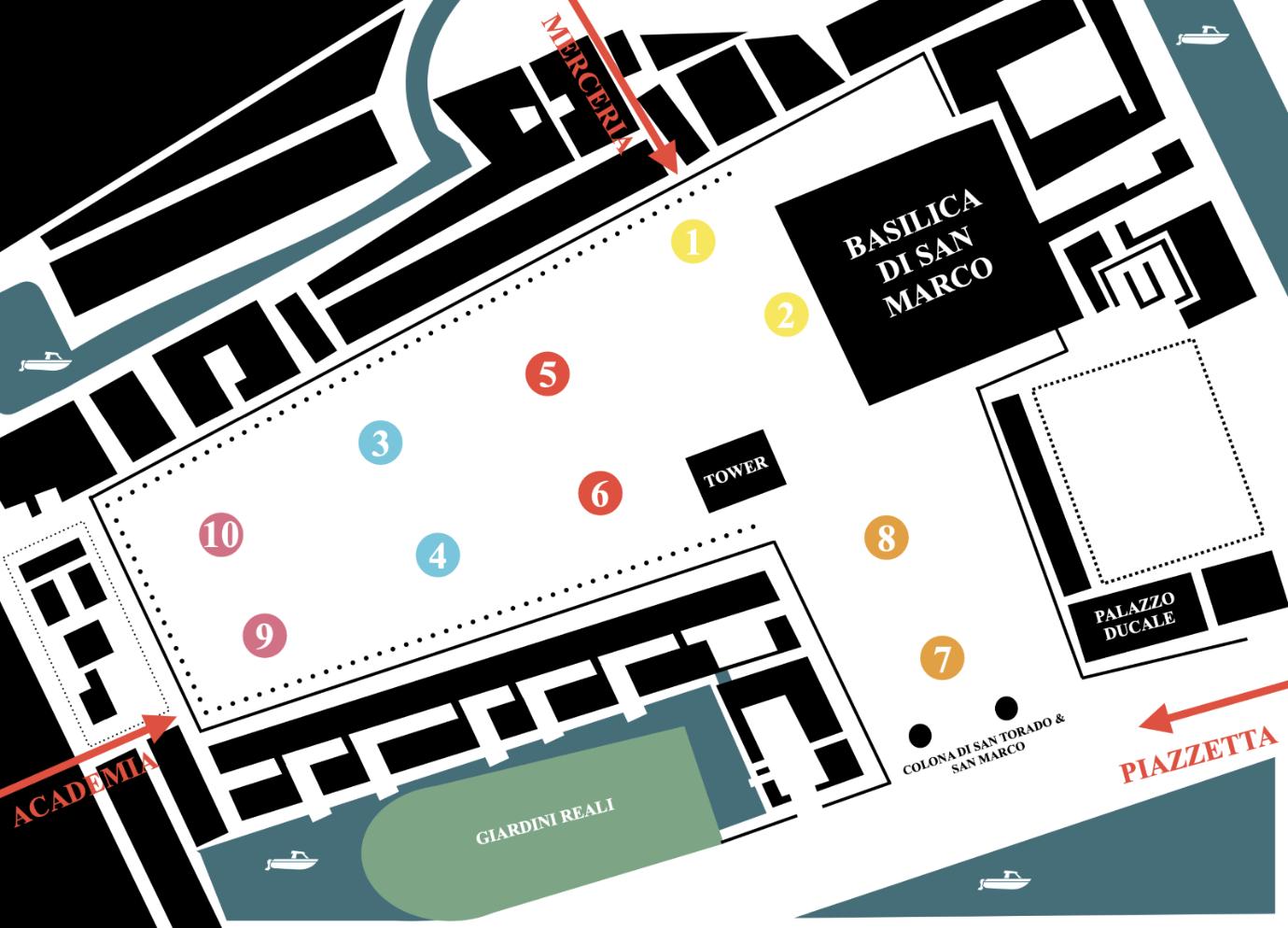
 Figure 1: Arrangement of installation in San Marco’s Square, aerial view. Evie Rose Thornton, 2024.
Artists
The African representatives are Pascale Marthine Tayou with ‘Plastic Bags’ and Sokari Douglas Camp with ‘Battle Bus’. ‘Plastic Bags’ (Collabcubed, 2013) stands 10 metres tall and will be situated at the main entrance to the square from the heart of the city. Upon entering the square, visitors will be immediately confronted by a towering U-shaped frame covered in repurposed, multicoloured plastic bags. The size of this work is vital to the exhibition as it reflects the overwhelming destruction that plastic has caused on the planet and allows the material to emphasise this point. While the use of plastic does not align with the Eco materialist philosophy of a non-harmful material legacy, it is made up of recycled material bound for a life somewhere in the world where it could potentially cause harm. It is also appropriate to position this piece in a tourist centriclocation whereplasticgaloshes are onsaleyear-round for floods, hopefully enabling visitors to question their consumptive habits.
‘Battle Bus’ is a work by Nigerian born Sokari Douglas Camp and is a memorial piece made in tribute to activist, poet and environmentalist Ken Saro-Wiwa, who headed protests in the Niger Delta against large oil-companies who came to extract oil from the land. This material extraction has polluted the island’s habitats and decimated the surrounding environment, as discussed in this interview with Camp (BBC, 2020). Saro-Wiwa was sentenced to death by the Nigerian government, and this work commemorates his work and the driving force behind the activist part ofhislife.Inthisexhibition,itillustratesthenegativeeffectthatoverextractionofoilandmaterials can have on the environment and emphasises the terrible nature of corporate greed and profit over the life of both the local indigenous population and the land on which they live. This van will be parked on the doorstep of the Basilica so that it will be featured in every tourist photo of the building, and so that the message of the piece will be seen both physically and digitally.
The representatives from the Americas are Doris Salcedo with ‘Uprooted’ and Jackie Winsor with ‘Bound Trees’. ‘Uprooted’ is an installation consisting of 804 dead trees and steel in the shape of
Figure 2: Pascale M. Tayou, ‘Plastic Bags’, (2013). Figure 3: Sokari D. Camp, ‘Battle Bus’, (2006).
a house that transforms into a forest. The house symbolises a place of comfort and belonging, while the title and lifeless forms of the trees suggest a fracture of this notion, instead hinting towards a loss of home. The trees have also been said to reference, “a rupture between humans and nature, examining how our connection to the environment is dissolving” (Mothes, 2023, para.3). In Venice, it will show both the forest and the home structure flooding with water, alluding to the fact that sea-level rise will flood everything in the landscape, both man-made and natural alike. It also speaks to the loss of homes, which will be a result of losing both land and housing from flooding.
Jackie Winsor binds 30 sapling trees together with hemp rope to form ‘Bound Trees’, which focuses on these unrefined materials to explore themes of labour and the relationship between nature and the artist (Paula Cooper Gallery, 2023). This work speaks directly to Eco Materialism, as it is positing a potential way in which artists can explore themes of environment and climatechange through the use of natural non-harmful materials. The bound trees speak to the stifling nature of climate-change on plant life as temperatures continue to rise and plants struggle to source water or grow naturally. These works will be placed in the middle of the square, so that each piece can be walked around.
The Asian representatives are Ai Weiwei with ‘Life Cycle’ and Subodh Gupta with ‘People Tree’. Ai Weiwei’s ‘Life Cycle’ boat is a later iteration of a previous inflatable boat made from PVC, both of which explore the current migration and refugee crisis (Knight, 2018). This boat is made from bamboo and silk, materials used in traditional Chinese kite-making that dates back to the Ming Dynasty (1368 – 1644) and is filled with figures inspired by the mythical creatures featured in Shanhaijing, a classic Chinese text. The cause of refugees is often attributed to war and poverty, and while these are still incredibly relevant current issues, by situating this work alongside other climate-change and environmental works, this exhibition looks to highlight the fact that global-
Figure 4: Doris Salcedo, ‘Uprooted’, (2020).
Figure 5: Jackie Winsor, ‘Bound Trees’, (2016).
warming will create climate refugees. Sea-level rise and rising global temperatures have already been the cause of mass displacement from homes and communities being destroyed by extreme weather events such as flooding or fires. As these events increase, so will the number of refugees, and it is an issue that will need to be considered in a world altered by the consequences of greenhouse gases and CO2 emissions.
‘People Tree’ by Subodh Gupta is a stainless-steel tree with leaves made from cooking pots and utensils used in traditional Indian cooking (Nair, 2023). The material speaks to the history of these utensils and the way that the value of this material has changed over time. The body of the work is in the shape of a Banyan, the national tree of India, and “is considered sacred, symbolizing eternal life and knowledge” (Ibid., para.10). In the context of this exhibition, this piece speaks to therelationship ofhumansto plant-lifeand will critiquehowtheuseofmaterials affects thenatural world. These works will be situated in the main square, in between the artworks from Africa and the Americas.
The European representatives are Anya Gallaccio with ‘Into the Blue’ and Olafur Eliasson with ‘Ice Watch’. ‘Into the Blue’, by Anya Gallaccio, is a column made from salt-bricks set on the shores of the Bournemouth coastline in Britain at the water’s edge (Manacorda, 2009), and the title work for this exhibition dissertation. In its original context, the sea laps against the surface, slowly eroding the column away and eventually collapsing into the sea. This piece will sit in-between the two pillars at the waters entrance to San Marco’s Square, introducing this work as a third pillar, allowing the material to set the work apart. When the water rises due to flooding, the piece will be submerged. Depending on the severity of the flooding, the bricks will either erode, or be misplaced and cause the tower to fall. The work in this context will speak to the threat of water levels rising and leave a visual reminder of the danger that this phenomenon will cause and of salt intrusion on coastal landscapes, as discussed in this paper (Aeman et al, 2023). The materials will cause no harm to the environment, as salt is a naturally-occurring compound in seawater. This is in keeping
Figure 6: Ai Weiwei, ‘Life Cycle’, (2018).
Figure 7: Subodh Gupta, ‘People Tree’, (2018).
with the Eco Materialist ethos, utilising locally sourced materials and causing no residual environmental harm after the work has been completed.
Olafur Eliasson is currently a UN Goodwill Ambassador for climate-change and Sustainable DevelopmentGoals(UNDP,2023),andwhosestatestheirartisticpracticeexplores,“therelevance of art in the world at large” (Eliasson, 2023, para.1). ‘Ice Watch’ will be situated behind Gallaccio’s salt column in full view of the blazing sun. By placing this piece in Venice, it emphasises how different water-sources will affect the level of the sea and how these glaciers that are not naturally from Venice will become a source of flooding. This idea alludes to the fact that, if nothing changes, the sea will swallow the city. As it is made from glacier water, the work will melt away andjointhesea,ultimatelycausing noharmto theenvironment. Becauseboth European works are temporal, they will have a line drawn round them during installation, which will be the only remnant of the work once the ice melts and the tower collapses.
The Oceanic representatives are Fiona Hall with ‘All the King’s Men’ and Chris Booth with ‘Te Haa o Te Ao’, also known as ‘The Breath of the World’. ‘All the King’s Men’ is a group of twenty sculptures, figurative sentinels made from teeth, bones, horn, glass, plastics and knitted woollenheads, among other recycled materials. This work, “reflects the current state of play in terms of global conflicts, world finances and the environment” (Llewellyn, 2016, para.2). In the context of this exhibition, these figures potentially foreshadow a world where conflict over land and environmental resources causes the destruction and dissolution of communities and borders. The materials of this work feature recycled textiles and plastics, alongside natural materials sourced from animal carcasses, which is a distinguishing feature of Eco Materialist theory. By utilising material left over from living beings, it is easily accessible material and means that the legacy of the artwork does not change, as it can be returned to the earth. The sculptures are placed at the entrancefromAcademiainSanMarco’sSquareandaremeanttooccupythesquarejustlikepeople do, allowing people to experience the work up close so that viewers are invited to place themselves
Figure 9: Anya Gallaccio, ’Into the Blue’, (1993).
Figure 10: Olafur Eliasson, ’Ice Watch’, (2015).
within the context of the work and consider their own place in relation to each piece. Due to the corporeal nature of this work, when the square fills with water it will give an impression of people drowning.
‘Te Haa o Te Ao’ is a kinetic sculpture made by Chris Booth that addresses man-kind’s newest battle: climate-change and represents, “a state of tension between humans and the natural environment”(Graaf,2023,para.32).Itisalsoamonumenttolocaleffortstotackleclimate-change. In this exhibition, this piece represents the responsibility that every individual has to protect the environment, no matter how small the gesture. The work is made from boulders and wire, all sourced locally, which again falls in line with Eco-materialist philosophy, and were obtained with the blessing of the local elder, which is an important factor when considering the colonial history of New Zealand (Pool, 2015). This work will follow on from Hall’s in the main square.
Legacy
On completion of this exhibition, a booklet will be produced made from recycled paper, with a bio and statement from each artist and an in-depth description of each artwork selected for the exhibition. Due to the fact this exhibition is intended to produce an emotional response from the visual spectacle of the artworks and the way in which they interact with intermittent flooding, it is unlikely that this can be reproduced visually within a document of descriptive text. Thus, Into the Blue will commission a poetic response to each artwork through an open call and include them within the document. This will look to emotionally affect the reader, simulating the emotional response of the visitor to the physical exhibition. At the end of this exhibition, the artworks will be treated for any water damage and returned to the artist, gallery or permanent residence from where it originates.
Figure 10: Fiona Hall, ‘All the King’s Men’, (2015). Figure 11: Chris Booth, ‘Te Haa o Te Ao’, (2023).
Intended Audience
This exhibition aims to bridge the gap between visitors and the local population. Venice’s resident population has significantly declined over the last ten years due to many factors, including the Biennale itself (Smith, 2021). This exhibition of work intends to address issues of climate-change that directly affect the residents of Venice and put them front and centre in the most tourist centric location, allowing visitors an insight into the problems faced by Venetians and how this relates to wider problems in the world. As it is in a public space, this exhibition will require no entry free, which allows anyone that is physically in Venice to access the exhibition and experience flooding first-hand.
Chapter 3: Curatorial Influences
Although the inspiration for dividing up the exhibition into continents initially came from the ‘Radical Nature’ exhibition, the need for broad representation was inspired by this year’s Venice Biennale, where “More than half of this year’s exhibition participants are from Africa or the African diaspora and half are female” (Brodka, 2023, para.3). This is especially relevant to the theme of this year’s festival focusing on Africa as the directing force in shaping the world to come, and is a first for the Biennale, which makes a powerful statement about the past and future of representation within this cultural institution. Equal representation in relation to Into the Blue comes in the form of global representation, focusing on selected artists that make work relevant to the continent of their origin who are exploring the effects of climate-change on the environment. It also contains an even number of male and female artists. These varied viewpoints are exploring climate-change in the hope of opening up the conversation about how to start tackling this issue on a global collective level.
When curating as a white, British, cis woman, there is a particular responsibility of care when representingvoices from different countries andcultures, andaduty to ensurethatthestoriesbeing told through this exhibition are from the voices of those who are affected, and not to sanitise the narrative through any personal lens or alter the meaning of the work to better suit an agenda. The subject of cultural representation within an exhibition context is discussed in Obrist’s book ‘Ways of Curating’, in reference to an exhibition that Boltanski, Lavier and Obrist were curating entitled ‘do it’:
James Clifford, who had written about a new model for ethnographic museums, in which the peoples whose culture was being ‘represented’ by the museum proposed their own alternate forms of exhibiting and collecting. They were taking it upon themselves to recollect their own story and create their own history from the inside. This changed the whole historical narrative of the ethnographic museum, which has mostly been a place for one culture to tell the story of another (Obrist & Raẓā, 2014, p.20).
It is the intention of this exhibition to provide the platform and an audience, and to situate these environmental works within a context that enhances their impact and shines a light on issues of climate-change that differ from country-to-country, artwork-to-artwork.
In Curating Context, Magda Malm is in conversation with Elvira Dyangani Ose/ Magdalena Malm about her exhibition titled ‘A Story Within a Story’, held at the Goteborg International Biennale of Contemporary Art. The aim of her exhibition was, “to provide multiple platforms for people to be actors and narrators of their own history, bringing within that scrutiny personal narratives and inner worlds, located on the margins of such history” (Malm, 2017, p.54). Dyangani Ose’s exhibition highlights the need for autonomy over the narrative, especially when these stories come
from marginalised countries. This exhibition offers a singular platform; one where representation from each Olympic charter continent is equally represented, and each artwork’s concept and use of materials speak to the lived experience of the artists and the countries that they represent. The aim is not to silence, recontextualise or manipulate the message, but to allow the work to speak for itself and to open up dialogues with people and situations that may not naturally occur.
Dyangani Ose’s exhibition also took place within a Biennale and noted that, “It has to address the place. You need to address both local audiences - and with them, their memory of previous biennales, their daily routines in their city and its institutions, etcetera - and international viewers and critics” (Ibid., p.57). The location alone means that this work will be seen by both tourists and locals alike. By placing the work in San Marcos Square, it is in some ways quite a confrontational act; an inescapable, unavoidable spectacle that obscures the square’s traditional tourist photographs and must be actively ignored to avoid them. This idea is applicable to the threat of climate-change and is a perfect example of how some members of the public can actively try to ignore the blatant warnings and visible changes in the climate.
A Guardian review of the 2023 Venice Architecture Biennale stated that, “It suffers, as have previous biennales, from exhibits that are wilfully hard to understand, unilluminated by wordy and opaque captions – in a kind of language that architectural academe for some reason loves” (Moore, 2023, para.8). The intention of this exhibition is to immerse the public in a visual narrative that explores worldwide viewpoints on climate-change with a focus on material choice and legacies and is done so by relying on the visual nature of public artwork. It will, therefore, forgo the text heavy curation featured in many of the exhibitions in the Biennale and exclude the use of signs or statements explaining the artwork. Instead, only the title of each work and the artist’s name will be displayed on the ground next to each piece, allowing the material to do the speaking.
In the book ‘Curating Context’, former public-art producer, Claire Doherty is quoted as saying that, “The new public art producer seeks to effect interruptions, physical displacements, and dislocations, to conjure mirages that enter the social imagination, to set in motion quiet infections which fundamentally remake place and space, and to proffer utopian futures’’ (Malm, 2017, p.92). This encapsulates the sentiment that is foundational to this current exhibition, as it relies on the physical nature of these expansive artworks to tell the story of climate-change, from the past and present, through to its potential future. It is an unavoidable physical intervention that, when the square periodically floods, interacts both with the public and with the landscape, emphasising the indiscriminate nature of climate-change.
V&A Dundee: Plastic
“Raw materials and resources are essential for modern economies, but they come with environmental impacts” (European Environment Agency, 2023). While every material causes varying degrees of harm, plastic can be held responsible for the majority of pollution and waste problems today. Plastic also goes deeper than the material itself, and it is in its colonial history that we can uncover the scale of the damage caused from its extraction. This was investigated in the V&A Dundee exhibition ‘Plastic: Remaking our World’ (V&A Dundee, 2023). The issues and effects of climate-change are currently unequal, a theory explored in the recent conference ‘Synthetic Histories: Plastics, Climate, and Colonialism’, hosted in conjunction with the plastics exhibition in Dundee (Chatterjee et al., 2023). The conference delved into the history of plastic, the ongoing impact of global waste, its future, and the ways in which art, craft and design are challenging these extractive processes. It also addressed the colonial past of plastic, where raw materials were taken from poor countries for the benefit of the Western world and how these actions have contributed to climate-change, which ultimately adversely affects those countries where the materials originated. The inclusion of plastic within Into the Blue was not without its difficulties. When evaluated through the lens of Eco Materialism it fails as a viable option due to the fact that it will not contribute to the health of the planet once the exhibition is over but will actively harm it. The exclusion of this material is to preclude the effects that it has on the planet and ignores the unequal impact of global waste on people and the planet. It inadvertently silences the voices of those affected the most by climate-change, and as such, would render the exhibition ineffectiveand deceptive. It wouldalso willfully ignorethebiggest contributorto themost harmful and pollutive material around today. Both this exhibition and the conference focused on the future and the role that creative industries could potentially have in shaping the way that artwork and designs are produced. This idea inspired the concentration on the future of materials, and when coupled with the framework posited by Eco-materialism for the production of artwork, the exhibition explores not only the complicity of artwork in the current climate, but also the idea of hope, adaptation and resilience.
Venice Architecture Biennale
As well as materials, climate-change was an integral theme in the 2023 Venice Architecture Biennale. The Danish Pavilion explored the theme of flooding (Lund & Carstensen, 2023). As a flat country at risk of sea-level rise and loss of land, its exhibition focused on promoting natural solutions for coastal towns, such as dunes and living walls, and how this can work alongside manmadestructures like concretewalls. The architectural approach to this exhibition consistedoflarge diagrams, boards of text, information and graphs highlighting statistics. The visual side of this
Chapter 4: Other Influences
project consisted of a set (much like the dioramas found in museums) made to look like a beach. The use of text, maps and a set like installation depicting sea-level rise was informative but did not address the emotional reaction towards this consequence of climate-change. Flooding and water damage is violent, destructive, visceral and uncompromising, and has a significant impact on mental health (Foudi et al., 2017). While the objective of the pavilion was to rethink the architecture of coastal landscapes in reaction to sea-level rise, it is essential for Into the Blue to tap into the emotional reaction towards flooding. It was therefore important to exclude long passages of text describing the exhibition, the artists or the artworks, and instead let the tide rise over San Marcos Square and slowly submerge each work in water. Sea-level rise is no longer an abstract concept discussed by people in power behind closed doors, or by engineers and architects in language hard to relate to, it is an experience. One in which the viewer is physically immersed in, where the water connects the viewer to the artwork, and everyone and everything in the exhibition is affected, regardless of personal, cultural, intellectual or physical difference.
Slow Praxis
Climate-change also plays a central role in ‘Slow Praxis’, an exhibition held at the Tatha Gallery, Scotland, in September 2023, co-curated by David Cass (Tatha Gallery, 2023). Cass’ own practice centres heavily around Venice and the threat of sea-level rise. Recycled materials feature heavily inhiswork,withhispaintingsoftenfoundonantiqueobjectssourcedfrom marketsaroundEurope. His recent exhibition brings together a group of six artists all creating work around the threat of climate-change, consisting of paintings, sculpture and prints. There were some very successful elements in this exhibition, including the placement of Cass’ water-surface paintings next to a window that looks out onto the water of the Tay. Each work was beautiful, serene and calm, depicting the issues of climate-change through sublime imagery, delicate sculptures and quiet prints. The accompanying text consisted of pensive quotes, all warning about an imminent loss, and the overall tone was of melancholic sadness. While beautiful and thought provoking, there was a distinct lack of urgency due to the peaceful nature of the artworks, which resulted in an absence of a visceral emotional response towards the exhibition. That is what Into the Blue aims to achieve throughthe useoflarge-scale sculptural works that will bevisually-affected by flooding and climate-change.
Just like the argument was made for the inclusion of plastic, there is a need to include the environment as a theme within contemporary art, and by excluding this subject purely for the potential hypocritical nature of its existence, we silence the voices and stories that come from experiencing global-warming.This exhibition recognises theenvironmentalimpact oftransporting theartworksto this location.It also, however,aims to offersolutions, alternatives, andexperiments in material choice, and to give equal weight to voices around the world.
Conclusion
It has become increasingly clear that unless action is taken to slow the progression of globalwarming, then the future of life on the planet is under threat. Every industry has a responsibility to consider its impact on the environment and must alter its usual working-practices to do so. Within contemporary art, choosing environmentally-friendly materials can reduce the enormous amount of waste produced every year, and even has the potential to be of benefit to the planet. This exhibition confronts the usual audience of the Venice Biennale and resident Venetians with a display of large-scale public-art works that highlight the reality of climate-change and globalwarming. It intends to challenge, “The Biennale’s reliance on temporary, bespoke installations –and the absence of a sustainability agenda from the Biennale Foundation to aid with recycling or reusing materials” (Smith, 2021) with the use of public artwork made from environmentally conscious materials. The selection of artwork was affected by material use, the nationality of the artist, the size of the work and whether it would withstand flooding. The responsibility for our planet lies with everyone, both collectively and individually, which is represented within the diversity of artists and artworks.
Using Eco Materialist theory to underpin a framework from which to select artists and artworks, this exhibition aims to portray a potential future where material considerations are at the forefront of,not only this exhibition,but also artisticpractices. It will push theideaof material responsibility further by allowing the artworks to become submerged during regular flooding events in San Marco’s Square. This will visually reinforce the urgent need for change within all industry practices and a need to pursue more environmentally-considerate alternatives.
Emotional response is a powerful tool we can use in order to galvanise people into action that is sorely needed in the battle against climate-change. Once completed, the exhibition will live on through a printed pamphlet on recycled-paper containing information about each artist and a commissioned poetic response to each artwork, in order to keep the emotional response true to boththephysical exhibitionanditsdocumentation.Duetothevisualnatureoftheartworkschosen, the location, the festival it is incorporated in and the occasions when it will flood, this exhibition will be photographed by the public in many different ways. This allows people who cannot access the exhibition a chance to see the artworks in situ, and enables people to take control of their own narrative, giving them a voice and a platform in which to start a conversation. This exhibition is just one answer to the question, what does the future of contemporary art look like in the face of climate-change? By allowing floodwater to interact with the artwork, it is a visual reminder of the dangers that threaten both contemporary art and the world today. Into the Blue aims to highlight and celebrate the use of alternative sustainable materials within artistic practices and serves as an inspiration for an environmentally conscientious framework that curators can utilise when selecting artworks for future exhibitions.
References
Aeman, H. et al. (2023) ‘Sinking delta: Quantifying the impacts of saltwater intrusion in the Indus Delta of Pakistan’, The Science of the total environment, 880, pp. 163356–163356. Available at: https://doi.org/10.1016/j.scitotenv.2023.163356
Basilica di San Marco (2024) Works and Restorations. Available at: http://www.basilicasanmarco.it/la-piazza-e-la-suasalvaguardia/il-rapporto-con-lacqua/restauri-ed-interventi/?lang=en (Accessed 2 January 2024).
Bayley, S. (2009) Nature seen in a bilious shade of green. Available at: https://www.theguardian.com/artanddesign/2009/jun/21/radical-nature-art-architecture-barbican (Accessed: 15 December 2023).
BBC (2020) 'Battle Bus' memorialised executed environmentalists. Available at: https://www.bbc.co.uk/news/av/stories51493664 (Accessed: 28 December 2023).
Borunda, A. (2020) Past decade was hottest on record. Available at: https://www.nationalgeographic.com/science/article/thedecade-we-finally-woke-up-to-climate-change?loggedin=true&rnd=1702568341496 (Accessed: 14 December 2023).
Brodka, C. (2023) Representing Africa at the 2023 Venice Architecture Biennale: Recurring Concepts and Approaches. Available at: https://www.archdaily.com/1001329/representing-africa-at-the-2023-venice-architecturebiennale-recurring-concepts-and-approaches (Accessed: 18 December 2023).
Chatterjee, S., Keene, N., Hale, C. and Bassam, L. (2023) Synthetic Histories: Plastics, Climate, and Colonialism. Dundee (Scotland), 27 January. Dundee: V&A Dundee. Available at: https://www.vam.ac.uk/dundee/whatson/events/synthetic-histories-plastics-climate-and-colonialism (Accessed: 31 December 2023).
Collabcubed (2013) Pascale Marthine Tayou: Plastic Bags. Available at: https://collabcubed.com/2013/02/19/pascalemarthine-tayou-plastic-bags/ (Accessed: 28 December 2023).
COP 28 UAE (2023) World Climate Action Summit. Available at: https://www.cop28.com/en/world-climate-action-summit (Accessed: 14 December 2023).
e-flux Education (2022) Design Lab #13: Material Legacies. Available at: https://www.eflux.com/announcements/501037/design-lab-13-material-legacies/ (Accessed: 15 December 2023).
Eliasson, O. (2023) Biography. Available at: https://olafureliasson.net/biography (Accessed: 28 December 2023).
European Environment Agency (2023) Resource use and materials. Available at: https://www.eea.europa.eu/en/topics/indepth/resource-use-and-materials (Accessed: 31 December 2023).
European Parliament (2023) The concept of 'climate refugee': Towards a possible definition. Available at: https://www.europarl.europa.eu/thinktank/en/document/EPRS_BRI(2021)698753#:~:text=According%20to%2 0recent%20statistics%20published,32.6%20million%20in%202022%20alone. (Accessed: 14 December 2023).
Florian, M. (2023) NEOM showcases its designs for the Line at the 2023 Venice Architecture Biennale. Available at: https://www.archdaily.com/1003370/neom-showcases-its-designs-for-the-line-at-the-2023-venice-architecturebiennale (Accessed: 19 December 2023).
Foudi, S., Osés‐Eraso, N. and Galarraga, I. (2017) ‘The effect of flooding on mental health: Lessons learned for building resilience’, Water resources research, 53(7), pp. 5831–5844. Available at: https://doi.org/10.1002/2017WR020435
Frearson, A. (2023) Dezeen. Available at: https://www.dezeen.com/2023/05/26/german-pavilion-material-bank-venicearchitecture-biennale/# (Accessed: 15 December 2023).
Gonzalez, M. and Navarro, J. (2006) ‘Assessment of the decrease of CO2 emissions in the construction field through the selection of materials: Practical case study of three houses of low environmental impact’, Building and environment, 41(7), pp. 902–909. Available at: https://doi.org/10.1016/j.buildenv.2005.04.006
Graaf, P. d. (2023) Kinetic sculpture represents Northland's efforts to protect environment - artist. Available at: https://www.rnz.co.nz/news/national/503638/kinetic-sculpture-represents-northland-s-efforts-to-protectenvironment-artist (Accessed: 28 December 2023).
JPI Climate (2022) Pan-European Sea Level Rise Conference 2022. Available at: https://jpi-climate.eu/event/sea-level-riseknowledge-hub-conference/ (Accessed: 19 December 2023).
Knight, C. (2018) Review: 'Ai Weiwei: Life Cycle' brings tradition and transformation to the Marciano Art Foundation Available at: https://www.latimes.com/entertainment/arts/la-et-cm-ai-weiwei-marciano-20180928htmlstory.html (Accessed: 28 December 2023).
La Biennale (2023) Biennale Architettura 2023: 18th International Architecture Exhibition. Available at: https://www.labiennale.org/en/architecture/2023 (Accessed: 15 December 2023).
Llewellyn, J. (2016) Wars of the world. Available at: https://www.adelaidereview.com.au/festivals/sala/2016/07/28/fionahall-all-the-kings-men-wrong-way-time-sala-2016/ (Accessed: 31 December 2023).
Lund, A. A. and Carstensen, J., S. (eds) (2023) Critical Coast. 1st edn. Copenhagen: The Danish Architectural Press.
Malm, M. (ed.) (2017) Curating context : beyond the gallery and into other fields. Stockholm: Art and Theory Publishing.
Manacorda, Francesco. (2009) Radical nature: art and architecture for a changing planet 1969-2009 [published on the occasion of the exhibition held at the Barbican Art Gallery, London, 19 June - 18 October, 2009]. London: Koenig Books.
Monserrate, S. G. (2022) The staggering ecological impacts of computation and the cloud. Available at: https://thereader.mitpress.mit.edu/the-staggering-ecological-impacts-of-computation-and-the-cloud/ (Accessed: 15 December 2023).
Moore, R. (2023) Venice Biennale 2023 review - an important challenge to western architectural tradition. Available at: https://www.theguardian.com/artanddesign/2023/may/21/venice-architecture-biennale-2023-review-18thlesley-lokko-laboratory-of-the-future-an-important-challenge-to-western-architectural-tradition-david-adjaye (Accessed: 18 December 2023).
Mose (2023) Mose System: The mobile barriers for the protection of Venice from high tides. Available at: https://www.mosevenezia.eu/project/?lang=en (Accessed: 14 December 2023).
Mothes, K. (2023) Doris Salcedo Uprooted. Available at: https://www.thisiscolossal.com/2023/02/doris-salcedo-uprooted/ (Accessed: 19 December 2023).
Nair, U. (2023) Subodh Gupta's People Tree at Donum. Available at: https://timesofindia.indiatimes.com/blogs/plumage/subodh-guptas-people-tree-at-donum/ (Accessed: 28 December 2023).
Obrist, H.Ulrich. and Raẓā, A. (2014) Ways of curating. First American edition. New York: Faber and Faber, Inc.
Oceanography (2020) The 2019 Flooding of Venice and its Implications for Future Predictions. Available at: https://tos.org/oceanography/article/the-2019-flooding-of-venice-and-its-implications-for-future-predictions (Accessed: 14 December 2023).
Paula Cooper Gallery (2023) Jackie Winsor. Available at: https://www.paulacoopergallery.com/artists/jackiewinsor#tab:thumbnails (Accessed: 2 January 2024).
Pool, I. (2015) Colonization and Development in New Zealand Between 1769 And 1900: The Seeds of Rangiatea. Cham: Springer International Publishing AG. Available at: https://doi.org/10.1007/978-3-319-16904-0.
Rafferty, J.P. (2023) Brittanica: Libya Flooding of 2023. Available at: https://www.britannica.com/event/Libya-flooding-of2023 (Accessed: 14 December 2023).
Russeth, A. (2019) The Venice Biennale: everything you could ever want to know. Available at: https://www.artnews.com/art-news/market/the-venice-biennale-everything-you-could-ever-want-to-know12373/ (Accessed: 19 December 2023).
Smith, C. (2021) Outrage: The Venice Biennale makes a mess. Available at: https://www.architecturalreview.com/essays/outrage/outrage-the-venice-biennale-makes-a-mess (Accessed: 19 December 2023).
Staatliche Museen zu Berlin (2023) Design Lab #13 Material Legacies. Available at: https://www.smb.museum/en/exhibitions/detail/design-lab-13/ (Accessed: 15 December 2023).
Tatha Gallery (2023) Slow Praxis. Available at: https://www.tathagallery.com/exhibitions/82-slow-praxis/overview/ (Accessed: 2 January 2024).
UNDP (2023) Goodwill Ambassadors and Advocates. Available at: https://www.undp.org/goodwill-ambassadors/OlafurEliasson (Accessed: 28 December 2023).
Viviano, F. (2022) National Geographic: Saving Venice from flooding may destroy the ecosystem that sustains it. Available at: https://www.nationalgeographic.com/environment/article/saving-venice-from-flooding-may-destroy-theecosystem-that-sustains-it?loggedin=true&rnd=1697103958373 (Accessed: 14 December 2023).
V&A Dundee (2023) Major new exhibition examines history and future of plastic. Available at: https://www.vam.ac.uk/dundee/info/plastic-remaking-our-world (Accessed: 31 December 2023).
Weintraub, L. (2019) What’s next?: eco materialism and contemporary art. Bristol, UK: Intellect.