Those of us who have been part of large transformational initiatives know that you have to take multiple bites at the apple. It won't happen the first time. And when things get toughest and you feel like giving up…that’s exactly when you shouldn’t.
—Emmanuel Frenehard
EVP & Chief Digital Officer, Sanofi
Over 35 years ago, Insigniam pioneered the field of organizational transformation. Today, executives in large, complex organizations use Insigniam’s consulting services to generate breakthroughs in their critical business results. Insigniam’s innovation consulting enables enterprises to identify and cross into new strategic frontiers to rapidly generate new income streams. Insigniam provides executives of the world’s largest companies with management consulting services and solutions that are unparalleled in their potency to quickly deliver on strategic imperatives and boost dramatic growth. Insigniam solutions include Enterprise Transformation, Strategy Innovation and Innovation Projects, Breakthrough Projects, Transformational Leadership and Managing Change. Offices are located in Philadelphia, Laguna Beach and Paris. For more information, please visit www.insigniam.com.
LETTER FROM THE EDITOR
EDITOR-IN-CHIEF
Shideh Sedgh Bina sbina@insigniam.com
EXECUTIVE DIRECTOR
Jon Kleinman jkleinman@insigniam.com
CONTROLLER
Steve Niedzielski sniedzielski@insigniam.com
DIRECTOR OF MARKETING AND SALES OPERATIONS
Natalie Rahn nrahn@insigniam.com
DIRECTOR OF CONTENT
Jon Ball jball@insigniam.com
INSIGNIAM.COM
Mia Studenroth mstudenroth@insigniam.com
CONTRIBUTORS
Marie-Caroline Chauvet, Deiter Halfar, Jon Kleinman, Katerin Le Folcalvez, Guillaume Pajeot, Camelia Palai, Nathan Owen Rosenberg, Julie Weber, Cedat Xi, June Zerinque, Jennifer Zimmer
IQ | InsigniamQuarterly is a thought leadership publication committed to transforming the world of business by offering content relevant to the C-suite and their executive teams at large, complex global enterprises.
A new year has a strange way of sneaking up on us. One moment, we are racing to hit final numbers; the next, we are staring at a blank calendar, aware that the window for shaping the year ahead has already begun to close. Change doesn't pause during the holidays, and it won’t pause now. It’s rewriting markets, accelerating technologies, and reshaping expectations faster than any leadership team can plan for.
In moments like this, vision is the easy part. Most leaders know what they want to build, transform, or fix. What’s harder—and far more consequential—is turning those intentions into something real. Breakthroughs don’t happen because the stars finally align; they happen because leaders decide to stop waiting for perfect conditions. They happen because someone chooses to move, even when the path isn’t fully lit.
That choice feels especially urgent this year. Many organizations are stepping into 2026 with bold ambitions and a headwind of volatility: new regulatory landscapes, sharper cost pressures, AI tools that evolve by the week, and a pace of change that refuses to slow for anyone. In a year like this, the leaders who pull ahead won’t be the ones with the most elegant strategies—they’ll be the ones who act with conviction and turn their ideas into momentum.
This issue of Insigniam Quarterly was built for that reality. We’ve brought together eight of our most impactful features—each one updated, expanded, and reframed for the world executives are facing right now. Think of this issue not as a retrospective, but as a playbook for the year ahead.
And, as you step into the year, my hope is simple: that these pages help you close the distance between what you envision and what you deliver. The year ahead will reward movement, courage, and clarity of action. Let’s make it real.
Shideh Sedgh Bina Founding Partner, Insigniam & Partner, Elixirr
Winter 2025 | Special Issue
COMMANDING EXECUTION
INSIGHT
04 BROWSER HISTORY
New book releases for the C-suite.
06 BY THE NUMBERS
What happens to your bottom line when execution goes wrong?
08 SPECIAL ISSUE: COMMANDING EXECUTION
A playbook for achieving your executive agenda in 2026.
PODCASTS
Tap to listen to our interview with Yale's Jeffrey Sonnenfeld on solving boardroom burnout.
AUDIBLES
Listen to a reading of of the featured stories in this issue.
“Automation might be cheaper than people, but augmentation—the ability to change the capabilities you give your workforce—that is where the real value lies.”
—Emmanuel Frenehard EVP & Chief Digital Officer, Sanofi
SPECIAL FEATURES
KEYNOTE
THE ARCHITECT OF EXECUTION
On the record with Sanofi Chief Digital Officer, Emmanuel Frenehard.
VELOCITY THE SPEED IMPERATIVE
An executive playbook for moving faster and delivering greater value.
By Jon Ball & Marie-Caroline Chauvet By Jennifer Zimmer
LEADERSHIP WINNING IN THE FIRST 90 DAYS
A guide to hit the ground running in the new year, as CXO turnover looms large.
By Nathan Owen Rosenberg
A
By Deiter Halfar
CULTURE CULTURE IS AN ENGINE. UNLEASH IT.
Drive alignment and execution via the nine facets of corporate culture .
By Katerin Le Folcavez
BOARDROOM GOVERNANCE WITHOUT FRICTION
Yale’s Jeffrey Sonnenfeld shares his toolkit for boardroom reinvention.
By Jon Kleinman
INNOVATION EMBEDDING INNOVATION
AI, data and human ingenuity: the ultimate execution infrastructure.
By Guillaume Pajeot
How to build innovation into the operating rhythm of the enterprise.
By June Zeringue
STRATEGY STEP-UP
Next-level reads to elevate yourself in 2026
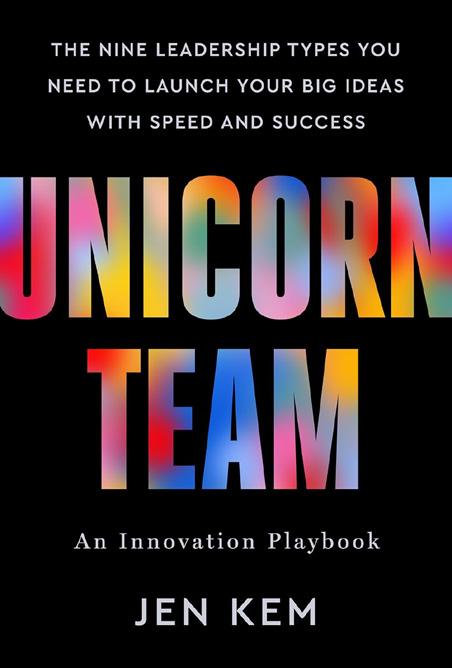
Unicorn Team: An Innovation Playbook
By Jen Kem; Hay House Business, Feb. 2025
In Unicorn Team, author Jen Kem reframes breakthrough leadership around one core truth: people—not ideas— create unicorn-level success.
Drawing on Fortune 500 experience, she helps leaders identify their “Unicorn Leadership Type,” assemble complementary talent, and mobilize teams with clarity and purpose. Through the "Unicorn Innovation Model" and nine distinct leadership archetypes, Ms. Kem shows how to build a values-driven culture, unlock team flow, and turn bold ideas into real, scalable results.
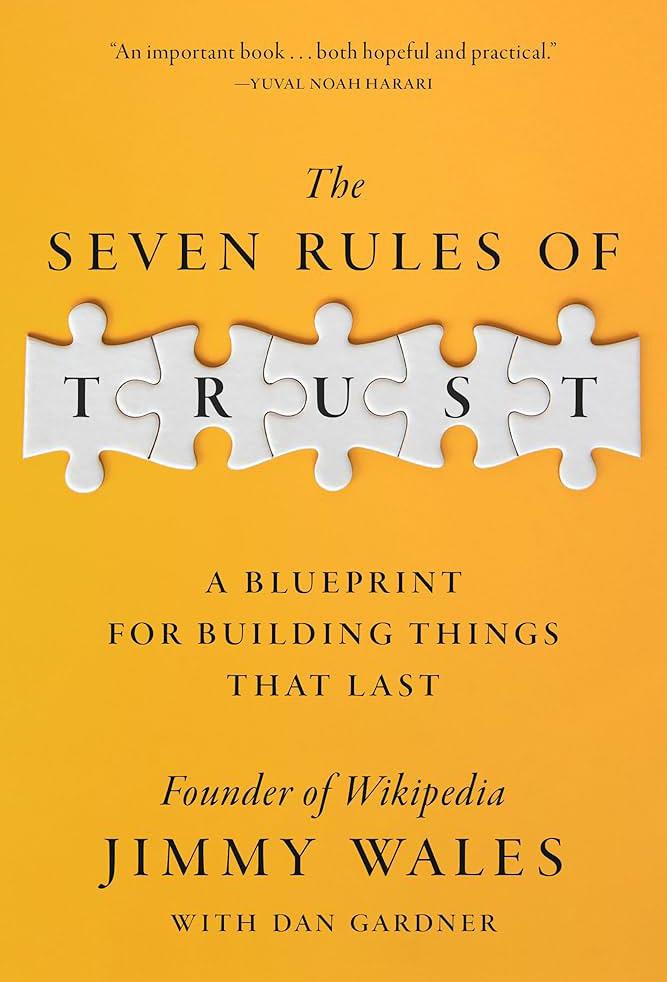
The Seven Rules of Trust
By Jimmy Wales; Crown Currency, Oct. 2025
Jimmy Wales’s The Seven Rules of Trust explores how Wikipedia defied early skepticism to become a global knowledge utility by cultivating one essential asset: trust. Blending candid stories from its early days with a timely reflection on today’s credibility crisis, Wales shows how trust is built, protected, and scaled. His framework offers practical guidance for any leader seeking to create accountable, resilient communities and build institutions that endure.
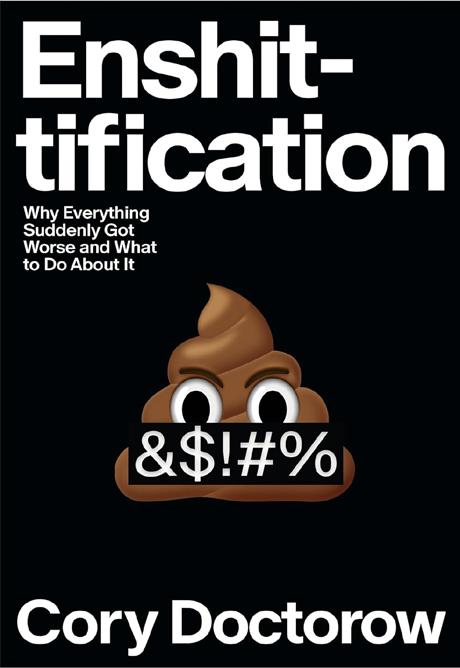
Enshittification:
Why Everything Suddenly Got Worse...
By Cory Doctorow; MCD, Oct.
2025
Cory Doctorow’s Enshittification delivers a sharp, urgent diagnosis of why the internet feels increasingly broken—and what it will take to fix it. Expanding on his viral term, he traces how digital platforms devolve from user-focused marvels into exploitative ecosystems that serve no one. Yet this isn’t a doom story: Doctorow outlines the decisions that caused the decline and offers concrete paths to reverse it, reclaiming a healthier, more human internet.
—
Seth Godin , New York Times best-selling author
Execution Dilution?
What happens when execution falters? The answer isn't good: Companies bleed value, losing up to 10% of revenue, forfeiting half their strategic upside, and ceding ground to faster rivals who turn intent into impact.1 With so much at stake, understanding the blind spots—and their bottomline consequences—is essential for any executive serious about executing their agenda in 2026 and beyond. The following data makes one point unmistakably clear: execution isn’t a capability gap—it’s a financial risk factor that compounds with every delayed decision, misaligned priority, and stalled initiative.
BIGGEST OBSTACLES
SILOS
Only 9% of managers say they can rely on colleagues in other functions or business units all the time, and 30% identify failure to coordinate across units as the single greatest challenge to executing.2
CONFUSION
While ~84% of staff in one firm said they were “clear” on priorities, fewer than 1/3 of managers could correctly list even two of the company’s top five strategic priorities.3
RESOURCES
Only 11% of managers believe their strategic priorities are adequately resourced, and 74% say their strategy has not been translated into tangible actions. 4
BIG PICTURE
$
2,000,000,000,000
PMI’s Pulse of the Profession has been repeatedly summarized as showing that organizations collectively waste about $1 million (USD) every 20 seconds due to poor project and strategy execution—or roughly $2 trillion annually.5
Percentage of megaprojects that overrun budgets and miss benefits, causing chronic drag, says KPMG/PMI data.7 %
25
Two-thirds of M&A deals fail to catalyze intended business synergies, with 1/4 actively destroying organizational value.8 %
An Economist Intelligence Unit study cited by Harvard Business School found 90% of senior executives said they failed to reach all their strategic goals because of poor implementation.9
COMMANDING EXECUTION
AN EXECUTIVE PLAYBOOK FOR TURNING INTENT INTO ACTION—AND VISION INTO VELOCITY—IN 2026 AND BEYOND.
BY SHIDEH SEDGH BINA
There is a moment every December when the energy inside an enterprise shifts. Strategic plans stop moving across conference tables and begin moving into the hands of the people expected to deliver them. The thinking is done. The intentions are clear. Now the question becomes whether the organization can turn those intentions into action with the speed the next year will demand.
In 2026, that demand will be fierce. The pace of business no longer resembles anything from three or even two years ago. Markets move faster. Competitors replicate quicker. Customers expect immediacy. AI compresses discovery, analysis, production, and distribution into cycles measured in days or hours. The external environment keeps accelerating, and the distance between strategy and execution keeps widening inside many enterprises. Vision has never been easier to articulate. Execution has never been more difficult to achieve. This issue exists for that reason alone.
Enterprises across industries are entering January with bold ambitions and a narrowing margin for error. They are stepping into a year shaped by geopolitical tension, technology that evolves in real time, persistent cost pressures, and talent dynamics that continue to shift under their feet. Under these conditions, the ability to execute is not simply another competency; it is the operating advantage that will separate the winners in 2026 from everyone else.
Most executives will recognize the familiar sources of breakdown: misaligned teams, slow decision rights, governance that prioritizes review over acceleration, cultures that tolerate missed commitments, and leadership teams that lose their first ninety days trying to diagnose problems instead of establishing tempo. Strategies fail not because leaders lack foresight, but because the machinery beneath the strategy cannot move fast enough or cleanly enough to make it real. The goal of this Winter 2025 issue is to close that gap.
In doing so, we return to the stories that defined Insigniam Quarterly over the last decade—the pieces that executives returned to again and again. These were the features that spread across boardrooms, executive retreats, and leadership off-sites; the ones downloaded, shared, quoted, and requested long after their publication. They earned that status because they revealed something deeper: not simply how organizations think, but how they act; not just how leaders plan, but how they deliver.
with Emmanuel Frenehard, the Chief Digital Officer of one of the world’s leading biopharma companies. His work sits at the intersection of digital transformation, architecture, and enterprise speed. His perspective anchors a core truth of modern leadership: velocity is never accidental. It must be designed.
Alongside Mr. Frenehard’s interview is a reframed exploration of organizational velocity itself—the mechanics beneath acceleration. Leaders speak often about moving fast; far fewer know what actually creates or kills momentum inside their organizations. This feature examines where speed originates, where it leaks, and how leaders can intervene early enough to prevent drag from becoming decay.
"Your strategy for 2026 is most likely complete. Your teams are preparing. The demands on your organization are not slowing down. The difference between aspiration and achievement will depend entirely on how effectively you execute."
For this issue, we rebuilt those stories for a modern context. Each feature has been updated, remastered, and expanded with new research, new examples, fresh data, and sharper insight into what it takes to execute in 2026. The intent is not nostalgia. It is utility. The leaders like yourself who are reading this issue need a playbook that is both proven and current—a set of ideas and tools that can withstand the demands of a new year and the velocity of a new era.
This issue opens with an in-depth conversation
Culture, too, plays an unmistakable role. The third feature examines culture not as a soft abstraction but as the organization’s true operating system. It shows how language, unwritten rules, decision habits, and norms of responsibility directly determine whether a company executes well or struggles for consistency. Culture becomes the hidden architecture that either supports strategy or quietly undermines it.
From culture, the issue moves to governance—an area where many enterprises still rely on structures built for stability rather than speed. The updated governance feature illustrates how decision-making, authority, and risk management must evolve for organizations to move with clarity and conviction. Slow governance is slow execution, and slow execution is a strategic liability.
Leadership is a thread running through every article, but it stands on its own in a feature dedicated to the first ninety days of a new executive’s tenure. The early months of leadership are decisive. They set pace, tone, and alignment. This piece offers a path for leaders to establish rhythm quickly enough to avoid the drift that plagues so many transitions.
Execution is also tested in moments of organizational change, which is why this issue includes an updated exploration of M&A. Integration exposes every weakness and magnifies every strength; it is the ultimate execution stress
test. Done well, it accelerates value. Done poorly, it destroys it. This feature examines what has changed in the integration landscape and how leaders can increase the probability that a deal produces real, measurable results.
No conversation about execution in 2026 can avoid AI. Many organizations have pilots, proofs of concept, and pockets of experimentation, but very few have translated AI into material enterprise performance. The AI feature outlines what separates activity from execution and how leaders can structure AI programs that deliver outcomes, not presentations.
The issue concludes with a reframed look at innovation itself. Often celebrated as an act of invention or imagination, the concept inside highperforming organizations is something different. It is a discipline. The updated feature demonstrates how innovation can be embedded into an organization’s operating rhythm, transforming new ideas into repeatable engines of growth rather than sporadic flashes of insight.
Across the following eight special features, a clear sequence emerges—one that defines the anatomy of execution in any enterprise. Vision sets direction. Alignment creates coherence. Accountability builds reliability. Operating rhythm establishes speed. Culture provides foundation. Governance shapes authority. Leadership sets the pattern. Innovation sustains momentum. AI extends reach. Together they form the architecture that allows an organization to deliver consistently on what it intends to achieve.
This issue is not meant to be read once and shelved. It is designed to be used, referenced, revisited, and put to work as leaders step into a year that will test their ability to act decisively. The next twelve months will not reward hesitation. They will reward clarity, conviction, and the willingness to establish a velocity that others cannot match.
Your strategy for 2026 is most likely complete. Your teams are preparing. The demands on your organization are not slowing down. The difference between aspiration and achievement—the difference between being prepared and being ready—will depend entirely on how effectively you execute.
That is the question this issue seeks to help you answer: how to close the gap between what you intend and what you deliver.
The year ahead will belong to the leaders who refuse to let execution falter. The ones who move when others hesitate. The ones who make their plans real. IQ
01
02 03 04 05 06 07 08
EXECUTION
A candid conversation with Sanofi's Emmanuel Frenehard, who reveals what it truly takes to build enterprise-wide velocity. Page 12
VELOCITY
The mechanics of organizational speed, and why momentum is never a coincidence but the result of deliberate design. Page 24
CULTURE GOVERNANCE
A look beneath the surface to the cultural operating system that determines whether strategy execution soars or stalls. Page 30
How boardroom decision-making models must evolve for organizations to act with clarity and conviction. Page 38
LEADERSHIP
As each new year brings a wave of new CXO hires, a framework to turn the first 90 days into a launchpad for execution. Page 44
M&A
A new approach to the ultimate stress test of an organization’s ability to align, integrate, and execute under pressure. Page 52
HUMAN-CENTRIC AI
As AI moves from promise to performance, learn what separates experimentation from real enterprise impact. Page 60
INNOVATION
Not as occasional invention, but as a disciplined operating rhythm that converts new ideas into sustained growth. Page 70
01 Architect of Execution The
BY JON BALL & MARIE-CAROLINE CHAUVET
As EVP & Chief Digital Officer at one of the world’s largest biopharma companies, Emmanuel Frenehard is building an execution engine to turn Sanofi's ambitious vision into a reality.
Digital Disruptor
As an executiondriven technologist reshaping enterprise performance, Sanofi EVP & Chief Digital Officer Emmanuel Frenehard is fusing AI ambition with disciplined operating cadence to turn vision into velocity.
There are leaders who adapt to change, and then there are leaders who refuse to inherit its pace. Emmanuel Frenehard belongs to the latter category: an executive who treats velocity not as a byproduct of strategy but as the design constraint of modern leadership. He believes the rhythm of an enterprise is not predetermined by its size or history; it is engineered through the discipline to turn intent into action and vision into velocity.
“We want to be the leading biopharma company using AI at scale. It [is] not motivation, it [is] a mandate.”
—Emmanuel
Frenehard EVP & Chief Digital Officer, Sanofi
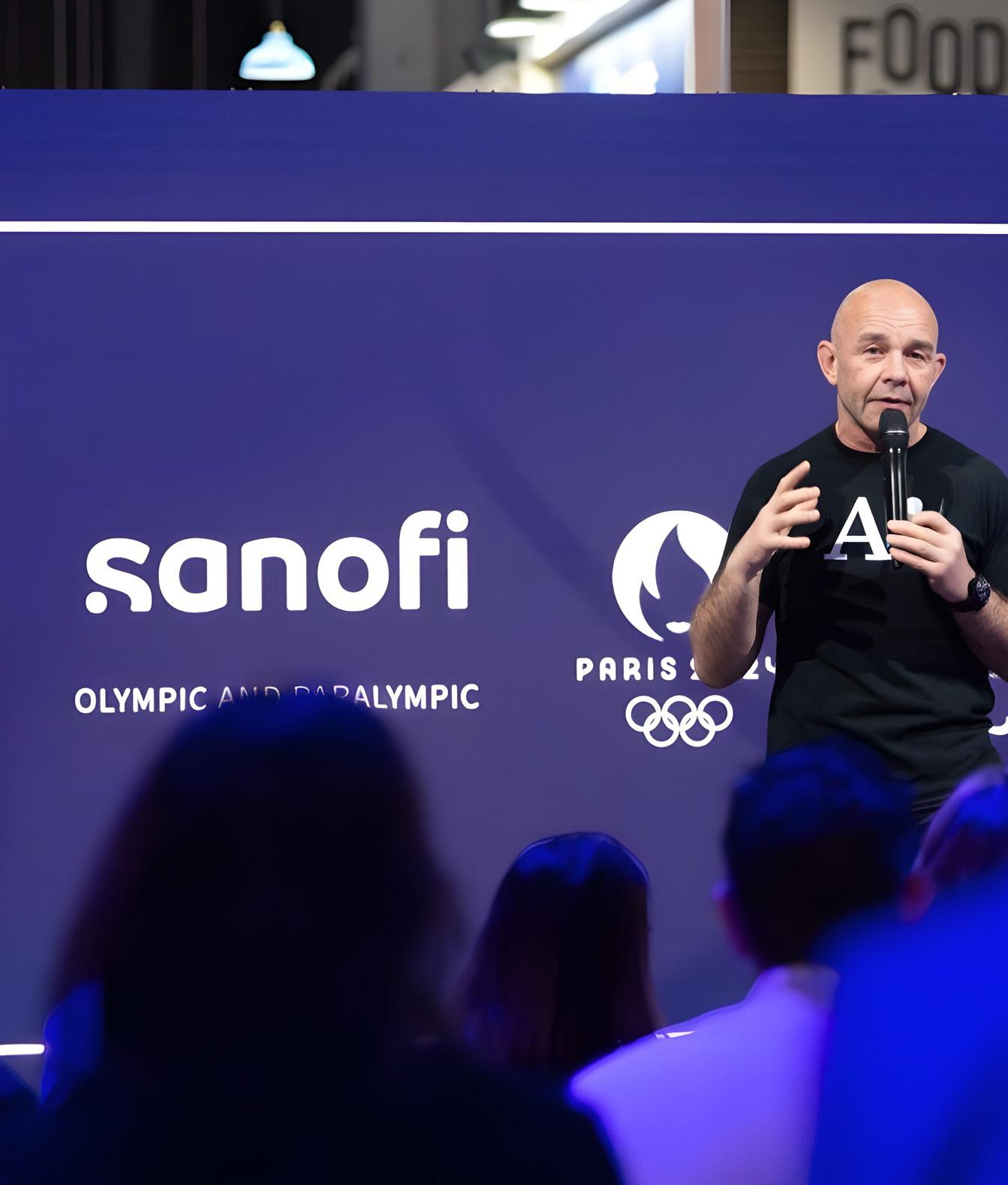
Onstage at a recent gathering of executives, he opened with a question that sounded less like speculation and more like a quiet indictment of slow-moving organizations:
“What if I told you that by 2030, half of your closest collaborators won't be human?”
The line landed without theatrics; just a truth stated plainly by someone who has already begun architecting that future inside Sanofi—the R&D-driven, AI-powered biopharmaceutical company committed to discovering, developing, and delivering medicines and vaccines for millions of people around the world—where he serves as Executive Vice President, Chief Digital Officer. The question wasn't really
about artificial intelligence. It was about execution. It was about whether institutions built for one world can operate in another.
“That doesn't mean AI will replace humans,” he told the room. “But humans who use AI will outperform those who don’t."
It wasn't hyperbole; rather, it was a call to arms.
Sanofi has no shortage of ambition. Yet, with a global workforce of over 72,000 employees, 39 manufacturing sites, and 13 R&D facilities globally, the company thoroughly understands that ambition collapses without the infrastructure to carry it. Mr. Frenehard's work—his obsession— is converting aspiration into something
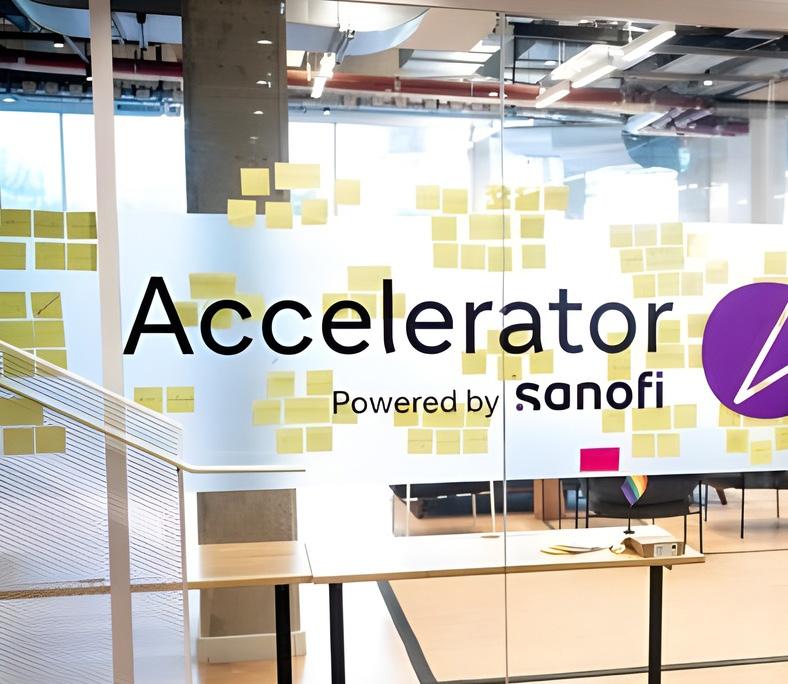
An Accelerated Future
The Sanofi “Digital Manufacturing & Supply Accelerator” is a dedicated hub launched in May 2025 (in Lyon) designed to embed digital-first tools—such as AI, digital twins and IoT—across its manufacturing and supply-chain operations; its purpose is to accelerate and de-risk the path from lab to large-scale production, making it possible to deliver medicines and vaccines to patients more quickly, reliably and efficiently, thereby improving access and outcomes for customers and patients.
“When
I joined Sanofi, the stakes multiplied... drug discovery, regulatory pathways, payer systems, clinical access...and patient lives. Intent means nothing without execution.”
—Emmanuel Frenehard
EVP & Chief Digital Officer, Sanofi
Innovation Amplified
At VivaTech 2024 — a major European conference on technology, startups and innovation —Mr. Frenehard formally showcased how Sanofi is “all-in” on AI, unveiling how artificial-intelligence tools are being applied across drug discovery, clinical trials, manufacturing, supply and commercial operations to accelerate the journey from molecule to medicine and ultimately deliver faster, more effective care to patients.
operational, measurable, and real. Something that works on Monday morning, not just in the boardroom.
To understand how he does that, you need to understand how he thinks—and how a career shaped by entertainment, technology, streaming platforms, and consumer behavior became the foundation for one of the most ambitious AI transformations in the world.
The Execution Architect
Before he entered the biopharma industry, Mr. Frenehard spent years building consumer platforms at breakneck speed. At Disney, he helped launch the company's first direct-to-consumer service, DisneyLife, and later at iFlix, he oversaw explosive adoption across Southeast Asia.
That world—volatile, fast, unforgiving—taught him a simple rule: speed is not an advantage; speed is survival. Whether the stakes are entertainment or medicine, friction—while challenging—drives innovation.
In a 2016 interview with Variety, he put it plainly: “We weren't just building an app. We were building a new relationship between a company and its audience.”
It's an unassuming line, but it reveals a core principle that now shapes the way Sanofi builds digital capability: technology is irrelevant if people don't use it. Adoption is the currency. Execution is expressed through behavior.
That mindset deepened at iFlix. Rolling out a platform across emerging markets meant reinventing everything—pricing models, infrastructure, distribution, licensing. Nothing came off the shelf;
everything was designed under pressure. The only constant was velocity.
This is what Mr. Frenehard brought into biopharma when he joined Sanofi in 2020: a worldview that sees digital not as a set of tools but as a systems-design challenge—how to remove friction and unlock human capability.
“When I joined Sanofi, the stakes multiplied," he says. "Instead of movie nights and binge-watching habits, the outcomes involved drug discovery, regulatory pathways, payer systems, clinical access, supply chains, and, ultimately, patient lives. The principle, however, remained unchanged. Intent means nothing without execution.”
In an industry where execution is measured in time saved, treatments delivered, and lives improved, Mr. Frenehard's words underscore the reality that velocity is not optional; it is existential.
The Ambition: AI Power at Scale
Sanofi's stated ambition is audacious: to become the first biopharma company powered by AI at scale. This means leveraging AI globally and at enterprise scale to transform its entire biopharma model—from discovery through to patient delivery—so that generating breakthrough medicines is faster, smarter, and more reliably impactful.
Beyond merely a vision statement, it's a directive that Mr. Frenehard refuses to let drift into rhetoric.
“We want to be the leading biopharma using AI at scale," he told employees. "It wasn't motivation; it was a mandate.”
60 K
Sanofi Concierge—used by 60,000 Sanofians—is an internal generative-AI assistant deployed to help employees with everyday tasks; from answering questions about company policies and procedures to summarizing documents, automating workflows, and generally streamlining lowvalue tasks so employees can focus on higher-value work.
But he also knows declarations don't execute themselves. Models alone don't drive outcomes. Infrastructure does.
“We learned the hard way that if your data isn't governed, trusted, or of quality, you're going to get poor decisions out of it," he says.
At Sanofi, AI is not allowed to run on any data that fails foundational criteria— quality, ownership, governance, metadata, and lineage.
“If your data is not AI-ready," he says, "we will not run on it.”
For Sanofi and Mr. Frenehard, it's a discipline forged by setbacks, challenges, and ingenuity.
"We failed plenty of times on a dataset we thought was good enough," he says. "And when they're not good enough, the recommendations can be a disaster.”
This is not the romantic version of AI transformation. Rather, it is the unglamorous engineering required to make AI useful at scale; something to which Mr. Frenehard is keenly aware.
Shifting From Systems of Record to Systems of Work
While many companies approach AI like a cost-cutting initiative—automate tasks, trim headcount, reduce human dependency, Mr. Frenehard views that it is not only shortsighted, but strategically backwards. Automation may save money, but it doesn't change capability. It doesn't create an advantage. It doesn't make an organization faster, smarter, or more adaptive.
“Automation might be cheaper than people," he says. "But augmentation—the ability to change the capabilities you give your workforce—that is where the real value lies.”
That distinction becomes the fulcrum for a much larger paradigm shift: the move from systems of record to systems of work. For decades, enterprises have architected their operating systems around tools—ERP, CRM, HRIS, procurement platforms—each designed to streamline a specific vertical.
Each has its own database, permissions, structures, and integrations. These systems standardized business processes, but they also created organizational gravity. Work conforms to software, not the other way around.
“Most of us do not know how to start building a workflow," he says, "because we've been formatted by the system of records.”
Agentic AI flips that logic. If data is liberated and workflows can run across systems rather than inside them, the record-keeping layer becomes secondary— important as a ledger, but no longer the architecture through which work flows.
This is where Mr. Frenehard sees the next frontier: AI workflows that fuse
“You don't scale AI. You scale human judgment enhanced by AI.”
—Emmanuel Frenehard EVP & Chief Digital Officer, Sanofi
deterministic decisioning (yes/no logic) with agentic autonomy (retrieval, synthesis, coordination, drafting). Simple decisions remain simple; complexity activates capability. The goal is not to replace systems. The goal is to reduce the friction between them.
“For example, we're reinventing procurement at Sanofi," he says. "Procurement touches every department, every cost center, every supplier. It is a battleground of inefficiency. The workflow today is a maze—best-inclass systems stitched together through handoffs, approvals, reconciliations, and workarounds. The technology isn't the problem. The workflow is."
AI doesn't merely fix that by making the maze faster, says Mr. Frenehard. It redraws the map.
“One workflow initiative alone is projected to drive a billion euros in top-line uplift," says Mr. Frenehard.
When Mr. Frenehard presented the initiative to the executive committee, he did so with a condition that sounded more like a challenge than a proposal: if it cannot generate that level of value, stop the project. This is his operational philosophy in its purest form: pick problems worthy of transformation and solve them in ways that restructure how the organization works— not just how it automates. This is execution by design.
Faster. Scalable. In biopharma, every second matters, and Sanofi is rebuilding its industrial engine to deliver with greater speed and accuracy. By infusing AI into every stage of development —from discovery to full-scale manufacturing —the company is cutting time-to-market by up to a year and positioning itself to triple new medicine launches, accelerating critical therapies to patients worldwide.
Smarter.
The Culture Challenge: Adoption, Not Technology
If systems design is the structural challenge, adoption is the human one—and Mr. Frenehard is blunt about where most transformations fail.
Citing a recent MIT study that 95% of generative AI projects fail to scale, he believes the problem isn't algorithms. The problem is people.
“Two-thirds of the problem is change," he explained. "Not technology.”
Enterprises can build dazzling prototypes, run pilots, launch labs, showcase demos—yet never change how work is done. The failure mode is not innovation; it's integration.
“Those of us who have been part of large transformational initiatives know that you have to take multiple bites at the apple," he says. "It won't happen the first time. And when things get toughest and you feel like giving up…that’s exactly when you shouldn’t.”
This is where Mr. Frenehard diverges from technologists and begins to sound like a coach. His leadership vocabulary centers on resilience, optimism, and persistence.
"Just believe," he says. "Be an optimist in that journey.”
Optimism, in his hands, is not sentiment. It is a requirement. Because adoption is psychological, it demands identity change, not just skill change. It asks people to trust a new way of working while letting go of what made them excellent in the first place. This is why Sanofi deploys AI tools the way consumer platforms are launched: intuitive, inviting, familiar. Concierge, the company's internal agent, isn't positioned as an enterprise system—it's positioned like a digital companion.
BONJOUR, EMMANUEL
Having joined Sanofi in 2020, Emmanuel Frenehard—based in Paris—leads the company's digital, data and technology strategy to help transform the practice of medicine, empower healthcare professionals, and better serve patients. Prior to being appointed Chief Digital Officer, he held the positions of Global Head, Digital GBU teams and Digital Products. He also led the Sanofi Digital Accelerator and several digital commerce initiatives, launching best-in-class digital experiences.
Before Sanofi, Mr. Frenehard spent 20 years leading large global organizations as well as three years in startups. He has built and launched multiple global digital products in support of existing and new business models, using the Agile methodology at scale. In particular, he managed iflix's explosive adoption across Southeast Asia, and led the launch of DisneyLife, Disney's direct-toconsumer digital subscription service in the UK.
Learn more at sanofi.com
Interface choices are strategic. Onboarding is emotional. Adoption is earned.
Sixty thousand employees use it, not by mandate, but by desire. That is not technology spread across a workforce; it is culture shifting at scale.
Inside Sanofi, digital tools are meant to reduce barriers to collaboration, not replace collaboration itself. They are meant to augment human connection, not simulate it.
“That's why Concierge wasn't launched like internal software—it was launched like a consumer experience: polished, inviting, responsive, even playful. Not to dazzle employees, but to ensure they actually use it."
For Mr. Frenehard, meaningful adoption isn't compliance, it's desire. Thusly, this is how he thinks about technology in aggregate: not as a frictionless substitute for human interaction, but as an accelerant for it. Tools make work easier; they should not make people optional.
Measuring Velocity
Many enterprises measure digital transformation with dashboards—usage charts, cycle times, automations, and savings. To Mr. Frenehard, these are fine as diagnostics but weak as a strategy. They measure motion, not momentum. They count activity, not value.
“We measure velocity in economic terms," he says. "Not in digital maturity level or innovation count, but rather actual enterprise contribution.”
He set a rule: no AI initiative moves forward unless it can generate at least €100 million in value—either in efficiency or revenue. The billion-euro workflow is the prime example. It is not a moonshot; it is a standard for focus, because scale demands proportional outcomes.
If it doesn't generate a billion in lifted sales," says Mr. Frenehard, "then we should not do it. We should apply our capacity somewhere else.”
This is not bravado. It is a constraint as a strategy. AI is expensive.
Organizational capacity is finite. Focus is a competitive advantage.
“If you are working at the fringes, you won't have a big impact," he says.
His metrics are not about adoption for adoption's sake. They are about enterprise performance: Does this capability make the company faster? More adaptive? More effective at delivering outcomes? Or put differently: does the transformation actually transform?
Leading Through a Changing World
Mr. Frenehard believes AI represents the fourth industrial revolution—except this one will unfold in a single generation, not across centuries. The displacement curve is faster. The adoption curve is steeper. The leadership challenge is different.
This requires organizations capable of pairing stability with reinvention, or what he calls an 'ambidextrous model.’
“You have to change the plane engine in flight," he says. "You have to juggle both dimensions—the dimension of reinvention and the dimension of running the company.”
Leadership in this era is not about predicting the future. It's about building the ability to respond to it. It is less about certainty and more about pace. Less about strategic vision and more about unlocking execution.
AI is here, he reminds leaders. Billions are being poured into the ecosystem. The acceleration is not theoretical.
“You can put your hand in front of the sun and not see the sun, but it's still there burning bright," he says.
This is Mr. Frenehard’s challenge to the C-suite: adaptation is no longer a strategic choice. It is a condition of relevance.
The Five-Year Horizon
While some executives may envision what success looks like five years out by reciting product pipelines, roadmap milestones, and efficiency targets, Mr. Frenehard talks about capacity.
He imagines every employee operating as "one person plus AI"—not augmented by a tool, but extended by a capability. Not automation replacing human judgement, but AI amplifying it. He imagines workflows behaving like conversations— dynamic, fluid, context-aware. He imagines a company that doesn't brace for disruption but absorbs it and accelerates through it. In essence, he imagines abundance.
“If tomorrow, we said let's build a call center that speaks every language in the world, that will call every Alzheimer patient to make sure they get their medication, you'd say it's not possible," he says.
Yet, Mr. Frenehard envisions a future where digital nursing agents support
Alzheimer's patients by calling them, speaking in their language, guiding them to medication, and checking adherence.
“Many people would simply say, it's not physically possible," he says. "But in a world of abundance, we can do it overnight.”
The Next Frontier
For Mr. Frenehard, AI is not an abstract vision of the future—it is a mechanism for execution in the present. It is the difference between ambition and impact, between promising change and delivering it.
“Everything we build has to start with value,” he says. “Not value as a theory— value you can feel in outcomes.”
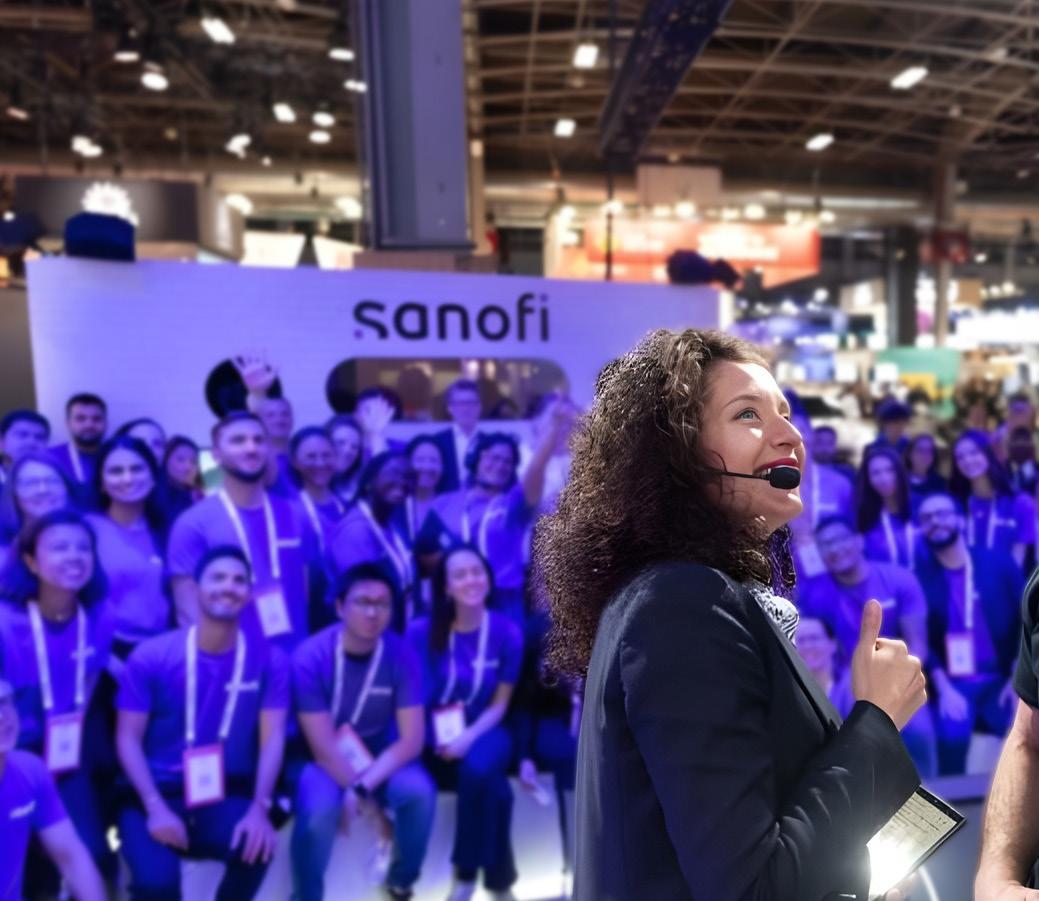
Sanofian Selfie Set amongst a backdrop of fellow Sanofians—the moniker given to the company's employees—Mr. Frenehard is keenly aware that his work also entails enrolling people who bring the company’s mission to life every day.
That instinct traces back to earlier chapters of his career, where adoption was earned one interaction at a time.
“There are brand deposits and brand withdrawals,” he says. “A deposit is when we deliver something truly new that works at scale. A withdrawal is when a company simply puts its name on something and expects the brand to carry it. We have to stay on the side of deposits.”
Execution, for Mr. Frenehard, is measured not only in efficiency or speed, but in the precision of outcomes and the integrity of systems that support them.
He points to moments that sharpen that responsibility—like a father whose child had
"Emmanuel's customercentric mindset applies both to what data and digital can provide to employees and the organization as a whole, as well as to external stakeholders, patients and HCPs in particular. He is a forward-looking executive and does not hesitate to challenge the status quo."
—Marie-Caroline Chauvet
Partner, Insigniam
Crohn's disease asking why a solution didn't exist sooner.
“Those moments remind you why speed matters,” he says. "Execution isn't about moving fast just to move fast—it's about getting answers to people who don't have them yet. AI helps us close that distance.”
Ultimately, his ambition is not simply to build an AI-enabled biopharma company, but one defined by disciplined follow-through.
“If five years from now we're moving faster, thinking clearer, making better decisions every day—and patients can feel the difference—that's success. That's what execution should look like.” IQ
The Speed Imperative
Every enterprise has a default trajectory—and without intervention, it slows execution to a crawl. Learn how to break from the drift and build the velocity your strategies demand.
By Jennifer Zimmer
For those of us who have witnessed true, meaningful breakthroughs—the kind that can reshape the trajectory of a company and even an entire industry—we understand their profound and lasting impact. As trailblazers in the art and science of catalyzing breakthrough results for more than three decades, Insigniam offers a refined definition: a breakthrough is a measurable outcome that is unprecedented or unlikely based on an organization’s history, resources, and the environment in which it operates.
Breakthroughs may concern processes, project deliverables, strategies, leadership, or corporate culture, but their effect is transformative. Most importantly, true breakthroughs are sustainable. They continue to deliver results without sacrificing quality, integrity, or well-being. They emerge when individuals adopt fresh perspectives and take novel actions that open pathways to possibilities previously unseen.
Yet even when leaders recognize the need for bold transformation, the pathway to execution can often feel opaque. The challenge is not in knowing that change is
required, but in understanding where to begin—and how to move swiftly enough to overcome stagnant growth, anticipate disruption, and avoid the perils of clinging to the status quo.
Breakthroughs Begin by Revealing the Drift
In any organization, breakthroughs begin by acknowledging and confronting the “organizational drift”—the likely trajectory of performance created by the convergence of established practices, institutional dynamics, and deeply ingrained belief systems. Drift is the invisible undertow that shapes how people think, behave, interact, and ultimately perform. It pushes outcomes in a predictable direction, much like a river current quietly pulling everything along its path.
Imagine standing at the edge of a river, watching the current move with a steady, almost unnoticeable force. Drop a twig into the water and you can easily anticipate its downstream journey. Organizations behave much the same way; without intervention, the drift determines the future.
To move beyond the drift and into a space where new futures become possible, Insigniam’s methodology identifies four essential stages—Reveal, Unhook, Invent, and Implement.
These stages occur in sequence, and each introduces new conversations, structures, and actions that set the conditions for a true breakthrough.
In the era of AI, compressed decision cycles, and unprecedented operating tempo, these stages now serve an additional purpose: they help leaders accelerate execution and shorten the distance between decision and action.
Reveal: Understanding the Current Reality and Its Impact on Speed
The first action on the path to a breakthrough is to reveal the prevailing and controlling conversations that shape how people act, interact, solve problems, and interpret their environment. This requires confronting what is assumed to be real,
The challenge is knowing where to begin and how to move swiftly to avoid the perils of clinging to the status quo.
as in the assumptions, interpretations, and unspoken norms that quietly limit pace and performance.
A recent example involved the CEO and CHRO of a Fortune 500 multinational food manufacturer who partnered with Insigniam to elevate their leadership culture in order to respond to rising consumer demand for nutritional products. Before they could move with the urgency the market required, they had to reveal how leaders experienced their work and themselves within it. Through a series of interviews and facilitated conversations, executive and extended leadership teams surfaced the underlying beliefs, assumptions, and habits that shaped their day-today behaviors.
Only after revealing these hidden constraints could they design a new leadership cultural framework—a shared purpose, new ways of working, and explicit commitments for how
leaders would show up. The executive team modeled new leadership behaviors, and extended teams followed by embodying clearly defined actions and ways of being that supported a renewed culture capable of operating with greater speed, cohesion, and accountability.
Unhook: Detaching from Limiting Conversations to Restore Trust and Tempo
The second stage requires the organization and its people to unhook from prevailing conversations, recognizing them as only one possible interpretation of reality. This stage is critical because much of what slows an enterprise down— missed deadlines, habitual risk aversion, or cross-functional friction—is not factual; it is rooted in shared interpretations and assumptions that have gone unchallenged.
One of the largest medical device companies in the world confronted this challenge while developing a groundbreaking surgical technology that could create an entirely new market category. After eight years— four years beyond the original target date—deadlines no longer felt real, and teams no longer believed in the timeline or in themselves. Trust had eroded among internal and external stakeholders, and the project had lost its tempo.
Insigniam worked with cross-functional teams to enable what seemed impossible: delivering the product to market within one year. To achieve this, individuals had to unhook from long-held norms about timelines, collaboration, and decision-making. Critical actions included establishing clear pathways for cross-functional communication, fasttracking priority requests, and creating decision structures that supported rapid progress. Project managers and quality leaders designed mechanisms that motivated the organization to complete a multitude of tasks on schedule ahead of regulatory submissions.
By unhooking from limiting narratives and operating from facts rather than assumptions, teams rebuilt trust, rekindled accountability, and aligned around a shared commitment to move the project forward as one unified team.
Invent: Designing New Conversations and Structures for a Faster Future
The third stage—Invent—requires individuals to design new conversations rooted in an inspired future, shifting from circumstance-based dialogue to commitmentbased dialogue. This is where organizations generate the energy, structures, and innovations that make a new trajectory possible.
A U.S.-based hospital healthcare system known globally for exceptional patient outcomes faced such a challenge. Despite its clinical excellence, the organization lacked a cohesive, intentional approach to developing
IS DECISIVENESS IN YOUR DNA?
The CEO Genome Project—published in Harvard Business Review—analyzed 17,000 assessments and 2,000 CEOs to identify what truly drives top performance. The data shows leaders who make faster, clearer decisions are 12× more likely to excel. The takeaway is simple: execution velocity starts with leaders who design decision flows, remove bottlenecks, and set the tempo for the enterprise.
6.7 X
ADAPTABILITY
CEOs with high adaptability are nearly seven times more likely to be high performers than their peers.1
94 % RELIABILITY
Among highperforming CEOs, reliability (i.e., following through) is a commonly shared trait.2
45 % 7 %
FAILURE
Nearly half of CEOs had at least one major career “blowup”— yet many still rose to succeed. 3
EDUCATION
Elite credentials are not predictive; only 7% had an undergrad degree from an Ivy-League school.4
1-4What Sets Successful CEOs Apart, Harvard Business Review, by Botelho, Rosenkoetter-Powell, Kincaid, and Wang.
About the Author
Jennifer Zimmer, Insigniam & Elixirr Partner
A member of Insigniam’s team since 1998, Jennifer Zimmer has expertise taking leaders to the next level of performance, empowering them to be accountable while delivering breakthrough results. She has substantial experience working in hospital systems, pharmaceuticals, and biotech, and consistently receives exceptional client satisfaction results. Her work includes consulting for major corporations on largescale business and cultural transformations and initiatives, such as ERP implementations, regulatory compliance issues, and revenue cycle. In these engagements, Ms. Zimmer has helped teams produce significant measurable results, including increased employee engagement, patient satisfaction scores, and cash flow, and decreased rework and order-to-cash cycle time. Ms. Zimmer is a soughtafter speaker at healthcare conferences and a member of the Healthcare Businesswomen’s Association. She is a licensed critical care nurse and holds a B.S. in Nursing from Simmons College and a Mini MBA from the Wharton School at the University of Pennsylvania.
physician leaders. Existing leadership development occurred sporadically, inconsistently, and often by chance. Yet their bold vision for the future demanded a structured platform for cultivating leadership throughout the system.
Insigniam convened cross-functional groups to surface the roadblocks to leadership development and reveal opportunities that had gone unseen. By confronting deeply embedded assumptions, leaders identified what worked, what no longer served the organization, and what needed to be invented to achieve their vision.
A collaborative design team used design thinking principles to prototype a formal leadership development structure. These prototypes were reviewed by the governing body and ultimately approved for implementation across the organization— laying the foundation for a scalable, long-term leadership pipeline capable of delivering breakthrough results.
Implement: Embedding New Structures, Accelerating Execution, and Sustaining Momentum
The final stage—Implementation—occurs when new conversations and structures become lived reality, enabling individuals and teams to convert breakthrough goals into breakthrough results. This step often requires organizations to operate under new conditions, as one of the world’s largest automotive tire manufacturers learned during the global pandemic. For decades, the company built customer relationships and internal collaboration through in-person meetings. When the pandemic eliminated the possibility of face-to-face work, the structures that had supported success vanished overnight.
Insigniam worked with the client to increase engagement with internal and external customers, strengthen virtual collaboration, and accelerate the development of new operating rhythms. After aligning on an inspiring future, project teams designed pathways to achieve their goals. The president of the operations group was so impressed by the clarity and strength of these plans that he invited the teams to present at a quarterly executive meeting.
Two efforts created profound organizational lift: a program that spotlighted what inspired employees about their work, and a safe platform for international teams—previously hesitant to speak up due to cultural norms—to share openly and participate fully. These initiatives deepened connection, strengthened engagement, and created new pathways for serving customers in a virtual world. The resulting cohesion generated new strategies, accelerated execution, and helped the organization sustain performance during an unprecedented disruption.
A Playbook for Action and Speed
The actions required for a breakthrough must be supported by a fundamental shift in thinking—one that challenges the belief that the future is dictated by the past. In truth, the future acts as the backdrop against which people determine what is possible. It shapes their behavior, informs their decisions, and influences the tempo at which they operate.
Creating an enterprise capable of breakthrough results requires leadership that understands the organization’s power extends beyond capital, technology, and operational efficiency. It calls for harnessing the human factor—investing in conversations, clarity, and new structures that accelerate execution. It demands the discipline to engage in the kinds of dialogue that create alignment, drive momentum, and turn intent into action quickly and decisively.
The essential question is this: If an observer were to examine your organization today, what actions—and at what tempo— would they see? In a world where speed is an advantage and execution is the great differentiator, breakthroughs are not a luxury. They are an imperative.
Do not surrender your future to drift or to your competitors. The actions required for a breakthrough—revealing, unhooking, inventing, and implementing—can propel your enterprise to results beyond what your past would predict. The capacity for breakthrough is already there. The question is whether you will command it. IQ
Portions of this article are based on materials created by Werner Erhard and on the book
For over 35 years, executives at the world’s largest and best companies have relied on Insigniam’s unique consulting to produce critical, unexpected outcomes, utilizing proprietary methodologies that marry breakthrough performance and innovation.
that your people will think newly, act differently and deliver unprecedented results.® For more information, visit www.insigniam.com
Culture is An Engine. Unleash It.
Culture acts as an invisible operating system that accelerates or undermines execution. To fuel it, we must learn to align the nine facets of corporate culture to drive performance.
By Katerin Le Folcavez
Every society runs on an invisible operating system. It isn’t written in code, yet it governs behavior just as precisely—quiet conventions, shared meanings, and unspoken expectations shape how people move through the world. As Daniel H. Pink notes in Drive: The Surprising Truth About What Motivates Us , our institutions, policies, and economic choices all rest on deeply embedded assumptions about how things work. Organizations are no different. Beneath the visible machinery of structures, tools, and reporting lines—and beneath the everyday motion of teams, workflows, and processes—sits a deeper layer that determines whether work actually happens. It consists of what people truly believe, how they make sense of their environment, and the unwritten rules that guide their actions. We often shorthand this as “culture,” but in reality it functions more like the enterprise’s DNA.
This operating system is the invisible force that determines whether performance accelerates or stalls. When a culture reinforces the company’s vision and strategy, the enterprise gains momentum; think of the disciplined innovation engines behind Siemens, Novo Nordisk, or Samsung. When it is narrow, rigid, or out of step with reality, it becomes an anchor. That is how once-prominent companies like Nokia end up in long, painful decline: not because they lacked ideas, but because their cultural operating system could not evolve quickly enough to support the future.
These cultural systems can be broken down into nine distinct elements:
1. Language and the network of conversations
2. Customer orientation
3. What is actually valued
4. Accountability and responsibility
5. Traditions, rituals, heroes, legends, and artifacts
6. Leadership dynamics
7. Unwritten rules for success
8. Decision rights and processes
9. Legacy
Together these elements form the set of instructions, protocols, and suppositions—
C-SUITE CULTURE CLUB
Leading CXOs know the real operating system for execution is culture, reinforced by what they reward—and refuse to tolerate.
the DNA—of the corporate organism. This DNA either primes the organization for growth, or sets it on a course of stagnation, dysfunction, and decline.
Language and the Network of Conversations
Ursula Burns, Former CEO, Xerox: “When people walk in the door of Xerox, they remain human. The way to get the best out of people is to not force them to be something other than they naturally are. [That's our] responsibility, and there is no negotiating on responsibilities.” 1
Roland Busch, President & CEO, Siemens: “To empower people, don't micromanage. Empowerment is not anarchy; if you give a strategy, empower your people and let them go. Even if you think you would do it differently, let them do what they are good at. Accountability comes from empowerment. " 2
Satya Nadella, CEO, Microsoft: “[Microsoft’s culture] needs to be a microcosm of the world we hope to create outside the company. One where builders, makers, and creators achieve great things.3 After all, our products may come and go, but our values are timeless.”4
Sources: 1Strategies for Influence.; 2LinkedIn News; 3BusinessInsider.com, 4. LinkedIn
What people say aligns with how they perceive what they’re experiencing. For human beings, perception is not only physical, it’s linguistic —shaped by language. What you listen for when assessing the network of organizational conversations are the elements shaping these interactions.
Listening to what’s being said is often not enough to generate a sense of corporate cultures. You also have to be aware of what’s not being said.
For example, we once interviewed employees at all levels of a leading supercomputer manufacturer. Throughout our interviews, we never heard anyone admit to making a mistake or wasting the company’s money. This told us that what was lacking (in terms of corporate culture) was a sense of personal responsibility and individual accountability. For an executive leader, this absence is not just cultural—it’s operational. Without candid conversation, execution problems surface late, or not at all.
When we relayed this to the CEO, he said, “Wow. I never would have gotten that. But the second you say it, you’re
absolutely right. We're so focused on being nice that we didn’t hold people to account.”
To drive growth, the patterns of conversation must shift from passive expressions such as: “It would be good if…,” “Somebody should…,” and “We need to…,” to active declarations such as “I will…,” “I promise…,” and “Would you…?”
2
Customer Orientation
How important is the customer? Years ago, we had the opportunity to participate in one of the first known corporate culture transformations at the Ford Motor Company. We found that some assembly line workers would often strike back at management by sabotaging cars. For example, they’d put a tin can inside a fender so it rattled when the car was driven. They were using customers to animate their hostility toward management.
This episode illustrates the consequences of a culture so dysfunctional that both employees and customers became
completely alienated from the company and its success.
When you put employees first, it translates to the customer. After all, only satisfied customers can fuel enterprise growth. Furthermore, customers are not abstractions; they set the tempo at which the organization must operate and execute. That’s why some companies embed the customer directly into every decision.
At Toyota, for example, leaders practice Genchi Genbutsu—“go and see”—requiring managers to understand the customer’s real experience before making choices that affect quality, service, or product design. When this mindset is institutionalized, customers shift from being distant metrics to active participants in how the organization sets priorities and delivers results.
3
What is Actually Valued?
Values drive what gets done—not what gets talked about. Corporate values are not plaques on walls, nor posters or handbooks
Culture as a Catalyst
When a corporate culture reinforces the company’s vision and strategy, the enterprise gains momentum—think of the disciplined innovation engines behind Toyota, Netflix, and ASML.
When the culture works, people do too—clarity, confidence, and execution in motion, powered by an environment that brings out their best.
passed out to employees. Corporate values are what leadership consistently displays and reinforces through action. What behavior can get you fired? What actions are people rewarded for? Rewards don’t necessarily mean bonus money. One of the misconceptions we often find among executives is the belief that without bonuses, people won’t pursue high performance. This is incorrect.
In Drive , Pink relates what a team of researchers reported to a leading regional bank after completing a study gauging the effects of incentives on performance: “In eight of the nine tasks we examined across
the three experiments, higher incentives led to worse performance.” Clearly, something other than money drives people to achieve. Oftentimes performance of the task and the sense of striving and accomplishment is its own reward. But this drive is fragile. It needs a hospitable environment to thrive.
A CEO we once worked with regularly composed handwritten notes to employees on his personal stationary to recognize a job well done. People framed these notes and put them up on their walls like they were plaques, because they were so proud to receive a simple handwritten note from their CEO.
People Power
These signals shape execution behavior far more than any performance framework. But remember: Stated values and beliefs are counterproductive if leadership doesn’t walk the walk. In one organization we worked with, several of the most senior executives regularly violated values and rules explicitly outlined in the employee handbook. That destroys corporate culture. It creates cynicism. It kills growth. You’d be better off having no beliefs than stating a set of beliefs and values that executives habitually violate.
Accountability & Responsibility
To successfully establish a growth trajectory, enterprise leaders must strive to create a culture where people aren’t afraid to bring bad news to leadership. If an employee has a problem delivering something that was promised, that employee should feel comfortable picking up the phone or walking down the hall to alert their superiors in a timely manner. Agile leaders often respond by offering assistance: “Okay, how can I help you?” or “What resources do you need?” or “Let’s think about how we can solve this problem.” If an employee believes leaders are prepared to support them in a pinch, they’re much more likely to bring up problems before they escalate into crises. Such an environment fosters collaborative problem solving and strengthens the organization’s ability to execute and deliver on its commitments.
Traditions, Rituals, Heroes, Legends, and Artifacts
At Home Depot, there’s a common-told story involving a customer who needed help installing an attic fan in his home. The associate provided him with the parts, instructions, and tools to do the job. But at the end of the day, the associate realized he forgot to give the customer a critical part for the installation. So he pursued the cashier who transacted the purchase, obtained the customer’s record, and contacted the customer. He then made arrangements to deliver the part to the customer’s house on his way home from work. What does this story tell new employees? It tells them three things:
About the Author
Katerin Le Folcalvez, Insigniam & Elixirr Partner
Successful cultures—those primed to execute on their growth strategy—make clear that anyone in the organization can lead. If only senior executives can lead, 5 4
Traditions, rituals, and heroes animate corporate culture. These powerful elements are instilled intentionally. Who do we want to make a hero? What are the stories we want to tell? By introducing potent narratives, we reinforce and give life to corporate values.
1. We’re in the do-it-yourself business; our job is to make do-it-yourself'ers successful.
2. Customer service is really important.
3. You take care of the customer.
At IKEA, the global home-furnishings retailer famed for its egalitarian and customer-centered culture, coworkers are encouraged to take initiative and feel ownership. Rather than rigid corporate hierarchies, IKEA’s values stress “togetherness,” simplicity, and responsibility—an environment where acts of care, collaboration, or creative problemsolving are quietly recognized across stores and teams.
If you’re an organization with a highperformance culture, you instill and sustain these stories. These narratives don’t just transmit values — they show people how to act when it’s time to deliver.
Leadership Dynamics
Katerin Le Folcalvez is a Partner at Insigniam, an Elixirr company, where she has spent more than 25 years advising senior executives on large-scale transformation and breakthrough performance. Her clients include companies in the fastmoving consumer goods, retail, automotive, manufacturing, pharmaceutical, and service industries. Clients credit Ms. Le Folcalvez for her energy and spirit, which, combined with strategic insight and questions that push wider and deeper thinking, catalyze a desire to create big futures together. She is known for enabling senior teams to see what has not been seen before, challenge entrenched assumptions, and design novel approaches that unlock new levels of growth. Ms. Le Folcalvez's work is grounded in a simple conviction: in highly competitive, marginsensitive categories business as usual is never enough—growth comes from bold ideas matched with rigorous execution fueled by inspiration. Ms. Le Folcalvez is recognized for ability to empower people to think newly, act differently, and deliver unprecedented results. She enjoys working with enterprises who are committed to creating longterm economic and societal value and is experienced in turning the complexities and strengths of these companies into competitive advantage. Ms. Le Folcalvez is based in Paris, France.
BY THE NUMBERS
Employee Engagement is Sliding
In 2024, engagement fell to a 10-year low of 31%, with 17% now actively disengaged.1
Engagement Among Managers
Has dropped globally to 27%, costing the world’s economy $438B in lost productivity.2
Developing
you’re in big trouble. And if the only person who can lead is the CEO, you’re in really big trouble. Highly effective organizations have leaders at each and every level. That distributed capacity becomes essential when an organization must move quickly on strategic priorities. When people step forward to lead, executives from the CEO on down must encourage and incentivize that behavior.
Great leaders encourage other people to lead, even if those people are not effective the first time out. They reinforce and support that behavior. True leaders are not threatened when others take the lead. Organizations saturated with leadership culture propel growth.
The high-performing cultures we’ve seen have well-defined leadership governance structures with different leadership bodies across management levels, each with its own charter, accountability, and meeting cadence to instill leadership throughout the enterprise.
Unwritten Rules for Success
This element is a tough one. The only way to tease out unwritten rules for success is by violating them. Therefore, you’re going to get a bruised forehead and a bloody nose walking into walls you simply can’t see. If you examine outcomes, these shadowy rules begin to take shape. What kinds of people succeed in the organization? How do they behave? What are they rewarded for?
But keep in mind: Unwritten rules are rules for succeeding in the company, not for succeeding in the marketplace. And these
rules are oftentimes at odds. We witnessed this at a manufacturing company that was fighting market-share erosion due to new, innovative activity from one of their key competitors. They needed to come up with potent, creative marketplace moves—and do so quickly.
Yet, when they called meetings with their top leaders, the unwritten rules said that only those executives that ranked senior vice president and above could sit at the conference table and participate in the conversation. VPs were expected to sit in the chairs around the wall and not participate unless called upon. So much for creativity and agility in the marketplace—the thinking is constrained by one’s title or the location of one’s chair in the meeting room. These invisible rules don’t just suppress creativity; they slow down the decisions required to act on new market opportunities.
Decision Rights and Process
In an enterprise focused on execution, who gets to make decisions? Who has the authority to make changes in a process or shift direction? In many large organizations, nobody knows the answer to these questions. And to the degree that nobody can intelligently answer these questions, you’ve got a problem. If employees want to change something in the company to make a process better, how do they know if they have the right to do so? And if not, who does? Too frequently the answer is, “I don’t know.”
Sometimes leaders refuse to grant people on different levels of the organization with decision-making rights, because they are afraid people are going to fail. Sometimes the drive for immediate results leads to decision rights rising to the top—thus reducing risk for the senior levels while shrinking the range of motion of those closest to the market. In an extreme case, we witnessed a $14 billion (USD) global company where every contract over $25,000 had to be personally signed by the CEO and any travel expense over $500 had to be approved by an executive committee member. This culture of thrift drove attention and action toward chasing literally every dollar and away from serving customers and executing on critical tactics.
Too much management and control indicates bad management. It also cripples the organization’s ability to execute consistently and at speed. Without the ability to execute on new ideas and innovative changes, employees will give themselves over to a culture of complacency, rather than working hard to continuously improve the way they do business.
Legacy
Having a mission statement or credo is important. So is the informal and formal storytelling that populate an enterprise. This means more than a poster on the wall; it helps everyone throughout the organization align and make decisions. Johnson & Johnson maintains an impressive decadeslong commitment to its credo. This four-paragraph statement written in 1943 by then-Chairman Robert Wood Johnson clearly states what is important and the responsibilities of the enterprise, and it outlines the focus of this $65 billion mega-corporation.
Great leaders encourage other people to lead, even if they are not effective the first time out. They reinforce and support that behavior. Companies that are saturated with a robust leadership culture execute and propel growth.
It also serves as a north star for thousands of micro-decisions that shape execution across the enterprise.
“We believe our first responsibility," said Johnson, “is to the doctors, nurses, and patients, to mothers and fathers and all others who use our products and services.”
By stating and codifying a clear ethos, J&J provides all of its employees with a consistent set of criteria to use as a benchmark for decision-making—the same criteria executives use to guide their decisions—which only serves to empower employees to deliver on stated objectives. The company invests significant money and time into monitoring its adherence to its credo and boasts premier performance among its competitors.
The Cultural Molecule
We call each of these facets “elements” because they come together to create a molecule—the very DNA that drives corporate culture. When combined, these elements contain the instructions and protocols that can drive dramatic growth.
Yet, when these elements lose their power, the organization begins to whither and degenerate. The culture becomes counter to what you want to accomplish and organic growth becomes harder and harder to achieve.
When leaders treat culture not as atmosphere but as infrastructure, execution becomes a competitive advantage that is nearly impossible to copy. Strategy may set the destination, but culture determines whether the enterprise can actually get there—at the speed the market now requires. IQ
Governance Without Friction
Jeffrey Sonnenfeld, “CEO Whisperer” and Yale School of Management dean, on how boards can become strategic catalysts—propelling organizations to execute quickly—and not speed bumps.
By Jon Kleinman
Jeffrey Sonnenfeld has spent much of his career studying how leaders make decisions under pressure. What concerns him today is not just the volume of challenges facing executives, but the overlooked role boards play in either protecting or depleting leadership capacity. Too many boards, he says, unintentionally pull managers into cycles of preparation, repetition, and ritual that sap the very energy needed to steer an enterprise through volatility. Governance, in other words, has become a hidden variable in organizational stamina—and speed.
Mr. Sonnenfeld’s view, sharpened across four decades of advising thousands of CEOs and directors, is not that boards are broken. It’s that too many boards are running on an operating system built for
an earlier era—one in which the cadence of oversight could comfortably lag behind the cadence of the marketplace. That world is gone. Velocity has become the defining characteristic of organizational advantage, and governance has emerged as one of the most underestimated determinants of whether a company moves decisively or hesitates just long enough to fall behind.
“It has become a major challenge for the executive leadership of companies, but also for the boards,” Mr. Sonnenfeld says with characteristic directness. “Using the meetings a lot more effectively is a major way to curtail burnout.”
But if you listen closely, he’s not really talking about burnout. Burnout is simply the visible symptom—an organizational fever. The underlying diagnosis is governance drag: how boards structure their time, their
Boardroom Bona Fide
No stranger to executive dysfunction, BusinessWeek named Mr. Sonnenfeld one of the world’s 10 most influential business school professors, and Directorship magazine listed him among the 100 most influential figures in corporate governance. His CEO summits attract Fortune 500 leaders, world heads of state, industry titans, top investors, policy shapers, and influential powerbrokers.
“A board that can’t talk to itself is a board that can’t govern. That isolation doesn’t protect against burnout; it accelerates it.”
Jeffrey Sonnenfeld Yale School of Management
conversations, their expectations, and their decision-making processes. What he is calling for is not merely care for exhausted executives, but a redesign of the board itself as an accelerator of clarity and strategic momentum. And behind that argument sits the central thesis of this article: the boards that thrive in the next decade will be the ones that learn to govern at the speed of strategy.
When the Board Slows the Enterprise
Conventional thinking tells us that boards exist to keep management in check, to guard against overreach, and to enforce discipline. There is truth in that. But as Mr. Sonnenfeld notes, the way boards pursue these aims often undermines the very outcomes they are charged with protecting. Oversight becomes overreach; scrutiny becomes suffocation; and meetings intended to sharpen strategy instead drain the oxygen from the room.
Nowhere is this more obvious than in what he calls the tyranny of the slide deck.
“Too many board meetings are consumed by encyclopedic PowerPoint presentations… the mind-numbing presentations go on so long that they consume so much of the meeting that board members get frustrated,” he explains. “They don’t really get to engage because they’re sitting there passively going through a very long presentation.”
The problem is not the content but the choreography. The instinct, he says, is often to hold information back until the meeting itself—as if governance were a theatrical performance in which the big reveal matters more than informed dialogue. “The instinct that a lot of executives have is to hold the information back as if there's some big reveal,” he notes.
And then something predictable happens: directors become reactive rather than
prepared, passive rather than curious. The meeting becomes a ritual of review rather than an engine of strategic synthesis.
For boards aspiring to accelerate the enterprise, this is lethal. Because speed—real speed, not haste—depends on context. And context requires preparation. When directors arrive flat-footed, the enterprise slows down, even if no one acknowledges it out loud.
Mr. Sonnenfeld’s remedy is both obvious and rarely practiced: distribute materials in advance, expect directors to do the homework, and use precious meeting time for genuine dialogue. “If you’re having people meet in a live session… have it be interactive and conversational,” he says. This is not about courtesy. It is about cycle time. Every hour spent reviewing is an hour stolen from deciding. Every page of a 200-slide deck is a unit of cognitive fatigue that dulls the conversation that follows.
The Traditions That Trap Boards in Slow Motion
If the tyranny of the slide deck is the most visible form of governance drag, the tyranny of tradition is the most subtle.
Many board rituals were born in an era when governance reform was about independence—insulating the board from management, disciplining cronyism, and erecting bright lines around conflicts. Those reforms were important. But they also created new orthodoxies that, over time, hardened into unintentionally limiting practices.
Mr. Sonnenfeld points to the longstanding belief that only the CEO should sit on the board from management. “There’s no evidence that excluding other senior executives makes boards stronger… In fact, it deprives directors of hearing directly from the people closest to the issues,” he says.
The idea made sense when boards were trying to eliminate insider control. But today, it often deprives the board of essential operational texture. If boards wish to operate at speed, they must hear from the people who live closest to the data, the risks, and the customer.
And then there are the rituals that verge on the absurd. Mr. Sonnenfeld recounts a story about Coca-Cola, where new directors were told not to speak for their first year. Jack Welch, in characteristic fashion, refused to participate under those terms. It is easy to laugh at such an extreme, but quiet rituals of deferral persist in many boardrooms: senior directors dominating conversation; new directors waiting cautiously for permission to speak; rigid seating arrangements that freeze roles into place.
At one large Texas bank, he found a boardroom arranged in classroom rows. Directors sat in neat lines—passively facing the front, unable to see each other, unable to create a true conversation. After he suggested rearranging the room into a semicircle—eventually two concentric U-shapes—the dynamic shifted immediately.
“It sounds so trite, but the physical layout of rooms can make a big difference. Many times board members fall into routines of sitting in the same seats in the same places, and they fall into almost scripted roles,” he notes.
Real dialogue requires proximity. It requires eye contact. It requires directors being able to read the room—literally.
Boards that cling to tradition for its own sake often misinterpret ritual as discipline. But what they are really enforcing is inertia.
Recognizing the Alarm Bells of Governance Drag
Boards tend to assume that leadership fatigue shows up as dramatic collapse. But as Mr. Sonnenfeld cautions, exhaustion in the executive team and dysfunction in the boardroom usually surface as something quieter—something easier to miss.
“Sometimes a director or executive will wind up asking a question that's already…
pounded pretty thoroughly, and they just revisit where we just were. And you realize this person's not paying attention,” he explains. Or worse: “They didn't do their homework and they're asking something that was pretty fundamental.”
These, he says, are not merely individual lapses. Rather, they are signals that the system is under strain. Fatigue masquerades as distraction. Burnout disguises itself as obsession with logistics. And confusion goes unspoken until whispered in hallways.
“Only talking in the hallways later… they're confused because the dynamic was dysfunctional and nobody wants to look like a skunk in a lawn party,” he observes.
For a board aiming to operate at velocity, these are early warnings that clarity is eroding and decision quality is degrading. They are signs that governance is becoming a source of noise rather than signal.
Breaking the Silence: Boards That Talk Move Faster
If there is one point Mr. Sonnenfeld returns to repeatedly, it is that directors must be allowed—encouraged, even—to speak to one another outside the performative setting of the meeting itself.
“They should feel very comfortable soliciting opinions outside of the board meeting. And if you have a management that doesn't want you to do that, that's a troubling sign,” he warns.
Information asymmetry is the enemy of velocity. Directors who cannot compare notes or consult independent experts cannot form the shared mental model that underpins fast, coherent decision-making.
Jack Welch once forbade his directors from speaking to each other outside formal meetings, for fear of factionalization. Mr. Sonnenfeld is explicit: this kind of isolation is toxic. Boards that cannot talk cannot govern.
Fast-moving organizations rely on alignment—both within management and between management and the board. That alignment cannot be manufactured once every ninety days. It must be maintained continuously, through conversations that
Sonnenfeld Yale; Founder, CELI
Jeffrey Sonnenfeld is the Senior Associate Dean for Leadership Studies and Lester Crown Professor in Management Practice at the Yale School of Management, as well as founder and president of the Chief Executive Leadership Institute, a nonprofit educational and research institute focused on CEO leadership and corporate governance. He has advised the White House, U.S. State Department, U.S. Treasury Department, and Council of Economic Advisers on Russian economic sanctions and business retreats and has testified to the U.S. Congress; in addition, he has been profiled by various media outlets, including TIME, Bloomberg BusinessWeek, Washington Post, and Business Insider. BusinessWeek listed Sonnenfeld as one of the world’s 10 most influential business school professors, and Directorship magazine has listed him among the 100 most influential figures in corporate governance. He currently serves on the board of Lennar, a leading American homebuilder, as well as IEX, Atlas Merchant Capital, and the Ellis Island Honor Society.
Jeffrey
Greater Than the Sum of Its Parts
Mr. Sonnenfeld says high-functioning boards create a culture where dialogue is encouraged. This includes affording directors with the freedom to consult independent experts without it being misinterpreted as disloyalty. Furthermore, he says, they must feel confident enough to challenge the assumptions of their peers without fear of it undermining management.
clarify thinking and help directors pressuretest what they are hearing. Velocity requires cohesion, and cohesion requires conversation.
Technology as a Catalyst for Adaptive Oversight
When COVID-19 forced organizations to reimagine how directors interacted, many discovered that technology could do more than bridge geography—it could flatten hierarchy. Weekly CEO forums, open Q&A sessions, and virtual drop-ins created continuous visibility into the issues shaping the enterprise.
“Crises are now common—you can’t anticipate them all. But, you can build a board with the character to respond with candor, adaptability, and courage.”
“A number of major consulting firms found that through COVID, having an ongoing forum with the boss remotely for anybody to ask anything is something they began to institutionalize later,” Mr. Sonnenfeld recalls.
Rather than reverting to old habits, he argues, boards should maintain these channels. They reduce reliance on quarterly meetings, prevent cognitive overload, and give directors a steadier grasp of how risks and initiatives are evolving.
Continuous context makes for faster decisions. Infrequent context forces the board to reconstruct months of complexity on the fly.
He offers a warning, however. If not handled with transparency, shifting dashboards can breed suspicion. “If there's a long gap between meetings… and you see the charts relabeled with different benchmarks, you start to wonder if you're being played,” he says.
The goal of technology is not for the sake of spectacle; it is continuity.
Character Still Counts: The Board as a Living Organism
No matter how well a board redesigns its meetings, its processes, its preparation expectations, or its use of technology, Mr. Sonnenfeld is adamant that these routines alone will never fully inoculate an organization against disruption. The world is too volatile, crises too varied, competitive threats too fluid.
“More the latter than the former… it has to be the character of the board more than the routine that insulates them from the unknown,” he says.
He notes that governance itself must be adaptive, drawing an analogy from Alexis de Tocqueville, who famously admired the “looseness” of American laws for enabling flexible interpretation.
“You can't anticipate it all with tightly written scripts, but you can expect different categories of kinds of things happening and have a way of dealing with this kind of crisis,” Mr. Sonnenfeld advises.
Boards that govern at velocity possess three qualities: candor, adaptability, and courage. These cannot be mandated through charters; they are cultivated through culture. IQ
3-STEPS FOR A BOARD REDESIGN
A fast-moving enterprise needs a fast-moving board. Jeffrey Sonnenfeld's recommended toolkit distills the essential redesign moves that eliminate governance drag and accelerate decisions.
1. Before the Meeting: Build the Conditions for Fast Synthesis
• Send board materials five to seven days in advance.
• Require a pre-read—not as a formality, but as table stakes.
• Use a digital portal for continuous updates between quarterly meetings.
• Ask directors to submit clarifying questions before the session to accelerate the dialogue.
2. During the Meeting, Convert Time Into Strategic Momentum
• Limit presentations to 30% of the meeting; allocate 70% to discussion.
• Arrange the room to promote eye contact and debate—no classroom rows.
• Bring multiple senior executives—not just the CEO—to broaden context.
• Remove ritualistic norms that silence new directors or over-index on hierarchy.
3. Post-Meeting: Maintain the Tempo
• Use technology to provide light-touch updates that keep directors informed.
• Create a standing weekly or monthly open forum with the CEO or Chair.
• Encourage director-to-director dialogue; ban isolation norms.
• Track follow-up items publicly so momentum does not dissipate.
Winning the First 90 Days
The beginning of each new year signals massive turnover throughout the C-suite. The first 90 days in a new role aren’t a grace period—they’re a pressure test. Get it wrong, and your ability to execute could be DOA.
By Nathan Owen Rosenberg
Every January, the corporate world experiences a quiet but powerful reset. New strategies come online, operating plans activate, and leadership transitions accelerate across the Fortune 500. This past year was no exception. In fact, it signaled an escalation: 222 CEOs exited their roles in January 2025 alone—the highest number ever recorded for that month.
It is a reminder of a truth most executives understand instinctively but rarely articulate out loud: a notable portion of C-suite transitions cluster at the start of the year, coinciding with fiscal-year resets and planning cycles. Which means that for many leaders reading this issue right now, the clock has already started. The first 90 days are underway—
Time for Action
In January 2025, 222 CEOs exited their roles—the highest number ever recorded that month—underscoring how a significant portion of C-suite transitions cluster at the start of the year, coinciding with fiscal-year resets and planning cycles.
or about to be. And while the view from the outside can make a new appointment look ceremonial, anyone who has ever accepted a C-suite role at the turn of the year knows that the opening stretch is not ceremonial at all. It is a narrow, high-pressure window where the smallest decisions shape the entire execution arc of the year ahead.
This is the paradox new leaders confront: the first 90 days feel like a fresh beginning, but in practice they function more like a loaded spring. The organization is watching, waiting, interpreting. Teams are calibrating their pace to yours before you realize it’s happening. Investors and boards expect early signals of direction and discipline. And inside the enterprise, people look for evidence not only of what you will prioritize—but how quickly you can convert strategic intent into tangible motion.
Plans do not fail in Q3. They fail here, in this compressed early-year stretch when leaders move too fast, or too slowly, or simply out of sequence. This is where execution gains momentum—or quietly loses it, sometimes before the leader even realizes the drift has begun.
When Leaders Move Too Soon, Too Fast, or Out of Sequence
The early days of leadership come with enormous symbolic weight. Everyone watches every move—employees, investors, media, customers, even competitors— and all are trying to decipher what the new leader stands for, how they will lead, and what comes next. The risk is not just reputational; it is operational. The wrong signal at the wrong time redirects organizational energy, distracts teams, and disrupts execution.
The most extreme example in recent memory comes from Elon Musk’s first
"CEOs should start with their mission and values. If an issue relates directly to their mission, it is incumbent to have a position.”
—Bill George Senior Fellow at Harvard Business School & former CEO and Chair, Medtronic
days at X (formerly Twitter), when actions triggered headlines before he even stepped through the door: firing top executives, setting ultimatums, floating product overhauls, and using social media to amplify the chaos. The problem was not that Musk moved quickly—speed can be an asset in many situations—but that he scrambled the organization before establishing context or a coherent direction. The choreography was off. Sequence matters more than speed in the first 90 days because the organization is still calibrating to the new leadership. When sequence is mishandled, teams default to confusion rather than momentum.
This is the execution implication many leaders overlook. The first days of a transition should be spent evaluating the landscape, absorbing the organizational cadence, and understanding where velocity will come from. Disruption before understanding creates noise where signal is required.
Early Insight Before Early Action
Research from Gallup reinforces a point that is still widely misunderstood: early insight— accurate, objective, unvarnished—is far more important in the first 90 days than early action. Gallup notes that leaders must “seek accurate, objective, performance-related insights” early in their transitions, because without grounding decisions in truth, the first priorities become guesses.
And once the first 90 days drift, the entire year drifts with them.
This is because execution is cumulative. Small misreads compound. Hidden cultural dynamics reveal themselves slowly, and often too late. Leaders who assume they understand the organization before they actually do begin making well-intended but poorly timed moves—reorganizing teams, redirecting capital, signaling strategic
pivots—that have the unintended effect of slowing down everyone around them. Leaders are often unaware of this drag because early enthusiasm can mask early misalignment.
The corrective is simple but demanding: listen longer than feels comfortable. Meet widely and deeply. Ask questions that invite candor. And look for inconsistencies between what people say publicly and what they confide privately. The strength of your early execution depends on the strength of your early insight.
Clarity Is an Execution Tool, Not a Talking Point
Much has been written about the importance of mission and values in leadership, but Bill George—former Medtronic CEO and long-time executive educator—offers a reframing that is especially relevant for new leaders in the first 90 days: mission and values are not merely cultural artifacts but decision filters. Without them, the first months become reactive and disjointed. With them, leaders can triangulate quickly, narrowing the wide ambiguity of early leadership into a handful of aligned priorities.
For executives stepping into a new role, anchoring early decisions in mission and values is not philosophical—it is operational. The first 90 days demand a small set of nonnegotiable priorities that serve as execution guardrails long before strategy documents take full shape. The alternative is survival mode—reacting to noise, chasing fires, pleasing factions. That path rarely leads to momentum.
Clarity is not a memo or a slide deck; it is a pattern of behavior. It is how you choose which fires not to chase. It is visible in what you prioritize when everything feels urgent. And in the first 90 days, people are not listening for the perfect articulation of a vision—they are watching for consistency.
The First Communication Mistake Most New Leaders Make
Bob Chapek’s troubled transition at Disney is now a case study in how a leader’s silence—or perceived silence—can erode trust. Chapek waited too long to speak publicly during a period of internal and external pressure. By the time he did speak, the vacuum had filled itself, and he spent much of his tenure recovering ground he could have claimed earlier.
The lesson for new CXOs is simple: in the first 90 days, silence is not neutrality; it is a vacuum. Execution slows when people cannot tell whether the leader’s intentions match the organization’s realities. Establishing a clear, visible leadership cadence early on is essential to prevent the entire enterprise from stalling.
Communication is not about volume or theatrics. It is about timing, signal clarity, and consistency. Leaders should speak early enough to establish direction but not so early
that they speak before they truly understand the landscape. It is a delicate balance but a necessary one.
The Governance Window: Boards Can Accelerate or Stall Early Execution
Many boards underestimate the degree to which their early interactions with new leaders influence execution in the first 90 days. The transition period is when trust is built—or weakened. It is also when new leaders depend heavily on the board to establish a stable environment, remove distractions, and provide honest feedback.
Too often, boards assume their role is passive early on, stepping back to “let the leader lead.” But when governance is uncoordinated or unclear, the execution engine sputters before it ever truly starts. Boards often do their greatest harm in these moments—not through malice or incompetence, but through benign neglect.
Boards that treat the first 90 days as an active governance window create velocity. Boards that treat it as a waiting period create drift.
This does not mean smothering a new leader with oversight. It means providing context, clarifying expectations, aligning
Beat the Clock
The early weeks into a new CXO's tenure sets the tempo. A single poorly timed move can ripple for months, proving that execution is about timing as much as action.
on priorities, and ensuring that the organization does not unintentionally sabotage the leader’s early execution rhythm through miscommunication or political maneuvering.
If execution begins with clarity, then the board’s first job is to help the leader establish it.
Why Leaders Lose Momentum: The Transition Patterns That Repeat
Human capital expert Jim Reid notes that early leadership transitions fail for a familiar set of reasons: leaders either move too fast, too slow, or misread the cultural
environment. His observation underscores a broader truth: the early rhythm a leader sets becomes the organization’s rhythm, for better or worse.
Leaders who overshoot—changing too much too early—send teams into frantic motion without direction. Leaders who undershoot appear hesitant, creating a vacuum for others to fill. Leaders who misread the culture often make technically sound decisions that the organization experiences as jarring or hostile.
These are not character flaws; they are execution flaws.
Momentum in the first 90 days is fragile. A misstep in week three can take three months to correct. A poorly timed reorganization can derail an entire transformation. Execution is relational before it becomes operational.
The Nuclear Power Example: When Early Moves Go Wrong
One former GE nuclear leader famously tried to demonstrate urgency by demanding that teams “get out of bed earlier and get out there,” pushing for speed before establishing trust. His intention—to signal action and performance—backfired. Teams felt attacked rather than inspired. The move damaged credibility before he had time to build it.
When a leader forces teams into motion without first establishing trust and alignment, early execution becomes chaotic rather than catalytic. The first 90 days demand precision—small, confidencebuilding moves that lay the foundation for larger actions.
This is the paradox few leaders appreciate: the fastest way to accelerate execution is to slow down long enough to understand the people you are asking to execute.
The Most Common Unforced Errors (And Their Execution Consequences)
Every unforced error in the first 90 days has an outsized impact on execution. Leaders who speak too soon, move too quickly, or act without context create early drag. Leaders who avoid necessary decisions in the name of caution create their own form of drag. Leaders who misunderstand the organization’s culture introduce friction
Nathan Owen Rosenberg is a founder of Insigniam and a partner at Elixirr. In over thirty-five years in consulting and sixteen years of leading transformational seminars, he has worked with more than 85,000 people. Prior to co-founding Insigniam, Mr. Rosenberg founded two other successful enterprises and served as chief executive of four corporations. As a young man, he served as an officer and aviator in the United States Navy, executive support officer to the Secretary of Defense, and national security advisor to the U.S. Senate Majority Leader. Mr. Rosenberg has been on the Boy Scouts of America’s Executive Board of Directors for over fifteen years and is a trustee of the Committee for Economic Development and the Falcon Foundation. Among his honors are the Joint Service Commendation Medal from the Secretary of Defense and the Silver Beaver, Silver Antelope, and Silver Buffalo awards from the Boy Scouts of America. He holds a B.S. in Management from the United States Air Force Academy and completed master’s course work in Legislative Affairs at George Washington University.
that reverberates through teams and slows delivery. These errors fall into patterns:
• Ignoring early listening equals misaligned execution
• Overconfidence in the strategy leads to premature moves
• Underestimating political dynamics that create unseen resistance
• Mistimed reorganizations leading to execution breakdowns
• Silence or ambiguity, as teams stall while waiting for direction
None of these are fatal in isolation. But together, they take the wind out of a strategy before it leaves the harbor.
A New Mandate for New Leaders
The first 90 days of leadership determine far more than a leader’s reputation. They determine whether the strategy gains momentum or loses it. They determine whether teams move with clarity or wait for permission. They shape whether the organization experiences the year as a decisive shift or as another cycle of aspiration without follow-through.
Leaders who succeed in this window are not the ones who make the biggest, boldest moves—they are the ones who sequence their moves with discipline and intent. They listen early, clarify priorities, set expectations, achieve small wins that build confidence, and align the board and organization around a coherent cadence.
In a world where so many strategies lose steam before the spring planning cycle is even complete, the first 90 days have become the most leveraged period of a leader’s tenure.
Use them wisely. The rest of the year depends on it. IQ
The first days of a transition should be spent evaluating the landscape, absorbing the organizational cadence, and understanding where velocity will come from.
Mastering The M&A Pressure Test
A disciplined, unconventional approach to mergers and acquisitions can be a game changer for executing your corporate agenda—especially when closing the alignment gaps that quietly derail integrations.
By Dieter Halfar, Elixirr Partner. Research by Julie Weber.
For leadership teams facing structural uncertainty , the real differentiator is no longer strategy—it is execution. Most companies know where they want to go, but far fewer can mobilize their organizations with the speed, discipline, and precision required to get there. In volatile markets, hesitation masquerading as caution slows momentum, erodes competitive position, and limits optionality. What separates the leaders from the laggards is their ability to translate intent into action—and to do so consistently, even when visibility is low.
ncreasingly, executives are turning to mergers and acquisitions not as episodic transactions, but as a core execution engine. When treated as a disciplined operating system rather than a reactive lever, M&A becomes a powerful mechanism for building capabilities, reshaping portfolios, and accelerating strategic priorities. In this environment, the winners are not simply the most aggressive acquirers—they are the ones who execute with clarity, conviction, and repeatable rigor. M&A, at its best, becomes a test of execution excellence: the capacity to move faster than uncertainty, integrate with purpose, and convert strategic ambition into measurable value.
A proprietary analysis of 150 fastgrowing mid-market firms in professional services across the U.S., U.K., and Europe reveals a distinct pattern: the winners are not the biggest or fastest. They are the most intentional. In their hands, M&A becomes a discipline, not a gamble; a catalyst for resilience, not just scale.
Volatility Rewards Clarity, Not Hesitation
Global M&A activity has slowed to its lowest level in over a decade. Rising interest rates, geopolitical instability, and jittery markets have prompted many companies to delay or abandon transactions altogether. In early 2025, U.S. deal volume fell 34 percent year-over-year,
reaching its lowest quarterly level since 2005. Yet history is clear: volatility rewards boldness when it is methodical. During past downturns, companies that pursued acquisitions with strategic clarity and execution rigor frequently outperformed peers in the recovery.
The M&A playbook itself is also evolving. Traditional models—long cycles, slow diligence, and broad synergy bets—are giving way to faster timelines, AI-augmented diligence, real-time integration tracking, and more founderaligned deal structures. Recent surveys show that 77% of M&A practitioners now use AI in their deal process, and 71%
In a volatile world, the top performers aren’t the ones chasing size—they’re the ones focused on fit, focus, and strong execution.
apply it to value-creation modeling. In this environment, M&A is no longer just a capital-allocation lever. It is a dynamic leadership capability—one that must adapt, orchestrate, and respond in real time.
The Perfect Fit By putting the right pieces in place, disciplined acquirers can use M&A to sharpen focus, strengthen execution, and create lasting competitive advantage.
Why the Best M&A Is Born in Downturns
Traditional levers like organic expansion, new hiring, and product roll-outs are faltering under macroeconomic pressure. As cyclical playbooks break down, the companies that thrive are those that architect growth, rather than wait for it.
High-judgment M&A becomes the proving ground for executive teams. When executed with discipline, acquisitions can generate significant competitive advantage. Yet, when misaligned, they can amplify strategic risk.
During the 2009 financial crisis, average U.S. deal multiples fell to 6.5x EV/EBITDA, down from 10.8x in 2005. By 2019, valuations rebounded to 11.6x. One Harvard study found that acquirers who acted during the 2008–2010 downturn achieved 6.4% shareholder returns, compared to –3.4% for those who abstained.
Today, that dynamic is playing out again. Global deal value in the first half of 2025 rose approximately 22% to $2 trillion, marking a meaningful rebound even as deal volume remained flat. Private-equity-
led transactions surged to ~$471 billion globally in the same period, up more than 30% year-over-year.
Making M&A a Strategic Operating System
In an environment where disruption is constant and planning cycles can’t keep pace, M&A must function as a system—repeatable, disciplined, and execution-driven.
The most successful acquirers treat M&A much like value investors treat markets: with long-term conviction, a clear thesis, and a focus on fundamentals. They know exactly what they are looking for and why.
Elixirr’s proprietary data shows that the most attractive acquisition targets tend to be small—often fewer than 150 employees—with two to four tightly interlocking capabilities. These firms exhibit high efficiency, with revenue per head (RPH) above £250,000 and, in top cases, exceeding £350,000.
This isn’t just financial efficiency. It is a marker of structural clarity, cultural cohesion, and pricing power. Small, sharp, and efficient firms are easier to integrate, offer clearer synergy pathways, and often create more defensible value. Unsurprisingly, 38% of corporates now cite “growth of the core business” as their primary M&A objective.
Inside the Winners’ Circle: The Rise of Hidden Champions
Elixirr’s analysis reveals a counterintuitive truth: the most efficient companies aren’t the biggest—just the clearest. Among them emerges a category of “hidden champions”: compact firms with multiple capabilities and exceptional productivity.
These companies outperform both highly specialized and heavily diversified peers. They prove that market-leading value can be delivered at modest scale—when structure, strategy, and execution align.
Dieter Halfar holds over 20 years’ experience in financial services and engineering and is recognized for his expertise and leadership in technology, operating model design, sourcing, change and transformation management, operational excellence and process improvement. Mr. Halfar works closely with multinational clients supporting their global growth agendas. He specializes in the development and execution of innovative business strategy, including creating a winning response to the threat of disruption, building our internal innovation capability and rapidly executing and operationalizing change initiatives. He has a special interest in driving change within the Retail, Corporate Banking and Asset Management industries – including specialist areas such as card, cash and payments, content and data management, asset and liability administration.
Their advantage is structural. Lean models reduce delivery drag; strategic precision creates pricing power; and tight customer integration boosts retention and renewals. For acquirers, these firms represent value disproportionate to their size—often justifying premium multiples due to cleaner integrations and higher postmerger leverage.
Mid-market sentiment reflects the same trend: more than half of midsize-business decision-makers expect the M&A market to be strong in 2026.
Where Most Don’t Look: Geography as a Signal, Not a Constraint
While deal-making has historically concentrated in London, New York, and San Francisco, some of the highest-performing targets now emerge from less traditional markets: Copenhagen, Edinburgh, Zurich, and Los Angeles. These locations consistently deliver superior revenue-perhead metrics.
Denmark and Switzerland stand out with strong EBITDA margins and exceptionally lean team structures. These markets benefit from dense talent pools, strong education systems, and lower operational friction. Moreover, deal-flow is shifting globally. Asia-Pacific and secondary European cities are now contributing meaningful volumes of high-value deals, driven by regulatory modernization and corporate globalization. For acquirers, this widens the aperture.
About the Author Dieter Halfar, Partner, Elixirr
The assumption that value lives only in marquee cities is increasingly outdated. Secondary markets often offer better fundamentals, lower saturation, and structurally resilient business models.
What Top Firms Reveal About Scale, Talent, and Limits
Elixirr's data also highlights a structural truth: in human-capital-based businesses, there is a ceiling to productivity. While high RPH is a hallmark of efficient firms, only four companies in the dataset exceed £350,000 per employee—and none surpass £500,000.
This indicates that beyond a certain point, further productivity requires
structural innovation, not just talent. Firms approaching the upper bound of RPH often rely on proprietary IP, technology-enabled delivery, or nonlinear economics—signals that they may not be traditional services firms at all.
Given current trends, acquirers increasingly screen for these scalable, nonlinear models—especially those leveraging AI, software-enabled services, and high-margin intellectual property.
Execution Is the Differentiator
It’s widely cited that roughly 70–75% of acquisitions fail to meet expectations. The drivers are familiar: weak strategic
When Everything Clicks Aligned teams bring M&A strategy to life, proving that clear direction and smooth execution create the momentum companies need to grow.
alignment, faulty valuation assumptions, and poor integration execution. In today’s volatile environment, the cost of failure is even higher. The differentiator is execution.This is why successful acquirers anchor every deal in longterm strategic fit, maintain valuation discipline, and apply equal rigor to financial, operational, and cultural diligence. Integration planning starts before signing, not after closing.
Recent research underscores the stakes: announced cost synergies in early 2025 were nearly double those in 2015, and revenue synergies grew eight-fold. Rapid value capture is no longer optional—it is expected. And cybersecurity has also become a critical diligence risk; weak cyber posture can now derail deals before closing, making technology and security diligence as central as financial review.
Final Word: M&A for a New Day
In a world of persistent volatility, the bestperforming firms are not those chasing scale but those optimizing for fit, focus, and execution. Their edge comes from clarity of value and the agility to pursue it.
While overall deal volume remains subdued, strategic acquirers are already moving—using disciplined M&A to reshape capabilities, redeploy capital, and outpace cautious competitors.
M&A has become more than a growth lever. It is a test of enterprise agility and leadership acuity: How quickly can your organization evaluate opportunity? How precisely can it structure and integrate? How confidently can it act when visibility is limited?
When companies follow this kind of disciplined, strategy-led M&A approach— starting with a clear investment thesis, screening for structurally efficient targets,
Small, sharp, and efficient firms are easier to integrate, offer clearer synergy pathways, and often create more defensible value.
diligencing leadership, culture, and operating model, and planning integration from day one—M&A becomes a force multiplier for corporate execution. Instead of sitting alongside the strategy, each deal extends and operationalizes it: filling capability gaps, redeploying capital into the most attractive segments, and accelerating access to technology, talent, and markets that would take years to build organically.
Research on successful acquirers shows that when transactions are tightly linked to enterprise goals and underpinned by robust integration plans, they are far more likely to realize the cost and growth synergies that flow through to earnings, cash generation, and, ultimately, durable gains in shareholder value. IQ
Integration Accelerated By fusing strategy, culture, and execution, Elixirr’s M&A method consistently speeds integration and safeguards the value most deals leave on the table.
A Human-Centric Guide to AI Transformation
The more powerful AI becomes, the more decisive human judgment, imagination, and culture become to execution.
To win the future, the choice is not human or machine—but human through machine.
By Guillaume Pajeot
There is a quiet irony to the moment we find ourselves living through, a hum beneath the noise of every keynote panel, LinkedIn post, and anxious executive briefing about artificial intelligence (AI). For all the breathless commentary about speed, scale, automation, and the algorithmic march toward a supposedly frictionless future, the deeper truth is far more interesting: the more powerful our technologies become, the more essential our humanity becomes. It is a paradox that sits at the heart of modern leadership, and one that many executives have felt intuitively long before they began trying to articulate it.
$15 T
A 2025 analysis estimates that AI could contribute up to US $15.7 trillion (USD) to global GDP by 2030. Regionally, the greatest gains are projected in China (up to +26% GDP by 2030) and North America (+14%) under broad AI adoption. 1
AI may change the systems. But only humans can change the future.
At Insigniam, we've spent the good part of the last year wandering through conversations with CEOs, researchers, and technologists—some awed, some apprehensive, many simply exhausted by the pace of change— and the one through-line that emerges is this: transformation today is no longer an engineering endeavor. It is a human one. The tools matter, of course; they always have. But the tools are not the point. Not anymore.
It is a story about what remains uniquely, irreducibly human in an AI-saturated world—and why the capacity to preserve, elevate, and unleash that humanity may very well determine which enterprises thrive in the coming decade, and which struggle to catch their breath.
Yet, this is also a story about execution, not in the mechanical sense of deadlines or workflows, but in the lived experience of moving a big idea through the bloodstream of an organization until it becomes real. There is no algorithmic substitute for that.
To understand what a human-centric approach to tech-driven transformation really requires, we first have to understand where the fear comes from—and why it tends to overshadow the opportunity hiding beneath it.
Overcoming Apprehension
When OpenAI released ChatGPT in 2022, the world lurched forward as if someone had kicked the floor loose. People waited weeks just to create an account. Offices buzzed with speculation: Would this replace jobs? Accelerate them? Flatten industries? Democratize them? The frenzy was almost comical in its intensity—and yet, for many workers, the reaction was not theoretical at all. It felt personal.
You hear it in the tone of a mid-career professional who hasn’t had time to reskill and wonders if the floor is shifting beneath them. You hear it in the nervous laugh of a senior leader who has spent decades building
judgment and intuition the old-fashioned way. And you hear it in the exhausted recognition from executives who, for years, have said some version of the same lament: If only I had more time to think.
Artificial intelligence, curiously enough, might be the first technology in decades that can make good on that lament.
“There’s a misconception that AI is coming to eliminate roles wholesale,” says Steve Steinberg, co-founder of Responsum and a partner at Elixirr. “But in most cases, roles don’t disappear—they evolve. When you remove the low-value, repetitive work that drains people of their energy, you actually give them the mental space to do the work that inspires them.”
It’s a deceptively simple idea: AI clears the underbrush so humans can do the work that only humans can do. But in practice, this idea has profound implications for how organizations operate, how leaders lead, and how enterprises execute.
To understand those implications, it helps to briefly return to a distinction that political philosopher Hannah Arendt drew decades before AI entered the public imagination. Arendt argued that humans engage in three types of activity: we work, we build, and we act. Work is the routine, the repeatable, the necessary. Building is the domain of craft, skill, and creation. And action—the third category—is the one she considers uniquely, properly human. Action is our capacity to initiate something new, to imagine what does not yet exist, and to bring it into being.
No machine, no matter how sophisticated, can take action in that sense. It can mimic, yes. It can combine patterns, project probabilities, and perform tasks with astonishing speed. But inspiration is not a statistical operation. Judgment does not emerge from a dataset. Imagination is not a byproduct of predictive modeling.
That distinction becomes important because the fear surrounding AI is not really about technology at all. It is about identity. It is about meaning. It is about the deeply
"AI does not remove the need for human judgment. If anything, it actually increases it.”
Steve Steinberg Co-founder, Responsum & Partner, Elixirr
human desire to feel that our contributions matter, and that our work reflects something of our spirit, not merely our output. When people worry that AI will “replace” them, what they are really afraid of losing is not their job but their dignity.
And yet, if you look closely at the organizations that are navigating this transformation well, you see a different story emerging—one that bends toward creativity rather than erosion, toward elevation rather than displacement.
What AI Can (And Can't) Do
Let’s pause here and acknowledge a simple truth: AI can do many things extraordinarily well. It can process and synthesize massive volumes of information. It can automate tasks with mechanical precision. It can generate content, simulate future scenarios, and
AI-Driven Transformation: By the Numbers
perform complex analysis in seconds that would take humans days or weeks. These are impressive capabilities. They can also be dangerous if misunderstood.
AI is only as sound as the data on which it is trained. It lacks situational awareness, emotional context, moral reasoning, and common sense. It struggles with ambiguity, contradiction, and novelty—the very conditions in which humans operate almost constantly. It does not understand people. It does not understand power. It does not understand how culture moves through an organization like an invisible gravitational field, shaping behavior in ways that no system architecture diagram will ever capture.
“AI does not remove the need for human judgment," says Mr. Steinberg. “If anything, it actually increases it.”
47%
Human Productivity, Enhanced by AI
In one survey, individuals reported being 47% more productive and saving around 12 hours per week after adopting AI tools.1
Firms in high-AI–exposure sectors saw a 27% increase in revenue per employee—roughly triple the gains seen in low-exposure firms.2 27%
38 %
Greater Adoption, Greater Reward
Return on AI-Investment
Percentage of executives who said they felt confident "their employees have the right skills to fully leverage the benefits" of Al.3
This becomes especially clear when you consider the role AI can play in organizational execution. At its most powerful, AI does not replace decision-making; it accelerates the path to decision-making. It does not generate alignment; it frees leaders to build alignment. It does not determine priorities; it helps leaders stay focused on the priorities that matter.
To do that, however, executives have to make a fundamental shift: instead of asking, What can AI do? they must ask, What can AI help humans do better?
This distinction may appear semantic, but it is the foundation of a human-centric approach to transformation. It is the shift that turns AI into a partner rather than a threat.
How Culture Dictates AI Success
There is another shift unfolding—one that many executives sense but have not yet named. It is the shift from viewing AI as a technical implementation to understanding it as a cultural transformation.
You see the contours of this shift in odd places. Take IKEA, for example. In 2021, the company retrained 8,500 call center workers—not to replace them but to elevate them. Instead of fielding routine inquiries, many of these employees became interior design advisors, supported by AI systems that handled the simpler questions. In the first year alone, this transformation contributed 3.3% of IKEA’s global revenue through remote design services, with projections to surpass 10% by 2028.
Or look at the U.S. Department of Health and Human Services, which runs an internal “Shark Tank” competition encouraging employees to bring forward ideas that AI could help bring to life. Winners receive funding, visibility, and organizational support. This is not automation. It is motivation.
These examples matter because they reveal a truth we too often overlook: culture is not a byproduct of transformation. It is the catalyst.
If executives want AI to strengthen execution—if they want faster cycles of learning, clearer decision pathways, more coordinated
work across functions—they cannot begin with tools. They must begin with people. They must begin with meaning.
Dinika Mahtani, principal at Cherry Ventures, describes the shift this way: “Generative AI will accelerate personalized and applied learning. Linear career pathways will fall away. Upskilling will become fluid, adaptive, and ongoing.”
Implicit in her argument is a larger reality: the organizations that thrive in an AI era will be those that cultivate human adaptability at scale—not as a training initiative, but as a cultural identity.
This requires leaders to ask questions that feel almost philosophical: What does work actually mean now? Where does human value reside? Which tasks express a person’s unique judgment, creativity, or empathy— and which can be automated to create more space for those expressions?
These questions are not rhetorical. They shape operating models, role definitions, talent strategies, and leadership behaviors. They influence how people interpret change—and whether they embrace it or resist it.
The tension between fear and possibility often comes down to where organizations place their attention. Do they fixate on the tasks AI can perform, or on the human abilities it can amplify?
A Shift Begins
One of the most striking insights about AI’s organizational impact comes from research published in the MIT Sloan Management Review. Authors Zoran Latinovic and Sharmila C. Chatterjee argue that AI can serve as an antidote to the siloed, fragmented communication patterns that haunt many large enterprises. With AI-enabled systems, they write, “employees communicate, collaborate, and coordinate their workflows” in ways that create greater synchronicity and fewer blind spots.
In other words: AI dissolves the obstacles to execution that have nothing to do with strategy and everything to do with human coordination. The tools are not doing some-
What do leaders owe their people in an AI era? They owe clarity of purpose. They owe guardrails that are flexible but firm. They owe a culture where people are encouraged to think, question, imagine, and act.
thing magical. They are doing something human. They are connecting people.
And yet, as any leader knows, connection alone does not generate commitment. It does not inspire people to stretch, to imagine, to take risks. For that, you need more than data. You need narrative.
JW Dobbe, an Insigniam consultant who monitors AI trends across several industries, frames the challenge succinctly:
“The narrative surrounding AI is crucial,” says Mr. Dobbe. “How we describe, view, and implement AI shapes its impact, especially on us as human beings.”
Mr. Dobbe’s point is deceptively simple: technology adoption is a communication act before it is a technical act. Fear thrives in the absence of narrative. Cynicism thrives in the absence of meaning. And execution falters in the absence of both.
This is why responsible use is not a compliance checkbox. It is a leadership behavior. It is a signal. It informs how people interpret decisions, how they interpret their own agency, and how they decide whether to trust what their leaders are asking them to do. AI cannot dictate responsibility. Humans must. And this is where the conversation turns.
The Human Ledger
Before we talk about what human-centric transformation looks like, we must address a topic that rarely receives the attention it deserves: accountability.
As AI systems become more deeply embedded in workflow processes, executives will confront scenarios that defy traditional governance frameworks. Consider a situation in which an employee relies on AI for a project deliverable. The output is flawed, perhaps dangerously so. The employee followed all guidelines; the AI made an error. Who is accountable? The human? The algorithm? The leadership team that permitted AI use without adequate guardrails? The question is not abstract—it is imminent.
The instinct to treat AI as a “black box” or shift accountability to an IT function is not only misguided—it erodes trust. A human-centric approach begins with a simple principle: AI is a tool, not an agent. Accountability always rests with the human. Accountability is an act of leadership, not an act of system architecture.
This raises another question, one that is even more profound: What do leaders owe their people in an AI era? They owe clarity of purpose. They owe guardrails that are flexible but firm. They owe training that strengthens human capability, not just technical proficiency. They owe a culture where people are encouraged to think, to question, to imagine, to act.
All of these commitments converge in a critical realization: tech-driven transformation is really character-driven transformation. Technology can accelerate a system. But character accelerates an enterprise.
Designing the Future
So what does a human-centric approach to AI actually look like? It looks like an organization that treats its people not as operators of a system but as stewards of a future. It looks like leaders who ask different kinds of questions, and who ask them more often.
It begins by elevating the work. That means using AI to strip away the tasks that erode motivation, fragment attention, and suffocate creativity. When people have space to think—truly think—strategy ceases to be an intellectual exercise and becomes a lived practice.
It continues by rebuilding cultural foundations. A human-centric transformation does not start with, “Here is the new tool.” It starts with, “Here is the story we are telling together.” In organizations where meaning is explicit, ambiguity becomes tolerable, and ambiguity is where transformation takes root.
It deepens with role redesign. As AI takes on more routine tasks, people must be trained—not just in how to use AI, but in how to lean into the qualities that distinguish them from AI. Critical thinking. Empathy. Judgment. Imagination. Collaboration. These are not soft skills. They are execution skills. They are the competencies through which strategy becomes reality.
It requires ethical guardrails. Not the performative kind, but the kind that leaders reference daily, not annually. These guardrails protect more than data. They protect dignity. And it culminates in alignment between human intent and technological capacity. When AI is deployed without a vision of who it is meant to empower, it becomes a system enhancement.
About the Author Guillaume Pajeot, Partner, Insigniam
Guillaume Pajeot has consulted for clients in most western and central European countries, as well as in Algeria, Australia, Brazil, China, Egypt, Kazakhstan, Morocco, South Africa, Turkey, and in the CIS. Among his clients are firms in the fast-moving consumer goods, pharmaceutical, film, automotive, and chemical industries, as well as agricultural cooperatives. He has trained internal consultants and helped implement numerous innovation projects. Mr. Pajeot possesses expertise in breakthrough projects, culture transformations, tackling the challenge of digital transformation, growth and new marketing strategies, and transformation of labor-management working conditions. He has experience creating breakthrough strategies and consulting on the execution of those strategies, with boards and executive committees, through management to shop-floor teams. He holds an MSc in Chemical Engineering from the École Nationale Supérieure de Chimie de Lille, an MSc in Environmental Pollution Control Management from Heriot-Watt University, and an MBA from La Sorbonne.
When AI is deployed with a vision of who it is meant to elevate, it becomes a transformation.
Mr. Steinberg describes this alignment through a simple mantra: “Think big, start small, and scale fast.” In his view, the organizations that succeed with AI are the ones that don’t chase grandiosity. They chase clarity. They chase momentum. They treat transformation not as a singular event but as an evolving capacity.
The power of his perspective is that it returns agency to leadership, not to the tool. AI does not transform an organization. People transform an organization. AI merely accelerates—and sometimes amplifies—that transformation.
A Future Of Possibility
There is a line from Studs Terkel’s Working that resurfaces often in these discussions: “Most of us have jobs that are too small for our spirit.” This is not a lament; it is an invitation. And in the context of AI, it feels particularly resonant.
What if the true promise of AI is not efficiency, or productivity, or scale, but spaciousness? What if the great contribution of AI is the reclamation of human imagination inside organizations that have spent decades subordinating imagination to process?
David Brooks, in a column for The New York Times, captured this sentiment with unwavering clarity: “The most important thing about AI may be that it shows us what it can’t do, and so reveals who we are and what we have to offer.”
This is the core of a human-centric approach; AI shows us what is mechanical in our work. Humans show us what is meaningful. AI speeds. Humans deepen. AI performs. Humans enliven. Transformation requires all of it.
As climate models grow more complex, AI can help predict natural disasters with far greater accuracy. But the courage to act on those predictions comes from people, not systems. As healthcare organizations
As AI takes on more routine tasks, people must lean into qualities like empathy, judgment, and collaboration. These are not soft skills. They are execution skills.
deploy AI-enabled diagnostic tools capable of identifying patterns invisible to the naked eye, it is the clinician—not the model—who must decide how to interpret, apply, and communicate those findings. As educators adopt adaptive learning platforms that personalize instruction, it is the teacher—not the tool—who shapes the emotional landscape of a classroom.
The same is true in business. AI may accelerate the work; only humans can execute the mission.
And that, in the end, may be the most urgent responsibility of any executive today: to protect the conditions in which humanity can flourish inside organizations that are becoming increasingly defined by the technologies they deploy.
Transformation is no longer a question of whether organizations will incorporate AI. That future has already arrived. The question now is how leaders will use AI to elevate not only the work their enterprises do, but the people who do it.
For all the talk about automation, prediction, and scale, the future of business will belong to the enterprises that treat their people as creators, not cogs; as actors, not operators; as thinkers, not nodes in a network.
To lead in an AI era is to hold two truths at once. The first is that AI will continue to reshape industries, roles, and expectations at an accelerating pace. The second is that the qualities that make us uniquely human—our imagination, our empathy, our moral judgment, our capacity for meaning—will matter more, not less.
The future will not be human or machine. It will be human through machine.
And in that future, the leaders who succeed will be the ones who never forget that technology may drive the efficiency of a system, but only people can drive the soul of an enterprise.
They will be the ones who understand that AI can change the work—but only humans can change the future. IQ
Customers want partners who help them anticipate and avoid risk before it happens.
2. Technology as transformation, not tools.
AI, data and digital ecosystems only create value when they’re embedded into how your people think, operate and serve.
3. Cost discipline as innovation.
4. Trust through culture, not compliance.
5. The next generation won’t wait.
Efficiency is about freeing capital to reinvest in customer-led growth and bold new ideas.
Regulators may set the minimum, but true trust comes from integrity lived every day across your business.
Gen Z and Alpha expect insurance that works as seamlessly as the apps in their pocket.
We don’t just advise, we build alongside you. Change is already underway. The choice is whether you’ll lead it.
Start today
The Secret for Embedding Innovation
Making innovation repeatable, reliable, and real is a discipline to transform ideas into measurable results.
By June Zeringue. Research by Cedar Xi.
Uncertainty has become the ambient climate of modern business, a constant swirl of economic volatility, geopolitical tremors, and existential industry shifts that once felt exceptional but now shape the everyday operating environment. And when pressure rises, the instinct for many leaders is predictable: pull back, conserve capital, pause the work that feels longterm. Innovation is often the first place organizations tighten their grip.
Yet the irony is unmistakable: those instinctive contractions can hold companies back at the very moment they need to find new ways to move forward. Like a sailboat meeting an abrupt change in wind, organizations that adjust their direction rather than drop anchor are the ones that maintain momentum. The difference between drifting and accelerating often lies in whether uncertainty is interpreted as a danger to avoid or a force to harness. Turbulence may invite caution, but it also has
a way of sharpening perspective, prompting the kinds of decisions that make inventive thinking real, applicable, and actionable.
How Uncertainty Can Hinder Innovation
In challenging conditions, ambition is often the first casualty. As seen during the 2008 financial crisis and again in the early stages of COVID-19, organizations shifted attention from longer-horizon bets to immediate operational stability. The Economist reported that many companies “paused or curtailed innovation projects” during COVID-19, and IBISWorld data shows U.S. business R&D spending fell by 4.8% in 2020. Globally, R&D as a share of GDP slipped from 0.58% to 0.53%, reversing several years of progress.
Such cost reductions may offer short-term relief. But when future-focused investments stall, the enterprise loses its ability to explore alternatives, test new approaches, or move quickly when conditions shift. Promising concepts remain untested. Early signals from customers go unanswered. Strategic opportunities drift by because the organization’s capacity to act on them has quietly eroded.
Even when innovation budgets remain intact, execution challenges often emerge elsewhere. Hiring freezes, stalled capabilitybuilding efforts, and thinner teams may stabilize expenses but strain the internal capacity required to advance new ideas. Leaders find themselves with fewer hands to pursue multi-phase initiatives or to coordinate across functions—coordination that is essential to shepherding an idea from concept to prototype to market.
Then there are the external forces. The U.S.–China trade war and ongoing tech sanctions disrupted high-tech R&D cooperation, while shortages of materials like lithium stalled progress in multiple industries. As AP News reported, businesses delayed innovation because of restricted access to essential components and rising input costs. In a globally interconnected ecosystem, a single chokepoint can slow
Innovation in Gear
It can be difficult to innovate during times of uncertainty, but companies who innovate because of uncertainty, not despite it, are those who leap ahead.
When crisis hits, most companies default to protecting
the core. Yet, real opportunity lies in the unknown. This is where the Four Pillars of Innovation can turn vision into velocity.
innovation across entire sectors. Under these pressures, organizations often retreat into defensive postures. Risk tolerance contracts. Collaboration becomes harder to maintain. And the structures that once propelled creative work can begin to calcify. Innovation has not vanished—its pathways have simply become narrower, more fragile, and more difficult to move through.
How Uncertainty Can Fuel Innovation
Yet uncertainty also has a strange capacity to become catalytic. The same conditions that make executives cautious can prompt a level of clarity and decisiveness that propels innovation forward.
Several pandemic-era growth leaders illustrate this. Zoom and Peloton, for example, didn’t just ride a wave of market demand; they responded with speed, condensed development cycles, agile prioritization, and rapid scaling. Their ascent reflected operational responsiveness as much as strategic foresight. After COVID-19, cloud computing spending rose 37% year-overyear, according to The Wall Street Journal, as organizations stood up digital operations at unprecedented speed. The Economist reports that two-thirds of global executives accelerated digital transformation to keep pace with changing customer expectations. Periods of upheaval also unleash entrepreneurial energy. When traditional employers contract, displaced talent often redirects expertise toward new ventures. In 2021, the U.S. Census Bureau recorded 5.4 million new business applications; a 53% increase from 2019. Axios noted that this surge included not only tech startups but also
About the Author
June Zeringue, Partner, Insigniam
June Zeringue is a partner at Insigniam who has worked with C-level executives and companies in a variety of industries, including energy, agriculture, pharmaceuticals, health systems, medical device companies, FMCG, and manufacturing.
Ms. Zeringue's work focuses on aligning leaders around a common vision and goal. She has expertise in working with teams to produce a breakthrough in accelerating the predictable timeline when developing an innovative product or tackling a specific business imperative.
Ms. Zeringue has held significant leadership positions in the Healthcare Business Women’s organization and has spoken at conferences for C-suite executives in the agricultural industry. She holds a B.A. in Economics from Douglass College, Rutgers University.
local manufacturers and service providers created by furloughed workers.
What unites these examples is a mindset shift: uncertainty is not something to wait out, but something to build within. Organizations that internalize this principle (and that empower internal entrepreneurs to do the same) are the ones that transform volatility into momentum.
Innovation Amid Uncertainty:
Insigniam’s Four Pillars Methodology When crisis hits, many companies default to protecting the core. But what if the core is not the engine of future relevance? What if the greatest opportunities lie in untested spaces that require new structures, new experiments, and new ways of moving ideas into reality?
Insigniam’s Four Pillars of Innovation offer not just a conceptual model but a practical way to keep ideas advancing during volatility. Each pillar supports the conditions that allow innovation to gain traction—conditions that determine whether promising concepts evolve into meaningful outcomes.
1Leadership Mandate
A genuine leadership mandate for innovation is not rhetorical. It is evidenced in which priorities get funded, which teams get empowered, and which decisions reinforce a commitment to the future even when the present feels unpredictable.
Ford Motor Company provides a clear example. Amid pandemic disruptions, CEO Jim Farley restructured operations
Innovation doesn’t happen in a vacuum. It depends on global collaboration: academic partnerships, R&D outsourcing, manufacturing agility, and data sharing across borders.
to prioritize EV and digital innovation. The company committed more than $50 billion to EV and battery development by 2026, according to The New York Times. This was not simply a declaration of support for innovation; it was a recognition that forward-looking commitments guide how the organization allocates effort, attention, and capacity.
Mandates like this play a quiet but essential role: they establish coherence. They give people confidence that their work on emergent ideas aligns with the organization’s direction, and that their contributions will not be sidelined when external pressures mount.
2
Dedicated Infrastructure
Ideas alone do not advance innovation. Infrastructure does—teams, tools, funding, and operating rhythms designed to give ideas a place to land, evolve, and gain traction.
Amazon is a case in point. Even in periods of volatility, its signature practices—innovation “pods,” the Working Backwards mechanism, AWS developer tooling—preserve the pathways through which ideas move into prototypes and ultimately into customer-facing products. In 2023, Amazon secured 1,688 new patents, many tied to sustained investments made in turbulent years. Infrastructure does not need to be extravagant, but it must be intentional. Without it, innovation becomes ad hoc. With it, innovation becomes a capability that strengthens over time.
3
Proprietary Innovation Process
An idea becomes a contribution when it
gains direction. That direction comes from process—not bureaucracy, but a clear, accessible pathway for capturing, evaluating, testing, and scaling ideas.
Netflix has institutionalized such a process through its innovation memos, which encourage contributions from across the enterprise. Ideas filter through cycles of testing and iteration, often piloted in select markets before scaling globally. This discipline has fueled innovations in bandwidth optimization, mobile streaming, and original content production.
Processes like this perform a critical function: they give ideas a runway. They ensure teams understand how ideas move and what steps carry them forward. Without process, innovation becomes performative... plenty of brainstorming, little building.
4
Supportive Culture
Even the strongest ideas wither in unsupportive environments. Culture influences how people engage with uncertainty, how they take risks, and how they interpret setbacks.
Spotify’s approach, with hack weeks, rapid ideation sprints, and open experimentation, has cultivated a cultural rhythm that sustains innovation even under pressure. During global disruption, these practices did not pause; they intensified. Innovations in podcasting, personalization, and advertising technology grew directly out of this cultural backbone.
A supportive culture is not permissive; it is empowering. It reinforces the behaviors that allow ideas to progress and establishes a climate in which people feel both encouraged and accountable to contribute.
Chart Your Course Now
Yes, innovating during uncertainty is difficult—especially for large, established organizations with entrenched processes and strong risk-management instincts. But difficulty does not negate necessity. In fact, the record shows that uncertainty often creates the very conditions in which innovation becomes most valuable.
Across industries and business cycles, one pattern repeats: hesitation is costly, while thoughtful, focused ambition often yields disproportionate gains. It rewards organizations that make their priorities explicit, that reinforce the structures and
cultural conditions that allow ideas to move, and that maintain the capability to adapt even when the ground is shifting.
Insigniam’s Four Pillars provide a practical path for doing exactly that. They are not a formula or a shortcut, but a framework built on decades of enterprise transformation—one that helps leaders sustain momentum, deepen resilience, and keep new ideas advancing even when external variables loom large.
The real question is no longer whether you can afford to innovate in uncertain times. The question is whether you can afford to lose the momentum that innovation creates. IQ
Collective Spark Plug Ideas without scaffolding are dreams. A company can have the world’s best ideas, but without a process to catalyze innovation, nothing gets built and great ideas float away.
Change Service Requested
Remarkable Results
For over three decades Insigniam has been providing the methods and applications that breathe life into Big Ideas and Bold Commitments.
Recognized by senior executives of the world’s best-run companies as an unrivaled partner in generating extraordinary performance and accomplishment.