Navigating Solo Practice After Big Law
BY MEAGHAN MIXON, ESQ.

BY MEAGHAN MIXON, ESQ.
BY MEAGHAN MIXON, ESQ.

There’s a certain comfort in Big Law— prestige, structure, unlimited resources, and the weight of an established name behind your work. But for many lawyers, myself included, that comfort eventually gives way to a deeper question: What does it look like to build something of your own?
The journey from Big Law to solo practice is both challenging and deeply rewarding. It demands that you think like a lawyer, but also like a strategist, a brand architect, and a business owner. It’s not just about going out on your own—it’s about stepping into a new level of professional ownership.
With my firm’s recent opening, I reflect on what it has taken to chart that course. From my early days working in the D.C. Superior Court through the
attorneys’ wrists, making the idea of building something independently feel daunting or impractical. But what those handcuffs also do is obscure the reality that the longer you wait to leave, the harder it becomes to build a practice that reflects your own values and vision. On October 1, 2025, The Rosewood Firm opened its doors in Washington, D.C. and Maryland, focusing on family law, criminal defense, and general commercial litigation— with plans to expand into Virginia in 2026.
Before law school, and throughout my time as a student, I worked in the D.C. Superior Court. Those years gave me a front-row seat to courtroom dynamics and the administration of justice—long before I took on the role of advocate myself. After graduating in 2019, I entered practice during the height of the COVID-19 pandemic, which created a uniquely challenging and instructive start to my legal career. Since then, I’ve practiced in Big Law, handling complex litigation across state and federal courts. While I found fulfillment in many of
The journey from Big Law to solo practice is both challenging and deeply rewarding. It demands that you think like a lawyer, but also like a strategist, a brand architect, and a business owner.
unique challenges of launching a legal career during the pandemic, and into years of practice at several top international firms, each chapter has shaped the lawyer and founder I am today. With Rosewood, I’m bringing that experience full circle—building a practice rooted in high-level litigation, intentional strategy, and direct, meaningful client service.
Leaving Big Law to launch a solo practice is not a leap into the unknown, but rather a deliberate recalibration of professional direction. For me, this step is about taking the skills, training, and experiences I gained as a Big Law associate and refining them into a practice that reflects both strategic discipline and personal ownership. We’ve all heard the nightmare stories of the so-called “golden handcuffs”—the prestige, pay, and perceived security of Big Law that can quietly tighten around
those matters, I was especially drawn to the cases that allowed me to work directly with clients, take ownership of strategy, and remain closely tied to the argument and outcome.
Big Law provided an invaluable foundation. I was fortunate to work on trial teams across the country in both state and federal courts, handling matters ranging from civil rights voting litigation to complex products liability defense. That experience sharpened my litigation skills and taught me how to navigate high-stakes, complex environments where millions of dollars were at issue. Yet, it also became clear that building a practice of my own would require a broader set of competencies—particularly those tied to entrepreneurship, business development, and leadership.
Running your own practice means approaching every decision with a dual mindset: lawyer and business owner.
Running your own practice means approaching every decision with a dual mindset: lawyer and business owner. Strategic planning, once primarily focused on case strategy, must now also consider client expectations, jurisdictional nuances, reputational risks, and the longterm sustainability of the firm. Pricing requires careful analysis because revenue depends entirely on the work you perform and collect. There is no safety net salary; being candid with clients about pricing, timelines, and realistic outcomes is essential. Avoiding the sunk cost fallacy is equally important—both for clients and for the lawyer—to ensure resources are allocated effectively.
Client communication takes on a heightened role. Delivering excellent legal work is only one part of the equation. Communicating clearly about value, limitations, and expectations ensures trust and transparency, which in turn strengthens relationships. In many ways, sales becomes part of the practice: articulating not just what you do, but why it matters and how it serves the client’s goals.
Continuous learning also shifts in purpose. Continuing Legal Education (CLE) is no longer a box to check; it becomes a strategic investment in staying competitive and sharpening both legal and business skills. The MSBA’s Passport Membership is particularly valuable, offering access to a broad range of resources at a fraction of the cost of piecemeal CLE programs.
Equally important is marketing. Transitioning from Big Law means starting from near invisibility, which requires clarity about your niche and intentionality about your message. For me, that niche is delivering high-touch, concierge-style service—providing the caliber of representation clients expect from Big Law but with the accessibility of a boutique firm. Marketing must be diversified and data-driven: family and criminal cases benefit from tools like Google Ads, while commercial litigation referrals are built through word-ofmouth, professional networks, and being present in the right rooms. The key is to test, track, and pivot quickly when strategies don’t deliver results.
Operational infrastructure forms the backbone of the practice. The systems you choose—from case management software to billing platforms—must serve both immediate needs and long-term scalability. It is far better to invest in tools and processes that can grow with
the firm than to rely on temporary fixes that will need to be replaced later. Delegation strategies must also be developed early, ensuring that when growth comes, the support systems are ready.
This recalibration has not only refined my business acumen but has also made me a stronger advocate for clients, particularly in commercial litigation. Experiencing firsthand the challenges of building and running a business provides a deeper understanding of the pressures clients face, allowing me to counsel with both legal precision and business awareness. Leadership, autonomy, and long-term vision are no longer abstract concepts; they are daily realities that shape my practice and my professional growth.
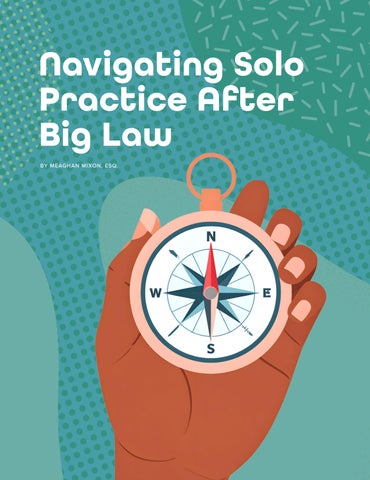
As Rosewood begins its journey this fall, my focus is on offering clients a combination of strategic insight, personal attention, and high-quality representation. For colleagues, I welcome opportunities to collaborate, exchange referrals, and build a community rooted in excellence and integrity. Finding your compass as a lawyer is not about sentimentality—it is about aligning your skills, values, and vision to chart a path forward with confidence and clarity.
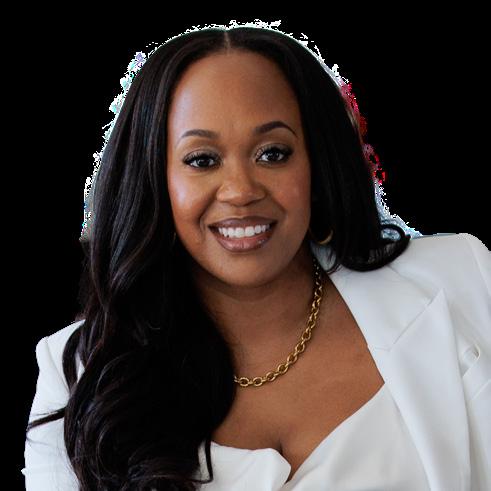
Meaghan Mixon is the founder and managing attorney of The Rosewood Firm, a boutique litigation practice launching in October 2025. She previously practiced at several leading international law firms after beginning her legal career in the D.C. Superior Court, where she worked for the Honorable Yvonne M. Williams in chambers for more than seven years, before and during law school. Meaghan’s practice focuses on family law, criminal defense, and general commercial litigation. Meaghan can be reached at meaghan@rosewoodfirm.com or 202.961.8315.