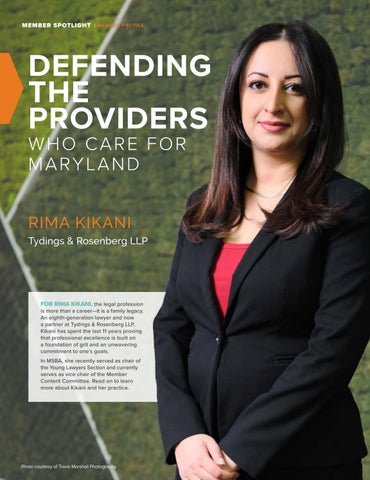
DEFENDING THE PROVIDERS WHO CARE FOR MARYLAND
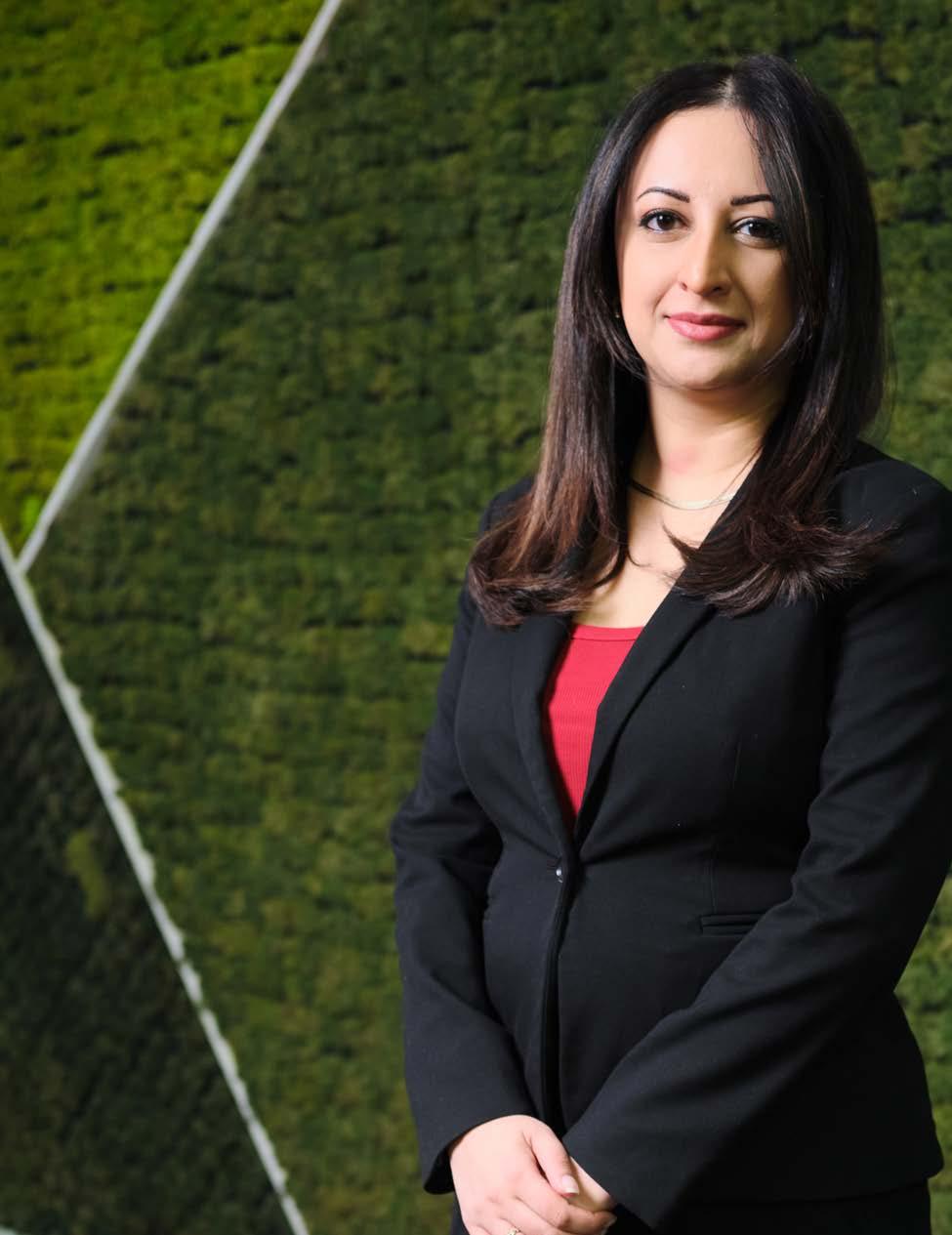
RIMA KIKANI
Tydings & Rosenberg LLP
FOR RIMA KIKANI, the legal profession is more than a career—it is a family legacy.
An eighth-generation lawyer and now a partner at Tydings & Rosenberg LLP, Kikani has spent the last 11 years proving that professional excellence is built on a foundation of grit and an unwavering commitment to one’s goals.
In MSBA, she recently served as chair of the Young Lawyers Section and currently serves as vice chair of the Member Content Committee. Read on to learn more about Kikani and her practice.

What is the best piece of advice you have received from someone in the legal profession?
Your bosses (partners, supervisors, etc.) are your first clients. Treat them like you would a client (work ethic, work product, responsiveness, professionalism, etc.), make them look good (especially in front of the actual client), and you will go far.
What professional accomplishment are you most proud of?
Passing the Maryland bar and sustaining a competent practice. When I was in law school, I was diagnosed with a rare and life-threatening condition. When my physician ordered me into what ended up being life-saving surgery just days before my law school graduation (I obviously missed it), he said to me, “you’re just fighting the clock now.” Everyone thought I was insane for wanting to sit for the bar that July in between ongoing treatment, but I sat for it that same July, passed it, and have managed to practice law for the last 11 years. It’s not always easy juggling appointments, testing, procedures, and treatment with meetings, depositions, and deadlines, but I’ve been doing it for over a decade now and have tried my best to have a “normal” life. In the words of Lee Ann Womack, I’m proud I danced when I had the choice to sit it out, and no one would have blamed me for it.
What are the best skills you bring to your legal career?
My resilience. I am a unicorn when it comes to adapting and bouncing back from challenging experiences, stress, and other difficulties of the legal profession. We (understandably) lose a lot of people in this profession, but I have managed to build a unique ability that not only helps me balance all of my commitments but also helps me excel in the face of adversity.
What do you enjoy most about your career?
Making lives a little easier—which may sound odd to some people, given the nature of my practice. “Medical negligence” is an ominous term, and the rhetoric surrounding these cases often dehumanizes the individuals involved. What so many people fail to understand is that these providers have spent hundreds of thousands of dollars and years in training to help people, not hurt them. Like us lawyers with our cases, in their minds, the providers have done everything they could think of to help their patients and moved forward with the course of action they believe would yield the best results. So when the same providers are accused of hurting people instead of helping them, they do exactly what we do when someone accuses us of malpractice—overanalyze, lose sleep, don’t eat, worry, and obsess over the different scenarios—an attack on their professional license affects them the same way it would affect us or another professional. Although it sounds cliché,
“
Although it sounds cliché, I take pride in helping people who have dedicated their lives to helping others and making their lives a little easier, even though they have much more important things to do.
I take pride in helping people who have dedicated their lives to helping others and making their lives a little easier, even though they have much more important things to do.
Tell us a little bit about your current role.
I am a partner at Tydings & Rosenberg LLP, where I defend health care providers (doctors and hospitals) in medical negligence cases. I am also the immediate past-chair of the Young Lawyers Section and currently serve as the vice-chair of the Member Content Committee.
What are some of the challenges you face in your current role?
As nearly every lawyer will echo, we work tough hours, and work-life balance is a challenge. That becomes especially challenging given the nature of my practice and always trying to learn more medicine, juggling clients, bosses, opposing counsel, etc., holding leadership positions in bars and other organizations, trying to give a 100% at your job and building a business, and then on top of that, trying to balance family, friends, physical and mental health, and other nonprofessional commitments. Although this is a very common complaint among lawyers, we have normalized it so much that we underestimate just how much of a toll it takes on us.
How has MSBA helped you in your legal career?
The networking, connections, and opportunities that MSBA offers are invaluable. Since becoming more involved with the bar over the last eight to nine years, I have met hundreds of people who have become amazing mentors, referral sources, and friends. The MSBA also offers a remarkable opportunity to meet and work with people whom you would not routinely encounter—for example, I have presented on panels with
judges from the Supreme Court of Maryland and local politicians, connected over drinks and dinner with appellate judges I would never otherwise meet, had meetings with members of the U.S. Congress to advocate on issues affecting lawyers, and collaborated on policies, projects, and seminars with innumerable brilliant lawyers I would not have gotten the chance to know and learn from. I think that if utilized correctly, MSBA is an incomparable gateway to some of the best opportunities you can have in your career that allow you to grow both personally and professionally.
As the immediate past Chair of the Young Lawyers’ Section (YLS), what was your primary goal for the section, and how did that work shape your perspective on the future of the MSBA?
My primary goal was to increase active membership. Post-COVID, we have seen a decline in active involvement, especially among younger lawyers who are trying to balance
their careers, families, health, and other commitments. For example, the YLS has well over 1,000 members each year, but very few are actually involved in the section’s work or attend the numerous events organized by the council.
I think cultivating more engagement is vital because young lawyers are the literal and figurative future of MSBA. If we cannot keep them involved, in 20–30 years, we won’t have much of a bar left.
How do you spend your free time?
I am an excellent chef, so you will often find me in my kitchen cooking or baking something. I also love the beach.