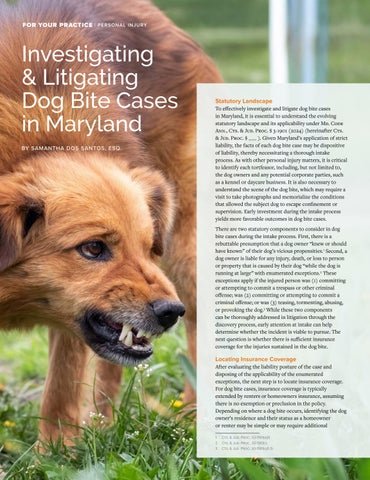
Investigating & Litigating Dog Bite Cases in Maryland
BY SAMANTHA DOS SANTOS, ESQ.

Statutory Landscape
To effectively investigate and litigate dog bite cases in Maryland, it is essential to understand the evolving statutory landscape and its applicability under Md. Code Ann., Cts. & Jud. Proc. § 3-1901 (2024) (hereinafter Cts. & Jud. Proc. § ___ ). Given Maryland’s application of strict liability, the facts of each dog bite case may be dispositive of liability, thereby necessitating a thorough intake process. As with other personal injury matters, it is critical to identify each tortfeasor, including, but not limited to, the dog owners and any potential corporate parties, such as a kennel or daycare business. It is also necessary to understand the scene of the dog bite, which may require a visit to take photographs and memorialize the conditions that allowed the subject dog to escape confinement or supervision. Early investment during the intake process yields more favorable outcomes in dog bite cases.
There are two statutory components to consider in dog bite cases during the intake process. First, there is a rebuttable presumption that a dog owner “knew or should have known” of their dog’s vicious propensities.1 Second, a dog owner is liable for any injury, death, or loss to person or property that is caused by their dog “while the dog is running at large” with enumerated exceptions.2 These exceptions apply if the injured person was (1) committing or attempting to commit a trespass or other criminal offense; was (2) committing or attempting to commit a criminal offense; or was (3) teasing, tormenting, abusing, or provoking the dog.3 While these two components can be thoroughly addressed in litigation through the discovery process, early attention at intake can help determine whether the incident is viable to pursue. The next question is whether there is sufficient insurance coverage for the injuries sustained in the dog bite.
Locating Insurance Coverage
After evaluating the liability posture of the case and disposing of the applicability of the enumerated exceptions, the next step is to locate insurance coverage. For dog bite cases, insurance coverage is typically extended by renters or homeowners insurance, assuming there is no exemption or preclusion in the policy. Depending on where a dog bite occurs, identifying the dog owner’s residence and their status as a homeowner or renter may be simple or may require additional
1 Cts. & Jud. Proc., §3-1901(a)(1)
2 Cts. & Jud. Proc., §3-1901(c)
3 Cts. & Jud. Proc., §3-1901(c)(1-3)
There are two statutory components to consider in dog bite cases during the intake process.
investigation. If, for example, the injured party can identify the property from which a dog fled, a simple search of the Maryland Department of Assessments and Taxation (SDAT) will reveal the named owners of the property. Under these circumstances, there is likely to be active homeowners insurance coverage.
On the other hand, if a dog fled from an apartment complex or another type of rental property, it is more likely that the operative policy is a renters policy. In recent years, it has become increasingly more common to find lapsed renters insurance policies. In both cases, letters of representation are addressed to the dog owner in an attempt to obtain their insurance policies, although we are not always met with cooperation.
In the event that an initial letter of representation is ignored and insurance policies are not provided, dog bite cases proceed to litigation, and service of process is effectuated on the dog owner. Oftentimes, once a dog owner is served, they report the claim and turn over the complaint to their insurance company, which may encourage an amicable resolution. However, when a dog owner is served and fails to file a timely response, there is an immediate concern that the dog owner may lack proper coverage. At that time, there are other avenues to investigate coverage, such as issuing subpoenas to property owners and the corporate offices of apartment complexes, requesting proof of proper rental insurance for their tenants. While locating an active insurance policy better positions the claim for resolution, there may be a policy exclusion that prohibits dog ownership on the subject property. It is essential to read the policy language to ensure whether any claimed exclusions are being appropriately applied or whether any ambiguities in the policy language will need to be litigated as well.
Running At Large & Dangerous Propensities
As the case proceeds, liability may be determined by the simple fact that a subject dog was running “at large.” While some counties offer their own definition of “at large,” the analysis typically involves deciphering whether a dog was off-leash and outside the control of its owner. These fact patterns include a dog escaping from its yard due to unlocked or faulty gates or a dog running away from its owner during a purposefully unleashed walk. While there is some simplicity to determining whether a dog was at large, the enumerated exceptions cannot be overlooked and should be dispelled during litigation through requests for admissions, written discovery, and deposition testimony.
A dog owner must also contend with the rebuttable presumption that they knew of their dog’s vicious propensities. To get ahead of any attempts to rebut this presumption, information regarding prior attacks may be obtained through the Maryland Public
Information Act and simple online case searches. There may also be references to prior bites involving a subject dog through the animal control report or the transcript from an animal control hearing related to the disposition of a dog. Establishing prior notice of a dog’s vicious propensities strengthens the position of the case and weakens a dog owner’s ability to claim ignorance later.
Proving Damages
There is some reluctance among personal injury attorneys to pursue dog bite cases due to potential uncertainty with insurance coverage and the rate at which these cases are litigated. However, there is an upside in potentially collecting from larger renters or homeowners policies in comparison to state-minimum automobile policies. There can also be serious injuries and significant medical expenses accumulated for addressing puncture wounds, stitches, vaccines, and surgical intervention. In these scenarios, medical illustrations and medical cost projections tend to be helpful and inexpensive tools in dog bite litigation to emphasize both the injuries sustained as well as the need for future procedures to address any scarring. While dog bite cases may require more investigation and a bit of niche knowledge, pursuing them can be both economical to a personal injury practice and helpful to keeping our community safe.
The decision to pursue dog bite cases invites an internal tug-of-war among some attorneys. While it may be instinctive to sympathize with a dog and its owner by characterizing a bite as a mere accident, pursuing these cases ensures that dog owners are held accountable for failing to monitor and address their dogs’ unsafe temperaments that pose a threat to the public. The companionship dogs provide generates a positive experience for many; however, holding irresponsible dog owners accountable for their failures in training and supervision remains essential. Both things can be true at the same time.

Samantha Dos Santos, Esq. joined Plaxen Adler Muncy, P.A. in Maryland in 2019 and was elevated to partner in 2024. Before joining the firm, Samantha worked as a judicial law clerk to the Honorable Jeannie J. Hong in the Circuit Court for Baltimore City. She attended George Washington University, where she played Division I Softball, and American University’s Washington College of Law, where she graduated cum laude. Samantha has been recognized as a Rising Star in both Maryland and Washington, D.C. and focuses her practice on personal injury matters.