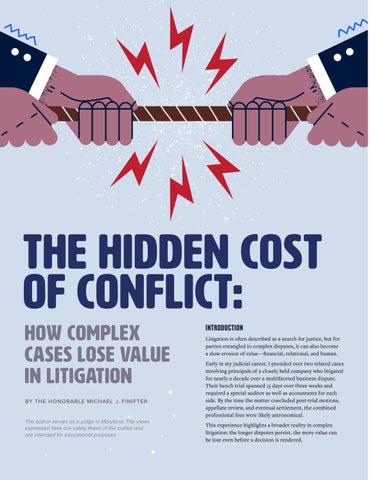
How Complex Cases Lose Value in Litigation
BY THE HONORABLE MICHAEL J. FINIFTER
The author serves as a judge in Maryland. The views expressed here are solely those of the author and are intended for educational purposes.
Introduction
Litigation is often described as a search for justice, but for parties entangled in complex disputes, it can also become a slow erosion of value—financial, relational, and human.
Early in my judicial career, I presided over two related cases involving principals of a closely held company who litigated for nearly a decade over a multifaceted business dispute. Their bench trial spanned 15 days over three weeks and required a special auditor as well as accountants for each side. By the time the matter concluded post-trial motions, appellate review, and eventual settlement, the combined professional fees were likely astronomical.
This experience highlights a broader reality in complex litigation: the longer disputes persist, the more value can be lost even before a decision is rendered.
The Hidden Cost of Conflict:
How Complex Cases Lose Value in Litigation
BY THE HONORABLE MICHAEL J. FINIFTER
The author serves as a judge in Maryland. The views expressed here are solely those of the author and are intended for educational purposes.
Introduction
Litigation is often described as a search for justice, but for parties entangled in complex disputes, it can also become a slow erosion of value—financial, relational, and human.
Early in my judicial career, I presided over two related cases involving principals of a closely held company who litigated for nearly a decade over a multifaceted business dispute. Their bench trial spanned 15 days over three weeks and required a special auditor as well as accountants for each side. By the time the matter concluded post-trial motions, appellate review, and eventual settlement, the combined professional fees were likely astronomical.
This experience highlights a broader reality in complex litigation: the longer disputes persist, the more value can be lost even before a decision is rendered.
Each layer of factual development—— multiple parties, voluminous discovery, overlapping expert analyses——adds both time and expense.
The Economics of Delay
In financially intricate cases—such as partnership dissolutions, contract disputes, or family property divisions—time is rarely neutral. In cases involving complex financial arrangements, even a short delay can materially affect the economic value at stake—as assets depreciate, opportunities are missed, and costs accumulate—a truth apparent to anyone who has traced how these burdens compound over time.
The longer a dispute lingers, the more the underlying subject matter—whether a business, real estate, or investment—can lose value. In such settings, delay is not merely procedural; it is a silent and compounding adversary.
Complexity as a Cost Multiplier
As disputes grow in complexity, so too do their costs. Each layer of factual development—multiple parties, voluminous discovery, overlapping expert analyses— adds both time and expense. Cases involving expert witnesses whose opinions depend on ongoing fact discovery are particularly vulnerable: new evidence often requires further review, supplemental opinions, and additional preparation on both sides before the matter is trial-ready.
These dynamics create an almost gravitational pull toward delay. The more intricate the factual matrix, the greater the administrative and professional friction. It is within this tangle that efficiency—both procedural and strategic—can preserve or destroy the very value the parties seek to vindicate.
The Psychological Toll
Beyond financial consequences, conflict exacts an emotional cost that is often underestimated. Parties commonly begin litigation believing that a judicial determination will bring closure, only to encounter prolonged stress, uncertainty, and fatigue as the process unfolds. Even experienced litigants can find it difficult to make sound decisions when anxiety and attrition take hold.
Heightened tension is particularly pronounced when meaningful discussions between the parties or counsel are deferred. This can exacerbate stress, impair judgment, and complicate decision-making, demonstrating that the hidden costs of litigation extend beyond financial loss to the very human dimensions of dispute.
The Value of Procedural Efficiency
If delay and complexity erode value, efficiency restores it. Courts, counsel, and litigants alike share a stake in processes that move cases forward with clarity and purpose. Timely scheduling orders, disciplined discovery, and realistic trial dates can convert uncertainty into structure—an essential antidote to the entropy of prolonged litigation.
In recent years, virtual and online platforms have shown notable promise in advancing these goals. When feasible, remote scheduling conferences and motions hearings can conserve resources for all involved, reducing travel and waiting time while maintaining procedural integrity. These modest efficiencies, multiplied across a docket, can make a significant difference in both cost and morale.
Procedural efficiency is not merely an administrative virtue; it is a form of respect for the parties, for their resources, and for the judicial process itself.
Litigation, at its best, resolves disputes through the structured application of law to fact. Yet resolution is not always synonymous with judgment. Some disputes, particularly those burdened by complexity or emotion, achieve truer closure through dialogue than decree.
Reflections on Resolution
Litigation, at its best, resolves disputes through the structured application of law to fact. Yet resolution is not always synonymous with judgment. Some disputes, particularly those burdened by complexity or emotion, achieve truer closure through dialogue than decree.
In my experience—and that of many of my colleagues—when parties are given the opportunity to confer before testimony begins, they often discover a path to narrow the issues or resolve the case entirely. These moments remind us that resolution is not always the product of persuasion, but of perspective.
The judicial process exists to serve justice, not inertia. When participants—whether judges, lawyers, or litigants—engage with that spirit of resolution, the system fulfills its highest purpose: not merely to decide, but to restore.
Conclusion
The visible costs of litigation are easy to calculate, but the hidden ones—time lost, relationships frayed, opportunities foregone—often are not. By acknowledging the full spectrum of costs, judges, counsel, and litigants can approach disputes more strategically and preserve value in ways that extend beyond the courtroom.

The Honorable Michael J. Finifter is the chief judge of the Baltimore County Circuit Court and Maryland’s Third Judicial Circuit. He has served as a designated judge for Maryland’s Business and Technology Case-Management Program since 2002. A former certified public accountant, he holds an LL.M. in taxation and has taught as adjunct faculty at the University of Baltimore School of Law.