
EILIDH PIRIE
A Critical Analysis of the Response to ‘A
Sculpture for Mary Wollstonecraft’ by Maggi Hambling
May 2025
Fine Art BA Hons Dissertation
DOI 10.20933/100001379

Except where other wise noted, the text in this disser tation is licensed under the Creative Commons Attribution-Non Commercial-No Derivatives 4 0 International (CC BY-NC-ND 4.0) license.
All images, figures, and other third-par ty materials included in this disser tation are the copyright of their respective rights holders, unless other wise stated. Reuse of these materials may require separate permission
A Critical Analysis of the Response to A Sculpture for Mary Wollstonecraft by Maggi Hambling
Eilidh Pirie
Word Count: 6732
Abstract
This dissertation examines the response to the artwork A Sculpture for Mary Wollstonecraft by Maggi Hambling. The work was commissioned by the Mary on the Green Campaign and installed as a piece of public art in London, in 2020. It is a tribute to Mary Wollstonecraft, who is considered ‘the mother of feminism’, as her work provided the foundation for Western feminist beliefs. As such, she is highly regarded by modern- day feminists, who feel a protective ownership over her legacy.
There was a polarised response to the work from the public and in the media from, amongst others, journalists, academics, art historians and feminists. As a result, there is value in assessing these views against the wider backdrop of critical and feminist art theories, the tradition of commemorative monuments and the potential of public art.
In this dissertation, an argument is presented to show that the fgure in A Sculpture for Mary Wollstonecraft does not conform to the conventions of the typical female nude in historical Western art, nor does it cater to the male gaze, as some critics had suggested.
A Sculpture for Mary Wollstonecraft incited a backlash from many critics who had anticipated a traditional portrait statue of Wollstonecraft . They questioned whether the sculpture was an appropriate tribute It is argued that the sculpture fulflled the artist brief provided by the campaign group and was particularly successfu l in raising awareness of Wollstonecraft and the impact of her work.
Acknowledgements
All third-party material reproduced in this dissertation is used under the UK’s fair dealing provisions for the purposes of criticism, review, or educational use. Any rights holders not acknowledged are invited to contact the author.
Figure 1 .1: Full View: A Sculpture for Mary Wollst onecraft 3
Figure 2.1: Roman Copy of the Knidian Aphrodite 7
Figure 2.2: The Birth of Venus 8
Figure 2.3: Detail: A Sculpture for Mary Wollstonecraft 9
Chapter One: Introduction
Mary Wollstonecraft
Mary Wollstonecraft, born in 1759, was an English writer and philosopher whose work is regarded as the basis of Western feminism . She rebelled against the conventions of her time; she associated with political radicals, supported the French Revolution and often lived and travelled independently. Her socialist ethos and personal desire for fnancial independence inspired her most renowned work, A Vindication of the Rights of Women (1792), the frst text in the English language advocating for equal rights for women. She argued that men and women were equally human, that diferences between them were not due to biology but a product of difering upbringing and societal expectations . According to Wollstonecraft, women, as equally rational and moral creatures, were equally deserving of rights and education
After Wollstonecraft’s death in 1797 (due to complications from the birth of her second child , Mary Godwin, later Mary Shelley, the writer ), her husband William Godwin published a memoir in her honour. As well as praising her literary works, Godwin exposed details of her private life, including the fact that she was unmarried when she had her frst child by the American adventurer Gilbert Imlay and that she had attempted suicide twice, in re sponse to Imlay’s refusal to care for her and the child. Wollstonec raft’s radical feminist philosophies, already proving unpopular in a conservative eighteenth- century Britain, were further discredited after her unconventional lifestyle was made public.
Over time, her ideas gained acceptance and popularity, inspiring the likes of feminist writer Virginia Wolfe and sufragist Millicent Fawcett. The ideas set out in A Vindication of the Rights of Women, have infuenced women’s rights and roles in society today and are still relevant in debates concerning gender, feminism, essentialism and social equality. Consequently, she is often regarded as ‘the foremother of feminism’ (Scobie, 2017; Mary on the Green, 2019; Birch and Fine, 2021).
Mary on the Green Campaign
The Mary on the Green Campaign was launched in 2010 by the charity organisation Newington Green Action Group. The campaign group aimed to install a monument commemorating Mary Wollstonecraft on Newington Green, in London , where she co -founded a school for girls in 1784. The group worked for almost a decade, raising a total of £143,000 to fund the sculpture.
In 2018, having secured almost half of their funding, the group selected proposals from two artists, Maggi Hambling and Martin Jennings , to be considered for the fnal design of the sculpture. The proposals were shared with the public, in a meeting attended by over 750 people, before being judged by a selection panel. The panel, which included the Deputy Curator of the Parliamentary Art Collection, Melanie Unwin, the sculptor Danuta Solowiej and members of the
campaign group, voted strongly in favour of Hambling’s design (Slawson, 2018; Berry, 2020; Mary on the Green, 2020b, Birch and Fine, 2021).
In a statement released on their social media announcing Hambling as the winning artist, the campaign group said:
The judges were unanimous in their agreement that this is a radical proposal embodying radical ideas. The fgure, an everywoman, emerges out of organic matter, almost like a birth. This evokes Newington Green as the birthplace of feminism, and echoes Wollstonecraft’s claim to be “the frst of a new genus.”
- Mary on the Green, 2018
Maggi Hambling
Maggi Hambling (b.1945), is a British painter and sculptor who lives and works in London and Sufolk She studied at the East Anglican School of Art, Ipswich School of Art, Camberwell School of Art and the Slade School. In 1980, she became the National Gallery’s frst artist-inresidence. Her character and artworks have earned her a rebellious reputation , for example, she has always insisted on being photographed and interviewed while holding a cigarette, to signal her belief in freedom of choice (BBC, 2020 b; Figes, 2022; Russel, 2022). Furthermore, her public sculptures have proven to be extremely controversial and have divided public opinion. Her 1998 sculpture, A Conversation with Oscar Wilde, located in central London, depicts a stylised torso of Oscar Wilde emerging from a cofin -shaped bench, mouth open and cigarette in hand, as if in conversation. It received a particularly vicious review from Tom Lubbock, writing for The Independent , who described the sculpture as “a plain disaster ”, “a tragedy” and “tourist tat” (Lu bbock, 1998). Similarly, her 10 -foot steel sculpture of a scallop shell, Scallop, dedicated to composer Benjamin Britten, was met with criticism after its unveiling in 2003 on Aldeburgh beach (Hambling, 2010). Some local residents objected to the sculpture’s location, believing that it spoiled the view of the coastline, (Kennedy, 2003; Ezard, 2004).
Hambling , seemingly unbothered by such comments, has often quoted Oscar Wilde saying: “when the critics are divided, the artist is at one with himself ” (Thorpe, 2020). Evidently, the controversy caused by her previous public artworks did not dissuade her from making A Sculpture for Mary Wollstonecraft .
Hambling collaborated with a team from Arch foundry to realise her design for A Sculpture for Mary Wollstonecraft . The fnal 10 -foot sculpture was cast in bronze using the lost wax process and fnished with a silver patina (Birch and Fine, 2021). The sculpture depicts, in Hambling’s own words, “a tower of intermingling female forms culminating in the fgure of the woman at the top who is challenging, and ready to challenge, the world” ( Hambling quoted by Mary on the Green, 2020).
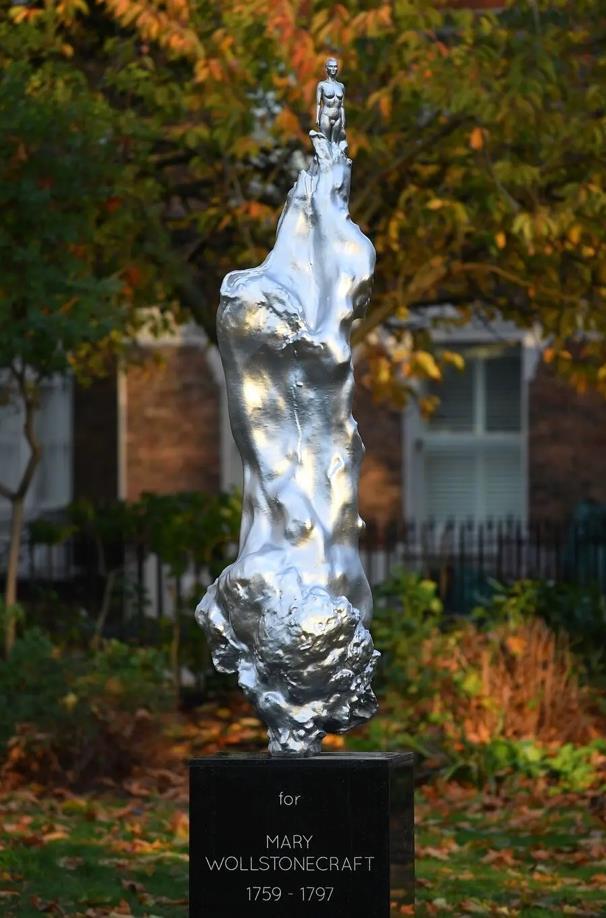
A Sculpture for Mary Wollstonecraft , Maggi Hambling, 2020, Sculpture, London
Image © Justin Tallis, 2020. Available at: <https://www.nytimes.com/2020/11/12/arts/design/marywollstonecraft-statue-london.html> (Accessed: 11/01/2025).
A Sculpture for Mary Wollstonecraft: Unveiling
A Sculpture for Mary Wollstonecraft (see Fig. 1.1) was installed on 9 th November 2020 , during the Covid-19 Pandemic. Lockdown restrictions in place at the time meant that the group were not able to host a typical in-person unveiling event. Instead, a few members of the campaign
Figure 1.1: Full View: A Sculpture for Mary Wollstonecraf t
group were granted permission to attend the site and live -stream the event via Facebook and Twitter (now X) (Birch and Fine, 2021).
A Sculpture for Mary Wollstonecraft was equally, if not more, controversial than Hambling’s previous public sculptures. There was an immediate and passionate response to the work on social media. An extensive online viral debate ensued, which primarily questioned whether the sculpture, containing a nude female fgure was an appropriate tribute to feminist icon Mary Wollstonecraft. The sculpture, and subsequent backlash , received widespread press coverage, predominantly published online.
It is impossible to say exactly how the Covid -19 pandemic and associated social restrictions afected the response to the sculpture. However, it may explain the online response from both the public and press; during the pandemic there was a large shift from print to online news consumption and an increase in the average amount of time people spent on social media (Newman et al., 2021, Pennington, 2021).
Despite the risks and restrictions present during the pandemic, several members of the public attended the sculpture in-person. Amongst them were protesters determined to make their disapproval of the sculpture visible. Some made alterations to the sculptu re: on separate occasions, its nude fgure was covered using duct tape, face masks and a t - shirt. Others left placards beside the sculpture, including one which read ‘is this really our tribute to the mother of feminism?’ (Chapman, 2020; West -Knights, 2020).
Dissertation Intentions
This dissertation will analyse the public and press response to A Sculpture for Mary Wollstonecraft with reference to critical and feminist art theory. Prominent aspects of the response will be examined, including the discussion surrounding the inclusion of the nude female fgure, the disappointment expressed by many critics that the sculpture was not a traditional portrait statue dep icting Wollstonecraft and the perceived successes and failures of the artwork as a public, feminist and commemorative artwork.
Chapter Two: An Idealised Nude?
Criticism of the Nude
The inclusion of the nude female fgure in A Sculpture for Mary Wollstonecraft proved extremely controversial amongst the public and critics. Harriet Hall, writing for The Independent (2020), expressed her disappointment with the form of the fgure, and said: “[Hambling has] embraced a patriarchal way of observing the female form, leaning directly into a centuries -long Western art historical tradition of female objectifcation”.
These sentiments were echoed by Rhiannon Cosslett, writing for The Guardian (2020), who additionally criticised the term “everywoman”, used by the artist and the campaign group to describe the fgure. She said: “the “everywoman” idea is in itself problematic, harking back to the idealised, objectifed nudes of the past, those hollow symbols of femininity that for so long represented the containment and subjugation of women”.
To assess the validity of these statements and provide a template for comparison, it is essential frst to examine the history and legacy of the female nude within Western art through a feminist lens
The
Power of Looking
Referring to prominent historical European a rtworks, in Ways of Seeing, frst published in 1972 , John Berger wrote:
Women are depicted in a quite diferent way from men – not because the feminine is diferent from the masculine – but because the ‘ideal’ spectator is always assumed to be male and the image of the woman is designed to fatter him.
Furthermore, he described how men assuming the role of the artist, thinker, patron and/or owner are allowed their individualism . By contrast, the women depicted in their paintings are not aforded the same treatment. He said: “ the person who is the object of their activities – the woman – [is] treated as a thing or an abstraction” (Berger, 1972)
Berger described how women have typically been objectifed in Western art, their bodies reduced to an unrealistic, sexualised ideal that catered to the male gaze.
Feminist analyses of Western art history have considered both these representations of women and the social and political circumstances in which th ey have been produced . In Vision and Diference (1988), Griselda Pollock argued: “If the dominant ideology is formed by men for the beneft of men, then both the art that is produced and the way that art is viewed, will predominantly speak to patriarchal interests ” (Jakubowicz, 2017).
This is demonstrated by the way that, historically, men have dictated which representations of women are considered ‘ideal’, tasteful or valuable by holding infuential roles as the artists and commissioners of these works, as curators who decide d which works were given prominence in galleries and museums and as writers who perpetuate d the prominence of these images within
the study of art history. Held back from education and employment, women were systematically excluded from holding these positions.
Furthermore, the infuence of the ‘power of looking’, specifcally the power aforded to those able to look at and study bodies, cannot be understated. Historically, women were not allowed to look at or learn about bodies, internally or externally, either as doctors or artists. As late as the middle of the twentieth century, in art academies in the UK, women artists were not permitted to enter the life room, despite life drawing being considered a central practice to artistic training. It was not deemed socially acceptable for women to observe the naked body or produce images of it. A s a result, men had sole access to the production of culturally signifcant images of the female body, in paintings, sculpture, flm, advertising , medical and anatomy textbooks. Men were able to create the defnitions and norms of ideal health and beauty to which women were expected to aspire to. In Western art, women were represented as they were seen by those with the power of looking: white, heterosexual men (Nochlin, 2015 ; Nead, 1992; McCormack, 2021) .
The infuence of these images on how women were expected to appear and behave is still fel t today, especially in Western society This is exemplifed by the following passage from Catherine McCormack’s book Women in the Picture (2021):
Images of women as sex objects, whether in newspapers or in oil paintings, have the power to shape archetypes that can threaten and undermine gender equality. Women are socialised from an early age to comply with hyper sexual stereotypes found in both fast-moving media and 'high art' and cultural representations, which consequently become the default norm . And seeing women as sexually available images found everywhere from the art gallery to the workplace to the top deck of the bus on the way to school, creates a totalising environment of erotic privilege for straight men.
Venus
In Women in the Picture (2021), McCormack highlight ed Venus (the Roman mythological goddess of love) as a prominent archetype within Western art and culture, symbolic of ideal femininity. Attaching the label of ‘Venus’ suggested to the viewer that they were seeing somethi ng otherworldly and distinctly non-human, despite images of Venus typically depict ing a naked woman. The prom inence and reverence of these images in Western art galleries only reinforced Venus’ status as the epitome of womanhood. Furthermore, as McCormack argued, Venus has “spawned an avalanche of imitations within and beyond the walls of the gallery that have impacted the way women live and perceive their bodies ”.
Images of Venus have provided a template for the idealised female nude within historical Western art and thus Venus is a highly appropriate figure to analyse A Sculpture for Mary Wollstonecraft against. One of the sculpture’s critics even described it as “an allusion to the creation of Venus from the spray of the sea” (Bartosch, 2020).
Furthermore, the earliest known version of Venus, the Knidian Aphrodite (Aphrodite was the Greek goddess of l ove, later adopted and renamed Venus by the Romans) , was itself a public sculpture. Dating back to 350 BCE, the Knidian Aphrodite was a marble sculpture originally located in an ancient Greek temple. Although the sculpture no longer exists, through analysis of the existing imitations and textual references , it has been possible to estimate how the original sculpture would have looked. The sculpture d epicted a nude woman holding a bathrobe (McCormack, 2021).
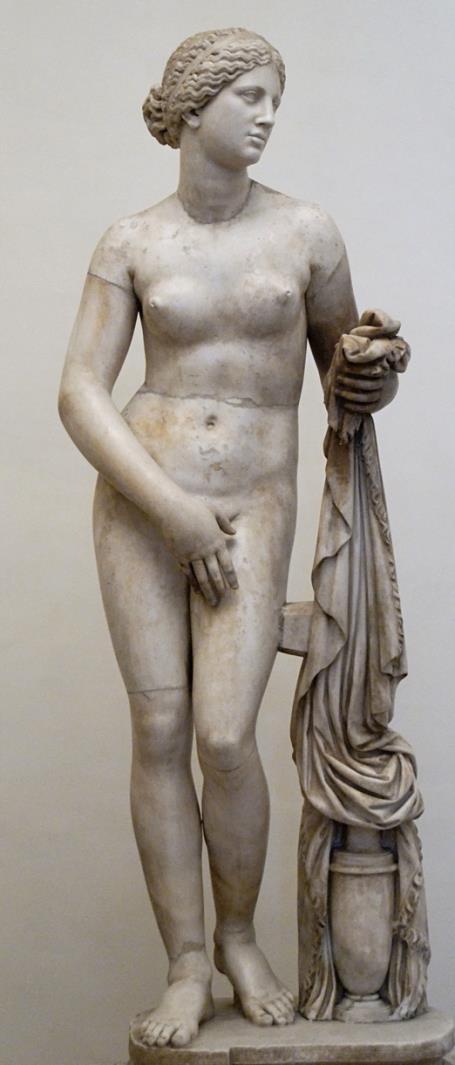
2.1: Roman Copy of the Knidian Aphrodite
Roman Copy of the Knidian Aphrodite, Unknown Artist, Unknown date, Sculpture
Available at:<https://commons.wikimedia.org/wiki/File:Cnidus_Aphrodite_Altemps_Inv8619.jpg > (Accessed: 11/01/2025).
Figure
In a Roman reproduction (see fig. 2.1), the figure appears to be aware of the viewer’s presence and is self-conscious of her nudity – her hand covers her groin. This pose, the ‘Venus pudica’ makes the viewer simultaneously aware of the sub ject’s sexuality and shame. It has been reproduced in countless images of the female nude in Western art and has reinforced a societal expectation that women should be both sexually available and ashamed of their sexual organs. McCormack argues that the Knidian Aphrodite, along with Sandro Botticelli’s painting, The Birth of Venus (c.1485 ), provide the “DNA” for all other reproductions of Venus (see fig. 2.2).
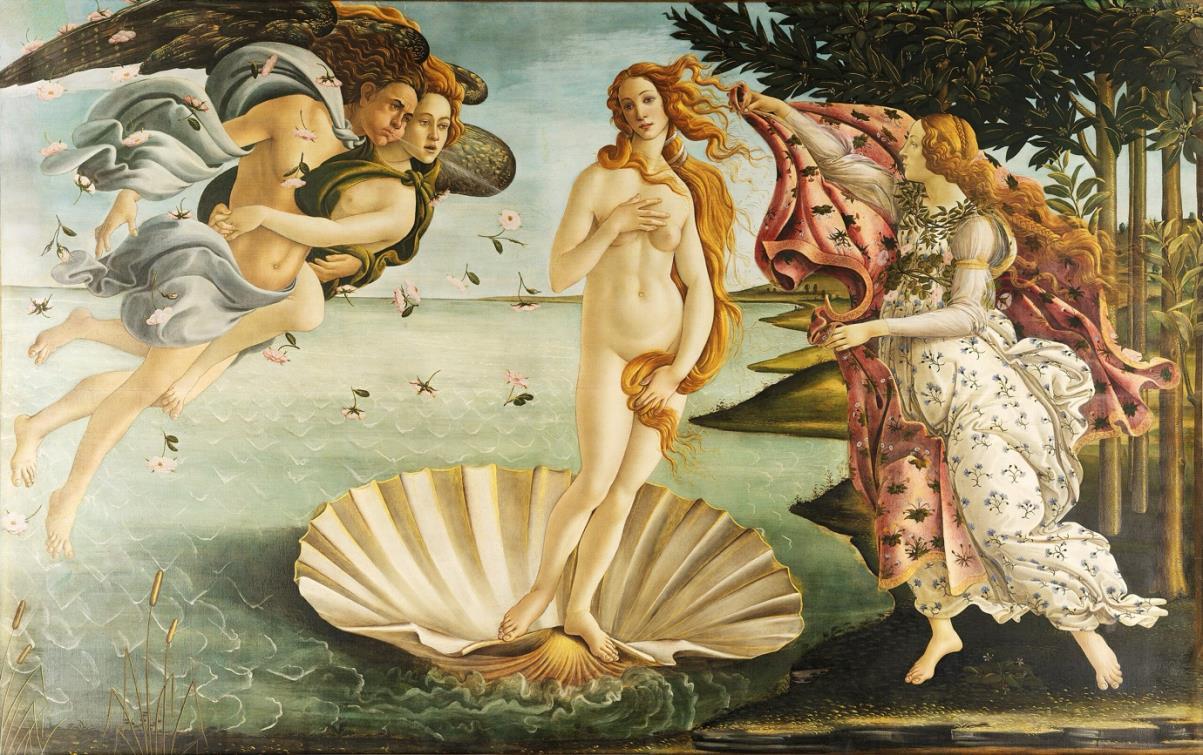
The Birth of Venus, Botticelli, c.1485, Sculpture, Ufizi Gallery, Florence
Image: Wikimedia Commons. Public Domain. Available at: <https://commons.wikimedia.org/wiki/File:Sandro_Botticelli_ -_La_nascita_di_Venere__Google_Art_Project_-_edited.jpg > (Accessed: 11/01/2025).
Botticelli’s Venus ha s smooth, white, flawless flesh. She is youthful, with high, round breasts and her body is both toned and softly curved. She, like the Knidian Aphrodite, adopts the Venus pudica pose, drawing attention to her sexuality. Her placid expression comforts the viewer, encouraging their gaze in a knowing performance of sexual availability. The only hair on her body is on her head; pubic hair is notably absent in idealised Venuses This represents a paradox; Venus must be sexually available without showing signs of sexual maturity. Images of Venus have infuenced the beauty standards that our current society values. Women must work to alter themselves, for example, by shaving their body hair, to conform (McCormack, 2021).
Figure 2.2: The Birth of Venus
A Sculpture for Mary Wollstonecraft : Another Venus?
Having outlined the classic hallmarks of images of Venus, who so ofte n represented the ideal female nude within Western ar t, it is now possible to ascertain whether these features are present within figure of A Sculpture for Mary Wollstonecraft
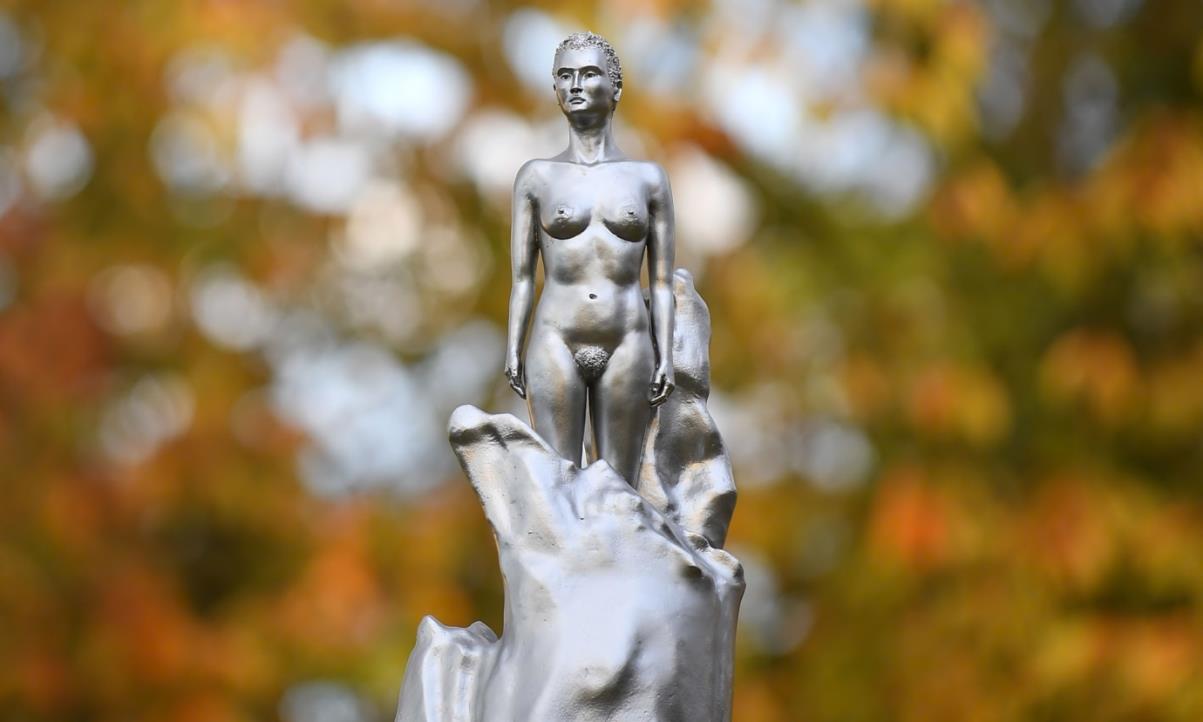
A Sculpture for Mary Wollstonecraft , Maggi Hambling, 2020, Sculpture, London
Image © Justin Tallis, 2020. Available at: <https://www.telegraph.co.uk/news/2021/06/02/artist -accusesfeminists-criticised-nude-mary-wollstonecraft/ (Accessed: 11/01/2025).
The shape of the figure’s body does reflect features of Venus (see fig. 2.3). Critics condemned Hambling for depicting a figure that was “conventionally attractive” (Gowar quoted in Singh, 2020 b). They described the figure as youthful, toned, slim, athletic and classically desirable (Hall, 2020; Cosslett, 2020; Ward, 2020 ). Jo Bartosch, writing for The Critic (2020), condemned Hambling’s attempt to depict an “everywoman”. She said : “Had the Wollstonecraft statue have really depicted an “everywoman” then the fgure at the top of the piece would be replete with stretch marks, sagging breasts and cellulite ”.
Hambling, offended by the attacks on her “everywoman ”, replied: “As far as I know, she’s more or less the shape we’d all like to be” (Hambling quoted by Dex, 2020).
Figure 2.3: Detail: A Sculpture for Mary Wollstonecraft
This hasty response is problematic, implying that Hambling’s everywoman represents an aspirational ideal, mimicking the ethos of historical Western female nudes. The figure depicted in A Sculpture for Mary Wollstonecraft is not an accurate representati on of all women’s bodies, nor should it aim to represent a singular ‘aspirational’ body type. As Lynda Nead argued in The Female Nude (1992), the hyper-visibility of a singular type of female body in Western art can also be regarded as a “tyranny of invisibility ”, exclusive of the myriad different types of female bodies. It implies that these body types are not worthy of representation , regarded as ‘other’ or outwith the norm, in both art and society .
The figure in A Sculpture for Mary Wollstonecraft , however, does not fully comply with the stereotypical hallmarks of Venus. Notably, the figure does not adopt the Venus pudica pose Instead of embodying shame, vulnerability and appearing sexually available, the figure’s stance is confident and assured. This was noted by fans of the sculptur e; the figure’s pose was described as “strong, upright, energetic” (Chisholm, 2020). Olivia Alabaster, writing for The Independent (2020) thought that the pose signalled “a woman who is fearless and brave ”.
Another key difference between Venus and the figure in A Sculpture for Mary Wollstonecraft is the figure’s hair on both her head and body. The fgure lacks Venus’ iconic long hai r, a signifer of her beauty and femininity and instead sports a short, masculine cut, although none of the articles examined in the research for this dissertation made this observation Furthermore, unlike Venus, the fgure has prominent pubic hair. Interestingly, instead of celebrating this progressive imagery of an adult woman with natural body hair, some writers were instead critical (See Bartosch, 2020; Cooke, 2020; Hall, 2020). They felt that the pubic hair was too prominent, an uncomfortably gauche reference to feminism. This demonstrates the fawed expectations of the sculpture’s critics: the nude was criticised for conforming to an ideal and for its visual diferences from this ideal
This is further emphasised by criticism of the fgure’s facial expression. The fgure was described by one critic as a “sour-faced sprite”. (West-Knights, 2020). Venus’ expression is often calm and placid, comforting the viewer as they visually consume her. By contrast, the expression of the fgure in A Sculpture for Mary Wollstonecraft is defant. Rather than putting the viewer at ease, the efect is confrontational. In a sculpture that represents the ongoing, un fnished battle for gender equality, this is highly appropriate.
Hambling was accused of catering to the male gaze, adopting the classic power dynamic embodied in historical Western female nudes, where the ‘ideal’ spectator is assumed to be a (white heterosexual) man (see Bartosch, 2020; Cosslett, 2020; Hall, 2020). These comments were refuted by fans of the sculpture. Kate Chisholm , writing for The Spectator (2020), said: “This is not a nude in any conventional sense, to be gazed upon or salivated over, but rather an unadorned human being, springing into life without preconceived ideas or stale obligations ”.
Fans argued that the nude fgure was not the dominant aspect of the sculpture, nor was it presented for the (sexual) enjoyment of the viewer, male or otherwise. At the peak of a 10 -foot tall sculpture, the fgure was much higher than comfortable viewing level, placing the viewer literally and symbolically beneath it (Chisholm, 2020; Ward, 2020).
A simple, but necessary distinction, placing the figure apart from sexualised images of the female nude in Western art was made by Bendor Grosvenor, writing for Financial Times (2020), who described the figure as “nude, but not erotic ”.
This ethos was echoed by Alabaster, writing for The Independent (2020), who said:
Nudity, I don’t think, is inherently sexual, though – and nor should it be seen to be. When women are thrown out of cafes for breast -feeding, or told to cover up, we rightly baulk at this. Our bodies are lots of things, and they can be sexual, but they can also be strong and powerful, and can help defend us against the world. They bring us pain and they bring us joy and they are the only thing we all have.
As previously mentioned, the dominance and omnipotence of hyper -sexualised images of women in art and society is problematic, creating a “totalising environment of erotic privilege for straight men” (McCormack, 2021). However, equally dangerous is the tota l censorship of women’s bodies, regarding them as taboo. To label a nude female body as sexual (or as a sexual object), simply because it is unclothed, negates the potential for it to be viewed as anything else.
Chapter Three: Sculpture versus Statue
S culpture versus Statue
For clarity, the term ‘sculpture’ used here refers to any sculpted three- dimensional artwork that is abstract or representational. A ‘statue’ is a sculpture that is a life -like depiction of a person.
A sizeable portion of the public and press response to A Sculpture for Mary Wollstonecraft centred around the fact that it was not a traditional portrait statue of Mary Wollstonecraft. This stimulated a contentious debate: some praised the sculpture for its novel approach to commemoration in public art whereas others felt that depriving Mary Wollstonecraft of a conventional portrait statue was akin to dishonouring her
Comparison to Commemorated Men
Amongst articles and comments about the A Sculpture for Mary Wollstonecraft , there was a tendency for writers to compare it with monuments dedicated to men. They highlighted that men have typically been commemorated with traditional portrait statues in Britain (See for example: Bartosch, 2020; BBC, 2020 a; Campbell-Johnston, 2020; Cosslett, 2020, Durrant, 2020; Faulkner, 2020; Hall, 2020; Singh, 2020; Sky News, 2020; Topping, 2020).
Rachel Campbell-Johnston, writing for The Times (2020) said: “[Mary Wollstonecraft’s] male counterparts are always clothed. We don’t have a nude Byron prancing down Park Lane or Adam Smith in the nuddy on Edinburgh’s Royal Mile ”. She was one of several writers who asked readers to imagine naked statues of various famous historical men, including Churchill, Dickens and Mandela, as well as Byron and Smith (Campbell -Johnston, 2020; Durrant, 2020; Hall, 2020; Faulkner, 2020; Topping, 2020). They implied that readers would fnd it absurd if a famous man was commemorated with a nude sculpture.
Hambling responded to these comments in an interview following the sculpture’s unveiling and made reference to Cosslett’s assertion that a man would not be “ honoured with his schlong out” (Cosslett, 2020) . She said: “Oh, but there are plenty of schlongs honouring men in art” (Hambling, 2020) . She then listed her favourite male nude sculptures to the interviewer, including the Elgin Marbles and Michelangelo’s David (Hambling, 2020) . In doing this, she tried to point out that there are examples of the male nude within Western art that ‘honour’ maleness, the ideal of the male personifed by a character in myth or biblical story.
The male nude carries very diferent connotations from the female nude within historical Western art. Recall the ‘Venus pudica’ with its origins in Ancient Greek sculpture Venus’ nudity, in conjunction with her pose signal led her shame, vulnerability and sexual availability in relation to the viewer. By contrast, sculptures of the naked male form in Ancient Greece represented power and heroism. They depicted aspirational intellectual and political ideas (McCormack, 2021). If the female nude has functioned as a refection of male desire within historical Western art, the male nude has functioned to compliment the male ego, attaching positive and powerful connotations to the male form. While the norms surrounding nudity may have changed, t he way
the male body has been presented and regarded in art and public sculpture remains the same. The ideals that the Ancient Greeks tied to the male body are still imbedded in the traditional British statue; although clothed, they are heroic, aspirational depictions of men .
What Hambling alluded to, that men have historically been ‘honoured’ and fattered by representations of the male nude in sculpture, is therefore accurate. That’s not to say that society would consider a naked version of a male statue as appropriate as a clothed version. But it is an inappropriate allegory, suggesting that the fgure in A Sculpture for Mary Wollstonecraft is a naked version of Mary Wollstonecraft , which it is not. It is a sculpture that includes a nude fgure and not a naked statue.
Conventions of Traditional Statuary
Several critics’ reliance on the traditional statue as a point of comparison for A Sculpture for Mary Wollstonecraft meant that they assumed the viewpoint that a statue was the default, if not ideal, way to commemorate an individual in public art. They suggested that defying this classic format denied Mary Wollstonecraft the respect that a portrait statue supposedly confers. They argued that the campaign group should have adhered to tradition.
Other writers pointed out the limitations and inaccuracies of th is traditional convention (Barrett, 2020; Grosvenor, 2020). Helen Barrett, writing for the Financial Times (2020) said: “ We still struggle to accept anything other than literal representations of humans on plinths, even as we see a statue of a 1 7th- century slave trader causing 21st- century trauma in this year’s Black Lives Matter protests”.
Barrett’s comment refers to a Bristol Black Lives Matter protest in June 2020 (just a few m onths before the installation of A Sculpture for Mary Wollstonecraft) , where the statue of the slave trader Edward Colston was pulled down, rolled through the streets and thrown into a harbour (Grovier, 2020). In response, historian David Olusoga said: “Statues are about saying ‘this was a great man who did great things.’ That is not true, he [Colston] was a slave trader and a murderer ” (Olusoga quoted by BBC News, 2020c).
As a result of the Black Lives Matter protests, Britain was forced to face up to its colonial past and to re- examine the appropriateness and modern- day relevance of its statues. One year after the Edward Colston statue was felled, almost 70 memorials to enslavers or colonialists across Britain were either removed or altered to include an explanation of their complex history, in order to comply with the government’s ‘retain and explain’ guidance (Mohdin and Storer, 2021; Department for Culture, Media and Sport, 2023).
It is evident that people care deeply about who is represented in Britain’s statues. More so, when the people depicted by these heroic monuments are no longer considered to be “great”, as Olusoga remarked. There are also concerns about the diversity of people represented by public monuments; the majority of the UK’s statues are depictions of white men, according to a survey conducted by ArtUK in 2021. Furthermore, of 2,600 public sculptures dedicated to named people in the U K that ArtUK surveyed , 77.5% were dedicated to men, whereas only 17%
were dedicated to women. Less than 2% of the sculptures were dedicated to people of Black, Asian and other ethnicities (Goodwin, 2023).
A Sculpture for Mary Wollstonecraft is a public sculpture dedicated to a named woman and thus would meet the criteria for inclusion in the survey. However, several writers believed that Mary Wollstonecraft has been denied representation by being denied a portrait statue (See Sky News, 2020 ; Topping, 2020 ).
Celebrating an Idea over an Individual
For both the artist and the campaign group, the move away from the conventional statue was a deliberate choice, representing a shift from celebrating the individual to celebrating their ideas and legacy. In her statement pitching A Sculpture for Mary Wollstonecraft to the campaign group, Hambling wrote:
As opposed to traditional heroic statuary, the free -standing woman has evolved from, is supported by, and does not forget, all her predecessors who advocated, campaigned and sacrifced themselves for women’s education and emancipation
– Hambling quoted by Birch and Fine, 2021
Bee Rowlatt, Chair of the Mary on the Green campaign group said:
By choosing Maggi we understood that we were choosing a sculpture that attempted to represent the birth of a movement, rather than a representation of Wollstonecraft herself. We were excited by the idea of getting away from putting people on pedestals, which frankly is not in the spirit of Wollstonecraft’s philosophy.
– Rowlatt quoted by Thorpe, 2020
In other words, they were aiming to depict Wollstonecraft’s legacy instead of her image. The sculpture references feminism as a movement instigated by Wollstonecraft but also as something that has evolved beyond her to hold new meaning.
However, critics of the sculpture felt that this was unfair and deprived Wollstonecraft individual representation. Hall, writing for the Independent (2020) said: “ Why must this woman be forced to represent all women when countless men from history have been honoured on their own terms?”
Similarly, Caroline Criado -Perez (an instrumental fgure in the campaign to install a statue of sufragist Millicent Fawcett in Parliament square ) said: “We’ve celebrated so few women from the past that the temptation is to attempt [to represent] all of womanhood, which is never an issue when it’s a male statue” (Criado-Perez quoted by Topping, 2020).
Nevertheless, Hambling and the campaign group received praise for choosing an alternative type of monument (Alabster, 2020; Grosvenor, 2020). Chisholm , writing for The Spectator (2020) said: “The dignity, insight and ‘greatness of soul’ of Wollstonecraft could never have been contained in a straightforward statue. Nor would she ever have wished to be memorialised as a grandee, in a static monument”.
By defying expectations and causing public debate, A Sculpture for Mary Wollstonecraft brought Wollstonecraft to the attention of an audience who preciously would have been unaware if her story, her work and her legacy. It is highly unlikely that a traditional statue of her likeness would have achieved this.
Chapter Four: Measuring the ‘Success’ of A Sculpture for Mary Wollstonecraft
Was A Sculpture for Mary Wollstonecraft Successful?
This chapter will consider the success of A Sculpture for Mary Wollstonecraft relative to the aims of the campaign group, the expectations of the public and how well it commemorated Mary Wollstonecraft.
The debate inspired by A Sculpture for Mary Wollstonecraft prompted the public to voice their opinions on its success as a piece of public art. As discussed in the previous chapter, the fnished sculpture was not what many members of the public had envisaged . Some felt that as public art, the piece should have catered to the expectations and aesthetic tastes of the general public by being a traditional statue of Wollstonecraft . This, they argued, was a key parameter by which to measure its success.
Other parameters were suggested Imogen West-Knights, writing for ArtReview (2020) commented on the complex requirements of public art : “it is so difficult to get right, needing to somehow represent the interests of the artist, the commissioner, the local powers that be, the subject themselves and ‘the general public’, whoever they are ”.
Fulflling the Artist Brief
Sections of the brief released by the campaign group for the commission were included in Anna Birch’s contribution to Wollstonecraft Live! & The Story of the Statue (2021) Outlined frst were the core requirements of the artist: “Produce a sculpture which will refect the achievements of Mary Wollstonecraft and enhance the identity and positive future of the area”.
Note that they did not stipulate any need for a traditional statue, but a sculpture that focussed on Wollstonecraft’s achievements. A Sculpture for Mary Wollstonecraft is highly successful in this regard. Wollstonecraft’s achievements are her work and ideas . Arguably, these are more relevant in our current society than they were in Wollstonecraft’s lifetime and the sculpture acknowledges that modern feminism would not have evolved without the foundations she laid.
Furthermore, the brief stipulated that the sculpture should “be touchable and refect engagement and debate in its setting ”. As is evident by the enormous and passionate response, the sculpture certainly encouraged engagement and heated debate. Furthermore, it brought attention and notoriety to both Mary Wollstonecraft and Newington Green.
The sculpture fulflled the requirements of the brief given to the artist so can be judged a success in this regard.
Pleasing the Public
Despite meeting the brief, the various fery responses to A Sculpture for Mary Wollstonecraft illustrate that not everyone thought it was successful. Rachel Cooke, writing for The Observer
(2020) said: “ I’ve been in a rage. Trust me. No photograph does its Bacofoil badness justice ”. Similarly, historian Simon Schama was quoted by the BBC saying he had “ always wanted a fne monument to Wollstonecraft - this isn't it” (Schama quoted by BBC, 2020 a). Both referred to the sculpture as if it had personally ofended them; it failed to meet their personal expectations and therefore they deemed it unsuccessful Several writers alluded to a sense of ownership that the public felt they had of both Wollstonecraft and her commemorative monument. They felt that the public should have had a say in what a monument dedicated to Wollstonecraft should be. (see BBC, 2020 a; Cooke, 2020; Cosslett, 2020; Durrant, 2020; West -Knights, 2020). In reality, the conception of the tribute belonged to the campaign group, without whom there would not have been a monument dedicated to Wollstonecraft.
On their Facebook page, the Mary on the Green campaign said: “We understand that not everyone agrees with the end result”, whilst also asserting that Hambling’s design was chosen through a “competitive, consultative process” and had been in the public domain since 2018 (Mary on the Green, 2020a). Th e campaign group were surprised by the backlash, as they had been transparent about the design when it was chosen. It was only after the installation that the public furore began. Their decade-long initiative to secure enough funding to install the monument had unfortunately lacked such attention and engagement
Hambling’s proposal was one of two considered for the fnal design of the statue. The other was put forward by the artist Martin Jennings, who spoke out against Hambling’s sculpture after it was unveiled. He said a “celebrity” artist such was unsuited to responding to public commission and lacked the relevant experience to do so. He said: “It’s very much about listening to your audience, not much about promoting yourself as an artist and celebrity” (Jennings quoted by Singh 2020a ).
However, it would be impossible to cater to the needs of the whole public before commissioning and installing a piece of public sculpture. And what about those members of “the audience” who supported the design? (see for example: Alabaster, 2020; Grosvenor, 2020; Nairne, 2020).
The di ficulty in listening to the public’s thoughts on A Sculpture for Mary Wollstonecraft , is that there was no clear universal opinion. The sculpture was both hated and admired for a variety of diferent reasons Individual members of the public have diferent opinions about what public art should look like and thus the public as a whole is impossible to please.
Commemorating Mary Wollstonecraft
As well as expressing concern about the form of the sculpture, the public questioned its success in commemorating Mary Wollstonecraft. Rowlatt, as Chair of the Mary on the Green campaign, said that she felt that in the end , the group had provided both “traditional commemoration” and “something diferent” (Rowlatt, 2021).
A Sculpture for Mary Wollstonecraft undoubtedly succeeded in educating a wide audience about the work and legacy of Mary Wollstonecraft . The press storm and online discussion meant that Mary Wollstonecraft trended on Twitter and in Google searches. The campaign group certainly felt they had achieved their goal to commemorate Wollstonecraft by raising awareness of her work and legacy (Birch and Fine, 2021).
The group were praised for their success in bringing Wollstonecraft to the forefront of attention (see for example: Campbell-Johnston, 2020; Grosvenor, 2020). Chisholm , writing for The Spectator (2020) observed:
If the intention behind the statue campaign was to ensure that all those who see it would go away and fnd out more about the woman who inspired it, then it has succeeded brilliantly. Hambling’s provocative creation accurately refects the strange, wilful combination of headlong folly and m easured, intelligent response that characterised Wollstonecraft.
A Sculpture for Mary Wollstonecraft demonstrated that public art, especially when commemorative, has the power to engage and educate the public. It stimulated interesting debates about feminism , feminist art and public art. Most importantly, it brought a new audience to the work of Mary Wollstonecraft Commemoration is about remembering , and this unique monument has ensured that Wollstonecraft will be remembered for generations.
Is
A Sculpture for Mary Wollstonecraft a Feminist Art work?
The success of A Sculpture for Mary Wollstonecraft as a feminist artwork was questioned by various writers, especially since it included a female nude, as discussed in Chapter Two Bartosch, writing for The Critic (2020) said: “One can’t help wondering whether the apparently “feminist” reading was added along with the silver- coloured coating, after the body of the piece was fnished ” . In other words, she did not conside r the sculpture to to be a feminist artwork.
According to Nead in The Female Nude (1992), ‘feminist art’ has no singular aesthetic and is not limited by style or media. Furthermore, it does not depend on the gender or intentions of the artist, given that interpretation of the artwork in a certain way is not guaranteed. Nead argued that feminist art disrupts dominant historical ideologies. She wrote:
The work can be defined as 'feminist' at the moment it […] intervenes in the dominant codes of artistic practice and definitions of gender and sexual difference. […] This has particular implications for visual images of the female body; in this case, the intervention will be in the structures of male sexuality and pleasure that are conventionally set in place by the female nude.
Chapter Two outlined the history of the idealised nude and its dominance in the Western art world. It confirmed that the female nude within A Sculpture for Mary Wollstonecraft defied convention and was not designed to satisfy the male gaze. In this way, the sculpture is firmly within the boundaries of feminist artwork.
Furthermore, A Sculpture for Mary Wollstonecraft defies the structure of traditional commemoration by providing a s culpture instead of a representational statue. This representational tradition has tended to align with the interests of the patriarchy , favouring the portrayal of white men. It has also helped to encourage the idea that the white male body represents “greatness”, simultaneously depriving those who it has not typically depicted from association with grandeur and potential. These notable exceptions include women and people
from BAME minorities. In disrupting this patriarchal con vention, A Sculpture for Mary Wollstonecraft further cements itself as a feminist artwork .
While A Sculpture for Mary Wollstonecraft may not me et conventional society’s expectations when it comes to how a tribute to ‘the mother of feminism’ should look , it is successful as a feminist artwork.
Chapter Five: Conclusion
A Sculpture for Mary Wollstonecraft is an unconventional public sculpture , which provoked a strong reaction from its viewers . There was a polarised response to the work from the public and in the media from, amongst others, journalists, academics, art historians and feminists. This dissertation has analysed prominent topics surrounding the response to the sculpture, such as the controversial inclusion of a female nude figure , the appropriateness of the sculpture as a commemorative monument and its success as a public artwork.
Critics were concerned that the nude female figure in A Sculpture for Mary Wollstonecraf t represented a sexualised ideal, echoing the patriarchal traditions of historical Western art. With reference to critical and feminist art theory as outlined by John Berger, Linda Nochlin, Griselda Pollock, Lynda Nead and Catherine McCormack, this dissertation has shown that the female nude in A Sculpture for Mary Wollstonecraft defies convention and does not cater to the male gaze. By contrast the figure is strong, assertive and confrontational.
The statue is a traditional, respected form of public commemorative monument. Some critics expressed their disappointment that this was not a traditional portrait statue of Mary Wollstonecraft and their responses made it clear that they equated a statue with status
This dissertation has shown that some members of the British public also understand the flawed symbolism attached to traditional statues, by referring to issues raised by the Black Lives Matter protests and recent studies i ndicating a lack of diversity of the individuals celebrated in British public monuments. Despite this, the Mary on the Green campaign group were heavily criticised for straying from tradition and commissioning a different type of commemorative sculpture. Rather than depicting Wollstonecraft’s image, the sculpture represents her legacy of ideas that formed the basis of Western feminism.
A Sculpture for Mary Wollstonecraft , whilst stimulating opposing and passionate views, fulfilled the brief set out by the campaign group. It was particularly successful in raising awareness of Wollstonecraft’s work and legacy by engaging the public in debate . The work inspired thoughtprovoking questions about the meaning of public art, feminist art and commemoration.
Reference List
Alabaster, O. (2020) ‘The statue for Mary Wollstonecraft is fearless and brave – she doesn’t need clothes to tell us that’, The Independent [online], 11 November. Available at: <https://www.independent.co.uk/voices/mary -wollstonecraft-statue-maggi -hamblingcontroversy-b1721233.html> (Accessed: 01/01/2025).
Barrett, H. (2020) ‘Mary Wollstonecraft row shows how confused we are about public art’, Financial Times [online], 13 November. Available at: <https://www.ft.com/content/04f12df0bf83 -4bce-8c1c-4a3f11cc385b> (Accessed: 03/01/2025).
Bartosch, J. (2020) ‘“A metal Barbie on the crest of an £143,000 turd”’, The Critic [online], 11 November. Available at: < https://thecritic.co.uk/a-metal-barbie- on-the- crest- of-an-143000turd/> (Accessed: 30/12/2024).
BBC. (2020a) ‘Mary Wollstonecraft statue: ‘Mother of feminism’ sculpture provokes backlash’, BBC News [online], 10 November. Available at: < https://www.bbc.co.uk/news/uk- englandlondon-54886813 > (Accessed: 01/01/2025).
BBC. (2020b) ‘Maggi Hambling: BBC documentary celebrates ‘extraordinary’ artist’, BBC News [onilne], 24 October. Available at: < https://www.bbc.co.uk/news/uk- england-sufolk54659096 > (Accessed: 01/01/2025).
BBC. (2020c) ‘Edward Colston statue: Protesters tear down slave trader monument’, BBC News [online], 8 June. Available at: < https://www.bbc.co.uk/news/uk-52954305 > (Accessed: 11/01/2025).
Berger, J. (1972) Ways of Seeing. London: Penguin.
Berry, F. (2020) ‘Mary Wollstonecraft statue group co -founder defends design: ‘What’s so shocking about the female form?’, Ham&High [online], 17 November. Available at: <https://www.hamhigh.co.uk/lifestyle/21129882.mary -wollstonecraft-statue-group - cofounder- defends- design-whats-shocking-female-form -/> (Accessed: 01/01/2025).
Birch, A. and Fine, K. (2021). Wollstonecraft Live! & The Story of the Statue . Twickenham: Aurora Metro Publications Ltd.
Campbell-Johnston, R. (2020). ‘‘Mother of feminism’ Mary Wollstonecraft is now the nude of Newington Green’, The Times [online], 10 November. Available at: <https://www.thetimes.com/life -style/article/maggi -hambling-sculpture-mary-wollstonecraftis-now-the-nude- of-newington-green-s5vscpk5b > (Accessed: 01/01/2025).
Chapman, H. (2020) ‘A dressing down for Mary’s naked statue’, WestminsterExtra [online], 13 November. Available at: < https://www.westminsterextra.co.uk/article/a - dressing- down-formarys-naked-statue> (Accessed: 01/01/2025).
Chisholm, K. (2020) ‘Maggi Hambling’s Wollstonecraft statue is hideous but ftting’, The Spectator [online], 28 November. Available at: < https://www.spectator.co.uk/article/maggihamblings-wollstonecraft-statue-is-hideous-but-ftting/> (Accessed: 01/01/2025).
Clery, E. J. and Rowlatt, B. (2021) ‘Remembering Mary Wolltonecraft: A Conversation’, Ninteenth-Century Gender Studies [online], 17(2). Available at: <https://www.ncgsjournal.com/issue172/cleryrowlatt.html > (Accessed: 01/01/2025).
Cooke, R. (2020) ‘Poor Mary Wollstonecraft – reduced to a Pippa doll with pubic hair’, The Observer [online], 15 November. Available at: <https://www.theguardian.com/commentisfree/2020/nov/15/poor-mary-wollstonecraftreduced -to -a-pippa- doll-with-pubic-hair> (Accessed: 01/01/2025).
Cosslett, R. (2020) ‘Why I hate the Mary Wollstonecraft statue: would a man be ‘honoured’ with his schlong out?’, The Guardian [online], 10 November. Available at: <https://www.theguardian.com/artanddesign/2020/nov/10/why -i-hate-the-marywollstonecraft-statue> (Accessed: 01/01/2025).
Department for Culture, Media and Sport et. al. (2023) ‘‘Retain and explain’ guidance published to protect historic statues’, GOV.UK [online], 05 October. Available at: <https://www.gov.uk/government/news/retain -and- explain-guidance-published -to -protecthistoric-statues> (Accessed: 11/01/2025).
Durrant, N. (2020) ‘I’m glad Mary Wollstonecraft is being celebrated. But really? A silver nude?’, The Standard [online], 11 November. Available at: < https://www.standard.co.uk/culture/marywollstonecraft-statue-nude-b63009.html> (Accessed: 01/01/2025).
Ezard, J. (2004) ‘Aldeburgh wants shot of Britten shell’, The Guardian [online], 6 January. Available at: < https://www.theguardian.com/uk/2004/jan/06/arts.artsnews > (Accessed: 01/01/2025).
Faulkner, K. (2020) ‘They fought, they fundraised. Instead of a statue of Mary Wollstonecraft, they got a full-metal shambles’, The Sunday Times [online], 15 November. Available at: <https://www.thetimes.com/culture/art/article/they -fought-they-fundraised -instead- of-astatue- of-mary-wollstonecraft-they-got- a-full-metal-shambles-vj6bzz685> (Accessed: 01/01/2025).
Figes, L. (2022) ‘Maggi Hambling: a maverick in life and public sculpture’, ArtUK [online], 01 March. Available at: < https://artuk.org/discover/stories/maggi -hambling-a-maverick-in-life-andpublic-sculpture> (Accessed: 01/01/2025).
Goodwin, K. and Jenkins, T. (2023) ‘Public Sculpture Annual Report, 2022’, ArtUK [online], 30 January. Available at: < https://artuk.qi - cms.com/media/_fle/annual-public-sculpture-unveilingreport-2022 -1.pdf> (Accessed: 11/01/2025).
Grovier, K. (2020) ‘Black Lives Matter protests: Why are statues so powerful?’, BBC Culture [online], 12 June. Available at: < https://www.bbc.com/culture/article/20200612 -black-livesmatter-protests-why-are-statues-so -powerful> (Accessed: 01/01/2025).
Grosvenor, B. (2020) ‘People only see’ silver tits’ and ‘boufant pubes’ now – but I predict Mary Wollstonecraft sculpture will become widely admired’, The Art Newspaper [online], 17 November. Available at: < https://www.theartnewspaper.com/2020/11/17/people -see- only-
silver-tits-and-boufant-pubes-nowbut-i-predict-mary-wollstonecraft-sculpture-will-becomewidely-admired > (Accessed: 01/01/2025).
Hall, H. (2020) ‘A vindication of the right to see women naked: the statue for Mary Wollstonecraft has set us back centuries’, The Independent [online], 11 November. Available at: <https://www.independent.co.uk/voices/mary -wollstonecraft-statue-maggi -hamblingcriticism -b1721059.html> (Accessed: 01/01/2025).
Hambling, M. (2020) ‘‘There are plenty of schlongs in art’ – Maggi Hambling defends her nude sculpture of Mary Wollstonecraft’. Interview with Maggi Hambling. Interviewed by Stuart Jefries for The Guardian [online], 16 December. Available at:
<https://www.theguardian.com/artanddesign/2020/dec/16/plenty -schlongs-art-maggihambling- defends-nude-sculpture- of-mary-wollstonecraft> (Accessed: 01/01/2025).
Hambling, M. (2010) The Aldeburgh Scallop . Woodbridge: Full Circle Editions.
Harvey, C. (2024) ‘Maggi Hambling: ‘The feminists got their knickers in a twist over my art – what are they on about?’’, The Telegraph [online], 27 October. Available at: <https://www.telegraph.co.uk/art/artists/maggi -hambling-interview -pallant-house- exhibition/> (Accessed: 01/01/2025).
Jakubowicz, K. (2017) A Macat Analysis: Griselda Pollock’s Vision and Diference: Feminism Femininity and the Histories of Art . London: Macat International Ltd.
Kennedy, M. (2003) ‘A word in your shell -like: get that monstrosity of our beach’, The Guardian [online], 3 November. Available at:
<https://www.theguardian.com/uk/2003/nov/03/arts.artsnews > (Accessed: 01/01/2025).
Lubbock, T. (1998) ‘It’s got to go’, The Independent [online], 01 December. Available at: <https://www.independent.co.uk/arts- entertainment/it-s-got-to -go -1188382.html> (Accessed: 01/01/2025).
Mary on the Green. (2020a) ‘We are so grateful to everyone who has thoughtfully engaged with ‘A Sculpture for Mary Wollstonecraft’ over the past couple of days’ [Facebook] 11 November. Available at:
<https://www.facebook.com/MaryWOnTheGreen/posts/pfbid05w8hhLC49F5pgUmpBbcs8MiHf 6LF4XKvfaKYyg4gnhtWxqF6xSmA8d6jVud271val > (Accessible at: 03/01/2025).
Mary on the Green. (2020b) ‘Mary on the Green Premier’ [Facebook] 10 November. Available at: <https://www.facebook.com/MaryWOnTheGreen/videos/2732144707038794 > (Accessed: 03/01/2025).
Mary on the Green. (2019) ‘The past few months have been HUGE for our campaign and we’re so grateful to everyone who’s helped us get this far.’ [Facebook] 7 September. Available at: <https://www.facebook.com/story.php?story_fbid=2608391652546536&id=165080946877631 &mibextid=wwXIfr&rdid=i5VtkSmcXjjqa8GG > (Accessed: 03/01/2025).
Mary on the Green. (2018) ‘We have some news . . . Another dent in the bronze ceiling, and one step closer to achieving #VindicationForMary!’ [Facebook] 14 May. Available at:
<https://www.facebook.com/story.php?story_fbid=1863501153702260&id=165080946877631 &mibextid=wwXIfr&rdid=3Rzaws1AJZTTITgx > (Accessed: 03/01/2025).
McCormack, C. (2021) Women in the Picture: Women, Art and the Power of Looking . London: Icon Books.
Mohdin, A. and Storer, R. (2021) ‘Tributes to slave traders and colonialists removed across UK’, The Guardian [online], 29 January. Available at:
<https://www.theguardian.com/world/2021/jan/29/tributes -to -slave-traders- and- colonialistsremoved-across-uk> (Accessed: 01/01/2025).
Nairne, E. (2020) ‘A Naked Statue for a Feminist Hero?’, The New York Times [online], 12 November. Available at: < https://www.nytimes.com/2020/11/12/arts/design/marywollstonecraft-statue-london.html> (Accessed: 03/01/2025).
Nead, L. (1992) The Female Nude: Art, Obscenity and Sexuality . London: Routledge.
Newman, N. et. al. (2021) ‘Reuters Institute Digital News Report 2021’, Reuters Institute for the Study of Journalism [online]. Available at: <https://papers.ssrn.com/sol3/papers.cfm?abstract_id=3873260 > (Accessed: 03/01/2025).
Nochlin, L. (2015) ‘From 1971: Why Have There Been No Great Women Artists?’, ARTnews [online], 30 May. Available at: < https://www.artnews.com/art-news/retrospective/why -havethere-been-no -great-women-artists-4201/> (Accessed: 03/01/2025).
Pennington, N. (2021) ‘Communication outside of the home through social media during COVID-19’, Computers in Human Behaviour Reports [online], 4. Available at: <https://www.sciencedirect.com/science/article/pii/S245195882100066X?via%3Dihub > (Accessed: 03/01/2025).
Pollock, G. (1988) Vision and Diference: Feminism, Femininity and the Histories of Art . London: Routledge.
Russell, A. (2022) ‘Maggi Hambling’s Deathly Visions’, The New Yorker [online], 10 May. Available at: < https://www.newyorker.com/culture/persons - of-interest/maggi -hamblings- deathlyvisions> (Accessed: 03/01/2025).
Scobie, R. (2017) A Macat Analysis: Mary Wollsonecraft’s A Vindication of the Rights of Women London: Macat International Ltd.
Singh, A. (2020a) ‘Wollstonecraft campaigners chose celebrity sculptor with ‘misguided’ idea, says rival’, The Telegraph [online], 11 November. Available at: <https://www.telegraph.co.uk/news/2020/11/11/wollstonecraft - campaigners- chose- celebritysculptor-misguided/> (Accessed: 03/01/2025).
Singh, A. (2020b) ‘Mary Wollstonecraft sculpture: Naked statue of seminal feminist thinker provokes anger’, The Telegraph [online], 11 November. Available at: <https://www.telegraph.co.uk/news/2020/11/11/mary -wollstonecraft-sculpture-naked-statueseminal-feminist/> (Accessed: 03/01/2025).
Singh, A. (2021) ‘Artist accuses feminists who criticised nude Mary Wollstonecraft statue of ‘denying’ women have bodies’, The Telegraph [online], 02 June. Available at:
<https://www.telegraph.co.uk/news/2021/06/02/artist-accuses-feminists- criticised -nudemary-wollstonecraft/> (Accessed: 03/01/2025).
Sky News. (2020) ‘Mary Wollstonecraft: Naked ‘mother of feminism’ statue prompts questions and criticism’, Sky News [online], 10 November. Available at:
<https://news.sky.com/story/mary -wollstonecraft-naked-mother- of-feminism -statue-promptsquestions-and- criticism -12129339 > (Accessed: 08/01/2025).
Thorpe, V. (2020) ‘‘I need complete freedom’: Maggi Hambling responds to statue critics’, The Observer [online], 14 November. Available at:
<https://www.theguardian.com/artanddesign/2020/nov/14/i -need- complete-freedom -maggihambling-responds-to -statue- critics> (Accessed: 04/01/2025).
Topping, A. (2020) ‘‘Insulting to her’: Mary Wollstonecraft sculpture sparks backlash’, The Guardian [online], 10 November. Available at:
<https://www.theguardian.com/books/2020/nov/10/insulting -to -her-mary-wollstonecraftsculpture-sparks-backlash> (Accessed: 04/01/2025).
Ward, I. (2020) ‘‘A Sculpture for Mary Wollstonecraft’ Is A Fitting Tribute’, The Indiependent [online], 1 December. Available at: < https://www.indiependent.co.uk/a- sculpture-for-marywollstonecraft-is-a-ftting-tribute/> (Accessed: 04/01/2025).
West-Knights, I. (2020) ‘Why is Maggi Hambling’s Mary Wollstonecraft Statue So Weird?’, ArtReview [online], 13 November. Available at: < https://artreview.com/why -is-maggi -hamblingmary-wollstonecraft-statue-so -weird/> (Accessed: 04/01/2025).