

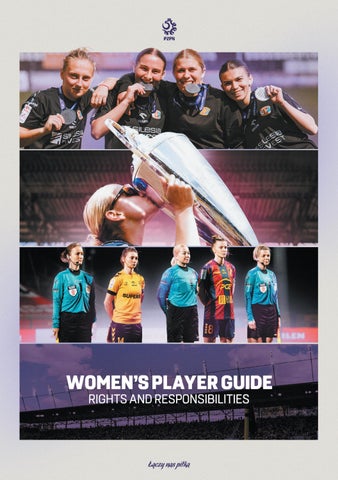
RIGHTS AND RESPONSIBILITIES
Authors: Agnieszka Syczewska, Grzegorz Stefanowicz
Coordination: Bartłomiej Stolarz
Editorial Support: Magdalena Paduch, Aleksandra Stronkowska
Cover Design: Tomasz Odrobina
Typesetting: Piotr Przychodzeń
Photographs: Paula Duda
Social media: Facebook
Łączy nas piłka kobieca
Instagram laczynaspilkakobieca
TikTok @laczynaskobieca
X
@laczynaskobieca
Version 1.0
Information current as of: 1 October 2025
© Polish Football Association Warsaw 2025

The Women’s Football Department of PZPN has operated within the structures of PZPN since 9 October 2021, providing women’s football with a voice, a dedicated space, and institutional support. The team implements strategic initiatives, supports clubs and players, and develops women’s football in Poland. The Department’s primary responsibilities include:
taking actions aimed at the popularisation and development of women’s football;
developing (in cooperation with other PZPN organisational units) competition systems as well as regulations for their organisation;
cooperating with other PZPN organisational units regarding the supervision and coordination of competitions.
Szymon Maiwald Competition Coordination Specialist
Weronika Możejko Women’s Football Development Manager
Magdalena Paduch Project Manager
Bartłomiej Stolarz Club Development and Promotion Coordinator
Aleksandra Stronkowska Senior Development Initiatives Specialist
Contact: kobiecapilka@pzpn.pl
Women’s football is developing dynamically, and with it, the expectations and needs of players are growing – not only on the pitch but also off it. We are increasingly discussing professionalisation, contracts, transfers, image rights, and the balance between a sporting career and private life. Knowledge is essential – specific, clear, and available exactly when you need it.
This guide was created with you – the player – in mind. Regardless of whether you play in a national league, an academy, or are just entering the world of senior football, you have the right to know the principles under which you operate as a sports participant.
Here, you will find key information regarding:
legal status;
contracts;
transfer rules;
legal protection.
This is a practical compendium. Our goal is for it to serve as support in everyday matters, but also as a tool to build greater awareness and self-confidence. Knowing your rights is the first step toward exercising them.
If you haven't found the information you were looking for, or if something has not been explained clearly enough, please write to us at kobiecapilka@pzpn. pl. We want to develop this guide together with you, ensuring it remains as helpful, clear, and practical as possible.
AGNIESZKA SYCZEWSKA Deputy Chairperson of the PZPN Women’s Football Committee

In Polish football, you may hold one of two statuses: amateur player; professional player.
Your status matters–it affects your rights and responsibilities, the rules for changing clubs, and the documentation required to participate in competitions
If you do not receive a salary or other benefits for playing, and the club only covers your actual expenses related to participating in matches (e.g., travel, accommodation, meals, kit, insurance, or training), you have amateur status.
In this case, to be eligible to play, you should sign an Amateur Player Declaration with the club–this is a simple document that confirms your registration with the club for a given season (see the FAQ on pages 9–11 for more details).
When am I a professional player?
You have professional status if:
ou have signed a professional football player’s contract with a club; ou receive remuneration or other benefits for playing that exceed the ordinary reimbursement of expenses provided to amateurs.
You can become a professional player as early as age 15, but only with the consent of your parents or legal guardians. A contract concluded with a minor player may have a maximum duration of 3 years.
I play in the Ekstraliga as an amateur – do I need any documentation?
Yes. You must have an amateur player declaration – without it, you cannot be registered for the competition.
I play in the 2. Liga – do I also need a declaration?
Yes. All amateur players in the Ekstraliga, 1. Liga, and 2. Liga must have a signed amateur player declaration.
if I play in the lower leagues?
You should still have a signed declaration – it is the fundamental document that confirms your affiliation with the club.
I have not signed an amateur player declaration or a contract with the club, but I have played at least one match in an official competition this season. What is my status?
In this situation, you are treated as a player with amateur status and, until the end of the current season, you are formally a player of the club whose colours you represented – despite the lack of a signed declaration. Your registration for the competition and participation in the match are treated as confirmation of club affiliation on an amateur basis.
I have signed an amateur player declaration – what are the implications?
You are committed to representing the club until the end of the given competitive season. Consequently, you may not leave the club unilaterally during the season.
Termination of this commitment is only possible through a mutual written agreement between you and the club. On this basis, the club may release the player from her obligation to represent the team. In such cases, registration with a new club may only occur during designated transfer periods.
For players in the Ekstraliga, 1. Liga, and 2. Liga, there are two designated transfer windows; their dates are set by the Women’s Football Department of PZPN:
The summer transfer window is usually: 1 July – 31 August;
The winter transfer window is usually: 1 – 28/29 February.
In the lower leagues, transfer windows may vary – please check the dates in official communiqués issued by PZPN or the provincial football associations.
I am under 16 years old – can I change clubs?
Yes, but only within specific timeframes:
From 1 July to 30 September;
From 1 February until the day the spring round of the competition begins for the league level for which the player is being registered.
I have never been registered with any club – when can I join one?
You may join at any time during the season – you are not restricted by the transfer windows.
I am a so-called "free agent" – when can I join a club?
If you were not registered with any club by the end of the summer or winter transfer window, you may be registered with a new club during the season –but no later than the end of March of that year.
For more details, see the transfer section on page 29.
If you wish to play football professionally, you need a contract - an official agreement concluded with a club. This document governs your rights and responsibilities and specifies your earnings, benefits, and what the club is required to provide for you.
The rules governing the conclusion of players' contracts in Poland are established by Resolution No. VI/90 of the Management Board of the PZPN dated 16 June 2023 – Minimum requirements for standard players’ contracts in the professional football sector. This resolution applies to both female and male players within the professional football sector.
Resolution No. VI/90 of theManagement Board of the PZPN dated 16 June 2023
A contract should include, among other things:

Resolution of the Management Board of the Polish Football Association No. VI/90 of June 16, 2023.
the term of the contract (a contract may be concluded for a minimum period until the end of the season and for a maximum of 5 years; for minor players, the maximum term is 3 years);
your individual remuneration;
additional premiums and bonuses (e.g., for sporting performance);
other non-monetary benefits provided by the club (e.g., accommodation, kit, insurance);
terms and methods of providing medical care;
provisions regarding the club’s use of your image rights;
specification of working hours and rest periods (you are entitled to a minimum of 4 weeks of paid leave per year, of which at least 14 days must be taken consecutively; the dates must be agreed upon between the club and the players);
consent for the processing of personal data;
your obligations to the club.
All contract requirements can be found in Article 7 of the aforementioned resolution.
By signing a professional football player’s contract, you commit not only to playing but also to adhering to specific rules and standards – both on and off the pitch. This is a vital element of being part of a professional team and the football community.
Here is what a contract typically includes:
a) You represent your club in domestic and international competitions, giving your all on the pitch;
b) You participate in training sessions and competitions according to the schedule established by the coaching staff;
c) You adhere to the Laws of the Game and the principles of fair play.
a) You maintain a healthy lifestyle and look after your physical fitness;
b) You undergo regular medical examinations as directed by the club doctor;
c) You do not use any medication without consulting the club doctor;
d) You comply with anti-doping regulations.
a) You take part in marketing or promotional events and activities organised by the club – this is as much a part of your duties as playing and training;
b) You notify the club in the event of illness or accident and provide a medical certificate;
c) During treatment, you follow the instructions of the club's medical staff;
d) You take care of sports equipment and are held accountable for club property entrusted to you.
a) You do not take any actions that could harm the image of the club, its sponsors, or the competition organisers;
b) You comply with reasonable instructions from the club regarding life off the pitch – e.g., place of residence, lifestyle, and off-field activities. You may not engage in dangerous activities or extreme sports (which carry a risk of injury);
c) You are strictly prohibited from participating in football-related betting;
d) You participate in mandatory training sessions (e.g., anti-doping, anti-corruption).
a) The contract also includes a specific declaration in which you commit to honest play and the principles of fair play. If you commit a sporting offence (e.g., match-fixing), you may be held financially liable to the PZPN.
Being a professional player is not only a privilege – it is also a matter of responsibility and duty.
You may do so if:
you do not have a valid, signed contract with another club;
your contract contains a buy-out clause – i.e., upon payment of a specified amount, the contract is automatically terminated;
your current contract expires in no more than 6 months.
Note! If your contract ends on, for example, 30 June, you can sign a new contract as early as 1 January – but the contract with the new club will only take effect from 1 July, after the current contract expires.

This means you must finish the season with your current club, even if you have already signed a new contract for the next season with another club. You cannot simply leave during the term of your contract unless your club gives written consent – you either terminate the contract or the clubs sign a transfer agreement.
your club agrees to a loan – you sign a contract with the new club for the duration of this loan. In such a situation:
you do not terminate your contract with your current club;
for the duration of the loan, you sign a contract with the club you are joining – it may be concluded for the loan period agreed between the clubs; you cannot enter into a contract with the new club for a different term;
upon completion of the loan, you return to your parent club unless a permanent transfer or an extension of the loan is agreed upon.
Before a club begins negotiations with you, it must inform your current club in writing.
Players who have reached the age of 15 but are not yet 18 may sign a socalled U18 Contract for a maximum term of 3 years.
For such a contract to be valid, the written consent of parents or legal guardians is required:
the consent may be part of the contract or a separate statement (with a signature authenticated by a notary);
in exceptional cases, consent may be granted by a family court. In the absence of the aforementioned consent, a player under the age of 18 may apply to the competent family court for authorisation to sign a U18 Contract.
A U18 Contract must, among other things:
include a minimum gross monthly remuneration of 500 PLN;
specify your rights and obligations;
oblige the club to enable you to continue your education.
The U18 Contract is the only contract regulating legal relations regarding the practice of football entered into between a club and a player under the age of 18. Any other agreements in this regard are absolutely null and void.
A U18 Contract in force on the day the player turns 18 remains fully valid until its expiration date, regardless of the player reaching the age of majority.
Before signing a contract, the club should:
provide you with the provisions of the PZPN Resolution on Minimum Requirements;
provide you with the current internal club regulations, particularly those regarding internal disciplinary rules. The player should confirm in writing that she has reviewed these documents;
conduct a medical examination of the player. The validity of the contract cannot be made conditional upon the results of subsequent medical tests.
Before signing a contract, the player should:
inform the club of all agreements to which she is a party, or which concern her, that are related to the performance of her duties as a player (e.g., commercial or sponsorship agreements).
Failure to provide prior information releases the club from the obligation to respect the player's commitments arising from the aforementioned agreements, regardless of any civil law consequences for the player.
Can I sign a contract at any time?
Not necessarily. If you are already under contract with another club, you may only sign a new one within 6 months of your current contract's expiry, or if the clubs agree on the terms of your transfer between themselves.
Can a club start negotiations regarding a contract or transfer without the knowledge of my current club?
No. An interested club must first inform your current club in writing before entering into negotiations.
Do I have to undergo a medical examination before signing a contract?
Yes – the club should provide you with a medical examination before the contract is signed. If the club signs a contract with you without conducting an examination, it cannot make the validity of the contract conditional upon the results of any later medical tests.
Do I need to know all the regulations before signing the contract?
Yes – the club is obliged to provide them to you. You should sign a confirmation stating that you have reviewed them.
I am under 18 – what do I need to do to sign a contract?
You need the consent of your parents/legal guardians, who must sign the contract with you or provide a separate statement with a signature authorised by a notary.
happens if I turn 18 while my U18 Contract is still in force?
A contract concluded before you turned 18 remains valid after you reach the age of majority – it continues under the terms specified within it. This means that if you signed a 3-year contract at the age of 16, you remain bound by its provisions after turning 18 until the end of that period.
Before signing the contract, ask for all documents and read them carefully – you have the right to do so.
If you have doubts regarding the content of the documents, you may, for example, consult a lawyer or ask them to participate in negotiations and the drafting of the contract.
If you have a valid contract with a club, you may sign a contract with a new club no earlier than 6 months before the current one expires.
The club must conduct a medical examination before signing the contract–if it fails to do so, it cannot make the validity of the contract conditional upon the results of subsequent tests.
If you have other agreements (e.g., sponsorship deals), you must inform the club about them.
If you are under 18, you may only sign a U18 Contract – for a maximum of 3 years and with the consent of your parents or legal guardians.
A contract entails specific rights as well as your obligations; familiarise yourself with them thoroughly to avoid breaches and liability.
When does my contract expire, and on what grounds can it be terminated – by me or by the club?
Your contract expires automatically on the date specified in the contract (e.g., 30 June) – without the need for any further action.
A contract is terminated based on:
Mutual termination agreement – concluded in writing between the club and the player under specified terms.
Termination for cause by the player (due to the club's fault) – the grounds for such action are described in the next question.
Termination for cause by the club (due to the player's fault) – the grounds for such action are described in the following questions.
Buy-out clause option – if the contract provides for a buy-out clause and specifies its terms, the contract is terminated upon payment of the amount indicated in the clause.
When can I unilaterally terminate the contract due to the club’s fault?
You may do so in the following cases:
Two-month salary arrears – provided that you have previously sent the club a written notice to pay, granting a period of at least 14 -days to settle the outstanding debt;

Failure to register for league competitions – if the club has failed to register you for a given league, and you submit a statement within one month of the closing of the transfer window;
Lack of mandatory AD&D insurance – if the club has failed to insure you or failed to provide proof of insurance within 14 days of your request, you may submit a statement within one month of the incident;
Failure to provide medical treatment or rehabilitation – if, following an injury sustained during a match or training, the club fails to provide treatment or rehabilitation, or fails to cover the agreed costs of such treatment/ rehabilitation, you may terminate the contract by submitting a statement within one month of the incident;
Relegation of the club to a lower league for non-sporting reasons – based on a final and binding decision of the PZPN – the statement may be submitted within one month of the date the decision became final.
In every case, the statement must be submitted to the club in writing and a copy must be provided to the competition organiser (e.g., the PZPN).
The club may submit a statement on the unilateral termination of the contract due to the player’s fault in the following cases:
Conviction for an intentional offence
If you are convicted of an intentional offence prosecuted by public indictment by a final and binding court judgement – the club has one month from the date it became aware of this fact to submit a statement of termination due to the player’s fault.
Extended suspension
If you are sanctioned with a suspension of at least 3 months by a disciplinary body – the club has one month from the date the decision becomes final to submit a statement of termination due to the player’s fault.
3-month ban from playing
If you are banned from participating in competitions for at least 3 months (e.g., for doping).
Unjustified absence from training
If, on at least three occasions within 6 months, you are absent from training sessions without a written justification – the club may submit a statement within the following timeframes:
by 10 January, if the absence occurred before that date; or
within 10 days after the end of the season, if the absence occurred during the season.
If you participate in betting related to any football competition – the club may submit a statement of termination within one month of receiving confirmed information regarding this fact.
Does the club have any other options for terminating my contract?
Yes, the club may unilaterally terminate your contract without your fault, by submitting a written statement (required form), only in the following situations:
Participation in fewer than 10% of official first-team matches (provided you are not a goalkeeper) – the statement must be submitted by the 10th day after the end of the season.
Long-term injury or illness – if, due to an injury, trauma, or illness confirmed by a medical certificate, you have not played in official club matches for a total of more than 180 days within a calendar year or season – the statement must be submitted by 10 January or within 10 days after the end of the season.
Following the club’s relegation due to sporting results, provided that:
1 The statement is submitted within 10 days of the end of the given season.
2. On the date the statement is submitted, the club has no outstanding salary arrears owed to you.
3 The club pays you compensation equal to one month’s remuneration, unless you agree on other terms for contract modification.
4. Proof of the compensation payment must be attached to the statement.
What happens after such statements are submitted? Am I a free agent as soon as it is sent or received?
Statements must be sent to the other party (club or player) and to the competition organiser – the PZPN.
If you believe the statement is unjustified or that procedures were breached, you have 7 days from the date of receipt to file a claim with the Football Court of Arbitration of PZPN – seeking a ruling on the ineffectiveness of the statements or a determination of the right to compensation.
If no claim is filed with the Football Court of Arbitration of PZPN by you or the club within 7 days, the statement becomes final and binding – the contract is terminated.
However, if a claim is filed by you or the club, the effects of the statement only arise once the Court dismisses the claim (in the first or second instance).
You or the club may also file a claim with the Court in situations other than those described (e.g., gross breach of contract). In such cases, the Court assesses the situation individually and may terminate the contract if further cooperation with the club would be unjustified –but only if this does not harm your or the club's interests.
You do not have to agree with the club's statement and may file a claim with the Football Court of Arbitration of PZPN.
If you take no action after receiving a statement, your contract will be terminated – potentially due to your fault.
The Court may also terminate a contract in exceptional circumstances, even without the fault of either party.
If you or the club terminate the contract without justification, you may be liable for penalties (Articles 10 and 11 of the Resolution on Minimum Requirements).

Below you will find key information to help you understand when, on what terms, and how you can move to a different club.
A transfer is the official change of a player's club affiliation. A transfer can be:
Permanent – the player moves to a new club indefinitely;
Loan – the player plays for a new club for a specified period, after which she returns to her parent club.
In both cases, the clubs (the releasing club – the one the player is leaving, and the acquiring club – the one the player is joining) must enter into a transfer agreement.
A transfer cannot be completed without the player's consent!
Moving to another club can only take place during designated transfer windows, which are set each season. For players in women's leagues, the following periods apply:
For players over 16 years of age:
Summer transfer window: usually 1 July – 31 August;
Winter transfer window: usually 1 February – 28/29 February.
For players under 16 years of age:
Summer transfer window: 1 July – 30 September;
Winter transfer window: 1 February – until the start of the spring round.
Dates are subject to change – please follow the official announcements issued by the PZPN and the Regional Football Associations.
Yes – but only in specific situations, such as:
Change of residence and starting primary school
If you move and start attending a different primary school, your club must grant you a temporary release – valid until you complete your education there.
No participation in competitions for 12 months
If you do not have a valid contract and have not played in any competitions in Poland or abroad for the last 12 months.
Club withdrawal from competitions
If your contract was terminated due to the team withdrawing from competitions, the liquidation of the club or its football section, or club bankruptcy.
Termination for cause attributable to the club
If the termination of the contract due to the club's fault, or its nullity, has been confirmed by a final and binding decision of the competent body (e.g., the Football Court of Arbitration of PZPN) – see the "Contracts" section for more details.
Injury or illness of a goalkeeper
If a goalkeeper registered to play for the club sustains an injury or falls ill, as confirmed by a medical certificate, the club may sign a new goalkeeper.
You have never been registered
If you have never been registered as a player with any club, you may join a club outside the transfer window.
Obtaining ITC after the transfer window (applies to international transfers)
If the PZPN requested the ITC (International Transfer Certificate) before the transfer window closed, but received it after the deadline.
Replacing a player absent due to maternity
If you are replacing a player who is absent due to maternity, you may join the club outside the transfer window.
Return from maternity leave
A player returning from maternity leave may be registered outside the transfer window.
On the basis of a transfer agreement concluded between the interested clubs; or
On the basis of a club's statement confirming the expiry of the player's agreement (contract), issued within 3 days of a request for such a statement; or
On the basis of a decision by the competition organiser, based on a complete set of documents confirming the transfer.
Every transfer must be approved by the competent football association in the Extranet system (a digital registration system for players). You may only play in matches for your new club after being officially confirmed in this system. Actions within the system are carried out by the clubs, the Regional Football Associations, and the PZPN.
At any given time, you may only be registered with one club; this means having a signed contract or an amateur player declaration with only one club.
Note!
You may play in official matches for a maximum of two clubs during a single season. This means you can change clubs during the season (e.g., during the winter transfer window), but you are not permitted to play for three different teams within one season.


In the event of a transfer, the following must be submitted:
an agreement between the clubs (for either a permanent transfer or a loan);
the player's consent (including consent from legal guardians if the player is a minor);
proof of payment of the transfer fee (if applicable);
a document confirming release by the previous club (e.g., termination of contract or expiry of declaration);
a contract or amateur player declaration signed with the new club.
A loan is a form of temporary transfer.
Duration:
Professional player:
Minimum: the period between two transfer windows;
Maximum: 1 year (not longer than the end of the transfer window);
The loan cannot exceed the term of the player’s contract with the releasing club (the one you are leaving).
Amateur player:
Minimum: the period between two transfer windows;
Maximum: 1 season;
The loan cannot exceed the duration of the amateur player declaration with the releasing club.
Agreement:
The clubs must sign a loan agreement specifying the duration and financial terms (the loan may be fee-based – i.e., the acquiring club pays the releasing club).
You must sign the loan agreement or provide written consent for the loan.
The transaction must be confirmed in the Extranet system.
Contract:
During the loan, you sign a contract with the new club for the same period as the loan agreement concluded between the clubs.
Your original contract with the releasing club is suspended unless otherwise agreed with the club in writing.
Upon completion of the loan, the Extranet system automatically restores the player to her parent club.
The club you join on loan cannot sub-loan you to another club.
The loan period may be extended via an addendum, but this applies only to professional players.
9. Is there a fee for a transfer?
In certain cases, the club acquiring the player must pay:
Training compensation – when the player is young and received training at her previous club(s);
A transfer fee, the amount of which depends on the agreement reached between the clubs.
I want to change clubs, but I have signed an amateur player declaration – what now?
You must have the consent of your current club, and the transfer can only take place during a transfer window, unless an exception applies (e.g., dissolution of the football section, maternity, etc.).
Can I play a match before I am confirmed in Extranet?
No. Participation in official matches is only possible after you have been confirmed in the system.
As a player, can I block my own transfer?
Yes – a transfer requires your written consent. You cannot be transferred against your will.
How many times can I change clubs in a season?
You may be registered with up to three clubs per season, but you can only play in official matches for two of them.
What if the club refuses to release me, but I am not playing?
If you are bound by an amateur player declaration and the club does not provide written consent for its termination, you must wait until it expires. If you have a contract with the club, you may request its termination in specific cases (see the "Contracts" section). However, we recommend reaching an agreement between you and the club in every case.
I want to return to my previous club after a loan – what do I need to do?
Nothing – the Extranet system will automatically restore your affiliation once the loan expires.
I am a free agent, but there are problems with my registration at a new club. Why?
The former club has 3 days to issue a statement confirming the expiry of your contract or amateur player declaration (counting from the day the request was submitted).
If this statement is not received on time, the new club may contact the Regional Football Association to register you based on available documentation.
The releasing club cannot block the process if you do not have a valid contract or amateur player declaration signed with them.
You have the right to be registered even if the club stalls. In such cases, the Regional Football Association can issue a relevant decision regarding your situation.
Masz więc prawo do rejestracji, nawet gdy klub zwleka. Wojewódzki ZPN może w takim przypadku wydać odpowiednią decyzję w Twojej sprawie.

A football agent is a natural person holding a FIFA licence who represents players (or clubs) in negotiations regarding contracts, transfers, and other matters related to their sporting career.
Beyond representation in negotiations, an agent may also provide other services to their client – such as legal advice, financial planning, image management (e.g., image rights, advertising collaborations), consulting, scouting, or negotiating commercial agreements.
The scope of cooperation depends on the agreement between the player and the agent – therefore, it is important to analyse it carefully and ensure you know what actions the agent is authorised to take on your behalf.
According to FIFA and PZPN regulations, since 1 October 2023, football agent services may only be provided by individuals holding a FIFA licence.
The agent's licence looks like this:
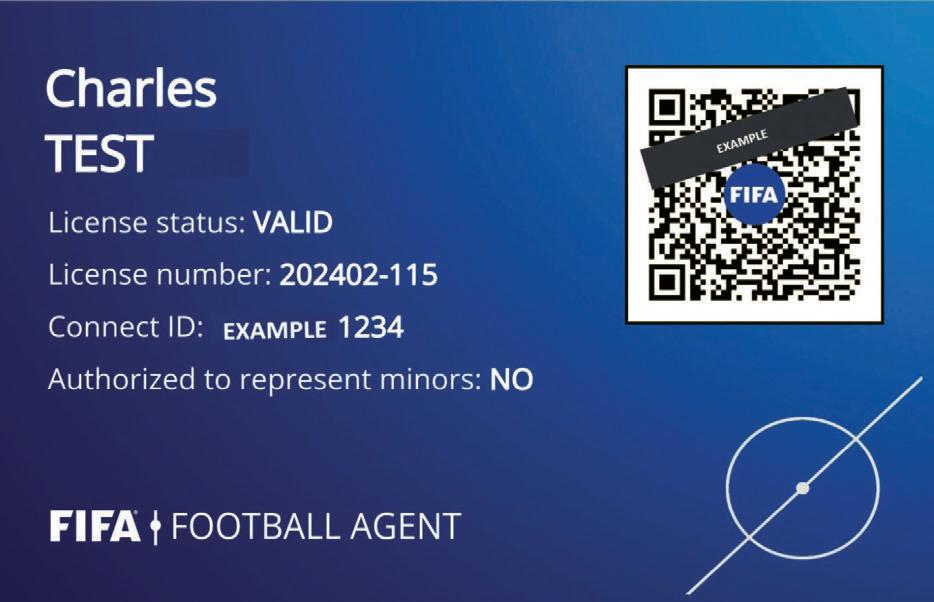
Before you sign an agreement – or even before you start a conversation –check the PZPN Agent Search at agent.pzpn.pl to see if your agent holds a valid licence. Working with an unlicensed person is a disciplinary offence – for both the player and the club.
Only a licensed agent may contact you or propose cooperation. Their employees are not allowed to take any action on your behalf unless they also hold a licence.
Ask the person claiming to be an agent to send you their licence. Once received, check the QR code to verify if the licence is active. If you are a minor, the agent must additionally be authorised to represent minors.
Before you begin working with an agent, you must sign a representation agreement, which includes, among other things:
your details and the agent's details;
the term of the agreement (maximum 2 years);
the scope of services (e.g., negotiations, transfers, representation in a specific country);
information on whether the agent is acting on an exclusive basis or only within a specific scope;
the amount and terms of the agent's remuneration.
An exclusive agreement means that only one specific agent has the right to represent you – worldwide and for the full scope of activities (e.g., contract negotiations, transfers with all clubs across all countries and leagues).
If you sign such an agreement, you cannot work with other agents – even in other countries, or specifically for certain leagues or selected clubs.
You are not required to sign an exclusive agreement; it is only one of the options.
Do not sign anything hastily! You have the right to consult the agreement with a lawyer, a parent, or a club representative. An agent is obliged to inform you of your right to seek legal counsel.
An agent may only provide services to you after a representation agreement has been concluded. For example, they cannot act regarding your contract or transfer if they have not signed an agreement with you.
I know that someone claiming to be my agent is contacting clubs. What can I do?
This is prohibited. An agent may only act on your behalf after a representation agreement has been signed. Report this to the PZPN at rzecznikdys@ pzpn.pl and inform the clubs that they should contact you directly.
An agent wants us to sign a representation agreement for 5 years. Is this permissible?
No. According to FIFA regulations, the maximum term for a player – agent agreement is 2 years. You may enter into shorter agreements – for example, only for the duration of a transfer window. You can also have different agents in different countries, signing an agreement with each for a different scope and period. Any clause extending the term beyond 2 years is null and void. Example: Suppose a transfer window is approaching and you decide you require professional support. You may choose to sign separate agreements with three different agents, each limited to the duration of that specific window. For instance, you could grant one agent the right to represent you in Poland, another in Germany, and a third in France. If you are not satisfied with their performance once the window closes, the agreements will simply expire, and you will no longer be bound by any legal obligations toward them.
An agent is proposing a representation agreement – what should I watch out for?
Always exercise your right to legal counsel and consult the agreement with an independent lawyer. We strongly advise against using a lawyer recommended by the agent. The agent is strictly obliged to inform you of your right to legal advice, and you must sign a statement confirming whether or not you have exercised this right.
I have an agent, but I am not satisfied with their services. Can I sign a contract with a club without their involvement?
Yes. You may enter into a contract with a club independently. In such cases, the contract should include a specific provision stating that it was concluded without the involvement of an agent. It is your responsibility to ensure this clause is included.
My representation agreement contains a clause stating that if I sign a contract without the agent, I must pay a penalty. Is this in accordance with the regulations?
No. Pursuant to FIFA regulations, such a provision is null and void. You are free to sign a contract with a club without that agent’s involvement.
Can I terminate my representation agreement with an agent?
Yes, but only in justified and exceptional circumstances. Therefore:
enter into agreements for shorter durations;
do not agree to excessively high fees that you would be required to pay the agent;
consider the partnership carefully – an agent is an opportunity, not an obligation.
I am 15 years old – can I have an agent?
A representation agreement may be signed no earlier than 6 months before you reach the age of 15. The agent must be specifically authorised to represent minors (verify this by checking their licence – e.g., via the QR code).
The agreement must also be signed by your parents or legal guardians; otherwise, it will be null and void.
is
A conflict of interest is a situation where an agent – instead of prioritising your interests – takes actions that serve themselves or others in their circle, at the expense of your well-being, the club's well-being, the integrity of the sport, or the public interest.
If you have doubts regarding an agent's integrity or a potential conflict of interest, you can report it.
Your agent simultaneously represents the club you are in negotiations with.
The agent has close family or business ties with the club (e.g., their spouse/brother works at the club, they hold shares in it, etc.).
The agent has failed to inform you that they also represent another player negotiating with the same club.
You sign two representation agreements with different agents that overlap in time or scope (e.g., two exclusive agreements).
Usually, it is you – the player – who covers the commission. Exceptions occur when a club agrees to pay your agent. Therefore, read the proposed representation agreement carefully and do not sign it hastily. An agent cannot collect a commission without a signed agreement, and you should know exactly how much you are paying and what for.
Do not sign anything in haste.
You have the right to request time to read the agreement thoroughly and calmly. You can always (and it is worth it!) consult it with, for example, a parent or guardian (in the case of minor players – parents/guardians must sign the representation agreement with the agent) or a lawyer.
Always ask whether the agent is representing only you in a given situation.
If they also represent the club you are negotiating with – this may constitute a conflict of interest, and you must be aware of this before making a decision.
Ensure transparency in every contract or annex:
In every contract you sign with the involvement of an agent, information regarding their participation must be included: the agent's details, who
their client is, their licence number, and the fee the agent receives –e.g.: “The contract was concluded with the involvement of Agent: Jan Kowalski, FIFA ID 12345678, representing player Janina Nowak; agent's fee in the amount of PLN 30,000 gross.” The contract must be signed by the agent who participated in its conclusion.
If the agent did not participate in concluding the contract or annex – remember that you can conclude it without an agent's involvement, even if you have a valid representation agreement with one. In such a situation, you should include a clause such as: “The contract was concluded without the involvement of a football agent or any other intermediary.”
You have the right to know how much money your agent receives from the club.
This is your right, and the agent must provide you with this information – not only when you are the one paying them.
Do I need to have an agent?
No. Working with an agent is your choice. You can independently negotiate contracts, club changes, or other matters related to your career. You may also seek assistance from a lawyer.
Only a person who holds a FIFA licence and is registered in the PZPN system. This means that not everyone can legally act as an agent. It is your responsibility to check if the agent holds a valid licence before you begin working with them.
If someone without a licence offers to represent you – do not use such assistance. You could also face trouble and be subject to disciplinary liability.
A reliable agent acts in your interest, not their own. What to watch out for?
Check if the agent holds a valid FIFA licence.
Always sign a representation agreement in writing.
The agreement should clearly define the agent's responsibilities and the remuneration they will receive, as well as the party responsible for paying it.
Do I need to report anything to the PZPN?
No. If you have a licensed agent, it is their responsibility to register your representation agreement with the PZPN.
Do I need an agent to play professionally?
No. You can sign a contract without an agent. However, if someone assists you as an "advisor", and receives payment for it, they are technically acting as an agent and must hold a FIFA licence. If you require support regarding your contract and other agreements, you can, for example, seek legal help from a lawyer without engaging an agent.
An agent is your right, but not an obligation!
If you have one – ensure they are operating legally and hold a valid licence. Ask them to send their card and verify the QR code.
Trust, but read your agreements and ask questions if you do not understand something. Seek assistance from a lawyer.
An agent cannot act on your behalf without your written consent.
Do not sign anything in haste. You have the right to consult the agreement with a lawyer or your parents and to read it calmly. The agreement may stipulate that you must pay the agent – pay close attention to such provisions and be fully aware of them.
Detailed information can be found in the PZPN and FIFA Football Agent Regulations (see QR codes).
If you wish to report an agent's non-compliant behaviour – email: rzecznikdys@pzpn.pl. Football agent regulations

In football – in addition to the Laws of the Game – disciplinary regulations also apply. A player, just like any other participant in the football system (coach, referee, club president), is held responsible for her behaviour both on and off the pitch. Detailed regulations in this regard can be found in the PZPN Disciplinary Regulations (QR code – page 79).
Below are the most significant disciplinary offences that may apply to players:
If you commit an offence as defined by the Laws of the Game, you may be cautioned with a yellow card (caution) or shown a red card (sending-off). Details regarding suspensions and penalties are set out in Article 57 et seq. of the PZPN Disciplinary Regulations.
Unsportsmanlike behaviour refers to any action that violates the principles of personal etiquette and respect towards other participants of the match – players, referees, coaches, or fans.
Profanity and offensive behaviour (Article 69 of the Disciplinary Regulations)
For using vulgar words or language generally considered offensive in connection with a match, you may be punished with a warning, a reprimand, or a fine.
If such words or gestures are directed directly at the referee, you also face a suspension (of up to 5 matches).
Challenging referee decisions (Article 70 of the Disciplinary Regulations)
Questioning a referee’s decision, their competence, or showing a lack of respect towards them (e.g., shouting, gestures, comments) may result in a warning, a reprimand, or a fine.
Certain behaviours, particularly those that threaten others or break fundamental safety and respect rules, are treated by the PZPN as the most serious offences. Here is what you need to know:
Violence, threats, and violation of physical integrity (Article 72 of the Disciplinary Regulations)
If a player uses threats, violence, or violates the physical integrity of a referee or another person (e.g., an opponent, coach, delegate) in connection with a match or football activities, she may be punished with a fine (minimum PLN 2,000), suspension, a ban from participating in football, or even expulsion from the PZPN.
If such behaviour is particularly flagrant, the suspension period cannot be shorter than 1 year.
Incitement to hatred or violence (Article 75 of the Disciplinary Regulations)
Publicly inciting hatred or violence, including outside of matches (e.g., in the media, on social media), is punishable – even if it did not occur during a match.
Such behaviour may result in, among other things, suspension and a fine.
4. Statements and Provocations
Provoking spectators (Article 76 of the Disciplinary Regulations)
Provocative gestures, statements, or behaviour towards fans, especially those that could trigger aggression or a breach of order, constitute a serious violation.
These are punishable by suspension or a fine of no less than PLN 2,000.
Disparaging and insulting statements (Article 77 of the Disciplinary Regulations)
Public statements (e.g., in the media, interviews, social media) that are offensive, insulting, or disparaging to the reputation
of the PZPN authorities, associations, leagues, clubs, players, coaches, referees, or officials are treated as serious disciplinary offences. Possible penalties include: a warning or reprimand, a fine from PLN 500, suspension, a ban from participating in football, and in extreme cases, expulsion from the PZPN.
Your statements and behaviour, including those off the pitch, build your image, but they can also seriously harm you. It is always worth reacting with respect – not only for yourself but for the entire football community. Even in emotional moments, it is important to maintain professionalism and keep your composure, not just for the good of the team, but also to avoid disciplinary penalties.
Doping is strictly prohibited. The Polish Anti-Doping Agency(POLADA) Rules as well as FIFA and UEFA regulations apply here. A player caught doping faces disciplinary consequences – including suspension or expulsion from the sport.
Unethical activities, such as attempts to manipulate match results, participating in betting, or withholding information about corruption, are the most serious offences in football. They are strictly punished not only by the PZPN but also by the Polish judicial system.
Corruption involves offering, accepting, or even merely planning to transfer financial or personal benefits in exchange for unethical behaviour that could influence the result of a match.
Penalties include: a fine of at least PLN 10,000, disqualification (minimum 6 months), a ban from participating in football, and even expulsion from the PZPN.
Any manipulation of the course or result of a match is prohibited in football – even if it does not affect the final outcome. This refers to deliberate
actions that remove the element of unpredictability from the competition, such as "spot-fixing" specific match events (corners, cards, goals) in connection with the manipulation of betting markets.
If a player (or any other person associated with football) prepares for, attempts, or successfully carries out such actions, they are subject to severe sanctions: a fine of no less than PLN 10,000, a time-limited ban from all football activities (minimum 6 months), suspension or loss of licence/ qualifications, and expulsion from the PZPN.
c. Betting
Players are strictly prohibited from betting on any football matches –whether in Poland or abroad. Even "innocent" betting can result in a fine, suspension, or expulsion.
d. Influencing matches not involving your club
Any attempt to unfairly influence the result of a match, such as offering money or other benefits to players, coaches, or representatives of another club, is strictly forbidden. This also applies to situations where someone acts on behalf of a club that is not participating in the match but has an interest in its outcome.
Such actions are treated as very serious violations and may result in a fine (at least PLN 10,000), disqualification for a minimum of 6 months, a ban from all football-related activities, and even expulsion from the PZPN.
You are obliged to report any suspicion of corruption, match-fixing, or attempts to influence a match result. Failure to report such incidents may result in penalties.
There is zero tolerance in such matters. If someone tries to involve you in suspicious activities – say NO immediately and report the matter to the appropriate persons at your club or the association. Your integrity is the foundation of your career.
Participating in illegal activities, even as an intermediary, can have very serious consequences for your career. If in doubt or suspicion, report the matter to the PZPN.
Any behaviour aimed at unfairly influencing a match result (e.g., giving or promising financial benefits) is subject to severe disciplinary sanctions, including suspension and expulsion.
It is not only what happens on the pitch that matters. As a player, you are part of the football community, and your words, including those spoken publicly or posted online, carry consequences.
If a player fails to comply with the rules regarding cooperation with football agents, as set out by the PZPN or FIFA (see the "Football Agents" section for more), she may be penalised. Possible penalties include: a reprimand, a fine, or suspension.
If a player participates in a match despite being suspended or disqualified, or plays under a false identity (assumed name), she may be penalised with: a reprimand, a fine, or a suspension ranging from 1 to 6 months.
If a final and binding ruling is issued (e.g., a decision by the disciplinary committee or a judgment by the Football Court of Arbitration of PZPN), it must be implemented within 30 days. Ignoring these decisions or delaying their implementation leads to sanctions, including fines and temporary suspensions.
Complying with association decisions is an obligation. A lack of reaction may result in the loss of your right to play. If you have any doubts regarding the content or deadline of a decision, do not hesitate – ask your club, a lawyer, or the relevant body for assistance.
If the contract was terminated due to the player’s fault, or if a statement of unilateral contract termination due to the club’s fault was found to be groundless (and this is confirmed by a judgment of the Football Court of Arbitration of PZPN), the player may be subject to a fine or suspension.
If a player:
fails to report for a national team training camp and does not justify her absence;
signs transfer agreements in violation of the regulations;
fails to comply with PZPN resolutions, decisions, or guidelines;
violates ethical or moral standards applicable in football;
ignores rulings of public administration bodies regarding football;
stalks or harasses a referee or any other match participant; may be subject to disciplinary action.
Cases are heard by the disciplinary committee of the PZPN or the Regional Football Association.
The body will call upon you to provide explanations or submit a statement – it is worth doing so!
Committees make decisions based on collected materials – match reports, witness testimony, documents, recordings, etc.
You have the right to participate in the body's hearing – they are held in person or remotely.
You have the right to a full defence. Present your version of events, witnesses, and arguments.
You have the right to appeal the decision – to the Regional Football Association Appeal Committee or to the Supreme Appeal Committee of PZPN. If you believe that the penalty is unfair or disproportionate, exercise this right.
Familiarising yourself with the disciplinary regulations is your right – but also your obligation.
During a football career, situations may occur where a player does not agree with a club's decision, feels treated unfairly, or does not receive the due benefits. In such cases, it is important to know what your options for action are and who you can turn to for help or intervention.
1. Talk first – try to resolve the matter internally:
Start with a conversation with the person responsible at the club (e.g. coach, coordinator, director, president). In many cases, a conflict arises from a misunderstanding or a lack of information and can be resolved without formal actions.
If you feel comfortable, you can ask someone you trust for support – e.g. the team captain, academy coordinator, club employee.
2. Turn to your association (Regional Football Association or PZPN)
If a conversation with the club does not bring results or if the matter is more serious, you can contact:
The Regional Football Association – if the matter concerns, for example, registration for competitions, lack of eligibility, organisational problems;
The Polish Football Association (PZPN) – in matters regarding violations of regulations, conflict with a club, problems with a contract or other disputes.
Women's Football Department – kobiecapilka@pzpn.pl
Disciplinary Spokesman – rzecznikdys@pzpn.pl
Spokesman for the Protection of Association's Legacy – marcin.ilkow@pzpn.pl
Ethics Spokesman – jerzy.kostorz@pzpn.pl
Football Court of Arbitration – psp@pzpn.pl
3. You can use the assistance of the Football Court of Arbitration
If your dispute concerns, for example, financial arrears, termination of an agreement, or a breach of contract terms – you can bring the case to the Football Court of Arbitration of PZPN – psp@pzpn.pl.
You have the right to assert your rights and seek help.
Document significant matters (e.g. agreements, messages, decisions).
You are not alone – there are institutions and people who can help you.

Explore the list of various career paths that girls and women can involve themselves in within the different roles available in football:
REFEREE
ANIMATOR
ANALYST
SCOUT
CAREER PATHS
COACH
VOLUNTEER
ANNOUNCER
DELEGATE
Do you play football and would like to combine a sports career with refereeing? Perhaps you have always wanted to be part of the football world, but not necessarily in the role of a player? Join the ranks of football match officials! Read about how to do it in a few simple steps:
1. Refereeing courses are organised by the Regional Football Associations.

2. Contact your Regional Football Association or fill out the form on the Polish Football Association website.
3. Candidates for referees must be at least 17 years old*, be in education or hold secondary education, and have a clean criminal record.
4. The course concludes with an exam divided into two parts: theoretical and practical.
5. Successful completion of the exams means that from that moment on, your adventure with the whistle begins. Good luck!
* in some regions, 16 years old.
Do you want to join the ranks of football coaches? Here are some tips:
1. Coaching courses are organised by the Regional Football Associations or the Polish Football Association.
2. You can check the course dates here: www.laczynaspilka.pl/trener.
3. Candidates for coaches must hold secondary education and have a clean criminal record.
4. Registration for courses is conducted on the www.pzpn24.pzpn.pl platform via a coach profile.
5. You can start your career with a football animator course on the pzpn24 or UEFA Grassroots platform, and subsequently obtain further coaching licences. More information regarding the types of licences and the qualifications they provide can be found in the publicly available PZPN Coaching Convention.
The PZPN Volunteer Programme is primarily about a variety of sporting events. Starting from Polish national team matches to local initiatives – each event entails diverse tasks, allowing for the acquisition of skills on many levels Together with us, volunteers become part of world or European championship-level tournaments. Thanks to the experience gained, many of them can today boast professional careers in sport, combining their daily responsibilities with their passion.
1. Registration on the PZPN Volunteer portal: www.wolontariat.laczynaspilka.pl

2. Completion of the information questionnaire regarding, among other things, volunteer experience, knowledge of foreign languages, and other competencies.
3. Application in the recruitment process for a selected event and positions.
4. Assessment of the recruitment form by the PZPN Volunteer Coordinator.
5. Decision on acceptance for the volunteering role.
6. Announcement of results in the PZPN Volunteer Portal (change of volunteer status along with e-mail information regarding the recruitment status).
The PZPN Central Stadium Announcer Course is a recurring training event organised annually in Warsaw. It is not only a massive dose of announcing know-how but also an opportunity to obtain a certificate authorising the conduct of football matches at all competition levels in Poland.
The courses are delivered based on the PZPN Announcer Package – a professional, interdisciplinary training programme created by experts in the field of sports event organisation, presentation, and security.
Do you want to know more or register for the next edition? Contact the Department of Event Organisation, Safety, and Infrastructure of PZPN: bezpieczenstwo@pzpn.pl
This is the person responsible for the proper conduct of the match: they check documents, oversee the match organisation, and ensure compliance with regulations. This role requires perceptiveness, responsibility, and a good knowledge of football realities. The work of a delegate has a real impact on the quality and safety of competitions.
The first step is to contact the relevant department for event organisation and safety at your Regional Football Association. This is where you will obtain information about requirements, training dates, and the qualification process. PZPN Volunteer Portal
Do you have an eye for talent? Are you interested in game analysis and searching for football gems? Scouts watch matches, analyse female and male players, and then recommend them to clubs or national teams.
PZPN conducts scouting courses (from variant B to the PRO level), which allow for the acquisition of knowledge and certificates. This is a great option if you want to develop football from behind the scenes, supporting talents on their way to the top.
Article 37 of the PZPN Coaching Convention. Additional recruitment criteria for the PZPN B Scout course:
1. A candidate for the PZPN B Scout course must complete the introductory training for the PZPN B scout course on the PZPN e-learning platform.
2. Admission to the PZPN B Scout course is decided on a first-come, first-served basis.
Article 38 Additional recruitment criteria for the PZPN A Scout course:
A candidate for the PZPN A Scout course must jointly meet the following criteria:
1. hold a PZPN B Scout diploma;
2. have at least one year of documented professional experience as a scout, gained after obtaining the PZPN B Scout diploma;
3. pass an entrance examination.
Article 39 Additional recruitment criteria for the PZPN PRO Scout course:
A candidate for the PZPN PRO Scout course must jointly meet the following criteria:
1. hold a PZPN A Scout diploma;
2. have at least one year of documented professional experience as a scout, gained after obtaining the PZPN A Scout diploma;
3. pass an entrance examination.
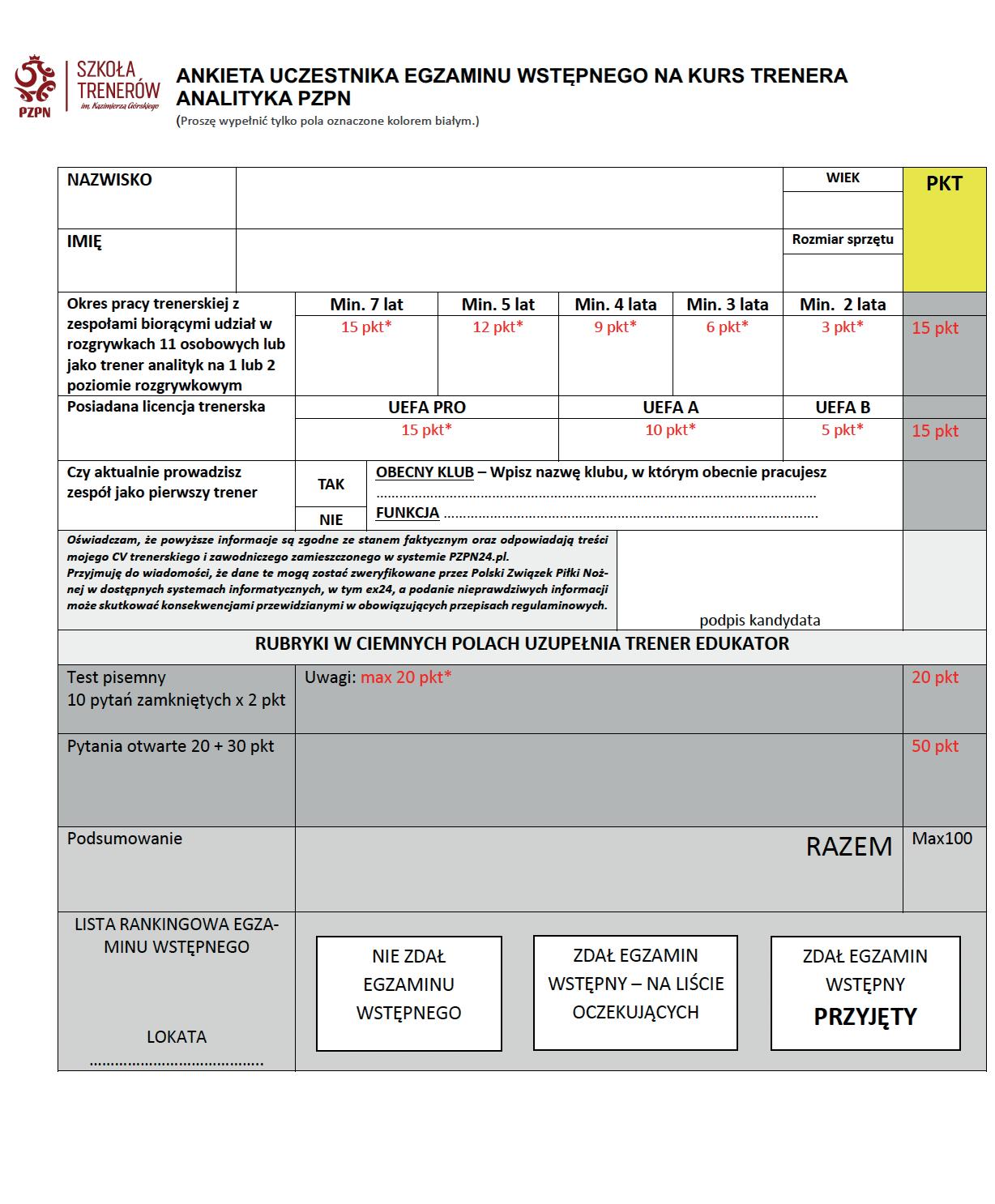
Do you like numbers, video, and modern technology in sports? Analysts work with coaching staffs, preparing reports from matches and training sessions.
A candidate for the PZPN Analyst Coach course must meet the following criteria:
hold a valid licence of at least UEFA B level,
successfully pass an entrance examination, in accordance with the rules set out in Annex 16 of the 2025 PZPN Coaching Convention.
Do you want to take local action, organise sessions, and introduce children and adults to the world of football?
Football animators complete a free online course, after which they receive a certificate and an ID card.
It is a great first step to working in football – you can lead sessions, tournaments, and activate the community in your local area. Your energy and ideas will help others catch the football bug!
The animator and grassroots leader course takes place online, is free of charge, and is available to everyone without the need to meet additional criteria. Upon completion of the animator and grassroots leader course, the graduate receives a certificate.
1. A graduate of the animator and grassroots leader course may apply for an ID card via the Extranet system.
2. The animator ID card entitles the holder to lead teams at B and C class levels for a period of 3 years.
3. The grassroots leader ID card entitles the holder to serve as an assistant head coach in children's football competitions in categories from U6 to U13 for a period of 3 years.
4. ID cards are issued by the body responsible for coaching licensing within the relevant Regional Football Association.
5. ID cards may be granted to course graduates, provided they meet the requirements set out in Art. 3 sec. 3 of this Convention.
6. The ID card is free of charge, issued in electronic form for a period of 3 years. After the expiry of the ID card's validity period, the holder is required to undergo the course again and apply for a new ID card for the subsequent 3 years.

What benefits is a contract player entitled to during an inability to play?
In the event of an injury or illness preventing participation in competitions for a period:
shorter than a total of 180 days in a calendar year (or in a competition season), confirmed by a medical certificate – the injured or ill player is entitled to the full remuneration specified in the contract;
longer than a total of 180 days in a calendar year (or in a competition season), confirmed by a medical certificate – if the club does not intend to exercise the right to unilateral termination of the contract, it has the right to limit the payment of remuneration to 50% of the individual remuneration due for the professional practice of football for the club, until no later than the day the player regains the ability to play.
In the event that a player is punished with a temporary disqualification of no less than 3 months or a preventive measure is applied against the player in the form of a ban on participating in championship and cup competitions for a period longer than 3 months, if the club does not intend to exercise the right to unilateral termination of the contract, it has the right to limit the payment of the remuneration due to the player to 50% of the remuneration, until no later than the moment the reason preventing the player from participating in competitions ceases.
My current club has withdrawn from the competition. What can I do in such a situation?
In light of the provisions of Art. 1, 2 and 3 of Resolution No. I/10 of 28 January 2018 of the PZPN Board on specific rules for the registration and eligibility of players in the event of a club team's withdrawal from football competitions:
in the event of a club team's withdrawal from competitions, professional players eligible to play exclusively for the withdrawn team are entitled to unilateral termination of the contract with the club by means of a written statement submitted to the club, under penalty of nullity;
in the event of a club team's withdrawal from competitions, players with amateur status eligible to play exclusively for the withdrawn team automatically acquire free-agent status;
the players referred to in Art. 1 and 2 may be registered and eligible to play for a subsequent club. They are not subject to the transfer window.
The clubs cannot reach an agreement regarding my training compensation. Can I change clubs in this situation?
In the event of disputes between the clubs involved regarding the amount of the compensation, the player may be eligible to play for the club.
Another club has invited me for training sessions during the season. Can I accept the proposal?
In the case of holding a valid amateur registration form or a contract, this matter should be settled with the current club.
In the case of an amateur player, it should be remembered that a player who arbitrarily leaves the club where she voluntarily plays football during the football season will be automatically subject to a 12-month suspension.
The club has suspended my rights as a player. What am I entitled to in such a situation?
The club, in its written decision to penalise a player in accordance with the Club Regulations/Statutes, is obliged to inform the player about the appeal process. Under the relevant PZPN regulations, a player has the right to appeal to the PZPN Disciplinary Committee.
Who is responsible for my insurance?
Players are entitled to personal accident insurance for accidents resulting from the practice of football. The obligation for such insurance rests with the club that the player represents in matches played by that club's team. Accordingly, the obligation to insure a player rests with the relevant Regional Football Association which the player represents in the matches of that association's representative team.
Players under the age of 23 are obliged to obtain a medical certificate confirming a state of health that allows for safe participation in competition, where the relevant certificate may be issued by:
a primary care physician;
a specialist physician in the field of sports medicine, including a doctor holding a certificate of completion of an introductory course to the specialisation in sports medicine.
Players participating in the Ekstraliga, 1st and 2nd Women's Leagues, as well as professional players under the age of 23 participating in the III league or other women's competition classes, are obliged to obtain a certificate from a specialist in the field of sports medicine on a state of health that allows for safe participation in sports competition.
Amateur players over the age of 23 participating in the III league or other women's competition classes are obliged to submit a statement to the club (each time in a new competition season) confirming the absence of medical contraindications preventing safe participation in sports competition.
Yes, you can. In the case of amateur players, the consent of the parent club is not required to combine playing;
In the case of professional players – they may combine playing in a given competition season after previously obtaining (via the Extranet system) the consent of the parent club. Consent may be granted no earlier than after the start of the given competition season.
Detailed matters in this regard are regulated by the provisions of Resolution No. VII/104 of 30 July 2024 of the PZPN Board on the combining of playing football and futsal by players. Resolution available via the QR code.
The participation of girls (both individual players and teams) is permitted in boys' competitions up to and including the Orlik U11 category, subject to the following rules:
a) in boys' competitions in the Skrzat U7 and Skrzat U6 categories, girls from the Żaczka U9 and Żaczka U8 categories, respectively, may participate;
b) in boys' competitions in the Żak U9 and Żak U8 categories, girls from the Orliczka U11 and Orliczka U10 categories, respectively, may participate;
c) in boys' competitions in the Orlik U11 and Orlik U10 categories, girls from the Młodziczka U13 and Młodziczka U12 categories, respectively, may participate.

Resolution No. VII/104 of 30 July 2024
In competitions conducted by the Regional Football Associations, with the consent of the body managing the competition, the participation of girls (both individual players and teams) from the Młodzik U12 to Trampkarz U15 categories is permitted in boys' competitions of the same or a lower age category, however, subject to the following rules:
a) in boys' competitions in the Młodzik U12 category, girls from the Młodziczka U12 category up to a maximum of the Trampkarka U14 category may participate;
b) in boys' competitions in the Młodzik U13 category, girls from the Młodziczka U13 category up to a maximum of the Trampkarka U15 category may participate;
c) in boys' competitions in the Trampkarz U14 category, girls from the Trampkarka U14 category up to a maximum of the Trampkarka U15 category may participate;
d) in boys' competitions in the Trampkarz U15 category, girls up to a maximum of the Trampkarka U15 category may participate.
Parental or legal guardian consent is required for girls to participate in boys' Regional Football Association competitions in age categories from Młodzik U12 to Trampkarz U15.
A player called up to a women’s national team of any age category for a training camp is obliged to report for the camp at the specified time.
The club from which the player was called up to the national team is not entitled to take decisions regarding the player’s release from the national team camp.
In the event that a player is injured but is mobile, she is obliged to report to the meeting point. Any further potential release will be decided by the national team doctor.
A player who, due to injury or illness, is unable to report following a PZPN call-up, is obliged to provide a medical certificate issued by the club doctor. The release will be decided by the national team doctor.
A player called up to a national team training camp but not participating in it without the consent of the PZPN or the national team doctor, is not eligible to participate in the upcoming championship and cup competitions.
Resolution No. IX/140 of 3 and 7 July 2008 of the Board of the Polish Football Association on the organisation of football competitions
Resolution No. VI/90 of 16 June 2023 of the Board of the Polish Football Association – Minimum Requirements for standard player contracts in professional football

Resolution No. VIII/124 of 14 July 2015 of the Board of the Polish Football Association on the status of players and the rules for changes of club affiliation

Resolution No. III/21 of 26 July 2002 of the Board of the Polish Football Association – Rules Governing relations between a club and an amateur player

Resolution No. V/82 of 25 May 2017 of the PZPN Board on the status of players participating in futsal competitions

PZPN Disciplinary Regulations

Game rules

Regulations of the Football Court of Arbitration of PZPN

Polish Football Association 7 Bitwy Warszawskiej 1920 str. 02-366 Warsaw tel. no.: 732 122 222 fax: +48 (22) 55 12 240 e-mail: pzpn@pzpn.pl www.pzpn.pl, www.laczynaspilka.pl