
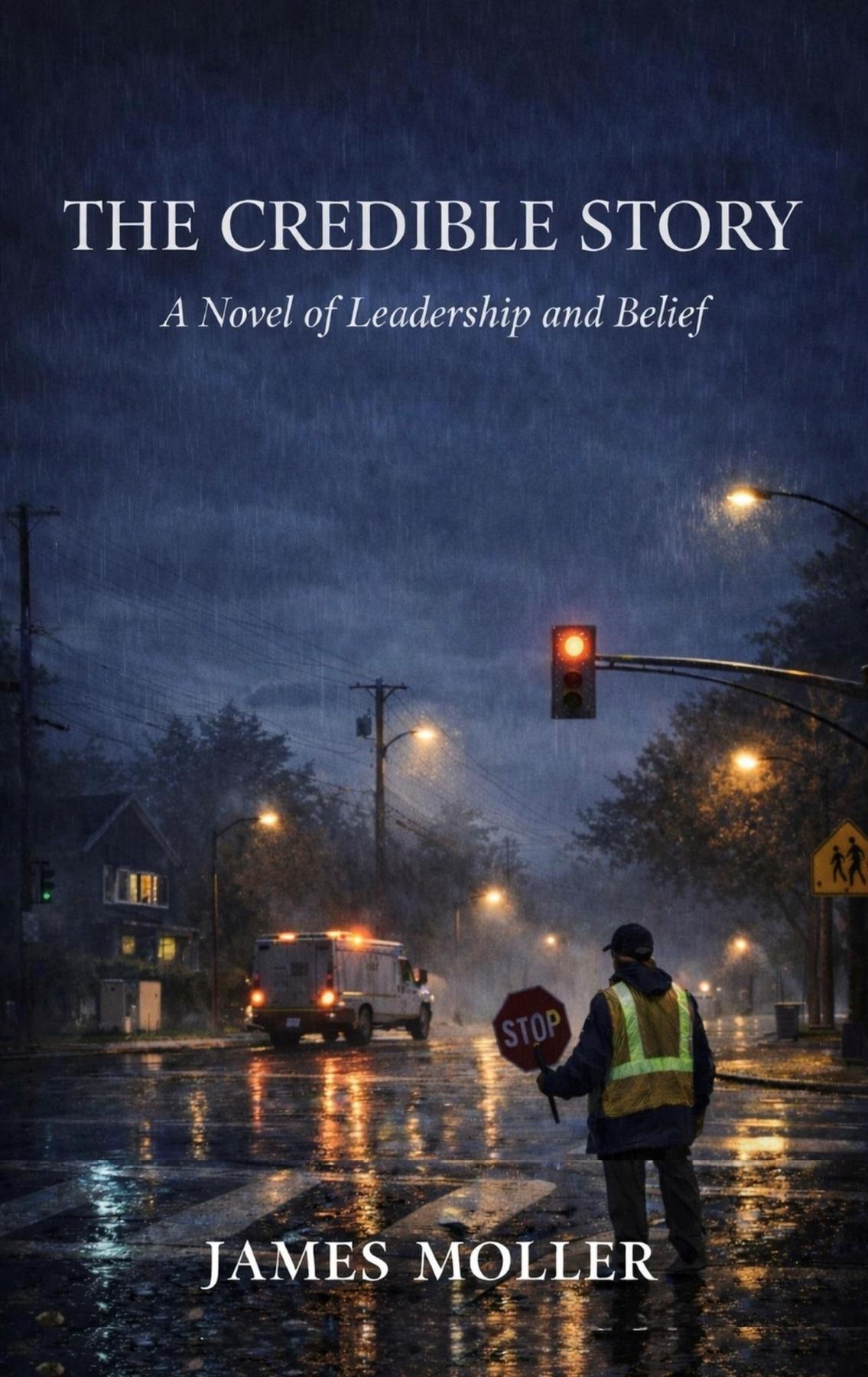
The Credible Story
A Novel of Leadership and Belief
James Moller
Copyright © 2026 James Moller
All rights reserved.
No part of this book may be reproduced, stored in a retrieval system, or transmitted in any form or by any means electronic, mechanical, photocopying, recording, or otherwise without the prior written permission of the author, except for brief quotatio ns used in reviews or scholarly works.
This book is published in Canada.
First edition.
The views and reflections expressed in this book are those of the author and are offered for educational and reflective purposes. They do not constitute legal, human resources, or professional advice. Readers are encouraged to consider their own context and to seek appropriate professional guidance where necessary.
Disclaimer
This is a work of fiction. Names, characters, places, organizations, events, and incidents are either the product of the author’s imagination or are used fictitiously. Any resemblance to actual persons, living or dead, real municipalities, public agencies,or actual events is entirely coincidental and not intended to represent or depict any specific individual, organization, or community.
For those who serve the public, and for those who live with the consequences.
3
Chapter One......................................................5
Chapter Two........ Error! Bookmark not defined.
Chapter Three...... Error! Bookmark not defined.
Chapter Four....... Error! Bookmark not defined.
Chapter Five........ Error! Bookmark not defined.
Chapter Six.......... Error! Bookmark not defined.
Chapter Seven...... Error! Bookmark not defined.
Chapter Eight...... Error! Bookmark not defined.
Chapter Nine....... Error! Bookmark not defined.
Chapter Ten......... Error! Bookmark not defined.
Chapter Eleven.... Error! Bookmark not defined.
Chapter Twelve.... Error! Bookmark not defined.
Chapter Thirteen. Error! Bookmark not defined.
Chapter Fourteen . Error! Bookmark not defined.
Chapter Fifteen.... Error! Bookmark not defined.
Chapter Sixteen... Error! Bookmark not defined.
Chapter SeventeenError! Bookmark not defined.
Chapter Eighteen. Error! Bookmark not defined.
Epilogue .............. Error! Bookmark not defined.
Author’s Note...... Error! Bookmark not defined.
Acknowledgements
This book grew from years of observing ordinary public life the kind that works so reliably we rarely stop to consider how much effort stands behind it. I am grateful to the many municipal employees, public servants, and community volunteers whose daily workis visible only when something goes wrong. Their professionalism, patience, and quiet judgment informed the spirit of this story.
I also want to thank the readers of my earlier novels. Your thoughtful responses and conversations shaped this project more than you may realize. Many of the questions that appear in these pages first appeared in your emails, comments, and discussions.
To colleagues and friends who encouraged me to keep writing when the ideas were still forming thank you for the time, perspective, and honest reactions.
Most importantly, thank you to my family for tolerating early mornings, late nights, and the long
stretches of silence that come with writing. Your support made the work possible.
Any errors or interpretations in this book are mine alone.
Prologue
At 6:43 a.m. the street was nearly empty.
A school zone sign stood dark beneath the stillworking streetlamp. The first buses had not yet begun their routes, and the houses along the block showed only scattered kitchen lights.
A sedan approached the intersection at a steady speed, its headlights reflecting off damp pavement from the night’s rain. The driver was watching the signal ahead, already green, and did not slow.
Across the street, a pedestrian paused at the curb, adjusting a bag on their shoulder. They did not intend to cross yet.
The signal held green longer than usual. For a moment nothing happened.
Then a maintenance vehicle turned onto the block and stopped briefly near the corner. The driver stepped out, walked to the signal control box, and checked something inside. A few seconds passed.
The pedestrian remained on the curb. The signal changed.
The sedan slowed and came to a normal stop.
A minute later, students began appearing along the sidewalk in small groups, their voices carrying lightly through the morning air. A crossing guard arrived and took position near the signpost.
Traffic resumed in short intervals.
No one remarked on the timing of the light. No one noticed the brief stop of the maintenance truck.
No one realized a different sequence had been possible.
Within ten minutes the street filled with ordinary movement— doors closing, footsteps quickening, a whistle signaling children forward.
The morning continued without interruption.
And by afternoon, no one in the neighborhood would remember that the day had ever depended on a few unnoticed seconds.
Chapter One Morning
DanielMercerwoke already thinking about mornings.
Not his schedule— those he could manage— but whether a morning itself could be made predictable. The thought had been sitting somewhere behind his sleep, waiting for him to notice it. When he opened his eyes, it was simply there.
The room was still dim. The clock read 6:02. A delivery truck shifted gears somewhere down the street, then idled. A minute later the refrigerator started in the kitchen below, a soft mechanical hum that always seemed louder before sunrise.
He lay still for another moment, listening.
“You’re awake,” Erin said without opening her eyes.
“Trying not to be.”
“You have the radio interview.”
“Traffic segment,” he said. “They want an update.”
Her eyes opened now. “You’re going to tell them about the crossing?”
He sat up slowly. “I’m going to tell them we’re reviewing it.”
She watched him. “You ran because of things like that.”
“I ran because of things like that,” he said, though the words sounded more certain in memory than in the room.
Upstairs a door opened and quick footsteps crossed the hallway.
“Emma!” Erin called. “Breakfast.”
“I’m late!”
Daniel stood and pulled on a sweater. “I’ll drive her.”
Erin looked at the clock. “Your office is the other direction.”
“I know.”
The street outside still held the night’s rain. Pavement reflected the streetlamps in long, uneven lines. He started the car and waited while the engine
settled, watching a pedestrian cross at the far corner before the signal changed.
Emma climbed in, backpack already on.
“You have a meeting,” she said.
“I always have a meeting.”
“You always say that.”
They drove in silence for a block before traffic began to gather. The school sat just off the main road, and vehicles compressed toward it in a pattern Daniel had begun recognizing not congestion exactly, but a tightening. Cars slowing earlier than necessary. Drivers watching the sidewalk rather than the light.
The crossing signal changed.
A guard stepped into the road, raising one hand. Traffic stopped all at once, more abruptly than the signal required. Children crossed in uneven groups, some running, some hesitating at the curb.
“See?” Emma said. “Everyone hates this part.”
A delivery van rolled forward a little too soon and stopped sharply when the guard blew the whistle. Nothing dramatic happened. The moment passed almost immediately.
But Daniel stayed watching longer than necessary.
He noticed the signal again it held vehicles a few seconds longer than seemed required before releasing them. Cars started forward cautiously, spacing themselves out without direction.
Emma opened the door.
“Text me when you get there,” he said.
“I always do.”
She disappeared into a cluster of backpacks and winter coats.
He remained parked another minute.
The street settled quickly once the rush ended. Within moments it looked like any other road ordinary, unremarkable, safe enough.
He drove away.
At City Hall, Rebecca Shaw already had his binder open.
“You’re early,” she said.
“School drop-off.”
She nodded once and slid a page toward him.
“You’ll want this before the interview.”
Public Works Recommendation— Temporary
Closure, North Valley Elementary Crossing
He read it standing.
Engineering review complete.
Drainage reconstruction required.
Three-week closure recommended beginning Monday.
A second attachment: parent correspondence.
Please delay until after exams week.
He leaned against the desk, reading the memo again. The diagram showed arrows and spacing and measured distances— a neat explanation for something that had felt much less orderly twenty minutes earlier.
He picked up the phone.
“Transportation.”
“This is Daniel Mercer.”
A brief pause. “Good morning, Mayor.”
“I read the closure recommendation.”
“Yes, we’d like to begin Monday.”
“Parents are asking for one week’s delay.”
“We don’t recommend that.”
“Is it unsafe?”
“It exceeds preferred conditions.”
Daniel looked through the office window toward the street below. Traffic moved evenly, the signal changing with steady patience.
“One week,” he said. “Notify the school and adjust.”
Silence held for a moment.
“We can accommodate that,” the engineer said.
He ended the call— but didn’t set the phone down.
For reasons he couldn’t explain, he almost called back.
Nothing in the memo suggested urgency. The work would still happen. Parents would have time. It was a reasonable decision.
Still, he remained standing, thumb resting on the screen, aware of a faint pressure he couldn’t identify.
Outside, a car slowed before the light changed.
He lowered the phone.
The radio interview went smoothly.
He spoke about listening to residents and balancing disruption with safety. The host thanked him for responding quickly. A caller praised the city for paying attention.
Afterward, a staff member passing the office door said, “Good call on the crossing.”
He nodded, surprised at how much relief the comment produced.
Maybe it could be this simple, he thought. A problem, a decision, an improvement.
Mid-afternoon Rebecca placed a single sheet on his desk.
“Transportation monitoring.”
He read it.
Morning vehicle clustering higher than projected. Signal cycle adjusted. No incident.
He looked up. “Is this normal?”
“They watch school areas.”
He read it again, noticing the time.
The adjustment had been made early that morning.
Before complaints.
Before the meeting.
Before his decision would matter.
He set the paper down slowly.
Outside his office window, traffic continued in steady intervals, stopping and starting with quiet consistency.
Rebecca gathered her files.
“You may want to leave ten minutes earlier tomorrow,” she said.
“Why?”
“Mornings change.”
She left before he asked more.
Daniel turned off his office light a few hours later, satisfied he had made a reasonable choice.
Across the city, a transportation analyst reran the morning model.
The projected line shifted slightly.
A note appeared beneath the timestamp.
Mitigation window extended.