Anicca Bakery Brings Bounty to Bread Aisles
by Marsha Lazarus
The terms Local, Organic, and Simple are right out front on Anicca Bakery’s home page, and they truly capture what’s important to founding owners Byrdie Kraut and Jared Niemela.
I first met Byrdie and Jared this past fall when they came through my checkout line during one of my weekly cashier slots. I was intrigued to learn that they operated a home-based bakery and soon noticed how popular their breads were—including the many varieties of their sourdough and challah breads sold at the Co-op! Their warmth and openness were so engaging and felt like an invitation to learn more.
We arranged to meet at their home-based kitchen on the second floor of a Victorian-era row house in Troy, N.Y. During my visit, I began to understand the significance
Book Club News
Our next book is Budget Justice: On Building Grassroots Politics and Solidarities by Celina Su.
“Celina Su’s Budget Justice is a prophetic and powerful call to reimagine how our society allocates its resources—and to whom. It is a blueprint for a moral revival in public policy. Su reminds us that budgets are not neutral—they are moral documents that reveal our deepest priorities. In this age of poverty amidst plenty, Su challenges us to engage in participatory budgeting and demand that our institutions serve the people rather than militarize our communities. Read this book, study it together, and then take it to the streets.”
—Rev. Liz Theoharis, Poor People’s Campaign cochair and coauthor of You Only Get What You’re Organized to Take
of the words “local, organic, and simple.” Not only do they describe how Byrdie and Jared approach their business but also how they organize their lives and their home—and how interconnected these all are.
Anicca Bakery started with Jared and Byrdie doing everything by hand, using the original apartment kitchen oven with a cooling rack out in the dining room. I noticed decorative dried organic lemons hanging in the bathroom window and recyclable cloth wipes used for cleaning and washing. “We use all organic ingredients,” Jared shared, “and do our best to source ingredients from within 200 miles of the bakery [our definition of local].”
Anicca Bakery is neither a storefront nor open to the public; my first question was why they chose this business model. “We wanted to just start with what we had,” Jared explained, “and slowly build from there. We have always
The book is available at Book House of Stuyvesant Plaza for 20% off for Honest Weight Book Club readers (you need not be an HWFC member). Please note that Book House has moved to a new location within Stuyvesant Plaza. The book is also available online at Princeton University Press. Use discount code CSBJ30 (applies to Princeton University Press only). Member Services has loaner copies.
Thursday, March 19 • 6–7:30pm in the HWFC Community Room
Join us for snacks, conversation, & connection. Author Celina Su will join us for the first hour via Zoom!
May’s book is The AI Con: How to Fight Big Tech’s Hype and Create the Future We Want by Emily M. Bender and Alex Hanna.
used the metaphor of allowing the fish to grow as large as the fish bowl will allow. That’s where we’re at today, a point where the business can’t grow anymore. And we’ve been able to get here without taking out loans or borrowing money from friends or family. Each month, we’re able to buy a new couple of pans or a new mixing bowl. After 13 months of being in business, we’ve got a full bakery here. We currently deliver to two co-ops (including HWFC) and people can buy bread on our website.”
“As the demand for Anicca bread grew,” Byrdie explained, “we realized that the original kitchen no longer worked.” I was introduced to the new kitchen, located in a much larger room (originally, Byrdie and Jared’s bedroom, now located in the “teeny tiny” room of the house). “[We use] a regular double kitchen oven and open bake on pizza stones. We’ve got cooling racks, prep tables, just a regular house refrigerator, and we’re a fan of buckets—to store different kinds of flour, sugar, toppings, seeds, etc.”
I noticed a pile of spreadsheets and learned that these were just excerpts of their planning process and baking schedule. “If I
2 Honest Slate March 2026
Anicca Bakery
continued from page 1
change the number of regular sourdough breads that we want to make on this day,” Jared explained, “the Excel spreadsheet updates the starter amount needed to make the day before. And we use three different bread starters— wheat, rice, and sourdough challah.” Mind you, this was just a fraction of the planning and replenishment process that Jared described!
As I learned more, I thought of the many twists and turns that our paths can take as we seek out work that matches our values and passions. “I’ve been baking as long as I can remember,” Jared shared. “My mother and my grandmother had a big hand in teaching me. I was 4 or 5 years old when I started baking. And so baking bread has always been something that I’ve loved doing.”
This home-based bakery involves a lot more skills than simply baking. Byrdie is a trained computer programmer and built the invoicing system for the business. As a maintenance manager, Jared spent a lot of time developing forecasting spreadsheets. Clearly, their past careers have been helpful in building the bakery.
This is not their first business start-up. “I’ve worked in many different kitchens,” Byrdie explained. “But that desire to be my own boss kept showing up!” A zero waste alternative business for reusing scrap fabrics was the first business Byrdie started. She then started a handwriting and letter-writing service—a skill she uses now to sign all Anicca Bakery orders.
Jared started and operated a mushroom cultivation farm for a couple of years—growing mushrooms and selling them to restaurants. “I also had a YouTube channel through which I shared the techniques that I was using,” Jared explained.
So how did Byrdie and Jared arrive at their decision to start a bakery? “I kept asking myself,” Jared explained, “what do I actually value and how do I meet the needs of my family at the same time? And baking is something that we’re both passionate about
and it’s about creating food for others! Being members at the Co-op also gave us access to buying flour easily.”
Byrdie vividly remembers the day she was shopping at the Co-op and thought, “We’re talking about doing a bakery, and I’m like, I’m going to do it. Today’s the day and I’m going to buy that 50-pound bag of flour! Yes, a painful, tough decision, but it all came together— the love of making bread and the need for high-quality food prepared by humans with a lot of love and carefully selected ingredients from the local area. And here we are!”
What motivated their specific choices to make and sell sourdough and challah breads?
Sourdough bread is universally appreciated, but challah is associated with Jewish traditions such as celebrating Shabbat or holidays.
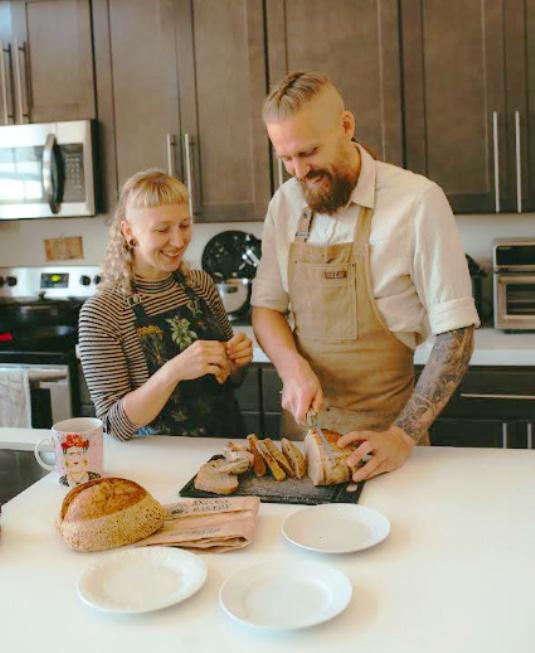
I learned about a completely new bread, called pula—very similar to challah, part of Finnish traditions, and in Jared’s family for a long time. “About 15 years ago,” Jared explained, “a neighbor who is Jewish introduced me to making challah. She actually brought over a loaf of pesto and goat cheese challah and that’s when we got hooked! I’ve kind of switched away from making the traditional pula to making challah, just because my family has loved it.”
And while the pesto goat cheese challah is not currently being sold, quite a variety of challah breads are available at the Co-op:
sugar cinnamon, multiseeded, sourdough challah, vegan, and the newest one, chai challah.
“You must be amazing jugglers,” I told them. How are responsibilities divvied up? “I take charge in leading the house,” Byrdie explained. “This means taking care of the house, managing it just like a business, between teaching the kids—I homeschool the two youngest—baking bread, and preparing lunch. I find great joy in all of that. It’s where I excel! But Jared takes a really big role in leading the bakery. He does all of the computer work, and the sourdough is a lot of work.”
Why the name Anicca?
“Anicca [pronounced ah-NEE-cha] means change,” Byrdie told me. It’s the law of impermanence in Pali, the sacred language of Theravada Buddhism. Their website states: “Change is a constant force in our lives. And rather than fighting the flow of the river, it’s simpler to slow down, see the river for what it is, and flow with the current of the universe.”
“This is where we’re really intentional with our lives,” said Byrdie. “Not having excess in the house allows us to slow down and see those things. We’re not drowning in a playroom full of toys; there are very few toys in this house. We have space in our home for the things that really matter. But we’re always asking, ‘What things can we stop doing? What can we let go of?’ We need to prune the bush and leave space for the new.”
What might that “new” be?
“We talk about having a place where people can come into the bakery and sit, enjoy a cup of coffee, a piece of toast, [and] hang out with us,” Byrdie shared.
Jared added, “I think we’re taking it the same way that we’ve built this business, just looking for the green lights, looking for where we’re needed, and what is needed. Right now, this area needs really good bread, and so we’re here doing that right now. It serves us and it serves the community. But eventually, it won’t serve one of those and something else will grow or change.” Ah, yes, that word again, Anicca—change.
Why Run for the Honest Weight Food Co-op Board?
We are approaching our Annual Membership Meeting, at which Member-Owners will elect individuals to serve on the Board of Directors, on April 26, 2026, at 6pm.
You may be asking yourself: Why run for the Board? My first reaction is, “Why not?” But then I thought about it more, and the first word that came to my mind is service. What about service? What does it offer?
As a social worker, knowing what makes people happier, function better, and live longer has been central to my 40+-year career. One path to achieving greater health and happiness is doing good deeds.
In an article called “The Science of Good Deeds,” author Jeanie Lerche Davis cites research done by Stephen G. Post, PhD, a professor of bioethics at Case Western Reserve University School of Medicine.
Reviewing the research, Davis wrote, “Post described the biological underpinnings of stress—and how altruism can be the antidote....These studies indicate that we’re dealing with something that’s extremely powerful. Ultimately the process of cultivating a positive emotional state through prosocial behaviors— being generous—may lengthen your life.”
Among the many ways to be prosocial at HWFC, Board service is distinct. As I see it, the Board’s charge is to hold a holistic view of the Co-op: to take a global perspective and preserve what makes it unique.
GF Buckwheat Bread GF Buckwheat Bread
This GF buckwheat bread is moist, holds together nicely, is high in fiber, and tastes delicious. It has undergone many iterations and I think this latest one is the keeper. You can find all the flours listed in this recipe in the GF bulk section at HW.
Ingredients
1/2 cup (83g) dark buckwheat flour
(93g) light buckwheat flour
(71g) sorghum flour
(64g) almond flour (88g) gluten-free flour blend
3 Tbsp (35g) psyllium husk powder
2 Tbsp (20g) ground flaxseed
1 Tbsp (10g) yeast
2 tsp (10g) baking powder
1 tsp fine sea salt
5 eggs, room temperature
1 tsp apple cider vinegar
1/3 cup (75ml) avocado oil
1 Tbsp maple syrup
2 cups (470ml) water, heated to 112º
Method
Line a loaf pan with parchment paper. Whisk dry ingredients in a large bowl.
Whisk eggs, avocado oil, maple syrup, and apple cider vinegar in a medium bowl. Add hot water and mix.

Pour wet ingredients into dry and mix together with a large spoon, making sure to thoroughly combine ingredients at the bottom of the bowl. The dough should resemble a thick cake batter.
Transfer dough into the prepared pan. Smooth out the top using a wet spatula. Depending on room temperature and humidity, you may need to add a tablespoon of water to the top of the dough as you smooth it out.
Let bread rise for 20' in a warm place. It’s important not to let the dough rise for more than 20' to avoid risk of collapsing after it bakes.
While the bread rises, preheat oven to 350º. Bake bread for 65’ or until it reaches an internal temperature of 205º.
Let cool for 5' or so in loaf pan. Remove bread from pan and let cool on a wire rack for at least 20.' Enjoy! —Nina Martinson
HWFC’s structure is unlike many other organizations, combining staff with Member-Owners who both have a voice in what the Co-op represents. Often, this is done by asking MOs to decide on particular initiatives brought to the Membership by the Board. For example, the Co-op extends discounts to students and seniors, as well as to those in the community who rely on food assistance (through the Double Up Food Bucks Program).
Board service asks us to think beyond our individual interests and consider the longterm health and vision of the Co-op. It is meaningful work. And yes—at times it is challenging. But meaningful work often is.
2026 in particular is critical: we’ll have 5 Board seats to fill. We need a mixture of skills to make for a well-rounded Board and hope to secure at least one individual with solid financial knowledge who might become Board Treasurer.
To serve can make the heart feel full, especially when the work requires thoughtfulness, collaboration, and perseverance.
George Bernard Shaw expressed this spirit beautifully in his 1903 play, Man and Superman:
“This is the true joy in life, the being used for a purpose recognized by yourself as a mighty one; the being a force of nature instead of a feverish, selfish little clod of ailments and grievances complaining that the world will not devote itself to making you happy.
I am of the opinion that my life belongs to the whole community and that while I live it is my privilege to do whatever I can for it.
I want to be thoroughly used up when I die, for the harder I work the more I live. I rejoice in life for its own sake. Life is no ‘brief candle’ for me. It is a sort of splendid torch which I have got hold of for the moment, and I want to make it burn as brightly as possible before handing it on to future generations.”
—Christi Wright
A Walk on the Wild Side: Trying Unfamiliar Foods in the Produce Department
by Robin D. Schatz
When I’m cruising through the Co-op’s Produce Department, most of the time I tend to pick up the same fruits and veggies out of habit and expediency: broccoli crowns; romaine or red-leaf lettuce; sometimes kale or beets; cauliflower if it looks fresh or asparagus if the price is right; Brussels sprouts when I can get good ones; tomatoes in season. Apples and berries, lots of avocados. Always organic, always delicious.
But lately I’ve been branching out. I realized I was missing out on a whole bunch of new taste and texture experiences, particularly for someone who makes plants the mainstay of their diet. So I resolved in January to “love a rutabaga” and to try a new fruit each month and figure out how to prepare it.
To be sure, we are lucky at Honest Weight Food Co-op. There is always something new to try in Produce, spanning cultures, cuisines, and sometimes time zones. At my local Greene County supermarket, there’s only one type of organic sweet potato if I can find any at all. At the Co-op I can choose among many options, from those with deep purple flesh to classic orange varieties.
I roamed the Produce aisles recently to see what new foods I could find, and I wasn’t disappointed. Here’s a sampling of what I brought home in my reusable grocery bag.
Rutabaga:
This root veggie, part of the Brassica family, may already be part of your diet, but it’s not one I’d ever tried before. This cousin to the turnip—the one I had was the size of a newborn’s head—is mostly yellow, with a splash of brilliant purple near the stem end. While it’s not much to look at, the rutabaga is a nutritional powerhouse, full of vitamin C to support the immune system, potassium

for good muscle function, and fiber, which aids in digestion.
Think of it as the potato’s slimmer cousin, with a fraction of the carbs and a mouth feel that’s still a bit starchy. You can cook and mash it, fry it, or roast it—my favorite technique. First peel and cut it into cubes, then toss with some good oil, a little coarse salt, and your favorite herbs and spices; I added Dijon mustard, date syrup, and paprika. Spread it out thinly on a baking sheet, and roast it at 400º F until crispy and tender, about 35–40 minutes.
Verdict: a bit pungent and turnipy in taste, certainly not as bland or chameleon-like as a potato. But I liked it enough to use it as a low-carb, low-calorie alternative in the future.
Celeriac:
I’d seen it before at the Co-op but never had the nerve to try it. It’s an intimidating, ugly-duckling-of-a-vegetable, with a large, bulbous root and rough surface. It’s not easy to peel and cut but well worth the effort. It’s related to celery, which becomes apparent when you take a whiff.

Its nutritional benefits are impressive: low in calories and carbohydrates and high in vitamin K, essential for blood clotting and improving bone density. It’s also a good source of vitamin C, phosphorus, potassium, and B6.
Like rutabaga and other root vegetables, celeriac takes kindly to roasting, air frying, and mashing or pureeing with a little olive oil or butter and salt. You can eat it raw in salads or throw it into soups and stews. Celeriac remoulade, a raw shredded salad, is a staple of French cuisine.
In Turkey, it’s used traditionally to make Zeytinyağlı Kereviz Yemeği, a dish of braised carrots and orange juice. You’ll find many versions online, some including potatoes. Here’s one from Cooking Gorgeous (https:// cookingorgeous.com/blog/zeytinyagli-kereviz-yemegi-braised-celeriac/).
Verdict: I’d definitely make the Turkish dish again. I may also try it in the air fryer.

Tamarind:
I scored a cardboard box of whole tamarind pods from Thailand at the Co-op. Tamarinds aren’t common in the U.S., and this was the first time I’d seen the fruit in its natural state (I’ve bought tamarind paste before). It’s a popular ingredient in many cuisines from India, Mexico, Thailand, and elsewhere. If you’ve ever had a really good Pad Thai, you probably have eaten tamarind.
The raw tamarind has a tart-sweet flavor and the texture of a date. Nutritionally, a serving offers 239 calories, 62.5 grams of carbohydrate, 5.1 grams of dietary fiber, and 2.8 grams of protein. It is a great source of magnesium, potassium, and iron.
So far, I’ve eaten just the chewy fruit right out of the brittle pods, which break apart easily. You have to remove a few fibers around the fruit and spit or cut out the garnet-colored seeds.
Verdict: When I get ambitious, I’ll try making my own tamarind paste to use in sauces and curries. For now, I’m just happy munching on them.
Chaste Tree Berry Chaste Tree Berry
by Erin Ethier
Chaste tree berry (Vitex agnus-castus), often just referred to as vitex, belongs to the Lamiaceae (mint) family. It used to be classified in the Verbenaceae family until the 1990s. While many species exist, we’re focusing on the agnus-castus variety, a deciduous tree with blue-purple flowers growing up to 22 feet tall, especially if cultivated.
Harvested in the fall, its berries are the part used.

The tree grows in warmer climates. I had been tempted to try growing it in NY as an annual, but after this winter I am convinced that it wouldn’t have survived as it prefers more tropical weather with at least a Zone 6 location. Vitex is native to Mediterranean Europe and Central Asia and was introduced in the United States as an ornamental in 1570.
Folklore suggests that chaste tree berry was used to promote chastity in monks during the Middle Ages; sprigs were carried by virgins in ancient Rome to represent purity. In the 1700s it was used for gastrointestinal issues to help dispel wind from the bowels.
HWFC Coffeehouse Open Mic Mon., March 16
6:30–8:30pm
HWFC’s café fills with song, music, and readings every 3rd Monday! Coffeehouse Open Mic Night is open and free to Co-op Members and the public alike.
Please join us for an evening featuring local performers and artists. Performer sign-in starts at 6pm. All types of family-friendly performances are welcome!
Since the 1900s, chaste trees have primarily been used as a key ally for women’s reproductive health.
Chaste tree berry has been used to support menstrual irregularities; it acts as a hormone modulator helping to balance progesterone and estrogen as an indirect normalizer. It works with the pituitary gland and can lower prolactin levels when taken in lower doses.
This herb can also help reduce the risk of flooding (menorrhagia), absence of a period (amenorrhea), and severe menstrual cramping and pain (dysmenorrhea). It is useful for PMS (premenstrual syndrome) and PMDD (premenstrual dysphoric disorder) symptoms such as acne, headache, breast pain, mood swings, irritability, and anxiety.
Chaste tree berry is believed to help with sexual function, libido, and fertility due to its hormone balancing ability. It increases progesterone and enhances corpus luteum development when taken in higher doses for at least 3 months. When used for sexual function, dosing matters: used in lower doses, it reduces the libido; taken in higher doses, it stimulates the libido.
Vitex has also been used to prevent miscarriage during the first trimester for those who have had a recurring problem. To use for this purpose, I strongly recommend you work with your midwife and herbalist.
Chaste tree berry acts as a galactagogue
White Affinity Group Meetings
Third Thursdays 6:30–7:45pm via Zoom
This is a group meant for white folks to work on eliminating racism and white supremacy.
Join us as we share thoughts, feelings, successes, and mistakes in a warm, friendly, and nonjudgmental atmosphere.
Contact Tam for the Zoom link at Listeningpartnerships@gmail.com.
when taken in small doses, helping to stimulate milk production when nursing.
During perimenopause and menopause, chaste tree berry has been found to be effective and safe. Vitex is known to aid significantly in maintaining healthy hormone levels. It can help to decrease common menopausal symptoms such as hot flashes, night sweats, mood swings, and insomnia.
It can be used while coming off birth control to rebalance one’s reproductive system, but it isn’t recommended to take while on birth control, fertility treatments, or hormone replacement therapy (HRT), and it is also not recommended for postmenopausal women.
Chaste tree is meant to be taken over a long period (at least 3 months) to see a difference, so be patient when you first start. Some may see improvements immediately while others may take a little bit longer.
You can find chaste tree berry in tincture and supplement form in the Wellness section of the Co-op. I prefer the tincture form or making tea with dried berries. For the tincture, lower doses are considered 5–10 drops 2–3 times a day, while higher doses would be 40 to 80 drops 3 times a day. As with all herbs please consult your doctor, midwife, or an herbalist if this is something that you want to start taking for medicinal purposes. This information is for educational purposes only.
HWFC does not provide medical advice. Please check with a health care practitioner before treating any condition. See page 6 for policies and full disclaimer.

Q & A Suggestion Box is on hiatus this month and will return.
Honest Slate 6
B o a r d Decisions
At the Feb. 3, 2026, HWFC Board of Directors meeting, the Board:
• Approved the February 3, 2026, Board of Director Meeting minutes as presented.
• Affirmed the decision to hire Karen Roth as HWFC Membership Manager.
• Approved the Communication Committee’s revised 2025-2026 work plan adding time investment hours for editing HWFC manuals as requested by the Membership Committee and the Nutrition & Education Committee.
• Approved the Jan. 25, 2026, Regular Membership Meeting minutes as presented. The meeting adjourned at 10:05 pm.
Board of Directors page: https://www.honestweight.coop/page/board-91.html
All other HWFC meetings: https://www.honestweight.coop/page/zoomlinks-for-hwfc-related-meetings-420.html Committee meeting Zoom links: https://www.honestweight.coop/page/committee-meeting-calendar-322.html
Phoning in?
To join any HWFC Zoom meeting by phone: +1 929 205 6099 US (New York)

March 2026
FAQ s: New Member
After orientation, you will need to show a picture ID. You will also need to purchase an ownership interest for $100 or start payments and agree to pay the rest. You will need to come in person to join at the customer service desk after the orientation.
Can I join with a group?
Each person who wants to be an Owner joins individually. So, $100 per person, and everyone who owns a portion of the Coop owns one portion just like all the other owners.
Do I have to do hours?
Owners can choose to become Member-Owners by investing time (often called “doing hours”). Owner = someone who has purchased an ownership interest but does not do hours; Member-Owner = an Owner who does hours at HWFC.
Discounts and Voting Owners receive a 2% discount on purchases and 5% on select local products, plus other specials announced throughout the year. A Member-Owner who does one 3-hour shift per month is called a “monthly Member-Owner” and receives an 8% discount on their purchases plus the 5% select local and extra specials. A Member-Owner who does a three-hour shift per week is called a “weekly Member-Owner” and receives a 24% discount on their purchases
march 2O26

Editors & Contributors
Cara Benson
Erin Ethier
Catherine Geysen
Elisa Grimm
Don Kennison
Marsha Lazarus
Nina Martinson
Carol Ostrow
Karen Roth
Robin Schatz
Janet Sorell
Christi Wright
honestslate@honestweight.coop Contact with questions, comments, ideas.
Submissions Policy
• Maximum article length is ~800 words.
• Material is published at the discretion of the Honest Slate team.
• Only signed work is accepted. Items are edited for length, grammar, & style.
• We may consider unsolicited material but encourage submitting ideas first.
• Letters to the Editor do not require preapproval.
plus the extras. HWFC self-governs; voting rights are earned by investing time in the store. Discount and voting rights apply in the month following the shifts, because we tally up the hours at the end of each month and give voting rights and discount if commitment is met. So, MOs invest time in November to earn discount and voting rights in December, then they invest time in December to get discount and voting rights in January, and so forth. Again, Owners do not have to invest time but can if they want to receive higher discounts and voting rights.
How do I invest time in the Co-op I own? If anticipating investing time in the store, you may want to think about different departments you’d enjoy investing time in. Check out https://www.honestweight. coop/page/departments-3.html and https://www.honestweight.coop/page/ member-owner-opportunities-101.html.
You need not invest time every month, but certain departments do want a weekly commitment. In some, you can drop in and invest time; in others, MOs need a set schedule to show up consistently at committed times. Some positions make an easy monthly commitment (like Grocery or Courtesy Clerk) and some shifts need to be scheduled weekly (like cashiers). We appreciate all our Owners’ efforts and encourage all to step up as much as they can, understanding that everyone’s circumstances are different.
Statement of Purpose:
Honest Slate is a platform for HWFC Membership, Staff, Management, and Governance: promoting transparency, reporting news without bias, and sustaining community.
Honest Slate articles are for informational purposes and are not intended to diagnose or treat disease. Opinions expressed in Honest Slate do not necessarily represent the views or policies of Honest Slate or Honest Weight Food Co-op.
All contents ©2026 Honest Weight Food Coop; no material appearing in Honest Slate may be reproduced in any form without the express written consent of HWFC.
COMMITTEE CORNER
Preliminary committee reports submitted to the Board of Directors (BOD) for its March 3, 2026, meeting. See Board Meeting packet for details. Approved reports are posted on HWFC’s website.
by Stephanie Conde
Honest Arts Committee (HAC)
∙ HAC has lost members, and now too few of us remain to function effectively.
∙ Board Request: help solicit new members. (1) Run artwork from previous exhibits in pre-RMM slide show. (2) Sponsor 2-weeklong committee fair with multiple tables. (3) Involve staff. (4) Include our committee in all emails and actions about changing store’s physical environment inside and out. Allow us to have input in decisions. (5) Remind RMM participants to attend meetings, learn what committees do.
Membership Committee (MC)
∙ Discussed BOD meeting summary.
∙ Reviewing Bylaws, work plan at April and May meetings to prep FY2027 work plan.
∙ Reviewed next steps for revised MO Manual. Targeted a Membership presentation date and prep of Manual materials.
(1) Reevaluating Orientation slides, notes; (2) posting time investment orientation info; (3) creating MO Mentor lists in each Department for MC subcommittee, maintain as resource for new MOs with questions or issues obtaining time investment. Karen, HR discussed Ownership orientation for New Employee Orientation.
∙ Janet S. will be MC Co-Chair now that Kristin will resign from BOD in April.
∙ Requests BOD consider changing RMM’s date from June 28 to June 21 (two popular outside events are scheduled for June 28).
Diversity, Equity, Inclusion Committee (DEIC)
∙ DEIC’s 2nd Community Cooking & Meal Share event will be Monday, April 20.
∙ Email: We don’t know whose addresses are included in the group; some are bounced back. Await IT Manager response.
∙ Discussed gender diversity concerns including respecting chosen pronouns.
∙ Refashioning DEIC’s website mission statement.
∙ May streamline meetings for productivity.
∙ Discussed concerns about hosting food-focused events potentially exclusive and traumatizing people with dietary restrictions.
∙ Requests BOD consider immediate quality training. DEIC has met monthly for over a year trying to connect to HWFC’s community to understand their concerns and needs around DEI.
Nutrition & Education Committee (NEC)
∙ Considered FPM changes regarding carrageenan and fluoride.
∙ Submitted documents recommending FPM changes to BOD.
∙ Submitted article to Honest Slate.
∙ Continued in-store tabling to promote FPM.
∙ Established MO feedback session dates on proposed FPM changes.
∙ Requested the term “Banned List” be removed from website.
∙ Submitted suggested rewording of FPM introduction on website.
∙ Provided a speaker to address food ingredients, importance of reading labels, and FPM.
∙ Requests BOD approve feedback session dates: Feb. 26, 6–7pm and March 8, 2–3pm.
Governance Review Council (GRC)
∙ Approved January GRC minutes.
∙ Shared Feb. 3 BOD meeting report.
∙ Discussed progress of Conflict Resolution, Policy/Problem-Solving Guide (particularly Peer Review Panel), and training for Peer Review panelists.
∙ Discussed compiling HWFC documents per Strategic and Long-Range Plan.
∙ Requests that BOD ask Personnel Committee to give GRC a clearly marked, edited draft of updates to revised Conflict Resolution policy that addresses the Peer Review Panel.
Communications Committee (CC)
∙ Reviewed March’s Honest Slate and planned April’s issue.
∙ Q&A on hiatus this month while an MO position is in transition. We hope to resume column next month.
∙ Created an editorial subcommittee to assist other governance groups with documents such as brochures (pamphlets) and manuals.
∙ Anticipating approval process for editing manuals.
∙ Requests BOD approve 2025-26 CC work plan, with +25 hours to edit FPM for style and grammar (separately from other chang-
es in progress), and +5 hours to edit committees pamphlet for style and grammar.
∙ Requested BOD clarify which committee(s) should formally request editorial changes. Should whichever committee is involved make an individual request to BOD to formally request editorial changes for Manuals?
Personnel Committee (PC)
∙ Discussed Problem Resolution Policy and Guidance. Reviewed Board’s questions, discussed and edited. Unanimously voted to return Policy to BOD with edits for review.
∙ Requested BOD review and approve Problem Resolution Policy updates.
Elections & Nominations Committee (ENC)
∙ Discussed updates, including possible Food & Product Manual (FPM) voting in April alongside BOD election voting.
∙ Discussed January RMM retrospective in the spirit of continuous improvement. Implemented hyperlink within Survey Monkey (SM) ballot at the last RMM for voters to be brought directly to voting language. ENC anticipates continuing to include links in SM to support voting clarity. Ballot prep went very well; made modifications as needed; recognized an SM challenge during vote counting, which we are working to resolve with the vendor directly. Phone voting had a different setup at RMM due to snowy weather and location of support people, but ENC made it work.
∙ Reviewed RMM/BOD election task list, assignments, recruitment efforts for 5 open Board seats in April.
∙ Updated website BOD Candidate Information and Nomination Form. Reached out to candidate waiting to apply. Requested BOD actively encourage MOs to consider running for BOD or nominate an MO who would be a strong candidate; promote candidacy via announcements, emails, in-store postings, tabling.
∙ Presented focused efforts for BOD election plus efforts for the future. Overarching goal: lead recruitment to find Board candidates; recognize we need support beyond our small committee.
∙ Request that BOD & committees cc cochairs when emailing electionscomm@honestweight.coop to be sure messages are received.
memBer-owner
Greetings
Honest Weight community, Happy March, a month when our sun is often on our minds with more minutes of daylight each day and the vernal Equinox on the 2Oth—although (fun fact) we actually reach equal day and night lengths on March 17 based on latitude (our equilux date). The possibilities of spring bring new hope and energy to most folks so we are wishing that for all of you.
After a challenging year, the Membership Department is now fully staffed and mostly caught up. 29 new Owners joined our ranks in February, bringing our total number up to 11,857 in our 50th year of operation. Approximately 775 of these Owners invested time during February (on the floor, or in administration, governance, Education, or Outreach); 965 received a discount above the 2% that all Owners enjoy.
Maltodextrin
by Catherine Geysen
According to Medical News Today, maltodextrin is a white, starchy powder that is used as a thickener or a binding agent for food and liquids. It can also be used to improve food’s flavor and shelf-life. Maltodextrin is commonly used in place of sugar or fat in low-calorie, processed foods. Because of its high range of uses, maltodextrin has become seemingly ubiquitous among packaged foods.
To make maltodextrin, manufacturers put starch through a process called hydrolysis. Hydrolysis uses water, enzymes, and acids to break the starch into smaller pieces, resulting in a white powder consisting of sugar molecules.
The starches are found in food and include, but are not limited to, corn, potato, wheat, tapioca, or rice. Although the powder comes from these natural products, it then undergoes processing. It should be noted that the substrate for maltodextrin can be organic, but not necessarily. The risk
We look forward to starting new initiatives (stay tuned), maintaining quality service to the Membership, and working within the Identity and Mission-based teams to infuse a collaborative and cooperative consciousness in Honest Weight’s internal and public identities.
One area of real need is for Member-Owners (MOs) to serve on governance groups and committees. These groups serve a vital function in our Co-op, providing essential tasks that allow the Board to make decisions in the best interest of the organization, research issues and refine language for Membership votes, and maintain the beauty and culture of our store and community. Information on our committees and visiting committee meetings can be found on our website. We are just starting to look into plans for a Committee Fair, where you can learn more about our committees.
of genetically modified organisms (GMOs) is present in the use of nonorganic corn and glyphosate with the use of nonorganic wheat.
Maltodextrin’s main concern lies largely in its high glycemic index (GI).
A high GI means that the sugars in these foods will quickly enter the bloodstream, where the body will absorb them and cause a sharp increase, or spike, in people’s blood sugar shortly after they eat foods that contain it. Such a spike in blood glucose can cause potentially serious issues for people with diabetes or insulin resistance.
Maltodextrin’s GI exceeds that of regular table sugar.
Its use is especially troublesome as it is known as a “hidden sugar” owing to its status as a sweetener without being subject to listing as an “added sugar” on an FDA Nutrition Facts label.
It should also be noted that maltodextrin can be hidden as a “natural flavor” in a product’s ingredients list.
We have a Membership Meeting at the end of April, when we’ll fill 5 of the 9 seats on our Board of Directors. Please remember that to vote you must be up to date with your time investment, either weekly or monthly, on or before March 31.
Regards to all, Karen and Valerie, your Member Services team
Co-opportunity!!
COVID changed so much; we want to get a favorite activity back up and running!
Sampling: Food Services is starting the call! This department seeks MOs with customer service experience for fixed weekly commitments. Help customers discover new faves by offering featured item samples! Contact Food.Services.Managers@honestweight.coop.
Some studies also suggest potential negative impacts on gut health by altering the balance of beneficial bacteria, potentially increasing susceptibility to certain issues, though this is an evolving area of research.
Interestingly, maltodextrin is used as a valuable ingredient in sports nutrition, delivering rapid energy, easy digestibility, and versatility. When used appropriately—within the context of exercise—maltodextrin can enhance performance and recovery.
In summary, with prepackaged food as the norm, maltodextrin has become all too common thanks to its versatile uses. It is insidious, being a hidden sugar that can impart sweetness to a product without its being listed as an added sugar in labeling. It is also a potential source of hidden GMOs, as the starch type is not required to be listed on a product’s Nutrition Facts.
Although maltodextrin is generally recognized as safe (GRAS) by the FDA, a growing number of people choose to avoid products that contain maltodextrin because of its potential for adverse effects on the body.