Graduate Lending
Budget Reconciliation Summary
Grad PLUS: Eliminates the Grad PLUS Loan Program.
Annual Cap: Limits the amount of federal student aid a student can receive annually:
● Graduate student – $20,500
● Professional student – $50,000
Aggregate Cap: Limits the amount of federal student aid a student can receive in the aggregate:
● Graduate student – $100,000
● Professional student – $200,000
Lifetime Cap: Caps the lifetime amount students can borrow at $257,500 ($200,000 combined for graduate/professional education, plus $57,500 for undergraduate education).
Changes the Standard Repayment timeline:
● 10 years for debt amounts less than $25,000
● 15 years for $25,000–$49,999
● 20 years for $50,000–$99,999
● 25 years for $100,000 or more
Eliminates all repayment plans authorized under Income-Contingent Repayment (ICR) regulations, as well as extended and graduated plans for new loans disbursed on or after July 1, 2026.
For borrowers with existing loans disbursed prior to enactment of the bill , transitions those who are in an ICR Plan or an administrative forbearance to an existing Income-Based Repayment Plan (IBR) or the new Repayment Assistance Plan . The transition will take place no later than July 1, 2028.
Loan Repayment
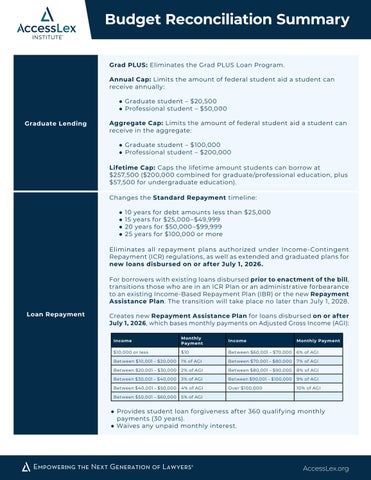
Creates new Repayment Assistance Plan for loans disbursed on or after July 1, 2026 , which bases monthly payments on Adjusted Gross Income (AGI):
● Provides student loan forgiveness after 360 qualifying monthly
● payments (30 years).
● Waives any unpaid monthly interest.
Accountability
Budget Reconciliation Summary
Establishes “do no harm” standard: Eliminates federal loan eligibility for programs that leave students worse off than if they had never enrolled:
● Prohibits new federal student loans from paying for
● undergraduate programs where the majority of former students
● earn less than the median high school graduate in the same
● state.
● Prohibits new federal student loans from paying for graduate
● programs where the majority of former students earn less than
● the median bachelor’s degree recipient in the same field in the
● same state.
Programs lose Title IV eligibility if they fail to meet the standard for two years in a three-year period, with the option to reapply after two years.
Applicable institutions will be charged a tax equal to:
● 1.4% for institutions with endowment assets between $500,000
● and $750,000 per student.
● 4% for institutions with endowments valued from $750,000 to
Endowment Tax
● $1.9 million per student.
● 8% for institutions with endowments worth $2 million or more
● per student.
Institutions that serve less than 3,000 students are exempt from the endowment tax.