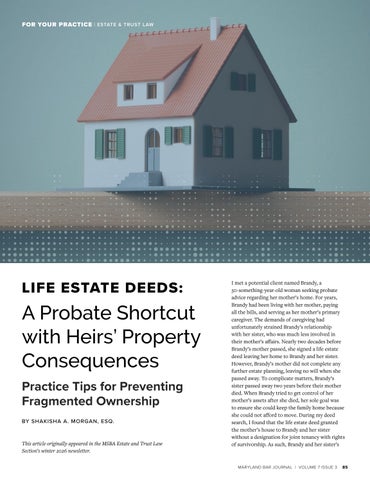

LIFE ESTATE DEEDS: A Probate Shortcut with Heirs’ Property Consequences Practice Tips
for Preventing Fragmented Ownership
BY SHAKISHA A. MORGAN, ESQ.
I met a potential client named Brandy, a 50-something-year-old woman seeking probate advice regarding her mother’s home. For years, Brandy had been living with her mother, paying all the bills, and serving as her mother’s primary caregiver. The demands of caregiving had unfortunately strained Brandy’s relationship with her sister, who was much less involved in their mother’s affairs. Nearly two decades before Brandy’s mother passed, she signed a life estate deed leaving her home to Brandy and her sister. However, Brandy’s mother did not complete any further estate planning, leaving no will when she passed away. To complicate matters, Brandy’s sister passed away two years before their mother died. When Brandy tried to get control of her mother’s assets after she died, her sole goal was to ensure she could keep the family home because she could not afford to move. During my deed search, I found that the life estate deed granted the mother’s house to Brandy and her sister without a designation for joint tenancy with rights of survivorship. As such, Brandy and her sister’s
As Maryland considers (and reconsiders) adopting transfer-ondeath deeds, we, as practitioners, must evaluate our continued reliance on life estate deeds and consider the risks they pose when clients are not fully advised.

estate were tenants in common, and Brandy was now an owner of heirs’ property. This situation was also compounded by the fact that Brandy’s sister (survived by a husband and children) died intestate.
Brandy’s case is not uncommon. In my practice, I have encountered several individuals and families who were either unaware that the property they lived in was classified as heirs’ property, knew that the property title had not been legally transferred, but were confused about the consequences of an unclear title, or did not have the financial resources or familial support to navigate the process of clearing title. While these cases have involved some level of estate planning, such as a life estate deed, it seems that practitioners, clients, and heirs were operating under different assumptions about what the deed accomplished and its legal and practical consequences.
Life estate deeds remain a commonly used probate-avoidance tool in Maryland, particularly for homeowners seeking a lowcost solution. As Maryland considers (and reconsiders) adopting transfer-on-death deeds, we, as practitioners, must evaluate our continued reliance on life estate deeds and consider the risks they pose when clients are not fully advised. While life estate deeds can be effective in certain circumstances, we must be diligent in ensuring that their use does not create outcomes contrary to our client’s intent. This is especially relevant considering the possible unintended creation of heirs’ property, as was the case with Brandy’s mother.
FROM LIFE ESTATE TO HEIRS’ PROPERTY IN ONE GENERATION
Heirs’ property is typically created when a homeowner dies intestate, and their heirs inherit an undivided interest in the property as tenants in common. While intestate succession laws were created for this specific scenario, heirs’ property is the most unstable form of tenancy in common, putting wealth accumulation, family relationships, and housing security at the greatest risk.
By its nature, tenancy in common allows two or more persons to hold title to real estate in a manner that vests each “owner” with an undivided interest in the property. Each heir has the right to possess (i.e., right to use and enjoy) the entire parcel of property (hence, their undivided interest), but their ownership interests are only fractional shares of a whole parcel of land. Tenants in common do not share ownership of the entire parcel of land, nor do they receive the right of survivorship. Moreover, tenancy in common can vary: the tenants may hold equal shares or unequal shares. Tenancy in common interests are transferable, devisable, and descendible. Rather than consolidate property interests (as in a joint tenancy), tenancy in common property fractions upon the death of each interest holder. Simply put, tenants in common are multiple “owners” of real property that is not physically divided, with each owner holding their share until required (by agreement, operation of law, or other legal means) to part with it.
Though property ownership typically represents the single greatest economic asset for low and middle-income families, heirs’ property continues to be a very common form of family property ownership among socioeconomically disadvantaged and historically marginalized communities. In fact, the
Federation of Southern Cooperatives estimates that 60% of Black-owned land in the United States is held as heirs’ property.1 This exacerbates the glaring wealth gap that persists in the United States, where new research highlights that the modern racial wealth gap is growing despite increases in Black wealth. From 2019 to 2022, the most recent years in which the Federal Reserve’s Survey of Consumer Finances collected household wealth data, the mean gap in net worth between Black and white households grew from $841,900 to $1.15 million—a 38% increase2. Property ownership and inheritance should be a wealth accumulation tool, but the existence of heirs’ property greatly diminishes that desired return. When life estate deeds are used without comprehensive counseling, they frequently result in heirs’ property. In a common scenario, you will have a parent who deeds a life estate to themselves with the remainder to multiple adult children. The attorney who prepares the deed fails to include survivorship language or governance provisions in the planning, and then one or more of the remaindermen later dies intestate, divorces, incurs debts, or moves out of state. At the life tenant’s death, the property does not pass cleanly as intended. Instead, it turns into undivided interests among multiple heirs, and often across multiple generations. This results in fractional interests that multiply over time (because life and death continue to happen) when left unresolved. For clients who prepare life estate deeds with the intention of providing stability, preserving family, or transferring wealth, this outcome is devastating.
This problem with heirs’ property reflects both client misunderstanding and insufficient counseling at the time of drafting and execution. Often, clients are ignorant of what happens if a remainderman predeceases the client, the impact of creditor or divorce exposure of remaindermen, and why they still need a comprehensive estate plan that aligns with their goals.
Probate avoidance is a necessary function of estate planning, but it cannot become the only objective. We must ensure that our clients’ long-term ownership goals are reflected in our practice.
PRACTICE POINTERS FOR MARYLAND PRACTITIONERS
If Maryland adopts transfer-on-death deeds, it will likely reduce reliance on life estate deeds. However, it does not diminish the need for practitioners to know when and how to use them, and to inform clients fully of the benefits and risks.
1 www.federation.coop/land-retention
When used without proper counseling, life estate deeds can create heirs’ property, family conflict, and preventable loss of generational wealth. Maryland practitioners must resist the urge to simplify complex ownership issues and instead focus on aligning estate planning tools with client intent.
Heirs’ property is typically created when a homeowner dies intestate, and their heirs inherit an undivided interest in the property as tenants in common.
Do not treat life estate deeds as a default tool.
A life estate deed should be a deliberate choice, not a default. These deeds are often selected reflexively to avoid probate without evaluating whether they advance the client’s broader goals. If those goals include family harmony, flexibility, or asset protection, a life estate deed may be the wrong choice.
Going forward, require yourself to share and document at least one alternative planning option with the client before proceeding with a life estate deed.
Counsel first and draft second.
Before drafting a life estate deed, practitioners should address how many remaindermen will take title, whether survivorship is intended, what happens if a remainderman dies first, what the client intends for the remaindermen to do with the property, and what the client’s tolerance for future family conflict is. If the client is unable to address these considerations, further conversation and planning are required. Clients must be well informed.
Going forward, prepare a mandatory pre-draft counseling checklist to be used by all the attorneys in your practice. Store the completed checklist in your client’s file.
2 Aditya Aladangady et al., Greater Wealth, Greater Uncertainty: Changes in Racial Inequality in the Survey of Consumer Finances, FEDS Notes (Oct. 18, 2023), federalreserve.gov/ econres/notes/feds-notes/greater-wealth-greater-uncertainty-changes-in-racial-inequality-in-the-survey-of-consumer-finances-20231018.html.
Probate avoidance is a necessary function of estate planning, but it cannot become the only objective. We must ensure that our clients’ long-term ownership goals are reflected in our practice.
If using a life estate deed, draft with precision.
When a life estate deed is appropriate, consider the following:
• Name remaindermen specifically, instead of using class gifts;
• Use survivorship language when it is consistent with the client’s intent;
• Prepare an aligned, full estate plan (powers of attorney and will or trust) or ensure the client has one already in addition to the life estate deed; and
• Document the counseling that you provide, including the heirs’ property risk.
Going forward, use a standardized life estate deed template that you can use intentionally, not mechanically.
Discuss alternatives, even if the client declines.
Practitioners should at least discuss revocable living trusts with successor provisions for real property, other forms of tenancy if applicable, transfer-on-death deed options if enacted, and incremental planning that preserves flexibility. These discussions should be memorialized as it is good practice and excellent risk management.
Going forward, prepare a one-page alternatives summary and have clients sign an acknowledgment if they choose the life estate deed instead.
Address governance.
Because life estate deeds address ownership—but not management, conflict resolution, or exit strategies (if there are no rights of survivorship)—discuss what the client’s desires are related to their heirs’ governance of the property.
Going forward, consider having your client explicitly state in writing their desires on dispute resolution and buyout options.

Morgan, Esq. is a learner, strategist, and connector with over a decade of legal experience. An educator at heart, Morgan is affectionately known as The Legacy Counselor™, and she is the Principal Attorney of The Morgan Firm, LLC.
Shakisha