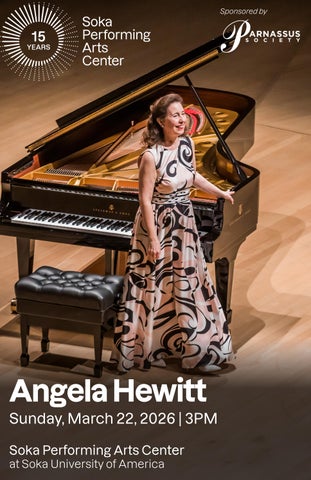
Sunday, March 22, 2026 | 3PM

Partita No. 5 in G major
Sonata No. 2 in G minor, Op. 22
From the Sixième Ordre
Les Moissonneurs
Les Langueurs-Tendres
Les Baricades Mistérieuses
Les Bergeries
Le Moucheron
JOHANN SEBASTIAN BACH
Born March 21, 1685, Eisenach
Died July 28, 1750, Leipzig
When Bach moved to Leipzig in 1723, his musical duties changed. For his music-loving prince in Cöthen, Bach had written the great part of his secular instrumental music, but now–as cantor of the Thomaskirche–he was charged with producing music for religious functions, and the music flowed out of him at a pace that would have exhausted even a Mozart: from the late 1720s came several hundred church cantatas and the St. Matthew Passion. But Bach did not altogether lose interest in instrumental music: he had written the first book of The WellTempered Clavier in Cöthen, and now in Leipzig he continued to compose for keyboard.
Bach’s set of six partitas, originally written for harpsichord, was composed between 1726 and 1731 and published in the latter year as the first volume of his ClavierÜbung (“Keyboard Practice”); in a wonderful introductory note in the score, the composer described these works as having been “Composed for Music Lovers, to Refresh their Spirits, by Johann Sebastian Bach.” Bach understood the partita to be a suite of dance movements–its name implies a set of “parts”–based on the traditional sequence of allemande-courantesarabande-gigue. He adopted this tradition but made it his own by supplementing it with three of what he called “galanteries”: extra
movements, somewhat lighter in character and intended to make the work more attractive to listeners. These consisted of an introductory movement (in a different form in each of the six partitas) and two extra dance movements.
The Partita No. 5 in G Major dates from 1730, when Bach was 45. The wonderful Preambulum has been likened to a concerto. It features brilliant exchanges between the hands, and all this dashing energy is interrupted by dignified chords that provide moments of repose before the music dashes off again.
Each of the four traditional movements of the partita has a distinct national origin. The Allemande (that name suggests its German ancestry) is a slow dance of serious character, usually in 4/4 time and in binary form. The Courante (French for “running”) is a lively movement, usually in triple time but sometimes mixing different rhythms; this one remains firmly in 3/8. The Sarabande, of Latin American and Spanish heritage, is a stately dance in triple time; this sarabande, in 3/4 meter, makes frequent use of dotted rhythms and grace notes. The concluding Gigue (derived distantly from the Irish jig) dances energetically and features polyphonic entrances and off-the-beat accents.
The interpolated “galanteries” are first a Tempo di Minuetto that belongs mostly to the right hand; its athletic and angular character makes this quick music seem at far remove from the minuet of
classical form. The second is a Passepied (“pass-foot” in French), a lively dance in triple time, said to be originally a sailors’ dance.
Born June 8, 1810, Zwickau
Died July 29, 1856, Endenich
Schumann was a master of the short piano piece. The many sets of short pieces he wrote in his twenties–pieces of expressive character, no specified form, and an instinctive sense of piano technique and sonority–have almost defined one face of romanticism by themselves, and they have become part of the repertory of every pianist, from the greatest virtuoso to the humblest amateur. Yet Schumann longed to master the classical sonata form of Mozart, Beethoven, and Schubert, and to that end he attempted while still in his twenties to compose three piano sonatas. The form gave him a great deal of trouble, and his sonatas have never achieved the popularity of his other piano works. Schumann himself remained uncertain about them: one of them he was willing to publish only twenty years later and after much revision, and he worked on the present Sonata in G Minor for a decade before he considered it complete.
Schumann began work on the Sonata in G Minor in the summer of 1833, just as he turned 23. He drafted the first two movements that June, and for the second movement he reached back to the song Im Herbste that he had composed
five years earlier, recasting it now for piano. The sonata had to wait two more years for its finale, which Schumann wrote in 1835. Still he was dissatisfied with what he had written, and he set the manuscript aside. In 1838-39, Schumann made an extended visit to Vienna, a stay that had important musical results. On this trip he visited Schubert’s aging brother and discovered among the composer’s dusty papers the manuscript for the “Great” C-Major Symphony. It was during this same visit that Schumann returned to the manuscript of his sonata, discarded the finale, and wrote a new one. He published the completed work in 1839 as his Second Sonata, although it was the last of his three sonatas to be composed.
The Sonata No. 2 is in four movements rather than the expected three, but Schumann’s long labors on this music make themselves felt–this is a very successful sonata. The first movement is in sonata form and treats two themes at length: the dramatic opening subject and a more lyric second idea, which is energized by its syncopated rhythms. Everyone notes the logical confusion of the young Schumann’s tempo markings for this movement. He marks the opening So rasch wie möglich (“As fast as possible”), but later in the movement he specifies that the music should be “Faster” and at the end marks the coda “Much faster.” The Andantino shows Schumann’s considerable lyric gift, as well it should, for this is the movement based on the early
song. Here that song’s melody becomes the basis for a free development, and Schumann’s writing demands great rhythmic suppleness from the pianist.
The Scherzo, marked Very fast and clear, whips along crisp dotted rhythms, while the concluding rondo alternates two quite different kinds of music. The central theme proceeds on a rush of octave sixteenth-notes so intense that one pianist has referred to this sound as a “tremolo,” while the lyric second idea is much slower. The movement switches between these quite varied ideas until a dramatic coda rushes the sonata to its close.
Born November 10, 1668, Paris
Died September 11, 1733, Paris
Francois Couperin trained as an organist, but we remember him today primarily for his harpsichord music. In 1716, at the age of 48, Couperin published a treatise on harpsichord-playing titled L’art de toucher le clavecin, and over the final two decades of his life he published 220 pieces for the harpsichord. He organized these pieces into 27 groups, which he called ordres rather than suites, and these were published in four “books” between 1713 and 1730. Couperin’s ordres bear some relation to the baroque keyboard suite–both contain dance movements, for example–but what distinguishes Couperin’s collections is the vast number of character pieces, often
with fanciful titles. Sometimes these pieces can be descriptive, offering musical portraits of specific people or things. And Couperin had a nice, wry sense of everyday reality: one of his pieces describes his operation for gallstones. Many times, however, Couperin’s titles are abstract, sometimes intentionally obscure, and these cause listeners to come to the music with fresh perceptions.
This recital offers five of the eight pieces from Couperin’s Sixième Ordre. Les Moissoneurs (The Harvesters) is a portrait of harvesting wheat. Couperin sets it in rondo form and marks it Gayement (“gaily); the sturdy rondo theme is separated by three interludes that Couperin titles “couplets.” Les LangueursTendres (Tender Languors) is built on a gentle, flowing melody decorated throughout with such embellishments as mordants and gracenotes.
Les Baricades Misteriéuses is one of the most famous of Couperin’s keyboard pieces. This music has haunted performers and audiences for the last three hundred years, but no one has any idea what those “mysterious barricades” are, and there have been countless interpretations of that title. But there can be no denying the mesmerizing, soothing power of this music. It is a short rondeau in what has been called the style brisé, or “broken style,” in which chords are “broken” or arpeggiated, and the thematic material grows almost incidentally out of the music’s rippling, interlocking textures. Every
rippling, interlocking textures. Every listener responds to the precision and formal balance of this music–there is something haunting and evocative about just that precision. Les baricades mistérieuses has been arranged for countless instruments and ensembles, and this music always works, no matter the instrumentation. Movie-goers will recall that director Terence Malik used it to good effect throughout his film The Tree of Life.
Les Bergeries translates literally as “sheep pens,” so this is another portrait from nature. And a very agreeable one. Once again, it is in rondo form with three couplets. Characteristically, Couperin asks that the performance be Naivement Le Moucheron translates as “gnat” or “midge.” Here that insect–rather than being annoying–dances, floats, and buzzes agreeably.
MAURICE RAVEL
Born March 7, 1875, Ciboure, Basses-Pyrennes
Died December 28, 1937, Paris
Two events combined to help produce Le tombeau de Couperin, Ravel’s last large-scale work for piano. In the second decade of the twentieth century, well before the beginning of the neo-classical movement, Ravel found himself increasingly drawn to the music of France’s past. He embarked on a lengthy study of eighteenth-century French keyboard music, going so far as to transcribe one of the keyboard pieces of Francois Couperin, and he planned to write a collection of
his own piano pieces in the manner of the eighteenth-century French clavecinists. His working title for this piece was Suite française.
The other force was less benign. In the summer of 1914, World War I exploded across Europe, and–after the guns destroyed the old certainties that summer–Western Civilization would never be the same. Ravel was one of the few composers in history to serve in the military. Driven by patriotism and a sense of the moment, he enlisted in the French army and–at age 40–drove ambulances carrying wounded back from the front. For a nature as sensitive as Ravel’s, the experience was devastating, and–to compound his misery–his mother died while he was gone.
Under these conditions, what had begun as the Suite française evolved into something quite different. During the years 191417 Ravel composed a suite of six movements for piano and dedicated each movement to a different friend who had been killed in the war. He gave the piece a title that reflects both its homage to the past and the dark moment of its creation: Le tombeau de Couperin, or “The Tomb of Couperin.” Ravel creates a consciously antiquarian sound in this music: each of the six movements is in a baroque form, and Ravel sets out to make the modern piano mimic the jangling, plangent sound of the harpsichord. A bittersweet flavor runs throughout Le tombeau: several of the movements may
several of the movements may be in dance forms, but here they dance with a gravity that springs from war and loss. Marguerite Long gave the first performance in Paris on April 11, 1919, five months to the day after the Armistice that brought the war to its close. Later that year Ravel orchestrated four of the movements, and Le tombeau de Couperin has become more familiar in this orchestral version than in its original form.
The opening Prélude is full of busy energy, whirling along a constant murmur of sixteenth-notes. Against this rush of quiet motion Ravel sets what are essentially fragments of themes, full of mordents, turns, and other decorations characteristic of eighteenth-century music. The Fugue, at a moderate tempo, is quite subdued. Its subject, only three measures long, is of narrow compass (most of this fugue is written with both hands in the treble clef), and Ravel extends it quietly (the dynamic never rises above mezzo-forte) before the music fades delicately into silence. A forlane was originally a lively dance believed to be of Italian creation, and Ravel’s Forlane dances with somber dignity along a springing 6/8 meter. Nominally in E minor, this music is riddled with accidentals, and its pungent harmonies echo the clang of the harpsichord.
A rigaudon was a lively folkdance in duple meter and short phrases, thought to be originally from Provence. Ravel’s Rigaudon–marked Very fast–bursts to life on a bright flourish in C major, followed
instantly by the propulsive dance. Its central episode slips into C minor, but the opening section soon returns in all its energy and the movement races to its close on the opening flourish. The Menuet is built on a long and expressive main theme. Ravel marks the center section Musette (an old dance accompanied by bagpipe), and the sustained chorale-like theme here echoes some of that antique sound.
The concluding Toccata is easily the most brilliant, and most difficult, movement in the suite–and the one that moves farthest away from an atmosphere of mourning. As its name implies, a toccata is intended to demonstrate a player’s touch, and this Toccata whips along its 2/4 meter on the steady pound of repeated notes. Against this driving energy, Ravel sets a dancing opening theme and a more wistful second subject, but the steady rhythms finally drive the Toccata to an exciting close, which–if it does not banish the air of stately mourning that surrounds Le tombeau de Couperin–at least rounds it off in brilliant fashion.
Program notes by Eric Bromberger © 2025.
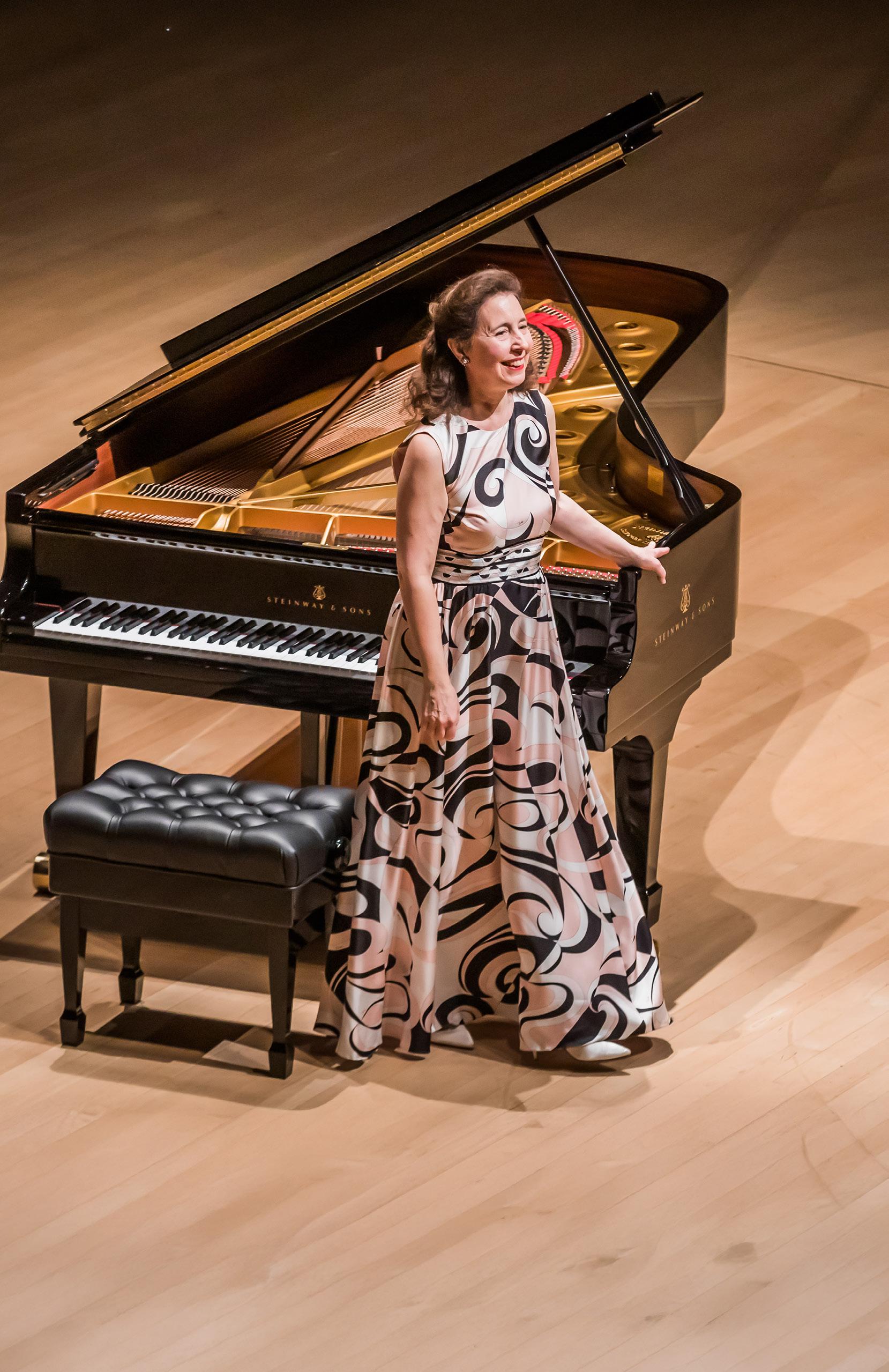
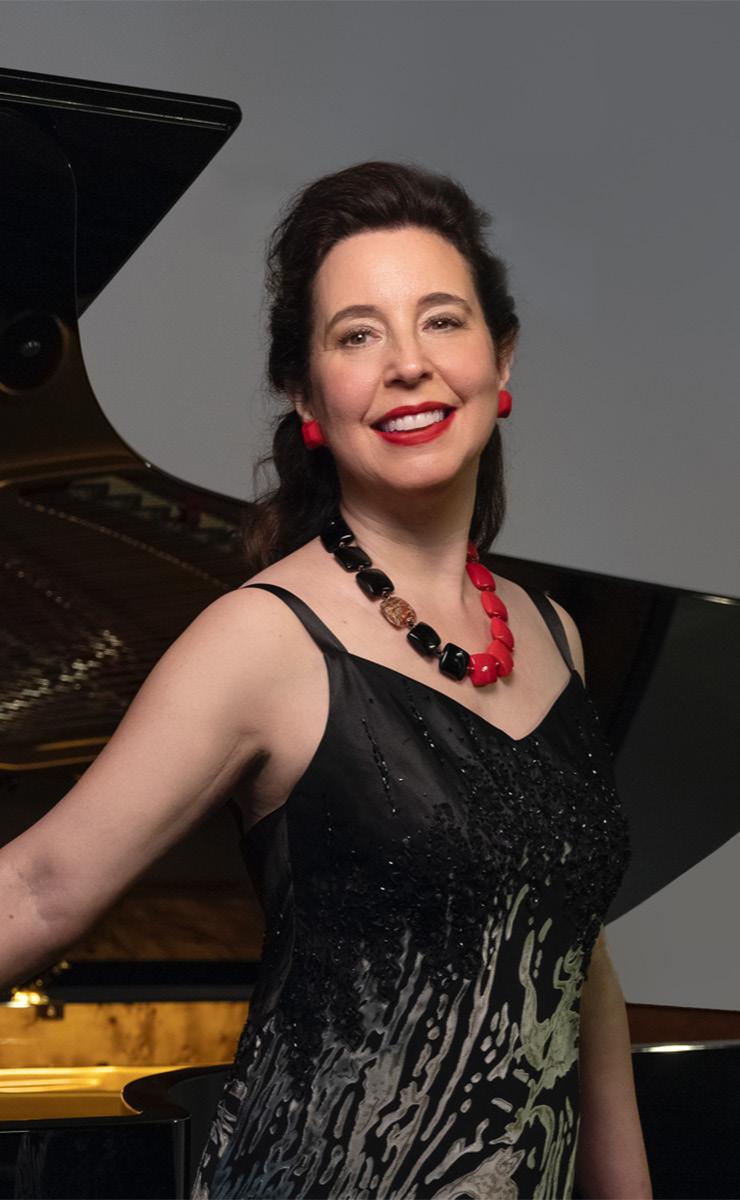
Angela Hewitt, one of the world’s leading concert pianists, brings her exceptional artistry to the stage with a performance that promises to captivate. Acclaimed for her profound interpretations and technical brilliance, Hewitt is a distinguished performer with a wide-ranging repertoire and frequent appearances with major orchestras across Europe, the Americas, and Asia.
An award-winning recording artist, Hewitt is renowned as one of the foremost interpreters of Bach. Her performances have garnered numerous accolades, including the prestigious City of Leipzig Bach Medal, making her the first woman to receive this honor in its 17-year history. Hewitt’s recordings of Bach’s keyboard works are considered among the greatest of our age, praised for their clarity and expressive depth.
In addition to her solo career, Hewitt has led numerous orchestras from the piano, including the Toronto Symphony Orchestra, Lucerne Festival Strings, and the Vienna Tonkünstler Orchestra. Her remarkable discography spans works by Couperin, Rameau, Mozart, Beethoven, Chopin, and many others, consistently earning critical acclaim and topping classical music charts.
Born into a musical family and beginning her piano studies at age three, Hewitt’s illustrious career was launched with her victory at
the Toronto International Bach Piano Competition in 1985. She has since been honored with numerous awards, including the Governor General’s Lifetime Achievement Award and the Order of Canada.
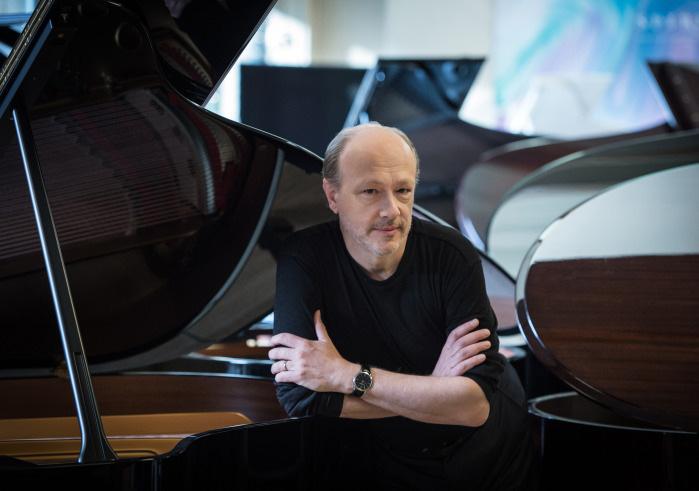


SUNDAY, APR. 12, 2026 | 3PM
PROGRAM
HAYDN Sonata in D major, Hob. XVI:37
BEETHOVEN Piano Sonata in C major, Op. 2, No. 3
MEDTNER Danza festiva, Op. 38, No. 3
RACHMANINOFF Étude-Tableau in E-flat minor, Op. 39, No. 5 and more!
“Hamelin’s legend will grow - right now there is no one like him.” - Alex Ross, The New Yorker
A wide variety of wine, beer, soft drinks and freshly prepared snacks will be available before the concert and during intermission.
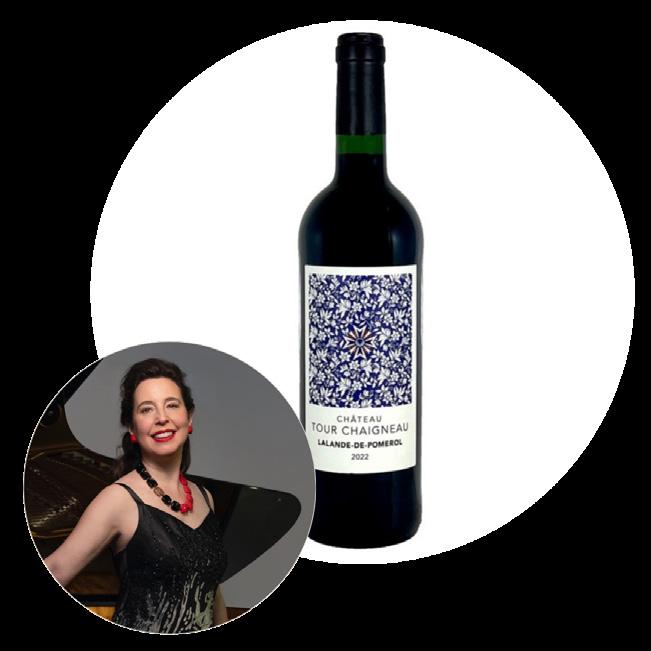
Chateau Tour Chaigneau Lalande de Pome
We asked the artists for their favorite drink pick to feature at concessions!
Chateau Tour Chaigneau Lalande de Pome was selected by Angela Hewitt and will be available for purchase before the performance and during intermission.
Pre-order your concessions and skip the line during intermission!

Our mission is to Engage, Educate, and Elevate the Human Spirit
Soka Performing Arts Center is dedicated to elevating the human spirit through transcendent live experiences. Discover the unmatched beauty of our acoustics. Expand your understanding and appreciation of music through our programs that illuminate new perspectives. Build community and forge deep connections through the shared experience of live performance. We invite you to become a part of our Soka Performing Arts Center family and to Listen. Feel. Transform.
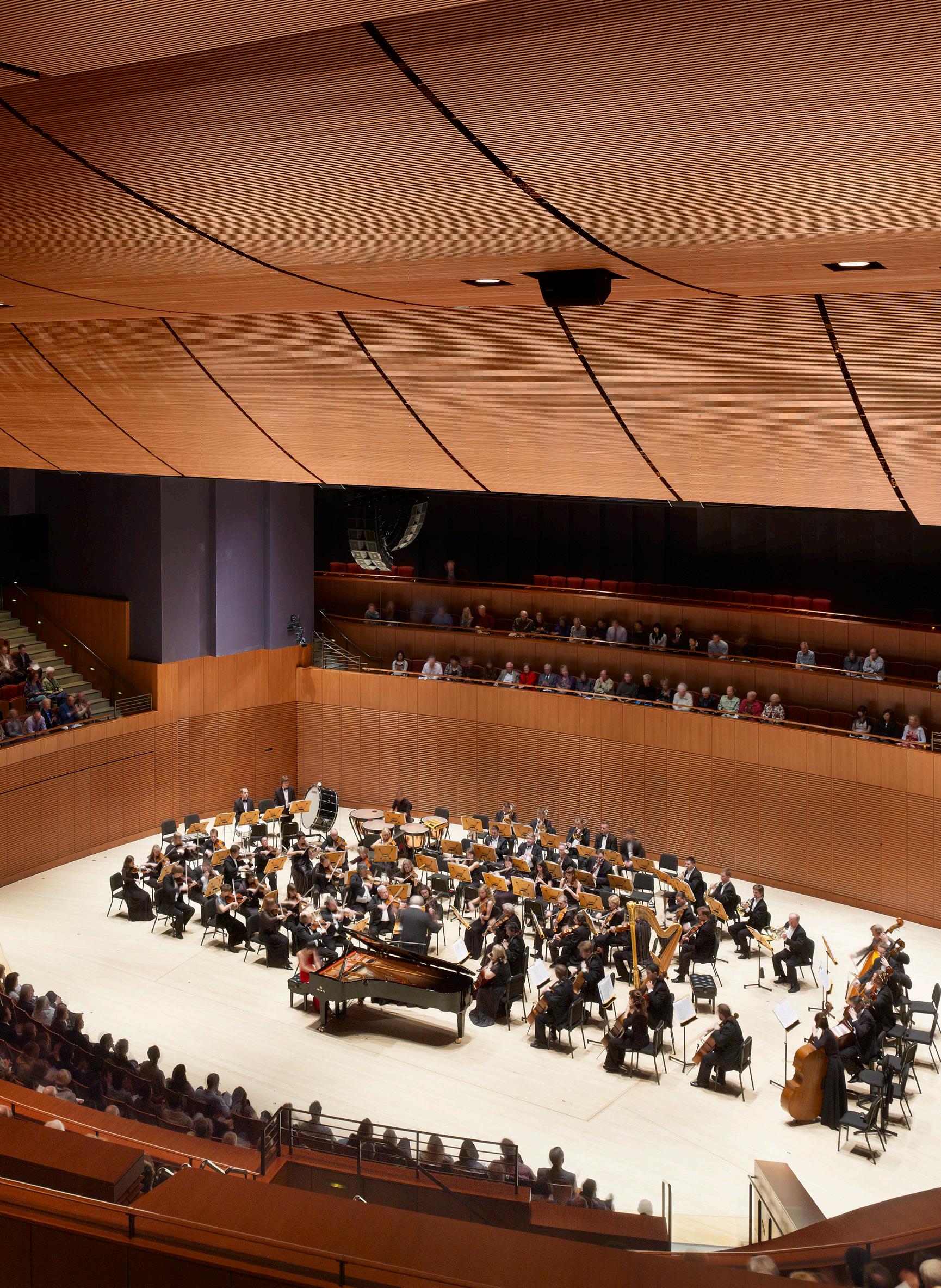

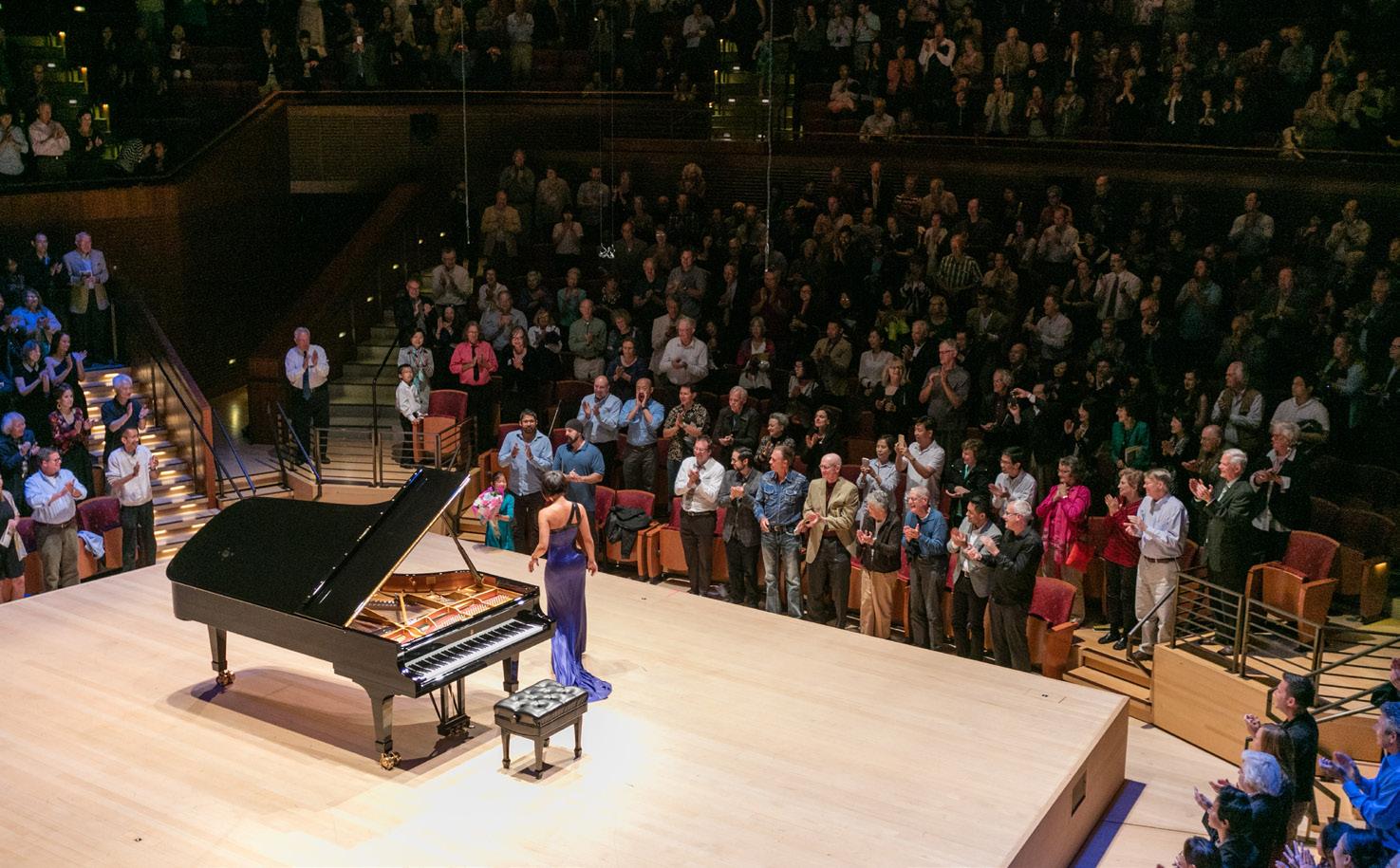
Soka Performing Arts Center is located on the beautiful hilltop campus of Soka University of America in Aliso Viejo. Our facility includes the 1,042seat Concert Hall featuring world-class acoustics designed by master acoustician Yasuhisa Toyota, designer of the Walt Disney Concert Hall in Los Angeles and Suntory Hall in Tokyo, among many others. We also have an intimate 350-seat Black Box Theatre that allows for multiple seating configurations including club seating with bistro tables.
More than 800 performances have taken place since the center’s dedication on May 27, 2011. The 2025-26 season marks our fifteenth season presenting first-class programming in our world-class concert hall. We are continuing to expand our programming and outreach with the addition of a Children’s Concert Series and the only Great Pianists Series on the West Coast. From classical and jazz to world and contemporary music, the Soka Performing Arts Center has become a prized space for artists and audiences alike.
We are proud to be the home of the Pacific Symphony Chamber Orchestra. Our Sundays @ Soka Series with Pacific Symphony continues to be one of our most popular series year after year. Our presentations with other Orange County arts organizations have enabled us to reach further into our community to offer arts education and programming. Our partnership with the Philharmonic Society of Orange County includes our Philharmonic Society Series, which brings superlative artists to our stage. We also partner with Philharmonic Society for our Outreach Program, bringing over 7,000 school children to Soka Performing Arts Center to experience live performances with outstanding musicians.
With its world-class acoustics and first-class performances, Soka Performing Arts Center is quickly becoming one of the cultural jewels of Orange County.
DIRECTOR’S CIRCLE ($75,000+)
Dr. Kenneth & Sandra Tokita
Sam* & Lyndie Ersan
CONCERTMASTER ($10,000+)
Ms. Emi Maeda
STAGE CHAMPION ($5000+)
Yoshitomo & Takemi Daido
STAGE BENEFACTOR ($1000+)
Anonymous
OC Chinese Cultural Club
John and Sue Prange
Terumi Saito
Jochen Schumacher
Alex & Sandy Scott
Scott A Shuping
Anson and Marilyn Wong
PLATINUM CLEF ($500+)
Anonymous
Jeffrey Hendrix
Edward D. Jones
Jane A. Lynch
GOLD CLEF ($200+)
Judy Kaufman
Lorraine Leiser
Naomi Uchiyama
SILVER CLEF ($100+)
Renée Bodie
Sam Chang
Masako Inage
Debrah Jiang
Chiharu Nagai
Paul Porto
Thomas Prigorac
Jonia Suri
Joseph Whittaker
BRONZE CLEF ($25+)
Raquel Bruno
Kenneth Hanawa
Ryosuke Iga
Jeannette Pease
Joyce M Wrice
Taro Yamanashi
* Deceased
List current as of 09/26/2024
The Soka Performing Arts Center deeply appreciates the support of its sponsors and donors, and makes every effort to ensure accurate and appropriate recognition. Contact Renée Bodie, General Manager at (949) 480-4821 to make us aware of any error or omission in the foregoing list.
DONATE TO SOKA PERFORMING ARTS CENTER
Your support helps ensure Soka Performing Arts Center fulfills its purpose: to engage, educate, and elevate the human spirit. Your gift supports the programming of world-class performances, provides transformative educational outreach experiences, and opens the opportunity to build engagement with our community by sharing the joy of live music.
Our subscription and renewal program provides you with even more flexibility in our season packages*. With our enhanced program, you now have the power to curate your very own unique experience.
• 15% Discount for a 3 performance package
• 18% Discount for a 4 performance package
• 20% Discount for a 5+ performance package
*full details online at soka.edu/pac
• Blueport Jazz
• Philharmonic Society of Orange County
• Pacific Symphony
• Parnassus Society
Renée Bodie
General Manager & Artistic Director
John Morgan
Box Office Manager
Antoinette Rossman
House Manager/Assistant to the General Manager
Steve Baker
Production Manager
Jarmil Maupin
Internal Events Manager
Ian Smith
Technical Services Manager
Katie Ohrn
Lighting Supervisor
Piano Tuners
Kathy Smith Lead Tuner
Ron Elliott
David Stoneman
David Vanderlip


Website soka.edu/pac
Soka Performing Arts Center resides on the beautiful campus of Soka University of America. We thank the SUA Board of Trustees and the SUA Leadership Council for all of their support.
Stephen S. Dunham, JD | CHAIR
Vice President and General Counsel Emeritus, Pennsylvania State University | Baltimore, Maryland
Tariq Hasan, PhD | VICE CHAIR
Chief Executive Officer, SGI-USA | New York, New York
Andrea Bartoli, PhD
President, Sant’Egidio Foundation for Peace and Dialogue | New York, New York
Matilda Buck
Benefactor | Los Angeles, California
Lawrence E. Carter, Sr, PhD, DD, DH, DRS
Dean, Professor of Religion, College Archivist and Curator, Morehouse College | Atlanta, Georgia
Andy Firoved
CEO, HOTB Software | Irvine, California
Jason Goulah, PhD
Professor of Bilingual-Bicultural Education and Director, Institute for Daisaku Ikeda Studies in Education, Director of Programs in Bilingual-Bicultural Education, World Language Education, and Value-Creating Education for Global Citizenship, College of Education, DePaul University | Chicago, Illinois
Clothilde V. Hewlett, JD
Commissioner of Department of Financial Protection and Innovation, State of California | San Francisco, California
Karen Lewis, PhD
Sondheimer Professor of International Finance and Co-Director, Weiss Center for International Financial Research, Wharton School, University of Pennsylvania | Philadelphia, Pennsylvania
Luis Nieves
Founder, Chairman Emeritus AUL Corp, Benefactor | Napa, California
Isabel Nuñez, PhD, MPhil, JD
Professor of Educational Studies, Dean of School of Education, Purdue University Fort Wayne | Fort Wayne, Indiana
Gene Marie O’Connell, RN, MS
Health Care Consultant, Associate Clinical Professor, University of California, San Francisco School of Nursing | Corte Madera, California
Adin Strauss
General Director, Soka Gakkai International-USA | Santa Monica, California
Yoshiki Tanigawa
Benefactor, Soka Gakkai | Tokyo, Japan
Gregg S. Wolpert
Co-president, The Stahl Organization | New York, New York
Edward M. Feasel, PhD
President, Soka University of America (ex-officio member) | Aliso Viejo, California
Edward M. Feasel, PhD
President
Chief Academic Officer
Professor of Economics
Archibald E. Asawa
Executive Vice President for Finance and Administration
Chief Financial Officer
Chief Investment Officer
Katherine M. King, PHR
Executive Vice President of University
Community
Chief Human Resources Officer
Title IX and Section 504 Coordinator for Faculty, Staff and Others
Michael Weiner, PhD
Executive Vice President for Academic Affairs
Professor of East Asian History & International Studies
Bryan E. Penprase, PhD
Vice President for Sponsored Research and External Academic Relations Professor of Physics and Astronomy
Tomoko Takahashi, PhD, EdD, LHD
Vice President for Institutional Research and Assessment
Dean of the Graduate School Professor of Linguistics and Education
David Welch, JD Vice President University Counsel
M. Robert Hamersley, PhD Dean of Faculty Professor of Environmental Biogeochemistry
Hyon J. Moon, EdD Dean of Students
Title IX and Section 504 Deputy Coordinator for Students
Michelle Hobby-Mears, MBA
Associate Dean of Students Director of Student Activities
Andrew Woolsey, EdD Dean of Enrollment Services
Martin Beck, MA
Executive Director of Strategic Marketing and Communications