
NAVIGATING AI GOVERNANCE
MATTHEW D. KOHEL
Saul Ewing LLP
“The AI and Legal Technology Task Force (Task Force) has identified a clear shift in the legal field’s adoption of AI. Specifically, we are moving away from the era of “AI experimentation” and into an era of strategic integration.
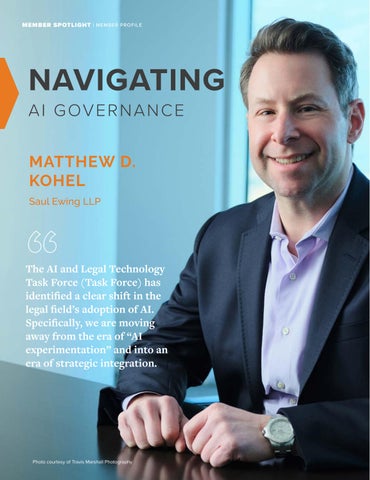
Photo courtesy of Travis Marshall Photography

NAVIGATING AI GOVERNANCE
MATTHEW D. KOHEL
Saul Ewing LLP
“The AI and Legal Technology Task Force (Task Force) has identified a clear shift in the legal field’s adoption of AI. Specifically, we are moving away from the era of “AI experimentation” and into an era of strategic integration.
Photo courtesy of Travis Marshall Photography
MATT KOHEL is a commercial litigation and intellectual property attorney who advises companies on artificial intelligence (AI) governance, IP, and data privacy. Kohel has been selected as a Maryland Super Lawyer every year since 2021 and is a recognized leader and speaker on AI law and technology. He has served as chair of the Maryland State Bar Association (MSBA) AI and Legal Technology Task Force since its inception in 2023.
Why did you enter the legal profession?
I was drawn to the law primarily because of the combination of the intellectual rigor of the profession and the practical role an attorney plays in a client’s success. At its core, being a lawyer is about being a problem solver and a partner to the client. I have found the challenge of turning legal insights into actionable business strategies to be incredibly rewarding.
Do you find time to relax and unwind?
In this job, you can get burned out quickly if you don’t build in downtime. For me, that usually means taking trips with my family where we can stay active. We’re big on nature and enjoy hiking, snorkeling, and other outdoor experiences that help me reset.
What is an interesting fact about you that no one would guess?
I’m a science nerd and curious person who likes to dig into how complex systems work, and I consider myself an astronomy and cosmology enthusiast. I am drawn to the unexplained questions about how the universe evolved and the relationship between the formation of the biggest structures in the universe and what’s happening in space on a much smaller level. It’s a hobby that helps me keep a healthy perspective.
What specific challenges or opportunities has the AI and Legal Technology Task Force identified so far in how AI is changing the way lawyers work?
The AI and Legal Technology Task Force (Task Force) has identified a clear shift in the legal field’s adoption of AI. Specifically, we are moving away from the era of “AI experimentation” and into an era of strategic integration.
The most immediate opportunity lies in enhanced client service. By leveraging AI, lawyers can provide more efficient, cost-effective results. Using AI for an investigative assessment, to stress-test an argument, or to surface obscure yet relevant patterns in a large volume of information enables deeper analysis from day one.
In addition, I view AI as a powerful tool for self-education. People are increasingly turning to large language models (LLMs) as new search engines, and they can help a
practitioner quickly get up to speed on a new niche or complex regulatory framework.
However, these opportunities come with a non-negotiable duty of technological competence and compliance with our ethical obligations. The Task Force projects were designed to address these challenges head-on. Attorneys must remain vigilant regarding hallucinations in court filings and other documents and rely on human-in-theloop verification. AI is not there to replace lawyers, but to assist us.
How is the Task Force approaching the balance between innovation and ethical responsibilities in legal practice as AI tools become more widespread?
The Task Force operates on the principle that innovation and ethics are not opposing forces. Instead, robust ethical frameworks enable safe innovation. We don’t want Maryland lawyers to avoid these tools out of fear, but rather to appreciate the risks and use AI tools responsibly.
To achieve this balance, our approach has been deeply practical. We started by analyzing generative AI’s capabilities against the Maryland Attorneys’ Rules of Professional Conduct (MARPC). A cornerstone of our strategy was the creation of various template AI acceptable use policies for attorneys. We recognized that a solo practitioner in Hagerstown has different resources than a large firm or an in-house department. By providing modifiable templates, the Task Force endeavored to provide the “guardrails” so lawyers can incorporate AI into their practice smartly without compromising on their ethical duties. One of our goals is to help shift the conversation from whether to use AI to how an attorney can do so thoughtfully.
Describe the legal services you provide to help businesses navigate the legal aspects of implementing AI?
I find myself serving as a “utility player” for clients when it comes to AI. Because AI implementation is rarely a siloed legal issue, my practice covers the technology’s lifecycle for companies looking to deploy and develop AI tools. This can begin by evaluating the legal risk-reward profile of an AI tool and by establishing policies and training programs that ensure employees use it safely and in compliance.
Over the next several years, we will stop talking about AI in law as a separate category and simply view it as lawyering. We are past or at least at the end of the “early adopter” phase. In the future, lawyers’ use of AI will be as natural and expected as checking email on a smartphone. “
As these projects progress, I may step into a product counsel role. For companies building or customizing their own AI tools, I help them navigate the complex data flows required for model training and negotiate the technology agreements and licenses needed for a successful launch. This is where compliance matters, and where we advise on emerging regulatory concerns such as algorithmic discrimination, training data sources, and the explainability of AI’s output. Finally, I bridge the gap between innovation and risk management by advising on intellectual property and data privacy issues. My goal is to help organizations build a bridge between the technical potential of AI and the increasing and evolving demands of the legal and regulatory landscape.
Looking ahead, how do you envision the relationship between lawyers and AI evolving over the next decade?
Over the next several years, we will stop talking about AI in law as a separate category and simply view it as lawyering. We are past or at least at the end of the “early adopter” phase. In the future, lawyers’ use of AI will be as natural and expected as checking email on a smartphone.
MSBA's AI & Legal Technology Task Force is a national leader in the AI legal landscape, providing members with the insights and resources needed to navigate this evolving landscape including TEMPLATES FOR A LAW FIRM POLICY ON THE USE OF GENERATIVE ARTIFICIAL INTELLIGENCE You can access the templates and other AI resources at WWW.MSBA.ORG/AIHUB
I envision a future in which AI serves as a digital partner. For the next generation of lawyers, AI adoption is more than a convenience; it is a prerequisite for professional relevance. Young lawyers who embrace these tools early will have a distinct advantage. However, I believe the human element in lawyering will become increasingly valuable as AI adoption continues. In 10 years, the most successful lawyers won’t be those who can out-search an algorithm, but those who can best direct one to deliver robust and creative results for their clients. Only humans can determine whether an AI system’s output aligns with our client’s unique goals, the complexities that arise when the law is applied to real-world facts, and the impact the law has, not just on businesses, but on people’s lives.

WEB EXTRA