Abstract
This dissertation will explore the relationship between art and magic at the point where they converge. I have referred to this point as art-magic, art-magic being an act of communication with, and creation from the invisible. Where the invisible is all that is immaterial, in this case, abstraction, creation and the ordinary. I argue that the invisible, or transcendent, is found in its most potent form within the home, meaning that the act of art-magic takes the form of those practices carried out within the home. I aim to shift our attention to the mundane in order to catch glimpses of the transmundane through our own world rather than attempting to abandon the home, body and world in search for something more. As this complete abandonment of the material fails to recognise the interwoven nature of both the invisible and the visible thus destroying one in pursuit of the other. Whereas if we turn to the ordinary in search for the invisible, and in turn practice the act of art-magic within the home, we may deepen our understanding of the true interwoven nature of existence, sharing this with others in the process, and changing the way we both view and interact with the world and its creatures. I will do this by turning to various forms of art-magic, starting with visual art’s depictions of, and experiences with the invisible, and their tendency to stray from material representation. I will then look to creation as a form of art-magic, specifically how the act of creation unfolds within each of its creations. I will then look to the ordinary and highlight the act of noticing and care as a form of art-magic that reveals the world to us within our own home.
Introduction
This dissertation will focus on the intrinsic relationship between magic and art. It will do this by journeying outside of itself and back again, pulling on the knot between absence, the transmundane, and the mundane. The rope bridge between each is where we find magic and of course then art. There are three sections of this bridge that we will encounter along the way. The first is abstraction, the second is creation and the third is the ordinary. As we walk through abstraction, we leave the realm of the created and begin to understand magic as a divine power outside of ourselves, that which is ineffable, mysterious and must be depicted in far removed spacey gestures. Here, the symbol is the language of magic, a condensing of the abstract into form and colour. To lose ourselves to abstraction is a love letter to the realm of magic. We walk further along our bridge and find ourselves back in the body accompanied by a thousand or more microscopic friends. Here magic is still unseen but of the world. It exists in the relationship between the microcosmic and macrocosmic. In the membrane of the earth and each of its creatures. Their fragile but unwavering interconnection is where it dances around, like atoms or pollen or human touch. It buzzes just outside of our reach and pushes us into creation. We dance into the third and final section where we find ourselves back at home, perhaps in the kitchen where magic is in our hands. To rub them together and create warmth, to mend a holed sock or gather wildflowers for the old glass in the middle of the dining table. Hopefully we realise the fantastical workings of the everyday and shift our attention from that which is unseen to the mysteries of the seen-too-often. Where a sink of dishes is a prayer for future meals and each break-away bubble a portal to the stars. The art of noticing is the practice of magic, the home is the universe and we, simultaneously the creation and the creator, may fashion a new world from bedsheets, pillows, and candlesticks so that we can begin to better understand our own.
By venturing to the cosmos and crash landing back home onto a pillow fort of our own making, I hope to highlight the inherent magical nature of the mundane and how residing in this space can assist with creating, whether that be art, worlds, or connections.
Chapter 1 Commissions from the Transcendent: Occult Symbolism and Early Abstraction Thought Forms
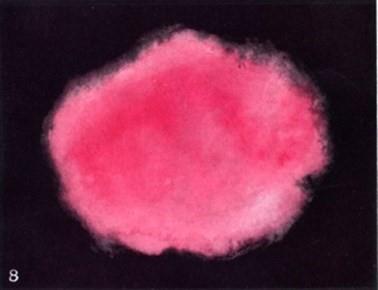
We begin in 1901 with Annie Besant and Charles Leadbeater, two active members of the London Theosophical Society. Theosophy was an occult philosophical and religious set of beliefs that blended mysticism and spiritualism with various Buddhist and Hindu doctrines, their main focus being the unity of all life (Theosophical Society, 2024). In its contemporary form, it was founded by Russian mystic Helena Petrovna Blavatsky, and later found a space for itself in late Victorian London. As a result of their involvement in Theosophy, Annie Besant and Charles Leadbeater published ‘Thought Forms’ (1901) a book depicting the visual aura of thoughts, music, events and emotions. The result is a collection of abstract pieces of art; thick clouds of rich or airy colours, things that wind and bend around suspended somewhere else, somewhere beyond sight. What would now most likely be considered synaesthesia was for them the language of magic. Each colour and shape with some assigned symbolic meaning. Yet, they appear as complete otherworldly structures floating in space, like angels or aliens that we project ourselves onto. To mould the divine like clay and say this is ‘Vague Pure Affection’ (Besant and Leadbeater, 1901). Again, this tension arises when one thing is caught between abstract and symbolic, where the abstract is something completely removed from the material, and the symbolic exists within the material constraints, simply alluding to that outside itself. To assign form to a thought feels as though we are compressing the heavens in order to digest it, which I guess, in a way, is the point or perhaps the eternal struggle, of articulating the ineffable. We
attempt to meet it somewhere in the middle, between forever and right now, and use our language to communicate with, or around, the beyond. To make the abstract symbolic of itself. In the sense that we take this thing, this outside-ness, this thought, and ground it in material reality in order to catapult ourselves to the original source from which it came. Like reaching the stars by naming constellations or speaking to a plastic figurine of god. In our attempt to leave the world for something more, we end up sharing the wonders of our material plane with the divine, in this case, through art.
The intention of the artists is interesting here as these pieces are presented in an almost diagrammatic way, like a photograph of the unseen, solely to depict their truth rather than express it. That is to say they are intended as symbolic rather than abstract. A concise visual language that gives space to feeling; these energetic processes that are so powerful they must materialise somehow, why not in clouds of colour? The goal here is understanding, we are plagued – or blessed – by the urge to understand, and in the case of the unseen, must work within the confines of our material plane to poke holes in the membrane and perhaps, at least once, catch a glimpse in full colour.
Thought forms gave readers a language they could use to reach the eternal-outside and therefore (to some extent) understand it. According to Besant and Leadbeater (1901) ‘Three general principles underlie the production of all thought-forms: - Quality of thought determines colour. Nature of thought determines form. Definiteness of though determines clearness of outline’ (pg.30). They condensed the expanse into easy-to-follow structures that could lend themselves to cosmic artists for years to come and could have done just that in the case of Swedish painter Hilma af Klint whose dance with the occult came to fruition a mere five years later. It would be no surprise if the rich content of thought forms influenced how Klint interacted with, and in turn depicted, the unseen.
The Ten Largest
Hilma af Klint gave us more than a glimpse into the other. Born in Sweden in 1862, Klint was a classically trained painter with a lifelong interest in the occult. Following the death of her younger sister, Klint began attending séances from a young age and later in life also took interest in Theosophy (Davis, 2018). During one particular séance in 1906, one of the ‘High Masters’ that she would regularly contact commissioned her to produce a series of paintings that would later be titled ‘Paintings for the Temple’. She described feeling as though the work was being created through her and that the spirit stood by her side throughout (Irish Museum of Modern Art, 2017, pg.27). Similarly, in 1907
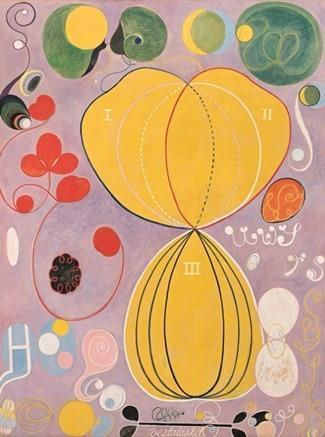
Klint had a vision of 10 paintings that she had to complete depicting the cycle of life. This resulted in
‘The Ten Largest’ a series that begins in childhood and ends with old age (Davis, 2018). Each piece brimming with circles, spirals and floral motifs. Shapes that seem to bounce around before finding a place for themselves within the work. Klint’s work, much like ‘Thought Forms,’ pre-dates the first widely recognised cases of abstraction with the likes of Wassily Kandinsky, most likely because she
requested it remain hidden until two decades after her death had passed (Irish Museum of Modern Art, 2017). Although now held in the same regard as other early abstract painters, Klint’s work was not aiming to be abstract. Instead, it acted almost as a form of communication with the beyond –starting with her sister and continuing with the ‘High Masters.’ As was the case with Besant and Leadbeater, Klint was using the language of magic. Each brushstroke often outwith her control, she managed to get as close to the transcendent as one might, by depicting nothing. The kind of nothing that feels full of everything – a lively nowhere. Yet there is still a prominent feeling of nature within her work, like the intersection of a plant, or the path you might walk to school, cellular things and cursive writing. Once again, we reside in this entanglement, unable to pull apart the material and the incorporeal. Even when a spirit passes through me, guiding my human hand, there are remnants of leaves, microscopic skin particles and my breath laying lightly on top of the brush, already my paint is spoiled with experience of those worldly things, already the transcendent has found me in a body. It doesn’t feel as though Klint was trying to leave the earthly realm through her work but rather act as the branch between each place, like giving the heavens to the earth and a bouquet of flowers to the High Masters. Where consciousness is a net, she managed to access the lines between each point, to reach across and wave, all the while having something to show for it.
I think proclaiming Klint’s work as purely abstract dampens the flame of connection that is so innate in her paintings. Art historian Briony Fer argues, ‘Taking af Klint seriously as an artist, in my view, actually requires us to take some critical distance from the mysticism that might have enabled her to make such innovative work.’ (Davis, B, 2018) I entirely disagree with this point, Klint’s paintings have an inherent mystical quality because of the context in which they were created, that is, one of practicing magic through art. They were never intended to be shown to the extent that they are nowadays and, in my opinion, are an extension of séance, a visual symptom of the incorporeal world Klint connected to and often functioned within. They are the paradox of living between worlds, bending each into the other. I also have a problem with Fer’s use of ‘seriously,’ as though
the serious and the mystical are mutually exclusive. For, in order to be a serious artist working in an abstract manor, you must exist in a vacuum – the world of the abstract where nothing is representative of nothing. To celebrate an artist’s greatness they must be individual, a solitary genius who plucked these forms from their mad mind and gave them to us oh so generously. We must forget af Klint’s involvement in hocus pocus, what a juvenile outdated notion. Yes, she is great, if we cut the cord that held her tightly to magic, then she is great. Despite this view, the abstraction in her later work was birthed from the automatic drawings she was carrying out at these séances. Whether it was a spirit or just the concentrated energy of infringing on the unseen, Klint was compelled to create by something outside of herself that eventually found a place within herself. Hilma af Klint’s abstract works remained hidden whilst abstraction began to find a place for itself within the art world in the form of Kandinsky who is credited for pioneering the movement and was similarly urged to create from a source just outside of himself, that which he tried to understand and get closer to throughout his artistic life (Mcmullen, 2024).
Wassily Kandinsky discusses this power that compels you to create in his book ‘Concerning the Spiritual in Art’ (1912). Giving it the title of the ‘inner need,’ Kandinsky explains how it is ‘built up of three mystical elements,’ that is, ‘Personality’, ‘Style’ and ‘Pure Artistry’. In other words, the internal, the external and the eternal. He stresses the importance of creating from this well of energy inside of ourselves, this internal truth, so that our art may be evergreen. Describing art as ‘the child of its time’ (pg.9), a child that perishes when that time phases into the next, as the style and context that fed her has moved on. However, art that holds the inner need within it can tell us secrets of the future and in turn last forever. Hilma af Klint’s work is a perfect example of this artistic time travel, as her paintings are now situated amongst their contemporary peers, no part of them declaring their time of origin. She successfully embellished the transcendent into the physical and so her work seems to float just outside of time.
Kandinsky also attempts to find the correct balance between abstraction and materiality in this book, specifically in relation to reaching an audience through your work and awakening that same inner need in them. He turns to music as an example of a form of art that reaches that place in us directly and asks us how visual art can do the same. Music has that same incorporeal quality as the transcendent, it vibrates through the space around us and mingles with all that is immaterial. This is why we use it to speak to the gods, and why the earth hums. Kandinsky proposes abstract art as visual arts answer to music, where colour and form act as notes, arranged perhaps, in repeat patterns or set in motion. Here, we hope to achieve the same ease with which the musician – or magician – can hold the spirit in their hand and pull it any which way. To reach the same level of instant communication with the divine. But even music has material constraints: duration, ivory, breath. Yes, the gods can hear us sing but now my voice cracks and sends itself back down to earth. Kandinsky describes these limitations on expression as follows: ‘In short, the working of the inner need and the development of art is an ever-advancing expression of the eternal and objective in the
terms of the periodic and subjective’ (pg.34). This beautifully sums up the entanglement in which we create, as beings of time who wish to capture forever. That if we approach materiality with acceptance, perhaps the transcendent will begin to reveal itself in parts and may be depicted with the same ease as breathing.
Kandinsky eventually reaches the conclusion that each art form has its strengths and ways of accessing pockets of divinity within us if only we imbue each piece with the internal/eternal truth, making it a potent well of spirit that can be accessed by all who view and therefore interact with it.
The idea of interaction in artwork is very prevalent among those who deal with magic, that is, communication with and alteration of external sources. Some artists create with the intention of interacting with the viewer on a scale deeper than simply viewing. Through the use of underground alphabets or symbols that reach far corners of the subconscious; even when we are ignorant of their origin, artists are able to influence the mind or bestow galactic knowledge upon the viewer. The work of
Paul Laffoley is a perfect example of those artworks whose surfaces buzz with geometric incantations.
Active Artworks
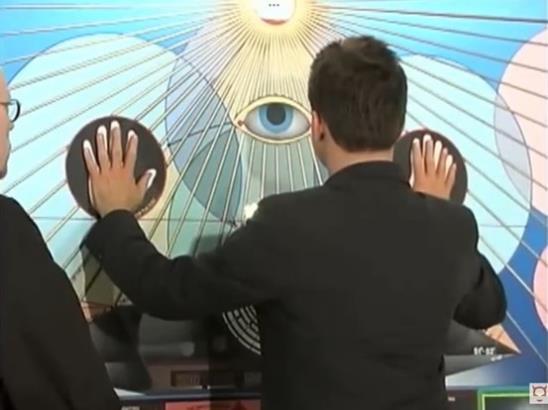
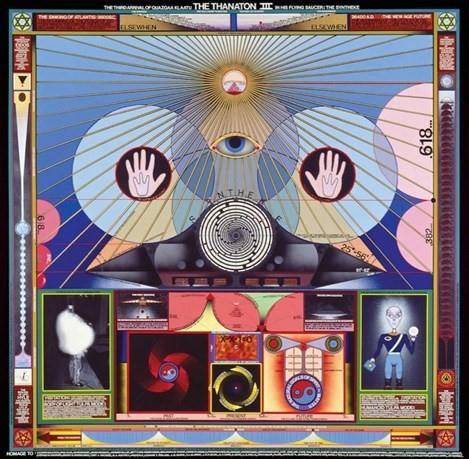
Paul Laffoley was born in 1935 in Massachusetts to an Irish Catholic family and would go on to study architecture at the Harvard Graduate School of Design from which he was later dismissed for straying too far from the curriculum (PaulLaffoley.net, N.D). Laffoley believed that a device of extraterrestrial origin had been implanted into his mind, we could say this was his inner need, and would develop a series of paintings so symbol heavy that they were no longer depictions but instead acted as technological devices (Manley, 1998). One piece in particular, Thanaton III (1989), requires the viewer to make contact with the surface of the painting, placing each of their hands to each of the painted hands and looking directly into the eye, in doing so they will receive information, presumably from the
beyond, directly into their mind (Irish Museum of Modern Art, 2017). Thus, the piece is almost incomplete without the interaction, or rather on standby waiting to be used as a technological device, one that lies at the intersection of science and religion, where diagrams and gods aren’t depicted but created, each iteration containing some part of the thing itself. Laffoley speaks of his own experience with the piece in an interview with Guillaume Wolf for Whitehall magazine in which he says ‘Yes. I got dreams! Lucid dreams. I saw the Omega gallery, and I saw these things I could not believe sculptures. And I felt I would be absorbed by them. I had to get away from them, quick. They had a power. I ran screaming out of the place’ (2016). In an interview carried out by Richard Metzger for TV Series ‘Disinformation,’ Laffoley explains how the artwork is imbued with information he received from an extraterrestrial source and transports the user to a higher dimensional realm for the brief moment in which they interact with it. Metzger also compares Laffoley’s work to a meditation device (Metzger, 2000), they both have this private exchange between user and device that cannot be disproven, the same way a prayer cannot be disproven. Mark Pilkington describes active artworks as something ‘to be used and experienced as much as they are to be viewed and read. Thus, they are imbued with a power that extends beyond their historic context or economic value, to make them sites of magical potency in themselves.’ (Irish Museum of Modern Art, 2017, pg.43) They have accessed the thing that exempts them from perishing with time – transference, of knowledge, of power, of their own soul. To give the self to the great Non-Self so that it may experience the beauty of the material and we may transcend it. For we cannot access the beyond without making the beyond access us. Laffoley functioned within the eternal-outside and as a result, created manifestations of it through his artworks, therefore bringing divine particles down to earth, as though he built a body for the alien that lived inside his brain. When the human hand holds the hand of Thanaton III, won’t this infinite being contained in the piece, for a second, feel the warmth of flesh, that entity which transfers its great cosmic knowledge through our calloused fingertips, for a moment Thanaton III experiences impermanence, the entire cycle of human life in a fleeting touch, the Ten Largest, the phenomenon of
eye contact – I am you, you are me, for a moment it exists. We are simultaneously, receiving knowledge beyond our comprehension, the kind that tempts you to abandon the body and return to an all-seeing, all-knowing source. There cannot be one without the other, the Great One and the Great Zero, shifting and touching and switching places but always there to prove the truth of its opposite.
The method of interaction with, through and around this dichotomy is what we refer to as magic and in turn art. Where art is both a symptom of and a device used in the practice of magic. Laffoley’s diagrammatic approach to the structures of the cosmos was a result of his love for and involvement in the art of architecture, pasting this together with imagery inspired by Hindu symbolism (PaulLaffoley.net, N.D). Art was the bridge between science and religion and the earth and the heavens.
But why is it art that humans turn to, or rather are possessed by, when attempting to decode/access/ communicate with the transcendent? When transference occurs, that is, the excavating of the soul, when ideas or knowledge are sewn into the atmosphere saturated by the hope of being winked at by god, the result is always art. As though we cannot find the words to say thank you, or what or why or please. The creation then takes on the role of the creator and fashions a world in their own image, to understand the nature of the divine by becoming it. Art then becomes a world in itself, a planetary extension of the artist’s inner need, with its own language, ecosystem and population of colour and form. A star in the multiverse of creative expression. The artist as Worldbuilder.
Chapter 2 Worldbuilding: Understanding and the Creative Nature of Being
In order to understand the artist as a creator of worlds, we must first look to creation itself, if we can find it somewhere amongst the weaving together of century old myths, both scientific and magical, where numbers are gods, and our sun takes on human characteristics prior to the first human. As though we have to project ourselves behind ourselves in order to conceptualise a world without being. The material constraints of being once again extend themselves to the cosmos and fashion a man out of stars. We cannot help being metaphoric, often painting creation as birth, to personalise the entire universe by seeing it as your mother’s womb. Even where science is concerned, the big bang was the cosmic scream of a child entering existence and creating a world to sustain itself as a result of this existence. Our attempt to understand creation since creation, has gone similarly to our attempt to understand the transcendent, considering they are both beyond, behind, outwith. We
can only approach the task of depicting these outsiders from inside, using terms created postcreation, and so we must turn to allusion.
In his 1971 book Creation Myths: Man’s Introduction to the World artist and author David Maclagan writes, ‘The only basis we have for describing what was, or is, behind existence is in terms of what has already been derived from that primal creative process: terms which are thus ‘second-hand’ or symbolic.’(pg.5) The symbolic or metaphoric allows us to paint a picture of the 4d within the 3d, by alluding to a multitude of ineffable impressions through relation. When we assign personalities to the stars or human forms to the gods and fabricate relationships between them - brothers, children, scorned lovers - we can feel what they might feel, we can see that they are as complex as our most mysterious inner workings and that they are flawed, that we are not the only ones who are flawed, that materiality is not a curse but rather we have always been like this, a reflection of the stars.
Through fiction (our own creation), we can get closer to that pre-human spark by catching glimpses of it between the lines of myth or art, in that sweet spot where one line ends and another is yet to begin, the point between breaths. The stories insinuate what is impossible to depict – nothing.
Nothing being that point zero prior to existence, the place where creation works away. The use of the term ‘creative process’ here to describe the source from which we came is important as it is this ‘process’ that continues within its creations, taking the form of the inner need or a spirit or extraterrestrial device that compels you to create. It is the metamorphosis that happens within the world alluding to the creation that occurs outwith it, the artist being part of this process of mutation, forever creating and recreating the world and in turn worlds of their own. Maclagan goes onto to write that, ‘Man’s own creative process can thus be seen as a version (or re-version) of the power that creates and sustains his existence. His being-in-the-world is a continuous process of re-creation, an expression of that primary imagination.’ (pg.8) We are born with art (magic) built in, a process unfolding across every physical iteration of itself, it bounces between the finite and the infinite acting as the bridge between them. Our ability to articulate the immaterial may be limited, but the
immaterial remains a two-way reflection of itself, meaning we can see the nature of creation reflected in the material plane - in ourselves - and continue the cycle, making us the catalyst for further creation. The focus then shifts from description to mimicry in the search for understanding, in fact, it becomes less of a search, as the understanding arises out of recreation. When we struggle to articulate the beyond or behind, we either project our materiality onto the immaterial or embody the immaterial by continuing the process of creation, either way we are entangled in the paradox.
Abstraction and materiality, inner and outer worlds, the transmundane and the mundane, we reside in the knot between these paradoxes, constantly ping-ponging back and forth, all the while carrying over small fragments from one to the other. They arise within the world in the form of the fragile balance of interwoven ecosystems, the way they co-exist (both in harmony and discord) and infringe upon each other.
This entanglement is a key focus in the work of American scholar Donna Haraway, in the earthly sense, where the world itself appears as a net of complex interrelations mirrored by that outside of it. Out of creation comes a world. A world that continues to build itself in the form of the creatures that reside within it. A new world birthing out of each individual earth process with nature and culture mutating and overlapping, each knot forming the net of our material reality, a weaving together of the fabric of the universe. Creation, then, is a craft, a handcraft, incorporeal but tactile in its material incarnations and can be grasped – both in hand and mind – through the act of repetition. Whether that be the process of recreation through art-magic or simply witnessing the unfolding of worldly processes embellished with that first creation.
In her book When Species Meet Haraway explores each knot in the world-net as an overlapping of creatures or a point of connection between them (Haraway, 2007). Where does one end and another begin and at what point do we merge/separate? She creates the concept of ‘becoming-with’ to deal with the interconnected nature in which we grow and live. ‘Becoming-with’ describes the creative process of becoming alongside those microbial creatures that inhabit the body, an interdependent relationship where one could not survive without the other. Again, the world is reflected inside of itself
here, with the body acting as the earth for these microscopic hitchhikers which, I argue, are just as invisible as the transcendent and thus magic is present in simply holding them. The microcosmic functions as the macrocosmic, like a Russian doll of worlds where we both hold and simultaneously are held. Each repeated iteration of creation a further loop in the world-net. Haraway’s concept of ‘becoming-with’ is the line that connects each knot and therefore strengthens the net as a whole, it debunks the individual as something exempt from the process. Much like David Maclagan’s use of the term ‘being-in-the-world,’ each word is connected to the next by that same line of rope or thread (Maclagan, 1971). It pluralises existence. Keeping us rooted in the context of the world, earthly but connected, they each describe an unfolding of existence wherein each creation and recreation causes the world-net to ripple and therefore draws each knot’s attention to the existence of a net in the first place. Creation is an act of sharing life, both in the case of birth and art. Where birth brings about one who can discover the nature of the world and in turn what lies just outside of it, and art can create a world of its own both through depiction and allusion, sharing the artists own world, and those worlds in common, with others.
Creation informs worldbuilding and is the catalyst for it, but they differ entirely. Where creation is the birth of a child in spring, new to what will become the world, worldbuilding is the process that occurs when this child forms the earth around them in their mind, their own personal world comes to fruition through a series of sensory experiences. When one touches a tree and finds it rougher than another does, they have each built a different world from the same creation. A child’s perception of the world is perhaps the most important place to look when trying to understand the process of worldbuilding as they are born artist-magicians. Haraway points to this in When Species Meet when she writes, ‘As a little girl I loved to inhabit miniature worlds brimming with even more tiny real and imagined entities,’ (Haraway, 2007, pg.4). Here, she is also referencing our microbial counterparts, as well as, I imagine, the bugs and various creatures we play with as children, a relationship that seems to falter with time. Both earthly beings and incorporeal ones have all been grouped together within these ‘miniature worlds,’ Haraway’s child-self was inhabiting. She was residing in the knot between
the paradox with ease, that is the way of the child. Still in the process of forming the world, it is able to be moulded and played with much more easily than it might be once they have finished building it. Therefore, those immaterial things can slip through the cracks, allowing the child to access a multitude of worlds and creatures at their tiny fingertips.
The child is the closest to creation as one can get, much closer to nothing than everything, as a conception of the material has not yet been formed. The material, however, does not simply give itself to our new creation but must be hand-crafted by them as they take on the lifelong task of building a world of themselves. Maclagan also discusses this process when he writes, ‘Each new person’s revision of the world is not a passive taking in, but an active revision,’ (Maclagan, 1971, pg.8). Revision, like recreation on the individual scale, where each perception of the world is a world of its own, a knot in our net. Therefore, the earth is a multiverse of revisions. Not only is it a revision but an ‘active’ one, there is an emphasis on action or, we could say, craft. A carving or weaving or sewing together of materials, a tactile act(ion) that is very much of this world - an earthly process. The incorporeal has then found its image in all things worldly, with each creation that arises from that source continuing the immaterial actions of its past within the confines of the material. All art is then an expression of that source, whether it be a depiction or an allusion. As the act of creation, and all things transcendent, are embedded in the earth processes that make up your everyday. Where children are natural worldbuilders, artists are the eternal child.
The artist simply depicts what is around them and finds an infinite unfolding of creation and recreation that contains the essence of the divine. Especially where nature is concerned, the continuous metamorphosis of the natural world is creation at work and any depiction of such, whether it intends to be or not, is therefore magic, in the sense that it is a form of communication with the invisible. To depict something is to pay great attention to it and in the case of the world, paying attention begins to reveal glimpses of the invisible, how the process of creation lends itself to the material and shows up in things like seasons and children. We’ve established that when one attempts to depict the divine by removing themselves from the world and resorting to ultimate abstraction, they are unable to rip
apart the immaterial and the material. Already their depiction has been tainted by their own physical existence. Yet when we simply allude to these greater outside processes by projecting our material selves and ways onto them, we can conceptualise a version of the transcendent dressed in a human narrative. It is only when we look to those worldly things and places where one would least expect to find the infinite that its interwoven nature to the finite will become apparent, that, in fact, these two parallel planes of existence become-with. That they are a reflection of each other, making it impossible to depict one without its opposite.
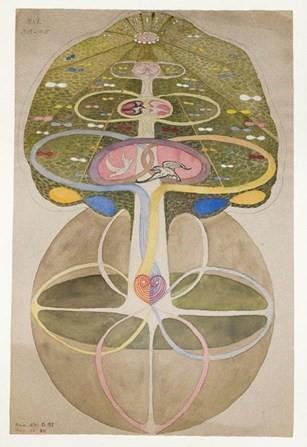
Again, if we look to Hilma af Klint we can see the floral gestures that made themselves known throughout her otherwise otherworldly paintings. Specifically, if we look to her ‘Tree of Knowledge’ series (1913-1915) the pieces are overflowing with dualities; she is exploring the astral plane within the shape of a tree. American poet Joy Harjo when asked to interpret these drawings said, ‘You see that duality, that utter earthliness threaded with sky knowledge,’ (David Zwirner, 2023, 3:57). Having been a landscape painter for the majority of her life, Klint was immersed in the natural world and when it came time to depict anything beyond that, it makes sense that she would recreate these cosmic processes in the form of earthly processes (Davis, 2018). Each drawing encapsulates the becoming-with of the heavens and the earth, with roots and spirals that lead us from one to the other. Klint shows us that in order to reach the cosmos we have to simply turn to its opposite – the ordinary.
The ordinary as that grey plane between the microcosmic and the macrocosmic where both appear only in hard-to-reach places, the invisible moments of the everyday, when it’s quiet and they know they won’t be seen. Haraway says, in the opening paragraph of When Species Meet that, ‘We learn to be worldly by grappling with, rather than generalising from, the ordinary,’ (Haraway, 2007, pg.3). This grappling is the action of noticing and creating something from the ordinary, whether it is a form in your mind that aids in the lifelong task of worldbuilding or a piece of art that shares this noticing with others – those microscopic, incorporeal and human creatures we share our net with. The former being creation/recreation and the latter being communication, both forms of art-magic. It is in this ordinary focused art-magic where we find the transcendent with ease.
Chapter 3 Magic in the Mundane: The importance of Everyday Practices and the Mysteries of the Seen-Too-Often
We have now made our way back to where we came from, that place of hyper-materiality. With the world built and abstraction a far-off thought, we are of the present moment, a bodily creature that touches those other physical objects and wonders only about the time of day or the state of the fridge. In declaring the search for the invisible over, it finds a place for itself within the home, where the home is the material reflection of the invisible itself. It is the point where these opposites converge or perhaps where the membrane that separates them is thinnest, almost translucent. The home, much like the immaterial, conceals powerful energetic processes that impact the rest of the world. These processes being: the act of creation itself, or the actions of care that enable each creature to continue to live. The home is its own functioning world within the world that is powered by this seemingly invisible force hidden inside the comfort of its four walls. The nature of the divine
then shifts from something faraway and intangible to that which embodies closeness and is built into the foundation of the home.
This shift that we have gone through, from abandoning the material world to homing in on the smallest most immediate parts of it, is the same journey that science fiction author Ursula Le Guin takes us on in her essay The Carrier Bag Theory of Fiction (Le Guin, 1986). Here the abstract takes the form of the ‘hero’ an individual on a linear, conflict fuelled quest, and the mundane takes on the role of the ‘carrier bag’ an invisible vessel as far as history is concerned. History as a story grounded in temporality, that unflinching beginning, middle and end that our hero must conquer his way through. Creation lies at the beginning of history and the ways in which we project ourselves onto the story of creation directly impacts the structure of the physical world. Our art gives back as much as it takes from the world, in the sense that it structures and restructures the social landscape. Siabhon Leddy writes, in her article surrounding Le Guin’s essay that, ‘Storytelling is a way of configuring and reconfiguring worlds; narratives can bring realities into being’ (Leddy, 2019). That is to say that when we have projected man as an individual, as an all-powerful being onto the process of creation, we can see him reflected in the hero or the genius or any other individual material being whom we deify. If man created man who then created man in a chain reaction of violent output, there is no room for the rest of us in the story of creation, in fact we have been banished, or blessed, with that same invisibility as creation itself.
Le Guin, however, proposes a revisioning of this story where the hero takes the form of the carrier bag. The carrier bag being the first tool likely used by the first humans to hold those foods they couldn’t fit in either hand or stomach. If history has been conflated with heroism, then it is now held within the entangled mess of a bag. To rethink our understanding of history in turn unravels everything we know about stories. Le Guin gives us the concept of ‘the life story,’ that art which surrounds everything but the hero, to instead tell a story of a carrier bag and the act of gathering, the
stories of the home. Le Guin characterises the life story as follows, ‘People have been telling the life story for ages, in all sorts of worlds and ways. Myths of creation and transformation, trickster stories, folktales, jokes, novels…’ (pg.168) The life story is that which bends and knots and jumps around. Spreading itself across a myriad of characters and therefore more accurately represents the nature of our world even when taken outside of it to depict those far away real or imagined planes. However, Le Guin also describes the life story as ‘untold’ despite the above quote, insinuating that perhaps it is invisible or told only in invisible spaces, such as the home (Le Guin, 1986). This is why it lends itself so well to the telling and retelling of creation, or folktales, as these stories, and therefore the life story, all reside within the invisible, only heard in whispers or late at night, passed on from mother to child.
The carrier bag then acts as a portal to the invisible, allowing us to tell tales of the transcendent through those most mundane objects and revealing new old worlds to be rebuilt by us. The home, as a larger carrier bag in itself, is then also a portal to the invisible. It is inside the home where these life stories are told, which explains their ‘untold’ nature.
The home is the meeting point of the unseen and the seen-too-often, where one infringes on the other. The unseen, of course, is all that is immaterial, while the seen-too-often is the antithesis of this.
It takes the form of the home, the carrier bag and anything that we are softly bombarded with or surrounded by on a daily basis. Those things which the eyes or the art usually overlook. There is a revealing that occurs in the noticing of the seen-too-often, in which its unseen-ness bubbles to the surface.
Although opposites, these two are again entangled in the paradox so much so that they become-with. In fact, the seen-too-often has gone so violently unnoticed that it has folded in on itself making it invisible. One becomes the other and back again, thus the entangled nature of the bag and the home.
Where time ceases to exist and one can stick their weathered fingers through the thinnest parts of the earth’s membrane, reaching the incorporeal body and sewing it into their own.
These acts and stories that fill and power the home must be carried out by someone, a natural artistmagician that can flit between worlds with ease, perform creation and counteract the hero’s story. Throughout the story of history this artist-magician of the home realm has often taken the form of a woman, a mother, a wife, a gatherer, any of those outside of the hero’s story with the freedom and timelessness to build something of the world that is the home. The homemaker, as the worldbuilder on a hyper-material level. Hand-crafting things from that rare invisible materiality that the home contains. The homemaker, as someone outside of the hero’s story and therefore history, is left to their own devices and over time has sculpted a realm just as invisible as themselves, that being the home, an unassuming portal to the beyond. Whilst those linear heroes are off fighting battles each more destructive than the last, the homemaker plays on two planes at once, bending space and time and dodging predictability, in the net that is the carrier bag.
The woman or homemaker as artist-magician is not a new concept. In the late 1800s, Artist and occultist Moina Mathers (previously known as Mina Bergson) proclaimed that ‘Woman is the magician born of nature.’ (Herring, E, 2021) As the first female member of The Hermetic Order of The Golden Dawn, a then recently founded secret society, she was well versed on all things invisible (Pit, 2018). Mather’s choice of the phrase ‘born of nature’ is important as it alludes to a creation that is of this world rather than occurring outside of it, as though she already knows that the transcendent is waiting for her here, that there is no need to go searching outside oneself. A woman born of nature is bound to realise the godliness of materiality, as she arose from an earth process. There seems to be this link between women and earthliness, with our own world being referred to as mother earth, the homemaker on a worldly scale whom the hero still disregards. If our hero is man, and man is on a grand journey, leaving behind both body and home, then the carrier bag is the rest of us, embodied creatures enmeshed in the collective world-net, who are forced to understand the magic of materiality. Little does our hero know that this is where the gods hide. As we previously discovered, creation is a handcraft, something familiar to the home and the work of a homemaker, to mend and
create; life, warmth, personhood. And so, any projection of man as singularity - as hero - onto god, crumbles beneath the worn, practiced hands of his mother who sews the life back into a holy sock.
Earlier we established how this idea of the worldbuilder is potent in children who are actively revisioning their surroundings into a new and personal world, as does the artist-magician. However, it is the mother that first provides this world in the shape of the home. The mother, or homemaker, builds the world that the child will then make for themselves. With each first bedtime story acting as a spell of creation that forms the foundation for the child’s own worldbuilding. The child witnesses a natural artist-magician at work, actively creating the world around them, actively creating them, and mimics this process thus forming their own tendencies towards art-magic. They continue the act of worldbuilding as an extension of their mother’s world, the same way that creation is reflected in its creations. For now, however, the child is also invisible, and the home is their portal to any world of their choosing. Where once we had magical artworks with an active surface, we now have action as art-magic in itself. And these actions, carried out behind the curtain of the home, form a new potential artist-magician, one who must choose whether to step outside of themselves – an absent hero damning the body (bag) and conquering the natural world in attempt to become god himself, or to give in to noticing, a slippery slope that leads you to the act of care and soon invisibility, back to the womb of your upbringing.
The act of care is an extension of the act of noticing, with noticing being the precursor to art-magic and care being a form of art-magic in itself. The homemaker orbits around care, in the sense that the making of the home, or the building of the world, relies on care as a driving factor. It is true that worldbuilding first comes from the need to understand, however, the want to continue to understand something must come from a place of care, and so, specifically within the context of the home, it manifests in acts of care or the act of care work.
Care work as a concept, differs from acts of care as it refers to those specific acts that nourish and sustain the world outside of the home. Things like raising and socialising children who may go on to
work, feeding those who already do or caring for those who no longer can. In that way, care is creation to society, a force functioning within the invisible that creates and powers those things external to it. However, in the specific case of care work, that external thing is our capitalist society, one that fails to notice the power of the care work that upholds it and therefore will de-create itself through its lack of noticing what’s behind its own creation.
In her article Contradictions of Capital and Care philosopher Nancy Fraser discusses this tension between care work and Capitalism and brings to our attention Capitalism’s self-destructive nature in failing to notice the creation behind itself. She states, ‘Capitalism’s economic subsystem depends on social reproductive activities external to it, which form one of its background conditions of possibility’ (Fraser, 2016, pg.101). She establishes two separate worlds: creation and the created, the invisible and the material, social reproduction and economic production. Fraser also cites nature as an unnoticed upholder of economic production, that same nature that birthed woman as artist-magician.
Once again, those things disregarded in the hero’s journey turn out to be potent pools of transcendence. However, due to Capitalism’s inherent nature of consumption, it begins to unknowingly eat away at itself in the process, by destroying the thing that upholds it. This is what Fraser refers to as the ‘crisis of care’ and reminds me of Le Guin’s Carrier Bag Theory of Fiction where she writes, ‘We’ve all let ourselves become part of the killer story and so we may get finished along with it’ (Le Guin, 1986, pg.168). This is why the shift is important, from hero to bag, abstraction to mundanity, capital to care. In attempt to abandon the material in search for the transcendent, we force the material into invisibility, making it closer to the transcendent than we as abstract hero ever will be. And now, because we are beings of materiality, we have destroyed ourselves in the process.
The answer that I offer you then, is noticing and by extension care. These both being forms of artmagic. Art-magic is a home process, where home processes mimic earth processes which mimic creation processes. It is a communication with the invisible through shifting our focus onto the ordinary, and in turn, a creation from this invisible by carrying out acts of care. To gather in Ursula’s
bag or sew the fabric of the universe. To perform the handcraft that is creation. To continue your childhood tendency to worldbuild both in the home and in those other recreated worlds. What better place to accept the dichotomy of materiality and transcendence than in the place where they converge. And once you have returned home, you find that worlds come to you with ease when you travel to them through your own.
To harmlessly observe the stars from our kitchen window is closer to the cosmos than any rocket ship might get, as here they are casting shadows right in my home.
Conclusion
To notice the seen-too-often is to find the unseen and therefore bring understanding into light. As is the case with the care crisis, to be ignorant of the most ordinary in life is to destabilise its very existence. The world-net is fragile and to act as though one thing can exist without the other; materiality and the invisible or capital and care, leaves one half unnourished thus affecting its opposite. We cannot untangle the becoming-with of worlds. It is an interwoven world-net that we first see reflected in the ordinary, and when we follow each string, the infinite is revealed there. The very nature of existence is a carrier bag and creation is a ripple repeating itself in each knot. It is artmagic that brings this net into view and then shares it with others, slowly shifting our noticing to the unseen ordinary, our stories to the carrier bag and our recognition to acts of care. As each artistmagician begins to see and interact with the world-net, whether it be through symbolic artworks, building a world or making a home, the interconnected nature of our worlds becomes clearer for its inhabitants, positively impacting the way we interact with the earth and its creatures as part of a collective immaterial and material body. We have then revisioned the entire world as a home. Now we are able to see the tree of knowledge, give form to a thought and receive intergalactic information through simply touching the earths surface. We have accepted the home as our portal to the transcendent.
Figure 1: Vague Pure Affection (1901)
Annie Besant and Charles Leadbeater, materials unknown
Courtesy of Annie Besant and Charles Leadbeater in Thought Forms (1901)
Figure 2: The Ten Largest, No.7, Adulthood (1907)
Hilma af Klint, Tempera on paper, mounted on canvas, 315 x 235 cm
Courtesy of The Guggenheim, New York (2018) Available at: https://www.guggenheim.org/audio/ track/group-iv-the-ten-largest-no-7-adulthood-1907-by-hilma-af-klint
Figure 3: Still from Disinformation (2000)
Director unknown
Courtesy of Richard Metzger (2000) Available at: https://dangerousminds.net/comments/ remembering_paul_laffoley_on_what_would_have_been_his_89th_birthday
Figure 4: Thanaton III (1989)
Paul Laffoley, Oil, acrylic, ink, and vinyl press type on canvas and wood, 187 x 187 cm
Courtesy of Kent Fine Art, Available at: https://kentfineart.net/artists/31-paul-laffoley/works/67-paullaffoley-thanaton-iii-1989/
5: Tree of Knowledge no.1 (1913)
Hilma af Klint, Watercolour, gouache, graphite, metallic paint, and ink on paper, 45.7 x 29.5 cm
Courtesy of The Guggenheim, New York (2018) Available at: https://www.guggenheim.org/audio/ track/tree-of-knowledge-no-1-1913-by-hilma-af-klint
Bibliography
• Battistini, M. (2004), magic and alchemy in art.
• Besant, A. Leadbeater, C. (1905) Thought Forms.
• Breen, B. (2014)Victorian Occultism and The Art of Synaesthesia. Available at:https:// publicdomainreview.org/essay/victorian-occultism-and-the-art-of-synesthesia/(Accessed: 06/01/25).
• Brooke -Hitching, E. (2021)The Devils Atlas: An Explorer’s Guide to Heavens, Hells and Afterworlds. Simon & Schuster.
• David Zwirner (2023)af Klint's Tree of Knowledge interpreted by U.S Poet Laureate Joy Harjo. 2023. Available at:https://youtu.be/M-shzuF9TrQ?feature=shared(Accessed: 09/01/25).
• Davis, B. (2018)Why Hilma Af Klint’s Occult Spirituality Makes her The Perfect Artist for our Technologically Disrupted Time. Available at:https://news.artnet.com/art-world/hilma-af-klintsoccultspirituality-makes-perfect-artist-technologically-disrupted-time-1376587(Accessed: 06/01/25).
• Ellcock, S. (2022)The Cosmic Dance. London: Thames & Hudson.
• Fraser, N. (2016) 'Contradictions of Capital and Care',The Left Review.
• Hall, M.P. (2010)Secret Teachings of All Ages. New York: Dover Publications.
• Haraway, D. (2008)Species Meet. London: University of Minnesota Press.
• Haraway, D. (2016)with the Trouble. Duke University Press.
• Herring, E. (2021) Moina Mathers - High Priestess of the Belle Epoque. Available at:https:// engelsbergideas.com/portraits/moina-mathers-high-priestess-of-the-belle-epoque/(Accessed:
• Irish Museum of Modern Art. (2017)Above, So below: Portals, Visions, Spirits & Mystics.: The Irish Museum of Modern Art.
• Kandinsky, W. (1977)The Spiritual In Art. Dover Publications.
• Klint, Hilma af (1913-1915)Tree of Knowledge Series. Available at: https:// www.davidzwirner.com/exhibitions/2021/hilma-af-klint-tree-of-knowledge (Accessed: 09/01/25)
• Laffoley, P. (2016) 'The Legacy of Paul Laffoley'. Interview with Paul Laffoley. Interviewed by Guillaume Wolf for, 6 January.
• Leddy, S. (2019)Should all be Reading More Ursula Le Guin. Available at:https://theoutline.com/ post/7886/ursula-le-guin-carrier-bag-theory(Accessed: 06/01/25).
• Le Guin, U. (1986)The Carrier Bag Theory of Fiction. Ignota Books.
• Maclagan, D. (1977)Myths: Man's Introduction to the World.: Thames and Hudson.
• Manley, R. (1998)The End is Near: Visions of Apocalyose, Millenium and Utopia.
• Mcmullen, R. (2024) Wassily Kandinsky.
Availablehttps://www.britannica.com/biography/WassilyKandinsky(Accessed: 06/01/25).
• Metzger, R. (2013)III: The Mysterious ‘Living Painting’ of Paul Laffoley. Available at::// dangerousminds.net/comments/thanaton_iii_the_mysterious_living_painting_of_paul_laffoley (Accessed: 6/01/25).
• Pit, R. (2018) Moina Mathers,The High Priestess and Mother of the Golden Dawn. Availablehttps://www.theoldcraft.com/2018/02/27/moina-mathers-high-priestess-mothergoldendawn/(Accessed: 06/01/25).
• Theosophical Society(2024) Available at:https://theosophicalsociety.org.uk/freedom(Accessed: 06/01/25).
• Waldo Schwartz, P. (1975)and the Occult.
• Warner, M. (1996)Inner Eye. United Kingdom: The Beacon Press.
• Wuthnow, R. (2001)Spirituality: the way of the artist.