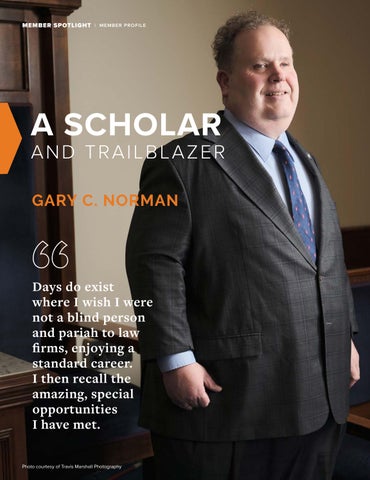
A SCHOLAR AND TRAILBLAZER
GARY C. NORMAN
“
Days do exist where I wish I were not a blind person and pariah to law firms, enjoying a standard career. I then recall the amazing, special opportunities I have met.
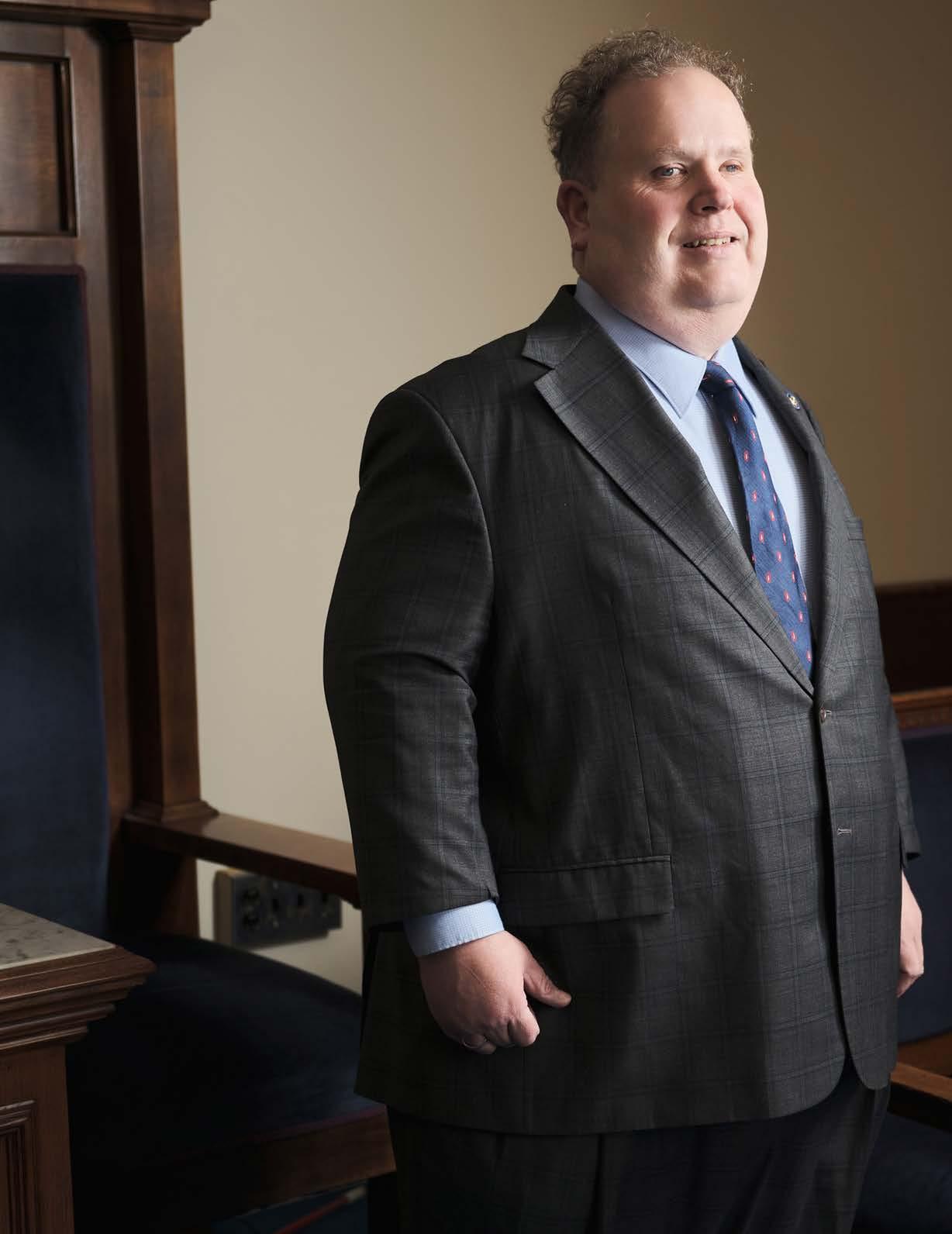
FOR GARY C. NORMAN, the law is not just a profession, it is a vessel for history, service, and resilience. Recently retired after a distinguished 25-year career at the U.S. Centers for Medicare and Medicaid Services (CMS), Norman has navigated the legal landscape as a “living historian,” blending complex health care law with a deep-rooted commitment to public service.
As a blind attorney, Norman’s career has been anything but traditional. From serving as a visiting professor at the Robert J. Dole Institute for Politics to his current role as an adjunct professor and chair of the Maryland State Bar Association (MSBA) ADR Section, he has consistently blazed trails. You can learn more about Norman and his non-traditional legal career below.
Why did you enter the legal profession?
As someone who continuously loves all aspects of the past, from archaeology to folklore, I originally contemplated a career as a Ph.D. historian and adviser. As a history major at Wright State University and someone recently inducted into a history honors society, I reflected that a Ph.D. could be an uncertain path to a paying job. So, I viewed obtaining a JD as a way to remain a living historian, but one that would set me on a path practically focused on service.
What is the best piece of advice you have received from someone in the legal profession?
Stoicism, resilience, and health are key. Fortunately, from Cleveland-Marshall College of Law, where I obtained my JD and now teach, to the LLM I obtained at Washington College of Law while working full-time at CMS, I have been blessed with coaches or mentors who have invested their time and commitment. They either shaped how I view myself or how I view the role of the law and the lawyer. Namely, I recognize David Roth, Esq. (RIP) who I worked under and who established a nonprofit law firm, retired Associate Professor Lazarus, Esq. of Cleveland-Marshall who remains my intellectual and teaching mentor, and retired Professor and Director Parver, Esq. who established the Healthcare Law Program at Washington College of Law. David, a boxing coach, often called me a champion.
What is your fondest memory of your legal career so far?
Days do exist where I wish I were not a blind person and pariah to law firms, enjoying a standard career. I then recall the amazing, special opportunities I have met. This includes 2015, when I served as a visiting professor at the Robert J. Dole Institute of Politics in Kansas. The Institute could have selected anyone, more famous for sure, but it selected me to celebrate the 25th anniversary of the Americans with Disabilities Act of 1990 (ADA), as amended.
What makes you unique in your profession?
I am often the sole guide dog handler in a room of influence. When I retired from the U.S. Centers for Medicare & Medicaid Services in May 2025, I was the last service animal handler working in the
building. While being a lawyer with a disability may come with its rock star status on occasion, it also comes with great responsibility. God knows it has taken the past 51 years to arrive at this level of self-acceptance and a sense of duty.
What are the best skills you bring to your legal career?
Because I had to collaborate with many diverse people during the 1990s, before screen readers were robustly in place, and continue to do so in addressing my inevitable screen-reader troubles (sorry, my former assistant at the agency), I possess what can be a hackneyed word: people skills. I am also significantly, if ironically, a great listener, who can synthesize copious amounts of data. In addition, I am a gifted writer, whose voice reflects deep reading and education.
What advice would you give to law students or young professionals considering an alternative career path?
As a person with a rare genetic disorder, who the law considers to be disabled and who identifies as such, I have enjoyed and navigated a different path, often succeeding notably but sometimes stumbling. Whether receiving acclaim or facing bias and barriers, I can say that the Grand Architect has blessed me with a fruitful, yet nontraditional, law career. For most people who have barriers, law practice will not be a Model T assembly line from law school to a large law firm. As I coach and mentor my law students or other people with disabilities, this is okay, if not even better, because lawyers with disabilities are destined often for a different path and one of true service to the people.
Describe a memorable MSBA event or product that has had an impact on you personally or professionally.
When I served as chair of the Animal Law Section from 2009–2010, I, in partnership with the section’s team, organized an innovative, non-partisan symposium on animal law. This product ran across future chairs of the section and for a total of five such symposia. As a follow-up to the effort to publish the proceedings, I co-founded a nonpartisan law and policy journal. I currently serve as chair of the ADR Section, having co-hosted a dialogue process on the Eastern Shore with positive responses that the legal community and ADR field felt like the MSBA was on the Shores for the first time.
What is an interesting fact about you that no one would guess?
I am an avid reader and patron of bookstores or libraries. To many people, in or out of the MSBA, but notably to lawyers, reading is only a visual exercise. To disabuse them of this foolishness, reading falls into three or four categories: auditory, or visual, or what I think is amazing, tactile—as in Braille. As a shareholder of the Library Company of Philadelphia, my third guide dog, my wife, and I once had a private tour of the Braille collections from one of its past exhibits, the oldest set of historic Braille materials in the United States.