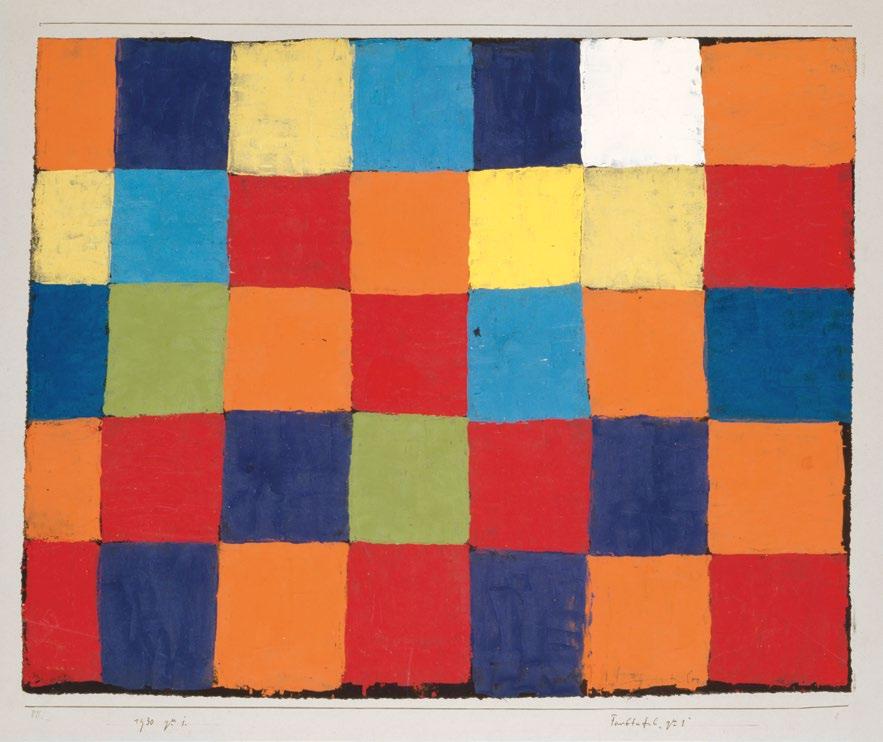
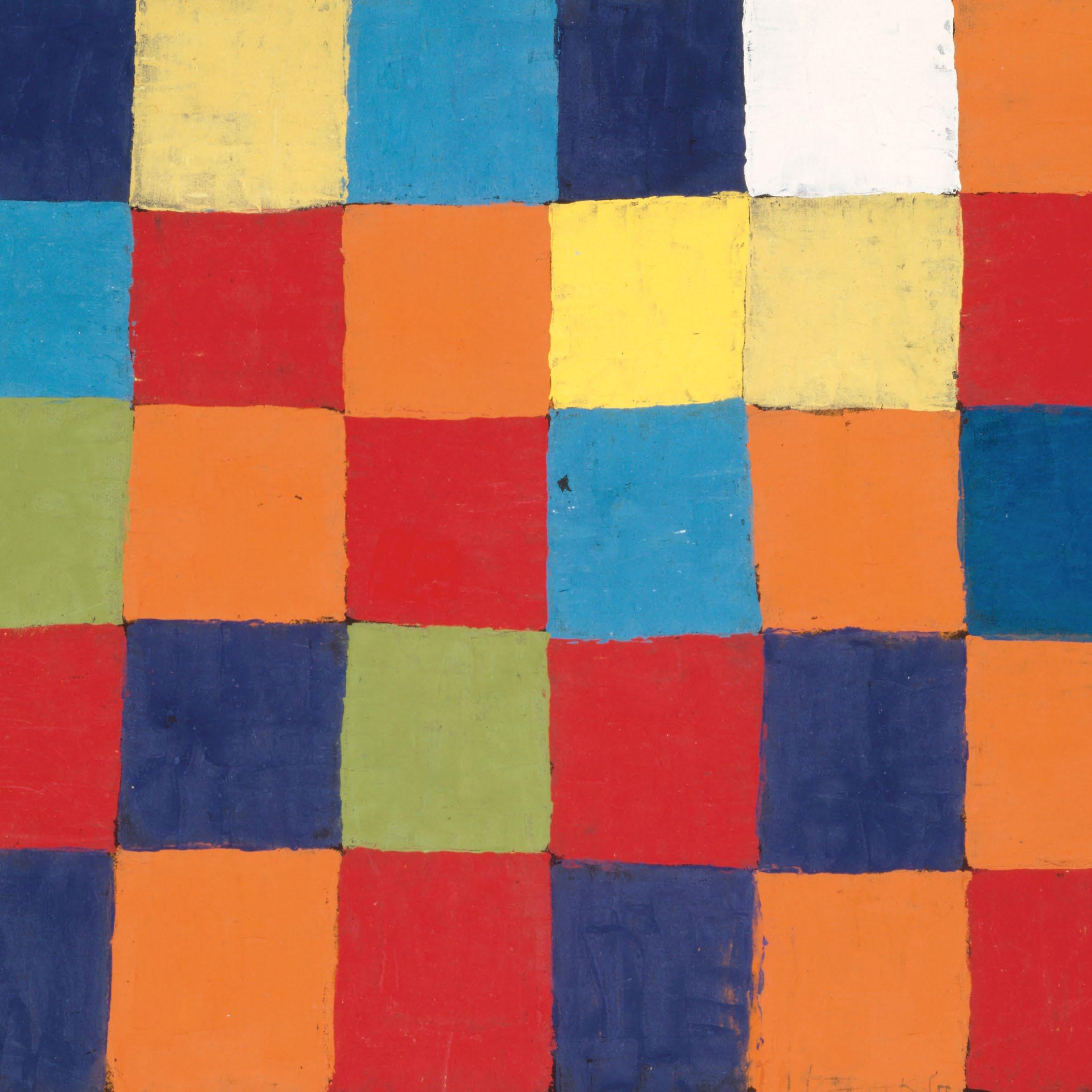
What does this painting have to do with math?
Swiss-born artist Paul Klee was interested in using color to express emotion. Here he created a grid, or array, of 35 colorful squares arranged in 5 rows and 7 columns. We will learn how an array helps us understand a larger shape by looking at the smaller shapes inside. Learning more about arrays will help us notice patterns and structure— an important skill for multiplication and division.
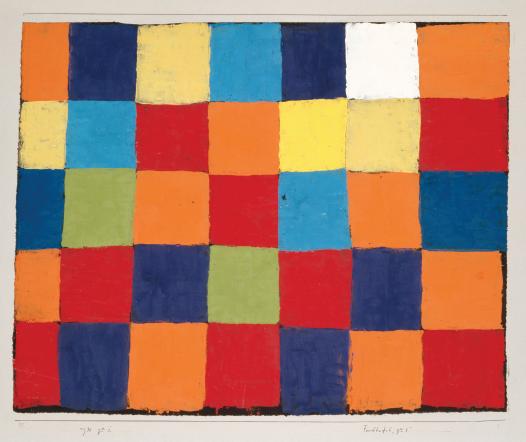
On the cover
Farbtafel “qu 1,” 1930
Paul Klee, Swiss, 1879–1940
Pastel on paste paint on paper, mounted on cardboard Kunstmuseum Basel, Basel, Switzerland
Paul Klee (1879–1940), Farbtafel “qu 1” (Colour Table “Qu 1” ), 1930, 71. Pastel on coloured paste on paper on cardboard, 37.3 x 46.8 cm. Kunstmuseum Basel, Kupferstichkabinett, Schenkung der Klee-Gesellschaft, Bern. © 2020 Artists Rights Society (ARS), New York.
Topic C
Topic B
Topic D Two Interpretations of Division
For this counting collection, I am partners with .
We are counting .
We estimate there are about of them.
This is how we organized and counted the collection:
We counted altogether. An equation that describes how we found the total is
Self-Reflection
Write one thing that worked well for you and your partner. Explain why it worked well.
Write one challenge you had. How did you work through the challenge?
Name
1. What unit did you use to count your collection? Explain why you chose that unit.
2. If you counted your collection again, would you choose the same unit? Explain.
Name
1. Use the equal groups for parts (a) and (b). , ,
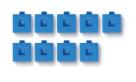
a. Skip-count by 5
b. Fill in the blanks to show the total number of bananas. + + = groups of five is
3 fives is 15
3 × 5 = 15
2. Fill in the blanks to match the picture. 9 + 9 = 18
3. The picture shows 2 groups of apples.
a. Does the picture show 2 × 3? Explain.
b. Draw a picture to show 2 × 3 = 6.
4. Eva says, “I see six 3 times. We can multiply 3 × 6 to find the total number of eggs.”
Do you agree with Eva? Explain.
Name
Use the equal groups for parts (a)–(d).
a. How many groups of 10 fingers are there?
4 groups
b. Fill in the blanks to show the total number of fingers.
10 + 10 + 10 + 10 = 40
c. How many tens are there?
4 tens
d. Fill in the blanks to match the picture.
4 × 10 = 40
1. Use the picture for parts (a) and (b).
a. Skip-count by 5.
b. Fill in the blanks to match the picture. groups of 5 is .
2. Use the picture for parts (a) and (b).
, 20 , 30
a. Skip-count by 10.
b. Fill in the blanks to match the picture.
3 groups of 10 is 30
3 tens is 30 .
3 × 10 = 30
The product is 30 .
3. Use the array for parts (a)–(c).
a. Skip-count by 5 down the side of the array.
b. Fill in the blanks to match the array.
8 fives is 40
8 × 5 = 40
c. Circle the product in the equation.
4. Use the array for parts (a)–(c).
a. Skip-count by 10 down the side of the array.
b. Fill in the blanks to match the array.
4 tens is 40 . 4 × = 40
c. Circle the product in the equation.
5. What do you notice about 8 × 5 and 4 × 10?
Name
Use the array for parts (a) and (b).
a. Skip-count by 5 down the side of the array.
b. Fill in the blanks to match the array. groups of is . 3 fives is 15 .
2. Use the equal groups for parts (a)–(d).
a. There are groups of balloons. There are balloons in each group. There is a total of balloons.
b. Complete the equation to describe the equal groups.
Number of groups × Number in each group = Product
c. Draw an array to show the total number of balloons. Make each equal group a row.
d. Complete the equation to describe the array.
Number of rows × Number in each row = Product
3. Draw an array to show 7 groups of 5. Make each group a row.
a. What factor shows the number of groups?
b. What factor shows the number in each group?
c. What is the product?
d. Complete the equation to describe the array.
Name
1. Use the equal groups for parts (a)–(c).
a. How many groups of cars are there? groups
b. How many cars are in each group? cars are in each group
c. Complete the equation.
2. Use the array for parts (a)–(c).
a. How many rows of cars are there? rows of cars
b. How many cars are in each row? cars are in each row
c. Complete the equation.
Number of rows Number in each row
3. Use the array for parts (a)–(d).
a. Number of rows:
b. Number in each row:
c.
d. There are apples in all.
4. Use the array for parts (a)–(d).
a. Number of rows:
b. Number in each row:
c. × = Number of rows Number in each row
d. The product is .
5. David drew an array and wrote an equation.
6 × 5 = 30
a. Which factor tells the number of rows?
b. Which factor tells the number in each row?
c. What is the product?
Name
Use the equal groups for parts (a)–(d).
a. How many groups of flowers are there? 4 groups
b. How many flowers are in each group? 5 flowers
c. What is the total number of flowers? 20 flowers
d. Fill in the blanks to match the picture.
Number of groups
Number in each group
Name
Use the Read–Draw–Write process to solve the problem.
1. A roller coaster has 10 cars. There are 3 people in each car.
How many people are on the roller coaster?
Use the Read–Draw–Write process to solve the problem.
2. The swinging ship ride has 9 rows of seats. Each row has 5 seats.
How many seats are on the swinging ship ride?
Name
Use the Read–Draw–Write process to solve each problem.
1. Oka has 4 baskets. Each basket has 5 bagels. How many bagels does Oka have? Oka has bagels.
2. A muffin pan has 5 rows. Each row has 3 muffins. How many muffins are in the pan?
There are muffins in the pan.
3. Mr. Lopez has 10 packs of cups. Each pack has 6 cups. How many cups does Mr. Lopez have?
4. Ivan has 6 packs of tomatoes. Each pack has 5 tomatoes. How many tomatoes does Ivan have?
5. A garden has 4 rows of beets. Each row has 10 beets. How many beets are in the garden?
6. Mrs. Smith has 10 boxes of books. Each box has 10 books. How many books does Mrs. Smith have?
Name
Use the Read–Draw–Write process to solve the problem.
Mr. Endo has 5 boxes of crayons. There are 8 crayons in each box.
How many crayons does Mr. Endo have?
Name
1. Use 10 crackers to make equal shares with 5 crackers in each group.
a. Draw to show how you equally shared the crackers and then complete the sentences.
b. The total number is .
c. The number in each group is
d. The number of equal groups is .
2. Use 10 crackers to make 5 equal groups of crackers.
a. Draw to show how you equally shared the crackers. Then complete the sentences.
b. The total number is .
c. The number in each group is
d. The number of equal groups is .
3. Use 20 crackers to make equal shares, with 5 crackers in each group.
a. Draw to show how you equally shared the crackers, and then complete the sentences.
b. The total number is .
c. The number in each group is .
d. The number of equal groups is .
4. Use 20 crackers to make 5 equal groups of crackers.
a. Draw to show how you equally shared the crackers. Then complete the sentences.
b. The total number is .
c. The number in each group is
d. The number of equal groups is .
Use the pictures to help you fill in the blanks.
1. There are 20 pencils in equal groups.
a. The total number is .
b. The number in each group is .
c. The number of equal groups is .
2. There are 30 apples in equal groups.
a. The total number is ______.
b. The number in each group is ______.
c. The number of equal groups is ______.
3. There are 20 apples.
a. Circle groups of 5 apples.
b. There are ______ groups of 5.
c. Circle two correct statements.
5 is the number in each group.
5 is the number of equal groups.
4 is the number in each group.
4 is the number of equal groups.
d. Circle the apples to make 5 equal groups.
e. There are ______ apples in each group.
f. Circle two correct statements.
5 is the number in each group. 5 is the number of equal groups.
4 is the number in each group. 4 is the number of equal groups.
g. In parts (a) and (d) you equally shared 20 apples.
How was the equal sharing different?
Name
There are 12 balloons.
a. Circle groups of 4 balloons.
b. Fill in the blanks to match the picture.
The number in each group is
The number of equal groups is .
1. There are 12 buttons. They are in groups of 3.
How many groups are there?
a. What are you trying to find? Circle it. the number in each group the number of groups
b. Draw to show the buttons equally shared in groups of 3
c. Fill in the blanks to match your drawing.
The total is .
The number in each group is .
The number of groups is
2. There are 12 buttons. They are in 3 equal groups.
How many are in each group?
a. What are you trying to find? Circle it. the number in each group the number of groups
b. Draw to show the buttons divided into 3 equal groups.
c. Fill in the blanks to match your drawing.
The total is .
The number in each group is
The number of groups is .
3. There are 30 crackers.
a. Draw to show the crackers divided into 5 equal groups.
b. How many crackers are in each group?
c. Draw to show the crackers divided into groups of 5
d. How many groups of crackers are there?
e. Which drawing shows 5 as the number in each group? How do you know?
4. Adam draws a picture to show 15 divided into 5 equal groups.
Do you agree with Adam’s work? Explain.
Name
Ray divides 30 beads into 5 equal groups.
a. Draw an equal groups picture to show Ray’s beads.
b. How many beads are in each group?
Name
Use the Read–Draw–Write process to solve the problem.
2. Gabe also collects rocks.
He has 15 rocks that he wants to display in 5 equal rows. How many rocks can Gabe put in each row?
Use the Read–Draw–Write process to solve each problem.
3. Jayla stocks shelves at the grocery store.
a. Jayla has 10 rolls of paper towels. She puts 2 rolls of paper towels on each shelf. How many shelves does Jayla put paper towels on?
b. Jayla has 10 cereal boxes. She puts an equal number of cereal boxes on 2 shelves. How many cereal boxes does Jayla put on each shelf?
Fill in the blanks to match the arrays.
1. There are 8 pencils in equal rows.
a. The number in each row is .
b. The number of rows is .
c.
2. There are 12 stars in equal rows.
a. The number in each row is .
b. The number of rows is .
3. Adam puts 14 books on shelves.
He puts 7 books on each shelf.
How many shelves does Adam put books on?
a. Draw an array to represent the problem.
b. Write a division equation to represent the problem.
c. Adam puts books on shelves.
4. There are 21 students in a class. The students sit in 3 equal rows. How many students are in each row?
a. Draw an array to represent the problem.
b. Write a division equation to represent the problem.
c. There are students in each row.
5. Amy has 9 chairs. She arranges the chairs in 3 equal rows.
What mistake did Amy make? How do you know?
Name
Ray puts 18 cards into rows of 3.
a. Draw an array to find the number of rows.
b. Write a division equation to show the number of rows.
Name
Use the
process to solve the problem.
Use the Read–Draw–Write process to solve the problem.
2. Miss Wong displays the 24 pictures her students made in art class on a bulletin board. She puts 8 pictures in each row.
How many rows of pictures does Miss Wong make?
Name
Use the Read–Draw–Write process to solve each problem.
1. 12 friends want to paddle boats across the lake.
2 friends can fit in each boat.
How many boats do the friends need?
2. Zara uses 16 cards to play a matching game. She makes rows of 4 cards.
How many rows of cards does Zara make?
3. There are 18 plants in the greenhouse. Oka puts the plants in 3 equal rows.
How many plants are in each row?
4. Ray puts 24 pictures in his scrapbook.
He puts 4 pictures on each page.
How many pages does Ray use?
5. Mr. Davis sells peaches and apples at his fruit stand.
a. Mr. Davis has 32 peaches to sell.
He puts the peaches equally into 4 baskets.
How many peaches are in each basket?
b. Mr. Davis has 27 apples to sell.
He displays the apples in 3 equal rows.
How many apples are in each row?
Name
Use the Read–Draw–Write process to solve the problem.
Luke has 20 dog treats.
He divides the treats equally among 5 dogs.
How many treats does each dog get?
2 threes
5 + 5 + 5



Sort: Equal Groups Set B
2 + 2 + 2
3 + 3 + 3 + 3 + 3
5 threes


Name
Use the Read–Draw–Write process to solve the problem. Pablo arranges his grapes into 7 rows. Each row has 2 grapes. How many total grapes does Pablo have?
a. Draw an array to represent Pablo’s grapes.
b. Write a multiplication equation to describe the array.
c. Use the commutative property to write a different multiplication equation for the array.
d. Complete the solution statement. Pablo has total grapes.
Fill in the blanks to match each array.
7. Jayla has 6 rows of 2 stickers.
a. Draw an array to represent the stickers.
b. Write two multiplication equations to describe the array.
8. Complete the equations.
9. a. Draw an array to show 2 × 4
b. Explain how the array also shows 4 × 2
c. Complete the equation to show how 2 fours and 4 twos are related.
Name
1. Draw an array to represent 2 × 3.
2. Explain how the array also shows 3 × 2.
1. Skip-count by fours. Match each number to the correct expression.
8. Use the Read–Draw–Write process to solve the problem. Miss Diaz has 5 tables.
There are 4 chairs at each table.
How many chairs are there altogether?
There are altogether.
9. Draw to show why the statement in the box is true.
Label the tape diagrams to match their equations. Then complete the equations.
12. How does the array show 2 fours and 4 twos?
Complete the equations to describe the total number of squares in the array.
Fill in the blanks to describe each array.
Shade each array to show two parts. Then fill in the blanks to describe each array.
6. Oka puts her stickers in 5 columns of 4.
a. Multiply to find Oka’s total number of stickers.
5 × 4 =
Oka adds 2 more columns of 4.
b. Add onto the array to show her new total.
c. Fill in the blanks to represent 2 columns of 4.
× 4 =
d. Find the total number of stickers Oka has. Add the products from parts (a) and (c).
+ = 28
e. Write a multiplication equation that shows Oka’s total. × =
Shade the array to show two parts. Then fill in the blanks to describe the array.
Name
1. Use the array to fill in the blanks.
a. Skip-count the rows by 3 and the columns by 10.
b. 10 rows of 3 is 10 threes is × =
c. 3 columns of 10 is
3 tens is × =
d. Complete the equation to show how 10 threes and 3 tens are related. × = ×
15. Complete the table. Label the tape diagram. Complete the related equation. Draw an array to match.
16. a. Circle two equations that show the commutative property of multiplication.
3 × 5 = 5 × 3
4 × 3 = 6 × 2
3 × 5 = 10 + 5
8 × 3 = 3 × 8
b. Explain how the equations you circled in part (a) show the commutative property.
Name
Draw to show that 3 × 4 = 4 × 3. Explain how you know.
Name
1. Luke is selling vases of flowers.
He arranges vases of pink flowers in 5 columns of three.
He arranges vases of yellow flowers in 2 columns of three.
a. How many total columns of vases are there?
b. How many vases of pink flowers are there?
c. How many vases of yellow flowers are there?
d. How many total vases of flowers are there?
4. A shoe store has a display of 9 stacks of 3 boxes of shoes. Some stacks of 3 boxes are on sale. The rest of the stacks are not on sale.
a. Draw one possible combination of stacks that are on sale and stacks that are not.
b. Write expressions and equations to represent your drawing and how many boxes there are altogether.
c. Write a solution statement to describe how many boxes there are altogether.
Fill in the blanks to describe each array.
4. Show two different ways to make 6 threes. Shade the arrays and complete the equations.
6 threes = threes + threes
6 × 3 = ( × 3 ) + ( × 3 ) 18 = +
6 threes = threes + threes
6 × 3 = ( × 3 ) + ( × 3 ) 18 = +
5. Liz buys a box of yogurt cups.
The box has 7 columns. There are 4 yogurt cups in each column. There are 2 columns of lemon yogurt, and the rest are peach.
a. Draw the array of lemon and peach yogurt cups.
b. Fill in the blanks to find the total number of yogurt cups.
6. There are 9 columns of 4 mailboxes in the office. Some of the columns have gray mailboxes. The rest of the columns have white mailboxes.
a. Draw to show one possible combination of gray and white mailboxes.
b. Write equations to represent your drawing.
c. How many mailboxes are there altogether?
The array shows 7 broken apart to find 7 × 4. Fill in the blanks to match the array. 7
Use the Read–Draw–Write process to solve the problem.
2. Mia puts lemon slices into cups of iced tea. She has 8 lemon slices. She puts 2 lemon slices in each cup. How many cups of iced tea have lemon slices?
Use the Read–Draw–Write process to solve the problem.
3. A fruit stand has a total of 40 plums on a table. They are arranged in rows. There are 5 plums in each row. How many rows of plums are there?
a. Draw an array to represent the problem.
b. Draw a tape diagram to represent the problem.
c. Complete the equations to find the unknown.
d. There are rows of plums.
Use the Read–Draw–Write process to solve the problem.
4. There are 24 students in a marching band. The students line up in rows of 4. How many rows of students are there?
Name
1. Robin puts 15 tennis balls into cans. She puts 3 balls in each can.
How many cans does Robin use?
a. Circle groups of 3 to show the balls in each can.
b. Complete the equations and statement.
× 3 = 15 15 ÷ 3 = Robin uses cans.
c. What do the unknowns in the equations represent? Circle the correct answer.
the number of groups the size of each group
2. 36 apple trees are planted in rows. There are 4 trees in each row.
How many rows are there?
a. Draw an array to represent the problem.
b. Complete the equations to find the unknown.
c. Write a solution statement.
d. What do the unknowns in the equations represent? Circle the correct answer.
the number of groups the size of each group
3. Mrs. Smith puts a total of 12 peaches into bags. She puts 2 peaches in each bag.
How many bags does Mrs. Smith use?
a. Draw an array to represent the problem.
b. Draw a tape diagram to represent the problem.
c. Complete the equations to find the unknown. 12 ÷ 2 =
d. Write a solution statement.
4. Mrs. Smith puts a total of 18 plums into bags. She puts 6 plums in each bag.
How many bags does she use?
a. Draw an array and a tape diagram to represent the problem.
b. Complete the equations to find the unknown.
c. Write a solution statement.
Carla has 12 grapes. She gives 4 grapes to each friend. How many friends get grapes?
a. Draw a picture to represent the problem.
b. Complete the equations to find the unknown. 12
c. friends get grapes.
Name
Use the Read–Draw–Write process to solve the problem.
1. Some students share 32 sticks of sidewalk chalk. Each student gets 4 sticks of chalk. How many students get sticks of chalk?
a. Draw a tape diagram to represent the problem.
b. Complete the two equations to represent the problem. Box the unknown.
c. students get sticks of chalk.
Use the Read–Draw–Write process to solve the problem.
2. A pet store has 14 birds. There are 2 birds in each cage.
How many cages of birds are there?
Use the Read–Draw–Write process to solve the problem.
3. A classroom has enough tables to seat a total of 20 students. There are 4 students seated at each table.
How many tables are in the classroom?
Name
1. 6 tomatoes are divided into groups of 3.
2. Divide 8 lollipops into groups of 2.
How many groups of 3 are there?
How many groups of 2 are there?
× 3 = 6
× 2 = 8
6 ÷ 3 = 2
There are groups of 3.
8 ÷ 2 =
There are groups of 2.
3. Divide 10 stars into groups of 5.
4. Divide 12 shells into groups of 4.
How many fives are in 10?
How many fours are in 12?
×5=10
10÷5=
5. There are 10 birds in cages at the pet store. Each cage has 2 birds in it.
How many cages of birds are there?
a. Circle the birds to show the number of cages.
12÷4=
×4=12
b. Complete the equations and write a solution statement.
×2=10
10÷2=
Use the Read–Draw–Write process to solve each problem.
6. Adam buys 24 meters of wire. He cuts the wire into pieces that are each 4 meters long. How many pieces of wire does he cut?
7. Eva makes 24 pancakes and puts them into stacks. There are 6 pancakes in each stack. How many stacks of pancakes are there?
Name
Zara uses 21 apples to make pies. She uses 3 apples for each pie. How many pies does Zara make?
a. Draw a tape diagram to represent the problem.
b. Write an equation to solve the problem.
c. Zara makes pies.
Name
Use the Read–Draw–Write process to solve the problem.
1. 3 students share 27 crackers equally. How many crackers does each student get?
a. Draw a tape diagram to represent the problem.
b. Complete a division equation and a multiplication equation to represent the problem. Box the unknown.
c. Each student gets crackers.
Use the Read–Draw–Write process to solve the problem.
2. Mr. Endo puts 28 papers equally into 4 piles. How many papers are in each pile?
Use the Read–Draw–Write process to solve the problem.
3. Shen puts a total of 45 marbles equally into 5 bags. How many marbles are in each bag?
Name
1. 14 flowers are divided into 2 equal groups.
2. 28 books are divided into 4 equal groups.
How many flowers are in each group?
How many books are in each group?
2×=14
4×=28
14÷2=
There are flowers in each group.
28÷4=
There are books in each group.
20 markers are divided into equal groups. butterflies are divided into equal rows.
How many markers are in each group?

4×=20
How many butterflies are in each row?
20÷4=
There are markers in each group.
15= ÷
×=15 15÷
There are butterflies in each row.
5. The pet store has 50 fish for sale. The fish are divided equally into 5 tanks. How many fish are in each tank?
a. Complete the tape diagram.
b. Then complete the equations and statement.
There are fish in each tank.
6. Mr. Davis has 24 pencils. He divides them equally among 4 tables.
a. How many pencils are on each table?
b. Complete the tape diagram. Then complete the equations and statement.
There are pencils on each table. Use the Read–Draw–Write process to solve the problem.
7. 24 jelly beans are shared equally by 3 students. How many jelly beans does each student get?
Name
Luke has 14 oat bars.
He eats the same number of oat bars each day. He eats all the oat bars in 7 days.
How many oat bars does Luke eat each day?
a. Draw a tape diagram to represent the problem.
b. Write an equation to solve the problem.
c. Luke eats oat bars each day.
Fill in the blank to complete the sequence.
Fill in the blank to complete the sequence.
There are 60 cookies packed equally in boxes. Each box has 10 cookies. How many boxes are there?
There are 60 cookies packed equally in boxes. There are 6 boxes. How many cookies are in each box?
There are 60 cookies packed equally in boxes. There are 10 boxes. How many cookies are in each box?
There are 60 cookies packed equally in boxes. Each box has 6 cookies. How many boxes are there?
Name
Use the Read–Draw–Write process to solve the problem.
1. There are 24 cookies packed in boxes. Each box has 6 cookies.
How many boxes are needed to package all the cookies?
Use the Read–Draw–Write process to solve the problem.
2. There are 24 cookies packed equally in 6 boxes. How many cookies are packed in each box?
Use the Read–Draw–Write process to solve the problem.
3. Jayla has 20 toy cars. She puts the cars in 4 equal groups. How many cars are in each group?
Use the Read–Draw–Write process to solve the problem.
4. The students on the team equally share 12 apples. Each student gets 2 apples. How many students are on the team?
Name
1. Miss Diaz puts 12 frogs into 4 equal groups.
How many frogs are in each group?
a. Circle the tape diagram that represents the problem. 12
b. Complete the equation and statement.
12 ÷ 4 =
There are frogs in each group.
2. Luke puts 21 cups of water equally into some bottles. He puts 3 cups of water into each bottle.
How many bottles does Luke put water into?
a. Circle the tape diagram that represents the problem.
b. Complete the equation and statement. 21 ÷ 3 = Luke puts water into bottles.
Use the Read–Draw–Write process to solve each problem.
3. A baker packs 70 muffins in 10 boxes.
How many muffins does the baker pack in each box?
4. The server puts 35 glasses into rows of 5. How many rows does the server make?
5. Shen pays $27 for some notebooks. Each notebook costs $3
How many notebooks does Shen buy?
6. Pablo and Casey buy 2 tickets to the movies. The tickets cost a total of $16.
Pablo and Casey share the cost equally. How much does Casey pay?
Name
Mia puts 20 books into 4 equal piles.
How many books are in each pile?
a. Draw a picture to represent the problem.
b. Write an equation to represent the problem.
c. There are books in each pile.
Name
1. Mrs. Smith bakes a tray of mini muffins.
The tray has 7 rows of 4 mini muffins.
2. Miss Diaz’s class is going on a field trip. The bus has 8 rows of 4 seats.
How many seats are on the bus?
Name
Use each array to complete the equations.
1. 1. (5 × 4) = (1 × 4) =
65 1 64 54 14 64 20 64
foursfoursfour =+ ×= ×+ × ×= + ×
() () =
2. 2. (5 × 4) =
(2 × 4) =
75 2 74 54 24 74 20 7
foursfoursfours =+ ×= ×+ × ×= + ×
() () 4 =
Complete each number bond. Then, use it to complete the equations.
3. 4.
8 fours
9 fours
85 84 54 4 foursfoursfours =+ ×= ×+ × () ()
8 84 20 84 ×= + ×=
5. David used the break apart and distribute strategy.
Look at David’s work.
5 fours
95 94 54 4 foursfoursfours =+ ×= ×+ × () ()
9 94 94 ×= + ×=
What numbers did David multiply? Complete the number bond and the equation.
5 fours 5 × 4
David’s work: () () 54 14 24 20 424 ×+ ×= += × =
Use each array to complete the equations.
Use the Read–Draw–Write process to solve the problem.
8. Luke makes 9 pancakes.
He puts 4 berries on each pancake.
What is the total number of berries that Luke uses?
Complete the number bond. Then, use the break apart and distribute strategy to multiply.
Use the arrays to help you complete the equations.
Divide by using the break apart and distribute strategy.
6. = 21 ÷ 3 = 5 + 15
7. + 24 ÷ 4 = =
8. + 32 ÷ 4 = =
9. Use the break apart and distribute strategy to find 36 ÷ 6. Explain your thinking.
Name
Fill in the blanks to match the arrays.
1.
2.
I see 2 groups of × 2 × ( × )
I see 3 groups of × .
× ( × )
3.
I see groups of × . × ( × )
4. The array is broken apart into 2 equal groups. Fill in the blanks to match the array.
I see 2 groups of × . × ( × )
5. Draw a line to break apart the array into 2 equal groups. Fill in the blanks to match the array.
I see 2 groups of × × ( × )
6. Fill in the blanks to match the expression. Break apart the array by drawing lines to match the expression.
4 × (2 × 2)
I see groups of × .
7. The same array is shown four times. Show a different way to break apart each array. Then complete the statement.
I see groups of × .
I see groups of × .
I see groups of × .
I see groups of × .
Name
1. Fill in the blanks to match the arrays.
I see groups of × . × ( × )
2. Fill in the blanks to match the arrays.
AFill in the blank to complete the sequence. Number Correct:
Fill in the blank to complete the sequence.
Name
Use the Read–Draw–Write process to solve the problem.
6 people go to the county fair.
They bring a total of $60 to spend on food.
Each person buys a lemonade and a popcorn.
Snacks
Lemonade $4
Popcorn $5
a. How much do the 6 people spend on lemonade and popcorn?
b. How much money do they have left?
Name
Use the Read–Draw–Write process to solve each problem.
1. Carla buys 3 books and 1 card.
Each book costs $8.
The card costs $4
a. What is the total cost of the books?
Books
b. How much does Carla spend altogether?
2. 7 students share 28 markers equally.
a. How many markers does each student get? 28
b. What is the total number of markers shared with 3 of the students?
3. A total of 18 cups are equally packed into 6 boxes.
a. How many cups are in each box?
b. All of the cups in 2 boxes are broken. How many cups are not broken?
4. 25 blue balloons and 15 red balloons are shared equally among 5 children.
a. What is the total number of balloons?
b. How many balloons does each child get?
5. Adam packs 27 limes into some bags. Each bag has 3 limes in it.
a. How many bags of limes does Adam pack?
b. Adam sells 5 of the bags. How many bags are left?
c. How many limes are left?
Name
Use the Read–Draw–Write process to solve problems (a) and (b). At lunch, a total of 30 students sit at 5 tables. The same number of students sit at each table.
a. How many students sit at each table?
b. 4 tables are red, and 1 table is blue. How many students sit at a red table?
Name
Use the Read–Draw–Write process to solve the problem.
There are 4 crates with 6 books in each crate.
3 brothers equally share the books.
How many books does each brother get?
Name
Use the Read–Draw–Write process to solve each problem.
1. Mr. Lopez buys 4 packs of 7 markers.
After he gives 1 marker to each student in his class, he has 5 markers left. How many total markers does Mr. Lopez give to his students?
Step 1: Find the total number of markers that Mr. Lopez buys.
7 7 7 7
Step 2: Find the total number of markers Mr. Lopez gives to his students.
Mr. Lopez gives a total of markers to his students.
2. Amy has 21 meters of ribbon.
She cuts the ribbon so that each piece measures 3 meters in length.
a. How many pieces of ribbon does Amy have?
b. If Amy needs a total of 12 pieces, how many more pieces does she need?
3.
Travis
earns money doing chores.
He earns $6 each week for 4 weeks.
He earns $4 the fifth week.
How much does Travis earn altogether?
4. Ivan has a bag of 18 fruit snacks.
There is an equal number of peach, cherry, and grape fruit snacks. Ivan eats all the grape fruit snacks.
How many fruit snacks does Ivan have left?
Name
Use the Read–Draw–Write process to solve the problem.
Carla buys 5 packs of glow sticks. Each pack has 8 glow sticks.
Carla uses 12 glow sticks on a project.
How many glow sticks are left?