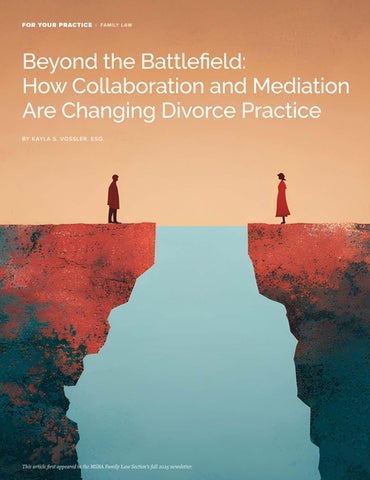

Beyond the Battlefield: How Collaboration and Mediation Are Changing Divorce Practice
BY KAYLA S. VOSSLER, ESQ.
Divorce has long been viewed as an adversarial process.
For many families, there’s an idea of “winning.” Yet as family lawyers often remind clients, there are no true winners or losers in family law. The litigation path can deepen wounds that are already difficult to heal. For many families, these processes provide a more constructive and empowering way to navigate separation, one that emphasizes control, transparency, and long-term stability over courtroom battles.
REFRAMING WHAT IT MEANS TO “WIN”
In traditional litigation, the process is inherently adversarial, structured around a plaintiff and a defendant, with each side arguing against the other as the court assigns responsibility, divides property, and issues orders.
In the collaborative process and mediation, the focus shifts to problem-solving. The question becomes not “Who is right?” but “What will work for this family moving forward?” This reframing can completely transform how clients experience divorce.
The collaborative process is a team-based approach in which both parties are represented by attorneys who have been collaboratively trained and agree to work together outside of court. The parties may also engage financial professionals and mental health coaches to provide education, clarity, and emotional support. The result is a process that helps clients make informed, sustainable decisions rather than reactive ones.
Mediation, while structurally different, shares many of the same principles. A neutral mediator facilitates conversation, helps identify priorities, and supports the parties in finding mutually acceptable solutions. Even when mediation does not resolve every issue, it often narrows disputes and promotes understanding, saving time, cost, and stress.
THE BENEFITS OF CONSTRUCTIVE RESOLUTION
Both the collaborative process and mediation encourage transparency, accountability, and self-determination. Clients often find that they emerge not only with a settlement agreement but with a greater sense of ownership over the outcome. For parents, this can mean smoother co-parenting relationships and less conflict for their children.
These processes also reduce the emotional and financial toll of divorce. Avoiding court allows families to preserve resources and privacy while maintaining more flexible timelines. For many, it is also the first opportunity to communicate directly and productively after months or years of conflict.
In traditional litigation, the process is inherently adversarial, structured around a plaintiff and a defendant, with each side arguing against the other as the court assigns responsibility, divides property, and issues orders. In the collaborative process and mediation, the focus shifts to problem-solving.
A LAWYER’S ROLE AS MEDIATOR AND COLLABORATIVE ATTORNEY
As attorneys, our role in these processes is not diminished; it evolves. Instead of adversaries, we become advisors, educators, and problem-solvers. We help clients identify their priorities, understand their options, and evaluate proposals in the context of their long-term goals. This approach requires preparation, creativity, and empathy. It asks us to listen as much as we advocate, to think holistically, and to help clients define success in terms of stability and dignity rather than division.
LOOKING FORWARD
The collaborative process and mediation are not right for every situation. But for many families, they provide a path that feels more humane and less destructive. They give clients the space to make reasoned decisions, the support to manage the emotions that accompany divorce, and the opportunity to rebuild a foundation of trust for the future. As the practice of family law continues to evolve, these models remind us that resolving conflict does not have to mean deepening it. When handled thoughtfully, divorce can be not only an end, but the beginning of a new chapter written with intention, clarity, and respect.


Kayla S. Vossler is an associate attorney at Burr Law Firm, where she practices family law with a focus on divorce, custody, and financial matters. She is trained in mediation, parent coordination, and the collaborative process, and is committed to helping families resolve disputes in a more constructive, client-centered way. She is admitted to practice in Washington, D.C., Maryland, and Texas.