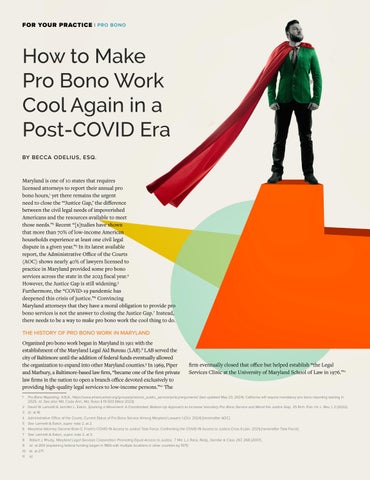
How to Make Pro Bono Work Cool Again in a Post-COVID Era
BY BECCA ODELIUS, ESQ.
Maryland is one of 10 states that requires licensed attorneys to report their annual pro bono hours,1 yet there remains the urgent need to close the “‘Justice Gap,’ the difference between the civil legal needs of impoverished Americans and the resources available to meet those needs.”2 Recent “[s]tudies have shown that more than 70% of low-income American households experience at least one civil legal dispute in a given year.”3 In its latest available report, the Administrative Office of the Courts (AOC) shows nearly 40% of lawyers licensed to practice in Maryland provided some pro bono services across the state in the 2023 fiscal year.4 However, the Justice Gap is still widening.5 Furthermore, the “COVID-19 pandemic has deepened this crisis of justice.”6 Convincing Maryland attorneys that they have a moral obligation to provide pro bono services is not the answer to closing the Justice Gap.7 Instead, there needs to be a way to make pro bono work the cool thing to do.
THE HISTORY OF PRO BONO WORK IN MARYLAND
Organized pro bono work began in Maryland in 1911 with the establishment of the Maryland Legal Aid Bureau (LAB).8 LAB served the city of Baltimore until the addition of federal funds eventually allowed the organization to expand into other Maryland counties.9 In 1969, Piper and Marbury, a Baltimore-based law firm, “became one of the first private law firms in the nation to open a branch office devoted exclusively to providing high-quality legal services to low-income persons.”10 The
firm eventually closed that office but helped establish “the Legal Services Clinic at the University of Maryland School of Law in 1976.”11
1 Pro Bono Reporting, A.B.A., https://www.americanbar.org/groups/probono_public_service/policy/arguments/ (last updated May 23, 2024). California will require mandatory pro bono reporting starting in 2026. Id. See also Md. Code Ann., Md. Rules § 19-503 (West 2023).
2 David W. Lannetti & Jennifer L. Eaton, Sparking a Movement: A Coordinated, Bottom-Up Approach to Increase Voluntary Pro Bono Service and Mend the Justice Gap, 25 Rich. Pub. Int. L. Rev. 1, 2 (2022).
3 Id. at 16.
4 Administrative Office of the Courts, Current Status of Pro Bono Service Among Maryland Lawyers 1 (Oct. 2024) [hereinafter AOC].
5 See Lannetti & Eaton, supra note 2, at 2.
6 Maryland Attorney General Brian E. Frosh’s COVID-19 Access to Justice Task Force, Confronting the COVID-19 Access to Justice Crisis 6 (Jan. 2021) [hereinafter Task Force].
7 See Lannetti & Eaton, supra note 2, at 3.
8 Robert J. Rhudy, Maryland Legal Services Corporation: Promoting Equal Access to Justice, 7 Md. L.J. Race, Relig., Gender & Class 267, 268 (2007).,
9 Id. at 269 (explaining federal funding began in 1966 with multiple locations in other counties by 1971).
10 Id. at 271.
11 Id.
Cool Again in a Post-COVID Era
BY BECCA ODELIUS, ESQ.
Maryland is one of 10 states that requires licensed attorneys to report their annual pro bono hours,1 yet there remains the urgent need to close the “‘Justice Gap,’ the difference between the civil legal needs of impoverished Americans and the resources available to meet those needs.”2 Recent “[s]tudies have shown that more than 70% of low-income American households experience at least one civil legal dispute in a given year.”3 In its latest available report, the Administrative Office of the Courts (AOC) shows nearly 40% of lawyers licensed to practice in Maryland provided some pro bono services across the state in the 2023 fiscal year.4 However, the Justice Gap is still widening.5 Furthermore, the “COVID-19 pandemic has deepened this crisis of justice.”6 Convincing Maryland attorneys that they have a moral obligation to provide pro bono services is not the answer to closing the Justice Gap.7 Instead, there needs to be a way to make pro bono work the cool thing to do.
THE HISTORY OF PRO BONO WORK IN MARYLAND
Organized pro bono work began in Maryland in 1911 with the establishment of the Maryland Legal Aid Bureau (LAB).8 LAB served the city of Baltimore until the addition of federal funds eventually allowed the organization to expand into other Maryland counties.9 In 1969, Piper and Marbury, a Baltimore-based law firm, “became one of the first private law firms in the nation to open a branch office devoted exclusively to
providing high-quality legal services to low-income persons.”10 The firm eventually closed that office but helped establish “the Legal Services Clinic at the University of Maryland School of Law in 1976.”11
1 Pro Bono Reporting, A.B.A., https://www.americanbar.org/groups/probono_public_service/policy/arguments/ (last updated May 23, 2024). California will require mandatory pro bono reporting starting in 2026. Id. See also Md. Code Ann., Md. Rules § 19-503 (West 2023).
2 David W. Lannetti & Jennifer L. Eaton, Sparking a Movement: A Coordinated, Bottom-Up Approach to Increase Voluntary Pro Bono Service and Mend the Justice Gap, 25 Rich. Pub. Int. L. Rev. 1, 2 (2022).
3 Id. at 16.
4 Administrative Office of the Courts, Current Status of Pro Bono Service Among Maryland Lawyers 1 (Oct. 2024) [hereinafter AOC].
5 See Lannetti & Eaton, supra note 2, at 2.
6 Maryland Attorney General Brian E. Frosh’s COVID-19 Access to Justice Task Force, Confronting the COVID-19 Access to Justice Crisis 6 (Jan. 2021) [hereinafter Task Force].
7 See Lannetti & Eaton, supra note 2, at 3.
8 Robert J. Rhudy, Maryland Legal Services Corporation: Promoting Equal Access to Justice, 7 Md. L.J. Race, Relig., Gender & Class 267, 268 (2007).,
9 Id. at 269 (explaining federal funding began in 1966 with multiple locations in other counties by 1971).
10 Id. at 271.
11 Id.
Convincing Maryland attorneys that they have a moral obligation to provide pro bono services is not the answer to closing the Justice Gap. Instead, there needs to be a way to make pro bono work the cool thing to do.
By the mid-1980s, Maryland was booming with pro bono and public interest services including the Office of the Public Defender (established in 1972), Maryland Volunteer Lawyers Service (MVLS) (established in 1981), the Maryland Disability Law Center (MDLC) (established in 1977 as the Maryland Advocacy Unit for the Developmentally Disabled) and clinics in both the University of Maryland Law School and the University of Baltimore Law School.12
As a result of drastically reduced federal funding, “in 1982, the Maryland General Assembly created the Maryland Legal Services Corporation (MLSC) with support from state and local bar associations, legal services and government leaders, and numerous advocacy organizations.”13 MLSC became, and still remains, the “largest funding source for civil legal aid to lower-income persons in the state.”14
While “substantial progress has notably expanded and improved Maryland’s system for providing legal aid and access to justice for low-income people in civil matters,”15 there are still “many people with legal needs [who] remain unserved.”16
PRO BONO IN THE TIMES OF COVID
When the COVID-19 pandemic hit Maryland, it “rocked the civil legal aid system as MLSC was experiencing the worst revenue shortage in its history.”17 While access to funding decreased, “legal aid and legal support services organizations [were] seeing increased demand for help with issues such as unaffordable medical bills, domestic violence, child custody, benefits denial, consumer debt, and an anticipated flood of evictions and foreclosures.”18 With the decline of funding came the need for more pro bono attorneys. However, in “the fiscal year ending June
30, 2020, which included almost three months of the pandemic impact, the number of pro bono hours reported by MLSC grantees declined by 17 percent from the previous year, and the number of attorneys providing free legal services declined by 14 percent.”19 The need for pro bono attorneys was greater than ever, and the pro bono numbers were lower than ever. As a result, “civil legal aid entities overcame resource, logistical, and technological challenges to continue serving low-income Marylanders . . . .”20 The lingering effects of COVID-19 can still be felt in communities throughout Maryland and in the struggle to regain volunteer attorneys.21
CONCLUSION: HOW
TO MAKE PRO BONO WORK COOL AGAIN
Maryland attorneys, “in the full-time practice of law should aspire to render at least 50 hours per year of pro bono publico legal service,”22 but there are several reasons why those 50 hours are often not met.23 The top three listed reasons preventing pro bono work by full-time attorneys are (3) personal or family medical issues, (2) no experience in relevant practice areas, and (1) lack of time.24 Not surprisingly, the top three listed incentives to engage in pro bono legal work are (3) a compelling client or cause, (2) substantive training in relevant practice areas, and (1) limited time commitment.25 However, there is ample pro bono work available across Maryland that provides substantive training and has limited time commitments.26 If the incentives are there, and the reasons preventing pro bono work are being adequately addressed, then maybe the answer is for pro bono service providers to figure out how to make pro bono work cool again in a post-COVID era.27
12 See id. at 271-72.
13 Id. at 273.
14 Id. at 284.
15 Id. at 293.
16 Id. at 283.
17 Task Force, supra note 6, at 23.
18 Id.
19 Id. at 24.
20 Id. at 25.
21 See generally Task Force, supra note 6, at 6, 24-25. See also AOC, supra note 4, at 14.
22 Md. Code Ann., Md. Rules § 19-503 (West 2023).
23 See AOC, supra note 4, at 33.
24 Id.
25 Id. at 46.
26 Statewide Opportunities, PBRC, https://probonomd.org/statewide-opportunities/ (last updated 2025).
27 See id.
Maryland attorneys, “in the fulltime practice of law should aspire to render at least 50 hours per year of pro bono publico legal service,” but there are several reasons why those 50 hours are often not met.
Court McCracken of Galaxy Digital has some ideas, including what is referred to as gamification.28 McCracken asserts that “adding game-elements to activities that are typically not game-related” can help nonprofits increase volunteer engagement.29 Nonprofits can use elements of gamification “to inform people about their cause, boost donations, change behavior, and encourage repeat engagement.”30
In other words, make it fun by creating a system of points and having volunteers “exchange their points for t-shirts, prizes, or other organizational swag.”31 If “[w]hat is missing is the spark to ignite collaboration of individual efforts in a post-pandemic world, which has highlighted the access-to-justice crisis,”32 then maybe gamification can be that spark to make pro bono cool again.
28 Court McCracken, How to Gamify Volunteerism and Increase Engagement, Galaxy Digital, https://www.galaxydigital.com/blog/how-to-gamify-volunteerismand-increase-engagement#:~:text=Additional%20Resources-,What%20is%20gamification?,and%20the%20Starbucks%20Rewards%20program. (last updated April 23, 2024).
29 Id.
30 Id.
31 Id.
32 Lannetti & Eaton, supra note 2, at 3.
Becca Odelius is a former middle school English teacher turned licensed attorney. She currently works as the Volunteer Manager for the Pro Bono Resource Center of Maryland (PBRC). Her passions include reading, writing, and creating comedy standup routines she will never perform. When not encouraging others to participate in pro bono work, you’ll find her on the pickleball courts or hanging out with her 16-month-old granddaughter, Naomi.