Managing Director, Content & Editor in Chief Paul J. McLane, paul.mclane@futurenet.com, 845-414-6105
Content Producer Nick Langan, nicholas.langan@futurenet.com
Technical Advisors W.C. “Cris” Alexander, Thomas R. McGinley, Doug Irwin
Contributors: Michael Baldauf, David Bialik, John Bisset, Edwin Bukont, James Careless, Ken Deutsch, Todd Dixon, Mark Durenberger, Charles Fitch, Donna Halper, William Harrison, Alan Jurison, Paul Kaminski, John Kean, Mark Lapidus, James O’Neal, Jim Peck, Mark Persons, Jeremy Preece, John Schneider, Gregg Skall, Dan Slentz, Randy Stine, Tom Vernon, Chris Wygal
Production Manager Nicole Schilling
Senior Design Director Lisa McIntosh
Senior Art Editor Will Shum
ADVERTISING SALES
Senior Business Director & Publisher, Radio World John Casey, john.casey@futurenet.com, 845-678-3839
To subscribe, change your address, or check on your current account status, go to www.radioworld.com and click on Subscribe, email futureplc@computerfulfillment.com, call 888-266-5828, or write P.O. Box 1051, Lowell, MA 01853.
LICENSING/REPRINTS/PERMISSIONS
Radio World is available for licensing. Contact the Licensing team to discuss partnership opportunities. Head of Print Licensing Rachel Shaw licensing@futurenet.com
MANAGEMENT
SVP, MD, B2B Amanda Darman-Allen
VP, Global Head of Content, B2B Carmel King
MD, Content, Broadcast Tech Paul J. McLane
Global Head of Sales, Future B2B Tom Sikes
Managing VP of Sales, B2B Tech Adam Goldstein VP, Global Head of Strategy & Ops, B2B Allison Markert VP, Product & Marketing, B2B Andrew Buchholz Head of Production US & UK Mark Constance Head of Design, B2B Nicole Cobban
FUTURE US, INC.
Future US LLC, 130 West 42nd Street, 7th Floor, New York, NY 10036
If you submit material to us, you warrant that you own the material and/ or have the necessary rights/permissions to supply the material and you automatically grant Future and its licensees a licence to publish your submission in whole or in part in any/all issues and/or editions of publications, in any format published worldwide and on associated websites, social media channels and associated products. Any material you submit is sent at your own risk and, although every care is taken, neither Future n or its employees, agents, subcontractors or licensees shall be liable for loss or damage. We assume all unsolicited material is for publication unless otherwise stated, and reserve the right to edit, amend, adapt all submissions.
Radio World (ISSN 0274-8541) is published bi-weekly by Future B2B. 130 W. 42nd St, 7th Floor, NY NY 10036.
Periodicals postage paid at New York, NY and at additional mailing offices. POSTMASTER: Send address changes to PO Box 1051 Lowell MA 01853.
Please recycle. We are committed to only using magazine paper which is derived from responsibly managed, certified forestry and chlorine-free manufacture. The paper in this magazine was sourced and produced from sustainable managed forests, conforming to strict environmental and socioeconomic standards. The manufacturing paper mill and printer hold full FSC and PEFC certification and accreditation.
What’s on your desk?
Tokens help keep us connected to ourselves and our medium
Paul McLane Editor in Chief
It has been said that we can tell a lot about people by the company they keep; but maybe we should look instead at what they keep on their desks. What’s on yours?
This thought was prompted by a little piece of Lucite that I have at hand. I received this paperweight from a reader very early in my time with Radio World and have treasured it.
Embedded in the plastic is a steel disk with rusted aviation orange paint around its perimeter. There’s an image of a tower also embedded, and the legend: “KDKA Radio AM 1020, World’s First Commercial Radio Tower, 1920–1995” and at the bottom “Children’s Hospital of Pittsburgh.”
According to a 1996 post on Antique Radio Classified, this tower originally stood in Saxonburg, Pa., and was moved in 1939 to Allison Park. The 718foot structure was felled in 1994. Small slices of a tower leg were placed in Lucite and sold for $20 to benefit the hospital.
Nothing says “radio” (or “Pittsburgh” for that matter) like KDKA. I hope they raised a lot.
You can see more images of these paperweights if you Google around. Maybe you even have one. I feel that this little token helps connect me to the roots of our medium.
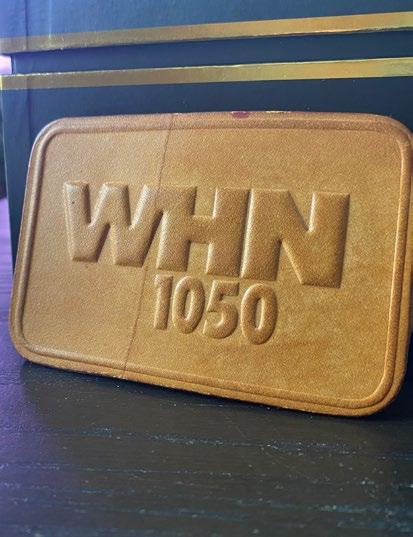
Another keepsake is a leather belt buckle with the call letters WHN on it. When I was a teenager listening to country music in the New York City area, I called in and won a belt buckle and actually got on the air (come to think of it, this was my first time on the radio anywhere).
I lost my buckle when a girlfriend and I split, and I’d given up on it until I mentioned it here in an editor’s column more than two decades later. Jim Nedelka, formerly of WHN, blew me away by sending me another WHN belt buckle from his personal keeping, an early example of how generous Radio World readers can be. And in this case the memento is a much more personal connection to my own radio history.
Do you have something connected to radio that is nifty, historic or meaningful on your desk or in your office? (Steve Shultis of New York Public Radio keeps a section of the Alford FM antenna from the Empire State Building in his office. Radio geeks unite!) Email me with a picture to radioworld@futurenet.com
More Translators Coming
The FCC was expected in February to start plans for its first-ever filing window for applications for new NCE reserved-band FM translators. The reserved band is 88.1 to 91.9 MHz.
The commission released a draft and was expected to adopt the notice at its monthly meeting. The notice directs the Media Bureau to begin work to open a filing window; specific dates would come later.
Under the plan, an applicant would have to be the licensee or permittee of an existing NCE FM, noncommercial AM or LPFM for the proposed translator to rebroadcast. The FCC does not plan to accept major modifications to existing NCE reserved band translators.
The commission proposed a limit of 10 applications nationally for each applicant (four for tribal LPFMs and two for other LPFMs). But it asked for public comment on the eligibility restrictions and caps.
“The commission has employed application caps or eligibility restrictions in prior reserved band full-service NCE FM windows and non-reserved band FM translator windows to promote efficiency, curb speculative applications and expedite the processing of applications and expansion of new service while preserving spectrum and future licensing opportunities,” it wrote in a summary.
“For example, in both 2007 and 2021, before the NCE FM station filing windows opened, the commission sought comment on an
application cap and subsequently established a limit of 10 NCE FM new station applications filed by an applicant during each filing window.”
It said the limit was an effective safeguard and helped restrict the number of mutually exclusive applications, prevented mass filings and allowed the FCC to process thousands of NCE FM applications. It noted that also has imposed such restrictions in prior translator windows.
Writer Elle Kehres
Should we kick the FCC to the curb?
Economist Mark Jamison discusses his proposal to disband the agency
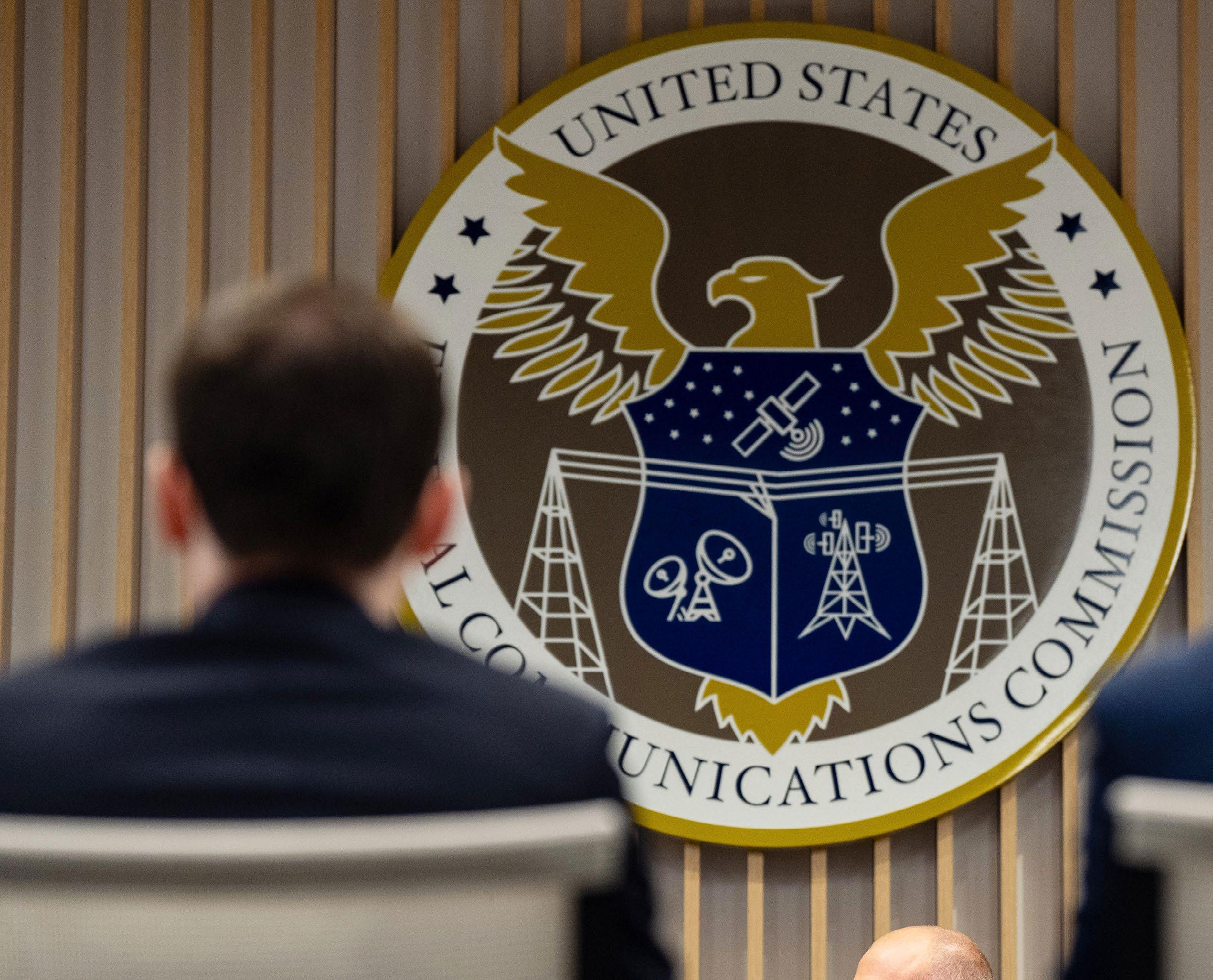
Long a key arbiter of U.S. communications policy, the FCC is actually stuck in a bygone era, argues economist Dr. Mark Jamison.
The American Enterprise Institute recently published his paper “Disbanding the Federal Communications Commission,” in which Jamison asserts that the agency’s independent commission model should be scrapped.
Jamison is a nonresident senior fellow at the AEI and director of the Public Utility Research Center and the Digital Markets Initiative at the University of Florida. He served on the Trump presidential transition team in 2015–16.
A regulatory dinosaur?
Jamison argues that the FCC is a relic of a world that no longer exists, one built around monopoly phone service
and tightly limited broadcast spectrum. Today, he says, “broadcasting” is just one of many ways to deliver content and it no longer justifies its own regulatory silo.
“Because consumers increasingly view broadcast programming through non-broadcast channels and regard it as one option among many, broadcasting no longer constitutes an industry in the traditional sense and deserves no special licensing other than a right to use radio spectrum,” wrote Jamison.
The FCC was established in 1934 to oversee governmentprotected telephone monopolies and to manage scarcity in the number of broadcasters. Jamison said those conditions have long since evaporated.
“Given its loss of purpose and its institutional weakness, it appears that communications policy in the U.S. would be better off without the FCC,” Jamison wrote.
The author wrote here recently about the career of Jeff Detweiler.
MarioGuti/Getty Images
“There is no longer a need for the two core functions for which the FCC was created: common carrier regulation and broadcasting licensing.”
When market boundaries are dynamic, he argued, it is impossible to establish common carrier regulations that apply only in situations where customers are unable to exercise options.
“Shuttering the FCC would implement a deregulatory strategy for the communications sectors,” he said.
“Common carrier regulations for telecommunications would cease, as would content oversight of broadcasters.”
Jamison contends that, as the FCC’s core mission has faded, it has become easier to use it as a political tool without real economic cost.
“During the Obama years, the agency undertook newsroom inquiries, redefined internet services to fit the common carrier mold and advanced initiatives shaped heavily by congressional partisans,” he wrote.
“The Trump administration continued the trend, attempting to enlist the FCC into regulating social-media content. The Biden administration pursued sweeping rules
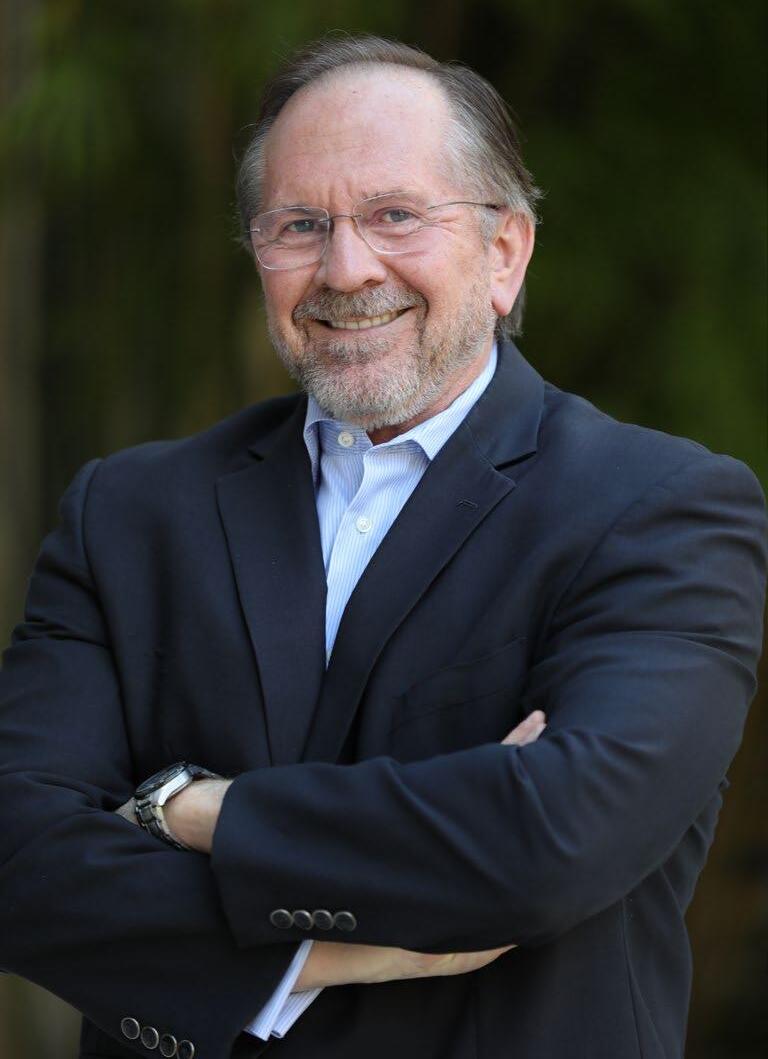
Mark Jamison
agency. The idea is continuity of work and expertise, with only the oversight structure changing.
“We can keep something that is like a ‘Federal Communications Department’ … but we just don’t need the commission,” Jamison told Radio World. “We can have staff and directors of staff that do that work quite well.”
If the FCC is dissolved, Jamison says its spectrum auction operations and staff should be transferred to an agency that is noted for its ability to manage technically complex functions. His candidates include the National Institute for Standards and Technology (NIST) and the Cybersecurity & Infrastructure Security Agency (CISA). He writes: “It might even be appropriate to form a new, specialized agency.”
As for other core FCC functions, Jamison says consumer protection would be better handled by the Federal Trade Commission. Additionally, equipment authorization functions could be handled by NIST. Emergency services oversight could be handled by the Department of Commerce, CISA or Homeland Security. Space policy could be handled by NASA. And international relations are covered by the
“Why shutter the FCC? The reasons for its creation in 1934 have largely disappeared, resulting in a mission vacuum that makes the agency a convenient political tool. ”
to oversee broadband participants and even broadband supply-chain relationships. The recent Biden and Trump efforts demonstrate the eroded predictability that regulatory-commission design was meant to protect.”
His solution is to scrap the commission structure, move its staff and duties elsewhere in government and avoid tech-specific rules that quickly go stale and stifle innovation.
Revamp, renew, reorganize Jamison’s plan is framed as an administrative reorganization rather than a shutdown of its core functions.
He emphasizes that the first step would be to identify which essential staff functions need to be preserved and immediately rehouse them within a different federal
Department of State.
Jamison says the way the FCC handles the distribution of broadcast licenses also needs to change.
Traditionally, a broadcast license includes both the spectrum in question and what the licensee is allowed to use it for.
“I’m suggesting that the last piece, ‘here’s what you can use it for,’ doesn’t belong anymore. You can have the license to use the radio spectrum but we’re not defining how it’s used.”
Political chess
According to Jamison, as the FCC’s founding purpose receded and the economic cost of politicizing it fell,
administrations began using the agency as a political tool rather than an independent regulator, with each executive power redefining the “public interest” to suit its own agenda.
As the reasons for its creation disappeared, a mission vacuum was created.
The FCC’s public interest standard requires radio and TV broadcast licensees to operate in the “public interest, convenience and necessity” — a broad mandate stemming from the Communications Act of 1934, obligating broadcasters to serve local needs with diverse programming rather than just maximizing profit.
“‘Public interest’ is a very general term, and I suspect that the Trump administration probably defines it quite differently than the Biden administration, which probably is quite different than the Obama administration, than the Clinton administration and either Bush administration,” said Jamison.
“Everybody gets their own definition.”
But he told Radio World that the FCC’s public interest standard is vague, subjective and in conflict with the First Amendment.
“When a broadcaster is influencing people to think differently than you do, you would view that as contrary to the public interest,” he said. This is one reason the FCC is so vulnerable to political pressure.
Since Brendan Carr was appointed FCC chairman by President Trump in January 2025, the rights and
“There is no longer a need for the two core functions for which the FCC was created: common carrier regulation and broadcasting licensing. ”
responsibilities of broadcasters and networks have been debated widely.
President Trump criticized ABC, NBC and CBS for what he called bias following the murder of activist Charlie Kirk.
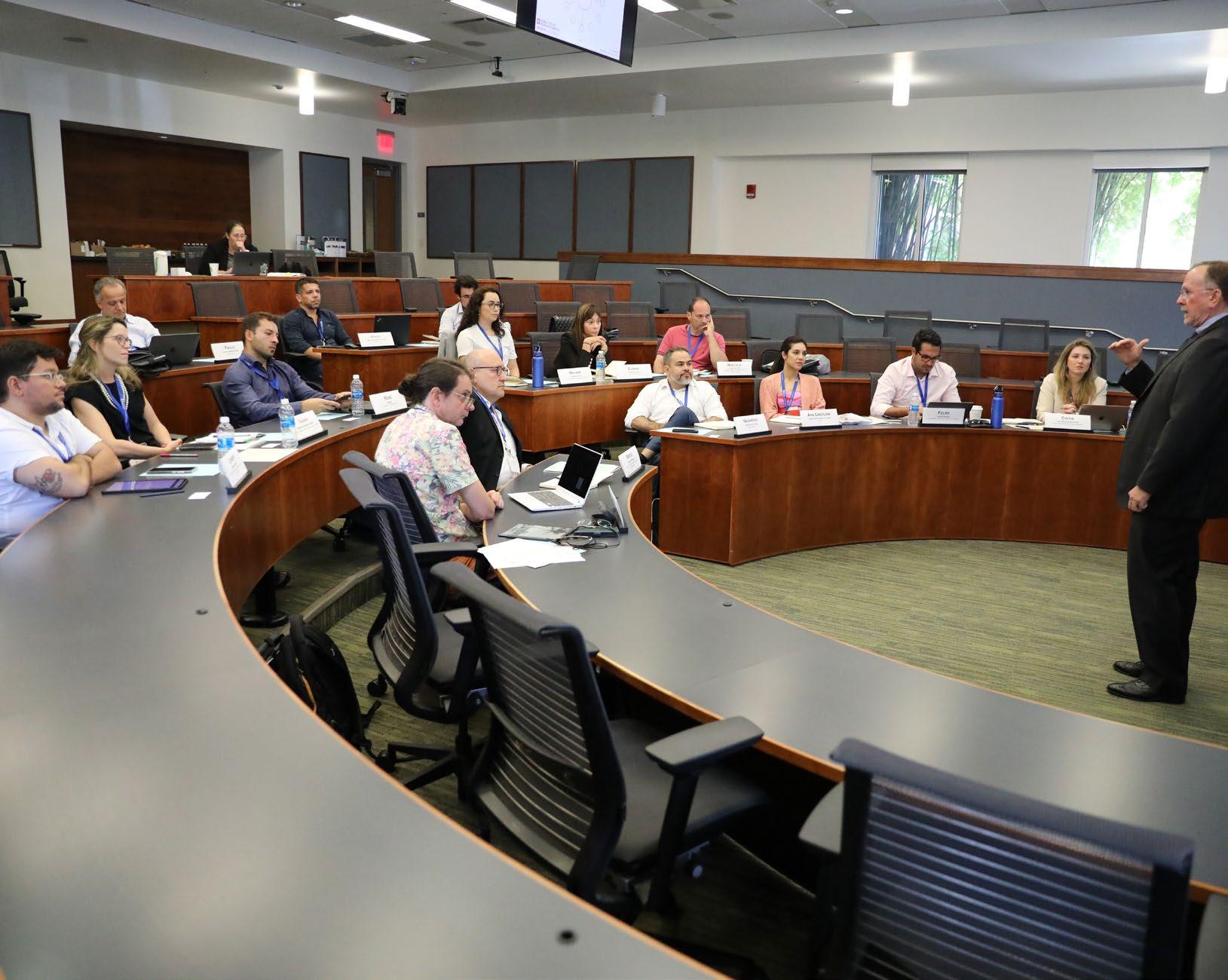
Below Jamison teaching at the University of Florida’s Warrington College of Business.
Carr warned the networks that he could and would use his powers to block mergers or pull the licenses of broadcasters who did not operate in the public interest. ABC’s suspension of Jimmy Kimmel in the face of such pressure resulted in widespread backlash.
Carr also launched investigations into NPR and PBS, questioning whether their corporate underwriting violated federal laws against commercials. The investigation helped propel Trump’s effort to end federal funding for public media, framing it as a move against perceived “liberal bias.”
Jamison said the FCC’s pressuring of broadcasters isn’t anything new. He said President Obama’s second term marked an “unprecedented rise in partisanship” at the agency.
He pointed to research by the Technology Policy Institute on commission votes from 1994 to 2016. It found that, during Chairman Thomas Wheeler’s term, 26% of votes were split along party lines, more than triple the rate under other Democratic chairs (8%) and more than five times that under Republican chairs (4%). Wheeler was appointed by Obama in 2012.
Likewise, TPI reported that fewer than half of the votes in this era were unanimous, compared with averages of 65% and 58% under other Democratic and Republican leaders, respectively.
“The FCC experienced more party line votes from late 2014 through 2015 than in its previous 43 years,” wrote Jamison.
Broadcast Regulation
Above Jamison with his Project Navigate student group. The initiative explores the European Union’s Digital Markets Act and Digital Services Act.
In the cases of both Presidents Trump and Biden, Jamison wrote that there is “inadequate” evidence that the FCC was doing a president’s bidding. “Nevertheless, the policy swings demonstrate that the agency is not providing the dependable regulatory environment that it was created to deliver.”
Innovation is key
Jamison warns that keeping outdated communications laws on the books traps broadcasters in “boxes that are not economically viable.”
He argues that rules designed for a bygone era hold back innovation and should be rethought so stations can adapt to today’s media and technology landscape.
rules were written in the 1930s and stopped being relevant in the ’80s.
His view is that radio’s future depends on regulatory frameworks loosening so stations can adapt and innovate, rather than being preserved through legacy, broadcast-specific protections.
This is an area where Jamison and Carr seem to agree. Under the direction of the chairman, the FCC opened up a “Delete, Delete, Delete” docket last March and has since scrapped countless “outdated” rules with the help of public feedback.
As to his broader conclusion, Jamison acknowledges that more research would be needed.
What do you think?
Comment on this or any story. Email radioworld@ futurenet.com with “Letter to the Editor” in the subject field.
Broadcasters “should be released to innovate and do things differently… not being bound by things that have lost their importance.”
He said: “If you write regulations with a particular type of technology in mind, the technology is going to race beyond you, and your regulations won’t be accomplishing what you would think they should. In fact, they may work against the very things that you’re trying to accomplish.”
As an example, Jamison questions the FCC’s standing regulations on fixed line telephone service, noting those
“It is unclear how expertise and statistical histories can be transferred without loss of skill, professionalism and proficiency. Work is also needed on how to protect from political interference agencies that take on FCC functions, especially those related to radio spectrum and subsidies.”
He added that the research will be even more important if the Supreme Court rules that independent agencies as currently constructed violate the Constitution.
“While political interests are legitimate for providing laws, they can be destructive when applied in the execution of the laws.”
Read Jamison’s paper at https://tinyurl.com/rw-jamison
Warrington College of Business
Writer
Michael Baldauf
The author has worked in roles including chief engineer and project manager since the 1980s. He enjoys supporting small station operations.
Final thoughts on liquid cooling bubble up
Its use in radio is just one part of a broader story
In previous articles we’ve discussed liquid cooling in transmitters and its applications. The topic becomes even more interesting when we explore the thermodynamics behind the implementation of such systems generally. While systems for FM transmitters use “antifreeze” and small pumps, higher-powered systems (think particle accelerators) use deionized clean water, resin bottles, sidestream purification loops and other technology.
While liquid cooling in transmitters may seem complex to a broadcast engineer, it is relatively simple within the wider universe of liquid cooling, where systems that serve major military and government applications have influenced what we see on the consumer end of things.
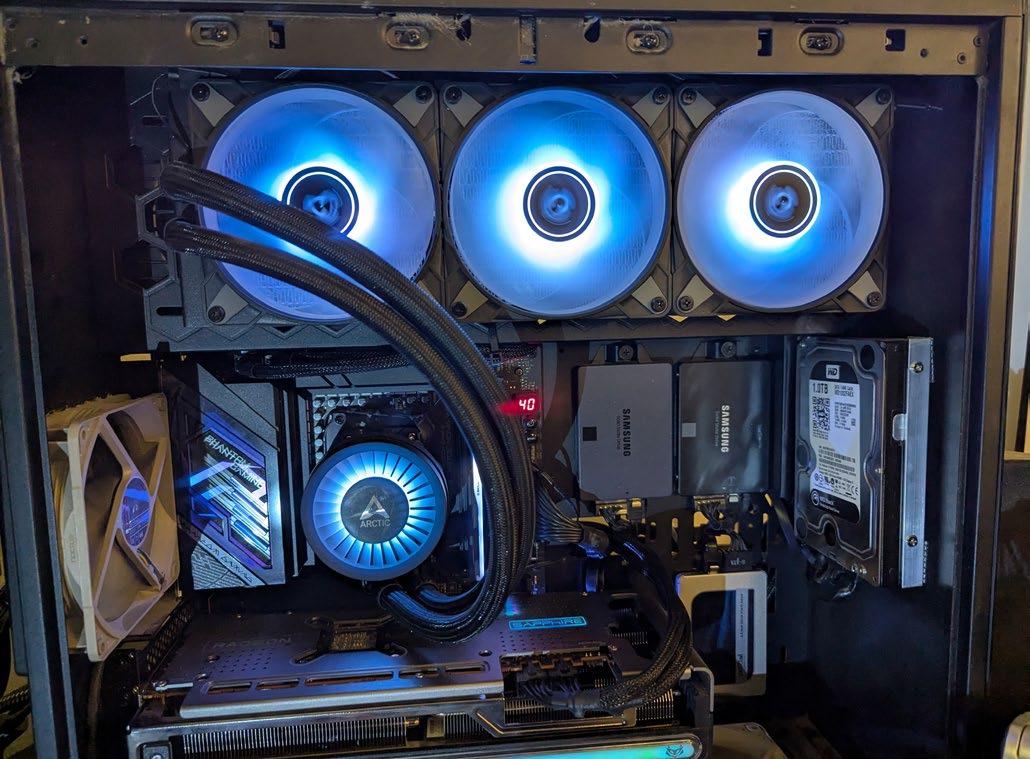
Liquid cooling is found in the studio as well. Microprocessors and graphic chipsets in computers use liquid-cooling technology to pull the heat off and away from the inside of the case.
Liquid cooling has the advantage of allowing larger fans with slower fan speeds to reduce noise, which could be an advantage in rooms where audio is being created.
Gone are the days when liquid-cooling systems meant cobbling together a computer system and doing plumbing in miniature, always concerned that a leak could destroy the computer.
Computer cases are available with liquid-cooling systems for the processor, video card CPUs and other heat-sensitive components.
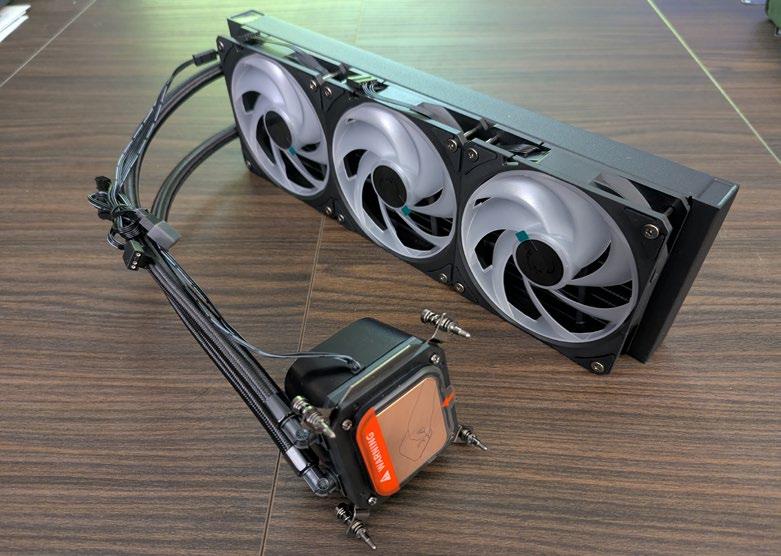
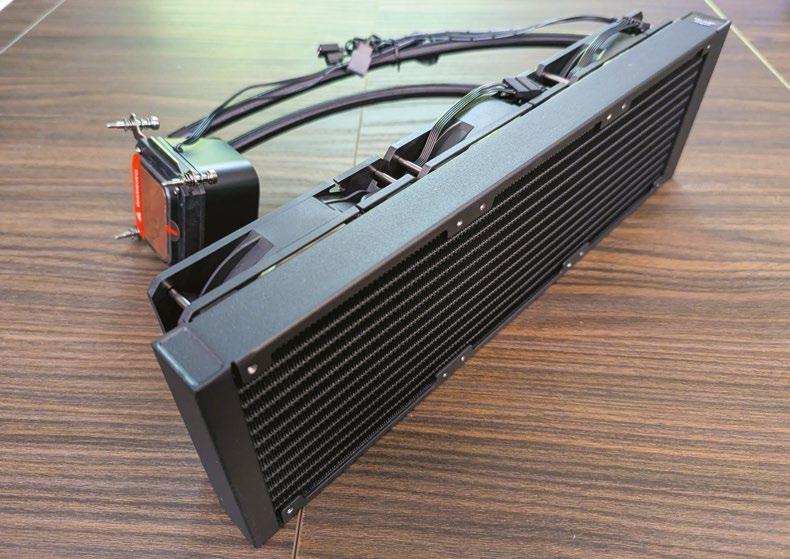
These “all in one” systems have the same components as other liquid-cooled systems but on a smaller scale. There is a pump, a fluid reservoir/radiator with fans attached, a CPU water block (the liquid cooling equivalent of a heat sink) and cooling tubes. The unit comes pre-filled with coolant.
Applications might be limited to uses like video editing and gaming, but for many users the bright colors and translucent cases used with liquid cooling are an attraction.
Final thoughts
Several final observations about the use of liquid technology in transmitters.
Lower-power transmitters probably do not need liquid cooling. LDMOS devices provide ruggedized compact efficient solutions for amplifier designs. With each new generation of power supplies, efficiency is improved and heat is reduced.
If a low-power transmitter needed liquid cooling it would probably be to compensate for a very compact design.
The systems used in desktop computers would provide examples for these applications.
The RF power level at which you might start to consider liquid cooling seems to be around 25 kW. Even at that level, the general case for liquid cooling would be difficult to make without the additional power requirements of digital radio channels.
But readers who have experience with liquid cooling indicate that the benefits and costs we’ve discussed are worth exploring. They remind us that the installation is best done with the help of people experienced in such systems. But they say that the cost savings can be significant and that any technical issues can be managed by competent engineers.
Right
CPU liquid cooling inside a computer. Below AIO unit fan and CPU water block view. Below right
AIO unit radiator/ reservoir view.
John Bisset
CPBE
The author is in his 35th year of writing Workbench. He handles western U.S. radio sales for the Telos Alliance and is a past recipient of the SBE’s Educator of the Year Award.
Send your tips Workbench submissions are encouraged and qualify for SBE recertification credit. Email johnpbisset@ gmail.com.
Smart diplexing saves an AM
Careful design and reused parts keep a project on budget
Ben Dawson, P.E., principal engineer of Hatfield & Dawson, wrote to tell us about KNUV, an AM station licensed to Tolleson, Ariz., a suburb of Phoenix. The station was required to vacate its longstanding transmitter site.
This is not an unusual situation for an AM station to find itself in these days, given the trends in urban development, the ever-rising value of real estate and the business challenges facing all AM stations.
With advice from Ben’s firm, the licensee and her technical contractor conducted a thorough search and decided to relocate to the site from which Phoenix station KXEG(AM) broadcasts.
The single 180-foot KXEG tower is close to the building, so they chose to install the diplexing filters and antenna tuning unit matching networks in an equipment room, and the tower is fed through a bowl insulator in the building wall via a well-supported copper tube to the tower base.
The filters and match networks for multiple frequency use of an antenna require segregated enclosures to electrically isolate the individual networks from one another.
Above
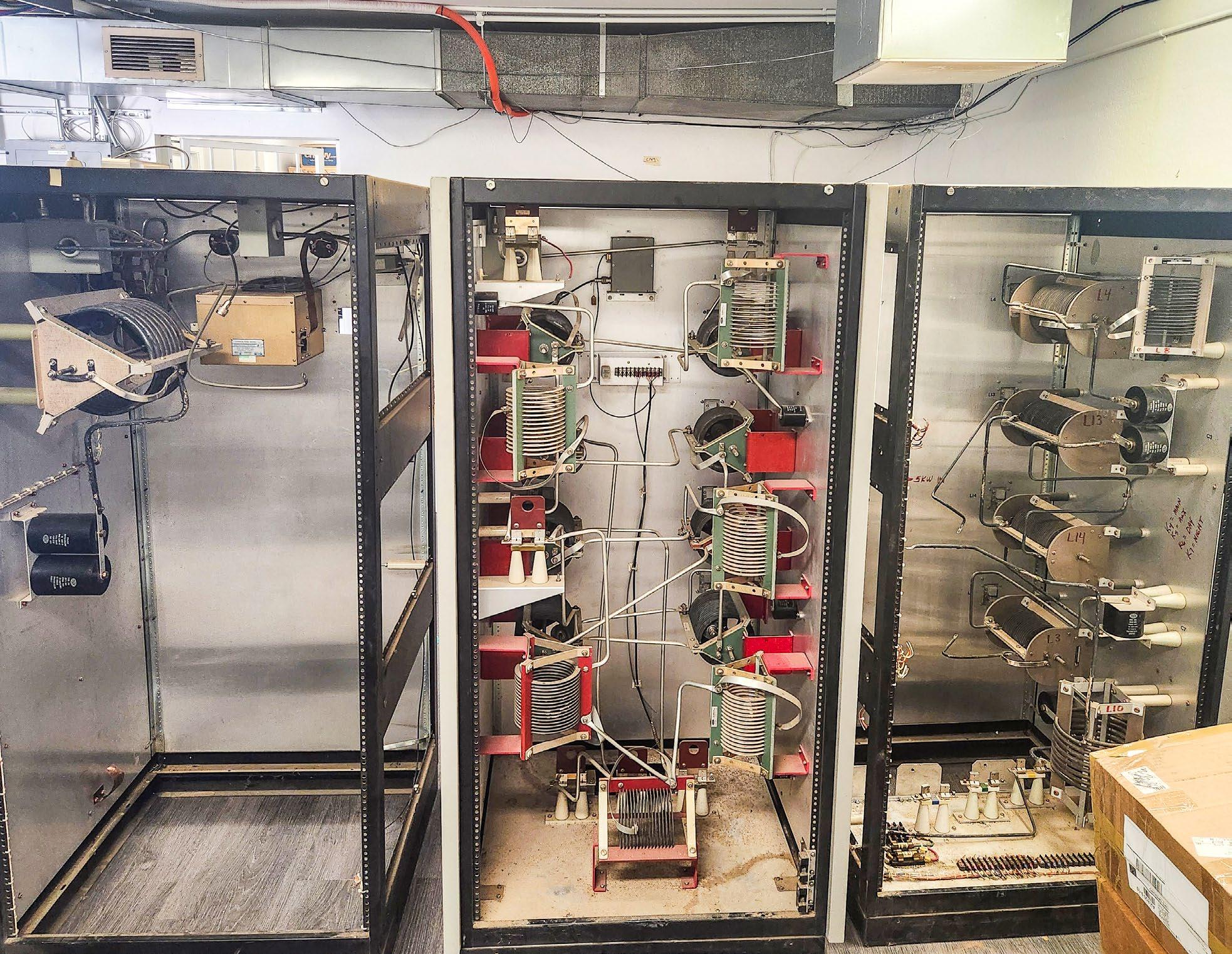
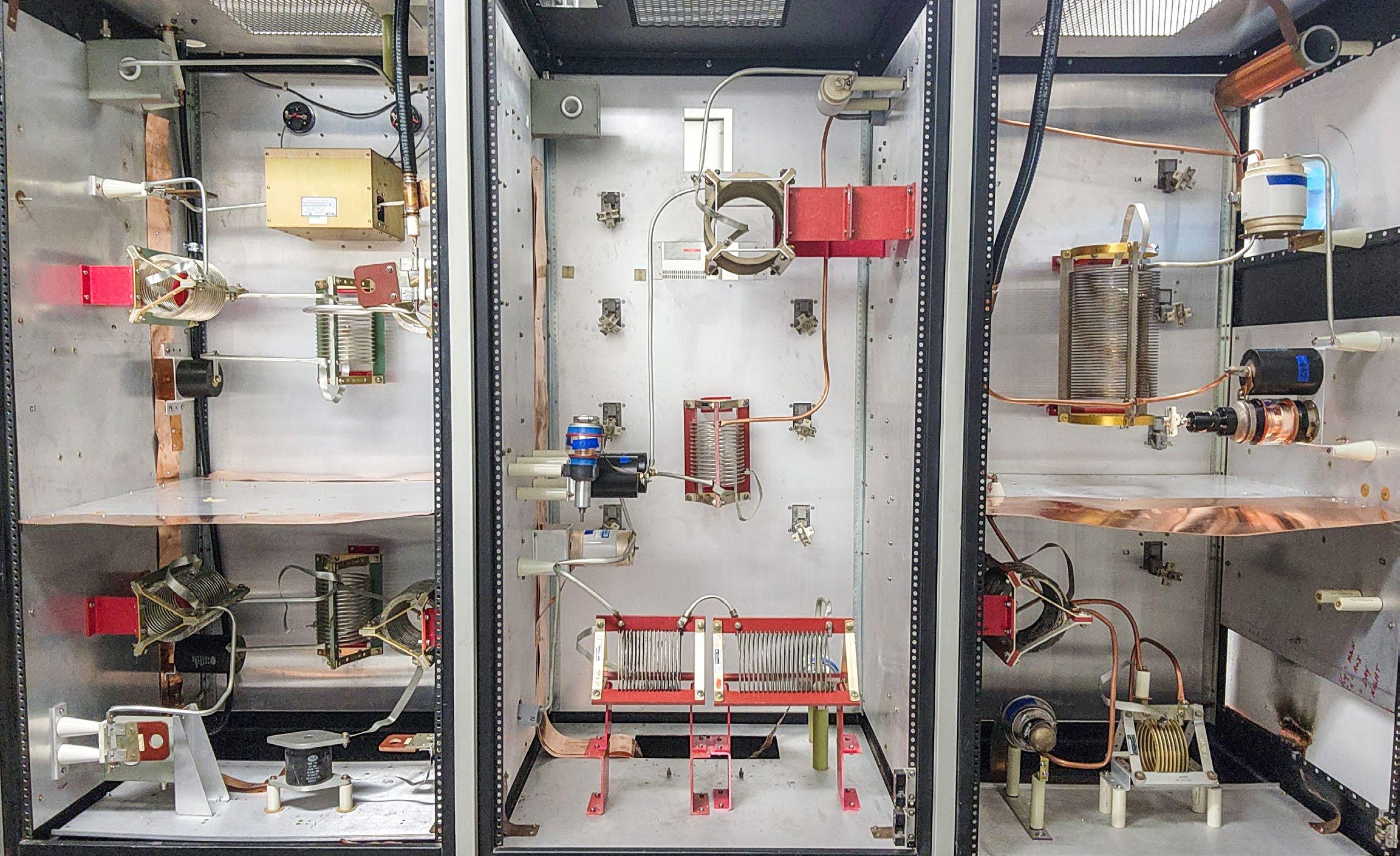
Fig. 1: The phasor cabinets before parts were removed.
KNUV now broadcasts on 1190 kHz with 640 watts day, 22 watts night. KXEG is on 1280 kHz with 2.5 kW day, 49 watts night. The KXEG site has an equipment building that had more than adequate space for KNUV’s equipment.
A three-cabinet phasor, formerly used at KXEG’s threetower directional site, was chosen to house the antenna equipment. One cabinet was used for each frequency’s filters, and the remaining cabinet was separated with a shelf into an upper and lower compartment, one for each of the ATU matching networks.
Fig. 1 shows a view of the cabinets before stripping components.
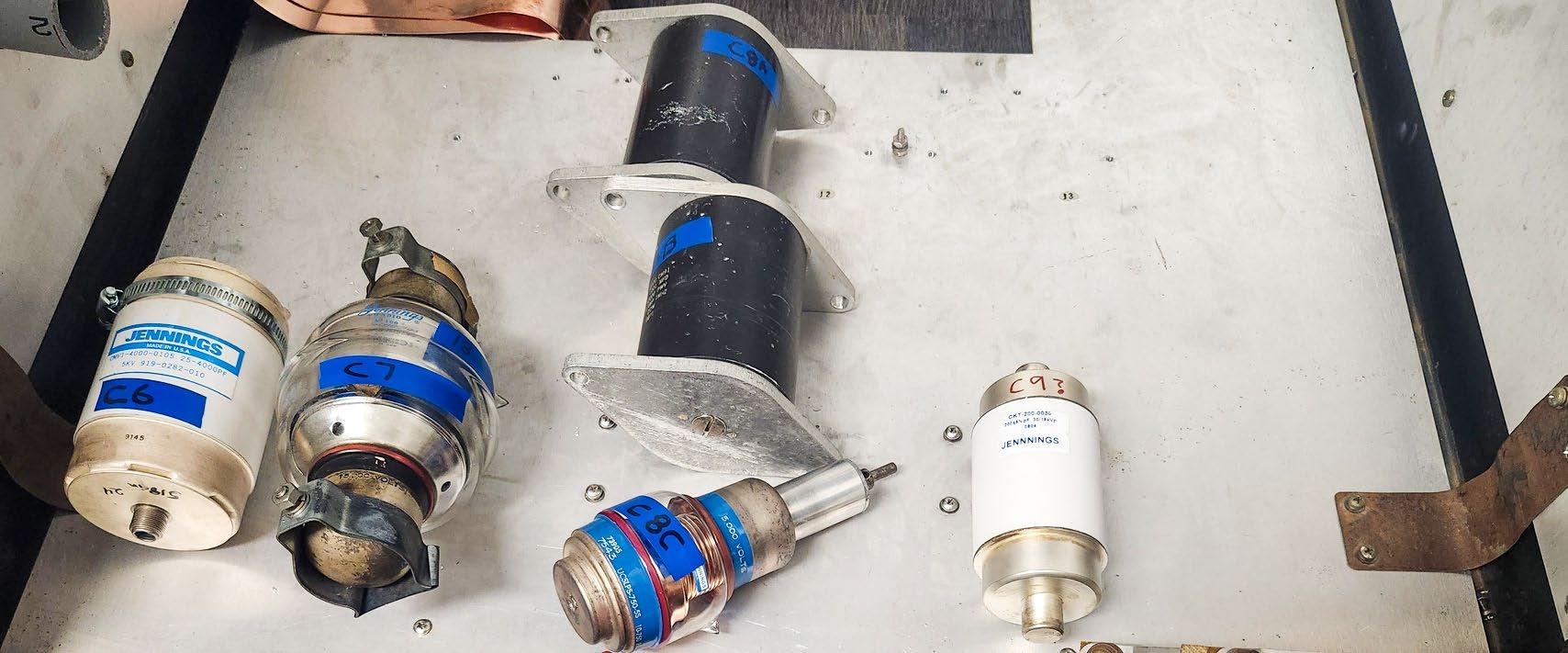
Above Fig. 2: Surplus components used in the project.
Right Fig. 3: Coils connected in series to obtain the proper inductance range.
Thomas Driggers measured the antenna impedances at both frequencies, and Steve Lockwood prepared a design for the system networks. Network values were selected to provide reasonable sideband loads to the transmitters of the two stations, using various software tools and with attention to the dictates of Ron Rackley’s “VARs matching” technique (described by Rackley in the 11th edition of the NAB Engineering Handbook, Chapter 7).
Once the design was in final draft form, the component list was prepared, and the team created an inventory. Components from the former phasor and ATUs were used where appropriate, and parts from available surplus collections were gathered to complete the inventory.
The phasor itself and the two ATUs were removed from service at the original KNUV site, with one left for STA operation.
The final system was constructed by Driggers entirely of surplus material and components except for a few feet of new 4-inch copper strap. Fig. 2 shows some of the surplus parts used.
The surplus items were inspected and measured carefully. Because filters often require high-voltage capacitors
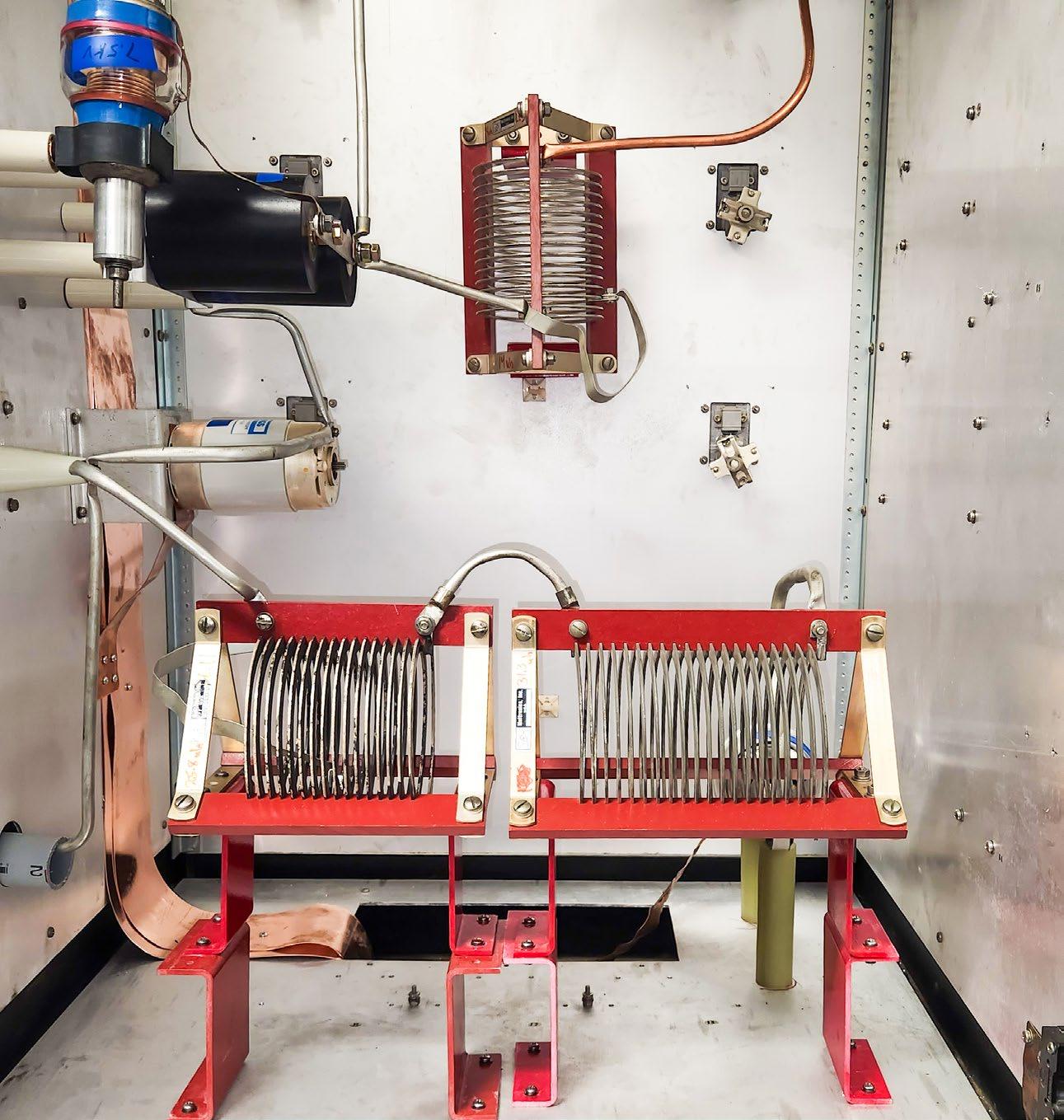
and high-inductance coils, the team found it necessary in at least one case to obtain the necessary inductance by using two available coils in series, shown in Fig. 3 above. The vacuum capacitors that were to be connected in series parallel to obtain the necessary voltage-handling capability in the filters were evaluated with a hipot tester.
Given the cost of replacement “new” parts, the package of additional components was packed up with care and insured for shipment to Phoenix.
When all parts were on site, the phasor cabinet was stripped and a shelf installed in the cabinet for the ATU networks. Parts were installed to minimize interaction.
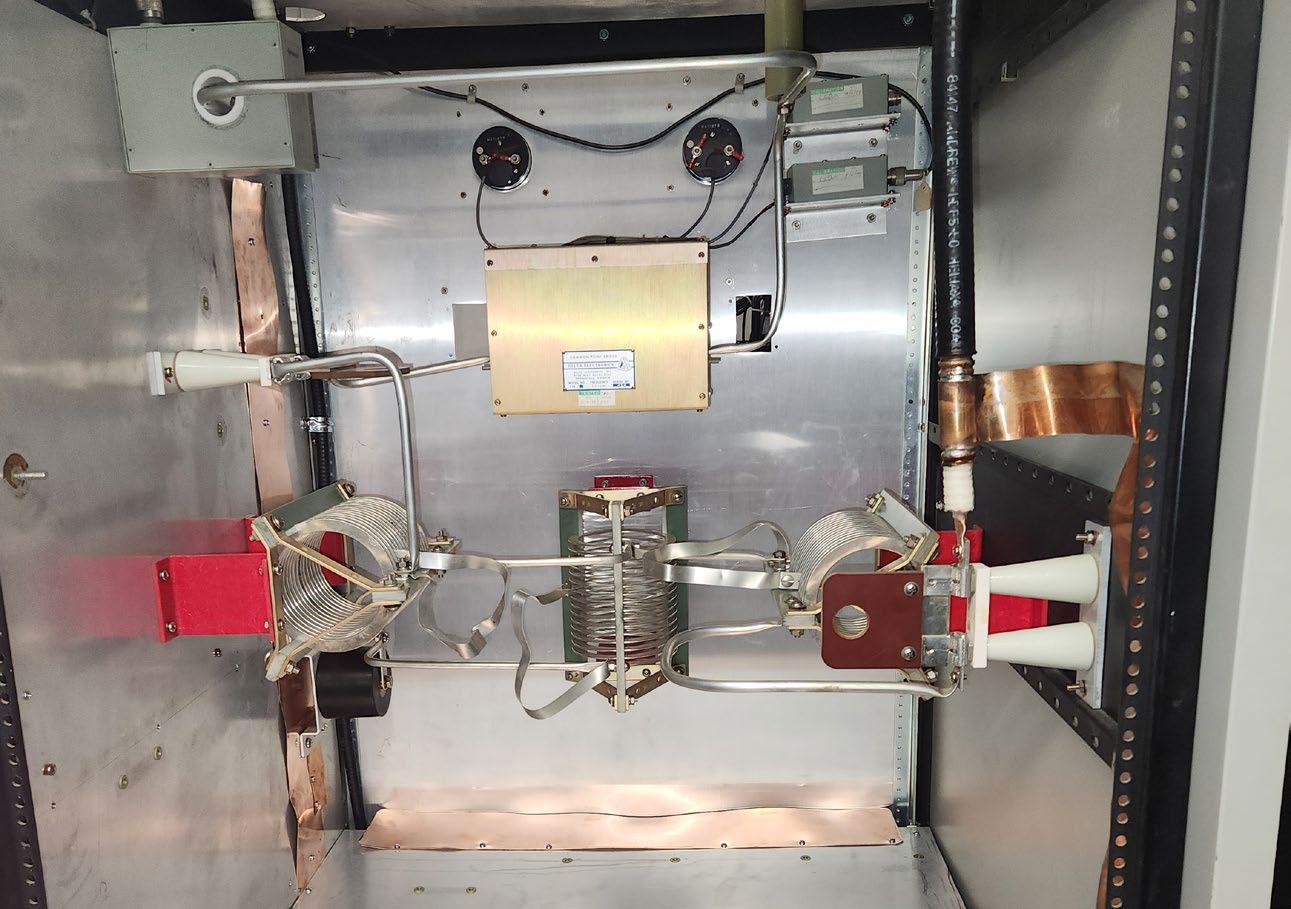
In particular the KNUV 1190 pass 1280 reject filters were connected to the KNUV ATU cabinet with a coaxial cable to avoid any coupling to the 1280 pass 1190 reject filters in the center cabinet.
(You can read a paper by Ben Dawson, “Isolation Requirements in Diplexed MF Antenna Systems.” At www.hatdaw.com/papers, scroll down to “isolation requirements.”)
Fig. 4 shows this coaxial cable from filter cabinet to ATU cabinet on the right side.
Though the resulting system is far from physically elegant, it is electrically straightforward and performs well.
Fig. 5 is a rear view of the completed system.
The trends I mentioned at the beginning have driven a virtual explosion of diplexed, triplexed and even quadriplexed installations, some at sites with as many as nine existing towers.
Under these circumstances, the project cost for multiple use of existing antennas requires careful consideration. In some cases simple systems can be
Above
Fig. 4: The isolating coaxial cable (at right).
Below
Fig. 5: A rear view of the completed system.
implemented at an affordable cost by “hand-made” or “composite” systems, if qualified design and construction personnel are available.
Ben adds that in his teenage years, half of the local AM stations had handmade transmitters, and many had handmade audio console equipment. “Not something often seen in modern installations,” he said.
Remembering IGM
The automation company in Bellingham, Wash., was part of radio’s landscape for three decades Writer
Criss
The
wrote last year
1959.
Radio automation pioneer Rogan Jones was remembered as an “idea man who spawned notions as fast as his aides could cope.”
That was the description of him in a newsletter that later recounted the history of the company he founded: IGM.
Jones got into radio with the acquisition of KXRO in his hometown of Aberdeen, Wash., in 1928, settling the back-rent that was due to him and his brother for space in a building they owned. The station had been off the air after one of its owners — a police lieutenant — was convicted for using it to coordinate a fleet of rumrunning speedboats!
The following year, Jones bought 100-watt KVOS in Bellingham, Wash., for $8,500, and purchased two other stations. He subsequently bought or started many West Coast FMs, including in Seattle, Portland, Los Angeles, San Francisco, San Diego and San Bernardino.
Although the stations were not financially successful — most listeners were still tuned to AM — Jones said the experience contributed to the development of his automation systems.
Because in 1959, Jones founded International Good Music to produce and sell taped music programs and automation equipment.
Simplimation
In 1961 IGM moved to a location on Home Road in Bellingham, where it would operate for the next 15 years. From that location came the “Simplimation” automation seen at the 1962 Seattle World’s Fair. It was on display for the public and provided background music.
Onan
author
about Gates Radio’s ST-101 tape recorder, introduced in
Right
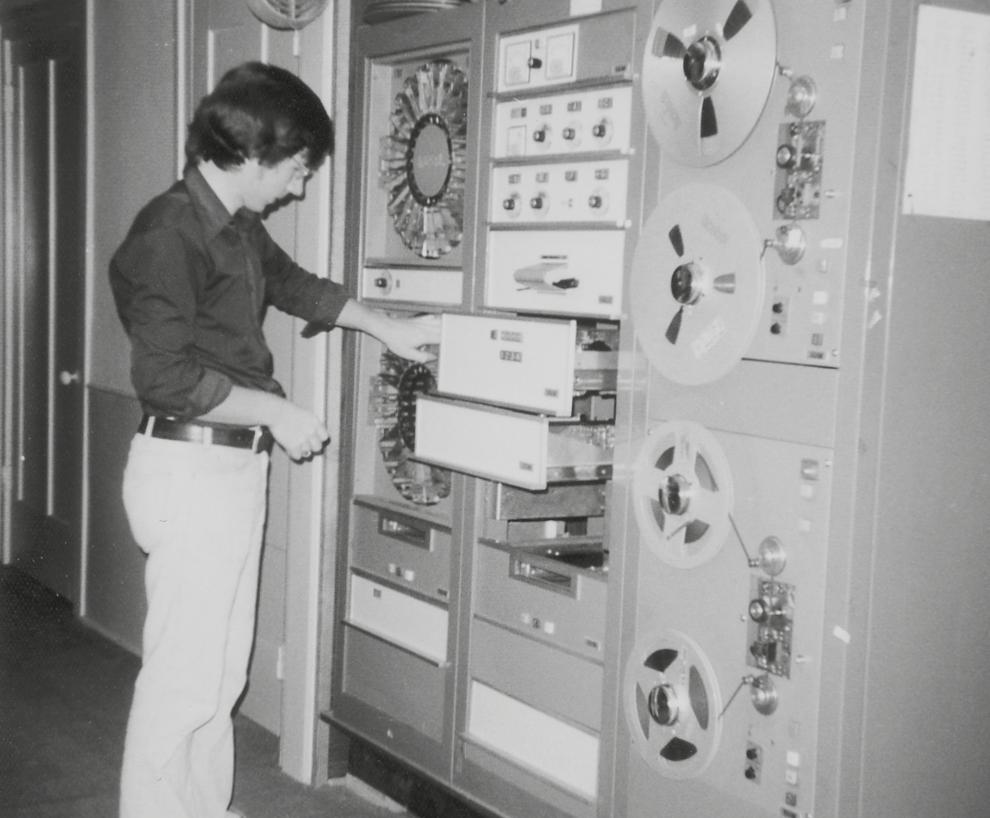
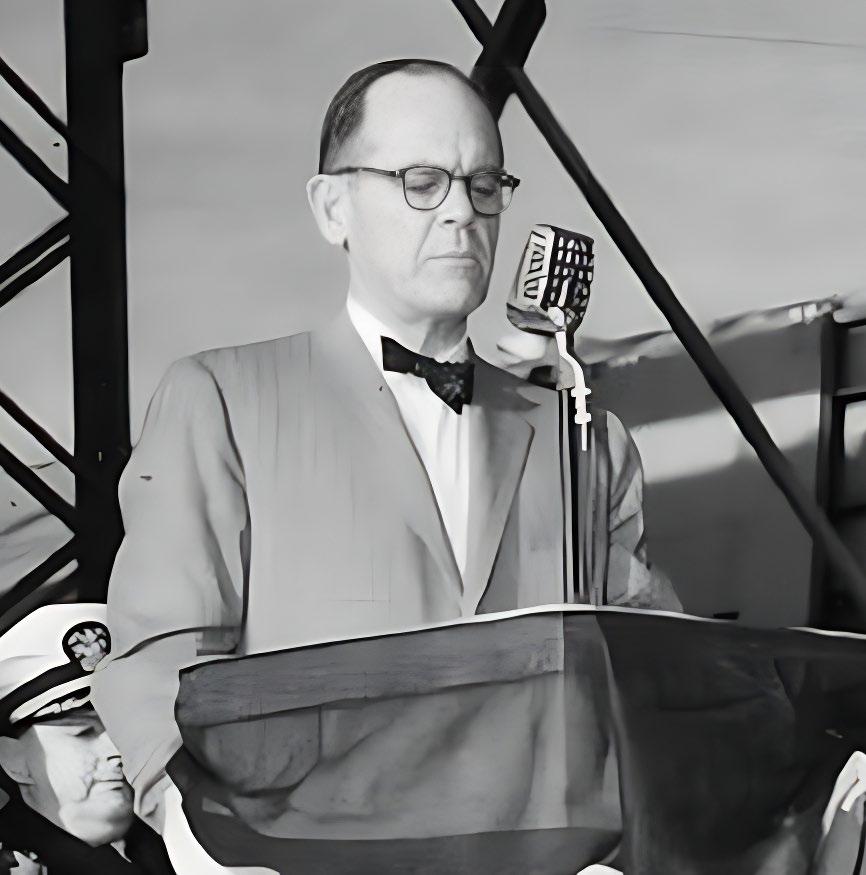
At top, author Criss Onan is shown in 1974 with the IGM 500 system at WFLR. At lower right is IGM founder Rogan Jones in 1958.
Early IGM automation sequencers, such as the 200 model introduced in 1961 and the 300 model soon after, were limited to a fixed number of playback sources. They were relay operated and used an “insertion” scheduling method.
Each non-music source, such as a single-play cart machine (or later an SCM Carousel) could be scheduled by an operator to play every 5 minutes, 7-1/2 minutes, 10 minutes etc.
When no more non-music sources were ready to play, music was played from reel-to-reel players until a nonmusic source was again ready.
A 300 system automation package cost $14,800, or about $155,000 in today’s dollars.
The model 500, displayed at the 1965 NAB show, was IGM’s first modular system and became the company’s most popular. Each nonmusic source was controlled by a plug-in card, allowing for expansion. Switching was done with small, inexpensive and readily available plug-in relays on the cards. A system started at $9,000.
In the late 1960s a large IGM van with a working 500 demonstration system sat parked behind my hometown radio station, WFLR(AM/ FM) in Dundee, N.Y. The general manager was convinced after he saw and heard the system. He bought much of a 500 system that was being traded in by KFRC-FM in San Francisco, including an “Actan” music controller, shown on page 20. An IGM technician once told a WFLR engineer that the Actan originally was designed to control traffic lights.
Thirty years later, KFRC Director of Engineering Phil Lerza told me he remembered wheeling each of those blue IGM 500 racks out of the station on a handcart when they switched to a new system.
The 600 IGM model introduced in 1965 was a 500 model with added program scheduling via an “automatic typewriter” and punch-card reader. Typical system price was $20,000, equivalent to $203,000 today!
Roots of Radio
Above
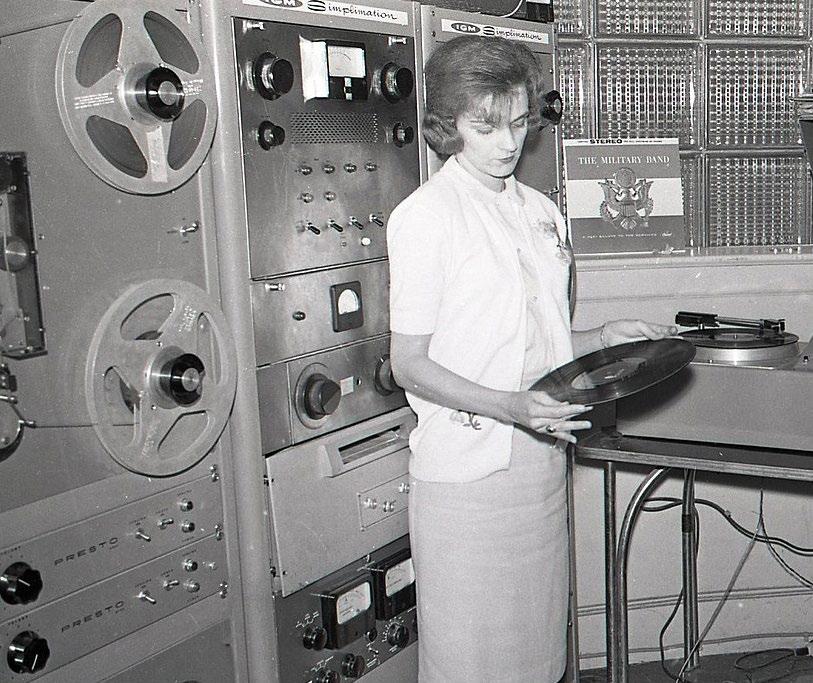
An IGM 200 “Simplimation” system is visible behind the woman holding an LP. This is at WDOD in Chattanooga, Tenn. in the early 1960s.
Chattanooga Times Free Press
Right
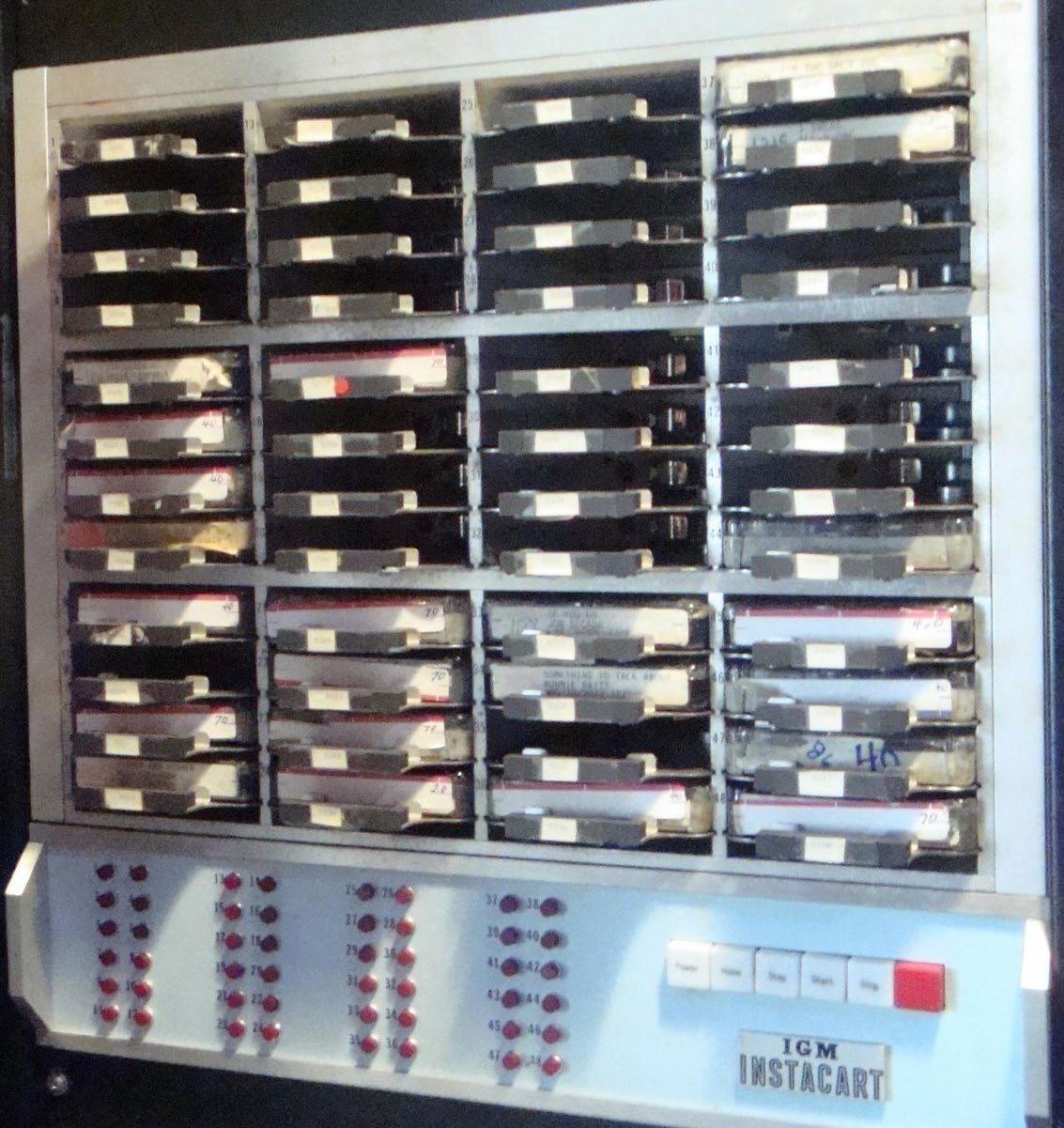
IGM Instacart. Courtesy Robert Leftwich
IGM cart sources were usually single-play or Carousel multi-cart decks rebadged from competitor SMC. That changed in 1969.
Ernie Burkhart, an aviation parts designer, had joined IGM in 1963 to build “bits, parts and pieces” in his words. One of the pieces he designed was the Instacart.
It held 12, 24 or 48 carts. Each cart was placed in a tray with a pinch roller and then inserted in an Instacart slot, where a solenoid would move the tray 1/16-inch in for playback.
Every slot had its own head, minimizing tape misalignment. Every column of trays had a common motor and capstan. In 1979, for additional cost each slot could have its own audio output.
The initial price for a 48-slot Instacart with the memory unit to allow a sequencer to access carts in desired order was $5,600.
IGM models changed from relay to solid-state sequencing beginning with the 400 model in 1971. The 700 family, introduced the following year, was a series of models — some controlled by DEC PDP-8 minicomputers — and a progression of punch card, paper tape, mag tape and ultimately disk drives as the boot and program loaders.
The number of events that could be scheduled became a horsepower race in the industry. IGM’s typically started at a minimum of 1,000 and could be expanded at additional cost. The quantity of input sources was expandable as well.
The IGM RAM model of 1975 was promoted for standalone use or as an add-on to a user’s existing system.
Roots of Radio
Above
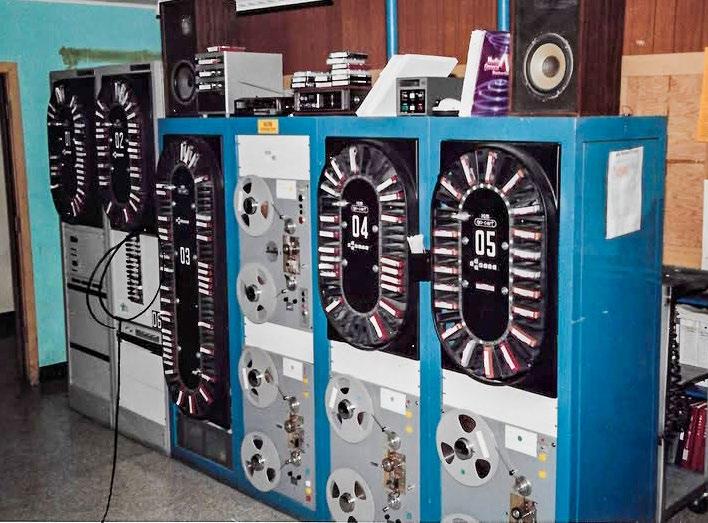
This photo shows equipment at WKAI(FM) in Macomb, Ill., in the early 1990s. There are four 42-tray IGM GoCarts, one 78-tray Go-Cart and one 12-tray Instacart, numbered 01 through 06, along with other audio sources. Courtesy Rick Bulger.
Below
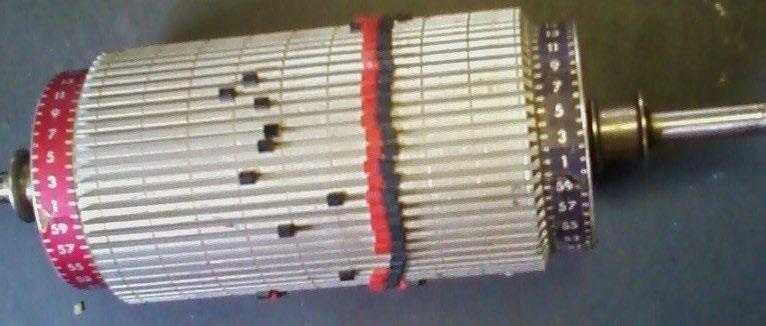
The IGM Actan was a drum rotated by a stepper relay with pegs and microswitches to control music playback from sources such as Scully 270 tape players. Courtesy Mike Smith.
Succession
Following Rogan Jones’ death in 1972 and his son’s death in 1974, VP of Sales and Service Irv Law left to form Broadcast Supply West, and IGM split into three companies.
The local radio stations continued to be owned by the Jones family until sold to the Saga Radio Group in 1998.
IGM’s billing, traffic and accounting software systems was acquired by Sales Manager Joe Coons and President Lee Facto, with whom I would later work at RCS.
IGM’s music syndication division was sold to broadcaster Kemper Freeman Jr. of Bellevue and
renamed Broadcast Programming International or BPI.
Some BPI formats included general “voicetracks” recorded with each song, creating the impression that the announcers were at the local station. A business owner once asked if the Jim French that he heard on WFLR “was one of the Frenches who lived over on Hollister Street.” French was actually at KVI in Seattle.
Ernie Burkhart bought the IGM automation side and designed a vertical Carousel-type multiple cart player called the Go-Cart, introduced in 1975. While less expensive than an Instacart, it improved on SMC’s Carousel product. Holding 24,
42 or 78 carts, the trays rotated bidirectionally under microprocessor control for fast access. A cart was removed from a tray and placed into a playback deck to minimize tape misalignment. The unit was hinged to swing open for maintenance. Pricing began at $4,045 for a 24-tray model.
By the late 1970s, about 500 stations were using IGM systems, roughly a third of the automation market.
The MARC VII (for “Manual Assist Remote Control”) came out in 1976; it was an early IGM microprocessor product, using an 8748. It included a “TV” display and control keyboard. The Basic A & B models (1977) each used three 8085s. The model B had dual floppy drives. Both models used “plain English” control and display on a color CRT and printer.
IGM employed 105 people in 1969, but by 1980 the number had dropped to 33, and production halted temporarily. That year, following a heart attack, Ernie Burkhart sold
a controlling interest in IGM to a local real estate developer. Later, IGM President Jim Wells bought the company. But by 1984, only 20 employees remained.
The SC model (for “Sophisticated Control”) was designed for PC control and came out in 1985, retailing for about $14,500. The EC (“Economical Control”) followed the next year for $4,975. These prices did not include the personal computer.
The MC, issued in 1990, was IGM’s last model. The company’s final
mention in Radio World was a trade show exhibitor listing in the fall of 1991. IGM never made the jump to hard drive audio storage.
Sources for this article include Archives West, Bellingham Herald, Broadcast Engineering, Broadcast Management/Engineering, Broadcasting, Radio World and IGM documentation and staff interviews. Got a memory of IGM or other automation to share? Email radioworld@futurenet.com with “Letter to the Editor” in the subject line.
“The model 500, displayed at the 1965 NAB show, was IGM’s first modular system and became its most popular.
Writer Paul McLane Editor in Chief
Trends in Codecs
Codecs serve increasingly diverse needs
Talent lean more into apps and social as companies explore centralization
Chris Crump is senior director of sales and marketing for Comrex. This is from the ebook “Trends in Codecs 2026.”
Chris what are the most important trends in this area?
Chris Crump: As we see younger broadcast talent entering the industry, they’re wanting to depend more on their personal mobile phones whenever and wherever possible. There’s an increasing dependence on apps and, of course, social media as an extension of their terrestrial broadcast.
On the corporate side, we are being asked for largescale virtualization to address centralized infrastructure or disaster recovery plans on an enterprise level. So while we see talent wanting the freedom that mobility offers, we also see a need for the cost savings that centralization can offer.
How has the expanding use of the cloud changed the role and use of codecs?
Crump: “Use of the cloud” always kind of makes me chuckle because it basically just means “somebody else’s computer that’s connected to the internet.”
But some of our biggest customers require a large-scale, virtualized codec that can live “in the cloud” to address their need for cost-savings, DRP and ease of routing programming within and between very large facilities. Some of our biggest customers have or will be moving to our ACCESS VM platform for centralized distribution of programming and streaming content. This is especially important in scenarios where having 100 or more hardware codecs is no longer tenable in terms of both cost and rack space.
How well do today’s codecs integrate with today’s AoIP networks and infrastructures; what issues do they present?
Crump: Luckily, or perhaps out of necessity, standards exist that help facilitate these integrations. Most
professional audio codecs on the market support some or all the various proprietary flavors of AoIP — Livewire, WheatNet, Dante, AES67 Ravenna — or the AES67 standard for AoIP interoperability.
We’ve also pulled some standards from the video side of our business such as SMPTE 2022-7 Seamless Production Switching and NMOS, which are critical for our key distribution customers that provide both audio and video content.
Our company philosophy has always been to support free, unlicensed, open-source standards and platforms to allow for easier integration of products with AoIP systems and to keep the costs of our products reasonable for our customers.
For example, we love the idea of AES70 for control and monitoring of media devices over AoIP networks, but its unlikely that we’ll see it implemented by console manufacturers because that’s really their “secret sauce,” if you will.
What considerations should be taken into account to allow radio talent to do shows using their phones?
Crump: Mobile phones have improved drastically as processors have gotten faster and storage more efficient. But today’s smart phones are very personal objects, and users have their own unique ways of using them.
Trying to get someone to understand that using a phone for reliable broadcast requires they understand that they need to turn off resource draining background apps and take measures to ensure an uninterrupted broadcast — perhaps even using a specific phone configured specifically for broadcast use.
There’s so much that can go wrong if someone is running a bunch of background apps and if they forget to put the device in “Do Not Disturb” or Airplane mode before they go on air.
Right
Chris Crump
Trends in Codecs
As developers, we must make sure our apps work on about a gazillion mobile devices, with new devices being introduced all the time. As with any broadcast, having a backup plan is key.
We really like the concept of apps, but for reliability, we still encourage the use of our purpose-built, hardware codecs like the ACCESS NX Portable.
Comrex has developed several products and applications that take advantage of mobile phones. Our free FieldTap can be used to connect to our ACCESS and BRIC-Link codecs using a wireless internet connection like 4G/5G or Wi-Fi, and it can also be used with our new FieldLink sideline reporter codec on private Wi-Fi connection.
Our Gagl + Hotline subscription-based service utilizes a web browser on a mobile device but it also allows users to call a 10-digit phone number in the U.S. from a Verizon, AT&T or T-Mobile device. This special phone line maintains HD Voice near-studio quality all the way to the hardware codec in the studio.
Our Opal IP Audio gateway uses the same WebRTC technology from a mobile device’s web browser to a dedicated hardware device in the studio. We’ve also seen customers having success using USB-C microphone/ headphone interfaces from Shure, IK and others with mobile devices, to make the experience more professional and broadcast-like.
“We really like the concept of apps, but for reliability, we still encourage the use of our purposebuilt, hardware codecs. ”
Can you tell us about a recent installation or application for codecs that you found notable?
Crump: We recently shipped our very first FieldLink Sideline reporter codec, which uses mobile phones to get audio from courtside or the sidelines up to the press box.
FM station KPGZ(LP) in Kearney, Mo., was the first to use it, at the Missouri High School Football state championships, with great success.
This product was developed for our customers who were requesting a simple and affordable way to do sideline reporting. So, for it to deliver such great results right out of the box and to generate comments like, “This thing is friggin’ cool” was a great feeling for everyone at Comrex.
Writer Cris Alexander CPBE
My virtual journey has been a real one
It’s time to stop worrying and love virtualization
Afew years ago, as I was lining things up for a studio move in our Buffalo market, I found that the options for broadcast phone systems had changed significantly since I had last purchased one.
After looking at all the available choices and with some reservation about the general concepts involved, I settled on a Telos VXs virtual VoIP system.
I had an integrator do the facility move, and they set up the VXs system there without issue, using our Avaya VoIP system as the SIP server. It all worked like the proverbial hose, and my reservations about using a virtualized on-air phone system diminished.
A short time later, I needed to replace a phone system in our Denver market. Again, looking at the available choices, the VXs virtualized system was the best fit, and since the Denver studios were just down the corridor from my office, it presented me with a way to get a firsthand look at such a system.
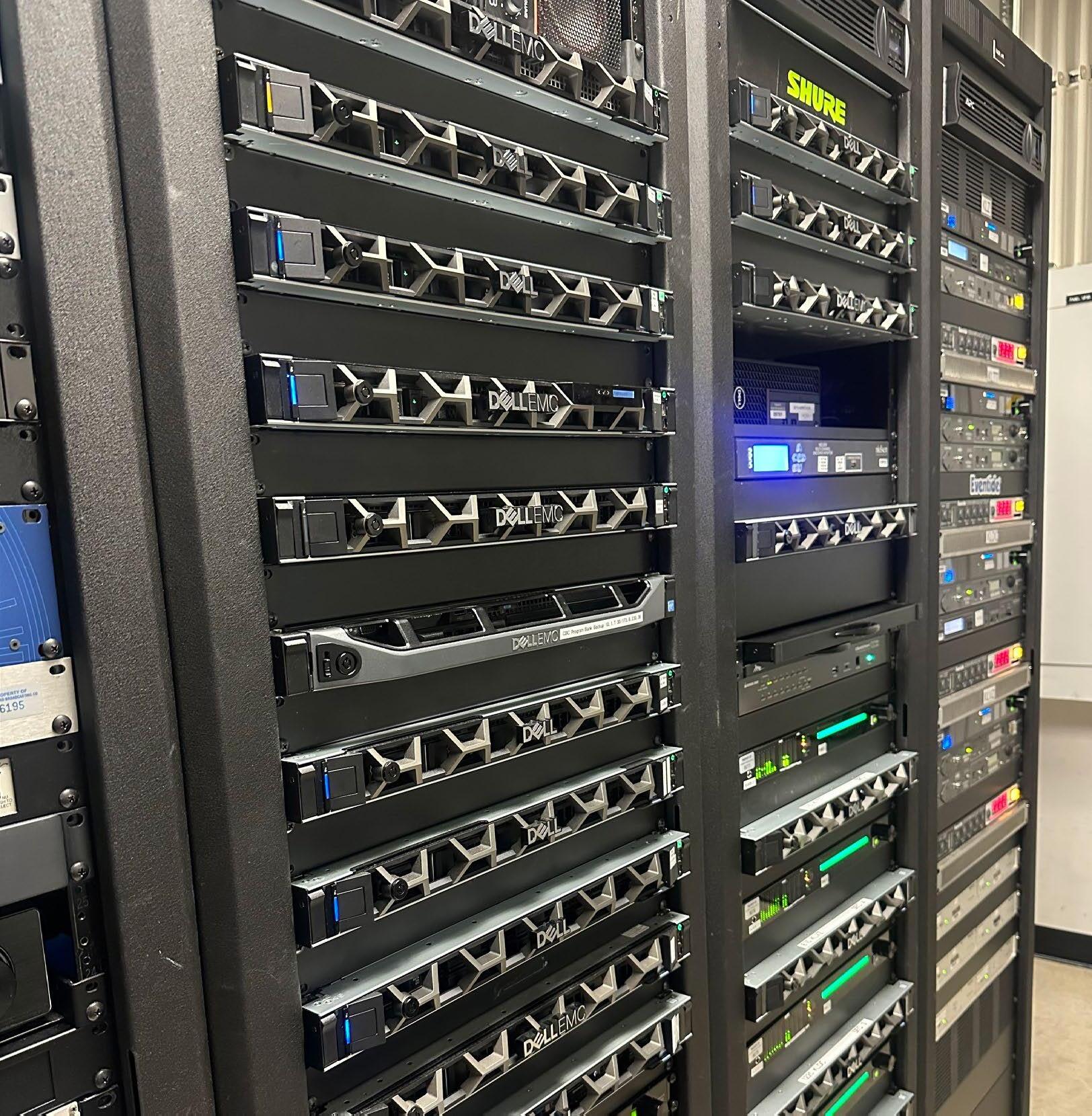
We already had Telos VSet6 broadcast phone controllers, so all I needed hardware-wise was a server. I ordered up one from Dell, loaded Ubuntu and followed the instructions from Telos for spinning up a container and installing the VXs application.
There were a few gotchas I had to work through, but it didn’t take long before I had it up and running, connected to our Avaya system as the virtual SIP server and working. It worked and sounded great, garnering praise from our afternoon talk host that very afternoon.
Since then, I have rolled out several other VXs virtualized systems across our company, and I plan to continue to go that route as our hardwarebased systems wear out and reach end of life.
The point of all this is not a product review of the Telos VXs system, although it’s a great choice that I would recommend. Rather it’s an example of the implementation of a new(er) and non-traditional technology in the broadcast environment.
It represented for me a change in thinking, one that I am carrying forward in our facility planning.
Computers by another name
Since making that move, it has occurred to me that we already have a good number of virtualized components in Crawford Broadcasting’s infrastructure.
One example is our audio processors. All of our AM stations use Omnia.9 processors, and while those processors do have hardware,
The author wrote last year about a National Radio Systems Committee study of AM band noise.
that hardware is used only for I/O and user control. Open the box and you’ll find a computer running software that’s doing all the heavy lifting. It’s an amazing processor.
Manufacturers are working on other virtualization, including PPM watermarking (available in several production audio processors even now), and there is a push underway to move EAS away from hardware and into the virtual environment. That makes all the sense in the world to me.
Major manufacturers offer virtualized mixing consoles that utilize the touch screen of your choice for operator controls. Sure, there is still some hardware — blades, nodes or whatever — to handle I/O, but even those devices are really computers with an OS running an application.
In my company’s facilities, we still have traditional control surfaces with mechanical faders, pushbuttons, OLED screens and blinky lights, but even those are just user interfaces providing input to the application.
Shaking my Magic 8 Ball, the words “more virtualization” appear in the window. When you stop and think about it, the possibilities are just about endless for virtualization.
I don’t think we’re going to see virtualized RF power amplifiers delivering many kilowatts to a transmission line, but everything right up to the PA hardware can
“It represented for me a change in thinking, one that I am carrying forward in our facility planning.
be virtualized, and I predict we’ll see that kind of thing more and more.
Otherwise, what part of the broadcast infrastructure is not a candidate for virtualization? Our rack rooms have become server rooms and bear this out. We’re using less and less purpose-built hardware and relying more and more on computers and servers.
Maybe it’s time for us all to stop worrying and love virtualization. I think it’s here to stay.
W.C. “Cris” Alexander, CPBE, is director of engineering for Crawford Broadcasting and former tech editor of RW Engineering Extra. He is a longtime Radio World contributor.
The case for a radio dashboard
A well-conceived dashboard creates a single source of truth
Mark Lapidus
Awell-done dashboard is a thing of beauty.
But while I do care deeply about how new dashboards in cars allot space for terrestrial radio, this time around I’m addressing a different kind of dashboard: a data display created specifically for your radio station.
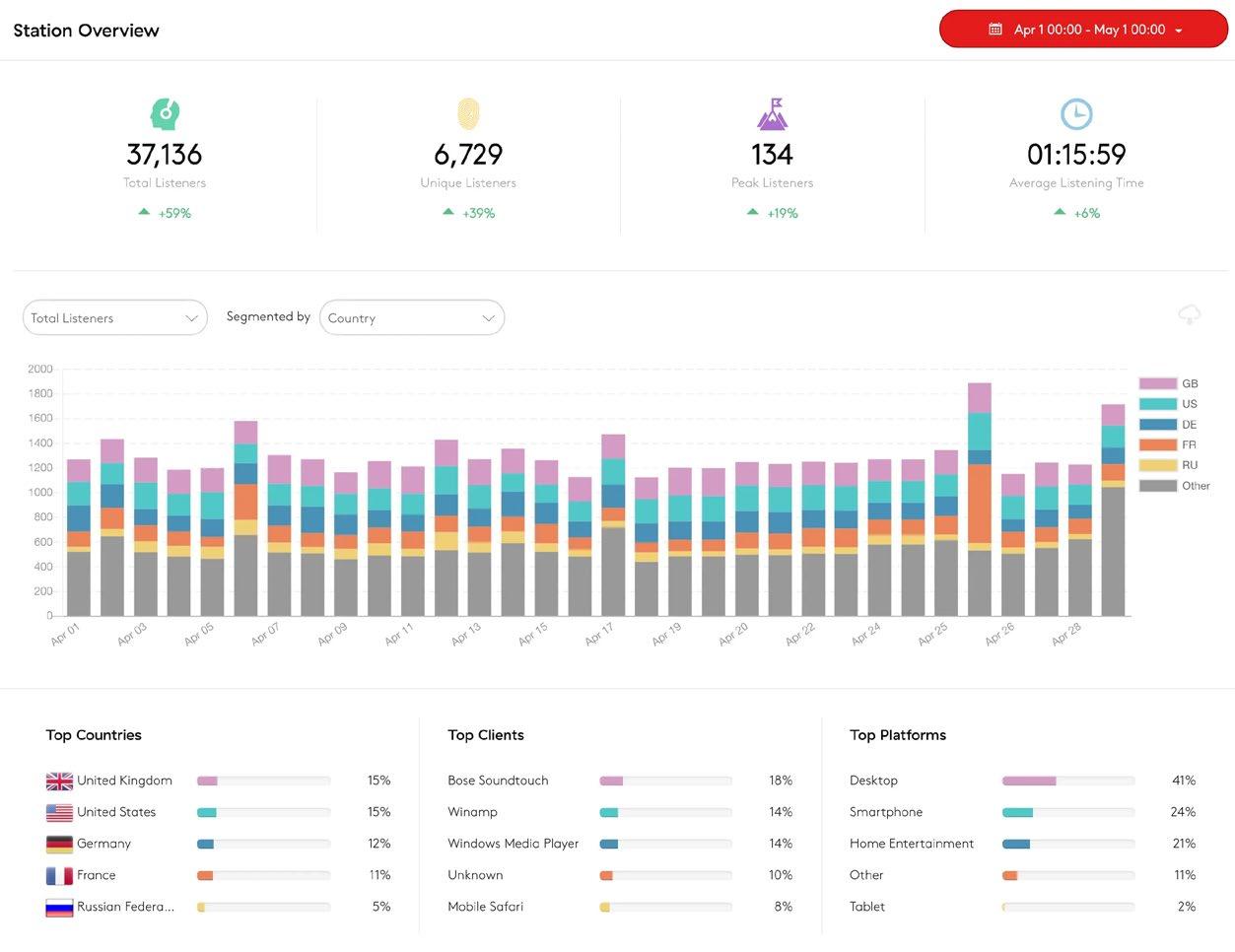
Data dashboards unify audience ratings, content, advertising and non-traditional revenue, expenses, budget tracking, streaming metrics and digital platform analytics. In other words, all the numbers you care about — finally in one place.
Luckily, radio is blessed with data. Unfortunately, most of it lives in discrete systems, with ratings in one place, streaming metrics elsewhere. And don’t even get me started on sales information, which is frequently trapped in spreadsheets.
It is frustrating to jump between systems to view such things as revenue versus inventory; podcast downloads; how well push
notifications perform in creating tune-in; how often each promo is airing; and whether any of it is actually working.
This kind of scavenger hunt wastes time and makes decisions more difficult than they need to be.
A well-conceived dashboard pulls every input into one place, creating a single source of truth. Just as important, the view can be customized by role.
A general manager may want to see everything at a glance. A sales executive may only need pacing, pipeline and inventory. Engineers are likely the only ones who care deeply about uptime, stream health and alerts, not to mention using such tools to keep an eye on remote infrastructure.
For public radio stations, dashboards can make it possible to correlate pledge-drive messaging with realtime donation activity; to track donor churn alongside renewal predictors; and to measure how premiums impact donor lift — all without waiting for a post-mortem. You can probably think of many more applications for a welldesigned dashboard.
Not long ago, dashboards required significant investment in hardware, software and complex extract-transform-load processes. That barrier is gone.
The author is a veteran multiplatform media executive.
Sean Anthony Eddy/Getty Images
Software-as-a-service pricing has made dashboards accessible to stations of all sizes. If you have the time and inclination, free platforms like Power BI Desktop can get you started. And because dashboards live in browsers and on mobile devices, there’s no need to build a custom interface.
“Affordability” may very well be the buzzword this year, which means any dashboard project must pass a costbenefit analysis.
The good news is there are plenty of inexpensive options. Looker Studio, Metabase, Power BI or Tableau dashboards can be built by a freelancer for as little as $500 in a month.
If you can afford a SaaS product designed specifically for broadcasters, even better, as many of the inputs you’ll want have been anticipated. I highly recommend integrating your CRM so your dashboard includes sales pipeline, campaign outcomes, projected revenue and advertiser feedback.
Finally, decide who owns the dashboard. Failure occurs when nobody feels responsible for success.
A poorly-conceived dashboard is worse than none at all, and bad data leads to bad decisions. Be wary of vanity metrics, clutter and unclear distinctions between historical trends and real-time activity.
Promo Power
This is your year to move meetings, programming reviews and sales conversations from gut reactions to informed decision-making. A great dashboard will sharpen good judgement, interpretation and communication for you and your staff.
RCS announced that President/CEO
Philippe Generali would retire at the end of February. For the next year he will act as a senior consultant to Mark Gray, CEO of Katz Media, who has had oversight of RCS for the past several years, while a succession plan is created. RCS and Katz are subsidiaries of iHeartMedia.
Generali led RCS Europe, then joined RCS USA. He became president of RCS USA in 2000 and then president and CEO of RCS
Worldwide. He also led its businesses Media Monitors, Florical and Mediabase. … Alex Siciliano left the National Association of Broadcasters in January to pursue another opportunity. He was SVP of communications.
Grace Whaley recently was promoted to NAB’s director of communications and social media. Judianne Meredith joined NAB last summer as a communications coordinator. …
MaxxKonnect hired Steve Griesbach as a senior engineer for the southeastern United States.
Griesbach will support stations serviced by MK from the company’s offices in Birmingham, Ala., and he will help its build team on projects around the country. He has been a chief engineer for Cumulus and Beasley.
Send announcements to radioworld@ futurenet.com.
Future in focus with …. Tom Stultz
The CEO of K-Love on his organization’s outlook
Arecent series of Q&As on the Radio World website asked industry thought leaders to comment on their outlook for 2026. Tom Stultz is CEO of K-Love, a Christian radio network owned by the Educational Media Foundation.
What is the most important thing that happened in your part of the world of radio in the past year?
Tom Stultz: Two things come to mind. Our acquisition of seven stations from Salem in top markets, plus the addition of the Tampa and Columbus markets to our network in 2025, represented a significant investment and expansion for the ministry. It allowed us to enter major markets where we did not yet have a presence and potentially reach millions more people as a result.
Separately, we worked through a significant technology upgrade in 2025, shifting from satellite to IP delivery. This will allow us to ensure that our radio signals remain healthy and strong. We expect that project to wrap up in Q1 of 2026. We are getting great reviews regarding the quality of our audio, which we hope will result in increased audience satisfaction.
What can we expect from you this year when it comes to additional expansion?
Stultz: We are always open to new opportunities to bring the hope of Jesus to more people. The Salem acquisition was substantial, and at this time I don’t foresee anything on the horizon that would be comparable, but remain open to where the Lord leads. Our stated goal is to minister to people in all of the top 50 markets. Right now there are only a handful of these markets that don’t have K-Love or Air1 stations.
What business or technology trend will have the greatest impact for you?
Stultz: Artificial intelligence is already making an impact on the radio industry at large, and I would expect that trend to continue as we see the rise of AI artists. Currently, there are no AI artists or hosts on K-Love or Air1, and we plan to keep
Above Tom
Stultz
it that way. However, we do think AI will be helpful in other ways, and we are open to exploring how these tools may complement the work of our teams.
The FCC is considering removing market caps on local radio ownership. Do you support that change; why or why not?
Stultz: I believe in a free-market system, so I am fine with potential changes in the ownership caps. If the caps are removed, I would expect to see even more consolidation, which would be good, short-term, for station valuations. If the caps are not removed, we believe the downward trend in valuations will continue, which could open up some acquisition opportunities for us in markets not currently served by our programming.
Either way, our listener supported, faith-based content should remain in high demand.
Any other topic on which you’d like to comment?
Stultz: There are two key issues that are important to us as we look to the future. One is the effort by automakers to remove radios from their vehicles. We feel such a move would be a disservice to their customers and disastrous for this industry. The other is to maintain strong support for the First Amendment. It is important that the media remains independent and free.
Tower memories
I so enjoyed your cover story “Towering Passions” (Jan. 1 issue).
I laughed at the letter “Not Her Bag” and identified with the closing line of “From Sea to Shining Sea.” As a couple passionate about radio, you could say that my late husband Herb Squire and I both chose well.
I still marvel at the former WPAT towers with their alienlooking top hats … thrill when I spy the ultimate one of all (Major Armstrong’s, of course) ... and feel I’m in home territory when I drive through the Meadowlands, a veritable tower farm!
Herb and I took a lot of road trips when our kids were little. As I drove, he roamed the dial with the precision of a surgeon to get the best signals of nearby stations, as well as whether his own station was coming in. When he drove, I had the same “assignment.”
Our daughters were totally at ease visiting transmitter sites, memorably when WHN’s resident cat named “1050” had a litter. There is a romance about towers — something vintage and even ethereal about them.
Laurie Squire Martinsville, N.J.
Just part of the wreckage
Mr. McLane, regarding your “Questions for the New Year” in the Dec. 17 issue:
The Trump administration’s slash and burn tactics against adult diplomacy finally hit home to me when it emasculated the Voice of America, where I was a journalist for 32 years. They didn’t kill it, however, maintaining the Mandarin, Farsi, Dari and Pashto language services to China, Iran and Afghanistan respectively.
Despite the administration’s effort to outright eliminate VOA, this was a nod to the need to continue broadcasting to foreign lands of diplomatic interest to them.
You ask if the White House will ever regret defunding not only VOA, but also Radio/Free Europe/Liberty and Radio Free Asia. You would think programming to Russia, North
Korea, Latin America and the Middle East would interest the Trumpistas, given that it is pursuing amateurish negotiations or gunboat diplomacy in those volatile regions. Ending those programs could come back to haunt them, but I don’t think they have the diplomatic maturity to look ahead.
Congress subsequently restored some of the USAGM funding. Yet when I step back and look at the totality of the damage Trump has done to our nation, I realize that losing the soft diplomacy of international broadcasting is only part of the wreckage.
Our country has a long road ahead to rebuild its international alliances and heal internally. Renewing its foreign broadcasting capability will be just a piece of the effort.
Public radio’s glass houses
Responding to William Harrison’s comments on EAS (“Future in Focus: William Harrison of WETA,” radioworld.com): People who live in “glass houses” probably can find an EAS budget or help those who can’t. The showcase palaces of public radio around the country belie the case for the co-opted opinion that a budget cut will place emergency communications for the public in danger.
This is at a time when many station logs are void of tests received or transmitted, either voluntarily or by a goof in the chain. It’s just another indicator that “no one’s at home” at many broadcast stations these days.
Peter Stover Spotsylvania, Va.
Thank you, Don
How to submit Radio World welcomes comment on all relevant topics. Email radioworld@ futurenet.com with “Letter to the Editor” in the subject field.
Don Jones was a very special person (“Don Jones Dies,” Feb. 1 issue).
When I started in radio broadcasting back in the 1980s he helped me in so many ways. He was so much more than a salesman.
He made me feel like I was the only reason that he was in business, actually guiding me in my early years. I will always remember his smile.
Bob Shivery President KBJS(FM) Jacksonville, Texas