MIDDLE SCHOOL | GRADES 6–8
VISION
Developing People the World Needs
VALUES
Think Deeply | Learn for Life | Welcome Everyone Live with Purpose | Relationships Matter
MIDDLE SCHOOL | GRADES 6–8
Think Deeply | Learn for Life | Welcome Everyone Live with Purpose | Relationships Matter
WELCOME TO ROWLAND HALL’S 2026–2027
MIDDLE SCHOOL COURSE CATALOG.
This catalog outlines the various classes students take while enrolled in our Middle School; some are required, while others provide students with choice.
Our core curriculum requires all students to take math, English, science, and history and social studies, known as MESH classes; participate in physical education and wellness courses; and study a world language (French, Mandarin Chinese, or Spanish) during their time in our Middle School. Sixth graders are also enrolled in a yearlong Foundations program covering four areas of study, and every student is assigned to an advisory group
In addition to core classes, students choose between semester and yearlong extension courses, as well as quarterly elective courses. The philosophy of extension and elective courses is to encourage and support students as they develop new interests and build new skills. There is a wide range of courses to choose from, and whether students are interested in exploring science, the arts, or technology, they will find engaging learning opportunities designed to challenge and inspire them.
Students are encouraged to take advantage of the vast opportunities available, choosing classes that are of interest. Course selection occurs in the spring and is a collaborative process, with parents and caregivers encouraged to discuss and consider the myriad extension and elective course options with their students. Students have the opportunity to submit their preferences and receive their schedules prior to the start of school.
In the Middle School, we provide an educational program that holistically supports early adolescent students in achieving academic success and positive personal growth. Rowland Hall’s dedicated faculty create a supportive, caring environment that motivates and challenges students. Teachers are as knowledgeable in their subject matter as they are in understanding students’ unique needs, whether they’re cognitive, emotional, or physical.
Our curriculum is relevant, challenging, and exploratory. Teachers use a variety of instructional and assessment methods grounded in research and best practices. We empower our students to be well-rounded and compassionate individuals.
Students develop their ability to take risks, become resilient in the face of setbacks, and seek opportunities to reflect on their work at every stage. They have many opportunities to work collaboratively, learning from one another, and accepting and providing constructive feedback.
Rowland Hall’s Middle School mathematics program prepares students to be people the world needs who:
• Make sense of contextual, real-world problems and persevere in solving them
• Reason abstractly and quantitatively, and demonstrate a depth of understanding to build a foundation to solve future problems
• While working collaboratively and independently, construct viable arguments and critique the reasoning of others in a positive manner
• Use appropriate resources and tools strategically, and model with mathematics as an aid to solving complex problems
• Attend to precision as a component of excellence
• Utilize the structure and repetition of previous problems to solve current ones
• Recognize math's place in our lives
At the heart of mathematics education at Rowland Hall is the desire to instill a lifelong love of this subject. Within the classroom, students are viewed as a community of mathematicians who connect what they are learning to the real world. Students engage in many projects and choose how to demonstrate their knowledge using different representations. An emphasis on modeling and application is intended to help students see mathematics as a tool for making sense of and describing the world around them. Our program is based on the mathematical practices of the National Council of Teachers of Mathematics.
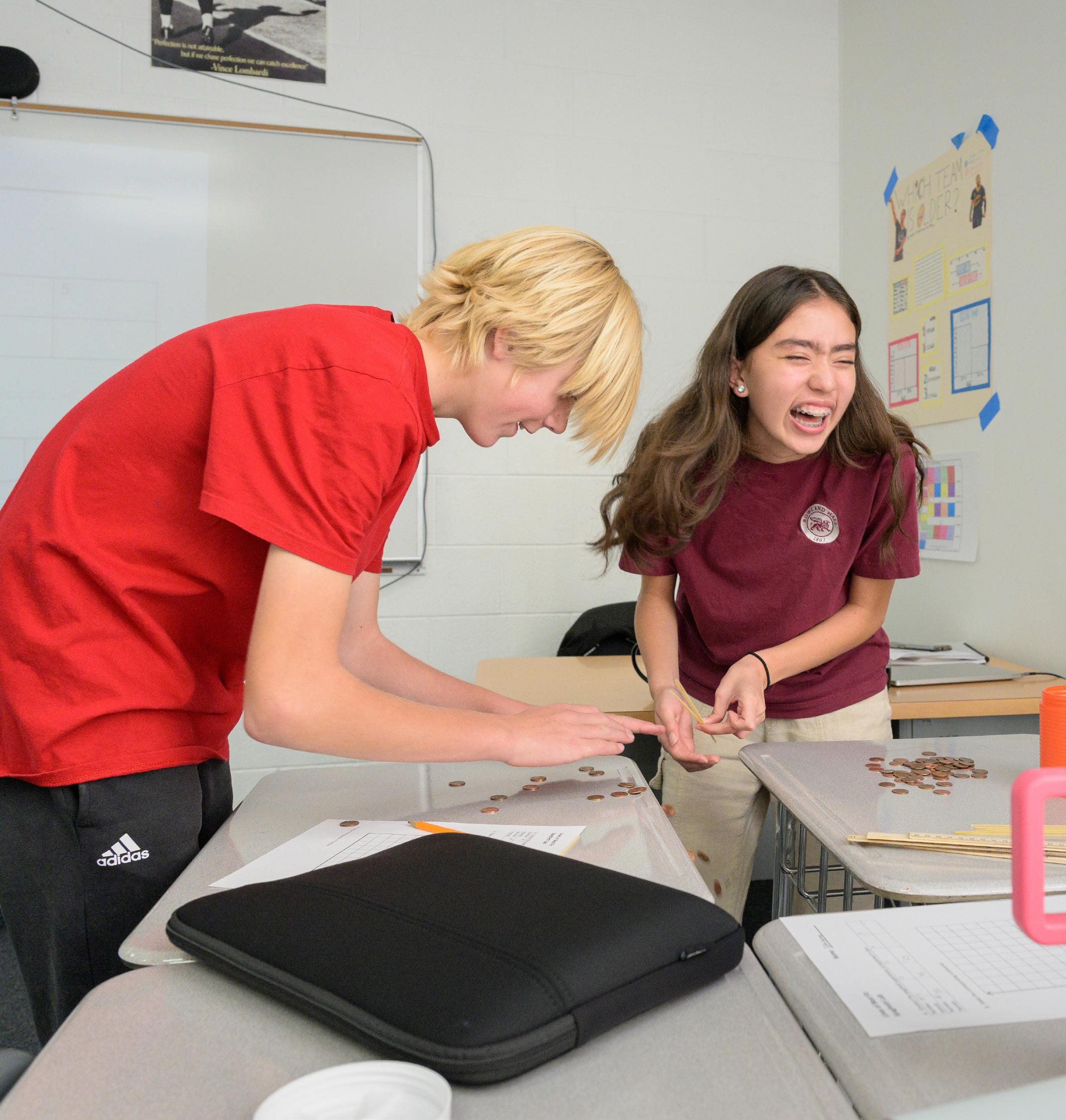
Math 6 builds a strong foundation in key mathematical concepts essential for higher-level math. Aligned with the Common Core State Standards, the curriculum focuses on developing students’ understanding of ratios and proportional relationships, division of fractions, rational numbers (including negative numbers), and expressions and equations. Students explore concepts through realworld applications and problem-solving activities designed to promote critical thinking and mathematical reasoning. An emphasis is placed on understanding the coordinate plane and analyzing relationships between variables. Students also work with statistical thinking—learning to collect, organize, and interpret data—and explore the concept of variability. Geometry is introduced through reasoning about area, surface area, and volume. The course encourages collaborative learning, mathematical discussions, and the use of models and tools to deepen understanding, as well as nurtures perseverance, precision, and mathematical communication. By the end of grade 6, students will have gained a solid grasp of fundamental mathematical ideas, preparing them for the transition to more complex topics in grade 7 and beyond.
Accelerated Math 6 is built around rich challenge problems and thoughtful mathematical discussion. The course moves at a fast pace and emphasizes depth of understanding. Students explore ratios, rates, and proportional relationships; rational numbers, including negative numbers; expressions and equations; and fraction operations through complex problem-solving and real-world applications. Designed for students who enjoy grappling with challenging problems, and require fewer practice opportunities to master new concepts, this course provides a strong foundation for continued accelerated study.
Math 7 uses real-life situations to build strong math understanding and confidence. Students use mathematics as a practical tool to explore ratios and proportions, percents, square root applications, equation solving, and linear relationships. Through problem solving in context, students strengthen number sense, learn to model situations with equations and graphs, and develop the ability to judge whether answers are reasonable. An emphasis is placed on communication and organization. Students explain their thinking using mathematical language, show clear and organized work, and use math to make sense of everyday situations. This course helps students become confident, thoughtful problem solvers who understand how math connects to the real world.
Accelerated Math 7 utilizes rich and challenging problems to create classroom discussions that engage with the course’s curriculum in a deep and broad manner. The foundational concepts for the year are solving algebraic equations, graphing functions in the coordinate plane, comparing and contrasting linear and exponential relationships, working with percentages and ratios, and exploring geometric concepts of surface area and volume. Designed for students who enjoy grappling with challenges, and require fewer practice opportunities to master new concepts, this course provides a strong foundation for continued accelerated study.
* All sixth-grade students begin here
Second semester only Progression
8th
Math 8 focuses on four major tools of algebra: variables, equations, graphs, and tables. The course uses a variety of methods to give students ample opportunities to become familiar with these powerful mathematical tools. The course also integrates geometry, statistics, probability, and number theory. Students engage in mathematical thinking via conversations, challenge problems, labs, direct instruction, project-based learning, practice sheets, and more.
Rich challenge problems and deep math discussions form the basis of the Accelerated Math 8 curriculum. The course covers a variety of algebraic, geometric, and introductory trigonometric topics. For students who strongly identify with math, lean into—rather than away from—tricky problems, and don’t need dozens of practice questions to rehearse a method, this course provides a platform for growth in math.
Rowland Hall’s Middle School English program prepares students to be people the world needs who:
• Read effectively for enjoyment and for deeper understanding
• Analyze text closely and think critically about meaning
• Develop and express a point of view
• Write texts for various purposes
• Understand and apply language concepts
• Apply a personalized writing and revision process
Throughout grades 6–8, students read widely and deeply as they hone their writing, critical-thinking, and communication skills. Students also develop analytical and critical-thinking skills as reading and writing exercises build in complexity through the years. Choice and student agency are vital components of our reading culture and the cultivation of individual student voices. Students actively engage in a variety of reading experiences across mediums and genres,
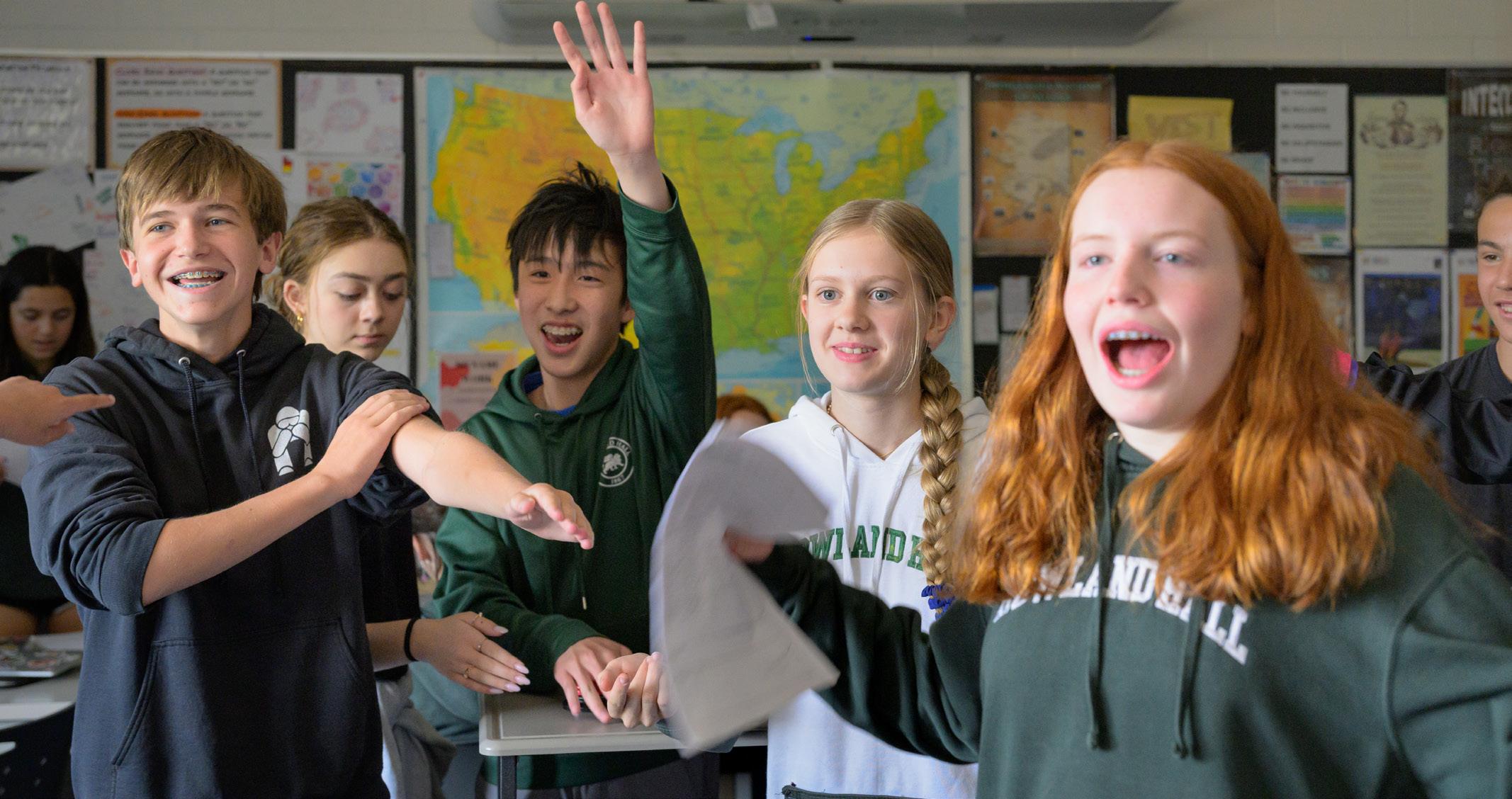
including independent reading, whole-class novels, and small, student-led book clubs. Reading experiences reflect diverse voices, experiences, and perspectives to develop cultural competency and understanding as global citizens. Students learn to draw inspiration, ideas, and evidence from their reading to write across a variety of genres, both expository and creative. They practice and view writing as a process that demands awareness of task, audience, and purpose. Whenever possible, students write for authentic audiences.
Sixth graders grow as readers, writers, and thinkers through a series of interconnected units designed to build critical literacy and authentic expression. The year begins with Notice & Note strategies, where students learn to recognize key moments in a text that reveal deeper meaning. During the Deep Character Study unit, students explore how characters are shaped by their choices, pressures, and environments—discovering how authors develop complex, believable people on the page. In the Personal Narrative unit, students craft meaningful stories from their own lives that use sensory details, dialogue, and reflection to reveal a deeper truth. Finally, in the Nonfiction and Research-Based Informational Essay unit, students investigate real-world topics they’re passionate about. They analyze nonfiction texts for central ideas and supporting evidence, conduct research, and present their learning through an informative essay that includes factual evidence, text features, and a bibliography. By the end of the year, students have developed the habits of thoughtful readers, purposeful writers, and reflective learners, ready to engage with the world through words and ideas.
Seventh-grade English challenges students to think deeply, write purposefully, and read with curiosity and empathy. Through novels, short stories, poetry, and nonfiction, students examine universal theme topics such as identity, belonging, perspective, responsibility, and interconnectedness, while also exploring relevant global topics such as human migration and environmental sustainability. They analyze how authors use language, structure, and style to shape meaning and influence readers. Writing experiences include analytical essays as well as creative and reflective pieces that help students refine their own voices. Vocabulary study, grammar, and sentence fluency are integrated throughout the year to strengthen clarity and precision in writing. Daily discussion, frequent collaboration, and year-round independent reading cultivate critical thinking and a lifelong enthusiasm for learning. By the end of the course, students will have developed as thoughtful readers, confident writers, and resourceful communicators who understand the power of stories—both others’ and their own—to deepen empathy and inspire positive change.
What are the stories we tell ourselves about what it means to be an American? Who are we as a people? Where have we been? Where are we going? The eighthgrade English course invites students to consider these questions—along with questions of their own—as we practice foundational skills in reading, writing, and speaking by investigating what “America” and “American” mean in the past, present, and future. We will encounter classics of American literature, work by some of the most exciting young American authors writing today, and a wide range of artists, musicians, filmmakers, essayists, and others from throughout American history. Students can expect to read, write, and engage in discussion almost every day, and to engage in interdisciplinary project work throughout the year.
Rowland Hall’s Middle School sciences program prepares students to be people the world needs who:
• Develop questions and define problems based on observations
• Engineer, refine, and manipulate models and carry out investigations
• Acquire analytical and computational skills to interpret and synthesize data, and are able to construct explanations and design solutions from multiple viewpoints
• Engage in arguments from evidence and evaluate the validity of claims made by other scientists
• Incorporate technology in their investigations to solve real-world problems
• Utilize their communication and critical-thinking skills to share solutions with the broader community
Middle School scientists develop a sense of wonder about nature and are encouraged to question the way the world works. We aim to inspire curiosity and engagement beyond the surface of our physical world.
In unit 1, Organisms, Cells, and Systems, we explore cell structure and how plants and animals are composed of cells and systems. Students observe inherited trait variations arising from genetic similarities and differences, and examine how organisms use characteristics and behaviors to survive. We introduce evolution as a function of molecular genetics, with energy and material cycling as an ongoing theme throughout all units. In unit 2, Physical Science and Energy, students explore energy forms, transfer, and transformation. We investigate electricity creation and distribution, build electrical circuits, and study energy production methods. We also examine efficient energy use and its impact on global climate, while learning the
SI measurement system for data collection and analysis. In unit 3, Earth’s Geological Systems, we explore how Earth’s materials and energy flow shape landscapes and oceans over vast timescales. Students study the cycling of water, atmosphere, and minerals driven by solar energy, internal heat, and solar system forces, using Utah’s landscapes as real-world examples.
In seventh-grade science, we explore how natural systems work and how we can make a positive impact through three major units: Ecology, Chemistry, and Climate Change. In our Ecology unit, we study how organisms interact and depend on each other and their environment. We learned about energy flow, invasive species, and how changes in ecosystems can affect populations. As scientists, we engineer bug traps to create a solution to a local problem. In Chemistry, we explore physical and chemical changes, density, and conservation of mass. In this unit we investigate if plastics can be recycled by testing how different types respond to heat, helping us understand real-world recycling challenges. In the Climate Change unit, we examined how Earth’s systems create weather and climate, and how humans are affecting our climate. We use data and models to understand these systems and work in teams to engineer solutions to reduce human impact.
The eighth-grade science curriculum explores how objects interact through three big phenomenon-based units focusing on energy, motion, and forces. This course emphasizes curiosity, critical thinking, and the interconnected nature of systems in our universe while strengthening the science skills and practices learned in sixth and seventh grade. Students investigate how waves transfer energy and information in the Energy
in Waves unit, examining wave properties, sound, and light, with connections to how the human eye detects light. In Forces and Energy, students explore motion, forces, and collisions to understand how energy is transferred and transformed, linking physics concepts to real-world issues like concussions and safety. The final unit, Patterns in the Solar System, focuses on gravitational interactions, lunar and solar cycles, and the future of human exploration in space, using the Great Salt Lake as a model for Martian studies. Throughout the year, students build models, analyze data, and develop evidence-based explanations that connect physical science to human physiology, technology, and sustainability.
Rowland Hall’s Middle School history and social studies sciences program prepares students to be people the world needs who:
• Develop questions, define problems, and find solutions through active engagement with the curriculum
• Acquire analytical reasoning and writing skills to interpret and synthesize research around any of the social sciences as it relates to the various content areas
• Engage in argument from evidence and evaluate the validity of others’ claims
• Work effectively together through process of communication that builds compromise and consensus
• Develop the ability to recognize the importance of various audiences and perspectives to help them understand others’ lived experiences
Through their studies, Middle School students build curiosity about the complexity of the world, both past and present. In addition to building content knowledge, students work toward mastery in several key academic skills. These include developing and refining research questions, evaluating bias and source reliability, tracking research using digital note-taking tools, synthesizing sources to construct evidence-based arguments, applying MLA formatting and in-text citation conventions, and analyzing Document-Based Questions (DBQs). Significant emphasis is also placed on producing research-based writing that is both analytical and informative, aligned with grade-level writing standards.
In sixth grade, students explore how people, ideas, and cultures have shaped the world from ancient civilizations to today. Through hands-on projects, discussions, and research, students investigate big questions about identity, culture, history, government, human rights, and the environment. They compare ancient and modern societies, reflect on their own goals and communities, and connect learning to real-world issues like inequality,
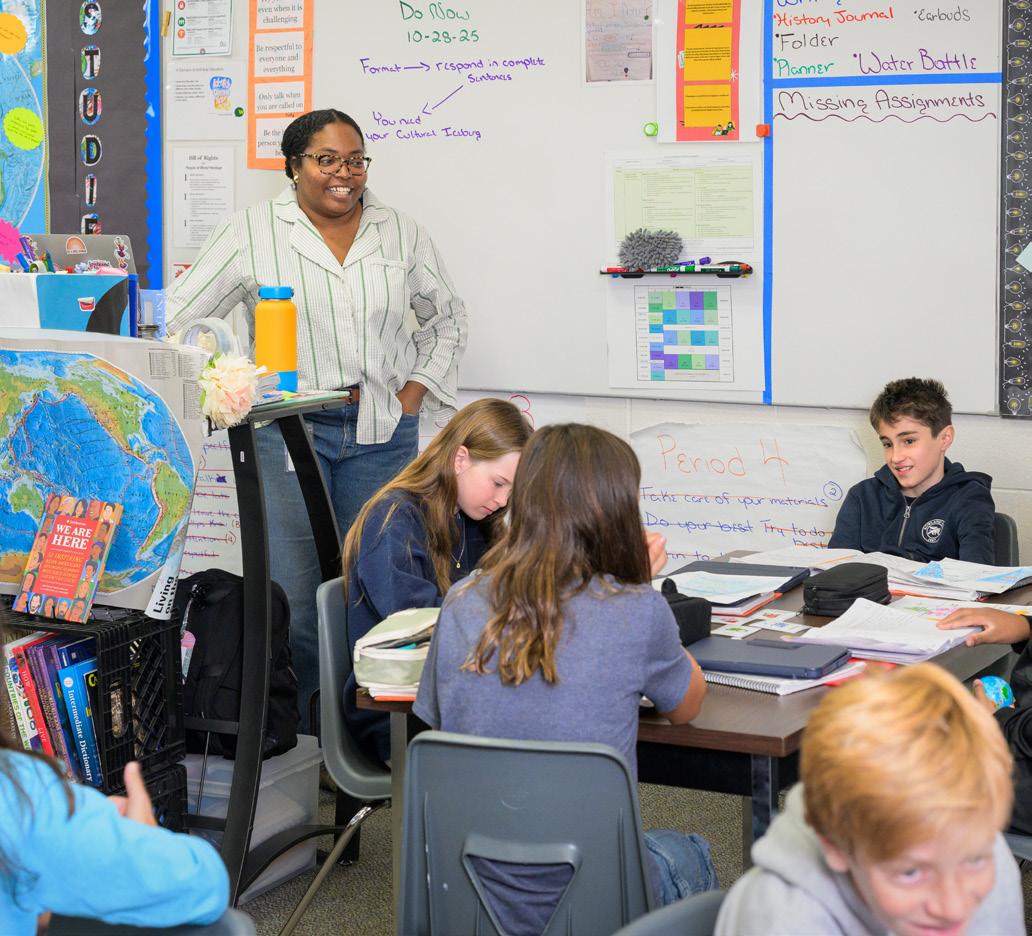
climate change, and global citizenship. Students build skills in critical thinking, research, and collaboration while being introduced to the United Nations Sustainable Development Goals. Activities include creating infographics, maps, posters, and action plans, all designed to help students understand the past, connect it to the present, and make a positive impact on the future.
In seventh grade, students investigate globally significant issues such as economic interdependence, migration, consumption, conflict, and environmental challenges, both past and present. The course emphasizes the development of global competence by helping students recognize diverse perspectives, communicate ideas effectively across diverse audiences, and take meaningful action to address real-world problems, such as teaching English as a Second Language to refugees and immigrants at local Salt Lake schools. Through the study of human geography, medieval history, and current global issues, students explore essential questions that deepen their understanding of how culture, population dynamics, and global interconnectedness shape human experiences, while also examining how historical events and patterns influence the world today and help us make sense of current global challenges. The curriculum incorporates the United Nations Sustainable Development Goals and provides opportunities for students to examine and challenge stereotypes, appreciate different worldviews, and make connections to their own lives and local and global communities. By analyzing multiple perspectives and engaging in inquirybased learning, students build empathy and develop the skills to engage positively across cultures.
In eighth grade, students engage in a thematic study of United States history, structured around five core units: Foundations of Government, Westward Expansion and Indigenous Peoples’ History, Black History, Building of Industry and Entering the 20th Century, and World War II. Through these themes, students develop enduring understandings of the United States as a nation shaped by complex and often contradictory narratives of progress and prejudice, hope and hate, wealth and want. They come to see how lived experience influences one’s perspective on the world, and they explore the idea that each individual holds the power to affect their community and society at large. Much of the course is designed to prepare students for a culminating field experience in Washington, DC, at the end of the academic year.
Rowland Hall’s Middle School physical education and wellness program prepares students to be people the world needs who:
• Gain the knowledge and skills to make healthy, informed decisions related to their physical, emotional, and social well-being
• Develop communication skills to be able to selfadvocate, and develop self-awareness in order to self-regulate
• Become physically literate through a variety of motor skills and movement forms, enhancing physical wellbeing, personal health, and social interaction, and fostering an appreciation for a lifetime of physical activity
The sixth-grade PE program is designed to provide a well-rounded and engaging experience that promotes physical fitness, fundamental skill development, teamwork, and sportsmanship. At the beginning of the year, students participate in cooperative games that emphasize collaboration, communication, and healthy competition, helping to establish a positive and inclusive learning environment. The curriculum then progresses through a variety of individual and teambased activities that focus on learning and applying the rules of the game, developing skills from basic to more complex movement patterns, and practicing respectful behavior in both cooperative and competitive settings. Winter programming includes structured weight room exploration to support students’ strength and wellness development. Instruction during this unit emphasizes proper form, safety regulations, and responsible equipment use to support foundational strength development in a safe and structured setting. Through these experiences, students build confidence, improve decision-making, and develop a lifelong appreciation for physical activity and healthy habits.
In grade 6, wellness is offered as a part of the Foundations programming; every student takes this course for one term. Refer to the Foundations section for more information.
The seventh-grade PE program is designed to provide a well-rounded and engaging experience that promotes physical fitness, skill development, teamwork, and sportsmanship. The curriculum includes a variety of individual and team-based activities that emphasize learning and applying the rules of the game, progressing skills from fundamental to more complex movement
patterns, and demonstrating respectful behavior in both competitive and cooperative settings. Winter programming includes structured weight room exploration to support students’ strength and wellness development. Instruction during this unit focuses on proper technique, safety regulations, and responsible equipment use to support age-appropriate strength development in a safe and supervised environment. Through these experiences, students build confidence, improve decision-making, and develop a lifelong appreciation for physical activity and healthy habits. Wellness is also incorporated into physical education, providing an opportunity for students to expand on topics covered in sixth grade: human growth and development, substance use and prevention, nutrition, and healthy decision-making. When appropriate, guest speakers join classes to facilitate conversations with expert voices.
When students enter eighth grade, they have a choice of the course they take for physical education and wellness.
The eighth-grade PE program is designed to provide a well-rounded and engaging experience that promotes physical fitness, skill development, teamwork, and lifelong appreciation for a healthy lifestyle. Tailored to the specific needs and interests of eighth-grade students, the PE curriculum integrates a variety of activities to cater to diverse preferences and abilities.
This advanced, yearlong course is for eighth-grade students who are ready for an in-depth study of dance. Students may opt to take this course in lieu of PE/ wellness. In addition to a rigorous dance curriculum, eighth-grade Dance Ensemble/Wellness students
participate in wellness lessons alongside their peers in PE classes. The course offers training in various techniques including contemporary, modern, ballet, hiphop, and improvisation. Throughout the year, students have the opportunity to learn foundational concepts in composition and choreography. They explore voice through making, and gain greater familiarity with performance skills as they build awareness of style and stage presence in preparation for the Upper School dance program.
This comprehensive and holistic class is designed to empower eighth-grade students with the knowledge, skills, and attitudes necessary to lead healthy and active lifestyles throughout their lives. The class goes beyond traditional physical education by incorporating elements of sport-specific strength and conditioning, fitness education, nutrition, strength training program design, and mental well-being.
Rowland Hall’s Middle School world languages program prepares students to be people the world needs who:
• Have an appreciation for language learning
• Foster an identity as a member of the global community
• Develop cultural competency through the skills of communication, with the goal of language application beyond Rowland Hall
The Middle School offers world language instruction in French, Mandarin, and Spanish, and our program aims to balance four components of language acquisition: reading, writing, speaking, and listening. Students are extensively exposed to the sounds and writing of authentic language and make great strides in their language acquisition. This experience is embedded in a traditional curricular framework, and those seeking an immersion program should note the difference. Our program is designed for learning a new language;
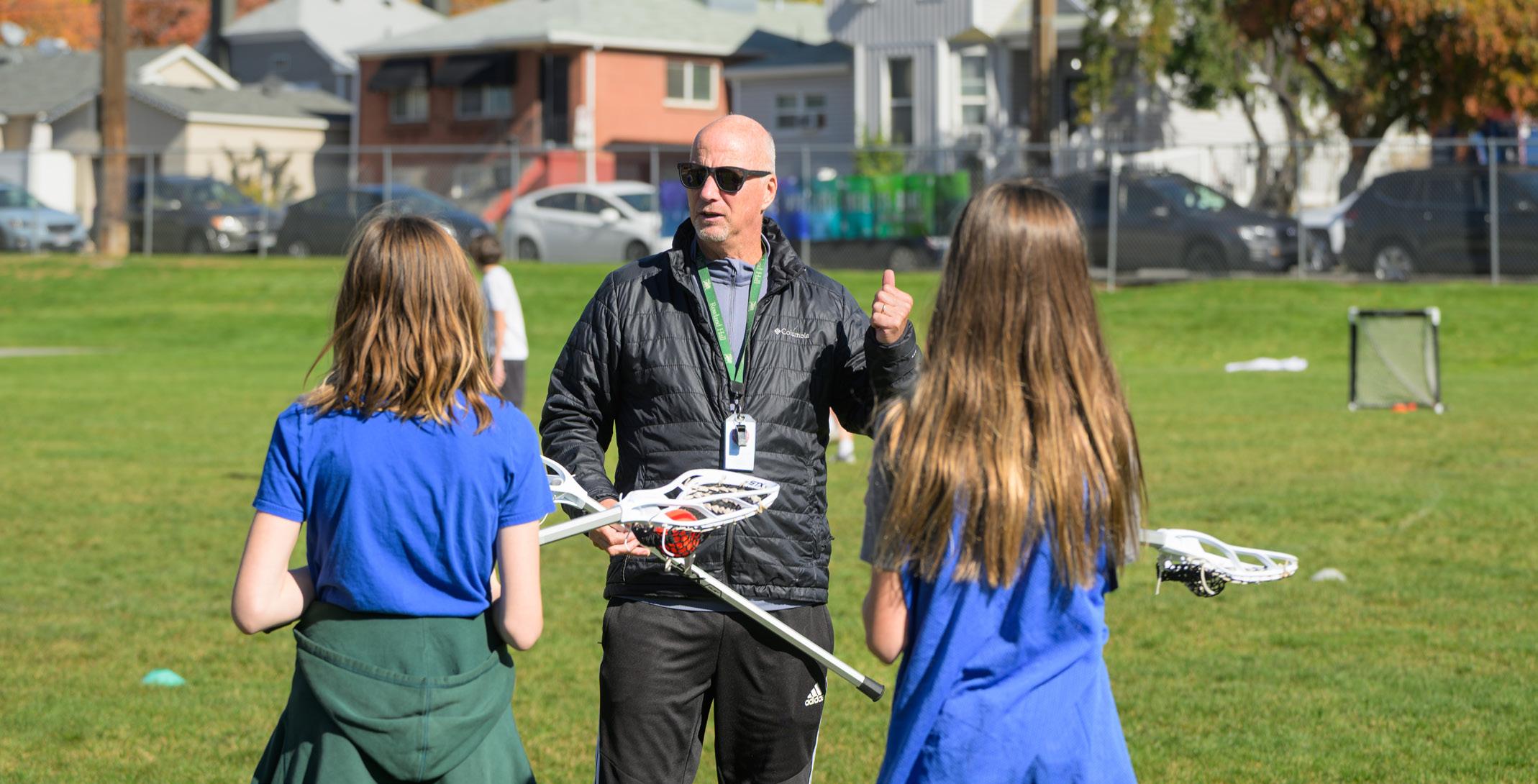
students with expert skills in any of the languages offered will choose a new language to learn in the Middle School.
Students select a world language upon entry to the Middle School and commit to the study of that language through eighth grade. Per the department’s philosophy, students who arrive with intermediate skills or above in any of the languages offered must choose a new language to learn in the Middle School. Questions related to a student’s language level should be directed to the head of Middle School and world language teachers.
When entering the Upper School, students are placed in year I or year II of their language (the class that will provide them with the appropriate level of development and challenge). Students who have consistently met expectations in Middle School language coursework and who strive to use the target language are most typically placed in year II. Although most students choose to continue their Middle School language in the Upper School, students may opt to switch their language upon entering ninth grade. World language placements are based on teacher recommendation, work habits, and overall language development.
In this introductory French course, students explore the rich diversity of the francophone world while building foundational language skills through engaging, comprehensible input and interactive dialogue. Using stories, songs, visuals, and real-world cultural connections, students develop their ability to understand and communicate in French about everyday topics such as greetings, family, school, and hobbies. Emphasis is placed on listening and speaking in a supportive, immersive environment that celebrates global Frenchspeaking cultures and encourages curiosity, creativity, and confidence in using the language.
Building on the foundation established in sixth grade, this course deepens students’ understanding of the French language and the many cultures that shape the francophone world. Through continued use of comprehensible input and meaningful communication, students expand their vocabulary and grammar knowledge to express opinions, describe daily routines, and discuss cultural traditions. Authentic stories, music, and media from a variety of French-speaking regions enhance comprehension and cultural awareness. Emphasis remains on developing listening and speaking fluency, while students begin to strengthen their reading and writing skills in an engaging, interactive environment that promotes global connection and linguistic confidence.
In this course, students will refine and expand their communicative abilities while exploring the complexity and diversity of the francophone world in greater depth. Building upon prior knowledge, learners engage in more sophisticated conversations, storytelling, and cultural comparisons using increasingly complex structures and authentic materials such as short films, articles, and music. Comprehensible input continues to guide instruction, supporting students as they develop stronger reading, writing, listening, and speaking proficiency. Through creative projects and cultural inquiry, students gain the confidence to express themselves more independently in French and prepare for the rigor and opportunities of Upper School language study.
In this course, students explore the Chinese language through the five Cs of world language learning— communication, cultures, connections, comparisons, and communities—with the ultimate goal to not only study
the language, but to truly learn how to communicate. Students spend significant time mastering pronunciation and tones, two of the greatest challenges for English speakers learning Chinese. They also engage in real conversation, from greetings and social interactions to expressing feelings, emotions, and opinions. Along the way, they deepen their understanding of Chinese culture and its products, practices, and perspectives, and gain valuable insights by comparing it with their own. By the end of the course, students will have built a strong foundation in the Chinese language and culture, giving them the confidence to continue their language-learning journey into the future.
In the Mandarin 7 course, students will continue exploring Chinese through the five Cs of learning a language (communication, cultures, connections, comparisons, and communities). The class goals are to really use Chinese and to understand more about Chinese culture, giving students an even stronger foundation for future Chinese learning. Students continue practicing correct pronunciation and tones (since they can be tricky for English speakers), but also move into more real-life situations. They have the opportunity to have conversations and greet people in different social settings, share feelings and opinions in Chinese, and learn how Chinese culture connects to the language. By the end of this course, students will not only have stronger speaking and listening skills, but also a deeper appreciation of how language and culture fit together.
In Mandarin 8, students continue developing their Chinese language skills, with the ultimate goals to communicate effectively in Chinese while gaining a deeper understanding and appreciation of Chinese
culture. Students continue working on the knowledge they have gained the previous two years and are introduced to new concepts and grammar to increase their knowledge of the Chinese language. They practice engaging in conversations, greeting others in various social situations, expressing feelings and opinions, and exchanging ideas. Alongside language growth, they explore the relationship between cultural products and perspectives, discovering viewpoints only accessible through the study of Chinese culture. This class is designed for students to take ownership of their learning. A basic pacing guide will be available in Canvas, but students are encouraged to push themselves to move faster than the set pace. The more they challenge themselves, the more they will grow and learn. Instruction takes place primarily in Chinese, giving students authentic exposure to the language, strengthening their listening and speaking skills, and providing a solid foundation for any future study of Chinese.
This introductory Spanish course uses comprehensible input to build an understanding of basic Spanish language. The curriculum is largely focused on building oral and written proficiency with the language by teaching language and culture simultaneously, giving students insight into distinct Spanish and Latin American lived realities (for example, discussing La Cumbia dance, the Panama Canal, and the running of the bulls in Spain). Interspersed within the comprehensible input curriculum, we learn basic Spanish grammar in order to prepare students for future language study.
In seventh grade, students continue building on the foundation they acquired in Spanish 6, with greater emphasis on verb conjugations and forming full sentences in the target language. Through comprehensible input, students also broaden their understanding of the Spanish-speaking world. Cultural focal points in this course include the tradition of human towers in Catalonia, typical foods across Latin America, and folkloric beings in various Spanish-speaking countries, such as El Cucuy and El Chupacabras. Students can expect to do more direct work with grammatical structures, including presenttense conjugations of both regular and irregular verbs, as well as the difference between a conjugated verb and an infinitive.
In their third year of Spanish, students continue with the comprehensible input curriculum, with a focus on speaking and verb conjugation. The class will be conducted largely in Spanish in order to expose the students to as much listening and speaking as possible and to prepare them for high school Spanish II. As in their first two years, students learn language and culture simultaneously, and we study famous Spanish-language novels, sports in Latin America, and children’s rights. After each comprehensible unit, the class will look at a grammatical topic that addresses a need specific to the class. In the past, we have covered possessive adjectives, two-verb usage, reflexive pronouns and verbs, direct and indirect object pronouns, and the past tense.
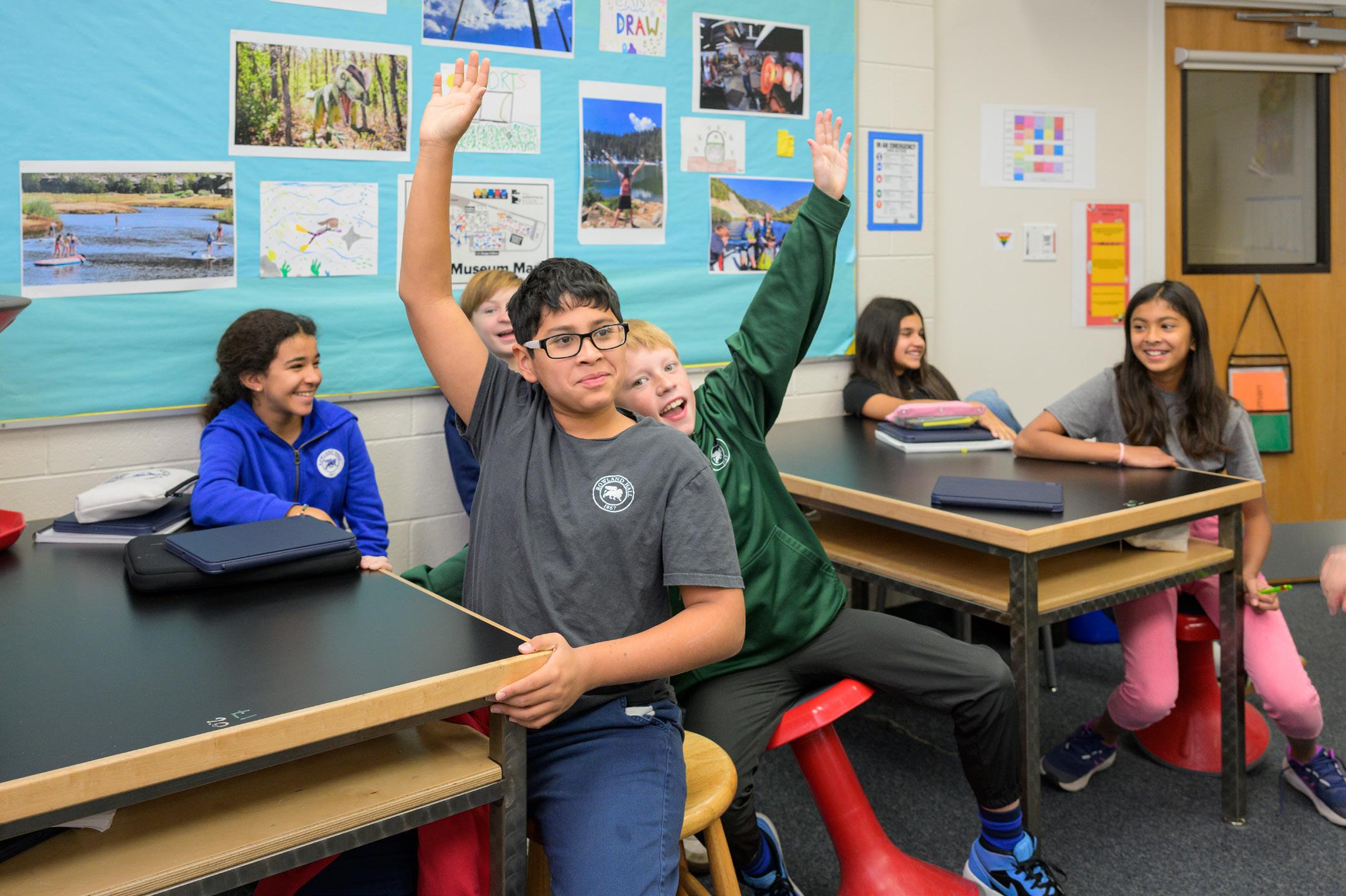
In addition to the core curriculum of math, English, cultural studies, science, PE, and world language, sixth grade students take a yearlong course called Foundations. Foundations are separated into four eightto ten-week sections, each focusing on a specific area of curricular extension or interest. This assigned rotation of classes sets up students for success within our Middle School program, as well as helps them make more informed elective choices in seventh and eighth grades.
This class includes lessons, activities, and performances that emphasize the importance of public speaking, effective argumentation, and reflective listening. Students select various topics to discuss and the class provides them with tips and strategies for creating, delivering, and evaluating persuasive speeches.
This class introduces sixth graders to physical, emotional, and social well-being. Students explore how healthy habits support both body and mind through ageappropriate study of nutrition, physical activity, sleep, stress management, and responsible decision-making. The course emphasizes building a healthy relationship with food, including learning how to read and analyze food labels to make informed choices. Students also begin a Human Growth and Development unit, examining the physical and emotional changes of puberty in a safe, respectful environment. Through discussion, reflection, and collaborative group work, students develop selfawareness, interpersonal skills, confidence, and the tools needed to make healthy lifestyle choices as they grow.
This course introduces students to the fundamental concepts of computer science through hands-on, problem-based learning. Students explore digital citizenship and online safety before diving into applied technologies. The curriculum emphasizes computational thinking through robotics (coding variables, functions, and animations) and immersive technology (virtual and augmented reality). Learning culminates with engineering interactive 3D prototypes, visualized first through augmented reality that integrates coding and hardware to solve real-world problems.
This class allows students to delve into critical thinking and acquire essential skills for navigating today’s media-saturated world. Students learn to decipher and respond to diverse media forms while honing their writing skills and enhancing their critical and creative thinking across various platforms and mediums.
Advisory is an identifying component of strong middle schools that contributes to culture and community by helping students develop key skills outside of the academic classroom setting. Our advisory program focuses on:
• Social-emotional learning, encompassing selfawareness, self-management, social awareness, relationship management, and responsible decisionmaking
• Positive identity development and cultural competency by focusing on questions such as: Who am I? Who are you? Who are we? Why are we better together?
• Academic advising based in metacognition and
executive functioning
• Community engagement that leads to positive impact and change in the school and local communities
Each Rowland Hall Middle School student is part of a grade-level advisory, a small group that meets regularly and becomes a home base and community within our larger Middle School community. Your child’s advisor is also a point of contact for parents and caregivers.
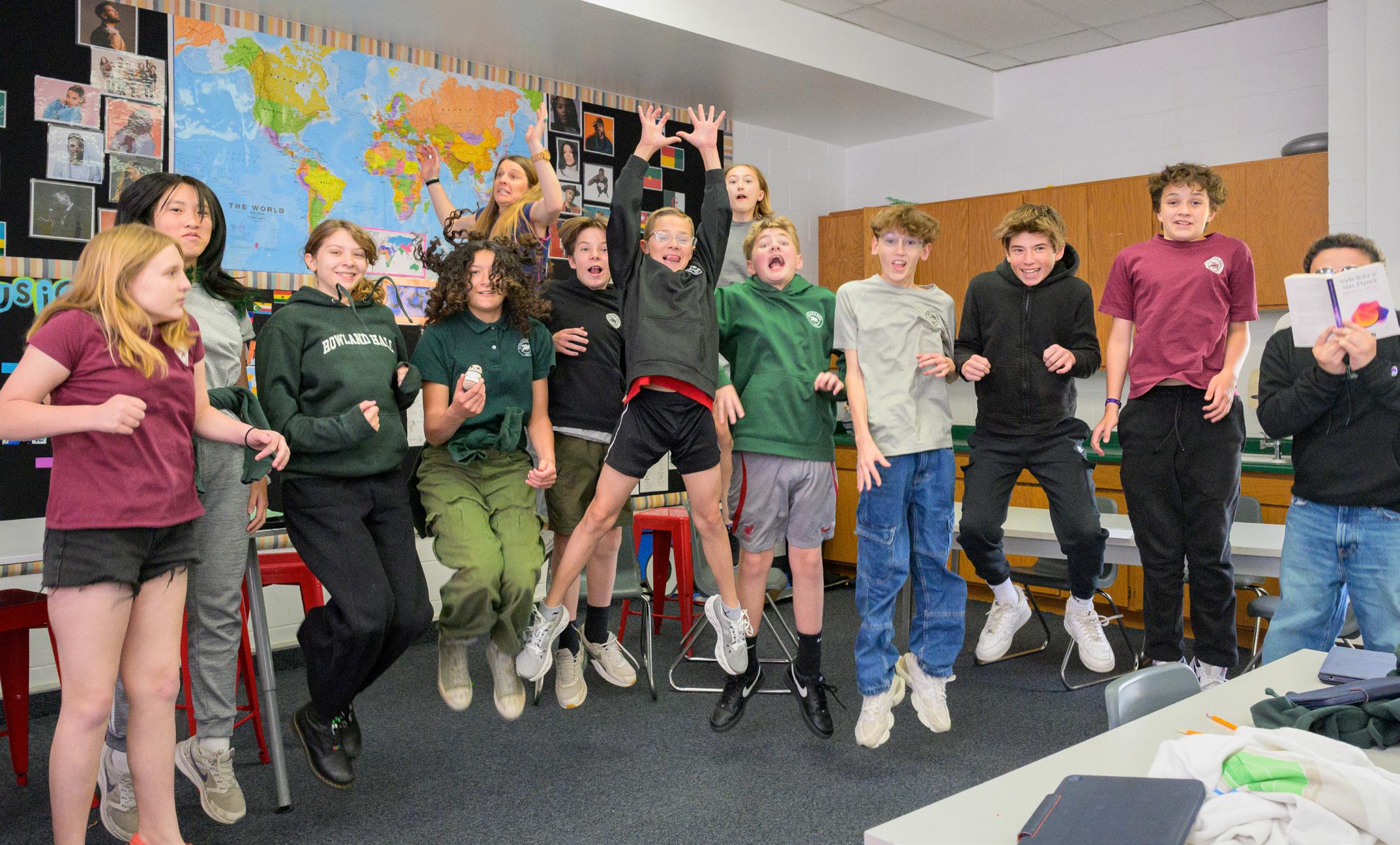
Extension courses are yearlong and semester-long classes for students in grades 6–8. Elective courses are half semester classes for students in grades 7–8.
ELECTIVE COURSE; HALF SEMESTER
Open to grades 7–8
This elective introduces the engineering process, a series of steps engineers follow to solve a problem, with a focus on aviation design. After learning flight fundamentals, students research, design, create, and test methods to complete fun, creative aviation build projects, including paper airplane innovation labs, project EZ Jets, and even a copter lab. As a capstone, student pairs construct the Sparrow’s Egg foam board glider, incorporating all steps of the Engineering Design Process. The objective? To evaluate which aircraft flies farthest while safely transporting an egg in a secure cockpit. While final testing can be a little messy, students have an amazing time using critical-thinking and problem-solving techniques to meet the test objective and earn the title Top Design Guru.
ELECTIVE COURSE; HALF SEMESTER
Open to grades 7–8
This elective provides an engaging overview of this dynamic field, including professions, history, flight principles, basic aerodynamics, flight procedures, aircraft controls, and flight instruments. Students learn the phonetic alphabet and get their own call sign, design a squadron patch, and build and fly balsa wood
airplanes. Using NASA software, students act as air traffic controllers, competing to be the most efficient, safest controller in class. This offering also includes three fundamental aircraft design labs and use of our in-class X-Plane 11 flight simulators for an introduction to normal aircraft ground and flight procedures. As an extension opportunity, students learn about unmanned aerial systems and fly Holy Stone drones to get hands-on experience with this emerging technology. Finally, two aviation presentations focus on student-centric aviation topics.
EXTENSION COURSE; ONE SEMESTER (SPRING)
Open to students in grade 8; must have previously taken Primary Flight School
Designed for students with a true interest in aviation, this course focuses on procedures and knowledge used to operate private and commercial aircraft. Students study life in the cockpit and flight planning, and complete several research projects. They learn about drone technology, piloting Holy Stone and DJI Mini 2 SE drones, and access Cessna 172 flight simulators running X-Plane 11 software with six aircraft simulation scenarios that prepare them for an actual flight sortie. The class concludes with a flight in a Piper or Cessna aircraft with Cornerstone Aviation–certified instructors. Students also enjoy two field trips (Cornerstone Flight Operations Center for an aircraft preflight evolution and Collins Aerospace to learn with software and design engineers). Again, this course is for the serious aviation flight candidate.
ENTREPRENEURSHIP
ELECTIVE COURSE; HALF SEMESTER
Open to grades 7–8
Ever dreamed of being on Shark Tank? This class makes it happen, Rowland Hall style. Students explore practical business planning, operational structure, finance basics, marketing, and pitching ideas by developing slogans, logos, and business plans for their companies. They also learn how to present those ideas in a short amount of time. Students learn how to build a sound and manageable structure around any business idea. Whether you’re exploring becoming an entrepreneur or have an idea and want to get it to market, this class is for you.
EXTENSION COURSE; ONE SEMESTER (SPRING)
Open to all Middle School students; this class is highly recommended for eighth graders interested in taking AP Computer Science in high school
This comprehensive, project-based course builds the foundational skills necessary for students interested in learning visual (blocks) and object-oriented programming (Python/Java). Through diverse and engaging activities, students tackle real-life problems and explore the societal impact of computing. Students utilize handson tools such as robotics, micro:bits, and Minecraft
modeling to learn the core concepts of the building blocks of code, variables, loops, functions, and arrays— all necessary and essential programming skills. This course will prepare students for advanced coursework, specifically AP Computer Science in ninth grade.
EXTENSION COURSE; ONE SEMESTER (FALL)
Open to all Middle School students
In this course, students transition from theoretical coding to advanced physical computing. Working in collaborative engineering teams, students utilize the Engineering Design Process to identify authentic realworld problems and design robotic solutions to address them. The focus of this class is on developing robot functionality and automation, and applying user centered design. Students gain professional experience with rapid prototyping such as CAD and 3D printing. Students also enhance their computational thinking through visual and textual programming (Python/Java). This course simulates a professional engineering product cycle, culminating in a final presentation where teams demonstrate their functional robotic prototypes solving a specific real-life challenge.
ELECTIVE COURSE; HALF SEMESTER
Open to grades 7–8
Ever wanted to invent and create marvelous gadgets like an electric guitar, an AI robot, interactive board games, or remote control vehicles? This class is designed to give students’ computers superpowers to control the real world. In this course, students become tech wizards,
using tiny computers to design and program awesome, fantastic, fun, and extraordinary projects. It’s like magic where they develop coding skills and integrate different electronic components such as circuits, servos, motors, light, AI, and proximity sensors.
ELECTIVE COURSE; HALF SEMESTER
Open to grades 7–8
This class unleashes students’ creativity as they learn to build beautiful, interactive, and user-focused websites from the ground up. In this course, students explore how to structure compelling digital experiences by integrating information, photography, video, and interactive elements. They develop foundational, real-world skills in HTML, CSS, and JavaScript—the core technologies that power the web. By the end of the course, students have designed and programmed a dynamic, shareable website that brings their unique visions to the world.
ELECTIVE COURSE; HALF SEMESTER
Open to grades 7–8; prerequisite: Web Art Design or understanding of JavaScript
This project-based course is students’ entry into the creative world of app development. Students engage in a complete design cycle to create a variety of projects, including interactive games, useful tools, and even simple AI chatbots. A key component of this course is collaborative testing and refinement; students share their creations with the class to gather feedback, learn to debug code, and improve designs. This handson process empowers class members to develop as innovative designers and creative communicators.
PRINTING WITH ROBOTIC
EXTENSION COURSE; ONE SEMESTER (SPRING)
Open to grades 7–8
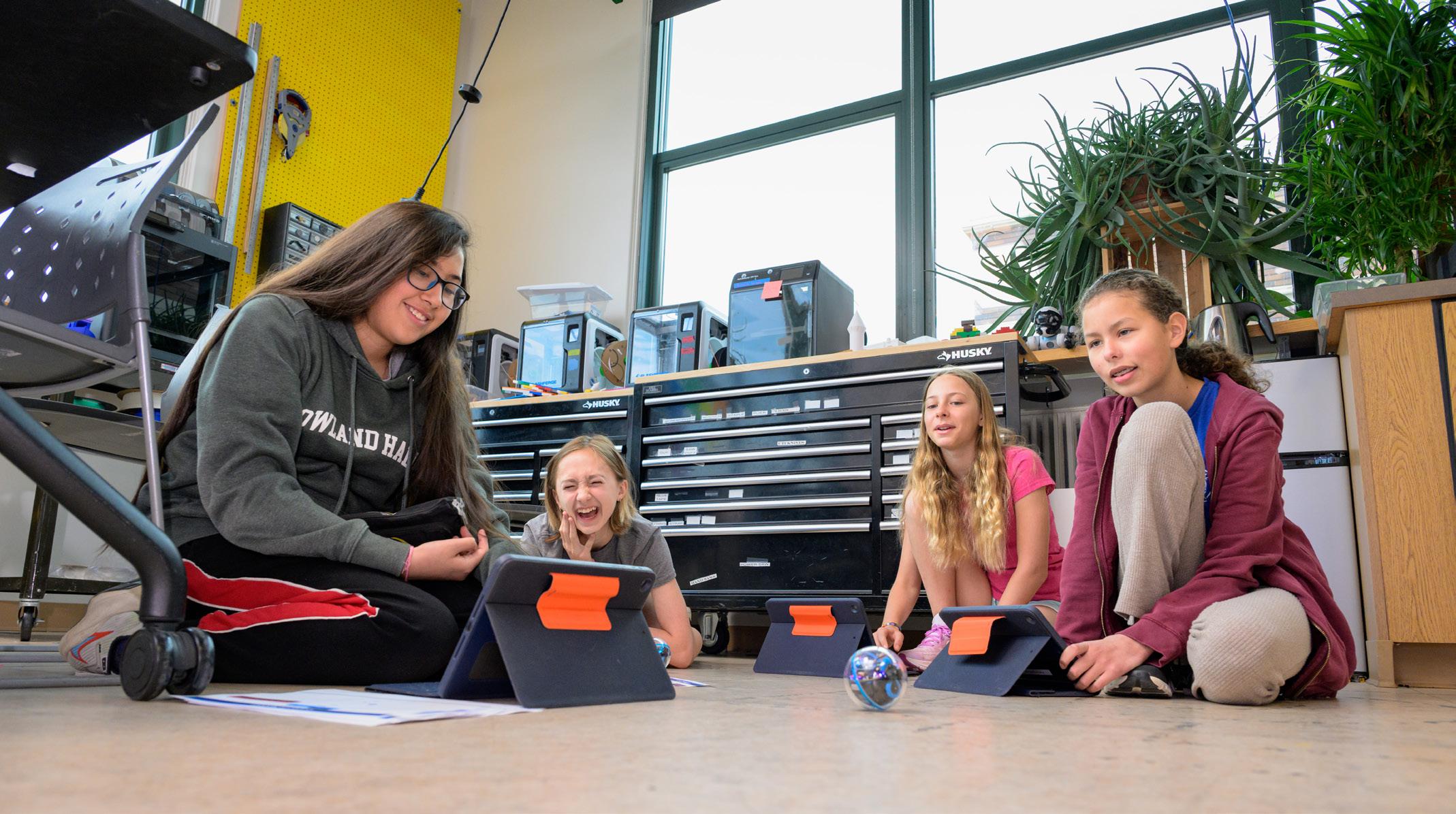
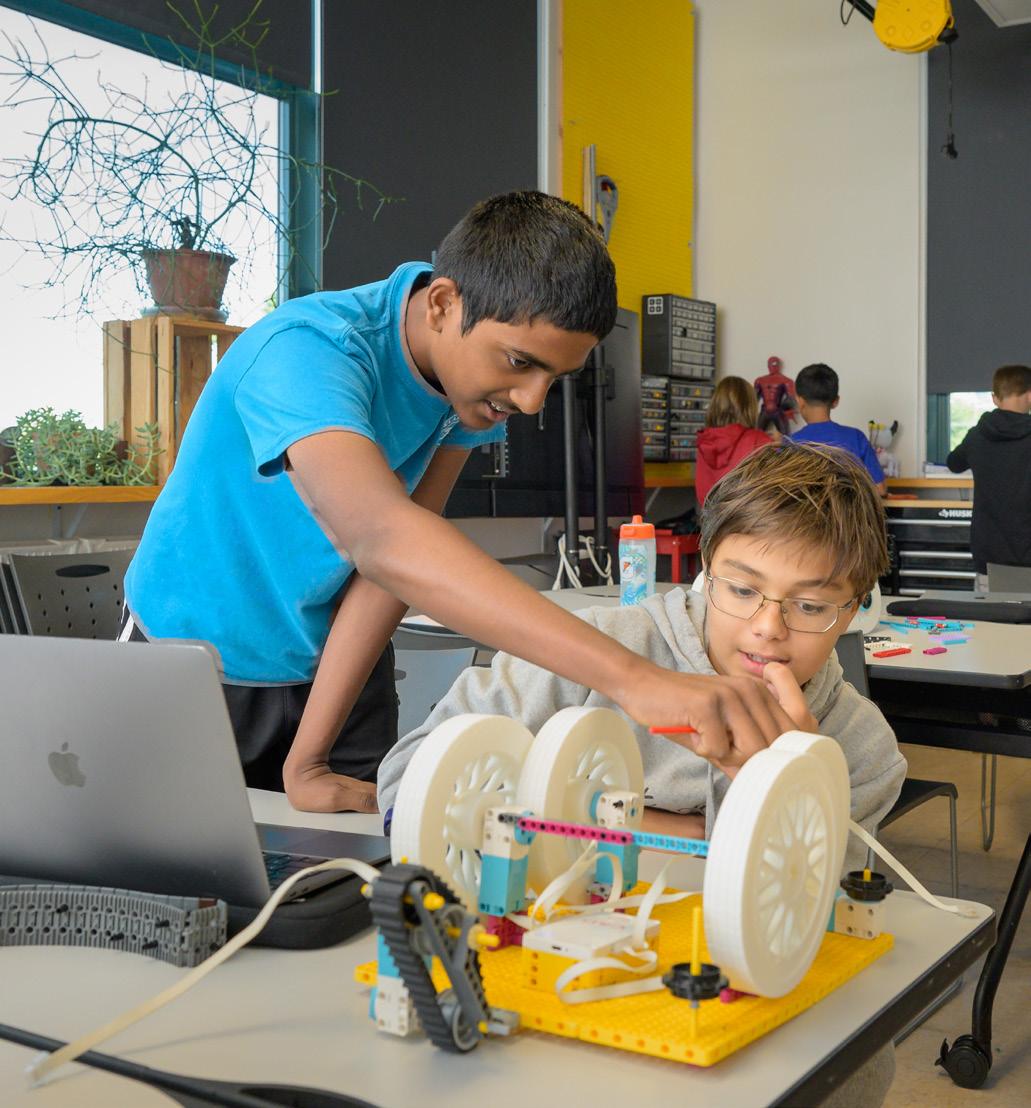
In this class, students are introduced to 3D modeling using Tinkercad, and move into more professionalgrade 3D modeling software. Using their own models, students use 3D printers to turn their designs into reality. Students also use LEGO SPIKE Prime and Sphero robots to learn the basics of programming and robotics. Additionally, they are introduced to the seven steps of the Engineering Design Process.
ELECTIVE COURSE; HALF SEMESTER
Open to grades 7–8
This course immerses students in the professional workflows of game development, emphasizing the synthesis of logic-based programming, system design, and collaborative problem-solving. Students trade their controllers for creative control, utilizing visual scripting engines to engineer the logic, art, and mechanics of their own interactive worlds. The curriculum is anchored in the Iterative Design Cycle, requiring students to prototype, test, analyze, and refine their mechanics based on user feedback.
INTRODUCTION TO DEBATE
ELECTIVE COURSE; HALF SEMESTER
Open to grades 7–8
After completing this course, students will have a set of portable argumentation and advocacy skills they can use in a variety of experiences throughout the curriculum at Rowland Hall. Students initially learn about and practice structured speeches, with emphasis on verbal and nonverbal delivery skills (organization, projection, inflection, eye contact, hand gestures, and more). Students then build a foundation for effective argumentation and advocacy by participating in structured debates. Special emphasis is placed on critical-thinking and listening skills, as well as argument resolution. This class is ultimately for students who want to explore debate in a non-competitive environment but may choose to participate on the debate team during the third term, or later in high school.
ELECTIVE COURSE; HALF SEMESTER
Open to grades 7–8
This advanced class grows students’ comfort with competitive debate, building on other debate classes to emphasize formal debate participation (one-on-one or with a partner). Attendance at at least one official tournament is required. The class reviews debate basics and introduces advanced forms of argumentation, including topicality, counterplans, disadvantages, weighing mechanisms, and frameworks. Students primarily research both sides of the official Utah debate resolution, but have later opportunities to conduct inclass debates on a topic of their choice. In addition to practicing constructive, rebuttal, and cross-examination strategies, students develop tactical skills, including evidence comparison, cost-benefit analysis, note-taking,
and audience adaptation. While debate is competitive in nature, students are never graded on wins or losses, and the class works collaboratively to create and prepare cases against other schools.
EXTENSION COURSE; ONE SEMESTER (SPRING)
Open to grades 7–8
This course is designed for students who want an interactive and applied approach to argumentation and public speaking. In the Mock Trial simulations, students learn about the legal system while roleplaying as lawyers and witnesses in a specific court case. In the Model United Nations simulations, students learn about global problems and international relations while roleplaying as delegates for different countries. In both activities, students research, deliver speeches, and collaborate as a team. Students develop skills in public speaking, critical thinking, problem solving, and cultural competency. Finally, students are encouraged to participate in events beyond the classroom and have opportunities to partner with different professional organizations, which helps hone their advocacy skills in formal settings.
EXTENSION COURSE; ONE SEMESTER (FALL)
Open to grade 6
In this engaging, hands-on class, students are guided through a range of art-making lessons that stretch their individual creativity and encourage them to become confident solvers and makers. Each prompt follows a well-thought-out progression of ideas that focuses on developing language, skills, understanding, and application. Solutions are often surprisingly novel and allow students to engage their emerging voices in their daily work. Units of study include 2D design, communication, drawing, color, painting, 3D design, craft, and concept.
EXTENSION COURSE; ONE SEMESTER (SPRING)
Open to grades 7–8
Students explore a variety of mediums to promote creative expression, with an emphasis on 2D design, drawing, painting, and printmaking. Young artists gain new project-based skills to strengthen their understanding of the elements of art and principles of design. Ideas and projects are supported as students are exposed to both traditional and contemporary artists.
ELECTIVE COURSE; HALF SEMESTER
Open to grades 7–8
This class is for art students with a strong desire to develop fundamental skills in drawing and painting. Students work with graphite, charcoal, and colored pencils on multiple drawings, learning basic skills in contour, perspective, and observation. The class covers color theory and how to mix colors using acrylic, oil, and watercolor paints. In addition, students learn the process of developing a painting from start to finish as they work on different surfaces.
ELECTIVE COURSE; HALF SEMESTER
Open to grades 7–8; prerequisite: students must take Fundamentals of Drawing and Painting prior to signing up for this advanced class, or receive special permission from the teacher
In this rigorous class, we build upon the fundamentals of observational drawing and painting skills, with students refining their capabilities of working with a large format and doing multiple revisions of both paintings and drawings. Students are encouraged to explore their creative aspirations as they dig deep into what goes into making a great work of art. Class focus is less about doing a series of shorter assignments but rather working in depth on a few projects. This class requires perseverance, determination, and a strong desire to take risks.
ELECTIVE COURSE; HALF SEMESTER
Open to grades 7–8
Students in this class work with both handbuilding and wheel throwing. Projects introduce students to basic handbuilding techniques, including slabs, coils, and pinch pots, as well as various methods on the wheel.
EXTENSION COURSE; ONE SEMESTER
Open to all Middle School students
This exciting hands-on class introduces the basics of designing and fabricating jewelry in a supportive atmosphere. Students become familiar with the essential techniques of metalsmithing, including sawing, cutting, filing, stamping, finishing, and polishing, as well as how to create cold connections such as riveting and wireworking. Emphasis is placed on the correct and safe use of tools. Students observe demonstrations and practice techniques during the first several weeks so they can later focus on designing and creating their own finished pieces. Note that if you have taken Metal Arts previously, you should not sign up for this class a second time.
ELECTIVE COURSE; HALF SEMESTER
Open to grades 7–8
This studio art elective focuses on the importance of public art on both local and global levels. We discuss the various forms of public art, including murals, sculpture, architecture, graffiti, environmental art, and digital art. Students also become familiar with some of the most significant public art pieces in Salt Lake City. As a class, we create one or two public art pieces to be displayed on campus. Each project emphasizes collaboration and leadership skills while exposing students to a variety of materials.
ELECTIVE COURSE; HALF SEMESTER
Open to grades 7–8
“The best camera is the one you have with you.” This is becoming a true catchphrase as smartphone cameras are more popular than ever. In this class, students explore advantages and limitations of mobile devices and digital cameras, and go over techniques to improve photos. The class is not device-specific, as the main focus is going over lighting and how to use it to improve image quality. A device will not be needed as students will be able to use school-provided iPads. However, if a student has a digital camera, they are allowed to bring that into class and practice on that device; they just need to be able to transfer photos to their laptops. We also explore a number of popular apps and programs that help customize photos to make them look more professional. The ultimate goal of the class is to use various lighting techniques to produce high-quality images.
EXTENSION COURSE; YEARLONG
Open to all Middle School students
This class is the Middle School’s central string ensemble for violinists, violists, cellists, and bassists of all levels. Students learn to read music and develop playing skills, including posture, intonation, bow hold, and foundational rhythm. As a performance-centered class, there is a strong emphasis on music literacy and ensemble musicianship. Students rehearse regularly with the Chamber Ensemble players and meet once a week in a separate section to focus on intonation, technique, and core ensemble skills. The orchestra performs a wide range of classical and popular repertoire at concerts and school assemblies. Beginning students are welcome, and no prior experience is required. However, those who are new to string instruments are strongly encouraged to attend Orchestra Boot Camp over the summer. Additional
details will be shared in Friday Facts; students can also email sarahyoon@rowlandhall.org for more information.
EXTENSION COURSE; YEARLONG
Open to all Middle School students
This course is designed for students with intermediate to advanced proficiency on string instruments. While students rehearse and perform regularly with the Middle School Chamber Ensemble, they also have the opportunity to work independently in smaller groups, including duets, trios, and quartets. This structure provides students with greater agency and supports the development of musical independence, refined intonation, advanced reading and technical skills, and collaborative leadership. In addition to performances with the Middle School orchestra, students showcase their work at various school events and throughout the local community. Students are strongly encouraged to take private lessons, which are available through the Extended Day program.
EXTENSION COURSE; YEARLONG
Open to all Middle School students
Beginning Band is for students interested in learning to play alto saxophone, trumpet, or trombone. Although no musical experience is required, getting set up on an instrument and taking a few private lessons in the summer prior to the school year, or planning to take private lessons during the school year, is strongly recommended.
EXTENSION COURSE; YEARLONG
Open to all Middle School students by audition
This ensemble is for brass, woodwind, and percussion musicians with at least one year of private study on their instruments. Although the ensemble will study and perform a variety of styles and genres, jazz music will be at the core of the curriculum. A limited number of rhythm-section instruments (piano, bass, drums, and guitar) will be admitted after being selected through an audition process. Auditions will occur during the first weeks of school. All interested musicians will be placed in Band or Beginning Band.
ELECTIVE COURSE; HALF SEMESTER
Open to grades 7–8
This class is for beginning guitarists; no previous musical training is needed. In addition to learning basic chords, Beginning Guitar students learn fundamental strumming and picking techniques. The curriculum also includes instruction on reading guitar tabs as well as some basic theory and music literacy skills.
EXTENSION COURSE; YEARLONG
Open to all Middle School students
This class is open to any student who enjoys singing and desires to grow as a vocal musician. Singers learn to identify and practice healthy vocal technique, confidently sing across their range and in harmony with others, sightread simple vocal lines, and arrange pieces of music with harmony and accompaniment instruments. Our repertoire includes pieces of music from the worlds of pop, classical, folk, and musical theatre. As an ensemble, we share our singing in performances for our school and community, including assemblies, evening concerts, and our annual Seasons of Light service.
EXTENSION COURSE; ONE SEMESTER (SPRING)
Open to all Middle School students
The pops/a capella group sings contemporary and popular arrangements of songs from a wide variety of genres. This group performs at concerts and sporting events, as well as any competitions and events fit for a capella and instrumental music. Additionally, students without vocal experience may join the ensemble as part of the backing band, playing piano, drums, guitar, bass, and other instruments up to the director’s discretion. Students also practice audiation, a critical-thinking skill that helps them understand the patterns of music and identify them in other genres of music.
EXTENSION COURSE; ONE SEMESTER (FALL OR SPRING), OR MAY BE TAKEN BOTH SEMESTERS AS A YEARLONG COURSE
Open to all Middle School students
Dance Movement Laboratory: Contemporary and HipHop introduces the fundamentals of these dance forms through basic technical practice of ballet, modern, improvisational dance techniques, hip-hop, breaking, parkour, and acrobatic training. Students learn to identify and engage with their individual physical potential while discovering how to use movement, public spaces, and music to build community, voice, and play. Coursework culminates in the composing of dances with peers for performance, as well as in critical discussion and training in dance history and music. This class may be taken as a semester or a yearlong course. Note that students who enroll in eighth-grade dance ensemble/wellness in lieu of PE/wellness are only permitted to take one semester of Dance Movement Laboratory.
EXTENSION COURSE; ONE SEMESTER (FALL OR SPRING)
Open to all Middle School students
In this class, we explore different elements of theatre, from acting to writing to directing, with students learning the basics in voice, movement, acting, and writing for the theatre. We investigate the importance of play in our lives and how we can bring that sense of play to different forms of storytelling. Some of our work culminates in a performance or “informance” for our classmates, while other projects are presented to the whole Middle School student body. Much of our time in class is spent on our feet and active, so bring your creative energy and let’s see what we can make. This class is ideal for beginning thespians.
ELECTIVE COURSE; HALF SEMESTER
Open to grades 7–8
This class is made up of the fundamentals of musical theatre (voice, movement, and character) through various exercises and in-class performances, with the option of sharing polished pieces in assemblies. The class is for beginners as well as those who want to polish their musical theatre skills.
ELECTIVE COURSE; HALF SEMESTER
Open to grades 7–8
This class is an overall hands-on theatre class with a performance outcome. No prerequisite skills needed—just a desire to learn and have fun. Students take on various roles in theatre and, in the end, have a delightful short play to brag about to their friends and family, with the potential of a performance presented at an assembly toward the end of the quarter.
EXTENSION COURSE; ONE SEMESTER (FALL)
Open to grades 7–8
In this class, students are introduced to basic practical skills in a variety of theatre tech areas, from understanding prop construction to operating the light and sound boards. Students learn how to be part of a running crew for a show and assist with various assemblies and performances.
EXTENSION COURSE; ONE SEMESTER (SPRING)
Open to students in grades 7–8
This class is designed to respond to the interests of the students. At the beginning of the semester, class members are provided with a list of theatre modules that they vote on and choose as a collective. Topics range from acting and performance to props, design elements, stage combat, and makeup effects, among many others. This is a dynamic class that’s new each year.
ELECTIVE COURSE; HALF SEMESTER
Open to grades 7–8
In this class, students learn to write with comedic intention: set up, deliver, and tag punchlines. They also learn to analyze comedic texts for humor and perform original comedic scenic work and improvisation through low and high comedy. Come have fun and laugh with your peers.
EXTENSION COURSE; ONE SEMESTER (FALL)
Open to grades 7–8
Introduction to Media Arts is a hands-on class where students learn the fundamentals of photography, filmmaking, and digital storytelling. In a collaborative,
project-based environment, students practice using cameras, editing tools, and other media technologies to bring their ideas to life. The course emphasizes creativity, experimentation, and teamwork through a variety of projects and film screenings. While the main focus is on making media, students also reflect on how stories and images influence the way we see the world. By the end of the course, students will have built a foundation of creative skills and confidence to continue exploring the media arts.
EXTENSION COURSE; ONE SEMESTER (SPRING)
Open to grades 7–8
Storytelling is one of humanity’s oldest traditions. The reason? If you can tell a great story, you can get what you want. Media Arts is about the fun, power, thrills, and challenges of building a great story. We use video, editing software, graphics, and other media (including 2D print and poetry) to get familiar with storytelling tools and tricks. We also get good at listening to stories so we can break them down and understand what makes them great … or what makes them terrible. Classwork includes creating videos and multimedia stories.
ELECTIVE COURSE; HALF SEMESTER
Open to grades 7–8
In this beginning digital music class, students create fun projects, write songs, and learn about sound design. Students learn to use the GarageBand app to create songs and become familiar with beats and layering techniques. Projects include writing an original rap to Dr. Seuss’s rhymes and building original sound audio for movie clips.
ELECTIVE COURSE; HALF SEMESTER
Open to grades 7–8
Rowland Hall Television (RHTV), is a parody newshow highlighting performance, writing, filming, directing, and producing, through the roles of anchor, director, writer, camera operator, sound designer, and producer. This beginning course is also suited to the more experienced behind- or in-front-of-the-camera student.
ELECTIVE COURSE; HALF SEMESTER
Open to grades 7–8
Videography is about much more than just video editing. During the first half of the class, students learn about techniques to better develop their filming skills by watching and analyzing actual movie clips. In the second half of the class, students create their own short films. We go over developing scripts and storyboards to determine how to best tell a story and how to best film that story. We also discuss the best way to film and edit using various apps and programs. All of this prep work culminates in a final video project showcasing everything students have learned. It’s all about telling a story and making it look professional.
EXTENSION COURSE; YEARLONG
Open to grade 8
In Publications, students plan, design, and create the 60page Middle School yearbook from cover to cover, as well as learn correct photo techniques in order to document the school year through pictures. Students work on layout, applying photos, writing descriptions and quotes, and editing finished work. In addition to more traditional print layout work, students also try new technologies to integrate interactive elements into the yearbook. This is a yearlong course for students who are able to work
independently and meet deadlines without excuses. Students need a device to take pictures, whether that’s a phone or a digital camera, and are required to commit time and energy outside of regular class hours to successfully document what occurs in the Middle School.
ELECTIVE COURSE; HALF SEMESTER
Open to grades 7–8
How will changing climates affect our food? To fully explore this question, students research food production and farm ecologies and meld takeaways with their own firsthand experiences working in local gardens. Our experiential research culminates in harvesting our own crops and in-class presentations of our findings from the field.
EXTENSION COURSE; ONE SEMESTER (FALL)
Open to all Middle School students
Voltaire said, “Writing is the painting of the voice.” In this elective, students develop their voices and grow their creative writing skills by exploring a variety of written forms. Students study mentor texts by professional and student writers, using them as guides for their own work. The class employs a workshop model: students read each other’s pieces and learn to give and receive descriptive, constructive feedback. After getting a taste of multiple genres, students then choose a form to study independently. Students should expect to share some of their final pieces with the larger community. Beginners
are welcome, but students should want to grow their skill set and be willing to write extensively and during each class period.
ELECTIVE COURSE; HALF SEMESTER
Open to grades 7–8
In this class, students review key foundational math, reading, and executive functioning skills to support ongoing work in their academic courses. Students explore different methods of organizing writing, especially using the Claim-Evidence-Reasoning (CER) method. They also improve their overall math skills, particularly number sense, problem solving, and mathematical fluency. The class further allows for supported homework time on days with longer blocks. Directed Study is capped at an intentionally small number to allow for individualized support.
ELECTIVE COURSE; HALF SEMESTER
Open to grades 7–8
Wondering how budgets, credit and debit cards, credit scores, savings accounts, and investments work, or how to grow the money you have? Introduction to Personal Finance equips students with the financial skills they need to make smart money decisions, now and in the future. Class members get a chance to shape parts of the curriculum around money topics they are interested in. Through simulations and real-world scenarios, students also learn how to budget, set goals, save, invest, and plan for the future.
Rowland Hall Middle School Athletics is committed to supporting the vision, mission, and values of the school while providing a competitive, fun, supportive, and safe learning environment across a breadth of athletic programs that develop the whole child through active participation. Emphasis is placed on skills development and training, discipline, commitment, and responsibility, as well as aiding in the growth of character and selfesteem, thereby building a strong foundational bridge for success at the high school level and beyond.
Rowland Hall’s athletics program is founded on the principle that student-athletes are, first and foremost, students, and that participation in athletics is a privilege rather than a right. All student-athletes are expected to conduct themselves in a manner that reflects positively on both themselves and the school, adhering to the standards outlined in the student-parent handbook. At the Middle School level, the primary objective of the athletics program is to provide each student with the opportunity for an enjoyable and enriching athletic experience. Emphasis is placed on participation, teamwork, and the development of fundamental skills necessary for success as a student-athlete. When multiple teams are formed within a particular age group due to high levels of participation, student placement will be determined by criteria such as demonstrated skill, commitment, willingness to learn, and dedication to team practices and after-school game responsibilities.
Rowland Hall Middle School student-athletes compete in the Wasatch Athletic Conference.
Note: Sixth-grade athletics take place predominantly after school, while seventh and eighth graders practice during the school day in an elective class during period 8. Competitions are held after school, with some early release days required for contests hosted by league schools.
FALL (TERM 1)
Girls Volleyball
Boys Soccer
WINTER (TERMS 2 AND 3; SEASONS TO ALTERNATE EACH YEAR)
Girls Basketball
Boys Basketball
SPRING (TERM 4)
Girls Soccer
Coed Cross Country
Boys Volleyball
Students must register to participate. Schedules outlining practices and games are distributed to students and parents/caregivers at the beginning of each season. Transportation to and from away games is provided.
Rowmark Ski Academy is the only external athlete program for which the coaches are members of the Rowland Hall staff. Students are admitted into the Academy or the Junior Program through the admission office and participate in the program year-round. See the Rowmark Handbook for additional information.
Experiential learning is an integral part of Rowland Hall’s curriculum. Our program aims to develop new ways of thinking, persistence, and autonomous learning. In the Middle School, we make use of the world outside the classroom to provide students with excursions that include curricular themes and help strengthen bonds between teachers and students. Each year, students have opportunities to take what they’ve learned and apply it in new situations. In addition to the daily opportunities for experiential learning within our classrooms, Middle School students participate in class trips, a 5-week Winter Sports program, and a wide variety of field studies throughout the year.
Sixth graders participate in Wasatch Adventure. During this week of learning, held at the beginning of the year, students climb, paddle, and become aviators, avid birdwatchers, and hikers. By the end of Wasatch Adventure, students are true Wasatch aficionados! Sixth graders conclude the year with a camping trip where they can apply more of what they’ve learned throughout the year.
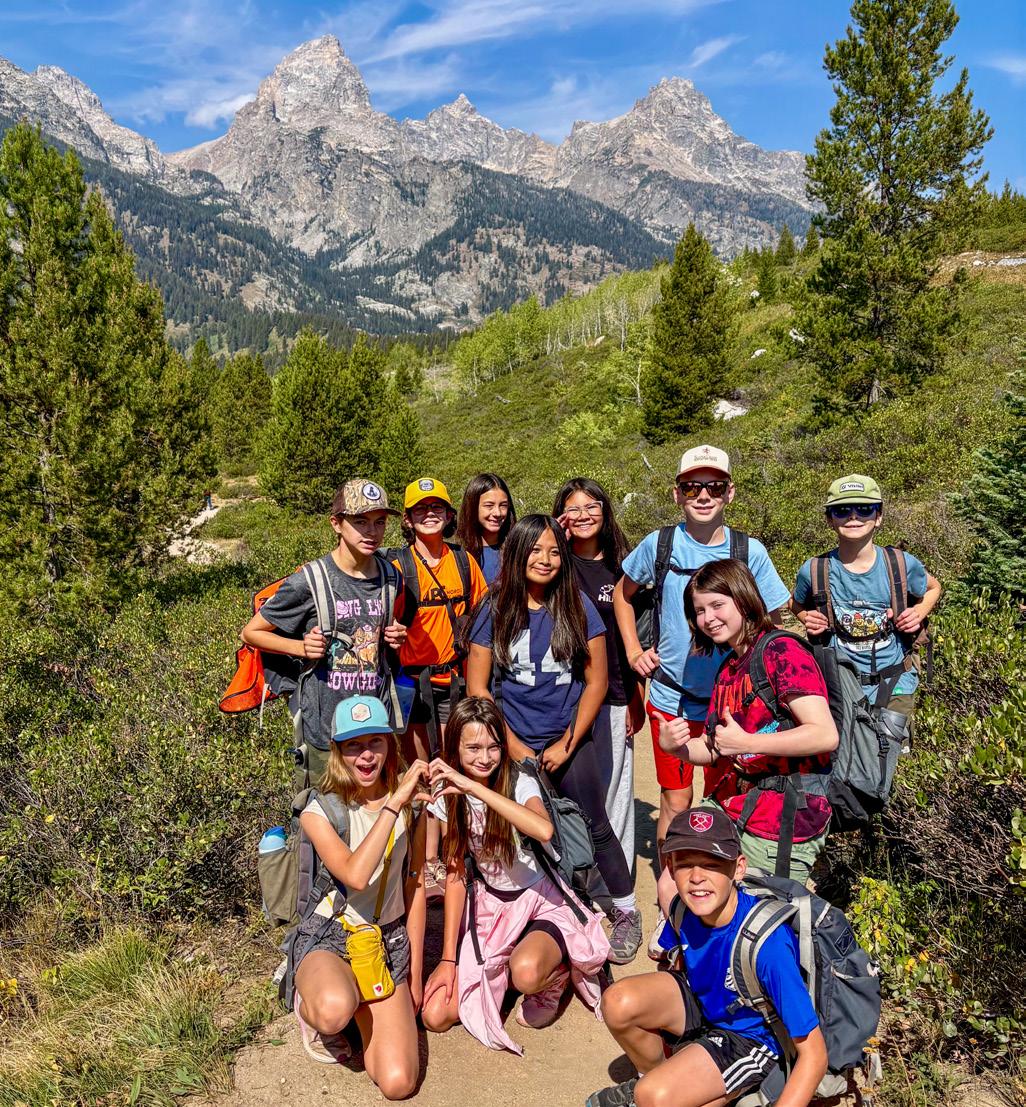
Our seventh-grade students head to the Teton Science Schools in Jackson Hole, WY, each fall for a week of science exploration. There, students become field scientists, engaging in a variety of placed-based learning activities that connect them to the awesome natural beauty of the area.
The eighth-grade year concludes with an annual trip to Washington, DC, to visit our nation’s capital. Much of what the eighth graders study throughout the year helps prepare them for a valuable field experience on this trip.
All Middle School students participate in the Winter Sports program, which begins in mid-January and continues for five Wednesday afternoons. Students participate in activities such as downhill skiing and snowboarding, ice skating, cross-country skiing, backcountry skiing, yoga, squash, SCUBA training, rock climbing, and more.
This program allows students to connect with seasonal physical and athletic pursuits, some of which take advantage of Salt Lake City’s geography, climate, and unique setting as a metropolitan area with immediate and extensive wilderness access. Our goal is to expose students to new sports and recreational activities that may become lifelong pursuits and, in turn, improve physical and emotional well-being.
The following academic policies apply to topics in this catalog and are provided for your reference. Please refer to the student-parent handbook for specifics.
We aim to collaborate for your student’s success, which includes regular attendance when they are healthy. As academic expectations rise each year, please schedule appointments outside school hours and plan vacations during breaks. Excessive absences make it harder for students to stay engaged and benefit from valuable classroom discussions and activities that can't be replicated elsewhere.
Prior to any planned absence, students must have teachers sign a green homework sheet that states what missed work can be made up. Students are responsible for missed work and should check Canvas for assignments. Please notify the office (msattendance@rowlandhall.org) of any planned absences or early dismissals, including if your student is sick.
Note that Middle School students must arrive by lunch in order to participate in any after-school activities occurring that day (a dance, game, theatre event, etc.).
Our Middle School values student choice in extension and elective classes. Course selection for the next year begins in spring, with caregivers receiving a catalog and selection form to review with their student.
All requests to change courses outside of the typical course selection process are subject to availability and may not always be accommodated due to limited space and the need to maintain balanced section sizes. Students may not request specific teachers or class periods. Advisors and Middle School administrators will guide students through the course change process as needed.

Read about student accomplishments in Rowland Hall Stories , Rowland Hall’s digital magazine.
ROWLAND HALL MIDDLE SCHOOL
843 Lincoln Street, Salt Lake City, Utah 801-355-7494 rowlandhall.org