
JAMES ROSS
DOI 10.20933/100001379

Except where otherwise noted, the text in this dissertation is licensed under the Creative Commons Attribution-Non Commercial-No Derivatives 4.0 International (CC BY-NC-ND 4.0) license.
All images, figures, and other third-party materials included in this dissertation are the copyright of their respective rights holders, unless otherwise stated. Reuse of these materials may require separate permission.
‘How grand! How wonderful! How incomprehensible!’
An
excavation and exploration of artistic responses to prehistory
By James Ryan Ross
Fine Art (Hons)
Word Count: 7469
A dissertation submitted in partial fulfilment of the requirements of a Bachelor of Arts (Hons) degree in Fine Art.
Duncan of Jordanstone College of Art and Design
University of Dundee 2025
Abstract
This dissertation explores the history of artists who have made work in response to Britain’s prehistoric sites. It does not seek to make any particular argument, but give a thorough critical survey of the tradition. The method is four-fold: deep reading of relevant texts; seeing artworks in person where possible; field trips to ancient sites, such as Avebury, that have been important to many artists; personal interviews with contemporary artists, and with experts who can offer insight into artists of the past. The first chapter introduces the topic though consideration of the development of prehistory as an idea, and takes an overview of the antiquarians, in particular William Stukeley, whose plans and illustrations of ancient sites created an aesthetic foundation on which artists later built. Chapter two covers the very different depiction of prehistoric sites in the work of Romantics, with a focus on the well known watercolours of Stonehenge by Turner and Constable. The third chapter explores the fascination Modernist artists – principally Paul Nash and Eric Ravilious – felt for the prehistoric. Chapter four turns to contemporary artists and features interviews with Jeremy Deller and Daniel & Clara, as well as analysis of works by Monica Sjöö and David Harding, exploring the ways in which their art uses prehistory to engage with social concerns. The dissertation concludes with a consideration of what common ground can be found between artists of such different styles and periods.
Acknowledgements
The writing of this dissertation would not have been possible without the help of my advisor Gair Dunlop. I also wish to thank the artists and other interviewees who gave generously of their time and expertise. I am grateful to all.
List of Figures – 5
Introduction – 7
Chapter I : Antiquarians – 8
Chapter II : Romantics – 12
Chapter III : Modernists – 16
Chapter IV : Contemporaries – 22
Conclusion – 32
Bibliography – 33
Appendix: Interview transcripts – 38
Contents
List of Figures
1. Inigo Jones’s reconstruction of Stonehenge, from his 1655 book Stone-Heng Restored. Image from John Michell’s Megalithomania (1982) Page 8
2. William Stukeley’s drawing of the Devil’s Den (1743), part of the Avebury prehistoric landscape. Image from Project Gutenberg. Page 9
3. William Stukeley’s snake-like interpretation of the Avebury landscape, from his 1743 book Abury, a Temple of the British Druids. Image from Project Gutenberg. Page 10
4. Drawing from William Blake’s Jerusalem (1804-20) showing the influence of William Stukeley’s depiction of Avebury, as well as Stonehenge-esque trilithons. Image from John Michell’s Megalithomania (1982) Page 10
5. Bill Brandt’s Stonehenge under Snow (1947) on the front page of Picture Post. Image from the Paul Mellon Centre, Yale University. Page 12
6. Caspar David Friedrich’s Cairn in Snow, or Hünengrab im Schnee (1807). Image from Staatliche Kunstsammlungen, Dresden. Page 12
7. J.M.W Turner’s Stonehenge (c.1827–28). Image from the Salisbury Museum. Page 13
8. John Constable’s Stonehenge (1835). Image from the Victoria & Albert Museum, London. Page 13
9. Paul Nash’s Equivalents for the Megaliths (1935). Image from Tate Britain, London. Page 16
10. Paul Nash’s Landscape of the Megaliths (1937). Image from the Victoria & Albert Museum, London. Page 16
11. Barbara Hepworth’s Forms in Echelon (1938) in a still from Figures in a Landscape (1953). Image from British Film Institute. Page 17
12. Mên-an-Tol in a still from Figures in a Landscape (1953). Image from British Film Institute. Page 17
13. Eric Ravilious’s The Cerne Abbas Giant (1939). Image from Rather Good Art. Page 18
14. Eric Ravilious’s The Long Man of Wilmington (1939). Image from the Victoria & Albert Museum, London. Page 18
15. Eric Ravilious’s The Vale of the White Horse (1939). Image from Tate Britain, London. Page 20
16. Paul Nash’s photograph of the Uffington White Horse (c.1937). Image from Tate Britain, London. Page 20
17. Monica Sjöö’s Meeting the Ancestors at Avebury (1993). Image from the Moderna Museet, Malmö. Page 22
18. Edward McKnight Kauffer’s Stonehenge (1931). Image from the Victoria & Albert Museum, London. Page 23
19. Jeremy Deller’s Sacrilege (2012) installed in Yorkshire Sculpture Park, Wakefield, 2012. Image from The Modern Institute, Glasgow. Page 24
20. Jeremy Deller’s Sacrilege (2012) installed in Glasgow Green, Glasgow, 2012. Image from The Modern Institute, Glasgow. Page 24
21. Jeremy Deller’s Built by Immigrants (2019). Image from The Modern Institute, Glasgow. Page 25
22. Jeremy Deller’s Cerne Abbas (2019). Image from The Modern Institute, Glasgow. Page 26
23. Daniel & Clara’s Avebury Complex (2023). Image from Daniel & Clara. Page 27
24. David Harding’s The Henge (1970). Image from BBC Scotland. Page 28
25. David Harding’s The Henge (1970). Image from Creative Carbon Scotland. Page 28
26. David Harding’s Heritage (1976) in Falkland Square, Glenrothes. Image from Grey Gardens (2016). Page 30
27. David Harding’s Heritage (1976) in Riverside Park, Glenrothes. Image from Grey Gardens (2016) Page 30
Introduction
This dissertation explores the history of artists who have made work in response to Britain’s prehistoric sites. It does not seek to argue a particular case, but to undertake a thorough critical survey of visual representations of these ancient landscapes, from the antiquarians of the 17th and 18th centuries, through the Romantics of the 19th and the Modernists of the early 20th, to contemporary artists whose engagement with such places allows them to explore 21st century concerns including national identity and climate change.
My own work is stimulated and catalysed by prehistoric landmarks, and my hope is to inform and inspire future work through this dissertation process. Therefore, my method has been to take a personal approach to research: carrying out interviews with a number of artists about the ways in which they respond to the prehistoric, as well as interviewing experts who can offer insight into artists of the past. I have made field trips to relevant ancient sites including Avebury stone circle and henge in Wiltshire, the Cerne Abbas Giant in Dorset, and the Pictish symbol stones in the Angus village of Aberlemno. Additionally, I have tried to see artworks in person where possible, including David Harding’s Glenrothes sculptures, and a selection of Monica Sjöö’s paintings. I have also read deeply in the available literature.
This dissertation is formed of four chapters. The first considers the development of prehistory as an idea, and introduces the ‘antiquarians’ – gentleman intellectuals of the 17th and 18th centuries who were the first to question the meaning and purpose of ancient sites. They did not see themselves as artists, and we shouldn’t regard them as such, but their depictions of prehistoric monuments provided a visual foundation on which artists would later build.
Chapter two, Romantics, explores the way in which painters of the 19th century – chiefly Turner and Constable – use their depictions of ancient sites, notably Stonehenge, to express strong personal feelings and to articulate the awe felt by those who encounter these places. In so doing, the painters were tapping into the Sublime, a concept defined by Edmund Burke, also covered in this chapter.
The third chapter, Modernists, examines the way in which prehistory became an important concern for artists of the early 20th century, with a particular focus on the paintings of Paul Nash and Eric Ravilious. Ancient monuments were the subject they chose when trying to connect the landscape tradition with new artistic ideas and language of the interwar years.
Chapter four, Contemporaries, deals with those artists of our own time who create work inspired by prehistory in order to reflect the concerns of the present day, such as climate change and national identity. Jeremy Deller is perhaps the leading artist in this field, and his practice is discussed in the chapter, as are works by David Harding, Monica Sjöö, and Daniel & Clara.
The dissertation will conclude with some thoughts regarding what the various artistic responses to prehistory may have in common.
Chapter I : Antiquarians
The nobleman Sir Richard Colt Hoare was a keen antiquarian and amateur artist who spent his wealth on excavating ancient sites. He has been described as one of the ‘founding fathers of modern British archaeology’ (Hill, 2008, p. 51) and is known for his book The Ancient History of Wiltshire (1821) in which he observed that a traveller on Salisbury Plain encountering Stonehenge would be bound to exclaim, ‘HOW GRAND! HOW WONDERFUL! HOW INCOMPREHENSIBLE!’ (Hill, 2008, p. 52). This quote expresses both the joyful wonder which antiquarians felt about ancient structures and their bafflement about what these places were and when they were made. Prehistoric remains were everywhere, but the idea of prehistory, even the word, had not yet been invented.
The first use of ‘prehistoric’ in English was in The Archaeology and Prehistoric Annals of Scotland, a book of 1851 (Daniel, 1967, p. 24). ‘Prehistoric’ refers to the period before written history. Eighteenth and 19th century developments in the study of geology and fossils suggested that the world was far older and that human life had been present for many more thousands of years than Biblical orthodoxy had insisted (Fagan, 2018, pp. 41-47). The ‘Three Age System’ in which prehistory is divided into the Stone, Bronze, and Iron ages (Fagan, 2018, p. 57), was established in the 19th century, but it wasn’t until 1950 that the development of radiocarbon dating allowed for the true ages of archaeological remains to be established (Morris, 2012, pp. 79-80).
But none of this scienti rst people, the so-called ‘antiquarians’, who attempted to study and understand prehistoric structures and to depict them with visual accuracy. Their drawings of Stonehenge and other sites were not intended as works of art, but have a pleasing aesthetic that created a foundation upon which later artists have built. Their work also brought these sites to wider public attention, again opening the way to artists who would make them their subject.
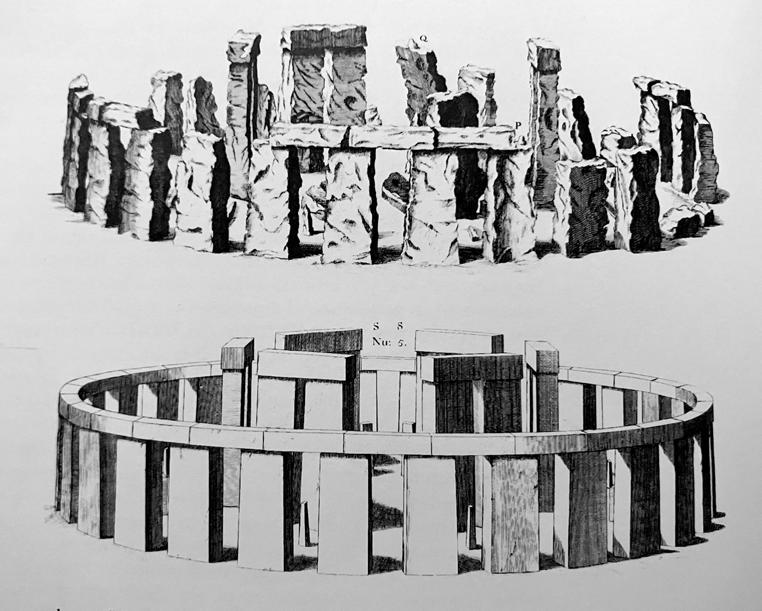
The first person to write a book about Stonehenge and to attempt to draw how it might have looked when first built, was the architect Inigo Jones in Stone-Heng Restored, his posthumous work of 1655. Jones regarded Stonehenge, incorrectly, as a Roman building, and his drawings have a stiff geometric quality that shows his obsession with classical architecture (Chippindale, 1983, pp. 57-60). John Aubrey was the first person to attempt an accurate ground-plan of Stonehenge, including this in his book Monumenta Britannica
Fig 1. From Inigo Jones’s Stone-Heng Restored (1655)
(1665-93). Aubrey saw Stonehenge as a creation of the ancient British people, and in particular as a temple of the druids – pagan priests – an idea that would later have great influence on the Romantics (Hill, 2008, pp. 30-33).
However, the individual who first blurs the line between antiquarianism and art is William Stukelely (1687-1765). ‘Of all the antiquarian artists who have specialized in depicting megalithic monuments, personal opinion rates William Stukeley the greatest,’ the writer John Michell has said, ‘on account of the mystical feeling for landscape that declares itself even in his detailed plans and drawings.’ (1982, p. 40) Stukelely, Michell added, had a ‘genius as a topographical draughtsman’ (1982, p. 17).
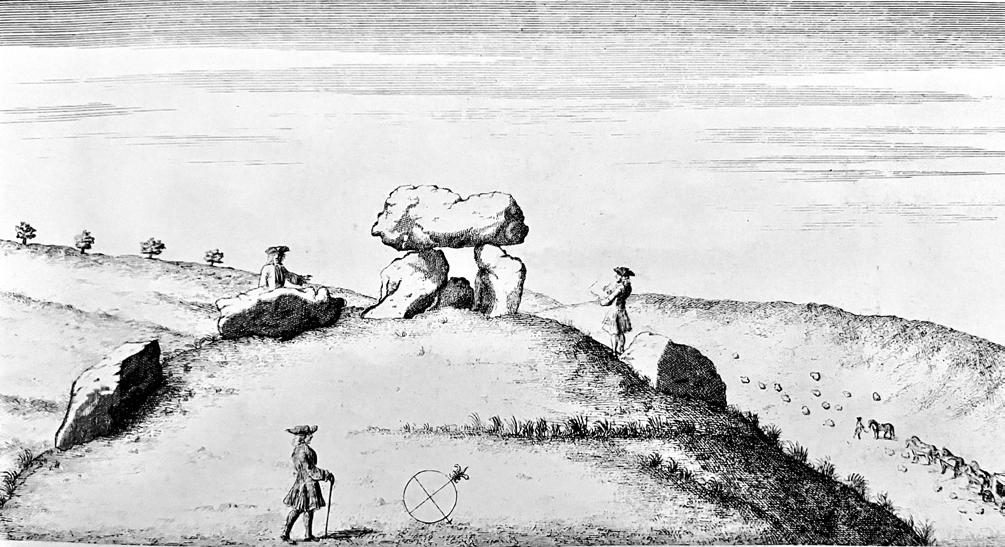
Stukeley, a physician and later a clergyman, was fascinated by Britain’s prehistoric landscape. He made many journeys, drawing ancient sites in considered detail, his pictures preserving the appearance of stones and structures that have since disappeared (Michell, 1982, p. 11).
His influence has had a lasting effect on archaeology and on public interest in prehistory in Britain, bringing the grand monuments of the past to the attention of artists, poets, writers, and tourists (Michell, 1982, p. 15). To give one example, William Blake (1757-1827) had studied Stukeley’s 1743 book Abury, a Temple of the British Druids, and the influence is detectable in his work. Huge trilithons – a word Stukeley had coined to describe two upright stones topped by a lintel – and snake-like stone avenues appear in his illustrations to the epic poems Milton (1804-10), and Jerusalem: The Emanation of The Giant Albion (1804-20). The serpentine avenues are derived from Stukeley’s drawings of Avebury (Smiles, 2017, pp. 42-43).
In the summer of 2024, Stukeley’s drawings of the Avebury landscape were exhibited in the Great Barn, a 17th century farm building on the site. These were not originals, but reproductions blown up to poster size. This enlargement allowed for detailed study.
Fig 2. From William Stukeley’s Abury, a Temple of the British Druids (1743).
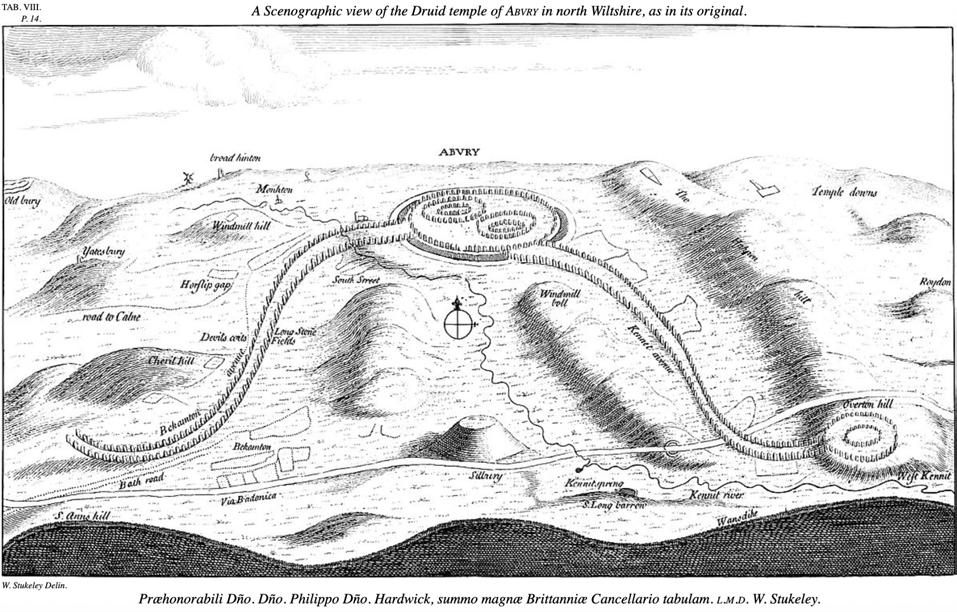
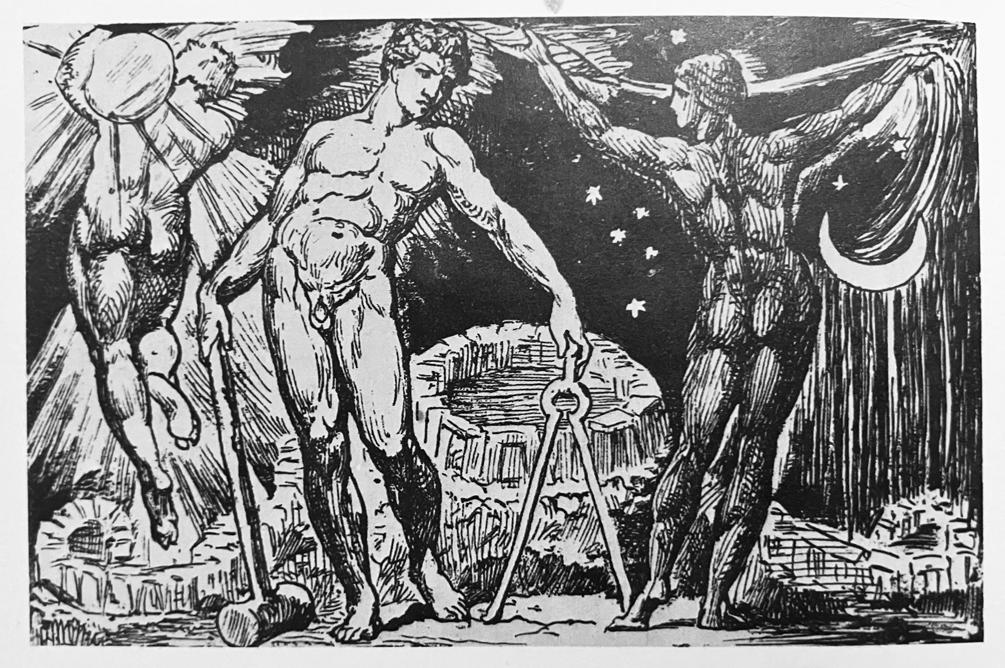
Fig 3. (top) From William Stukeley’s Abury, a Temple of the British Druids (1743) Fig 4. (above) From William Blake’s Jerusalem (1804-20). Stukeley’s serpent-like depiction of Avebury was a clear influence on Blake.
Stukeley’s careful drawing meant that I was able to recognise a number of individual standing stones, having just come from sketching them myself. One of the joys of Stukeley’s drawings is that he cheerfully includes elements from his own age: gentlemen in tricorn hats, ladies in petticoats; pet dogs and horse-drawn carriages. The pleasure he takes in observing and depicting place is apparent and infectious.
This is why Stukeley’s works, of all the antiquarians, could be considered art. They are not just recording information, they have a mood and elicit emotion in the viewer, prefiguring the treatment of such sites in the Romantic era.
Chapter II : Romantics
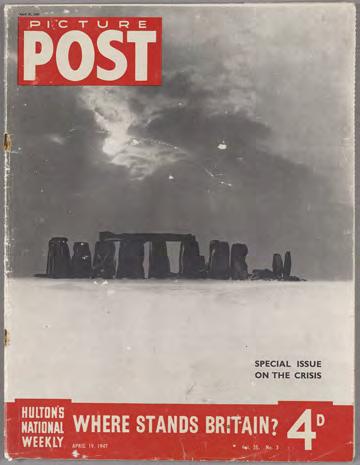
On April 19th 1947, a new issue of the Picture Post was published. The front page photograph, by Bill Brandt, was of Stonehenge in the snow (Picture Post, 1947, p. 1). The black megaliths, stark white foreground and heavy grey sky – with bright sun beginning to break the clouds – communicated a feeling of anxiety and uncertainty that suited the cover story on Britain’s energy and economic crisis. Brandt’s picture is, above all, Romantic. It conveys not just the physical reality of the scene, but strong emotion; it is not straightforwardly beautiful and pleasing, but contains negative feelings – melancholy and dread – that provide an enjoyable shiver.
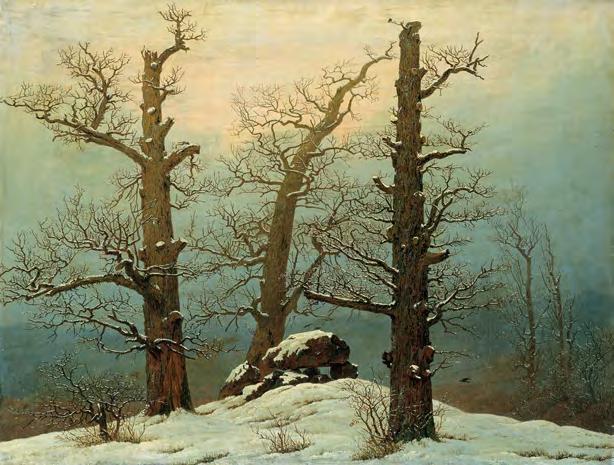
Brandt’s lonely stones bring to mind Cairn in Snow (1807), a painting of a Neolithic burial chamber by the Romantic landscape artist Caspar David Friedrich. Prehistoric ruins – in their mystery, decay and eeriness – appealed to the Romantic sensibility.
In Britain, the outstanding Romantic depictions of the prehistoric are the watercolours of Stonehenge by J.M.W. Turner and John Constable. Art historian Louis Hawes, in his monograph on Constable’s Stonehenge (1835), asserts that the two painters were the first to adequately convey that sense of the Sublime inherent in the monument (1975, p. 13).
The Sublime is a quality and concept defined by Edmund Burke in A Philosophical Enquiry into the Origin of Our Ideas of the Sublime and Beautiful. For Burke, sublime places and objects do not simply please the eye and mind, but stimulate fear and what he calls ‘delightful horror’ (Burke, 1757, p. 67) – delightful in the sense that the individual is in no real danger, and therefore experiences landscape as ‘tranquility tinged with terror’ (1757, p. 123). For Burke, a winding river may be beautiful, but a raging waterfall is sublime. A stone circle is sublime because it is rough, disproportionate, and uncivilised. Indeed, for Burke, Stonehenge’s rugged appearance intensified its sublimity:
‘Stonehenge, neither for disposition nor ornament, has anything admirable; but those huge rude masses of stone, set on end, and piled on each other, turn the mind on the
Figs 5. & 6. Bill Brandt’s Picture Post photo of Stonehenge (1947) and Caspar David Friedrich’s Cairn in Snow (1807)
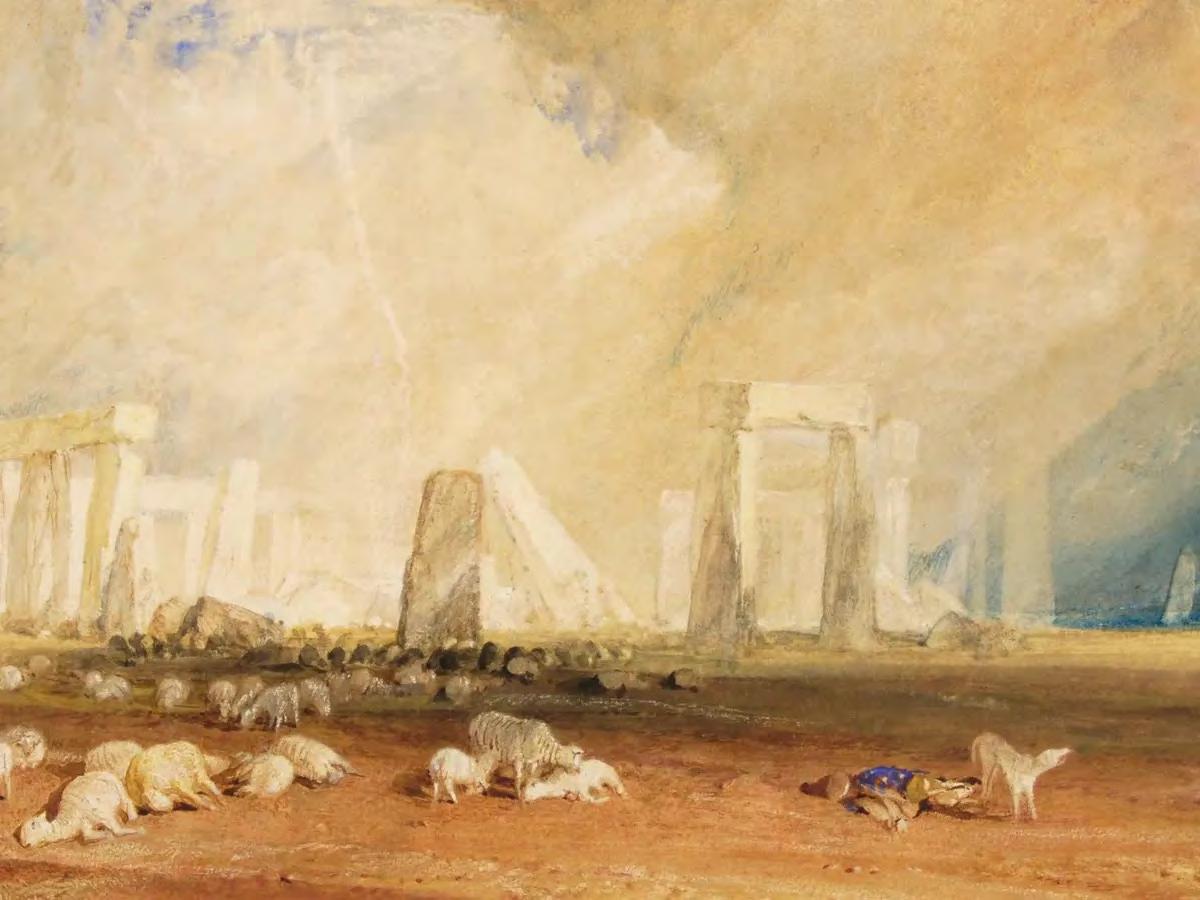
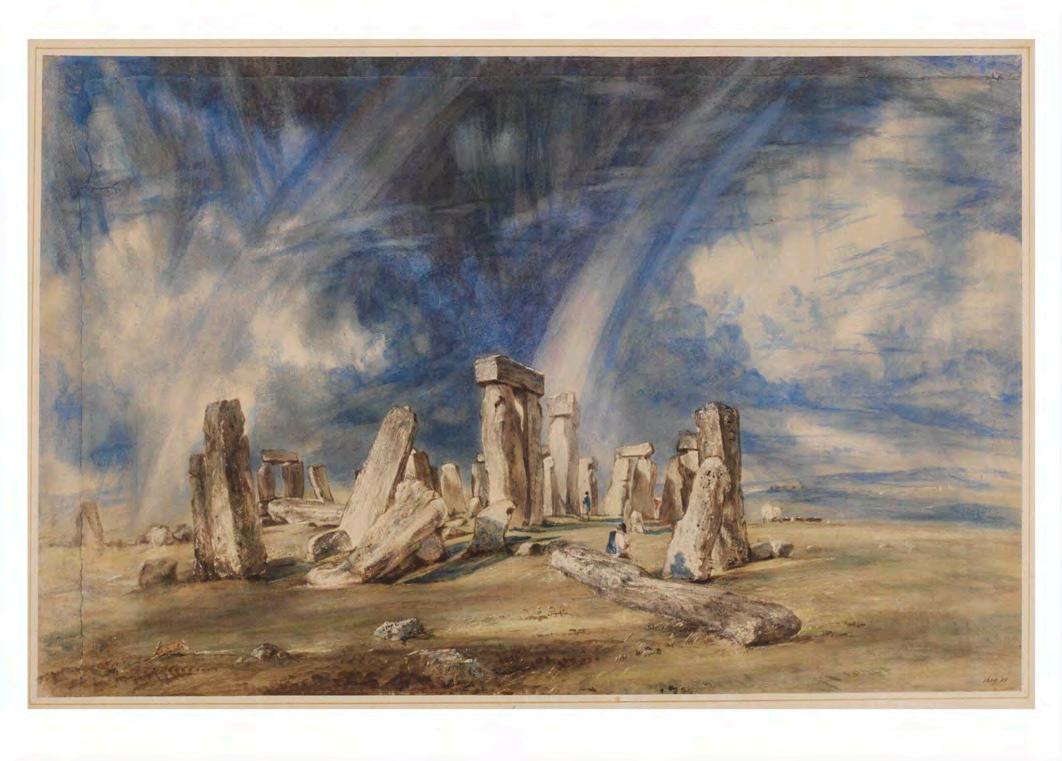
Fig 7. (top) J.M.W Turner’s Stonehenge (c.1827-28). Fig 8. (above) John Constable’s Stonehenge (1835).
immense force necessary for such a work. Nay the rudeness of the work increases this cause for grandeur’ (1757, p. 71).
It is this Stonehenge, the Sublime Stonehenge, rather than the topographical monument depicted by the antiquarians, that Turner and Constable painted.
Turner’s Stonehenge (c.1827–28) is a wild scene, a sky of storm clouds and lightning. A shepherd and sheep have been struck dead; his dog howls in dismay. The watercolour was painted and then engraved for the series, Picturesque Views in England and Wales (1827-38). The Picturesque was ‘a middle ground between Burke’s categories of the sublime – too stirring – and the beautiful – not quite stirring enough.’ (Owens, 2020, p. 155) There is a gentleness and serenity to the Picturesque; one thinks of idyllic countryside.
‘These are supposed to be picturesque views, but this [painting] is not,’ Adrian Green, director of Salisbury Museum said of Turner’s Stonehenge when we spoke over video call. ‘This is drama! This is the elements! … It evokes the mystery of the place; the unknowable in the monument.’ (2024) It is, in other words, Sublime. The watercolour is part of the Salisbury Museum collection.
Turner’s strategy was to ‘extract the essence of the monument’s power and wonder’ in an effort to ‘wrench Stonehenge out of its topographical co-ordinates to present it at the centre of a maelstrom of energy’, the resulting image moving ‘beyond description to capture the impact Stonehenge had on all those who encountered it’ (Smiles, 2017, pp. 16-18).
Comparison with Constable’s Stonehenge, painted a few years later, is instructive. ‘They’re very different paintings, aren’t they?’ Green said. ‘Constable’s use of colour is more naturalistic, lots of blues and greens, whereas Turner’s painting is violent; the reds and oranges and browns almost seem alien. Constable seems concerned with depicting the monument accurately, whereas Turner doesn’t seem that fussed … His main concern is the drama that he’s keen to play out against this historic monument and landscape.’ (2024)
This is not to say that Constable’s painting is realist. Indeed, the artist himself insisted that his watercolour should be ‘poetical’ rather than ‘literal’ (Hawes, 1975, p. 7).
Constable’s Stonehenge is a lonely picture. A man rests on a toppled stone, kept company by his own shadow, which falls on a leaning megalith. Dark storm clouds loom above, divided by a double rainbow. In the foreground, a hare darts for a corner of the frame. Shadow, rainbows, hare: evanescent images which contrast with the primeval stillness of the stones. The sky in Turner’s Stonehenge is the more celebrated, not least by John Ruskin who called it ‘the standard of storm drawing’ (Hawes, 1975, p. 17), but Constable’s sky – although understated in comparison – is nevertheless radical and deeply strange. In particular, those spectral rainbows, made by wiping away paint from the paper (Hawes, 1975, p. 4), look more like the sort of sublime waterfalls Edmund Burke might have appreciated.
‘This extraordinary sky possesses a degree of dynamism unprecedented in the artist’s oeuvre,’ says Hawes (1975, p. 4). Why so? Perhaps because it conveys Constable’s personal turbulence. He had sketched Stonehenge in 1820, but by the time he came to paint it fifteen years later, he was experiencing distress following the death of his wife and a number of friends, as well as political and financial worries (Hawes, 1975, pp. 5-6). The 14
picture can be seen as a psychological self-portrait. Constable’s paintings were ‘landscapes of his soul, repositories of memory and emotion’ (Owens, 2020, p. 189).
Constable’s response to prehistory almost prefigures Expressionism in its emotional and stylistic intensity. His portrait of the ancient stones offers a glimpse of modernity.
Chapter III : Modernists
One day in the high summer of 1933 a painter came to Avebury. The landscape Paul Nash saw was not what William Stukeley had seen. Most of the megaliths had been broken up for building material in the 18th century, while others had been buried centuries earlier by superstitious villagers (Burl, 1979, pp. 30-56). But enough remained to make a strong impression.
‘The great stones were then in their wild state,’ Nash wrote. ‘Some were half-covered by the grass, others stood up in cornfields or were entangled or overgrown in the copses, some were buried under the turf. But they were wonderful and disquieting, and as I saw them then, I shall always remember them.’ (Montagu, 2003, p. 36)
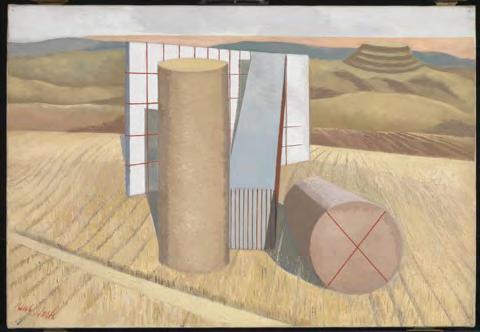
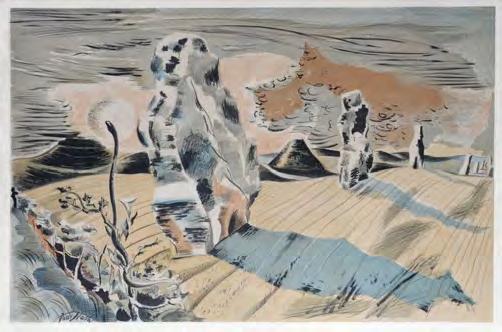
Struck by this strange beauty, Nash took photographs and made several drawings. He would go on to make a number of paintings and lithographs based on Avebury, two of which – Equivalents for the Megaliths (1935) and Landscape of the Megaliths (1937) – are among the most accomplished of his career.
Nash was one of a number of artists working between the wars for whom ‘ancient, manmade landscapes began to exert an attraction every bit as powerful as mountains had in the eighteenth century’ (Owens, 2020, p. 248). Alexandra Harris, in Romantic Moderns, names some of these artists: Henry Moore, John Piper, Barbara Hepworth and Walter Gropius – ‘prehistory had an impressive list of modern advocates appropriating its monuments for their various visions of England’ (2010, p. 213).
What visions? Moore had first encountered Stonehenge by moonlight in 1921, and it ‘helped to form his sense of the possibilities of sculpture in landscape, of how art set within nature could become monumental. Like Barbara Hepworth, he saw a connection by descent between himself and the creators of the stone circles, between the mute mystery of Stonehenge and the abstractions of twentieth century art.’ (Hill, 2008, pp. 156-157)
What Stonehenge was for Moore, the Cornish megaliths were for the sculptor Barbara Hepworth (1903-1975). She had moved there from London in 1939, fearing the imminent war (Clayton, 2021, p. 95). In a letter of 1940, she named some of the Neolithic sites that had met her eye (Smiles, 2017, p. 25), the most notable of which, given Hepworth’s use of 16
Fig 9. (left) Paul Nash’s Equivalents for the Megaliths (1935). Fig 10. (right) Landscape of the Megaliths (1937).
openings in her sculpture, is the iconic holed stone Mên-an-Tol. Cornwall’s prehistoric sites, she wrote, have ‘a very deep effect on me, developing all my ideas about the relationship of the human figure in landscape’ (Smiles, 2017, p. 106).
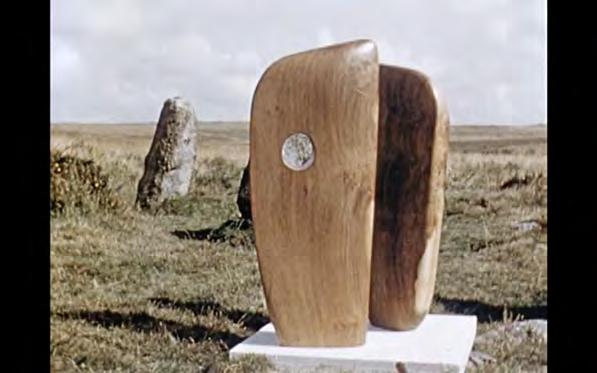
Figures in a Landscape, scripted by archaeologist Jacquetta Hawkes, is a short film in which Hepworth’s modernist sculptures are juxtaposed with ancient sites, suggesting an equivalence or relationship. It is striking how similar they are. In one scene, Mên-an-Tol is filmed through an opening in Hepworth’s 1938 work Forms In Echelon (Figures in a Landscape, 1953).
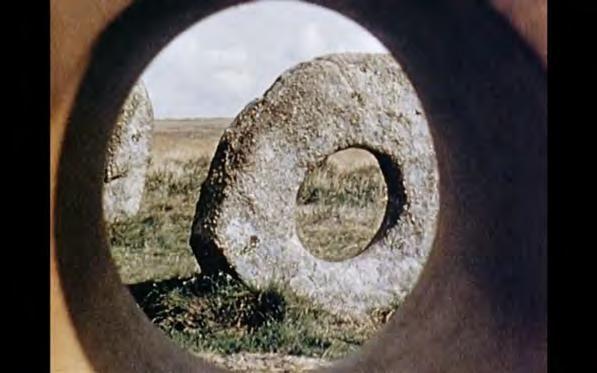
Why had so many British artists become fascinated with prehistory? Sam Smiles, in British Art Ancient Landscapes, offers three reasons. Firstly, archaeological discoveries were being covered in the media with greater regularity, stimulating public interest. Secondly, the depiction of ancient sites fitted the genre of landscape art, in which tradition many contemporary artists worked; John Piper’s collage Archaeological Wiltshire (1936-37), for example, has elements of abstraction, but remains recognisably a picture of the English countryside. Finally, the increasing interest in ‘primitive’ art from other continents, notably Africa, led to a growing fascination with the prehistoric culture of Britain (Smiles, 2017, p. 19).
Arguably, too, the appearance of ancient sites – arranged in circles and lines – informed a homegrown response to the abstract art movements of continental Europe. The formal aspects of ancient sites seemed to have kinship with Constructivism, while the feeling of these places – dreamlike and mysterious – had more in common with Surrealism. As Rosemary Hill has written of the Modernist attitude to Stonehenge, ‘If they found it less forbidding than the Romantics had, they were perhaps more moved by it, for it seemed to speak a visual language they could understand.’ (2008, p. 156)
One artist fluent in the language of landscape was Eric Ravilious (1903-1942), the watercolourist and designer. ‘Ravilious,’ according to the painter and writer Christopher Neve, ‘had an eye that effortlessly identified design in landscape and objects where it already existed, whether in the emblematic whiteness of chalk hill figures or in the jam spiral on the end of a Swiss roll.’ (1990, pp. 28-29)
Ravilious had been taught by Paul Nash at the Royal College of Art, London, in the mid-1920s (Ravilious, 2023, p. 11). This had a lasting impact on his sensibility. Neve
Figs 11. & 12. Barbara Hepworth’s Forms in Echelon (1938) and Cornwall’s iconic prehistoric holed stone Mên-an-Tol seen through it, in stills from Figures in a Landscape (1953).
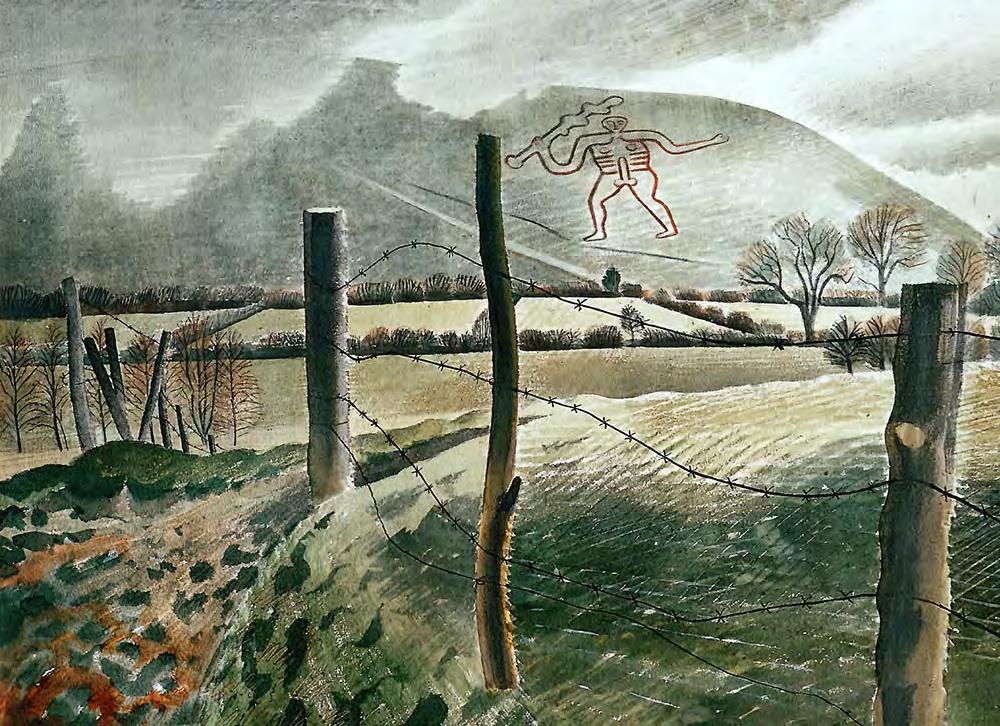
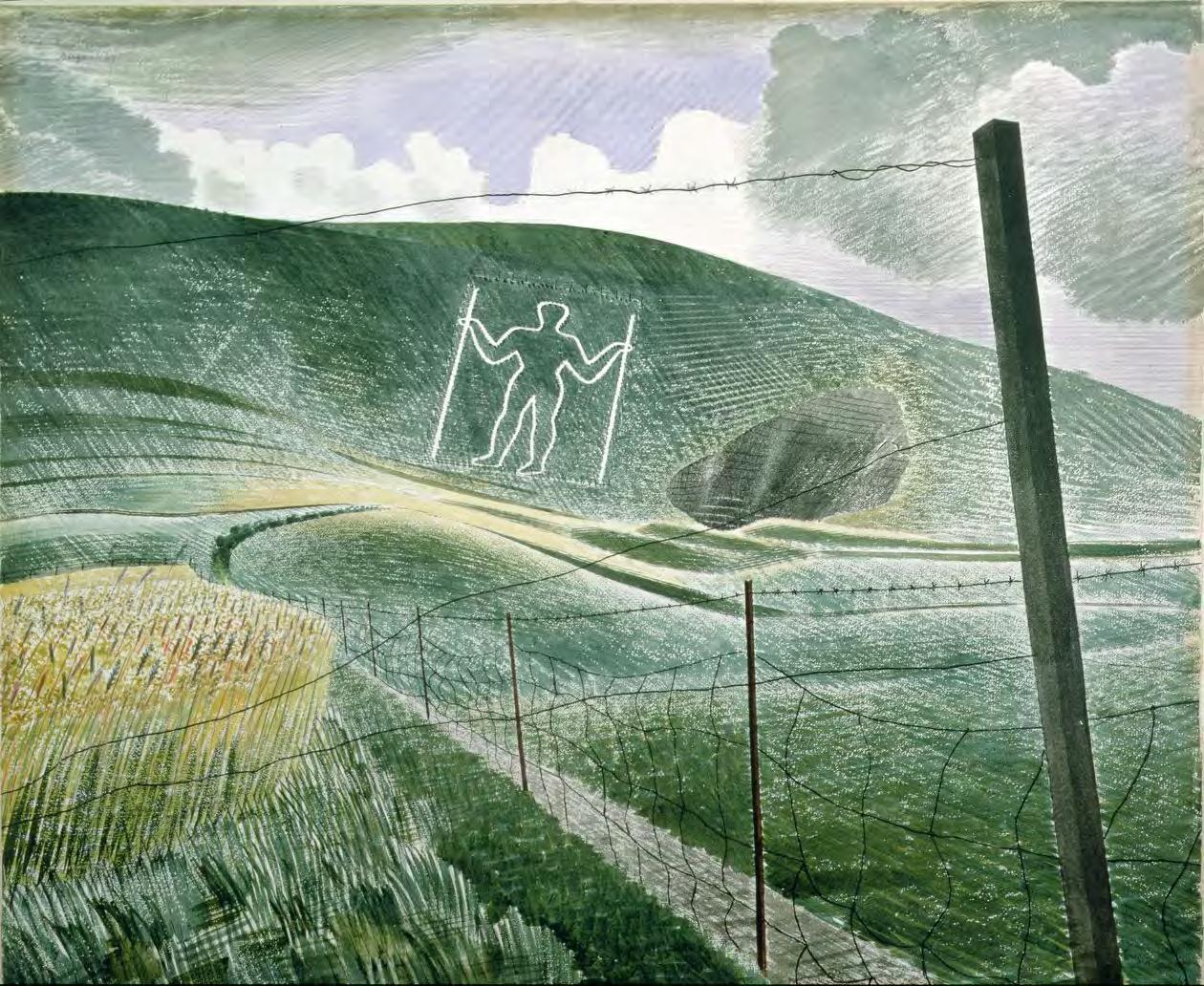
Fig 13. (top) Eric Ravilious’s The Cerne Abbas Giant (1939). Fig 14. (above) The Long Man of Wilmington (1939).
writes of Nash, ‘A subject always needed to appeal to the geometric side of his painter’s nature, the side that made him a modernist graphic designer and a design teacher’ (1990, p. 19). This could, even more so, be said of Ravilious, who seemed to see pattern everywhere he looked, whether in the South Downs or among the Arctic convoys. Such landscapes held a particular aesthetic appeal: ‘The colour white – or if not colour, then tone, or atmosphere, or absence – seems to have possessed a particular power of attraction for him: it was there first in the chalk of the south, and later in the ice of the north.’ (Macfarlane, 2012, p. 299)
His love of whiteness may have led him to accept a commission to illustrate a children’s book with the working title White Horse. This was to focus on the prehistoric landscape of the southern chalklands, in particular the giant figures carved into hillsides in the ancient past. In December 1939, Ravilious drew the Cerne Abbas Giant in Dorset and Uffington White Horse in Berkshire. He died before the book could be published, but his paintings of these monuments were completed (Pearson, 2019).
The Uffington White Horse, which measures 110 metres from head to tail, was a creation of the late Bronze Age or early Iron Age. In Ravilious’s watercolour, however, you might miss it. Located in the upper middle third of the painting, the figure is only just visible on the edge of the hill, rather like a scuff on the tip of a boot. Indeed the ancient carving seems almost incidental. ‘I think it’s as much about chalk as it is about ancient figures,’ replied Ella Ravilious when I asked – by video call – about her grandfather’s depiction of prehistoric hill figures (2024). Again, it seems to have been the whiteness that attracted him. White is the quintessential Modernist colour, especially in architecture and the new gallery spaces. Chalk, therefore, is ‘inherently more modern than granite or sandstone’ (Harris, 2010, p. 217).
The Long Man of Wilmington (1939) is a good example of a Modernist artist working within the landscape tradition. Ravilious’s use of barbed wire as a framing device, which he also employs in his picture of the Cerne Giant, distinguishes him as a painter of modernity. ‘The inclusion of the wire fence is very modern,’ Ella Ravilious told me. ‘Even though it seems like quite a nostalgic picture now, that was part of his style – not to prettify the picture or hide anything.’ (2024)
The barbed wire has been interpreted as an allusion to impending war (Smiles, 2017, p. 98) but Ravilious, a curator at London’s Victoria and Albert Museum, argues that such symbolism was not her grandfather’s way: ‘I think he was quite a straightforward person and not given to wild romantic ideas like that.’ He had a ‘lightness’, she said, that manifested itself in uncomplicated enjoyment of physical reality (2024).
‘Lightheartedness’ is the quality Christopher Neve most associates with Ravilious. But he does not think him shallow or unserious (Neve, 1990, pp. 28-38). Indeed, it is one of Ravilious’s gifts that he is able to intensify the pleasure of landscape, as is clear from his paintings of hill figures. ‘These were already enchanted sites, but Ravilious casts his own magical light over them and asks us to look at them afresh.’ (Owens, 2020, p. 252)
Despite his pictures being on the surface quite straightforward, there is a sense of the visionary about them. The White Horse is a good subject for Ravilious because, like his paintings, it is very obvious and yet has a felt mystery. ‘That elusiveness and unreadableness is very much part of his work,’ Ella Ravilious said. ‘If we knew exactly what they meant, they would not be by him.’ (2024)
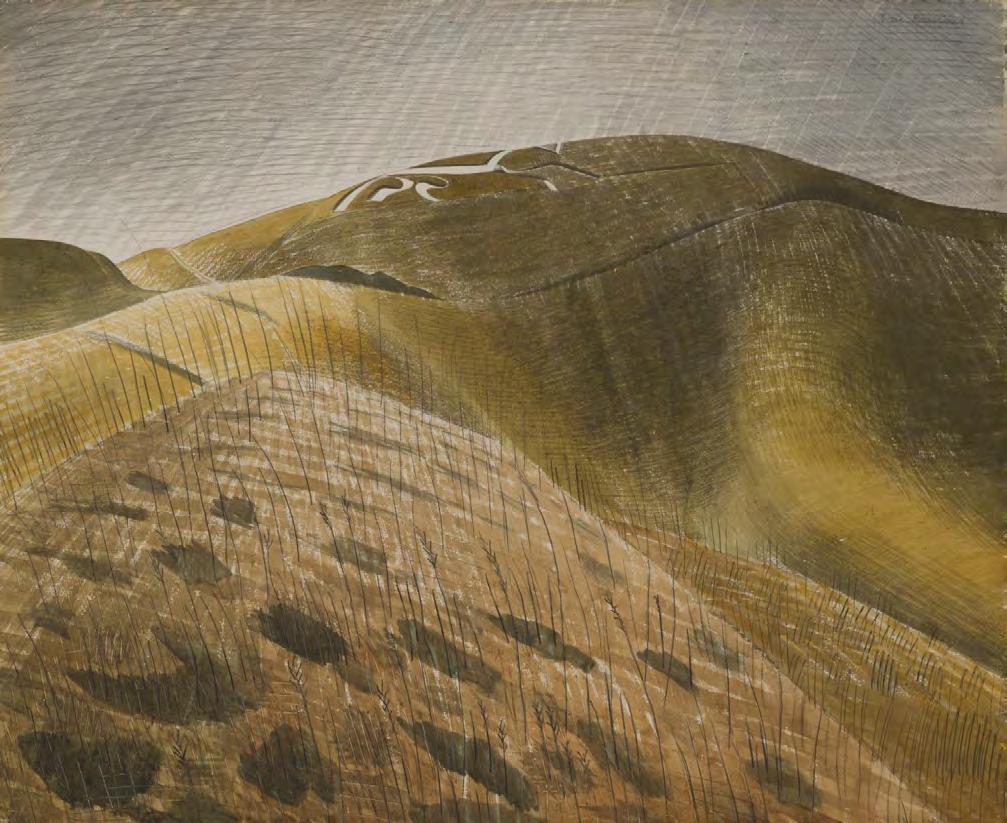
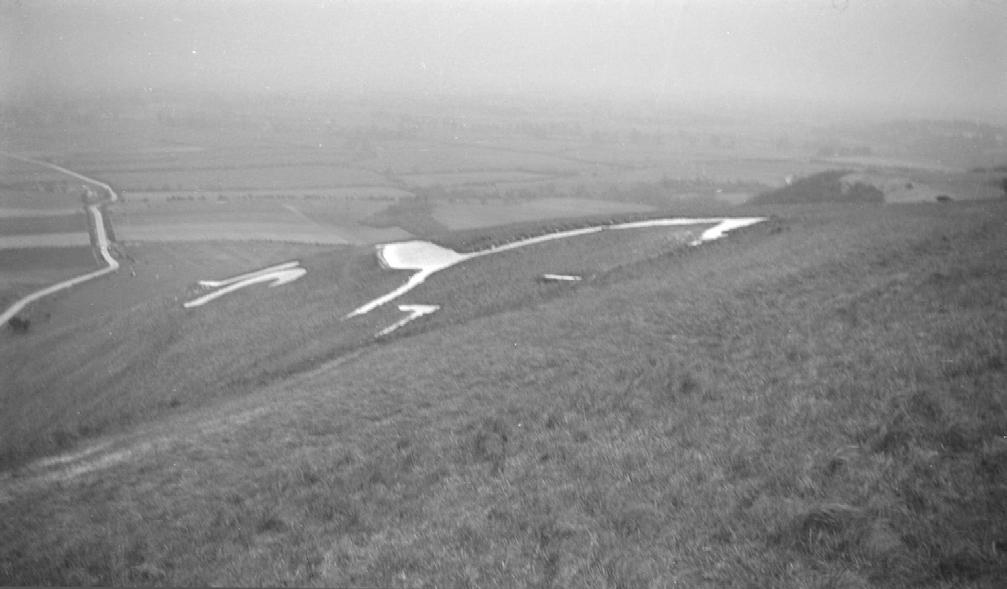
Fig 15. Eric Ravilious’s The Vale of the White Horse (1939). Fig 16. Paul Nash’s photograph of Uffington Horse (c.1937).
Paul Nash had photographed the Uffington White Horse in 1937. Like Ravilious, he wasn’t interested in documenting the figure in its complete form. What was important, he wrote in Country Life, was that ‘the landscape asserts itself with all the force of its triumphant fusion of natural and artificial design.’ (Montagu, 2003, p. 66)
For Christopher Neve, Nash’s ‘essential subject was time’ which he explored through the depiction of prehistoric sites (1990, p. 25). Neve feels that Nash – like Ravilious – was attempting to capture ‘something unpaintable, indefinable’ (1990, p. 20), some spirit of landscape present ‘in ancient sites, in clumps and standing stones, where the enormity of what had passed was still in the air like electricity.’ (1990, p. 16) In this, Nash felt a kinship with Blake and Turner, artists who – he wrote in 1934 – had been able to capture in their paintings ‘a reality more real’ (Montagu, 2003, p. 48). Nash also knew the drawing and writing of William Stukeley, and Sam Smiles has argued that the oil painting Druid Landscape (1934) and lithograph Landscape of the Megaliths (1937) are responses to that work (2003, p. 34).
Nash, then, is a painter who synthesises Romantic and Antiquarian ideas of the prehistoric in his own intense and transporting works of art.
Chapter IV : Contemporaries
A number of recent media stories have explored why prehistory is once again in vogue among artists and the public. A feature in the Financial Times (Farrell, 2022) includes interviews with a number of artists, among them Emii Alrai whose work, inspired by the ‘powerful aura of the past’, makes a connection between the movement of megaliths –through glaciation and man’s intervention – and human migration, of which she has family experience. The artist Matthew Shaw, co-founder of megalith enthusiast group Stone Club, is quoted on the BBC website (Jana, 2022) as saying standing stones offer escape and consolation from grim political realities: ‘They’re always on the outside.’ For curator Simon Costin, quoted in The Observer, ancient sites and the folklore that often surrounds them offer spiritual experiences to secular people: ‘Organised traditional religion is abhorrent to most of them … so instead they’re looking at prehistoric monuments and pilgrimage routes.’ (Fisher, 2023)
Prehistory has been important to certain contemporary artists before this particular cultural moment. Monica Sjöö (1938-2005), the Swedish-born feminist artist and activist who lived and worked in Britain, had a long creative relationship with the prehistoric sites of Wiltshire. This began in 1978 with a visit to Avebury henge and Silbury Hill. There, under the influence of magic mushrooms, she had her first encounter with what she called the ‘Cosmic Mother’, a goddess figure who would appear in much of her work (Sjöö, 2018, p. 18).
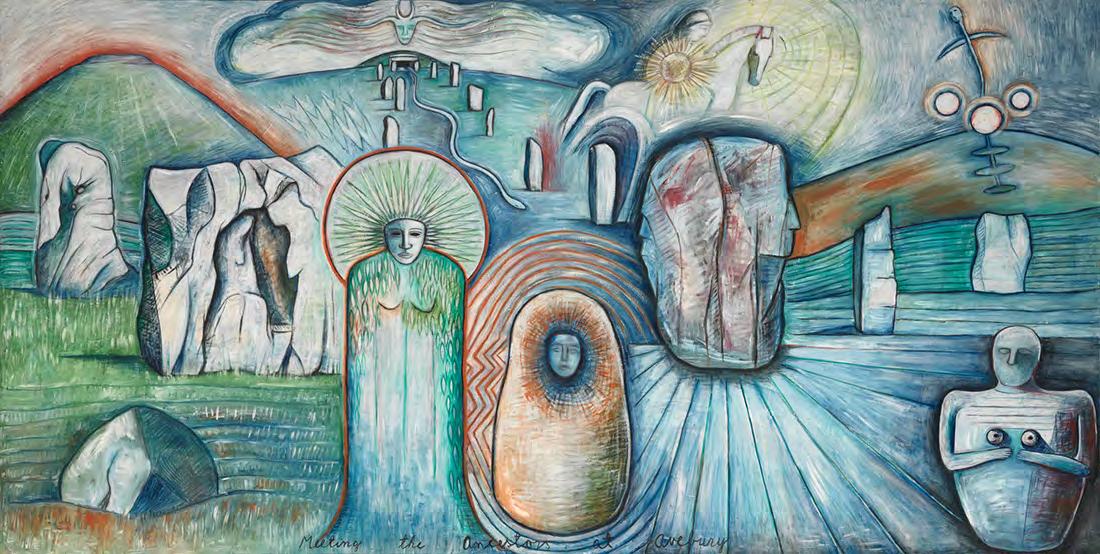
When I saw an exhibition of her paintings at the Moderna Museet in Malmö, Sweden (The Great Cosmic Mother (2024)) I was struck by how many depict prehistoric sites of the south of England. In Meeting the Ancestors at Avebury (1993), Silbury Hill is in the background, beside it lies the West Kennet Avenue of megaliths, and in the middle ground is one of the most distinctive stones of the Avebury circle, the so-called Devil’s Chair. Of this painting, Sjöö has written, ‘I have woven together Silbury, Avebury stones and spirits that dwell in them’ (Sjöö, 2014).
Fig 17. Monica Sjöö’s Meeting the Ancestors at Avebury (1993).
Although these paintings depict real landmarks, their composition is highly stylised. Sjöö’s Avebury is more dreamscape than landscape; the appearance and atmosphere of the works seem to reflect the spiritual significance she found in these places and perhaps her experience of being in an altered state. It is notable, however, that her paintings are not simply expressions of intense personal experience. They look out to the world, not just in to the self. As the directors of Moderna Museet and Modern Art Oxford have written, ‘Sjöö is an artist who is strikingly current today, whose work engages strongly with present concerns about climate change, social equity and justice, and the place of women in global culture … The power of her art is stronger now than ever before.’ (Ørskou and Hobson, 2023, pp. 11-13) If that is so then, surely, some of that power derives from Sjöö’s depiction of ancient sites, harnessing their potency to explore her own themes and agendas.
A very different artist, but one inspired by some of the same landscapes as Sjöö, Jeremy Deller (1966) is the most prominent of the current generation of creatives responding to the prehistoric.
He is an English conceptual artist whose works combine politics, history, pop culture and humour. His love of history developed in childhood, through visits to museums, in particular London’s Horniman Museum, where he joined the art club. ‘That was my playing ground, and it still is in a way,’ he has said. ‘It’s where I go and play, in a sense. I just wander round the backstages of museums, picking out things and looking at things. ‘I’m very at ease in that world.’ (Desert Island Discs, 2019)
Asked by email whether he regards himself as working within the lineage of British artists who have created art concerned with prehistory, he replied that it is for others to judge (Deller, 2024). But one of his best known works, Sacrilege (2012) is certainly part of a tradition of depictions of Stonehenge. Unlike Constable and Turner, Deller’s work is sculptural – a life-size inflatable model of the monument. It was made to his specifications by Inflatable World Leisure, a manufacturer of ‘bouncy castles’. Sacrilege was first displayed, on Glasgow Green, as part of the Glasgow International Festival of Visual Art, its inflated trilithons mirroring the tower block skyline. Unlike the real Stonehenge, which visitors are not allowed to enter and touch, Sacrilege was made with the intention that adults and children would jump around and enjoy it.
‘I wanted to make something fun and stupid that the public could interact with, but was also a comment of sorts on national identity,’ Deller told me, by email (2024).
Stonehenge has long been a symbol of Britishness. One tabloid newspaper featured the monument on a pro-Brexit front page that also included a Spitfire and the UK Parliament, under the headline ‘Great Britain Or Great Betrayal’ (The Sun, 2018, p.1).
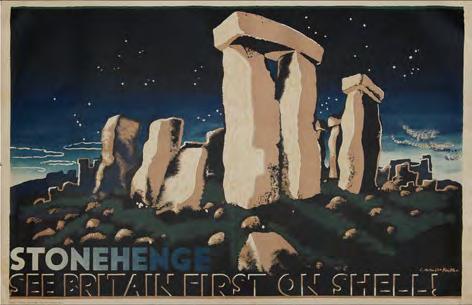
Edward McKnight Kauffer’s lithograph Stonehenge (1931) promotes petrol in an advertising campaign, with the slogan ‘Stonehenge: See Britain First on Shell!’ (Smiles, 2017, pp. 96-97) Bill Brandt’s Picture Post photograph of Stonehenge was used above the headline ‘Where Stands Britain?’ (1947, p. 1) The question reflected uncertainty about 23
Fig 18. Edward McKnight Kauffer’s Stonehenge (1931).
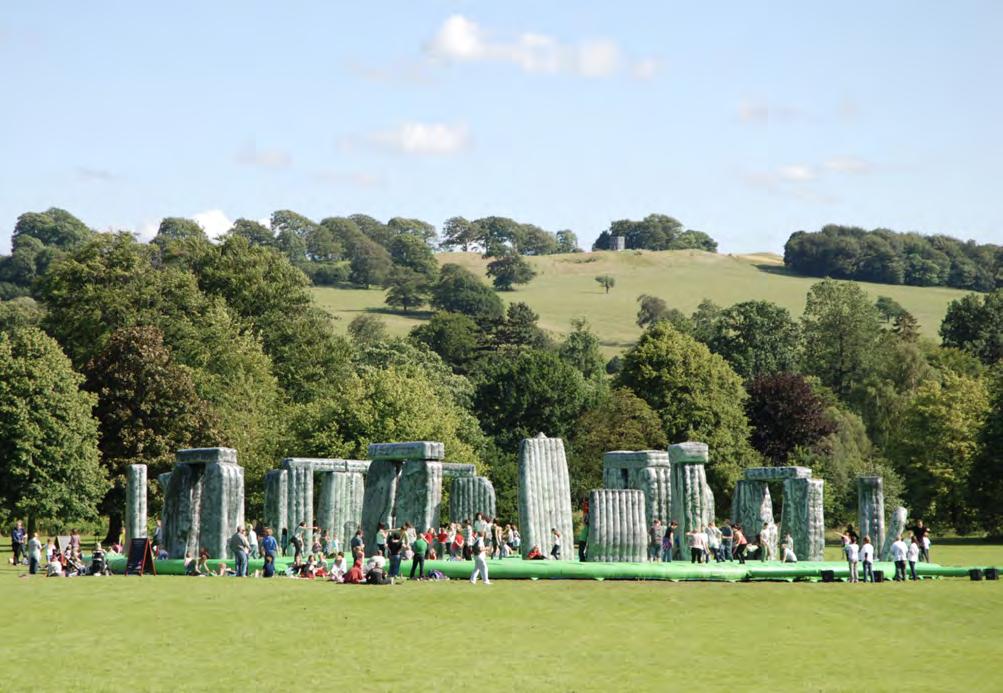
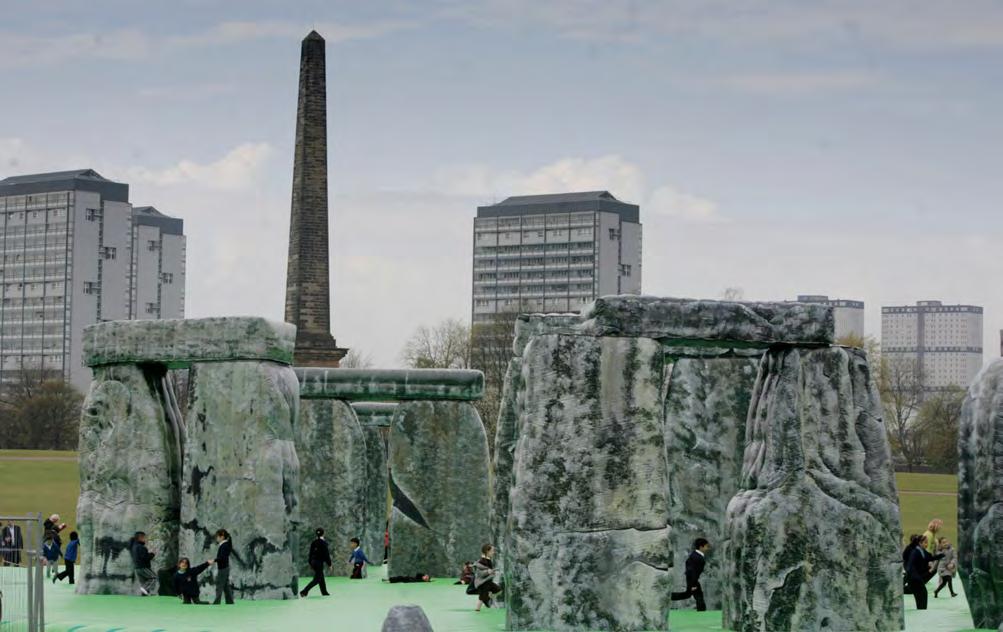
Fig 19. (top) Jeremy Deller’s Sacrilege (2012) installed in Yorkshire Sculpture Park, Wakefield, 2012. Fig 20. (above) The artwork installed on Glasgow Green, as part of the Glasgow International Festival of Visual Art, 2012.
the future at a time of post-war austerity, with the stones standing for the nation and people.
Why does Stonehenge work as national symbol? For Deller, it is because the monument’s intended purpose, function and meaning is unknown, and therefore contemporary society can see itself within it. Stonehenge is, he has written, ‘a national mirror that reflects whatever it is that we are concerned about at the time.’ (Deller, 2023, p. 19) That may be Brexit, austerity, the thrill of car-ownership, whatever – Stonehenge mirrors them all. ‘Stonehenge always feels relevant,’ Deller has said. ‘To me, it’s the most contemporary structure in the United Kingdom.’ (Farrell, 2022)
The playful innocence of Sacrilege counterbalances the political ideas within the work. Deller, like Ravilious, has an essential lightheartedness in the execution of his art. For him, Stonehenge in its mystery – we don’t know who, exactly, built it – suggests that British national identity is open and fluid. The monument is therefore a corrective to right-wing concepts of racial belonging. ‘The idea of multiple interpretations of a place and history goes against the instincts of nationalism and authoritarianism, where countries have their sacred founding myths which cannot be interfered with,’ he has written (2023, p. 19).
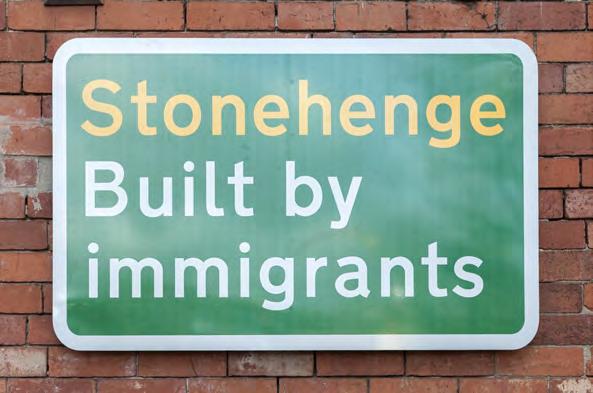
This is explicit in another of Deller’s artworks, Built by Immigrants (2019). This takes the form of an A-road sign – green with yellow and white lettering – which reads ‘Stonehenge: Built by immigrants’. This work subverts the nativist narrative that Stonehenge was created by and symbolises people from a time before multiculturalism.
Stonehenge is not Deller’s only ancient muse, having also made work about the Cerne Abbas Giant. This chalk hill figure looms above a village in Dorset, and has done for more than a thousand years. Eric Ravilious painted it in 1939. The Giant is one of England’s strangest landmarks: naked, wielding a club, penis erect. On a research trip I made to Cerne Abbas in 2024, he seemed a constant presence. At once profound and absurd, deeply English and deeply daft, it was clear why he would appeal to Deller as a subject. ‘Again, like Stonehenge, there is a mystery there and a space that is open to interpretation, and some idea of mischievousness and naughtiness,’ he later told me (2024).
Fig 21. Jeremy Deller’s Built by Immigrants (2019).
‘He’s just a great graphic design image, one of the great graphic design images, I think, in Britain … an incredible feat of drawing,’ (180 Fact, 2019, 2:14) he said ahead of the opening of a London exhibition in which his take on the Giant featured (Wiltshire B4 Christ, (2019)).
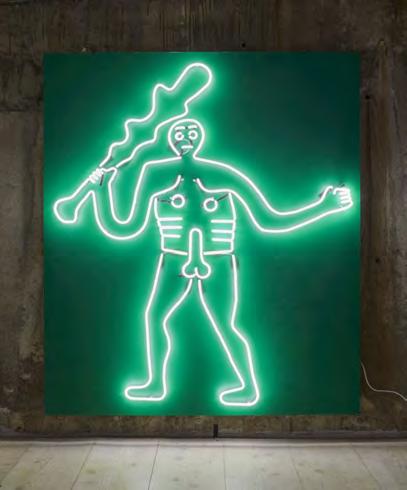
Cerne Abbas (2019) is a faithful reproduction of the Giant, but with his contours represented in green neon. This brings the ancient figure into the modern world of advertising and nightlife. As Deller told me, ‘Neon seemed to be the appropriate medium for him, he’s like a logo for the whole movement.’ (2024)
The ‘movement’ refers to the growing community of creatives who are making work inspired by ancient sites. Among these are Daniel & Clara, who describe themselves as ‘two humans, but one artist’ and so prefer not to use their surnames (Daniel & Clara, 2024). Collaborating and coauthoring, speaking as one, they work in a range of genres including photography, film and performance art.
They first visited Avebury in 2017. Since the 1930s restoration, driven and funded by Alexander Keiller, the Dundee marmalade magnate, the biggest stone circle in Britain has been an impressive and exciting place to visit (Burl, 1979, pg. 69-74). The stones had an immediate impact upon Daniel & Clara, prompting a move to the UK from their base in Portugal and a new direction in their art.
‘We saw Avebury as somewhere the imaginary had been made real,’ they told me, when we spoke by video call, of their transformational encounter. ‘This massive stone circle had started as an idea in someone’s head; then they convinced other people, and over time made this thing happen. That’s what art is. Human beings have this inclination to do something that is sometimes absurd, sometimes seems impossible, but we move towards these inclinations… Suddenly, Neolithic people seemed just like us, and it opened up a whole new area of thought.’ (Daniel & Clara, 2024)
They had known little about Avebury and Silbury Hill on that first visit, but soon learned that the sites had been an inspiration and influence for artists of previous generations, among them Derek Jarman, Bruce Lacey and Paul Nash. By making work about that prehistoric landscape they were joining a tradition: ‘We suddenly felt this sense of connection, almost like we’re part of a story and other people have felt this, so it’s sort of like coming home.’ (2024)
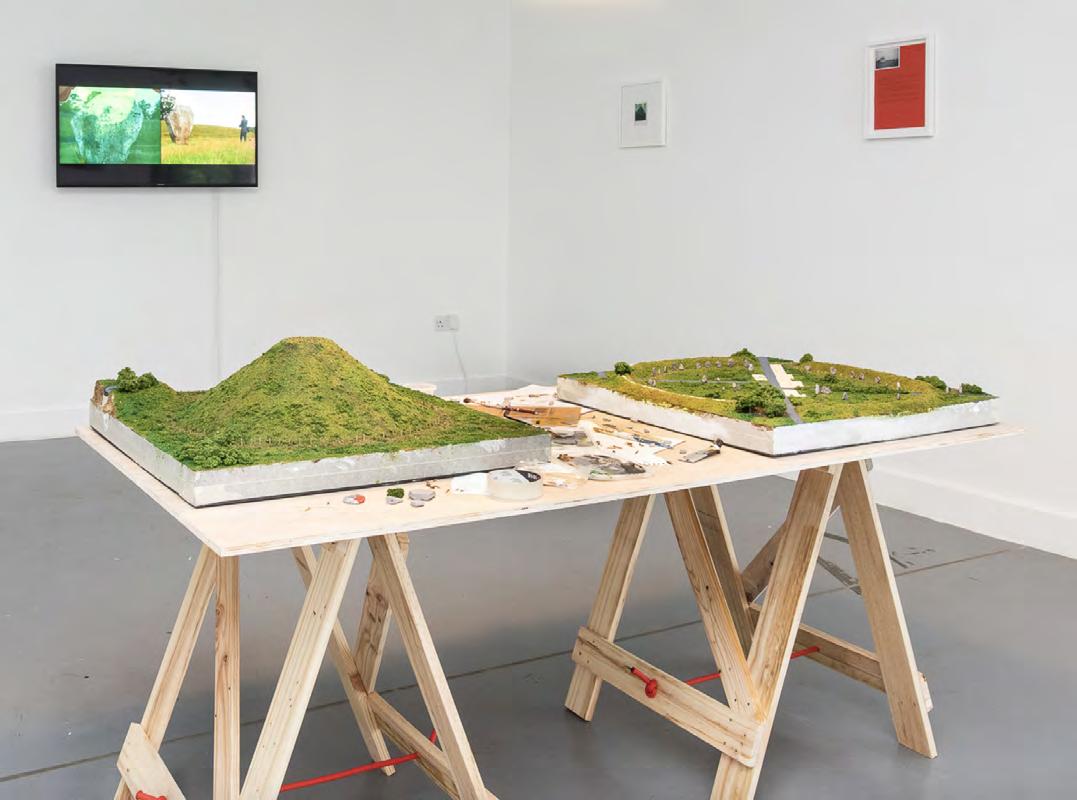
Daniel & Clara have made a number of works with Avebury and Silbury as the subject, including the short films Notes From A Journey (2019) and Revisiting (2019). Moving image has long been a focus of their art, but – impressed by the scale and presence of the megaliths – they wanted to create a work that mirrored the physicality of the place. This led to Avebury Complex (2023): painted models of the stone circle and Silbury Hill, borrowing an aesthetic from hobbyist miniature railways. The models were made in the studio without any visual guide, relying on their own recollections.
Fig 22. Jeremy Deller’s Cerne Abbas (2019).
changes with the perception of whoever experiences it.
Although Daniel & Clara are in the lineage of artists making work about prehistoric landscapes, their angle of approach is distinct from their predecessors in that they are working during the climate crisis, anxiety about which informs their work. They describe themselves on their website as ‘Adam & Eve at the end of the world confronting the beauty and terror of existing’ (Daniel & Clara, 2025).
We often like to think of early humans as living in harmony with nature. In reality, we can regard stone circles and the like as early examples of mankind’s separation from the natural world and exploitation of it. The Neolithic people were the first farmers, which meant clearing forests to allow for the growing of crops in fields and for grazing domesticated animals. Minerals, especially flint, began to be mined from the earth. The Stone Age monuments were thus made possible by people settled in one place and with the food resources to allow for large, long-term construction projects (Garrow and Wilkin, 2022, p. 38-73). These landscape interventions are the first foreboding steps into our modern world of industry and industrial-scale agriculture, and therefore towards manmade climate change.
Daniel & Clara see Avebury in this context: not as the ruins of a time of greater innocence, but as a manifestation of the abstract thinking that distinguishes the human mind and which has had consequences both creative and destructive. ‘It might even be the reason we make art,’ they told me. ‘Fundamentally, we make art as soon as we perceive the separation between us and nature, see animals and nature as “the other”, and somehow feel that we are different. It’s the root of so much of our predicament now that we have
Fig 23. Daniel & Clara’s Avebury Complex (2023).
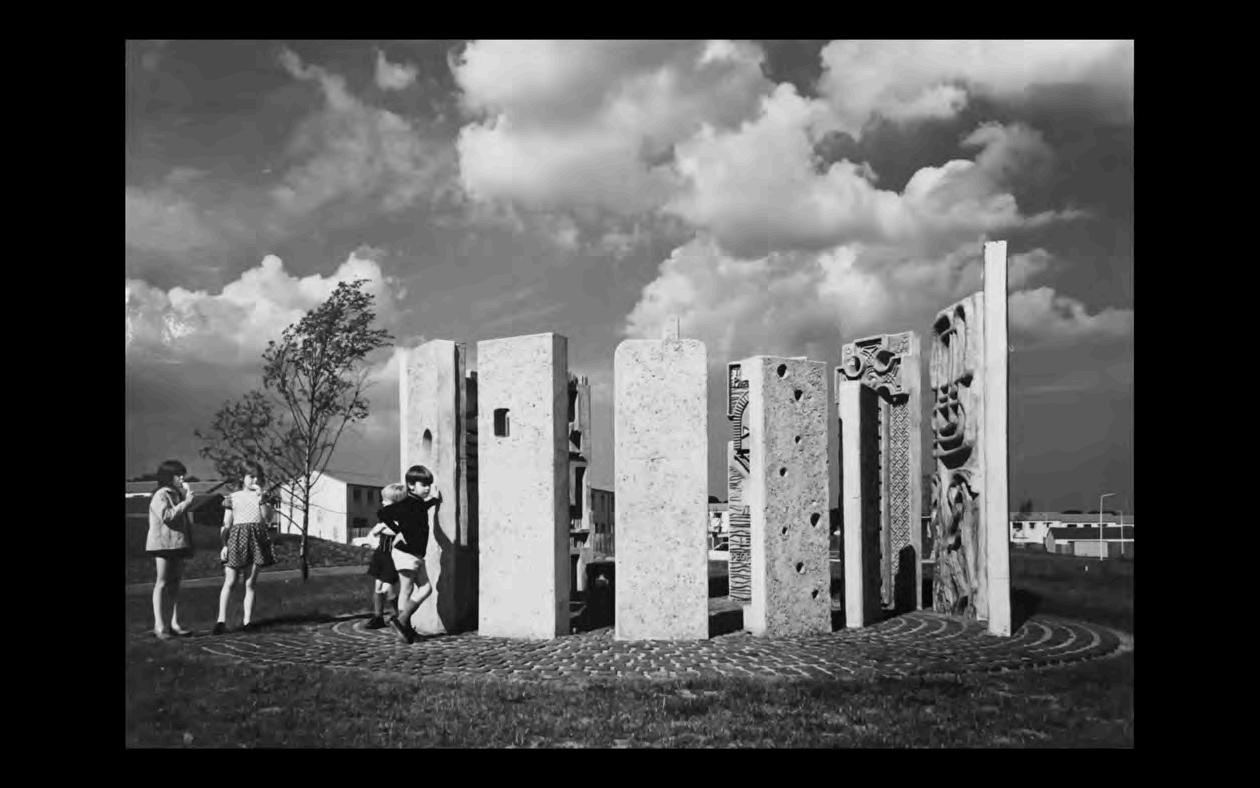
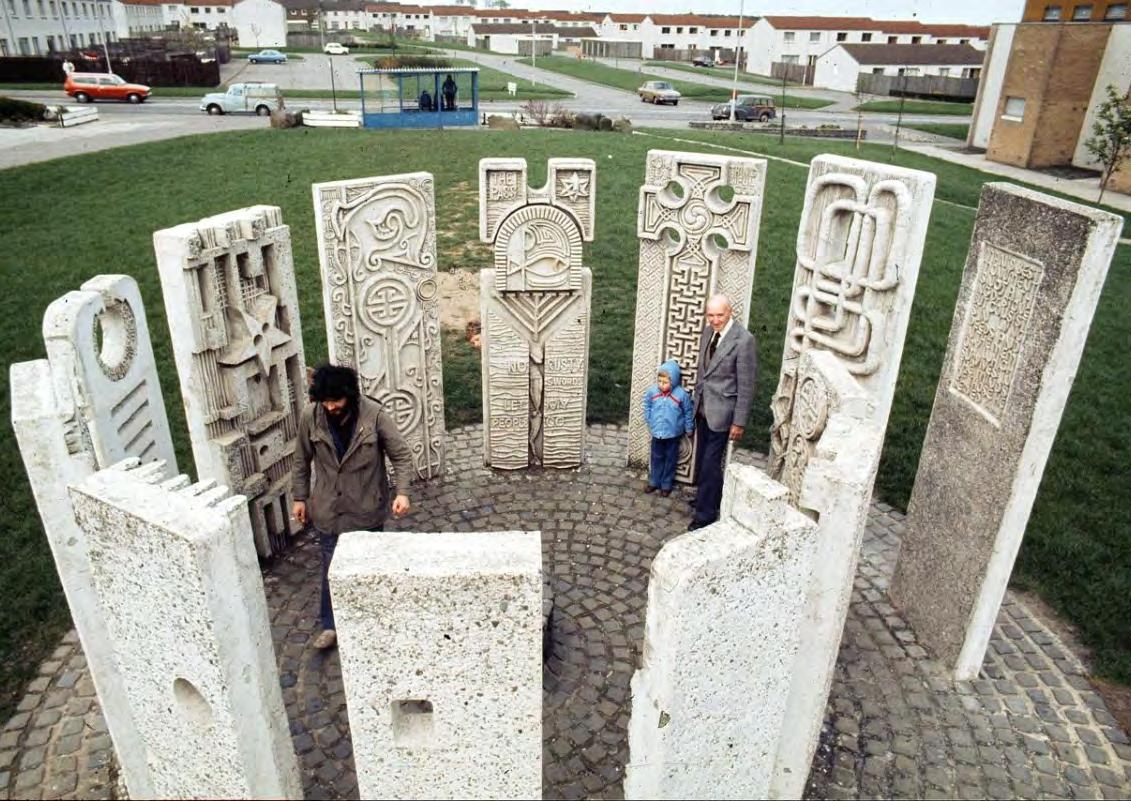
Fig 24. (top) David Harding’s The Henge (1970) photographed shortly after its installation. Fig 25. (above) David Harding (left) photographed inside The Henge
seen nature as just a resource there for us to take and take and take.’ (2024)
While Daniel & Clara are responding to iconic rural sites, others have made work influenced by the prehistoric, but in an urban context.
David Harding (1937) is a Scottish artist who, between 1968 and 1978, worked as ‘Town Artist’ in Glenrothes, Fife, one of five New Towns in Scotland. Harding’s brief was to create public art that would engage the new community and help foster a local identity (Meet You at the Hippos, 2021).
Harding made many works for the town, including one that he considers among the most significant of his career (Harding, 2024). The Henge (1970) is a spiral of thirteen concrete slabs, ascending in height from 1.5 to 2 metres. The title and design references a type of Neolithic earthwork consisting of a ditch and bank and which, in certain cases, includes a circle of stones.
When I visited Glenrothes one bright autumn day, The Henge seemed less than imposing. In photographs taken soon after erection, it dominates the urban landscape, and the freshly cast concrete appears white against the sky. After decades of weathering, it has darkened significantly. It is overlooked by mature trees that were saplings in 1970, and as a result appears smaller than than in archive pictures. There has been graffiti and other vandalism, but, despite this, The Henge feels at peace. It has aged with the housing scheme. Even ancient monuments were new once. Perhaps, like them, The Henge will outlive its creator and the population for whom it was created.
Andrew Demetrius, artist and curator, is an authority on the work of David Harding and knows him personally. I interviewed him in his office at the University of St. Andrews.
‘What David is trying to do is create artwork that relates a New Town and landscape, where you think everything is new, to a history that requires effort to see,’ Demetrius explained. ‘Look past the houses and the concrete and you realise that this is an ancient landscape with an ancient culture that’s been there all the time.’ (Demetrius, 2024)
Glenrothes is home to authentic ancient monuments. Balfarg henge, which dates to around 2500 BC, lies amid a modern housing estate and is surrounded by a circular road called The Henge, having been landscaped in the late 1970s. Two standing stones remain; a flat stone in the centre marks the grave of a teenage boy buried around 2000 BC (Magee, 2024). Harding’s Henge is a work of art that rhymes, so to speak, with the Neolithic site.
Not far away from Balfarg henge is Balbirnie stone circle. The megaliths of which are thousands of years old, but were was excavated, moved and reassembled to make way for a new road. This was happening at the same time as Harding was working on The Henge, and the artwork was intended, in part, as criticism of the decision to move the stone circle. ‘David’s issue was you can’t mess with this stuff,’ Demetrius told me. ‘Once it’s moved from the site it becomes something different. The stones as an ancient art form only mean something on that site.’ (2024)
The Henge and Harding’s wider works in Glenrothes share that quality with the Neolithic monuments: they are site-specific and the overall effect depends on the location.
Indeed, one of Harding’s Glenrothes works later suffered the same fate as Balbirnie stone circle. Heritage (1976) is a work consisting of fourteen concrete columns created for the exterior of the shopping centre at Falkland Square. However, when the area was redeveloped in 2011, Fife Council decided that the work should be preserved and relocated. This was done against Harding’s wishes. His view was that it should be demolished along with the surrounding buildings. Yet it can now be seen in Riverside Park. ‘I went there with David a few years ago and he did grudgingly admit that it was quite a nice spot but he did say it doesn’t have any meaning anymore,’ Demetrius told me (2024). Like Balbirnie stone circle, the art – as physical object – remains striking, but outwith its original context it becomes merely decorative, losing the power it derived from the environment for which it was made. Intention is an important part of meaning.
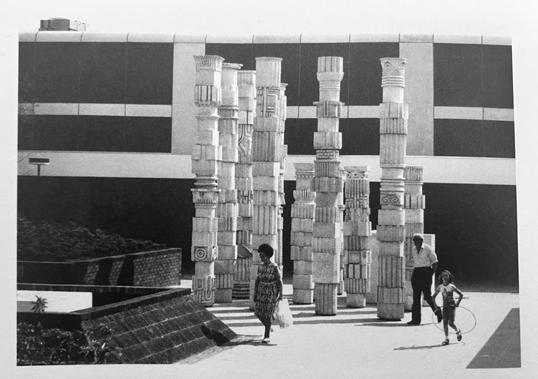
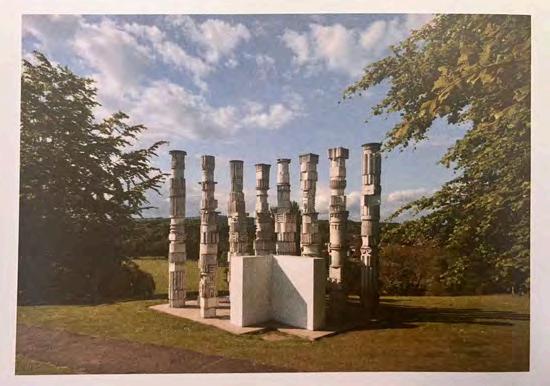
One of Harding’s main concerns was to create works that could help unify the fledgling Glenrothes community (Demetrius, 2024). He created points of congregation and conversation. Again, one can see the similarity of function between his public works and those ancient monuments, such as stone circles, which seem to have been intended for gathering and ritual.
The Henge achieves this in a variety of ways. First, its open spiral design invites people to enter and engage. The inner faces of the slabs are covered in text: quotations from significant 20th century figures, dealing with themes of life and death. One slab, for example, slightly misquotes a poem by Dylan Thomas: ‘Do not go gentle into that good night/Cry, cry against the dying of the light.’
There are also design elements inspired by Pictish carving. The Picts were a people of the 3rd to 10th centuries AD, a culture that has left behind a number of carved symbol stones in parts of Scotland where they lived (Noble and Evans, 2022). Two Henge slabs reference the patterns of these stones, a third has been cast with a ring-headed cross similar to that carved in relief on Pictish cross-slabs such as that in the churchyard in the Angus village of Aberlemno.
The Henge thus seems in dialogue with Scottish history of various periods. Its name and design references the Neolithic, while the Pictish elements recall the period from the Iron Age to early Christianity. The inclusion of the cross, and the use of quotation, mark The Henge as a spiritual work in its broadest sense – concerned with the human spirit – and
Figs 26. & 27. David Harding’s Heritage (1976) in Falkland Square and following relocation to Riverside Park.
this is another point of connection with stone circles, which have been widely interpreted as having some ritual function, perhaps places of religious ceremony.
Harding’s use of material emphasises this point. Stone circles and other prehistoric monuments were, for the most part, made from local stone, and therefore were the stuff of the landscape in which they sat. The Henge, being concrete, does not appear separate from the buildings that surround it. ‘If art’s made from the same stuff as your house, as the church and the school, it’s much more humanised,’ is how Andrew Demetrius put it (2024). Balfarg henge and the Balbirnie circle were creations of the Stone Age, The Henge is from and for the Concrete Age. It is not a gallery piece, not kept apart from the people for whom it was made. It is part of the landscape and community life. As Harding himself declared in a television documentary, ‘There will be no plinth in Glenrothes!’ (Meet You at the Hippos, 2021).
Conclusion
This dissertation has explored the ways in which artists have responded to the prehistoric over a period of almost four hundred years, from the antiquarians’ practical and illustrative depictions of monuments, to the works of contemporary artists who use these places to express societal concerns.
The archaeologist Jaquetta Hawkes wrote that, ‘Every age has the Stonehenge it deserves – or desires’ (1967), by which she meant that perception of the ancient monument is always influenced by the preoccupations and character of the time. This is very like Jeremy Deller’s idea of Stonehenge as ‘a national mirror’ (2023, p. 19).
Equally, artistic responses to prehistoric sites reflect the styles and ideas of their particular artistic moment. William Stukeley’s drawings of monuments are busy with charming human figures because they were made in the context of growing public enthusiasm for those places. Constable and Turner’s paintings of Stonehenge have stormy skies because they express Romantic interest in strong emotion and ideas of the Sublime. For certain Modernist artists, such as Paul Nash, the abstract forms of ancient monuments offered an opportunity to reconcile the long tradition of English landscape painting with the radical new language of Constructivism and Surrealism. Contemporary artists, while continuing to feel fascination for ancient sites, regard them as a jumping-off point for exploration of issues of social concern.
The first chapter of this dissertation quoted the antiquarian Sir Richard Colt Hoare’s response to Stonehenge: ‘HOW GRAND! HOW WONDERFUL! HOW INCOMPREHENSIBLE!’ (Hill, 2008, p. 52). I would suggest that it is the adoration and sense of wonder that drives artists to make art about these places, but it’s the incomprehensibility – the absence of certain knowledge about their meaning and purpose – that makes them so open to artistic interpretation. That is what all the artists in this study have in common: they are creative people for whom the unfathomable mysteries of the ancient past are a blank canvas on to which they project and create.
Bibliography
Artworks
Constable, J. (1835) Stonehenge [Watercolour] Available at: https://www.vam.ac.uk (Accessed: 25 September 2024).
Daniel & Clara. (2019) Notes From a Journey [Single channel video HD]. Available at: https://danielandclara.com (Accessed: 26 March 2024).
Daniel & Clara. (2019) Revisiting [Mini-DV]. Available at: https://danielandclara.com (Accessed: 26 March 2024).
Daniel & Clara. (2023) Avebury Complex [Sculpture]. Available at: https:// danielandclara.com (Accessed: 26 March 2024).
Deller, J. (2012) Sacrilege [Sculpture]. Available at: https://www.jeremydeller.org (Accessed: 15 October 2024).
Deller, J. (2019) Built by Immigrants [Sculpture]. The Modern Institute, Glasgow (Viewed: 25 October 2024).
Deller, J. (2019) Cerne Abbas [Sculpture]. Available at: https://www.youtube.com/@180fact (Accessed: 29 October 2024)
Friedrich, C.D. (1807) Cairn in Snow [Oil on canvas]. Available at: https:// www.wikipedia.org (Accessed: 22 December 2024).
Harding, D. (1970) The Henge [Sculpture]. Beaufort Drive, Glenrothes (Viewed: 10 October 2024).
Harding, D. (1976) Heritage [Sculpture]. Riverside Park, Glenrothes (Viewed: 10 October 2024).
Hepworth, B. (1938) Forms in Echelon [Sculpture]. Tate Britain, London. Available at: https://www.tate.org.uk (Accessed: 5 November 2024).
Kauffer, E. (1931) Stonehenge [Lithograph]. Available at: https://www.vam.ac.uk (Accessed: 17 November 2024).
Nash, P. (1935) Equivalents for the Megaliths [Oil on canvas]. Available at: https:// www.tate.org.uk (Accessed: 15 March 2024).
Nash, P. (1937) Landscape of the Megaliths [Lithograph] Available at: https:// www.vam.ac.uk (Accessed: 15 March 2024).
Nash, P. (1935) Druid Landscape [Oil on canvas]. Available at:https:// www.britishcouncil.org (Accessed: 15 March 2024).
Piper, J. (1936-37) Archaeological Wiltshire [Collage]. Available at: https:// www.nationalgalleries.org (Accessed: 4 December 2024).
Ravilious, E. (1939) The Long Man of Wilmington [Watercolour]. Available at: https:// www.vam.ac.uk (Accessed: 7 November 2024).
Ravilious, E. (1939) The Cerne Abbas Giant [Watercolour]. Available at: https:// www.rathergoodart.co.uk (Accessed: 10 November 2024).
Sjöö, M. (1993) Meeting the Ancestors at Avebury [Oil on hardboard]. Moderna Museet, Malmö, Sweden (Viewed: 11 June 2024).
Turner, J.M.W. (1827-28) Stonehenge [Watercolour]. Available at: https:// salisburymuseum.org.uk (Accessed: 25 September).
Books
Aubrey, J. (1665-93) Monumenta Britannica. Bodleian Archives and Manuscripts CMD ID 12767, Bodleian Libraries, Oxford.
Burke, E. (1757) A Philosophical Enquiry into the Origin of Our Ideas of the Sublime and Beautiful. Reprint: Oxford: Oxford University Press, 1990.
Burl, A. (1979) Prehistoric Avebury. New Haven and London: Yale University Press.
Chippindale, C. (1983) Stonehenge Complete: Everything Important, Interesting or Odd That Has Been Written or Painted, Discovered or Imagined, About the Most Extraordinary Ancient Building in the World. London: Thames & Hudson.
Clayton, E. (2021) Barbara Hepworth Art & Life. London: Thames & Hudson.
Garrow, D. and Wilkin, N. (2022) The World of Stonehenge. London: British Museum Press.
Daniel, G. (1967) The Origins and Growth of Archaeology. London: Penguin Books.
Deller, J. (2023) Art is Magic. London: Cheerio Publishing in association with Profile Books.
Evans, N. and Noble, G. (2022) Picts: Scourge of Rome Rulers of the North. Edinburgh: Birlinn.
Fagan, B. (2018) A Little History of Archaeology. New Haven and London: Yale University Press.
Harris, A. (2010) Romantic Moderns. London: Thames & Hudson.
Hawes, L. (1975) Constable’s Stonehenge. London: Her Majesty’s Stationery Office.
Hill, R. (2008) Stonehenge. London: Profile Books.
Hoare, R.C. (1812-21) The Ancient History of Wiltshire. London: Vol 1 published by William Miller and vol 2 published by Lackington, Hughes, Harding, Mavor & Jones.
Lippard, L. (1983) Overlay: Contemporary Art and the Art of Prehistory. New York: The New Press.
Macfarlane, R. (2012) The Old Ways. London: Hamish Hamilton.
Michell, J. (1982) Megalithomania. London: Thames & Hudson.
Montagu, J. (ed) (2003) Paul Nash: Modern Artist Ancient Landscape. Liverpool: Tate Publishing.
Morris, R. (2012) Time’s Anvil: England, Archaeology and the Imagination. London: Weidenfeld & Nicolson.
Neve, C. (1990) Unquiet Landscape: Places and Ideas in 20th-Century British Painting. London: Thames & Hudson.
Ørskou, G. and Hobson, P. (2023) Monica Sjöö: The Great Cosmic Mother. Cologne: Moderna Museet.
Owens, S. (2020) Spirit of Place. London: Thames & Hudson.
Pearson, J. (2019) White Horses: Eric Ravilious and the Lost Puffin Picture Book. London: Design For Today.
Ravilious, E. (2023) Eric Ravilious: Landscape & Nature. London: Thames & Hudson.
Sjöö, M. (2018) Spiral Journey: Stages of an Initiation into Her Mysteries. Cornwall: Antenna Publications.
Smiles, S. (2017) British Art Ancient Landscape. London: Paul Holberton Publishing.
Stukeley, W. (1740) Stonehenge: A Temple Restor’d to the British Druids. London: Printed for the author.
Turner, J.M.W. (1827-38) Picturesque Views in England and Wales. London: Charles Heath in collaboration with Jennings & Co.
Exhibitions
The Great Cosmic Mother (2024) [Exhibition]. Moderna Museet, Malmö, Sweden. March 23 – November 1, 2024.
Exhibition Catalogues
Domke, G. (2016) Grey Gardens: Art and Architecture Inspired by Modernity and Nature Exhibition held at Dundee Contemporary Arts, Dundee, February – May 2016 [Exhibition catalogue]. Dundee: Dundee Contemporary Arts.
Films
Figures in a Landscape (1953) Directed by D.S. Ashton. Available at: BFI Player (Accessed: 31 January 2024)
Journals
Hawkes, J. (1967) ‘God in the Machine’, Antiquity, 41, pp. 174-180.
Live Lectures
Deller, J. (2024) ‘Art is Magic: Jeremy Deller, in conversation with Emily Stone’ [Lecture]. DJ32002: Contemporary Art Practice. Duncan of Jordanstone College of Art and Design. 7 February.
Newspapers
Farrell, A. (2022) ‘The Magic of Stonehenge’, Financial Times, 21 May. Available at: https:// www.ft.com (Accessed: 27 March 2024).
Fisher, A. (2023) ‘Cool as Folk: Why Britain’s Young Rebels are Embracing Ancient Rites, The Observer, 12 February. Available at: https://www.theguardian.com (Accessed: 27 March 2024).
‘Great Britain or Great Betrayal’, The Sun, 12 June 2018, p.1.
‘Where Stands Britain?’, Picture Post, 19 April 1947, p.1.
Personal Communications (see appendix for transcripts)
Daniel & Clara. (2024) Teams conversation with James Ross, 18 April.
Deller, J. (2024) Email to James Ross, 21 October.
Demetrius, A. (2024) In-person conversation with James Ross, 10 October.
Green, A. (2024) Teams conversation with James Ross, 9 December.
Ravilious, E. (2024) Teams conversation with James Ross, 12 November.
Podcasts
Magee, M. (2024) Stone Me Podcast: Balfarg Henge [Podcast]. 29 September. Available at: https://www.stonemepodcast.com (Accessed: 30 September 2024).
Radio Programmes
Desert Island Discs (2019) BBC Radio 4, 11 January. Available at: https://www.bbc.co.uk (Accessed: 7 October 2024).
TV Programmes
Meet You at the Hippos (2021) BBC Scotland. Available at: https:// learningonscreen.ac.uk/bob/ (Accessed: 1 October 2024).
Websites and Web-links
180 Fact (2019) Jeremy Deller on new exhibition WILTSHIRE B4 CHRIST. 21 January. Available at: https://www.youtube.com (Accessed: 24 October 2024).
Daniel & Clara (2025) Daniel & Clara. Available at: https://danielandclara.com (Accessed: 4 March 2024).
Harding, D. (2024) Glenrothes Town Artist 1968-1978. Part of an unpublished memoir. Available at: https://www.davidharding.net (Accessed: 15 October 2024).
Jana, R. (2022) Stonehenge and the eerie allure of ancient stone circles. Available at: https://www.bbc.com/culture/article/20220615-stonehenge-and-the-eerie-allure-of-ancientstone-circles (Accessed: 23 March 2024).
Sjöö, M. (2014) Monica Sjöö: Through Space and Time the Ancient Sisterhoods Spoke to Me: An Online Retrospective. Available at: https://monicasjoo.co.uk (Accessed: 17 October 2024).
Appendix: Interview transcripts
Daniel & Clara, Artist
Date of interview: 18/4/24
Interviewer: James Ross
Format: Teams Meeting
JR: Could you try and express why you think Avebury and Silbury hill have become so important to you and your work?
D&C: For us it was totally unexpected. I guess we were at a moment of transition in our work and in our lives when we first encountered it. We were actually living in Portugal at the time and we had been there for several years, and we were doing a tour around the UK showing our work at different places, and we’d already been thinking about moving on from our earlier work which is very theatrical and lots of performers, dancers, actors, it’s kinda like psychodrama, this kind of more performative work. We were starting to feel like there needed to be some kind of change, and we were thinking a lot about the history of landscape painting, and wanted to do something with landscapes but were hadn’t quite worked out what that next step was going to be. And then during this tour around the UK, which was two weeks we were here, on the last day we went to Avebury and we had two hours there. We’d been filming all the way around the tour, filming landscapes, almost not really sure what we were going to do with this footage, but then on the last day when we entered Avebury, it was this amazing experience of encountering this place that felt like it was somewhere that could exist in the imagination, but it was there and it was so physical, so present, so real, it’s these huge stones, just incredible. It instantly captivated us. The fact that 5000 years ago people had come together as a community and raised these stones.
We saw Avebury as somewhere the imaginary had been made real. This massive stone circle had started as an idea in someone’s head; then they convinced other people, and over time made this thing happen. That’s what art is. Human beings have this inclination to do something that is sometimes absurd, sometimes seems impossible, but we have move towards these inclinations. And we just felt this connection. Suddenly, Neolithic people seemed just like us, and it opened up a whole new area of thought. New ideas, new things to think about. We went back to Portugal with all this footage of Avebury and Silbury Hill. And we kept thinking about it, and we didn’t really know anything about it when we went there the first time, but then we went away and we read up on it and we discovered all the other artists that had been to Avebury and felt their lives change: Derek Jarman, Paul Nash, Bruce Lacey, there’s so many. We suddenly felt this sense of connection, almost like we’re part of a story and other people have felt this, so it’s sort of like coming home. And then once it was under our skin we kept thinking it, we had to go back. We moved back to the UK a few years later and the first thing we did was go back and make another film, and then from that film it led to mail art and photographs and performance and all sorts of other things started emerging. Now, it’s almost a part of us, in our psychological map of the world Avebury is somehow the centre.
JR: I thought it might help me to understand your practice and motivations if we could talk about one of your specific works: the pair of models called Avebury
Complex. Can you talk about your thinking in making that work – in particular your idea of recreating it from memory rather than looking at photos and maps?
D&C: That was maybe the most recent piece that we’ve made, last year. By the time that the idea for the model came to us, we had done quite a lot about Avebury and actually it got to a point where we thought maybe we’re done, maybe there’s not going to be any more works about Avebury. Part of the thinking was that we started having this feeling overall in our practice of wanting to make more physical things. We started by working mainly with moving image and then opening up to photography and performances and it kind of got to this point where we felt like making objects, but we didn’t really know what kind of objects, just needing to create something more physical; and I guess actually this idea of recreating Avebury as a little model, inspired by these railway model-making and table-top gaming things that people create, Avebury was the instant subject because the physicality of the place really impressed us. It was the clear subject to fulfil this need to make something physical, and because we had thought about our experiences so much, it was a way to create a challenge for ourselves. It wouldn’t be about recreating Avebury exactly how it is, but to kind of access it again through our experiences. It’s engaging with the idea that Avebury lives on in the people who visit it, lives on in their minds and memories. So it’s almost taking Avebury back into the imagination, as we first encountered it when it felt like it was our imagination becoming real in the landscape. That’s how the model came into being.
All of our work is dealing with this idea of the subjectivity of experience and dealing with all of those layers; being in a body, having an imagination, all the baggage that we carry that creates our understanding of reality in each moment, and I think one of those things that’s really important is memory, and memory comes up quite a lot in the larger Avebury body of work that we’ve made, this idea of the experiences we’ve had in the past, how they impact our understanding of something in the present, and this idea of making something from memory. It’s not really Avebury, it’s our Avebury. In terms of geological scale it’s completely wrong, but in psychological scale it’s accurate. It was interesting when we pitched our memory against reality. It drew attention to how much we see reality through our own very specific subjective lens, and even those things you think you’re quite objective about are completely layered with the nuances of personal perception.
Yeah, and in the way that we left the models unfinished and present them side by side on the working table with all the materials that we used for making them – that’s to point out that this image is still coming into being, and Avebury itself as a place is constantly coming into being. It’s never had a fixed form, it’s always been in construction and it’s still in construction now.
JR: You mentioned you wanted to visit Orkney and other sites. Have you seen any that have touched you so deeply as Avebury, or is Avebury particularly special do you think?
D&C: I think Avebury has got a particular personal link, just because of the way that it opened up something new and the way it wove itself into our imaginations and it’s almost like the more work we make about Avebury, the more a part of us and more significant it becomes, and it starts to become not just the Avebury out there, it’s this thing that belongs to us in our creative work. But the other key site that’s been slowly reoccurring is the Mên-An-Tol in Cornwall. We did a project called the Cornwall Diary which we made in the first lockdown. We’d planned to go to Cornwall, but we had to cancel it because of
the first wave of Covid. So instead of disregarding our preparation for our visit there, we pitched the tent in our garden in Essex and took this imagined journey to Cornwall. We made this home movie around the garden and we wrote a diary of what we imagined would happening we went to Cornwall, and then this ended up in a performance we presented online. In that imagined story we ended up at the Mên-An-Tol and there’s this feeling of a time loop where we see ourselves there, and it’s got this eerie narrative. So even before we encountered the real thing, the image of the thing was working on us. Last year we went there, and we’re editing a short film that we shot last year in Cornwall, which has a big section about Mên-An-Tol and Lanyon Quoit and some of the other sites there, so it feels like something is brewing. But I don’t think it will go to the depth that Avebury did, simply because Avebury was our first love and shaped us in some way.
It was a real turning point in our lives. It was the reason why we moved back to the UK. We thought that we wanted to base our work and set it all in the British landscape and it was Avebury that really started that.
JR: You mentioned the number of artists that have visited and made work about Avebury. Does that at all make it difficult to find a fresh angle, a way of saying something new?
D&C: I think, actually, for us it was the opposite. Seeing so many responses, maybe because we became aware of them after we had already done our first trip. So in a way, we encountered it and it was ours first, and then we learned about how everyone else had responded. That really helped us opening up even more possibilities of what else can be done. That’s how we usually engage with art history. We’re very interested in looking at artists of the past. If something feels relevant it doesn’t matter if it was a thousand or five thousand years ago, art always speaks to us in a present time. And that’s what we like. Seeing what other people do just spurs possibilities, and what more can be done. Creativity is endless.
JR: Why do you think so many British artists through history have been drawn to make artwork about ancient sites, like Avebury?
D&C: In some ways, everybody encounters Avebury in a slightly different way, but also the scale is impressive. Not just the vast stones themselves, but also the fact that it covers a large area of landscape and you have to move through it. I think it has this really visceral impact and it’s very physical and very much about movement, and I think that’s what gets under people’s skin. It’s interesting that for different people it’s not just been impactful, but a turning point – for Derek Jarman it was right there at the beginning of his filmmaking. It resonated with him and left an important impact. Paul Nash is another one. Avebury helped him reconcile being both a British artist working in the tradition, and thinking about Modernism. Depicting in a quite Modernist way something very ancient was a reconciliation of that problem. There’s probably some similar reason for us in some ways to was going on for Nash; different era, different context, maybe a different problem being worked out, but I think it’s this space where, because it’s prior to living memory, you can project on to it. There’s an element of mystery, and where there’s mystery the imagination can interject.
JR: I suppose it’s quite fluid in that sense?
D&C: Yeah, it’s completely open to interpretation and whatever it is that you are carrying with you that maybe hasn’t found a way to come out, it can come out in that space because we don’t really know what it is. It’s a doorway to a mystery.
JR: Is there a sense that Avebury and Silbury Hill are in themselves aesthetic masterpieces and that any artist trying to make work in response to them is necessarily going to be making something secondary and perhaps even underwhelming?
D&C: It’s something that we often think about when we look at prehistoric art. When you see those images of those paintings in Palaeolithic caves, they’re so good! You can’t really get better than that. It’s a really sophisticated aesthetic expression there, and obviously, as with any artist, you want to be able to express something with craft and authenticity and urgency, no hesitation and no doubt. That is inspiring.
Also, our thinking is that art doesn’t get better. It’s not about progress. You make the art that you need to make now for the world now. You hope that it’s going to speak to people in the future and is going be useful to people in the future. Even if you feel like what you’re making isn’t as good as something else that exists, if you really in yourself that this thing has to exist, then you have to do it because it’s bigger than us. Our idea is we’re the servants of art: this is our purpose. We’ve given our lives to this project of making art and it’s not really our job to judge whether it’s good or not. We obviously make judgement as we’re creating, but really it doesn’t matter. If we need to make it, we have to make it and time will make a decision. Whenever we are in service of that creative energy, that mysterious thing that we call the creative spirit, that’s all we’re interested in. And we know that the same creative spirit that was speaking through Picasso or the Neolithic people or the cave painters or a child drawing a picture, it’s the same energy, It’s running through all of us. Our films and our photographs are operating in a totally different way to what Silbury Hill is doing. That is this great vast pile of earth, and our things are encountered on a wall or in a dark space. So you almost can’t compare them, they just operate in different zones. I think it’s unlikely that our work will last as long as an Avebury stone, because just materially they’re not going to exist as long! But it doesn’t matter actually. This would be our advice to every artist: you’ve got to get connected to that core thing that fires you up, and bring that thing into existence in the most loving and uncompromising way possible, because you will encounter obstacles, criticisms. Often when we were starting out we encountered indifference. That is the worst. It’s almost better if people hate what you’re doing. Nobody’s paying any attention whatsoever, but you just have to keep doing it. Even if you feel like you’re doing something that’s been done before, it hasn’t been done before by you in the way that you are doing it.
JR: You seem to have a particular fascination with the way that the climate crisis is a psychological crisis. On your website you write, ‘An anxiety bubbles through our work, erupting at times from the landscape or nature, at other times from the body. This horror grows from … the realisation that what we have done to the planet we have done to ourselves.’ I wondered how your interest in the prehistoric ties in with that? After all, places like Avebury are very early examples of mankind changing the landscape, of leaving a mark on the planet, and so it could be regarded as quite a place with a sense of foreboding about it.
D&C: I think that’s one of the revelations Avebury has given us. Maybe in general there’s this idea that early humans were more in tune with the landscape, living with the seasons
and all of that kind of stuff. But when we were at Avebury and seeing what it really was –this massive intervention within the landscape – we thought that to do something like this, it must mean that you’re not quite at one with the landscape. They’re imposing a certain abstract thought onto the landscape. That means that already people were seeing themselves as separate from their environment, and they have to create some ritual to align themselves with the world around them and their environment. It just makes you think this is maybe a really, really deep part of what it is to be human. How long ago did we start feeling like this? Like we are not a part of nature? When you look at early cave paintings, I think the same thing is happening there: we’re looking at animals with this awareness and this curiosity and admiration that means we felt we’re not like them.
It might even be the reason we make art. Fundamentally, we make art as soon as we perceive the separation between us and nature, see animals and nature as ‘the other’, and somehow feel that we were different. It’s the root of so much of our predicament now that we have seen nature as just a resource there for us to take and take and take, and not live in a replenishing relationship. We’ve gone too far.
We talk about it being a psychological crisis because we know that we’ve gone terribly wrong, and what things need to be done to change, but for some reason we don’t seem to be able to make those changes. So what’s really happening is there’s this vision of reality that’s crashing and we’re not able to change our vision of reality to what it needs to be. That is a psychological crisis. That’s why it’s going to take some really extreme situation in order to force action, which is probably inevitable unfortunately.
JR: Paul Nash believed that once the stones at Avebury were tidied up, they lost some ‘primal magic’. With the development of scientific techniques in the field of archaeology, it feels like we learn more and more about the people behind these ancient sites. Are you at all curious about new discoveries or do you feel that these can dispel some of the mystery and thus inhibit the artistic aspects?
D&C: We’re not scared of dispelling mystery, because I think mystery will always exist. Whenever science reaches another threshold of understanding, there’s just new questions that emerge. We’re not anti-science, we should be asking questions and seeking answers. I think mystery will always be the edge of knowledge, but then there’s also the mystery that’s really a part of the imagination, and I think that’s our arena as artists. It’s not about questions that can be answered, I think Our interest is in simply the mystery of existing and those questions that come up for each of us. We all want to know why we’re here, what our purpose is, how we can make sense of our existence, how we can organise all this chaotic emotion and experience and the material of our lives into some kind of feeling of control and order and purpose and know why we’re here and what the hell we’re gonna do with that short time from birth to death while we’re on the planet. Every single one of us will go through that journey in our own way, and I think art is a part of that. Art, for us personally, is our way of grappling with those questions. Other people have different tools for grappling with those. But art is also a way of giving some possible avenues of exploration and meditation and potential answers for other people as well. So I think it just goes on. The story just goes on, and we’re all just links in this chain of asking these questions, finding potential answers based really in the language of our time. Whatever our time is, we’ll be using the language that’s specific to this moment. I think it’s really interesting that so many artists working right now are interested in ancient stones. There’s a big cult around this at the moment with things like the Stone Club and Weird Walk and all of this wonderful stuff that’s going on. And it’s all part of the same question.
We want meaning, we want to have something grounded, roots, a feeling of connectedness, it’s not about nationality I don’t think. I don’t think its about Britishness, as it might have been in the past. I think it’s actually about our collective ancestors that we’re interested in, it’s our collective past as human beings. We’ve gone into this space where we’re living in a very ethereal zone, we’re all on screen, we’re all connected through this immaterial reality, and you don’t get more material than a Neolithic stone that’s sat in the landscape for five thousand years. So, it’s really interesting that this has become an obsession over the last few years.
Jeremy Deller, Artist
Date of interview: 21/10/24
Interviewer: James Ross
Format: Email
JR: When and how did your fascination with standing stones and other ancient sites begin?
JD: Probably as a child going to Avebury. We had friends that lived nearby.
JR: In my dissertation, I plan to write about your work Sacrilege. Why did you decide to recreate Stonehenge as a sort of bouncy castle? And what has been your experience of seeing the public engage with it?
JD: I wanted to make something fun and stupid that the public could interact with, but was also a comment of sorts on national identity, during an Olympic year. It was also about my love of history and the Neolithic. It was meant to be funny, and way to laugh at ourselves and the freedom to do that. The public over the worLd respond to it in the same way, always with enthusiasm.
JR: Built in England, with stones from Wales, and we now know from Scotland too, is Stonehenge a perfect portrait of Britain? And related to this, when you say it is a “national mirror”, what do you mean by that?
JD: We see ourselves in it both collectively and individually. It means whatever we want it to mean.
JR: In 2019, you made a neon green Cerne Abbas Giant. I visited Giant Hill for May Day and saw the Morris men dancing above the giant. Can you talk a little about why you are drawn to that hill figure, and why you decided to depict it in that particular way?
JD: Again, like Stonehenge, there is a mystery there and a space that is open to interpretation, and some idea of mischievousness and naughtiness. Neon seemed the appropriate medium for him, he’s like a logo for the whole movement.
JR: There is a long tradition of artists making work inspired by prehistoric sites. Turner, Constable, Nash, Hepworth, Ithell Colquhoun etc. Do you regard yourself as
part of that lineage? And what is it about these places that seems to speak to artists so deeply?
JD: I am not sure If I am, that’s for other people to judge. It’s the sense of mystery and openness. They are a big space to work in .
JR: It feels like in Britain there is a great swell of interest in the prehistoric that goes beyond the art world. I’m thinking about organisations such as Stone Club, but also just the public at large. Why do you think so many people are being drawn to the ancient past at the moment? Could it be to do with dissatisfaction with the present and anxiety about the future? Something else? I’m very interested to hear your thoughts.
JD: Maybe it’s cyclical. It’s a reaction against online worlds and also something that is spread through social media, so a contradiction. It’s pre-Christian and pre-colonial. It’s full of space to think and make up stories.
Andrew Demetrius, Artist & Visual Resources Curator, University of St. Andrews
Date of interview: 10/10/24
Interviewer: James Ross Format: In-person conversation
JR: Could I begin by asking you about your relationship with David Harding, please? How would you characterise it?
AD: I’ve been writing a PhD thesis on David and his Town Arts in Glenrothes over the last six years, which has just concluded. I developed a good working relationship with him in that time. He’s a teacher, he’s a friend, he’s a resource, he’s an all round number one guy!
JR: What is it you would say is the significance of his work in Glenrothes in particular?
AD: He comes into the story of Glenrothes about twenty years after it begins. Glenrothes is a New Town, of which there are five in Scotland; East Kilbride, Glenrothes, Livingstone, Cumbernauld, and Irvine. So they built this town, Glenrothes, around the Rothes Colliery, but the mine actually fails after only about six years. So they have to rethink and they transfer from heavy industry to light industry and electronics. And so, as part of the rethink around the late 1960s, they have changed the approach to housing. You’ll notice that around the centre of the town it’s very different to the districts further out. So they decide that there’s something lacking, and there not a lot of money to invest in a theatre or a cinema, and so they decide that public art is an economical option and something that’s going to engage the residents, and essentially it’s also about helping to foster a community. How do you bring people together in a New Town? There’s no single answer to that, but David Harding creates public art.
JR: Let me ask you about his work Henge. As an artist and academic, what’s your personal response to that piece?
AD: I give a whole chapter to Henge in my thesis. It’s an extremely rich work, partly because of the form and partly because of the content. It’s usually referred to as David’s most personal and autobiographical work. From the exterior it kind of relates to Neolithic henge building, but also it’s concrete, not stone, so the forms relate to a certain style of Modernism and Modernist architecture and modern art that architects can relate to, so there’s nothing too scary or provocative from the outside. It fits within this residential area, provides a kind of focus, and it’s an interactive sculpture. It’s an important work, I think, because he’s moving from the centre of the town to the residential area and that’s quite a big conceptual change, taking art to the people as it were. So it’s no longer necessarily a kind of civic monument, it’s something people are living with. And people see this every day from their windows or passing by. So he sets out to enrich it with as much content as he can think of. There’s far more than you can absorb on a single visit, because the intention is for people to return and see something different each time. So you’ve got these 12, 13 panels? And each of them has a different relief on the interior, so you have to enter it. There’s an interactivity which is really interesting. And there’s kind of hub, central point, which I interpret as putting the viewer at the centre of the work.
Henge is really about his heroes in a way. Each panel represents a character from 20th Century history and they can be religious, philosophical, literary, there’s poets and writers in there, Che Guevera is represented, there’s songs by the Beatles and Bob Dylan, Pele the footballer. So there’s something for everyone, its intended for a mass audience, not an art world audience. Whether it’s sport, popular music, literature, politics or poetry, there’s something that anybody can respond to.
But within that he’s also bringing in form. The spiral shape of it is not actually a henge. Henges are always elliptical, but it has the ‘earth work’ quality of a henge. It has this kind of mound, so you’re led up this little incline that raises it slightly above the ground level, and some of the panels have designs that relate to Pictish art.
What David is trying to do is create artwork that relates a New Town and landscape, where you think everything is new, to a history that requires effort to see. Look past the houses and the concrete and you realise that this is an ancient landscape with an ancient culture that’s been there all the time. There’s an indigenous culture there. So he takes designs from Wemyss caves, which are about three miles away; he takes designs from Pictish stones within Fife and replicates them in concrete.
And there is, what I think of as quite a strong political dimension to it all as well. He’s making this work partly in response to the planning of the town, and the new bypass which passed through Balbirnie Stone Circle, an original Neolithic site. The development corporation decided to move Balbirnie Stone Circle about 100 metres instead of moving the road. David’s issue was you can’t mess with this stuff. Once it’s moved from the site it becomes something different. The stones as an ancient art form only mean something on that site. And it’s the same with these artworks in a way. It’s about making artwork that responds to site. So wherever they are located, he’s working with the planning department and looking at everything holistically, so its not the same as putting a sculpture on a plinth, it’s about developing environmental art, and thinking about art in relation to the landscape and the architecture.
So going back to Henge, the spiral is a Pictish design so he chose that quite carefully. He accepts that people call it Henge, it’s a convenient point of reference with Stonehenge, but he’s aware that although Stonehenge gets all the attention, Scotland has an incredibly diverse and rich history. So there’s lots of different levels to Henge. There’s a
contemporary political response to the development corporation moving Balbirnie Stone Circle, but there’s also a broader political dimension where he wants to celebrate Scottish culture and use that as a means of unifying the identity for this new community. In a New Town everyone’s an immigrant, and these are immigrants from across Scotland, and there is a cultural diversity within a small country ,and so he’s doing that through art and landscape and also through language. So it begins with Henge, but he takes the elements he puts in Henge and plays with them, so he has other works that are more to do with poetry and he uses contemporary Scottish poets, and he uses poetry as almost the political wing of culture. So he’s not a hard line SNP, but he’s of the left and he believes that these things should be available to people to help them develop an identity for themselves.
JR: Has it, in some ways, improved with time; or, on the other hand, has it got a bit lost with the passing years?
AD: it varies in different parts of the town. We need two consider that in the early 1990s, the New Town development corporations across the UK were wound up and their assets and responsibilities were transferred to local authorities. So Glenrothes development corporation ceases to exist and it passes to Fife Council. And Fife Council have quite a different attitude and a different set of responsibilities and the town is no longer really managed or developing in the same way. So things are generally moving towards privatisation. On the outskirts of Glenrothes you have a different style of housing more in tune with the times. People want bigger homes with bigger gardens. Those older homes are showing their age a bit and the development corporation isn’t around to upkeep these homes. Upkeep wasn’t really considered that much when building a New Town. But just because something is concrete and modern doesn’t mean it’s going to last forever –there’s climate, there’s vandalism, general disrepair, and that applies to the artwork as well as the buildings and the landscape.
So if you walk around you’ll see particularly you see that Henge is in pretty good nick, occasionally there’s some graffiti, but generally people respect the artwork quite well I’ve found, and its stood up well to the Scottish climate, and generations of kids clambering over it, but some works do show their age and I think there are issues with his legacy in the town being respected. With the redevelopment, the council decided they needed to move some works. Some of the concrete mushrooms have been moved from the residential areas to roundabouts for example, the most notable one is a piece called Heritage, which were these concrete columns which were next to the shopping centre, but have now been moved north to Riverside Park. David’s attitude was, ‘If you’re redeveloping that area and the buildings around it are being demolished, take the work with it.’ The work was made in response to the environment, and if that goes then the work has no meaning, but the council decided to keep the artwork and move it against David’s wishes and reinstalled it on the edge of the park. I went there with David a few years ago and he did grudgingly admit that it was quite a nice spot but he did say it doesn’t have any meaning anymore. And that’s an interesting debate. There’s three works that have been listed by Historic Environment Scotland, but I think there is an argument that you could look at the whole town as design landscape and all of the artworks could be considered for overall protection, which I think they would really benefit from, it would acknowledge the significance of David’s work in Glenrothes, it would acknowledge the history that the work has now. New Towns aren’t new anymore, and the works are about fifty years old and have a kind of value to the community. Two, three generations of people have grown up with the art now. The people living with art is a fascinating story.
That concept of using art to create a kind of locational identity is quite an important concept. I feel quite strongly that that is something that grows richer over time.
JR: He could have made the work in natural stone, which would have been more in keeping with the historical references. But he chose to work in concrete. What was the result of that creative decision, would you say, in terms of the outcome of the work?
AD: It’s very fortuitous and I think it’s important. Stone would have been a possibility had he had a materials budget. He has a salary, he negotiates to have a workshop, he has a house for his family, and eventually he negotiates to have an assistant, but he doesn’t have a budget for materials. So what he and other Town Artists had to do was develop their position working within the planing and architects office. And what you do is build up relationships with the architects so you can find and plan suitable places for your sculptures, and then you develop relationships with the various engineering departments to negotiate to incorporate your artwork within their materials budget. So you’ve got brick and you’ve got concrete, so you’re making art with the materials of the building site, which feels very much in tune with what’s happening at the time, so using those materials makes perfect sense. It also helps to embed the sculptures within the environment because they’re made of the same stuff so immediately you’ve got a dialogue going on that very much connected to that materiality. The significant thing that David recognises is that New Towns can get quite negative press coverage, partly because of the social sides of things, the concept of the ‘New Town Blues’, particularly women suffering from mental health problems because they were isolated from their families. That family and social community side is in development but they haven’t quite got there yet. But the use of concrete also addresses the other side of things, which is that I think the UK has struggled with modern architecture from the get go, and notions of the high-rise were accepted more widely and faster in continental Europe than here, and concrete materiality of these buildings is a major factor. And so what he does particularly with something like Henge, or the underpass murals, is he’s creating sculpture using concrete that is on the ground, next to paths, in housing, places where people can go and interact with it in ways that are quite different from museum sculptures where you can’t climb on them, you’re not encouraged to touch them. And so you can walk along a path round Henge or into an underpass and run your hands on it and get up close to it and you see he’s using different mixes to create different surfaces; sometimes it’s smooth, sometimes it's rough. It’s encouraging people to engage with the tactile, to climb on it, to touch it, and it’s about getting people acclimatised and used to this material and not viewing it as something strange and other. If art’s made from the same stuff as your house, as the church and the school, it’s much more humanised.
I think there was another political dimension that David was pushing against, which is why you have these artworks along pedestrian networks and particularly around the underpasses. No-one likes an underpass, so what can you do to make that better, what can you do to introduce character, to help people find their way around? One concrete underpass looks exactly the same as another and yet they could be on the opposite side of the town. So by introducing content and relief designs, these act as geographical markers – you don’t just live in the third block, you live in the block with the giant mushrooms outside, or the hippos. People responded to that, and I think it was particularly successful because it was happening at the same time as the houses were being built, so now if you’ve got to have a consultation, you want to find out what the community want, what the artist can provide, and what the space allows. Here the art is
fait accompli, its already there. So people are very accepting, which I think is great, I think that sends a very positive message about the success of David’s art.
JR: Although the Henge layout is reminiscent of the Neolithic stone circles, its decorative carvings and script are more in the tradition of Pictish symbol stones from much later. Can you tell me anything about why he used that style and imagery, please?
AD: I think it was about trying gently introduce a few different ideas. It’s about time and landscape. The fact that it’s a New Town brings with it a set of preconceptions that David was interested in breaking down to help the community recognise that there’s a deeper history. Glenrothes was an almost entirely green field site. There was a wee village, farms, and that was about it. Glenrothes felt a bit more isolated, so for about the first twenty years you got more of a sense of pioneer spirit, so it was a bit awkward for a few years. So David was setting off to help people with the landscape and the history within the landscape. In Lucy Lippard’s book Overlay, there’s a nice survey that she does that connects a community of interest from the mid 1960s through to the 1970s of artists engaging with landscape in different ways; you’ve got land art, Robert Smithson, Richard Long, Hamish Fulton. So David’s so-called Town Art relates to broader stories, some of which urban and some more landscape based, and it’s an interesting combination. So he’s starting with landscape itself and then the human impacts on that, and bringing in these local histories in Pictish stones, Pictish carvings at the Wemyss caves, the standing stones and henges, which are local, but also part of a national history. David is interested in the political connections, he’s interested in what is perhaps uniquely Scottish, but what ties Scotland to a broader network. He does that also with the literary and poetry works. And there’s a history of Scottish art working with literature, they almost come from the same place. Think of early Christian art. The Picts are pre-Christian, but they become Christianised, you see this kind of process within Pictish art. The early stuff he uses on one panel from Henge, but then you have the Christianised one which he uses on another panel, a Pictish cross. David is from a Catholic upbringing and he’s interested in dialogue between different religions. So he’s not trying to project a specific point of view, but I think he really appreciates being able to engage and generate a kind of dialogue in a way I think would have been quite difficult earlier in Scotland, and particularly would not have been possible in Glasgow. The people moving from Glasgow and the west coast to Glenrothes, particularly the Catholic community, would have experienced a kind of freedom or relief from the sectarianism that went on there. I think he’s quite keen to engage the inclusivity, and engage a mixed community, and present forms and language that celebrate that diversity. He’s also interested in minority cultures, of which Scottish Celtic culture is one, and so he does want to support that. It’s not going to be rammed down people’s throats. It’s there if you want to see it, but if you don’t then it’s just a nice design. But that’s the thing with public art, you’re not going to please everybody. But in a sense that’s not the point. The point is to have something that will encourage debate and discussion, something to talk about, which is important in a New Town environment.
JR: One of the things that makes stone circles so compelling is that they predate written language. That gives them a deep mystery. But Harding’s Henge is covered in text. So you just look at it, you read it. What’s the effect of that, would you say?
AD: He’s aware of this tradition in Scottish art and other cultures too, the relationship between the vital and the literal, of which there is a long history in this country, and I think he felt that it was important to connect with that. When you bring together the form of the
panels, the form of the spiral with the relief designs, you are kind of expanding the richness of the work. So you have form that’s responding to its environment, bringing people inside it. You’re decorating the interior with abstract and figurative designs, you’re using different concrete mixes, different aggregates, so there’s a uniformity from the outside but on the inside there’s a diversity. You’re using different techniques, it’s almost like a lexicon of concrete casting the interior – panels cast using carved polystyrene, but others made using clay casts and direct impressions. There’s a panel that quotes Martin Luther King Jr but you can see that it’s been made using hot metal letter press for printing; there’s another panel opposite that has physical detritus and machinery pressed into the clay, but others that are clearly carved. So he registers different languages of sculpting – some of it’s carving, some of it’s casting, some is abstract, some is figurative.
JR: Ancient stone circles are often interpreted as ritual spaces, probably with some sort of religious function. Is there any sense in which David Harding’s Henge can be seen as a spiritual work?
AD: Yes, there’s definitely spiritual content in it. I think he liked the idea of it having a ritual function, but of course you can’t make people use it that way. I suppose the closest that we got to that was children’s games. It wasn’t designed for that, but kids within the community developed games. For an adult, someone your or my size, there’s really only one entrance, we might just squeeze between the panels, but for kids it’s easier. Some of the panels have wee holes in them so you can put your hand through or throw a ball through. A game is a kind of ritual, and he’s interested in play. If you walk from Henge across Westwood, you’ll come to a playground with the sculpture Rocket, which I think of as a counterbalance to Henge. Whereas Henge is perhaps a little more formal in its approach, Rocket and the space around it is a different set up and obviously the playground is for children. When you look at the Rocket, you might have seen photographs of Cold War playgrounds in America and Russia where they have climbing frames in the shape of rockets. But this isn’t a space rocket, this is a nuclear missile which instead of ascending, is instead crashing back down to earth, and you look at the bottom there’s a frieze of human figures being crushed by this technology. He describes this as a sermon in concrete. It’s a religious oratory. And on the interior panels of Henge, you’ve got a Pictish cross, you’ve got a quotation from Mother Theresa, Catholic representation, the Christianisation of Pictish culture, there’s two panels that relate to Gandhi, and his concept of satyagraha, which is not necessarily a religious concept, but more to do with personal emancipation in its broadest sense. This is like a public library, a public resource that people can visit – and you’re outside but you’re kind of contained. You have these texts around you, a sense of enclosure, but with the gaps between them and the light above you, everything is interpenetrating. It’s a space where people can contemplate the panels, the texts, the poetry. For different parts of the community he’s providing this concentrated cultural resource, that is designed for repeated visits.
Date of interview: 9/12/24
Interviewer: James Ross
Format: Teams meeting
AG: Let me preface by saying I’m not a Turner expert
Adrian Green, Director, Salisbury Museum
JR: But you’re familiar with the painting?
AG: Yes. It’s one of the prize objects in our collection.
JR: What do you find special about this painting? What’s the magic of it?
AG: I’ve always been a big fan of Turner. Before I came to work at this museum, I’d never been responsible for a big art collection. So the idea of being responsible for this watercolour by one of the country's greatest artists was really exciting. And then the fact that it’s of Stonehenge, which of course is one of the country's most important iconic monuments. It's a sort of marriage of two brilliant things really. I'm an archaeologist by training, so that's what excites me about the painting, this dramatic depiction of this monument, this sublime – and I use that in the artistic sense – depiction of this important monument is what makes it so important. Yeah, it's sort of merging together of all these different strands. It's brilliant.
JR: What makes Stonehenge a good subject for Turner?
AG: Well there's an irony about it actually, because the watercolour was engraved for a series called the Picturesque Views in England and Wales. These are supposed to be picturesque views, but this is not, is it? This is drama! This is the elements! This is what happens when you are out in nature: Stonehenge on Salisbury Plain in this windswept isolated environment, and here you have this thunderstorm taking place and this shepherd has been struck down and his dog is crying out, and some of the sheep have been struck down as well by this storm. It evokes the mystery of the place; the unknowable in the monument.
In fact it was a 19th century antiquarian who described Stonehenge as being “How grand, how wonderful, how incomprehensible." Turner’s painting encapsulates a lot of that.
JR: On the Salisbury Museum website there is a blurb about the painting. On the the subject of the shepherd struck dead by lightning is written: “Such tragedies were reported in the 1820s, but the incident has been interpreted symbolically by commentators like John Ruskin, for whom perceptions of Stonehenge were coloured by its darker, pagan associations.” I wondered if you could elaborate on the ideas that Ruskin raised?
AG: We did an exhibition back in 2015 with Ian Warrell. So that comes from Ian Warrell’s research comments that were in his publication. But picking up on that paganism aspect, although people at that stage had not established the date of Stonehenge, it was clearly associated with prehistory – the time before writing – and it appeared that people did not fully understand it was clearly pre-Cristian as well. So the idea of old religion and so on and so forth would have been abhorrent to many people in the 19th century without question. So the painting has this very dark undertone to it. The other thing about that particular watercolour is it's paired off with with another picture we've got in our collection from the Picturesque Views in England and Wales series, which is a view of Salisbury from Old Sarum, which also has a shepherd in it. It’s a view of Salisbury with storm clouds in the distance; the storm’s heading towards the cathedral, and in the background there’s Old Sarum, again an old monument, and the shepherd’s family have a blanket over their head, sheltering from the oncoming storm. Now, there's a lot of debate about what that all symbolises, but of course there was a lot of turmoil in church in the 1820s and it could
be that, like Turner’s contemporary John Constable, he was reflecting something of the position of the church in the 1820s. People also sort of pair off that watercolour, and the other with the shepherd and his flock being struck down by lightning as alluding to some religious Christian theme. Flocks are symbolic of congregation. Perhaps divine retribution has taken place in this pagan monument. We can impose a lot on this, but in fact we don’t know. Sometimes there’s a danger of reading too much into it.
JR: How do you view JMW Turner’s painting and John Constable’s later watercolour of Stonehenge from 1834 side by side?
AG: We had an exhibition on Constable in 2011. The curator Tim Wilcox wrote quite a lot about this, about antiquarianism in John Constables's work because he looked at the watercolours; Old Sarum and Stonehenge. There was a lot about the juxtaposition of the stones with the sky in Constable’s watercolour. Like a lot of his pictures, there's a lot of emphasis on the natural world of the landscape, what they would have believed God had given them, and Stonehenge is this monument that has been built by humans, something that's falling down and has become a ruin. So Wilcox had juxtaposed these two things –on one hand, the permanence of the heavens above, and on the other hand this monument sitting in the foreground that's fleeting, that’s transient, that's falling apart. There’s a darting rabbit running off into one corner of the picture and a man sitting on a stone contemplating in his shadow – all emphasising the passing of time.
They're very different paintings, aren't they? Constable’s use of colour is more naturalistic, lots of blues and greens, whereas Turner’s painting is violent; the reds and oranges and browns almost seem alien. Constable seems concerned with depicting the monument accurately, whereas Turner doesn't seem that fussed. Constable may have altered the perspective a little bit, but Turner has been there, he’s sketched it, he's later use those sketches for the basis of his watercolour, but his recollection through his sketches has not been his main concern. His main concern is the drama that he's keen to play out against this historic monument and landscape.
JR: Yeah, speaking about that kind of altering, Turner has altered Stonehenge’s appearance to better suit the aims of his painting. Paul Nash, who made paintings of the stones at Avebury two centuries later believed that the paintings of both Turner and Constable depicted ‘a reality more real’, despite their archaeological inaccuracies. Do you see Turner’s painting that way?
AG: Yeah, I think I could I agree with that. It's interesting actually because it doesn't worry me. It's about a sense of place rather than an accurate depiction of it. If you go through Turner’s sketchbook, there are some very accurate drawings of Stonehenge on site, and the same with Constable. Overall, the accuracy doesn’t really matter in that sense.
JR: How did Turner’s painting come into the possession of the Salisbury Museum?
AG: Acceptance-in-lieu. So we we didn't buy it. It was given to us.
JR: But it's quite nice that it’s at your museum
AG: Very appropriate. It's displayed as part of the archaeology collection.
JR: Why does Stonehenge lend itself as subject for the Romantics and what Edmund Burke’s described as the Sublime?
AG: I think it comes back to where we started. For me it's the mystery. That’s what lends itself. There's so many questions. I’m coming not just from an artistic point of view, but also from an archaeological point of view as well, that when you go to Stonehenge there’s a sense of awe and mystery and you're trying to encapsulate that. You're trying to interpret some of that and bring it into a picture or a depiction of the monument – the unknowable aspects of it, that disconnect that we have. We know that this was built by people in the past, and we’ve good idea how, but the why is a very big mystery. So it's hardly surprising that people like the Romantics were attracted to this thing for that for that very reason. And other archeological sites have attracted similar interest for that reason too. It may seem quite simple, really, but I think the mystery is everything.
JR: That seems to be the kind of overarching thing that links artists from back then to now, that kind of fluidity of Stonehenge. You can interpret it how you like.
AG: Well that's it. Jaquetta Hawkes said that ‘Every generation has the Stonehenge it deserves’, and I think that's the very interesting point. Every generation has their own interpretation of it as well and what they think it might represent, and that continues. Today there are numerous different people and interest groups who have some claim over Stonehenge. Archaeologists are one aspect of that, but then you've got a whole series of modern groups, New Age druids for example, travellers, etc. They all have their own claim and their own version of what Stonehenge is. And artists fit within that too, without question.
Ella Ravilious, Curator, Architecture and Design, Victoria & Albert Museum, London
Date of interview: 12/11/24
Interviewer: James Ross
Format: Teams meeting
JR: Generally, first of all, what do you think it was about prehistoric landscapes and in particular the chalk hill figures that seem to fascinate Eric Ravilious?
ER: He wasn’t a superstitious person ,but he did have some fascination for ancient figures and things like signs of the zodiac. I don’t think he believed in them, believed in them, but I think he liked them and was interested. He also had a relationship with the chalk landscape more generally in his paintings, so its understandable why he liked chalk and that links to – he would leave white space in his watercolours and chalk obviously works quite well with that technique. There’s only one piece of writing he did during his lifetime that was published. I think there’s some little introduction to the wood engravings he did of the zodiac signs for a calendar for the Lanston Monotype Corp. And there’s just a little paragraph he did thinking about the signs of the zodiac. He situates them all on the Downs, and one of them is of the Long Man of Wilmington. He touches a lot on those kinds of things. I think it’s as much about chalk as it is about ancient figures, and he did that whole series of chalk figures right before the war. They covered up the chalk figures during the war to prevent them being used as navigation aides by German planes, and I think there’s some chat in his letters about that.
JR: His background was in design. Do you think he appreciated these hill figures as a form of illustration?
ER: Yeah, he certainly used them in illustration. He wasn’t from a background of artists, his dad was a shopkeeper and an antiques dealer and various other failed businesses, so when he got this scholarship to the Royal College of Art – he went to art school in Eastbourne, which is where he grew up – he got this scholarship, rocks up at the RCA, and at that time the principal chose which school you would go into. So he was put in the Design School to learn to be a book illustrator. I think he was delighted to be there, but that’s why he trained as a designer. I think his design training you can see that in his later work. I think he had quite a lot of insecurities about being a designer and not a painter. It took him a long time to call himself an artist, so, yeah, the first time the chalk figures show up is in his illustration work and he’s thinking about what would work as vignettes and what would sum up particular landscapes and what would play into his design briefs and and his interests. So, yes, I think it definitely came out of his design work.
JR: More broadly, what was the importance of that South Downs landscape to him, and his development as an artist? In your book you write ‘In the gentle hills, chalk and dewponds he found the colours and shapes he had been looking for, and his watercolour work flourished.’ Could you expand on that idea please?
ER: Sure. So, he didn’t like Essex. Once they moved out of London after he and Tirzah were married, they moved to Essex first and he writes that he didn’t like the red earth of Essex, the grass was too green and it was all wrong. So I know that’s the landscape he didn’t like. He grew up in Eastbourne, so the Sussex landscape was kind of home to him, but I think the little hills, and as I say the chalk and the ability to render that by leaving white space in the watercolour, was why that spoke to him particularly. But he also had really good friends in Sussex that he would stay with. He stayed with Peggy Angus in Furlongs, and that was a really significant place for him. He wrote to thank her, to say this changed his whole way of painting, coming to stay with her. She would have these crazy parties at night on the Downs, so I think it had a lot of significance to him in terms of his personal relationships as well. Plus this childhood aspect. Plus this ability of the chalk to show through the paper.
JR: I’d like to ask you about a specific picture, the one that’s on the cover of your book: The Long Man of Wilmington, which he painted in 1939. Can you give me your thoughts on that picture, as you see it?
ER: Sure, well the things that come to mind now about this, there’s a couple of things. I think it’s James Russell that talks about the barbed wire as a framing device in this picture. I think he’s right about that. The inclusion of the wire fence is very modern. Even though it seems like quite a nostalgic picture now, that was part of his style – not to prettify the picture and hide anything. And I know there’s two places in this picture where you can still see his notes, under the paint layer, which he did a lot. The top of the yellow corn on the left and in the little bit of lighter sky on the left, you can see he’s written yellow and grey. That was definitely a designer’s trick and he never seemed to mind that it showed in the final thing. But I like seeing his handwriting. I think this is the one where he writes to Helen Binyon saying, ‘Oh you’ll like this one, I’ve done what you call a “clever sky”.’ He’s always called such an English artist, and I never knew what to make of this, and I think it’s really about how he conveys the British weather. So clearly he’s putting a lot of work into the skies, and into this kind of middling British sort of semi-cloudy rainy
could-be-anything kind of weather. From his letter we know he thought about that and put a lot of work into it. Me and a couple of other people, we’ve always wondered about the brown blob in the middle.
Possibly another designer’s trick, the way he’s using the paint here, like in the grasses at the front and on the hill towards the back, he’s doing a kind of cross-hatch in watercolour, which is kind of a weird thing to do with watercolour. And in his scrap books you can see there’s lots of test pieces where he’s just trying out these patterns, so it’s something he’s worked at a lot and he’s using those to convey shapes and texture in a way that’s particularly him. The dry brush technique he learned from Paul Nash, but the way he develops it is is particularly Eric-y. I always say he’s be a hard artist to forge. Eric paintings look like Eric paintings. His early work is a lot wetter and more generic but these really dry scatchy things are very him. But I can also picture him sat on a camp stool with jumpers given to him by his friends, sat there painting the first layer. The notes underneath show he finished the painting later, he didn’t paint it all in one go. It’s quite a low-down perspective, he’s definitely on one of those crappy little camping chairs. So I think of him behind the picture.
JR: In both that picture and and his painting of the Cerne Abbas Giant, he frames the figures in barbed wire from the foreground. What do you make of that? It can be read as a foreboding symbol of the impending war. Do you see it that way?
ER: Nah not really. I think he was quite a straightforward person and not given to wild romantic ideas like that. And also, I mean, he didn’t know the war was going to happen; obviously it was threatening to happen. I think he just liked it! He loved the landscape but he also loved modern stuff. He was so into planes and machinery and I think that’s just genuine, he just really liked machines. It’s easy to see that in retrospect as more than it was, and some sort of wider comment on the political situation, but I’m not sure that it was. I just think he really liked them.
JR: What would you say is the mood of these hill figure paintings? I feel there’s something seductive about them – they make me want to go there and see these places – but there’s also something melancholy about them too. How do you feel about them? Why do they have that melancholy atmosphere?
ER: I don’t quite see them that way, I don’t think he was sad when he painted them. It’s very subjective and I think that’s fine. I see him as someone who’s really visually interested. I think he would have really enjoyed these. That elusiveness and unreadableness is very much part of his work. If we knew exactly what they meant, they would not be by him. I don’t think he’s being deliberately obscure; I think he just had that kind of lightness to him, and was more interested in the visuals. My aunt sees it slightly differently. She feels there was more of a kind of symbolism behind it, so I think it’s open to anyone’s view. But, yeah, for me I just see him enjoying the shapes and the weirdness of it and the history of it.
JR: Why do you think Eric Ravilious has become so popular in recent years?
ER: Because he came out of copyright! Not only that. So there was a really great show of his war work at the Imperial War Museum that probably put him on the map, about twenty years ago. That was followed by a fantastic show at the Dulwich Picture Gallery, that was the most popular show they had in a long time. And what with him coming out of
copyright as well, you can buy jumpers and mousemats and anything you like; he speaks to a particular… Somebody wrote a book about how great Brexit was and they used an Eric Ravilious painting on the cover and I was pretty pissed about that. It’s certainly not my view, but I don’t think it would have been Eric’s view either; he wasn’t super-political by any means, but he was generally left-wing and pretty in love with Europe as soon as he could get there. So yeah, I think now people see it as British and nostalgic and it can speak to a Brexity nostalgic vibe, but that’s not why he painted them, and at the time they wouldn’t have been seen as nostalgic because they included modern stuff; it’s just that that stuff has now aged, so it all looks quite nostalgic, and what with the manner of his death, it’s all quite romantic. So yeah, I think that’s my answer why he’s popular now. After his death, just because of circumstances, he got pretty much forgotten about and buried for a bit. I think people discovered his wood engravings first and then his ceramics got a little bit popular after that, but, yeah, even when I interviewed at the V&A for my first job here twenty years ago, the people on the panel hadn’t heard of him. So yeah, it’s definitely been in the last fifteen years that he’s risen in popularity.