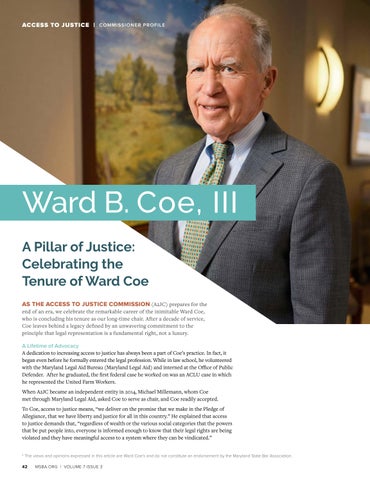
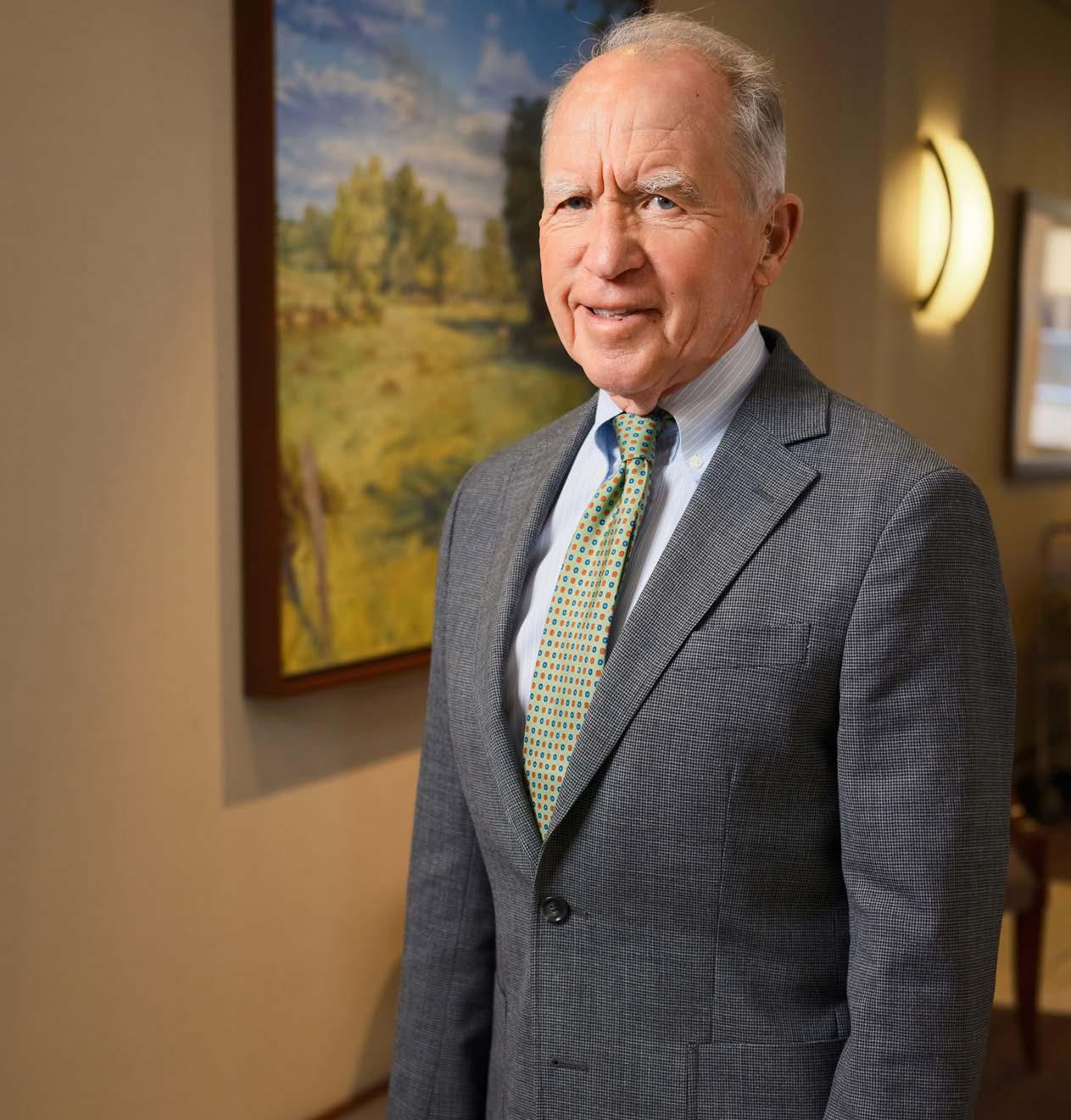
Ward B. Coe, III
A Pillar of Justice: Celebrating the Tenure of Ward Coe
AS THE ACCESS TO JUSTICE COMMISSION (A2JC) prepares for the end of an era, we celebrate the remarkable career of the inimitable Ward Coe, who is concluding his tenure as our long-time chair. After a decade of service, Coe leaves behind a legacy defined by an unwavering commitment to the principle that legal representation is a fundamental right, not a luxury.
A Lifetime of Advocacy
A dedication to increasing access to justice has always been a part of Coe’s practice. In fact, it began even before he formally entered the legal profession. While in law school, he volunteered with the Maryland Legal Aid Bureau (Maryland Legal Aid) and interned at the Office of Public Defender. After he graduated, the first federal case he worked on was an ACLU case in which he represented the United Farm Workers.
When A2JC became an independent entity in 2014, Michael Millemann, whom Coe met through Maryland Legal Aid, asked Coe to serve as chair, and Coe readily accepted.
To Coe, access to justice means, “we deliver on the promise that we make in the Pledge of Allegiance, that we have liberty and justice for all in this country.” He explained that access to justice demands that, “regardless of wealth or the various social categories that the powers that be put people into, everyone is informed enough to know that their legal rights are being violated and they have meaningful access to a system where they can be vindicated.”
“ Access to justice demands that, “regardless of wealth or the various social categories that the powers that be put people into, everyone is informed enough to know that their legal rights are being violated and they have meaningful access to a system where they can be vindicated.”
While meaningful access to courts means having legal representation, Coe noted that increasing access to justice requires a great deal of education, as “knowing your rights gives you the ability to stand up for them, especially when the government is the one depriving you of your rights and saying you don’t have them.”
Navigating Modern Challenges to the Rule of Law
As he reflected on current access to justice issues, Coe identified significant macro-level threats that extend beyond state borders. He views the current era as one where the Trump administration has conducted an “assault on human rights” and undermined the “concept of the rule of law” and the “independence of the judiciary.” For Coe, these are fundamental access to justice issues that demand a collective response: “It’s an access to justice issue for everyone across the country, and it’s something that everyone has to do something about. We all have to fight it.”
At the state level, Coe remains deeply concerned about the economic stability of the civil justice infrastructure. He notes that funding for legal service providers is often the first to be threatened. He also sees the threat to loan forgiveness programs, a vital lifeline for legal aid attorneys, as a serious issue. The expansion of the right to counsel in civil cases involving critical human needs is also critical, as Coe notes, “we don’t have justice if we don’t provide lawyers to folks to defend their rights.”
Coe noted that “a lot of people assume that the government gives you a lawyer if you need one or that legal aid or other legal service providers will always have the capacity to represent you,” which is not the case. As such, he believes we need to do a better job of educating people about access to justice issues.
Moving the Needle: The Success of ACE
When asked which initiative has most significantly impacted Maryland, Coe points to the Access to Counsel in Evictions (ACE) program. He describes this as an area of “critical human need” where the disparity in representation was once staggering. Before ACE, landlords typically had representation, while tenants did not, leading to a system where “a lot of people were evicted who should not have been.”
The results of the ACE program have been, in Coe’s words, “astonishing.” “The statistics show that... out of 88% of tenants who had filings against them who wanted to stay in their houses, 87% of them prevailed. That’s astonishing. It used to be that the rate of success was tiny.”
Coe argues that this success benefits the entire Maryland economy by preventing the “economic damage” and “disruption of lives” caused by homelessness. He believes this model should be expanded to other complex fields where unrepresented individuals face professional opposition, such as consumer debt, government benefits, and deportation defense. The stakes can be very high in these proceedings, and there are profoundly disparate impacts on minorities and women.
A Vision for Pro Bono and Beyond
Coe’s dedication to pro bono is inextricably linked to his long career at Gallagher LLP, where community involvement is a core cultural pillar. “It’s just part of what we do,” he explains, “I would have been a little uncomfortable if I wasn’t doing it.” His firm currently sees over 20 lawyers and paralegals handling immigration cases for the Tahirih Justice Center and Esperanza Center, work that Coe finds personally restorative, noting, “You meet people who are so heroic, so resourceful; they inspire you in your own lives. You want to help them.”
He views pro bono not just as a duty, but as a professional privilege: “My message to lawyers is, give it a try. Read the rule. Be inspired. I think you’ll find an element of your professional life really lit up by it.”
Even as technology and allied legal professionals emerge as new frontiers to close the justice gap, Coe insists that the human element remains paramount. He advocates a leadership style that “leads from the front,” where one does the work they advocate for while hiring and trusting great people, such as A2JC Executive Director Reena Shah, to execute the mission.
The Road Ahead: From Annapolis to the Himalayas
While stepping away from A2JC marks a conclusion of Coe’s formal chairmanship, he is far from slowing down. He plans to remain involved in the world of access to justice advocacy while continuing his adventurous travels with his wife, Christie. From sleeping in two-person tents at 16,000 feet in Bhutan to walking Abraham’s path in Jordan, Coe finds that the humanity he encounters abroad mirrors the resilience he sees in his clients.
“As amazing as all these places are, the most amazing part of it is the people you meet,” Coe reflects. Whether navigating the lava rock desert of Turkana, Kenya, or the complex corridors of the Maryland State House, Coe’s career has been a singular journey toward ensuring that every individual has the power to stand up for their rights. As he transitions to this next chapter, his message to the bar is clear: the pursuit of access to justice is a shared responsibility, and we all must take part in it.