
DEL NORTE HIGH SCHOOL | FEBRUARY 2026 | VOLUME 08, ISSUE 01

DEL NORTE HIGH SCHOOL | FEBRUARY 2026 | VOLUME 08, ISSUE 01
Dear Reader,
Some say the pen is mightier than the sword. Truly, there’s something magical about putting words on a page, watching the sparks of neurons ring form into thoughts, thoughts into words, words into something the whole world can feel. They can educate you about a completely di erent topic, transport you to a brand new world, and help you feel emotions that were never yours to begin with.
Yet, today, we live in an era of unprecedented noise. Social media, while democratizing people’s ability to express their opinions, has strongly polarized the public and eroded critical thinking. With the click of a button, people can spread misinformation that creates disastrous consequences.
The rise of arti cial intelligence has added another layer of complexity. Machines can now mimic the very practices that make us human, generating speeches, intricate art, and stories in mere seconds. Think of arti cial intelligence as a Xerox machine of emotions, always scanning and interpreting, forever on the outside looking in. It can analyze every love song written, every eulogy delivered, every story passed down generations. But it can never relive what the original creator experienced, and will never understand the weight behind why it mattered. It reproduces the shape of feeling, hollow at its core.
In a time where the world just keeps spinning, feeling as fast-paced as ever, writing remains how we make sense of the chaos. It’s important to take a step back and appreciate the art around us. This issue was put together by all the talented students in The Featheralist who share this philosophy and have something important to tell the world.
When we came to Del Norte as freshmen, we never expected this magazine to hold such an important place in our hearts. Now, we are proud to be part of this journey and thankful for everyone who makes The Featheralist possible. Flipping through these pages, we hope this issue reminds you of the power words can have.
Samhita Lagisetti and Saanvi Dogra
Co-Presidents, Editor-in-Chiefs

by Evelyn Lee, ‘29
“Desk” by Sophie Tran, ‘26 Digital 03
by Evelyn Wang, ‘27
“The Kiln” by Chloe Kang, ‘26 Digital 04
by Joann Xie, ‘27
“From The Train” by Grace Ye, ‘27 Digital
05
by Viola Han, ‘29
“Ship” by Emily Capua, ‘27
08 IS LIFE IN CONGRESS ALL IT’S CRACKED UP TO BE?
by Khloe Louie, ‘28
“Protest” by Kayla Peng, ‘26 Digital
by Grace Ye, ‘27
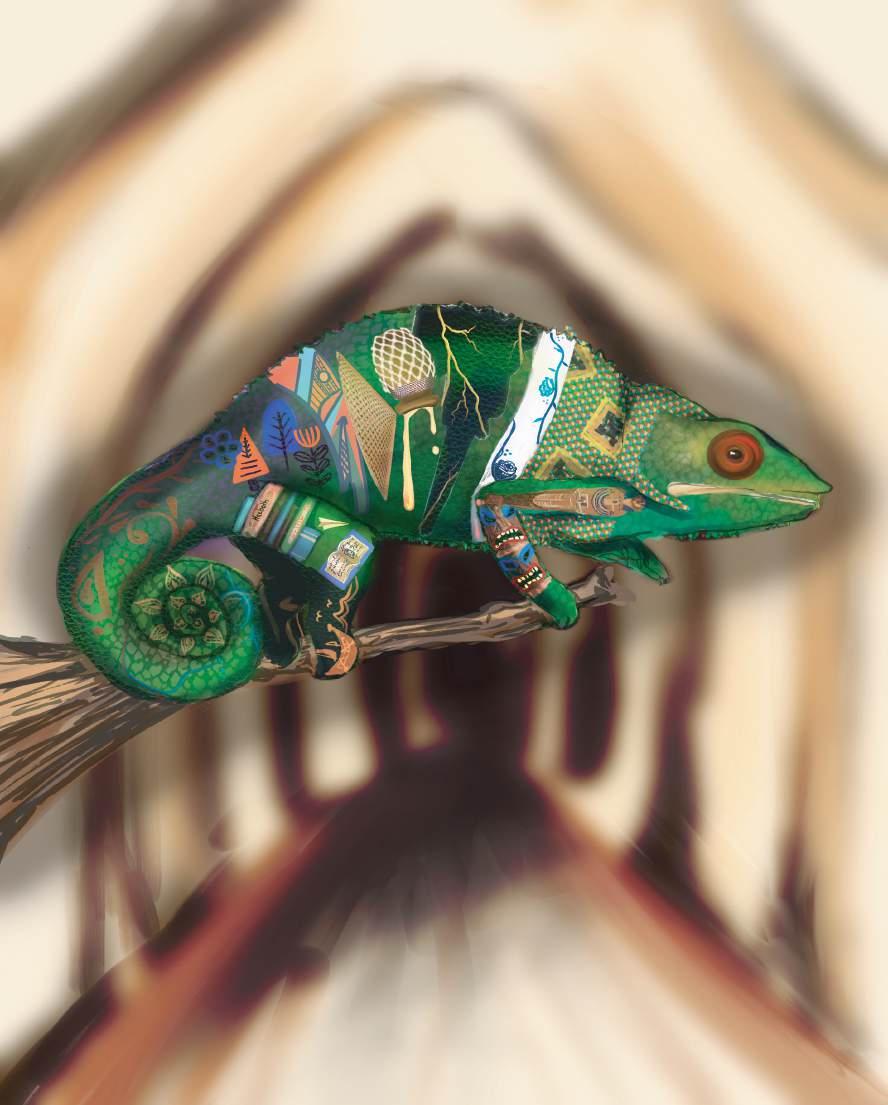
“Cultural Chameleon” by Ananya AR, ‘27
10
LAW & SOCIETY: THE HUMAN
by Jayaj Bhatnagar, ‘29
“Philosopher’s Judgement” by Ananya AR, ‘27 Digital
12 CONTRIBUTORS AND COLOPHON
Written by Evelyn Lee, ‘29 | Designed by Sophie Tran, ‘26
2020, the year of isolation.
Curtains drew shut, windows locked.
The world shrank to the size of a single room.
The air thickened as the streets held their breath, As if someone had slammed “pause” on a remote.
Attended school through a glass barrier, Connected yet untouchable.
Clueless faces trapped in tiny gray boxes, Wi cutting in and out, Typing into chat boxes to desperately communicate.
Eat. Study. Sleep. Repeat. Life reduced to echoes of itself, A reel of my life looping without end.
Loneliness washed over me.
Yearned to see faces lit with joy, not clouded by sorrow. Every breath felt guarded, shielded by cloth and caution, as though trust itself had grown contagious. Hands slick with sanitizer wherever I went, the unescapable odor stinging my nose.
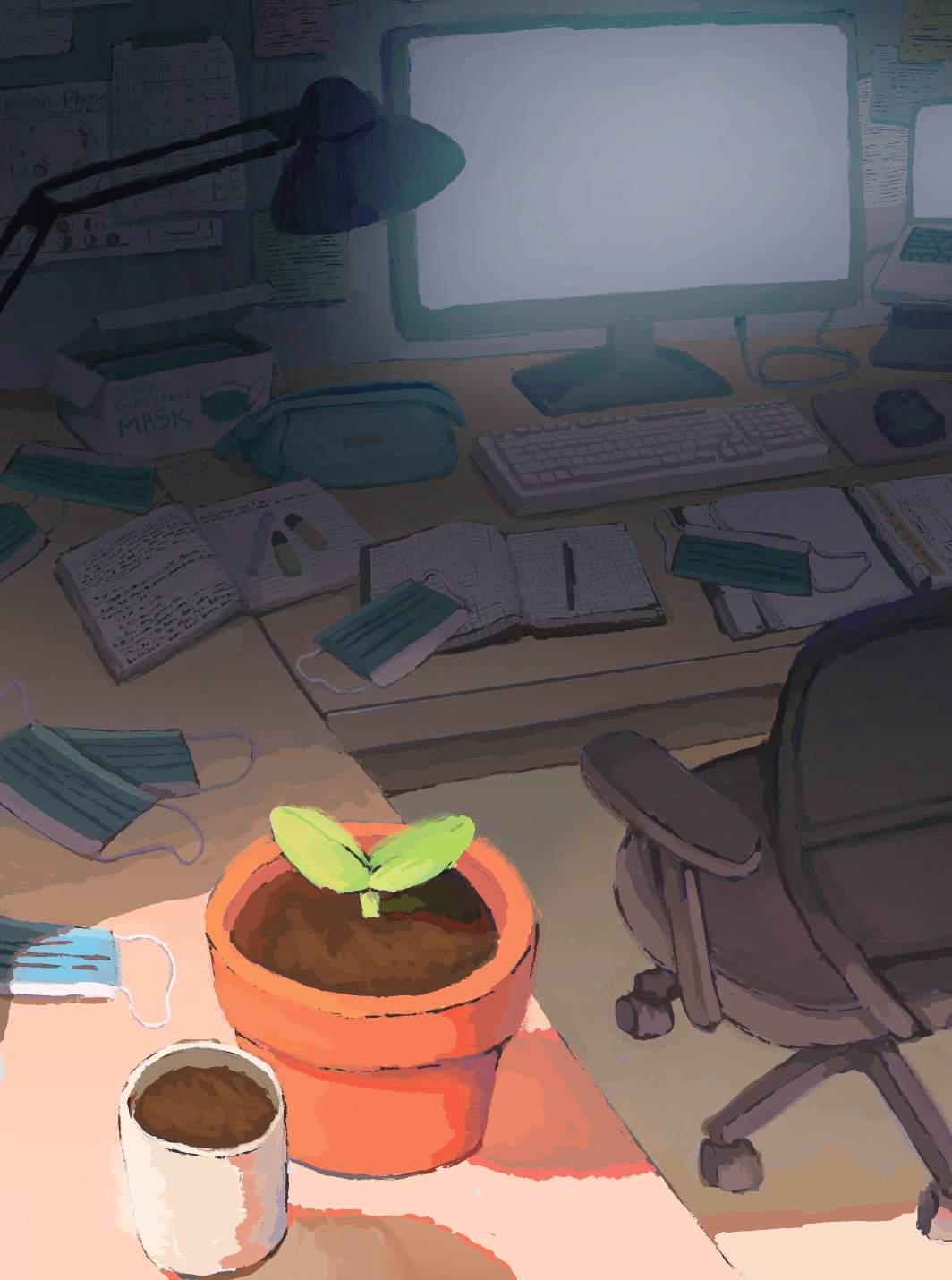
Yet silence was not eternal. Finally returned to school, the halls buzzing with voices.
Laughter bounced o the walls, The classrooms no longer devoid of life. Talking face to face Warm human connection that could not be erased, even by a deadly virus.
Continued planning for the days ahead. Planted new owers, read new books, made new friends.
Like small stepping stones to a better life ahead. Each act, a resilient promise that life bends but does not shatter.
Written by Evelyn Wang, ‘26 | Designed by Ishanvi Patel, ‘28
Knead the loam
Roll the coil
I lay shapeless gures
In the center of the kiln
Pinch and curl
Silt lingers under ngernails
My hands work the clay
Mold, pull, etch, shape
Become
In the heat of the kiln
I shatter
Burn and crackle
Cleanse and purify
Every imperfection sti ens, hardens
A baptism or an inferno?
I unload the kiln
Dip the brush
Smooth and careful
I paint swi , intense
With a careful knife
I scrape away the colored slip
Crushed bottles and sea glass
Iron eck
With a so clink
The glass pebbles drop

Vivid color blooms from dull powder
Fine cracks spill over my walls

Written by Joann Xie, ‘27 | Designed by Joann Xie, ‘27

i lie in the back of the little red train, dreaming that i am six, leaning in against father’s shoulder as we trudge around shopping malls.
i long for the cities in massachusetts. it doesn’t remind me of the paci c, of mothers waiting for the day their only daughters come home, taking children who know nothing of homeland, of beaches where i rst tried to skip rocks, each plunging into sea, face carried to my ancestors through waves, lost in rippled water.
i pretend i don’t feel your hands caressing my heart, tender surface ripping from inside.
today and tomorrow i will buy tickets to the trackless train, watching your head on father’s shoulder, rocking in rhythms of wheels on tile; the day a er i’ll rewind again, searching once more for when my face dri ed onto your skin.
Written by Viola Han, ‘29 | Designed by Olivia Li, ‘27

We are all victims to the threads of colonialism, to the glory we claim a er death. We will never live to see the vestiges of war.
Nothing can compensate for the amount of bloodshed our nation has spilled. We will always nd a way to justify our actions, we have just learned to rebrand savagery into something that sounded more tolerable to the human heart.
And the navy, I want to cower away from it. I want to hide behind the same ag that I once, with a pu ed chest, signed my life o to.
The amber-tinged lanterns of the enemy’s coastal outpost had now registered into sight.
Raiding the enemy ports could reward our nation with coins, blood, and more honor to our corpses. But they are useless against the fragility of life. I do not want to die.
The gentle waves rocked the ship on the moongladed sea, the evanescent gleam of stars glinted o the bow.
Dread slammed free from my ribcage.
In a few hours, the sea will be peaceful no more, the waters instead dyed crimson from our attack. Corpses will be nestled underwater and on the port’s wooden planks, falling under the proud banner of the navy.
Written by Grace Ye, ‘27 | Designed by Evelyn Wang ‘27
Once upon a time, there was a bright, bustling town with much to adore. From the lively shops where goods shone at daytime and lamps twinkled at night, to the unique ora that complemented buildings, it was an ideal place for both residency and tourism.
Many animals lived around this town too. The majority of households kept at least one, which typically was a dog, cat, or sh. However, if one were to walk to the town’s outskirts, they would easily spot a great abundance of wildlife, leading to constant instances of seeing many vibrant animals.
Among those was one small, anxious chameleon.
It always felt like it would thrive better in the middle of the town, longing for a livelier setting than the quieter, shady forest. Yet at the same time, it didn’t want to be noticed by ashy cameras and overenthusiastic news reporters. Despite the vast variety of animals the town was familiar with, they were yet to see a chameleon. The chameleon wanted to enjoy and immerse itself in a more urban life while also being away from the spotlight.
A library with multiple stories rested peacefully right next to the forest. Though not in the heart of the town, the window panes outside showed many people reading, lounging or grabbing hot cups of co ee near a mini café on the second oor, intriguing the chameleon. As the front door opened, it snuck through, nestling itself on
It was unpleasantly surprised to see that its eye wasn’t camouflaged, the pale edges of its eye standing out from the darkness of the bookshelf.
nestling itself on one of the bookshelves, and hoping nobody else noticed its presence.
Inside of the tall library, there was a tall mirror, so close to that bookshelf that the chameleon could reach towards it without hesitation. Looking around, it crept closer to the mirror to see how well it was blending in.
It was unpleasantly surprised to see that its eye wasn’t camou aged, the pale edges of its eye standing out from the darkness of the bookshelf.
Rushing out of the library, the chameleon decided to travel to a nearby pottery shop. It crawled around the tables, shelves, and drawers stu ed with clay-made objects. Some were pots, some were pans, and others were simply decorative. Some were nished, some were in the middle of being painted, and others were just starting to be made.
There in the pottery shop, the chameleon turned around for a short moment, only to panic a er noticing that its tail wasn’t matching the surroundings. No matter if it touched the pale gray clay, the auburn table or the teal wall, its tail stubbornly remained its natural color of a deep green.
Frustrated, the chameleon dashed out of the shop and went to the town’s renowned grand hallway. There were mirrors and translucent objects all around, so it could easily check if it was blending in well. It felt relieved to realize its tail was starting to change colors again, as the chameleon could ensure that at least a prominent part of itself was blended in with its surroundings. Believing that it was able to fully camou age now, the chameleon happily wandered around the halls, admiring the paintings of the famous and mourning at the memorial.
A er going around the hallway, the chameleon decided to take a break. While it was resting on a bench, a few children noticed the chameleon’s head visibly standing out from the rest of its hidden body. They were curious, pointing and trying to pet it, garnering the attention of their parents and several others around them. The chameleon was confused for a moment before turning to a small hand mirror close to it. It
before turning to a small hand mirror close to it. It was terri ed to see its visible head in the mirror while the rest of its body was still camou aged.
That was the nal straw for the chameleon. It used all of its energy to try bolting out of the grand hall, while the children tried chasing a er it. The sun was setting, and seeing the paths to di erent sections of the hall was getting harder. There was only a short while until the sky would no longer be a light source, and the chameleon’s energy was depleting fast.
The chameleon was getting too tired, but it still wanted to nd an exit to the hall, not taking any time to rest. Several children were right behind it, and they only seemed to be running faster. Before it saw the large door signifying the main exit, it passed out, hitting the hard oor with a so thud. Due to becoming unconscious, the chameleon had fully gone back to its dark green color.
The children's smiles faded quicker than a ash of lightning. Some scurried around to nd anything that could possibly wake the chameleon up, while others stayed right beside it. One of the children went around to get a glass of water and a small blanket. At the time where they were trying to nurse the chameleon back to health, the unconscious chameleon caught the attention of several others besides it.
Although none of the townspeople had ever seen a chameleon in-person before, they truly didn’t have any malicious intentions and wanted to see it thrive. Instead of seeing faces that were terrifying, the chameleon woke up to
wanted to see it thrive. Instead of seeing faces that were terrifying, the chameleon woke up to see faces that were genuinely concerned about it. It felt the urge to run away again, but was stopped by people’s kind smiles. The children still wanted to play with the chameleon, but they were a lot gentler than before.
Cultural Chameleon
Ananya AR, ‘27 Digital
It felt the urge to run away again, but was stopped by people’s kind smiles.
Written by Khloe Louie, ‘28 | Designed by Gloria Zhai, ‘27
Is life in Congress all that it’s cracked up to be?
A/N: This is a satire about the presence of political drama and the lack of productivity in Congress. All people mentioned in this article are ctional.
July 20, 2050
If there’s one thing that everybody needs to know about politics, it’s that being a congressperson is not easy, especially in this day and age. The federal government is more divided than ever, whether it’s over foreign policy regarding the German-British War, or any of the domestic issues relating to the economy or social rights. Lawmakers have been reported to stay up until 4:00 am for simple oor votes.
To make matters worse, extra hours do not correlate to public approval. As of 2050, the approval rating for Congress has been sitting at a measly 10%. Both Democrats and Republicans have similar approval rates, at 9% and 11% respectively. However, one telling factor has emerged. A study conducted by the Washington Post’s esteemed, Pulitzer-winning Survey Team discovered that only 2% of all Congress members approve of the obligations and working environment of their jobs, down from 6% in 2048. Midterm elections are coming up, and the country has been facing many high-pro le issues that will be on the ballot in many states.
One imminent danger is the looming threat of World War III. Despite the work the President has been putting into rebuilding relations with Russia, those relations have been at an all-time low ever since Russia threatened to nuke New York City. Emmet Ross (I-NY-12), whose district is based around Midtown Manhattan, no longer lives in his own district out of fear for his own life. Even though this angered a lot of his constituents, he refuses to go back.
“I don’t want to have to think about dying whenever I step out of my house,” said Ross in an interview with those losers from the New York Times.
“Extra hours do not correlate to public approval.”
These thoughts have impacted his decisions, or lack thereof, on important votes in the Lower Chamber. Ross has been caught on C-SPAN staring out the window at least ten times during vote sessions this month. Known for his hardline pro-Germany stance, even in its war against the United Kingdom, Ross campaigned heavily to pass a bill to send nancial aid to Germany. However, his paranoia overtook him, and on the day of the voting, he did not pay attention, causing him to be marked as “abstaining.” The bill failed 215-217, and pro-Germany Democrats within his district were outraged.
“If this is who represents New York right now, I’m going to call it quits,” said Alisa Schultz, a lifelong Democrat whose parents were immigrants from Germany.
Still, Ross brushed o his constituents’ concerns, calling them a minority. He was reelected to a tenth term in the 2048 election with 53% of the vote. Political scientists chalked this up to fellow New Yorker Donald Reynolds (D-NY-10), and Ross’s elbow partner in the House, who campaigned mercilessly on his behalf.
“Only Emmet Ross will create change around Midtown!” Reynolds said to a screaming crowd of 5,000 people in Times Square. Ross was not present at this rally, prompting people to joke Reynolds was representing two districts at once. Many people were convinced he was running for Ross’s seat instead, and only voted for Ross because of Reynolds’s presence. Ross has not responded to our requests for comment.
However, not all stress in Congress is caused by outside issues and overwork. As political violence has increased in our country, lawmakers have not been trying to solve this issue. Mackenzie Cheng (R-PA-03) believes in ghting has become a major issue in the Republican Party.
“One day, they’ll cheer me on while I take down commie Courtney [Tran (D-CA-14), known for her advocacy of socialism], the next they’ll call me a RINO and attack me instead,” Cheng said in an interview with us at the Washington Post. She was elected to her seat in 2046 due to her MMA reputation rather than her political positions, and given the nickname of “Mani-Mac” based on her aggressive ghting style. One di erence between her and other lawmakers is her lack of actual political positions. “There’s so much going on that I don’t know what to believe anymore.”
Cheng is currently the only Republican representative that does not align herself with a caucus. This makes her both a valuable ally and a major target. C-SPAN caught an incident where two unidenti ed Republicans were pulling her into their respective directions. In response, she challenged both of them to wrestling matches, despite repeatedly insisting that in ghting is a problem. “It’s so easy to use buzzwords like ‘in ghting’ and stu to get people all riled up, even if you don’t really know what they mean,” Cheng later said in the same interview. “As long as it makes the press happy.”
This strategy has worked for Cheng, as many major newspapers have been endorsing her. The Philadelphia Inquirer, her home newspaper, started this trend, and it’s likely her speeches loaded with buzzwords got more papers on her side. Courtney Tran, one of Cheng’s sworn enemies, has commented on these tendencies.
“If fascism was making the news, she would call me a fascist, and so would the news,” said Tran in an interview with the Le -Wingers Today magazine. “And the more people talked about racism, the more likely she was to accuse me of being racist.” However, when we asked Tran for details about her relationship with Cheng outside of Congress, she said they got along well. “It’s like we’re living double lives, like we hate each other in public but get along in our personal lives.” Although we at the Washington Post signed an NDA to protect Tran and Cheng’s reputations, they both allowed us to share the fact that they go to Nats games and hang out at the House Gym together.
In fact, many representatives we interviewed spoke highly of the gym. “It’s a good way to cope with running two elections at once!” said Reynolds, who is part of the bipartisan House Gym Club that meets every morning at 6:00 am. Led by Cam the Carpenter (G-WA-05) since 2033, members agree that working out is the best way to release stress and think about anything but congressional duties.
“On an average day in the Gym Club, we’ll discuss the newest Marvel movies, the best avors of Lay’s chips, and how to get good seats in Nationals Park for less,” said Carpenter.
Originally a perennial candidate for the Green Party, Carpenter did not expect to get elected. But a er Washington State adopted ranked-choice voting, and the rst-place candidate moved to Canada before they could get sworn in, Carpenter, the second-place candidate, took up the position instead. The former dentist has stated multiple times that he wants to pass a law requiring everyone to oss their teeth at least once a day to promote good dental hygiene within his district. He formed the House Gym Club for fun, telling the Seattle Times that “sometimes, we need to lighten up a little and not take things too seriously.”
More and more representatives have been joining the House Gym Club every session to remind themselves to enjoy their lives outside of lawmaking. Exercise has been scienti cally proven to release dopamine, which temporarily helps these lawmakers feel better and focus when on the voting oor.
Another common coping mechanism is for lawmakers to sneak their phones under their desks, even when Congress is in session. “[Secretary of Everything Bethany] Blackburn does it, and this means we can too, right?” asked Constance Ramirez-Yang (D-PR-01). Ramirez-Yang has always looked up to Blackburn, and this only intensi ed in 2037, when Blackburn, then a Democrat representing Rhode Island’s third district, introduced a bill to make Puerto Rico the 51st U.S. state. The bill passed 315-117. Since then, Ramirez Yang has tried modeling her own policies and behaviors a er Blackburn’s, even a er Blackburn le the House to become the Secretary of Everything.
“She’s probably seen me use my phone all the time, but she’s never called me out on it,” Ramirez Yang told the San Juan Daily Star. When asked about what she does on her phone, she included watching TikToks, reading fan ction on AO3, and playing Stallion Wagon, a match-3 gacha game that exploded in popularity a er Blackburn speedran the rst 500 levels in a three-hour livestream in 2045. About 60% of the House plays that game daily. “I don’t think it’s that bad,” Ramirez Yang continued, “because at least most people still vote
Cassie O’Brien (D-RI-03), Blackburn’s successor, o ered a di erent perspective. “Some social media addicts are abstaining from votes because they didn’t even hear it was being announced,” she told the Providence Journal, quickly claiming she wasn’t only saying this to break from Blackburn. This has been re ected in the vote records. The most recent bill to be introduced during the 131st Congress, the MONSTER Act, which gives werewolves, zombies, and sapient animals full voting rights so long as they are American citizens, passed the House 401-2, with only one person voluntarily abstaining, meaning 31 representatives did not vote at all. By contrast, during the 130th Congress, an average of 6 representatives did not vote on any given bill.
This may explain why fewer bills are passing. So far, as of April 2050, only about 500 bills have been passed by both chambers of Congress. It’s common for representatives to convince others, even those who normally participate in the voting process, to join them in Stallion Wagon’s multiplayer mode. Blackburn has encouraged these games and has even joined in herself. Still, with everything going on in the world right now, O’Brien doesn’t blame anyone for simply needing an escape.
“What can I say?” asked O’Brien. “In the end, we’re all just trying to survive.”

Written
Jayaj Bhatnagar,
“Plain
pullquote text here.”
“The life of the law has not been logic; it has been experience.”

Philosopher’s Judgement
Ananya AR, ‘27
Digital
Philosopher’s Judgement
Ananya AR, Digital
Title Here
Artist Name, ‘00
Title Here
Artist Name, ‘00
Medium Here
Medium Here
Sta Contributors
Samhita Lagisetti, ‘26 - Co-president/Editor-in-Chief
Saanvi Dogra, ’26 - Co-president/Editor-in-Chief
Sophia Cao ’26 - Vice-president/Deputy Editor-in-Chief
Gloria Zhai, ‘27 - Treasurer/Editor
Mandy Hung, ‘27 - Secretary/Editor
Cindy Liang, ‘26 - Board Editor
Katherine Chen, ‘27 - Board Editor
Evelyn Wang, ‘27 - Board Editor
Adhya Karthik, ‘27 - Board Editor
Sa ya Warsi, ‘28 - Board Editor
Chloe Kang, ‘26 - Head of Art
Joann Xie, ‘27 - Co-head of Graphic Design
Olivia Li, ‘27 - Co-head of Graphic Design
Advisors
Mr. Thomas Swanson
Dr. Trent Hall
Writers
Joann Xie, ‘27
Grace Ye, ‘27
Evelyn Wang, ‘27
Khloe Louie, ‘28
Viola Han, ‘29
Evelyn Lee, ‘29
Jayaj Bhatnagar, ‘29
Artists
Sophie Tran, ‘26
Chloe Kang, ‘26
Kayla Peng, ‘26
Emily Capua, ‘27
Grace Ye, ‘27
Ananya Rajendrababu Anoop, ‘27
Graphic Designers
Sophie Tran, ‘26
Katherine Chen, ‘27
Olivia Li, ‘27
Evelyn Wang, ‘27
Joann Xie, ‘27
Gloria Zhai, ‘27
Ishanvi Patel, ‘28

The Featheralist, Volume 06, Issue 02 Del Norte High School's Political and Literary magazine. Published on March 23, 2024.
Del Norte High School, 16601 Nighthawk Lane San Diego, CA 92127
Phone: (858) 487-0877
Fax: (858) 487-2443
https://www.powayusd.com/Schools/HS/DNHS https://dnhshumanities.weebly.com/ dnhshumanities@gmail.com
School Population
2,459 students
153 full-time sta
Font Families
League Gothic (titles) Oswald (pull quotes) Libertinus Serif (by lines/body text)
Computer Hardware and So ware Windows 10
MacOS
Adobe Illustrator
Adobe Photoshop
Adobe InDesign
Paper stock
Cover: 100# Glossy Text
Inside: 80# Glossy Text
We would like to thank our printing company, Best Printing USA, for their steadfast technical support and consistent high quality.
Price of magazine
We rely 100% on local advertisers and student-essay-contest-award money to print our magazines. We print approximately 150 copies per issue depending on page count and distribute copies for free to the Del Norte student body and surrounding community.
The Featheralist is produced and managed entirely by members of the synonymous The Featheralist club, an 100% student-run extracurricular club. The Featheralist club members are divided into three distinct but coordinating departments: Writing, Art, and Graphic Design. Each department is led by a small group of student o cers.
The Writing Department collects dra s from both sta and guest writers. Student-led “editing squads” ensure that all articles are publication-ready. The Art Department curates artwork of all subjects, mediums, and styles through methods similar to the Writing Department. O cers screen all writing and art pieces for school appropriateness. Lastly, the Graphic Design Department combines verbal and visual content together into print-ready spreads.
The positions expressed in any of the articles are solely those of the individual writer(s). They do not represent the viewpoints of The Featheralist, nor those of Del Norte High School or the Poway Uni ed School District.
The Featheralist as a club exists to foster a collaborative and mutually edifying community of artists, writers, and graphic designers. We empower students to explore topics spanning the entire spectrum of the humanities — from screenplay to political essay, from poetry to short story. We serve as a megaphone to broadcast students’ unique ideas, experiences, and visions to the entire campus and the larger community.
Scholastic A liations
We are a proud member of the Columbia Student Press Association.
NOBODY
OF
BECAUSE IT CANNOT FLY. IT IS SIMPLY A DIFFERENT KIND OF BIRD. DIFFERENT, NOT LESS. Stuart Duncan