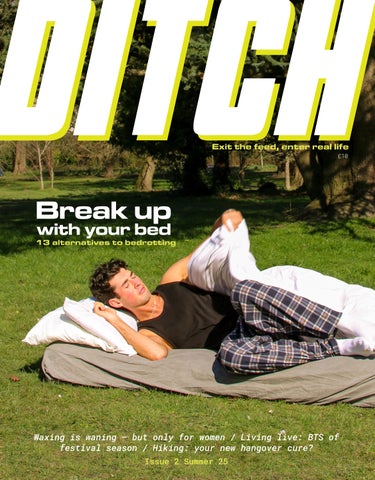
Waxing is waning – but only for women / Living live: BTS of festival season / Hiking: your new hangover cure?
Editor’s letter
The sun’s finally peeking out from behind the clouds, the beer garden is calling and men have decided to abandon their tops in public spaces.
That’s right: summer’s here, or near enough. And with that, we bring to you issue two of DITCH, all about DITCHing the bedrot.
It’s something we’ve all done, wasted the day in bed, scrolling through TikTok for the fifth hour in a row, while pretending our to-do lists don’t exist. Head to page_6 for Amelia to give you the full run-down on bedrotting (complete with Mia’s 13 things to do instead of spending your day in bed).
This issue, DITCH challenges you to get out of bed and actually do something – whether that be a six hour hike like Amelia (page_10) or a feral night out like Alfie (page_18). And if you’re really struggling for motivation, head to page_8, where you’ll find Wiki’s breakfast recipes that will have you practically leaping out of bed – even when you’ve got nothing in your fridge.
This issue comes to you in collaboration with fellow editors Mia Wilson and Jade Burrell. Mia’s team brought our words alive and she shot and created our cover (shoutout to Alfie too, for being our cover star and making a blow-up bed in a park look cool). Jade’s team created content for our socials (make sure you’re following! Details on page_27) and organised our upcoming podcast episode all about charity shops v online resellers, coming to Spotify soon.
Hope you enjoy the read. Read it in the park, on the beach, at the pub, in the club. Just not in bed.
Molly Baker, content editor
Fashion
2010’s Indie sleaze is back for the summer (think Gossip Girl).
Leo, 23rd July - 22nd August
TIME
Get your internet fix without picking up your phone
Aries, 21st March - 19th April
Summer’s the time to go feral, so kick things off with a night so intense that even your hangovers will need a holiday.
Taurus, 20th April - 20th May
You love your routine and that’s cool –but even you deserve to shake things up a little. Try saying yes to something spontaneous, like getting naked in public.
Gemini, 21st May - 20th June
You’ll be on a quest for the perfect summer fling, but forget their name two days later. At least you’ll remember the tequila shots.
Cancer, 21st June - 22nd July
Not everything has to be a therapy session, no matter how much you feel like the beach has emotional meaning.
Get ready to be the star of every summer party – you’ll be turning heads, stealing hearts and probably making someone’s drink magically disappear.
Virgo, 23rd August - 22nd September
I know you’re trying to plan the perfect summer, but chill out. Not everything needs a schedule.
Libra, 23rd September - 22nd October
Trust your gut this summer, but hold off on sending that 3am text to your ex. Your dignity will thank you.
Scorpio, 23rd October - 21st November
Being mysterious is so last autumn. Let loose this summer; you might even find you enjoy it.
Sagittarius, 22nd November - 21st December
This summer’s for spontaneous road trips, questionable decisions and probably a tattoo… or two.
Capricorn, 22nd December - 19th January
It’s time to take a break and finally let your hair down. Go crazy, wear mismatched socks or something.
Aquarius, 20th January - 18th February
Your best summer move? Don’t make any plans at all. Let the chaos take you wherever it wants.
Pisces, 19th February - 20th March
DITCH the clothes this summer and head to your local beach/lake/paddling pool in your friend’s garden for some skinny dipping.
Words_Molly Baker & Lois Beasley
We think you should DITCH:
Filming
concerts
Why are you watching your favourite band play through a screen? Let’s be real: you’re never going to watch those concert videos again and if you do, it’s just going to be your voice – out of tune, far too loud, drowning out the live music. So, this summer, go to a festival, drink a warm beer at 11am and leave your phone in your tent (or maybe just your pocket).
DITCHionary
Bedrot
Wasting the day in bed, being as unproductive as possible, often accompanied by scrolling through social media (hear what Amelia has to say about bedrot on page_6).
Girl dinner
Compiling the most random assortment of food and calling it dinner, from a packet of crisps and three pickles, to a cheese string and a couple of slices of toast (see page_24 to read about Lucy’s week-long girl dinner challenge).
Your summer horoscope
What’s new and trending? Films
The upcoming ping pong prodigy movie Marty Supreme is going to be hot according to Gwyneth Paltrow, who’ll be starring alongside Timothy Chalamet.
Get ready for nostalgia with the new How To Train Your Dragon movie – got thoughts about live action remakes? Let us know @ditch.magazine on Instagram.
The eighth Mission Impossible film will be released this May, confirmed to be Tom Cruise’s last film as Ethan Hunt - but not the end of the franchise.
Celebs
Kim K has trademarked her kids’ names and Kanye is mad about it (no surprise there).
People are romanticising adventure, capturing their moments with the “Hozier yell” from the song Northern Attitude.
1. Hay Festival of Literature and Arts, Hay-on-Wye, 22nd May1st June
2. London naked bike ride, Clapham Junction, Croydon, Hyde Park, Regent’s Park, Tower Hill, 14th June
3. Tafwyl Welsh Culture Festival, Bute Park, Cardiff, 14th June
4. Open-air cinema, Hyde Park and Regent’s Park, throughout the summer
5.Bristol Harbour Festival, Bristol Harbour, 18th-20th July
RISE AND SHINE? NO THANKS
ATake a dive into the psychology of staying in bed all day, aka bedrotting
t some point, everyone hits a wall. You stop moving, stop thinking and let go of any hope at being productive. Instead you sink into your bed, queue up another episode of a neverending Netflix series, and let your to-do list fade into the background. This is what has become known as bedrotting by TikTok users.
Bedrotting is supposedly a way to escape the relentless pressure to be productive, offering a space to unwind and decompress. So, instead of waking up at 5 am, journaling and making a green smoothie, you wake up at noon, order UberEats and watch six hours of The Office without blinking.
While it might seem like an understandable winter habit, responding to dark mornings and freezing temperatures, bedrotting is just as much a summer issue. There’s something uniquely guilt-inducing about spending a perfectly sunny day under the covers, ignoring texts from friends asking you to come out. Instead of hibernating from the cold, you’re hiding from the expectation to be out living your best life.
For Amy, a 22-year-old student, bedrotting is a break from the relentless cycle of university deadlines and the looming pressure of figuring out what she’s going to do with the rest of her life. “Sometimes I just need my brain to switch off, and being in bed means I’m in a calm space where I can just get away from everything, it feels safe,” she says.
Words_Amelia Jones
Enthusiasts claim that spending hours in bed provides much-needed relaxation and improves mental health, but experts aren’t convinced. Dr. Bhavini Shah, a GP from LloydsPharmacy Online Doctor, warns that excessive bedrotting could lead to sleep problems, joint stiffness, vitamin D deficiency and digestive issues like constipation.
Caroline Jones, a sleep specialist, also warns that too much time in bed can backfire. “Sleep is about allowing your whole body to rest, and your body does a lot while you’re sleeping,” she says. But if you’re skipping sunlight and movement all day, your body clock takes a hit, making it harder to fall asleep at night.
This hasn’t stopped influencers like Nat Doumkos from promoting bedrotting on TikTok, with the rise of trends like “rot with me for the day.” These videos, often featuring dimly lit rooms, unmade beds and a steady stream of snacks and scrolling, turn bedrotting into a shared experience – one where doing absolutely nothing is not just accepted, but celebrated.
Maria Chiorando, who wrote about bedrotting for The Daily Mail, believes the trend is a response to the overwhelming expectations placed on young people. But she warns it’s not a healthy response to pressure. She says: “If you’re solo bed rotting, you are cutting yourself off from engaging with people and life in general.”
Like most TikTok trends, bedrotting isn’t inherently good or bad, it depends on how you use it. Taking a day to switch off and recharge? Probably fine. Making it a daily ritual that replaces real self-care? Maybe not so much.
So, if you’re about to burrow under your duvet for the third day in a row, ask yourself: is this really self-care, or am I just avoiding life? If it’s the latter…you might want to consider getting up.
“You wake up at noon, order UberEats and watch six hours of The Office without blinking”
BREAKFAST
OUT OF BED
Rolling out of bed is hard enough on a normal day, let alone when you have
Words & Images_Wiki Jazwinska
1 cup oats
1 ripe banana (the spottier, the better)
½ cup milk
1 egg
½ tsp bicarbonate of soda
½ tsp baking powder
Optional: cinnamon, honey, yoghurt and berries to top
1. Blend oats and blitz until fine.
2. Add the remaining ingredients and blend again, then refrigerate for 30 minutes.
3. Preheat a frying pan on medium heat and brush with butter. Pour on your batter and let each pancake cook for 5-6 minutes, flipping them halfway.
4. Serve with whatever you have in the fridge or cupboard.
Words_Mia Wilson
13 THINGS TO DO instead of bedrotting
If
CHEESE CRUSTED EGG
1 egg
1 handful of grated cheese Salt and pepper to taste
1. Preheat a frying pan on medium heat.
2. Grate your cheese, then spread in an even circular layer on your frying pan and cook until melted.
3. Crack your egg on top, cover with a lid and cook for 3 minutes, then uncover and cook for another 2 minutes until the cheese is crisp and golden.
4. Season to taste and serve with toasted bread, avocado, hot sauce.
you’ve wasted the first half of your day in bed, here’s how to turn the rest of it around
1. Place all the ingredients in a saucepan and simmer while whisking.
2. Reduce for a couple of minutes until the sugar has dissolved creating a
Put on an ‘outdoor’ outfit – swap out those jammies for jeans so you’re not tempted to scramble back under the covers.
Cook or bake something – don’t worry about going to the shop; follow one of our recipes on the left.
Decorate your room – everyone has photos and posters waiting to make it on the wall.
Write or journal – grab a pen, pencil, felt tip, or whatever and write down all of the thoughts you’ve had today (that you
Call a friend – remember that friend you keep meaning to catch up with? Call them. Now.
Go outside – it sounds simple, but sitting in a park is better than rotting in bed.
Listen to music/a podcast – listen to an album from start to finish or check out our new podcast DARE on Spotify.
Make a vision board – open Pinterest, make some new boards, and get inspired. But obviously, don’t do it in bed.
9
Organise your clothes – fold or sort through items to donate or upcycle.
10
Shower and skincare – take a shower to wash off the rot and reward yourself with a relaxing face mask.
11
Write yourself a letter – date it and open it a year from today… but try not to lose it.
12
Colour walk – choose a colour and go for a stroll, taking a photo every time you see your colour.
13
Read something – put your phone down and finish/start a book or maybe… even… a magazine…
the sleep paradox the sleep paradox
Ever
“listen to your body”, but DO NOT DO THAT IF YOU’RE SLEEP-DEPRIVED. It will lie to you out of pure spite.
Cortisol is also called the stress hormone for a reason. Dr. Chester Wu, a sleep medicine specialist, says if you keep pulling this “sleep is for the weak” stunt, your body will take revenge. Do you know what’s on the other side of too much cortisol? Sleep problems, concentration issues, weight gain, heart attacks and – most importantly – wrecked libido. That’s right, no sleep? No sex drive. Your body is out here sabotaging you on every level.
But what about oversleeping?
woken up after barely sleeping and felt unstoppable – only to sleep in and wake up feeling
Alike a cremated corpse?
lright, picture this: it’s Sunday night and your mates have convinced you to have “just one drink.” Classic. You’ve got an early start in the morning, a meeting you can’t skip and you are being so responsible this time. Until, of course, you aren’t. One beer turns into five, five turns into shots, and suddenly it’s 3am and you’re contemplating life over a portion of cheesy chips. You finally crash into bed, knowing damn well you’re going to suffer tomorrow.
hours of sleep and wake up feeling… like absolute death. Groggy. Confused. Your coffee is somehow both scalding hot and tasteless. Your day is ruined.
What the hell is this sorcery?
“Your body panics and starts pumping out cortisol like a dodgy energy drink”
Except you don’t. You wake up after four hours feeling invincible. Your coffee hits different. You might actually be the most powerful person alive.
Now, let’s flip it. It’s a different Sunday. This time, you decline the drinks like the responsible adult you claim to be. You’re in bed by 10, get a luxurious nine
To put it simply, your body is a liar and a cheat. It’s all chemistry, baby. First up, let’s talk cortisol: the body’s own double espresso. According to Dr. David Rosenberg, a family physician, the hormone is “the body’s caffeine.” When you’re running on fumes after your four hours of sleep, your body panics and starts pumping out cortisol like a dodgy energy drink, tricking you into thinking you’re fine. You’re not. You’re in survival mode.
And here’s the kicker – your body is straight-up gaslighting you. People say,
Oh, you think getting too much sleep is fine? Cute. Your brain wakes up before you do, already caffeinated and wondering why you’re still unconscious. This messes with your circadian rhythm – the same way jet lag does. Your body’s confused, your concentration is shot and suddenly, even the blurb on the back of a crisp packet reads like gibberish. And just like not getting enough sleep, oversleeping can also screw you up long-term. Increased risk of depression, brain fog and – yes – even more sleep problems. It’s a lose-lose situation. What’s the fix? There isn’t one. You can’t always get it right. Late nights, early mornings, and the occasional 12-hour hibernation are inevitable. Just don’t make it a habit. Find your sleep sweet spot, stick to it as much as possible and try not to let your body gaslight you into thinking four hours of sleep is the answer to your problems.
Words_Magda Patynska Illustrations_Gabi Patynska
HIKES FOR HANGOVERS
DITCH writers take on a six hour and one minute hike up Pen y Fan... severely hungover
Ahhh, that familiar Sunday morning feeling. You wake up with a pounding headache, a queasy stomach and the classic promise to never drink again. Sure, you could spend the day rotting in bed, doomscrolling through last night’s questionable texts and wallowing in self-pity, or you could fully embrace the suffering with a six hour and one minute hike up Pen y Fan –the highest peak in South Wales.
Apparently, fresh air and exercise are good for you – who knew? A study published in the journal Addictive Behaviors examined 1,676 undergraduate students and found that regular exercise helps the body cope with hangovers. Exercise also releases endorphins which fight the boozefuelled inflammation and help dull those annoying hangover headaches and sore muscles. Plus, it’s the perfect excuse to put your phone down, escape the endless doomscrolling, and swap screen time for actual scenery.
A spokesperson for Queer Hikes South Wales says it’s good to get out on that dreaded morning after: “On an early Sunday morning where we’d usually stay in bed, instead, we’re up and out with a group of like minded people enjoying nature and one another’s company no matter the weather.”
Rules:
No phones, no distractions – This is a full detox, and that means no doomscrolling, no GPS and no desperate Googling of “Can you actually die from a hangover?”
Puke mindfully – If you must vomit, do it away from the group and with as much dignity as possible. Bonus points if you keep walking while doing it. Negative points if it’s on someone’s boots.
No turning back – Once you start, you’re in it till the bitter end. No excuses, no exits, no shortcuts. The only way off this mountain is up.
Bring a snack – Your body is running on regret and bad choices. Keep it moving with protein bars, fruit, chocolate, or in our case, a vegan brownie. If you can hold it down that is.
601 challenge
Here at DITCH, we challenge ourselves to take on a different, phoneless activity for 6 hours and 1 minute – the average screentime of an 18 - 24 year old.
Our Route
6 hrs 1 minute to go
As we went through the kissing gate, we came face to face with the challenge we were about to complete. Fooled into thinking it was a summer’s day just because the sun was out, I soon discovered it was actually bitterly cold. It wasn’t ideal – I didn’t bring a coat, but I suppose it spurred me into action.
5 hrs 30 mins to go
The first few steps felt manageable until the incline hit. My head pounded with every step, last night’s drinks making their presence painfully known. The wind cut straight through my hoodie and my regret deepened.
Lucy glanced at me, noticing I was shivering and clearly struggling, and offered me her coat. I didn’t even try to act tough. I just nodded and took it. The warmth was an instant relief against the relentless wind.
The others were struggling too, groaning about their heads, legs, and life choices, but somehow that made it easier. We were all in this together, dragging ourselves up the mountain one step at a time.
The incline was steeper now, loose stones shifting underfoot, but something about the fresh air and
open space was helping. My head still ached, but the freezing wind was waking me up.
As I struggled on, I remembered what Trek Therapy director Ian Whiteside said about ditching my phone and opting for a walk in nature, as a powerful way to address negative or harmful behaviours. He said it was a healthy approach to addressing harmful behaviours such as hangovers.
The higher we climbed, the more the landscape opened up. It was breathtaking, a view that made the climb feel worth it. The wind whipped through the gaps in the rocks, sharp and relentless, but instead of pure misery, I felt a surge of energy. Lucy’s coat kept the worst of the cold at bay and for the first time, I wasn’t just focused on surviving – I was starting to enjoy it.
“ We were all in this togther, dragging ourselves up the mountain one step at a time ”
4 hrs 30 mins to go
We finally stopped, sinking onto the grass with exhaustion and relief. The wind had eased, the sun was warm on our faces and finally, the climb didn’t feel quite so punishing.
Molly pulled out a stash of vegan brownies. The first bite was dense, chocolatey, and exactly what we needed.
We guessed we were about halfway, though without our phones telling us, we weren’t entirely sure. With our legs aching but our energy slowly returning, we sat for a while, letting the sugar do its job. The worst of the hangover was starting to fade, replaced by something else – maybe even enjoyment.
Molly (left), Amelia (centre) and Lucy (right) ditching the hangovers at the top of Pen y Fan
“The struggle, the unexpected extra climb, and the lingering hangovers faded into the back- ground”
3 hrs 25 mins to go
We finally reached what we thought was the summit, relief washing over us until we realised we were standing on the wrong peak. What we had climbed wasn’t Pen y Fan, just a deceptively high point with a perfect view of the actual summit in the distance. A steep descent followed by yet another climb now stood between us and the peak.
Groans of frustration echoed around us, but we had to keep going. As we started the downhill stretch, the worst of the hangover was fading, replaced by a second wind. The end was finally in sight, and despite the extra effort ahead, there was a growing sense that this would be worth it.
2 hrs 45 mins to go
At last, we reached the summit of Pen y Fan. This time, there was no mistaking it: the iconic stone marker stood proudly before us, a reward for our aching legs and stubborn determination. The wind was fierce up here, but it didn’t matter. We’d made it.
1 hrs 15 mins to go
Once we got past the worst of the wind, time moved surprisingly fast. The descent was more straightforward. Our legs were tired, but at least we weren’t fighting gravity anymore. The conversation flowed more naturally and the mood felt lighter.
The air was still cold, but at least we were moving steadily. At one point, we came across a small stream cutting through the path, the water rushing clear and fast over the rocks. We picked our way across carefully, trying to avoid slipping.
With the finish getting closer, the trail didn’t feel so punishing. The hardest part was done. Now it was just a matter of getting there.
7 mins to go
The gate was finally in sight. After hours of climbing, slipping and wondering why we thought this was a good idea, the end was just ahead. Legs heavy, faces windburnt, we pushed on, determined to reach the finish.
As we passed through the gate, there was no big celebration, just a shared sense of relief and pride. As Whiteside said, “There is no cure for a hangover, however getting outside can help recovery as this may increase the process of alcohol leaving the body.”
Instead of spending the day recovering in bed, we’d dragged ourselves up a mountain, fought through the wind and made it to the top. The climb had been hard, the summit further than expected, but somehow, it had been worth it.
Despite the struggle, the hangovers, and the unexpected extra climb, a buzz of accomplishment felt electric between us. We took the obligatory photos, some victorious, some showing our sheer exhaustion.
With no phones allowed, there were no distractions. Just us, the open sky, and the endless hills stretching into the distance. We stood silently for a moment, letting the sense of accomplishment sink in. The struggle, the unexpected extra climb, and the lingering hangovers all faded into the background. Reaching the top felt like a victory.
The hardest part was behind us. Now, it was time to make the journey back down.
Scan to watch the hungover hikers climb the higest peak of South Wales.
A view beautiful enough to distract from the nausea and headaches
The hangover creeping up the mountain
Words_Alanya Smith
Thong & A Full Bush
Put the wax away, ‘Let it grow’ is the feminist battle cry of the summer
Wild. Naked. Brazilian. Bikini. Landing strip. Nope, these aren’t the names of clothes or Bear Grylls spin-off shows, but labels given to the carefully choreographed methods women have been shaping their public hair in for centuries. For such an intimate part of the body, the groin has been so heavily politicised and criticised throughout history that not even your private parts are private anymore.
TikTok user @sujindah experienced a “radical” vision when gandering through reviews of a bikini seller on Etsy marketplace, only to be met with the image of a woman sporting the product with a full bush. Her response? “Don’t talk to me unless you have a full bush,” a message 9.5m TikTok users heard in two days.
“Your hoo-ha does not need to be styled like haute couture”
Zara McIntosh, 21-year-old content creator with 96K TikTok followers under the name @whatzaraloves6, saw the video as an opportunity to tackle the stigma around body hair and self-image online. In her podcast series Taboo on the Bus, she chatted about the growing “bushaissance” of femininity.
“I think it comes down to representation from women in power and women in authority,” Zara explains. “Whether that is a teacher, whether that is an influencer or just someone in power that makes women feel like that’s okay for them to do too, because a lot of women do rely on more powerful figures to set that standard.”
Since Ancient Egyptian times, when the only famous pyramids were the OG great ones and not the health and wellness pyramid schemes of today, women have been opting for no pubic hair. Stripping away all public hair was seen as a symbol of being upper-class, using a sugaring
technique still used today. This sentiment continued into the Middle Ages until pubic hair became a defence against disease and a lack thereof was reserved for sex workers.
Skip to 1915, and Gillette launched their first ever razor targeted at women called the Milady Decollette, prompting a wave of pubic shaving that wouldn’t be disturbed until the 70s hippie vibe brought about a carefree attitude to the pube. The invention of the low-rise jeans and the camera phone swiftly changed this in the early 2000s.
Your hoo-ha does not need to be styled like haute couture, calm down. Although recently, there’s been a rise in new styles, according to a poll conducted by the Guardian, which found that although 82% of respondents remove some of their pubic hair, only 15% were completely bare. New treatments include anal bleaching and even vaginal Botox, for that special look that you can see without holding a hand mirror.
You might be as clean-shaven as a pebble or as free-flowing and ever-growing as a spider plant, but say it with us:
NOBODY CARES ABOUT YOUR GENITALS (not even us). Hair is completely natural and normal. If you want a plait falling out of your bikini this summer, then be our guest, but don’t feel like a super horrible, “I’m failing the world” anti-feminist if you want to bang out the wax strips. No matter what you opt for, we’ll meet you on the beach in our hairy swimwear.
“Say it with us: nobody cares about your genitals”
Smooth operator
Manscaping is on the rise, with more men choosing to garden their pubic hair
For centuries, body hair on men was welcomed. It was a sign of higher testosterone, signifying masculinity, an indication that you’ve entered adulthood. It was the thing that moved you away from baby-faced to handsome and rugged, but recently things have been shifting.
According to market intelligence agency Mintel, men are becoming more open to experimenting with their grooming routines. According to their most recent data in 2018, as many as 46% of men removed hair from their bodies, and a ballsy 57% of 16-24-year-olds said they shaved their pubic area.
#MensGrooming, #Bodybuilding and #Teabag have thousands of posts on TikTok featuring men showcasing the latest grooming tools and tips on polishing and caring for their crown jewels. Social media feeds are flooded with adverts for men’s grooming products, such as Manscaped, which proudly advertises its range of intimate care products like the best selling Lawn Mower 5.0 intimate shaver. Vice president of integrated creative at Manscaped, Henry Arlander said: “Men are becoming far more intentional about their grooming routines, treating self-care as an essential part of their daily lives.” In his opinion, cultural shifts and social media have made men’s grooming more mainstream, helping destigmatise conversations around it.
Aspiring bodybuilder Theo Clarke, 21, said: “Opinions on grooming men’s pubic hair have changed. I think men would have been expected to be more ungroomed in the past.” In his opinion, the modern dating scene and visibility on social media have affected people’s attitudes towards being groomed. With picture-perfect bodies infiltrating all our social media feeds, no wonder more men groom to adhere to these standards.
Similarly, avid gym-goer Lloyd Thomas, 22, thinks there is pressure on men to be primped and preened in a generation where style and aesthetics appear essential. He added that some men have been carving shapes out of their body hair. Your partner’s initials in your pubes, anyone?
“I use an electronic razor all over my intimate areas to keep things tidy, especially if I anticipate the possibility of someone seeing me bollock naked. I like to be groomed for those occasions,” says LLoyd.
“If I anticipate someone seeing me bollock naked, I like to be groomed for those occasions”
But it’s not just young men choosing to keep things neat and tidy down there. Jerome Henry, the 50-year-old author of the Dapper and Groomed blog for men, wrote in 2024 that he has been shaving his pubic hair for many years in a post dedicated to his grooming routine after seeing that his content on “ball trimmers” performed well. Jerome writes: “Keeping things neat and trim makes me feel more confident,” while acknowledging that he started shaving due to the porn he watched in the mid-90s when being polished was the norm.
It turns out that the “bald eagle” (a sleek, smooth, blank canvas) and the “lion’s mane” (low-maintenance, wild and free) are just two of many ways to style your crotch. Designs like the “the fade”, “designer stubble” and even “landing strip” provide men with more than one way to express themselves while in the nude.
Today, male self-expression goes beyond the clothes they wear and the hairstyles they choose; how they take care of what’s below the belt is just as important. While much of the grooming performed is often an attempt to fit trends and expectations, a growing number of men are choosing to shave their bodies for themselves.
So, whether you fancy spicing up your look, want to feel fresh during those hot summer months or keep things au naturale, what you do with your nether region is up to you.
Backstage
PASS
Words_Eva Cahill
DITCH talks to Eve Appleton Band about performing live and the fun of festivals
There’s no better feeling than being in a field with a warm can of beer in hand, soaking in any ray of British sun you can get. With summer comes festival season and, at DITCH, we want to know what it’s like to be on the other side of these events. To inspire you to see some live music this summer, we spoke with Bristol-based Eve Appleton Band to get their insight into playing live.
The band’s singer, Eve, went from singing in her hometown of Bridgeport to being the namesake of a six-part band, Eve Appleton. They won their first award, Greenman’s Rising Award, in 2023 and were recognised in NME magazine, joining the likes of Dua Lipa, The Temper Trap and Olivia Dean as they opened for Dot to Dot festival last year. With new songs Honey Boy and My Annie Dear being released ahead of this summer and some 11-odd festivals lined up, it’s an exciting time for the band.
I spoke to guitarist Ben, drummer Josh and violinist Arthur about their love of playing live and their experience of festivals.
We’re chatting after rehearsal. They’re smoking rollies, sitting in a dimly lit living room. Mirroring their chemistry on stage, they answer my questions together, adding to each other’s sentences and building up each other’s anecdotes.
Eve Appleton Band’s top five tracks to listen to:
1. Serious_Richard Hawley
2. Besties_BCNR
3. Had to Come Back Wet_ Roger Fakhr
4. Midnight in Harlem_Tedeschi Trucks Band
5. September Fields_Frazer Ford
How would you define your sound?
“It’s a bit limiting calling ourselves a folk band and people get surprised when they come to our gigs,” says Ben.
“But I think folk describes the foundations and storytelling aspect of our music,” says Tom.
“There’s a strong element of Americana, leaning into aspects of funk, rock and really really loud blues,” adds Arthur. Indefinable? I offer up. “Indefinable, yeah,” Ben jokingly agrees.
What does playing live look like?
“I think we’re a better live band than a recorded band,” starts Tom.
“And I think a lot of that has to do with
how relaxed we are on stage. I don’t think any of us take it too seriously,” adds Arthur.
“Yeah I like to f*ck around a bit,” Ben, the guitarist, adds. “I feel like reacting live adds to the songs people have heard before.”
Have you had any nightmares playing live?
Ben laughs, “Yeah, we were supporting this band from Berlin. We had an absolute shocker of a gig! The sound guy was just a moody f*cking guy; he couldn’t be bothered with any of it.”
Arthur explains: “We have this one song, Good Stupid Sheep, it’s quite a slow song…”
“Oh shit yeah!” the drummer chimes in, remembering the incident.
Arthur continues: “Mid-song, someone
Playing at Green Man 2023 Image_Sam Gabay
Playing in their hometown Image_Morgan Roberts
pulled the lead of my violin out of the instrument while I was performing a solo. So, I wasn’t making any noise, and the rest of the band were holding the same chord for ages and ages. It was about 30 seconds long.”
“We didn’t know until the grumpy sound guy told us after. The crowd wasn’t feeling it. It dampened the mood… total shocker,” rounds off Ben.
You’ve got tons of festivals lined up this summer. What do you enjoy about them?
“From a band’s perspective, festivals have really great sound techs, so you can hear yourself really clearly and you’re able to play really well,” Ben explains.
Tom adds: “At festivals, people don’t necessarily come just to see us, but winning them over is one of the best feelings.
“At the Fleece festival last year, the cheering got louder and louder as we went on. When we stopped playing, the crowd just carried on cheering. I feel like that was one of the best gigs we did!” he finishes.
So when you’re coming off the buzz of performing, what happens then? Are you getting involved in the festival?
“We head straight for a pint,” both Arthur and Ben say in a uniform, both donning a jokey West-country accent.
“And then definitely, definitely get involved in the festival,” Arthur adds.
One of their favourite festivals to enjoy after playing is the Festival of Bristol. “You go from bands in the day to drum and bass in the evening,” explains Tom.
“There’s some filthy tunes at night, just night time scattiness,” says Ben with a smile.
What gig do you enjoy playing the most?
“There’s a house in Bristol called the Hot Whale’s house, which is this huge tenperson old house with a big basement and two rooms with professional sound kits. They just have raves and parties all the time,” explains Arthur.
“We play there in the evening before the proper basement music starts. You can’t hear yourself; the sound is terrible, but everyone’s just packed in this room, just kinda off their heads, going wild. They’re a pretty supportive crowd,” adds Ben.
Do you have any rituals or superstitions that you do as a band before you play?
“We all stand in a circle and then we just all sh!t together,” Ben says, deadpan.
Arthur and Tom start sheepishly laughing.
“Just kidding, sorry, we don’t really do that,” the guitarist adds apologetically.
“We actually don’t warm up or anything,” Arthur answers more honestly.
“Anna and Eve [the singers] always do some face painting, add some squirrels or feathers to their face,” he adds. “It’s always good to watch the band before. Then we tend to just have a can of beer, head on stage, see what happens.”
What’s your opinion on people filming or being on their phones at a concert?
Ben leads on this one. “I think people can do what they want, if they’re just taking a few pictures or a short video.”
“But if they’re literally watching a gig through their phone,” Tom chimes in, “it kind of defeats the point of being in a room with people and experiencing the music together.”
Arthur adds: “I see a lot of clips on Instagram, with people who’ve put it on their story and shared it. It’s useful in terms of promotion, but it always feels like it doesn’t really do it justice. It’s a bit like when you go to take a picture of a nice landscape and it never looks the same on your phone.”
“At festivals, people don’t necessarily come just to see us, but winning them over is one of the best feelings”
Here’s 5 more affordable music festivals across Britain for you to check out:
Charlbury Riverside Festival
Oxfordshire 19th - 20th July
FREE
Nowadaze Festival
Bristol 17th - 20th July
£79.00
Silverburn Festival
Kirkcaldy 20th - 21st June
£36.38
Goodlife Festival
Leeds 28th June
£49.95
The Gower Festival south west Wales 1st - 12th July
£20 per ticket per day
Josh, drummer at a gig
Image_Robin Battison
GO
FERAL GO FERAL
Gen Z have swapped nights out for morning runs and iced matcha – but are we still having fun in the club?
With the rise of wellness and puppy yoga, people seem to have forgotten the power of the club. According to research from the consultancy firm McKinsey & Company, gen Z and millennials now purchase more wellness products compared to older generations. However, while it’s good news that health is becoming a priority, there’s something to be said for letting loose in the club.
Here at DITCH, we love everything about clubbing. Dancing till your feet get tired, screaming and laughing in the smoking area and all the things that slip away from memory until a rogue photo surfaces and it all floods back.
It turns out it’s not just us who love a night out either. According to research from Motion, a Bristol nightclub, 90% of young people feel that clubbing helps them connect with others and improves their mental well-being. Those statistics bring us hope at DITCH, knowing there are still people out there who’s ideal weekend consists of getting blisters from dancing, spilling chips and gravy down themselves and spending the rest of the weekend recovering… instead of training for a marathon.
We took to the streets to try and understand if going feral in the club really is dying
Maggie, 25: “I don’t know if people get that feral because I think it’s too expensive to get proper drunk. I can only get one or two drinks before I feel like I’ve spent too much money.”
Frank, 33: “We just had fun when I was younger with no cares. We went every Friday, Saturday and Sunday. Now I don’t know if people are doing that, but we also didn’t have social media stressing us out.”
Suzie, 22:
“I mean I go feral, but I understand why some people don’t. When you wake up with hangxiety, anyone can have photos or videos of you that you don’t remember.”
Dan, 51:
“I don’t go clubbing now, but I see photos on social media and everything just feels fake, like an act of having fun. If you were truly having fun I don’t think you would get your phone out to record everything.”
Feeling inspired? We want to see your feral pictures from a weekend where you really let loose. Send them to our Instagram @ditch.magazine so we know club rats still exist.
The night out notebook
Ditch the digital memories and write down your night out antics in a night out journal – a way to remember the chaos without scrolling.
Six things to include:
1. Quotes – Anything and everything worth remembering, from unhinged one-liners to crazy things overheard in the bathroom.
2. Random signatures – Who knows, the random guy in the smoking area could be famous one day.
3. Photobooth print – If there’s a photobooth, it’s fate – get in!
4. Post-club debrief – Describe the highlights, with input from friends.
5. Drink of the night – Who drank what? Who shouldn’t have? Rate accordingly.
6. Promises, promises – Who promised not to go feral but did? Who was a good egg and stayed true to their word?
Words_Alfie Bennett & Magda
Time to ditch celebs?
The age of celebrity worship is over – it’s time to step out of their bubble, stop idolising them and live in the real world
Words_Molly Baker
We’ve all been there: endlessly scrolling through celeb gossip, obsessing over who’s dating who and who’s wearing what. But why are we giving these shiny, polished strangers so much of our energy and attention? In an era of social media, where celebrity culture is being forced down our throats, it’s all too easy to fall victim to their charm and good looks. But they’re not saving the world – in fact, many are doing more harm than good (shoutout to Taylor Swift’s private jet). There are better ways to spend your life than being preoccupied with someone else’s. It’s obsessive, unhealthy and just a bit weird. Spoiler alert: you can live without knowing what your favourite star had for breakfast.
Parasocial relationships are onesided relationships, where one person devotes their emotions, time and interest in another person… who has absolutely no idea they exist. The term was first coined by psychologists
the mid-1950s. As TVs became more widely available, they noticed viewers began to develop an illusion of intimacy with the characters they were seeing on screen.
There are many theories as to why we develop parasocial relationships, but according to Psychology Today, one of the main explanations is that the human brain has evolved to be social. It makes sense that “when so much of our time is spent online or watching TV or movies, we’re naturally inclined to recognise the faces we repeatedly see and develop warm feelings for them.”
Although much of the research around these relationships relates to fictional characters, today our understanding of parasocial relationships is predominantly in the context of crazy-intense-obsessivesuperfans and celebrities who have absolutely no idea they exist.
You don’t know her!
In 2024, pop singer Chappell Roan meteorically rose to fame following the
me. There is always more to the story. I am scared and tired.” Chappell was met with backlash from these requests, being labelled “disingenuous” by music executive Jeff Rabhan for profiting from the industry she’s demanding change from. But why do we feel entitled to know so much about a person? And why should we even care?
“Celebrities aren’t our friends, there’s no guarantee they are even nice people”
Gracie, 28, is the name behind the handle @chappellroanhub on Instagram. She praises Chappell for her decisions and admits to looking up to her while claiming their relationship isn’t parasocial.
“I see Chappell as just another person,” she says. “I know we don’t have a relationship and I don’t expect her to be a part of my life like other people are.” It’s okay to look up to celebrities for their art but it’s important we know where to draw the line.
Celebrities are often idolised even, and sometimes especially, when they shouldn’t be. We place them on a pedestal and give them a platform, which – let’s be honest – very few use for good. Recently, Kanye West has made headlines for his controversial outbursts on social media, including a string of anti-semitic remarks, going as far as labelling himself a N*zi.
In a Hunger Games-esque manner, we also see celebrities at events like the Met Gala adorned in clothes worth more than what most people earn in a year. In reality, celebrities aren’t our friends and there’s no true guarantee they are even nice people.
We’d be better off if we stopped idolising the lives of people we only know through a screen and started focusing more of our attention on the relationships we have in real life — with people who actually acknowledge our existence.
What celebrities should we put in the bin this summer?
NOSTALGIA
CYCLE TrAP
Regurgitating culture, reviving aesthetics and romanticising the 2010s – is it time to start embracing the present?
Words_Jade Burrell
Nostalgia-driven trend cycles are nothing new, but these days, they’re coming around quicker than ever. It seems as though we barely escaped the 2010s and yet social media is already treating it like a bygone golden age. From the return of millennial pink and ballet flats, to teenagers making “2014 Tumblr” mood boards, we’re seeing a rapid recycling of nostalgia that feels – quite frankly – unsettling. So, why are these nostalgia cycles accelerating? According to one popular theory called the nostalgia pendulum, cultural trends move in 20 to 30-year cycles, meaning the trends and tropes of previous decades resurface three decades later. For example, 1980s culture was romanticised in the 2000s and 1990s aesthetics dominated the 2010s.
Now, we barely have time to miss an era before it’s back. The 2010s only just ended and we’re already watching YouTube videos titled “What was 2014 fashion?” and “Recreating My 2013 Makeup Routine.” Unsurprisingly, it’s apps like YouTube, Instagram and TikTok that are largely to blame.
As Qi Wang, professor of human development at Cornell University, explains, “Social media condenses the time, constantly bringing the past to the present and boosting a nostalgic longing for things past.”
In theory, this historical awareness could enhance creativity, giving us access to a wealth of diverse information to build upon. But in practice, it seems to be having the opposite effect. Instead of using the past as inspiration, we’re merely copying it.
It makes sense that gen Z, many of whom were teens in the early 2010s, would look back fondly on their formative years. That’s normal. What’s unusual is how quickly the internet and social media are accelerating this process. The volume of content being produced and archived online means every cultural moment is instantly available, allowing trends to be revived at will. There’s no time for genuine absence, which is what traditionally fueled nostalgia. Instead, we have a conveyor belt of recycled aesthetics, giving us the illusion of nostalgia while keeping us trapped in an endless loop of regurgitated culture.
Collective yearning
The pandemic played a massive role in this phenomenon. For many, Covid-19 made the recent past feel even more distant. According to an article by Abel Brodeur from the University of Ottawa, extended periods stuck at home with minimal social contact likely deprived people of sources of interest and meaning. This prompted a compensatory turn to nostalgia, with studies showing that boredom during the pandemic was as strong, or even stronger, than loneliness. The pre-pandemic world was vastly different: no masks, no lockdowns, no lingering fear of another outbreak. This abrupt societal shift made it easier for people to romanticise their younger years – dreaming back to a time when their biggest
concerns were homework, prom or which filter to use on Instagram. Compared to the global trauma of 2020 and beyond, the early 2010s seem like a simpler, happier time.
And then there’s social media itself. Platforms that once felt personal and creative have become increasingly commercialised and algorithmdriven. Many people remember 2014 Tumblr as a refuge for self-expression, before influencers, monetisation and endless brand partnerships. The Tumblr era was messy, emo, weird – a place where aesthetics weren’t polished to perfection and every post wasn’t optimised for engagement. It’s no
“Social media condenses the time, constantly bringing the past to the present”
surprise that, in contrast to today’s hyper-curated social media landscape, people are yearning for rawness again.
Capitalsing culture
The irony is, nostalgia itself has been commercialised. The resurgence of the 2010s aesthetics isn’t happening organically; it’s being repackaged and sold back to us. Fashion brands are churning out low-rise jeans and crop tops, while trend forecasters push the return of indie sleaze. Even digital nostalgia is being monetised, with TikTok influencers building entire platforms around recreating early 2010s YouTube content. What started as a sentimental throwback quickly became a marketing strategy.
Social media’s relentless engagement-driven algorithms also stifle true creativity. The internet was once a place of experimentation, where trends emerged naturally from subcultures. Now, every piece of content is optimised for visibility, leading to standardised, recycled aesthetics. Instead of fostering originality, social media rewards familiarity. We don’t innovate; we just remix.
Breaking the cycle
The past is not just easier to monetise; it’s also easier to participate in. The sheer pace of modern digital culture is overwhelming. There’s always a new micro-trend to keep up with, a new platform to master, a new slang term to learn. Revisiting a past era means stepping into a world that feels both familiar and frozen in time, where the rules are already established and nothing can truly surprise you.
This isn’t to say nostalgia is inherently bad. Reflecting on past aesthetics, music and internet culture can be fun and sometimes even meaningful. But when nostalgia becomes the dominant cultural force, it can limit creative progress. If we’re constantly looking back, how do we ever move forward?
The real challenge is breaking free from this cycle. That means resisting the urge to retreat into nostalgia every time the present feels overwhelming. It means creating something new, even if it feels risky or unpolished. It means embracing the messiness of the moment instead of clinging to a curated past.
Begley
QUESTIONS IN THE PUB
We asked the regulars at our local what they miss most about being in their 20s
Sam Jones, 50 academic
There’s no doubt young people are anxious about the future. It’s how gen Z and millennials have earned their infamous snowflake reputation.
Roughly half of gen Z and millennials say they feel anxious or stressed most of the time. According to data from the accountancy firm Deloitte, the cost of living crisis is their biggest concern alongside the ever-present problem of the current world.
To find some comfort amid the terrifying chaos, we at DITCH headed to our safe place, the local pub. We wanted to know what the local boozers missed about their youth so that, despite the stress, our 20s can be appreciated before time inevitably whisks them away.
Peter Beaton, 67 environmental consultant
Pint of choice: Brains IPA “My fitness and playing sport.”
Pint of choice: Dealers choice of real ale
“Being able to have 15 pints and wake up in the morning not feeling like death.”
Alastair Mitchell, 62 retired
Pint of choice: Strong lager “Not having much money, but having hope and life before you.”
Johnathan Pugsley, 53 builder
Pint of choice: Carling “Being able to run aroung pain free.”
John Davies, 60 taxi driver
Pint of choice: Stella Artois
“Well, I guess my hair hahahaha.”
Andrew Roberts, 68
Pint of choice: Birra Moretti “Not being old and creaky and not being able to play football anymore.”
Tom Evans, 72 retired
Pint of choice: John Smith’s “Not having to worry about my health.”
Craig Muyers, 62 plumber
Pint of choice: Guiness
“I miss when everyone didn’t modify their appearance.”
Dom Johnson, 61 builder
Pint of choice: Cider
“Without being crude, the physicality of young relationships.”
Bringing back girl dinner
I tried living off girl dinners for a week to see they were worth reviving
Ah, girl dinner. A fleeting TikTok trend that took the internet by storm before crashing and burning under the weight of its own toxicity. What started as a fun, chaotic way to embrace haphazard meals quickly spiraled into an aesthetic that glamorized barely eating at all. So, should we bring it back?
The premise of girl dinner was simple: no rules, no judgment, just random assortments of whatever you had in the fridge. A bowl of spaghetti hoops with garlic bread? Valid. A plate of pickles and a singular Babybel? Sure. The whole point was to embrace cravings and reject the societal expectation that every meal has to be perfectly balanced and Insta-worthy. But, as the internet so often does, things got dark. Soon, girl dinner started featuring meals that were worryingly sparse. A cup of black coffee, a cigarette, and some ice cubes? Babe, that’s not girl dinner, that’s a cry for help. As nutritionist Alissa Rumsey told National Geographic: “My biggest concern with this is that many of these ‘girl dinners’ that we see on social media are not enough food, which can both promote and normalise disordered eating and under-eating.”
And so, like all trends that become problematic, girl dinner faded into obscurity. But was there something worth salvaging from the ashes? I decided to put it to the test by eating girl dinners for a whole week.
Day 1
Starting strong: a chicken nugget and sweet chili wrap. Not revolutionary, but exactly what I was craving after a long day. The best part? Zero guilt. Girl dinner, in its purest form, is about listening to your body and eating what you actually want – no pressure to whip up a Michelin-starred meal when all you need is comfort food.
Day 1
Day 2
“A cup of black coffee, a cigarette, and some ice cubes? Babe, that’s not girl dinner, that’s a cry for help”
Day 2
We’re entering chaos mode. Leftover tofu stir-fry, a cheese and spinach crêpe, two sliced pickles, and three green olives. A Frankenstein’s monster of a meal, but surprisingly satisfying. If nothing else, girl dinner is an icon of sustainability, turning leftovers into something (somewhat) edible rather than chucking them in the bin.
Days 3 & 4
Things got weird. Day three saw me eating tinned mackerel on rye bread, tortilla chips and a slapdash Caesar salad.
By day four, I was in full girl dinner burnout. The meal? An abomination. A true trainwreck of mismatched ingredients I refuse to name. By this point, the novelty wore off and I was craving an actual meal –something warm, hearty, and well paired.
Day 5
Ending on a high with an OG girl dinner: buttery pasta. Little nutrients, no balance, just carbs and vibes. And you know what? It hit. The beauty of girl dinner is the minimal effort, maximum reward dynamic. It’s a lifesaver when you can’t be bothered to cook, but should it be a lifestyle?
Honestly? No.
While there’s something liberating about rejecting the pressure to make ‘proper’ meals every night, a long-term diet of girl dinner just isn’t it. Sure, it’s great for clearing
Day 3
Day 5
Day 4
out your fridge or embracing lazy-day eating, but it’s not exactly a nutritional goldmine. The original trend had its merits – casual, intuitive eating without shame – but its toxic evolution proved that not everything needs to be an aesthetic. So, should we bring girl dinner back? Maybe in moderation. But if the alternative is a glass of wine and air for dinner, let’s leave this one in the archives.
Words_&_Images_Lucy Dempsey
A healthy alternative to girl dinner
Can’t be arsed to cook? Registered dietitian Aisling Pigott shares 3 quick, low-effort meal ideas that won’t leave you feeling rubbish:
1
Boiled or scrambled eggs on multigrain toast, with a side of chopped tomato
2
Packet rice and tinned tuna, served on a bed of salad with a drizzle of olive oil
3
Bowl of cereal of your choosing, with a side of greek yogurt and fresh fruit
Top tip: making sure every meal has a carbohydrate, a source of protein, and a serving of fruit or veg, will help you hit your nutrition needs.
DARE 2 DITCH PODCASt
BOOKING A HOLIDAY ONLINE VS IRL
Planning a holiday can be overwhelming, but with a few simple tricks you can swap the stress-sweats for sun-sweats
Scan the QR code to listen to the full podcast on Spotify
Travel agent’s top tip: don’t stress too much about planning what you’re going to do when you arrive. Have a quick Google, maybe, but all the good stuff will be found naturally when you get there. Nobody wants to run around on holiday so busy stressing about their itinerary that they miss the local hotspots.
But there are some places where you really do have to take precautions before heading out. Afghanistan, for instance, is on the FCDO no-travel list, so traveling there could invalidate your insurance and without a British Embassy to help you when you’re out there, you may end up in a pickle. Don’t over-plan, but know your destination.
Listen to podcasts:
And finally, without a shadow of a doubt, the best way to plan your holiday to get the best out of it is to listen to podcasts. But not just any podcast, our podcast. Listen to our latest episode of DARE 2 DITCH, holiday booking battle royale for more tips ahead of your next trip.
Get a MONZO account:
This makes money a whole lot less stressful when you are on holiday. This card will not charge you for payments abroad so there’s no need to exchange any money. If you need to pay in cash, you can withdraw £200 a day in the EEA and every 30 days anywhere else.
Foreign travel advice:
It’s obviously fun to spin a globe, stick your finger out and get on the next plane to wherever your finger lands.
Insurance:
This one seems a bit dull, but it can save you a lot of pain if you find yourself up a mountain with a broken leg in a medically extortionate country like the US. Travelling with insurance can give you the peace of mind you need to relax, knowing that if something goes wrong, there’s someone on the end of the phone willing to lend a hand. You can even get insurance for really extreme places. For a hefty premium, companies like Battleface travel insurance will insure you in even the hairiest situations.
Words_Tommy Begley
BEDTIME STORIES
We’ve been scouring the nation for the dankest, rankest, rottiest bed stories. We dare you to best them, send yours to @ditch.magazine on Instagram!
Eva, 24
“I was hungover and lying in bed all day, not arsed to move. I got up and had a huge imprint of a knife and fork on my side. Turns out, when I’d got in the night before, I’d made myself a meal and slept on my cutlery. I was too hungover and numb to notice.”
Kate, 26
“I took a guy home one night and, after the deed, we fell asleep in my bed. The guy had a piss bag and it exploded in the night. I woke up covered in piss and was so hungover I just carried on lying in it and fell back asleep.”
Anon, 25
Stephen, 30
“I spent the summer researching the impact of novel benzodiazepines on the human body for my dissertation. I ordered a bunch from the internet and nibbled a few down; I spent the next 16 hours entirely incapacitated in my bed – probably the longest I’ve ever spent in bed in one go.”
John, 77
“I’ve probably spent the longest time in a single bed. I was born in the same bed I sleep in now. And my sister died in this bed.”
Immy, 23
“I was staying with my girlfriend and her in-laws and we went out drinking. When we got back, I got undressed and ran into what I thought was my girlfriend’s bedroom. I ran in, knocked myself out on one of the beams and passed out butt-naked on the bed. Turns out it was her parent’s bedroom. Safe to say that girlfriend is now an ex.”
Will, 21
“I once fell asleep in bed while eating a bowl of spaghetti bolognese. I woke up the next morning with it all over my face, pillow, bedsheets and laptop, with Family Guy still playing in the background.”
Anon, 26
“I once took home a Tinder date. Lying in bed next to him, I heard the spark of a lighter; thinking he was lighting a fag I turned around to ask him to go outside and saw as he took a huge honk on a grotty glass crack pipe.”
“I sleep talk. One night I brought a guy back and threatened to kill him while asleep. The guy was so scared he tried to flee my room and was caught by everyone in my flat.”
Anon, 24
“I was at a festival, partying and having a great day. When I got back to my tent, someone had done a perfectly shaped poo right in the middle of my camping bed. The horror.”
Dan, 27
“I picked the biggest room in our new shared flat, which had a huge patio door right next to the bed. Two days later, a homeless man was sleeping right next to me just outside the window. He stayed there for about a month. Sometimes he would tap on the window for a glass of water or a sandwich.”