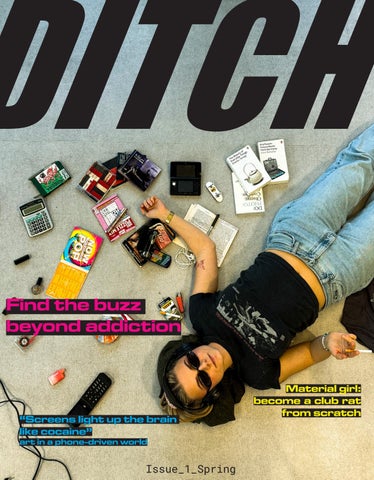
DITCH Issue 1 Preview

Page 1


DITCH

Find the buzz beyond addiction

“Screens light up the brain like cocaine” art in a phone-driven world

Phones

vs vs

Phone addicts bear striking resemblance to smokers

hile phone addiction isn’t officially recognized as a disorder, the ways people try to quit them are surprisingly similar to the ways smokers

It’s a line that gets thrown about casually and often:

Looking at the stats, it’s hard not to agree. Last year, Ofcom reported that the average screen time of 18–24-year-olds in the UK is six hours and one minute per day. While Gen Z increasingly feels pressured to, “Get off that damn phone! Go and touch some grass,” phone usage isn’t looking much better across any of

The same Ofcom report revealed the average adult spends four hours and twenty minutes on their phone every day, while those over 65 aren’t far behind, averaging three hours and ten minutes.

Meet Bob and Rob

dopamine reliant. It’s in our nature. But that doesn’t mean it’s good for us.

A whole host of apps have launched in recent years, trying to help you peel your eyes away from the neverending hole of social media.

But DITCH couldn’t help but feel there were certain similarities between your nic-addicted friend’s last bid attempt to use the quitSTART smoking app, and your pal buying a flip phone and downloading the latest digital detox app. They’re both easing themselves off their dependencies, and they’ve both got some irritatingly positive cheerleader in the form of an app to supposedly keep them on track.

With this in mind, at DITCH we are interested in what similarities exist between fags and phones….

2. Crank up feelings of anxiety, lonelines and depression

Bob and Rob are different in many ways. Bob is bald, Rob has spiky hair. Bob loves a doomscroll, and Rob can’t resist a toke. But their different vices lead to uncannily similar behavioural problems.

4. And leave them with dreaded withdrawals when they have to go without 1. What nicotine is to fags, notifications are to phones. Bob and Rob keep coming back for that sweet dopamine high, until their bad habits…

Swipe at your

own risk

From threesomes to conspiracy theories: online dating horror stories

Alongside others I know, I am guilty of spending too much of my time on dating apps. That feeling you get when you match with someone online is great. Until they send you a disturbing message, or turn out to have a partner that is using these apps to cheat.

I spoke to three anonymous members of Cardiff’s single pool, to hear about

Swiper one: Community support worker, 23

A few years ago, I was using dating apps. I was always a bit unsure of them, but my main platforms were on Tinder and Bumble. As a bi, mascpresenting woman, I found it a bit odd because people would make assumptions about me and that could be quite annoying.

One day, I matched with a guy on Tinder. I say hi. Straight away, I get a message back saying, “So would you want to join a threesome with my girlfriend and I? You seem gay.”

He was immediately blocked. To be honest, most of my online experiences were filled with men asking if I was

“Turns out, she was here on behalf of her boyfriend, who was the guy I had been texting”

gay. Which obviously I am not, because otherwise I wouldn’t be coming up on your Tinder, would I? It became very repetitive, and I became irritated. So, I deleted them all. Now I’m dating my best friend from that time, and I’m happy. In short, screw dating apps!

Swiper two: Bartender, 25

I’d been talking to this guy on Grindr for about a week, sending frequent texts. He was very much my type. He wasn’t very flirty, but asked me A LOT of questions about my hobbies, education, and travelling aspirations. It kind of felt like I was being interviewed...which wasn’t actually too far from the truth.

We arranged to meet for drinks. When I got there, he messaged to say he’d be a few minutes late. So I grabbed a pint and a table.

I was sipping my cider as I looked up and found a girl waving at me. I was confused because I didn’t recognise her. So, I said, “Sorry, I think you’ve got me confused with someone.”

Turns out, she was here on behalf of her boyfriend, who was the guy I had been texting. Apparently, she had found some things left in his browser history that led her to believe he was gay. For their upcoming anniversary, she wanted to surprise him by finding him a replacement partner! In complete disbelief, I simply asked her. “Why?” She smiled and said “I just want him to be happy.”

I just said I wasn’t interested and

walked out. But I did meet my future boyfriend on the train home that night, so I guess every bad experience has its silver lining.

Swiper three: Student, 22

When I was 19, I was using Bumble. With Bumble, you think you’re safe, because only women are allowed to message first. Wrong.

I messaged a guy I had matched with, because he seemed normal. Straight away, he began lecturing me on his political views and odd conspiracy theories. He started with pixelated images, then about satanists, and then the classic anti-vaccine rant. When he eventually stopped, he then asked for my Snapchat.

I said no, and that I didn’t think our interests correlate. He then recommended a bunch of websites to check out, so that I can be cleansed from the “brainwashed, governmentplugged society that has stopped him from getting a girlfriend.”

I left him on read.

Surviving 24 hours without my phone

DITCH writer Mia is forced to go phone-free

My phone is fine. Or at least, it was. It was sitting there, charging in its usual spot. I quickly went to check the time, tapping the screen impatiently. No response. So I tapped again but harder. Still no response. I angrily pushed the power button and still nothing.

My heart rate started increasing at an alarming rate. I realised my phone was dead. I sat there, staring at the blank screen, feeling like I’d just been sent back to the Stone Age. The world around me felt eerily quiet and as I stared at my blank bedroom wall I really started to wonder what I was going to do.

I felt like an absolute mess. I quickly realised just how dependent I’d become on this little device. I needed to check the time. What did I even do in the olden days when I couldn’t just glance at my phone? Oh right, a clock. I had to actually look at a wall clock like I was

“I didn’t die. In fact, I felt connected to the world around me”

in the Victorian times. The panic started to set in. It didn’t stop there. I had plans to meet a friend, but how would I know what time we were meeting? I wasn’t about to send her a pigeon, so I had to actually email her. There I was, waiting for her reply, feeling like I was navigating a lost world.

And then later that day, came the ultimate crisis: I had to try and pay in cash. Physical cash, like actual money in my hand. I routed around in my purse and found my waitressing tips which consisted of ten onepound coins. I stashed them in my coat and sighed in relief, at least I was still able to get a coffee. Spoiler alert: I couldn’t actually buy one because they didn’t take cash!

Then something strange happened: I started to adapt. I enjoyed the things around me, like the dusty books on my shelf and I actually listened to people instead of typing half-hearted replies on my phone. I actually managed to sit through a whole film without scrolling.

By the time I reached the end of the 24 hours, and collected my friend’s spare phone, I realised I had survived. No phone, no crisis. I didn’t die. In fact, I felt more connected to the world around me. Sure, I was itching to check my messages and be able to listen to music on my walk to uni again, but maybe this whole “no phone” thing wasn’t so bad after all.

Still, I wouldn’t voluntarily have a broken phone again.

dark truths

Artist draws inspiration from childhood poem to unmask the dark truths behind phone addiction and brainrot

From running her own business to now studying BA Illustration at UWE Bristol, 22-year-old artist Mia Tirion is already making waves in the creative world. With an eye-catching style and a fresh perspective, she’s one to keep on your radar. At DITCH, we’re excited to dive into her latest project, Word and Image.

Drawing inspiration from Roald Dahl’s iconic poem Mike Teavee and her own concerns about the impact of technology - specifically brainrot among younger generations - Mia’s artwork fuses the surreal with the eerily familiar. In this exclusive interview, DITCH’s Cat sat down with Mia to talk tech, creativity, and the deeper meaning behind her work.

Okay, let’s talk about your interest in art growing up. Did you find it was kind of an escape for you? Well, I’ve always enjoyed it. I remember having conversations with my Dad when I was younger like, ‘How much do artists make?’ He’s an architect so he used to teach me how to draw buildings in square form, and, honestly, that’s kind of my first memory of being like, ‘Damn, this is epic.’

Then I kind of lost interest. I think it was when GCSE Art was coming up, I was like wow, I better get good. And then it definitely became an escape for me.

I want to touch on your journey to University. You mentioned that you were selling your own art for a bit before deciding to go to University, right?

So then I started Hafan Heulog. Where I crocheted and made money that way. It was fun, but after a while I treated myself like a machine. After about a year, I decided that uni definitely was for me. I was not done learning yet, basically.

I think it’s really common for art spaces online not to value education and there’s a kind of anti-intellectual sort of feel to it. Is that something you would agree with?

I agree. I think a lot of the people online have taught themselves, so they’re like, ‘You don’t need to [go to uni], you can just learn it online’. But when you’re learning online you lack so much of the finesse.

For ages I was thought, I’m an introvert so I’m fine not being around people, but being on your phone all the time is the most brain-shrinking activity you could be doing. Like, yes, it’s social media. But no, it’s not very social. Seeing people’s expressions in real life, interacting with people in real life, that’s what teaches you about who you are as a person. If you’re at home all the time on your phone, you’re not getting that.

Speaking on the topic of phones and technology. What was your relationship with tech growing up?

I remember playing on my DS when I was younger and pushing it under the pillow when my parents walked in. I was always playing games as a child and I don’t think that was necessarily a bad thing.

“The fact that our brain looks the same when we’re addicted to screens as we are to cocaine is crazy”

Yeah. I never wanted to go to Uni, because I believed that art courses were a waste of money and a bit of a scam. It was actually my art foundation year at college that led me to what is now Hafan Heulog (Tirion’s online art shop). I didn’t know what to do for my final project and my tutor said, ‘You should try creating a small business.’

Then I discovered Videostar, which taught me to edit. I always think back on my relationship with technology and on one hand I’m like, ‘Damn, I wish I was doing something else,’ but on the other hand I wouldn’t be the person I am today without any of that. I’m glad I had the experience of technology that I did, but I kind of wish I wasn’t on it as much.

Ditching the doomscroll

Are you guilty of doomscrolling Tiktok as soon as you wake up? Yeah, me too.

I reach for my phone before I’ve even fully opened my eyes, scrolling through whatever the algorithm throws at me—bad news, memes, productivity hacks I’ll never use.

I’m not the only one. 81% of people in the UK reach for their phones as soon as they wake up, and 75% head straight to social media.

So, I ditched my morning doomscroll for a five day working week, to see if I could actually survive without it. I wanted to see how easy it’d be to wake up, and how long I could last before clawing for my phone again. Each morning, I swapped it out for something else and see if anything could shake me out of my zombie state

I found it easier to wake up on day two, thrilled to leap out of bed for the exhilarating task of... meditating. I hoped for inner peace in a world of algorithms and dwindling attention spans—but instead, I just got very bored. I’ve always used guided meditation to help with my easily distracted mind (thanks, TikTok!) but this time I sat in silence. It did the job of waking me up, since I had to actually get out of bed, but I was seriously craving the dopamine rush of my FYP.

The first day hit the hardest. I woke up before my alarm, fighting the urge to check my notifications and convincing myself I could always start the challenge tomorrow. My inner phone addict wanted to relapse before I’d even begun. Fighting the urge, I reluctantly picked up a book. It took a minute to actually focus, but eventually, I realised I kinda liked carving out time to read—something I would’ve never bothered with if I was still glued to my phone. And when I eventually checked my phone? I was met with my screen time notification. The irony.

Day 2 - Sitting in silence, desparate for a scroll
Day 1 - Guess I’ve got to do this challenge

DITCH

Turn static files into dynamic content formats.

Create a flipbook