



By Dan Guetre
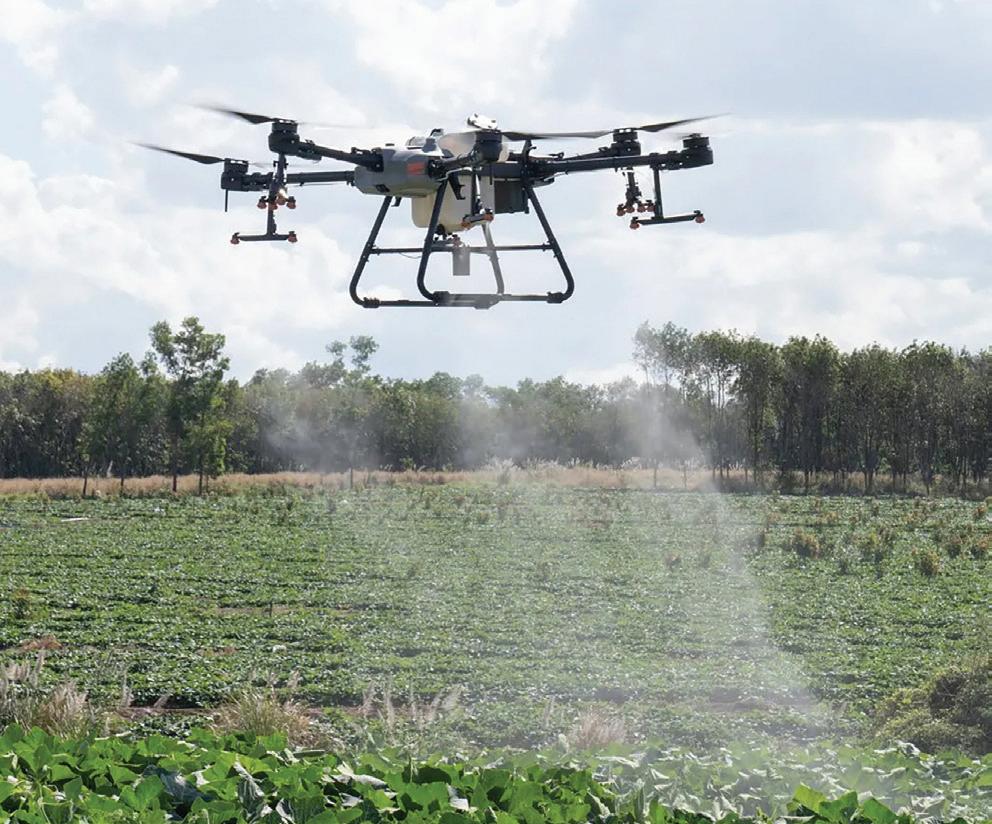
The Canadian Canola Growers Association (CCGA) is calling on federal regulators to move quickly on proposed rules that would allow drones to apply pesticides already approved for aerial use, saying the change would boost competitiveness, efficiency and innovation for Canadian farmers.
In a letter addressed to the Pest Management Regulatory Agency (PMRA), CCGA Vice-President of Government & Industry Relations Dustin Pike responded to a regulatory proposal which explores permitting pesticide application using remotely piloted aircraft systems (RPAS), commonly known as drones.
CCGA strongly supported the PMRA’s proposal to allow drone application of crop protection products already registered for aerial use, urging regulators to implement the
changes in time for the Spring 2026 growing season.
The organization said drone technology would give farmers more flexibility in managing pests, particularly in conditions where traditional ground spraying is difficult due to wet fields or remote terrain.
“Spray drones provide Canadian farmers with a versatile tool to apply crop protection
products more efficiently and precisely,” wrote Pike.
CCGA also noted that drones can reduce crop damage from heavy equipment traffic and enable targeted “spot spraying,” which can lower overall product use while improving effectiveness.
With more than 90 per cent of Canadian canola exported, the group stressed that access to
new technology is essential to maintaining competitiveness with international producers, particularly in jurisdictions such as the United States and Australia, where drone spraying is already widely used.
In its submission, CCGA backed several key elements of the proposed regulatory framework, including:
- A “blanket approval” system for aerial-approved products, rather than individual label reviews;
- Use of existing scientific data from trusted sources, including the Unmanned Aerial Pesticide Application Systems Task Force;
- Continued approval of chemistries already authorized for aerial application.
The organization said these approaches would reduce administrative burden without compromising safety.
CCGA also encouraged regulators to rely more broadly
on international data sources to speed up approvals where appropriate.
While supportive of the overall framework, CCGA raised concerns about a proposed “registrant opt-out” clause that would allow pesticide manufacturers to exclude their products from drone application.
The association said any optout should be based on scientific evidence, such as demonstrated risks of low efficacy or excessive spray drift, to prevent unnecessary restrictions on farmers.
“Registrants should provide a data-driven rationale so farmers are not denied access to important pest management tools without science-based reasoning,” stated Pike.
CCGA also urged the PMRA to continue consulting with farm groups as drone technology evolves, particularly on practical issues such as
personal protective equipment requirements and best management practices.
The organization noted that drone spraying is a relatively new technology with different operational considerations than traditional aerial application, and said ongoing research will be essential to refining regulations.
CCGA said regulatory updates should remain flexible to reflect new evidence, improve safety guidelines and support real-world farm conditions.
“These changes will help Canadian farmers compete internationally without affecting safety by providing more flexibility and options,” wrote Pike.
CCGA encouraged regulators to continue streamlining approval processes and engaging directly with producers as drone technology becomes more widely adopted in Canadian agriculture.

By Dan Guetre
A new private member’s bill aimed at modernizing Canada’s agricultural regulatory system was introduced in Parliament in mid-April, with supporters arguing it could significantly reduce delays for farmers seeking access to essential tools.
David Bexte, a Conservative Member of Parliament, tabled Bill C-273, the Facilitating Agricultural Regulatory Modernization Act (FARM Act), describing it as a first step toward addressing what he called an outdated and overly burdensome approval process.
“For years, Canadian farmers have been stuck waiting for products already proven safe and widely used in other countries,” Bexte said. “That’s not common sense. It’s red tape, plain and simple.”
The proposed legislation would introduce a “trusted jurisdiction” framework, allowing feeds, fertilizers, seeds and pest control products approved in at least two recognized regions — such as the European Union or countries like Australia and New Zealand — to receive pro-
visional approval in Canada within 90 days of a completed application.
While accelerating access, the bill maintains that Canadian regulators would continue conducting full reviews in parallel. The federal minister would also retain authority to deny or revoke approvals if any health, environmental or safety concerns arise.
Agricultural organizations have voiced support for the proposed reforms. The Canadian Federation of Agriculture said the bill could enhance competitiveness and strengthen food security.
CFA President Keith Currie emphasized the need for faster processes, noting that global competitors are moving more quickly.
“It is imperative that farmers can move at the same pace,” he said.
According to Seeds Canada, current regulatory timelines in Canada can delay product commercialization by one to two years, with overall lag times of up to six years compared to the United States. These delays have discouraged investment and, in some cases, led companies to bypass

Canada altogether.
Conservatives argue the cumulative current impact has been significant by increasing costs for producers, limiting access to innovation, and widening productivity gaps with international competitors.
The FARM Act proposes several changes, including:
- Provisional approval within 90 days for products already approved in at least two trusted jurisdictions;
- Expanded provisions under the Food and Drugs Act to improve access to veterinary drugs;
- Continued Canadian oversight with full authority to intervene if risks are identified.
Supporters say the changes would help address shortages of animal health products while improving farm productivity and reducing input costs.
The Conservatives also point to international comparisons, noting Canada ranks 32nd out of 43 OECD countries in regulatory burden on businesses. They argue that excessive red tape has held back a sector with the potential to significantly increase its contribution to the national economy.
Shorter approval timelines in competing
markets, particularly in the United States, have allowed farmers abroad to adopt new technologies sooner, contributing to higher yields and lower costs.
Bexte said reforms could generate broad economic benefits, including improved farm incomes, stronger rural communities and lower food prices for consumers.
“This bill is about standing up for rural Canada and ensuring farmers have the tools they need to succeed,” he said.
Bill C-273 is currently at First Reading in the House of Commons. It has been introduced and made available for public and parliamentary review but remains outside the Order of Precedence, meaning it has not yet been scheduled for priority debate.
To become law, the bill must pass several stages in both the House of Commons and the Senate, including second reading, committee review, report stage and third reading, before receiving Royal Assent.
Supporters say is long overdue for Canada’s farming sector and if adopted, the FARM Act would establish a new pathway for faster access to agricultural products already vetted by trusted international regulators.
By Harry Siemens
Manitoba producers head into the 2026 growing season with a mixed weather picture that calls for flexibility, awareness, and steady management. Long-time agricultural meteorologist Drew Lerner, founder of World Weather Inc., outlined a season shaped by competing forces—lingering dryness in parts of the Prairies, excess moisture in others, and large-scale patterns still in transition.
Before Lerner’s outlook, Prairie producer Darren Sander set the tone with a practical reminder: farmers cannot control the weather, but they can manage stress. His approach focuses on reducing stress at every stage of the crop cycle, beginning with strong
infiltration, retention, and biological activity. Eliminating compaction and building soil resilience, he said, helps crops handle swings from dry to wet, hot to cold.
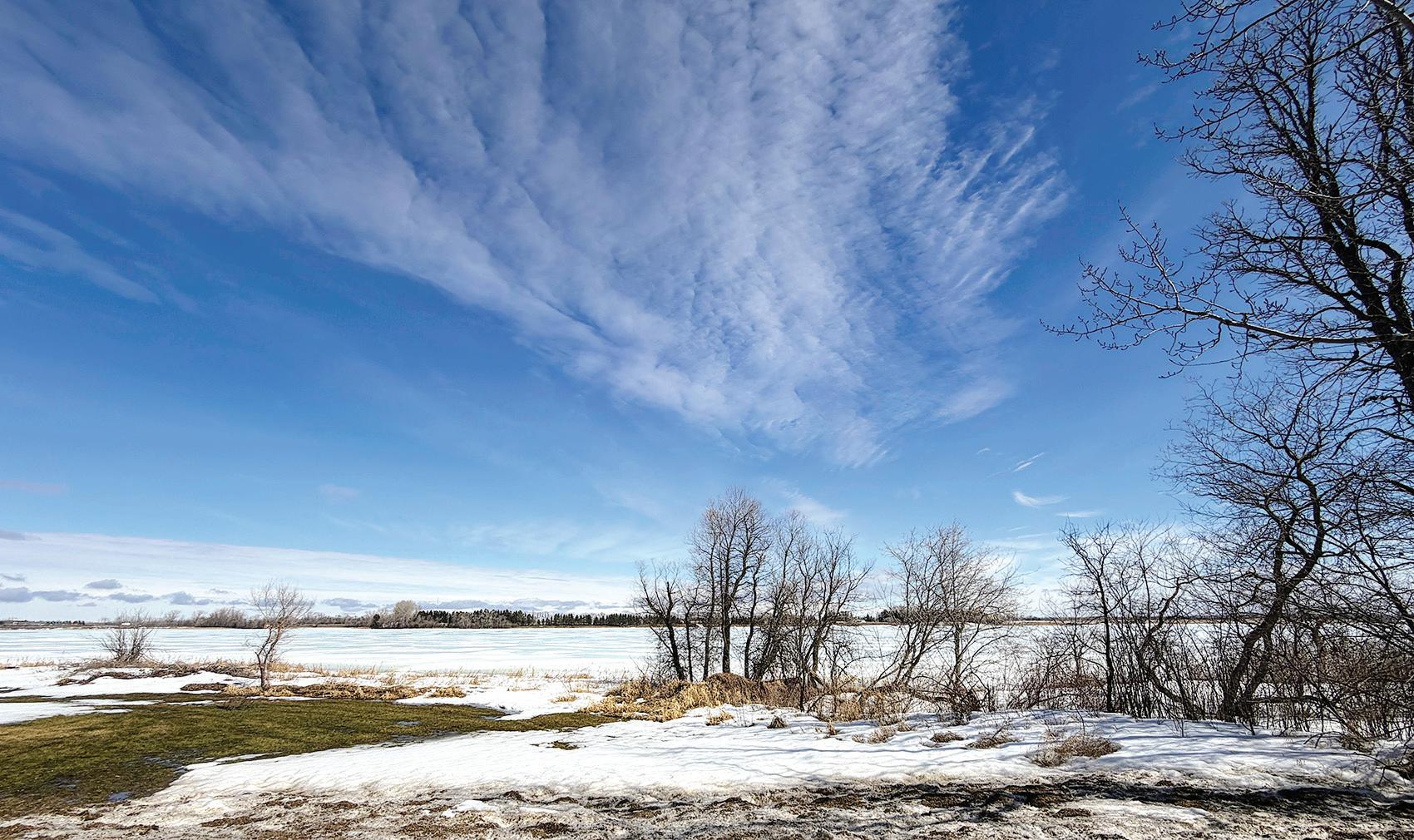
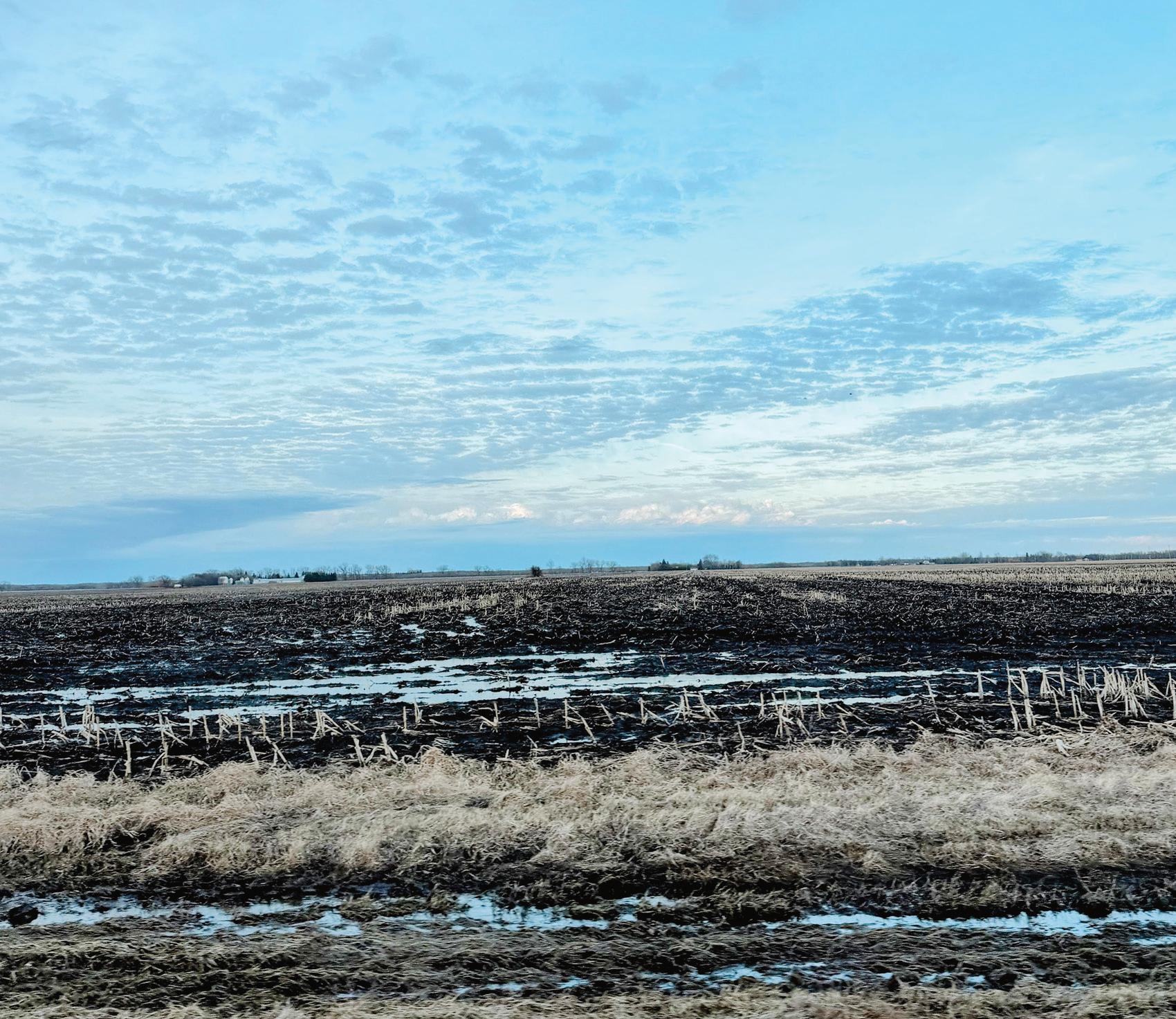
That mindset fits the broader weather picture. Across Manitoba, conditions vary sharply. Snowpack remains significant in central and eastern regions—from north of Brandon through the Interlake and into the east. As temperatures rise, that moisture will enter the system, creating a real risk of delayed fieldwork and wet soils early in the season.
Meanwhile, parts of the western Prairies continue to face long-term moisture deficits.
Lerner described it as a “two-sided situation”—too wet in some areas, not enough in others.
The pattern behind this has been stubborn. A

ridge of high pressure over western North America has limited widespread precipitation for months, pushing storm systems either south into the U.S. or north of crop regions. While some localized systems have offered relief, they have not delivered the broad, soaking rains producers prefer.
There are signs of change, but not immediately. Lerner expects a quieter period following current spring storms, with less precipitation and gradual warming. That window should allow Manitoba farmers to begin field operations, though timing will be tight. His advice: take the window when it comes. Waiting for perfect conditions may mean missing the opportunity altogether.
Larger climate drivers will shape the season ahead. The transition from La Niña to El Niño is expected by early summer, bringing a shift toward more active weather patterns later in the growing season. The 18-year lunar cycle and broader ocean temperature trends point to a variable, mixed season rather than widespread extremes.
For Manitoba, that likely means a wet start followed by more balanced conditions. Moisture should remain adequate through much of the year, especially in central and southern regions.
Parts of eastern Saskatchewan and western Manitoba could see a drier trend later in summer—not drought, but below-normal precipitation during key periods.
Temperatures should warm through May and June, helping dry soils but also
increasing evaporation if rainfall remains inconsistent. Dry conditions across the U.S. Plains raise the possibility of stronger high-pressure ridging later in summer, which could limit Prairie rainfall. For now, Lerner frames that as a concern, not a forecast. The overall message is measured: there is moisture in the system and an opportunity for a good crop, but variability will define the season.
Sander’s approach—focus on soil health, improve water management, build resilience—reflects the reality producers’ face. Weather uncertainty will never disappear, Lerner said, but understanding the patterns and preparing for them can make the difference between managing a tough year and being caught off guard.



It is mid-April here in the Pembina Valley, and if you listen closely past the sound of the wind, you can hear the low hum of preparation. It’s that time of year when the air changes, the frost finally retreats, and the collective heartbeat of the Manitoba farmer starts to quicken. But as I chat with folks around Winkler, Carman, and Portage, and the rest of the province, I’m sensing an attitude that’s a bit different than the wide-eyed optimism we sometimes see.
Right now, the mood is one of heightened caution and pragmatic resilience.
I’ve been around the block a few times, and I’ve seen years where we
felt like we were “gambling with the house’s money.” This isn’t one of those years. As we look at the 2026 season, the “margin squeeze” is no longer a forecast; it’s the reality sitting right there on the ledger. While we’ve seen some relief in fertilizer prices compared to record-breaking peaks, they haven’t dropped nearly as fast as grain prices.
When I look at the numbers, I see that only about a third of our producers feel like they’re in a “good” financial spot. That’s a sobering thought as the tractors hit the fields. With fuel prices jumping again due to global tensions, every pass across the field feels just a little bit heavier on the wallet.
But here is the thing about Manitoba farmers: we don’t panic. We sharpen our pencils.
I was recently talking about the work of independent agronomists like Jason Voogt over in Carman. Men
like Jason are seeing a shift. Farmers aren’t just “putting out a crop” this year; they are being surgical. They are using soil testing and variable rate applications not just because it’s the latest tech, but because they need to account for every nickel of nutrient. It’s about efficiency. It’s about making sure that every seed has a reason to be where it is.
We’re also dealing with a fair bit of “trade fatigue”. Between Chinese tariffs on our peas and canola and the “America First” rhetoric coming from south of the border, it’s easy to feel like we’re just pawns in a much bigger political game. It makes marketing a nightmare. But as I’ve always said, we focus on what we can control—and what we can control is the dirt under our boots and the management of our own shops.
I’m also keeping a close eye on our young farmers. With the interest rates where they are, the weight
on the next generation is immense. It’s heartening to see some provincial support via the Young Farmer Rebates, but let’s be honest—it’s a tough climb when the cost of entry is this high.
Despite the challenges, the spirit remains. About 80% of us still have our lenders’ backing and the grit to get the job done. We are a business-like bunch this spring. We aren’t necessarily “happy” with the markets, but we are focused.
As we head into this season, my advice is simple: Know your cost of production. Don’t guess. Don’t chase the neighbour. Lean on your agronomists, trust your data, and keep your faith. We’ve faced droughts, floods, and trade wars before. We’ll meet this challenge with the same wisdom and grit that has defined this province for generations.
The land is waiting. Let’s get to work.
By Dan Guetre
The Government of Canada has announced plans to extend tax relief measures for livestock producers affected by recent bovine tuberculosis outbreaks, offering greater flexibility as farmers work to rebuild their herds.
Federal Agriculture Minister Heath MacDonald said the government intends to amend the Income Tax Act to allow eligible producers in Alberta, Saskatchewan and Manitoba to defer income from compensation payments over multiple years.
The measure targets producers who received compensation after
animals were ordered destroyed due to the 2024 and 2025 bovine tuberculosis events.
“Canada’s producers are the backbone of our rural communities and are essential to our agri-food success story,” MacDonald said. “This extended tax deferral period would address the unique realities faced by producers as they rebuild their herds after animal health events.”
Under the Health of Animals Act, the Canadian Food Inspection Agency (CFIA) compensates producers when livestock must be destroyed due to federally reportable diseases.
Previously, Section 80.3 of the
Income Tax Act allowed producers to defer such compensation for one year. The proposed changes would extend that timeline significantly, allowing income deferral from 2026 through 2030.
The updated schedule would allow:
- Up to 100 per cent of compensation to be deferred to 2027 (with at least 83 per cent recognized that year);
- Up to 17 per cent deferred to 2028;
- Up to 8 per cent deferred to 2029;
- Up to 4 per cent deferred to 2030.
The phased approach is designed to better reflect the time it takes to rebuild herds, which can span several years depending on market condi-

tions and livestock availability.
Officials say the extended deferral schedule was developed in consultation with producers and industry groups, including the Canadian Cattle Association, to ensure it aligns with on-the-ground realities.
The move follows similar measures introduced after earlier outbreaks, including tax relief provided following bovine tuberculosis cases in 2016 and 2017.
The federal government says the changes are part of a broader effort to strengthen resilience in the livestock sector and support rural communities during periods of disruption.
In addition to disease-related measures, producers facing environmental challenges such as drought or flooding can access the Livestock Tax Deferral Provision, which allows deferral of proceeds from the sale of breeding animals in designated regions.
Officials say these combined supports are intended to help farmers manage financial pressures, maintain operations and recover from unexpected losses.
“The Government of Canada remains committed to giving producers the support and stability they need to keep the sector strong and resilient,” MacDonald said.
By Dan Guetre
The Government of Canada is moving forward with the develop ment of a National Agricultural Soil Health Strategy, with a new collab oration announced between Agricul ture and Agri-Food Canada (AAFC) and the Soil Conservation Council of Canada (SCCC).
Federal Agriculture Minister Heath MacDonald said the initiative un derscores the importance of soil as a foundational asset for Canada’s agricultural productivity, environ mental sustainability and long-term resilience.
“Healthy soils are the foundation of a strong and sustainable agricul ture sector,” MacDonald said. “The Government of Canada will continue working with partners across Canada to collaborate on the development of the National Agricultural Soil Health Strategy and protect this essential resource.”

existing work by the SCCC and its partners will help accelerate development of the strategy.
“The Soil Conservation Council of Canada very much appreciates the commitment that the Government of Canada is making to address agricultural soil health challenges,” said Alan Kruzel, a farmer and director with the council. “Our collective goal … is to support farmers and ranchers who are the stewards of this valuable natural resource.”
AAFC says the strategy will be developed through extensive consultation with provinces and territories, Indigenous agricultural groups, producer organizations, academia and industry stakeholders.
supported by Bill S-230, which calls for a coordinated national approach to soil protection, conservation and enhancement.
The strategy builds on earlier work led by the Senate, including contributions from Robert Black, and is
Momentum for the initiative has also been shaped by industry-led efforts, with officials noting that
Engagement is set to begin this spring, with the goal of ensuring the strategy reflects regional differences and long-term priorities across Canada’s agriculture sector.
A committee structure and advisory working groups will also be established to guide development, with expert input expected in areas
such as research, data collection, extension services and incentives for sustainable practices.
The National Agricultural Soil Health Strategy aims to support improved soil management practices, enhance data collection and strengthen the long-term resilience of Canada’s agricultural lands.
The initiative aligns with international efforts as well. Canada is a member of the Global Soil Partnership, a forum established by the Food and Agriculture Organization to promote sustainable soil management and knowledge sharing worldwide.
Officials say the collaboration will help ensure Canada remains aligned with global best practices while addressing domestic challenges.
The federal government says continued partnership with industry and stakeholders will be key to developing a strategy that supports farmers, protects natural resources and strengthens the future of Canadian agriculture.

By Harry Siemens
Manitoba grain and oilseed markets posted a mixed performance the week ending April 17 as farmers prepare for spring fieldwork across the prov ince. Prices moved in different direc tions depending on the crop, reflect ing shifting global demand, currency pressures, and ongoing uncertainty in North American weather patterns.
Wheat values strengthened across most classes. Western Red Spring wheat rose to $291.01 per tonne, up $9.19 from the week before, while Northern Hard Red climbed to $280.72, gaining $14.33. Red Win ter wheat posted one of the stron ger moves, rising $15.07 to reach $271.17 per tonne. These increases contrast with year-ago levels, where Western Red Spring sat at $297.63 and Northern Hard Red at $285.87.
Special Purpose (Low Vomi) wheat edged up slightly to $236.61, though still well below last year’s $265.26. Barley also saw a modest gain, ris-
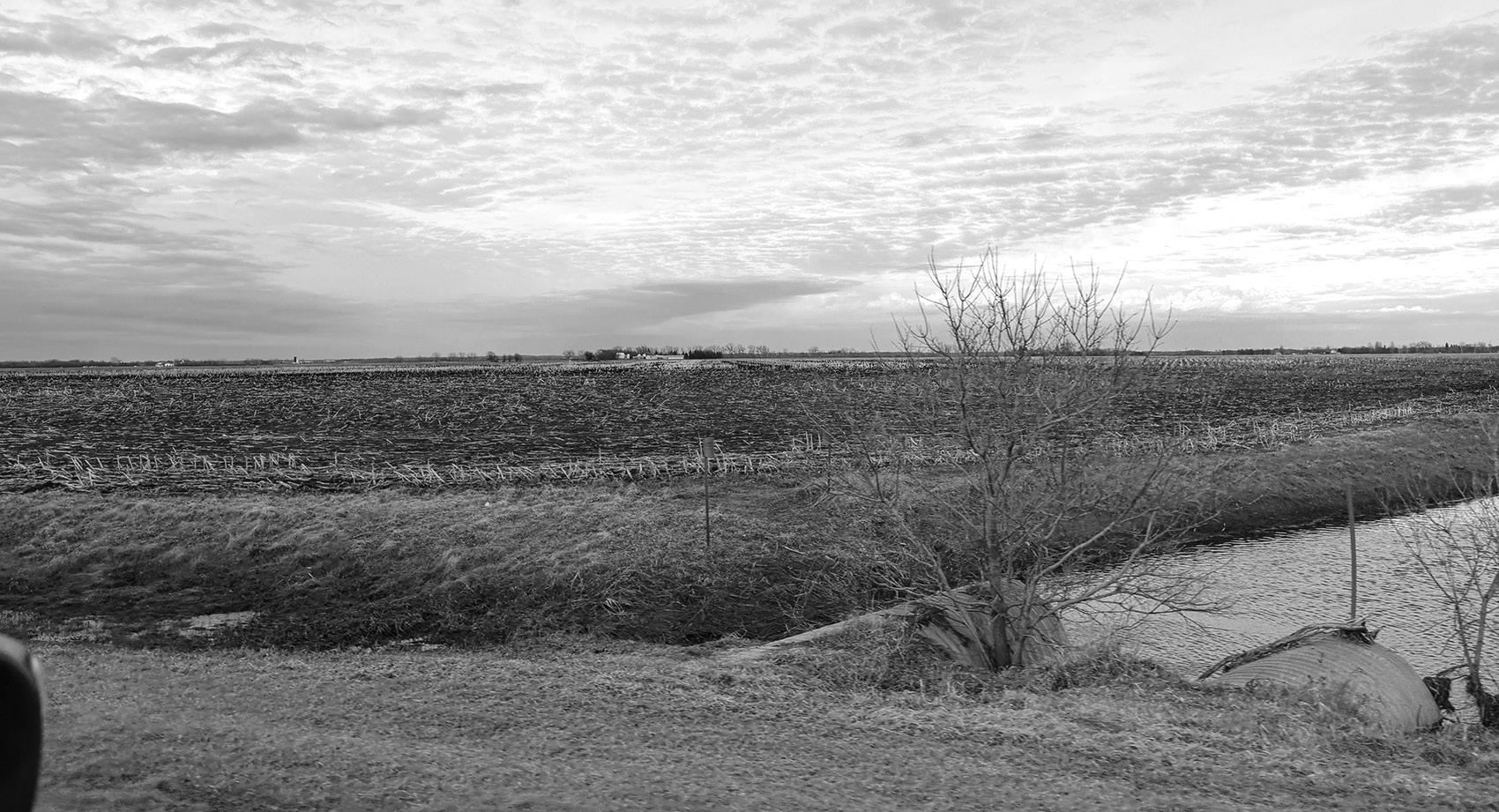
ing $2.76 to $223.22 per tonne, but remains under last year’s $237.00.
Oilseeds were mixed. Flaxseed gained $1.18 to reach $686.58, though still sharply lower than last
Submitted photo
year’s $762.56. Canola slipped $9.70 to $664.47, despite being slightly above the year-ago level of $646.83. Soybeans, however, continued their upward trend, rising $2.94 to
$508.90, well ahead of last year’s $439.09.
The report notes: Soybeans at $508.90 compared to a year ago $439.09.
Peas dropped $5.88 to $282.19, reflecting softer demand and ample supplies.
Oats also slipped, falling $1.95 to $232.13, compared with $287.90 a year earlier.
Corn saw a small increase of $0.39, reaching $198.02, but remains well below last year’s $235.81.
On the futures side, ICE canola showed mixed direction. The par region contract rose $5.50 to $679.30, while Thunder Bay and Vancouver track prices each fell $10.80, landing at $707.90 and $727.90 respectively.
U.S. futures were mostly firmer, with July 2026 Chicago wheat up $9.00 to $219.73 per tonne, and hard red winter wheat gaining $21.50 to $238.28.
Soybeans climbed $6.34 to $434.13,
while corn added $4.92 to $179.91. Currency movements also played a role. The Canadian dollar sat at 1.367 per U.S. dollar, influencing export competitiveness and basis levels across the Prairies.
Overall, the week’s price action reflects a market still searching for direction. Wheat continues to find support from tightening global supplies and weather-related concerns in key producing regions. Oilseeds remain sensitive to shifting crush margins, South American production estimates, and global vegetable oil demand. Pulse and feed markets continue to respond to supply carryover and cautious buying.
As Manitoba farmers prepare for seeding, these price signals will shape early marketing decisions. With moisture conditions uneven across the Prairies and global markets reacting to every weather update, volatility is likely to remain a defining feature of spring 2026.
By Harry Siemens
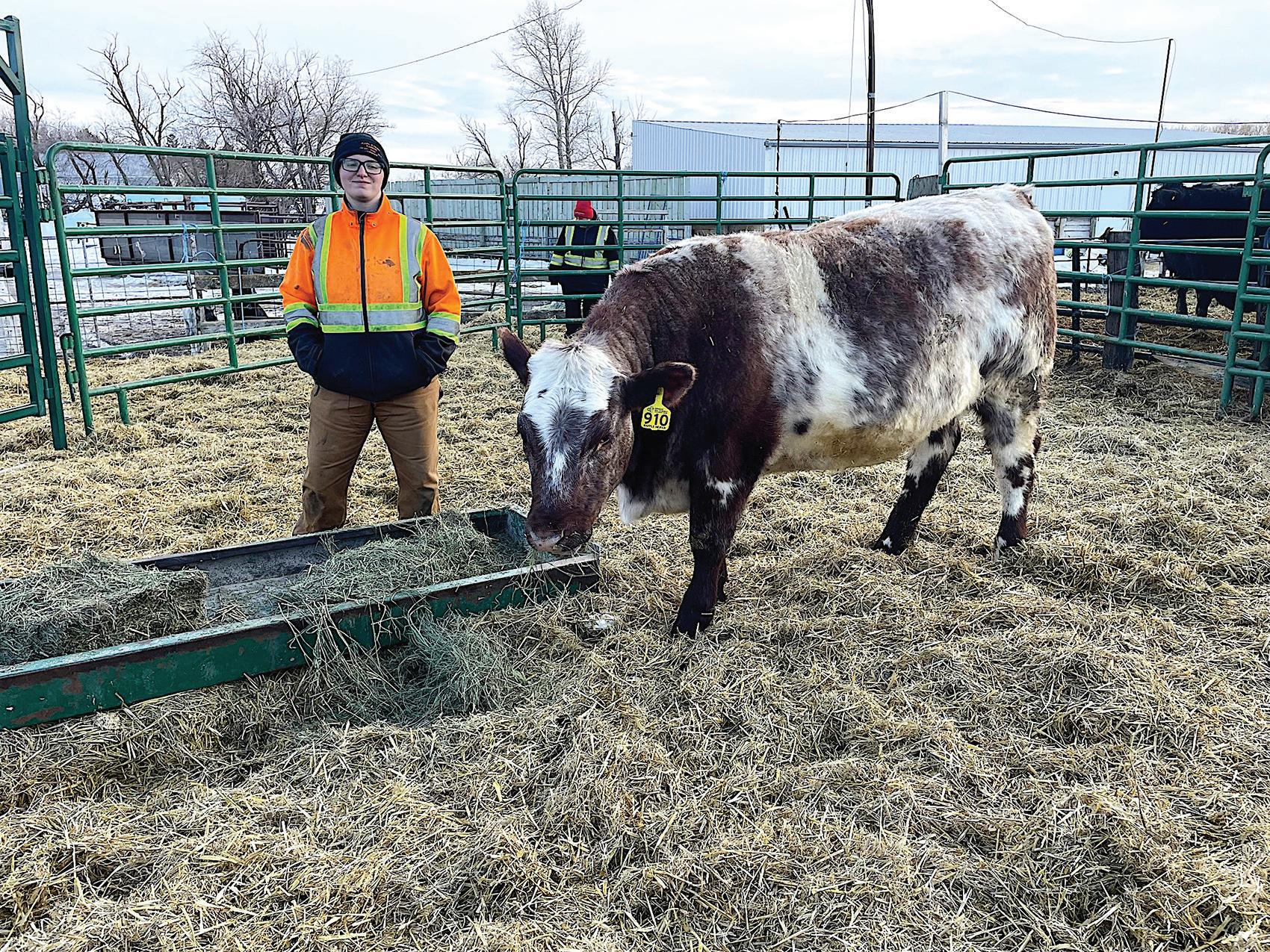
The Manitoba Bull Test Station at Douglas stands as one of Canada’s largest and longest-running centres for beef performance testing. Owned and operated by the Manitoba Beef Cattle Performance Association Inc., this non-profit facility has spent more than half a century helping producers refine genetics, measure gain, and improve herd quality.
What began in the mid1960s as a practical management tool for evaluating bulls under uniform conditions has grown into a respected hub for both purebred and commercial producers seeking data-driven progress in an ever-changing industry.
That legacy continued recently with the station’s 62nd
annual bull sale, a milestone that drew buyers from across the Prairies and beyond. Manager Cam Wood called it the best sale yet.
“Last year we thought it was the best sale we’d ever had,” he said. “This year our averages were about $2,000 higher.”
The sale featured 100 bulls, averaging $9,400, along with 18 test heifers and four pens of three commercial heifers.
The cattle alone grossed just over $1 million, a first for the station. “With semen lots and extras, it was even higher,” Wood said. “We’ve never done that before.”
Buyers came from Ontario, Manitoba, Saskatchewan, Alberta, and even North Dakota. The reach reflects how far the Douglas Test Station’s reputation has spread since its start
in 1964-65, when only four breeds—Shorthorn, Angus, Hereford, and Charolais— were tested. Today, the program continues to evolve with genetics from across Canada.
Wood explained that the station’s purpose remains simple but vital.
“It’s a place for producers to put cattle—bulls and heifers— on test under the same ration and conditions,” he said. “It’s a total level playing field. They can compare their cattle to everyone else’s.”
That comparison gives producers a clear look at how their genetics perform against contemporaries within the breed.
“They see what their cattle actually do in the real world,” Wood said. “It’s honest data.”
The sale also operates with a

floor price, ensuring fairness for consignors.
“Our floor this year was $6,000,” Wood said. “That covers what a guy has in that calf from last fall plus his expenses getting him to sale.”
Individual producers can set their own minimums if they believe a bull deserves more.
“If they want $8,000 or $10,000, they can set that,” he said. “If they don’t get it, they’ll often take that bull home.”
After three years managing the station, Wood sees steady optimism in the cattle business.
“The industry is as strong as it’s ever been,” he said. “Calf prices are high, and that shows in how our bull sales have gone. Commercial producers sold their calves for more money than ever last year, and again this year. They’ve got more to invest back into their herds with better bulls.”
That optimism echoes the vision of the producers who founded the station more than six decades ago. They wanted a fair, controlled environment to measure performance and improve herds across Manito-

ba. The results speak for themselves: steady gains in average daily weight and weight-perday-of-age figures for every breed tested.
Visitors are welcome yearround to tour the Douglas Bull & Female Development Center, view livestock, and talk with staff about programs. During test season, they can see firsthand how data and dedication combine to shape the future of Manitoba beef.
As Wood summed it up, “It’s about progress. Every year we learn something new, and every year the cattle get better.”

By Harry Siemens
The gravel roads across Southern Manitoba tell the story of April 2026. It is a messy, restless mixture of dust and mud. Fields sit mostly bare, but the air remains stubborn. There is no roar of engines yet— only the sound of water running in the ditches and the scratching of pencils on ledgers.
Right now, the mood among Manitoba farmers is one of heightened caution and pragmatic resilience. As the calendar hit mid-April, the sentiment is less about optimism and more about “making the numbers work” in a very tight environment.
In Winkler, Bill Elias watches the slow melt with a seasoned eye. He notes that while the snow disappeared gradually, the “shorelines” on the heavy ground remain a concern.
“These days we do very little field work in spring, so shorelines can be an issue,” Elias says.
He is also feeling the pinch of the market.
“Fertilizer is very high-priced this spring, so some will change to soybeans instead of corn. But my corn seed is bought, so I need the fertilizer.” Despite the costs, he remains steady. “Time-wise, I think we are okay so far.”
In Carman, Jason Voogt, president, Field 2 Field Agronomy, sees a province divided by the snowline.
“South central varies north to south,” Voogt says.
He notes that while snow is 95% gone from Carman through Winkler and Morden, the story changes quickly as you head north.
“Seeding will be delayed. North of Winnipeg and Beausejour, there is lots of snow yet,” he said.
The delay isn’t just about the moisture; it’s about the mess left behind from last year. Voogt points out a major hurdle along Highway 2.
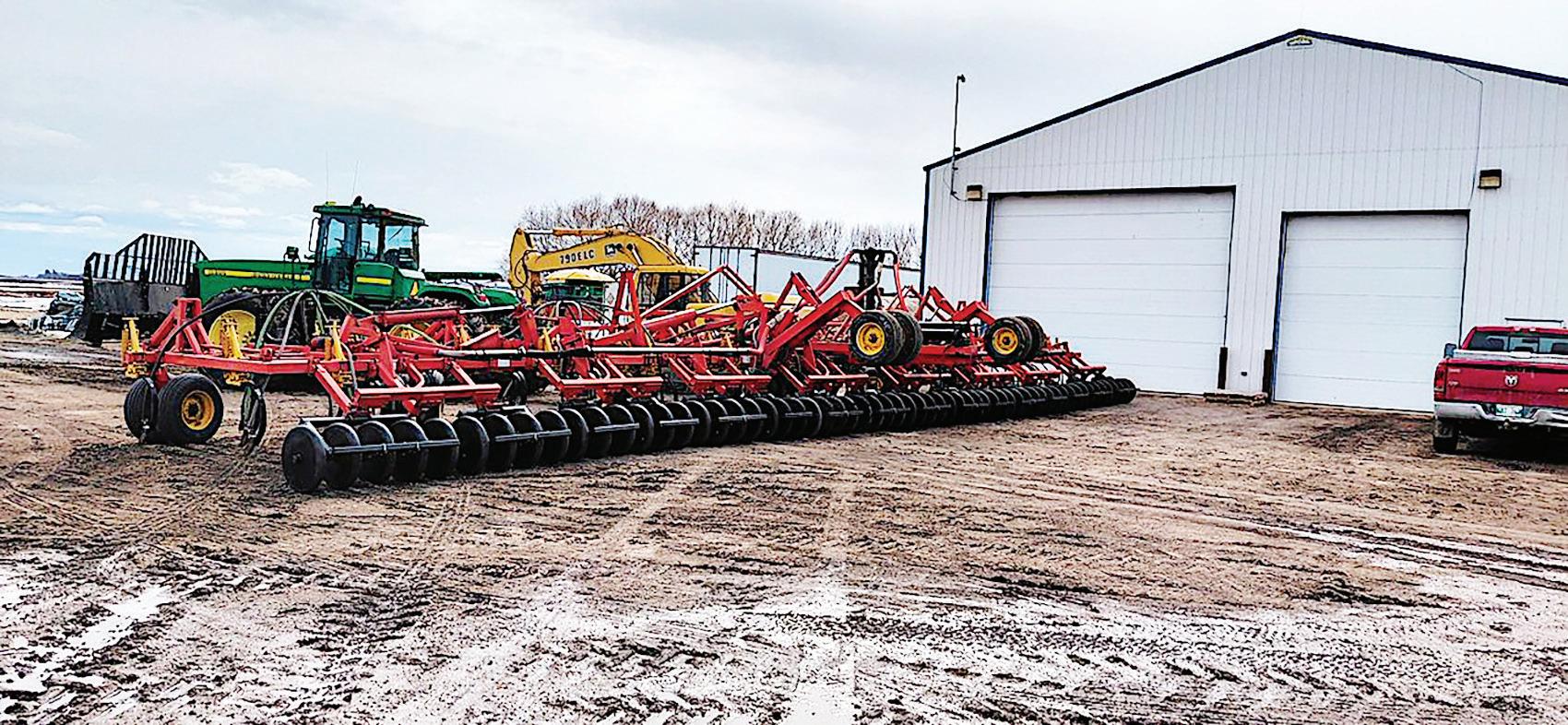
“A lot of fields still have ruts from fall, and no tillage done. They need time for rework before seeding,” noted Voogt.
Further east near St. Jean-Baptiste, Brunel Sabourin of Antara Agronomy watches the clouds with a wary eye. He says the showers every few days and the lingering cold prevents any real progress.
“We need drying weather. Heat and wind,” Sabourin says.
That lack of optimism stretches across the border into North Dakota. Farmer Greg Amundson knows the feeling of a stalled spring all too well.
“This time of year, that is a terrible situation,” he says. “It sucks the wind right out of your sails.”
Back home in the Red River Valley, the water is moving, but the ground is saturated. Graeme Manness in Domain watches the runoff and hopes to be on the land by May 1, while near Portage la Prairie, Jim Pallister keeps it simple, estimating “a couple of weeks yet.”
In the southeast, Korey Peters sees the water leaving the fields
around Steinbach, but the soil remains cold.
“Need some heat to warm and dry the soil soon,” says Peters.
Meanwhile, in Boissevain, Jason Hildebrand reports that while the snow is gone, the temperatures are
simply “far too cold.”
Even where the snow persists, the spirit of preparation—and a bit of relief—is alive. In Newdale, Andrew Dalgarno finally sees his air drill emerging from the drifts. And back in Winkler, Bill Elias has a reason to
celebrate: his tractor, which sat idle most of the winter due to a computer failure, is finally humming again.
“Bon voyage,” Elias says. “Happy fields to you.” The land is waiting. The equipment is ready. “Now, we just need the sun.”

By Joan Airey
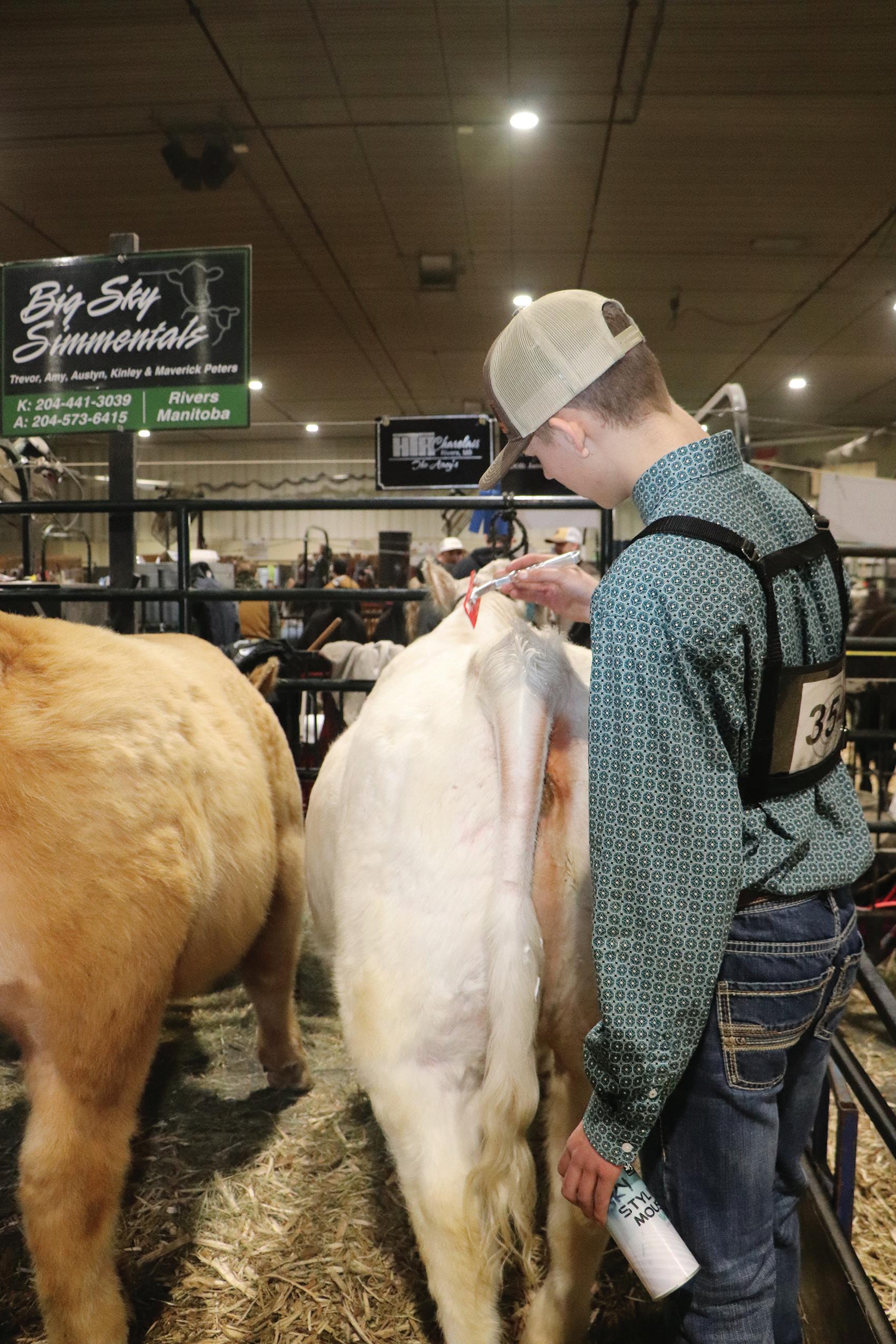
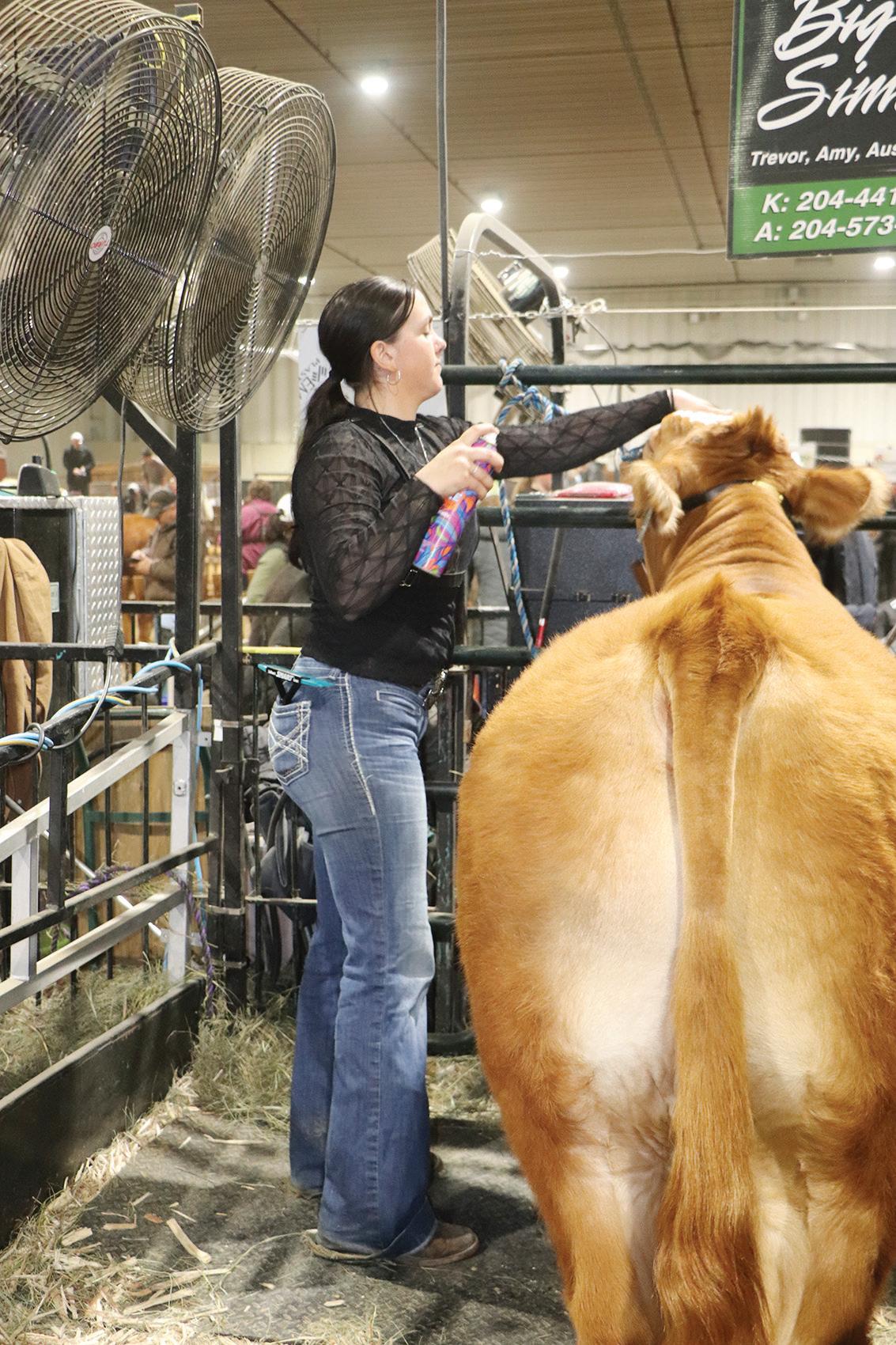
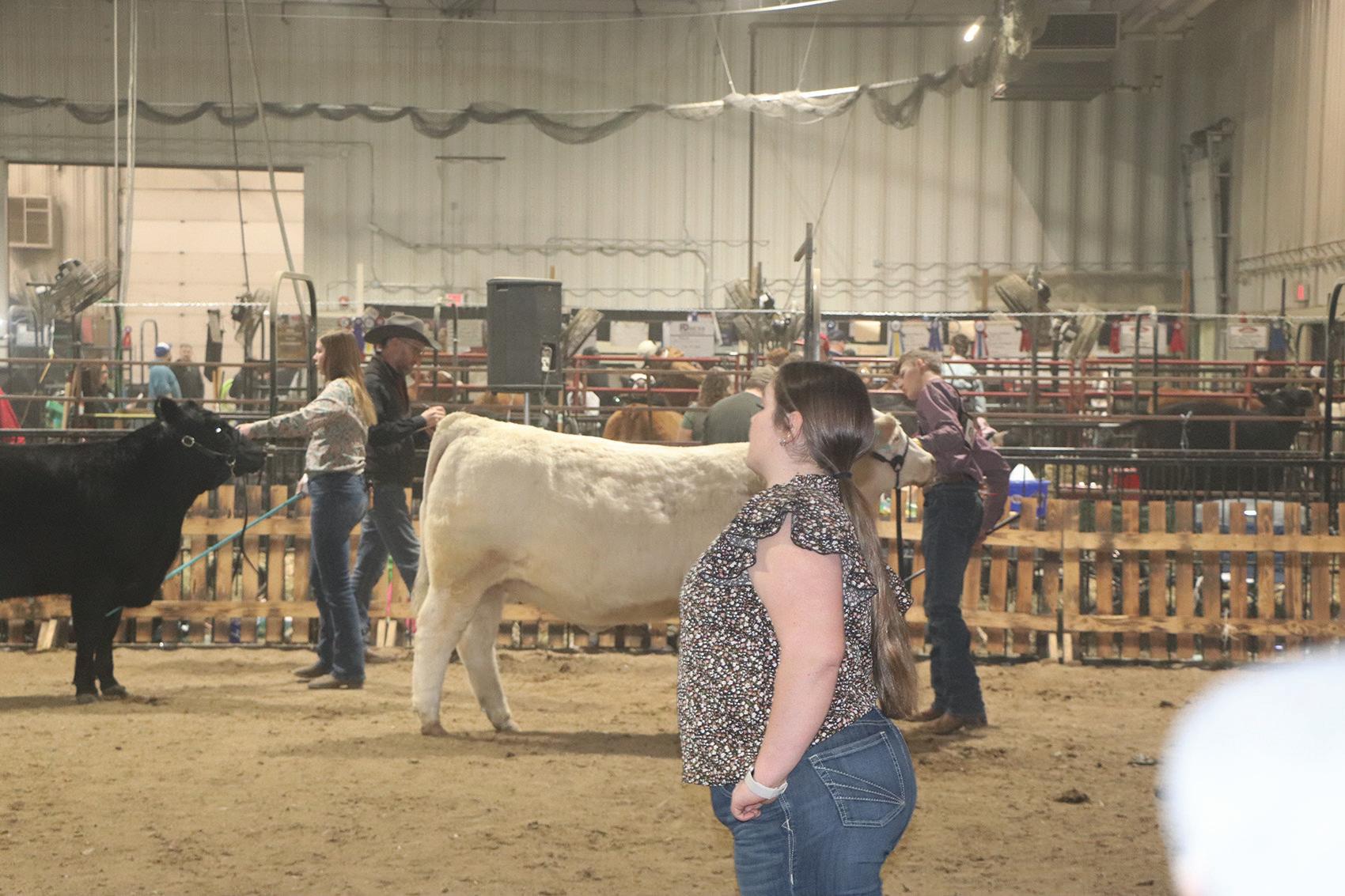
Numerous young people spent spring break showing their heifers or steers at the Royal Manitoba Winter (RMW) Fair in Brandon. Hours before the big day were spent grooming and many days training their animals to be ready for the show ring.
Young people from across Manitoba and Saskatchewan spent March 30 to April 4 hard at work at the Keystone Centre in Brandon looking after their heifers or steers while getting ready to participate in the shows.
Those showing steers took part in Thursday’s steer event and later that day in the steer sale. Friday morning was the Klondike Showmanship classes. Saturday morning was the All-Breed Heifer Show and the Royal Lady Jackpot Show was held Saturday afternoon.
Three youth that worked together were sisters Kinley and Austyn Peters along with their fellow 4-H’er Chase Airey.
Kinley and Chase attend high school while Austyn is in first year Agriculture at Assiniboine College. They stalled their cattle together and whoever was watching the cattle made sure they stayed clean, watered and fed while the others were showing or getting animals ready for the show ring.
“We were at the Keystone barn by 5 am on show days and 6:30 at the latest [the] other days because animals have to be stalled by 8 am,” said Kinley Peters. “We washed and dried our animals every morning. Our cattle are in outdoor stalls from 6 pm until we put them back in their stalls in the Keystone every morning. A couple of us that were
showing would take turns checking on the cattle at eleven pm to make sure animals were okay.”
When they weren’t busy with their own animals, they were volunteering their time to help other junior competitors with slipping, fitting and showing assistance. Our girls only brought steers so Kinley helped at the heifer show as a ring person.
“I feel it is very educational to take part in the RMW Fair as they have to keep track of the schedule for different things like weigh times, event times and show times. They have to manage their time to have their calves ready for the show ring on
time,” said Amy Peters.
“One of our favourite parts of the Winter Fair is meeting new people with same interests. We make contacts in the beef industry from all over Manitoba and Saskatchewan. This can be a benefit in the future,” said Kinley. “One competition we do, we are put on teams and we work together getting to know each other.”
Many of the young people who take part in this event choose careers in the industry such as livestock photographers, veterinarians, or go on to have their own cattle herds in the purebred industry.

By Harry Siemens the United States, Argenti -
The Wheat Growers Association is voicing strong support for Bill C-273, the Facilitating Agricultural Regulatory Modernization Act (FARM Act), calling it an important first step toward repairing what the group describes as a regulatory system that has fallen behind Canada’s global competitors.
Introduced by MP David Bexte, the FARM Act aims to speed up access to new agricultural tools and technologies by allowing provisional approval in Canada for products already cleared in trusted jurisdictions such as
na, and Australia.
The Wheat Growers say this approach would help close the widening productivity gap between Canadian farmers and producers in competing export nations.
“For too long, farmers have faced delays accessing safe, proven tools already approved around the world,” said Gunter Jochum, President of the Wheat Growers Association. “This legislation is a long-overdue signal that Canada is ready to start taking competitiveness seriously again. Farmers are not asking for shortcuts. We are asking for timely access
to tools our competitors are accessing and often using safely and effectively.”
The group argues that Canada’s current regulatory timelines have discouraged companies from bringing new products to the country, particularly in smaller crop sectors. As a result, farmers have fewer options to manage pests, disease, and production risk—factors that directly affect yields, costs, and long-term investment.
Jochum says the trusted-jurisdiction model reflects how modern regulatory systems operate in other advanced agricultural
By Dan Guetre
A new Manitoba-based research initiative is calling on farmers and agricultural service providers to share their experiences as part of a study focused on improving mental health and wellness in the agriculture sector.
The project, led by the Centre for Critical Studies of Rural Mental Health (CCSRMH) at Brandon University, aims to identify what is already working well within the farming community using a strengthsbased approach.
Researchers are inviting participants to take part in interviews or focus groups to discuss their farm experiences, wellness strategies and the realities of working in agriculture. The study is open to farmers, including owners, operators, employees and adult family members, as well as agricultural service providers such as businesses, organizations and agencies that support the industry.
“This research is about listen-
ing to farmers and Ag service providers and learning from what’s already working,” said Tracy Young, principal investigator with CCSRMH. “Hearing directly from farmers and those who support them is key to shaping meaningful approaches to wellness.”
Unlike many studies that emphasize the pressures facing agriculture, this initiative seeks to highlight resilience and successful coping strategies already present in rural communities.
Researchers hope the findings will help develop an advocacy toolkit aimed at promoting farmer mental health and strengthening supports across Manitoba’s agricultural sector.
Participants will have the opportunity to share why a strengths-based approach matters, what has helped them maintain wellness, and how existing supports could be improved or expanded.
The study comes amid growing awareness of mental health
nations.
“Relying on trusted partners is not a compromise on safety. It is recognition that duplication does not equal diligence,” he said. “Canada has world-class regulators, but we need a system that moves at the speed of innovation, not years behind it.”
While the Wheat Growers strongly support the bill, they emphasize that the FARM Act should be viewed as a beginning, not a complete solution. Jochum says the legislation would help Canada catch up, but more work is needed to position
the country as a leader in agricultural innovation.
“This bill moves us in the right direction, but catching up is not the same as leading,” he said. “If Canada wants to be a global agriculture powerhouse, we need a regulatory system that attracts investment, accelerates innovation, and sets the pace internationally.”
The Wheat Growers say a more modern system would improve farm-level productivity, strengthen Canada’s position in global markets, support rural economies, and help maintain food af-
fordability for Canadians.
“The opportunity in front of us is significant,” Jochum said. “Getting this right means better yields, stronger farms, more resilient supply chains, and a more competitive Canada. This legislation is a step forward, and we encourage all parties to work together to get it passed and build on it.”
The Wheat Growers Association says it will continue advocating for reforms that support innovation, reward investment, and deliver practical results for farmers and the broader economy.
challenges in agriculture, where long hours, financial pressures and unpredictable conditions can take a toll on producers and their families.
By focusing on practical solutions and lived experiences, the research team aims to create tools and resources that reflect the realities of farm life and can be used by communities, organizations and policymakers.
Those interested in participating or learning more about the study are encouraged to contact the research team directly to schedule an interview or join a focus group.
Organizers say broad participation from across Manitoba will be key to ensuring the results accurately reflect the diversity of the province’s agricultural community and contribute to stronger, more effective mental health supports.
For more information or to schedule your participation, contact Tracy Young at youngt@brandonu.ca or 204-571-8532.

By Harry Siemens
When agricultural entrepreneur Ben Unrau, owner of BenCo Foods, reflects on the company’s rapid rise in Manitoba’s local-food market, his story reads like a Prairie blueprint for persistence, innovation, and community-minded growth. What emerges is a narrative shaped by family, faith, and a deep commitment to supplying Manitobans with healthy, affordable food.
Ben grew up on an organic farm north of MacGregor. His first venture into market gardening began in high school, “mostly for the fun of it,” he recalls. The fun quickly gave way to reality — the model wasn’t efficient, and the market wasn’t strong enough to support it.
But one opportunity stood out: potatoes. People in the community wanted them, and with the right equipment and storage, the crop became viable. His father rented him five acres each year until Ben eventually purchased his own 80 acres.
His father also insisted that variety was
Red Fife wheat into flour.

as Ben
essential for serving the local food market. That advice led Ben to expand into onions and carrots — root crops that store well and sell steadily through winter.
Today, BenCo contracts local growers to produce those vegetables, keeping the supply chain close to home and rooted in Manitoba soil.
Fruit entered the picture almost by accident. Unrau, his father, and his uncle designed a homemade apple press to make juice. With a large extended family, extra apples were never in short supply.
Soon, neighbours began dropping off halfton loads for custom pressing. Demand grew quickly, and Unrau upgraded to a commercial press on his farm. Customers began asking for apples to buy, and before long, semi-loads of B.C. fruit were arriving. What began as a family project evolved into a major part of the business.
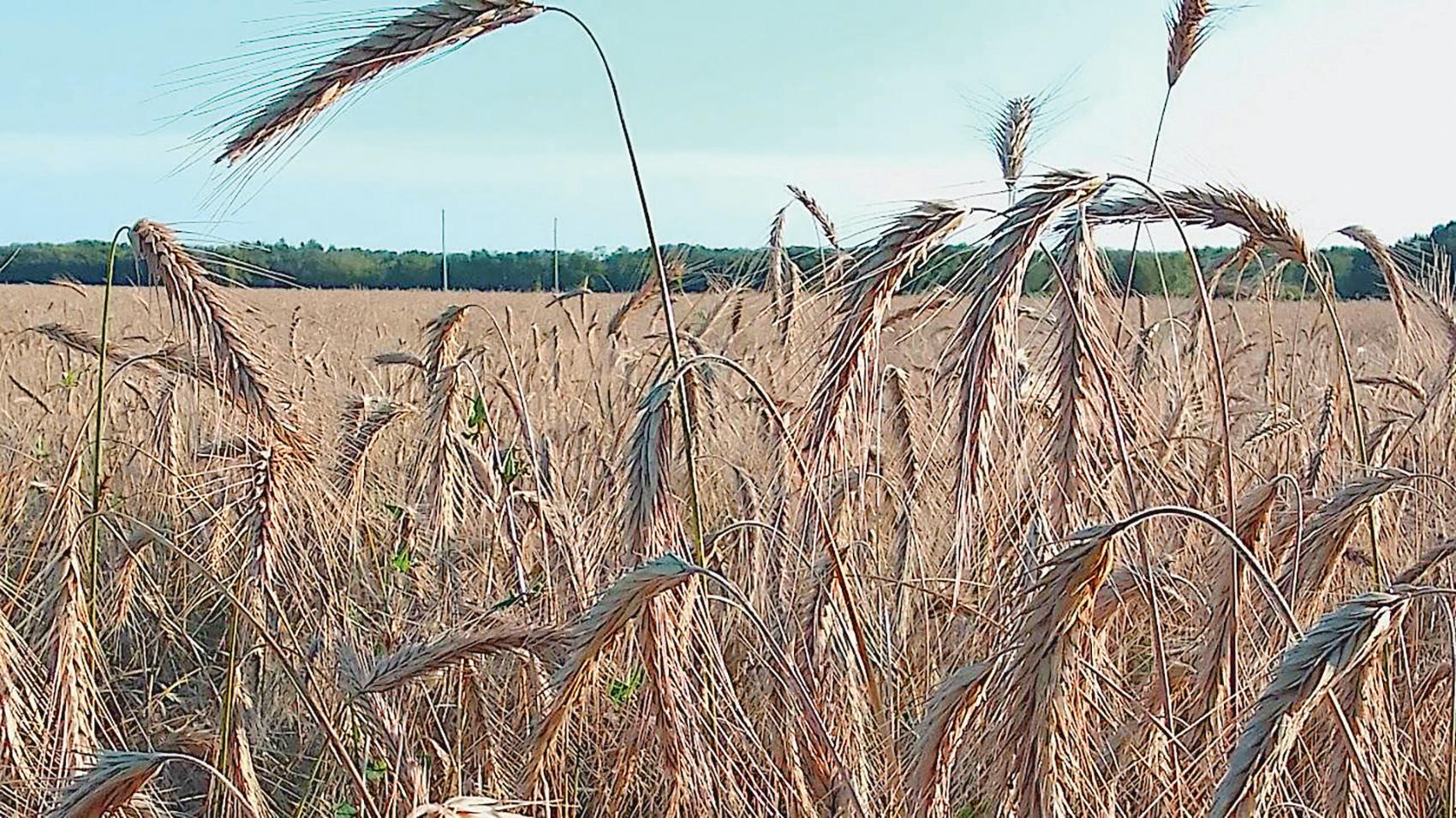
Still, the 80 acres had more potential. He realized the vegetable market alone couldn’t fully utilize the land. That led him to the grain side of farming. Partnering with a local stone miller, he began milling Red Fife wheat into flour. From there, the operation expanded steadily.
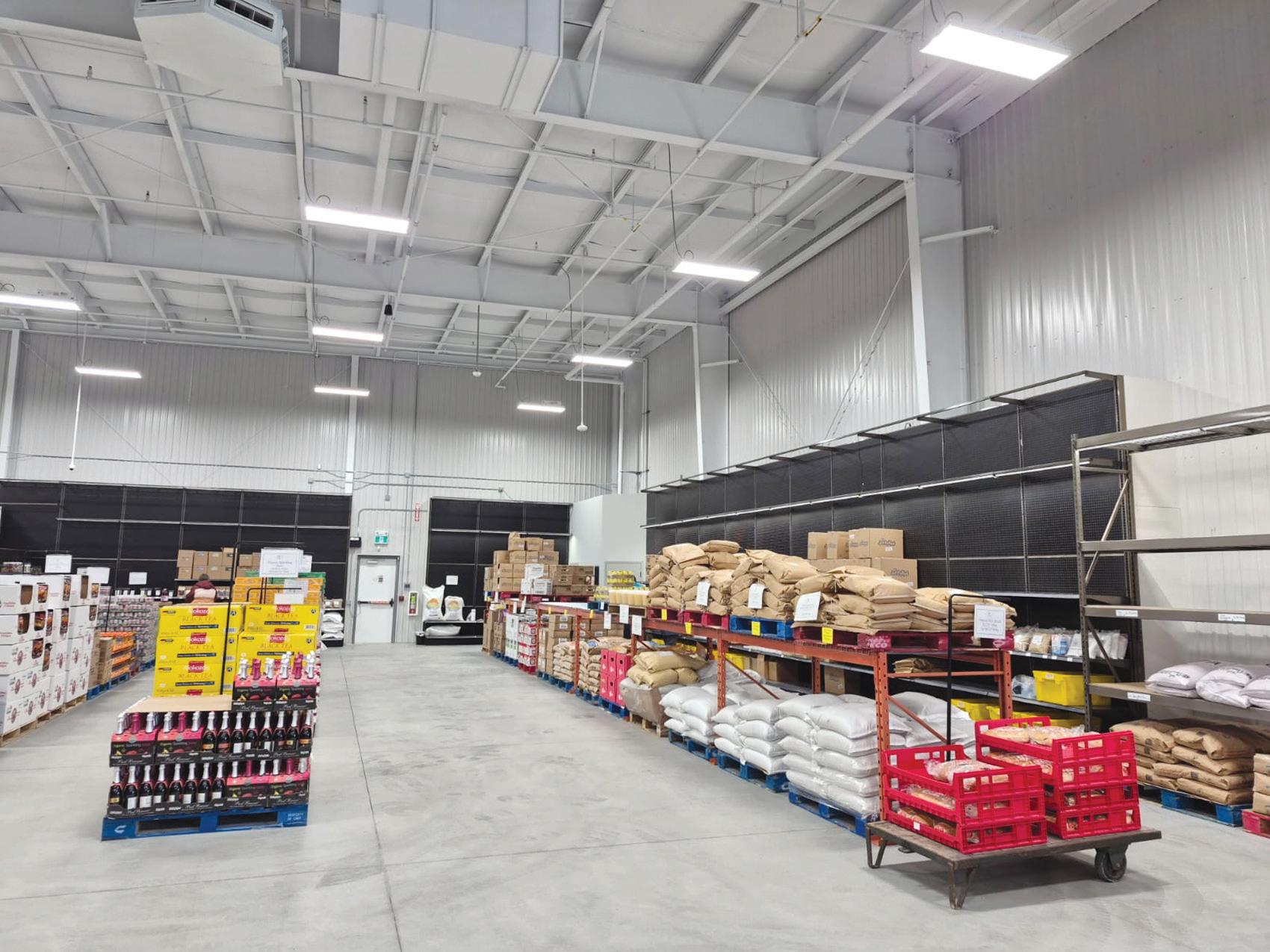
BenCo established its own production and warehouse facility at Rossendale, scaling up to meet growing demand. Today, the company contracts hundreds of acres to supply its mill.
The newest chapter is unfolding in Steinbach. BenCo had long delivered to Hutterite colonies and rural communities across Mani-
toba, but demand in Steinbach surged beyond what the delivery system could handle. In January, BenCo opened a store in the former Peavey Mart building. It has already become the company’s largest market.
Ben emphasizes that if the company can’t grow a product itself, it aims to source it as locally and organically as possible. Running everything from production to retail gives BenCo a unique advantage — and builds trust with customers who want to know where their food comes from. At the same time, affordability remains central.
“Eating healthy and local should be affordable,” Unrau says.
To keep prices competitive, the company incorporates grocery liquidation where appropriate, balancing price and quality without compromising values.
The biggest challenge today is keeping up with demand — infrastructure, staffing, and logistics all stretch under the strain of rapid growth. Yet Ben speaks of it with gratitude.
“God has blessed my business beyond anything I could’ve imagined,” he says. “We want to be a blessing and a ray of sunshine in our communities.”
He believes Manitoba’s local-food market is still largely untapped. With products available at the Steinbach store, at the Rossendale farm and mill, and through a fleet of delivery trucks serving larger orders across the province, BenCo Foods is poised for continued growth — and committed to supplying Manitobans with as much healthy, local food as possible.
By Dan Guetre
As planting season ramps up across the country, farm safety advocates are remind ing families that children face unique risks in agricultural environments during the third annual Kids FarmSafe Week.
The national campaign, running May 11 to 17, focuses this year on the theme “Nur turing the Future of Agriculture,” empha sizing the need to protect children while fostering their connection to farm life.
Farms are both homes and workplaces, meaning children are often surrounded by equipment, livestock and active job sites. While these environments offer valuable opportunities to learn responsibility and life skills, they can also pose serious haz ards if proper precautions are not taken.
Organizers stress that safety begins with awareness, particularly when children in teract with livestock. Even calm, familiar animals can behave unpredictably if startled or stressed.

Experts recommend that children should always be supervised around animals and taught to move calmly, avoid sudden noises, and never feed or touch livestock without permission. Recognizing warning signs — such as agitation or aggressive behaviour — can help prevent injuries.
Farm machinery remains one of the most significant dangers for children. Tractor-related incidents, especially runovers, can result in life-altering injuries or fatalities within seconds.
The national campaign, running May 11 to 17, focuses this year on the theme “Nurturing the Future of Agriculture,” emphasizing the need to protect children while fostering their connection to farm life.
Submitted photo
While farms provide endless opportunities for exploration, not all areas are safe for play. Campaign organizers encourage parents to establish clear boundaries, keeping children away from high-risk zones such as machinery areas, livestock enclosures and active worksites.
Supervision remains critical, even in familiar spaces, as conditions can quickly change during daily operations.
A key message of Kids FarmSafe Week is that safety should be part of everyday farm life. Teaching children age-appropriate tasks, encouraging open communication and reinforcing safe habits can help build confidence while reducing risks.
“Safety is not an afterthought - it’s part of every job,” the campaign emphasizes.
Young children between the ages of one and four are at the highest risk for bystander runovers. Safety advocates urge families to enforce strict rules: never allow children to ride on machinery, always supervise them near equipment, and remove keys when machinery is not in use.
“These incidents are devastating, but they are also preventable,” organizers note.
Rail safety is another key focus during
the week. Trains can be particularly fascinating to children, but they also pose serious risks, especially in rural areas where crossings may lack signals or barriers.
Each year, more than 100 Canadians are seriously injured or killed in railway-related incidents. Families are encouraged to teach children to cross tracks only at designated crossings, and to always look and listen carefully, as trains can approach from any direction and take a long time to stop.
The importance of these efforts is underscored by long-term data. Between 1990 and 2020, 435 children and youth lost their lives in agriculture-related incidents in Canada, a reminder that farm hazards should never be overlooked.
Advocates say proactive measures, education and leading by example can significantly reduce these risks and ensure safer environments for young people growing up in agriculture.
“Every child deserves a safe place to grow, learn and thrive,” organizers say. “By working together, we can protect children today while supporting the future of agriculture for generations to come.”

By Harry Siemens person.
Robyn Harte, a Swine Industry Specialist with Manitoba Agriculture, hosts the department’s BarnYard Talk webinar series. The free monthly sessions give small-scale livestock and poultry producers practical guidance on raising healthy pigs, poultry, rabbits, and small ruminants.
In the latest session, poultry specialist Amy Hopkins-Green outlined key steps for purchasing livestock, emphasizing reputable sourcing, animal health, and strong biosecurity.
She said Manitobans buy animals in many ways—online, through local groups, from breeders, neighbours, or at auctions—but problems often arise when animals are purchased with little information or without being seen in
“Buying without proper inspection can lead to issues later on,” she said.
Hopkins-Green encouraged producers to buy from reputable breeders with a known track record. A reliable seller should provide a full history of the animal, allow buyers to visit the farm, and, when applicable, offer pedigrees. She noted that with stock photos and AI-generated images becoming more common, seeing the animal in person remains the safest approach. She recommended choosing animals from a single-source herd or flock whenever possible. Buyers should ask whether animals have been tested for disease or vaccinated for common illnesses. Registered poultry hatcheries, for example, participate in disease sur-

veillance programs, including testing for Salmonella enteritidis.
Some producers purchase animals from commingled sites such as auctions or shows. Hopkins-Green said these locations carry additional risk because animals from multiple sources come into con-


tact, increasing the chance of disease spread. Buyers should ask about health requirements, record-keeping, and whether animals are kept separate before sale.
When speaking with sellers, she advised asking about vaccination and treatment history, including any antibiotics used and their withdrawal periods. Buyers should also ask about deworming schedules, breeding status, signs of illness, and whether the farm keeps records. Keeping the seller’s contact information is important for follow-up.
Choosing the right animal is another key step. Hopkins-Green said buyers should look for animals that are healthy, alert, and in good
body condition. Animals should have sound feet, good teeth where applicable, and a calm temperament. She reminded producers to ensure the animal fits their purpose, noting the differences between meat-type poultry such as Cornish Cross and laying breeds like Leghorns.
Before purchasing, producers should plan how they will transport the animals. Trailers or crates must be clean, safe, and well-ventilated. Hopkins-Green reminded participants that livestock in Manitoba must be transported with a manifest that includes ownership and movement details.
Once animals arrive on the farm, they should be quarantined for at least four weeks in
a separate area prepared with clean bedding, feed, and water. New animals should be monitored daily, and feed changes should be introduced gradually. She stressed the importance of biosecurity, including the use of separate clothing, footwear, and equipment when handling quarantined animals. Hopkins-Green closed by highlighting the importance of record keeping. Detailed records of purchases, movements, and sales support traceability and help meet regulatory requirements such as PigTRACE for pigs and CCIA for cattle.
BarnYard Talk continues to provide practical, accessible information for small-scale producers across Manitoba.


By Dan Guetre
With spring seeding underway and crop protection decisions top of mind, Keep it Clean has released its 2026 Product Advisory to help Canadian growers avoid potential market access risks tied to certain crop protection products.
By Myriam Dyck
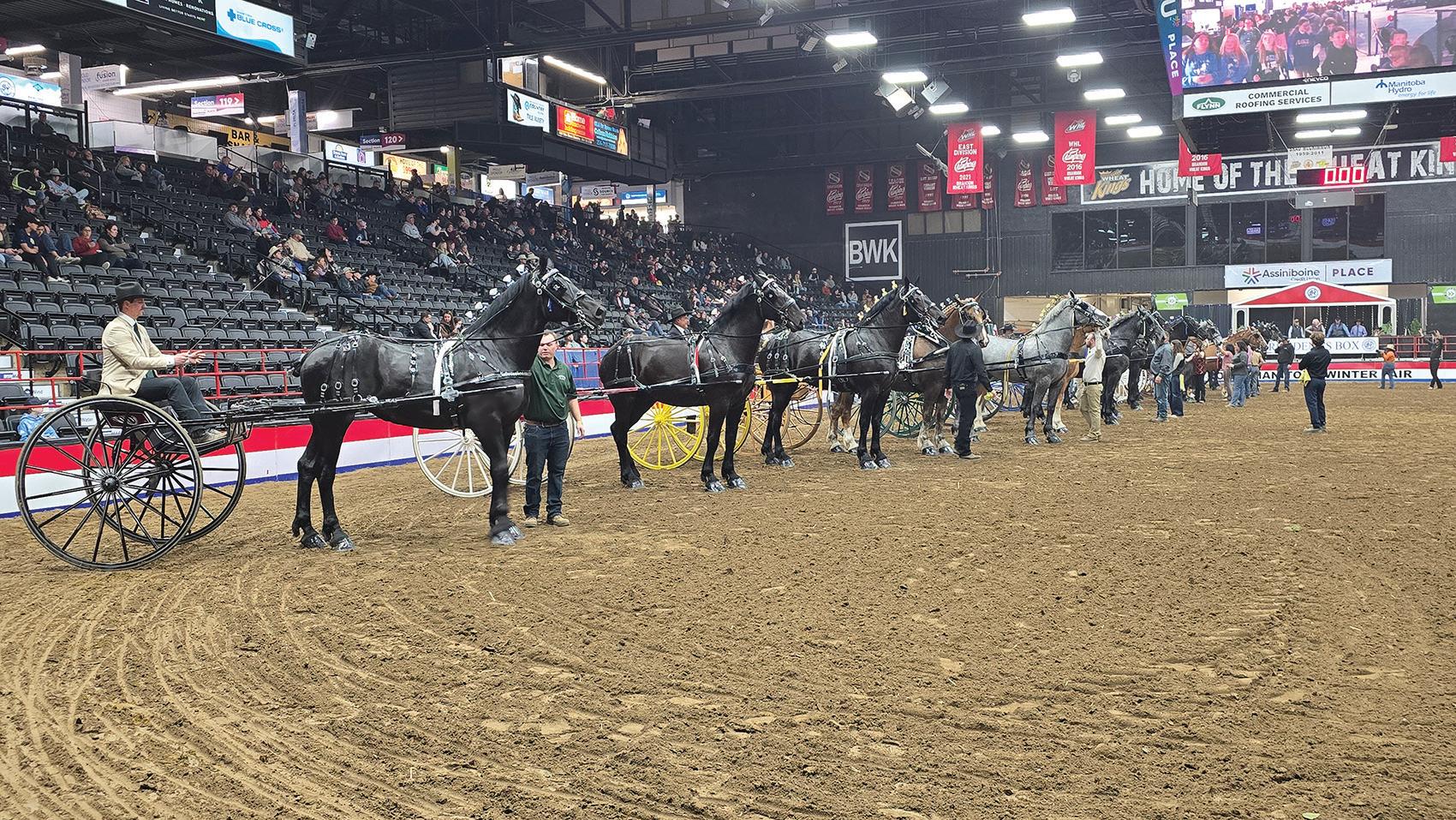
The 2026 NAERIC (North American Equine Ranching Information Council) Draft Horse Futurity finals were held at the Royal Manitoba Winter Fair.
These young 3-year old entries were shown in hand and in harness and winners received significant futurity payouts.
The NAERIC Draft Horse Classic program encourages breeders to nominate and/or sell registered draft horse yearlings at auction each spring. The nominated horses and those sold through the sale (also held at the RMWF this year)
return after training for 2 years to compete for a significant purse at the Futurity which is designed to demonstrate their quality, conformation and performance.
The updated guidance outlines crop and product combinations that could create challenges in international markets, where regulatory requirements, including maximum residue limits, continue to shift year to year.
Canada’s grain sector is highly export-dependent, with up to 90 per cent of canola and more than 80 per cent of crops such as wheat, barley and oats shipped abroad annually. Pulses also rely heavily on global demand, with roughly 85 per cent exported each year. As a result, even small regulatory changes in key markets can have significant implications for producers.
“Requirements in our export markets can change from year to year,” said Krista Zuzak, Director of Crop Protection and Production at Cereals Canada. “The 2026 Product Advisory provides growers and crop advisors with the most up-to-date information on crop protection products that can create market risks in various crops.”
The advisory is designed to support growers as they finalize crop protection plans for the 2026 growing season. By identifying potential risks early, the initiative aims to help maintain Canada’s reputation as a reliable supplier of high-quality grain.
Keep it Clean is encouraging producers to review the advisory carefully and consult with grain buyers before applying any products flagged in the report.
To further support industry awareness, Keep it Clean will host a webinar on May 7 at 11 a.m., providing an overview of key updates to export market requirements. The session is open to growers, agronomists and others across the value chain seeking clarity on evolving regulations.
Organizers say proactive communication and informed decision-making are essential to protecting market access, particularly as global standards become more complex.
The 2026 Product Advisory and webinar registration details are available through Keep it Clean’s website at keepitclean.ca.


By Harry Siemens

Manitoba’s cattle market continues to show impressive strength in feeder prices even as overall marketings remain below last year’s pace. According to the April 10 Manitoba Agriculture report, total auction marketings reached 4,600 head for the week, bringing the year-to-date total to 102,943 head — a 4.3 percent decline from 107,583 head at this time in 2025. Virden led with 2,155 head sold, followed by Ste. Rose at 1,423, Ashern at 749 and Grunthal at 273, while Gladstone, Killarney, and Winnipeg reported no sales. The numbers show a market moving fewer cattle but doing so at consistently strong price levels.
Slaughter cattle prices held firm. D1–D2 cows averaged $252.75 per hundredweight, up $10.38 from the previous week, with a range of $231.25 to $274.25. D3 cows averaged $213.33, a slight increase. Bulls softened, averaging $260.59, down $4.28.
Individual auction results reflected similar trends. Ashern and Ste. Rose both averaged $258 for D1–D2 cows, Virden averaged $250, and Grunthal $245. Bull prices varied, with Ste. Rose topping the week at $267.25 and Grunthal averaging $251.13. Overall, the slaughter market remains steady, with cows showing particular strength.
Feeder steer prices were strong across all weight classes. Steers over 901 pounds averaged $453.33, while 801–900 pound steers averaged $502.75. The 701–800 pound category saw one of the week’s largest gains at $571.83, up $29. Steers in the 601–700 pound range averaged $617.33, and 501–600 pound steers averaged $698.83. Even the 401–500 pound group remained high at $762.58 despite a slight decline.
Ste. Rose posted some of the strongest prices, with 401–500 pound steers at $810 and 501–600 pound steers at $700.50. Virden and Ashern followed the same pattern, with 701–800 pound steers averaging $585 in Virden and $570.50 in Ashern.
Heifer prices also strengthened. Heifers over 901 pounds averaged $417.50, while 801–900 pound heifers averaged $480.17, a notable increase from the previous week.
Mid-weight heifers in the 701–800 pound range averaged $489.50, and 601–700 pound heifers averaged $571.00. The 501–600 pound group averaged $627.50, while 401–500 pound heifers averaged $687.50.
Ste. Rose again led several categories, with 801–900 pound heifers averaging $496.50 and 401–500 pound heifers averaging $700. Virden also showed strength, with 601–700 pound heifers at $582.50 and 501–600 pound heifers at $661.50.
Sheep and goat markets showed more volatility. At Winnipeg’s March 18 sale, lamb prices declined across all weight classes, with 100-plus pound lambs averaging $330, down $42.50. Lambs in the 80–100 pound range averaged $367.50, down $57.50, while 60–80 pound lambs averaged $425, down $67.50. Goat prices softened as well, with billys averaging $385, down $60.
Grunthal’s March 25 sale, however, showed stronger results, with 60–80 pound lambs averaging $447.50 and goat kids averaging $500.
Overall, Manitoba’s cattle market reflects a North American trend of tight supply supporting strong prices. With year-to-date volumes down but feeder prices holding firm or rising, producers continue to benefit from a market that rewards quality and consistency.
By Harry Siemens
The Seal River Watershed Alliance, together with the governments of Canada and Manitoba, has taken another major step toward protecting one of the world’s last great intact watersheds. The partners have released a proposal outlining how the Seal River Watershed in northern Manitoba could be safeguarded for future generations, and they are inviting the public to review the plan and provide feedback through EngageMB until June 2.
The proposal recommends protecting the entire watershed through a network of conservation designations that would sustain lands and waters, honour Indigenous ways of life, and welcome visitors to the region. Manitoba has pledged a $4 million endowment contribution, while the federal government recently committed $74.7 million over 11 years, plus $7.9 million in ongoing funding, to advance the establishment of an Indigenous Protected and Conserved Area (IPCA) and a national park reserve.
Spanning more than 50,000 square kilometres, the Seal River Watershed is one of the largest intact watersheds on the planet. Its lakes, wetlands, and boreal forest support more than 30 species at risk, including barren-ground caribou, polar bears, and wolverines. The watershed provides clean drinking water, stores carbon, and supports sustainable live-
lihoods through local food harvesting, ecotourism, and conservation-based economies. The Seal River flows freely into Hudson Bay without dams or industrial development, and the region currently has no active mineral claims, mining leases, or significant petroleum discoveries.
For millennia, Dene, Cree, and Inuit peoples have lived on and cared for this land. In recent years, the four First Nations of the Seal River Watershed Alliance—the Sayisi Dene, Northlands Denesuline, Barren Lands, and O-Pipon-Na-Piwin Cree—have led the effort to ensure the watershed remains healthy and intact.
Their leadership is central to the proposal, which outlines a mosaic of protected areas combining an Indigenous Protected and Conserved Area, a new provincial park, and a national park reserve. Roughly two-thirds of the watershed would be protected under a provincial park designation, with the remaining one-third designated as a national park reserve.
A joint management board is proposed, appointed by Indigenous governments, Canada, and Manitoba. The board would operate by consensus and guide stewardship, decision-making, and the development of a management plan rooted in science, Indigenous knowledge, and community input. The four First Nations have also expressed a commit-
ment to expanding sustainable tourism, welcoming visitors to hike, paddle, hunt, fish, and learn about Dene and Cree cultures.
The proposal has also drawn attention from resource-user groups. Chris Heald of the Manitoba Wildlife Federation says there are positives in the plan, including the intent to protect important landscapes, but he notes that many details remain unclear. Heald says the national park component raises questions on how much authority would shift to the federal government and how the proposed management board would be structured.
He adds that early information suggests the board could influence harvest decisions and natural resource allocations, and the Federation wants clarity before offering support.
Heald also points to reports of a 10-year sunset clause on hunting and angling within the proposed national park area. He says this could affect outfitters and tourism operators and that more information is needed on how such changes would be managed. The Federation plans to review the proposal in detail and consult with affected stakeholders during the public engagement period.

This proposal builds on several years of collaboration. In January 2024, the Nations and both levels of government signed an agreement providing interim protections for the watershed. In March 2025,
after public engagement and assessment, the partners released a report concluding that protecting the watershed was feasible and would generate environmental, economic, social, and cultural benefits. Public feedback will help shape the final establishment agreement that would create Manitoba’s next major protected area. Manitobans are encouraged to review the proposal and share their perspectives as the partners work toward a long-term vision for the Seal River Watershed.
By Harry Siemens
The Manitoba Pork Council’s annual general meeting drew a strong turnout this year, with about 160 people attending daytime sessions and roughly 400 gathering for the evening banquet. The participation reflects the strength and engagement of Manitoba’s hog sector, as producers, processors, and industry partners came together to assess the state of the industry and consider what lies ahead.
Cam Dahl, general manager of Manitoba Pork, said his main takeaway from the AGM was a renewed sense of optimism among producers. “In talking with producers, I came away with a sense of optimism,” Dahl said. “There is talk of expansion and renewal.”
That optimism, however, is tempered by the realities of a shifting global landscape. “At the same time, there is a lot of uncertainty because of geopolitical events and trade chal lenges — the U.S., CUSMA, EU non-tariff barriers, and China. Uncertainty will impact investment.”
fying trade is critical,” he said. “We also need to keep disease out of our barns and ensure we have the people and financing to sustain growth.” These issues directly affect producers’ ability to plan, invest, and expand with confidence.
Even so, Dahl remains convinced that Manitoba is one of the best places in Canada to raise pigs. “We have the people, the feed, the space, the water, and efficient, effective production systems,” he said. “The opportunity for growth is high — higher than in other parts of Canada.” This combination of natural
resources, skilled producers, and proven systems continues to position the province as a leader in Canadian pork production.
Looking ahead, Dahl said the industry must prepare for slower global population growth and the resulting shifts in long-term demand.
“Slowing growth and demand are factors we need to incorporate into long-term planning,” he said. “We need to focus on quality, dependability, and non-intrinsic factors like sound environmental stewardship and animal care.” Manitoba’s competitive advantage, he emphasized, will increasingly rest on trust,
integrity, and sustainability.
One ongoing concern is China’s 25 percent tariff on Canadian pork. “Today, that tariff is costing the Canadian industry about $100 million per year,” Dahl said. While he noted that shrinking populations in China and Japan will eventually reduce demand, the immediate impact of the tariff remains significant and unresolved.
Despite these challenges, the tone of the AGM was one of resilience and forward momentum — a sector grounded in realism yet moving ahead with cautious optimism.

Dahl identified four key challenges shaping the industry’s outlook: trade uncertainty, la bour shortages, biosecurity, and access to capital. “Keeping our markets open and diversi-

By Peter Vitti
Open a bag of cattle mineral and pour it into a mineral feeder for beef cows. That’s the easy part. It takes a lot more effort to manage mineral and vitamins for beef cows, to meet their nutritional requirements. That’s why I encourage farmers to purchase a well-formulated cattle mineral and look after it in the feeders throughout the entire summer. In this way, we promote good mineral intake, which contributes to good cow health and reproductive performance.
There are many factors that either promote or hinder the consumption of a commercial cattle mineral, so that each cow consumes 56 – 112 grams (2 – 4 oz), daily. Here is an outline of some major factors:
Mineral formula – Well-balanced minerals (and vitamins) are formulated to match the cowherds’ vital and performance requirements. They might achieve technical per-
fection, but are a complete failure when the cows refuse to eat them.
This happened to me couple of years ago. I formulated a high-calcium beef cow mineral for a 150 cow-calf operation. It easily complimented the cowherds’ low-calcium summer grass pastures, yet the cowherd didn’t relish eating a 60% glass-rock mineral. Needless-to-say, we diluted it down with corn distillers’ grain to watch them slowly eat 30 grams per day.
Water quality – Mineral content and dissolved salts in the cows’ drinking water is one of the biggest hindrances to get beef cows to eat loose-fed cattle mineral.
A few years ago, I recommended a 2:1 cattle mineral (with 10% salt) to a 200 cow-calf operation that grazed rotational pasture - drawing water from a natural spring. It contained low levels of salt and minerals; the cattle ate about 4 oz. of mineral, daily. Weeks later, the

cattle were moved to a new pasture in which its well-water was very salty. As a result, cattle minerals consumption fell to zero.
Pasture season – Whether cattle are overwintered on a good mineral program or not, it seems that providing loose mineral on sprouting pasture is a new experience for even the most experienced cows. Overconsumption of cattle mineral is initially expected, which usually tapers off after a week or so. Because of this phenomenon, it important to keep loose mineral and salt available at all times.
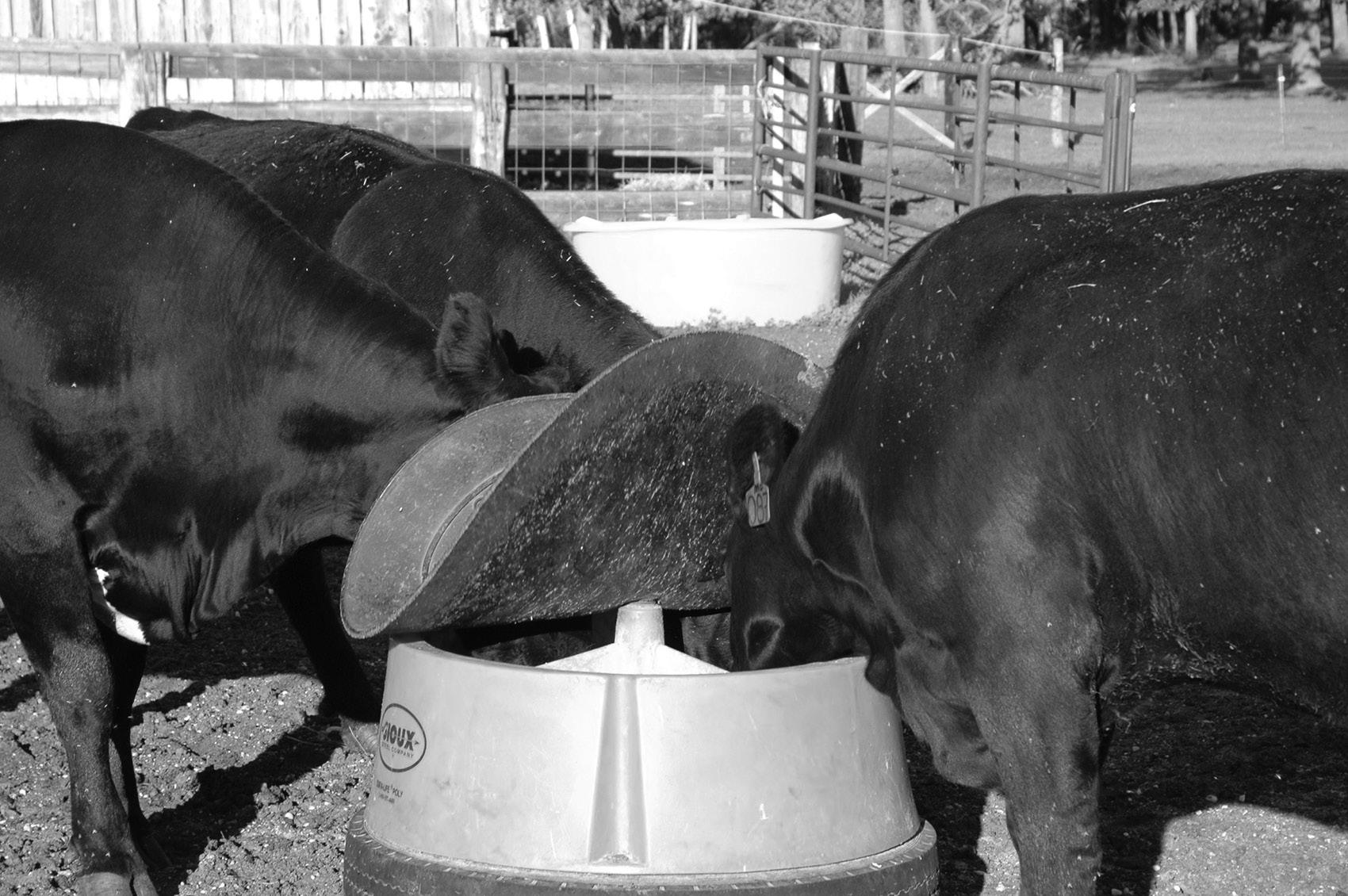
Mineral feeder – Over the years, I have seen beef producers provide cattle mineral in a variety of home-made devices. These inappropriate mineral feeders include: old wooden crates, cardboard boxes, toddlers’ plastic swimming pool, bent out-of-shape aluminium feeders, and half-oil drums with jagged-edges.
The reward for the most “innovative” cattle mineral feeder; the producer would put out cattle mineral in the trunk of a wheelless 1962 Oldsmobile. One day his cattle abruptly stopped eating trunk-mineral. That’s because a fox gave birth to her pups in the back and prevented cattle from sticking in their heads. Overcoming these few and often funny obstacles to good cattle mineral consumption should lead to good consistent mineral intake. In-line, we should:
- Calculate the amount of mineral that you would need to carry the cowherd, every few days. It goes something like this: 300 cows x
112 grams of mineral x 3 days = 100 kg or 4 x 25 kg bags of mineral.
- Place about 1/3-bag in about a-dozen durable mineral feeders (one per 30 cows).
- Check back every few days and refill mineral feeders. Note- adjust mineral consumption as the summer progresses as spring calves start eating minerals, too.
Applying these few pointers - I knew a producer with about 300-beef cow-calf pairs in which he mounted seven new “3-compartment” plastic mineral-feeders (each covered with a thick rubber flap) on tractor tires. These feeders were filled with ½ bag of a nutritious and palatable mineral and placed out over a couple summer pastures, with one or two of them placed near water-filled dugouts. Clumps of old mineral were removed and a fresh supply was provided every few days. Mineral consumption ranged from 70 to 110 grams per head, daily throughout the summer. It was a good example of what to do when feeding cattle mineral to beef cows. Rather, I got a call from a veterinarian which concluded that a local 300-cowherd client had a copper deficiency and she asked me to formulate a cattle mineral with “extra bioavailable copper”. During our conversation, the vet had no information about the cattle’s mineral consumption, yet I did learn from our conversation the cattle’s owners visited their cowherd about every three weeks. It ended up that copper nutrition was not the solution, but a need for good mineral management.

Molasses blocks have been fed to beef cows for many years. It’s only been recently that more of them are being fed on dairies. Not only are they being placed in the drylot for replacement heifers or faraway dry cows, but they are finding a home in the main lactating barn. That’s because molasses blocks or cattle lick-tubs can be a source of extra nutrients, and is also an excellent way of promoting good rumen function. Some producers may get sticker-shock from their price-tag, but many people that feed them find they contribute to good milk profitability.
Compared to other conventional feedstuffs like soybean meal; a dairy molasses block contains a homogenous blend of added energy, protein, macro- and trace minerals and fat-soluble A, D, and E vitamins. For example, its Nel value is around 2.0 Mcal/kg much like corn and its protein content is often formulated to 16 – 30%. Typical crude fat content for blocks is about 3 – 5%, calcium at 1.0 – 3.0%, phosphorus at 0.5 – 2.0% and with a host of varying levels of mineral and vitamins.
Such solid nutrition often called - “low-moisture” molasses blocks (lick-tubs), which accu-
rately describes how they are manufactured in the first place. Namely, the process of producing these blocks starts with heating molasses together with several litres of vegetable oil and then vacuuming off 25% natural moisture found in this mixture. This low-moisture liquid is combined with dry ingredients (protein, mineral, and vitamins) and then the taffy-like substance is poured into barrels and are allowed to cool. The product itself absorbs moisture, which allows only the exposed surface to become tacky, while the rest of the block remains hard.
As a dairy nutritionist, I am not depending on the molasses blocks’ nutrient content at all in the lactation barn. Rather, I like to use them to maximize the cows’ natural licking action. Research feed-trials demonstrate that when cattle repetitively lick these molasses blocks, it stimulates their natural production of saliva containing bicarbonate-ions.
Therefore, I believe that such action increases the buffering capacity of lactating cows, which help reduce their predisposition to sub-acute ruminal acidosis (SARA).
For example, a friend of mine milks over 300 cows in his lactation barn. Ten years ago, he had a serious issue with fresh cows coming into the lactation barn from their close-up dry cow pen. It seemed that they would develop SARA within two weeks after being housed in the fresh cow pens. As a result, these cows would have inconsistent dry matter intakes, lower milk fat
and eventually lost more body condition than acceptable. Plus, their recovery of lost body condition was inadequate until their first few weeks in the faraway dry cow pens.
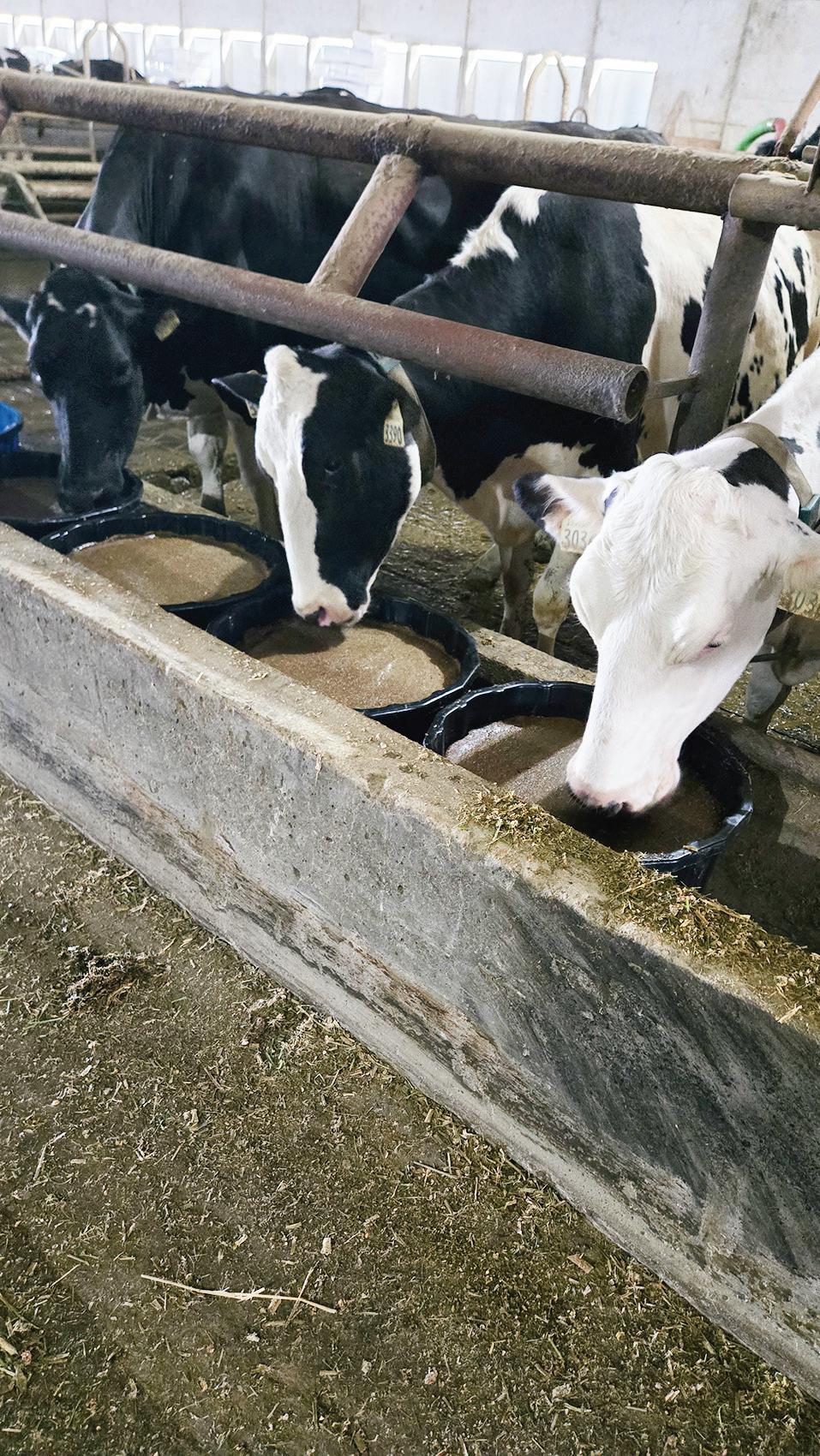
As my picture illustrates, this dairy producer placed three low-moisture blocks in the fresh cow pen as well as in other caveats at the end of each feed bunk. His main cowherd (including all fresh cows) readily licked them. It took about six-weeks (years ago), but all evidence of SARA in his lactation barn, practically disappeared. Dry matter intake in the fresh cow pen improved as well as general feed intake in the general population became more consistent. In addition, all dairy cows regardless of parity seemed to retained more body condition (BCS of 3.0 – 3.5) by the end of lactation. No changes in milk production or milk components were realized.
Like other dairy producers, my friend is conscious of all of his feed costs. He often purchases 12 x 200 lb. 18% cattle low-molasses lick tubs at $250 per 200 lbs. He figured out that the average lactating cow licks about 200 grams of nutrient-enriched molasses per day, which calculates into a feeding cost of $0.55 per head, daily.
He finds that the payback, due to feeding these molasses blocks is largely intangible. However, he reflects that their true advantage is healthier fresh dairy cattle. In addition, he removed some other feed additives such as sodium bicarbonate
from his entire dairy diet in order to offset the input cost of low-moisture blocks. His testimony demonstrates that dairy molasses blocks may contain good nutrition, but they can be more of a good lactating cow management tool. This mean a well-balanced TMR for lactating dairy cows is always required to supply all essential nutrients for good milk production. Yet, these good rations may still fall short, when it comes to digestive SARA. As a result of placing molasses blocks in the lactation barn, they can lick this serious problem.
By Dan Guetre
The Canadian Cattle Association (CCA) has launched a national campaign opposing the inclusion of beef access in a potential trade agreement between Canada and the Mercosur, warning it could harm domestic producers and rural communities.
Mercosur, which includes Brazil, Argentina, Paraguay and Uruguay, is currently engaged in active trade negotiations with Canada. According to the CCA, the issue of beef imports has emerged as a central point of contention in discussions.
The campaign, launched recently, is already gaining traction. The association reports that more than 1,000 emails have been sent to Members of Parliament, while social media outreach has reached tens of thousands of Canadians. The CCA is also directly engaging MPs, including follow-ups to outreach initiated by its president, Tyler Fulton.
“Canadian beef farmers and ranchers are opposed to any beef access in a Mercosur trade
deal which would result in increased imports of low-quality beef for Canadian consumers,” Fulton said in a statement.
He emphasized that Canada’s beef sector adheres to high standards in animal health, labour practices and food safety, while contributing to environmental sustainability through carbon sequestration, ecosystem protection and wildlife habitat preservation.
“In contrast, Mercosur beef does not meet the same standards … and has long been associated with environmental degradation,” Fulton added. “Displacing locally and sustainably produced Canadian beef is a loss for consumers, the environment and rural communities.”
The CCA points to recent data showing that Canadian beef imports reached their highest level since 1993 in 2025, accounting for an estimated 30 per cent of domestic consumption. This marks the largest import share in more than two decades.
The association argues that increased imports have not led to lower prices for consumers, sug-
gesting instead that strong demand continues to drive the market.
Industry leaders also warn that relying on lower-cost imports could have long-term consequences. Beef production operates on extended cattle cycles, meaning that discouraging domestic herd growth now could reduce supply in the future and contribute to price volatility.
The CCA maintains that additional imports from Mercosur could undermine efforts to rebuild Canada’s cattle herd, displace domestic producers and weaken rural economies. The organization also raised concerns about environmental implications, noting that Canadian beef production generates significantly fewer emissions compared to some international competitors.
Among its key messages, the association argues that:
- Canadian beef should not be used as a bargaining chip in trade negotiations;
- Increased imports risk displacing domestic producers and harming rural communities;
- Additional access for Mercosur beef could hinder herd rebuilding efforts;
- Greater reliance on imports may conflict with Canada’s environmental goals;
- Differences in standards for labour, food safety and environmental practices remain a concern.
To support its campaign, the CCA has introduced an online tool at cattle.ca/mercosur allowing Canadians to easily contact their MPs by entering their postal code and sending a pre-addressed message.
The association is urging producers, stakeholders and supporters to continue amplifying the campaign to ensure the issue remains a priority for decision-makers in Ottawa.
While reaffirming its support for rules-based and reciprocal trade diversification, the CCA argues that a deal with Mercosur offers little export opportunity for Canadian beef while posing significant risks at home.
“We have nothing to gain and much to lose in these negotiations,” the association said in a statement.

By Harry Siemens
At the recent Royal Manitoba Winter Fair, Manitoba Agriculture Minister Ron Kostyshyn delivered a clear message at the Pork Quality Luncheon: Manitoba agriculture grows stronger when producers, provinces, and trading partners work together.
Speaking to a full room of hog producers and industry partners, Kostyshyn acknowledged ongoing challenges. Margins remain tight, markets shift quickly, and global politics add uncertainty. But he focused on the sector’s strengths.
“We’re fortunate in Manitoba,” he said. “We have resources, experience, and producers who keep moving forward.”
He pointed to Manitoba’s strong relationship with the United States, especially Iowa. The province ships about 2.5 million weanlings south each year, and U.S. processors continue to demand Manitoba pigs for their biosecurity and genetics.
“They tell us Manitoba pork has some of the

best biosecurity anywhere,” he said.
Kostyshyn credited producers, researchers, and universities for building that reputation, calling producers the backbone of the sector.
He also emphasized the role of youth programs like 4-H in shaping the future of agriculture.
“4-H shows students where their food comes from,” he said. “It builds confidence and leadership.”
Turning to competitiveness, Kostyshyn highlighted insurance programs and federally inspected processing plants that support high standards in food safety and animal care.
Trade remained central to his message. While ties with the U.S. and Mexico remain critical, he sees opportunities in new markets, including the European Union.
“The world is large,” he said, “but it’s not as large as it used to be.”
He also pointed to the Port of Churchill as an emerging advantage, offering new logistics options for exports to Europe and Asia.
Interprovincial trade barriers, however, remain a concern. Kostyshyn called for greater cooperation across Canada.
“If we can move more product across Canada, we all win,” he said, urging a stronger Team Canada approach in global markets.
He said recent tariff disputes forced Canada to adapt quickly and find new markets.
“It forced us to get creative,” he said. “We built new relationships and proved we can adapt.”
Kostyshyn warned against complacency, stressing the need to keep expanding market access.
“We have the product and the capacity,” he said. “Now we need to keep pushing.”
He closed by reinforcing Manitoba’s role in national trade efforts.
“When we work together, we grow together,” he said.
The message reflected the tone of the luncheon—practical, forward-looking, and focused on opportunity.
By Dan Guetre
The Canadian Federation of Agriculture (CFA) is welcoming the federal government’s decision to extend the $250,000 interest-free threshold under the Advance Payments Program (APP) for the 2026 program year, calling it a timely measure for producers facing ongoing financial pressures.
The announcement, made by the federal agriculture minister, ensures farmers will continue to have access to a significant portion of financing without interest, helping them manage cash flow during the production cycle.
“This is a positive step that ensures farmers continue to have access to cost-effective operating capital at a time of ongoing uncertainty and rising input costs,” said Keith Currie. “Programs like the APP are critical tools that help producers manage cash flow throughout the production cycle.”
The Advance Payments Program provides farmers with low-cost, short-term advances, allowing them to delay selling their commodities until market conditions are more favourable rather than being forced to sell immediately to meet financial needs.
Under the 2026 terms, producers can access up to $1 million in total advances across more than 50 commodities. This includes:
- Up to $250,000 interest-free;
- An additional $250,000 interest-free specifically available for canola;
- The remaining $500,000 available at an interest rate of prime minus 0.25 per cent.
CFA says maintaining the higher interest-free portion is increasingly important as farmers continue to face elevated input costs and inflation.
“Maintaining the $250,000 interest-free portion reflects the realities farmers are facing today,” Currie said. “We are seeing continued volatility in input costs, supply chains and global markets, and this type of support is important in helping farmers navigate those pressures.”
While welcoming the extension, the organization is urging the government to provide greater long-term certainty by making the increased threshold permanent.
“Farmers need certainty to plan ahead,” Currie said. “We look forward to continuing to work with government to secure a permanent increase to the interest-free portion of the program.”
CFA also stressed the importance of timely program announcements to ensure producers can effectively plan for the growing season.
Industry leaders say predictable and accessible financial tools like the APP are essential as Canadian farmers navigate an increasingly complex and volatile operating environment.
By Joan Airey
Before you even think about heading out to the grocery store, plan your meals for the week. This not only saves time but also helps you stay focused on buying only what you need, reducing unnecessary waste and expenses. Start by making a general list of exact ingredients needed for your planned meals. Planning this way helps reduce impulse buys and ensures you have everything to create balanced meals.
If possible, check your fridge and pantry. This not only prevents buying things you don’t need but it inspires you to make meals with ingredients that need to be used up.
Last week John, a friend shared his pickerel catch with me so I definitely will be including that in our menus this week. The pickerel was delicious while Kaylee cooked it for supper last night we texted John a photograph of the pickerel cooking to thank him for the delicious meal. He texted back that we should cook it in garlic butter which we will try next time. Plus, he’d visited friends in the meat business and brought us samples of several products they sell.
My cousin and I challenged each other to use what was in our freezers and cold rooms to make tasty meals earlier this winter. So far, I have been doing a good job of using what I have on hand. My canned tomato supply is really running low so I’m hoping for a good crop this year.
Stocking up on staples while they are on sale helps the budget such as flour and ingredients for baking that can be frozen. My sister picks me up shortening, lard and butter in the city for half the price it is locally.
Last week I asked my husband to pick up some cream corn because a Canadian brand was on sale. The brand on sale was sold out and the manager gave him the Co-op brand instead. Believe it or not, it was from Thai land. I’m not a fan of cream corn at the best of times but buy it because my husband enjoys it.
Manitoba Farm Women’s Conference board are hard at work putting together a cookbook to celebrate forty years of having a conference in Manitoba. I asked Chairperson of the Board Doris Doelger to share one of her favourite recipes with my readers. I tried the recipe for Potato Wedges and it’s a keeper.
Potato Wedges
4 potatoes
3 Tablespoons canola oil
4 garlic, minced
½ teaspoon rosemary
½ teaspoon oregano
½ teaspoon thyme
½ teaspoon paprika
½ teaspoon pepper
1 teaspoon salt
Preheat oven to 425F
Directions: Cut each potato into 8th’s and place in a mixing bowl with the rest of the ingredients. Toss well. Line a sheet pan with foil and place wedges skin down, space evenly. Bake for 35 minutes until tender.
The books will be available for pre-order plus if you attend a conference in Winnipeg next November you will receive one. You can follow the Manitoba Farm Women’s Conference on Facebook.
This recipe was shared with me by Kaylee Hatley whose delicious cooking I get to eat at family get-togethers.
Perogy Casserole
1 package bacon
1 small onion chopped
284 ml can mushroom soup
1 soup can of milk
1 pkg perogies (around 2 dozen just enough to cover bottom of baking dish).
Grated cheddar cheese
1 can mushrooms
Directions: Fry bacon until cooked. Sauté mushrooms, bacon and onion. Place perogies in a 9 x 13 baking dish. In a bowl mix mushroom soup and milk. Add sautéed mushrooms, bacon and onion to mushroom soup and milk mixture. Mix together and pour over perogies. Top with grated cheese. Bake at 350F for forty-five minutes. I use fresh mushrooms as one of my sons always said canned mushrooms weren’t real when he lived at home.
Canadian farmers and agri-industry stakeholders are being encouraged to attend an upcoming webinar hosted by Keep it Clean, offering key insights into the 2026 Product Advisory ahead of critical in-season crop management decisions.
Scheduled for Thursday, May 7, from 11 a.m. to 12 p.m., the session will provide updated guidance on potential market risks linked to the use of certain crop protection products on specific crops.
The Product Advisory is an important tool for growers, highlighting how evolving international requirements — including maximum residue limits — may impact the marketability of Canadian grain.
The webinar will feature a panel of industry experts representing key national organizations, including:
- Krista Zuzak, Director of Crop Protection and Production at Cereals Canada
- Jeff English, Vice President of Public Affairs at Pulse Canada
- Curtis Rempel, Vice President of Innovation, Production and Supply at Canola Council of Canada
Organizers say the webinar will help growers better understand recent updates to export mar-
ket requirements and how they may affect crop protection decisions during the 2026 growing season.
Keep it Clean is reminding producers that careful planning is essential to maintaining access to international markets. Growers are advised to review the Product Advisory closely and consult with grain buyers before applying any crop protection products flagged as potential risks.
By staying informed and proactive, the initiative aims to help Canadian farmers protect the quality and marketability of their crops throughout the season.
Registration details for the webinar are available through KeepitClean.ca or scan the QR code.


Photo by Joan Airey

By Harry Siemens
The Provincial Exhibition of Manitoba welcomed back the Pork Quality Luncheon on April 1, during the Royal Manitoba Winter Fair, drawing producers, partners, and community supporters to celebrate Manitoba pork and the people behind it.
Presented with support from Manitoba Pork, Assiniboine College, East 40 Packers, and Blue Water Wash, the luncheon remains a cornerstone event that blends industry excellence with strong community support. Producers filled the room, reinforcing the sector’s focus on high-quality protein and local impact.
A defining feature of the event is its charitable model. The Grand Champion and Reserve Grand Champion carcasses go directly to the Manitoba Institute of Culinary Arts at Assiniboine College, where students gain hands-on experience with premium pork. All remaining carcasses are processed at cost by East 40 Packers and donated to Westman food banks, including Samaritan House and Helping Hands.
Sponsorship dollars extend that impact. Each entrant names a charity and any entry placing
fifth or higher directs at least half its prize money to that cause. Many producers donate their full winnings. This year’s charities included the Brandon Regional Health Centre Foundation, Neepawa Health Centre, Souris Hospital, and Portage General Hospital.
The numbers again told a strong story. A total of 1,172 pounds of pork supported Westman food programs, with an average carcass weight of 98 kilograms. Judging followed producer-driven criteria that reflect what processors define as the ideal market hog, where even a millimetre difference in fat or loin depth can affect placement.
Judge Jason Care called it one of the closest competitions he has seen. First through third were separated by a single point, with a tie for fourth and fifth.
Sprucewoods Colony claimed top honours with 93 points. Wellwood Colony placed second with 92, followed by Riverside Colony at 91. Sunnyside Colony and Boundary Lane Colony tied for fourth and fifth with 89.
Care noted the judging system, developed by producers, continues to reflect processor expectations and ensures consistency.

“There are no losers in this competition,” he said. “Every entry represents high-quality pork.”
Strong partnerships underpin the event’s success. Support from Fortified Nutrition, East 40 Packers, Manitoba Pork, Assiniboine College, Blue Water Wash, and the Victoria Inn, which prepared the meal, keeps the program running smoothly.
While the competition draws attention, the
heart of the luncheon remains the producers. They gather to support each other, celebrate quality, and give back to their communities. That combination continues to strengthen Manitoba’s reputation across the North American pork sector.
The Pork Quality Luncheon once again showed what defines the industry: quality production, strong partnerships, and a commitment to community.
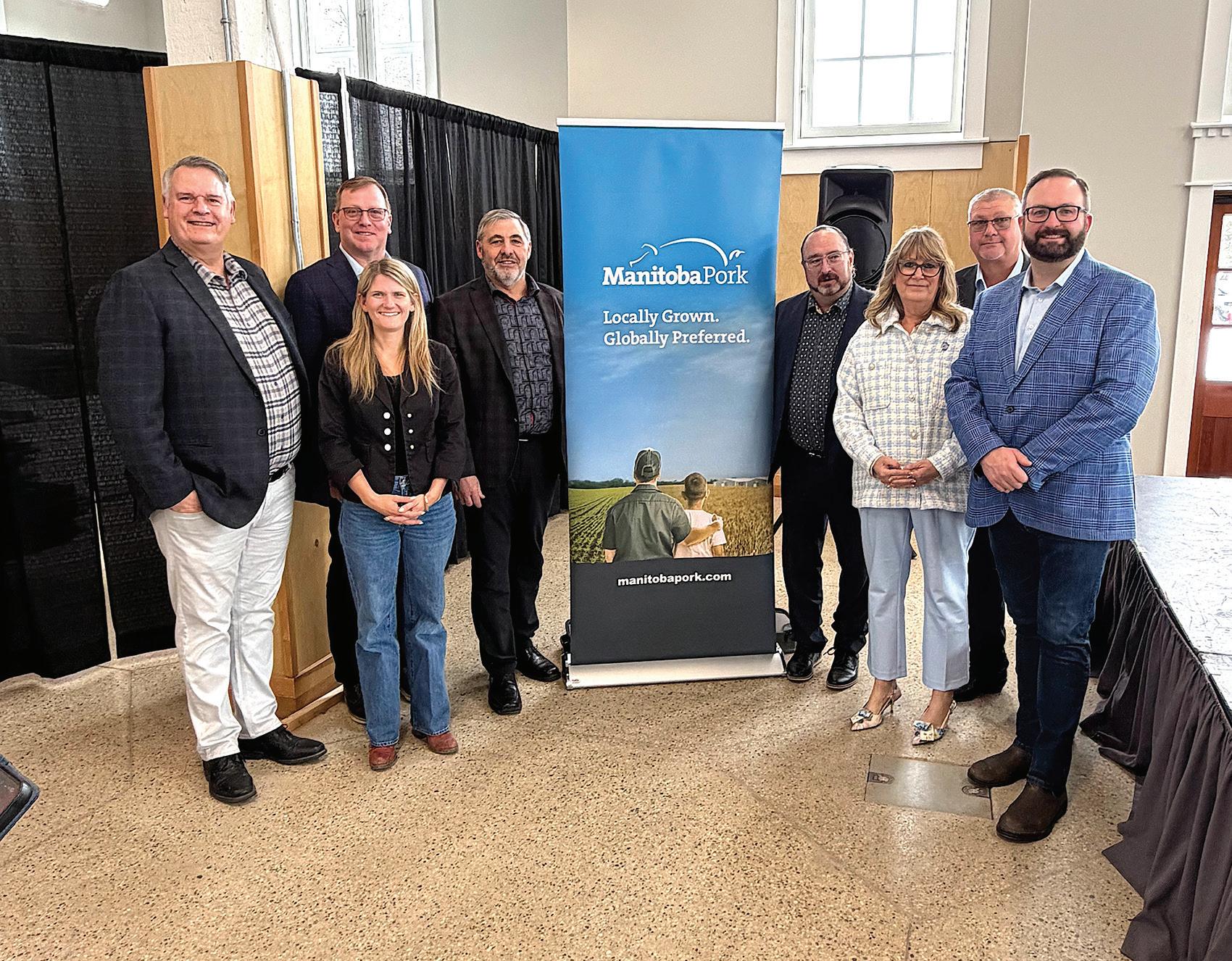

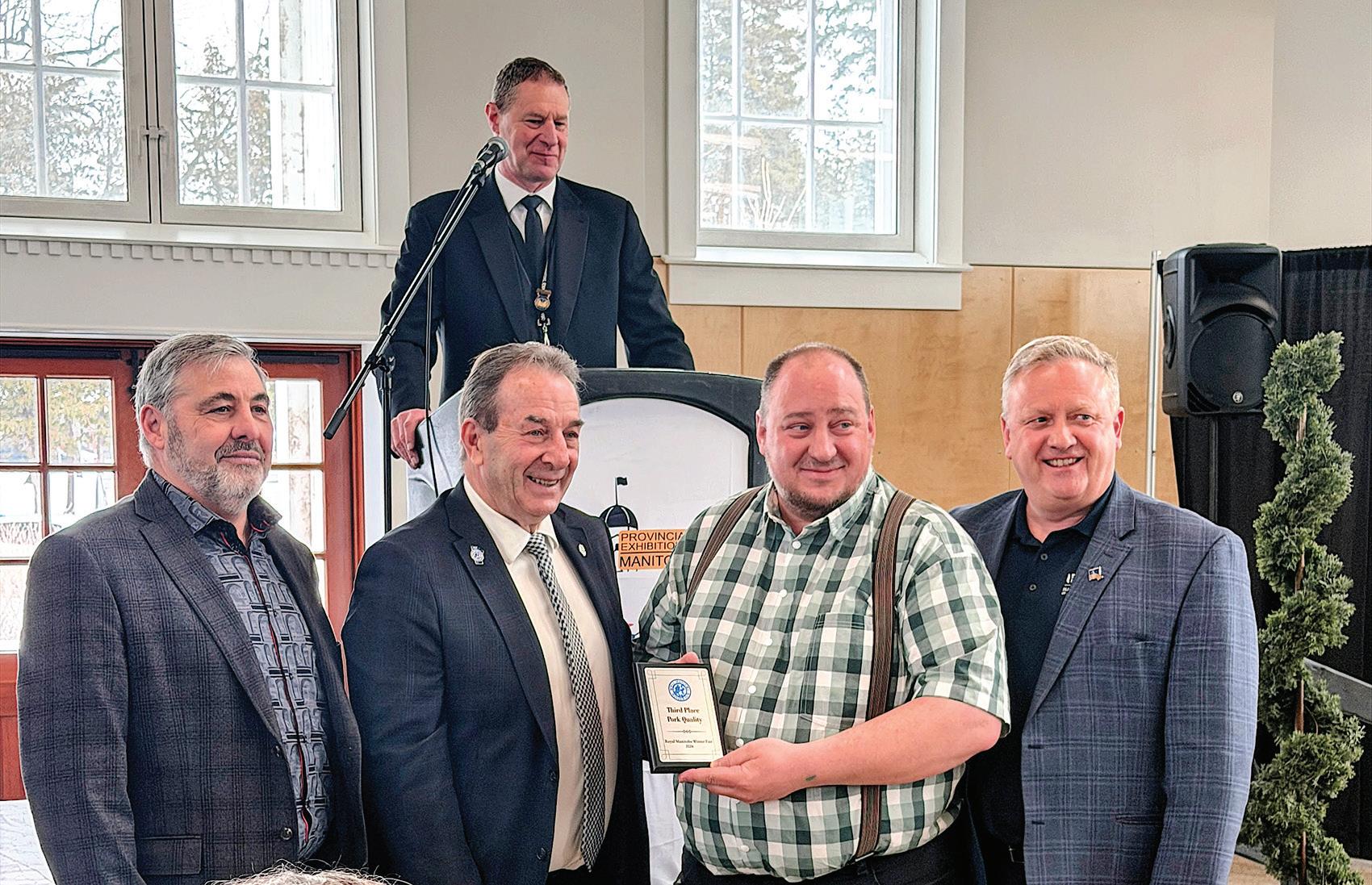
By Harry Siemens
Speaking at the annual general meeting of Manitoba Pork in Winnipeg, Richard Madan stressed the need for Manitoba to tell its story directly in Washington as trade uncertainty grows.
Madan, Manitoba’s Senior Representative to the United States, said the province stepped into the U.S. capital at a critical time for export-driven sectors like pork.
“This province has a great story, but there wasn’t always someone there to tell it,” he said.
Manitoba now operates an office within the Canadian Embassy in Washington, joining provinces such as Alberta, Ontario, and Quebec. Madan said these offices emerged after past trade shocks, when provinces realized they needed a direct voice in U.S. decision-making.
“There’s a lane that needs to be built to talk about agriculture,” he said. With ten years of experience in Washington, Madan said success depends on understanding how the U.S. system works.
“It’s transactional,” he said. “You have to make your case in a way that matters to them.”
That has shifted Manitoba’s message. Instead of emphasizing friendship, the focus now highlights value.
“We’re not just an ally—we’re a partner,” he said. “Here’s how we help you.”
As Canada, the United States, and Mexico approach a review of the CUSMA, uncertainty remains. Madan said negotiations between the U.S. and Mexico have advanced further, while Canada has taken a more cautious approach.
“A good deal is better than a bad deal,” he said.
Formal talks are expected to begin soon, but questions remain about how much influence Congress will have compared to the White House.
Tariffs continue to dominate discussions.
“Tariffs are going to be a reality,” Madan said. “The issue is whether we gain a stronger deal or simply accept concessions.”
He also pointed to emerging issues, including telecom access, banking
presence, and country-of-origin labelling. While voluntary labelling may be manageable, he warned it could still disrupt supply chains.
“That’s something to watch,” he said.
Despite tensions, Madan said agriculture remains a strong point of alignment between Canada and the U.S.
“There’s recognition of how integrated our food systems are,” he said.
He encouraged producers and industry leaders to engage directly with U.S. stakeholders, especially at the state level, where relationships can carry influence.
“Explain how we support their economy,” he said. “Make it about their interests.”
Affordability has become a key political issue in the U.S., shaping trade policy. That reality reinforces the need for clear, practical messaging.
“Take the emotion out,” Madan said. “Focus on how we contribute to food security.”
For Manitoba’s pork sector, which depends heavily on exports, maintaining access to the U.S. market remains critical.
“This is a time to be present,” he said. “If we’re not at the table, we’re not part of the conversation.”


By Harry Siemens
Speaking at the annual general meeting of Manitoba Pork in Winnipeg, Todd Thurman delivered a clear message: the global pork industry has entered a new era, and producers must prepare now.
Thurman, founder and CEO of Swine Insights International in Weatherford, Texas, brought more than 25 years of global experience. He has worked in 17 countries and advised some of the world’s largest pork producers. His focus centred on long-term structural change rather than short-term market swings.
He opened by referencing the “Blue Marble” image from the Apollo 17 mission, saying the industry needs a similar shift in perspective.
“For most of our careers, what we’ve experienced has felt normal,” he said. “But historically, it’s not.”
He explained agriculture has operated in a rare period of rapid population growth, expanding
trade, and rising incomes. Those forces drove strong demand for pork and created decades of opportunity.
That environment is now changing.
Thurman pointed to Paul Ehrlich, whose warnings of mass starvation proved wrong as agriculture increased production. Today’s challenge differs. Instead of scarcity, the industry faces slowing population growth and, in many regions, decline.
Fertility rates continue to fall globally, while population’s age. China stands as the clearest example.
Its population has peaked and begun to decline, while the share of people over 60 continues to rise.
“Older consumers eat less,” Thurman said. China has long driven global pork demand, but growth has slowed. At the same time, China improves production efficiency and moves closer to self-sufficiency.
For export-dependent regions like Canada, that raises concerns.
“Markets are going to shift,” he said.
He noted nearly 70 percent of past growth in food demand came from population increases. As that driver weakens, the industry must adjust.
Emerging regions, especially in Africa, offer future population growth. However, those markets currently consume little pork and present cultural and economic challenges.
“It’s not a direct replacement,” Thurman said.
He also addressed immigration. Growth in countries like Canada and the United States depends heavily on migration. Any slowdown could tighten labour supply and slow economic growth.
“Our system assumes a growing workforce supporting an aging population,” he said.
Despite the challenges, Thurman sees strength in North America’s efficiency, resources, and
innovation.
But he stressed a shift in focus.
“We have to move from quantity to quality,” he said.
That means strengthening domestic demand, maintaining export markets, and understanding changing consumers, especially older buyers.
Trade remains critical. For Manitoba, where most pork production depends on exports, maintaining market access remains essential.
“We cannot take trade for granted,” he said.
Thurman closed by urging longer-term thinking.
“We’re good at short-term planning,” he said. “We need to think 10 to 20 years out.” His message focused on awareness, not crisis. The industry has adapted before. It must do so again.
“The future will look different,” he said. “The sooner we recognize that, the better positioned we’ll be.”
By Dan Guetre
The value of Canadian farmland continued its upward trend in 2025, rising by an average of 9.3 per cent nationwide, according to the latest report from Farm Credit Canada (FCC).
The FCC Farmland Values Report points to strong growth across the Prairie Provinces as the primary driver of the increase, with additional gains seen in parts of Atlantic Canada. However, growth slowed in Central Canada compared to previous years.
Manitoba recorded the largest increase in average cultivated farmland values at 12.2 per cent in 2025, following gains of 6.5 per cent in 2024 and 11.1 per cent in 2023. Alberta followed with an 11.4 per cent increase, while Saskatchewan saw values rise by 9.4 per cent.
In Atlantic Canada, New Brunswick posted a 9.1 per cent gain and Prince Edward Island rose by 8.5 per cent. Nova Scotia experienced more modest growth at 1.6 per cent.
Meanwhile, Quebec saw farmland values increase by 4.8 per cent, reflecting steady demand, while Ontario recorded a slower 2.2 per cent rise after several years of stronger growth.
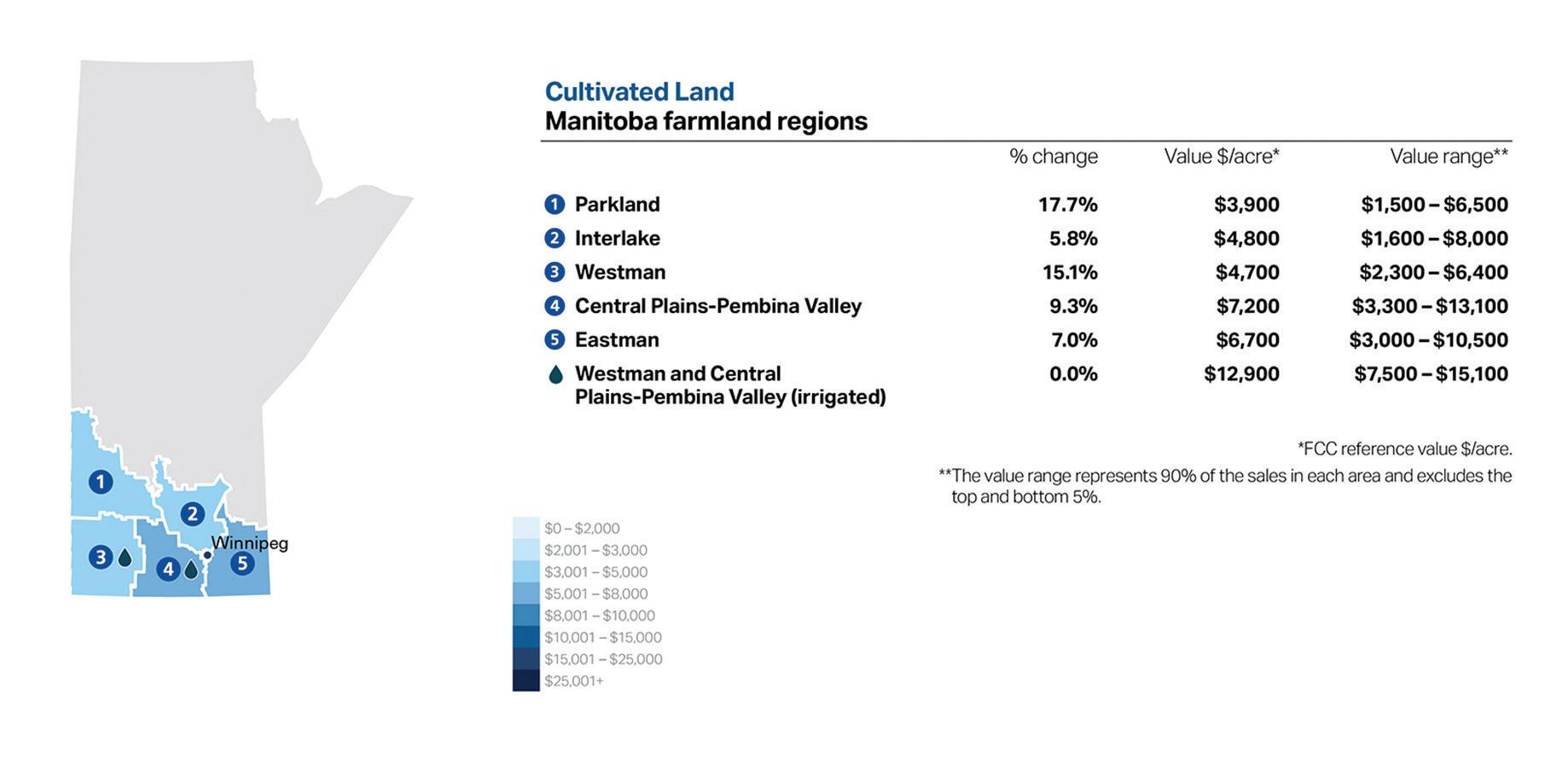
Manitoba recorded the largest increase in average cultivated farmland values at 12.2 per cent in 2025, following gains of 6.5 per cent in 2024 and 11.1 per cent in 2023. Chart provided by Farm Credit Canada
Four provinces — Alberta, Manitoba, New Brunswick and Prince Edward Island — reported higher growth rates in 2025 than in the previous year.
British Columbia was the only province to report a decline, with average farmland values dropping by 1.7 per cent. Despite the dip, the province continues to hold the highest av-
erage farmland values in the country.
FCC noted there was insufficient publicly reported data to assess farmland value changes in Newfoundland and Labrador, Northwest Territories, Nunavut and Yukon.
FCC says the farmland market remained resilient throughout the year, supported by continued demand from producers looking to
expand operations.
“Demand for farmland remained robust, supported by long-term confidence in Canadian agriculture, lower borrowing costs, strong livestock prices and the limited supply of land available for sale,” said J.P. Gervais, executive vice-president of agri-food, economics and productivity at FCC.
He added that ongoing uncertainties, including trade issues, tariffs, high input costs and weaker commodity prices, did little to dampen buyer interest.
While steadily rising land values have strengthened farm balance sheets over the long term, FCC notes they also present barriers for new entrants to agriculture.
Higher land prices can make it more difficult for young farmers and those looking to expand into the sector. To address this, FCC offers financing options such as transition loans aimed at helping the next generation establish themselves in farming.
Looking ahead, FCC says a combination of local market conditions, input costs and global economic factors will continue to shape farmland affordability and value trends across the country.
By Joan Airey
My front lawn doesn’t have much snow but my main garden still has several inches. Yesterday I couldn’t believe it when my potato seed arrived in the mail from T & T Seeds and it was still snowing outside.
This week I received The Old Farmer’s Almanac Garden Guide 2026. I checked the frost and growing season information for Brandon. It says the last frost this spring will be May 28 and September 11 for the first frost. That gives us 105 growing days. Normally my garden doesn’t get frost till around
the 23 September.
The guide contains the neatest Companion Planting Chart. For example, lettuce likes to be planted near peas, radishes or dill for example. Peppers like onions and dill. Tomatoes like beans, celery, radishes, or asparagus.
The book also contains a start your veggies section. For example, it tells you potatoes shouldn’t be planted until the soil is 40F and should be planted eight inches deep. Carrots can be planted three to four weeks before last spring frost and soil


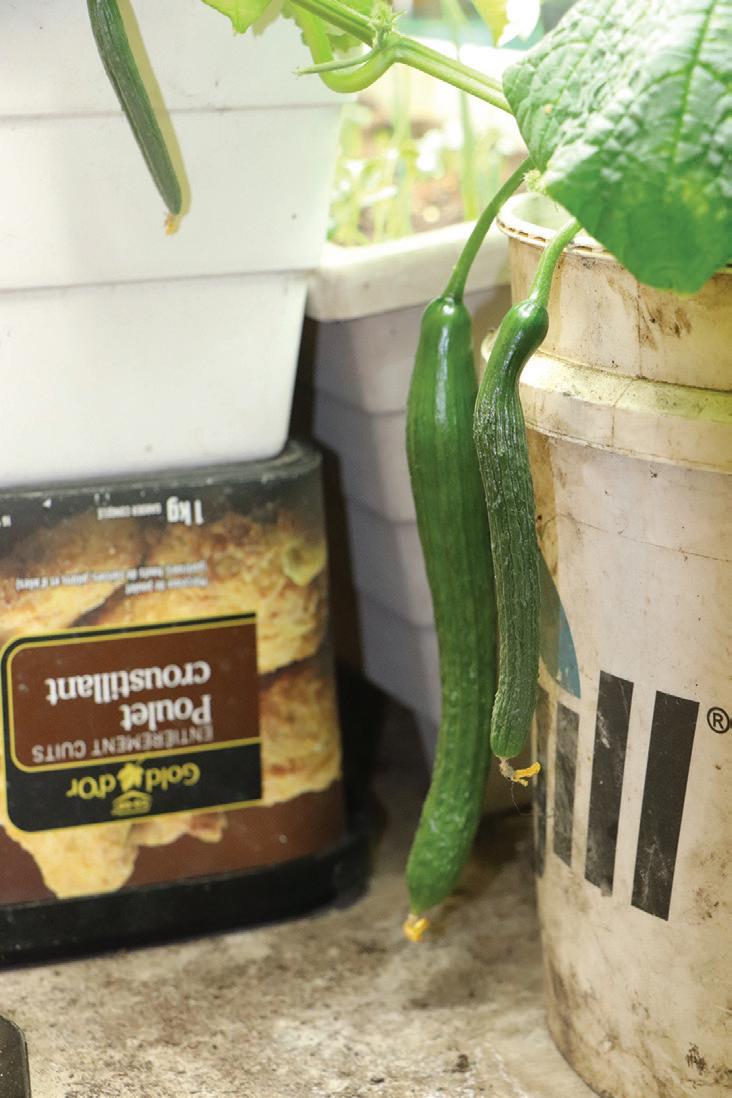
should be worked at least six inches while a person from Stokes Seeds said it should be worked eight inches deep. The magazine sells for $11.99 and I have found it very interesting reading.
I planted lettuce under my grow lights on March 14 and as of April 14 we started using lettuce. I need to follow Dan Reid’s advice and plant more so we have a steady supply.
My greenhouse cucumbers under lights have several cucumbers already but it will be a couple of weeks before they are ready to eat.
Dan Reid can be found at www.Youtube. com GarDer6.
I had an empty Swiffer container and decided to recycle by using it to start my Jalapeno Pepper seeds. It worked great. I used the clear plastic lid to keep the moisture in and the germination was high with twenty-one seeds out of twenty-five seeds growing.
With one tomato costing $1.95 at the grocery store we all should be planting tomato plants if it is something your family enjoys.
You can grow them anywhere from in the garden to in an extra-large planter on your deck. Last year I had three plants on the deck and they produced an abundant crop. My garden tomatoes last year didn’t do as well.
T & T seeds sent out an email saying if you have kept seeds over and are concerned about their germination rate it’s simple to do a germination test. Place 10 seeds on a damp paper towel. Then fold it over and seal it inside a plastic bag or container to keep the moisture in. Leave it in a warm spot for several days to a week, depending on the type of seed. Check periodically to see how many seeds sprout. If most of the seeds germinate, they are still good to go. If only a few sprout, you may want to sow them more densely or replace the packet all together. This quick test is an easy way to save time and avoid disappointment once planting season arrives.
By the time I write my next column I hope my carrots and onion seeds I planted in the fall have germinated. Here’s to a great growing season.