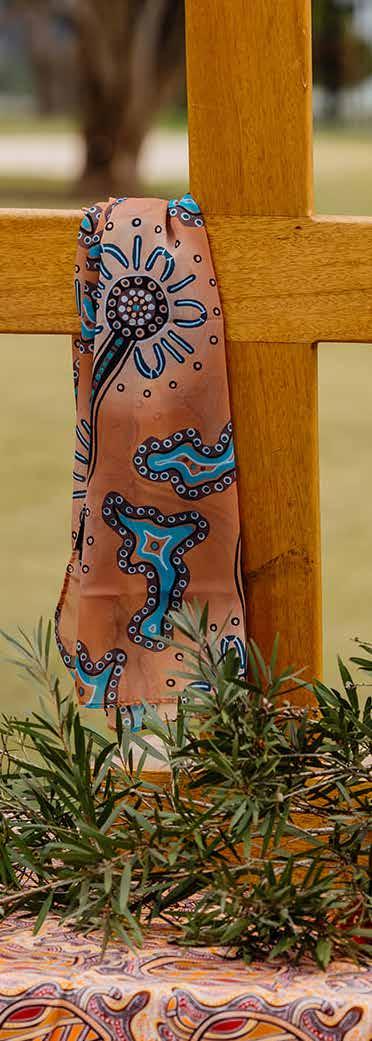
This highly textured sand engraved artwork shares the story of our spirit creator - Biamie. The creator of all things and the bringer of light, both spiritually and through the creation of the Ponte-Boone (moon) and Punaal (the sun).
Gathering circles interwoven within the design represent the sun and moon, while celebrating the Catholic Schools community and Aboriginal people groups across NSW, welcoming all to share in our rich and invaluable cultural heritage.
Pathways flowing across the canvas depict the valuable journey of education, reflective of the Catholic Schools Office. Pathways, together with the gathering circles are reflective of coming together for the 2019 NSW Aboriginal & Torres Strait Islander Education Conference and highlights the event’s footprint on
country, across the lands of the Wonnarua and Awabakal peoples.
The lands of the Wonnarua and Awabakal peoples of the hills and plains are depicted within the artwork through engraved songlines that highlight country - blues reflective of our many waterways from ocean to wetlands and earthy tones connecting to our diverse and majestic landscapes. This imagery is intertwined with white as an acknowledgment of Biamie’s spirit presence as we gather to celebrate together.
On the Cover: Ponte-Boone-Biamie Biamie - Spirit of Sun, Moon, Creator
Acknowledgement of Country and Traditional Owners
We acknowledge Aboriginal and Torres Strait Islander Peoples as Australia’s First Peoples and the Traditional Owners and Custodians of the land on which we work to build a stronger, more equitable, kinder society, that values children, young people, families and individuals.
We honour the wisdom of and pay respect to, Elders past, present and emerging. We acknowledge the spiritual culture of all Aboriginal and Torres Strait Islander peoples across Australia.
The Diocese of Maitland-Newcastle is located on the traditional lands of the Awabakal, Biripi, Darkinjung, Kamilaroi, Wiradjuri, Wonnarua and Worimi people.
This Diocese acknowledges the important Aboriginal and Torres Strait Islander occupation and care of the land by our Traditional Custodians that we live on and their continual spiritual and cultural connection to Country. We acknowledge all Aboriginal and Torres Strait Islander peoples as having been on this land for over 60,000 years.
Disclaimer
Aboriginal and Torres Strait Islander Peoples are respectfully advised that this publication may contain the words, voices, names, images and/or descriptions of people who have passed away.
A message from the Administrator of the Diocese of Maitland-Newcastle
All Australians have much to learn from the cultures, spirituality and knowledge of country of Aboriginal and Torres Strait Islander people.” This sentence forms the opening line of ‘Part 1’ of the Statements and Motions of the second session of the Fifth Plenary Council of the Catholic Church in Australia held July 2022, in Sydney.
Titled ‘Reconciliation: Healing Wounds, Receiving Gifts’ this statement acknowledges the unique relationship that our First Nation’s peoples have played in the unfolding of culture and life here in Australia from the beginning, as well as the unique relationship Aboriginal and Torres Strait Islander people have as members of Australian society in this modern era. To have a voice and to be heard is a wonderful gift that this Reconciliation Action Plan will assist us all, to offer and receive.
Australia’s peoples are as diverse as her environment and landscape; was, is and will always be. I believe we are truly blessed when we embrace and learn from the diversity around us and can acknowledge respectfully the first Australians and
their traditions under whom this land flourished.
There is much synergy between the spirituality of the traditional custodians of Australia and our own Catholic spirituality. Their symbols, stories, and use of language in ritual has much in common with our own. Our own Catholic ancestors learnt to adapt from those around them as our own traditions developed.
This Reflect Reconciliation Action Plan is an important step for the Diocese of Maitland-Newcastle and will shape our ongoing journey as a Catholic community. I pray it will empower Aboriginal and Torres Strait Islander peoples to have a voice that is heard, helping all to see their gifts, to share their spirituality and culture for the benefit of all.
Fr Greg Barker Diocesan Administrator - Diocese of Maitland-Newcastle
Message from Reconciliation Australia
Reconciliation Australia welcomes the Catholic Diocese of Maitland-Newcastle to the Reconciliation Action Plan (RAP) program with the formal endorsement of its inaugural Reflect RAP.
The Catholic Diocese of Maitland-Newcastle joins a network of more than 1,100 corporate, government, and not-for-profit organisations that have made a formal commitment to reconciliation through the RAP program.
Since 2006, RAPs have provided a framework for organisations to leverage their structures and diverse spheres of influence to support the national reconciliation movement. The program’s potential for impact is greater than ever, with close to 3 million people now working or studying in an organisation with a RAP.
The four RAP types - Reflect, Innovate, Stretch and Elevate - allow RAP partners to continuously develop and strengthen reconciliation commitments in new ways. This Reflect RAP will lay the foundations, priming the workplace for future RAPs and reconciliation initiatives.
The RAP program’s strength is its framework of relationships, respect, and opportunities, allowing an organisation to strategically set its reconciliation commitments in line with its own business objectives, for the most effective outcomes.
These outcomes contribute towards the five dimensions of reconciliation: race relations; equality and equity; institutional integrity; unity; and historical acceptance.
It is critical to not only uphold all five dimensions of reconciliation, but also increase awareness of Aboriginal and Torres Strait Islander cultures, histories, knowledge, and leadership across all sectors of Australian society.
This Reflect RAP enables the Catholic Diocese of Maitland-Newcastle to deepen its understanding of its sphere of influence and the unique contribution it can make to lead progress across the five dimensions. Getting these first steps right will ensure the sustainability of future RAPs and reconciliation initiatives and provide meaningful impact toward Australia’s reconciliation journey.
Congratulations Catholic Diocese of Maitland-Newcastle, welcome to the RAP program, and I look forward to following your reconciliation journey in the years to come.
Karen Mundine Chief Executive Officer Reconciliation Australia
Our Diocese
The Diocese of Maitland-Newcastle represents the Catholic Church in a region extending from Lake Macquarie to Taree and inland to Merriwa and Murrurundi. A diocese is a community of Christ’s faithful – it represents a portion of the people of God in a particular area, which is entrusted to a bishop.
The Diocese of Maitland-Newcastle serves the people of the Newcastle, Hunter and Manning regions which have a population of some 160,000 Catholics. Through its parishes, pastoral groups, and agencies of Catholic Schools Office, CatholicCare Social Services, St Nicholas and others the Diocese provides services of faith, spiritual, pastoral, educational, social welfare, and community development.
The Diocese strives to meet the dynamic needs of our employees and prides itself as a service provider of choice in the early learning, education and social
services sectors of the Hunter and Manning regions. The Diocese has two Diocesan Offices, 38 parishes, 58 Catholic schools, eight CatholicCare Social Services offices, and within St Nicholas; 11 Early Education Centres, 35 OOSH services, and five Pathways programs.
The Diocese employs approximately 4,000 staff across its parishes and agencies. There are Aboriginal and Torres Strait Islander people employed across the Diocese and its agencies. The Diocese of Maitland-Newcastle is developing a plan to be able to accurately collect information on the number of Aboriginal and Torres Strait Islander staff in all our agencies.
Parishes
Under the care of the Bishop, the Diocese is divided into 38 parish communities, many of which comprise several smaller communities with their own churches. These communities, served by the clergy, have their own activities, finances and ministries such as visiting the sick, organising youth activities and more.
CatholicCare Social Services Hunter Manning
The official social services agency of the Catholic Church in the Diocese, CatholicCare offers support and empowerment to those in need regardless of their religion, age, gender, physical and intellectual capacity, or ethnicity.
Catholic Development Fund
The Catholic Development Fund exists to further the pastoral mission of the Catholic Church. By harnessing the financial resources of the Catholic community we are able to provide cost-effective financial arrangements for capital works and other essential pastoral programs.
Catholic Schools
The Catholic Schools Office (CSO) is responsible for the leadership, operation and management of 58 schools that educate more than 20,000 students in the Catholic Diocese of Maitland-Newcastle.
Office of Safeguarding
The Office of Safeguarding is responsible for overseeing the safeguarding of all children and vulnerable adults who participate in the life of the Diocese as part of our faith communities in parishes, in our diocesan systemic schools and early education centres, as part of our welfare and community services through CatholicCare, out-of-school hours care, and other diocesan ministries.
Chancery and Pastoral Ministries
The Pastoral Ministries Team provides support to the whole diocesan community under the Five Foundations planning framework – Identity and Community, Worship and Prayer, Formation and Education, Mission and Outreach and Leadership and Structure. It does this to bring about the mission as revealed in the person of Jesus Christ. The word pastoral derives its meaning from the word pastor, which means shepherd, the one who tends the sheep.
St Nicholas Early Education
St Nicholas Early Education is committed to supporting family life as the foundation of society and the Church.
St Nicholas Early Education provides 11 high-quality Early Education services operating with best practice guidelines throughout the Hunter.
St Nicholas OOSH operates 35 out of school hours services providing high-quality education and care to children aged 5 – 12 years.
St Nicholas Pathways has been developed to excite, engage and support those in the community who want to explore a career in early childhood education and care through a range of study options and programs.
Community Housing
Community housing contributes to the fulfillment of the mission of the Diocese through the prevention of homelessness by providing people in high need in our region access to secure, affordable and appropriate housing. Tenants in the programs are invited into our wider community to engage in our many service offerings across welfare, education, training, and employment.
Services are delivered in a fair and just manner, and with integrity, demonstrating compassion for individuals so that they may have hope and be able to fully participate in our community.
Our Reconciliation Action Plan - Reflect
Acknowledgement
Our vision for reconciliation is to follow the principles of Catholic Social Justice Teaching; to promote a vision of a just society that is grounded in biblical revelations, and principles to end poverty, promote justice, uphold dignity, love of God, and love of neighbour.
We acknowledge in the past, wrongful policies and practices by the Australian Government and Churches, including the Catholic Church, resulted in discrimination and disadvantage for Aboriginal and Torres Strait Islander Peoples. This has caused many Aboriginal and Torres Strait Islander Peoples to experience discrimination and disadvantage at a level that causes great sorrow and shame to many Australians.
We acknowledge Human Rights policies and statements that recognise and protect the rights of indigenous people across the world and within Australia. In the Australian context, these declarations and documents relate to the rights of the Aboriginal and Torres Strait Islander Peoples. We must show special care to Aboriginal and Torres Strait Islander communities within the context of trauma-informed care.
We believe in the value of human dignity, which provides people with the capacity to develop fully. We hope that the Reflect RAP and future RAPs, will help the Diocese deliver reconciliation actions aimed at closing social and economic gaps to ensure the human dignity of all First Nations Peoples we engage with, employ, educate or assist.
In our first step in our reconciliation journey, we are committed to:
• Establishing and strengthening mutually beneficial relationships.
• Including and listening to the voices of Aboriginal and Torres Strait Islander people in decision making and leadership.
• Raising internal and external awareness of our RAP.
• Promoting reconciliation across our Diocesan parishes, schools, and agencies.
The RAP Journey
Our partnership and current activities
Aboriginal Catholic Ministry began in the Diocese of Maitland-Newcastle in the 1980s with the support of both Aboriginal and non-Aboriginal people, the bishop, clergy and laity in parishes and agencies.
In 2021 the leadership of the Diocese of MaitlandNewcastle, through the Aboriginal and Torres Strait Islander Catholic Ministry Group, approved a proposal for a RAP and a Reconciliation Action Plan Reference Group (RRG) was established to develop the first RAP for submission to Reconciliation Australia. Membership of the RAPWG, is comprised of eleven people, five of whom are Aboriginal and Torres Strait Islander people. The RRG will consult to gain feedback and cultural guidance on the Reflect RAP deliverables, from local Aboriginal and Torres Strait Islander Elders and key stakeholders.
The implementation of the RAP is primarily the responsibility of Director Pastoral Ministries as the RAP Project Manager. Pastoral Ministries works closely with Catholic parishes, schools and diocesan agencies across the Diocese of Maitland-Newcastle. Collectively we seek to raise internal and external awareness of the Reflect RAP so as to promote reconciliation across our Diocesan parishes, schools and agencies, with the support of the Diocese of Maitland-Newcastle Administrator, CEO and Directors, to embed its implementation.
Aboriginal and Torres Strait Islander Catholic Ministry Council
Background
The National Aboriginal and Torres Strait Islander Catholic Council (NATSICC) was formed in 1989 at the first national conference of the Aboriginal and Islander Catholic Councils. In 1992 the Australian Catholic Bishops Conference officially recognised and welcomed it as the national representative and consultative body to the Church on issues concerning Indigenous Catholics. NATSICC plans a National Assembly every three years, to which the Diocese of MaitlandNewcastle sends a representative/s.
In 1997, the Catholic Church officially designated the first Sunday in July as Aboriginal and Torres Strait Islander Sunday. The day aims to encourage Catholics locally, to focus their worship on Aboriginal and Torres Islander people, their culture, and the issues of social justice they represent.
Aboriginal Catholic Ministry began in the Diocese of Maitland-Newcastle in the 1980s with the support of both Aboriginal and non-Aboriginal people, the diocesan bishop as well as the clergy and laity in parishes and agencies.
The Diocese of Maitland-Newcastle also regularly participates in NAIDOC Week and National Reconciliation Week and has connections with Australians for Native Title and Reconciliation (ANTaR).
Purpose
Aboriginal and Torres Strait Islander Catholic Ministry in the Diocese of Maitland-Newcastle fosters the spiritual, cultural, social awareness and development of Aboriginal and Torres Strait Islander Australians. Aboriginal and Torres Strait Islander Catholic Ministry functions as a collaborative group who:
• Provide a voice for Aboriginal and Torres Strait Islander people within the Catholic community.
• Provide a forum for its members to dialogue and encourage a deeper understanding of the relationships between the Church and Indigenous Peoples and Indigenous spiritualties.
• Assist Catholics in engagement with the truth and reconciliation process and its calls to action.
• Serve as a united Catholic public voice on relations and dialogue between the Church, Aboriginal and Torres Strait Islander people, and Aboriginal and Torres Strait Islander people’s spiritualties.
• Engage in yarning circles as a way of sharing and connecting stories.
• Network across the diocesan community – parishes, the Chancery, Catholic Schools, CatholicCare, St Nicholas and other Catholic organisations which minister in the Diocese.
• Link with people across the diocesan community to share Aboriginal and Torres Strait Islander spirituality.
• Celebrate the major Aboriginal and Torres Strait Islander events throughout the year.
• Bring together both Aboriginal and Torres Strait Islander and Catholic spirituality and rituals.
• Advise and promote cultural awareness protocols for Aboriginal/Catholic ceremonies.
• Recognise and promote the history of Aboriginal and Torres Strait Islander Catholic heritage.
• Enable Aboriginal and Torres Strait Islander students to identify with their heritage and be proud that they are part of a Catholic school system while identifying with Aboriginal and Torres Strait Islander spirituality.
• Outreach to parents of Aboriginal and Torres Strait Islander students.
• Advocate on issues with and for Aboriginal and Torres Strait Islander people.
• Equip Aboriginal and Torres Strait Islander people to exercise pastoral leadership and ministry in their local communities. Non-Indigenous people who serve, or who would like to serve, in Aboriginal and Torres Strait Islander communities are also welcome to participate.
• Carry out agreed-upon initiatives and actions.
• Evaluate the effectiveness of the outcomes and initiatives.
Reconciliation Action Plan (RAP) representatives
An internal RAP Reference Group, in consultation with other diocesan agencies, convened to develop the Diocese of Maitland-Newcastle Reconciliation Action Plan and will regularly monitor its achievements, address challenges, and report to the Diocesan Leadership Group on the achievements, challenges and deliverables of the RAP.
Diocesan Leadership Group:
Rev Greg Barker Diocesan Administrator
Teresa Brierley Director Pastoral Ministries
Gary Christensen Director CatholicCare Social Services Hunter-Manning
David Healy Executive Director St Nicholas
Gerard Mowbray Director of Schools
Rev Matthew Muller Chancellor and Canonical Advisor
Sean Scanlon Chief Executive Officer
Lisa Tierney Chief Operating Officer
Sean Tynan Director of Safeguarding
RAP Reference Group Members:
Teresa Brierley Director Pastoral Ministries, Chair
Elizabeth Baker Communications Project Adviser
Louise Campbell Gumbaynggirr Woman, Aboriginal Education Officer, Catholic Schools Office
Vincent Cooper Ministry Coordinator, St Joseph’s High School, Aberdeen
David Dryden Life Story and Cultural Planner, CatholicCare Social Services Hunter-Manning
Rachel James Head of Communications and Marketing
David McGovern Diocesan Director Catholic Missions
Kiera Multari Gomeroi Woman, Business Development Officer, School to Work Program, National Rugby League
Bryan Rowe Teacher (IESIP), San Clemente High School, Mayfield
A Terms of Reference document will be developed to support the goals of the RAP Reference Group. The RAP Reference Group will launch, promote and develop a reporting and monitoring system. Members will engage and consult with key stakeholders on the implementation of the Diocesan Reconciliation Action Plan into their parishes, schools, and agencies.
1. Establish and strengthen mutually beneficial relationships with Aboriginal and Torres Strait Islander stakeholders and organisations.
2. Build relationships through celebrating National Reconciliation Week (NRW).
1.1. Identify Aboriginal and Torres Strait Islander stakeholders and organisations within our local area or sphere of influence.
1.2. Research best practices and principles that support partnership with Aboriginal and Torres Strait Islander stakeholders and organisations.
2.1. Plan for each parish, school and diocesan agencies to organise at least one NRW activity each year.
3. Raise internal and external awareness of our RAP to promote reconciliation across our Diocesan parishes, schools, and agencies.
4. Promote positive race relations through anti-discrimination strategies.
Nov 2022 Pastoral Ministries - Mission and Outreach Manager
Nov 2022 Pastoral Ministries - Mission and Outreach Manager
Dec 2022 Director of Pastoral Ministries and CEO
2.2. Register the NRW events on the NRW website. April 2023 Pastoral Ministries - Mission and Outreach Manager
2.3. Identify and participate in an externally organised NRW event.
2.4. Encourage and support staff and senior leaders to participate in at least one external event to recognise and celebrate NRW.
2.5. RAP Reference Group members to participate in an external NRW event.
2.6. Circulate Reconciliation Australia’s NRW resources and reconciliation material to our staff.
2.7. Extend an invitation to anyone to share their reconciliation experiences or stories and publish, with their permission, on our news channels (MN News, Dio update, Parish bulletins and school newsletters).
3.1. Communicate our commitment to reconciliation to all staff and the Diocesan community.
3.2. Identify external bodies that our organisation can engage with on our reconciliation journey.
3.3. Identify RAP and like-minded organisations that we could approach to collaborate with in our reconciliation journey.
4.1.Research best practice and policies in areas of race relations and anti-discrimination.
4.2.Undertake a gap analysis against current best practice and current diocesan policy and report back to the DLG with recommendations.
May 2023 Pastoral Ministries - Mission and Outreach Manager
May 2023 CEO
27 May to 3 June 2023 Director Pastoral Ministries
27 May to 3 June 2023 Head of Communications
27 May to 3 June 2023
May 2023
of Communications
of Communications
May 2023 Pastoral Ministries - Mission and Outreach Manager
August 2022 Pastoral Ministries - Mission and Outreach Manager
December 2022
December 2022
Respect
ACTION
5.Provide cultural learning opportunities to increase our understanding and appreciation of Aboriginal and Torres Strait Islander cultural, spirituality, histories, and achievements.
6.Promote an understanding of the significance of Aboriginal and Torres Strait Islander cultural protocols, such as Welcome to Country and Acknowledgment of Country, to ensure there is a shared meaning.
DELIVERABLE TIMELINE
5.1. Develop a business case for increasing understanding, value and recognition of Aboriginal and Torres Strait Islander cultures, histories, knowledge and rights within our organisation. May 2023
5.2. Conduct a review of cultural learning needs within our organisation.
5.3. Provide opportunities for senior leaders, staff and members of the community to participate in cultural awareness training.
6.1. Develop an understanding of the local Traditional Owners or Custodians of the land and waters within our organisation’s operational area.
June 2023
March 2023
March 2023
Ministries - Mission and Outreach Manager
7.Build respect for Aboriginal and Torres Strait Islander cultures and histories by celebrating NAIDOC Week.
6.2. Increase staff’s understanding of the purpose and significance behind cultural protocols, including Acknowledgement of Country and Welcome to Country protocol.
6.3. Engage Elders to provide a Welcome to Country at our significant events and liturgies.
6.4. Develop, implement and communicate a Cultural Protocols document for Acknowledgement of Country.
December 2022
August 2022
November 2022
6.5. Develop a video Acknowledgement of Country. November 2022
7.1. Raise awareness and share information amongst our staff about the meaning of NAIDOC Week.
7.2. Introduce staff and the Diocesan Community to NAIDOC week by promoting external events in our local area.
of Catholic Schools
June 2023
July 2023
7.3. Review Human Resources policies and procedures to provide opportunities to participate in cultural opportunities, celebrations, activities and ceremonies e.g. NAIDOC Week. June 2023
7.4. RAP Reference Group to participate in an external NAIDOC Week event.
7.5. Provide opportunities for all staff to participate in cultural opportunities, celebrations and ceremonies e.g. NAIDOC Week.
3 July to 10 July 2023
3 July to 10 July 2023
Ministries - Mission and Outreach Manager
Pastoral Ministries
Ministries - Mission and Outreach Manager
Opportunities
8.Investigate opportunities to improve and increase Aboriginal and Torres Strait Islander employment and engagement outcomes through the Diocese.
9. Provide opportunities to incorporate Aboriginal and Torres Strait Islander suppliers and services diversity within our Diocese.
Governance
10.Establish and maintain an effective RAP Reference Group (RRG) to drive governance of the RAP.
8.1.Build diversity data forms within mnpeople to collect relevant data on our employees and volunteers who identify as Aboriginal and Torres Strait Islander people.
8.2.Consult with Aboriginal and Torres Strait Islander people employees and volunteers to understand barriers to employment and opportunities for pathways to employment and volunteering across the Diocese.
8.3.Develop a proposed list of opportunities to increase the participation of Indigenous people across DoMN to the DLG for consideration and resourcing.
8.4.Develop a business case for procurement from Aboriginal and Torres Strait Islander owned business.
9.1.Investigate Supply National Membership. August 2023
11.Provide appropriate support for effective implementation of RAP commitments.
10.1. Maintain a RRG to govern RAP implementation. January 2023
10.2. Draft a Terms of Reference for the RRG.
10.3. Establish Aboriginal and Torres Strait Islander representatives on the RRG.
11.1. Define resources for RAP implementation.
11.2. Engage senior leaders in the delivery of RAP commitments.
11.3. Define appropriate systems and capability to track, measure and report on RAP commitments.
2022
2021
12.Build accountability and transparency through reporting RAP achievements, challenges and learnings internally and externally.
13.Continue our reconciliation journey by developing our next RAP.
12.1. Establish requirements that the RAP Reference Group monitor the achievements, address challenges and provide reports to the Council for Mission and Diocesan Leadership Group.
12.2. Complete and submit the annual RAP Impact Measurement Questionnaire to Reconciliation Australia.
March 2023
May 2023
July 2023
30 September 2023
13.1. Register via Reconciliation Australia’s website to begin developing our Innovate RAP. August
Glossary Terms
ANTaR - Australians for Native Title and Reconciliation
CFM – Council for Mission
CSO – Catholic Schools Office
CCSS – CatholicCare Social Services Hunter-Manning
DLG – Diocesan Leadership Group
RAP – Reconciliation Action Plan
RRG – RAP Reference Group
NAIDOC – National Aboriginal and Islanders Day Observance Committee
NATSICC - National Aboriginal and Torres Strait Islander Catholic Council