VOL. 68, NO. 16
WWW.CROOKSTON.ORG
OCTOBER 8, 2014
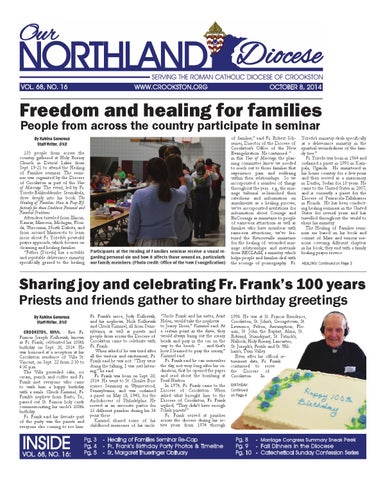
Freedom and healing for families People from across the country participate in seminar By Katrina Genereux Staff Writer, OND
135 people from across the country gathered at Holy Rosary Church in Detroit Lakes from Sept. 19-21 to attend the Healing of Families seminar. The seminar was organized by the Diocese of Crookston as part of the Year of Marriage. The event, led by Fr. Yozefu-Balikuddembe Ssemakula, dove deeply into his book The Healing of Families: How to Pray Effectively for those Stubborn Personal and Familial Problems. Attendees traveled from Illinois, Kansas, Missouri, Michigan, Florida, Wisconsin, North Dakota, and from around Minnesota to learn more about Fr. Yozefu’s powerful prayer approach, which focuses on cleansing and healing families. “Father [Yozefu] has a notable and reputable deliverance ministry specifically geared to the healing
Participants at the Healing of Families seminar receive a visual regarding personal sin and how it affects those around us, particularly our family members. (Photo credit: Office of the New Evangelization)
of families,” said Fr. Robert Schreiner, Director of the Diocese of Crookston’s Office of the New Evangelization. He continued: “… in this Year of Marriage, the planning committee knew we needed to reach out to those families that experience pain and suffering within their relationships. So we incorporated a number of things throughout the year: e.g., the marriage tribunal re-launched their catechesis and information on annulments as a healing process; we’ve incorporated invitations for information about Courage and EnCourage as ministries to people of same-sex attractions as well as families who have members with same-sex attractions; we’ve featured the Retrouvaille ministries for the healing of wounded marriage relationships and materials from RECLAiM, a ministry which helps people and families deal with the scourge of pornography. Fr.
Yozefu’s ministry deals specifically as a deliverance ministry in the spiritual woundedness of the family tree.” Fr. Yozefu was born in 1964 and ordained a priest in 1993 in Kampala, Uganda. He ministered in his home country for a few years and then served as a missionary in Darfur, Sudan for 10 years. He came to the United States in 2007, and is currently a priest for the Diocese of Pensacola-Tallahassee in Florida. He has been conducting healing seminars in the United States for several years and has travelled throughout the world to share his ministry. The Healing of Families seminars are based on his book and consist of Mass and various sessions covering different chapters in his book; they end with a family healing prayer service. HEALING: Continued on Page 3
Sharing joy and celebrating Fr. Frank’s 100 years
Priests and friends gather to share birthday greetings By Katrina Genereux Staff Writer, OND CROOKSTON, MINN. - Rev. Fr. Francis Joseph Kulhawik, known as Fr. Frank, celebrated his 100th birthday on Sept. 20, 2014. He was honored at a reception at his Crookston residence of Villa St. Vincent, on Sept. 22 from 2:30 to 4:30 p.m. The Villa provided cake, ice cream, punch and coffee and Fr. Frank met everyone who came to wish him a happy birthday with a smile. Chuck Kimmel, Fr. Frank’s nephew from Barto, Pa., passed out St. Francis holy cards commemorating his uncle’s 100th birthday. Fr. Frank said his favorite part of the party was the priests and everyone else coming to see him.
INSIDE
VOL. 68, NO. 16:
Fr. Frank’s niece, Judy Kulhawik, and his nephews, Nick Kulhawik and Chuck Kimmel, all from Pennsylvania, as well as priests and people from across the Diocese of Crookston came to celebrate with Fr. Frank. When asked if he was tired after all the visitors and excitement, Fr. Frank said he was not. “They were doing the talking, I was just listening,” he said. Fr. Frank was born on Sept. 20, 1914. He went to St. Charles Borromeo Seminary in Wynnewood, Pennsylvania, and was ordained a priest on May 18, 1940, for the Archdiocese of Philadelphia. He served as an associate pastor for 13 different parishes during his 34 years there. Kimmel shared some of his childhood memories of his uncle.
“Uncle Frank and his sister, Aunt Helen, would take the nephews … to Jersey Shore,” Kimmel said. At a certain point in the drive, they would always bring out the rosary beads and pray in the car on the way to the beach. “… and that’s how I learned to pray the rosary,” Kimmel said. Fr. Frank said he can remember the day, not very long after his ordination, that he opened the paper and read about the bombing at Pearl Harbor. In 1974, Fr. Frank came to the Diocese of Crookston. When asked what brought him to the Diocese of Crookston, Fr. Frank replied, “They didn’t have enough Polish priests!” Fr. Frank served at parishes across the diocese during his active years from 1974 through
1996. He was at St. Francis Residence, Crookston; St. John’s, Georgetown; St. Lawrence, Felton; Assumption, Florian; St. John the Baptist, Alma; St. Edward, Strandquist; St. Patrick’s, Hallock; Holy Rosary, Lancaster; St. Joseph’s, Fertile and St. William’s, Twin Valley. Even after his official retirement date, Fr. Frank continued to serve the Diocese of Crookston. In BIRTHDAY: Continued on Page 4
Pg. 3 - Healing of Families Seminar Re-Cap Pg. 8 - Marriage Congress Summary Sneak Peek Pg. 4 - Fr. Frank’s Birthday Party Photos & Timeline Pg. 9 - Fall Dinners in the Diocese Pg. 5 - Sr. Margaret Thueringer Obituary Pg. 10 - Catechetical Sunday Confession Series
2
October 8, 2014
A
COMMENTARY
OUR NORTHLAND DIOCESE
Voice from the Valley BY BISHOP MICHAEL J. HOEPPNER
MARRIAGE CONGRESS – DIOCESAN MARRIAGE DAY As I sit to write this column, I am so looking forward to our Diocesan Marriage Congress this coming weekend. Goal Five of our pastoral letter Meeting Christ – Living Christ is this: Renew the Understanding of Commitment to God’s Plan for Marriage and Family. To help us achieve this goal, our plan called for a Year of Marriage and as part of that year, a Marriage Congress: “We will set 2014 as the ‘Year of Marriage’ in the Diocese of Crookston. During this year, through parish activities, through deanery gatherings and diocesan events, we will all join in reviewing and renewing the Church’s understanding of marriage, the Sacrament of Matrimony, and the family. From the riches of our Catholic faith, we will articulate and communicate the vision of married life and family given us by God, renewed and elevated by Jesus, and entrusted to the Church. As a culminating event, we will hold a diocesanwide ‘Marriage Congress’ to pray together and celebrate God’s plan for marriage and the family.” I so look forward to joining with faithful from all parts of this Diocese and beyond as we celebrate God’s great gift of marriage. I want to thank all who have worked so hard to make our congress a reality.
RESPECT LIFE SUNDAY & RESPECT LIFE MONTH The first Sunday of October is Respect Life Sunday, and all of October is Respect Life Month. We set aside this weekend each year to pray in a special way that the richness of life from conception to natural death might be treasured and enjoyed by all, including yet-to-be-born human beings in the womb. We ask that God continue to give us wisdom, courage and strength to be effective in our work to eradicate all vestiges of the “culture of death” in our country and world. PUBLIC LIFE Once again, this November, we as Catholic citizens will have the opportunity to be involved in our country’s electoral process through our opportunity to vote. All our recent popes have encouraged the faithful to be involved in their country’s political life; Pope Francis most recently said: “Politics, according to the Social Doctrine of the Church, is one of the highest forms of charity, because it serves the common good,” (Homily, September 16, 2013). The Catechism of the Catholic Church itself reminds us: “co-responsibility for the common good make(s) it morally obligatory … to exercise the right to vote,” (#2240). It is incumbent upon each of us to review carefully the positions that candidates for public
office take on important issues that affect the common good. With this in mind, the Minnesota Catholic Conference of Bishops has published the guide, Spotlight on Voting. It contains information on various issues of importance for the upcoming election to assist Catholics in evaluating these issues through the lens of Catholic social teaching. In my article in this issue of the OND and in the issues to come, I want to review a number of these important issues. Life: Pope St. John Paul II reminded us: “Above all, the common outcry, which is justly made on behalf of human rights – for example, the right to health, to home, to work, to family, to culture – is false and illusory if the right to life, the most basic and fundamental right and the condition for all other personal rights, is not defended with maximum determination,” (Pope St. John Paul II, Christifideles Laici, no. 38). All human life is sacred and the right to life – from conception on – cannot be subordinate to any condition. We have a responsibility to support all life: the unborn, the infirm, the vulnerable and the elderly. Unfortunately in Minnesota, our tax money pays for abortions! Bills that would have banned most abortions after 20 weeks, ended taxpayer funding of abortion and prohibited coverage of abortion in the Minnesota insurance exchange
(MNSure) have either died in our state Senate or have been vetoed by the Governor. We must elect people who will fight for life. So ask: “Where does the candidate stand on the need to enact legislative limits on abortion and the abortion industry, the need to protect human life from conception until natural death and on issues such as the reduction of violence and physicianassisted suicide?” Religious Liberty: The right of religious freedom is a God-given right. The right of religious freedom is enshrined in the First Amendment of the Constitution of the United States of America. It states: “Congress shall make no law respecting an establishment of religion, or prohibiting the free exercise thereof …” This amendment was passed to prevent undue government interference in the practice of religion in the United States. Now, religious freedom has come under attack at both the federal and the state levels as government seeks to exert greater authority over how religious organizations operate. Government has even sought to define what religion and religious practice is by limiting religious practice to what happens in church buildings and excluding
BISHOP’S CALENDAR October 11 October 12 October 14 October 14
5:00 p.m. 10:30 a.m. 7:45 a.m.
Rite of Confirmation, Holy Rosary, Detroit Lakes Rite of Confirmation, St. Joseph’s, Bagley Mass, Cathedral of the Immaculate Conception, Crookston
10:00 a.m.
Chancery Staff Pilgrimage to Year of Marriage Icon, Cathedral of the Immaculate Conception, Crookston
October 16 October 18 October 19 October 21 October 21
Diocesan High School Youth Rally, Greenbush
5:30 p.m.
Rite of Confirmation, St. Clement’s, Grygla
10:30 a.m. 7:45 a.m.
7:00 p.m.
Rite of Confirmation, St. William’s, Twin Valley Mass, Cathedral of the Immaculate Conception, Crookston Deanery Gathering - FAMILIES: The Domestic Church, St. Philip’s, Bemidji
If you or someone you know has been sexually abused, your first call should be to law enforcement. If you have been abused by a Catholic priest or another person in Church ministry, the Diocese of Crookston Victim’s Assistance Coordinator is also available to offer you help and healing. Please contact Louann McGlynn at 218281-7895 (24-hour confidential number) or Lmcglynn@crookston.org.
the ministries of health care, social work and education from its definition of religious practice. Truly religious organizations are being required to provide contraception in their health care coverage and to abide by sexual orientation and gender identity laws when receiving government contracts. In Minnesota, business owners who decline to offer facilities or services for same-sex wedding ceremonies have been threatened with legal action and, in at least one case, have already been punished with heavy fines by the State. Some Minnesota legislators have promised to introduce legislation in 2015 that mirrors the federal HHS efforts to require employers to provide contraception and abortifacient drugs in their health care plans. We need to elect officials who will protect religious liberty in America. So ask: “Where does the candidate stand on the right for religious institutions to operate and serve the general public in a manner that is consistent with the organization’s faith-based mission? Where does the candidate stand on the right of individuals to live their faith in their school, their place of employment, in their chosen profession or in their business?”
(USPS 414-940) Our Northland Diocese is a semi-monthly newspaper committed to publishing Good News for the purpose of strengthening and furthering the Reign of God in the Diocese of Crookston.
Subscriptions: $13.65 per year in the diocese, $14.90 per year outside the diocese. Publisher: Editor: Associate Editor: Editorial Assistant:
The Most Reverend Michael J. Hoeppner Bishop of the Diocese of Crookston Rev. Robert Schreiner Office of the New Evangelization, Director Mrs. Janelle C. Gergen jgergen@crookston.org Mrs. Katrina Genereux kgenereux@crookston.org
For questions about subscriptions or address changes, please contact: Renee Tate at rtate@crookston.org Periodical postage paid in Crookston, MN and additional mailing offices. Postmaster: send address changes to: Our Northland Diocese PO Box 610, Crookston, MN 56716-0610 Phone: 218-281-4533 Publishing dates and submission deadlines for news and advertisements can be found online: http://www.crookston.org/ond/
OUR NORTHLAND DIOCESE
DIOCESAN
October 8, 2014
3
HEALING: Continued from Page 1 “Father introduced seminar par- the seminar. Zurface is also the ticipants to the very real notion Coordinator of Justice, Marriage that many ongoing, long suffered and Family Life for the Diocese ailments or struggles and habits of of Crookston. “Father Yozefu resin may well have deep generation- peated over and over again to us – al connections through the power the participants – that ‘God always of the evil one,” said Fr. Schreiner. gives, gives, gives, life, life, life!’ “He emphasized the necessity for He would say this when speaking rightly understanding who God is about the truth that God is a God and what God wants to do for us: of life and He only desires good namely, that we clearly understand for us, and that God does not will that God is life! And God wants bad or destruction for anyone or anything. This is the hopeful mesus to live life fully and freely. “At the same time he reminded sage that 135 of us received at this us, via the Church’s experience and seminar. It is the message of the biblical tradition, that the evil one Gospel. The Church proclaims it! is a lying thief whose singular pur- We heard it from Father Yozefu. pose and goal is to destroy life and Praise God for sending him to the that in our lives he acts only to steal, Diocese of Crookston.” Zurface added, “I was struck by destroy and kill. … Father introduced seminar participants to the the reminder that even though our tools the tradition of the Church sins are forgiven through participrovides the baptized with which pation in the Sacrament of Reconto take authority over any and all ciliation, … there are still ‘effects’ attempted destructive incursions or ‘consequences’ from sin that into the life God yearns for us to we have committed, or even the lead. And he ended the seminar sins that our parents, grandparby leading the group in prayers ents and/or ancestors committed enabling seminar participants to … they affect us and our families call upon the power of the Holy can possibly be ‘bound’ due to Name of Jesus our participaand break gention or a famerational bonds ily member’s “God always which may have participation wounded or in ‘ungodly gives, gives, gives weighed down consent.’ God life, life, life!” the life of a famwants to deily.” liver us and On his webour families, - Fr. Yozefu Ssemakula past and pressite, Fr. Yozefu states: “We are ent, from any created by God bondage that in families, no one is naturally might exist.” born without parents, without “One of the central points that family. God created us attached Fr. Yozefu stressed was that this to our families to ensure the best power to heal generational bonds possible chances for our survival is a spiritual authority every bap… He intended to bless us auto- tized person holds – and they must matically through our natural fam- use it,” said Fr. Schreiner. “This is the amazing grace of ilies, that blessings infused by Him in them may simply go down our God in this prayer: Just one memlines of descendants, and this is ber of the family can bring freehappening. However there is also dom to the whole family through something else happening: Satan this prayer,” says Fr. Yozefu on his also discovered this plan of God website. to bless us for all through life, and According to Fr. Schreiner, many he bugged the system by implant- participants expressed their gratiing sin into it. And so, as blessings tude to the Diocese of Crookston are being transmitted in your fam- for putting on the seminar and for ily, non-blessings too get transmit- allowing people outside the Dioted. The Healing of Families semi- cese of Crookston to attend. “There were tears of much gratinar will enable you to detect where this is happening in your particular tude for the knowledge gained and family, and will show you how to for the graces received throughout deal effectively with it, pulling it the weekend,” said Fr. Schreiner. out of your family for good.” More information about Fr. “The Healing of Families Semi- Yozefu’s ministry and his book can nar was an opportunity for me, be found at www.healingoffamilies.net. “I would highly recommend that personally, to be reminded that God is Love! He really does love every Catholic should at least read each and every single one of us. In Fr. Yozefu’s book to understand this love is His desire for us and this aspect of the spiritual life our families to be healed from and to access the treasury of the sin and the effects of sin,” said Church’s prayers on their family’s Amanda Zurface, a participant in behalf,” said Fr. Schreiner.
Fr. Yozefu Ssemakula speaks to the 135 participants that filled the gymnasium at Holy Rosary Catholic Church for the three-day seminar. (Photo credit: Office of the New Evangelization)
Lay faithful from Kansas City, Mo., travel to the Diocese of Crookston to participate in the Healing of Families seminar – a unique opportunity for locals and those from afar. From Left to Right: Bill Vogt, Gina Vogt, Patti Lewis, Judith Goetting, and Sue Lee. (Photo credit: Office of the New Evangelization)
Fr. Yozefu Ssemakula celebrates Holy Mass with con-celebrants Fr. Robert Schreiner (Left) and Msgr. David Baumgartner (Right) at the main altar of Holy Rosary Church, Detroit Lakes. (Photo credit: Office of the New Evangelization)
4
October 8, 2014
DIOCESAN
OUR NORTHLAND DIOCESE
BIRTHDAY: Continued from Page 1 1997, he helped at St. Francis de Sales parish in Moorhead while Fr. Dave Super was on sabbatical, and at the age of 100 he is still concelebrating Mass at the Villa. Jim and Geraldine Schneider were Fr. Frank’s drivers while he was in Moorhead in 1997, and came to his birthday celebration. Jim was asked to put together a list of people who could drive Fr. Frank around. “I figured it was just easier to do it myself instead of calling around to these other people,” he said. “He used to drive me around to different hospitals to bring Holy Communion in Moorhead while I was subbing for Fr. Super’s sabbatical,” said Fr. Frank. That’s how they became friends. “It was a very snowy winter in 1997 … we were in and out of quite a few snowbanks,” Schneider said. “We got to know each other well.” “We’ve kept up with him since then and remember him in our prayers,” said Schneider. Catherine Broers from St. William’s in Twin Valley was also at Fr. Frank’s birthday celebration. She has been watching over Fr. Frank for many years. “His biggest passion is to make people happy,” Broers said. “If he could he would give everything away.” Peg Hanson also came to the party to wish Fr. Frank happy birthday. She was one of his parishioners in Twin Valley. “Fr. Frank took his time when my husband was dying and would visit him often,” she said. “He would make peace in our household when he came. My husband was Lu-
theran.” Hanson said Fr. Frank has played a big role in their family, presiding at the weddings of two of her children and baptizing some of her grandkids. “I always make sure to get a blessing from Fr. Frank every time I see him,” she said. Fr. Frank said some of the biggest changes in the Catholic Church during his priesthood came out of the Second Vatican Council. He also has fond memories of the two times he was able to see Pope John Paul II. Fr. Frank saw the now St. John Paul II in Iowa and in Winnepeg, Canada, when the pope was in North America for papal visits. Fr. Frank said he tried to get on the stage with the pope during his visit to Canada. “They wouldn’t let me get on stage because I didn’t register in time,” he said. Fr. Frank has a picture of St. John Paul II hanging in his room. “They tell me I look like him,” he said with a smile. Fr. Frank has been living at the Villa for a few years. Kim Wikoff, an activity assistant at the Villa, said, “Fr. Frank is very polite and wonderful. It is a delight to have him around. He is very kind and has a good sense of humor; he’s very witty.” According to Wikoff, Fr. Frank likes sing-along time, watching the birds, and going to Mass. Fr. Frank summed up a reflection on his time serving the people of the Diocese of Crookston by saying, “I did my best.” He continues that mission by sharing joy with all those who visit him at the Villa, offering them a piece of candy and a ready smile.
Nick Kulhawik, Judy Kulhawik and Chuck Kimmel, Fr. Frank’s relatives from Pennsylvania, are shown visiting with Fr. Pat Sullivan. (Photo credit: Janelle C. Gergen, OND)
Fr. Frank’s brother priests of the Diocese of Crookston pose with him at the birthday celebration on Sept. 22. Clockwise: Fr. Adam Hamness, Bishop Emeritus Victor Balke, Fr. Joseph Kieselbach, Msgr. David Baumgartner and Fr. Larry Delaney. (Photo credit: Janelle C. Gergen, OND)
Fr. Frank is pictured visiting with Jim Schneider of St. Joseph’s, Moorhead. (Photo credit: Janelle C. Gergen, OND)
FR. FRANK’S FIRST CENTURY: 1984-90: PASTOR
1977: INCARDINATION
1914: BIRTH
2014: 100TH BIRTHDAY!
(St. Patrick, Hallock and Holy Rosary, Lancaster) Incardinated for the (Villa St. Vincent, Crookston) Fr. Frank is born Diocese of Crookston (Sept. 20) (Sept. 27) 1974-75: CHAPLAIN 1990-96: ADMINISTRATOR 1977-84: PASTOR (St. Francis Residence, Crookston) (St. William, Twin Valley) (Assumption, Florian)
1940: ORDINATION
Fr. Frank is ordained for the Archdiocese of Philadelphia and serves there for 34 years. (May 18)
1982-84: PASTOR
1996: RETIREMENT
(St. Edward, Strandquist)
Fr. Frank retired (July 1)
1977-82: PASTOR
(St. John the Baptist, Alma)
1975-77: ADMINISTRATOR
(St. John, Georgetown & St. Lawrence, Felton)
1990-93: ADMINISTRATOR (St. Joseph, Fertile)
OUR NORTHLAND DIOCESE
AROUND THE DIOCESE
October 8, 2014
5
Sister Margaret Thueringer, OSB, dies at 86 Sister Margaret Thueringer, OSB, 86, died peacefully at Villa Saint Vincent in Crookston, Sept. 18, 2014. Margaret was born in Britton, S.D., on June 17, 1928. She was the second oldest of John and Annie Thueringer’s four children. Her father was a farmer and the family lived in various places: Britton, S.D., Rutland, N.D., and finally Beaulieu, Minn., located east of Mahnomen. The desire to become a sister occurred to Margaret before she was of school-age. She attributed her vocation to the Franciscan Sisters in Hankinson, N.D., having become acquainted with them when her brother was a boarder in their academy as a first-grader. Sister Margaret thought, however, that her vocation to be a sister actually came from her “dear, devoted, religious parents.” After the family moved to Beaulieu, she attended Rosedale country school for seven years. Sister Margaret related the story of being very shy, but her brother (two years older) had bragged that she could
tap-dance. She recalled jumping around and demonstrating what she called tap-dancing. With the intention of becoming a sister, she attended Mount Saint Benedict Academy as an eighth-grader and through high school. Sister Margaret wrote, “I think my father was the proudest man on earth to have a daughter who was going to be a sister!” Margaret entered the Mount Saint Benedict community on Jan. 6, 1945, and was invested with the Benedictine habit as a novice on July 11, 1946. At this time, she received the name Sister Marguerita (Later she reverted back to her baptismal name of Margaret). She made first monastic profession on July 16, 1946, and her final profession in 1949. Sister Margaret received a Bachelor of Science degree in education from Viterbo College in LaCrosse, Wis. Her first teaching assignment was to Saint Joseph’s School, Red Lake Falls, as a teacher of the primary grade children. She taught in East Grand Forks, Barnesville, Moorhead, Bemidji, Mahtomedi
Sr. Margaret Thueringer, OSB
and Benson in Minnesota; Asherton, Texas and in Bogotà, Colombia. In Bogotà, she taught in an all-boys school which graduated many of the country’s most important political leaders including a president of Colombia. She expressed her convictions about teaching when she wrote, “I feel I
can help others, especially the little ones, in knowing and loving Jesus better through my teaching.” Outside the classroom, she felt most privileged when she was chosen to be an Extraordinary Minister of Communion. She thought it was her greatest honor to bring Christ to others in the Eucharist. Sister Margaret retired from teaching in 1990 and returned to the Mount. She assisted in a variety of ways, chiefly in the garden and cannery. She particularly enjoyed picking chokecherries and ground cherries used to make jellies, and she accompanied others on outings to pick wild blueberries. Sister Margaret made many items for the Mount gift shop: baby booties, caps, scarves and mitten sets, afghans and slipper socks. She grew Job’s tears plants and picked the seeds which became beads for more than 500 rosaries. She also made cord rosaries which were distributed to prisoners in the Northwest Regional Corrections Center. She faithfully assisted in the development office by making daily recordings of do-
nations, and would remember each donor in her daily prayer. Sister Margaret suffered a stroke in April 2013. As a result, she became a resident of Villa Saint Vincent. Her ministry became one of prayer and suffering. To the very end, Sister Margaret maintained a sense of humor and a positive attitude. Sister Margaret is preceded in death by her parents and siblings. She is survived by the Sisters of Saint Benedict of Crookston and many nieces and nephews. Reception of Sister Margaret’s body was at 4:30 p.m. on Sunday, Sept. 21 with visitation from 5 p.m. until the 7 p.m. prayer service. Sister Margaret’s funeral was at 3 p.m. Sept. 22, with Father Vincent Miller presiding. All services were held in Sacred Heart Chapel, Mount Saint Benedict Monastery, 620 Summit Ave. Crookston, MN. Obituary and photo submitted by Sr. Denise Schonhardt, OSB.
Our Lady of the Lakes Magnificat Marriage Retreat at to feature Geri Majcin’s testimony Sacred Heart, Frazee “Everyone who asks receives; and the one who seeks, finds; and to the one who knocks, the door will be opened,” (Matthew 7:8). Geri Majcin’s life reflects the veracity of this scripture verse in her relationship with Jesus and His work in her life. Our Lady of the Lakes Magnificat, Walker, Minn., is hosting Geri Majcin from Walker, who will present her personal testimony and transformation at a Magnificat Breakfast on Saturday, Oct. 25, 2014, at Saint Agnes Parish, 210 Division Street, Walker, Minn., starting at 8:30 a.m. In her testimony, Majcin speaks about her youth growing up on the west side of Chicago, her formative years, marriage and her life as a mother and an educator. She attests to the closeness of Jesus in both good times and bad, and how He carried her and her family and healed their son. Majcin, a selfless and dedicated teacher, spent 31 years teaching secondary English to young Catholic women in Chicago. She grew up in a neighborhood that had seven Catholic churches within a six block radius of her home. Growing up in a Catholic community, she was able to participate in novenas, special devotions and festivals offered by the Catholic churches
near her home. When she was in the seventh grade, Majcin had a special visitation of the Holy Spirit during a Holy Hour with her family on Holy Thursday. She felt the presence of the Lord, and experienced euphoria. From then on, she developed a much deeper prayer life. She continued to grow in her relationship with Jesus until she graduated from high school. After graduating from college, Majcin married her high school sweetheart, Rich, and they had two children. As the demands of her teaching career, motherhood and church work increased, she found it more difficult to devote herself to prayer and contemplation as she had as a young woman unencumbered by the responsibilities of work and family life. When the Majcin’s son was four years old, he was diagnosed with Wilm’s cancer which had a 50 percent survival rate. Their son suffered the loss of a kidney, and for two long years, the worried parents suffered with their son. In the end, however, Jesus completely healed him. Looking back, Geri said she was able to care for her son and family knowing Jesus was carrying them as depicted in the famous “Footprints in the Sand” picture. While teaching, Majcin helped
with a Kairos retreat. Kairos means God’s time. As a result of her participation in the three-day retreat, her faith grew dramatically. Jesus became first in her life and in her classroom. When they retired, the Majcin’s moved to Walker, Minn., to relax. Because of their commitment to the Lord, both are extremely busy in their parish of St. Agnes, leading Bible studies and helping with grandchildren. The morning starts with registration at 8:30 a.m., followed by fellowship and breakfast at 9 a.m. The cost of the Breakfast is $12. Pre-registration is required by calling (218)-507-0953. Payment for the event must be received in advance. Please send a check made out to MAGNIFICAT to Lorri Henning, 3080 20th Ave NW, Hackensack, MN 56452. Payment must be received on or before Monday, Oct. 18. For more information please contact: Jean Bauerly: dljcbauerly@hotmail.com or Betty Garoutte: garoutte@tds.net. Magnificat exists to evangelize and to encourage Catholic women to grow in holiness through opening more fully to the power and the gifts of the Holy Spirit. For more information, visit http:// www.ololmagnificat.com.
Sacred Heart Parish in Frazee, Minn., is hosting Blessed are the Married: The Beatitudes as a Guide for Christian Marriage on Oct. 25, 2014. The retreat begins with check-in at 8:15 a.m. and concludes with 5:30 p.m. Mass of Anticipation. The retreat will be presented by Dr. Mark and Julie Krejci, married for 30 years and members of St. Joseph’s parish in Moorhead, Minn. They both have their graduate degrees in Counseling Psychology from the University of Notre Dame. The presenters will reflect on the ways each beatitude is connected to specific aspects of healthy marital living. Couples will consider the following: listening, communication, empathy, forgiveness and how to keep marriage and Christ at the center of life. Anyone wishing to attend the retreat must register before Oct. 22, 2014, by e-mailing their names and phone numbers to shfre@ loretel.net.
YEAR OF MARRIAGE: Upcoming Events October 21 – 7:00 p.m. Final Deanery Gathering with Bishop Michael Hoeppner FAMILIES: The Domestic Church St. Philip’s Catholic Church, Bemidji October 24-26 Men’s (Widowers) Diego House Retreat: Til Death Do Us Part with Father Chuck Huck November 22 – 5:00 p.m. Closing Mass Diocese of Crookston’s 2014 Year of Marriage with Bishop Michael Hoeppner Cathedral of the Immaculate Conception, Crookston. Sponsored by the Office of the New Evangelization 218- 281-4533 ▪ www.crookston.org/YOM
6
October 8, 2014
COMMENTARY
OUR NORTHLAND DIOCESE
Addiction and the desire for control INTEGRITY
We tend to think of addiction as an issue primarily related to a substance, an experience or some inordinate process at play. It is, but it often goes hand in hand with the need to be in control and facilitate the events of life. Often a person who has experienced powerlessness in their life is shaped with a pretty strong emotional need to remain in control. An emotional need to control others can be driven by a lot of different things including: to feel safe or protected, to not be alone or abandoned or to be free of the overbearing constraints of an authority figure, etc. Generally, having a desire for a level of control is natural, but when it plays out with anger, avoidance or criticalness towards others, it gets pretty unhealthy. By the way, as you can imagine, these patterns tend to run in families where there are high levels of blame, judging others as “not doing it the right way,” and you guessed it, addiction. These attitudes exist kind of like the color of a landscape and those within the system are
HUMAN PERSON INSIGHTS
By Dan Spadaro, MA, LPC Synidcated through The Colorado Catholic Herald
usually unaware that anything is wrong, until they can see it from a more distant point of view. Addiction often develops as a need to manipulate emotional experiences. Addictive behavior is sometimes referred to as a “mood altering” experience. The addictive “high” allows a person to escape and seemingly change their mood state, at least in a physical sense. What ends up happening is that the person who is addicted actually looses control of their life in an attempt to regulate or moderate an experience. Now, granted, the person who is doing this generally does not realize it. They allow themselves to be fooled into thinking that this is a normal way to func-
tion, and quite commonly it was patterned for them since youth. Trauma can also be a factor that influences a person’s need to be in control. For instance trauma such as any type of abuse, ongoing criticism or significant loss can leave a person with fears that things are happening which are out of their control and that the world is not a safe place. Thus many situations where they do not feel in control trigger or become reminders of this emotional experience. The problem develops if a person is stuck in a negative pattern of reacting, not to mention that it could dispose them to an addiction or dependency relationships. One thing that is
suggested to help in these situations is to develop a more integrated way of thinking, feeling, and acting, where eventually the faculty of reason is allowed to lead the emotions. Keep in mind that trauma reactions are not necessarily character flaws, but could become that if emotional immaturity persists. Our body is also something that we like to control. In a related way, our sexuality is what we have been taught to think of as a personal “right,” at least in our modern culture. In truth, we as embodied persons have a right to be treated with respect and dignity and be taught the beauty of our sexuality and to receive good parenting. But the logic of “sexual rights” conveys that “no one has a right to say what I do with my body at least as long as it does not hurt others or me.” These types of statements are also very common in addictive thinking. Addictive thinking says my needs trump your needs, and thus selfishness destroys the natural ability to love. Also, that little disclaimer about “not hurting others or me” is
pretty important, because what we do with our bodies will likely impact our lives and the lives of others. For example, if we choose to have sex with others outside of the spousal relationship, that will impact the stability of a marriage. If a marriage is impacted that will impact the security of any children no matter their age. Because we are physical, emotional, and spiritual beings, we find that the use of our bodies has consequences for bad and good, whether they are visible or not. The spiritual consequences tend to trump the others. That is why it is important to put emphasis on what we can control in our life as well as our responsibilities and allow others the freedom to make mistakes. Dan Spadaro, MA, LPC, is a licensed professional counselor and a member of the Diocese of Colorado Springs. His website is www.imagodeicounseling.com. Integrity is syndicated through The Colorado Catholic Herald, www.coloradocatholicherald. com.
Odd combination of editorials Animal rights and abortion both on Page 11A The September 13 issue of the Fargo Forum paper had the oddest combination of editorials on page 11A. On one side, there was an editorial from the Los Angeles Times trying to redefine the abortion procedure as a simple method of taking care of a simple problem. The editors said the limitations being placed on access to abortion in many states amount to a reduction in basic medical care for women. Of course, it all links to the so called “war on women” being used as a political pawn, once again, this political cycle. With any “war” there are causalities and this one is no different; abortion leaves one wounded and one dead. The editorial said requirements made by state legislatures forcing clinics to meet standards of surgical centers are over the top. The truth is, states are requiring abortion clinics to have quick and easy access
LIFE FIRST By Father Don Braukmann Parochial Vicar - St. Philip’s Parish, Bemidji and St. Charles Parish, Pennington
to hospitals in case something goes wrong with the abortion. It seems like common sense health care to me, but not to the proabortionists who see their bank accounts shrinking. The editorial also claimed the new laws placed more restrictions on abortion than other procedures which had a greater risk. Huh? I didn’t know there was a greater risk for a patient when it means one patient will die! What are they talking about? The writer(s) also ignored the fact that those having a knee or
hip replacement receive more information about their surgery than a woman having an abortion. In an abortion mill, the “doctor” uses an ultrasound machine to locate the baby so she can be killed. The doctor turns the screen away from the mother so mom cannot be fully informed about what is taking place. Interesting how the screen is turned TOWARD the mother if the baby is wanted; same baby, same biology, same life. Those were just a couple of the arguments made from the
folks in Los Angeles defending the method where the child must die so we can live as we wish. The other side of Page 11 was written by a member of the People for the Ethical Treatment of Animals (PETA). I agreed with the writer who condemned animal cruelty and questioned some of the practices used by the entertainment industry when it came to the treatment of elephants, bears, etc. What I found to be odd were the human qualities the writer gave to animals. For example, the editorial said, “Life on the fair circuit is no life at all. Animals know nothing but chains and cramped cages. They never get to feel the grass beneath their feet, much less graze, hunt or roam. They are lonely, disoriented and afraid. Fairgoers come for the day and go home, but for the animals, every miserable day is the same as the one before.” I am making a judgment here
but I am making it from my experience with different political groups over the years. What I have found is PETA stands with those who are pro-abortion on the political spectrum. It really boggles the mind, really. For PETA, animals – without souls – are given “rights” the human being – with a soul in the womb – is not granted. Do you see the disconnect? I know I should not be surprised by both editorials being on the same page and presented as logical, reasonable arguments for abortion and animal rights. It is just hard to stomach how far our society has devolved into the moral abyss. Animals are “afraid” and “lonely” and their defenders demand “justice,” while the child in the womb is gagged and muzzled.
OUR NORTHLAND DIOCESE
COMMENTARY
October 8, 2014
7
Holy and charitable actions In the 1892 encyclical Magnae Dei Matris, Pope Leo XIII explains that the relationship between faith and works is necessary because, “faith draws its life from charity and charity flowers forth in a profusion of holy actions.” Pope Francis recently reminded us of this teaching, noting that faith must be more than theoretical, abstract truths, or “nothing more than words.” In our modern world, these teachings, which flow from scripture, are worth repeating, as the populus Dei, the people of God, are sent forth to evangelize and serve our culture. Indeed, the hopes of reawakening a culture of life, open to marriage and family urgently rest today upon faith-to-action initiatives by the faithful. In a unique way, this teaching of the Church is best illustrated in the spiritual and corporal works of mercy. Actions minister to the various areas of suffering we experience on a daily basis, demonstrating the recourse we have been given to God’s mercy, charity and His justice. These works include: instructing the ignorant, counseling the doubtful, admonishing sinners, bearing wrongs patiently, forgiving offenses willingly, comforting the afflicted, praying for the living and the dead, feeding the hungry, giving drink to
CREDO
A NEW EVANGELIZATION WITNESS
By Mr. Richard Aleman, guest columnist Sponsored by the Diocesan Office of the New Evangelization
the thirsty, clothing the naked, harboring the harborless, visiting the sick, ransoming the captive and burying the dead. Fidelity to spiritual works knits the family, strengthens the interior lives and bonds of husband and wife, and unites parents and children in their love of God and His universal Church. They openly reveal to God their fears and weaknesses, summoning an examination of today’s behavior for tomorrow’s resolve to become His mouthpiece when their words fail them, and His hands when theirs seem too small to provide for the need of others. “If an outsider who comes to visit us doesn’t pay attention to our praying and what that means,” said Servant of God Dorothy Day, “then he’ll miss the whole point.” To serve the hungry, the unemployed and the homeless, Dorothy kept a strong spiritual and sacramental life in her constant care for and passionate courage on behalf of
the needy, the broken, and left behind. For Dorothy, our words and actions balm the spiritually wounded, the catechumen, and prayers fuel the tireless work of serving the vulnerable. The same crucifixion that bears the signature commandments to love God with all of our hearts, minds, and souls, and to love our neighbor as ourselves, also artistically conveys the Church’s social teaching on solidarity and subsidiarity, both significant to the healthy life of the household. Subsidiarity is a decentralizing principle that matters ought to be handled by the smallest, lowest, or least centralized authority competent of addressing matters effectively. Instead of topdown decision making, subsidiarity empowers and respects the integrity of family values and the importance of local knowledge surrounding everyday life. Cain’s error when he rejected oversight of his brother’s wellbeing and the common good
reminds us of the authentic importance of solidarity. Solidarity means paying attention to other people’s crosses. According to the USCCB, the Gospel calls us to strive to love, to become our brother’s keepers, because at “the core of the virtue of solidarity is the pursuit of justice and peace.” As Pope St. John Paul II writes in Sollicitudo rei Socialis, [Solidarity] is a firm and persevering determination to commit oneself to the common good, that is to say, to the good of all and of each individual, because we are all really responsible for all. If we do not urge subsidiarity, perhaps some other centralized authority will introduce a “gospel” foreign to the truth of Christ, one that reduces reason to a mere servant for our passions and ignores the nature and purpose of things. As St. John Paul II writes, every citizen is reduced to being a “cog” in the machine. If we do not practice solidarity, perhaps the individualism of Cain will dominate our civilization which “excludes the economic sector from the State’s range of interest and action,” ignores justice and fragments society into a collection of individuals. On the other hand, if we satiate our neighbor’s deep longing for Christ, perhaps we can re-
build our world upon the solid foundation of virtues instead of vices, love of money or sex can be replaced by almsgiving and sacrifice, and truth will transform ugliness into beauty. If we are hospitable to Christ in prison, open the door to those who knock on it, and clothe the naked perhaps they will see Christ in us, and yearn for His glory. According to the Gospel of St. Matthew, we must “be reconciled to one another before coming to the altar.” It is in the liturgy where our brothers’ and sisters’ intentions unite with the priest in the Holy Sacrifice as he proclaims, “The Lord be in my heart and on my lips that I may worthily and fittingly proclaim His holy Gospel.” The family participates in the extraordinary spiritual and corporal works as witnesses to society of God’s love, His mercy, and His intervention. Beyond the many divisions we encounter in today’s households, indeed, among the Catholic faithful, we must remind ourselves to think with the mind of the Church and to love those we struggle to love—this is the very charity of our Lord. Fraternally correct others, but also listen without caveat and comfort with peace in your hearts. Ora et labora. Work and pray.
Receiving Him like the dewfall Submitted by Mary Schiebe Our Lady of the Pines, Nevis
“You are indeed Holy, O Lord, the fount of all holiness. Make holy, therefore, these gifts, we pray, by sending down your Spirit upon them like the dewfall …” (Eucharistic Prayer II). The beautiful image of the dewfall which brings nourishment and life to the parched land and all that grows on the land is an image of what I experience in Eucharistic Adoration. While I am in His Eucharistic Presence, He nourishes me by His Holy Spirit radiating from the Host. I welcome Him in every pore of my body and with all my senses. He replenishes and feeds me with his love and peace just as the dewfall replenishes thirsty
EXPOSITION PRAYER IN THE DIOCESE OF CROOKSTON
Ms. Bonnie Lee
Director of the Office of Worship plants and the ground it collects on with needed moisture. He changes me to become His servant and to bring Him to those with whom I Iive and work, and with those I meet along the way. I love being in His Presence. As I sit in the Presence of Jesus in the Eucharistic Host, I let myself relax totally by focusing on Him and placing on Him
any thoughts and concerns that come to mind. He is the key and the answer to all my questions and needs. As I look at Him, I give Him my whole self - all my past, my present and all my future - because He holds me in His Hands. Being in His Presence, being fed with the grace of His Holy Spirit is better than any other thing in this life.
“Eucharistic adoration is an extension of our communion with Christ in Holy Communion and helps bring about within us a deeper longing for our next reception of Holy Communion.” - Most Reverend Michael Hoeppner Bishop of Crookston Meeting Christ, Living Christ, (pg 4)
You are invited to submit your testimonial of adoration before the Blessed Sacrament to: blee@crookston.org or P.O. Box 610, Crookston, MN 56716.
“O Mary, Mother of Jesus Christ, and our dear Mother! O all ye holy angels, who, by your adoration in our churches, make up for the little love which your God and our Savior receives from men, obtain for us the grace to comprehend a little the love of Jesus Christ in the Most Holy Sacrament.” - St. Margaret Mary Alacoque Feast day: Oct 16th
8
October 8, 2014
DIOCESAN
OUR NORTHLAND DIOCESE
SUMMARY SNEAK PEEK Look for a full summary of the Diocese of Crookston’s Year of Marriage Congress in the Oct. 22 issue of Our Northland Diocese!
Clockwise: Holy Family Icon enthroned at Crookston Inn; Fr. Robert Schreiner addressing Congress participants; Danielle Rose and family performing at the Cathedral; Bishop Hoeppner greeting lay faithful following the Marriage Celebration Mass; Danielle Rose holding infant daughter, Agnes. (Photo credit: OND Staff)
The OND asked participants: Why did you choose to attend the Year of Marriage Congress?
Jake: “I got kidnapped!”
“My husband was on hospice and they thought he would be able to make it. We were talking about coming to learn more about the Sacrament of Marriage. He died April 24 and in July, I decided, ‘I’m going anyway.’ I need to continue learning because I’m still here. I’m so glad I did.” -Rosemary Beck St. Cecelia’s, Sabin
“I am on the marriage prep team at church, so it was important to be here.” -Mary Hager
Holy Rosary, Detroit Lakes
“One thing is it was the culmination of the Year of Marriage. Also, it was one thing I could really take part in as a single person and to pray for marriages. Maybe it doesn’t pertain to my life now, but in the future, it may, so it is good to hear these things.” -Megan Grubb Holy Rosary, Detroit Lakes
Ashley: “I surprised him. We just wanted a weekend away for our anniversary.” -Jake and Ashley Hodapp
St. Philip’s, Bemidji
Laurie: “To strengthen our marriage.” Warren: “It was recommended by our priest, now our spiritual director. He said we should go and we connected with Marriage Encounter and we’re going in East Grand Forks.” -Laurie and Warren Maliwitz St. Joseph’s, Red Lake Falls
OUR NORTHLAND DIOCESE
AROUND THE DIOCESE
Fall Dinners in the Diocese of Crookston
October 8, 2014
9
Celebrating First Communion
SUNDAY, OCT. 12, 2014: ST. BENEDICT’S, WHITE EARTH Chicken and meatball dinner & Bazaar OGEMA COMMUNITY CENTER 11:00 A.M. - 1:00 P.M.
SUNDAY, OCT. 12, 2014: ST. JOSEPH’S, FERTILE Turkey dinner & Bazaar
11:00 A.M. - 2:00 P.M.
SUNDAY, OCT. 19, 2014: HOLY FAMILY, HALSTAD Fried chicken and meatball dinner 11:00 A.M. - 1:00 P.M. SUNDAY, OCT. 19, 2014: ST. ANDREW’S, HAWLEY Turkey dinner 11:00 A.M. - 1:30 P.M. SUNDAY, OCT. 19, 2014: ST. BERNARD’S, TRF Roast pork dinner & Fall Festival 11:00 A.M. - 2:00 P.M. SUNDAY, OCT. 26, 2014: CATHEDRAL, CROOKSTON Fall Festival and dinner
MARIAN HALL, MOUNT ST. BENEDICT
St. Lawrence Parish, Mentor (Submitted photo)
11:00 A.M. - 3:00 P.M.
SUNDAY, OCT. 26, 2014: ST. ELIZABETH’S, DILWORTH Spaghetti dinner 11:30 A.M. - 6:00 P.M. SUNDAY, OCT. 26, 2014: ST. ROSE OF LIMA, ARGYLE Turkey and ham dinner & Bazaar 12:00 P.M. - 5:30 P.M.
Congratulations to Our Lady of the Pines Parish, Nevis, for bringing home the Bishop’s Cup
Bishop Michael Hoeppner presents the Bishop’s Cup trophy to this year’s Bishop’s Cup Fishing Tournament Champions: Team Captain Ahab, Our Lady of the Pines, Nevis. Left to right: Daniel DeCrans, Rev. Tony Fernando, Bill Jones, Most Rev. Michael J. Hoeppner. (Photo submitted by: Lisa Hatlestad)
wants your news and advertisements! Find 2014-15 publishing dates and submission deadlines on the web: http://www.crookston.org/ond/
The next OND submission deadline is: Weds, Oct. 15 by 12:00 p.m. Email: Janelle C. Gergen Associate Editor jgergen@crookston.org
10 October 8, 2014
COMMENTARY
OUR NORTHLAND DIOCESE
Catechesis on the Sacrament of Penance and Reconciliation: Part 1 By Fr. Peter Ryan, SJ Executive Director, Secretariat of Doctrine USCCB “For God so loved the world that he gave his only Son, so that everyone who believes in him might not perish but might have eternal life” (Jn 3:16). By reflecting on that familiar passage, we can begin to grasp the significance of the Sacrament of Penance and Reconciliation. GOD’S PLAN OF SALVATION THROUGH JESUS Recall first the context of God’s decision to send his Son. Seeing his beloved human race fall into sin, which leads to death and eternal loss, and knowing that human beings were utterly incapable of saving themselves, the Triune God responded with a merciful plan of salvation. God first paved the way to salvation through the law and the prophets of the Old Testament. As the Fourth Eucharistic Prayer puts it: “And when through disobedience [man] had lost your friendship, / you did not abandon him to the domain of death. / For you came in mercy to the aid of all, / so that those who seek might find you. Time and again you offered them covenants / and through the prophets / taught them to look forward to salvation” (The Roman Missal, Third Typical Edition [Washington DC: United States Conference of Catholic Bishops (USCCB), 2011], 657). Then, when the time was fulfilled, the astounding gift was given. The second Person of the Trinity, the Eternal Word, entered his own creation. Through the power of the Holy Spirit he took on flesh in the womb of the Virgin Mary and became one of us. Again, we read in the Fourth Eucharistic Prayer: “And you so loved the world, Father most holy, / that in the fullness of time / you sent your Only Begotten Son to be our Savior. / Made incarnate by the Holy Spirit / and born of the Virgin Mary, / he shared our human nature / in all things but sin” (Roman Missal, 657). Thus, the Son, while remaining divine, became man—a perfectly obedient man— in Jesus Christ in order to fulfill the mission entrusted to him by the Father. A familiar Christmas hymn wonderfully expresses the Lord’s humility in coming as he did to offer himself for our salvation: Why lies He in such mean estate, Where ox and ass are feeding? Good Christians, fear, for sinners here The silent Word is pleading. Nails, spear shall pierce Him through, The cross be borne for me, for you.
Hail, hail the Word made flesh, The Babe, the Son of Mary. Now let’s recall the life Jesus lived among us. He preached the Kingdom of God and bore witness to it with great compassion and powerful signs. He urged his hearers to repent and believe the Good News of salvation. By remaining true to the Father’s will through terrible suffering and even death itself, he won our salvation. For Jesus’ death was overcome by his resurrection: “God raised him up, releasing him from the throes of death, because it was impossible for him to be held by it” (Acts 2:24). Now ascended into heaven, he blesses us through the sacraments of the Church and sustains us with the Father’s gift of the Holy Spirit. Jesus empowers us to remain faithful through the trials of this life so that we will be able to enter his completed Kingdom and share in divine intimacy and joyful resurrection life forever. WE CAN RECEIVE THE GIFT OF SALVATION ONLY IF WE COOPERATE WITH GOD’S GRACE Filled with the Holy Spirit, the newly bold St. Peter announced God’s plan of salvation in the very first Christian sermon on Pentecost Sunday. His hearers’ hearts were moved, so they asked, “What are we to do, my brothers?” And Peter replied, “Repent and be baptized, every one of you, in the name of Jesus Christ for the forgiveness of your sins; and you will receive the gift of the holy Spirit.” He exhorted them, “Save yourselves from this corrupt generation” (Acts 2:37-38, 40). Peter’s words apply to us and to people of every age. He is teaching that our eternal salvation depends on how we respond to God’s gracious offer. God arranged this merciful plan of salvation because he “so loved the world.” The Father so loved the world that he sent his only Son, despite knowing all he would have to endure. The Son, who is God incarnate, so loved the world that he laid down his life to save us. And the Holy Spirit, who is also divine, loves us so much that he transforms us from within and abides with us. In short, the Triune God does not want us to perish but to have eternal life, so he graciously offers us the gift of salvation. But salvation is not automatic. It is possible to miss out. Indeed, the same Lord who pours out his blood on the Cross for us so that we can be saved makes it clear that some will miss out: “Many, I tell you, will attempt to enter but will not be strong enough” (Lk 13:24). He indicates that among the lost will be some who, despite considering themselves upright, failed to minister to his needs in the least of his
brothers and sisters (see Mt 25:4146). Jesus even says that many who claim to have acted in his name failed to do the Father’s will and thus will be unable to enter the Kingdom (see Mt 7:21-23). The gift of salvation is just that—a gift. Yet it requires our free cooperation. Just as God freely offers us the gift of salvation, so we must freely respond. As C.S. Lewis explains through the senior devil Screwtape, “Merely to override a human will . . . would be for Him useless. He cannot ravish. He can only woo.” The Lord’s desire is to elicit our free, loving response of faith to his loving initiative. THE GIFT OF BAPTISM IS THE FIRST STAGE OF OUR COOPERATION Our decision to repent, believe, and be baptized is the beginning of our loving response. Of course, most of us were baptized as infants and could do little more than sleep or yawn or perhaps cry as someone else pronounced baptismal vows on our behalf. But now we are able to respond, and we must endorse those vows by committing ourselves to live holy Christian lives. Baptism is meant to be a complete break from sin. We participate in the Death of Christ so that we may also share his resurrection life. St. Paul explains: “We who were baptized into Christ Jesus were baptized into his death” (Rom 6:3). And Paul adds: “We were indeed buried with him through baptism into death, so that, just as Christ was raised from the dead by the glory of the Father, we too might live in newness of life. For if we have grown into union with him through a death like his, we shall also be united with him in the resurrection” (Rom 6:4-5). Paul goes on to urge us to remain true to our baptismal commitment. He explains that our sinful selves were “crucified with [Christ]” (Rom 6:6) and that we must think of ourselves as being “dead to sin and living for God in Christ Jesus” (Rom 6:11). THE GIFT OF FORGIVENESS AFTER BAPTISM: COOPERATION THROUGH PENANCE AND RECONCILIATION Baptism should mark an end of sin for us, but let’s face it. We are weak and do not always stay true to our baptismal promises. We do not always hold fast to grace. We do not always say no to sin. Yet God’s love for us is so deep that he makes provision even for the sins we commit after we are baptized. The Lord does not do this by turning a blind eye to sin as an indulgent parent might do, for the Holy One demands holiness. Peter makes this clear in an exhortation: “As he who called you is holy, be holy yourselves in every aspect of
your conduct, for it is written, ‘Be holy because I [am] holy’” (1 Pt 1:15-16). But the Lord doesn’t just demand holiness. He empowers us to be holy by making forgiveness available to us through the Sacrament of Penance and Reconciliation and by giving us the Holy Spirit. What cooperation is required of us to receive the forgiveness Jesus offers? We must humbly admit our sins and turn to the Lord. St. John beautifully explains: “If we say, ‘We are without sin,’ we deceive ourselves, and the truth is not in us.If we acknowledge our sins, he is faithful and just and will forgive our sins and cleanse us from every wrongdoing” (1 Jn 1:8-9). It is, of course, best to avoid sin entirely. But our loving Savior understands our weakness and has made wonderful provision for it. Again, John says: “My children, I am writing this to you so that you may not commit sin. But if anyone does sin, we have an Advocate with the Father, Jesus Christ the righteous one. He is expiation for our sins, and not for our sins only but for those of the whole world” (1 Jn 2:1-2). To receive the Lord’s forgiveness, we must go to a priest and confess our grave sins in kind and number, as the Council of Trent teaches. This means that we must honestly tell the priest, without in-
cluding needless details, any mortal, or deadly, sins we have committed and how often we have committed them. Of course, the Lord does not ask the impossible. Rather, he asks for a pure heart. Those who cannot recall all of their mortal sins need only tell what they do remember as well as they can. Copyright ©2014, United States Conference of Catholic Bishops, Washington, DC. All rights reserved. Permission is hereby granted to duplicate this work without adaptation for non-commercial use. Excerpts from the English translation of The Roman Missal © 2010, International Commission on English in the Liturgy Corporation. All rights reserved. Scripture excerpts used in this work are taken from the New American Bible, rev. ed.© 2010, 1991, 1986, 1970 Confraternity of Christian Doctrine, Inc., Washington, DC. All rights reserved. No part of this work may be reproduced or transmitted in any form or by any means, electronic or mechanical, including photocopying, recording, or by any information storage and retrieval system, without permission in writing from the copyright owner. Excerpts from the Catechism of the Catholic Church, second edition, copyright ©2000, Libreria Editrice Vaticana–United States Conference of Catholic Bishops, Washington, DC. Used with permission. All rights reserved.
OUR NORTHLAND DIOCESE
COMMENTARY
October 8, 2014
11
All Out of Tears: how Retrouvaille can repair a broken marriage By Danielle Bean Reprinted with permission from: Catholic Digest “Divorce is when parents give up and lay down their crosses,” he told her, “and their children have to pick the crosses up and carry them.” DAVID’S LIES PUSHED SARAH TO LEAVE ... OR LOVE Sarah drove her kids home from soccer practice in a rage. Hot tears stung at her eyes and she wiped at them furiously. In the backseat, the kids paid no attention. In recent months, they had become accustomed to seeing their mother in tears. Sarah hadn’t always been a weepy mother. In fact, she was an exceptionally smart, strong, and capable woman. She and her husband David were both high-powered attorneys who enjoyed fastpaced careers, big paychecks, long hours, and the heavy pressure that came with the territory in a highly competitive field. The couple had met in the early stages of their careers and fallen in love as they sought worldly success together. After finishing law school, they married in 1997 and the talented twosome was well on their way to realizing their dreams of living what they thought was “the good life.” Though both were Catholic, their striving for money and success defined their lives. For David and Sarah, the “good life” they enjoyed meant lucrative careers, fancy cars, a large home, and traveling the world. When the couple had a baby girl in 1999 and a baby boy three years later, Sarah opted to work only part time so she could be home with the children, while David worked longer and harder hours than ever. FINANCIAL FAILURE Shortly after the birth of their second child, though, their seemingly idyllic marriage met its first challenge. Sarah discovered that David had invested a large sum of money in a friend’s catering business, and he had failed to tell her about it. “I was furious,” Sarah recalls. “Not so much because of the money, though it was a lot of money and that part was important to me, but because he hid it from me. I knew married people weren’t supposed to keep secrets like that.” David shrugged off his wife’s concerns about the money, figuring she would come around when the investment paid off and they started to make even more money.
(Photo credit: Catholic News Service, 2009)
But that never happened. As Sarah struggled with feeling betrayed and distrusting her husband, the catering business failed to take off and David, in hopes of saving it, invested more and more money in a losing proposition. “We were dumping money into this thing and seeing no benefit. I was so angry at him making for this poor business decision with our money without consulting me, that I wasn’t sure I could forgive him. We just kept writing checks — it was like we were throwing our money away and I had no choice in the matter.” Though they were financially strapped and their relationship had taken a serious blow, the couple continued to put on a brave face to their friends and families. They even welcomed a third child, another boy, in 2005. BUILDING RESENTMENT Anger and frustration with her husband’s behavior led Sarah to make some poor decisions of her own. Decisions that exacerbated the family’s financial struggles. “I decided that this was David’s problem,” she says, “I wasn’t consulted about this investment, and I didn’t think I should have to make sacrifices because of his bad decision. The very idea that I should have to shop for bargains in the grocery store because of what he did to our family was so offensive to me. I just used credit cards and kept spending money as I always did, even if the money wasn’t there anymore.” By 2006, when the catering business finally failed completely and there was no longer any hope for return on David’s investment, the couple was drowning in debt, and Sarah’s feelings of resentment loomed larger than ever. Once an affectionate couple, the two hardly touched anymore and never enjoyed intimate conversations. They spoke in order to arrange family schedules and the
kids’ activities, but they lived mostly separate lives. When David started putting in extra hours at the large law firm where he was now working, Sarah was secretly relieved that he wasn’t around much. Because he had never taken on full responsibility for his financial failures, she had never truly forgiven him for keeping her in the dark about the investment. Her anger ate away at her until she came to resent her husband in dozens of small ways, taking notice of his every fault. With David working long hours, Sarah found that life was just easier on her own. She could focus on the kids, the house, and her own work without having to pretend to be happy with a man who made her angry and miserable. When David came home after working late, she would often pretend to be asleep just to avoid having to talk with him and having another fight. FLIRTING WITH TROUBLE It was around this time that David began a friendship at work with a single woman named Heather. He and Heather often worked late together on important projects and the two found that they had a lot in common. David liked Heather from the first time they met. She was young, attractive, flirtatious, and fun. At home, David had grown accustomed to his wife’s anger, resentment, complaints, and frequent reminders of his failures. At work, though, Heather respected and admired him — and she told him so. She listened when he talked, valued his opinion, praised his accomplishments, and encouraged him. David was not looking to start a sexual relationship with Heather, but he did begin looking forward to spending more and more time with her. Even after hours, the two of them enjoyed dinner, drinks, and sporting events. Many times, David told Sarah he was hanging out with some male friends when
he was really meeting Heather. The day Sarah found a large number of text messages from Heather on David’s cell phone, she confronted her husband about it. He told her they were only friends and she needn’t worry, but the texting had seemed so intimate and inappropriate to Sarah that she was now on high alert. The next time David told her he was meeting “friends” for drinks, Sarah investigated and discovered that he was really meeting Heather. Even when caught in lies, however, David refused to admit that his relationship with Heather was inappropriate. Sarah demanded that he end the relationship, but he told her he had a right to make his own friends and would hang out with whomever he pleased. THE ‘D’ WORD The angrier and more aggressive Sarah got, the more defensive and adamant David became about his relationship with Heather. Meanwhile, the couple’s financial problems continued and tensions rose. Then, during one particularly vicious argument, David threatened divorce. When her husband finally said the “D” word, Sarah felt only relieved that he was the one who said it first. The day Sarah drove home from soccer practice in tears, however, her anger was not directed at her husband, his dishonesty, his financial mistakes, or his flirtations with other women. She was furious with her good friend and fellow soccer mom Christie, with whom she had shared that she was contemplating giving David the divorce that he wanted. Sarah had confided in her longtime girlfriend about her marital troubles because she was seeking support. More than anything, she had wanted her trusted friend to say what all her other friends had been telling her for months about RETROUVAILLE: Continued on Page 12
THE BEGINNING OF THE END OF ABORTION Fall Worldwide Campaign: September 24 – November 2 THE DIOCESE OF CROOKSTON’S OFFICE OF THE NEW EVANGELIZATION WILL LEAD A ROSARY FOR THE UNBORN:
Saturday, November 1 @ 12:00 p.m. Outside Planned Parenthood: 2504 Hannah Ave. NW, Bemidji, MN
12 October 8, 2014
COMMENTARY
OUR NORTHLAND DIOCESE
RETROUVAILLE: Continued from Page 11 her dishonest, untrustworthy husband who had driven the family into financial ruin with unwise investments: “You deserve better than this. You deserve to be happy. Just leave him.” But Christie was a different kind of friend. Christie had the nerve to remind Sarah of her wedding vows and insist that her marriage was worth saving. Christie had even dared to suggest to Sarah that she should try being nice to David! After arriving home from soccer, Sarah pushed the infuriating conversation from her mind as she focused on getting the kids’ dinner, giving them baths, and reading bedtime stories. David was working late again, so once she got the kids into bed, she found herself alone. She did the dinner dishes and checked her email. In her inbox was a message from Christie. “Tomorrow, send a text message to David,” it read in part. “Search your heart and ask God to help you say something really loving to him. Praise him for something — his generosity, his care and concern
for others. Try to make a habit of saying uplifting things to him. Remember, God’s love shines through pain and suffering. God loves when love isn’t deserved. God wants you to love this way, as well. The more you practice pouring out kindness when kindness isn’t deserved, the more he will help you and bless you.” Sarah put her head down on the computer desk and sobbed. She knew in her heart that Christie’s words were true, but she did not want to admit it. THE HARD TRUTH Sarah made an appointment to talk to her parish priest the next day. Secretly, she was hoping he would say that her marriage was hopeless, that David had robbed her of all earthly joy and driven her to depression, and that she deserved the freedom and happiness that a divorce would surely bring. He didn’t tell her any of that, though. And Sarah will never forget the startling words that he did say: “Divorce is when parents give up and lay down their crosses,” he
told her, “and their children have to pick the crosses up and carry them.” Sarah was running out of tears. And excuses. She had been thinking only of her own suffering, she realized, and had been ready to sacrifice her children’s happiness for the sake of her own. For the first time in many months, she felt an urge to make the commitment to save her marriage, whatever the costs. But she knew she couldn’t do it alone. With her pastor’s help, she made arrangements for a Retrouvaille retreat where Catholic couples on the brink of divorce seek help in saving their marriages. HEALING AND HOPE David agreed to attend the Retrouvaille weekend as a last-ditch effort. “In the end, it was a very healing weekend,” Sarah recalls. “We really talked to one another and made real progress toward understanding each other and healing.” After Retrouvaille, there was no more talk of the “D” word. David agreed to end his relationship with
Heather and request a move to a different department so that the two of them would no longer work together. Sarah had her own issues of anger, resentment, and forgiveness to deal with, and she relied heavily on her faith and on prayer to get her through. “I would spend hours and hours just praying and praying for healing,” Sarah says. Those prayers were answered. Though the couple had some setbacks along the way, through communication and prayer, they did eventually find healing. Along the way toward that healing, David’s faith flowered again. In early 2008, he sought spiritual direction for the first time in 11 years of marriage. He began reading the Bible and saying the Rosary. He ended all friendships with female co-workers and started seeing a therapist. Sarah, who has made great progress toward letting go of long-held resentments and forgiving her husband, has been overjoyed by his spiritual renewal and commitment to their marriage.
CENTRAL MINNESOTA RETROUVAILLE: ST. CLOUD, MINN.
TWIN CITIES RETROUVAILLE: MINNEAPOLIS & ST. PAUL, MINN.
BISMARCK, N.D. RETROUVAILLE
SIOUX FALLS, S.D. RETROUVAILLE
For more information: 320-255-9363 or www.savingmarriages.org For more information: 877-405-7435
PLEASE PRAY
For more information or to register: 651-464-5855 or www.TCR-MN.org
For more information: 605-988-3755 or www.sfcatholic.org/respectlife
for vocations to the priesthood and religious life
She feels particularly grateful to her friend Christie and her parish priest who stood up for the unpopular truth when all the rest of the world was telling her to give up on her “hopeless” marriage. “I’m just so grateful I didn’t listen to the secular world,” Sarah says. “If I had, David would be living in an apartment now and we’d be juggling weekends with the kids, forcing them to shuttle back and forth. Instead, we’re playing Monopoly as a family and going out for ice cream.” “I feel like I’ve been through a war and lived,” she adds. “I pray a lot, and God has helped me forgive so my heart has been softened. I feel our marriage is stronger than ever and we have made a commitment. I think now we can get through anything.” Originally published in Catholic Digest’s FAITH & FAMILY Section in the January/February 2009 issue. Danielle Bean is Editor-in-Chief of Catholic Digest and FaithAndFamilyLIVE.com
OUR NORTHLAND DIOCESE
NATIONAL
October 8, 2014
13
Father Benedict Groeschel dies at 81 By Catholic News Service
TOTOWA, N.J. (CNS) -- Father Benedict J. Groeschel, who was a founder of the Franciscan Friars of the Renewal, a leading pro-life figure and popular author, retreat master and preacher, died Oct. 3 at St. Joseph’s Home for the elderly in Totowa after a long illness. He was 81. “We are deeply saddened by the death of Father Benedict. He was an example to us all,” said Father John Paul Ouellette, who is also a Franciscan friar and the order’s community servant. “His fidelity and service to the church and commitment to our Franciscan way of life will have a tremendous impact for generations to come,” he said in a statement released Oct. 4 by the order’s community office in the Bronx, New York. A wake was planned for Oct. 8 at St. Adalbert’s Church in the Bronx, with a wake to be held Oct. 9, followed by an evening vigil, at the Cathedral Basilica of the Sacred Heart in Newark, New Jersey. A funeral Mass will be celebrated for Father Groeschel Oct. 10 at Newark’s cathedral basilica, followed by burial at Most Blessed Sacrament Friary in Newark. The burial will be private. “The Catholic Church and the Franciscan family lost a giant today,” said an Oct. 3 statement issued by Father Groeschel’s community. The community of friars felt “mixed emotions,” it said. “We are deeply saddened by the loss of Father Benedict but also relieved that
God has set him free Life of a Struggling from the physical and Soul. He also wrote numental suffering he merous articles for varihas experienced over ous periodicals including the past decade.” First Things and Priest “Father Benedict Magazine. was a brother and a faIn the 1970s, he headther to everyone he ened the Office of Spiricountered. In a world tual Development in the often overwhelmed Archdiocese of New with darkness, he was York. For more than 30 a man filled with hope, years he was a regular on a hope that he shared various programs on the with both the rich and Eternal World Televipoor alike,” the statesion Network. He was ment said. “His love host of EWTN’s “Sunfor others and deep day Night Prime” televidesire to serve, sent sion for many years. him among poor famiHis outreach to the lies who were in need poor was legendary -of assistance, young for decades he distribpeople trying to find uted food to hundreds their way, bishops Father Benedict J. Groeschel, founder of the Franciscan Friars of of needy people in the faced with challenging the Renewal and aleading pro-life figure, is pictured in a 2008 South Bronx. His first decisions, priests and photo. He died Oct. 3 at age 81 after a long illness. (CNS photo/ assignment as a priest religious in need of an Karen Callaway) was as Catholic chapencouraging word, and lain at Children’s Village the stranger who was in Dobbs Ferry, New far from God. officially retired from public life York, a residential facility for trou“Father Benedict was at home in and was welcomed by the Little Sis- bled children. After being there 14 every circumstance and every en- ters of the Poor in Totowa. Daily years, he became founding director counter.” visits of family and friends were of Trinity Retreat in Larchmont, Over the past decade, despite his the highlight of his days along with New York, a retreat house primardecline in health, Father Groeschel spending time in the chapel, con- ily for Catholic clergy and religious. “continued to serve the church celebrating Mass and making his He was there for 40 years. generously and with great fidelity,” daily Holy Hour. He also was the founder of St. according to his community. Father Groeschel had published Francis House in Brooklyn, New In January 2004, Father Groe- a number of books on spirituality York, for older adolescents. In schel hovered near death after a car and pastoral counseling and found- 1985, he and Chris Bell founded hit him in Orlando, Florida. After ed the Trinity Retreat, a center for Good Counsel Homes for young a yearlong recovery, he had to walk prayer and study for clergy. He pregnant women in need. with a cane and experienced weak- taught at Fordham University, Iona Born Robert Peter Groeschel ness in one of his arms. But he was College and Maryknoll Seminary. July 23, 1933, in Jersey City, New able to resume his schedule. At the time of his death, he was Jersey, he was the eldest of six In 2012, following a minor stroke writing a memoir to be published children. He graduated from high and other health complications, he by Our Sunday Visitor called “The school in 1951 and 10 days later en-
tered the novitiate of the Capuchin Franciscan Friars of the Province of St. Joseph in Huntington, Indiana. The following year, he professed temporary vows and took the name Benedict Joseph, after the Franciscan saint, St. Benedict Joseph Labre. He professed his final vows in 1954 and was ordained a priest in 1959. He received a master’s degree in counseling from Iona College in 1964 and a doctorate in education, with a specialty in psychology, from Teachers College at Columbia University in 1971. During his early years as a priest, he was invited to conduct a retreat for the Missionaries of Charity in India, which was the beginning of Father Groeschel’s long relationship with that community and his deep friendship with its founder, Blessed Teresa of Kolkata. In 1987, Father Groeschel and seven other friars left the Capuchins to form a new religious community, the Franciscan Friars of the Renewal, based in the South Bronx and dedicated to the service to the poor. The community now numbers 115 members. A similar community for women, the Franciscan Sisters of the Renewal also was formed; it currently has 35 members. Father Groeschel is survived by two sisters, Marjule Drury of Caldwell, New Jersey, and Robin Groeschel of Glendive, Montana, and one brother, Garry Groeschel of St. Petersburg, Florida, and nine nieces and nephews. He was preceded in death by his brothers Ned and Mark.
Year of Consecrated Life events to teach about religious By Carol Zimmermann Catholic News Service
WASHINGTON (CNS) -- In an effort to help lay Catholics gain a deeper understanding of religious life, priests, brothers and women religious intend to open their convents, monasteries, abbeys and religious houses to the public one day next February. “If you’ve ever wondered what a brother or religious sister does all day, you will find out,” said Dominican Sister Marie Bernadette Thompson in announcing the open house scheduled for Feb. 8, 2015. The open house is just one of the events for the upcoming Year of Consecrated Life, which begins the weekend of Nov. 29-30 -- the first Sunday of Advent is Nov. 30. It will end Feb. 2, 2016, the World Day of Consecrated life. The special year dedicated to consecrated life was announced
by Pope Francis and is similar to previous themed years announced by popes such as Year of the Priest (2009-2010) or Year of St. Paul. (2008-2009). The year also marks the 50th anniversary of “Perfectae Caritatis,” a decree on religious life, and “Lumen Gentium,” the Second Vatican Council’s Dogmatic Constitution on the Church. The purpose of the yearlong celebration, according to a Vatican statement, is to “make a grateful remembrance of the recent past” while embracing “the future with hope.” Bishop Michael F. Burbidge of Raleigh, North Carolina, chairman of the U.S. Conference of Catholic Bishops’ Committee on Clergy, Consecrated Life and Vocations, announced the Year of Consecrated Life events at an Oct. 1 news conference at the USCCB headquarters in Washington. He said the scheduled events will provide an opportunity, especially
for young people, to see how men and women religious live. He also urged heads of religious orders to let his committee know of activities they are planning so they can be publicized. Sister Thompson, council coordinator of the Council of Major Superiors of Women Religious, said the purpose of the open house gatherings will be to provide people with an encounter with men and women religious and also an encounter with Christ. Sister Marcia Allen, a member of the Sisters of St. Joseph of Concordia, Kansas, and president-elect of Leadership Conference of Women Religious, said another initiative for the upcoming year is called “Days with Religious,” during which laypeople will have opportunities to join men and women religious in works of service throughout the summer of 2015. She said these opportunities, to be announced locally, will not only
give laypeople the chance to “work with us side by side” but will also enable them to become aware of the charisms of different orders. Sister Allen said she hoped the experience would be a “coming together for the sake of the church’s presence” in the modern world. The third major initiative for the year is a day of prayer scheduled Sept. 13, 2015. “We will join hands and hearts with you that day,” said Father James Greenfield, president of the Conference of Major Superiors of Men, who noted that throughout that day people will be invited to join religious men and women for vespers, rosary or holy hours. The priest, who is a member of the Oblates of St. Francis de Sales of the Wilmington, Delaware-Philadelphia province, said he hoped the year would not only encourage new vocations but also would allow people to “see our commitment with fresh eyes and open
their hearts to support us with a renewed energy that stirs us all to embrace our pope’s ongoing call for the new evangelization.” Although the year’s events are intended to give laypeople a deeper understanding of consecrated life, the men and women religious also said they will most likely benefit. Sister Thompson said she hopes women religious experience a renewed joy in their vocation and Sister Allen stressed that by simply explaining their order’s charisms to others should give the sisters a deeper understanding and appreciation of their ministries. “Whenever you think you are giving something you always end up receiving more,” she said. Prayers intentions, prayer cards, a video on consecrated life and other resources are available at: www. usccb.org/beliefs-and-teachings/ vocations/consecrated-life/yearof-consecrated-life/index.cfm.
14 October 8, 2014
INTERNATIONAL
OUR NORTHLAND DIOCESE
Pope tells bishops at family synod to speak fearlessly, listen humbly By Francis X. Rocca Catholic News Service
VATICAN CITY (CNS) -- Pope Francis opened the first working session of an extraordinary Synod of Bishops Oct. 6, urging participants to speak fearlessly and listen humbly during two weeks of discussion of the “pastoral challenges of the family.” Hungarian Cardinal Peter Erdo of Esztergom-Budapest then outlined some of the major challenges the bishops would discuss, including such controversial topics as cohabitation, divorce, birth control and the impact of social and economic pressures. “Let nobody say: ‘I can’t say this; they’ll think such-and-such about me,’” Pope Francis told more than 180 bishops and more than 60 other synod participants. “Everyone needs to say what one feels dutybound in the Lord to say: without respect for human considerations, without fear. And, at the same time, one must listen with humility and welcome with an open heart what the brothers say.” The pope recalled that, after a gathering of the world’s cardinals in February, one cardinal told him others had hesitated to speak out for fear of disagreeing with the pope. “This is no good, this is not synodality,” the pope said. Later in the morning, Cardinal Erdo, who as the synod’s relator has the task of guiding the discussion and synthesizing its results, gave an hour-long speech that drew on written statements submitted in advance by the synod fathers and on responses to a well-publicized questionnaire sent to the world’s bishops last November. The Oct. 5-19 synod is not supposed to reach definitive conclusions but set the agenda for a larger world synod in October 2015, which will make recommendations to the pope. Cardinal Erdo said the synods would seek to develop shared pastoral “guidelines to help those living in difficult situations,” so that individual bishops would not resort to the “improvisations of a do-it-yourself ministry.” “What is being discussed at this synod of an intense pastoral nature are not doctrinal issues, but the practical ones, nevertheless inseparable from the truths of the faith,” the cardinal said. Among the difficult family situations he identified was that of divorced and civilly remarried Catholics, whose predicament Pope Francis has said exemplifies a gen-
Archbishop Joseph E. Kurtz of Louisville, Ky., president of the U.S. Conference of Catholic Bishops, center, arrives for the afternoon session on the first working day of the extraordinary Synod of Bishops on the family at the Vatican Oct. 6. (CNS photo/ Paul Haring)
Pope Francis prays at the start of the afternoon session on the first working day of the extraordinary Synod of Bishops on the family at the Vatican Oct. 6. (CNS photo/Paul Haring)
eral need for mercy in the church today. The cardinal made only an oblique reference to what is sure to be one the synod’s most discussed topics: a controversial proposal by German Cardinal Walter Kasper that would make it easier for such Catholics to receive Communion, even if they do not obtain annulments of their first, sacramental marriages. “It would be misleading to concentrate only on the question of the reception of the sacraments,” Cardinal Erdo said. He focused instead on the possibility of streamlining and simplifying the annulment process -- the task of a special commission Pope Francis established in late August -- and noted proposals to allow bishops to declare marriages null as an administrative action, without holding a trial before a church tribunal. “Under the influence of the existing culture, many reserve the right not to observe conjugal fidelity, to divorce and remarry if the marriage might not be successful, or not to open themselves to life,” the cardinal said, citing attitudes
Pope Francis leads the afternoon session on the first working day of the extraordinary Synod of Bishops on the family at the Vatican Oct. 6. (CNS photo/Paul Haring)
that could render many marriages invalid. While he reiterated Catholic teaching that “a second marriage recognized by the church is impossible while the first spouse is alive,” the cardinal said it would be important to study the “practice of some of the Orthodox churches, which allows for the possibility of a second or third marriage.” Noting that Catholics increasingly choose to marry civilly or live together without marrying at all, Cardinal Erdo said the church should “draw close” to such couples in order to lead them on the “path toward celebrating the sacrament of marriage.” He said doing that would require the church to recognize the “best part of these situations which oftentimes is not understood or capable of being grasped.” “When these relationships are obviously stable in a publicly recognized legal bond, they are characterized by deep affection, display
a parental responsibility towards their offspring and an ability to withstand trials,” he said. On the subject of birth control, the cardinal emphasized that “openness to life is an essential part, an intrinsic requirement of conjugal love,” but said that families cannot be expected to live up to that value without an increased expression of “diffused and concrete solidarity” from the wider community, including the church. “The tendency toward the privatization of love needs to be overcome,” he said. “The Western world risks making the family a reality entrusted exclusively to the choices of the individual, totally detached from a regulatory and institutional framework.” Cardinal Erdo highlighted social and economic pressures on the family, an area that bishops from developing countries are likely to emphasize. “We are not dealing with only problems involving individual be-
havior but the structures of sin hostile to the family, in a world of inequality and social injustice, of consumerism, on the one hand, and poverty, on the other,” the cardinal said, noting in particular the weight of “increasing job insecurity” and migration. “The concrete support of the church for these families is unable to be done without a pro-active commitment through appropriate policies by governments and public agencies,” he said. In contrast to many of the speakers at the last such gathering -- the Synod of Bishops on the new evangelization, held in October 2012 -- Cardinal Erdo did not criticize the effects on secularism on traditional Christian morality. But he did mention the “disruptive” effects on the family of “various forms of dependence, such as alcohol, drugs, gambling, pornography, sexual addiction and social networks.”
OUR NORTHLAND DIOCESE
COMMENTARY
WORD to LIFE October 12
TWENTY-EIGHTH SUNDAY IN ORDINARY TIME Isaiah 25:6-10a; Psalm 23:1-6; Gospel: Matthew 22:1-14
Philippians 4:12-14, 19-20
October 8, 2014
15
FOR FAITH-SHARING GROUPS
October 19
TWENTY-NINTH SUNDAY IN ORDINARY TIME Isaiah 45:1, 4-6; Psalm 96:1, 3-5, 7-10; Gospel: Matthew 22:15-21
1 Thessalonians 1:1-5b
By Catholic News Service
By Catholic News Service As I walked down the road on a July morning, I stopped to talk to a neighbor who happened to be picking wild blackberries along the fence. I don’t even know this woman’s name, but we’ve met on the road and exchanged greetings for years. Although she’s stooped with age, her quick, kind smile and soft voice indicate a gentle soul. “It looks like you’ve found some ripe ones,” I called out. She showed me a handful of plump berries she held in a small plastic container. “These are for Tom -- he likes them with his breakfast. Do you know Tom?” Yes, I do. Tom is another older neighbor. He’s suffering from a terminal pulmonary disease. My friend stood there smiling down on her little banquet of berries and thinking of Tom. She wore clean cotton slacks and a pressed, sky-blue blouse under a striped apron. Everything in her countenance told me she was properly “dressed” for a generous feast offered by the Lord as described in this weekend’s Scriptures. In the Gospel, Jesus uses a parable of a wedding feast to speak to us about being not only willing but also ready to receive the bountiful goodness God has for us. Jesus tells how a king invites people to a rich banquet, yet the invitation is ignored or rejected. When he extends the guest list, one attendee at the sumptuous table isn’t appropriately dressed for such a grand offering. In other words, he is unprepared to appreciate it or use it to truly celebrate and share in its goodness. This was not at all what the
king had in mind for his feast. He tosses him out. The reading from Isaiah explains that the Lord provides “for all peoples” a rich feast that promises to destroy death forever. That is, the Gospel points out, for those who are prepared to accept it properly -- to celebrate and share in God’s life. My neighbor, seeing God’s little feast on the side of the road, accepted the invitation, attired herself in love and concern for her friend Tom, picked the ripe berries and joyously shared their goodness.
Questions: How would you describe the fare at the banquet God has provided for you? How can you prepare yourself to worthily celebrate and share these blessings?
“EVERYTHING IS READY; COME TO THE FEAST.” -- MATTHEW 22:4
I’ve always admired educators, especially those skilled in teaching children. So I enjoy hearing Ellen, a middle school librarian, talk about her vocation. Highly respected by school administrators and her peers, Ellen is particularly committed to inspiring a love for reading and literature in her young learners. She’s been at it for more than 20 years. She especially loves her current school, a public middle school in a low-income neighborhood. Many of her students come from dysfunctional families or homes struggling with poverty or other difficult circumstances. The city’s largest family shelter is in her school’s attendance zone. She told me that being there gives her an opportunity to be available in a more personal way to individual young teens and preteens who have serious social and emotional needs. She listens to their troubles and tries to provide comfort as a friend. She’s a mentor for some whose parents aren’t capable of helping them negotiate a teenager’s challenges of learning responsibility and making choices. Ellen also has enlisted friends in her church community to help provide clothing and toiletries for individual youngsters at her school who otherwise would have to do without. Although she works for a state-supported school, she feels no conflict in responding to a more important call of her Christian faith by serving those children in need. In this weekend’s Gospel, the Pharisees try to get Jesus to incriminate himself by choosing between loyalty to God or Caesar. He confounds their plot by saying that although these are two distinct loyalties, a person should be responsible to
each without forsaking the other: “Repay to Caesar what belongs to Caesar and to God what belongs to God.” In this way my friend Ellen balances two different vocations at once. She is a consummate professional who gives her school district everything she has as an educator: engaging instruction, discipline, strong organizational skills and careful student evaluation. But her greater role of supporting, encouraging and caring for certain children in her school community is defined by her relationship with Christ. “I know,” she said with conviction, “that this is exactly where God wants me to be. Being there for these kids is something I’m meant to do.”
Questions: What are your own challenges in balancing your secular involvements with your faith life? What do you consider your most important responsibilities to God?
“IT IS I WHO ARM YOU ... SO THAT TOWARD THE RISING AND THE SETTING OF THE SUN PEOPLE MAY KNOW THAT THERE IS NONE BESIDES ME.” -- ISAIAH 45:5-6
THE OND IS NOW ONLINE!! - ARCHIVED EDITIONS -
Vol. 68, No. 15 (September 24, 2014) can be viewed here: www.crookston.org/ond/
16 October 8, 2014
DIOCESAN/NATIONAL/INTERNATIONAL
OUR NORTHLAND DIOCESE