VOL. 68, NO. 18
WWW.CROOKSTON.ORG
NOVEMBER 5, 2014
Youth rally embraces hero theme Teens encouraged to seek God’s design for their lives By Katrina Genereux Staff Writer, OND
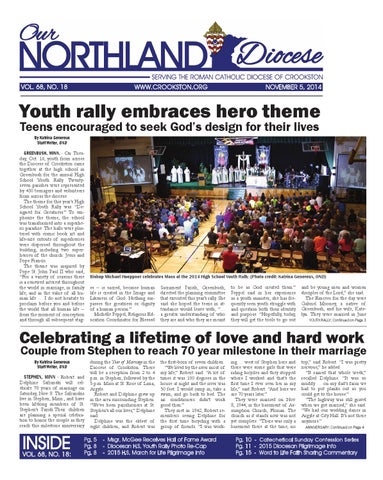
GREENBUSH, MINN. - On Tuesday, Oct. 16, youth from across the Diocese of Crookston came together at the high school in Greenbush for the annual High School Youth Rally. Twentyseven parishes were represented by 430 teenagers and volunteers from across the diocese. The theme for this year’s High School Youth Rally was “Designed for Greatness.” To emphasize the theme, the school was transformed into a superhero paradise. The halls were plastered with comic book art and life-size cutouts of superheroes were dispersed throughout the building, including two superheroes of the church: Jesus and Pope Francis. The theme was inspired by Pope St. John Paul II who said, “For a variety of reasons there is a renewed interest throughout the world in marriage, in family life, and in the value of all human life … I do not hesitate to proclaim before you and before the world that all human life -from the moment of conception and through all subsequent stag-
Bishop Michael Hoeppner celebrates Mass at the 2014 High School Youth Rally. (Photo credit: Katrina Genereux, OND)
es -- is sacred, because human life is created in the Image and Likeness of God. Nothing surpasses the greatness or dignity of a human person.” Michelle Peppel, Religious Education Coordinator for Blessed
Sacrament Parish, Greenbush, directed the planning committee that executed this year’s rally. She said she hoped the teens in attendance would leave with, “… a greater understanding of who they are and who they are meant
to be as God created them.” Peppel said in her experience as a youth minister, she has frequently seen youth struggle with and question both their identity and purpose. “Hopefully, today, they will get the tools to go out
and be young men and women disciples of the Lord,” she said. The Emcees for the day were Gabriel Mooney, a native of Greenbush, and his wife, Katelyn. They were married in June YOUTH RALLY: Continued on Page 3
Celebrating a lifetime of love and hard work
Couple from Stephen to reach 70 year milestone in their marriage By Katrina Genereux Staff Writer, OND
STEPHEN, MINN - Robert and Delphine Safranski will celebrate 70 years of marriage on Saturday, Nov. 8. The Safranskis live in Stephen, Minn., and have been lifelong members of St. Stephen’s Parish.Their children are planning a special celebration to honor the couple as they reach this milestone anniversary
INSIDE
VOL. 68, NO. 18:
during the Year of Marriage in the Diocese of Crookston. There will be a reception from 2 to 4 p.m. in Stephen, followed by the 5 p.m. Mass at St. Rose of Lima, Argyle. Robert and Delphine grew up in the area surrounding Stephen. “We’ve been parishioners at St. Stephen’s all our lives,” Delphine said. Delphine was the eldest of eight children, and Robert was
the first-born of seven children. “We lived by the river most of my life,” Robert said. “A lot of times it was 100 degrees in the house at night and the river was 50 feet. I would jump in, take a swim, and go back to bed. The air conditioners didn’t work good then.” They met in 1942; Robert remembers seeing Delphine for the first time bicycling with a group of friends. “I was work-
Pg. 5 - Msgr. McGee Receives Hall of Fame Award Pg. 8 - Diocesan H.S. Youth Rally Photo Re-Cap Pg. 8 - 2015 H.S. March for Life Pilgrimage Info
ing … west of Stephen here and there were some girls that were riding bicycles and they stopped where I worked and that’s the first time I ever seen her in my life,” said Robert. “And here we are 70 years later.” They were married on Nov. 8, 1944, in the basement of Assumption Church, Florian. The church as it stands now was not yet complete. “There was only a basement there at the time; no
top,” said Robert. “I was pretty nervous,” he added. “It rained that whole week,” recalled Delphine. “It was so muddy … on my dad’s farm we had to put planks out so you could get to the house.” “The highway was still gravel when we got married,” she said. “We had our wedding dance in Argyle at City Hall. It’s not there anymore.” ANNIVERSARY: Continued on Page 4
Pg. 10 - Catechetical Sunday Confession Series Pg. 11 - 2015 Diocesan Pilgrimage Info Pg. 15 - Word to Life Faith Sharing Commentary
2
November 5, 2014
A
COMMENTARY
OUR NORTHLAND DIOCESE
Voice from the Valley BY BISHOP MICHAEL J. HOEPPNER
ALL SAINTS - ALL SOULS Each year we begin November with two wonderful days of special prayer, the Solemnity of All Saints and All Souls Day. On Nov. 1, we celebrate “the festival of [Saints]…the heavenly Jerusalem, our mother, where the great array of our brothers and sisters already” give God eternal praise. That great multitude which no one can count is from every nation, race, people and tongue. (Preface) And what will be the happiness of the eternal life for which we hope? “No eye has seen nor ear heard, nor the human heart conceived what God has prepared for those who love him.” (I Cor. 2:9) The Catechism of the Catholic Church describes heaven as both the exemption of all evil, such as hunger, thirst, tears, sorrow and death, as well as the fullness of positive glories without measure: the fulfillment of the deepest human longings, the state of supreme, definitive happiness. (CCC 1024) And of course, the deepest longing of the human heart is love and God is love. In the Vatican II document, Lumen Gentium, it is noted that “the whole church of the saints in the supreme happiness of love will adore God and the Lamb …” (Lumen Gentium, 51) The Catechism says that “those who die in God’s grace and friendship and are perfectly purified live forever with Christ. They are like God forever, for they ‘see him as
he is,’ face to face …” (CCC 1023) Again, “This perfect life with the Most Holy Trinity – this communion of life and love with the Trinity, with the Virgin Mary, the angels, and all the blessed – is called ‘heaven.’” (CCC 1024) Heaven is being consumed in perfect love, a communion with all the redeemed in perfect love, happiness and peace for eternity. Heaven is full of holy saints. Holiness is a transformed heart - a heart fully in love with God which always overflows in love of our brothers and sisters. But what if we die not yet perfect in love, carrying the residue of selfishness and sin? How will we ever enter into the heavenly communion of perfect love? With further purification we can be made ready for heaven. Pope Benedict XVI in his encyclical, Spes salvi, offers a beautiful picture of purgatory: “The encounter with Him is the decisive act of judgment. Before His gaze all falsehood melts away. This that we build during our lives can prove to be mere straw, pure bluster, and it collapses. Yet in the pain of this encounter, when the impurity and sickness of our lives becomes evident to us, there lies salvation. His gaze, the touch of His heart heals us through an undeniably painful transformation “as through fire.” But it is a blessed pain, in which the holy power of His love sears through us like a flame, enabling us to become
totally ourselves and thus totally of God. ... our defilement does not stain us forever if we have at least continued to reach out towards Christ, toward truth and towards love. Indeed, it has already been burned away through Christ’s Passion. At the moment of judgment we experience and we absorb the overwhelming power of His love over all the evil in the world and in ourselves. The pain of love becomes our salvation and our joy.” (Spes Salvi, 47) The beautiful Funeral Liturgy of the Church reminds us that, “all the bonds of love and affection that we forge in this life do not cease with death.” On All Saints and All Souls days, we feel these bonds which unite us with our deceased loved ones and we are filled with great hope, hope for their eternal happiness and for our own as well. We know that we live “in the hope of eternal life that God, who never lies, promised before the ages began.” (Titus 1:2) On All Saints Day, we ask God, “that, coming to perfect holiness in the fullness of your love, we may pass from this pilgrim table [of the Eucharist] to the banquet of our heavenly homeland.” And on All Souls Day, we ask: “that all our departed brothers and sisters may be taken up into glory with Christ Jesus, in whose great mystery of love we are all united” (Prayer Over the Offerings). And we know our hope, Jesus Christ, does not
BISHOP’S CALENDAR November 8 November 10-14 November 15 November 16 November 17-19 November 22
5:00 p.m.
Mass, St. Rose of Lima, Argyle USCCB Fall General Assembly, Baltimore, Md.
4:30 p.m.
Mass, St. Joseph’s, Williams
9:00 a.m.
Mass, St. Mary’s, Badger
5:00 p.m.
Installation of Archbishop Blase Cupich, Chicago, Ill. Closing Mass for Year of Marriage, Cathedral, Crookston
If you or someone you know has been sexually abused, your first call should be to law enforcement. If you have been abused by a Catholic priest or another person in Church ministry, the Diocese of Crookston Victim’s Assistance Coordinator is also available to offer you help and healing. Please contact Louann McGlynn at 218281-7895 (24-hour confidential number) or Lmcglynn@crookston.org.
disappoint. NATIONAL VOCATIONS AWARENESS WEEK Each year, the Church in the United States sets aside one particular week to pray for and encourage vocations to the ministerial priesthood, diaconate, and consecrated life. This year, National Vocations Awareness Week is the first week of November (Nov. 2-8). I ask you to offer prayer during this week for the vocations we need here in this local church. We thank Almighty God for the many blessings we receive through the many priests, deacons and religious men and women serving us here so well. May the Good Lord continue to provide the vocations we need. Pope Francis has reminded us that we all need to do our part to build a culture of vocations. “The fraternal life and fervor of the community can awaken in the young a desire to consecrate themselves completely to God and to preaching the Gospel. This is particularly true if such a living community prays insistently for vocations
and courageously proposes to its young people the path of special consecration.” (Evangelii Gaudium) Studies show that when three or more people ask and encourage a young person about a vocation, that young person is more likely to seriously consider a vocation. Help build a culture of vocations; encourage our young people to consider a vocation; pray for the vocations we need. COLLECTION Each year the Catholic Campaign for Human Development (CCHD) funds wonderful projects throughout the dioceses of the United States which help to build bright “sustainable futures for communities.” The upcoming national collection is the primary source for CCHD’s funding of anti-poverty and education grants and programs which offer new hope for those living in poverty in the United States. Twenty-five percent of the funds remain in our own diocese to help the poor here. Please be as generous as you can be the weekend of Nov. 22-23.
(USPS 414-940) Our Northland Diocese is a semi-monthly newspaper committed to publishing Good News for the purpose of strengthening and furthering the Reign of God in the Roman Catholic Diocese of Crookston.
Subscriptions: $13.65 per year in the diocese, $14.90 per year outside the diocese. Publisher: Editor: Associate Editor: Editorial Assistant:
The Most Reverend Michael J. Hoeppner Bishop of the Diocese of Crookston Rev. Robert Schreiner Office of the New Evangelization, Director Mrs. Janelle C. Gergen jgergen@crookston.org Mrs. Katrina Genereux kgenereux@crookston.org
For questions about subscriptions or address changes, please contact: Renee Tate at rtate@crookston.org Periodical postage paid in Crookston, MN and additional mailing offices. Postmaster: send address changes to: Our Northland Diocese PO Box 610, Crookston, MN 56716-0610 Phone: 218-281-4533 Publishing dates and submission deadlines for news and advertisements can be found online: http://www.crookston.org/ond/
OUR NORTHLAND DIOCESE
DIOCESAN
November 5, 2014
3
Above: Fr. Todd Arends of Holy Rosary, Detroit Lakes, jokes with youth while they eat lunch. Left: The hallways of the school are shown covered in comic book pages to accent the superhero theme of the youth rally. (Photo credit: Katrina Genereux, OND)
YOUTH RALLY: Continued from Page 1 and throughout the day, they shared the story of their vocational call to marriage. Sonar, a Catholic band from the Twin Cities area, provided music ministry for the event. Sonar has been a staple at youth rallies in the Diocese of Crookston for the past ten years. The keynote presenters for the day were Lamar Edwards and Catie Payne from The Culture Project International. According to their website, the organization is “an initiative of young people set out to restore culture through the experience of virtue.” They work to “proclaim the dignity of the human person and the richness of living sexual integrity, inviting the culture to become fully alive.” Edwards delivered the morning keynote, focusing on the root of identity and the call to the greatness of sainthood. During part of his presentation, he showed a movie trailer from “Superman” where the hero’s parents were preparing to send their infant son away from their dying planet to Earth. After showing the video, Ewards said, “I don’t know if you saw how saturated that trailer was with this idea of Baptism and being a beloved son. He (Superman’s father) says to his son, ‘Our hopes and our dreams, they go with you.’ This is what God the Father says because there is something about you, and only you that you can give to this world, this culture, to this society.” He continued, “There is a way that you can love someone in a way that no one else can. That you can invite someone else into the Church, into discipleship with Jesus Christ, like no one else can. But you cannot do that
if you don’t know who you are. their paths to conversion and the ized, “This is really God … not Superman could fight for the ways they were destined for the only is this God … but He wants justice and the truth and the dig- greatness of sainthood. He en- to be with me.” Payne shared nity of every person because he couraged the teens to follow the how she has been striving since example of these saints, saying, that day to invite Jesus Christ first knew … who he was. “And I think what every … “You and I, we too, are able to into her entire life. “I can tell saint on this earth knew before … hold on tight to the great- you in all honesty, ever since I inthey could go out and give and ness God has planned for each vited Jesus into my entire life … do anything, they knew three of us. We do so as we hold onto I sometimes push Him out, but things: They knew that they the hand of Jesus and take a walk I keep trying to invite Him back in again. It’s a struggle, it’s not were a beloved son or daughter with Him.” easy, but I can tell you I of God, they knew that have zero regrets. He’s they were unconditionchanged a lot of things. ally loved and they knew “There is a way that you can love He’s made my life differthey had a purpose. It is someone in a way that no one else ent than it used to be.” important for us and I can. ... But you cannot do that if you She encouraged everywant you to take it with one to go to Confession don’t know who you are.” you for the rest of the to strengthen them in day.” --Lamar Edwards, Keynote Speaker their pursuit of holiness, Before Mass beand to meet Christ in the gan, Sonar practiced sacrament. “He wants to a few songs with the A special collection was taken give us freedom … not only are youth. Caroline Metzinger provides keyboards and vocals for up during Mass to benefit the our sins wiped away, but there the band. She encouraged the LifeCare Center in Thief River are special graces attached to the sacrament to make us stronger in teens gathered to prepare their Falls. $483.74 was collected. Following Mass, the teens split the future,” Payne said. hearts to receive the Lord, sayFollowing the keynote address, ing, “Make this Mass different. into groups to take turns going Reflect on this: I am going to to lunch. When they weren’t eat- there was a time of Adoration. receive the God of the Universe ing, they participated in a cha- Sonar led everyone in praise and rades-style game show led by DJ worship music for a short time into my body today.” Several priests of the Diocese John Young, an entertainer from and then everyone prayed in silence. Priests of the diocese of Crookston concelebrated Grey Eagle, Minn. National Evangelization were on hand to hear confesMass with Bishop Hoeppner in Teams (NET) missionaries were sions, and the line of youth waitthe gymnasium. The readings complemented on hand as well. They led grace ing to receive the Sacrament of the theme “Designed for Great- before meals, performed skits Reconciliation remained full the ness” and the morning’s keynote following lunch and dinner, entire time. The youth rally concluded address. The first reading came staffed a booth with information from St. Paul’s Letter to the about their ministry and mingled with awards and a few hours Ephesians. “… as he chose us with teenagers throughout the of fun with inflatable games, a dance featuring DJ John Young, in him, before the foundation of day. Payne delivered the afternoon a three-on-three basketball tourthe world, to be holy and without blemish before him. In love keynote focusing on mission. nament and a coffee house and He destined us for adoption to She shared her experiences of craft area. Rhett Zepper of Assumption, Himself through Jesus Christ, encountering Christ’s love and in accord with the favor of his the gradual and on-going pro- Barnesville, and Lauren Weaver cess of turning her entire life of St. Philip’s, Bemidji were will.” (Eph 1:4-5) presented with the St. Timothy During his homily, Bishop over to Him. Ten years ago, at the age of Award. Youth Ministers nomiHoeppner spoke about walking the path of life. He spoke 13, in Adoration, she had a pro- nate seniors in high school who about St. Augustine and St. Paul, found experience where she real- have shown a high level of lead-
ership, service and commitment to their parish during their high school years. Recipients are those who provide examples of love, faith and purity and demonstrate joy in faith through both a personal and communal prayer life. The winners of the Vocatio Award were John Lein of St. Joseph’s, Moorhead, and Heather Mitchel of Sacred Heart, Frazee. This award recognizes adult volunteers for their service to young people. Those who receive this award demonstrate the joy of pursuing the Catholic faith and a holiness of life that brings young people to Jesus Christ and His church. Parishes represented at this year’s High School Youth Rally were: St. Joseph, Ada; St. Rose of Lima, Argyle; St. Joseph, Bagley; Assumption, Barnesville; St. Philip, Bemidji; Cathedral of the Immaculate Conception, Crookston; Holy Rosary, Detroit Lakes; Sacred Heart, East Grand Forks; St. Joseph, Fertile; Assumption, Florian; St. Mary, Fosston; Sacred Heart, Frazee; Blessed Sacrament, Greenbush; St. Clement, Grygla; St. Patrick, Hallock; Holy Rosary, Lancaster; St. Andrew, Hawley; St. Michael, Mahnomen; St. Lawrence, Mentor; St. Joseph, Moorhead; St. Peter, Park Rapids; St. Joseph, Red Lake Falls; Sacred Heart, Roseau; St. Stephen, Stephen; St. Bernard, Thief River Falls; Sts. Peter and Paul, Warren; St. Mary, Warroad and Sacred Heart, Wilton.
Turn to Page 8 for more youth rally photos
4
November 5, 2014
AROUND THE DIOCESE
OUR NORTHLAND DIOCESE
ANNIVERSARY: Continued from Page 1 “Going to Argyle, my best man was driving, and a car came at him with funny lights and he drove into the ditch in all that water and mud,” remembered Robert. They were stuck, but somebody stopped and brought them the rest of the way to Argyle for the wedding dance. “When people were married for 50 years, we thought they were ancient,” Delphine said. “Not very many people … were married for 50 years then either. My folks were for 45 I think. Yours were for 50 or 60 I think.” The Safranskis have eight children, four boys and four girls. They lived on a farm one mile east of Stephen, growing beets and grain and raising chickens. Delphine had a large garden and did a lot of canning. “We raised a pretty big family and we farmed for many years, for 50 some years,” said Robert. During the winter, Robert worked in the potato warehouse. They now have 24 grandchildren and 33 great-grandchildren, the youngest of which are twin boys, who were born in July. The Safranskis have worked hard all their lives. “I worked till last year at the farm. I could have probably this year too, but I think they figured I was too old,” Robert said, smiling. “He’s gonna be a farmer until the day he dies,” said Jim Safranski, their third child. “He taught us how to farm. When we were about eight years old, we were
on the tractor.” Jim and his wife Donna live in Stephen. Delphine said, “I worked hard for my mother since I was six years old.” She added, “I got to be a waitress when I was in my 60s; I liked that the best.” They lived on the farm until the year of their 50th anniversary, when they moved into town. Robert is 89, and Delphine celebrated her 90th birthday this year. She still works by cleaning the laundry area of the apartment complex where they live and helping out at St. Stephen’s with the Ladies’ Aid group. “They were always together,” said Bob Safranski, their second child and oldest boy. “You got married and that was it. You had a problem, you worked it out.” Bob and his wife Jean have been married for 44 years; they currently live north of Florian, Minn. Sue Amundgaard of Warren, Minn. is their fourth child. She remembers her mom and dad working together as a team cleaning the windows. “Windows they always did together. It was a two story house,” Sue said. “Dad would get the ladder and he’d do the outside and she’d do the inside.” “Running the farm, they had to be on the same page.” Sue added. Joanne Decker of Litchfield, Minn., their eldest daughter, said her parents taught her dedication, hard work and responsibil-
wants your news and advertisements! Find 2014-15 publishing dates and submission deadlines on the web: http://www.crookston.org/ond/ The next OND submission deadline is: Wednesday, November 12 by 12:00 p.m. Email: Janelle C. Gergen, Associate Editor jgergen@crookston.org
PLEASE
pray for vocations to the priesthood and religious life
Robert and Delphine Safranski are pictured at their home in Stephen, Minn. (Photo credit: Katrina Genereux, OND)
ity. “If you want something, you work for it.” “Family meant a lot. They were good parents,” said Joanne. “We were always well taken care of.” The Catholic faith played a large role in the Safranski household. “Faith was big,” Sue said. The family attended Mass every Sunday and went to confession every month. “We were brought up religious,” said Jim. “We said the Rosary [daily] during Lent and went to church every Sunday.” “We never missed Mass. That
carried down to me,” Bob said. He talked about the role faith plays in marriage, saying, “That’s the important thing anyway in any relationship. If you don’t have your Catholic faith, if you lose it, where do you turn to?” “There was a lot of compassion for other people,” commented Sue. “They always helped strangers or anybody that needed help,” said Sue. “They wouldn’t turn anybody away.” “I’ve known them for 39 years,” said Donna Safranski. Donna is married to the couple’s son, Jim. “They have their dis-
agreements just like any married couple, but Robert very much looks out for the welfare of Delphine. Their enduring love is ‘understood.’” When asked if they had any advice, Delphine and Robert shared the following: “We try to run stuff 50/50,” he said. “Most of the trouble is when one tries to run everything … it should be at least 50/50 for everything.” She added, “Work hard. I worked hard, you [Robert] worked hard, and that’s about it.”
OUR NORTHLAND DIOCESE
AROUND THE DIOCESE
November 5, 2014
5
Msgr. McGee inducted into Bishop Ryan Catholic School Hall of Fame By Janelle C. Gergen Associate Editor, OND
On Saturday, Oct. 11, Msgr. Timothy McGee, pastor of Holy Rosary Parish, Detroit Lakes, was inducted into the Bishop Ryan Catholic School Hall of Fame in his hometown of Minot, N.D. The twelfth annual event took place at Minot’s Holiday Inn - Riverside Hotel and included a social, silent auction, dinner, award presentation and dance. Bishop Ryan Catholic School’s mission is “Providing an education in the spirit of Jesus Christ”. According to the Bishop Ryan School website, “The Hall of Fame award was founded to promote pride in Bishop Ryan and to honor alumni, faculty, staff and friends who have made outstanding accomplishments in their communities and their lives in the time since or while associated with the school. The Hall of Fame preserves and strengthens the school’s motto, ‘Ever to Excel’. These recognitions also honor and perpetuate the individuals who have excelled and provided our students with examples of what to dream and aspire to be.” Timothy Hugh McGee was born Oct. 4, 1948, in Minot. He attended St. Leo’s Grade School through eighth grade. Msgr. McGee’s father, Richard, helped with the founding of Minot’s new Catholic high school, so his Catholic education contin-
Balke ordained Msgr. ued at Bishop Ryan McGee to the priestHigh School. Msgr. hood for the Diocese McGee graduated of Crookston on Dewith the Bishop Ryan cember 19, 1987, at Class of 1966. Sacred Heart Catholic Msgr. McGee atChurch in East Grand tended National ColForks. lege in Rapid City, His first assignment S.D., and graduated for the diocese was as in 1971 with a degree Associate Pastor at St. in Business AdminPhilip’s, Bemidji. In istration. He worked July 1988, Msgr. Mcfor the North Dakota Gee was assigned as Workmen’s CompenAssociate Pastor of Sasation Bureau in Biscred Heart Parish, East marck for two years, Grand Forks. Then, in and in 1973, enrolled July of 1990, McGee in the San Francisco was named Pastor of College of MorSacred Heart, and soon tuary Science. He its missions of Holy earned an Associate Trinity, Tabor (1991), of Science Degree and St. Francis of Asin Mortuary Science sisi, Fisher (1996). in 1974 and returned In April of 1997, to North Dakota severe flooding devto work at Boelter astated the Red River Funeral Home in Bismarck. In 1976, Commissioned artist, Vern Skaog, of Minot, N.D., cre- Valley and caused exMsgr. McGee re- ated a painting honoring Msgr. Timothy McGee. The tensive damage to turned to his home- artwork depicts (clockwise): St. Leo’s Catholic Church the Sacred Heart Partown of Minot and of Minot, Msgr. McGee’s ordination symbol, Msgr. Mc- ish and Sacred Heart began employment Gee’s current portrait, a 1999 architectural rendering School buildings. Both at Thompson Lar- of Sacred Heart School and Parish and Msgr. McGee’s the elementary and son Funeral Home. high school graduation portrait. The piece was on dis- high school facilities Then, in 1981, he play at the induction ceremony and will permanently were beyond repair and moved to East Grand hang in the Bishop Ryan Catholic School Hall of Fame were later demolished. Msgr. McGee successForks, Minnesota, to Gallery. (Replica image was scanned for publication by fully directed a $13 milwork with his uncles lion rebuilding project at Norman Funeral Our Northland Diocese.) for the school. FollowHomes in the GreatSacred Heart School of Theol- ing the 1997 flood in East Grand er Grand Forks area. Msgr. McGee answered the ogy in Hales Corners, Wisc., and Forks, he says he spent many Lord’s call to begin formation for completed his Doctorate of Di- sleepless nights in prayer. He priesthood in 1984. He entered vinity in 1987. Bishop Victor H. credits federal government aid
and the people of Sacred Heart Parish for the success of the building project. The Sacred Heart reconstruction project was completed in 1999. In July 2001, Msgr. McGee was reassigned as Pastor of St. Bernard’s Parish, Thief River Falls, and served there for eight years. In 2006, Msgr. McGee was awarded the Lumen Christi Award by Sacred Heart School for his contributions and leadership during his years of service there and in 2007, was named Chaplain to His Holiness with the title of Monsignor. In July 2009, Msgr. McGee was assigned as Pastor of Holy Rosary Parish, Detroit Lakes, where he currently serves. When delivering his remarks at the Hall of Fame induction, Msgr. McGee stated, “In those 27 years since ordination, I have always been assigned to a parish that has a Catholic school. I can’t imagine not having a school in my parish because I believe that it is the lifeline of the parish and the Catholic community.” In closing, McGee said, “Mine is a story of faith in which Bishop Ryan High School played a huge part … My parents, who were always instrumental in what I did, would be very pleased with this as well and I can’t help but think they are smiling … You have honored me and you have honored them as well.”
6
November 5, 2014
COMMENTARY
OUR NORTHLAND DIOCESE
Grounding boys in reality is best Growing up in Central New York, the neighborhood kids often got together for games of basketball or kickball in back yards on warm summer days, at least until the dinner bell rang. We knew each other well and how to organize teams. These days, I am noticing that kids are increasingly interested in video games and connecting through online media or the like instead of backyard games. I know kids still play actual sports and still have “real” friends, but more often they connect through some form of media. Increasingly, we appear to have more connections with those we would call friends, but by and large these connections are less significant. The need remains for reality-based, look-me-in-the-face, old school interactions. It is an important part of growing up and learning. One of the potential dangers of technology-based living is that kids learn less personal and more detached forms of communication, which for some, plays right into a more active
INTEGRITY HUMAN PERSON INSIGHTS
By Dan Spadaro, MA, LPC Synidcated through The Colorado Catholic Herald
fantasy life. Fantasy is not the same as imagination or creative play. Kids play in all kinds of imaginative ways, with forts and costumes and swords. Fantasy is more like escape from reality and trading out interactions with people who they have consistent relationships with, for role-played scenarios. In fantasy, boys can imagine and role-play things that they have never done and do things that are humanly impossible, all without consequences. Boys in particular (old ones too) desire adventure, competition and mastery. They want to see how they measure up against others and with dad. If they do not feel
some success, they may need guidance, but fantasy presents a quick and easy solution. Selfmastery turns into video game mastery. Adventure becomes a journey through an unreal world of screens and creatures. If we do not feel competent in real life, we risk trading that for the alternative of pretend worlds and our preference for where we like to spend our time becomes lopsided. The explorative and dynamic nature of the Internet and media devices offers the ability to take a thought, explore that thought immediately to learn or interact in new ways. Boys explore the world in basic ways. They seek to observe,
understand and then act out or practice what they have seen in some form or another. Some people may excuse fantasy interests as experimental or as a phase, thinking that it does not really matter. “It’s just a video game,” they could think. Fantasy avoids the ultimate learning experience of any behavior: consequences. If we do something that gets us into a lot of trouble, we are less likely to try that again. Fantasy has no consequences and thus no apparent price tag, but the lesson is still there. For teens there is the added dynamic of peer pressure. Teens find it very important to have social experiences and relate in ways that they believe will gain them acceptance by their peers. Their peer group starts to hold more precedence than the role of their parents, so consequences impact differently too. Fantasy seems to foster a false sense of control over life. It is the thinking that one can control his own world and, if he doesn’t like the outcome,
just reboot. Control is also fostered by the ability to hide behind a role, image or false identity. This is very much present in the elements of video games, chat rooms, blogs or even social media. A life that is ordered by prayer, work and relationships is far more insulated to a potential fantasy life, but kids don’t develop this on their own. They need parents and adults to provide that structure for them in order to learn how to develop it for them. So kudos to Catholic programs which provide boys with a system of achievement, adult and peer mentorship and faith formation (like Catholic Scouting). Not to mention, these programs foster the ability for boys to learn reality-based selfmastery and virtue, thus providing them the opportunity to pursue their vocation in life.
Dan Spadaro, MA, LPC, is a licensed professional counselor and a member of the Diocese of Colorado Springs. His website is www.imagodeicounseling. com. Integrity is syndicated through The Colorado Catholic Herald, www.coloradocatholicherald.com.
California leads the way; sells soul California politicians are proud of the liberal abortion laws they have implemented. The president of the National Abortion Federation even brags about California saying it is the “gold standard” of abortion access in the United States. A state law that went into effect last January has authorized nurse practitioners, certified nurse-midwives and physician assistants to perform a method of first-trimester abortion known as vacuum aspiration. Until 10 months ago, only doctors were allowed to perform the procedure. A Planned Parenthood clinic in San Rafael, Calif., confidently markets itself by explaining it performs abortions as routinely as breast exams and birth control consultations. It no longer has “abortion days” each week; the procedure can now be done each day at the most “convenient time” for a patient. While other state legislatures across the country have passed laws the past four years setting basic restrictions on abortion, California political leaders have moved in the opposite direc-
LIFE FIRST
By Father Don Braukmann Parochial Vicar - St. Philip’s Parish, Bemidji and St. Charles Parish, Pennington
tion. The state is the only one in the country which is actually expanding the number of abortion providers within its borders. Abortions conducted in the first trimester are usually done in one of two ways. A “medication abortion” is done when the baby is up to ten weeks old. The woman then has a miscarriage in the privacy of her own home. The other method, mentioned earlier, is “safe” through the third month of pregnancy. A “vacuum aspiration” abortion really needs no explanation, does it? Planned Parenthood literature explains it innocently as a method of “removing the contents of the uterus.”
There is no mention in the literature that the heartbeat of the baby begins at three weeks, brain waves at six weeks and that 46 human chromosomes came into existence at fertilization. Note that they are human chromosomes, not an animal’s. All of this can happen before a woman even realizes she is pregnant! Isn’t it interesting, as well, that California law defines death as the moment when brain waves cease? Yet, the same state’s abortion law does not follow its own logic by concluding that life begins when brain waves do! The new law goes a long way in bringing abortion to the more remote areas of Califor-
nia; another fact the state legislature is proud to crow about. The University of San Francisco’s School of Nursing and Health is providing a curriculum to help expand abortion services and even has a class devoted to performing vacuum aspirations. The director of the Planned Parenthood clinic said, “Pregnancy is not all about having babies.” One in three women has had an abortion she points out. She also said the new program allows women to know their “caregiver” and makes it easy to develop a “treatment plan” for each pregnant woman who comes to the clinic. Caregiver? Treatment plan? And people wonder why we stand outside Planned Parenthood clinics and abortion mills praying! Looking evil straight in the eye without blinking can only be done on our knees in prayer. Of course, not every California politician believes the child in the woman must die if she is not wanted or is inconvenient. One pro-lifer, ashamed of the direction the state is going, was
A man displays a sign next to a woman holding a baby during a rally in front of San Francisco City Hall during the 10th annual Walk for Life West Coast Jan. 25, 2014. (CNS photo/Jose Aguirre, Catholic San Francisco)
quite insightful in saying, “I’ve noticed that everyone who is for abortion has already been born. Quite insightful indeed.
OUR NORTHLAND DIOCESE
COMMENTARY
November 5, 2014
7
The Year of Marriage in hindsight This is the final month for our diocesan Year of Marriage. It formally closes with a Mass celebrated by Bishop Hoeppner at the Cathedral on the Vigil of the Feast of Christ the King, Nov. 22. As we come to a close, I would like to offer some personal reflections on the year. When a Catholic takes account of history it is possible to do so from two perspectives: the temporal and the sacramental. The temporal perspective permits an evaluation of the ‘facts’ of the experience(s) – the ‘stuff ’, if you will, of what happened. On the other hand, the sacramental perspective takes the ‘stuff ’ of that list and then asks: “And what more, O God?” The sacramental aspect of history is that aspect of time which inexplicably exceeds the sum of the parts. It has to do with what more God chooses to do (if He so chooses) with the stuff we’ve offered Him. It’s that reality at play when, for example, we put together the stuff of unleavened bread plus wine, plus a priest praying Christ’s words, and we inexplicably end up with far more than bread, wine and words. God takes it and makes it something MORE. In that case, it’s the more of a Sacrament (large case): the Real Presence of Christ’s body and blood. When viewing history, it, too, can re-
CREDO
A NEW EVANGELIZATION WITNESS
By Fr. Robert Schreiner, S.T.L. Director of the Office of the New Evangelization
veal (by God’s action) something more than the sum of its parts – something sacramental (small case). Temporally speaking, the Year of Marriage had a whole lot of parts to it. By the numbers, we accomplished a list of things comprising 16 pages when printed out. (This doesn’t include the many individual parish initiatives undertaken throughout the past year.) We held events at locations in all five deaneries of the diocese and welcomed approximately 2,600 people to them. Over 30 articles related to marriage and family life were published in this paper which reaches more than 14,000 Catholic households with each edition. Of those 30 articles, 16 were commissioned specifically for the Year of Marriage and ran in this column. We offered a threepart “Love & Life Concert Series.” Twelve bulletin inserts were offered to parishes which told the stories of saintly marriages throughout history. For
12 months in 14 northwestern Minnesota counties we’ve catechized, prayed and sung of the goodness of marriage and family life. Temporally speaking, that’s just some of the 16 pages of “stuff ” and a few of the numbers. And, if one is honest, none of the numbers are particularly overwhelming or earth-shattering by worldly measurement. But that’s only one way to look at this past year. We’re Catholic and we have a sacramental view by which we can see. From that perspective, I am convinced that God has taken what was offered and has done something far more with it; far more than was ever imagined in our “plan” for things. Back in 2010, the Holy Spirit inspired 100 members of the second (ever) Diocesan Synod and brought them to the Synod microphone. Of 100 interventions throughout the Synod the majority of them spoke of the need to affirm, heal, and minister to our marriages and
families. The bishop listened to that inspiration and in 2011, issued a post-Synod pastoral letter which called for 2014 to be a Diocesan-wide Year of Marriage. That’s the historical background. But the sacramental view of this history notices that all this was before we’d even heard of the Minnesota Marriage Amendment (one man-one woman) which in 2012 was proposed and failed by less than 2 percent of the votes cast by the citizens of the state. The sacramental view notices that new seeds were being planted in our diocese by the Holy Spirit well before the state legislature overturned the entire history of the state’s law on marriage and unilaterally redefined marriage in 2013. I suggest there was something “more” going on for a while now. And I believe God has taken what began in 2010 and is exceeding anything we had imagined. Many dioceses and archdioceses throughout the United States have contacted our office in the past year inquiring about our Year of Marriage. As far as we know, five or six are currently committed to doing a Year of Marriage in their own diocese. National and international newspapers and national Catholic radio programs highlighted what was being done
here and called for its repetition throughout the nation and world. Letters were sent to our bishop and to the participants of the Marriage Congress from: Archbishop Nienstedt of Minneapolis-St. Paul; Archbishop Carlo Viganó - the Pope’s representative in Washington, D.C.; Archbishop Silvano Tomasi - the papal representative to the United Nations in Geneva, Switzerland; and through his own secretary – Pope Francis himself. Each of them expressed gratitude and encouragement for our efforts and emphasized the necessity of the entire Church to take up this very effort on behalf of marriage and family life. Personally, I don’t think the Year of Marriage will end here in November, even if that had been our plan originally. Something bigger is going on here; something that has exceeded the mere sum of its parts. The sacramental perspective recognizes that God can do great things when littleness is offered in faithfulness. We’re little. And we’ve just done some little things as best we could and offered them to God. So one is left to ponder and to wonder: What more, O God? Let us proceed in littleness and faithfulness and watch with expectant joy what God does next …
Teens encounter the Lord in Adoration at youth rally EXPOSITION PRAYER IN THE DIOCESE OF CROOKSTON
Ms. Bonnie Lee
Director of the Office of Worship In her keynote address at the High School Youth Rally on Oct. 16, Catie Payne spoke about the Samaritan woman at the well and the life-changing encounter she had with Jesus. (John 4:4-30) “He was the one she had been looking for. One encounter was enough to change her whole life. … One encounter with this man Jesus was enough. So how do we … get that encounter?” She then spoke about an experience she had at a youth
conference when she was a teen. During Adoration, the priest brought the Monstrance around to each person to adore. “And I had this moment while Jesus was in front of me where I was like ‘Oh my gosh this is really God … and not only is this God, but God who is the King of the Universe, who fashioned my being wants to be in front of me right now, wants to stop in front of me and look at me.’ … I knew that was my encounter.”
You are invited to submit your testimonial of adoration before the Blessed Sacrament to: blee@crookston.org or P.O. Box 610 Crookston, MN 56716.
Above: Teens kneel in the gymnasium adoring the Lord during the youth rally. Right: Fr. Luis Buitron, Pastor of Blessed Sacrament Parish, Greenbush, processes in with Christ in the monstrance as Sonar leads participants in song. (Photo/story credit: Katrina Genereux, OND)
8
November 5, 2014
DIOCESAN
Designed for Greatness Above: Lamar Williams references Pope St. John Paul II while delivering his keynote address. Right: Members of NET Ministries provide entertaiment in the form of boistrous skits following meals at the Youth Rally. (Photo Credit: Katrina Genereux, OND)
Right: Catie Payne, of The Culture Project International, speaks with two young women after her women’s session presentation. Below: Elizabeth Rzepka, Coordinator of Catechesis and Youth Ministry, thanks the youth ministers of the diocese for their work, as costumed hospitality volunteers prepare to hand out thank you gifts.
Who’s your favorite? The OND asked attendees to choose their favorite superhero out of those represented at the youth rally. Here are the results: Captain America: 41% Superman: 31% Spiderman: 28%
High school youth invited on pilgrimage for human dignity Submitted by Elizabeth Rzepka Coordinator of Catechesis and Youth Ministry CROOKSTON, MINN. - On Jan. 19, 2015, the youth of the Diocese of Crookston will embark on their third pilgrimage to Washington D.C. to stand up for life at every stage of development. Young people in grades 9-12 are invited to participate in this lifechanging, cross-country journey. Participation in this pilgrimage is intended to help young people become leaders in the effort to transform our society into a civilization of love and a culture of life. During this experience, students will have opportunities to explore places of faith and
historical relevance in our nation’s capital, experience the dynamism of the Universal Church and witness to the dignity of life by participating in the national March for Life. The cost is $475 per person for seven days and six nights. It includes transportation, accommodations, conference and site entrance fees, nine meals and much more. Initial deposit and registration are due Nov. 21; final payments must be received by Dec. 12. Pilgrimage dates are Jan. 19 through Jan. 25, 2015. Students can register online at https://dioceseofcrookston.wufoo.com/forms/2015-marchfor-life-pilgrimage/. Down-
loadable registration forms are available at www.crookston.org/ youth_ministries or by contacting Elizabeth Rzepka at erzepka@crookston.org or (218) 2814533, ext.435. Those who cannot make the journey to participate are encouraged to join in prayer or to consider sponsoring a scholarship for a young person to attend. Every little bit helps and it is a powerful ministry to support a young person’s journey toward deepening their faith in Jesus and their experience of the Church. Questions about making a March for Life donation can be directed to Rzepka.
OUR NORTHLAND DIOCESE
More photos from the 2014 H.S. Youth Rally
OUR NORTHLAND DIOCESE
Holy Rosary holds pet blessing Mass On Oct. 3, 2014, Holy Rosary Parish, Detroit Lakes, hosted its annual pet blessing Mass to celebrate the Feast of St. Francis of Assisi, which is on Oct. 4. Msgr. Timothy McGee presided. This year, the weather was very chilly and it was drizzling outside, so Mass was held inside the sanctuary. The Mass was open to the community and many brought pets to be blessed. The children who attend Holy Rosary Catholic School and many of their family members were also present at the Mass. However, among the congregation were a variety of animal species. Some children brought their fish while others brought the family cat. Other family pets in attendance included a rabbit, a hedgehog, a duck and a large assortment of dogs. Some of the dogs shared
their vocal talents during the songs. One particularly talented dog, Ellie, is a husky and she is a member of the Kapphahn family. Mrs. Kapphahn is the 4th grade teacher at Holy Rosary Catholic School. A couple of the dogs seemed to offer up an occasional “Amen!” The Holy Rosary students look forward to this Mass every year! Had the weather cooperated, one of the students had planned to bring her horse! Msgr. McGee asked that the pets be brought forward to the altar for a special blessing. It was a beautiful sight to see the joy in the faces of the children and families who brought their family pet as they received their blessing. Msgr. McGee sprinkled the pets with holy water and the congregation prayed for their good health.
Msgr. Timothy McGee blesses pets at the altar. (Story and photo submitted by: Nona Willet, Technology Teacher, Holy Rosary Catholic School)
AROUND THE DIOCESE
9
Fire consumes church building in Dorothy
What was formally known as St. Dorothy’s Catholic Church, Dorothy, Minn., burned down on Friday, Oct. 24. The church was built in 1919 and the Diocese of Crookston closed the church in 2000. The property was later sold to a private party. The church became engulfed in flames when the property owner was burning leaves. Crews from the St. Hilaire Fire Department and the Crookston Fire Department were able to save the house adjacent to the church. No one was injured in the fire.
St. Dorothy’s Catholic Church, photographed in 2001. (Photo credit: OND archives)
The bell tower sign in Dorothy’s cemetary depicts the The remains of the church in Dorothy, church. (Photo submitted by: Chancery Staff) Minn. (Photo submitted by: Chancery Staff)
Diocese of Crookston’s Year of Marriage -- CLOSING MASS -with Bishop Michael Hoeppner DATE: November 22 TIME: 5:00 p.m. LOCATION: Cathedral of the Immaculate Conception Crookston, MN Sponsored by the Office of the New Evangelization 218- 281-4533 ▪ www.crookston.org/YOM
Fall Dinners in the Diocese of Crookston SATURDAY, NOV. 22, 2014: ST. PETER’S, PARK RAPIDS Crafts, bake sale, door prizes
November 5, 2014
9:00 A.M. - 3:00 P.M. (LUNCH SERVED 11-2)
10 November 5, 2014
COMMENTARY
OUR NORTHLAND DIOCESE
Why should I confess my sins to a priest? by Rev. Ian M. Bozant, Archdiocese of New Orleans
In a modern American mindset, a great deal of emphasis has been placed on privacy. As such, the idea of confessing one’s sins to another person can seem odd or even unnecessary. Often, the most common argument against this idea is that Almighty God knows all things and desires all people to approach him in prayer, so it seems sufficient to simply confess one’s sins and beg for forgiveness in private prayer. While venial sin may, in fact, be forgiven in many ways, the Catholic Church teaches that it is necessary to confess one’s mortal sins to a priest in the Sacrament of Penance in order to receive forgiveness from God. This teaching is based on our fundamental reality as human beings, on Sacred Scripture, and on a knowledge of sin’s personal and communal effects. Many will point to the following passage from Scripture as a rebuttal of the Catholic Church’s position: “For there is one God. There is also one mediator between God and the human race, Christ Jesus, himself human, who gave himself as ransom for all” (1 Tm 2:5-6). Why, then, should one approach an additional mediator—a priest—in order to receive forgiveness? The answer here is that the priest is not an additional mediator; rather, he is the agent of the one mediator as he stands in the person of Christ in confession. It is our Blessed Lord who forgives sins in and through the person of the priest. Even so, Christ as the sole mediator and as the Son of God has the divine prerogative to choose how he wishes to mediate his plan of salvation and forgiveness to the world. Christ, as the sole mediator, chooses to use others in the accomplishment of his work in the person of the priest. One might say on a very natural level that one of the reasons our Blessed Lord chose to institute confession this way is because we are human. Often, a very important part of the healing process comes in being able to name our transgression and fault and then expressing that to others. Bringing forth these hidden faults and sins into the light of Christ’s mercy has an essential role in the
healing that our Blessed Lord wishes to offer. Additionally, one often finds a great deal of comfort in verbalizing these faults to another and hearing the words of forgiveness pronounced by the lips of another person. Almighty God recognizes our humanity and our need for communion with others and thus institutes the Sacrament of Penance to accord with our human nature and needs. More importantly, the Scriptures themselves illustrate that our Blessed Lord gave to his Apostles the power to forgive sins: “When he had said this, he showed them his hands and his side. The disciples rejoiced when they saw the Lord. [Jesus] said to them again, ‘Peace be with you. As the Father has sent me, so I send you.’ And when he had said this, he breathed on them and said to them, ‘Receive the Holy Spirit. Whose sins you forgive are forgiven them, and whose sins you retain are retained’” (Jn 20:20-23). Thus, very clearly, one can see the specific charge our Blessed Lord gave his Apostles to forgive the sins of others, but they were unable to do this on their own, which is why he sent the Holy Spirit upon them. It is remarkable to note here that this is only one of two passages that illustrate Almighty God breathing upon man, with the other being God breathing on man at creation (see Gn 2:7), illustrating the importance of the Sacrament of Penance. But this charge to the Apostles to forgive the sins of others is not restricted only to them. Our Blessed Lord intended for this charge to continue throughout the ages and be carried out by the successors to the Apostles (see Mt 28:9-20) so that Christ’s offer of forgiveness would be available to all people. Few would deny that the command found in Matthew 28 to baptize all nations would be restricted only to the Apostles, even though they are the ones being spoken to in the passage. Likewise, this power to forgive or retain sins is a part of the apostolic office and is an instrument of the Church to remit or retain sins committed after Baptism. Thus, the priest shares in the mission of Christ’s own redemptive work without replacing him as the one mediator between God and man. Here, one might ask why the person of the priest is necessary or what
our Blessed Lord’s motivation was when he instituted the Sacrament of Penance. In Pope John Paul II’s postsynodal apostolic exhortation Reconciliatio et Paenitentia, he elaborates on the notion of sin and its effects. First and foremost, sin has a profound effect upon the sinner: “As a personal act, sin has its first and most important consequences in the sinner himself: that is, in his relationship with God, who is the very foundation of human life; and also in his spirit, weakening his will and clouding his intellect” (Pope St. John Paul II, Reconciliation and Penance [Reconciliatio et Paenitentia (RP)] [Washington, DC: United States Conference of Catholic Bishops, 2003], no. 16). However, this personal aspect of sin is not its only effect. Throughout the writings of St. Paul, the truth that each baptized person is a member of the Body of Christ is repeated over and over again (see 1 Cor 12:12-31; Col 1:18; 2:18-20; Eph 1:2223; 3:19; 4:13, etc.). Members of one Body, the graces and victories won by one member redound to the glory of all the members; however, the converse is also true. When one member of the Body sins, the other members are effected. The most obvious way sin affects others is when that sin is clearly directed toward another: slander, murder, theft, etc. Pope St. John Paul II also points out that sin has a social effect in more subtle ways than these though: “To speak of social sin means in the first place to recognize that, by virtue of human solidarity which is as mysterious and intangible as it is real and concrete, each individual’s sin in some way affects others. ... In other words, there is no sin, not even the most intimate and secret one, the most strictly individual one, that exclusively concerns the person committing it. With greater or lesser violence, with greater or lesser harm, every sin has repercussions on the entire ecclesial body and the whole human family” (RP, no. 16). Thus, each and every sin in some way affects the whole Body of Christ. It is precisely this truth that can help one understand the need to confess one’s sins to a priest. Certainly, the priest stands in the Person of Christ offering the forgiveness of Almighty God to the penitent in accord with our Lord’s
command in the Gospel of John discussed earlier. But the priest himself does not lose his humanity or his membership in the Body of Christ when he hears the confession of penitents and pronounces the words of absolution. Thus, the priest is a representative of the Church and functions on behalf of God as well. In this way, the priest can reconcile the penitent with God himself, who has been offended by the sins confessed, but the priest can also reconcile the penitent with the Church, whose members have, in some mystical way, been effected by those same sins. Recognizing the truth of one’s membership in the Body of Christ, the penitent should desire to make amends in some way for the effect that sin has had on the fellow members of the Body of Christ. Confessing one’s sins to the priest satisfies this demand of true contrition and sets the penitent back in right relationship with God and his holy Church. Often, many object to the notion of confessing one’s sins to another person. People feel uncomfortable and ashamed telling others of the wrongs they have committed, but, in some sense, this is appropriate. Each person guilty of sin should be ashamed, at least in
some way, of his or her transgression and feel some sorrow for the sins he or she has committed. This helps to prepare the penitent’s soul for the forgiveness of Almighty God and is in itself a grace leading the soul back to right relationship with our Blessed Lord, which should be a source of great consolation! There may always be some sense of trepidation and fear when one approaches the confessional, but with great humility, the priest opens the doors of God’s mercy to the contrite penitent, filling the soul with grace and repairing the bond with Almighty God and his Church that was damaged by sin. Copyright © 2014, United States Conference of Catholic Bishops, Washington, DC. All rights reserved. Permission is hereby granted to duplicate this work without adaptation for noncommercial use. Scripture excerpts used in this work are taken from the New American Bible, rev. ed.© 2010, 1991, 1986, 1970 Confraternity of Christian Doctrine, Inc., Washington, DC. All rights reserved. No part of this work may be reproduced or transmitted in any form or by any means, electronic or mechanical, including photocopying, recording, or by any information storage and retrieval system, without permission in writing from the copyright owner.
OUR NORTHLAND DIOCESE
DIOCESAN
November 5, 2014
11
12 November 5, 2014
NATIONAL
OUR NORTHLAND DIOCESE
Woman’s suicide symbol of ‘culture of death’ By Catholic News Service PORTLAND, ORE. -- Brittany Maynard, a young California woman who was suffering from terminal brain cancer and gained national attention for her plan to use Oregon’s assisted suicide law, ended her life Nov. 1. She was 29 years old. “We are saddened by the fact that this young woman gave up hope, and now our concern is for other people with terminal illnesses who may contemplate following her example,” said Janet Morana, executive director of Priests for Life, in a Nov. 2 statement. “Our prayer is that these people will find the courage to live every day to the fullest until God calls them home,” she said. “Brittany’s death was not a victory for a political cause. It was a tragedy, hastened by despair and aided by the culture of death invading our country.” Several days before Maynard’s suicide, Portland Archbishop Alexander K. Sample urged Maynard and others in similar situations: “Don’t give up hope!”
“We are with you. As friends, families and neighbors we pledge to surround you with our love and compassion until the sacred moment when God calls you home,” he said in a statement issued just before the feasts of All Saints on Nov. 1 and All Souls on Nov. 2. He said assisted suicide offers the illusion that humans can control death. “It suggests that there is freedom in being able to choose death, but it fails to recognize the contradiction,” the archbishop said. “Killing oneself eliminates the freedom enjoyed in earthly life. True autonomy and true freedom come only when we accept death as a force beyond our control.” Oregon became the first U.S. state to allow doctors to prescribe lethal overdoses. Voters approved the Death With Dignity Act in 1994 and then reaffirmed it three years later. Since then four other states have since passed similar laws -- Washington, Montana, Vermont and New Mexico. The Oregon law says a patient
must be of sound mind and must prove to a doctor he or she is a legal resident of the state. The patient must swallow the lethal drug without anyone’s help. At the start of 2014, Maynard, a newlywed, learned she had brain cancer. A few months after she underwent two surgeries, doctors delivered the news that the cancer had returned and that most patients die from such tumors in about a year. She decided against further treatment. Maynard and her husband, Dan Diaz, moved to Oregon, to become legal residents of the state and thus able to take advantage of its assisted-suicide law. On Nov. 1, as she had planned, she took a legal overdose. At one point Maynard, who would have turned 30 Nov. 19, said she might postpone taking her life to see how the disease progressed, but she stuck with her original plan. Archbishop Sample in his statement said: “Cutting life short is not the answer to death.” “Instead of hastening death, we encourage all to embrace the sometimes difficult but precious
moments at the end of life, for it is often in these moments that we come to understand what is most important about life,” he said. “Our final days help us to prepare for our eternal destiny.” Across the country in the Diocese of Raleigh, North Carolina, a 30-year-old Catholic seminarian facing the same disease as Maynard wrote a poignant essay in mid-October responding to Maynard’s announced decision to end her life. Philip Johnson called her story heartbreaking and one “that really hit home,” because he was 24 when doctors told him he had inoperable brain cancer. The news came when he was “beginning an exciting career as a naval officer with my entire life ahead of me. I had so many hopes and dreams, and in an instant they all seemed to be crushed.” “I have lived through six years of constant turmoil, seizures, and headaches. I often changed hospitals and doctors every few months, seeking some morsel of hope for survival. Like Brittany, I do not want to die, nor do I want to suffer the likely outcome
of this disease,” he wrote. “I do not think anyone wants to die in this way.” “This terrifies me, but it does not make me any less of a person,” he continued. “My life means something to me, to God, and to my family and friends, and barring a miraculous recovery, it will continue to mean something long after I am paralyzed in a hospice bed,” he said. “My family and friends love me for who I am, not just for the personality traits that will slowly slip away if this tumor progresses and takes my life.” He noted that he has lived longer than expected, which is its own miracle. Johnson added: “I know exactly what she is going through. I still get sad. I still cry. I still beg God to show me his will through all of this suffering and to allow me to be his priest if it be his will, but I know that I am not alone in my suffering. I have my family, my friends, and the support of the entire universal church.”
Veterans find help to heal their emotional wounds By Nancy Wiechec Catholic News Service CHANDLER, ARIZ. -- David Campbell believes he has died twice in his lifetime. He was not breathing at birth. Then, as a young soldier, he was hit by an exploding grenade and resuscitation efforts nearly failed. “I believe in God very much,” he told Catholic News Service during an interview at his home in Chandler. “I’ve been through too much not to.” As Veterans Day approaches, Campbell reflects on his service, the pain he endured after war and how, after two decades of emotional and mental anguish, he found some relief in a healing retreat and a new form of psychotherapy. Pfc. Campbell served as a combat engineer in operations Desert Shield and Desert Storm. Campbell’s duty was to help clear away anything blocking the movement of his tank unit. “I was inside an enemy bunker and I have no memory of what happened,” he said. He spent six weeks being treated in mobile Army medical units. Campbell began EMDR (Eye Movement Desensitization and
Reprocessing) psychotherapy, a process that helps people with traumatic memories develop a way to recall the events without experiencing the powerful emotions tied to those events. He also attended a weekend workshop for veterans at a Franciscan retreat center in Scottsdale. “Luckily we’ve found the Franciscan Renewal Center and they’ve given us the opportunity to heal through ‘Healing of Memories,’ and to me that’s been huge,” he said. The workshop is led by the Rev. Michael Lapsley, an Anglican priest and missionary to South Africa, where he was an anti-apartheid activist. Rev. Lapsley was maimed by a letter bomb in 1990 as he worked with the African National Congress. He returned to South Africa following the dismantling of apartheid and witnessed an entire nation “damaged” by the experience. He began reaching out to people who had suffered violence of any kind. Rev. Lapsley brought his “Healing of Memories” retreat to the United States in 2008, offering it first to veterans in Minnesota. In 2013 the Fran-
ciscan Renewal Center hosted the retreat. Dozens of veterans, including Campbell, attended at no cost. The center hosted two more workshops this year and is planning for three in 2015. The focus of the workshop is storytelling and small-group discussions. Campbell said he was finally able to see that PTSD, anxiety and depression were “not a death sentence” and “there’s actually a light at the end of the tunnel.” Campbell’s wife, Melissa, said she noticed a “renewed sense of hope” in her husband after the retreat. “I’m proud of him for going, and I’m seeing the improvement.” Campbell has presented talks to police and firefighters and to other veterans about his healing journey. He was honored earlier this year by local veteran groups and the local ABC affiliate for that work and his work with at-risk youths. He’s also being trained as a facilitator for future “Healing of Memories” workshops. His main message is “help is out there and healing is possible.”
Veteran David Campbell spends time with his dog, Sugar, outside his home in Chandler, Ariz., Oct. 19. Campbell was severely injured in a grenade explosion that nearly took his life. (CNS photo/Nancy Wiechec)
OUR NORTHLAND DIOCESE
INTERNATIONAL
November 5, 2014
13
CRS manages ‘safe and dignified’ burials of African Ebola victims By Bronwen Dachs Catholic News Service CAPE TOWN, SOUTH AFRICA --
Burials that are dignified and safe are urgently needed for Ebola victims in West Africa, where corpses are frequently left unattended for days and then thrown into graves without ceremony, a U.S. church aid official said. “So many people are dying that there has not been the capacity to respond” to burial needs in an appropriate way and “we are now making this a priority,” Michael Stulman, regional information officer for the U.S. bishops’ Catholic Relief Services, said in a telephone interview from Freetown, Sierra Leone. Nearly 5,000 people have died in Sierra Leone, Guinea and Liberia during the worst Ebola outbreak on record with many people contracting the disease from touching the highly infectious dead bodies of victims. “The ritual of the family washing the body of the deceased has been taken away and this can’t be changed because of the health risks, but we can bring dignity back to the burial process,” Stulman said. CRS has taken responsibility for managing “safe and dignified
burials” in Port Loko district in northern Sierra Leone, he said. The agency will ensure that graves are marked so that families know where their loved ones are buried and that there is “one body in one grave,” he said, noting that in the current crisis “this is not always the case.” Stulman, who is based in Dakar, Senegal, visited a cemetery in Freetown, Sierra Leone’s capital, where laborers “are digging 40 graves a day,” he said. “We need to create ways for people to visit the graves of their loved ones and still be safe,” he explained, noting that currently no funeral services are held in Sierra Leone and visits to cemeteries are not allowed. Ebola is spread through contact with bodily fluids of an infected person and is not an airborne disease. “We will work closely with local religious leaders in putting in place burial procedures,” Stulman said. “There needs to be some ceremony for the loved one who has died,” he added. Father Paul Morana Sandi, general secretary of the Interterritorial Catholic Bishops’ Conference of The Gambia and Sierra Leone, told Catholic
News Agency for Africa that a meeting with Sierra Leone President Ernest Bai Koroma had led to a decision that religious leaders can be at burial sites “to pray, but from a distance, with some of the relatives present.” The removal of all rituals associated with death “has had negative influences on our own cultural practices and way of behaving,” Father Sandi said. “A sacred ritual has been taken away” in the wake of Ebola, Stulman said, noting that health teams in protective gear now remove corpses from homes; in the past, religious leaders and family members had carefully prepared the body for burial. While most people “understand the severity of the disease, there is a reluctance to change behavior, particularly regarding burials,” he said. When someone dies of Ebola in Sierra Leone, households “wait between one and seven days for a burial team to collect the body,” he said, noting that this is often caused by “difficult roads or a car breaking down.” CRS aims to enable burial teams to respond to calls “quickly and safely, with the resources to protect themselves from danger of infection,” Stulman said.
Health workers in protective gear take a body bag containing the highly contagious body of an Ebola victim out of a vehicle in preparation for burial at a cemetery in the Port Loko district in northern Sierra Leone. (CNS photo/Michael Stulman, courtesy Catholic Relief Services)
Two vehicles are needed for collecting bodies from homes or clinics for burial; “one for the team and the other to transport the body,” he said. “The team should spray the body with disinfectant and put it in a bag and also spray the house,” he said.
Noting that deaths from Ebola can be “sudden and unexpected” and there is little help at hand for grieving families, Stulman said CRS will start providing counseling services.
Poverty was among synod’s major concerns By Simone Orendain Catholic News Service MANILA, PHILIPPINES -- Cardinal Luis Antonio Tagle of Manila said the Synod of Bishops on the family was more than a series of discussions on divorce and gay unions and that the impact of poverty on families, especially in Asia, was a major concern of participants. “Poverty is really affecting the Filipino family in a dramatic way,” Cardinal Tagle told reporters at an Oct. 30 news conference. The prelate explained that while he was in Italy he was part of a forum on families and afterward a number of contract workers from the Philippines approached him in tears. Cardinal Tagle said one worker told him, “If it weren’t for hardship I would never have left my wife and children behind.” The Philippines is among the world’s top countries that sends workers overseas. More than 9 million Filipinos,
about 10 percent of the Philippines population, live overseas and about half of them migrated for work, the government has reported. Cardinal Tagle said migration was a major concern in synod discussions. “Couples separate not because they’re mad at each other,” the cardinal said. “They separate because they love their family and they bear the pain of separation just to find jobs elsewhere. So we ask, ‘What kind of pastoral care can we give for the (contract) workers to remain faithful to their families ... and what can we do for those left behind?’” Cardinal Tagle pointed to financial insecurity as a hindrance to marriage and a burden on family life. Young people are delaying marriage because of a lack of jobs in the Philippines and elsewhere and thoughts that they could not support a family, he said, adding that for those who have work, the breadwinner is focused on hanging on to the job and “putting the family second.”
The bishops also credited grandparents and extended family members for their roles in raising children because of the economic stresses placed on nuclear families. Cardinal Tagle also reported on preparations for Pope Francis’ planned January visit to the Philippines. He said officials from the Vatican planned to visit in November to check on arrangements and that specific details of the trip would be released at the end of November or early December. Cardinal Tagle also said the Philippine government is “very concerned” about security for Pope Francis during his Jan. 15-19 stay. The cardinal said the pope “deserves” the effort under way by the government and the military for his safety. In September the Islamic State militant group that has occupied much of Syria and Iraq said it would target the pope, possibly during one of his overseas visits.
Pope Francis is scheduled to visit the Philippines Jan. 15-19, 2015, after spending a few days in Sri Lanka. This is the official logo for the Philippines visit. (CNS/courtesy of Catholic Bishops’ Conference of the Philippines)
14 November 5, 2014
INTERNATIONAL
OUR NORTHLAND DIOCESE
Bright lights, cool air protect Sistine Chapel
Popularity of chapel makes ‘radical intervention’ necessary By Cindy Wooden Catholic News Service
VATICAN CITY -- The Vatican is not promising visitors to the Sistine Chapel more elbow room, but it is guaranteeing a cooler experience. Marking the year of the 450th anniversary of Michelangelo Buonarroti’s death, the Vatican Museums hope the brand new air conditioning system and the 7,000 new LED lights will preserve the Renaissance artist’s masterpiece for generations to come. Television cameras, news photographers and journalists were invited to the chapel Oct. 29 for a “before and after” experience. Initially, they viewed the chapel with the lighting installed 20 years ago after the cleaning and restoration of Michelangelo’s ceiling frescoes and his massive wall mural, “The Last Judgment.” Then the brighter, cooler LED lights were turned on. Even with a crowd in the chapel, the room is designed to stay cooler than ever -- never going above 77 degrees Fahrenheit -thanks to a new system installed by the U.S.-based Carrier company and adjusted over the past
three years with input from the Vatican Museums’ conservation team and its diagnostic and scientific research laboratory. Antonio Paolucci, museums director, said his team believed the best way to honor Michelangelo was to highlight and preserve the culmination of his life’s work, something which was threatened by the work’s popularity. When the old lighting and air filtering and conditioning systems were installed two decades ago, he said, the annual number of visitors to the museums and chapel was under 2 million. Today it hosts almost 6 million visitors a year, with more than 20,000 people a day entering during the peak pilgrim and tourist season. The popularity “required a radical intervention to guarantee air circulation, keep dust and pollutants down, control the temperature and humidity and keep the carbon dioxide at an acceptable level,” Paolucci said. Carrier and Osram, a German lighting company, donated the new systems, which have an estimated value of about $3.8 million.
The Sistine Chapel is illuminated with new LED lighting at the Vatican Oct. 29. (CNS photo/Paul Haring)
Pope to open conference on traditional marriage By Francis X. Rocca Catholic News Service VATICAN CITY -- A month after closing a Synod of Bishops on the family stirred by controversy over divorce, same-sex unions and other nonmarital relationships, Pope Francis will open an interreligious conference dedicated to traditional marriage. The Vatican-sponsored gathering, on the “Complementarity of Man and Woman,” will take place Nov. 17-19 and feature more than 30 speakers representing 23 countries and various Christian churches, as well as Judaism, Islam, Buddhism, Hinduism, Jainism, Taoism and Sikhism. The conference will aim to “examine and propose anew the beauty of the relationship between the man and the woman, in order to support and reinvigorate marriage and family life for the flourishing of human society,” according to organizers. Archbishop Charles J. Cha-
put of Philadelphia and the Rev. Rick Warren, senior pastor of Saddleback Church in California, will be among the participants. Other Americans at the conference will include Russell D. Moore, president of the Ethics and Religious Liberty Commission of the Southern Baptist Convention; Henry B. Eyring, president and a member of the Quorum of the Twelve Apostles of the Church of Jesus Christ of Latter-day Saints; and Mercy Sister Prudence Allen, former chair of the philosophy department at St. John Vianney Theological Seminary in Denver, whom Pope Francis named to the International Theological Commission in September. Other notable speakers will include Lord Jonathan Sacks, former chief rabbi of Great Britain, and Anglican Bishops N.T. Wright and Michael Nazir-Ali. Pope Francis will address the conference and preside over its first morning session Nov. 17, following remarks by Cardinal
Gerhard Muller, prefect of the Congregation for the Doctrine of the Faith. The conference was an initiative of Cardinal Muller, who proposed it to Pope Francis in November 2013, according to Helen Alvare, a professor at George Mason University School of Law in Virginia, who is handling press relations for the event. The conference is officially sponsored by the doctrinal congregation, and co-sponsored by the pontifical councils for Promoting Christian Unity, for Interreligious Dialogue and for the Family. The heads of all four curia offices are scheduled to address the assembly. Topics of lectures and videos will include “The Cradle of Life and Love: A Mother and Father for the World’s Children” and “The Sacramentality of Human Love According to St. John Paul II.” Given its timing and subject matter, the conference is likely to
invite comparisons with the Oct. 5-19 synod on the family. Several conference participants have already commented publicly on the earlier event. One of the synod’s most discussed topics was a proposal by German Cardinal Walter Kasper to make it easier for divorced and civilly remarried Catholics to receive Communion. Cardinal Muller was a leading opponent of that proposal. Archbishop Chaput told an audience in New York Oct. 20 that he had been “very disturbed” by press reports of last month’s synod, saying, “I think confusion is of the devil, and I think the public image that came across was of confusion,” though he added: “I don’t think that was the real thing there.” The archbishop will play host to the September 2015 World Meeting of Families, which Pope Francis is widely expected to attend. Rev. Warren was one of 48 Christian ministers and scholars who signed an open letter
to Pope Francis and the synod fathers in September, urging the assembly to defend traditional marriage, among other ways, by supporting efforts to “restore legal provisions that protect marriage as a conjugal union of one man and one woman.” Moore, of the Southern Baptist Convention, wrote a blog post in response to the synod’s controversial midterm report, which used remarkably conciliatory language toward people with ways of life contrary to Catholic teaching, including those in same-sex unions and other non-marital relationships. Moore praised the document for suggesting that “we should not drive sinners away, but that we should receive them and nurture them toward Christ,” but said that the “church is not itself, though, to be made up of unrepentant people.”
OUR NORTHLAND DIOCESE
COMMENTARY
WORD to LIFE November 9
FEAST OF THE DEDICATION OF THE LATERAN BASILICA IN ROME Ezekiel 47:1-2, 8-9, 12; Gospel: John 2:13-22
Psalm 46: 2-3, 5-6, 8-9;
1 Corinthians 3:9c-11, 16-17
By Catholic News Service Glenmary Father Rollie Hautz, a priest for 60 years, loved building churches. One of them he literally built with his own hands as a young man -- well, with the help of his dad and a few parishioners. He still likes to tell about fabricating the steeple off-site and then using his own dump truck to haul it to the new church where he arranged for a local crane operator to stop by between jobs and hoist it into place on the roof. But as much as he enjoyed the sense of accomplishment in erecting a house of worship that would stand and serve a small Catholic community for more than 50 years, what gratified Father Rollie the most was building up the human church. He lived and worked in a remote region of Appalachia, fulfilling a mission of his Glenmary religious community to establish a “Catholic presence” there. While ministering to the considerable temporal needs of the impoverished people, Father Rollie also delighted in preaching the love of Christ -- for a time from the back of a trailer as he traveled the backwoods where evangelical churches predominated. He witnessed many conversions and the number of Catholic faithful grew in that unlikely place. This week, Paul’s First Letter to the Corinthians explains that God’s Spirit lives in his people, that we are “God’s building.” However, he says, while we are called to continue to build God’s kingdom, “no one can lay a foundation other than the one that is there, namely, Jesus Christ.” Father Rollie loved seeing the Catho-
lic Church grow in Appalachia, but he loved even more seeing the life of Christ grow in the people. He told me about a woman in a rural African-American community who came to him after following his preaching intently. She said she wanted to become a member of his church, “but I can’t because if I joined, you’d never have another white convert.” He replied, “Come on in!” He trusted Jesus as the church’s foundation. In his 59th year of ministering and converting hearts, I watched Father Rollie celebrate the real presence of Christ in the Eucharist at Mass. At the moment of consecration, I witnessed a sudden burst of enthusiasm. He explained later, “It is exciting every time.”
Questions: Why do you think Scripture reminds us to ensure that our church builds only on the foundation of Jesus? How have you witnessed Christ’s power energizing and growing the human church?
“DO YOU NOT KNOW THAT YOU ARE THE TEMPLE OF GOD, AND THAT THE SPIRIT OF GOD DWELLS IN YOU?” -- 1 CORINTHIANS 3:16
November 5, 2014
15
FOR FAITH-SHARING GROUPS
November 16 THIRTY-THIRD SUNDAY IN ORDINARY TIME
Proverbs 31:10-13; Psalm 128:1-5; 1 Thessalonians 5:1-6 Gospel: Matthew 25:14-30 or Matthew 25:14-15, 19-21 By Catholic News Service When I was a kid, I always got this week’s Gospel wrong. When the master gives talents to his servants and the first two take some risks, even though they double the money, I thought they were the foolish ones. I believed the one who safely buried the talent was smart because “no risk, no worry.” When the master praises the first two and chastises the third, I was always dumbfounded. It seemed that he was the safe and secure one, while the others risked the master’s money! What I did not understand as a child is that this is a metaphor for the gifts God has given each of us. We are not to hide them from the world. Rather we are to take risks, share them, offer them to others and most especially offer them to God. Sometimes when we think of offering gifts to God we think in the context of ministries at church, such as giving our musical abilities for the choir or our time to serve on a committee or as an altar server. But in reality, any and all of our gifts can be used to serve God. Maybe you are a good listener, maybe you are good at fixing things around the house or maybe one of your gifts is just sitting with people when they are sick. God has graciously blessed us all with so many gifts and talents. Usually they are things that come so naturally to us that we do not see them as extra special. But in reality, not everyone can do certain things as easily as you can. The key is to use these gifts in the
spirit of words attributed to Mother Teresa: “We can do no great things, only small things with great love.” When we follow her wisdom, we can be assured that when the Master comes back and asks us what we have done with the talents he has given us, we will hear the allimportant words: “Well done, my good and faithful servant.”
Questions: What gifts and talents do you have, and how have you used them? What other ways might you use them? What are the challenges to using them to the fullest?
“WELL DONE, MY GOOD AND FAITHFUL SERVANT.” -- MATTHEW 25:21
THE OND IS NOW ONLINE!! - ARCHIVED EDITIONS -
Vol. 68, No. 17 (October 22, 2014) can be viewed here: www.crookston.org/ond/
16 November 5, 2014
NATIONAL
OUR NORTHLAND DIOCESE
WHAT IS THE CATHOLIC CAMPAIGN FOR HUMAN DEVELOPMENT (CCHD)?
CCHD is the domestic anti-poverty program of the U.S. Catholic Bishops. CCHD works with Catholic dioceses and their bishops to award grants to local, low-income community groups working to address the causes of poverty. By helping the poor to participate in the decisions and actions that affect their lives, CCHD offers a hand up, not a hand out, helping people and communities overcome injustice, escape poverty and build bridges of solidarity. CCHD also works to educate Catholics about poverty and its causes in our nation and to help the non-poor put into practice the Church’s concern for human life and dignity, the Gospel command to care for “the least of these” (Matthew 25) and the Holy Father’s call to practice solidarity in helping people who are poor help themselves to overcome injustice and escape poverty.
GROUNDED IN OUR CATHOLIC FAITH
•CCHD was created in response to a mandate from the U.S. Catholic bishops in 1969 to address the root causes of poverty in the United States. •CCHD provides funding to groups whose activities are consistent with Catholic moral and social teaching and who work to help persons who are poor help themselves. •More than 683 Catholic priests, 776 Catholic parishes, 18 Catholic Charities agencies, and 51 religious communities are involved in the work of groups around the country that receive funding from CCHD. •As the Catechism of the Catholic Church reminds us, “The Eucharist commits us to the poor” (#1397). The Eucharist, celebrated as a community, teaches us about human dignity, calls us to right relationship with God, ourselves and others and sends us on mission to help transform our communities, neighborhoods and world. The work of CCHD is an example of “Eucharistic” living. “I commend the bishops of the United States for their wisdom and compassion in establishing the [Catholic] Campaign for Human Development . . . and I thank the whole Catholic community for the generous support given to this initiative during all these years.” - John Paul II, October 5, 1979, Providence of God Church, Chicago, IL http://www.usccb.org/about/catholic-campaign-for-human-development/upload/cchd-gospel-in-action-handout.pdf