VOL. 69, NO. 9
WWW.CROOKSTON.ORG
MAY 6, 2015
Following wherever the Good Shepherd leads
Diocese of Crookston native lives ‘adventure’ of consecrated life in Texas Editor’s Note: To continue our Year of Consecrated Life series, OND will begin profiling individuals from the Diocese of Crookston who are living their vocation to consecrated life outside of the diocese. By Katrina Genereux Staff Writer, OND
Sister Nancy Boushey, OSB, is currently living out her call to consecrated life at Good Shepherd Monastery in Rio Grande City, Texas. She grew up in East Grand Forks and attended Sacred Heart School. “I was raised in a strong Catholic environment at home which was backed up by my Catholic education,” she said. “I was attracted to the spiritual dimension of it all – the prayer, Mass, religion classes.” She added that the Benedictine Sisters of Mount Saint Benedict who taught her through the years served as loving and joyful examples of
consecrated life. Sister Nancy recalls hungering for more, and asking herself how she could give her all to God. She considered a variety of options including marriage, becoming a Sister of the Good Shepherd in the Twin Cities area to care for troubled teens, or becoming a nurse and serving in Africa. As things turned out, her discernment eventually led her just half an hour away. She joined the Benedictines in Crookston right after high school in 1963, making her first profession two years later and her final profession in 1970. As a Benedictine at Mount Saint Benedict, Sister Nancy served in a variety of ways, teaching in Detroit Lakes, serving youth at the Mount boarding school, and ministering at the Fort Totten and Red Lake reservations. In 1985, Sister Nancy describes herself as being at a crossroads and wanting some-
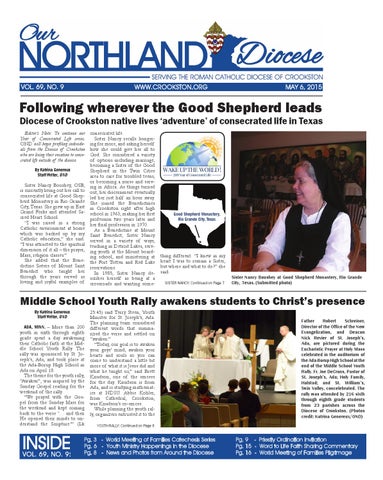
Good Shepherd Monastery, Rio Grande City, Texas
thing different. “I knew in my heart I was to remain a Sister, but where and what to do?” she said. SISTER NANCY: Continued on Page 7
Sister Nancy Boushey at Good Shepherd Monastery, Rio Grande City, Texas. (Submitted photo)
Middle School Youth Rally awakens students to Christ’s presence By Katrina Genereux Staff Writer, OND ADA, MINN. — More than 200
youth in sixth through eighth grade spent a day awakening their Catholic faith at the Middle School Youth Rally. The rally was sponsored by St. Joseph’s, Ada, and took place at the Ada-Borup High School in Ada on April 18. The theme for the youth rally, “Awaken”, was inspired by the Sunday Gospel reading for the weekend of the rally. “We prayed with the Gospel from the Sunday Mass for the weekend and kept coming back to the verse ‘… and then He opened their minds to understand the Scripture.’” (Lk
INSIDE
VOL. 69, NO. 9:
25:45) said Terry Steen, Youth Minister for St. Joseph’s, Ada. The planning team considered different words that summarized the verse and settled on “awaken.” “Today, our goal is to awaken your guys’ mind, awaken your hearts and souls so you can come to understand a little bit more of what it is Jesus did and what he taught us,” said Brett Knudson, one of the emcees for the day. Knudson is from Ada, and is studying mathematics at NDSU. Abbie Kohler, from Cathedral, Crookston, was Knudson’s co-emcee. While planning the youth rally, organizers entrusted it to the
Father Robert Schreiner, Director of the Office of the New Evangelization, and Deacon Nick Revier of St. Joseph’s, Ada, are pictured during the Eucharistic Prayer at Holy Mass celebrated in the auditorium of the Ada-Borup High School at the end of the Middle School Youth Rally. Fr. Joe DeCrans, Pastor of St. Joseph’s, Ada; Holy Family, Halstad; and St. William’s, Twin Valley, concelebrated. The rally was attended by 216 sixth through eighth grade students from 23 parishes across the Diocese of Crookston. (Photos credit: Katrina Genereux/OND)
YOUTH RALLY: Continued on Page 6
Pg. 3 - World Meeting of Families Catechesis Series Pg. 6 - Youth Ministry Happenings in the Diocese Pg. 8 - News and Photos from Around the Diocese
Pg. 9 - Priestly Ordination Invitation Pg. 15 - Word to Life Faith Sharing Commentary Pg. 16 - World Meeting of Families Pilgrimage
2 May 6, 2015
A
COMMENTARY
OUR NORTHLAND DIOCESE
Voice from the Valley BY BISHOP MICHAEL J. HOEPPNER
God’s eternal mercy. MAY: MARY’S MONTH! I really like the month of May. Birds are back and serenading. Trees sprout, grass grows, browns turn to luscious greens and fields begin their marvelous transformations from planting to harvest. Most of all, I really like May because it’s Mary’s month. I’ve shared with you before how at home, while growing up, the daily evening Rosary we prayed as a family got moved to a special place for May in honor of Mary’s month. This special shrine place was adorned with a beautiful statue of Mary and fragrant fresh flowers. Marian litanies were added to our Rosary prayer, which was an additional honor for Mother Mary in her month of May. “HAIL, HOLY QUEEN, MOTHER OF MERCY…” Pope Francis, in his Papal Bull, establishing for us a Holy Year of Mercy asks Mary, Mother of Mercy, to watch over us during our Holy Year of Mercy. He notes how Mary’s “entire life was patterned after the presence of mercy made flesh … Her hymn of praise, sung at the threshold of the home of Elizabeth, was dedicated to the mercy of God, which extends from ‘generation to generation.’” (Lk. 1:50). “We too,” Pope Francis notes, “were included in those prophetic words of the Virgin Mary. This will be a source of comfort and strength to us as we cross the threshold of the holy year to experience the fruits of divine mercy.” I hope that each family in this local church will honor Mary in a special way this month and experience, in a marvelous way, the joy of her maternal love and the comfort and strength of
SUFFERING HAS MEANING FOR LIFE Recently I had the opportunity to speak at the Family Faith Night at St. Philip’s Parish, Bemidji, on the topic: “Sacraments of Healing.” We reflected together on the following points: 1) All human beings are vulnerable to suffering, sickness and death; 2) Jesus was sent by the Father to bring God’s redeeming love to us and Jesus made this redeeming love explicit and very evident in healing sickness and forgiving sin. We are all vulnerable to suffering, sickness and death. Some suffering we bring on ourselves. Smoking causes cancer and a poor diet can lead to a heart attack. Not all suffering, however, is self-inflicted. Accidents happen and people suffer. Some mental illnesses are hereditary and people suffer. We experience a particular anguish in the face of innocent suffering and we wonder why. Why do the innocent suffer? Why the death of a child? Why does injustice seem to prevail? How does faith square with a just and loving God when there is so much suffering in the world? Our reactions to suffering are varied. We have the vast medical field to help us when we are sick. We spend billions on medical and pharmaceutical research, on fitness and cosmetics. There certainly is a human tendency to run from significant suffering in our lives. Yet, we all remain vulnerable to suffering, sickness and death. This is a symptom of our mortality. Into this context of suffering, sickness and death, Jesus is sent by the Father to bring to us God’s redeeming love. From the outset of his ministry, Je-
BISHOP’S CALENDAR May 9 May 10 May 16 May 19 May 23
sus manifests this redeeming love by healing the sick, forgiving sins, and driving out demons. The biblical perspective is that suffering, sickness and death are all symptoms of human mortality, a mortality that is not caused by God, but by the force of evil that was introduced to us through the sin of Adam and Eve. Jesus came as a healer and an exorcist who confronted suffering, sin and death in all its forms. He came to alleviate human suffering and by his own innocent suffering on the Cross, he conquered the power of sin and death. In his resurrection, he brought us new life. In the Sacraments, the healing, forgiving, life-giving ministry of Jesus continues. “Go make disciples of all the nations, baptize them in the name of the Father and of the Son and of the Holy Spirit …” (Mt. 28:19) Those who know Jesus, believe Jesus and enter with Jesus into the death of baptism, rise with Jesus to a healthy, holy life of joy, peace and love. Jesus trained and commissioned his disciples for continuing this mission. “Jesus summoned the Twelve and began to send them out two by two, giving them authority over unclean spirits. ... They expelled many demons, anointed the sick with oil, and worked many cures.” (Mk. 6:7-13). On the day of Easter, in St. John’s Gospel, Jesus appears in the upper room to his disciples. “‘Peace be with you’, he said again. ‘As the Father has sent me, so I send you … Receive the Holy Spirit. If you forgive men’s sins, they are forgiven them. If you hold them bound, they are held bound.’” (Jn. 20:20-23) Jesus establishes his new family and gives them the gifts needed for the new life he brings.
5:00 p.m. Rite of Confirmation, St. Bernard’s, Thief River Falls 10:30 a.m. Rite of Confirmation, Sacred Heart, Frazee 5:00 p.m. Rite of Confirmation, Cathedral, Crookston 7:45 a.m.
Mass, Cathedral, Crookston
10:00 a.m. Ordination Mass, Cathedral, Crookston
VICTIM ASSISTANCE STATEMENT:
If you or someone you know has been sexually abused, your first call should be to law enforcement. If you have been abused by a Catholic priest or another person in Church ministry, the Diocese of Crookston Victim’s Assistance Coordinator is also available to offer you help and healing. Please contact Louann McGlynn at 218-281-7895 (24-hour confidential number) or Lmcglynn@crookston.org.
The General Introduction to the revised Rite, entitled “Pastoral Care of the Sick: Rites of Anointing and Viaticum,” beautifully speaks of the meaning of human suffering in light of Jesus. “Christians feel and experience pain as do all other people; yet their faith helps them to grasp more deeply the mystery of suffering and to bear their pain with greater courage. From Christ’s words, they know that sickness has meaning and value for their own salvation and for the salvation of the world. They also know that Christ, who during his life often visited and healed the sick, loves them in their illness.” Jesus taught us to carry our crosses and it is love – God’s love for us and our love for one another – that makes suffering a cross we can bear. In carrying the cross of suffering and death, as people of faith, we give witness to that suffering. Sin and death do not have the last word. God’s redeeming love in Jesus has the last word and that word is “Peace.” And so the General Instruction goes on to say, “Moreover, the role of the sick in the Church is to be a reminder to others of the essential or
higher things. By their witness, the sick show that our mortal life must be redeemed through the mystery of Christ’s death and resurrection.” Suffering has meaning for life here and now and life hereafter! Recently, our State Legislature held a “listening session” on the topic of allowing or legalizing assisted suicide in Minnesota. Assisted suicide is absolutely contrary to the meaning of life and the dignity of human life and contradicts the hope and love for human life held out to us in human suffering. I anticipate that the topic will be discussed more in the months to come, and when it is, we will have an opportunity to be lifeaffirming voices to our family, friends and neighbors, to witness to the meaning of suffering and death as Jesus has taught us. We will have a chance to help people understand how suffering and death remind us of, and can lead us to, “the essential things or higher things.” Those essential and higher things being to not despair, but hope in love and peace, and a life redeemed by Jesus.
(USPS 414-940)
Our Northland Diocese is a semi-monthly newspaper committed to publishing Good News for the purpose of strengthening and furthering the Reign of God in the Roman Catholic Diocese of Crookston.
Subscriptions: $13.65 per year in the diocese, $14.90 per year outside the diocese. Publisher:
The Most Reverend Michael J. Hoeppner Bishop of the Diocese of Crookston
Editor:
Rev. Robert Schreiner Office of the New Evangelization, Director
Associate Editor:
Mrs. Janelle C. Gergen jgergen@crookston.org
Editorial Assistant: Mrs. Katrina Genereux kgenereux@crookston.org Proofreader:
Deacon Dan Hannig
For questions about subscriptions or address changes, please contact: Renee Tate at rtate@crookston.org Periodical postage paid in Crookston, MN and additional mailing offices. Postmaster: send address changes to: Our Northland Diocese PO Box 610, Crookston, MN 56716-0610 Phone: 218-281-4533 Publishing dates and submission deadlines for news and advertisements can be found online: http://www.crookston.org/ond/
OUR NORTHLAND DIOCESE
DIOCESAN
May 6, 2015
3
Selfless love through everyday faithfulness By Katrina Genereux Our Northland Diocese
“God’s fingerprints were all over it,” said Liz Rongen, speaking about how she met her husband, Aaron, when they were both in their mid-thirties. “We married later in life, so as we waited on God in our singlehood, we each tried to be faithful and obedient in that time, making choices that would honor God. We both made decisions to be open to God’s plan for our future vocation,” said Liz. Although neither of them were certain they were being called to marriage, they both took steps to prepare for it. Aaron heard about the group e5 Men, an organization based on Ephesians 5 that encourages men to fast for their wife or future bride if they are not yet married, and he began fasting for his future wife. Liz was the only single woman out of a group of 25 in a Bible study that focused on being a Godly wife. They met at a mission in Jamaica during the summer of 2007. Aaron was serving as a chaperone for a mission trip with a group of youth from northern Minnesota, and Liz, who was living in Florida at the time, was helping the mission camp director. “We ended up working together off and on quite a few times that week on projects and began to develop a friendship,” said Liz. They stayed in touch after returning to the U.S., and their friendship grew through phone calls
Aaron and Liz Rongen are pictured in front of their fifth generation homestead near Fertile, Minn. with their three children, John Douglas, Arthur, and Mary Cate. (Submitted photo)
that always ended in prayer, said the couple. In the middle of a typical Minnesota winter, Liz visited Aaron and they decided to begin dating. “We knew this relationship was different from any other we had been involved in,” said Liz. “We were not sure how God was going to orchestrate all the details, but as always, he beautifully did.” The two were engaged in March 2008, and married later that year. “God knew all along what his plan was for us, and we were blessed how he chose to honor our commitment to him,” said Liz. “Not only in marriage, but also with the gift of children.” The Rongen’s lost their first child, Mary Clare, during pregnancy; Arthur,
4; John Douglas, 2 and Mary Cate, 9 months, eventually followed. The family lives on the Rongen homestead near Fertile, Minn., which has been in Aaron’s family for five generations. Aaron works for Bergeson Nursery and Liz is a stay-at-home mom who, thanks to modern technology, continues working for the restaurant franchise group she worked for while living in Florida. “We have sacrificed our time and agendas to make our marriage and our kids our biggest priority in the way we invest our time,” said Liz. According to the couple, church, family prayer, date night, family meals and family playtime are the cornerstones that help them live their faith. “Our experience of the Catholic
Church is one that really fosters a spirit of loving those inside and outside the walls of the church,” said Liz. “This has given us the insight on how we can love by doing our part in these areas. For both of us, this was part of how we ended up in Jamaica to serve the people of that country. But in our lives now, we find our mission to be with those right around us. Our family has made it a priority to get involved with helping organizations that support the prolife movement along with those that are fostering and enriching the lives of our troubled youth.” As a family, the Rongens try to serve as witnesses of Christ’s love in the world by being intentional in their prayer, use of time, financial choices, and everything they do and say. “The older two kids already have a love for Jesus and a compassion to pray for others,” Liz said. “What a joy this is for us to see the seeds of their faith starting to take root at such a young age.” According to Aaron and Liz, the boys’ favorite thing to do for people who need prayers is to sing a song of blessing over them. When they are not able to sing to them in person, they try to do it through video chat or Aaron records them singing their song and sends it in a text to the person. The Rongens strive as a family to answer the Lord’s call to love selflessly, despite the obstacles, and live as witnesses of God’s faithfulness to the world through their ordinary, everyday lives.
CATECHESIS ON THE FAMILY: MISSION OF LOVE By Amanda Zurface The Catholic Church wants to see your marriage succeed and be fruitful. The incredible reality of the Church’s teaching on marriage and family life is that it sets Catholics apart from the rest of the world. The Church guides us to that place of success and fruitfulness. How so? The Church, in her wisdom, shows us exactly how we are to pinpoint real love! As Catholics, we have learned that Jesus gave us an instruction and a mission in the Gospels to be open, to receive God’s love and to extend that love to others. Jesus specifically asked us to love our neighbors. He asked us to feed the hungry, clothe the naked and to go so deep into service of the other that we arrive at a point where we love them as God loves them. Have you ever thought that another image of that love, other than serving your neighbor at the local food shelf, also includes your marriage and loving your spouse as God loves them? While there are different images of God’s love depicted for us in Scripture – including God as healer, teacher, friend, father and king – marriage is actually the crowning image that depicts for us the intensity of God’s love and exactly how we are to love as he loves. This imagery comes to life in Ephesians 5 where the marriage analogy of Christ and the Church captures God’s love. That’s right! We are called to identify with this selfless love, to recognize it, and draw it out of others, especially our spouses. Within marriage, spouses are to live out “the greatest love story ever told.” They do this through sacrificial fidelity and by integrating compassion and patience, ultimately seeking to mirror Christ’s sacrifice on the Cross. We know through Scripture and personal experiences that God wills only the best for us. His love doesn’t cease when we reject him, nor does he desire someone more appealing. God always remains faithful and extends to us the chance for repentance and forgiveness. Jesus’ love shows us how to love unselfishly. He sets a model for all Christian marriages. Ultimately, Jesus reveals to us that real love grows from what we give to others, not what we take for ourselves. Thus, through holy marriages and in family life, children learn all about self-giving love. My spiritual director recently expressed to me, “If God could yell anything to us from Heaven, it would be two words: life and love. The two ‘L’ words.” This is God’s purpose for our lives: to have life and to love God’s way. We don’t want to do things our way, we want to do things God’s way, to love his way. According to Father Larry Richards, “I did it my way” is the “theme song” of those suffering eternally in hell. We are called to measure our love according to God’s way of loving. This type of love - Christian love - involves a choice. Let’s all choose the mission of love. Amanda Zurface, J.C.L., is the Coordinator of Justice, Marriage & Family Life in the Office of the New Evangelization for the Roman Catholic Diocese of Crookston.
WANT TO GO? To register for the Diocese of Crookston’s pilgrimage, or for more information, go to: http://www.crookston.org/wmf
WORLD MEETING OF FAMILIES SERIES: Our Northland Diocese will run a series of articles, in conjuction with publications from all Minnesota dioceses, highlighting the 10 themes of the catechesis and profiling families throughout Minnesota. To learn more about the catechesis document, Love is our Mission, go to: http://www.worldmeeting2015.org/about-the-event/catechesis/
4 May 6, 2015
COMMENTARY
OUR NORTHLAND DIOCESE
Chimps, a presidential hopeful and Ohio’s Planned Parenthood LIFE FIRST
Here we go again. You may recall a column I wrote back in January explaining how “Tommy,” a 26-year-old chimpanzee living in a shed in upstate New York, was being used in the court of law to give “legal personhood” to an animal. The court ruled against Tommy but that was not the last word. When it comes to evil, it seems there never is a last word. Just two weeks ago, New York Supreme Court justice Barbara Jaffe granted two chimpanzees a petition, through human attorneys, to defend their rights against unlawful imprisonment. The move is yet another step in the laying of legal groundwork for animals to obtain a status as “legal persons” under the law. The chimpanzees, Hercules and Leo, are part of medical experiments at Stony Brook University on Long Island, New York. The goal of their lawyers is to have their clients transferred to a primate sanctuary in Florida. From the start, I want to make it clear that cruelty to
By Father Don Braukmann Parochial Vicar - St. Philip’s Parish, Bemidji and St. Charles Parish, Pennington
animals is wrong, period. There will continue to be debate on the issue of animal experimentation but that is not the focus of this column. The point I am making is the fact our society is moving toward giving the legal status of “personhood” to animals, a right denied to many humans. As with most things, once the concept finds a voice in the courts, it quickly finds a legal home in the heart of a judge who pioneers a whole new interpretation of the law. The lawyers for Hercules and Leo claim chimpanzees are “intelligent, emotionally complex and self-aware enough to mer-
it some basic human rights.” They also stated Hercules and Leo are “autonomous and selfdetermining.” Chimpanzees are given their day in court … not the innocent human child in the womb. Next, I could not believe my ears when an announced presidential candidate said last week, “Far too many women are denied access to reproductive healthcare [catch phrase for abortion]. Laws don’t count for much if they are not enforced. Deep-seated cultural codes, religious beliefs and structural biases have to be changed.” Did you catch that? For this presidential hopeful even “reli-
gious beliefs” must be changed, so those beliefs ease our conscience enough to justify the killing of the most guiltless among us! I know it doesn’t show here but I stopped typing as I wrote those last five lines. I just stared at my computer screen in heartrending disbelief. Possibly, the next president of the United States believes she knows more about the dignity of human life than God himself. The arrogance it takes to make such a statement in public, on purpose, is beyond measure. My third tidbit of information comes from Ohio. The Ohio legislature is trying to pass a bill which says an abortion cannot be performed simply because the baby in the womb has Down syndrome. Well over 80 percent of pregnancies involving a child with Down syndrome end in abortion. Over 80 percent. And our nation turns a blind eye, offers a deaf ear and chokes an outcry. Of course, Planned Parenthood of Ohio has unleashed
its fury on the legislators who, as this goes to print, are standing firm. Planned Parenthood remains true to their mission … any baby who is not wanted, not convenient and not “normal” (by their definition) has no rights, no day in court. I can only think of Liam, Wade, Shenoah, Casey and Arianna; just five of the incredible people I have known in my lifetime who have Down syndrome and humbled me more than once with their laughter, their ability to forgive, their acceptance of others and their unconditional love. Sorry, no chimpanzee comes close to the dignity of such a child of God. Sorry, Planned Parenthood is a wolf in sheep’s clothing. And, sorry, the arrogance of a politician telling us we must change our religious beliefs to justify evil will never get my ear, my respect or my vote.
Time with the Blessed Sacrament is a love rekindled Submitted by Rachel Bridgeford Sacred Heart, East Grand Forks
As a young child, I attended elementary school at St. Michael’s in Grand Forks. I can remember the reverence that accompanied Benediction Mass. I loved being able to be in church and have those moments of silence with my thoughts and with God. Adoration carries on that same love I had as a child. I have to admit, it took some time to rekindle. I was no longer comfortable with the silence. I had forgotten how to relax and not be busy in my mind. Sunday Mass has music, readings, prayers, ritual and adorable children to look at. What was I supposed to do for a whole hour? My first encounter with attending adoration was several years ago at St. Anne’s Guesthome in Grand Forks. Sister Annella Miller oversaw the sign up and participation at that time. Often, when I arrived
IN HIS PRESENCE EXPOSITION PRAYER IN THE DIOCESE OF CROOKSTON
“When you look at the crucifix, you understand how much Jesus loved you then. When you look at the Sacred Host, you understand how much Jesus loves you now.” -Blessed Mother Teresa of Calcutta
for my hour she would be in the back of the chapel with her rosary beads. She would greet me with a smile and have some sort of reading material to suggest. I have very fond memories of that year I spent with God. When the opportunity arose at Sacred Heart, I literally felt like a young kid that wanted to
race out to the sign-up table to “get a spot” on the list. I put no thought into if coming on Tuesdays at 9 a.m. would even work with my schedule. I didn’t worry about what to do if I couldn’t show up. I didn’t even pay attention to any of the details, which is not my way of doing things. I just knew that I
needed to be there, and I wanted to experience that time with God again. Why adoration? What does it do for me? I feel like it gives me permission to really express my faith. Sure, there are a few other people sitting in the church when I am there and if I get filled with emotion I cry. I can hear other people sniffling and silently weeping too, but I know in my heart we are all there with the same desire and I don’t feel like I am being watched or judged. I know I can have quiet time with God at home. For me though, I get distracted by the laundry baskets, the cell phone, the dishes that need to be washed or the dog. In church, I am surrounded by the stained glass windows, the crucifix, the monstrance, and a different kind of silence that all adds to my experience and my focus. Sometimes when I arrive I am very focused and I know what I want to pray about. Sometimes
I need to talk to God and ask for clarity about a problem I am having. Sometimes I am not very focused and my mind wanders. Sometimes I read the Bible or I read another chapter in the book Rediscovering Catholicism. Every time is a little different. The bottom line is this, I can’t do this life on my own and there are too many times when seeking advice from others still leaves me feeling empty and without direction. Sister Annella helped me realize, all those years ago, that there isn’t a certain formula that you have to stick to or a certain prayer that you have to say when you come to be with God at adoration. I come willing to be honest with myself in front of him and he does the rest. I am always going to be a work-in-progress but at least nowadays, I see that there has been progress and that keeps me coming back to God for more.
OUR NORTHLAND DIOCESE
COMMENTARY
May 6, 2015
5
Commemorating the Voting Rights Act As we mark the 50th anniversary of the enactment of the Voting Rights Act, which is one of the most important and effective pieces of civil rights legislation enacted in this country’s history, more work needs to be done to ensure that racism and other inequities do not inhibit anyone from fully participating in community life. For example, racial inequities in our nation’s criminal justice system impact voter participation. Many states, including Minnesota, disenfranchise persons with a felony conviction who have completed their time of incarceration but have not completed their full sentence, including periods of supervised release. In other words, even those who have left jail or prison and are living and working in the community and paying taxes cannot vote if they have not finished their period of probation or parole. Disenfranchising felony offenders disproportionately impacts minorities. In Minnesota, approximately 7.4 percent of African-American and 5.9 percent of American-Indian Minnesotans are disenfranchised due to a felony conviction, as opposed to only 1.1 percent of
FAITH
IN THE PUBLIC ARENA
By Mr. Jason Adkins Executive Director Minnesota Catholic Conference
white Minnesotans. Catholic social teaching encourages greater attention to disparities that impact voting participation. The Compendium of the Social Doctrine of the Church states that “participation in community life is not only one of the greatest aspirations of the citizen ... but is also one of the pillars of all democratic orders and one of the major guarantees of the permanence of democratic life.” (CSDC 190.) OUR JUSTICE SYSTEM HAS CHANGED Historically, a felony conviction resulted in what is called “civil death” – a concept dating back to ancient Roman jurisprudence. By committing a crime, one had offended the peace of
the community and, therefore, rightfully lost the privileges of participating in civil society. Yet, when these rules barring the restoration of civil rights until the full sentence is completed were instituted, the criminal justice system looked a lot different than it does today. In 1858, when Minnesota became a state, there were 75 felony crimes enumerated in statute. Today, there are 368 (and the list continues to grow). Only 30 people were in prison in 1858, and there was no probation system. Today, there are approximately 16,000 people incarcerated in Minnesota, and 75 percent of felony convictions result in probation. 47,000 Minnesotans are on some form of supervised release and unable to vote.
Fortunately, a rethinking of the punitive criminal justice policies enacted in recent decades is occurring across the ideological spectrum. RESPONSIBILITY, REHABILITATION, AND RESTORATION Solidarity, a foundational principle of Catholic social teaching, is defined as “social friendship.” (CSDC 103.) In their document, “Restoration, Rehabilitation, and Responsibility” (2000), the U.S. Catholic bishops declared that in matters of criminal justice, “[s]olidarity calls us to insist on responsibility and seek alternatives that do not simply punish, but rehabilitate, heal, and restore.” The premise of supervised release programs is that an offender and society are better off by re-integrating people back into our communities. If offenders continue to be reminded, however, by the collateral consequences of a conviction that they are not like everyone else, how can we, as a society, have expectations that they will act as responsibly as everyone else? Restoring the vote to those who are out of prison and liv-
ing and working in our communities under supervised release can promote successful reintegration into the community, as voting can be a powerful, concrete, and symbolic way to contribute to one’s community and to feel invested and empowered to play a positive role. In other words, it serves the common good. Fuller integration of people into their community and involvement in civic life logically results in stronger ties and feelings of empowerment, which can help to lessen feelings of disconnection and frustration that can contribute to future crime. The Church should continue to be at the forefront of providing a policy framework that cuts through the false “either/ or” rhetoric of criminal justice debates. It should emphasize the need to integrate the policy goals of restoration, rehabilitation, and responsibility – not just retribution – and highlight the themes of justice and mercy for the disenfranchised and others on the margins of society.
Perfectionism, surrender and mercy Perfectionism presents us with a distorted view of self. It often expresses itself as a way of thinking of or judging one self by an unreasonable standard or by the expectations of others, as the source of legitimacy. But having high standards, for instance, is not necessarily the problem, as much as not having the freedom to make mistakes and giving up control of outcomes. So seeking what is “good” merely as an act of the will or to maintain appearances can result in a lot of wasted energy. Statements like “I must,” “I have to,” “I can’t” are drivers, but they end up shaping an intolerance for error or harsh judgment with those around us. A perfectionist can also fall into various forms of denial, which can lead to avoiding emotions, thus missing their true passion and their real identity. Years ago my undergrad professional writing teacher, Dr. MaryAnn Sunyoger, inadvertently offered an example of how to beat this mindset. She emphasized achievable short-
INTEGRITY HUMAN PERSON INSIGHTS
By Dan Spadaro, MA, LPC Syndicated through The Colorado Catholic Herald
term goals, rather than an all-ornothing approach. She offered weekly tasks, drafts and peer review to challenge and move us along the way as we learned how to write that letter, resume, or proposal. She moved us away from the procrastination mindset, or avoidance, toward an approach of steady progress. We were guided in the basic tasks, while simultaneously preparing for the final draft. I would say that her expectations were high, but she guided us in ways to reach them. The saints embody the ideals of holiness. Holiness has been viewed as similar to perfectionism, but it is not the same.
Blessed Pier Giorgio Frassati, for example, was known as the “man of the beatitudes,” due to his enthusiasm and virtue at a very young age. Simply put, his holiness was based on a growing love for doing the work of God, in receiving the sacraments regularly and serving those around him who were suffering. Love for God translates into love for others. But perfectionism confuses worth with outcome. Perfectionists, in this form, can tend to view their own performance in all or nothing terms, either all good or all bad. For the perfectionist, there is a heavy price of self-criticism when things don’t work out.
There can be high expectations, often with a low probability of success. For some, this can be a recipe for procrastination or fear of failure. As we see with the saints, the pursuit of holiness, on the other hand, comes with a sense of resolve to “be Christ” despite the outcome, while perceiving God’s providence. There is a mission to pursue God’s will, but their worthiness is not based on success. Perfectionism can impact many areas of life without a person really realizing the role it plays. One of these impacts is the tendency to hide oneself. Since there is an over-identification with success or failure, rather than let one’s flaws stand out, it is easier to hide them. There is a lot written about the connection between perfectionism and addiction, not to mention anxiety in general. A couple of antidotes for perfectionism are surrender and mercy. Surrender can involve giving up control, not limiting the options, and relinquishing the need to have things work
out our way. (i.e. there is value in progress.) Surrender can also be a willingness to deal with difficulty. Mercy, particularly God’s mercy, can be a source of identity. This mercy reminds us that God forgives us and we too can forgive ourselves. It also reminds us that there is a better way to live than building our identity on success or failure. Mercy is a reminder that relationship trumps outcome and thus we are motivated by gratitude and a desire to be in relationship. This still assumes our behavior does matter. It can lead to happiness or unhappiness, but our identity does not rest on it. We see with the example of St. Thomas that we can connect with the truth about God, touch his wounds and see the reality of his love for us. This mercy is a reminder that his sacrifice is great, particularly because it is God’s sacrifice for us, not meaningless suffering. God thus reveals something about his nature and reminds us that we were made for him.
6 May 6, 2015
AROUND THE DIOCESE
OUR NORTHLAND DIOCESE
YOUTH RALLY: Continued from Page 1 patronage of St. Rita of Cascia. Throughout the day, Kohler shared information about the saint and encouraged the youth to ask for her intercession. “Saint Rita is known to be the patron saint of impossible causes,” said Kohler. “For any of us today who might have things on our mind, whether they are very impossible seeming, or maybe they’re little things … As we talk about Saint Rita, as we pray to her, I invite you to just let those come to mind and ask the Lord to bless them, ask Saint Rita to intercede for you, and let the Holy Spirit come.” The day was jam-packed with fun and inspiration for those in attendance. The main entertainment and speaker for the day was Spork, a self-described, “comedy duo and dance music explosion”. Kyle Heimann and Justin Magaldi shook up the auditorium stage with wild dance moves, invited students from the audience to join them in song and kazoo playing, and performed a non-magic show. After they had everyone’s full attention, Spork shared a more serious side with the young people. “I think sometimes we read through scripture and we don’t put ourselves in the situation that is going on, and it’s kind of hard because it happened so long ago,” said Heimann. To help those gathered enter in to scripture, the duo brought a
scripture passage to life, inviting two members of the audience to help act out the story of Samuel and Eli on stage (1 Sm 3). “God is calling Samuel while he is sleeping, he’s waking him up, he’s being awakened and Samuel doesn’t realize it’s God speaking to him,” Heimann said. He then focused on the response Eli tells Samuel to give to God the next time he is called: “Speak, Lord, for your servant is listening.” (1 Sm 3:9) Heimann encouraged the young people to invite the Lord to speak to them, so they can serve him, and then to listen for him. “How many times is God calling us, waking us up, trying to snap us out of our routine to say, ‘Hey, I want to talk to you’ and we don’t realize it?,” asked Heimann. He invited them to make time every day to step away from distractions, read the scriptures, and listen for the voice of God. “It is up to you and only you to take that opportunity to listen,” added Magaldi. “Wherever it is that you’re at, never for a second doubt that God is calling you just the way he was calling Eli and Samuel.” Following the keynote address, groups of students took turns eating lunch and being entertained by Spork. Spork played a variety of games with students, including a Name
Justin Magaldi, half of the comedy duo Spork, holds the microphone for participants at the Middle School Youth Rally as they guess which celebrity facial hair is shown on the image of Pope Francis’s face during Spork’s “Name that Facial Hair” game. (Photo credit: Katrina Genereux/OND)
that Famous Facial Hair game, where they showed photos of Pope Francis with added celebrity beards and mustaches, and had students guess who the facial hair belonged to. They also held a dance-off and led a few rounds of Instant Recall, where teams watched a short video and were quizzed on their ability to observe minute details. After lunch, students were given the opportunity for Adoration and Reconciliation. Jordan Buchhorn of St. Joseph’s, Moorhead, led praise and worship, and a number of priests of the Diocese of Crookston
heard confessions. Students were then given some free time to take part in a variety of activities. There was a dance, games, crafts, and a service opportunity making rosaries for Jamaica and other mission areas. A three-on-three basketball tournament was also held, with the team from Ada taking first place. The youth rally closed with Holy Mass concelebrated by Father Robert Schreiner and Father Joe DeCrans, pastor of St. Joseph’s, Ada; Holy Family, Halstad; and St. William’s, Twin Valley.
In his homily, Father Schreiner emphasized that everyone is called to be a witness to Christ, and in order to be his witnesses, we have to know him. “Engage in Bible study, pray daily, live the sacramental life of the Church, and you’ll be a powerful witness,” said Father Schreiner. He also encouraged those present to ask Mary about her son because she longs to share him with the world. He closed saying, “You shall be his witnesses, and you shall change the world.”
Cathedral Life Teen celebrates 10 years of ministry By Katrina Genereux Staff Writer, OND CROOKSOTN, MINN. — 2015 marks the tenth year of the Life Teen program at Cathedral of the Immaculate Conception. A special anniversary celebration was held on the evening of April 26. Former Core Members, students, and members of Cathedral parish were invited to participate along with current high school students during a regularly scheduled Life Night. It began with Holy Mass concelebrated by Bishop Michael Hoeppner, Father Robert Schreiner, Director of the Office of the New Evangelization and Father Vincent Miller, Rector of the Cathedral. Deacon Denny Bivens and Deacon Dan James assisted. At the beginning of the Mass, Bishop Hoeppner in-
vited Father Schreiner forward to share a few words about Life Teen with the congregation. He spoke about Life Teen’s history and current presence in 2,000 parishes in 24 countries, saying, “You are part of a big family. You are part of a movement of Church history.” Guthrie Dingmann was confirmed as part of the Mass. According to Mark Hollcraft, Director of Life Teen Ministries at Cathedral, this was the third time in ten years that a student was confirmed at a Life Teen Mass. Following the Mass, a dinner was served in the dining room. During dinner, Deacon Bryan Kujawa was present through Skype, and shared a few words about the impact Cathedral’s Life Teen program had on his vocation to the priesthood. Deacon Kujawa is scheduled to
be ordained on May 23. Hollcraft shared a review of the past ten years. “Over the past ten years we have reached out to bring the Gospel of Christ to 1,000 teenagers,” he said. He also spoke about the importance of the two pillars of Life Teen: the Eucharist and Mary. There was also a slideshow of photos from over the years, and Randy Raus, President of Life Teen, Inc. recorded a video message to the group that was played. Everyone gathered in the church near the statue of the Immaculate Conception for the closing prayer which consisted of praying a decade of the Rosary. At the end of the closing prayer, Father Miller invited Hollcraft up for a special blessing.
Bishop Michael Hoeppner raises up the Blessed Sacrament following Communion while students, former students and Core Members kneel in adoration at the Life Teen Mass on April 26. This Mass was part of a reunion celebrating the tenth anniversary of the Life Teen program at Cathedral. The Eucharist is central to the mission of Life Teen, so this time of adoration is a regular occurance at Cathedral Life Teen Masses. (Submitted photo)
OUR NORTHLAND DIOCESE
YEAR OF CONSECRATED LIFE
May 6, 2015
7
SISTER NANCY: Continued from Page 1
Sister Joan LaCoursiere, the prioress at the time, suggested that she consider going to Texas where Sister Luella Walsh and Sister Fran Solum were ministering and had a dream of starting a monastery in the Brownsville Diocese. “That was indeed something different and challenging,” said Sister Nancy. She flew to Texas, interviewed at St. Pius X Parish in Weslaco, Texas, and began working there. “That was my landing pad to this new beginning,” said Sister Nancy. “The rest indeed was an adventure into the unknown future.” That adventure eventually manifested itself in what is now known as Good Shepherd Monastery. In 1991, the trio of sisters were granted permission from their founding monastery, Mount Saint Benedict in Crookston, to establish a dependent monastery in the Diocese of Brownsville. In 1993, the sisters were gifted 115 acres from Texaco. In 2004, the sisters moved to their new location northwest of Rio Grande City. That 115 acres now contains a monastic residence, chaplain’s house, the Monte Cassino Renewal and Conference Center, an adoration chapel, and three residential houses for small groups. The sisters are currently fundraising to add a 24 bed dormitory and another large gathering space to help in their ministries. “We never took out a loan,” said Sister Nancy. “No debt, but to love!” According to Sister Nancy, this was possible because of God’s grace and generous donations of money, time, materials, and professional skills. Sister Nancy said one passage from the Psalms that has been a guidepost for the sisters to live by is: “Commit your life to the Lord, trust in him and he will act.” (Ps 37:5) “That is why the Lord has done what he has done as we ‘stood on this word’,” said Sister Nancy. “He just couldn’t let us down.” “We have open doors for people to come to pray, work, have time in the adoration chapel, send petitions and call for words of hope,” Sister Nancy said, describing the work of the monastery. “The calendar gets quite full of individuals and groups coming for renewal in the Lord.” The sisters of Good Shep-
herd Monastery are involved a variety of outreach ministries including a Catholic radio station, pro-life work, natural family planning education and above all, prayer. They also host a wide variety of retreats – post-abortion healing, ACTS, marriage preparation, parish retreats, Serra Club, Legion of Mary, and young adults. “One half million of our diocese’s population are 25 years and under,” said Sister Nancy. “We welcome them especially for their times away and await the day when we can provide more events for that age group.” She said when the sisters receive an invitation to a wedding, but are unable to attend, they invite the couple to come spend a weekend in one of the guest houses as a gift. This January, one young couple took the sisters up on their offer, and spent their honeymoon at the monastery. “That was so special,” said Sister Nancy. The sisters at Good Shepherd Monastery seek to live the Gospel through daily Lectio Divina. Sister Nancy says praying with the readings from the day’s Mass, “stirs us to be daily transformed into the original image we were made to be.” They also pray Liturgy of the Hours, attend daily Mass, and pray the rosary and Divine Mercy Chaplet each day. Sister Nancy describes daily life at the monastery as an adventure. “Seeking the Lord in the ordinariness of life grants many opportunities to find him,” she said. “Our life at the monastery is one of ebb and flow between prayer and also work.” There are many joys in living consecrated life. “First and foremost, to know that the Lord is right under our roof, right down the hall in our chapel, the Real Presence,” said Sister Nancy. She also takes delight in knowing that the Lord will not abandon them. The sisters took a great leap of faith when they left their paid jobs in local parishes and moved onto the monastery full time. They support their work there through selling religious goods in their gift shop and through retreat fees. The sisters are sustained by their daily communal prayer, as well as time spent alone in prayer. “Life in a stable community helps me to be secure, being able to count on each other in times of struggles,” said Sister
The sisters of Good Shepherd Monastery pose with some of the Oblates and their families during an open house held in February celebrating the Universal Year of Consecrated Life. Some of the Oblates create religious goods out of mesquite wood, shown on the table in front of them, which are sold in the monastery gift shop. (Submitted photo)
Nancy. “There is never a dull moment,” she added. “Surprises come our way through the visitors, a phone call, a gift … God is a God of surprises.” While consecrated life contains many joys, it also has difficulties. “For us, because we are very small, we have the challenge of caring for every aspect that a larger monastery has,” said Sister Nancy. “It keeps me flexible and with my heart on my knees thanking the Lord for his filling in the gaps of my lack of talents.” CELEBRATING CONSECRATED LIFE Good Shepherd Monastery has been celebrating the Year of Consecrated Life. They hosted an open house at the beginning of February, as encouraged by the United States Conference of Catholic Bishops. “Although we are out on a ranch, eight miles from Rio Grande City, there were still about 200 people who came,” said Sister Nancy. The monastery has a large community of Benedictine Oblates – lay people who go through formation and incorporate Benedictine values into their lives – who led tours of the monastery during the event, and prepared a light lunch for those in attendance. There were tables around the open house area representing the different ministries of the sisters. “This year we continue to invite the laity into our life,” said Sister Nancy. They are hosting events such as Chalupa Bingo, Celebrating Dads, and a Con-
Good Shepherd Monastery in Rio Grande City, Texas. (Submitted photo)
cert Under the Stars event that will feature mariachi groups. The sisters are distributing books published by Dynamic Catholic at all of their events this year in the hopes that the people who encounter them will have an opportunity to learn about God and the Catholic Church. “The culture of our day is very anti-Christian,” said Sister Nancy. “It is therefore more difficult for a person to be attracted to God and to the consecrated life if there is no faith foundation at home. Pope Francis called those in consecrated life to ‘wake up the world.’ We believe that giving serious thought to the wisdom of these books will help to wake all of us, for we too need to be awakened each day.” The sisters are praying that the Holy Spirit will stir a new fire in all the people they en-
counter throughout this Year of Consecrated Life. “It is a challenge not to look down with discouragement about the troubles of our society, family life and lack of vocations here, and instead to look up and remember that we have a future full of hope,” Sister Nancy said. Sister Nancy had the following advice to give to women who think they may be called to religious life: “Fear not! Let the Lord lead you without preconceived ideas. ... Seek a spiritual guide, pray daily, participate in Mass frequently, pray before the Blessed Sacrament and pray the rosary. God is never outdone in generosity.” For more information about the Good Shepherd Monastery, visit http://www.starrcb.com.
8
May 6, 2015
AROUND THE DIOCESE
OUR NORTHLAND DIOCESE
First Holy Communion celebrated
Sts. Peter & Paul, Warren (Submitted photo)
St. Mary’s, Warroad (Submitted photo)
Rite of Confirmation
St. Mary’s, Fosston (Submitted photo)
St. Philip’s, Bemidji (Submitted photo)
OUR NORTHLAND DIOCESE
AROUND THE DIOCESE
May 6, 2015
9
Cub Scout Awards at St. Joseph’s
WITH PRAISE AND THANKSGIVING TO ALMIGHTY GOD The Roman Catholic Diocese of Crookston and the families of Deacon Bryan Kujawa and Deacon Johnathon Christianson cordially invite you to celebrate the Ordination to the Priesthood of
Deacon Bryan Lee Kujawa and
Deacon Johnathon Richard Christianson Fr. Larry Delaney, St. Joseph’s, Moorhead, presented Catholic Cub Scout awards on April 12. Alex Lindberg (left) earned his Light of Christ award and Jack Lindberg (center) earned his Parvuli Dei award. Parvuli Dei is Latin for “children of God”. (Submitted photo)
High School Prom Blessing
through the invocation of the Holy Spirit and the Laying on of Hands by THE MOST REVEREND MICHAEL J. HOEPPNER, Bishop of Crookston. Saturday, the twenty third of May, in the two thousand and fifteen year of the Lord at ten o’clock in the morning CATHEDRAL OF THE IMMACULATE CONCEPTION 702 Summit Avenue Crookston, Minnesota
wants your news and advertisements! Find 2015 publishing dates and submission deadlines on the web: http://www.crookston.org/ond/ St. Francis Xavier, Oklee (Submitted photo)
The next OND submission deadline is: Wednesday, May 13 by 12:00 p.m. Email: Janelle C. Gergen, Associate Editor jgergen@crookston.org
10 May 6, 2015
AROUND THE DIOCESE
OUR NORTHLAND DIOCESE
Minnesota Catholic Daughters state convention Catholic Daughters throughout Minnesota gathered for the 46th biennial state convention of the Minnesota Catholic Daughters in Worthington. The 2015 convention was hosted by Court Santa Marie, #247 of Adrian; Court St. Bernard #886 of Lismore and Court Madonna #839 of Wilmont, who chose as their theme “Christ Be Our Light”. New State Officers were elected for 2015-2017. They are Margee Keller as State Regent, Crookston Court Bishop Schenk; Evonne Seivert as 1st Vice Regent, Marshall Court St. Joan of Arc; Marlys Knuth, 2nd Vice Regent from Court Queen of Peace, Slayton; Mary Pufall as State Secretary from Court St. Mary, Moorhead; and Jackie Svenby as State Treasurer from Court St. Anne, Medford. Top left: Pictured from left to right are: Mary Pufall, Evonne Seivert, Margee Keller, National Regent Shirley Seyfried from Minnesota, Marlys Knuth and Jackie Svenby. (Submitted photo) Holy Rosary Court #1916 from Detroit Lakes attended the Catholic Daughters of the Americas state convention in Worthington on April 17 and 18. They congratulate Bishop Hoeppner on his appointment as CDA State Chaplain and Margee Keller on her election to State Regent. Bottom left: Pictured from left to right are: Linda Schons, Marie Raun, Barbara Veronen, Cynthia Wirth and Mary Buschette. (Submitted photo)
Benefit held for Jayne Miller
Weddell presentation
Priests of the Diocese of Crookston gathered with Bishop Michael Hoeppner in Bemidji April 20-22 for Spring Priests’ Study Days. Sherry Weddell, founder of the Siena Institute and an internationally recognized speaker and author on the New Evangelization in parish and diocesan life, was a presenter. (Submitted photo)
On April 19, a benefit for Jayne (Morrissey) Miller from Goodridge, Minn., was held at St. Bernard’s Catholic Church, Thief River Falls. Jayne has Graves’ disease and pancreas and colon issues. The kitchen crew included (from left to right): Pat Gaffaney, Fr. Rick Lambert, Evie Huot, Carol Yonke, Peggy Seed, Bernard Huot, Becky Routier, Jayne Miller, Cheryl Wellman and Steve Stone. (Submitted photo)
PLEASE
pray for vocations to the priesthood and religious life
OUR NORTHLAND DIOCESE
NATIONAL
May 6, 2015
11
12 May 6, 2015
NATIONAL
OUR NORTHLAND DIOCESE
Catholics join efforts to heal, move forward in Baltimore By Christopher Gunty and Erik Zygmont Catholic News Service BALTIMORE — As the city cleaned up after a night of riots, looting and fires following the funeral of Freddie Gray, Archbishop William E. Lori said the church’s place is to pray, be a voice for peace, and participate in a wider community dialogue to solve the systemic issues that led to the unrest. Gray, 25, died April 19, one week after being arrested on a weapons charge and sustaining a severe spinal cord injury in West Baltimore while in police custody. After his funeral April 27, peaceful protests turned into unrest later in the day, leading to damage of buildings and cars, and looting and fires seen nonstop on national TV news networks. The next morning, as Archbishop Lori, Auxiliary Bishop Denis J. Madden and other archdiocesan leaders toured the West Baltimore neighborhoods affected, adults and children with brooms and trash bags were as numerous as the rioters the night before. Ray Kelly stopped outside of St. Peter Claver Church to talk with the archbishop’s group and Josephite Father Ray P. Bomberger, pastor. “We’re going to do a cleanup and bring Sandtown leaders together. We want to make sure that residents are part of this effort.” Kelly, who said he has lived in the Sandtown-Winchester neighborhood “forever – 44 years,” said, “They’ve got to start restructuring. Right now. Today.” He said because he has lived here, he could feel it was going to happen. He and a friend were talking after the weekend unrest April 25, and he wondered if this was the calm after the storm, or the calm before it. He said he knew “there’s more to come.” Archbishop Lori made stops at St. Peter, St. Gregory the Great and the senior center next door, and at St. Edward, before heading to North Avenue to survey looted buildings and the carcass of a burned car. He said during the unrest he called as many West Baltimore pastors as he could, and spoke to many of them. “We will continue to do a lot of work, especially through Bishop Madden and the city pastors, especially on the west side,” he said. “First of all, let’s pray. ... We need to strengthen our communities that they might be a force of peace. We need to participate vigorously in a citywide dialogue on the systemic issues that have really bubbled up to the surface here,” the archbishop said. “It seems that’s our role in this.” Stephen Scott, who lives just around the corner from St. Gregory the Great, greeted Archbishop Lori when he visited the Harvey and Jeanette Weinberg Sandtown Winchester Senior Center April 28. “It’s sad, so sad when it comes down to this and it hurts everybody,” Scott said of the violence. Shirley Washington, who works at the
Baltimore Archbishop William E. Lori visits a riot-stricken section of West Baltimore April 28. During a night of unrest that erupted in response to the death of 25-year-old Freddie Gray while in police custody, the archbishop called pastors to check on their safety and the situation in their neighborhoods. (CNS photo/Karen Osborne, Catholic Review)
center, said she hopes those who participated in the violence will realize what they have done. “When it all settles down, you’ll think about what you did wrong then,” she said. At St. Bernardine Parish, a previously scheduled three-night revival opened as the violence flared. “I think we’re all heartbroken over what’s happening, but we’re going to keep our faith in God and keep praying, keep looking for truth and answers, and look for peace as well,” said Msgr. Richard Bozzelli, pastor. He said the parish planned to go ahead with the youth night portion of the revival April 28 in partnership with St. Frances Academy. At the opening, Deacon B. Curtis Turner, principal of St. Frances Academy, preached about the hapless disciples, terrified in a boat in a storm, as they witnessed Jesus walking on water, Msgr. Bozzelli said. Deacon Turner described the irony of first learning of the mayhem while in Washington, D.C., on a field trip with his students. “We were literally standing under the Martin Luther King Jr. Memorial when we heard about it,” he said. “It’s disturbing because the students see (the violence) on TV, and they know that that’s not the majority of Baltimore youths,” Deacon Turner added. “Sadly, that’s what gets all the media coverage.” Willa and Brendan Walsh of the Baltimore Catholic Worker Viva House, lo-
cated several blocks from the violence, said they received many phone calls and emails inquiring about their safety. They responded in a statement on what they saw as the roots of the destruction. “The unrest and anger are the results of decades of unemployment (over 50 percent in our ZIP code), decades of miserable uninhabitable housing, decades of under-funded chaotic schools, decades of the drug trade, and, it goes without saying, centuries of racism,” the Walshes wrote.
“The most violent country in the world has produced citizens, unfortunately another generation of young people, who will believe that violence is the solution to all problems.” Public schools across the city cancelled classes for April 28. The Archdiocese of Baltimore did the same, closing all schools except for the School of the Cathedral of Mary Our Queen, located in Homeland, north of the violence.
OUR NORTHLAND DIOCESE
INTERNATIONAL
May 6, 2015
13
Pope says ‘scandal’ of inequality, fear of marriage must be addressed By Laura Ieraci Catholic News Service VATICAN CITY — Two millennia after the “Gospel of the family” defeated an abusive social practice that humiliated women, the “radical equality” of spouses in Christian marriage must now bear “new fruit” in society, including “the right to equal pay for equal work,” said Pope Francis. This “disparity” between men and women in the workplace is “a pure scandal,” Pope Francis said April 29 during his weekly general audience. Continuing a series of audience talks about marriage, the pope began by saying Jesus demonstrated his great fondness and solicitude for marriage and family when he changed water into wine at the wedding at Cana. The love between man and woman in marriage is “God’s masterpiece,” the pope said, straying from his prepared remarks. Though Jesus’ message to married couples is always the same, “many things have changed” since then, he said. Today there are fewer marriages, more marriage breakups, and fewer children, the pope noted. Family and marital bonds are broken with “always greater frequency and speed,” and children
are always “the biggest victims,” he said. The pope said that if a person, since childhood, experiences marriage as a temporary bond, then “unconsciously” he or she will tend to live that way, too. Though young people rank family first as a social indicator for happiness, he said, many give up on the idea of “an irrevocable bond” and of a long-lasting family life. “For fear of failure, many do not even want to think about (marriage),” Christian youth included, he said. “I believe we need to reflect with great seriousness about why many young people ‘don’t feel’ like getting married,” the pope said. Why do they “often prefer cohabitation” and why do “they have so little faith in marriage and family?” The pope dismissed economic difficulties as a major factor, “even if these are truly serious.” The argument that marriage has changed in recent decades because of women’s emancipation “is not valid either,” he said. “This is an insult. It is not true,” he added, straying again from his prepared remarks. “It is a form of chauvinism that wants to dominate the woman” and that follows in the footsteps of Adam who blamed Eve because
he ate the apple. “Poor woman,” the pope said. “We must defend women.” “In reality,” the pope continued, “almost all men and women would like permanent emotional security, a solid marriage and a happy family.” The pope said the fear of failure in marriage is perhaps “the greatest obstacle to welcoming the word of Christ, who promises his grace on the marital bond and on the family.” “The most effective witness to the blessing of marriage is the good life of Christian spouses and their families. There is no better way to communicate the beauty of the sacrament,” he said. “Marriage, consecrated by God, safeguards that bond between man and woman that God has blessed since the creation of the world, and it is the fount of peace and goodness for marital and family life,” he added. The pope also spoke of “an abuse” at the time of the early Christians, “which was the right of husbands to repudiate their wives, even with the most pretentious and humiliating reasons.” This practice was “then considered to be normal,” he said. “The Gospel of the family, the Gospel that proclaims this sacra-
Pope Francis talks to young people during his general audience in St. Peter’s Square at the Vatican April 29. (CNS photo/Paul Haring)
ment (of marriage) had defeated this culture of habitual repudiation,” he added off the cuff. “The Christian seed of radical equality between spouses must today produce new fruit,” he continued. “Therefore, as Christians, we have to become more demanding in this respect. For example, backing to the right to equal pay for equal work; the disparity is a pure scandal!” he said. “At the same time, we must recognize the motherhood of women and the fatherhood of men as a treasure that is always precious, especially for the children’s ben-
efit.” He urged Christians to be unafraid to invite Jesus to their “wedding feast” and into their homes, so that Jesus may “safeguard the family.” “When Christians marry ‘in the Lord,’” he continued, “they are transformed into an efficacious sign of God’s love. Christians do not marry only for themselves; they marry in the Lord for the benefit of the whole community, all of society.”
Archbishop seeks help for embattled Christians of Syria By Mark Pattison Catholic News Service WASHINGTON — Ties to the land stretching back two millennia keep Syria’s Christian population from fleeing en masse, said Melkite Catholic Archbishop Jean-Clement Jeanbart of Aleppo, Syria. He said people come to him for counsel on whether they should stay or leave in the middle of a protracted civil war among the regime of Syrian President Bashar Assad, fighters from Islamic State, and a clutch of rebel groups of various leanings. “This has been our land for 2,000 years,” Archbishop Jeanbart said during an April 30 interview with Catholic News Service. Moreover, he added, Christians have lived peaceably with their Muslim neighbors, “although not as much now as before.” Archbishop Jeanbart was in Washington as part of a brief U.S. visit to raise awareness of
the plight of Syrian Christians and to raise funds for their relief. His Washington stop was to include interviews with CNN and ABC as well as a meeting with Rep. Christopher Smith, R-New Jersey, who has long been active in international human rights issues. Getting to the United States can itself be an adventure. With the Aleppo airport closed, it’s a drive of nearly eight hours to Beirut, plus a four-hour flight to a European stopover en route to a seven- or eight-hour trans-Atlantic flight to the United States. “It becomes a 24-hour trip,” he said. Syrians do not have that much mobility. “After seven or eight o’clock, nothing,” Archbishop Jeanbart said. “Before six o’clock in the morning, nothing.” Before the war, he added, “you could be anywhere at two o’clock in the morning and no harm would come to you – even if you were a woman.”
Aid to the Church in Need, the international Catholic charity that sponsored Archbishop Jeanbart’s U.S. visit, has committed $2.8 million in emergency aid for Syria’s Christians. About 40,000 of them have fled Aleppo, according to the archbishop. They tend not to go to refugee camps but instead to cities that are “less exposed, more quiet,” or seek out family in nearby countries, he said. Failing that, they head to European nations such as Germany and Sweden. “I feel that once they go so far, they will never come back,” he said. Archbishop Jeanbart is pushing his “Build to Stay” initiative, which seeks contributions to help Syrian Christians rebuild their lives and livelihoods. In the Washington neighborhood where Archbishop Jeanbart was interviewed, it might be possible to buy a small apartment for $500,000. With that kind of money in Syria, he said, “you could provide homes for
100 families.” Build to Stay was conceived earlier this year, during a period of “quiet” in the war. “Just saying, ‘Don’t go, stay,’ is banal” unless there is something worth making Christians stay, he said. He also said an Aleppo archdiocesan official contacted him days before the CNS interview to tell him that a 500-year-old Armenian church only 200 yards from the Melkite cathedral had been destroyed by bombs. Archbishop Jeanbart wondered aloud whether it was an intentional response to the recent 100th anniversary commemoration of the Armenian genocide at the hands of the Ottoman Turks; he believes Turkey lets arms flow freely across its borders to Islamic State. His Melkite church and his residence have been hit twice with bombs during the war. More arms are needed to stop Islamic State, he said, adding Pope Francis has declared it “le-
gitimate” for Christians to bear arms to protect themselves from attacks. But Archbishop Jeanbart decried the ready availability of weapons, including arms stockpiled by Libya during the rule of Moammar Gadhafi, but now used by militant groups throughout the region. Peace will come only when “everybody is tired” of fighting and ready for dialogue,” he said. Archbishop Jeanbart asked for the intercession of St. Paul – although he said it was not part of the Melkite custom to ask for his help – to bring an end to four years of civil strife. St. Paul was on the road to Damascus, the present-day Syrian capital, to persecute more Christians when he had his conversion experience. “Come to help us,” Archbishop Jeanbart prayed to St. Paul. “Please ask God to send his aid.”
14 May 6, 2015
INTERNATIONAL
OUR NORTHLAND DIOCESE
Bishop in Nepal: Time is running out for victims of earthquake By Anto Akkara Catholic News Service KATHMANDU, NEPAL — Time is running out for victims of Nepal’s earthquake, who are suffering because aid cannot reach them, said Bishop Paul Simick of Nepal. “The biggest challenge now is the time factor. All of us have to rush to reach out to the victims. It’s already too late,” Bishop Simick told Catholic News Service April 30 after a five-hour trip to some of the worst-affected areas of Nepal’s capital. “If this is the state of affairs in the capital, you can imagine the suffering of the people in the remote areas,” Bishop Simick said at the end of the visit to St. Ignatius Parish in Banyatar. During the two-hour drive from the bishop’s house to the parish, Bishop Simick got out at several places touched by the devastation. At St. Ignatius, which he reached on a slushy footpath, Bishop Simick visited with local residents. He prayed with members of 15 Catholic families who have taken shelter in the church, including some injured and wearing arm slings. A dozen Hindu families also have sought shelter there. The parish priest, Father Anil Beck, told the bishop that 9-year -old Michele Ghale had died when her house collapsed. “We have no trace of five (Catholic) families. The road to their village is blocked. I am trying to reach them,” said Father Beck. The parish cook, Sharki Ghale, introduced his wife, Temaya and daughter Dilasha – both of them bruised from the collapse of their house overlooking the church. The bishop also met Sujina Ghale, 4, who almost was cremated when she was mistaken for dead. Sujina, with her bruised face, lay quietly as her mother, Chaju Ghale, recounted her daughter’s escape. Chaju Ghale was tending grazing cattle April 25 and had to walk four hours after she felt the tremors. “When I reached (home), they were taking her (Sujina) also for cremation (along with six other dead bodies). I pleaded with Phullu Tamang (the village health worker) to check on my daughter, and he found her body was warm,” recounted the mother. The child had been pulled out from the debris of her house two hours after the quake and kept with other dead bodies till
Bishop Paul Simick of Nepal visits an injured Catholic earthquake survivor April 30 in remote Banyatar parish perched on a hilltop overlooking Kathmandu. (CNS photo/Anto Akkara)
the evening. Sujina was rushed to the village health center and government officials were informed. Early April 26, she was airlifted by helicopter along with the mother to Kathmandu. Bishop Simick said he was especially “worried about the situation in the villages. “Affected people will die a slow death unless relief work is stepped up and well-coordinated,” he said. “You see people queuing up for water even here. Unless they have drinking water, medicines and shelter, epidemics will break out, and it will a big tragedy. I am worried about the suffering of the people in the villages,” the bishop said as his vehicle passed collapsed buildings. “But sadly, things are happening the wrong way,” he said. “We wanted to go to a remote area with relief material. But a local government official informed our people that we could leave the material with them and they will distribute them. This is not what we want.” “I am glad that lot of Catholic charity groups from Caritas network, CRS are here to help
us,” the bishop said, referring to Catholic Relief Services, the U.S. bishops’ relief and development agency. “This is a moment of test for the church in Nepal to coordinate the relief and make use of the relief and disaster management expertise of the entire Catholic Church for the people of Nepal.” “I myself had a taste of the ordeal of the people when the earthquake happened,” said Bishop Simick, who was more than 100 miles southeast of Kathmandu when the earthquake hit. “I was coming down a steep hill with my driver after the ordination when I heard a sound like that of a helicopter. The earth was trembling. Houses were falling like a pack of cards and stones were rolling down,” the bishop said. Later, they drove for several hours and had to stop at Maithili, where the road had been blocked due to landslides. “We walked for hours and reached a church center. Next day they arranged me a vehicle and finally, I reached Kathmandu by Tuesday (April 28),” Bishop Simick said.
“This is a moment of test for the church in Nepal to coordinate the relief and make use of the relief and disaster management expertise of the entire Catholic Church for the people of Nepal.” -Bishop Paul Simick of Nepal
OUR NORTHLAND DIOCESE
COMMENTARY
May 6, 2015
WORD to LIFE
FOR FAITH-SHARING GROUPS
SIXTH SUNDAY OF EASTER
SOLEMNITY OF THE ASCENSION OF THE LORD
May 10
Acts 10:25-26, 34-35, 44-48; Gospel: John 15:9-17
Psalm 98:1-4;
1 John 4:7-10
By Catholic News Service This weekend’s Gospel proclaims: “Love one another as I love you,” and “As the Father loves me, so I also love you.” The words of the First Letter of John echo, “Let us love one another, because love is of God; everyone who loves is begotten by God and knows God.” Wow. Reading that makes me feel really good. I feel as if I could love forever and be totally “of God.” But – I promise I am not making this up – as I was contemplating that Scripture in preparation to write this reflection, this bon mot popped up on my computer: “Behind every great kid is a mom who’s pretty sure she’s screwing it all up.” It was sent – lovingly – by a person with whom I’d been discussing the ups and downs of my parenthood. Of course, the witticism was meant to emphasize the redeeming outcome of a “great kid” through unconditional, selfless love as personified in the term “mom.” However, going back to the Scripture I was reminded that my ability to love is sometimes tenuous. Now I noticed the line exhorting us to “remain in my love,” and I remembered how hard that can be. For those of us who aren’t divine, loving with constancy isn’t a given. Even with one’s own beloved child, one can easily screw up under strain and fall off the love train. God knows that. As this Gospel explains, that’s why he sent us his Son – to
show us how to “remain” in divine love. We remain there by keeping God’s commandment to love one another as he loves us, Jesus said, explaining, “No one has greater love than this, to lay down one’s life for one’s friends.” Indeed, Jesus lived that truth, giving his life for humanity. In that act, he at once redeemed our weakness and exemplified how to remain in God’s love. Love without condition, but by sacrifice – which could include comfort, security, material things, self-fulfillment, control, personal preferences, shortterm happiness – for the sake of others in need. Like the “great kid” loved unconditionally by a mom, we learn love by being loved and accepting the exemplified effort it requires to love in the same way. So love remains.
Questions: When, recently, have you failed to love selflessly? What obstacles do you have – and how can you overcome them – to more readily love others as Jesus loves you?
“IT WAS NOT YOU WHO CHOSE ME, BUT I WHO CHOSE YOU ... TO GO AND BEAR FRUIT THAT WILL REMAIN.” — JOHN 15:16
15
May 17
Acts 1:1-11; Psalm 47:2-3, 6-9; Ephesians 1:17-23, Ephesians 4:1-13, or Ephesians 4:1-7, 11-13 Gospel: Mark 16:15-20 By Catholic News Service For years I have been telling high school and college students that one of the hardest things they will ever do in their entire lives is, in dating, to follow their conscience as a Christian and remain pure. I do not think this is new information for them, but I also remind them that just because it is one of the hardest things they will ever do, doesn’t mean it is impossible. There are many very difficult things we have to go through in life. Just recently, a student I know asked for prayers because she is suffering through the fifth classmate of hers who has died in the last three years. She was at her wits’ end and could not understand why God was allowing this to happen. Whether it is dating as a believer, trying to understand why bad things happen to good people, struggling with sobriety, trying to lose weight, seeing so much poverty, disease and sadness in the world and feeling overwhelmed by wondering how you can help, or any number of challenging aspects in life, this week’s readings are here to bring us some hope. In the passage from the Acts of the Apostles, Jesus tells us that we will receive power when the Holy Spirit comes upon us. Then we hear in Ephesians that those who believe are connected to the surpassing greatness of his power. Finally, in the Gospel Jesus tells us that in his name we can even drive out demons. We are not alone in this world full of troubles. Yes, there are problems we will face, but God does not leave us power-
less. In fact, the opposite is the case. Not only are we not powerless, we have been given the power of the Holy Spirit to aid us in this life. It is not magical power that takes away the entire struggle; rather it is strength for the journey, resolve in the midst of temptation and hope for the future. Suffering is a part of the Christian journey, but there is no Easter Sunday without a Good Friday. Just as it was with Jesus, in the midst of the struggle we may feel abandoned, but God has a bigger plan in the works.
Questions: How have you seen the power of God in your life? How has your faith sustained you through tough times?
“BUT YOU WILL RECEIVE POWER WHEN THE HOLY SPIRIT COMES UPON YOU.” — ACTS 1:8
THE OND IS NOW ONLINE!! - ARCHIVED EDITIONS -
Vol. 69, No. 8 (April 22, 2015) can be viewed here: www.crookston.org/ond/
16 May 6, 2015
DIOCESAN/NATIONAL/INTERNATIONAL
OUR NORTHLAND DIOCESE