VOL. 69, NO. 5
WWW.CROOKSTON.ORG
MARCH 11, 2015
Seeking to be servants of mercy
Parishes strive to provide for people’s basic needs The food distributed by St. Rose of Lima comes from the Crookston Food Bank and donations from the area churches. The food shelf also receives funds to provide food from an anonymous donor within the diocese, through grants, and through a fund drive each March.
By Katrina Genereux Staff Writer, OND
March is becoming more and more known as a month to support food shelves in Minnesota because of the annual Minnesota FoodShare March Campaign. It is organized by the Greater Minneapolis Council of Churches, and for more than 30 years, has been helping to stock food shelves around the state. According to their 2015 March Campaign fact sheet, “in 2014, Minnesota FoodShare partnered with almost 300 food shelves statewide to raise more than $8 million and more than 4 million pounds of food during the month of March, ensuring that thousands of Minnesotans were fed.” In his March 3 homily, Pope Francis spoke about how Catholics can answer the call to Lenten conversion of heart through acts of mercy toward those in need. “Remember that in Israel the poorest and most needy were orphans and widows: do justice to them, go there to the wounds of humanity, where there is so much pain … And by doing so, by doing good, you will cleanse your heart.” Parishes throughout the Diocese of Crookston seek to perform works of mercy and to provide for those in need of basic things like food, clothing and shelter. Some parishes run their own food pantries or clothing depots, while others partner with organizations, supporting them with donations and volunteers. ST. WILLIAM’S, TWIN VALLEY Brenda Dexheimer of Ulen, has been instrumental in opening a food pantry and resource center in the basement of St.
INSIDE
VOL. 69, NO. 5:
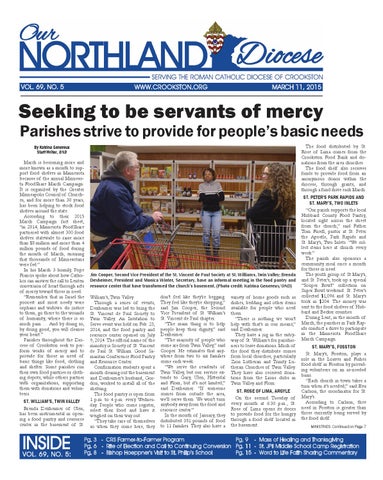
Jim Cooper, Second Vice President of the St. Vincent de Paul Society at St. Williams, Twin Valley; Brenda Dexheimer, President and Monica Winter, Secretary, have an informal meeting in the food pantry and resource center that have transformed the church’s basement. (Photo credit: Katrina Genereux/OND)
William’s, Twin Valley. Through a series of events, Dexheimer was led to bring the St. Vincent de Paul Society to Twin Valley. An Invitation to Serve event was held on Feb. 23, 2014, and the food pantry and resource center opened on July 9, 2014. The official name of the ministry is Society of St. Vincent de Paul St. William Good Samaritan Conference Food Pantry and Resource Center. Confirmation students spent a month clearing out the basement and Dexheimer’s husband, Gordon, worked to install all of the shelving. The food pantry is open from 1 p.m. to 4 p.m. every Wednesday. People who come register, select their food and have it weighed on their way out. “They take care of themselves so when they come here, they
don’t feel like they’re begging. They feel like they’re shopping,” said Jim Cooper, the Second Vice President of St. William’s St. Vincent de Paul chapter. “The main thing is to help people keep their dignity,” said Dexheimer. “The majority of people who come are from Twin Valley,” said Cooper. He estimates that anywhere from two to six families come each week. “We serve the residents of Twin Valley, but our service extends to Gary, Ulen, Hitterdal and Flom, but it’s not limited,” said Dexheimer. “If someone comes from outside the area, we’ll serve them. We won’t turn anybody away from the food and resource center.” In the month of January, they distributed 351 pounds of food to 11 families. They also have a
variety of home goods such as dishes, bedding and other items available for people who need them. “There is nothing we won’t help with that’s in our means,” said Dexheimer. They have a jug in the entryway of St. William’s for parishioners to leave donations. Much of the food they distribute comes from local churches, particularly Zion Lutheran and Trinity Lutheran Churches of Twin Valley. They have also received donations from the Lions clubs in Twin Valley and Flom. ST. ROSE OF LIMA, ARGYLE On the second Tuesday of every month at 6:30 p.m., St. Rose of Lima opens its doors to provide food for the hungry through a food shelf located in the basement.
ST. PETER’S PARK RAPIDS AND ST. MARY’S, TWO INLETS “Our parish supports the local Hubbard County Food Pantry, located right across the street from the church,” said Father Tom Friedl, pastor at St. Peter the Apostle, Park Rapids and St. Mary’s, Two Inlets. “We collect items here at church every week.” The parish also sponsors a community meal once a month for those in need. The youth group of St Mary’s, and St. Peter’s, took up a special “Souper Bowl” collection on Super Bowl weekend. St. Peter’s collected $1,096 and St. Mary’s took in $204. The money was sent to the food shelves of Hubbard and Becker counties. During Lent, in the month of March, the parishes in Park Rapids conduct a drive to participate in the Minnesota FoodShare March Campaign. ST. MARY’S, FOSSTON St. Mary’s, Fosston, plays a role in the Loaves and Fishes food shelf in Fosston by providing volunteers on an as-needed basis. “Each church in town takes a turn when it’s needed,” said Eva Carlson, the coordinator for St. Mary’s. According to Carlson, thee need in Fosston is greater than those currently being served by the food shelf. MINISTRIES: Continued on Page 7
Pg. 3 - CRS Farmer-to-Farmer Program Pg. 9 - Mass of Healing and Thanksgiving Pg. 6 - Rite of Election and Call to Continuing Conversion Pg. 11 - St. JPII Middle School Camp Registration Pg. 8 - Bishop Hoeppner’s Visit to St. Philip’s School Pg. 15 - Word to Life Faith Sharing Commentary
2 March 11, 2015
A
COMMENTARY
OUR NORTHLAND DIOCESE
Voice from the Valley BY BISHOP MICHAEL J. HOEPPNER
LENT I hope your Lenten journey is progressing well. We continue to pray for our catechumens who are preparing for the sacraments of initiation and for our candidates who are preparing for full communion with us in the Catholic Church. All of us continue to prepare our hearts and minds to celebrate the Passion and death of Jesus as we move through Holy Week this year. We are thankful that God loves us so much that he gave us his only Son who died on a cross for us and for the salvation of the world. It is the Sign of the Cross with which we sign ourselves as baptized Christians, followers of Jesus Christ who are baptized into the new life he brings. Unfortunately, in our world today, there are ample reminders that evil resists the person and message of Jesus and his followers. In Libya, the murders of 21 Coptic Christians by the socalled Islamic State displayed for the whole world the face of fanaticism, the reality of religious persecution and the presence of evil. In noting that these people were beheaded “for the mere fact of being Christian,” Pope Francis called upon world leaders and all people of good will to work to rid the world of “fanaticism and fundamentalism.” The Holy See reiterated that it is licit to use force that is “proportionate and discriminate” and employed within the framework of
“international and humanitarian law” to stop unjust aggressors and protect religious minorities and civilians from these brutal attacks. While noting this, Pope Francis has also been clear that “the problem cannot be resolved solely through a military response.” What is needed is a solidarity and respect for human life, a respect for religious freedom, care for one another and the environment and as Pope Francis said, “commitment to ensuring what each person requires for a dignified life.” Leadership of the Catholic Church here in the United States has urged President Obama and our leaders in Congress to continue to do all they can to address these serious matters. The chair of the United States Conference of Catholic Bishops International Committee lead a solidarity visit on behalf of our Conference of Bishops to the Kurdish region of Iraq where hundreds of thousands of Syrians and Iraqis, including Christians, Yezidis and Muslims, have fled the terror of the “Islamic State,” many of them carrying with them only the clothes on their backs. We continue to urge our government and others to help provide humanitarian assistance and protection for these refugees. Lent is a time for added prayer. Please continue to pray for an end to this fanaticism, for greater respect for life and religious
freedom and a truly dignified life for all people and join in giving, through Catholic Relief Services or other agencies, for the humanitarian assistance desperately needed. Jesus carried the cross of suffering so that all people might have life in its fullness. As we gratefully thank him this Lent and Easter, may he make us instruments of his peace. PARISH LIFE Speaking of fullness of life, I thoroughly enjoyed reading the last reports from our parishes on what they’re doing in relation to our pastoral letter, Meeting Christ – Living Christ. Every six months, the parishes file a report on how things are going and the latest reports are evidence of many good things. Regarding prayer, parishes report the following new initiatives have begun: one started a Prayer Committee; in another parish, members committed to at least 10 minutes of prayer each day; others report use of prayer cubes; more communal prayer of the Rosary; encouraging adoration and increasing adoration from one hour to six a week; offering training for how to pray and how to go about prayer before the Blessed Sacrament; starting communal Morning Prayer and starting prayer groups inviting the Holy Spirit to be present and alive. Regarding the Eucharist, one parish reported hiring a liturgy direc-
BISHOP’S CALENDAR March 17 March 17 March 18 March 19 March 24 March 25 March 26
7:45 a.m. Mass, Cathedral, Crookston 12:30 p.m. Deans Meeting, Chancery, Crookston 9:00 a.m. 12:00 p.m.
School Mass & Classroom Visits, Holy Rosary, Detroit Lakes Priests Council Meeting, Chancery, Crookston
7:00 p.m.
Reconciliation, Cathedral, Crookston
8:45 a.m.
Mass & Classroom Visits, Cathedral, Crookston
12:00 p.m. Diocesan Finance Board Meeting, Chancery, Crookston
VICTIM ASSISTANCE STATEMENT: If you or someone you know has been sexually abused, your first call should be to law enforcement. If you have been abused by a Catholic priest or another person in Church ministry, the Diocese of Crookston Victim’s Assistance Coordinator is also available to offer you help and healing. Please contact Louann McGlynn at 218281-7895 (24-hour confidential number) or Lmcglynn@crookston.org.
tor. Others reported working on full and active participation, beginning a youth choir, starting bulletin inserts on the Eucharist, offering classes and workshops on the Eucharist and the other sacraments and offering sessions explaining the Mass before Sunday Masses. Highlighting our Year of Marriage, some parishes began recognizing marriage anniversaries at Mass. Other parishes reported having special Masses for married couples, having married couple retreats, having a married persons’ date night once a month, joining in diocesan marriage events, blessing marriages each month, offering reading material on marriage and giving homilies specifically focused on marriage. Many parishes also reported training couples to help in marriage preparation. Parishes also participated in the three day seminar on healing of families, in World Wide Marriage Encounter and in sessions on natural family planning. The parishes reported that old groups continue to meet and
new groups were started. Many parishes had ARISE groups. One parish started a St. Vincent de Paul group, another began a befriender group. There are men’s discipleship groups and women’s discipleship groups started. There are Bible study groups for adults and the young, groups studying the Catholic Catechism, groups studying other materials, i.e. Father Robert Barron’s Catholicism series, and there are youth faith-sharing groups. Parishes have addressed outreach. One parish started a St. Monica’s Ministry Support Group for people who have had family or friends leave the Church. Another started a Welcoming Committee. There are groups supplying food for the hungry and home visiting committees and home visiting volunteers to reach out to re-engage the non-practicing. It is wonderful to see the excitement and energy of vibrant parish life present throughout this local church within the Diocese of Crookston. May God bless our efforts at fulfilling the mission He has given us.
(USPS 414-940)
Our Northland Diocese is a semi-monthly newspaper committed to publishing Good News for the purpose of strengthening and furthering the Reign of God in the Roman Catholic Diocese of Crookston.
Subscriptions: $13.65 per year in the diocese, $14.90 per year outside the diocese. Publisher:
The Most Reverend Michael J. Hoeppner Bishop of the Diocese of Crookston
Editor:
Rev. Robert Schreiner Office of the New Evangelization, Director
Associate Editor:
Mrs. Janelle C. Gergen jgergen@crookston.org
Editorial Assistant: Mrs. Katrina Genereux kgenereux@crookston.org Proofreader:
Deacon Dan Hannig
For questions about subscriptions or address changes, please contact: Renee Tate at rtate@crookston.org Periodical postage paid in Crookston, MN and additional mailing offices. Postmaster: send address changes to: Our Northland Diocese PO Box 610, Crookston, MN 56716-0610 Phone: 218-281-4533 Publishing dates and submission deadlines for news and advertisements can be found online: http://www.crookston.org/ond/
OUR NORTHLAND DIOCESE
DIOCESAN
March 11, 2015
3
The vocation of farmers and a unique invitation to serve By Amanda Zurface Coordinator of Justice, Marriage and Family Life, Office of the New Evangelization CROOKSTON, MINN. — In 2013, Dodge sponsored a Super Bowl commercial titled: “Farmer.” It featured excerpts from Paul Harvey’s “So God Made a Farmer” speech which was originally delivered in 1978. You may remember it. The opening lines of the speech go like this: “And on the eighth day, God looked down on his planned paradise and said ‘I need a caretaker.’ So God made a farmer …” The ad, which sparked nostalgia and emotional sentiments for viewers, reminded the American people of the strength, dedication and sacrifice which goes into farming, as well as the overall importance of the vocation of farmers. At the beginning of the year, our Holy Father, Pope Francis, gave yet another reminder to
the whole world by addressing the overall role and responsibility of farming and agriculture. The Pontiff expressed that “[i]n a world marked by wastefulness and extreme climate change, they have the important vocation of caring for the earth and providing for all humanity.” Because of the importance of farming here and abroad, Catholic Relief Services (CRS) has established an all-expenses-paid opportunity called the Farmerto-Farmer program. This program calls upon United States farmers and educators to volunteer in one of four African countries. They travel to Ethiopia, Kenya, Uganda or Tanzania to help strengthen farming techniques and improve animal health. In the United States, it is easy to forget the importance of the history, resources and skills used by farmers. Each farmer is unique and blessed. Farming vocations are often first cultivated
in childhood. Many farmers grow up close to the land, learning the necessary skills from their parents, grandparents, aunts and uncles. Most American farms have been in families for four or more generations! While the number of people
studying agriculture and entering the life of farming appears to be increasing, nowadays, many farmers need second jobs to support their farms in order to survive. Farm-life can be challenging. Farmers work hard and many sacrifice to raise food for their own families and for the people of the United States, and beyond. The American farming life includes many joys as well. The communal aspect of farming is one of those joys. Family and farming companions work together and help with the needs at hand. CRS seeks the history, experience and skill of the American farmer to guide the farmers in these African countries. Participants in the program help by teaching them how to improve productivity, access new markets, conserve environmental and natural resources, and develop the local capacity necessary to increase food production and rural incomes (www.catholicrur-
allife.org). The Farmer-to-Farmer program provides a way for United States farmers, as Pope Francis said, to live their “vocation of caring for the earth and providing for all humanity,” but in a different light. Volunteers assist African farmers through shortterm trainings and technical assistance projects. Farmers and educators in the Diocese of Crookston are invited and encouraged to participate and learn more about ways to share their gifts abroad. We are thankful to all of the farmers and educators in the area of agriculture in the Diocese of Crookston for their ongoing commitment and hard work. For more information, visit www.farmertofarmer.crs.org or contact the Office of the New Evangelization at (218) 2814533, ext. 425.
4 March 11, 2015
COMMENTARY
OUR NORTHLAND DIOCESE
Through a people touched by God At daily Mass in the Bishop’s chapel, the Chancery staff in attendance read aloud the petitions which have been given to Bishop Hoeppner through the DAA for his prayerful intercession. As we lift these needs to the Lord, one cannot help but recognize over a period of time just how many parents and grandparents are aching over the loss of faith of their children and grandchildren. This phenomenon of the deChristianization of Christian people and Christian culture goes by many names: e.g.: secularism, atheism, indifferentism, etc. Pope St. John Paul II identified it as the end effect of the Culture of Death. But the net effect is the same: Faith (Christian faith in general and/or Catholic faith in particular) is gradually eroded and eventually disappears altogether as a way of life in individuals and eventually in an entire culture. Regardless of “how” it happened, parents and grandparents ache over what to do about
CREDO
A NEW EVANGELIZATION WITNESS
By Father Robert Schreiner, S.T.L. Director of the Office of the New Evangelization
it. And their turn to prayer is without question a right answer, and a beautifully inspired one as well. But the heart is still plagued with a desire to do something more. This, too, is a beautiful evangelizing impulse in the heart of believers born of a deep love of God and a deep love for those who have left the practice of faith. Is there an answer for those who desire to do something – anything – to “bring back” those no longer practicing their faith? Yes. And it is quite simple in the end. So simple it might seem not to take the question of doing something seriously enough. What is it? Live your
own faith with joy. Live your Catholic/Christian faith with the richness it brings you. Live your faith intentionally, purposefully and joyfully. There is no greater witness to the faith we profess than to simply live it – without rancor, without antagonism and without panic. The attractiveness of the faith is most effectively found on the face of a joyful Christian. I think this is what Pope Benedict was getting at when he spoke these words: “What we need at this time in history are people, who, through a faith which is enlightened and lived out in practice, make God credible in this world … We need
people who keep their gaze fixed upon God, learning from there what true humanity is. We need people whose intellect is enlightened by the light of God and whose hearts God may open up in such a way that their intellect may speak to the intellect of others and that their hearts may open the hearts of others. Only through people who are touched by God can God return to humanity.” In place of the word “humanity” at the end of Pope Benedict’s sentence go ahead and place the name of someone you love who has left the practice of their faith. Instead of the word “people” at the beginning of that sentence be thinking of yourself, so that it reads this way: “Only through me, who am touched by God, can God return to _______.” And if you, and – dare we hope – if all the Christians in your son or daughter or relative’s life did this, they would surely find their way back to the practice of faith.
The New Evangelization is specifically meant to reach all those people Bishop Hoeppner has been asked to pray for by parents and grandparents around our diocese and beyond. And we will certainly hold them all in our prayers. But there is more that can be done – each of us can allow our lives to be ever more deeply touched by God so that our daily life is so infused with God’s goodness and mercy that we, in turn, cannot help but radiate God upon our faces because our hearts are filled with Him. I pray that this Lent will find all of you deepening your life of faith in God; letting your hearts be ever more touched by God; and letting your lives be ever more co-opted by the Divine Will in all things. In doing so, you will be made the New Evangelizer your beloved sons and daughters and family members need in order to rediscover God … and come home again.
Our governor: License dog breeders, not abortion clinics Recently, I have written about the odd priorities of the legal system and legislatures in New York and California. Well, we are not exempt from such oddities in Minnesota. Little known to most people, our governor signed legislation a year ago, which went into effect last July, creating a licensing and inspection process for dog and cat breeders in the state. The governor said, in signing the legislation, “The humane and decent treatment of these innocent creatures is no longer an unwritten expectation, it is the law.” Just his use of the words “humane” and “decent” are so disconnected from reality in this context it is hard to fathom! The new law imposes health standards and requires commercial breeding facilities to be licensed by the Board of Animal Health. In contrast, Minnesota’s abortion centers are neither licensed nor inspected by the Department of Health. In 2012, a pro-life legislature passed a bill to license abortion facilities in the same way as other outpatient surgical cen-
LIFE FIRST By Father Don Braukmann Parochial Vicar - St. Philip’s Parish, Bemidji and St. Charles Parish, Pennington
ters, and to allow such facilities to be inspected. The governor vetoed the bill. The clinics would have been subject to up to two surprise inspections per year and a clinic could lose its license if it was found to have engaged in fraud, dangerous health practices or illegal activity. Why in the world would we not demand an outpatient abortion clinic to live under the regulations created to monitor other outpatient centers? As is well known, a person going in for a minor knee surgery at an outpatient facility receives more information about the surgery and the possible consequences than a woman receives
going into an abortion clinic to have her child stripped from her womb. She is never shown a picture of her baby. The governor tried to hide behind the National Abortion Federation which, he claims, “sets clinical policy for performing abortions.” Well, in 2011, the same organization made headlines when conditions at a Philadelphia abortion clinic under its watch were found to be so abhorrent the director was charged with and convicted of murder! The director, Kermit Gosnell, was sentenced to life in prison for killing at least three babies born alive after botched abortions. Former clinic employees
stated in court that Gosnell routinely performed illegal abortions past Pennsylvania’s 24-week limit. They also said he delivered babies who were still moving, whimpering or breathing, and that he and his staff dispatched the newborns by “snipping” their spines, as he referred to it. Staffers also revealed one teen was nearly 30 weeks pregnant when Gosnell aborted her “product of conception” and then allegedly joked the baby was so big it could “walk to the bus.” A second baby was said to be alive for about 20 minutes before a clinic worker snipped the neck. A third was born in a toilet and was moving before another clinic employee severed the spinal cord, according to testimony at the trial. The grand jury which indicted Gosnell criticized by name the National Abortion Federation for failing to report Gosnell to authorities, especially as its stated mission was to “promote health and justice for women.” This is the organization the governor trusts to regulate and monitor Minnesota’s abortion
clinics! Why is the welfare of animals more important than the welfare of women in Minnesota? No answer is offered but the governor is quick to join those who say basic monitoring of abortion facilities is part of the “War on Women.” Sorry, governor, the war on women is coming from those in your camp who insist their health and safety takes second place to the demands of the abortion industry. How else can such “exemptions” be interpreted? The most recent abortion stats for Minnesota are from 2013, and were calculated by the state health department. According to those stats, 9,903 abortions took place in the state in 2013, an average of 27 a day, more than one an hour, 24 hours a day, 7 days a week, 365 days a year. But, thanks to the governor, we can be sure our dogs and cats are healthy!
OUR NORTHLAND DIOCESE
COMMENTARY
March 11, 2015
5
Confession as a source of greatness Since the earliest times of Christianity, penance in the form of fasting, prayer and almsgiving, have been primary ways to express conversion on the level of self, God and others. However, the Church places a primary focus on the interior conversion of heart above any outward expressions of penance. Confession offers us this opportunity of conversion as we do battle with our weaknesses. It is a vehicle towards the goal of transformation. Pornography use (or any addiction) has a way of creeping back into the life of one who is on a path of recovery, unless there is a great deal of vigilance. At least part of this vigilance can be found with regular confession. Confession is a way that we experience God’s mercy and it is also a spark of grace encouraging the believer to take up the battle once again. Recently, I had the experience of taking my son to his first reconciliation. He is nor-
INTEGRITY HUMAN PERSON INSIGHTS
By Dan Spadaro, MA, LPC Syndicated through The Colorado Catholic Herald
mally a pretty adventurous boy, but when faced with confessing his sins to a stranger, he was pretty reluctant. In fact, at first he flat out refused. So after some preparation and coaching, he went with his siblings to the chapel at the mall. He was the last one to go in. But when it was all over, he ran out with an expression of sheer joy that was hard to miss. It was a good reminder for me that this stuff is meant to be great. I think that we can identify with the fear of bearing all to someone, but for the man or
woman recovering from a history of pornography use, or sexual addiction, it can almost be unbearable. I have witnessed very few things more difficult, than for a man to work up the courage to disclose his struggles to his spouse or to a loved one. Confession takes courage. Reading the stories of King Arthur and Robin Hood, by Roger Lancelyn Green, you learn inspiring examples of courage and virtue. In the stories, these men honored legitimate authority, the Blessed Mother,
and were willing to die for their brothers. Their courage seemed to come naturally, but it usually had a price. They trained themselves to confront evil rather than run in fear. We all need examples of heroes or heroines; that’s what the saints are. We need real courage to face our sins, call them out, and do battle. Within the confessional and spiritual direction there is a realization that we are not alone in the battle and real help is available. This grace is a help along the way. Confession when repeated with the same priest can also be a form of accountability. I like the definition of accountability offered by Matt Fradd – that it helps us see who we are and who we want to be. Sometimes without this accountability we fall into discouragement or avoidance of the problems. I also think a lot of guys come to confession wanting real solutions and someone to know them. They recognize that
good things should take effort and they eventually recognize the spiritual benefits. We might not always experience confession as profound or inspiring and it can take time to fully trust the process. We realize that in confession we have nothing to prove and no need to hide. Addiction recovery is very similar. We open up about the “big ones” and then unravel the distorted attitudes and desires which underlie the problem. We lead with our weakness and walk out a free person. So we can have great confidence in God’s mercy and find this in the sacrament of reconciliation. We also find that this sacrament and Lent are part of the journey of transformation on both human and spiritual levels. My son may not be seen as a heroic figure of history for facing his first confession, but his courage in confession can be a source of greatness that we can all learn from.
Affordable housing key to helping people move out of poverty This year, the Minnesota Catholic Conference has joined many other organizations in supporting the Homes for All agenda currently before the Minnesota Legislature. Homes for All is a collaborative initiative of many organizations working to combat homelessness and create affordable housing opportunities. The Homes for All proposal invests $39 million to address a spectrum of housing needs, such as developing more affordable housing, providing services to prevent homelessness, and making rental assistance available to low income families. The proposal breaks down into $19.5 million for housing (through MN Housing Finance Agency), bill HF 886/SF456, and $19.5 million for services (through Department of Human Services), bill HF1054 /SF551. These appropriations would help Minnesotans of all walks of life find affordable, quality housing. AFFORDABLE HOUSING OUT OF REACH FOR MANY An integral part of the “American Dream” is the promise that every family, rich and poor, can have an affordable place they can call their own. The home has always played an important role in our nation’s imagination.
FAITH
IN THE PUBLIC SQUARE
By Mr. Ben Jones
Law Clerk for Minnesota Catholic Conference and third-year law student at the University of Minnesota
No matter what shape your home takes, it is much more than a place to lay your head. The home represents independence, security, and the chance for self-determination. Sadly, the reality has never completely matched the dream. Throughout history, millions of Americans have suffered homelessness. Others have worked hard just to hold onto any shelter, including crowded tenements and substandard houses. Still others have been forced to repeatedly move from one substandard place to another due to changes in economic fortune. Homelessness and the lack of access to affordable housing is not a problem of our past. By some measures, affordable housing is growing further and further out of reach for more Americans. Housing costs have increased faster than wages in
recent decades, and the number of Americans spending more than the recommended 30 percent of household income on their housing has increased by more than seven million. Families with excessive housing costs now comprise more than onethird of all American households. In Minnesota, a majority of renters cannot afford a market rate, two-bedroom apartment without spending more than 30 percent of their income. Homelessness remains ever-present, and an average of 372 families seek refuge in public shelters every day in Hennepin County alone. ACCESS TO HOUSING IS A PATH OUT OF POVERTY Pope St. John XXIII, in his encyclical Pacem in Terris, listed housing prominently among the rights inherent to all people as beings created in the image
of God. Pope St. John Paul II made clear why this need is so crucial. In his words, “a home is more than a roof over one’s head.” It is “a place for building and seeking one’s life.” As Catholics, we have an obligation to work towards placing adequate and safe housing within the grasp of all persons. We are commanded to be open-handed to the poor in our midst. (Dt 15:11) Christ has called on us to provide for those, like Lazarus, who live outside the gates of our homes and communities. (Lk 16:19) Ensuring access to safe and affordable housing is both a mandate of our faith and good public policy, and it is a step towards a more equal, prosperous, and self-reliant society. Providing people access to adequate housing costs relative to their household budget has proven to be a tremendous boon to the fight against poverty. When people have the foundation of an adequate home, and the security of stable living costs, they are freed to flourish and develop their potential. They can devote their energy and resources to making long-term improvements in their lives and in their children’s lives. One notable study on the Minnesota Family Investment Program found that access to
public or subsidized housing significantly increased the recipient’s employment rate and wage level. Keeping housing costs to a manageable level of a household’s budget leads to superior child development outcomes across the board. Children raised in a household that has access to affordable housing have higher rates of better nutrition and stronger health, and lower high school drop-out rates, as well as improved levels of overall academic performance. REALIZING THE DREAM Catholics are called to create a preferential option for the poor—preferential concern, or priority, for the people among us who are most vulnerable. Support for affordable housing initiatives, like Homes for All, help in providing “the means necessary and suitable for proper development of life” (Pacem in Terris, 11), and give many of our fellow Minnesotans a step up in their own efforts to escape poverty. Working together to foster the common good is an important step towards someday making the American Dream a reality for all. For more information about Homes for All, visit http:// www.mhponline.org/policy/ state/homes-for-all.
6 March 11, 2015
AROUND THE DIOCESE
OUR NORTHLAND DIOCESE
Deacon Kermit Erickson proclaims the Gospel during the Rite of Election and Call to Continuing Conversion. (Photos by: Katrina Genereux/OND)
Moving forward on the journey to Easter By Katrina Genereux Staff Writer, OND CROOKSTON, MINN. — The Rite of Election and Call to Continuing Conversion can be summed up by Bishop Michael Hoeppner’s words prior to the intercessions: “My brothers and sisters, in beginning this period of Lent, we look forward to celebrating at Easter the life-giving mysteries of our Lord’s suffering, death, and resurrection. These elect and candidates, whom we bring with us to the Easter sacraments, will look to us for an example of Christian renewal. Let us pray to the Lord for them and for ourselves, that we may be renewed by one another’s efforts and together come to share the joys of Easter.” It was for this purpose that nearly 80 people gathered at the Cathedral of the Immaculate Conception at 3 p.m. on Sunday, Feb. 22 for the Rite of Election and Call to Continuing Conversion. The Rite of Election is the ceremony in which Catechumens (those seeking initiation through Baptism, Confirmation and Eucharist) from across the Diocese of Crookston are presented to the bishop and write their names in the Book of Elect. The Call to Continuing Conversion is celebrated by Candidates (those who have already been baptized, but who seek initiation through Confirmation and Eucharist) from parishes throughout the Diocese of Crookston. During his homily, Bishop Hoeppner welcomed all the candidates, catechumens, godparents, sponsors and their supporters. He addressed the Candidates and Catechumens saying, “God is calling you because he
Bishop Michael Hoeppner signs the Book of the Elect following the Catechumens, who watch with their sponsors.
James Erickson sits with his candidate Morris Pyle, and MorBishop Hoeppner greets Sonia N’Kulu, ris’ wife, Jeanette Pyle, at the reception following the rites. The a candidate from St. Joseph’s, Moor- Pyles have been married five years and attend St. Francis de head. Sales, Moorhead
loves you and wants to bestow his blessings upon you.” “The Eucharistic Sacrifice, the memorial of the death and resurrection of the Lord in which the sacrifice of the Cross is perpetuated over the centuries is the summit and the source of all Christian life,” continued Bishop Hoeppner. “It signifies and effects our communion, the communion, the unity of the people of God and achieves the building up of the Body of Christ … As Pope St. John Paul II put it,
‘We are born from the Eucharist. The holy church and all she does lives from the Eucharist.’ … We look forward to your joining us in this most wonderful banquet of God’s Eucharist. I encourage you catechumens and candidates, stay close to Christ by remaining close in the communion of the Church.” Andy Hall is a candidate from Holy Rosary, Detroit Lakes. He and his wife, Leann, were married this summer and moved to Detroit Lakes from the Twin
Cities area. “I am most excited to receive the Eucharist,” said Andy. “That’ll be my ‘yeah’ moment.” He added that he might do a fist pump out of excitement when he receives the Eucharist for the first time. Carolyn Holecek is the Rite of Christian Initiation for Adults (RCIA) coordinator at St. Bernard’s, Thief River Falls. She said, “I think for candidates and catechumens, it is kind of like going to a mountain top on
a journey, coming closer to the Lord. I see how Bishop Hoeppner talked about the Eucharist being the source and summit. We come together as a diocese to that mountain.” In her experience as RCIA coordinator, a teacher, and as a sponsor, she said candidates and catechumens are usually very eager to receive the Lord in the Eucharist. She said that the Rite of Election and Call to Continuing Conversion are important times to gather with those who are moving toward the waters of baptism and the banquet of the Eucharist and to share in their joy. Tracy Waggoner and his wife Diane were married in August and belong to St. Philip’s, Bemidji. Tracy said his journey so far has been important. He added that he wants to have more faith and understanding of the Eucharist. “I’m still trying to get used to that,” he said. Amanda McMullen is a candidate from St. Bernard’s, Thief River Falls. She said she is looking forward to going to communion with the rest of her family. “She teaches me new things,” said McMullen’s husband, Scott. He said some of the things in the RCIA classes he knew before, but had forgotten. Amanda is reminding him. Deborah Hegg is a catechumen from the Cathedral, Crookston. She is looking forward to her baptism at the Easter Vigil Mass. “My age brought me here. I’ve never been baptized,” she said. “It was time … I didn’t want to die unbaptized.” Hegg is enjoying the RCIA classes. She said her favorite parts have been, “being able to ask questions and not feel stupid, and being welcomed and fully embraced.”
OUR NORTHLAND DIOCESE
AROUND THE DIOCESE
March 11, 2015
7
MINISTRIES: Continued from Page 1
“There are more people who would come if they didn’t feel like they were asking for something,” she said. “I wish more people would feel more comfortable coming there.” The food shelf is open the first and third Wednesday of every month from 1 to 3:30 p.m. At St. Mary’s, there is a basket out for people drop off food for the food shelf.
ST. PHILIP’S, BEMIDJI St. Philip’s is one of 18 churches in Bemidji that support the Bemidji Community Food Shelf. Pearl Cervenka and Mary Jo Vorgert served as representatives for St. Philip’s on the food shelf board for 10 years. The seat is currently vacant. According to Cervenka, St. Philip’s provides volunteers on the fourth Monday of every month. There are currently 35 volunteers who take turns filling 16 spots each time. “Our volunteers guide clients in selecting a three to five day supply of food, stock shelves and help at stations in the reception area, weighing of food, and checking out clients,” said Cervenka. The food shelf is open from 10 a.m. to 3 p.m. Monday, Wednesday, and Friday. Every third Monday, they are open until 5 p.m. The food shelf has added a garden in recent years. According to their November newsletter, in 2014, they grew 5,500 pounds of food that went directly to the food shelf. Mary Mitchell, Manager of the Bemidji Community Food Shelf said as of mid-February, they had distributed 106,237 pounds of food in 2015. Mitchell also said the Minnesota FoodShare is very important to their operation. “It is a huge fund and food drive that keeps us afloat over the summer when donations are typically down. A portion is matched through the Greater Minneapolis Council of Churches, and last year the match amounted to $10,000, so it is very significant.” St. Philip’s is collecting both food and cash donations for the Minnesota FoodShare March Campaign. Food items can be dropped off in a shopping cart at the church, and monetary donations can be placed in the offertory collection at Mass in envelopes marked “food shelf.” All food and proceeds will be delivered to the Bemidji Community Food Shelf on March 31. St. Philip’s also runs a Clothing Depot that has been in op-
Shirley Curtis, Assistant Manager of St. Philip’s Clothing Depot, helps a customer at the register. (Photo credit: Katrina Genereux/OND)
eration since 1972. “We have upped the prices a little bit in the last 30 years,” said Norma Himmelright, the manager of the Clothing Depot. Most items at the store cost less than a dollar. Himmelright has been working at the thrift store since the beginning. She said it is important to her to keep prices down so the thrift store can continue to provide clothing and other items to those who are most in need. The shop is open Tuesday through Saturday from 9:30 a.m. to 3 p.m. The Clothing Depot relies on local volunteers to sort, price and organize the large amount of inventory that is donated. “People are really generous,” said Himmelright. Kathy Jones is a parishioner of St. Philip’s. She started doing mending for the clothing depot four years ago and has been volunteering at the store for the past two years. “I’ve always been interested in the Clothing Depot since we joined the parish in 2005,” Jones said. “You feel like you’re helping the community – the people who come in here and the donations that go out into the community.” Shirley Curtis is the Assistant Manager and has been with the Clothing Depot for ten years. “I notice the need is on the rise,” she said. “There is a high demand and low pricing is what we’re here for.” Jessica Powell lives in Bemidji and shops at the Clothing Depot once or twice a month. “I just like the prices,” she said. “A lot
of times I can find something I can’t find elsewhere. I have kids, so when I can find things at nice prices, it is good.” Proceeds from items sold at the Clothing Depot go to a variety of organizations. They recently announced the allocation of funds for the year ending Feb. 28, 2015. They donated a total of $30,000, including $10,000 to Bemidji Community Food Shelf; $5,000 to LSS Senior Nutrition; $3,000 to the Senior Activity Center; $5,000 to Evergreen House; $2,750 to Northwoods Pregnancy Care Center; $2,750 to St. Philip’s Youth Ministry and $1,500 to People’s Church to help supply mattresses for people in need. CATHEDRAL OF THE IMMACULATE CONCEPTION, CROOKSTON “Our local assistance to the poor is provided in great part by the Care and Share ministries,” said Father Vincent Miller, Rector of the Cathedral of the Immaculate Conception, Crookston. Care and Share is an independent organization that was started by Sister Justina Violette, OSB. The Cathedral has some involvement through parishioners on the board, taking up collections for Care and Share and coordinating a giving tree during Advent. “The Care and Share offers emergency and transition housing for adults and families in need,” said Susan Shirek, the director of Care and Share. There are individual rooms for five women and 10 men. There
is also a large dormitory space that can house 25 men comfortably, and a building that can hold up to six families, depending on their sizes. Care and Share provides three meals a day. According to Shirek, breakfast is usually toast or cereal. Lunch is served daily at noon, and supper is at 6 p.m. These meals are available not only to the residents of Care and Share, but also to anyone in the community who is in need. “It is a nice outreach, and a way for people who used to live here to reconnect and maintain relationships,” said Shirek. Generally, the food is prepared by the kitchen manager and cooks who work there. Sometimes food is donated or prepared by volunteers. “We get food from the grocery store, food bank, or what people drop off. Sometimes we get leftovers from banquets,” said Shirek. “The people, as a whole, from the diocese have been very supportive,” said Shirek. “We don’t just take care of people from Crookston … Our outreach is broad-based, and what we receive from the area is awesome.” Care and Share is able to offer many types of support to people from around the region with needs including gas vouchers for doctor’s appointments, and school supplies and winter coats for kids. The Holy Family Shop, a long running thrift store sponsored by Care and Share, recently moved to a new location and changed names to Care and Share Thrift Shoppe. They opened their doors at what used
to be the Crookston National Bank at 116 West Robert Street, in Crookston on March 1. Paul and Sis Eickof donated the building, and the entire thrift store inventory was moved over the course of a few weeks at the end of February. “Everything donated goes to a good cause,” said Shirek. “It helps us provide jobs to people who have been former residents here.” The thrift shop also helps supply items to residents who are either just coming into the Care and Share or preparing to leave. Sometimes people move into the Care and Share with nothing other than the clothes they’re wearing. “Through the thrift shop, they are able to get a couple outfits and begin to get stabilized,” said Shirek. She hopes that the thrift store will be successful enough to become a viable source of income for Care and Share. “With nonprofit funding sources being the way they are, the more things we can do to be self-sufficient, the better off we are,” she said. Shirek hopes to turn the space previously occupied by the thrift store into a communal greeting and visiting space, as well as classrooms that will meet the needs of the residents. She hopes to offer money management, budgeting, cooking, nutrition, and GED classes in the future. “This place becomes a place that becomes home for a while,” said Shirek. “It gets them on their feet and helps them touch base with other people they can feel comfortable with.” Donations for the thrift store can be brought to the new location. Anything people want set aside or donated directly to the residents can be brought to the Care and Share building, Shirek said.
ST. JOSEPH’S, MOORHEAD St. Joseph’s, Moorhead, provides volunteers and other support for the Dorothy Day Food Pantry. The current site at 1308 Main Avenue, Moorhead, was purchased in 1999 and remodeled in 2009. They use the choice model so people can choose their own food. In that way, it is similar to a grocery store. They also recently partnered with Land O’ Lakes to purchase milk and eggs; all other food is donated by the community. “Every single day people MINISTRIES: Continued on Page 12
8 March 11, 2015
Bishop Hoeppner visits students at St. Philip’s School By Katrina Genereux Staff Writer, OND BEMIDJI, MINN. — On Feb. 25, Bishop Michael Hoeppner travelled to Bemidji to celebrate Holy Mass with the students of St. Philip’s Catholic School and spend the day visiting with them in their classrooms. During his homily, Bishop Hoeppner talked to the students about a hot air balloon festival in New Mexico. He told them that all the balloons had sand bags attached to them, and in order to go higher, they had to drop some of the sand bags. He then made a comparison
Above: Students in Mrs. Sue Hengel’s first grade class raise their hands to ask Bishop Hoeppner a question during his visit to their classroom on Feb. 25. Right: Bishop Hoeppner writes on the board in Mrs. Karen Williams’ eighth grade classroom. He was explaining to the students how the sacrifice of Calvary is made present on the altar each time they are at Mass. (Photos by: Katrina Genereux/OND)
to Lent saying “Lent is a time to take a look inside and ask God to help us know ourselves and help us drop off whatever is holding us back.” Bishop Hoeppner visited each classroom throughout the day and spoke to the students about the signs of a bishop, the seven sacraments and the Mass. In each classroom, he talked about the times during Mass that processions take place. “Processions here never stop on earth … we are all caught up in a procession from here to eternity,” Bishop Hoeppner said. “The liturgy is carrying us into heaven.”
AROUND THE DIOCESE
OUR NORTHLAND DIOCESE
Left: Students in Mrs. Kaitlin Graham’s kindergarten class lean in to see Bishop Hoeppner’s amethyst ring while he explains how it symbolizes his duty to care for the bride of Christ, the Church. Below: Bishop Hoeppner sits with students for a few minutes to chat during their lunch period in the cafeteria at St. Philip’s School.
OUR NORTHLAND DIOCESE
AROUND THE DIOCESE
March 11, 2015
9
Faithful gather for Mass of thanksgiving, healing
Sacrament of Anointing of the Sick offered to those in attendance By Katrina Genereux Staff Writer, OND CROOKSTON, MINN. — More than 100 people gathered at the Cathedral of the Immaculate Conception, Crookston, at 3 p.m. on Feb. 24 for a Mass of thanksgiving and healing. Bishop Michael Hoeppner, Father Mario Prada, Father Bill DeCrans, and Father Vincent Miller presided and Deacon Denny Bivens assisted. At the beginning of Mass, Bishop Hoeppner said, “Many many months ago, Father Mario came and said ‘you know, my heart is full of gratitude to almighty God for leading me through my recent illness with cancer, and I would like to do a special prayer, a special Mass of thanksgiving, thanking God for his presence and action in my life, for filling my heart with great gratitude. I’d like to invite people to come and anyone else who is sick to come and receive the Sacrament of Anointing.’” Father Prada began his homily saying, “How glorious is this day for all of us, to be able to be gathered in the spirit. God is with us, in our midst. We were made in love, for love, love of God. It feels so good to be with all you brothers and sisters in the faith in Christ. I value and treasure your presence and of those who faithfully gave me their prayers and their offerings and I
Father Mario Prada delivers the homily at the Mass of thanksgiving and healing. Father Prada desired to have a special Mass of thanksgiving for the healing he has experienced, and to offer the Sacrament of Anointing of the Sick to others who are suffering. (Photo credit: Katrina Genereux/OND)
can tell those, I am a new priest; I have changed.” “God has taught us forgiveness and mercy,” continued Father Prada, “so that we may realize that God has not abandoned us. That he is our Lord, our savior, our eternal life. It is an invitation from God to tell us that we are people of the resurrection, of life everlasting, and
that should be the joy that guides us … May we continue every day to acknowledge the miracles that sometimes we don’t see, that we filter out, but that are real.” Following the homily, the Sacrament of the Anointing of the Sick was offered to all present.
Those who wished to receive the sacrament remained standing. Bishop Hoeppner and his brother priests moved through the pews laying their hands on and praying with those who stood. After praying with the individuals seeking healing, Bishop Ho-
Father Mario Prada lays his hands on an attendee’s head and prays over her during the Anointing of the Sick. (Photo credit: Katrina Genereux/OND)
eppner and the priests took up the Oil of the Sick and passed through the pews a second time, this time anointing those in need of healing.
10 March 11, 2015
YEAR OF CONSECRATED LIFE
OUR NORTHLAND DIOCESE
The impacts of Confession and sacrifice on vocations by Servant of God Fr. John A. Hardon, S.J.
CONFESSION AND VOCATIONS The sacrament of confession is closely related to priestly and religious vocations. It is not too much to say, in most cases, the sacrament of penance is a condition for recognizing, following, and remaining faithful to a vocation. How so? Recognizing: It is safe to say that those called by Christ are all sinners. They differ only in the degree of their sinfulness. In God’s ordinary providence those who have received a call to follow Christ in the priesthood or the consecrated life have no choice. Even to recognize they have a vocation, they must either acquire or maintain the habit of frequent confession. Nothing so blinds the mind in recognizing a vocation as sin. Nothing so forces the mind to hear Christ’s call as reduction in sin. So true is this that we can paraphrase the sixth Beatitude to read, “Blessed are the sinless of heart, for they shall see the will of God.” Frequent confession, as recommended by the Catechism of the Catholic Church, enables young persons to see what state of life God wants them to embrace. This is especially true if they are called to serve God in a lifetime commitment as priests or religious. Following: No less than sin blinds the intellect, so it weakens the will to accept the vocation to which the Savior calls certain people to “follow me.” Again, reception of the sacrament of penance strengthens the will to respond to Christ’s invitation. Every sin we commit lessens our will power to say, “Yes” to God. In the Church’s history, we read how often a single fervent sacramental confession has converted a great sinner and inspired the convert to become a great saint. So, too, frequent confession elevates the natural power of human freedom to give oneself to Christ without reserve. Perservering: We are living in what some have called the most unstable period in two millennia of Christianity. One reason for this is that so many once-believing Christians have lost their sense of sin. Whatever Happened to Sin is not only the title of a well-known book. It is a commentary on the moral condition of western society. Frequent confession is, there-
fore, not only a proved means of recognizing and following a vocation. It is also a most effective way of insuring perseverance in the priesthood or a life of the evangelical counsels. You might say this stands to reason. It is also confirmed by the Church’s experience. As we become more detached from sin, we become more generous in our response to Christ’s love. I know of nothing more certain to stabilize the priesthood and consecrated life in our day than the restoration of the practice of frequent confession. The teaching of Pope Pius XII could not be more clear. His words deserve to be memorized: “The sacrament of penance is the masterpiece of God’s goodness. By it our weakness is fortified. “It is true that venial sins may be expiated in many ways which are to be highly commended. But to ensure more rapid progress day by day in the path of virtue, we desire that the pious practice of frequent confession, which was introduced into the Church by the inspiration of the Holy Spirit, should be earnestly advocated. By it, genuine self-knowledge is increased, Christian humility grows, bad habits are corrected, spiritual neglect and tepidity are resisted, the conscience is purified, the will strengthened, a salutary self-control is attained, and an increase of grace is secured by the very fact that the sacrament is received.” Frequent confession is eminently valuable for every state of life. It is imperative for discovering, maintaining, and sustaining the vocation of those who are called by the Redeemer to follow Him “the whole way.” SACRIFICE AND VOCATIONS Every vocation is born of sacrifice, is maintained by sacrifice and is measured in the apostolate by the sacrifice of those whom God calls to the priesthood or the religious life. This should not be surprising, once we realize that it was by His sacrifice that Christ redeemed the world. The servant is not greater than his Master. In fact, the more intimate is one’s vocation to the service of Christ, the more demanding will be the sacrifices required. Barring an extraordinary grace from God, He generally calls those persons to follow Him as priests or religious, who
have been taught the value of sacrifice from childhood. The experience of self-denial in the use and enjoyment of material things is the normal predisposition for a lifetime practice of evangelical poverty. Training in self-control of the senses, especially in the use of the media, is the ordinary preparation for a lifelong dedication to consecrated chastity. Careful and loving nurture in self-denial, almost from infancy, is God’s usual way of conditioning the human will for commitment to the counsel of obedience. If sacrifice in childhood and young adulthood is the seedbed of vocations, continued fidelity in serving the Church is impossible without the habit of self-surrender. There are many reasons for the tragic loss of so many once-dedicated persons in affluent countries like America. But surely one of these reasons is the prior loss of a willingness to give in to the sometimes hard demands of Christ’s love. We may, therefore, say that vocations are nourished on sacrifice as the body is sustained on food. Or, as the Savior told His followers – and bade them follow His example – “My meat is to do the will of Him Who sent Me.” Sacrifice is finally the condition and norm of apostolic work in the priesthood and religious life. Who have been the great achievers in the vineyard of the Lord over the centuries? Have they not been the men and women who never said, “Enough” in their zeal for souls; who labored, like St. Paul, in season and out of season, selflessly and exhaustingly; who never counted the cost in time or effort or personal preference; in a word, who lived lives of heroic sacrifice? All of this is common knowledge for those who have come to know Christ Who, “having joy set before Him, chose the Cross.” But this kind of knowledge needs to be taught – and learned – if the vocations which the Church so desperately needs are to be fostered and preserved in our day. Servant of God Fr. John A. Hardon, S.J., founded the Institute on Religious Life in 1974. These meditations written by him were taken from the Institute on Religious Life at http://irl.solutciosoftware.com.
PLEASE
pray for vocations to the priesthood and religious life
OUR NORTHLAND DIOCESE
AROUND THE DIOCESE
March 11, 2015
11
Register now for St. John Bronze Pelican Award Paul II Middle School Camp presented to Rezac By Elizabeth Rzepka Coordinator of Catechesis and Youth Ministry Office of the New Evangelization
This summer, young people entering grades seven through nine are invited to the Diocese of Crookston’s annual St. John Paul II Middle School Camp taking place Sunday, July 5 through Thursday, July 9 at the Northern Pines Camp and Retreat Center in Park Rapids. The camp’s mission is to empower young people to become disciples of Jesus Christ by engaging them in prayer, worship, leadership skill development, scriptural reflection, and service learning. This Camp is designed for youth who have a desire to grow in their faith and to share that faith in their daily lives. St. JP II Camp creates a space, a place and a time for campers individually and communally to encounter Jesus Christ in a personal way, a way that can lead to a life-giving and life-long personal relationship with their Lord and Savior. The camp is a powerful fiveday journey for one-hundred campers and over thirty staff. Campers participate in various types of prayer, learning to read scripture, and serving others out in the community of Park Rapids in order to provide them with some of the essential building blocks of Christian discipleship. While each day is filled with
fun and fellowship, worship and sacraments, learning and workshops, prayer is always at the core of the week-long journey, intended to be the bedrock foundation for all other elements of Camp. Each day builds in anticipation of what is typically the highlight or capstone experience of Camp: Four Corners Prayer. In the presence of the Blessed Sacrament, the young people are invited to receive their Heavenly Father’s infinite mercy in the Sacrament of Confession and to offer Him adoration and Worship. The Campers are invited to ask Jesus to increase their faith, heal wounds, provide peace in their lives, and to intercede for specific prayer requests through Four Corners prayer ministry with camp staff. The entire evening is designed to draw campers into a more intimate relationship with the person of Jesus Christ. Once a person has encountered Jesus Christ in a personal way, the natural movement is to share the fruit of such joy, healing, and peace – in a word, to evangelize! The day after Four Corners prayer and thus armed with the grace of this personal encounter, the campers are sent into the community to give back out of the abundance they have received. They participate in service projects which emphasize the corporal and spiritual works of mercy. This experience yields immense gratitude and humility
as each camper comes to understand serving others as profoundly life-changing. Participating service opportunities include the Pregnancy Resource Center, Kids Against Hunger, Library, Diamond Willow, St. Peter’s Parish, and citizens in the community who have particular needs such as lawn care. On the final day of camp, each small group gives a presentation focusing on what they learned about prayer, sacred scripture and Catholic teaching. These presentations help campers solidify what they received and learned and discover new ways to share that knowledge and how they plan to live it out at home. Later that day, families of campers are invited to Camp for the closing Mass, slideshow and commissioning. During a time set aside for sharing graces, parents, staff and fellow campers hear testimonies of how God’s grace has been at work. In the end, all leave feeling refreshed, encouraged and equipped to live the Christian life back home in both family and parish life. For more information or to download registration materials, see the Diocese of Crookston website: http://www.crookston. org/events/diocese-ofcrookston/st-john-paull-ii-middle-school-camp. Registration forms and $50 deposit are due June 8. Register early as camp fills up quickly!
Fr. Gary Lemoine presents Bob Rezac of St. Cecilia’s parish with the Bronze Pelican Award from the National Catholic Committee on Scouting of the Boy Scouts of America. The purpose of this award is to recognize an individual’s outstanding contribution to the spiritual development of Catholic youth in the Scouting program. (Submitted photo)
Rasmussen honored for completing PLP studies
Assumption, Florian celebrates confirmation
(Submitted photo)
Margaret Rasmussen of St. Bernard’s in Thief River Falls received her Certificate of Completion for the Pastoral Leadership Program on Feb. 26, 2015. Rasmussen began her studies for the Pastoral Leadership Program in 2004, and has faithfully fulfilled all the requirements for certification in Catechetical Ministry. Holy Mass was celebrated in Bishop Hoeppner’s Chapel at the Chancery in Crookston with her peers in ministry from all over the diocese. At the conclusion of Mass, Margaret was honored for her hard work, perseverance, and for being a faithful servant of the Gospel as the Director of Religious Education at St. Bernard’s Catholic Church. (Submitted photo)
12 March 11, 2015
AROUND THE DIOCESE
OUR NORTHLAND DIOCESE
Two Diocese of Crookston seminarians receive ministries at St. Meinrad Seminary Nate Brunn, a seminarian for the Diocese of Crookston, and 22 of his classmates at Saint Meinrad Seminary and School of Theology, St. Meinrad, Ind., received the ministry of lector on February 19, 2015, in the Seminary’s St. Thomas Aquinas Chapel. Archbishop Joseph Tobin, of the Archdiocese of Indianapolis, installed the lectors. While he handed them the lectionary, the Archbishop gave them the following exhortation, by which they were installed as lectors: “Take this book of holy Scripture and be faithful in handing on the word of God, so that it may grow strong in the hearts of his people.” The ministry of lector is conferred upon those who prepare and proclaim readings from Scripture at Mass and other liturgical celebrations. A lector also may recite psalms between the readings and present the intentions for the general intercessions. Matt Schmitz, a seminarian for the Diocese of Crookston, and 25 of his classmates from Saint Meinrad Seminary and School
Nate Brunn, shown above, and other seminarians being installed as lectors approached Archbishop Joseph Tobin, knelt before him, and received the Lectionary. (Photo credit: Krista Hall/Office of Development, Saint Meinrad)
of Theology, St. Meinrad, Ind., received the ministry of acolyte on Feb. 19, 2015, in the Seminary’s St. Thomas Aquinas Chapel. Archbishop Tobin also installed the acolytes. He said the
following exhortation, by which they were installed: “Take this vessel with bread for the celebration of the Eucharist. Make your life worthy of your service at the table of the Lord and of his
Those to be installed as acolytes approached the Archbishop, knelt before him, as Matt Schmitz and a classmate are shown doing above, and received the paten containing the bread for the celebration of the Eucharist. (Photo credit: Krista Hall/Office of Development, Saint Meinrad)
Church.” An acolyte assists a deacon or priest, primarily in the celebration of Mass. He attends to the needs of the altar and may distribute Communion as an aux-
iliary minister. He also may be entrusted with the public veneration of the Blessed Sacrament, but does not give the Benediction, since he is not a priest or deacon.
MINISTRIES: Continued from Page 7 drop off food,” said Sonja Ellner, Executive Director for the food pantry. They are also able to participate in the Daily Bread Program and receive bread and pastry products that are close to expiration from area stores so they can be distributed rather than thrown out. Ellner said that a majority of the funding comes through community support, and United Way provides money for staff. “Whatever we don’t get from donations, we are members of Great Plains Food Bank and can get food at a reduced cost from them,” said Allen Kukert, a deacon at St. Joseph’s and volunteer at the food shelf. People can come once per month, and just need to bring identification. “We try to keep the barrier low,” said Deacon Kukert. “If they need more help than that, we try to refer them to other pantries if possible.” “I think we’ve seen a lot of working families because of the economy starting in 2007 and 2008,” said Ellner. “In 2009 flooding in the area made it so a
lot of people couldn’t work. It’s a lot of working families who have changes, medical emergency, flooding, etc.” “Usually we have a line of 40 families a day,” said Jim Manly, the Food Pantry Coordinator. They are open Mondays and Wednesdays from 6:30 p.m. to 7:45 p.m. and Tuesdays and Thursdays from 1 p.m. to 2:45 p.m. They also offer the Daily Bread program on Fridays from 9:45 a.m. to 11 a.m. “When people come in here and see the need, it gives a whole different perspective,” said Ellner. “We have a lot of community support all around.” “I’m just so humbled by people who use our services here and once they get back on their feet, they come back here and volunteer,” she added. “That’s really cool to see.” The students of St. Joseph’s Catholic School and the youth group and religious education students of the parish also contribute their own works of mercy. The Committee for Children
with Special Needs at St. Joseph’s made fleece tie pillows for Churches United. “It helps them to give back,” said Joanne Kobel, Religious Education Director for Pre-K through Fifth Grade at St. Joseph’s. Melissa Hurd-Cerna is the Coordinator of Religious Education and Youth Ministry for grades six through 12 at St. Joseph. She tries to provide the older students with service experiences where they can learn about the group they are serving and the Catholic teaching behind the work they are doing. St. Joseph’s also has a large basket for kids to bring food items up during the offertory at weekend Masses. The food is donated to the Dorothy Day Food Pantry. The students at St. Joseph’s Catholic School also participate in different ways according to Principal Andrew Hilliker. The fourth grade helps lead the school in collecting food for the area Fill the Dome project where the community comes together to fill the floor of the
Fargo Dome with food for the Great Plains Food Bank. Pete Keller, an assistant cook at the school and the chair of the Life and Justice Committee at St. Joseph’s helps come up with creative ways to get the parish involved in donating food. Keller volunteers at the food shelf and noticed a need for cereal, so started a drive for cereal on Sundays. It took two pick up trucks to transport the cereal that was donated. Another time, he led a ton-a-tuna drive and brought in a canoe for people to fill with tuna. Keller also cooks at the Dorothy Day House, an emergency shelter for adult men. “I get to cook for 10 to 12 people and sit and have a meal with them,” he said. “It takes the stereotype out of people you meet.” Marge and Roy Klinger head up the St. Vincent de Paul Society at St. Joseph’s. They have a helpline based in the parish where people can leave a message and one of the volunteers will respond within 24 hours. The assistance they provide
varies. “It can be anything from bread, milk, cereal, gas, diapers,” said Marge. “We refer a lot to Birthright for infant and toddler clothing, diapers, maternity clothes, etc.” “The money we have is all donated,” she said. They have a rummage sale, sell caramel rolls and host a walk in the fall on the Saturday nearest St. Vincent de Paul’s feast day. “We have 11 in our organization; five do home visits,” said Marge. They go out two-by-two and meet with people in their homes to help in whatever way they can. “We try to evangelize too. A lot of times, the kids haven’t been baptized. We tell them what’s available at St. Joe’s,” Roy said. Visits always close with prayer. “Not one home visit is the same,” Marge added. “There are some really rewarding experiences and some very sad stories. “You see the face of Jesus in all those you serve.”
OUR NORTHLAND DIOCESE
NATIONAL
March 11, 2015
13
Cardinal Egan commended to Christ’s mercy CNA/EWTN News NEW YORK CITY, N.Y. — Cardinal Edward Egan, a former Archbishop of New York who shepherded the city in the wake of the Sept. 11 terrorist attacks, died Thursday at the age of 82. “Join me, please, in thanking God for his life, especially his generous and faithful priesthood,” Cardinal Timothy Dolan of New York said March 5. “Pray as well that the powerful mercy of Jesus, in which our cardinal had such trust, has ushered him into heaven.” Cardinal Dolan said his predecessor passed away after lunch in residence at the Chapel of the Sacred Hearts of Jesus and Mary. His secretary, Father Douglas Crawford, gave him the sacraments. He was taken to a hospital and pronounced dead due to cardiac arrest. Cardinal Egan served as Archbishop of New York from 2000 to 2009. His time as New York archbishop included the horrors of the Sept. 11, 2001 terrorist attacks and the intense emotion of the rescue efforts. “It was a time of great tragedy, but also of great heroes,” he told the National Catholic Register in a September 2011 interview. “New York and the world saw examples of self-sacrifice that I don’t think have ever been matched in our time,” he said. “People worked around the
Cardinal Edward M. Egan greets Alfred E. Smith IV, grand marshal of the 2013 St. Patrick’s Day Parade, outside St. Patrick’s Cathedral in New York City. Cardinal Egan, retired archbishop of New York, died March 5, at age 82, of cardiac arrest at a New York hospital. (Photo credit: CNS/Gregory A. Shemitz)
clock, with dust and sand from above or below. No one was thinking about themselves. Police officers, firefighters, emergency workers poured themselves out for others. You couldn’t help but be inspired by that. We saw heroism and self-sacrifice — expressions of great holiness.” Cardinal Egan went to a hospital soon after the attacks and then visited Ground Zero at the
site of the World Trade Center, trying to comfort victims and encourage relief workers. The cardinal’s time in New York also witnessed celebrations of the archdiocese’s bicentennial in 2008, a year which also included the pastoral visit of Benedict XVI to the city. Pope St. John Paul II named him a cardinal in 2001, giving him as his titular church the Ba-
silica of Saints John and Paul on the Caelian Hill. As archbishop, Cardinal Egan worked to ensure financial reform in one of the largest archdioceses of the United States. He also established the Catholic Channel on Sirius/XM Satellite Radio. Cardinal Egan was born April 2, 1932 in Oak Park, Ill. He earned a bachelor’s degree from Saint Mary of the Lake Seminary in Mundelein, Ill. He finished his seminary studies at the Pontifical North American College in Vatican City and was ordained a priest of the Archdiocese of Chicago in 1957. He earned a Licentiate in Sacred Theology from the Pontifical Gregorian University and then served in the Chicago archdiocese before returning to Rome to serve as assistant vice-rector and an instructor at the Pontifical North American College. After earning a doctoral degree in canon law at the Pontifical Gregorian University, he served as a secretary to Cardinal John Cody of Chicago and later served as chancellor of the Chicago archdiocese. He served on several ecumenical boards and other organizations that addressed social concerns, including racial issues. From 1971-1985 he served as a judge on the tribunal of the Roman Rota. During this time he also worked for the Congre-
gation for the Sacraments and Divine Worship and the Congregation for the Clergy. He was a professor at several Catholic universities in Rome and was among the six canon law experts who reviewed the 1983 Code of Canon Law before its promulgation. Cardinal Egan was consecrated a bishop in 1985, and appointed an Auxiliary Bishop of New York. He served there until 1988, when he was made Bishop of Bridgeport. His time in Connecticut included work in organizing Catholic school system and the diocesan health care system, as well as service in the U.S. bishop’s conference. Cardinal Egan remained in the Diocese of Bridgeport until his 2000 transfer to the Archdiocese of New York. He served on the boards of many universities, charities and hospitals. He had leadership roles in many Catholic organizations, including the Catholic Near East Welfare Association, the Knights of Malta, the Knights of the Holy Sepulchre, the Society of Catholic Social Scientists and the Black and Indian Mission Office. Cardinal Dolan expressed his sympathies to Cardinal Egan’s family and to his “spiritual family” in the Archdiocese of New York.
wants your news and advertisements! Find 2015 publishing dates and submission deadlines on the web: http://www.crookston.org/ond/
The next OND submission deadline is: Wednesday, March 18 by 12:00 p.m. Email: Katrina Genereux, Editorial Assistant kgenereux@crookston.org
14 March 11, 2015
INTERNATIONAL
OUR NORTHLAND DIOCESE
Pope plans to canonize St. Therese’s parents during family synod By Cindy Wooden Catholic News Service VATICAN — Pope Francis is expected to canonize Blessed Louis and Zelie Martin, the parents of St. Therese of Lisieux, during the world Synod of Bishops on the family in October. Cardinal Angelo Amato, prefect of the Congregation for Saints’ Causes, leading a conference Feb. 27 on the role of saints in the life of the church, announced that “thanks be to God, in October two spouses, parents of Saint Therese of Lisieux, will be canonized.” Blessed Louis and Marie Zelie Guerin Martin were married in 1858. The couple had nine children, but four of them died in infancy. The five who survived – including St. Therese – all entered religious life. Zelie Martin died of cancer in 1877, at the age of 45; her husband died when he was 70 in 1894. The couple was beatified in 2008. They are believed to be the first parents of a saint to be beatified, highlighting the important role parents play in their children’s human and spiritual upbringing. Following normal Vatican procedures, before their canonization the pope would have to recognize a miracle that occurred
Blessed Louis and Marie Zelie Guerin Martin, the parents of St. Therese of Lisieux, are pictured in a combination photo created from images provided by the Sanctuary of Lisieux in France. The couple was beatified in 2008. They are believed to be the first parents of a saint to be beatified, highlighting the important role parents play in their children’s human and spiritual upbringing. Pope Francis is expected to canonize the couple during the world Synod of Bishops on the family in October. (CNS photo/Courtesy of Sanctuary of Lisieux)
after prayers for the couple’s intercession before God. The decree is expected to be signed before Easter. The next step would be for the
pope to consult with the church’s cardinals and hold a consistory with cardinals present in Rome to announce the decision to proceed with the ceremony during
the world Synod of Bishops on the family Oct. 4-25. A Vatican official said that meeting probably would take place in June. According to the Lisieux
shrine’s website, a miracle being studied for the couple’s canonization involves a little girl in the Diocese of Valencia, Spain. Born prematurely and with multiple life-threatening complications, Carmen suffered a major brain hemorrhage, which could have caused irreversible damage. Her parents prayed for the couple’s intercession. The little girl survived and is healthy. Pope Francis has a special devotion to St. Therese. The pope used to keep a photo of the 19th-century French Carmelite nun on his library shelf when he was archbishop of Buenos Aires. He has said that when he has a problem, he asks St. Therese “not to solve it, but to take it in her hands and help me accept it.” As a sign that she’s heard his request, he said, “I almost always receive a white rose.” Before opening the October 2014 meeting of the extraordinary Synod of Bishops on the family, Pope Francis venerated the relics of St. Therese, her parents and another couple, Blessed Luigi and Maria Beltrame Quattrocchi; the relics were brought to Rome specifically for prayers during the bishops’ discussions about family life.
Affectionate care for elderly shows value for life, pope says By Cindy Wooden Catholic News Service VATICAN — The most serious ailment the aged face and the greatest injustice they suffer is abandonment, Pope Francis said. “Those who helped us grow must not be abandoned when they need our help, our love and our tenderness,” the pope told members of the Pontifical Academy for Life March 5. The academy was beginning a three-day meeting focused on “assisting the elderly and palliative care.” A day earlier, Pope Francis had used his weekly general audience to focus on the way the aged are treated in modern societies and on the role they have in the family. At the audience March 4, he said that seeing the elderly only as a burden “is ugly. It’s a sin.” Meeting the next day with members of the Academy for Life and with physicians and nurses who specialize in hospice and palliative care for the dying, the pope emphasized the importance of bringing medical personnel and the elderly person’s family together in providing true care to the patient. The affection of a family cannot be replaced “even by the most efficient struc-
tures or the most competent and charitable health care workers,” he said. Pope Francis said he wanted to encourage professionals and students to specialize in hospice and palliative care, which “is no less valuable just because it is not about saving lives.” Instead, he said, palliative care accomplishes something “just as important: it recognizes the value of the person.” As people age, the pope said, the medical community in general tends to offer them less care and they can, in fact, be abandoned. “Abandonment is the most serious ailment of the aged and also the greatest injustice they can endure.” Belief in the sacredness and dignity of every human life means that “when a life becomes very fragile and approaches the conclusion of its earthly existence, we have a responsibility to help it and accompany it in the best way possible,” the pope said. “Palliative care has the objective of alleviating suffering in the final phase of an illness while, at the same time, providing an appropriate human accompaniment” as the person prepares for death, he said. The noblest aim of medical science, he said, is to promote the good of the patient, “a good that can never be achieved
by going against life and dignity.” Obeying the biblical command to honor one’s father and mother -- to honor one’s elders, Pope Francis said, “today can be translated as the obligation to have extreme respect for and take care of
those who, because of their physical or social condition, could be left to die or ‘made to die.’”
OUR NORTHLAND DIOCESE
COMMENTARY
March 11, 2015
WORD to LIFE
FOR FAITH-SHARING GROUPS
FOURTH SUNDAY OF LENT
FIFTH SUNDAY OF LENT
March 15
2 Chronicles 36:14-16, 19-23; Gospel: John 3:14-21
Psalm 137:1-6;
Ephesians 2:4-10
By Catholic News Service Years ago, a student in a confirmation class I was teaching said to me, “I’m doing just fine, why do I need a savior?” His question took me by surprise. It had never occurred to me that these teenagers would have no idea of their need for a savior and, furthermore, I was not sure how to convince them of this need. After some conversation, the other leaders and I decided that the reason for this lack of understanding was that the young people did not know anything about the nature of sin -- that we all sin and that the consequence of sin is eternal death. So in the next class I gave a talk on sin. I purposely painted a dark, foreboding picture of the reality of sin and how it affects each of our lives. I offered no hope and no glimmer of light at the end of the darkness of sin in our lives. After the lesson, I gave everyone a piece of paper that simply said, “I sin.” I asked them to take the paper home and put it someplace where they would see it every day, and when they saw it, to think about the sins they had committed. The next week I told the rest of the story of salvation and how, as we read in this week’s Gospel, “God so loved the world that he gave his only son, so that everyone who believes in him might not perish but might have eternal life.” At the end of the class, I gave them another sheet of paper that said, “I sin, Jesus loves.” These four words hold the nucleus of the Gospel message. It is a simple truth that is not always easy to grasp. In a world where we like to pull ourselves
15
March 22
Jeremiah 31:31-34; Gospel: John 12:20-33
Psalm 51:3-4, 12-15;
Hebrews 5:7-9
By Catholic News Service
up by our own bootstraps, it is hard to admit that we stand in need of anything or anyone. In the case of sin, our need has never been greater, but the love of God has never been stronger.
Questions: When did you come to know you need a savior? In what ways have you experienced the love of God?
“FOR GOD SO LOVED THE WORLD THAT HE GAVE HIS ONLY SON.” — JOHN 3:16
As I write this, the fields near my mother’s home are lush and green with winter wheat. I’m the daughter of a farmer so the life cycle of wheat was an important part of my growing up; our family’s economy depended upon how those tiny grains fared when they hit the dirt. Long before the seedlings made their appearance, my dad would walk out to the fields and gently dig down to check whether the seeds were undergoing the changes necessary to produce young plants. After the seed’s tough outer husk had been broken down and the inner food store used up, the baby plant would emerge: a root to be embedded in the soil and a barely recognizable shoot that would eventually break through the crusty surface to reach for the sun. Still, it would be months before that bare patch of ground would be recognized for what it was: a wheat field. Jesus picks up the metaphor in today’s Gospel to remind us of the process that is required not only to become our truest selves but to be fruitful in such a way that when people see us, they also see Jesus. Jeremiah first reminds us that the same hand of creation that designed the seedling wrote his law in our hearts, drawing us out of ourselves to reach for his light. The psalmist sings of the Father’s immense and tender compassion that softens the tough shell of sin and selfcenteredness encasing our being and preventing our becoming what we are created to be.
But sprouting is not a passive exercise. Obedience to God’s call and service of others – or in two words, “losing oneself ” – are required for maturity, growth and fruitfulness. Most often, this takes the form of fulfilling those mundane, thankless or repetitive tasks of diaperchanging, commuting to work, washing dirty clothes, forgiving offenses, feeding the hungry, submitting to those in authority without grumbling, grieving our losses and apologizing to our spouses. When we open our eyes to see Jesus in other people and in trying situations, and respond accordingly, we become those grains of wheat dying to be reborn. We don’t have to speculate about our life’s purpose, nor will others wonder who we really are. We will be the image of Jesus in the world.
Questions: In what circumstance or aspect of my life am I still hardened by sin and selfishness? What one thing can I do today to die to self?
“SIR, WE WOULD LIKE TO SEE JESUS.” – JOHN 12:21
THE OND IS NOW ONLINE!! - ARCHIVED EDITIONS -
Vol. 69, No. 4 (February 25, 2015) can be viewed here: www.crookston.org/ond/
16 March 11, 2015
INTERNATIONAL
OUR NORTHLAND DIOCESE