VOL. 69, NO. 3
WWW.CROOKSTON.ORG
FEBRUARY 11, 2015
Catholic Schools Week 2015
Celebrating communities of faith, knowledge and service By Katrina Genereux Staff Writer, OND
Catholic Schools Week was celebrated in Catholic schools across the nation from Jan. 25 through Jan. 31. Students, teachers and faculty in the Diocese of Crookston took part in Mass, games, special times of prayer, service projects, dress-up days, and other activities to mark this special week. During Catholic Schools Week, the students at St. Michael's School, Mahnomen, collected money for Food for the Poor. "Our students were very touched by the need of those less fortunate in South America. In one week’s time, students raised funds to provide a year’s worth of food for eight hungry children," said Principal Sarah Chalich. Diocesan schools were asked to send in photos of their activities during Catholic Schools Week. A sample of the submissions can be viewed on Pages 8 and 9.
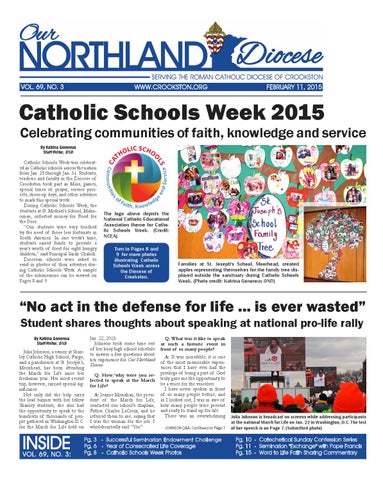
The logo above depicts the National Catholic Educational Association theme for Catholic Schools Week. (Credit: NCEA) Turn to Pages 8 and 9 for more photos illustrating Catholic Schools Week across the Diocese of Crookston.
Families at St. Joseph's School, Moorhead, created apples representing themselves for the family tree displayed outside the sanctuary during Catholic Schools Week. (Photo credit: Katrina Genereux OND)
“No act in the defense for life ... is ever wasted” Student shares thoughts about speaking at national pro-life rally By Katrina Genereux Staff Writer, OND
Julia Johnson, a senior at Shanley Catholic High School, Fargo, and a parishioner at St. Joseph's, Moorhead, has been attending the March for Life since her freshman year. Her most recent trip, however, carried special significance. Not only did she help carry the lead banner with her fellow Shanley students, she also had the opportunity to speak to the hundreds of thousands of people gathered in Washington D.C. for the March for Life held on
INSIDE
VOL. 69, NO. 3:
Jan. 22, 2015. Johnson took some time out of her busy high school schedule to answer a few questions about her experience for Our Northland Diocese. Q: How/why were you selected to speak at the March for Life? A: Jeanne Monahan, the president of the March for Life, contacted our school’s chaplain, Father Charles LaCroix, and he referred them to me, saying that I was the woman for the job. I wholeheartedly said “Yes.”
Q: What was it like to speak at such a historic event in front of so many people? A: It was incredible, it is one of the most memorable experiences that I have ever had the privilege of being a part of. God truly gave me the opportunity to be a voice for the voiceless. I have never spoken in front of so many people before, and as I looked out, I was in awe of how many people were present and ready to stand up for life. There was an overwhelming JOHNSON Q&A: Continued on Page 7
Julia Johnson is broadcast on screens while addressing participants at the national March for Life on Jan. 22 in Washington, D.C. The text of her speech is on Page 7. (Submitted photo)
Pg. 3 - Successful Seminarian Endowment Challenge Pg. 10 - Catechetical Sunday Confession Series Pg. 6 - Year of Consecrated Life Coverage Pg. 11 - Seminarian "Exchange" with Pope Francis Pg. 8 - Catholic Schools Week Photos Pg. 15 - Word to Life Faith Sharing Commentary
2 February 11, 2015
A
COMMENTARY
OUR NORTHLAND DIOCESE
Voice from the Valley BY BISHOP MICHAEL J. HOEPPNER
TEENS ENCOUNTER CHRIST (TEC)
On Sunday, Jan. 18, at Sacred Heart in East Grand Forks and again on Sunday, Feb. 15, this time at St. Joseph Parish, Moorhead, I will have the delight of attending an Agape Meal in conjunction with TEC retreats. High school students from various parishes in the diocese attend these retreats. In the hours of prayer, reflection and sharing they engage in, they open their hearts to an encounter with Jesus, an encounter which will hopefully be special and remain with them for the rest of their lives. The Diocese of Crookston has a wonderful history of involvement with TEC retreats. Hundreds of young people, many as part of their preparation for receiving the outpouring of the Holy Spirit in Confirmation, have been touched by the Lord during TEC retreats in a
transforming way. I enjoy saying a few words to these young people at the special Agape Meal they share during the retreat. I share with them the encounter Peter had with Jesus after the Lord’s resurrection, during which Jesus asked Peter: “Do you love me?” The story is in St. John’s Gospel which is written in Greek. The word Jesus uses for “love” is the verb agapan. This is a strong word for love. It refers not only to the heart and emotions, the affection someone has for another, but it also refers to the mind and will. It calls for a firm determination to work for the other person’s good and well-being at all costs. It calls for the marshalling of all of one’s powers to maintain that positive, caring attitude toward the other person, no matter whether that person’s attitude or activity toward one is positive and good or not. Agape
refers to unconditional love. When Jesus asks Peter whether he has this love, Peter, probably well aware that he denied Jesus three times, answers, “Yes, Lord, you know I love you,” but he answers using the verb philein. This word for love refers to friendship love or the love of a husband and wife. It refers to a really deep affection, a true cherishing of another person. However, Jesus is asking Peter for more; he is asking for unconditional, total love. Peter is being honest; he loves Jesus but does not say his love is unconditional. A second time Jesus asks Peter about his love using agapan, and a second time Peter answers with philein. Then, the third time, Jesus changes his question, a change we don’t pick up since the English language only has the one word for “love”. Jesus comes to Peter’s level. He asks if Peter loves him and Jesus uses Peter’s verb, philein. Jesus is
willing to meet Peter where he is at. Jesus, however, then goes on to tell Peter that in the days to come, people will put a belt around him and take him where he does not want to go. The Gospel says in narration, “this indicated the kind of death Peter was to undergo.” Peter would eventually, with the Lord’s help, reach unconditional agapan love, laying down his life in love. As the young people on retreat encounter Jesus, it is good for them to know that Jesus comes and meets them where they are at. Whether we are young or old, Jesus comes and joins our life-journey where we are at and leads us, sometimes gently and sometimes not so gently, toward perfect love. As we prepare to enter the Lenten Season, before our Holy Week and Easter celebrations that recall how Jesus loves us “to the end” (meaning both end of his life on earth and to the nth degree) by his Pas-
sion, Death, and Resurrection, let us allow Jesus to lead us to perfect love. I offer my thanks to all the adults who work behind the scenes on each of our TEC retreats. RITE OF ELECTION AND WELCOME The First Sunday of Lent each year, at the Cathedral of the Immaculate Conception in Crookston, I have the privilege of welcoming those who will become new members of our Roman Catholic Church at Eastertime. Unbaptized persons preparing for the sacraments of Christian initiation, that is Baptism, Eucharist and Confirmation, are called Catechumens. Through the Church’s Rite of Election, the scrutinies and by ongoing catechesis, they grow in their relationship with our loving God and in their understandBISHOP: Continued on Page 14
BISHOP’S CALENDAR February 13 February 14 February 15 February 15 February 18 February 18 February 19 February 20 February 22 February 23 February 24 February 25 February 25 February 26
8:35 a.m.
School Mass & Classroom Visits, St. Bernard’s, Thief River Falls
5:00 p.m.
Rite of Confirmation, St. Stephen’s, Stephen
(USPS 414-940)
10:30 a.m. Rite of Confirmation, Assumption, Florian
Our Northland Diocese is a semi-monthly newspaper committed to publishing Good News for the purpose of strengthening and furthering the Reign of God in the Roman Catholic Diocese of Crookston.
TEC Agape Meal, St. Joseph’s, Moorhead 7:00 a.m. Mass, Cathedral, Crookston
Subscriptions: $13.65 per year in the diocese, $14.90 per year outside the diocese.
7:00 p.m. Mass, Holy Family, Halstad 12:00 p.m.
Diocesan Finance Board, Chancery, Crookston
10:00 a.m.
Mass, Oak Crossing Care Center, Detroit Lakes
3:00 p.m.
Rites of Election and Call to Conversion, Cathedral, Crookston
8:00 a.m. Mass, Mount St. Benedict, Crookston 3:30 p.m.
Mass of Thanksgiving, Cathedral, Crookston
8:40 a.m.
School Mass & Classroom Visits, St. Philip’s, Bemidji
6:30 p.m.
Faith Formation Classes, St. Philip’s, Bemidji
12:00 p.m.
Catholic Community Foundation Board, Chancery, Crookston
VICTIM ASSISTANCE STATEMENT: If you or someone you know has been sexually abused, your first call should be to law enforcement. If you have been abused by a Catholic priest or another person in Church ministry, the Diocese of Crookston Victim’s Assistance Coordinator is also available to offer you help and healing. Please contact Louann McGlynn at 218281-7895 (24-hour confidential number) or Lmcglynn@crookston.org.
Publisher:
The Most Reverend Michael J. Hoeppner Bishop of the Diocese of Crookston
Editor:
Rev. Robert Schreiner Office of the New Evangelization, Director
Associate Editor:
Mrs. Janelle C. Gergen jgergen@crookston.org
Editorial Assistant: Mrs. Katrina Genereux kgenereux@crookston.org Proofreader:
Deacon Dan Hannig
For questions about subscriptions or address changes, please contact: Renee Tate at rtate@crookston.org Periodical postage paid in Crookston, MN and additional mailing offices. Postmaster: send address changes to: Our Northland Diocese PO Box 610, Crookston, MN 56716-0610 Phone: 218-281-4533 Publishing dates and submission deadlines for news and advertisements can be found online: http://www.crookston.org/ond/
OUR NORTHLAND DIOCESE
DIOCESAN
February 11, 2015
3
Diocese exceeds fund matching challenge Donors' generosity enables seminarian endowment to grow By Katrina Genereux Staff Writer, OND CROOKSTON, MINN. — The Diocese of Crookston exceeded the goals of the 2014 Seminarian Endowment Challenge. As a result, more than $125,000 will go toward an endowment fund for seminarian education. After applying for the grant, the diocese was selected by the Catholic Extension Society, based in Chicago, Ill., to take part in this challenge. The Catholic Extension Society matched gifts dollar-per-dollar up to $50,000. It was required that the gifts be given in $1,000 increments; they also needed to be received by Dec. 31, 2014. “We had to raise a minimum of $33,000 to qualify for the matching funds, and the Extension Society promised to match up to $50,000,” said Reathel Giannonatti, JD, the Director of Stewardship and Development for the Diocese of Crookston. “As far as development goes, it was nearly an effortless job. People were incredibly willing to contribute,” said Giannonatti. “Lisa Hatlestad, Stewardship Manager, created a brochure featuring our seminarians that was sent to pastors and prior contributors.” An annoucement was also
placed in Our Northland Diocese. Giannonatti was surprised by the number of people who tore the challenge announcement out of the paper and sent it in with $1,000. Gifts were made by a total of 50 groups and individuals. Some parishes, Knights of Columbus Councils and Catholic Daughters Courts, as well as other groups participated in the challenge. “The Chancery staff as a group donated $1,400, which became $2,800 with the match,” said Giannonatti. “I was really proud of my colleagues’ generosity.” One donor, who wishes to remain anonymous, was able to donate $11,146 to the Endowment Challenge. When the deadline was reached at the close of December, the $50,000 goal was met and matched by the Catholic Extension Society, becoming $100,000. “We had received $7,000 in excess of the $50,000 goal,” said Giannonatti. A few weeks following the deadline, the same anonymous donor contributed an additional $20,000 that will be added to the endowment. “The Catholic Extension Society sponsors this endowment challenge so we can build rela-
tionships and develop a list of donors who are interested in supporting seminarians,” said Giannonatti. “It has helped introduce us to people who have a heart for the church and for helping seminarians.” “Our future rests on these young men,” said Giannonatti, speaking about the current and future seminarians. There are six men in seminary for the Diocese of Crookston. Deacon John Christianson and Deacon Bryan Kujawa will be ordained to the priesthood later this year. The seminarians are featured in the 2015 Diocesan Annual Appeal campaign. The annual mailing contains a special tear away, designed by Hatlestad, which can be placed in a prominent place as a reminder to pray for and send notes to our seminarians, said Giannonatti. The Catholic Extension Society has a large impact on the Diocese of Crookston. As a mission diocese, the Diocese of Crookston receives an annual gift of $250,000 from the Catholic Extension Society; they also make yearly contributions to St. Mary’s Mission, Red Lake, and give the diocese the opportunity to apply for grants to help with special projects.
Seminarians are the feature of the 2015 DAA as seen in this excerpt from the mailing sent to diocesan homes. (Image credit: Lisa Hatlestad)
Diocesan survey will impact October synod of bishops The people of the Diocese of Crookston are invited to make a contribution to the upcoming XIV Ordinary Synod of Bishops, Oct. 4 – 25, 2015. The topic of the synod will be The Vocation and Mission of the Family in the Church and Contemporary World. Bishops around the world have been asked to answer questions about the state families in their home dioceses and their needs. People from across the diocese are invited to give their input through an online survey. The hope is that as many people as possible from all different backgrounds will take part in the survey. The 20-question, multiple choice survey will be available through March 1 on the Diocese of Crookston’s recently revamped website at http://www. crookston.org. The link to the survey is the second slide at the
The survey can be accessed at http://www.crookston.org as seen above; it will be available through March 1.
top of the diocesan home page. The survey will help give Bishop Michael Hoeppner a better idea of how the diocese as a whole views the Sacrament of Marriage in society and the
Church, as well as the challenges faced by families in the contemporary world and the ways the Church can better serve the needs of families. The answers provided will be
used to compose a response that will be sent to the United States Conference of Catholic Bishops. The USCCB will then compile all of the information submitted by bishops across the nation and
send it to the Vatican in anticipation of the October meeting. This information will be used as the Instrumentum Laboris, or guiding document, to direct the synod in discussion and prayer.
4 February 11, 2015
COMMENTARY
OUR NORTHLAND DIOCESE
Return from Haiti: finding home in the world As readers may know, I traveled to the Life Teen Mission Base in Haiti last month. I had indicated to you, quite truthfully, how very much outside my comfort zone this trip was going to be. And in that anticipation, I was not disappointed. But when the group of us gathered on our last night in Haiti to share our thoughts and experiences of the week, I began by saying quite truthfully: “Haiti is no longer outside my comfort zone.” No one was more surprised by that declaration than I was. Mind you, that doesn’t mean the cold showers got warmer over the week. Nor does it mean that the sun and heat ever let up. And it certainly doesn’t mean that I eventually found a La-Z-Boy recliner. No, I can honestly say that in terms of the creature comforts which fill my home, I found none in Haiti. But the miracle is that sometime around Tuesday afternoon, I realized I was no longer looking for them. In fact, it was while visiting an orphanage in the mountains that I realized I must have adjusted. Upon arrival at the orphanage, we found that a mission group of Newman Center students from Baltimore, Md., was staying at the orphanage
CREDO
A NEW EVANGELIZATION WITNESS
By Father Robert Schreiner, S.T.L. Director of the Office of the New Evangelization
the same week we were staying at the Life Teen Base. At lunch, one of the college girls with whom I was sitting at table started freaking out when she discovered a chicken had wandered into the dining room and was under the table at which we were eating. I said calmingly to her: “Oh don’t mind the chicken – she’s just looking for popcorn on the floor.” I almost had to look around to see who had said that. It seems I was adjusting to life in Haiti. Though God’s mercy saved me from my own self-interest in creature comforts while on mission, I could not really shake from my thoughts the overwhelming material poverty inflicting the people of Haiti (and by extension all such third world nations). Surely I’ve known of it. Obviously I’ve seen pictures of it. I’ve compassionately listened as many friends have shared their first-
hand experiences of it. But the notion of it is a world apart from the face-to-face encounter with it. The sights; the sounds; the smells … nothing really can adequately prepare one for it, I don’t think. Except, I was grateful for a simple sentence Randy Raus (President of Life Teen) shared with me as we were leaving the Port-au-Prince airport Sunday afternoon to begin the three and a half hour truck ride to the Mission Base. He simply said to me: “Fr. Bob, nothing in Haiti is easy.” It was a line which echoed in my head like a Psalm Response to every experience I had throughout my time in Haiti. Shortly after leaving the airport, our truck pulled up on a riot going on outside the National Government building. Haitians were protesting the failure of the government to adequately manage (read: grafting and corruption) the post-
earthquake rebuilding of their nation. As our driver pulled to a stop, a tank rolled out of the government compound shooting canisters of tear gas and firing a water canon at the protesters. R./Nothing in Haiti is easy … The next day, Jan. 12, was the fifth anniversary of the devastating earthquake which destroyed Haiti. In the morning we joined parishioners at St. Charles Borromeo parish as they were gathered by our Life Teen Summer Missionaries (who are native Haitians formed by our Life Teen Base) to pray on the anniversary. They began their hymns, rosaries, prayers and praise around 8 a.m. We arrived at the parish around 11:30 a.m., and they were going strong. They didn’t finish praying until around 2:30-ish that afternoon. When I stepped into the packed church (around 150-200 people), I knew in my bones I was hearing the voice of Haiti. It was one voice of praise to God, singing of God’s goodness and mercy, while also crying out to heaven in their deep and profound sadness. It was faith giving voice to the heart. This was a community of faith; gathered in a Catholic Church; praying in love to God the Fa-
ther, through the Son and definitely in the Holy Spirit; and calling upon Mary as their Perpetual Help and their very own Mother. It was home. I was home, here, though I was unknown and unnamed to them. I didn’t understand their Creole; they didn’t understand my English. But we were brothers and sisters in Christ, sons and daughters of Mary. And I heard the unity of their voice in their soulful song. And I knew. We were all home here. The trip has renewed and deepened my heartfelt gratitude for those who are called by God to the missionary life. I want to witness to you the vibrancy of our Catholic faith so alive in our young people! To those eight men and women who allowed themselves to be sent to Haiti as Life Teen Missionaries and are so effectively loving the teens and their families with the love of Christ, in union with the Church through the Bishop of Anse-au-veaux and Miragoane; and through the loving intercession of Mary, I want to say: You are to me heroes in the faith. Thank you for showing me just how big is Our Father’s House. Haiti is no longer outside my comfort zone. God is so good.
“And … that's why I believe in God.” The following was written by an 8-year-old named Danny Dutton, who lives in Chula Vista, Calif. He wrote it for his third grade homework assignment, to “explain God.” It is too bad, as we grow, our understanding of God becomes convoluted and we forget the basic truths about a loving, caring God who refuses to leave us orphaned. Danny writes: One of God's main jobs is making people. He makes them to replace the ones that die, so there will be enough people to take care of things on earth. He doesn't make grownups, just babies. I think because they are smaller and easier to make. That way he doesn't have to take up his valuable time teaching them to talk and walk. He can just leave that to mothers and fathers. God's second most important job is listening to prayers. An awful lot of this goes on,
LIFE FIRST
By Father Don Braukmann Parochial Vicar - St. Philip’s Parish, Bemidji and St. Charles Parish, Pennington
since some people, like preachers and things, pray at times beside bedtime. God doesn't have time to listen to the radio or TV because of this. Because he hears everything, there must be a terrible lot of noise in his ears, unless he has thought of a way to turn it off. God sees everything and hears everything and is everywhere, which keeps Him pretty busy. So you shouldn't go wasting his time by going over your mom and dad's head ask-
ing for something they said you couldn't have. Atheists are people who don't believe in God. I don't think there are any in Chula Vista. At least there aren't any who come to our church. Jesus is God's Son. He used to do all the hard work, like walking on water and performing miracles and trying to teach the people who didn't want to learn about God. They finally got tired of him preaching to them and they crucified him.
But he was good and kind, like his father, and he told his father that they didn't know what they were doing and to forgive them and God said “O.K.” And God did not let Jesus stay in the grave, but raised him from the dead. His dad (God) appreciated everything that he had done and all his hard work on earth so he told him he didn't have to go out on the road anymore. He could stay in heaven. So he did. And now he helps his dad out by listening to prayers and seeing things which are important for God to take care of and which ones he can take care of himself without having to bother God. Like a secretary, only more important. You can pray any time you want and they are sure to help you because they got it worked out so one of them is on duty all the time. You should always go to
church on Sunday because it makes God happy, and if there's anybody you want to make happy, it's God! Don't skip church to do something you think will be more fun like going to the beach. This is wrong. And besides the sun doesn't come out at the beach until noon anyway. If you don't believe in God, besides being an atheist, you will be very lonely, because your parents can't go everywhere with you, like to camp, but God can. It is good to know He's around you when you're scared, in the dark or when you can't swim and you get thrown into real deep water by big kids. But ... you shouldn't just always think of what God can do for you. I figure God put me here and he can take me back anytime he pleases. And ... that's why I believe in God.
OUR NORTHLAND DIOCESE
COMMENTARY
February 11, 2015
5
Pornography and a pro-life conscience I have witnessed a number of pro-life demonstrations over the years, and invariably, they seem to touch off some pretty strong reactions by some of the men who drive by those events. Women could certainly have these reactions, but what I can’t deny is the anger I have witnessed in men. So dare I ask, why are men angered by this, and how might porn use contribute to a lack of conscience toward life issues? I have certainly thought about the connections between pornography and abortion. Years ago, Dr. Janet Smith popularized the connection of contraception and abortion and how the disconnection of sexuality from babies leads toward support for an abortion mentality. So I am also sure that many have thought of the trajectory of pornography and irresponsible sex towards abortion, but you don’t read much about it. Of course, I don’t mean to imply that all people who have had abortions are directly influenced by pornography. I also don’t assume that all men angry about pro-life marches are us-
INTEGRITY HUMAN PERSON INSIGHTS
By Dan Spadaro, MA, LPC Syndicated through The Colorado Catholic Herald
ing porn, but I think it might be useful to look at some consequences of pornography use to see what influences are present. Pornography has an array of consequences, not only for the culture, but also for the individual. Pornography is considered to be inherently selfish and fosters the viewer towards using another person for the sake of their own pleasure. It is geared towards objectification. With ongoing pornography use, anyone can lose some appreciation of the dignity of those they objectify. People who get addicted to pornography and sexual compulsions, have commonly bought into certain “lies.” Two
of these are: “I am worth less than others,” and “I can’t trust others to understand me or meet my needs.” So, lack of self-respect and lack of trust are strong core beliefs in the mind of many addicted persons. With these deficits in place, the pornography addict focuses on finding their own solutions without the support of others. Pornography speaks a language that says sex, as relational intimacy, is optional. It tears at the human fabric of trust with others and with God, and impacts the formation and exercise of our consciences. In many ways, it seems that there has been an effort to reduce human conscience to a
personal opinion where no one is right and no one is wrong. But, according to the Catechism of the Catholic Church, the human conscience is “educated” through the development of virtue (1784). It is also referred to as the law of God inscribed on our hearts. It is something which is formed through “knowledge and practice.” In a sense it is knowledge of the truth put into practice, which supports our ability to make good decisions and take responsibility when we have made bad ones. Those who have bought into the lies pornography speaks about human relationships, tend to react with strong and confusing defenses when they are confronted. William Struthers, a biopsychologist at the University of Illinois, agrees that there are commonly attitudes of entitlement, tendencies to blame, as well as a need to be right (to name a few) with male pornography users when they are confronted. For many men, pornography use requires that they adopt a number of rationalizations in order to excuse
or protect what they are doing. This creates a false reality and thus damages the user’s conscience. When consciences are damaged, we become apathetic and lack good judgment. As this damage progresses we avoid responsibility and become angry. Struthers also writes about this saying, “Pornography provokes and has at its core an element of anger, not joy or love. Men are invited into love and joy, but pornography provokes to anger, frustration, hostility and distrust.” He indicates that there can also be an element of aggression towards women underlying a man’s use of porn. Thankfully, not all men avoid responsibility or use pornography. We can find many examples of this in our families and in our churches, men who are able to take ownership, provide for their families and develop good relationships with their wives, men who make mistakes and repair their wrongs. This is the legacy of a man with a wellformed conscience.
6 February 11, 2015
YEAR OF CONSECRATED LIFE
OUR NORTHLAND DIOCESE
Strong families and Catholic schools help vocations flourish by Servant of God Fr. John A. Hardon, S.J.
THE CATHOLIC FAMILY AND VOCATIONS
Where are vocations to the priesthood and the religious life mainly fostered? In strong Catholic families. When do these vocations flourish? When Catholic families flourish. When do vocations wane? When Catholic family life is weak. If this is true, then whatever we can do to stabilize Catholic family life and strengthen family ties among the faithful will promote good vocations to the service of the Church. It is not hard to find reasons for this. After all, whatever else a true vocation to the priesthood or the consecrated life implies, it always means that a person is called to an aboveaverage practice of virtue in the following of Christ. Concretely this means having the generosity to spend a lifetime in serving others without counting the cost. It means having the humility to work under authority for the common good. And above all it means having the charity, born of grace, to give up some of life's most precious possessions and prospects out of love for God. The family is the divinely instituted place for generosity, humility and charity to first take root and, with divine assistance, to be cultivated from infancy, through childhood and adolescence, into adult life. We speak so casually about grace building on virtue that we are liable to miss the profound implications of what we are saying. The grace of vocations needs good soil in which to be planted, and the proper conditions to develop under God's supernatural care. There is no soil more necessary and no conditions are more important than a good family life. Certainly God is master of His gifts and He can, if He wishes, dispense with these provisions of nature. Good vocations have come from very unlikely backgrounds and in spite of the most adverse home situations. But these exceptions only prove the rule. In His ordinary providence, however, the Lord prepares those He plans to choose by making sure they are reared in a family where generosity as selfsacrifice is shown to their children and required of them by the parents; where humility is a
way of life because father and mother exercise their authority with kindness but with a firm and steady hand; and where charity, as the love of God, is instilled in the children by the practice of prayer and respect for religion that becomes almost the family atmosphere. No one who knows what is going on in modern western society has any illusions about the status of the family. Irresponsible fathers, absentee mothers, neglected children, broken homes are becoming commonplace in one country after another. We have no choice. We who believe that Christ is God, believe that He has not neglected His people. But we must do our part. We must strive by all manner of means to preserve sound Christian values in the family and restore them where they have been lost. And we must beg the Lord of the harvest to produce laborers for His vineyard by providing such families as are the normal seedbed of vocations in the Catholic Church. RELIGIOUS EDUCATION AND VOCATIONS
Vocations to the priesthood and the religious life depend on good religious education as the harvest depends on a good soil. Vocations prosper when religious education in the home and school is true to its Catholic heritage; when parents and teachers seriously proclaim the Faith of our Fathers, when they train the young in the Christian virtues of obedience, chastity and selfless charity, and lead the souls under their care to a healthy fear of sin and a loving devotion to Jesus in the Blessed Sacrament. On the other hand, where sound religious education is neglected it is either tempting Providence or asking for a miracle to expect vocations to flourish. And no amount of effort to adjust seminaries or novitiates to an alleged new age of freedom will attract young people to give themselves to the consecrated service of the Church. This has profound implications for both the home and school. The breakdown of family life has had devastating consequences on priestly and religious vocations. The secularization of large segments of once-thriving Catholic schools has reduced vocations in some
parts of the United States to the vanishing point. Where have vocations over the centuries been most prosperous if not in places where the seeds of Faith were sown and nourished by believing parents and teachers? The same is true today. Either we Americans wake up to this fact of supernatural history or our present situation will not only not improve but become more serious with every passing year. TWO BASIC RECOMMENDATIONS
Whatever is done to strengthen the Catholic family, to keep father and mother together and inspire them to educate their children in the fear and love of God is the first and single most effective means of giving the Church the vocations she needs to carry on the mission entrusted to Her by the Redeemer. So, too, whatever is done to preserve Catholic schools, make certain they are teaching the Church's doctrine in complete loyalty to Christ and His Vicar on earth, and protecting them from the violence of modern secularism, is a sure way of obtaining the priests and religious that the world needs. Why does the world need priests and religious? Because it needs the graces that are channeled by the Sacrifice of the Mass and merited by a lifetime sacrifice of self under the vows. Servant of God Fr. John A. Hardon, S.J., founded the Institute on Religious Life in 1974. These meditations written by him were taken from the Institute on Religious Life at http://irl.solutciosoftware.com.
PLEASE
pray for vocations to the priesthood and religious life
OUR NORTHLAND DIOCESE
AROUND THE DIOCESE
February 11, 2015
7
JOHNSON Q&A: Continued from Page 1 feeling of fellowship. And I am so very blessed to have had the opportunity to represent my school and my state. Q: Where did the inspiration for your speech come from? A: I truly believe that the inspiration for my speech came from the Holy Spirit. I prayed very fervently so that I could deliver God’s message to the entire crowd. Without God, none of this would have been possible. Q: How did the entire student body of Shanley get to be at the March for Life? Whose idea was it? What did it take to get all of you there? A: Father Charles LaCroix had a vision that he wanted Shanley High to be the first high school in March history to bring our entire school. He got it cleared with the administration, and the fundraising began. The school, through personal donors, working at Scheels during the holidays and fundraising efforts by the students, raised enough money so that every single student could go for free. Q: What was it like being part of the front line at the March for Life? A: I felt honored to be a part of such a noble revolution. To be able to say that my fellow classmates and I led over half a million people in our nation’s Capitol to defend Life is almost unthinkable. I am so humbled that Shanley High was chosen, and I am so grateful. Q: What was the highlight of this year's pilgrimage? A: It was a tie between speaking at the rally and carrying the lead banner, both were incredible. Q: When did you become passionate about the pro-life
movement and the sanctity of life? A: My freshman year after I went on the March for the first time was when I became passionate about the prolife movement. I had always considered myself to be pro-life but this trip made me realize why I was pro-life. It instilled in me a passion to protect the unborn and their right to life. It was then that I truly realized that life is a gift, a beautiful one, and it is worth fighting for. Q: Do you participate in the pro-life movement at the local level? How? A: I am in my school's Teens for Life group and we host cupcakes for life as well as doing diaper drives and baby item drives for organizations, such as First Choice Clinic, as well as participating in 40 Days for Life. Q: What would your advice be for other people who want to make an impact on life issues? A: No act in the defense for life, no matter how small is ever wasted. Anything you can do to help protect our brothers and sisters in the womb is a beautiful choice. Don’t be afraid to be a voice, stand up against injustice. Q: Since Catholic Schools Week just ended, could you share the impact Catholic Education has had on you? A: Catholic education has taught me how to be an expressive young adult who is able to defend my values and beliefs. I have had the privilege of cultivating all aspects of my life while finding my own talents and gifts. I truly believe that my Catholic education gave me my willingness to seek what is just. And it has given me an environment in which I am not afraid to ask questions and where I am excited to learn.
JOHNSON SHARES WORDS OF INSPIRATION, ENCOURAGEMENT IN THE FIGHT FOR LIFE
The following is the text of Johnson's speech delivered at the rally preceding the national March for Life on Jan. 22, 2015 in Washington D.C. Thank you. As was mentioned, my name is Julia Johnson and I am a senior at Shanley High School in Fargo, North Dakota. And as a school we are humbled and honored to have been selected to carry the lead banner in this year’s March for Life. To the youth of America: It is our responsibility to end the scourge of abortion. At Shanley High School, we are trying to do just that. We have had an active pro-life group for many years and in being named to carry the lead banner, we decided to bring our entire high school this year. Including students, teachers, and chaperones, we packed 400 pro-life warriors into eight buses. We have travelled for 24 hours to come to D.C. to be a witness to life at our nation’s Capitol. We are the pro-life generation. To my fellow youth: Our cause in defending life is a noble one. It is noble because we are living in a modern day holocaust. A holocaust that on average takes the lives of more than 3,000 babies each day, which amounts to over 1 million babies a year. The silent horror of abortion has embedded itself into society and has targeted the most vulnerable and precious of us all. But we will not remain idle. We cannot. It is our job to protect our brothers and sisters in the womb and their right to life. It is – It is our obligation to speak up for those who cannot speak for themselves. One’s value is not determined by size or by age. As I look out, I see hundreds of thousands of people who are willing to stand up for what is right and true and virtuous. Our generation has stared through the smokescreen of lies and deceit, and we have seen the truth. We know that human life is present in the womb and we are willing to fight for it. We refuse to stand by and watch the lives of innocent children be discarded as nothing more than medical waste. This is why we march. We march to stop an injustice that has taken the lives of a third of our generation. This pro-life revolution was not born out of hate for our neighbors, but out of love. And as we walk today, I look forward to experiencing the joy that comes from being a part of an event that is bigger than ourselves. I am privileged to march with each and every one of you, for together we will achieve victory for mothers and their babies, for our country, and for our God. God bless. To view a video of Johnson speaking at the March for Life Rally, go to: https://www.youtube.com/watch?v=anmbHg9dUqU&sns=fb&app=desktop
8 February 11, 2015
OUR NORTHLAND DIOCESE
CATHOLIC SCHOO
St. Michael's School MAHNOMEN
Students pose with a Food for the Poor poster. They collected enough money for the organization during Catholic Schools Week to feed eight children for an entire year.
Father Dave Super begins Catholic Schools Week by asking students to help him illustrate Jesus asking the Apostles to follow him at Holy Mass on Sunday, Jan. 25. Iraq War Veteran, Christian Penner, shares his love of scale model building with the students. (Submitted photos)
Sacred Heart School EAST GRAND FORKS
Above: Representatives from each of the Greater Grand Forks Catholic Schools process in with their school banners at the beginning of the All School Catholic Schools Mass. Bishop John Folda of the Diocese of Fargo presided with priests from each of the schools. (Submitted photos) Right: Bishop Folda greets a student from St. Michael's Catholic School during the offertory. An estimated 600 people from Sacred Heart and three Grand Forks parishes — St. Michael's, St. Mary's and Holy Family — attended the Mass held in Merth Auditorium at Sacred Heart School.
Above: Students race to a shoe pile during the Kookie Olympics on Tuesday. Kindergarten through sixth graders competed in events facilitated by the phy ed teacher, Roger Morton, and the senior class. Right: Father Adam Hamness found his twin Tuesday morning. The theme was "Superhero Day – people who do good works every day." Students dressed up as everything from doctors and veterinarians, to comic book super heroes.
C SCHOOLS WEEK
OUR NORTHLAND DIOCESE
February 11, 2015
9
Cathedral School
CROOKSTON
Mrs. Erickson's first grade class sits with the Mayor of Crookston, Gary Willhite, on Western Day. At morning prayer on Monday, the mayor read a proclamation officially declaring it Catholic Schools Week in Crookston. (Submitted photos)
Students headed to the Crookston Arena for an afternoon of ice skating.
Alumni from Cathedral, now seniors in high school, reunited with the Cathedral School staff for a rematch of the sixth grade versus teachers volleyball game. The rest of the school watched as the seniors defeated the teachers 3-0.
St. Bernard's School THIEF RIVER FALLS
St. Bernard's alumni visit current students during Morning Prayer. (Submitted photos)
Students bundle up and take their sleds to the slopes during School Sledding Day. At the Spirit Olympics, students show off their moves during the group dance.
10 February 11, 2015
COMMENTARY
OUR NORTHLAND DIOCESE
Moral development and Catholic conscience formation: notes for catechists and parents by Joseph D. White, PhD
Human development refers to the way in which individuals grow and change over their lifespan. Growth in cognitive understanding, social skills, and self-regulation all have an impact on the moral development and conscience formation of the individual. To be as effective as possible in forming individuals for a life of discipleship, catechists should know about the typical stages of human development. The way we approach moral catechesis and conscience formation will vary somewhat depending upon the developmental level of the individual. Preschool and kindergarten children are just beginning to understand the expectations of adults in their lives. They need limits and structure, and guidelines should be supported by positive consequences when behavior is appropriate and logical negative consequences when it is not. This is a wonderful time to teach children that God made them because he loves them, and that he invites them to imitate him in showing love for one another in concrete ways. When the preschool child understands, “God made me,” the next logical questions are, “Why did God make me?,” and, “Why did God make me the way I am?” During these years, children can learn, for example, that God gave them hands to help others, voices to praise God and to talk with friends and family, and eyes to see God’s beautiful world. Moral catechesis for the really young preschool years should focus on learning to forgive and asking for forgiveness. In the elementary school years, when children have reached the age of reason, catechists have an excellent opportunity to share the Ten Commandments, presented on a developmentally appropriate level, to help the child better understand when they are, and are not, doing God’s will. Catechists should explain that the reason God commands us to do some things and avoid other things is that he knows what is good and bad for us and only wants what is good. In light of the New Covenant, the Ten Commandments should be presented in the context of the
Great Commandment of Jesus Christ, as all of the Commandments relate to loving God and others. The Beatitudes are also critically important content for moral catechesis, but they are more principles of living than laws, making them somewhat more abstract. For this reason, the child’s understanding of the Beatitudes and their practical application will increase over the course of the elementary years. Children in the early elementary school years may feel some guilt and shame as they become aware of God’s rules and realize they have not always followed them. Catechists might feel tempted to tell them, “God doesn’t expect us to be perfect,” but in fact, Jesus does call us to “be perfect, just as your heavenly Father is perfect” (Mt 5:48). A better approach would be a message that simultaneously promotes a positive self-image and continued efforts to be virtuous with God’s help. You can challenge children to think of ways that Jesus was perfect and how they could do those things in their own lives. Use words like the following: “When we sin, we deliberately choose actions that are harmful to our relationship with God, ourselves, and/or others. God is merciful and forgives us when we are truly sorry. Through God’s grace and our cooperation with it, we can strive to heal those wounded relationships and grow in goodness.” Catechists should also help children distinguish between “mistakes” (e.g., “I accidentally bumped into a classmate”) and “sins” (e.g., “I deliberately bumped into a classmate and caused him to hurt himself ”). In learning this distinction, children are developing an age-appropriate moral conscience. Because elementary school– age children are such concrete thinkers, good and bad choices, or loving and unloving actions, should be presented in terms of concrete examples that apply to their everyday life. Role-play of good choices will further increase understanding and may elicit a greater desire to make good choices. In the later elementary and middle school years, children are moving into a period of more abstract thought, and they are able to begin internal-
strive to grow in their faith. Help them see that even their struggle to understand their faith is an important part of growing in faith, and a means to help them hold onto and internalize their Catholic identity. Finally, and most importantly, a discussion of moral catechesis would not be complete without some mention of the example of the catechist. The General Directory for Catechesis speaks of the “solid spirituality and transparent witness of life” that is so vital to this ministry (Congregation for the Clergy, General Directory for Catechesis [Washington, DC: United States Conference of Catholic Bishops, 1997], no. 156). It is important that all catechists remember that the example they set for others is the most practical and meaningful teaching they provide. An openness to God’s grace and the work of the Holy Spirit help to ensure faithful teaching not only in word but in action.
izing standards of behavior. In other words, they begin to have the capacity to make moral choices not based on what will happen externally but on their inner understanding of right and wrong. This is a critical time for conscience formation, as the standards they internalize will continue to guide them as they grow and mature. A reexamination of the Beatitudes and Commandments, as well as a study of virtues, can be helpful. This is especially effective when learning occurs in the context of identity formation, which is such a critical issue in these years. God has a unique plan for everyone’s life. Each person should do all he or she can to discover and embrace that plan, which is one’s personal vocation. Children this age should be prompted to think about what God’s plan for them might be and what habits and goals would help bring that plan to fruition. They should also be taught an understanding of “mercy.” In the high school and young adult years, individuals continue this development of identity, and this can be supported by discussions of vocation and behaviors consistent with our
state in life and our identity as sons and daughters of God. Teens and young adults sometimes begin to question and struggle with Church teachings, including moral teachings. This struggle can be a natural part of the transition from being Catholic because it was how they were raised, to being Catholic because it is what they believe. Reassure them that they are called to be a part of the Church as they seek thorough answers that are built upon universal truths to their questions, which they grapple with as they
Copyright © 2014, United States Conference of Catholic Bishops, Washington, DC. All rights reserved. Permission is hereby granted to duplicate this work without adaptation for noncommercial use. Scripture excerpts used in this work are taken from the New American Bible, rev. ed.© 2010, 1991, 1986, 1970 Confraternity of Christian Doctrine, Inc., Washington, DC. All rights reserved. No part of this work may be reproduced or transmitted in any form or by any means, electronic or mechanical, including photocopying, recording, or by any information storage and retrieval system, without permission in writing from the copyright owner.
OUR NORTHLAND DIOCESE
AROUND THE DIOCESE
February 11, 2015
11
Seminarian exchanges zucchettos with Pope Francis By Katrina Genereux Staff Writer, OND
Deacon John Christianson brought back a token of Pope Francis when he returned from pilgrimage in Rome. On Jan. 21, Deacon Christianson and 18 fellow deacons from St. Paul Seminary attended the Wednesday Audience with Pope Francis. Deacon Christianson stood along the walkway as Pope Francis passed by and was able to trade zucchettos with him. Deacon Christianson and three others from his group waited at the gate for three hours before the audience began in order to be next to the center aisle. “When the Holy Father entered the Paul VI Audience Hall, he walked right by me. This is when I lost some hope in actually being able to trade zucchettos with the Pope.” When Pope Francis left the audience, he exited through the center aisle, allowing Deacon Christianson to make the exchange. When asked what the trade meant to him, Deacon Christianson replied: “It is a marvel that someone from the Diocese of Crookston was able to make contact and have a funny interaction with the Holy Father. The zucchetto is a lifelong memorial of that event.” He added, “Further, it also signifies the universality of the Church from the connection made between a son of the Diocese of Crookston (myself) to the Holy See (the Holy Father).”
Deacon John Christianson, a seminarian for the Diocese of Crookston, gives Pope Francis a thumbs up as the pontiff prepares to hand the zucchetto he was wearing to Deacon Christianson following his Wednesday Audience on Jan. 21. (Photo credit: Fotografia Felici)
The School of Divinity Class of 2015 from St. Paul Seminary was in Rome from Jan. 4 through Feb. 4 for their January Term classes. Deacon Alvaro Perez wrote in the class blog, “This trip marks the beginning of the final preparation for our priestly ordination. Like St. Ignatius, we are going to the feet of the Holy Father to receive our ‘orders’.”
Deacon Christianson reacts with extreme joy while Pope Francis smiles after handing his zucchetto to the seminarian. Deacon Christianson was in Rome on pilgrimage with his fellow deacons from St. Paul Seminary. They are in their final year of study before ordination. (Photo credit: Fotografia Felici)
St. Elizabeth Knights donate coats for kids
Knights hold free throw competition
The Knights of Columbus of St. Elizabeth Parish (Council 15722) donated 24 winter coats to students of Dilworth Middle School. Principal, Mrs. Peg Hanson, distributed the coats to the students. Father Pat Sullivan and Deacon Steve Nemeth were present, along with nine students for the presentation. (Submitted photo)
Coach Chuck McNamee explains the free throw rules to anxious participants. There were 21 youth competing in the event. (Photo credit: Jen McNamee)
On Saturday, Jan. 24, the Knights of Columbus Mother Teresa Council 15807 in Laporte/Nevis invited area youth ages nine through 14 to participate in a local and district Youth Free Throw Championship. Local KC members from St. Theodore of Tarsus and Our Lady of the Pines Catholic Churches were excited to facilitate the competition. Each of the 21 contestants was allowed three warm-up shots followed by 15 consecutive free throw attempts to determine their individual scores. Winners of each age group were allowed an additional 3 warm-up shots followed by 25 consecutive free throw attempts to determine their district score. The regional competition will take place in Crookston on Feb. 22.
12 February 11, 2015
NATIONAL
OUR NORTHLAND DIOCESE
Pope sends letter of encouragement to Arizona teens serving recently deported By Nancy Wiechec Catholic News Service PHOENIX — Saying their letters had touched his heart, Pope Francis wrote a personal response encouraging teens in southern Arizona in their work aiding migrants. “These young people, who have come to learn how to strive against the propagation of stereotypes, from people who only see in immigration a source of illegality, social conflict and violence,” he wrote, “can contribute much to show the world a church, without borders, as mother of all; a church that extends to the world the culture of solidarity and care for the people and families that are affected many times by heart-rending circumstances.” The pope’s letter, written in Spanish and dated Dec. 19, was responding to letters he received from Jesuit Father Sean Carroll, executive director of the Kino Border Initiative, and Kino Teens at Lourdes Catholic School in Nogales, Arizona. The Kino Teens support the work of the initiative advocating for more humane and viable migration solutions. “Your letter and the ones from the Lourdes Catholic School
students have touched my heart, not only because of the drama they describe, but also for the hope they manifest,” the pope wrote in his letter addressed to Father Carroll. Father Carroll had written the pope about the Kino Teens and invited him to visit the border region in both Nogales, Ariz., and Nogales, in the Mexican state of Sonora. The Arizona border with Mexico is one of the busiest for illegal crossings. It accounts for nearly 30 percent of all U.S. Border Patrol apprehensions. Twenty Kino Teens wrote letters to the pope describing their experiences living on the border and serving migrants. “He didn’t say whether he was coming (to the border) or not, but he sent a beautiful letter expressing his gratitude for the letters and his support for what the young people are doing,” said Father Carroll. “It was a wonderful response affirming the work of KBI and the Kino Teens.” Pope Francis is set to travel to the U.S. in late September and there had been rumors that he might make a stop along the U.S.-Mexico border. His only confirmed visits are to Washington, New York and Philadelphia for the World Meeting of Fami-
Kino Teens volunteers Angelica Ortiz, Marian Enriquez and Nicole Davison serve dinner to recently deported migrants in the kitchen and dining hall of Centro de Atencion al Migrante Deportado (Aid Center for Deported Migrants) in Nogales, in the Mexican state of Sonora. The volunteer group was started at Lourdes Catholic School in Nogales, Ariz., and supports the Catholic-run Kino Border Initiative, which works for more humane and viable solutions to immigration issues. (CNS photo/Nancy Wiechec) (June 13, 2014)
lies. His full itinerary has not been announced, but the pope is expected to be in Philadelphia for the last two full days of the Sept. 22-27 families’ meeting. In addition to their letters, the
Kino Teens produced a video for Pope Francis. It explains their advocacy work and their experiences at the “comedor,” the Kino Border Initiative soup kitchen that serves deported mi-
grants in Nogales, Mexico. The pope encouraged the young people “not to tire in their labor of edifying love of others and [their] embrace against discrimination and exclusion.”
wants your news and advertisements! Find 2015 publishing dates and submission deadlines on the web: http://www.crookston.org/ond/
The next OND submission deadline is: Wednesday, February 18 by 12:00 p.m. Email: Katrina Genereux, Editorial Assistant kgenereux@crookston.org
OUR NORTHLAND DIOCESE
INTERNATIONAL
February 11, 2015
13
Pope: Families need fathers who guide and love them through thick and thin By Carol Glatz Catholic News Service VATICAN — Every family needs a father — a father who shares in his family’s joy and pain, hands down wisdom to his children and offers them firm guidance and love, Pope Francis said. Being a father is not easy since it takes lots of patience and grace, he said. “But what consolation, what a reward one receives when the children honor this legacy. It is a joy that more than makes up for the hard work, that overcomes every misunderstanding and heals every wound,” the pope said at his general audience Feb. 4. In a series of talks on the family, the pope continued the second part of his reflection on the role of fathers. While his last audience talk looked at the risks and problems caused by fathers who are absent or fail their family, this talk focused on the importance and dignity of fatherhood. Speaking to some 7,000 people
gathered in the Paul VI audience hall, the pope spelled out the essential, but demanding, things it takes to be a good father. The most important is being present, first by being by his wife’s side “to share everything, joy and pain, hard work and hope” and by being there for his children as they grow, he said. A father is there for his kids “when they play and when they work hard, when they are playful and when they are distressed, when they are communicative and when they are taciturn, when they are daring and when they are afraid, when they have strayed and when they have found their way again,” he said. However, being present “is not the same as being controlling, you know, because fathers who are too controlling suffocate their children and don’t let them grow,” the pope said. A father knows how to firmly correct children’s mistakes without demeaning or demoralizing them, as well as protect them at all costs, the pope said. Guidance does not come from a fa-
Pope Francis leads his weekly audience in Paul VI hall at the Vatican Feb. 4. (CNS photo/Tony Gentile, Reuters)
ther who is “weak, yielding and a softie,” he said. A good father also knows how to forgive sincerely from the heart and be patient and merciful, like the father in the Gospel
account of the prodigal son, he said. “How much dignity and how much tenderness in that father who is waiting by the door,” waiting for the child who has strayed, he said. “Yes, fathers must be patient. So many times there’s nothing left to do but wait, pray and wait with patience, tenderness, magnanimity and mercy.” A parent finds pride not in having the child “be the same as me, who repeats what I say and what I do,” but when the child has received the wisdom and values that really matter in life. The father will have formed his children’s heart to know on their own what is right and wrong and to feel, speak and act with wisdom and integrity, the pope said. He said a wise and mature father will be able to say to his children after they’ve grown: “I taught you things that you didn’t know, I corrected errors that you did not see. I let you feel an affection that was both deep and discreet that perhaps you did not
fully recognize when you were young and unsure. I gave you witness of rigor and willpower that perhaps you did not understand when you just wanted complicity and protection.” The good father tempers his emotions and digs deep to find the right words to make himself understood as well as accept the burden of those inevitable misunderstandings, he said. The father will say to his grown children as they have children of their own, “When I see that you try to be this way with your kids and with everyone, I am deeply moved. I am happy to be your father.” The pope said that without God and his grace, “fathers lose their courage and walk off the field. But children need to find a father who is waiting for them when they return from their failures. They will do everything not to admit it, not to show it, but they need this, and not finding him opens up in them wounds that are difficult to heal.”
Indian Christians arrested during protest outside New Delhi cathedral By Anto Akkara Catholic News Service BANGALORE,
INDIA
—
Church leaders criticized police manhandling of Christians who gathered Feb. 5 at the gate of Sacred Heart Cathedral in New Delhi to protest re-
cent attacks on churches. “The people are angry, anguished and frustrated. Five churches have been attacked in Delhi in two months and yet, not a single arrest has been made so far,” Archbishop Anil Couto of Delhi told Catholic News Service Feb. 5.
“This is shocking. The government has done nothing to arrest those who desecrated and attacked churches. On the contrary, the police are using force to silence our protests,” he told CNS in Bangalore, where the Catholic Bishops’ Confer-
ence of India was meeting. Nearly 200 Christian protesters who gathered at the gate of his cathedral in New Delhi were bundled into police buses and taken to the police station, Archbishop Couto said. Divine Word Father Dominic Emmanuel spoke to CNS about the incident. “We had not moved from the cathedral gate when the police started swooping down on us,” he told CNS from New Delhi. “They heckled me and dragged (me) into the (police) bus. The police did not spare women and even nuns,” he said. Father Emmanuel was held for two hours at the police station near the cathedral. Among those forcibly taken away from the cathedral gate were Father Susai Sebastian, vicar general Delhi Archdiocese, and Catholic activist John
Demonstrators shout slogans as they hold placards during a protest outside Sacred Heart Cathedral in New Delhi Feb. 5. Hundreds of Christian protesters clashed with police in India's capital as they tried to press demands for better government protection amid concern about rising intolerance after a series of attacks on churches. (CNS photo/Anindito Mukherjee, Reuters)
Dayal. Protesters continued singing hymns and holding placards in the police buses. In a statement after the arrests, the Delhi Archdiocese cited five attacks on churches since Dec. 1. One church had its entire interior burned; other incidents included smashed
windows, burned statues and desecration of the Eucharist. “The (Christian) community has lost faith in Delhi police, which has failed to solve the conspiracy that has led to the vandalism, arson and desecration of churches,” said archdiocesan statement.
14 February 11, 2015
DIOCESAN
BISHOP: Continued from Page 2 ing of who we are as Christ’s Body, the Church. Those doing so this year will be officially enrolled in the Book of the Elect as we pray together the Rite of Enrollment of Catechumens. Those persons already baptized and now preparing, through prayer, study and penance, to enter into full communion with us in the Catholic Church we call Candidates. Through the rite of Call to Continual Conversion of Candidates, the bishop, in the name of Holy Mother Church and all present, invites them to membership in the Roman Catholic Church. We delight in welcoming all the Catechumens and Candidates who will join us this year. They are a sign of hope to all of us. Please remember to include them in your prayer during Lent. WORLD DAY FOR CONSECRATED LIFE Each February, we celebrate World Day for Consecrated Life. This year, our celebration was Feb. 2 – celebrated in parishes the weekend of Feb. 7 and 8. In 1997, Pope St. John Paul II instituted
this special day of prayer for women and men in consecrated life, attaching it to the Feast of the Presentation of the Lord/Candlemas Day (the day on which candles are blessed, symbolizing Christ who is the light of the world). So too, those in consecrated life are called to reflect the light of Jesus Christ to all peoples. Those consecrated to God by the vows of chastity, poverty and obedience seek to live their Baptismal promises. We are thankful for all who have responded to the prompting of the Holy Spirit to be a religious priest, brother, sister, hermit or consecrated virgin. In the Diocese of Crookston, we enjoy the witness and ministry of the Benedictine Sisters, Sisters of St. Joseph and the Priests and Brothers of the Oblates of Mary Immaculate. In this Year of Consecrated Life for the universal Church initiated by Pope Francis, we thank Almighty God for these wonderful women and men, and we pray that God will bless them. May our young people consider dedicating their lives to God in this wonderful way, as a religious sister, brother or priest.
OUR NORTHLAND DIOCESE
OUR NORTHLAND DIOCESE
COMMENTARY
February 11, 2015
WORD to LIFE
FOR FAITH-SHARING GROUPS
SIXTH SUNDAY IN ORDINARY TIME
FIRST SUNDAY OF LENT
February 15
Leviticus 13:1-2, 44-46; Gospel: Mark 1:40-45
Psalm 32:1-2, 5, 11;
1 Corinthians 10:31-11:1
By Catholic News Service A while back I met a friend for lunch and when I went to shake his hand he pulled back and said he was sick and didn’t want to spread his germs. I said, “Thanks,” and just waved at him as we took our seats. This is a pretty common practice, wash your hands and avoid contact during flu season. The church even implements similar protocols to help slow the spread of disease. Now imagine what it would be like if every time you had a rash or were visibly sick, you had to yell out, “Unclean, unclean!” when someone came close to you. This was the reality of people with a variety of ailments in biblical times. This week’s readings relate two stories of people with leprosy. Leviticus reveals the law that demanded an unclean person announce this to all those around them. In the Gospel, Jesus cures a man who had leprosy and afterward instructs him to go show himself to the priest to be proclaimed clean. Thankfully, modern medicine has led us to a point where illness is not seen as being unclean. But there is another ailment that we all are afflicted with that does make us unclean, and this is sin. Try as we might to avoid it, sin impacts each of our lives and, as a result, makes us spiritually in need of a cleansing. Lucky for us the church offers the sacrament of reconciliation so we can “show ourselves to the priest” and by the power of God be made clean. Lent starts this week. It is a season of repentance, a time to look within ourselves for the areas that need a little ex-
15
February 22
Genesis 9:8-15; Gospel: Mark 1:12-15
Psalm 25:4-9;
1 Peter 3:18-22
By Catholic News Service
tra cleaning. The 40-day journey through the spiritual desert culminates with the passion, death and resurrection of Jesus. In a very real way we take our sins and failures through the desert and offer them to Jesus on the cross so that his death can triumph over them in the resurrection. Whenever I head into the confessional for the sacrament of reconciliation, I feel very much like the leper in the Scriptures, unclean. But I also leave just like the leper who was healed by Jesus, because that is exactly what happens.
Questions: How are you preparing for Lent this year? How does the sacrament of reconciliation affect your life?
“IF YOU WISH, YOU CAN MAKE ME CLEAN.” — MARK 1:40
I live near a lovely part of the country where rolling hills blanketed with vegetation and century-old live oak trees provide habitat for wildlife and even a couple of rare species of birds. One of those endangered species, the goldencheeked warbler, depends upon the ash juniper for its nesting material and for its very survival. On a recent drive through the hills, I was shocked and dismayed to see huge tracts of ash juniper habitat replaced by bare, rocky soil, cleared for future housing construction. I’m all for economic growth and the rights of families to relocate and prosper, but I can’t help feeling profound sadness at the irreplaceable loss of vegetation and wildlife that such progress brings. It goes beyond mere sentiment to a much deeper level of sorrow that something precious is gone forever. The biblical story of Noah and the ark has captured the imagination of generations of children. But a less romantic reading and a review of what led to the flood in the first place also points us to a profound truth: The God who created not only human beings but every living thing goes to tremendous lengths to keep us from destroying ourselves and everything else along with us. The sadness I feel at the loss of bird habitat is only a fraction of the grief that God must suffer when life, especially human life, is cheapened, abused or annihilated. The season of Lent begins with Jesus’ proclamation of the Gospel of God — but what is this message? In his 1995 encyclical letter “Evan-
gelium Vitae,” St. John Paul II explains, “The Gospel of life is at the heart of Jesus’ message. ... Respect, protect, love and serve life!” Conversely, it is the lack of regard for living things that he calls “the culture of death.” At its most extreme, this could involve the direct taking of human life — but it might also include rejection of the weak and vulnerable, reckless consumption of natural resources or the irresponsible use of our sexuality. Lent provides the perfect opportunity to reflect upon how the “culture of death” might have taken root in our own lives, to repent accordingly and to once again embrace and cherish the fullness of life that overflows from the creative heart of God.
Questions: In what way have I disrespected the dignity of another human person? How have I shown a lack of regard for the sacredness of other living things?
“I WILL RECALL THE COVENANT I HAVE MADE BETWEEN ME AND YOU AND ALL LIVING BEINGS.”— GENESIS 9:15
THE OND IS NOW ONLINE!! - ARCHIVED EDITIONS -
Vol. 69, No. 2 (January 28, 2015) can be viewed here: www.crookston.org/ond/
16 February 11, 2015
DAA AD
DIOCESAN
OUR NORTHLAND DIOCESE