VOL. 69, NO. 4
WWW.CROOKSTON.ORG
FEBRUARY 25, 2015
Benedictines celebrate Year of Consecrated Life
Sisters of Mount St. Benedict open their doors, share charism By Katrina Genereux Staff Writer, OND
THE ORIGINS OF MOUNT ST. BENEDICT:
CROOKSTON, MINN. — The doors of Mount Saint Benedict Monastery were open wide on Sunday, Feb. 8. The sisters hosted an open house as part of the world-wide celebration of the Year of Consecrated Life declared by Pope Francis. The United States Conference of Catholic Bishops called for a Day of Open House to take place on the weekend when the World Day of Consecrated Life was celebrated in parishes. The sisters presented a slide show highlighting the history of their order and their ministry in the Diocese of Crookston. Sisters in the audience shared their memories while the slides were shown, and visitors were encouraged to ask questions. Following the slideshow, refreshments were served by Sister Myra Schmieg and Sister Eileen Mohs. Sister Shawn Carruth led a tour of the monastery that began at the entrance and ended in the Oratory with a viewing of the Saint John’s Bible. Throughout the tour, Sister Shawn shared excerpts of the Rule of Saint Benedict and gave participants an idea about what life is like at the Mount. While in the planning stages of the event, Sister Denise Schonhardt, Director of Development, said she hoped the open house would be an opportunity for the sisters to share their history with the community.
YEAR OF CONSECRATED LIFE In addition to hosting their open house, the Sisters of Saint Benedict are celebrating the special year in other ways as well. They have been praying the prayer for the Year of Consecrated Life and are learning the official Year of Consecrated Life hymn, both created by the USCCB. They have also been studying Rejoice, the letter written by Pope Francis to consecrated men and
INSIDE VOL. 69, NO. 4:
ACROSS THE CENTURIES, AROUND THE GLOBE
Monte Cassino, Italy 6th Century St. Benedict of Nursia wrote his Rule for Monks and Benedictine monasteries spread throughout Italy.
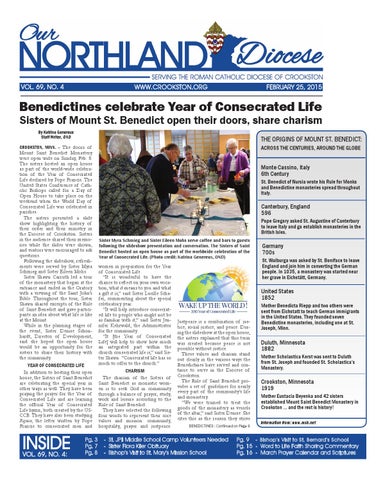
Canterbury, England 596 Pope Gregory asked St. Augustine of Canterbury to leave Italy and go establish monasteries in the British Isles. Sister Myra Schmieg and Sister Eileen Mohs serve coffee and bars to guests following the slideshow presentation and conversation. The Sisters of Saint Benedict hosted an open house as part of the worldwide celebration of the Year of Consecrated Life. (Photo credit: Katrina Genereux, OND)
women in preparation for the Year of Consecrated Life. “It is wonderful to have the chance to reflect on your own vocation, what it means to you and what a gift it is,” said Sister Lucille Schafer, commenting about the special celebratory year. “It will help introduce consecrated life to people who might not be as familiar with it,” said Sister Jennifer Kehrwald, the Administrator for the community. “It [the Year of Consecrated Life] will help to show how much an integrated part within the church consecrated life is,” said Sister Shawn. “Consecrated life has so much to offer to the church.” CHARISM The charism of the Sisters of Saint Benedict as monastic women is to seek God in community through a balance of prayer, study, work and leisure according to the Rule of Saint Benedict. They have selected the following four words to represent their core values and mission: community, hospitality, prayer and justpeace.
Germany 700s St. Walburga was asked by St. Boniface to leave England and join him in converting the German people. In 1035, a monastery was started near her grave in Eichstätt, Germany.
United States 1852
Justpeace is a combination of justice, social justice, and peace. During the slideshow at the open house, the sisters explained that this term was created because peace is not possible without justice. These values and charism stand out clearly in the various ways the Benedictines have served and continue to serve in the Diocese of Crookston. The Rule of Saint Benedict provides a set of guidelines for nearly every part of the community’s life and monastery. “We were trained to treat the goods of the monastery as vessels of the altar,” said Sister Denise. She cites this as the reason they strive BENEDICTINES : Continued on Page 6
Pg. 3 - St. JPII Middle School Camp Volunteers Needed Pg. 7 - Sister Flora Klier Obituary Pg. 8 - Bishop’s Visit to St. Mary’s Mission School
Mother Benedicta Riepp and two others were sent from Eichstatt to teach German immigrants in the United States. They founded seven Benedictine monasteries, including one at St. Joseph, Minn.
Duluth, Minnesota 1882 Mother Scholastica Kerst was sent to Duluth from St. Joseph and founded St. Scholastica’s Monastery.
Crookston, Minnesota 1919 Mother Eustacia Beyenka and 42 sisters established Mount Saint Benedict Monastery in Crookston ... and the rest is history! Information from: www.msb.net
Pg. 9 - Bishop’s Visit to St. Bernard’s School Pg. 15 - Word to Life Faith Sharing Commentary Pg. 16 - March Prayer Calendar and Scriptures
2 February 25, 2015
A
COMMENTARY
OUR NORTHLAND DIOCESE
Voice from the Valley BY BISHOP MICHAEL J. HOEPPNER
LENTEN JOURNEY
Not long ago, someone shared with me an article by a woman about being “stuck in front of a petty, typical case of ‘marital discord.’” The discord came because the woman did not feel appreciated by her husband for all she had been doing for their family. She said that a murmur kept repeating itself in her head: “Does it make sense to love as Christ loved? Wouldn’t it be better to use certain words or simply silence to make sure he understands how hurt I feel?” She couldn’t shake it. She had to beg Jesus to change her heart. Then, she writes, “it happened after Mass; it was 9 a.m. I cried and felt my heart soften, the layers of skepticism fall away.” Christ embraced her as weak, broken and as full of doubts as she was. “The embrace of Christ is the only way to stay in front of my husband with tenderness, more fully aware of the mystery that he is … To love truly, I need to be loved and forgiven, now.” (“She Pondered These Things In Her Heart: To Love I Need To Be Loved”, Jacqueline Hamm Aldrette) On Ash Wednesday, God our Father brought us to the beginning of another Lenten journey. The church calls Lent a “time of salvation.” In this time of salvation, we ask God to fill us with the spirit of holiness, to soften
and purify our hearts and to strengthen us to be more loving. We ask Jesus to embrace us, weak and broken as we are, to soften our hearts and have the layers of skepticism fall away. How will this happen? In Lent, the church puts before us tried and true ways to enable this to happen. Make time for more attentive listening to the word of God and prayer. During this Lenten journey, spend time with your Bible; read and ponder the word of God. Let God speak to your heart. Spend time in prayer each day and let God speak to your heart. In the Gospel for Ash Wednesday, Jesus speaks to us not only of prayer, but also of giving to the poor and of fasting. This Lent, give to the poor, for example through the Rice Bowl initiative and the various parish collections taken up during the season. This Lent, fast. Give less to yourself as a way of forming a disposition for giving more to others. Fast to trim off selfishness and sin. This is the service of Lent. And so we pray: “Grant, O Lord that we may begin with holy fasting this campaign of Christian service, so that, as we take up the battle against spiritual evils, we may be armed with weapons of self-restraint.” (Collect, Ash Wednesday) Lent is a journey. May our bags be packed with God’s word, almsgiving for the poor, fasting, as well as what
The 2015 Rice Bowl is pictured above with a Lenten calendar and recipies available as resources from Catholic Relief Services. (Photo credit: Katrina Genereux, OND)
the prophet encourages in the first reading on Ash Wednesday: mercy, graciousness, kindness and forgiveness (Is. 2:1218). The Lenten journey takes us to the Cross of Christ. This Lent, may we come to understand the mystery of secret of Christ’s Cross more deeply. The secret of the Cross of Christ is love. The Lenten journey takes us through the Cross of Christ to the glory of the resurrection. May each of us have a most blessed and fruitful Lenten journey this year, so that, having used well this “gracious gift” of Lent, we may come to
BISHOP’S CALENDAR February 26
12:00 p.m.
CCF Board Meeting, Chancery, Crookston
the celebration of Easter, the “sacred paschal feasts with the joy of minds made pure.” Having been “more eagerly intent on prayer and on the works of
charity,” may each of us be “led to the fullness of grace that God bestows on his sons and daughters.” (cf. Lenten Preface I)
(USPS 414-940) Our Northland Diocese is a semi-monthly newspaper committed to publishing Good News for the purpose of strengthening and furthering the Reign of God in the Roman Catholic Diocese of Crookston.
Subscriptions: $13.65 per year in the diocese, $14.90 per year outside the diocese. Publisher:
The Most Reverend Michael J. Hoeppner Bishop of the Diocese of Crookston
Editor:
Rev. Robert Schreiner Office of the New Evangelization, Director
Associate Editor:
Mrs. Janelle C. Gergen jgergen@crookston.org
March 1
9:00 a.m.
Mass, St. Anne’s, Naytahwaush
March 2
8:00 a.m.
Mass, Mount St. Benedict
Editorial Assistant: Mrs. Katrina Genereux kgenereux@crookston.org
March 4-5
Minnesota Catholic Conference, St. Paul, Minn.
Proofreader:
Deacon Dan Hannig
For questions about subscriptions or address changes, please contact: Renee Tate at rtate@crookston.org
VICTIMS’ ASSISTANCE STATEMENT If you or someone you know has been sexually abused, your first call should be to law enforcement. If you have been abused by a Catholic priest or another person in Church ministry, the Diocese of Crookston Victim’s Assistance Coordinator is also available to offer you help and healing. Please contact Louann McGlynn at 218281-7895 (24-hour confidential number) or Lmcglynn@crookston.org.
Periodical postage paid in Crookston, MN and additional mailing offices. Postmaster: send address changes to: Our Northland Diocese PO Box 610, Crookston, MN 56716-0610 Phone: 218-281-4533 Publishing dates and submission deadlines for news and advertisements can be found online: http://www.crookston.org/ond/
OUR NORTHLAND DIOCESE
DIOCESAN
February 25, 2015
3
Summer service opportunities at St. John Paul II Camp By Elizabeth Rzepka Coordinator of Catechesis and Youth Ministry for the Office of the New Evangelization
“He who finds his life will lose it, and he who loses his life for my sake will find it,” Jesus tells us in the Gospel of Matthew. The whole of the Christian life calls us to the high standard that embraces the biblical paradox of the Cross. The lived witness of those who give everything they have in service, as missionaries, as humble parishioners in their local communities, and so much more, is a testament to the truth of the saying, it is in giving of ourselves that we receive. The Second Vatican Council reiterated this truth when it proclaimed that it is only in a total and sincere gift of self that we are truly able to find ourselves. Ask anyone who has taken the leap and given it a try and they will tell you that they have never been so blessed as when they gave it all. Among the myriad ways we can offer ourselves to God and to his Church, we find the re-
warding and inspiring gift of youth ministry. Serving the youth is energizing, joy-filled, and powerful. This summer, the Diocese of Crookston has two great ways that you can pour yourself out to help our youth come to know Jesus Christ and follow Him in the midst of his Church at our annual St. John Paul II Camp for middle school youth. One opportunity for those who will be juniors and seniors in high school in the fall of 2015 is the Service Team. The Service Team partners with adult staff to put on the camp and allow campers to come to know Jesus Christ in a deeper way. They do this primarily through service, with small groups, leading daily activities and games, helping with behind-the-scenes preparations, assisting at Mass, skits and dramas, giving testimonies, and witnessing a life of faith through prayer and example. The second opportunity is to join the Adult Staff of St. John Paul II Camp. Faith-filled, passionate and enthusiastic adults who desire to invest in the
The 2014 Service Team, Adult Staff and campers of the St. John Paul II Middle School Camp at Northern Pines in Park Rapids, gather for a photo. (Submitted photo)
youth of our diocese are invited to come forward to be considered for this awesome task. Staff work together to witness to the love of Christ in word and deed, pray for the campers, lead small groups, give personal testimonies, direct socials and games, and supervise the campers throughout the 5-day camp. This kind of service will challenge you and call you out of
yourself. It will require you to stretch the limits of your comfort zone, but if God is calling, you can be sure the grace will be supplied and you will find it to be a life-changing and transformative experience. For more information, see the website and the downloadable application forms: http:// www.crookston.org/events/ diocese-of-crookston/st-john-
paull-ii-middle-school-camp. If this service isn’t for you, consider encouraging high school youth and adults within your parish, who may be blessed by this opportunity to serve, and personally invite them to apply. Applications are due March 20th for Adult Staff and April 1st for Service Team.
4 February 25, 2015
COMMENTARY
OUR NORTHLAND DIOCESE
Thank God, God still waters plastic flowers! Every community and parish has a unique character or two whom God uses to grant us insight to the depth of God’s love for us. Al, known also as “Big Al,” was one of those folks here in Bemidji. Al died recently and the lessons he taught behind the scenes floated to the surface of his life as we bid him farewell. From his obituary, in summary: Albert was born on Sept. 17, 1918. He served in the United States Army and was discharged in 1946. He worked as a logger and owned his own sawmill. When Al was 50, a car dealership purchased the sawmill property and built a new business on the edge of Bemidji. Al was a fulltime employee of the dealership. Al’s tiny house on the property burned to the ground some time later and his boss suggested Al live in the dealership until he rebuilt his house. Al never did rebuild the house and the dealership literally became his home and the owner’s family became his family. To that fam-
LIFE FIRST
By Father Don Braukmann Parochial Vicar - St. Philip’s Parish, Bemidji and St. Charles Parish, Pennington
ily, especially to the children, he became like a blood relative in a short time. For the past few years Al has been in a nursing home and that is where I first met him nearly four years ago. He was a character and would often wear his special hat which was encircled with small plastic cars in honor of his home … a home I don’t think his mind ever left. At the prayer service for Al, the stories poured forth from friends and his adoptive family. There were three things which I took from the sharing which I want to share with readers; three lessons taught by a man the world, for the most part, ig-
nored. First, Al was a man of great hope. He had so much hope, in fact, he would help out at the dealership, his home, by watering the plants. He even faithfully watered the plastic ones! We may chuckle but what an insight to God and God’s faithfulness to us. Thank God, literally, God still waters us, his plants, even if our souls have turned to plastic and we don’t think we need him. Somewhere deep inside Al had hope strong enough to believe if the plants were watered, they would come to life. It was sure to happen. In short, don’t give up on something or someone just because
everyone else does! Second, Al was a man of simplicity. He had no family. He had never married. When the tiny house he lived in burned to the ground, he accepted the invitation of his new family and lived in a car dealership. He insisted on sleeping on the floor in the owner’s office each night. For Al, as was clear when person after person testified at the prayer service, people were more important than things. Titles, mansions and money were of little value when compared to the love of family and the loyalty of friendship. Third, Al was a man of presence. Sure, he may have given his share of “presents” to his adoptive family but the greatest gift anyone can give to a family is just plain being there. The children of the family he was part of, now adults, shared how they would call Al to pull them out of the ditch on a late winter night or give them advice when they were in trouble and had to face their parents. Some of the stories were hysterical and each gave us another
glimpse of God using Al to deliver a message of presence. Just picture an aging man getting bundled up to rescue one of the lost sheep who wasn’t bright enough to come in out of the cold. God is like that too. At the dealership, Al drove more than three million miles transferring and delivering cars; all of those miles without an accident. He could not get that part of his duties out of his mind while at the nursing home. He would roll up to the window overlooking the parking lot and ask visitors how he was supposed to move all those cars without knowing where the keys were! Al was a servant to the end, a kind man of hope, simplicity and presence. May we ignore the condemning verdict and suspicious stares of a suspecting world and begin watering the plastic plants as well as the organic ones. May we remember people are more important than things. May we be present to one another without titles, without agendas and without fear.
CRS Rice Bowl: How a cardboard box assists dioceses and beyond Catholic Relief Services (CRS) has been providing assistance to the needy for more than 70 years. The international humanitarian agency of the Catholic community in the United States was established by the U.S. Catholic Bishops following World War II. They hoped to assist Europe and its refugees in recovering from the six years of conflict. Even within these 70 years of outreach, there exists yet another milestone. This year, CRS celebrates 40 years of what’s known as the CRS Rice Bowl! According to CRS, the Rice Bowl began 40 yeaers ago becaue Catholics in the United States wanted to respond to the scarcity of food in Africa. They asked the following question: “Could we feed the hungry through Lenten prayers, fasting and almsgiving?” The answer was “Yes!” And the ultimate solution came in the form of a small cardboard box (http:// www.crsricebowl.org/about/). From Ash Wednesday to Easter Sunday, the CRS Rice Bowl both accompanies and aids hundreds of thousands of people in all different states of life around the world, including many right here in the Diocese
CREDO
A NEW EVANGELIZATION WITNESS
By Ms. Amanda Zurface, J.C.L Coordinator of Justice, Marriage & Family Life
Diocesan Director of Catholic Relief Services & the Catholic Campaign for Human Development of Crookston. The Rice Bowl, which includes faith formation, draws us all – individuals and families – closer to Christ and His Universal Church throughout the 40-day season of Lent, by integrating works of penance that is, prayer, fasting and almsgiving (charity). The Rice Bowl initiative, based on Catholic social teaching, helps to incorporate a universal solidarity. It does this through the actual Rice Bowl itself, along with the accompanying resources, including a Lenten calendar and so much more. These resources stay true to the three pillars of our Lenten spirituality: prayer, fasting and almsgiving. To guide our prayer, CRS provides communal prayers with reflections on the Stations
of the Cross, the Seven Sorrows of Mary and the Lives of the Saints. To assist us in our fasting, recipes have been made available to help us eat more simply throughout Lent. They also provide information about the importance of nutrition, as well as the diets of our brothers and sisters in different areas of the world. Lastly, through almsgiving, CRS provides our communities with the Rice Bowls – FREE small cardboard boxes which remind us to give to those in need. There are many benefits in choosing to give through CRS Rice Bowl. It’s a fun and active way to get our children involved and learning about the Lenten season. Another benefit is that we actually have the op-
portunity to see how our gifts are changing lives both internationally and locally. Each year, 75 percent of all CRS Rice Bowl donations collected in the Diocese of Crookston (and all dioceses) support CRS programs around the world. These programs include projects that focus on agriculture that help farmers improve their harvests; mother and child health projects that offer health and nutrition services; water and sanitation projects, which help to bring clean water to communities; microfinance projects that support small businesses and educational projects that provide resources and trainings. The remaining 25 percent of the donations offered through the CRS Rice Bowl in the Diocese of Crookston go to hunger and poverty alleviation efforts in our local communities. This year, due to the generosity of so many through the 2014 Rice Bowl collection, charitable organizations, food pantries and assistance programs received extra financial support to assist their efforts to help local families and individuals who have firsthand experience of hunger and poverty.
Some of those groups include: the Becker County Food Pantry, Roseau Area Food Shelf, Lake of the Woods Food Shelf, Warroad Area Food Shelf, the Refuge of Detroit Lakes and others. We offer special thanks to our diocesan deans, pastors and parish commitees for their leadership in these efforts. Bishop Hoeppner and the Office of the New Evangelization are grateful for your past and future generosity to the CRS Rice Bowl. We are also thankful for the 40 years of Rice Bowl and the ways it has guided our local Church throughout Lent. Please continue to support this initiative and the many ways it alleviates both the spiritual and material suffering of those in poverty internationally and locally. Pick up your FREE CRS Rice Bowl from your parish office today! If it’s your first time participating and you have questions, contact the Office of the New Evangelization at (218) 2814533, ext. 425, or visit http:// www.crookston.org/justice.
OUR NORTHLAND DIOCESE
COMMENTARY
February 25, 2015
5
Since biblical times, surrogacy poses many problems In 2014, the Minnesota Catholic Conference worked tirelessly to successfully stop problematic legislation that would have legitimized commercial surrogacy contracts, which are currently not recognized under Minnesota law. This session, MCC is advocating for legislation that would establish a legislative commission to study the issues and concerns associated with surrogacy arrangements, including how to ensure that we protect vulnerable women and children from potential exploitation and commodification. Surrogacy is the process in which an individual or couple, who often cannot have a biological child of their own, pays a fee to a woman in exchange for her carrying and delivering a baby. At birth, the child is turned over to the “intended parent(s).” The commercial surrogacy industry capitalizes on the desire of well-meaning intended parents yearning to have a biological child of their own. Good intentions, however, can lead to unintended consequences. HAGAR AS THE BIBLICAL MODEL OF A “WOMB FOR RENT” Couples struggling with fertility have used surrogacy-like arrangements to solve infertility issues for centuries— going all the way back to the Old Testament story of Abraham and Sarah. Sarah was barren, so she gave her slave girl, Hagar, to Abraham in order to conceive a child (Genesis 16:1-3). Upon birth, the child was legally considered Sarah’s and, therefore, Abraham’s heir. Hagar’s story did not, however, end happily when she gave birth to Ishmael. After Sarah conceived her own child, she turned from both Hagar and Ishmael. Ultimately, Hagar was misused, her child was pushed aside by Sarah, and she and Ishmael were forced to flee into the wilderness (Genesis 21:9-13). Most people object to Sarah’s use of Hagar as a reproductive slave, but they
FAITH
IN THE PUBLIC SQUARE
By Ms. Kathryn Mollen Policy and Outreach Coordinator Minnesota Catholic Conference
may overlook the similarities of Hagar’s story to that of some modern surrogacy arrangements. Many of us can relate to Sarah’s pain, because she experienced the loss and sadness of childlessness that so many women experience today. Yet, should our compassion for Sarah justify the commodification and exploitation of Hagar? COMPASSION DOES NOT JUSTIFY COMMODIFICATION Surrogacy arrangements that seek to overcome infertility by “renting” out a womb can create a host of problems. Foremost may be the issue of unequal buyer/seller arrangements between the surrogate mother and intended parents. These arrangements can favor the preferences of the often more affluent “buyer” over the needs of the pregnant surrogate mother, making her vulnerable to inadequate informed consent, coercive situations, and inadequate health care coverage. For example, in 2013, a Connecticut woman agreed to carry a baby for an infertile couple and signed a contract at the onset of the pregnancy that included an abortion provision, which gave the couple the option to terminate the pregnancy at any point they chose in exchange for $1,000. When the baby showed prenatal signs of birth defects, the couple chose to exercise the abortion option. The surrogate mother, although she had signed a contract and
was in desperate need of the money, refused to follow through. When the couple offered her $10,000 to abort and sent lawyers after her to abide by the contractual terms, she moved to another state in order to give birth to the baby and place her up for adoption. The unintended, disastrous consequences of surrogacy arrangements often surface when one party changes their mind. A couple decides they want a surrogate to abort the baby because they no longer want the child. Or, a surrogate mother begins to agonize about giving up a child as she begins to bond with the child in-utero. These situations have led the commercial surrogacy industry in the U.S. to push for state legislation that helps them legitimize surrogacy contracts – contracts that protect their client’s “in-
vestment” and do what was historically unthinkable in our legal system: buy and sell a baby. PROTECTING WOMEN, AVOIDING “REPRODUCTIVE TOURISM” Currently, Minnesota law – similar to the law of many other states – does not recognize the validity of commercial surrogacy contracts. States that have passed legislation to legalize surrogacy contracts, such as Illinois and California, have seen the number of surrogacy arrangements increase significantly. In these states, the industry is setting up brokerage firms that are attracting larger crowds of international and national “reproductive tourists.” Minnesota needs to take a more serious, in-depth look at the many concerns associated with surrogacy contracts before we create laws that legalize commercial surrogacy agreements and, in doing so, create an incentive for the practice of surrogacy to expand and grow in Minnesota. Forming a legislative commission to study surrogacy is one of the best ways to help ensure Minnesota is protecting vulnerable women and children from the unintended consequences of surrogacy arrangements.
Contact your legislators today and urge them to support the following bills by sharing the messages below: HF 439/SF 462: HELP FAMILIES OF BABIES WITH CHROMOSOMAL DISORDERS “Please support the Prenatal Trisomy Diagnosis Awareness Act (HF 439/SF 462). This bill will provide expectant parents, upon receiving a diagnosis of Trisomy 13, 18, or 21 (Down Syndrome), with supportive and educational information during a critical and sometimes stressful period for their family.” HF 342/SF 355: RESTORE THE VOTE “I believe people should be able to vote after they have served their jail time and have been released. Restoring the right to vote for those who are living in our community will create clearer laws, save on government resources, and encourage positive community participation from those who are trying to get back on their feet. Please support HF 342/SF355 to restore the right to vote.” For Catholic teaching and public policy details on these bills, or for instructions on how to contact your legislators, visit the “Advocacy” tab in the MCC Action Center (www.mncc.org/actioncenter). The Catholic Advocacy Network is an initiative of the Minnesota Catholic Conference, the public policy voice of the Catholic Church in Minnesota.
6
February 25, 2015
YEAR OF CONSECRATED LIFE
OUR NORTHLAND DIOCESE
BENEDICTINES: Continued from Page 1 to care for their buildings and keep them in good condition. This part of their charism is carried through into their building. Portions of the monastery, including a pillar near the library, are from previous buildings they have occupied. It is important to the sisters, when leaving a place behind, to make sure that nothing is wasted and anything still useable is given new life. “Any disorder is put into order quietly and quickly,” said Sister Anita Whalen, the Acting Archivist. She added as an example, “If you see a wrapper on the floor, pick it up right away.” Another aspect of the charism of the Sisters of Saint Benedict is living in community. “Common life is the expectation,” said Sister Denise. “If you have to live alone, it is considered temporary; it’s harder to have conversion if you live by yourself.” According to Sister Anita, common life is a hallmark of Benedictine life. “In the Benedictine monastic tradition, we live together as much as possible. … Married life and raising children works best with two. In the same way, our duty to pray Liturgy of the Hours goes better with community.” “We take vows of conversion of life and stability – stability to the people of the community,” said Sister Anita. “The fidelity to the monastic way of life requires that you stick with these people.” The Benedictines have certainly maintained their commitment to this portion of their charism during their 96 years in the community of Crookston. “The point is for us all to end up together with God,” said Sister Anita. She said that community life offers a sense of helping each other along the way. Living in common is one way the Benedictine sisters foster a respect for the journey of others. LIFE IN THE MONASTERY “We have a balance of work, prayer and leisure,” said Sister Kathy Kuchar, the Subprioress at Mount Saint Benedict. In addition to personal prayer and Lectio Divina, the sisters gather together for prayer in the morning, at noon and again in the evening. “We have a quiet atmosphere evening through morning,” said Sister Jennifer. They rise early, eat a quiet breakfast and then
have Mass at 8 a.m., followed by Morning Prayer. They take time for individual Lectio Divina during the day and then pray Evening Prayer together at 5 p.m., followed by supper. The sisters also balance their life of prayer with work. “All of the retired sisters have a job of some kind. They contribute to the monastery,” said Sister Kathy. After the evening meal, the sisters have recreation time. In all that they do, the sisters seek to foster an environment of quietness and peace throughout their monastery. “The notion of silence hits you when you come,” said Sister Anita. She said that all of the sisters can walk together in the hall without much noise. When they walk with a visitor, the visitor’s steps are generally very noticeable. “We have learned to have quietness; that it’s ok to be quiet,” she added. WORK IN HOSPITALS In 1919, the Sisters of Saint Sister Norma Jean Edie describes the large painting she created to tour guests during the open house at Benedict began living in and Mount Saint Benedict. The artwork depicts sisters planting and preserving food planted in their gardens. serving at St. Vincent’s Hospi- The painting hangs outside the canning room at the Monastery. (Photo credit: Katrina Genereux, OND) tal in Crookston. Forty-two sisters from the Diocese of Du- she said. luth transferred to the Diocese Sister Bernadette continued of Crookston to form the new working through the transition community. time when St. Vincent’s became After they moved out of the a nursing home and St. Francis hospital into a home of their Hospital was opened in 1950. own, the sisters continued serv- “When we moved over to St. ing as nurses throughout the Francis, I remember cleaning diocese for many years. the new tubs and toilets, and “Seeing sisters in their getting everything ready,” she starched white uniforms gave said. people a certain sense of The sisters in the hospitals peace,” said Sister Anita, who worked 12 hour shifts, seven worked as a dentist in Warren days a week. for many years. She recalls go“The only few days they had ing to the hospital for a pro- off was when they came here cedure as a young girl. She for retreat,” said Sister Denise. was nervous until she saw the “We worked nights, went Sister Anita Whalen, Acting Archivist, shows tour participants the sisters. “I just was not scared to the retreat for a few days, two volumes of the St. John’s Bible specially displayed in the Oratory anymore,” she said. “Someone and then went back to work at for the Year of Consecrated Life Open House. (Photo credit: Katrina was not going to just do the job night,” added Sister Bernadette. Genereux, OND) well, but was also going to care She said some of their work well for me.” ing, “Those sisters taught you sisters, including in the adminisdays lasted 24 hours. Sister Jennifer worked in a “Work in the hospitals was how to do it. You knew how to trative roles,” said Sister Kathy. hospital outside of the diocese, hard on community life,” said be busy and find jobs to do and In 2013 Sister Kathy retired afbut recalls some of the lengths Sister Jennifer. they would show you how to do ter 17 years serving as principal at St. Bernard’s School, Thief the sisters went to when things Although the sisters of it.” River Falls. were not working properly. She Mount St. Benedict are no lonEDUCATION The sisters strove to incorpoworked in a six story hospital ger working as nurses in the The Sisters of Mount St. rate the Catholic faith in every with one elevator. When the hospitals, their presence is still elevator broke down, they cre- felt. Sr. Shawn said she recently Benedict have played a large aspect of their schools. “It wasn’t just that we had reated a human chain through the had blood taken from a nurse role in Catholic Education staircase to serve meals to the who was trained by Sister Dig- throughout the diocese. They ligion classes, it was throughout patients. na, a former nurse from Mount taught at and ran schools in the school,” said Sister Denise. Crookston, East Grand Forks, “It [religion] was included in Sister Bernadette Kostrzews- St. Benedict. ki was an intensive care nurse “The teaching goes beyond Barnesville, Bemidji, Detroit every moment and breath of at St. Vincent’s Hospital and the classroom,” said Sister Ani- Lakes, Mahnomen, Moorhead, the day,” added Sister Kathy. Not only did the sisters teach remembers teaching the new ta. She recalls a person com- Park Rapids, Red Lake Falls and the subject matter and share nurses who came in. “Most sis- menting about the on-the-job Thief River Falls. “Many schools in the early ters that worked there got their training they received at the RN and became anesthetists,” hospital from the sisters, say- years were entirely staffed by BENEDICTINES : Continued on Page 12
OUR NORTHLAND DIOCESE
AROUND THE DIOCESE
February 25, 2015
7
Sister Flora Klier, OSB, known for gardening, dies Sister Flora (Alvina) Klier died peacefully at Villa Saint Vincent on Friday, Feb. 6, 2015. She was born in Park Rapids, Minn. on May 2, 1924, the third of four children born to Mary (Thiesen) and Anthony Klier. Sister Flora began thinking about a religious profession when she was about 14 years old because of the Benedictines who taught summer catechism in her parish at Two Inlets. She entered their community on Sept. 4, 1942, and made her final profession in August of 1947. Sister Flora remarked, in autobiographical information a few years ago, that living at the Mount has always been very special to her. She stated that all the beauty surrounding the monastery is just a little bit of heaven for her. Because of a very special skill at cooking, Sister Flora’s first ministry was charge of the dietary depart-
ments of hospitals in Detroit Lakes and Browerville, Minn. for a number of years. She was then assigned to the dietary department of Mount Saint Benedict in Crookston (we at the monastery fondly remember her homemade angel food cake and other delights!). While working in the dietary department, she became interested in the large twelve-acre garden here at the Monastery under the direction of Sister Benigna. She was given charge of this garden in 1974, where she helped raise food for more than one hundred sisters at the Mount, for mission schools where more than fifty sisters worked, and also for the Care and Share. Her volunteer helpers in the garden also were able to get the vegetables they needed for their own use. In the 1990’s, she and her volunteers yearly raised 3,735 pounds of potatoes, 21,522
Sister Flora Klier, OSB
pounds of carrots, 11,142 pounds of squash, 2,544 pounds of peas, 1,775 pounds of beans, 141 bushels of tomatoes, 850 pints of raspberries, 249 pints of strawberries, 2,437 pounds of spinach, 777 pounds of lettuce, 12 bushels of large
apples, 18 bushels of crab apples, and much more! Sister Flora was a master at good care of the soil, using only minimal fertilizer and pesticides. In order to enrich the soil, she planted buckwheat and later plowed the full-grown crop under. She used lady bugs purchased from a firm in California to combat aphids and also enlisted the help of cats to keep the mice and birds from stealing produce as well as a dog to scare away the deer. Not only was Sister Flora extremely talented with the garden, she also had artistic talent in cake making and decorating for weddings as well as wood carving. She belonged to the Wood Carvers’ Club of this area and created intricate works. She also restructured broken statues and painted them for a number of churches in the area. Sister Flora was preceded in death by her parents; her sis-
Retired Father Joseph C. Miller, 92, dies Father Joseph C. Miller, age 92 of Nevis, died Saturday, February 7, 2015 at Green Pine Acres Nursing Home in Menahga, Minn. A Mass of Christian Burial was held at 11 a.m. Friday, Feb. 13 at St. Michael’s Catholic Church in Spring Hill, Minn. Father Timothy Wenzel presided, with Bishop Donald Kettler and other priests concelebrating. Interment followed in the parish cemetery. Reception of the Body was at 3:30 p.m., Thursday, at St. Michael’s Catholic Church in Spring Hill with visitation from 4 to 8 p.m. at the church. Parish prayers were at 7 p.m. Visitation continued from 9:30 to 11 a.m. Friday at the church in Spring Hill. Reverend Joseph Conrad
Miller was born September 6, 1922, in Spring Hill Township, Stearns County, Minn., to Joseph and Catherine (Nietfeld) Miller. He attended country school at Stearns County District 133 through the eighth grade and then graduated from the Crosier Preparatory Seminary in Onamia, Minn. He received his bachelor’s degree in philosophy and theology from the Crosier House of Studies in Hastings, Neb., and his master’s degree in classical languages from The Catholic University of America in Washington, D.C. Father Miller professed his solemn vows as a member of the Crosier Order on December 8, 1944 in Hastings. He was ordained to the
Father Joseph C. Miller
priesthood on June 4, 1949 by Bishop Louis Kucera and celebrated his first Mass on June 5, 1949 in Boys Town, Neb. Father Miller was a teacher of Latin, Greek, and German at the Crosier Seminary in Onamia from 1950 to 1967. He was also the pastor of St. Mary’s
Church in Milaca from 1960 to 1967. Father Miller was incardinated in the Diocese of Owensboro, Kentucky in 1968, where he served in the following pastoral assignments: pastor of St. Anthony Church, Peonia, Ky., St. Benedict Church, Wax, Ky. and St. Augustine Church, Grayson Springs, Ky., for ten years; St. Alphonsus Church, St. Joseph, Ky. for seven years; and Immaculate Conception Church, Earlington, Ky. for two years. Father Miller retired in 1986 and has resided on Lake Belletaine, near Nevis, Minn., since then. Father Miller is survived by many nieces and nephews. He was preceded in death by his parents; two brothers, Math (Theresa) Miller and Father Henry Miller; and four sisters, Sister Gordian Miller, O.S.B, Julianna Miller, Leona (John) Mehr, and Armella (Leo) Eveslage.
ters, Mathilda and Delores and her brother, Marcellus. She is survived by a sister-in-law, Ida Klier; a niece, Rose Pitcher; friends and the members of her monastic community. Gifts in memory of Sister Flora to Mount Saint Benedict Foundation are preferred. Sister Flora Klier, OSB, age 90, of Mount St. Benedict in Crookston, MN, died at the Villa St. Vincent in Crookston. A Mass of Christian Burial was held at 11 a.m. on Feb. 11, at the Sacred Heart Chapel of Mount St. Benedict, Crookston, with Msgr. Roger Grundhaus presiding. Visitation was at the Sacred Heart Chapel on Feb. 10 from 5 to 7 p.m., with a 7 p.m. prayer service, and also for one hour prior to the burial Mass. Interment will be in the Mount St. Benedict Cemetery in the spring.
8
February 25, 2015
AROUND THE DIOCESE
OUR NORTHLAND DIOCESE
Bishop Hoeppner, Shepherd of the Faith, visits his little lambs at St. Mary’s Mission By Katrina Genereux Staff Writer, OND RED LAKE, MINN. — On cold, icy Feb. 11, Bishop Michael Hoeppner visited the school at St. Mary’s Mission, Red Lake. He celebrated Mass with the students, teachers and faculty, and then spent the rest of the morning visiting with students in their classrooms. During his homily, Bishop Hoeppner spoke about how his mother used to tell him “don’t ever try to make yourself look bigger by standing on someone else.” He said rather than stepping on someone else, we should remember that, “God loves us right where we are and God helps us grow bigger by being good.” Bishop Hoeppner visited each classroom and spoke to the students about blessings and how to receive them, the seven Sacraments and the symbols of a bishop. Before departing each classroom, Bishop Hoeppner offered the students and teachers a blessing. Three boys from the fifth and sixth grade class beat a drum as the rest of the children bundle up to head back to their classrooms following Mass. The boys played the drum and sang at the beginning and end of Mass, as well as before the Gospel. It is something they do on feast days and for special Masses.
Father Jerry Rogers proclaims the Gospel during school Mass with Bishop Hoeppner. (Photo credits: Katrina Genereux, OND)
Bishop Hoeppner greets a preschool student on his way into the classroom.
Bishop Hoeppner teaches the third grade class about blessings while their teacher Mrs. Frenzel and Principal Tony Kerr listen as well.
Principal Tony Kerr, Father Jerry Rogers, and Bishop Hoeppner spend a few minutes chatting in the principal’s office.
OUR NORTHLAND DIOCESE
AROUND THE DIOCESE
February 25, 2015
9
Bishop Hoeppner blesses students at St. Bernard’s, visits their classrooms By Katrina Genereux Staff Writer, OND THIEF RIVER FALLS, MINN. —
Bishop Michael Hoeppner traveled to Thief River Falls on Feb. 13 to spend some time with the students at St. Bernard’s Catholic School. He started by concelebrating school Mass with Father Rick Lambert. In his homily, Bishop Hoeppner spoke about Adam and Eve and the effects of original sin. He talked about baptism and the way God helps us overcome sin, saying “Grace is bigger [than sin], we can resist the temptation to not do good ... We thank God today for putting this life in us to help us fight original sin.” Bishop Hoeppner went to each of the classrooms, visiting with students, quizzing them about the sacraments, and answering their questions.
Bishop Hoeppner raises his hand as he blesses the students during the recessional at St. Bernard’s School Mass on Feb. 13.
Bishop Hoeppner leans forward to receive the bread and wine from students during the offertory while Father Rick Lambert observes. (Photo credits: Katrina Genereux, OND) Left: Bishop Hoeppner tells Mrs. Knott’s first graders about the symbolism of a bishop’s miter. Right: Preschool students at St. Bernard’s Catholic School rush forward to hug Bishop Hoeppner at the conclusion of his visit to their classroom. Bishop spoke to the preschool students about how to receive a blessing by making the sign of the cross and “smearing it all over” themselves, something they practiced a few times before he blessed the class.
Bishop Hoeppner and Principal Randy Schantz visit with students in the cafeteria during lunch.
Students in Mrs. Dallman’s class jump out of their seats and raise their hands high to name the seven sacraments. Bishop Hoeppner focused on First Communion with the second graders.
10 February 25, 2015
AROUND THE DIOCESE
OUR NORTHLAND DIOCESE
Couples celebrate marriage at Sacred Heart On Saturday, Feb. 14, nearly 200 people gathered at Sacred Heart in East Grand Forks for the parish’s second annual Marriage Celebration Night. The evening began with Holy Mass and was followed by a catered meal and a witness talk. The event was hosted by Sacred Heart’s Marriage Ministry Team. Presenters were Deacon Tom Cerar and his wife, Marsha. They reside in Moorhead and have been married for 39 years. The topic of the evening was Marriage: A Journey to Heaven. Their presentation included tips for living a holy marriage by: emptying self, welcoming Jesus into the home, praying together, showing love, creating a domestic church, arguing well, forgiveness, establishing rituals and committing to on-going marriage building.
Msgr. Mike Foltz extends his hand in blessing 97 marriages at the conclusion of Marriage Celebration Night at Sacred Heart in East Grand Forks. (Submitted photo)
Knights of Columbus Council 5341 Sacred Heart student receives national Activities Award wins Triple ‘A’ award Council 5341, Knights of Columbus, representing the parishes of East Grand Forks, Tabor, and Fisher, Minn., earned the 2014 National K of C Columbian Activities Award. Dan DeCrans, State Program Director, presented the Columbian Plaque to the Council in a group assembly. Over $22,000 was provided to needy individuals and families for food, clothing, Christmas presents, nursing home equipment, school supplies, scholarships, altar server entertainment, television equipment for the parish, religious education materials, and other various requests. Only 10 percent of the Minnesota Councils earn this award.
State Program Director for the Knights of Columbus, Dan DeCrans, presents the National K of C Columbian Activities award to Knights of Columbus Council 5341 at a group assembly. (Submitted photo)
Hannah Modeen, a Sacred Heart senior, poses with her parents, Nathan and Jennifer Modeen after winning the Subsection 31 Triple ‘A’ Award at the Region 8 banquet in Mahnomen. The Triple ‘A’ Award (Academics, Arts, and Athletics) is an award that recognizes and honors high school seniors who have excelled in the classroom, on the athletic field, and in the fine arts.
Nei Bottling Inc. P.O. Box 516 Bemidji, MN 56619 Phone: (218) 751-3847
OUR NORTHLAND DIOCESE
AROUND THE DIOCESE
Three Bishop’s Medals awarded On Feb. 8 during Holy Mass at Sts. Peter and Paul, Warren, Bishop Michael Hoeppner bestowed Bishop’s Medals on three people: Greg Myszkowski and Phyllis and Bob Nowacki. Myszkowski was recognized for his life-long involvement with the parish serving in various Mass ministries, and his work with the Knights of Columbus. He has also provided technology services for the parish including setting up and running their website, running the projector, and recording Masses and Christmas programs. Myszkowski also serves as a catechist for the religious education program and was a leader for the ARISE program. Bishop Hoeppner recognized the Nowacki’s for their contributions together and separately. The couple has been involved with St. Pete’s Posse and the Relay for Life as well as serving at Knights of Columbus fish fries and the St. Patrick’s Day Dinner. They also work together to care for altar banners and cloths, and make sure that they are changed with the liturgical seasons. Phyllis was recognized for her service as a cantor and liturgist, and Bob was recognized for his contributions as an usher and Eucharistic minister. All three recipients of the Bishop’s Medal were nominated by their pastor at Sts. Peter and Paul, Father Emmanuel Sylvester.
Bishop’s Medal recipient Greg Myszkowski, holding his medal, poses for a photo with Father Emmanuel Sylvester and Bishop Michael Hoeppner. (Submitted photo)
Bob and Phyllis Nowacki display their medals and pose for a photo with Bishop Hoeppner and their pastor, Father Emmanuel Sylvester. (Submitted photo)
February 25, 2015
11
Celebrating Confirmation
Sts. Peter and Paul, Warren. (Submitted photo)
St. Stephen’s, Stephen. (Submitted photo)
PLEASE
pray for vocations to the priesthood and religious life
wants your news and advertisements! Find 2014-15 publishing dates and submission deadlines on the web: http://www.crookston.org/ond/ The next OND submission deadline is: Wednesday, March 4 by 12:00 p.m. Email: Katrina Genereux, Editorial Assistant kgenereux@crookston.org
12 February 25, 2015
YEAR OF CONSECRATED LIFE
OUR NORTHLAND DIOCESE
BENEDICTINES: Continued from Page 6 the Catholic faith, but they also strove to foster a lifelong thirst for learning in their students. Sister Jennifer remembers teaching chemistry in Sioux Falls, S.D. The students noticed her interest in reading because she always had a book with her to read while they were doing their lab work. She said her continual reading modeled the value of life-long education for them. The sisters’ ministry of education spread beyond the schools they served in, expanding into parishes and beyond. They taught religious education classes and vacation bible schools in parishes, as well as providing adult education and formation. “It [evangelization] is teaching something about the sacredness of life, not even consciously, but automatically,” said Sister Anita. The sisters did not just share Christ through religious education, they also served the communities around them in a multitude of other ways.
OTHER BENEDICTINE MINISTRIES According to Sister Jennifer, Benedictine sisters often contributed to parishes as parish musicians. “Sisters here gave free organ lessons,” said Sister Shawn. “They would teach piano lessons, and if a pupil seemed
like they could do it, the sisters would teach them to play the organ for free so they could play at Mass.” “Other ministries of the sisters outside of the Catholic Schools included a reading program at the Care and Share to help adults who had never learned to read,” said Sister Denise. “Sisters also offered ESL help at the Care and Share. Some sisters serve as paras at the Sunrise Center.” The sisters of the Mount also ministered to migrant workers in the diocese. Latino migrants came every year to work in the fields thinning the sugar beets, and brought their children with them. Often the kids left school before the end of the year and returned after the next school year had already started. The sisters saw a need for education and a safe place for the kids to be, so they started summer boarding schools to meet this need in Crookston and Moorhead. The sisters also started schools in Texas. “They followed some of the migrants down, and taught some of the same students in Texas as in the migrant schools up north,” said Sister Denise. Some of the sisters of Mount St. Benedict collaborated with other Benedictines to teach in three schools in Bogota, Colombia following a request from the Vatican for sisters to
go to the missions in the early 60s. “We were asked to send 10 percent of our members to the southern hemisphere,” said Sister Denise. The sisters taught at schools in the poorest areas of Bogota, Colombia, and worked with women in the barrios there, said Sister Denise. According to Sister Denise, after returning from Colombia, Sr. Margaret Ann worked at the Care and Share in Crookston. She was asked how working at the Care and Share compared to working in the barrio in Colombia. Her reply was that here the poor have a car. She spoke about going to the shacks in the barrio to visit the women and being served tea in dirty, broken cups. Sr. Margaret Ann said she learned to drink the tea because it was the best the women had to offer.
CONTINUING THE TRADITION According to Sister Jennifer there are currently 60 Sisters of Saint Benedict. Forty-one of them live at the monastery in Crookston. There are also six at Villa St. Vincent, three at The Summit, six in Texas, and four others living on their own elsewhere in Minnesota. While the sisters are less active outside the walls of their monastery, their impact remains. The sisters continue to spon-
Sister Shawn Carruth pauses with tour guests next to a pillar and arched windows that were built into the monastery from previous buildings the sisters occupied. (Photo credit: Katrina Genereux, OND)
sor the Sunrise Center for Children and Families, a daycare and preschool program at the Cathedral in Crookston, directed by Sister Judy Moen. The sisters also continue to serve at Villa St. Vincent, providing pastoral care and volunteering in different ways. They also maintain a connection with the Care and Share in Crookston through their presence on the board of directors. Mount Saint Benedict operates a Spirituality Center that provides a space for people seeking individual retreats and
prayer. The sisters living at the monastery seek to live in simplicity, with prayer as the center from which their work of service to the communities within and outside of their walls flows. “The Church can’t get along without us,” said Sister Denise. “The Church needs our witness, and we need to witness. That’s what monastic life has been in so many ways.” For more information about the Sisters of Saint Benedict, visit their recently updated website at http://www.msb.net.
OUR NORTHLAND DIOCESE
NATIONAL
February 25, 2015
13
Work now underway on $400 million Museum of the Bible By Nate Madden Catholic News Service
WASHINGTON – On a gray and overcast morning in Washington, just a short walk from Capitol Hill, construction work began on a museum intended to promote engagement, education and discussion of the Bible. The 430,000-square-foot museum will feature a 200-foot LED screen on the lobby ceiling, displaying a set of rotating images from Israel, Rome and Spain. It also will have a facade modeled after various printed manuscripts of the Bible, stainedglass windows from Germany, and a top-floor, glass-enclosed promenade that will offer “some amazing views” of the National Mall and the Capitol, according to project director Brian Flegel. “D Street and the area around it are going to be getting a bit of a ‘facelift’” as a result of the construction, Flegel told the media Feb. 12 at the groundbreaking
while showing proposed designs of the eight-story, $400 million museum. It also will have an environmentally sustainable “green roof,” a “biblical garden” and a “Foods of the Bible” restaurant, which will be “inspired by the bazaars and markets of the Middle East.” The site of the Museum of the Bible — founded and funded by the family that owns the Hobby Lobby chain of craft stores — is a historic warehouse near the Federal Center and just two blocks south of the National Mall. The building was purchased for $50 million in July 2012 by the museum’s board. Architectural plans call for restoring the exterior of the building, originally built in the 1920s as a refrigeration warehouse for the District of Columbia, and gutting the interior to build the museum’s various features. It is scheduled to open in November 2017. “This is a museum dedicated
to one book,” Cary Summers, museum president, told reporters. “It’s the most widely sold book in history, most debated book in history and most banned book in history. “People ask why we do this. We believe that it’s such an important part of our daily life that we should focus our time and efforts so that other people can be engaged with the Bible, just as we are.” The exhibits will feature pieces from several different libraries around the world, as well as the museum’s own private collection. The Museum of the Bible currently boasts “the largest private collection of biblical manuscripts and artifacts” on earth, according to Summers. “We have collected over 44,000 items over the past several years” said the chairman of the board, Steve Green, which includes “Dead Sea scrolls fragments, Gutenberg portions, and papyrus fragments” among others.
This architectural rendering shows how the Museum of the Bible planned for Washington will look. (CNS photo/courtesy Smith Group JJR)
Currently, many of the artifacts in the collection are undergoing study, and many more are on display in various exhibits in cities around the world and at colleges and universities throughout the U.S. Green, who also is the presi-
dent of Hobby Lobby, said that he hopes the museum will be a way for all people to learn about and engage with the Bible, regardless of faith or theological expertise.
On Ash Wednesday, cardinal urges solidarity with persecuted Christians By Richard Szczepanowski Catholic News Service WASHINGTON – Making an impassioned plea at the end of his Feb. 18 Ash Wednesday Mass at the Cathedral of St. Matthew the Apostle, Cardinal Donald W. Wuerl of Washington urged Catholics to offer prayers and speak out for Christians being persecuted throughout the world. “Lent is a time of prayer – pray for those who are suffering and offer your voice,” Cardinal Wuerl told a standing-roomonly congregation. “Say, ‘This is wrong. There is no political, social, cultural or religious reason for this.’” Particularly mentioning the suffering and persecution of Christians in Africa, especially in Nigeria, in the Middle East,
in parts of Iraq and Syria and in India, Cardinal Wuerl noted that “when we go out the door with ashes on our forehead, we manifest ourselves as practicing Christians, but there are parts of the world where this will be a death sentence.” The cardinal also lamented the recent beheading of 21 Egyptian Christians by Islamic State militants in Libya, and he noted how Pope Francis spoke out after the atrocity. “People are being slaughtered simply because they believe in Jesus Christ,” Cardinal Wuerl said. “We should not have to die, we should not have to pay this extraordinary price no one has to pay because we are followers of Jesus.” He pointed out that persecution against Christians takes many forms: “People have their
homes destroyed, their churches burned, they face forced conversion and their children are sold into slavery simply for being a Christian.” He condemned what he called “the silence of the world community at this extraordinary violence against the Gospel of Jesus Christ,” and reminded the faithful that “we owe [persecuted Christians] a sense of solidarity and our prayerful support and our voice. We have to say what is so obvious -- ‘This is wrong. This must be rejected. This cannot be a one-day story.’” Cardinal Wuerl was the principal celebrant and homilist and distributed ashes during a midday Mass at the Washington cathedral. An overflow, standing-room-only crowd attended the liturgy, receiving on their foreheads ashes in the form of
a cross and the admonition to “remember you are dust, and to dust you shall return.” As the faithful spiritually prepare for Lent, Cardinal Wuerl reminded them during the Mass that these 40 days are a time “to purify ourselves more and more of anything that withholds us from God.” He said that the ashes -- placed on the forehead in the sign of the cross -- are “a sign of humility and exaltation, of death and new life.” “The ashes are a sign of death, the cross a sign of our salvation,” the cardinal said. “The cross reminds us that our citizenship is in heaven.” Calling Lent “part of our preparation for heaven,” Cardinal Wuerl likened the observance of the 40 days as a journey, “and the end of the journey is glory the cross is the sign of victory, even over death.” He also said this penitential season is a time to “come back (to God) with our hearts open to his mercy.” In his plea for prayers and witness for persecuted Christians, the cardinal called on Catholics to stand in “prayerful solidarity” with our brothers and sisters. “We change the world by changing hearts, beginning with our own,” he said. “When we walk out these doors (of the cathedral) wearing our ashes, let us simply pray for those who can’t do that, or
do it at the risk of death simply because they believe in Jesus Christ,” he said. “We cannot forget them.” In other U.S. Catholic reaction to the beheading of the Coptic Christians, Dallas Bishop Kevin J. Farrell in a Feb. 17 posting on his blog said the killings show that atrocities carried out by ISIS terrorists have “reached a new level of barbarity.” But he also said, “This is not a time for vengeance or retaliation that is contrary to the teaching of Jesus, and only escalates violence. Rather, it is a time for prayerful reflection on the sacrifice of these Coptic brothers who, as the Holy Father noted, only said, ‘Jesus help me.’” New York Cardinal Timothy M. Dolan on his radio show on Sirius XM said that the fact that ISIS and other groups are attacking people because of their religion “is hideous. This is scary.” Like Pope Francis, he called for respect for all religions and urged moderate followers of Islam to denounce ISIS. Cardinal Dolan said the fanaticism carried out by ISIS is as much a threat to the world as Nazism was and he said he hoped the world would soon rise up and say, “Enough of this.” He added, “This cannot go on. This cannot continue. We must call this what it is, and we must do something about it.”
14 February 25, 2015
INTERNATIONAL
OUR NORTHLAND DIOCESE
Pax Christi program helps youths become peacemakers By By Carol Glatz Catholic News Service PORT-AU-PRINCE, HAITI – Mentor Elison wants peace for the little kids, if for no one else, in Cite Soleil. The 19-year-old aspiring doctor wants the kids to feel safe when going to school, to have a safe haven when they get home. That’s not always the case in Cite Soleil, the sprawling poverty-mired 300,000-strong community on the northern edge of the Haitian capital where violence is common and armed groups often fight over turf in gun battles and through intimidation. “Peace is very important for
many things, but it’s primarily important for youth like me growing up and living in Cite Soleil,” Elison said. He has decided to promote peace by how he lives using the skills he has learned through SAKALA, a peacebuilding program for youth sponsored by Pax Christi Haiti. SAKALA was started in 2006 by Daniel Tillias, who was raised in a Catholic family that was considered middle class in Cite Soleil. he said he was motivated to help kids bypass the road to violence because he had parents who made sure he attended classes and stayed away from trouble. After college he wanted to do the same for the kids in
Cite Soleil. Tillias settled on the name SAKALA – Sant Kominote Altenatif Ak Lape in Creole (Community Center for Peaceful Alternatives). As a word, sakala translates to “we will find our way together.” Tillias affiliated with Pax Christi after learning about the organization from U.S. Catholic peacemakers, including retired Auxiliary Bishop Thomas J. Gumbleton of Detroit. The bishop visited SAKALA on solidarity trips to Haiti after the country’s 2010 earthquake. Overall, the program serves 300 young people. In addition to soccer and dance, SAKALA raises money to help cover tuition
Daniel Tillias, executive director of SAKALA, speaks with young people at the community center in the Cite Soleil neighborhood of Portau-Prince, Haiti, Feb. 14. (CNS photo/Bob Roller)
so children can attend school outside of Cite Soleil. It provides employment opportunities
and job skills training to at-risk youth and young adults.
Pope: Don’t let meatless Fridays be selfish, soulless, seafood splurge By By Carol Glatz Catholic News Service VATICAN CITY – Real fasting isn’t just restricting food choices, it must also include cleansing the heart of all selfishness and making room in one’s life for those in need and those who have sinned and need healing, Pope Francis said. Faith without concrete acts of charity is not only hypocritical, “it is dead; what good is it?” he said, criticizing those who hide behind a veil of piety while unjustly treating others, such as denying workers fair wages, a pension and health care. Being generous toward the church, but selfish and unjust toward others “is a very serious sin: It is using God to cover up injustice,” he said Feb. 20 during his homily in a morning Mass
celebrated in the chapel of the Domus Sanctae Marthae, where he lives. The pope’s homily was based on the day’s reading from the Book of Isaiah in which God tells his people he does not care for those who observe penance passively -- bowed “like a reed,” lying quietly in a “sackcloth and ashes.” Instead, God says he desires to see his people crying out “full-throated and unsparingly” against injustice and sin, “setting free the oppressed, breaking every yoke; sharing your bread with the hungry, sheltering the oppressed and the homeless.” In the reading, God also points out the hypocrisy of the faithful who fast, but treat their workers badly and fight and quarrel with others. Pope Francis said Lent is about
fulfilling all commandments, both toward God and others, according to reports from Vatican Radio and the Vatican newspaper. Lent is not about the formal observance of “doing a little whatever” and not eating meat on Fridays, while giving oneself free reign to “grow in selfishness, exploit others and ignore the poor,” he said. There might be someone who thinks, “Today is Friday, I can’t eat meat, but I’m going to have a nice plate of seafood, a real banquet,” which, while appearing to be an abstinence from meat, is the sin of gluttony, the pope said. Another person might say: “I am a great Catholic, Father, I like it a lot. I always go to Mass every Sunday, I receive Communion,” to which, the pope said he would
reply, “Great, and how is your relationship with your workers? Do you pay them under the table? Do you give them a fair wage? Do you contribute toward their pension? To their health insurance and social services?” Some people may regularly make financial contributions to the church, but, the pope asked, how generous are they toward their loved ones and their dependents? Are they generous and just to them, too, he asked. People cannot “make offerings to the church on the back of injustice,” he said. “It is not a good Christian who doesn’t do justice to the people who depend on him” and who does not “deprive himself of something essential for him in order to give it to another who is in need.” “This is the distinction between formal and real,” he said,
which Jesus underlined, too, when he condemned the Pharisees and doctors of the law, who adhered to “many external observances but without the truth of the heart.” Unfortunately, he said, many “men and women have faith but they separate the tablets of law,” that is, they obey the first commandments and obligations to God while ignoring or being selective about the rest of the commandments concerning others. “They are united: love toward God and love to your neighbor are one, and if you want to practice real, not formal, penance, you have to do it before God and also with your brother and sister, your neighbor,” he said.
Spring Dinners in the Diocese of Crookston SUNDAY, MARCH 15, 2015: ST. ANDREW’S, HAWLEY
Turkey dinner with salads and desserts 11:00 A.M. - 1:30 P.M.
OUR NORTHLAND DIOCESE
COMMENTARY
WORD to LIFE March 1
SECOND SUNDAY OF LENT
Genesis 22:1-2, 9a, 10-13, 15-18; Gospel: Mark 9:2-10
Psalm 116:10, 15-19;
Romans 8:31b-34
By Catholic News Service
I have long understood that what God asks of Abraham, the sacrifice of his own son, born long after any child was expected – or even thought possible – was a foreshadowing of God offering his only Son Jesus for us all. What God is asking in Genesis 22 seems insane and impossible – but only if he were not both willing and planning to do the same. When Abraham is on the verge of killing his long-awaited son, God intervenes and provides a ram caught in the bushes nearby. All of this, of course, anticipates the perfect sacrifice the Father would offer in Jesus. In the last few days, I have connected with an Indonesian priest serving the faithful in Russia. He left his tropical home where he received his formation as a Society of the Divine Word priest to minister in the sub-Arctic cold of Russia. The photos he shared on Facebook showed the bright blue Russian church in the snow-covered area where he serves. For a missionary priest from Indonesia to serve in such a place is an act of sacrifice reminiscent of that asked of our father in faith, Abraham. It may seem to Father Milto Seran like a bit part in the long road of salvation history, but to those of us who have been asked so much less, it seems a major role. The central role in this drama of salvation is that of our Lord Jesus who is revealed to his disciples Peter, James and John in the passage from today’s Gospel in Mark 9. Jesus’ relation to the Father is revealed as he is transfigured on a high
mountain where he shines brighter than anything on earth could shine, and God gives his followers the ultimate message demanding our attention and obedience: “This is my beloved Son. Listen to him.” No exclamation points needed, but imagine the majesty of the voice.
Question: Have you sought God’s direction for your life – in great and small things?
“IF GOD IS FOR US, WHO CAN BE AGAINST US? HE WHO DID NOT SPARE HIS OWN SON BUT HANDED HIM OVER FOR US ALL.” — ROMANS 8:31B-32A
February 25, 2015
15
FOR FAITH-SHARING GROUPS
March 8
THIRD SUNDAY OF LENT
Exodus 20:1-17 or Exodus 20:1-3, 7-8, 12-17; 1 Corinthians 1:22-25 By Catholic News Service We were new to town and registering at our local parish. The Christian formation director welcomed us. “You’ll find this is a Jesus-centered parish,” he said. My husband gave him a quizzical look. Later, he said, “Doesn’t that go without saying? Isn’t every Christian church Jesus-centered?” That was many years ago. Since then we’ve been in a few parishes that somehow occasionally seemed to lose that center. For instance, I remember once standing in a church foyer just before Mass. People entering the building had to pass through a gauntlet of greeters in the 30-foot distance between the front door and the doors to the pews. Youth were having a car wash, the Knights of Columbus were selling tickets to a pancake breakfast and the women’s club offered baked goods for sale. A family walking through the area seemed annoyed by the commotion. I heard a teenager remark, “Gosh, it’s like that story when Jesus got mad at all the merchants in the temple.” That story is today’s Gospel. Jesus, annoyed by the commotion, told the temple money changers, “Stop making my Father’s house a marketplace.” A marketplace scene indeed has become familiar in churches today. Maybe we’ve developed a bad habit in how we support our church and its ministry, forgetting that if we value and revere God, we don’t need any fundraising exchanges for investing in the life of Christ’s community.
Psalm 19:8-11; Gospel: John 2:13-25
In this week’s Old Testament reading, God’s commandments call us to have no other gods, to respect our one and only God and keep him at the center of our lives. When Jesus drives the money changers out of the temple, he’s accusing them of distracting people from God as their center. Then he adds, “Destroy this temple and in three days I will raise it up.” Scripture explains that he was referring to his own body and his resurrection. But it’s a warning that our worldly distractions can destroy the place where God comes to dwell -- whether it is our faith community or our own hearts. He will rise, though. He explained that. God will forever triumph. However, don’t we want to maintain a dwelling place for God at the center in our own lives? The turnaround was unbelievable to her friends, but it didn’t surprise Isa, who never stopped believing in Jesus’ tireless care.
Questions: How have you been distracted, recently, from having Jesus at the center of your life? How can you maintain a proper dwelling place for God in your own heart?
“YOU SHALL NOT HAVE OTHER GODS BESIDE ME.” – EXODUS 20:3
THE OND IS NOW ONLINE!! - ARCHIVED EDITIONS -
Vol. 69, No. 3 (February 11, 2015) can be viewed here: www.crookston.org/ond/
16 February 25, 2015
DIOCESAN
PRAYER CALENDAR MARCH 1 SECOND SUNDAY OF LENT Fr. Tim Bushy MARCH 2 LENTEN WEEKDAY Fr. John Cox, OMI MARCH 3 - ST. KATHARINE DREXEL, VIRGIN Fr. Bill DeCrans MARCH 4 - ST. CASIMIR Fr. Joe DeCrans MARCH 5 LENTEN WEEKDAY Fr. Larry Delaney MARCH 6 LENTEN WEEKDAY Fr. Antony Fernando MARCH 7 - STS. PERPETUA AND FELICITY, MARTYRS Msgr. Mike Foltz
MARCH 8 - THIRD SUNDAY OF LENT Fr. Tom Friedl
OUR NORTHLAND DIOCESE
MARCH 2015
Fr. Xavier Ilango
MARCH 15 - FOURTH SUNDAY OF LENT MARCH 9 - ST. FRANCES OF Fr. Joe Kieselbach (retired) ROME, RELIGIOUS Fr. Augie Gothman MARCH 16 LENTEN WEEKDAY MARCH 10 Fr. John Kleinwachter LENTEN WEEKDAY Msgr. Roger Grundhaus MARCH 17 - ST. PATRICK, (retired) BISHOP Msgr. Donald Krebs (retired) MARCH 11 LENTEN WEEKDAY MARCH 18 - ST. CYRIL OF Fr. Adam Hamness JERUSALEM, BISHOP, DOCTOR OF THE CHURCH MARCH 12 Fr. Frank Kulhawik (retired) LENTEN WEEKDAY Fr. Joseph Hitpas, OMI MARCH 19 - ST. JOSEPH, SPOUSE OF THE BLESSED MARCH 13 VIRGIN MARY LENTEN WEEKDAY Fr. Rick Lambert Fr. Chuck Huck MARCH 20 MARCH 14 LENTEN WEEKDAY LENTEN WEEKDAY Fr. Gary LaMoine
Fr. Ray Palcisko (retired)
MARCH 21 LENTEN WEEKDAY Fr. Bob LaPlante
MARCH 28 LENTEN WEEKDAY MARCH 22 - FIFTH SUNDAY Msgr. Mike Patnode OF LENT Msgr. Tim McGee MARCH 29 - PALM SUNDAY OF THE PASSION OF THE LORD MARCH 23 - ST. TURIBIUS OF Fr. Raul Perez-Cobo MOGROVEJO, BISHOP Msgr. William Mehrkens MARCH 30 - MONDAY OF (retired) HOLY WEEK Fr. Mario Prada (retired) MARCH 24 LENTEN WEEKDAY MARCH 31 - TUESDAY OF Fr. Vincent Miller HOLY WEEK Fr. Duane Pribula (retired) MARCH 25 - ANNUNCIATION OF THE LORD Fr. George Noel MARCH 26 LENTEN WEEKDAY Msgr. Jerry Noesen (retired) MARCH 27 LENTEN WEEKDAY
VOCATION PRAYER OF POPE ST. JOHN PAUL II: Lord Jesus, as you once called the first disciples to make them fishers of men, let your
sweet invitation continue to resound: Come follow me! Give young men and women the grace of responding quickly to your voice. Support our bishops, priests, and consecrated people in their apostolic labor. Grant perseverance to our seminarians and to all those who are carrying out the ideal of a life totally consecrated to your service. Awaken in our community a missionary eagerness. Lord, send workers to your harvest and do not allow humanity to be lost for the lack of pastors, missionaries, and people dedicated to the cause of the Gospel. Mary, Mother of the Church, the model of every vocation, help us to say “yes” to the Lord who calls us to cooperate in the divine plan of salvation. Amen.
DAILY SCRIPTURE MARCH 1 - Gn 22:1-2, 9a, 10-13, 15-18; Ps 116:10, 15-19; Rom 8:31b-34; Mk 9:2-10 MARCH 2 - Dn 9:4b-10; Ps 79:8-9, 11, 13; Lk 6:36-38 MARCH 3 - Is 1:10, 16-20; Ps 50:8-9, 16bc-17, 21, 23; Mt 23:1-12 MARCH 4 - Jer 18:18-20; Ps 31:5-6, 14-16; Mt 20:1728 MARCH 5 - Jer 17:5-10; Ps 1:1-4, 6; Lk 16:19-31 MARCH 6 - Gn 37:3-4, 12-13a, 17b-28a; Ps 105:1621; Mt 21:33-43, 45-46 MARCH 7 - Mi 7:14-15, 18-20; Ps 103:1-4, 9-12; Lk 15:1-3, 11-32 MARCH 8 - Ex 20:1-17 or 20:1-3, 7-8, 12-17; Ps 19:811; 1 Cor 1:22-25; Jn 2:13-25 MARCH 9 - 2 Kgs 5:1-15b; Ps 42:2-3; 43:3-4; Lk 4:24-30 MARCH 10 - Dn 3:25, 34-43; Ps 25:4-5b, 6, 7bc, 8-9; Mt 18:21-35 MARCH 11 - Dt 4:1, 5-9; Ps 147:12-13, 15-16, 1920; Mt 5:17-19 MARCH 12 - Jer 7:23-28; Ps 95:1-2, 6-9; Lk 11:14-23 MARCH 13 - Hos 14:2-10; Ps 81:6c-11b, 14, 17; Mk 12:28-34 MARCH 14 - Hos 6:1-6; Ps 51:3-4, 18-21b; Lk 18:914 MARCH 15 - 2 Chr 36:14-16, 19-23; Ps 137:1-6; Eph 2:4-10; Jn 3:14-21 MARCH 16 - Is 65:17-21; Ps 30:2, 4-6, 11-12a, 13b; Jn 4:43-54
MARCH 2015 MARCH 17 - Ez 47:1-9, 12; Ps 46:2-3, 5-6, 8-9; Jn 5:116 MARCH 18 - Is 49:8-15; Ps 145:8-9, 13c-14, 17-18; Jn 5:17-20 MARCH 19 - 2 Sm 7:4-5a, 12-14a, 16; Ps 89:2-5, 27, 29; Rom 4:13, 16-18, 22; Mt 1:16, 18-21, 24a or Lk 2:4151a MARCH 20 - Wis 2:1a, 12-22; Ps 34:17-21, 23; Jn 7:12, 10, 25-30 MARCH 21 - Jer 11:18-20; Ps 7:2-3, 9b-12; Jn 7:40-53 MARCH 22 - Jer 31:31-34; Ps 51:3-4, 12-15; Heb 5:79; Jn 12:20-33 MARCH 23 - Dn 13:1-9, 15-17, 19-30, 33-62 or 13:41c-62; Ps 23:1-6; Jn 8:1-11 MARCH 24 - Nm 21:4-9; Ps 102:2-3, 16-21; Jn 8:2130 MARCH 25 - Is 7:10-14; 8-10; Ps 40:7-11; Heb 10:410; Lk 1:26-38 MARCH 26 - Gn 17:3-9; Ps 105:4-9; Jn 8:51-59 MARCH 27 - Jer 20:10-13; Ps 18:2-7; Jn 10:31-42 MARCH 28 - Ez 37:21-28; (Ps) Jer 31:10-13; Jn 11:4556 MARCH 29 - Mk 11:1-10 or Jn 12:12-16; Is 50:4-7; Ps 22:8-9, 17-20, 23-24; Phil 2:6-11; Mk 14:1-15:47 or 15:1-39 MARCH 30 - Is 42:1-7; Ps 27:1-3, 13-14; Jn 12:1-11 MARCH 31 - Is 49:1-6; Ps 71:1-4a, 5-6b, 15, 17; Jn 13:21-33, 36-38
POPE FRANCIS’ PRAYER INTENTIONS
MARCH 2015
(Photo credit: CNS)
UNIVERSAL: SCIENTISTS That those involved in scientific research may serve the well-being of the whole human person. EVANGELIZATION: CONTRIBUTION OF WOMEN That the unique contribution of women to the life of the Church may be recognized always.