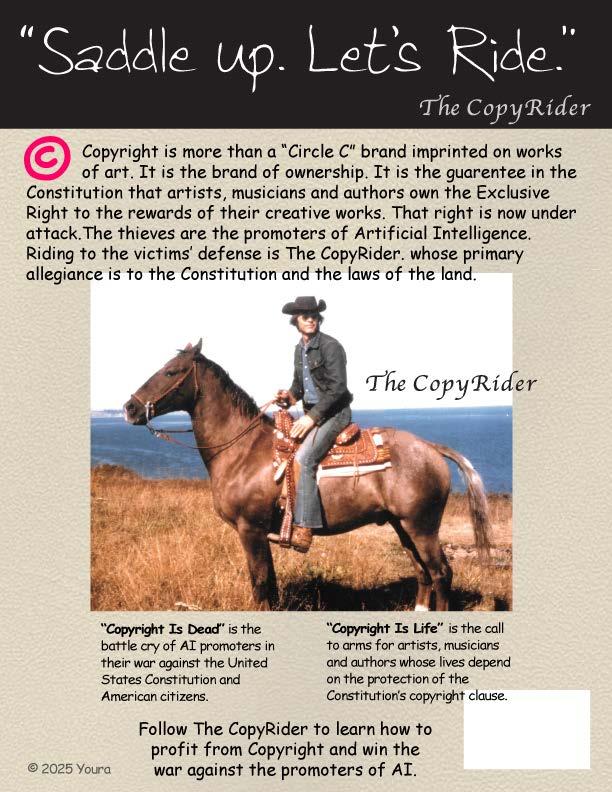
All rights reserved. No part of this book may be reproduced, stored, or transmitted by any means—electronic, mechanical, photocopying, recording, or otherwise—without prior written permission of the publisher, except for brief quotations in reviews or scholarly works.
Published in the United States of America. For information, visit: TheCopyRider.com Design & Branding: Circle-C Brand Press
ISBN: 9798264314582
Publisher Youra Media Seattle, Washington 360-379-8800
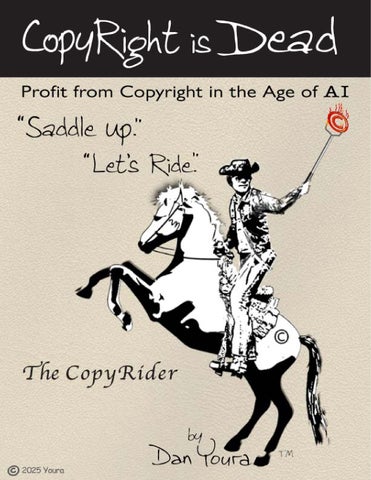
This book was born out of necessity. The battle cry “Copyright Is Dead” cannot go unchallenged. For too long, artists, creators, and everyday citizens have been left without a clear trail to follow in the storm of artificial intelligence. The promoters of AI declare the death of copyright. The law lags as corporations race ahead. Ordinary people are caught in the dust.
As a publisher, writer, and cartoonist, who has worked across decades, I’ve seen firsthand how originality gets tested by new machines, new markets, and now, by algorithms that mimic without memory and generate without soul.
The CopyRider campaign grew out of this tension: to protect originality, expose deception, and light a beacon for fair competition. What follows is both a story and a manual—a map of the open range where truth and creativity must still ride free.
The CopyRider rides into an untamed frontier — a digital landscape where the old laws of creativity are being tested by new forces of artificial intelligence. In this land, creators can be pioneers or prey. The mission of this book is simple: to give every rider the knowledge and tools they need to survive and thrive on the open range of ideas.
As you turn these pages, you’ll find maps to guide you, codes to steer your choices, and tools to defend what’s yours. The six tools of the open range are not theory or decoration — they are meant to be used. Together, we can carve out a future where innovation and integrity ride side by side.
Promoters of AI must be shown that “Copyright Is NOT Dead.”
Introduction
Every frontier has its myths, its dangers, and its heroes. The American West was no different: open land, contested claims, cattle rustlers, and brave riders who defended their herds and homes. Today, we face a new frontier: the digital range shaped by artificial intelligence. The fences are invisible, but the stakes are real — your originality, your data, your voice.
This book lays out both the threats and the tools. Here’s what you’ll find on the trail ahead:
PART I –– New Frontier
Chapter 1 – Who Rides the Open Range? Creators are today’s ranchers, guarding originality instead of cattle. AI rustlers threaten to steal what isn’t theirs
. Chapter 2 – Why Copyright Still Matters. Explains why copyright remains the strongest fence line protecting human authorship.
Chapter 3 – Selling Content in the Age of AI. Practical strategies for selling characters, stories, and creative work.
Chapter 4 – Rustlers on the Frontier. Exposes how false claims and AI fraud undercut honest riders.
Chapter 5 – Transparency on the Trail. How honesty becomes a market advantage.
Chapter 6 – The CopyRider Rises. How cartoons, videos, and advocacy spark a movement.
Chapter 7 – The Trail Map of Truth. The six guiding Codes of the Open Range.
Chapter 8 – The Riders of the True Beacon. Celebrates watchdogs and truth-tellers
. Chapter 9 – The Sovereign Data Rider. Declares ownership of your data, art, and voice.
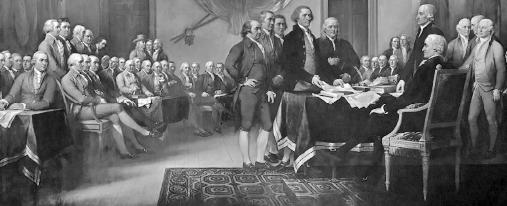
Every trail begins with a mark. For a rancher, it is the brand on the cattle. For a nation, it is the mark set in its founding law. The United States marked its property in Article I, Section 8, Clause 8 of the Constitution, written in 1787:
“To promote the Progress of Science and useful Arts, by securing for limited Times to Authors and Inventors the exclusive Right to their respective Writings and Discoveries.”
This was no small fence line. The Framers knew that the lifeblood of a free people was not only their land and labor but also their ideas, their inventions, their stories. Copyright was never meant as a government favor. It was recognition that creativity is property — like the deed to a home, the title to a car, or a stock certificate. And property is worth defending.
The Sheriff of Originality
From those words, America built the U.S. Copyright Office — a keeper of the brand. Its job: register works, record ownership, and enforce the promise that originality belongs to the human mind.
For over 150 years, this Office has been the branding iron of the Republic. And in January 2025, when the range was threatened by machines, the Office spoke again with clarity:
- Works generated entirely by Artificial Intelligence are not eligible for copyright protection.
- Machines cannot be authors. Programs cannot be inventors.
- Copyright belongs to people — flesh-and-blood creators, not algorithms. This ruling drew a bright line in the sand. Without it, the range would be overrun by soulless works flooding the market. With it, the law reaffirmed that human authorship is the spark that makes creativity property.
This Prologue is here to remind you:
- Copyright is not just a policy; it is a constitutional right.
- The Copyright Office is not just bureaucracy; it is the sheriff of originality.
- The January 2025 ruling is not just paperwork; it is the new brand, proving that property belongs to its riders.
When you turn the page into Chapter One, you will meet the riders of today’s open range: creators, artists, and storytellers who still put their mark on their work.
But remember this Prologue when the trail grows long: your creativity is not a courtesy. It is not a privilege granted by corporations. It is your property, secured by the Constitution, defended by the Copyright Office, and carried forward by every rider who saddles up to defend originality. This is the Constitutional Brand. This is the CopyRider’s trailhead.
AI and the Constitution
This discussion focuses on the immediate impact of A.I. on society’s constitutional and civic governance that is taking place right now. This is a critical area few people are fully considering, yet it may prove far more consequential over the long term.
AI and the Constitution’s Core Principles
The U.S. Constitution enshrines principles like free speech, due process, equal protection, checks and balances, and the sovereignty of “We the People.” AI challenges these in subtle and overt ways:
Free Speech (First Amendment). AI blurs the line between human and machine-generated speech. If a deepfake, AI-generated article, or chatbot influences voters, is that “protected speech”? Can AI-generated lies be regulated without infringing human free speech? The Supreme Court has yet to clarify this.
Privacy (Fourth Amendment). AI surveillance — facial recognition, predictive policing, data profiling — tests what counts as an “unreasonable search.” The Constitution didn’t foresee pervasive digital tracking. Courts will likely have to reinterpret privacy standards.
Due Process (Fifth & Fourteenth Amendments). When AI systems make decisions about parole, welfare, or hiring, how do citizens challenge an algorithm they can’t see? “Explainability” of AI may become a constitutional necessity.
Separation of Powers. AI could subtly shift power toward whichever branch controls the most advanced technology (e.g., executive agencies using AI for intelligence or enforcement). Congress may lag in oversight, upsetting balance.
Historical Reliance on the Constitution
Historically, the Constitution adapts slowly but profoundly:
• The Civil War Amendments redefined citizenship and rights.
• The New Deal era expanded federal powers to match industrial changes.
• Civil Rights rulings reinterpreted equal protection for new realities.
AI could trigger a similar constitutional “inflection point,” forcing reinterpretations in areas like personhood (do AI systems have legal standing?), intellectual property (human vs machine authorship), and democratic safeguards (AI in elections).
Political Culture and Civic Dedication
Erosion of Trust: Widespread AI-generated misinformation may weaken faith in elections, courts, and even the text of the Constitution itself (e.g., fake “founding father quotes”).
Civic Literacy Decline or Renaissance: AI tools could either flood citizens with noise or help them engage more deeply with constitutional history (e.g., personalized civic education).
Shift from Human Agency to Technocracy: If decisions are increasingly made by AI “advisors,” citizens may cede moral and political responsibility to algorithms, undermining the idea of self-governance.
The Constitution as a Stabilizer — or Obstacle?
Stabilizer: Constitutional principles (rule of law, individual rights) can serve as guardrails against AI misuse (e.g., unconstitutional mass surveillance).
Obstacle: Rapid AI development may tempt policymakers to sidestep slow constitutional processes via executive orders, emergency powers, or private corporate control. This could erode the Constitution’s authority in practice.
Long-Term Scenarios
Constitution Reaffirmed: AI challenges lead to renewed public engagement, constitutional amendments, and a digital Bill of Rights.
Constitution Eroded: AI-driven governance becomes opaque, with corporate algorithms holding de facto power outside constitutional checks.
Hybrid Evolution: Courts reinterpret the Constitution for an AI age, preserving core principles but redefining their application (e.g., algorithmic transparency as a constitutional right)
Why This Matters More Than Jobs
Jobs come and go with every industrial revolution. But constitutional principles define who we are as a nation. If AI shifts our relationship to those principles — especially our trust in human judgment and democratic accountability — it could mark the greatest transformation in American civic life since 1787.
The tension between artists’ constitutional rights and corporate AI ambitions sits at the heart of one of the most important legal and cultural conflicts of our time.
Constitutional Foundation: Article I, Sec 8, Clause 8
This clause — often called the “Copyright Clause” — states:
“To promote the Progress of Science and useful Arts, by securing for limited Times to Authors and Inventors the exclusive Right to their respective Writings and Discoveries.” (Article 1, Section 8, Clause 8)
Key points embedded in this:
• Exclusive Right: A human right — given to authors and inventors.
• Purpose: Promote progress by rewarding creativity, not just output.
• Personhood Requirement: The term “authors” historically and legally has always meant natural persons, not machines. Current Conflict: AI-Generated Works
AI Companies’ Position:
• They argue that because AI can create images, music, or text that resembles human output, they should gain copyright (often claiming it for themselves as the “maker” or owner of the AI).
• Their business models rely on treating AI output like any other intellectual property — commodified and protected.
• U.S. Copyright Office Ruling (January 2025): • Clarified that purely AI-generated works cannot receive copyright protection because they lack human authorship.
• Only works with “sufficient human creative input” qualify.
• This directly flows from the constitutional requirement: rights belong to authors (humans), not tools or algorithms.
Why This Is a Constitutional Issue, Not Just a Legal One This isn’t simply a bureaucratic policy choice — it’s rooted in the founders’ intent:
• The Constitution never granted rights to machines or corporations (corporate personhood is a much later, separate development).
• The “exclusive Right” is tied to human creativity, which is both moral (recognizing human effort) and practical (incentivizing innovation). When AI companies claim copyright on machine output, they’re effectively asking for a constitutional reinterpretation:
• Should “authorship” include non-human entities or corporate proxies for AI?
• If allowed, would that dilute human creators’ rights — the very rights the Constitution sought to protect?
Implications
for Artists and Society
For Artists:
• Without strong enforcement of human authorship, human-created work risks being devalued and drowned out by mass machine output.
• Upholding the original constitutional principle protects the incentive structure for real creativity.
For AI Companies:
• They must adapt to a model where AI is a tool — like a paintbrush or camera — rather than a rights-bearing entity.
• This means human involvement in prompting, curating, or editing remains key to securing copyright.
For Society:
• This debate will shape the future of culture: Will art remain a human legacy or become corporate-controlled algorithmic product?
Chapter 1 The CopyRider
Today, the open range is digital. Instead of cattle, we tend ideas, images, and stories. Instead of wooden fences and barbed wire, our boundaries are copyright law and the honesty of markets. Yet the danger remains the same: rustlers — this time wearing the mask of artificial intelligence, mass platforms, and corporate monopolies — slip through the gaps to take without asking, and to profit without credit.
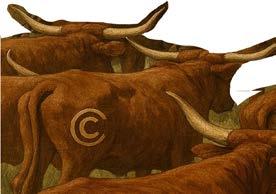
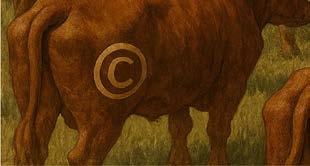
The CopyRider was born from this new frontier. He is not a lone outlaw, but a guardian of the herd — an advocate for the creator, the small publisher, the independent artist. He rides with a brand — the Circle C — not to burn flesh but to mark what is real, what is earned, and what is rightful. His creed is simple: Liberty. Land. Legacy.
Liberty — the right to create freely, without theft.
Land — the ownership of one’s work, recognized and respected. Legacy — the passing on of creative rights to future generations.
This book is your trail map. It will not offer every answer — the law itself is still finding its way in this unsettled country. But it will give you stories, tools, and codes to help you ride with confidence.
As you turn the pages ahead, you’ll find two things woven together: the cowboy’s mythic code of honor and the practical realities of modern copyright. One keeps your heart strong, the other keeps your contracts clean. Together, they form the CopyRider’s way — a path where creativity can still flourish, even on this wild digital frontier.
So saddle up. The trail ahead is long, but it is ours to claim.
Manifesto: In Defense of the Human Creator
A Call to Arms for Artists, Writers, Inventors, and Truth-Tellers in the Age of Artificial Imitation
Written by
Cultural First Responder
Preamble
In the early days of the Republic, when ink met parchment to birth the Constitution of the United States, our Founding Fathers inscribed a principle so enduring, so sacred, that it remains one of the cornerstones of liberty: the right of the individual to the fruits of his or her creativity.
Enshrined in Article I, Section 8, Clause 8, the Constitution declares:
"The Congress shall have Power... To promote the Progress of Science and useful Arts, by securing for limited Times to Authors and Inventors the exclusive Right to their respective Writings and Discoveries.”
This principle—clear in its language, timeless in its intent—is not merely a statute. It is a covenant. It is the spiritual heartbeat of all who create. And it is under attack.
1. The Irony of Our Age
We live in a moment of astonishing contradiction. On one hand, Artificial Intelligence is lauded as the messiah of modernity. It writes, paints, composes, converses. It dazzles us with mimicry and seduces us with efficiency. On the other hand, the very laws of our Republic—refreshed and reinforced in January 2025 by the United States Copyright Office—have declared plainly:
Only human creativity can be copyrighted.
That is not a footnote. That is a legal line in the sand. While the world praises the machine, the law affirms the maker.
This is not anti-technology. This is pro-humanity.
2. The Sacred Spark
Human creativity is not code. It is not prediction. It is not statistical output. It is intuition, memory, heartbreak, vision. It is pencil shavings and ink stains. It is melody in the night and brushstrokes that defy perfection. No machine knows the ache of the muse or the thrill of invention.
It is for this reason that copyright was born. It is for this reason that courts and lawmakers, generation after generation, have returned to the well of the Constitution and found its water still clean.
As the January 2025 ruling affirmed: AI-generated content alone is not eligible for copyright protection. The human hand, the human mind, the human soul—these are the decisive factors.
3. The Rising Threat of Artificial Imitation
Let us not be lulled. While AI can be a useful tool, it is also a force of economic displacement, cultural confusion, and creative erosion. In schools, in studios, in courts, in boardrooms, we are witnessing the subtle erasure of the individual artist. In the name of efficiency, we risk losing authenticity.
And the tragedy is not only economic; it is existential. If originality becomes indistinguishable from simulation, if we surrender authorship to algorithm, we forfeit more than profit. We forfeit meaning.
Chapter 2 — Why Copyright Still Matters
— Even in the Age of AI
The chatter in the saloons of Silicon Valley is loud these days: “Copyright is dead. The machines have won. Creativity belongs to anyone who can prompt it.” But those voices speak more like rustlers than ranchers. They want you to be-
Copyright is not dead. It is tested, strained, sometimes undermined — but never dead. In fact, its importance is sharper now than ever before. Here’s
1. Copyright is the Last Fence Standing
On the frontier of digital creation, copyright is the line that says: This is mine, and not yours to take. AI companies insist their scraping and remixing is “fair use.” But courts and governments are already wrestling with this question. Creators who hold registered copyrights will be better positioned when the
2. Copyright Proves the Human Hand
A purely machine-made image may not be copyrightable. But when you, the creator, sketch, select, alter, or combine — you leave a human mark. That human mark is the difference between cattle born wild and cattle branded by their rightful owner. Even the U.S. Copyright Office has affirmed: human creativity, however small, can transform an AI-assisted work into protected property.
3. Copyright Creates Market Value
Buyers, from small publishers to global corporations, don’t want to risk lawsuits or scandal. They need certainty. A creator who can show registered copyrights, clear licenses, and authentic authorship will sell more easily than a prompt jockey with no claim to ownership. Copyright is not just law — it is leverage.
4. Copyright Builds Legacy
Your work is not just for today’s buyers. It is part of your estate, your inheritance to those who follow. Without copyright, your legacy dissolves. With it, your family can inherit value, your name can endure, and your art can remain yours long after the rustlers have ridden off.
This is why copyright still matters. Not because lawyers say so, but because creators live by it. The law is imperfect, the battles ongoing, but the prin ciple is timeless: creators deserve to own what they create. Without that, the open range becomes a wasteland. With it, the trail remains open — and worth riding.
“Copyright is the last branding iron in the digital corral. Use it, or lose your herd.”
Chapter 3 – Selling Content in the Age of A.I.
In a world of copycats and AI imitations, authenticity is gold. When you present your work with a clear copyright claim, registration number, or even the Circle C mark, you are offering more than art — you are offering peace of mind. Buyers will pay more when they know they’re buying certainty.
A single panel can be funny. A recurring character can be a business. Think of Mickey Mouse, Garfield, or even Dilbert. Each began as a drawing but became a license, a product line, a franchise.
• Sell your characters as packages: artwork + usage rights.
• Offer categories: political figures, animal mascots, celebrity caricatures.
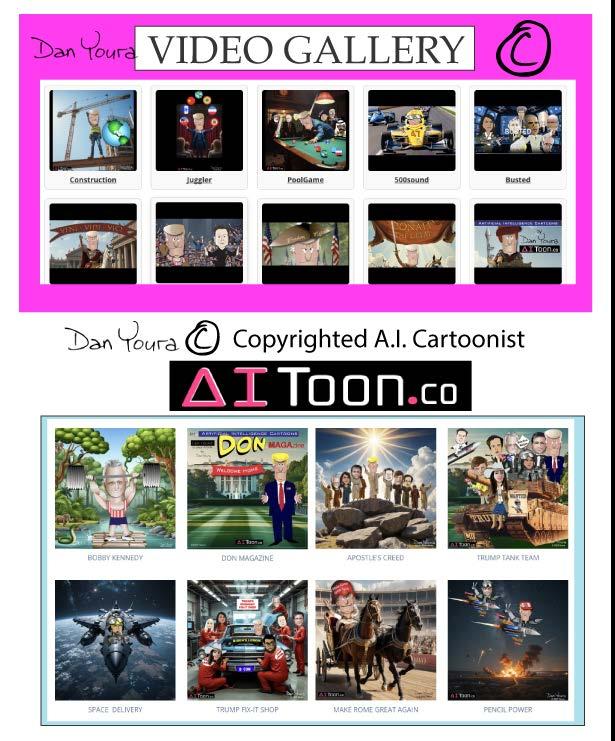
• Create simple flyers or galleries so buyers can see what they’re getting.
When a buyer sees not just a drawing, but a cast of characters ready for action, they see potential for newsletters, campaigns, games, or branded merchandise.
• Small Businesses: mascots for newsletters, ads, or websites.
• Podcasters & YouTubers: characters to brand shows or appear as visual avatars.
• Educators: illustrations for courses, presentations, or textbooks.
• Digital Stickers & Merch: emojis, t-shirts, mugs, posters.
One creation, many streams. You don’t sell the cow outright — you lease grazing rights.
4. Price the Story, Not Just the Drawing
A cartoon isn’t just ink on paper. It’s commentary, humor, recognition. A buyer may think they’re paying for one drawing, but what they’re really buying is:
Your unique voice.
The cultural resonance of your character.
The risk-free ownership of a copyright-protected piece. Don’t undersell. Price with confidence. Rustlers may give work away, but ranchers with branded herds command respect.
5. Use the CopyRider’s Code to
Close the Deal
When in doubt, return to the three truths:
Liberty — show buyers they’re free from fear when they use your work. Land — prove you own the rights, and that you’re not selling stolen cattle. Legacy — remind them they’re investing in something with enduring value, not a prompt that will vanish tomorrow.
The CopyRider Code becomes your sales pitch: “I sell what is mine, I protect what you buy, and I give you rights you can trust.”
Closing the Chapter
AI may flood the market with cheap imitations, but it cannot flood the market with trust. That is your edge. Rustlers sell shadows. CopyRiders sell certainty.
If you are willing to ride tall, to brand your work, to present it boldly in flyers, catalogs, and contracts, you can still prosper on this frontier. Your art is not just a drawing. It is a story, a character, a brand. And stories, characters, and brands never go out of style — even in the Age of AI.
Chapter 4 Rustlers on the Frontier
False Claims and AI Fraud
The open range has never lacked for rustlers. In the old West, they came by night, cutting fences, sneaking off with calves, and rebranding herds as their own. The crime was not only theft of cattle — it was theft of trust. Once rustlers were known to roam, neighbors eyed each other with suspicion, and the open range itself seemed lawless.
Today, the rustlers ride with different tools. They are the companies and individuals who make false claims of copyright on AI-generated material — branding with a hot iron that the law itself refuses to recognize.
The Constitutional Fence Line
The U.S. Constitution drew the first fence line. In Article I, Section 8, Clause 8, the Founders promised:
“To promote the Progress of Science and useful Arts, by securing for limited Times to Authors and Inventors the exclusive Right to their respective Writings and Discoveries.”
The word Authors was no accident. It meant people — not tools, not machines, and certainly not algorithms. From the beginning, false claims of authorship were treated as fraud, because they undermined the very incentive system the Founders designed.
In January 2025, the U.S. Copyright Office reaffirmed that promise:
“Works produced solely by a machine or mere mechanical process cannot be registered for copyright.”
Yet false claims abound. AI-generated novels flood self-publishing platforms, labeled “copyright protected.” Stock image libraries are packed with AI collages, tagged as “original.” Some sellers even issue takedown notices against human artists, using their false brands as weapons.
• Civil law voids contracts entered under misrepresentation.
False copyright claims are more than sloppy practice — they are outlaw behavior.
The Cost of Looking the Other Way
When rustlers ride unchecked, the honest rancher pays the price. Buyers can’t tell real work from fake, so they stop buying. Courts become clogged with disputes. Consumers lose faith in creators. And the herd — the market itself — thins. This is why exposing false claims is not optional. It is the first duty of those who ride the open range with integrity.
Trail Tip: Don’t just look at the brand — check the herd.
–Rustlers don’t just steal cattle anymore — they steal trust. And trust, once lost, is the hardest herd to rebuild.”
Rustlers & Bandits:
How Big A.I. Steals the Herd
The old frontier had cattle rustlers—men who slipped through gaps in the fence, cut brands off hides, and claimed another rancher’s herd as their own. Today’s digital frontier has its own rustlers, but they ride under corporate banners. They are the Big AI firms, harvesting creative herds that don’t belong to them, branding them as their own, and selling them on the open market.
1. Theft by Training
Big AI has scraped massive datasets of books, music, art, photography, and code without consent. They’ve trained their engines on the blood, sweat, and originality of others.
• OpenAI’s GPT models trained on copyrighted books and articles.
• Stability AI & MidJourney used artists’ portfolios pulled from the web.
• Google’s Gemini absorbed YouTube content and publisher catalogs. The legal herd is already in motion: The New York Times suing OpenAI and Microsoft for billions, Getty Images suing Stability AI, and authors like Sarah Silverman leading class actions
2. Deceptive Tools for Creators
The rustlers have dressed their traps as gifts. “Create your book!” “Make art fast!” But hidden inside is a snare:
• You may not be able to claim copyright.
• Your work may be demonetized or banned from platforms.
• Every click trains the very system that could replace you tomorrow. Ease and speed come at the cost of rights—a crooked trade deal no honest rancher would accept.
3. Disinformation & Omission
Big AI rarely tells the truth about authorship. Marketing glosses over copyright limitations, and onboarding hides the hard facts. Many users believe: I created it, so I own it. But if AI did 90%, that brand is false, and the herd is not yours. This isn’t just accident—it’s a strategy. Rustlers thrive on shadows, omission, and confusion. Exposing them is the work of the Riders of the True Beacon.
Honest Dealing in the Marketplace
Every rider knows the value of a lantern on a dark trail. Without it, you stumble in the fog, unsure of the next step. With it, the way forward is clear, and others can see where you stand. In the marketplace of ideas, transparency is that lantern.
Courts Carrying the Water
For over two centuries, American courts have carried the water for fairness in trade. The Supreme Court has long held that fraud voids contracts. As Justice Story once wrote, “Fraud vitiates every contract, however solemn.” In plain speech: a deal built on lies is no deal at all. Transparency is not merely a virtue; it is a legal necessity.
From the Constitution to the Copyright Office
The Founders drew the blueprint. The courts enforced it. And in 1870, Congress vested the U.S. Copyright Office with the authority to carry it out in practice. That Office now serves as the institutional guardian of the Founders’ promise. Its rulings echo the constitutional fence line: copyright belongs to humans. When creators are clear about their role, they not only protect their own rights, they protect the market from collapse.
Why Transparency Wins
In today’s frontier of AI:
• Creators win when they disclose — “Human + AI assisted” or “Original Human Work.” Honesty builds trust and attracts serious buyers.
• Publishers win when they demand provenance — clear licenses, records of authorship, and verification.
• Consumers win when they see what they’re paying for, free from deception.
Transparency is not charity. It is the very currency of the marketplace. Without it, buyers flee, sellers collapse, and law has no anchor.
Lighting the Trail Ahead
Every honest brand, every clear disclosure, is a lantern. It shines light on the trail, guiding buyers and protecting creators. And like lanterns across the prairie, each small light adds up to a horizon of clarity.
Trail Tip: Every honest brand shines brighter than the rustler’s shadow.
“Transparency is not charity — it is currency. In a marketplace of shadows, the clear brand is gold.”
Creative Trailblazers for the New Frontier
.
We’re seeking:
Artists who own their lines.
Musicians who compose, not copy.
Writers who craft every word.
Investors who dream without permission.
W e’re callin’ out the brave few who still build with brush, pen, chord, or code of their own.
Creators who bla�e trails instead of following scripts. The hands behind the work— not the algorithm that mimics it
Join The Copy Rider. Protect Liberty. Defend Legacy. The digital frontier needs your spark. Mount up. The future ain’t written yet. Posted by
Chapter 6
The Due Process Rider
“Without freedom of thought, there can be no such thing as wisdom — and no such thing as public liberty without freedom of speech.”
Benjamin Franklin
The Frontier of Motion
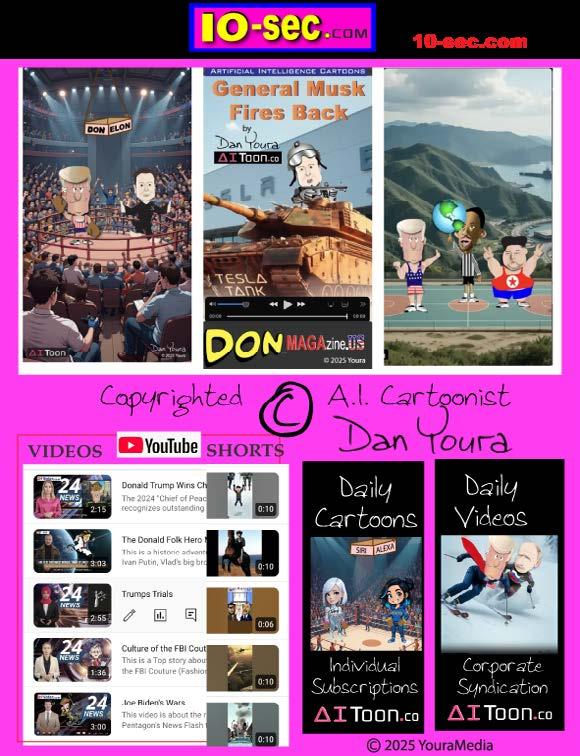
Words on a page are strong. Images on a poster are stronger. But moving pictures — even ten seconds long — can cross more ground in less time than a rider at full gallop. The CopyRider videos are built to do just that: carry the message of liberty, authorship, and pride into the fastmoving streams where people watch,
VIDEO MARKETS
1. Social Media Sparks
Short, shareable videos that work as conversation-starters on platforms like YouTube Shorts, TikTok, Instagram Reels, and X. Perfect for driving awareness with
2. Educational Clips
Quick explainers that break down complex copyright issues — like “What is the Constitution’s copyright clause?” — into snack-sized lessons that teachers, stu-
3. Campaign Promos
Mini-trailers for The CopyRider project itself. A quick 9–10 second video is long enough to brand the message, short enough to leave viewers curious for
4. Cartoons Come
Existing cartoon characters get new life in motion, sparring, joking, or warning against “AI rustlers.” This bridges cartoon legacy with today’s AI tools.
5. Advocacy
Clips that can be dropped into emails to lawmakers, lawyers, and allies — a video is more likely to be watched than a page of text.
6. Fundraising Nug-
Mini-commercials for donation campaigns. A quick video that entertains and calls for support works better than static text alone.
7. Conference / Event Ice-
At panels or gatherings, a 10-second CopyRider clip can kick off the conversation, instantly setting tone and focus.
8. Creator Community
Clips designed for other artists and musicians to share — making them feel part of the ride, part of a movement.
9. Media
Short videos journalists can easily embed in articles, online features, or news coverage. They translate abstract issues into something watchable.
10. Legacy Ar-
Over time, the videos become their own creative library — a living “trail diary” of the movement. Future generations will be able to look back and see, in motion, the stand that was taken.
Why It Matters
In an age where most people scroll past text but stop for motion, these videos aren’t decoration — they’re ammunition. They let the message of liberty, land, and legacy travel where the riders of old could never go: directly into the hands of mil-
The CopyRider rides not only in ink and print, but in sound and motion.
Chapter 7 The Trail Map of Truth
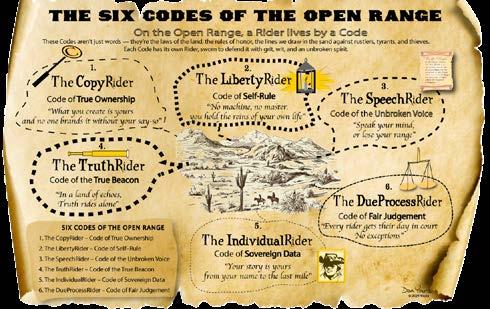
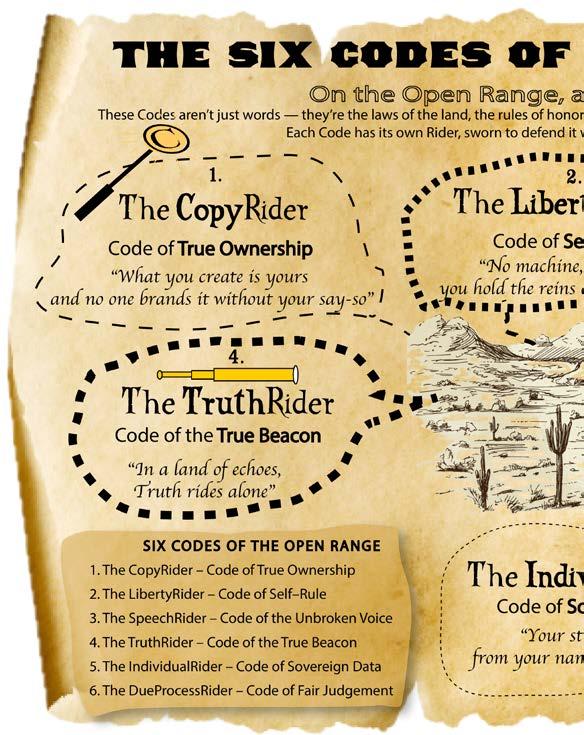
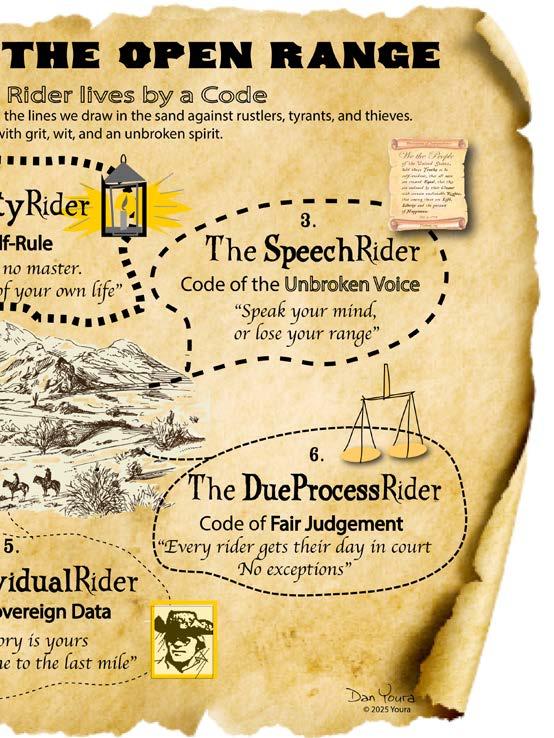
View large size map on pages 32-33
The wide-open range has always been both promise and peril. It offered room to grow, space to breathe, and freedom to roam. But it also left herds unguarded, fences unfinished, and rustlers eager to slip through in the night. Today, in the digital frontier shaped by artificial intelligence, we stand in that same tension. There is opportunity as vast as the horizon, but there is also deception as cunning as any outlaw.
The question is: how do we navigate it?
That is the purpose of the Trail Map of Truth. Like a weathered chart tucked into a saddlebag, the Map does more than sketch the land. It points out the crossings, the watering holes, and the dangers that might catch a rider unaware. In our case, the Map shows how to navigate copyright in the AI frontier. At its heart are six guiding Codes, each marking a trail that leads toward fairness, transparency, and authenticity.
The Six Codes of the Open Range
1. The Code of Truth
On the open range, a man’s word was his bond. False branding, false claims, or false deals could get you run out of town—or worse. In today’s digital economy, the same rule applies: no false claims about authorship or originality. If an image is AI-generated, it cannot be labeled “copyrighted” under U.S. law. This Code reminds us that truth in advertising isn’t optional—it’s the fence line that keeps the herd safe.
2. The Code of Your Story
Every rancher has a brand, and every creator has a story. It’s the mark that says, this is mine, it came from me. AI can remix and mimic, but it cannot tell your story. This Code is a reminder that human originality matters, and that when you put your hand, mind, or heart into your work, you deserve recognition that no machine can steal.
3. The Code of Fair Dealing
Trade on the frontier was based on trust. A handshake deal was sacred. Today, fair dealing means honest transactions: no fraud, no hidden AI, no inflated prices based on false copyright claims. Consumers deserve to know what they’re buying. Creators deserve a fair shake for their labor. The Code of Fair Dealing restores integrity to the marketplace.
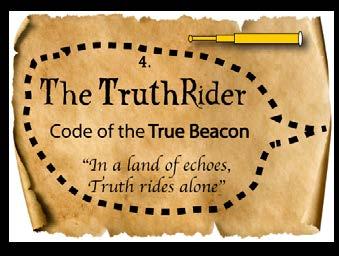
4. The Code of the True
Every town had its lookout, the one who kept the lantern burning at night or warned when rustlers were on the move. In our day, those beacons are watchdogs, whistleblowers, and consumers who shine a light on false claims. This Code honors the truth-tellers who refuse to let deception pass unchallenged. Without them, the prairie stays dark; with them, the horizon lights up with clarity.
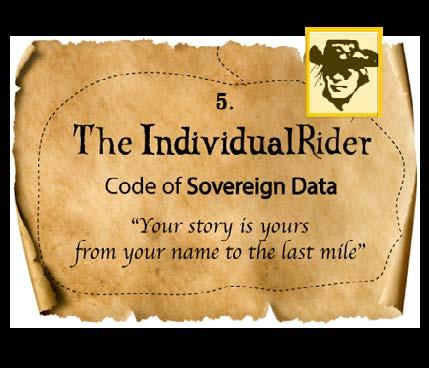
5. The Code of Sovereign Data
A rancher’s herd was his livelihood, branded and guarded. In the digital age, your herd is your data, your identity, your creative output. Rustlers may come not with lassos but with algorithms, scraping and harvesting without your consent. This Code declares: you are the sovereign of your digital cattle. Guard it, brand it, and defend it.
6. The Code of Legacy
The frontier was not just about today’s ride; it was about tomorrow’s generations. A good rancher left land, herd, and name intact for those who followed. In the AI frontier, legacy means protecting originality so that art, law, and culture have fertile ground for the future. If everything is machine-made and falsely claimed, nothing endures. The Code of Legacy keeps the trail open for those yet to ride.
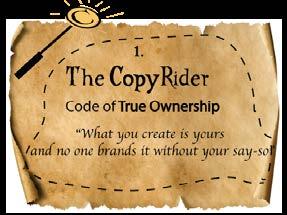
you create is yours and no one brands it without your say-so”
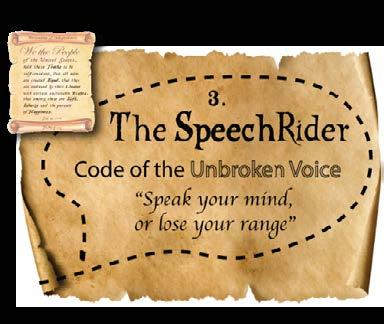
These Codes aren’t just words — they’re the laws of the land, the rules of honor, the lines we draw in the sand against rustlers, tyrants, and thieves. Each Code has its own Rider, sworn to defend it with grit, wit, and an unbroken spirit.
The six Codes are not just individual trails—they’re interconnected paths. Truth leads to fair dealing; fair dealing depends on transparency; transparency protects legacy; and sovereignty over data ensures the herd isn’t stolen before it’s branded. The Map shows that these are not isolated values but a woven system,
Think of the Map as both compass and contract. It tells you where you stand, shows you where to go, and reminds you what promises bind you along the way. Without it, the frontier feels lawless. With it, the open range becomes navigable.
Why the Trail Map Matters
The Trail Map is not just theory—it matters to real people in three powerful ways:
• For Creators – It affirms their right to authorship, their claim to originality, and their protection against AI-driven theft.
• For Consumers – It shields them from fraud, inflated prices, and false claims.
• For Lawmakers and Enforcers – It provides a framework that makes sense both legally and morally, helping to close gaps where deception thrives.
And to the broader economy, it ensures that the open range stays productive, competitive, and fair. If the herd is stolen before the brand is burned, the whole ranch suffers. But if the Codes are followed, the herd grows, the land prospers, and the legacy endures.
The Call to Ride
The Map has been drawn. The Codes are clear. The question is not whether we can see the trail but whether we will ride it.
This chapter is a proof of concept for the entire book: a vision, a compass, and a call. If you believe in truth, in authorship, in legacy, then the Map is yours to carry. Share it. Use it. Teach it. Defend it.
The open range belongs not to the rustlers but to the riders who hold fast to liberty, land, and legacy. The CopyRider has saddled up. Will you?
Chapter 8 – The Riders of the Truth
Every range needed its lanterns. In the deep hours of night, a light on the hill told travelers where safety lay, and a lamp in the window told riders that someone was awake, watching for trouble. In our age, the light we need most is the light of truth.
The Riders of the True Beacon are those who refuse to let deception stand unchallenged. They are watchdogs, journalists, whistleblowers, and ordinary consumers who point a finger at false claims and say: that is not yours to brand.
Their power comes not from force but from exposure. Like lanterns, they don’t move cattle, but they show the herd where the dangers are. They reveal when a piece of “copyrighted” art is nothing more than AI output. They reveal when a publisher floods the market with books written by machines but sold under stolen names. They reveal when the rustler’s rope has already lassoed half the herd.
But this beacon light is fragile. Just as the wind can snuff out a lantern, the storm of misinformation can overwhelm the truth. Which is why the Beacon Riders need allies: consumers who demand transparency, lawmakers who enforce it, and creators who protect their brands. Without them, the prairie stays dark. With them, the horizon shines with clarity.
The Code of the True Beacon is not optional. It is the difference between stumbling in the dark and riding with direction. It reminds us that exposure is the first step toward justice, and that no rustler can thrive long under the gaze of the lamp.
Chapter 9
The Sovereign Data Rider
On the frontier, ownership was visible. A brand seared into a steer’s hide marked it as yours. A fence line told where your land began. Your saddle, your rifle, your boots—all carried your mark.
Today, in the AI frontier, ownership is invisible. Your brand is not burned into cattle but scattered across servers. Your land is not fenced but lives in data fields. Your identity—your words, your art, your likeness—can be harvested, remixed, and sold without you ever knowing.
That is why the Sovereign Data Rider matters. This Code insists that you are not a tenant on someone else’s range—you are the rightful rancher of your own digital herd. Your data, your authorship, your story: all belong to you.
But the rustlers have grown clever. They don’t ride in under moonlight; they scrape in daylight, building empires on other people’s labor. They take without branding, harvest without asking,
and sell without shame. Sovereignty means standing against that theft. It means demanding laws that protect authorship, tools that allow creators to watermark or tag their works, and accountability when corporations profit from what they never created.
The Sovereign Data Rider is not just a single rider—it is all of us who insist that our names, our works, our voices are not fodder for the machine. To yield them without protest is to abandon the herd. To defend them is to secure both our present and our legacy.
In the end, sovereignty is not just about ownership; it is about dignity. A rancher without his herd is nothing. A creator without his authorship is forgotten. But a sovereign who guards his cattle, his land, his story—that sovereign rides free on the open range.
So far in this book, you’ve learned about the problem. You’ve seen the rustlers and the weak fences. But now we ride into the money chapter. This is where you learn how to defend your brand, secure your copyright, and turn it into revenue.
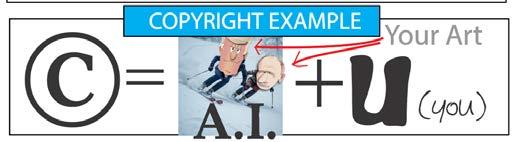
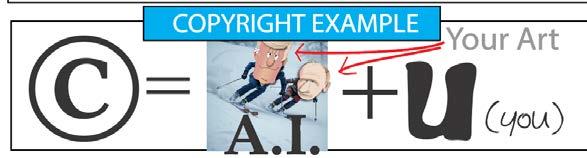
The secret — the loop hole — is simple: formula [ Copyright = AI + U ].
AI alone cannot get you copyright. But add yourself — your hand, your mind, your creativity — and suddenly your work can qualify. This isn’t trickery. It’s the same as a rancher using the tax code’s “loop holes” to keep more of his earnings. A loop hole isn’t cheating — it’s knowing the system better than the outlaws.
✅ Step 1: Recognize Why Copyright Is Worth Money
• Copyright turns your work into property — it can be licensed, sold, inherited, defended.
• A copyrighted work is worth more to buyers and publishers because they can safely invest in it.
• Without copyright, your work is just content — with copyright, it becomes capital.
•
• Tip: Always ask yourself — “Am I holding property, or just content?”
•
✅ Step
2: Know the Change in the Law
• The U.S. Constitution gives cop yright only to human beings.
• The U.S. Copyright Office has ruled: Works entirely made by AI are not copyrightable.
• The Loop Hole: If you pour in your own creativity, the work can qualify.
•
• Tip: Think of copyright law like a branding iron — AI can round up the cattle, but only you can burn in the brand.
This chapter is your saddlebag. With these steps, you know how to:
• Protect yourself.
• Qualify for copyright.
• Increase your earning power.
The rustlers don’t want you to know the loop hole. But you do. That makes you the CopyRider — rider of truth, defender of originality, and owner of the brand.
SIX “POWER TOOLS” for Your Saddlebag
The following 6 pages feature 6 “Power Tools” to use in your efforts to smoke out the cattle thiefs and expose them for the crooks
Power Tools
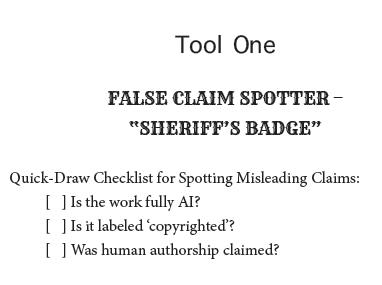
1. False Claim Spotter = “Sheriff’s Badge”
2. Compaint Forms = “Ready to Use”
3. Copyright Status = “Trail Signpost”
4. Transparency Badge = “Honest Brand”
5. Action Flowchart = “Decision Compass”
6. Resource Links = “Campfire Tools”
#1 False Claim Spotter
Sheriff’s Badge
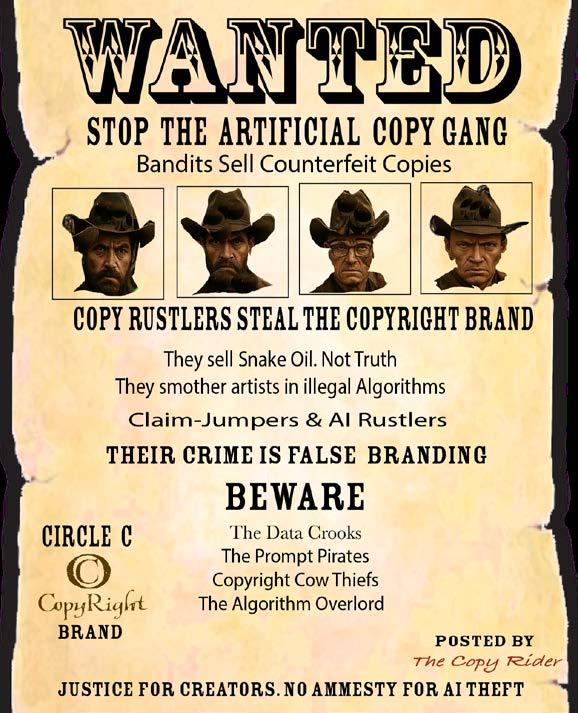
#2 Complaint Templates Wanted Posters
Refund Request to Seller:
Dear [Seller’s Name],
Ready-to-Use Forms:
I purchased [Product/Artwork] on [Date] for [$ Amount]. The item was advertised as “[Claimed Feature],” but it was misrepresented. I request a full refund within 14 days.
Sincerely, [Your Name]
FTC Complaint Checklist:
[ ] Your Contact Information
[ ] Seller/Website Name
[ ] Description of Fraud (include screenshots)
[ ] Am id
State Attorney General Report Template: I was misled by [Seller/Company] regarding [Product]. They falsely claimed copyright/ownership of AI-generated content. Please investigate this consumer fraud.
[Your Name]
Action Step: Copy, paste, and send. Hold fraudsters accountable with these pre-written letters.
#3 Copyright Status QUICK GUIDE
Tool Three
“TRAlL SIGNPOST”
Know what qualifies for copyright:
[ ] Copyrightable: Human + AI assisted (with human originality).
[ ] Not Copyrightable: Purely AI-generated works.
Example: An artist sketches a character and uses AI for background. The sketch is copyrightable. Pure AI images are not.
#4 Transparency Labels “Honest Branding”
Voluntary Transparency Labels for Sellers:
[ ] ‘Human + AI Assisted’
[ ] ‘Original Human Work’
[ ] ‘100% Artificial Intelligence’
These transparency labels build trust with buyers and reward honest creators.
Action Step: Ask sellers to add the Transparancy Labels to their products for sale. Encourage marketplace honesty.
Participating Companies
#5 Consumer Action Flowchart
“Decision Compass” Tool Five #5. CONSUMER
ACTION FLOWCHART
“DECISION COMPASS”
Checklist Pathway:
[ ] Spot suspicious claim
[ ] Apply Sheriff’s Badge questions
[ ] If false claim detected ®
[ ] Request Refund (Template #1)
[ ] Report Fraud (FTC / AG)
[ ] Leave Review / Warning
[ ] Support Honest Creators
Action Step: Follow this compass step by step. Don’t freeze when fraud appears.
Action Step: Bookmark these links. Your allies wait at the campfire. Keep these 6 tools in your saddlebag. Out on the Open Range of AI, the honest rider is never defenseless.
10 Other Threats by AI to Legal Issues
Threat is not in 2 Years or 4 years. Some are happening RIGHT NOW!
Fair Use Intellectual Freedom “Don’t Let AI Gut Fair Use”
Ten Industries at the Crossroads
–– AI v. Copyright
The frontier fight between human authorship and machine generation is not just an artist’s quarrel—it’s a range war stretching across entire industries. Here’s where the stampede is happening today:
1. Publishing & Authorship
AI floods Amazon with machine-made novels and children’s books. Some are uploaded under fake or stolen names. The U.S. Copyright Office has ruled: AI-only works cannot be copyrighted. Disclosure is now mandatory, or authors risk rejection
2. Journalism & Media
BuzzFeed, CNET, and Gannett have run AI-generated articles. Results: plagiarism, errors, unverifiable sources. Some publishers slap on disclaimers; others push AI copy to cut costs. Either way, copyright ownership is shaky.
3. Theater & Screenwriting
Hollywood saw the danger. The 2023 Writers Guild strike forced studios to ban AI from writing or rewriting scripts. Now every scriptwriter must declare how much of their work was human vs machine.
4. Music Industry
AI composes songs, clones voices, and mimics styles. Who owns the melody? Is an AI voice “identity theft”? Universal Music Group has filed lawsuits against AI clones, while the Copyright Office rejects purely AI-composed works.
5. Fashion & Textile Design
AI can generate entire collections, but without human originality, those designs risk losing protection. A designer who leans too heavily on AI may find her herd unbranded and free for the taking.
6. Interior Design & Decor
Wallpaper, furniture, and pattern design are being machine-spun. But if creators can’t prove their authorship, copyright and design patent protections collapse.
7. Film, TV & YouTube
Generative tools can already produce scripts, deepfakes, and entire video scenes. Some YouTube and TikTok channels run on AI-only content, risking demonetization and copyright rejection.
8. Podcasts & Voice Acting
AI voices mimic podcasters and actors alike. Who owns a show if the host never spoke? Platforms may deny copyright if the voice was cloned.
The Range War at Scale
Every industry now faces the same dilemma: if humans yield authorship to machines, copyright collapses. Without copyright, originality has no fence line, and every herd is up for grabs.
The stakes are not just artistic—they are economic, cultural, and constitutional. The open range cannot stay open if rustlers are allowed to roam unchecked.
Epilogue – Liberty. Land. Legacy
“Every trail has its end, but every end is a beginning.”
The open range of creativity is never quiet for long.
In these pages, we’ve ridden together through history, law, art, and the fast-changing landscape of technology. You’ve seen how the promise of the Founders — that creators should own the fruits of their labor — has been challenged by machines that can copy without conscience and corporations that can profit without paying.
This is not the time to hang up your saddle. It is the time to claim your brand, to ride boldly into a future where human creativity still matters.
Liberty
Copyright is more than a legal code — it’s part of our freedom.
It protects the individual voice from being silenced by the mob or the machine.
When you register your work, you are planting your flag on the frontier, declaring, “This is mine. I made this.”
The CopyRider fights for that liberty — not just for artists, but for every citizen who believes freedom comes from the ability to create, speak, and innovate without fear.
Land
Liberty
On the frontier, land was life.
Today, your intellectual property is your land — your ranch, your homestead, your future. When someone takes it without consent, it’s cattle rustling on the digital range.
Protect it.
Defend it.
Because in the realm of ideas, your imagination is your territory, and your copyright is your fence line.
Legacy
Someday, we will all ride off into the sunset.
What remains are the trails we leave behind — stories, songs, inventions, laughter, and lessons. Your creative work is a legacy for those who come after you, proof that you were here and you mattered.
The CopyRider’s mission is to make sure that legacy isn’t stolen, erased, or buried beneath algorithms and automation. When you protect your work, you protect the next generation’s right to build on it.
The Ride Continues
As this book closes, the trail ahead is yours to ride. The challenges will grow, but so will the opportunities.
Join the fight — not as a lone rider, but as part of a growing posse of creators, thinkers, and citizens who refuse to let machines write the future without us.
The CopyRider will keep watch on the horizon, lantern held high, branding iron ready. Now it’s your turn to saddle up.
Dan Youra is a world-recognized publisher, writer, and professional cartoonist. The Times of London lauds his website as “potentially life enhancing.” He editer “Current Thought on Peace & War” a digest on international topics, published in the United Nations in New York and distributed to foreign embassys worldwide.
For the International World’s Exposition on the Environment in Vancouver, British Columbia, CANADA Youra published EXPO 86 Guidebook for the Washington Pavillion. He designed the Global Village Exhibit at the International Worlds Fair in Spokane, Washington, for which he was proclaimed a “pioneer in the Global Village” by the Governor of Washington.
Youra published COSMIC MECHANIX with Frank Herbert on trends in future communications technology. He published the Ferry Travel Guide with international ferry routes and traveled to Lisbon, Portugal and to Vancouver, British Columbia, Canada with the . Youra’s company publishes US ARMY and US Marine Corps survival magazines.
Youra wrote stories and reported on International Tourism on trips to Costa Rica, Mexico, Puerto Rico, and the Amazon Rain Forests in Columbia, Peru, and Brazil.
Youra is recognized as an editorial cartoonist, whose satiric, digital productions are fed on Internet networks and social media. His specialty are his caricature alter egos for world leaders and national, political personalities. He is one of very few artists, whoes video and computer productions are able to be copyrighted working in A.I. media that are A.I. assisted. He produces “10 Second News.” ( 10-sec.com ). His websites are ( AIToon.co ), which distributes Youra’s Artificial Intelligence Cartoons. His A.I. website teaches technology to assist people build their own A.I. systems ( AI-DIY. top ).
Youra’s current production is his CopyRider Campaign, supporting social efforts to encourage artists, writers, and muscians to create and promote their own individual art without complete dependence on output created by Artificial Intelligence.