photos. I promptly burst into tears, right in the middle of the hall. I can’t push it out of my head, any longer. The time is now — my baby girl is becoming a little girl. Sobbing, I accepted the documents from her teacher and walked sadly out of the school. I think my daughter was a bit embarrassed at my emotional breakdown. After the reality of this all finally swept over me, I sat back, worried my daughter wouldn’t be ready for kindergarten. Then I remembered, we have been planning and practicing for kindergarten for years, and we didn’t even always make the learning intentional. All the skills and lessons we have taught her over these past five years has all been in preparation for joining public school. Indeed, the basic skills are incredibly useful for children to have as they enter kindergarten, like knowing colors and shapes, identifying letters and writing some, having the ability to write her name, counting to 100, adding together small quantities. However, it is the soft skills that will help a young student find a good foothold in education. A young child must be taught to develop a love for learning and a curiosity about the world because these are two key qualities that will really propel a child in their schooling. Children must learn social norms and how to get along with others while working strategies of self-regulation and independence. Some of these skills are things we practice nearly every day by taking advantage of teachable moments that arise. For instance, reading will support the child as she learns to think through and solve problems with others. Reading will impart life lessons of emotional intelligence and basic educational knowledge. Reading is so important, and I think I have touched on that in at least two other columns. Sorry for the redundancy, but I can’t say it enough. Children who are read to at home will have a higher rate of success at school, according to statistics by National Center for Education, a division of the U.S. Department of Education. Children who are read to have higher chances of learning all letters, counting to 20, learning to write their name and reading or pretending to read, according to the center. Reading also helps to foster a natural curiosity to the world and a love of learning. Another great tool for fostering a love of learning is utilizing PBS. The network has awesome shows available for little kids focused on reading, math and science. Shows like “Peg + Cat,” “Odd Squad,”
46 BRAZOSMONTHLY | AUGUST 2018
Tune in to Learning
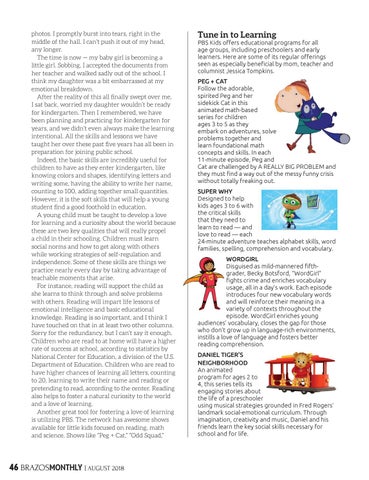
PBS Kids offers educational programs for all age groups, including preschoolers and early learners. Here are some of its regular offerings seen as especially beneficial by mom, teacher and columnist Jessica Tompkins. PEG + CAT Follow the adorable, spirited Peg and her sidekick Cat in this animated math-based series for children ages 3 to 5 as they embark on adventures, solve problems together and learn foundational math concepts and skills. In each 11-minute episode, Peg and Cat are challenged by A REALLY BIG PROBLEM and they must find a way out of the messy funny crisis without totally freaking out. SUPER WHY Designed to help kids ages 3 to 6 with the critical skills that they need to learn to read — and love to read — each 24-minute adventure teaches alphabet skills, word families, spelling, comprehension and vocabulary. WORDGIRL Disguised as mild-mannered fifthgrader, Becky Botsford, “WordGirl” fights crime and enriches vocabulary usage, all in a day’s work. Each episode introduces four new vocabulary words and will reinforce their meaning in a variety of contexts throughout the episode. WordGirl enriches young audiences’ vocabulary, closes the gap for those who don’t grow up in language-rich environments, instills a love of language and fosters better reading comprehension. DANIEL TIGER’S NEIGHBORHOOD An animated program for ages 2 to 4, this series tells its engaging stories about the life of a preschooler using musical strategies grounded in Fred Rogers’ landmark social-emotional curriculum. Through imagination, creativity and music, Daniel and his friends learn the key social skills necessary for school and for life.