UNASA-SU hosts anti-war protest for Ukraine
AURELIA MOUTON
T
he United Nations Association of South Africa (UNASA) organised a student march in a show of solidarity with Ukraine

The march, which occurred on 1 March, saw the collaborating of UNASA’s Stellenbosch University (SU) and University of Cape Town (UCT)chapters.

“The turnout for the event was even better than we hoped. Between 300 400 people attended, so we’re thankful that the Ukrainian Association of South Africa (UAZA) sponsored so many candles for the event,” said Nina Hugo, chairperson of UNASA’S SUchapter
UNASA plead with South Africans to support Ukraine and to put pressure on South African president Cyril Ramaphosa to condemn the actions of the Russian government. The Palestinian Solidarity Forum (PSF) also showed their support at the march and the vigil that followed.
“We, as students and as human
beings, have to stand up for what is right, since our government obviously is not doing so. As a country that is intimately familiar with subjugation and oppression, we especially have a responsibility to stand in solidarity with Ukraine,” said Hugo.
“It is not conflict. It is not aggression. It is war!” said Kristina Oliinyk, one of the speakers and a Ukrainian citizen.
“We are asking the world to cover our skies. Our military is not enough. We just want our skies covered. Our land is ours, but they send rockets,” Oliinyk continued, explaining the severity of the situation in Kyiv.
“This protest is important for everyone, because Putin—Russian president [and] terrorist—is attacking not only Ukraine. This is [a] war against democracy, against the whole civilised world. He is fighting against human rights, and independency of other countries. If we are today, then other European countries [are] tomorrow. When he takes other European countries, he will come
for Africa too. This man is very dangerous,”saidOliinyk.
Michael du Plessis, South African and Ukranian citizen and alsothird-yearBEng(Mechanical) student, explained that his grandmother is still in Kyiv. “She says that the days go by quickly, but the nights are troubling. Duringthedaythereisnoises,gun violence. But at nights the bombs comeandshehastotakecoverin the bathroom. [The] children take shelterattheschool.
“Innosocietyshouldacountry be usurped. This is our reality at the moment. I tried to run away from that in the beginning. It’s just easier, but we have to take it in [and] follow the news to understand what is happening. That’s the only way to know how to support, how to help in any wayyoucan,”DuPlessissaid.
“There’s not much that one single country can do against the Russian Federation at this very moment, but if people stand together in support, that really makes a difference. [At] the beginning of this . . . there
were many jokes and memes sent on student groups. I found it disappointing to see, but now that there’s more consideration of the topic, I’m happy to see the student support,” Du Plessis continued.
Putin announced the launch of the invasion of Ukraine on Russian television on 24 February. Soon thereafter, the first reports of missile air strikes and bomb explosions came from the Ukranian cities of Kharkiv, Kramatorsk, Mariupol and the country’s capital, Kyiv.
Putin deployed the Russian military under the orders of a “special military operation”, as stated in his televised speech. This followed after months of increased Russian military presence on their side of the Ukrainian border.
Many Ukranians citizens fled their cities, seeking refuge in the neighbouring countries of Poland, Hungary and Romania, and many are still waiting for asylum. Putin has since ordered Russian nuclear deterrence forces to be on high alert.
EEN-EN-TAGTIGSTE JAARGANG | NO. 2 WOENSDAG 2 MAART 2022
Teologie-fakulteit verdedig queerkonferensie 2 We all scream for affordable ice cream! 7 Bohemia band nights are back! 10 Maties boys bounce back in Wits battle 16
FIGHT WAR TO END WAR Anti-war protestors rallied by Nina Hugo, chairperson of UNASA. Photo: Jamie Venter
Teologie-fakulteit verdedig queerkonferensie
hierdie donker wêreld die draer en beskermer van die waarheid (1 Tim 3:14 16) te wees.
Hierin moet die teologiese fakulteite en dosente voor loop deur te wees soos fonteine wat uitborrel en oorloop van die lewende waters. Wanneer hierdie heerlike voorreg misbruik word ter wille van ideologiese doelwitte, soos by die beplande Queering the Prophet konferensie, dan is die kerk in ’n groot krisis.”
Knoetze het ook genoem dat die KN al vir ’n ruk lank alter natiewe teologiese opleiding soek, soos te sien in ’n artikel van 28 September van verlede jaar wat beskikbaar is op Netwerk24 se webwerf. Claassens het ook gesê
“[die fakulteit] het gehoor van die KN se vae dreigemente om nie meer vir [hulle] studente te stuur nie. [Die studente] gaan nou APK [Afrikaanse Protestantse Kerk] en Potch toe. By APK mag daar nie bruin of swart mense wees nie en Potch laat nie vroue tot die amp toe nie.”
US glo in “menswaardigheid, heling, geregtigheid, vryheid en gelykheid vir almal” terwyl dialoog met die US se waardes van uitnemendheid, deernis, verantwoordelikheid, respek en billikheid ooreenstem.
Viljoen het gesê: “Die US ver welkom die konferensie, en die klem wat die organiseerders plaas op dialoog, kritiese debat en dat die verskillende temas met die nodige sensitiwiteit aangebied word teen die agter grond van verantwoordbare na vorsing.”
MIEKE DE WET
D
ie Kairos Netwerk (KN), ’n groep behoudende gelowiges wat die NG Kerk wil re formeer, het onlangs die Uni versiteit Stellenbosch (US) se teologie fakulteit gekritiseer vir die Queering the Prophet konferensie. Dié konferensie is deur die Beyers Naudé Sentrum se gendereenheid (wat deel van die fakulteit vorm) georganise er.
Hierdie konferensie, wat tus sen 16 en 18 Maart plaasvind, gaan sprekers regoor die land en wêreld verwelkom. Volgens
prof Juliana Claassens, ’n professor van Ou Testament en die hoof van die gendereenheid, gaan die plaas like sprekers van Unisa, die Uni versiteit van KwaZulu Natal en die Universiteit van Pretoria afkom.
Claassens het die profete wat in hierdie konferensie bespreek gaan word, beskryf as ’n “queer bunch”.
“Hulle doen vreemde goed. Hulle is nie jou tipiese prentjie van wat mense dink van profete nie. Ook die wounded prophets – baie keer omdat hulle goed sê en doen wat teen die norm is, word hulle baie gepersecute en getraumatise,” het sy gesê.
Die KN het in ’n persverklaring wat hulle op 18 Februarie uitgereik het, genoem dat hulle besorgd is oor die konferensie wat die fakulte it aanbied aangesien NG Kerk stu dente hulle opleiding by die US se teologie fakulteit ontvang. Die KN meen ook dat “akademiese vryheid versus akademiese verant woordelikheid hoegenaamd nie ’n verskoning [is] om [die konferen sie] te verduidelik nie”.
Dr Anton Knoetze, die voorsitter van die KN, het die volgende oor die konferensie en die impak daarvan op die kerk gesê: “Die kerk is deur God geroep om in

Prof Reginald (Reggie) Nel, die dekaan van die teologie fakulteit, beskryf die konferensie as “[’n] geleentheid vir sprekers en lede van die publiek om kwessies wat sommige mense bedreig mag laat voel, te ondersoek”. Hy het ook genoem die fakulteit wil die hoof stroomgeloofsgemeenskappe, sowel as die gemarginaliseerde, tegemoetkom. Hy beskryf die algemene gevoel van die konfe rensie as “kom ons hoor mekaar, pleks van mekaar te smoor”.
Martin Viljoen, die US se mediabestuurder, het gesê die US bewus is van die KN se reaksie; die
Die KN het, volgens Knoetze, nou so veel gedoen as wat hulle kon en hulle wag nou vir ’n re spons van die betrokke partye soos die Wes Kaapse Sinode, die US se teologie fakulteit en gendereenheid. Die enigste party wat gereageer het op die KN se verklaring oor hierdie konferensie is die die NG Kerk se kuratorium (wat die kerklike toesigliggaam is) en Knoetze het hulle reaksie as “niksseggend” beskryf.
Volgens Ashwin Thyssen, ’n junior lektor in kerkreg, kerk geskiedenis, religie en die reg, gaan die konferensie, in die naam van akademiese vryheid, voort soos beplan. Hy was nie bereid om enige verdere kom mentaar te lewer nie.
“[Die konferensie] is ’n onge looflike geleentheid vir ons as ’n fakulteit om duidelik te maak wie ons is en wie ons wil wees,” het Claassens gesê. “Ons [is] ’n inviting community en ons challenge power structures wat mense seer maak en uitsluit.”
SRC commits to multilingual communication where ‘feasible’
official languages. To that end, the SRC has worked to secure the necessary funding that will allow it to utilise the translation services of the SU Language Centre and to release all communications in Eng lish, Afrikaans and Xhosa.
Visage said that the SRC has commenced a “process to draft and adopt a communication policy that would address all manners of [their] interaction with students, including language usage.
“This policy has, however, stalled due to our communications officer’s resignation. We intend to adopt it before the end of this aca demic term.”
Visage said that the SRC is “not bound by the provision in the language policy that obliges offi cial internal communication to be [published] in all three languages”.
couraging that the SRC informal ly intends to comply with clause 7.2.1 of the SU Language Policy, it is worrying that the SRC . . . wants to evade strict commitment [thereto].”
Stressing that StudentePlein had opted “to act in good faith”, Liebenberg said that his organisa tion would “await the outcome of the adoption of the SRC Commu nication Policy”.
Both Liebenberg and Visage em phasised the importance of mul
dentePlein. He highlighted that the matter was largely one of account ability and said, “The SRC should be representing all students on campus, but by posting and com municating in English, they are showing disregard to the majority of students [who speak Afrikaans and Xhosa].”
SLADE VAN ROOYEN
THE Stellenbosch University (SU) Students’ Representative Council (SRC) recently attracted the at tention of the Afrikaans advoca cy group StudentePlein after two of its members alleged that two recent SRC communications had been published in English only.
Following the circulation of an email written solely in English by the SRC to students on 1 February, StudentePlein approached the SRC on behalf of its members to raise the issue.
According to Albertus Lieben berg, the director of member ser
vices at StudentePlein, the practice of monolingual communication by the SRC “does not align with the re quirements of SU’s Language Poli cy”, and StudentePlein requested that future communications also be published in Afrikaans.
Philip Visage, vice chairperson and policy officer of the SRC, stated that the two “mass mailers” sent to students to date by the 2021/22 SRC were written in English only “due to the practicality of sending out mass mailers in a single language”.
He said, however, that the SRC had, prior to StudentePlein’s com plaint, already recognised the need to communicate in each of SU’s
This view was adopted by the SRC after comments on the factual accuracy of its response to Studen tePlein’s complaint were received from SU Legal Services. Visage continued, “The SRC should, in principle, release communica tion—to the extent feasible—in all three languages.”
Liebenberg expressed dissatis faction with the SRC’s “informal undertaking”, arguing that “the SRC is incorporated and regulat ed by [paragraph 26(1) of the SU Statute] and as such is an insti tutional body of SU [that] has to adhere to the Language Policy”.
He continued, “While it is en
... the SRC is “not bound by the provision in the language policy that obliges official internal communication to be [published] in all three languages”
tilingualism within the context of tertiary education. The former stat ed, “SU should not be an English university that also offers certain courses in Afrikaans. It should be a multilingual university within a multilingual environment.”
This sentiment was echoed by Eduan Naudé, a third year BA (In ternational Studies) student who lodged the complaint with Stu
Co complainant Kristan Kraak, a second year BA (Internation al Studies) student, adopted a more strident tone, stating that she believed it to be “important to attack the institutional English cul ture head on, considering that SU claims to accommodate Afrikaans and Xhosa students as well,” an official stance that she argued had begun to “[seem] like a facade”.
Visage’s response to the com plaints stressed the need for nuance in the SRC’s approach to communication.
“The SRC val ues multilingualism, as it is a core characteristic of the diverse stu dent populace that we serve. . . We intend to communicate to our stu dents in the manner best suited to [making] them feel acknowledged and represented.”
However, he noted that in cer tain circumstances, the interests of the student body would be “better represented by instant communi cation”. He continued, “In those cases, our mandate requires us to place speedy communication (in a language that is understood by all students) above multilingual com munication.”
2 NEWS
VOLSTROOM VOORT Die teologie-fakulteit gaan voort met hulle konferensie wat deur die Kairos Netwerk teengestaan is. Foto: Karla van der Merwe
MULTILINGUAL CONUNDRUM Phillip Visage, vice chair of SRC, explained that the SRC values multilingualism. Photo: Vicky Hendrikz
Typhoid-outbreak sparks fear
6–30 days after exposure to the organism, with a gradual onset of a high fever lasting several days.”
Other symptoms associat ed with typhoid, according to Barnes, are weakness, headaches, abdominal pain, constipation, vomiting, and the development of a skin rash with rose-coloured spots. In severe cases, typhoid can lead to confusion and even death.
New centre aspires to shape democracy through research
Recently, concerns over the potential contamination of munic ipal water prompted advice against the use of unboiled tap water on social media. This followed after the National Institute for Commu nicable Diseases (NICD) notified the public of surges in enteric fever (an infection that includes typhoid fever) cases reported in the Western Cape and North West on 16 Febru ary. Investigations into the source of transmissions were subsequently launched.
For fourth-year BSc (Food Science) student Kgalalelo Koloti, news of the possible Typhoid out break was received with great caution. “I was alarmed. What I had assumed was a mere stomach bug turned out to be an enteric opportunistic pathogen of major concern.”
During this year’s Welcom ing period, several Stellenbosch
University (SU) students fell ill, citing a wide-spreading stomach bug as the cause. Dr Jo Barnes— epidemiologist and senior lecturer at SU’s Faculty of Medicine and Health Sciences—said, “A student population reflects the health risks present in their environment, just as any other community does, and poor personal hygiene can hugely contribute to the spread of a wide range of organisms that can cause diarrhoea.”
She added that in spaces of close contact between large groups of people, such as a university, this risk is further amplified.
As a distinct gastrointestinal disorder, typhoid fever is caused by the organism Salmonella Typhi and is primarily carried by human and animal faeces. According to Barnes, “Typhoid is spread by eating or drinking food or water contaminated with the faeces of an infected person.
“Symptoms usually begin
With persistent challenges of improper water and sanitation services, the presence of typhoid in South Africa is certainly not unheard of. Despite this, Dr Jantjie Taljaard—Infectious Diseases Physician at Tygerberg Academic Hospital—provides that cases per year over the past 10 years have rested around the 100-case mark. He added that while sharp increases have been noted in both the Western Cape and North West this year, “no cases of typhoid have been diagnosed in the Stellenbosch area”.
“Contamination of common wa ter sources [is] being investigated, but tests are all negative up to date,” Taljaard said. This was con firmed by the Stellenbosch Munic ipality in communication posted on 23 February. Updates from the municipality through Twitter indi cate that water samples have been sent to laboratories for full spec trum testing as an additional safety measure.
In Barnes’s expert advice, com mon practices of good hygiene such as regular hand washing and the cleaning of shared spaces remain just as relevant to preventing the spread of typhoid as it does to curbing the common stomach bug. In cases of uncertainty or a display of symptoms, one can contact a nearby hospital, clinic or private doctor for diagnosis.

THE political science depart ment at Stellenbosch Univer sity (SU) has gained a new addition to their wide range of research units. Ursula van Beek, the director of the Cen tre for Research on Democracy (CREDO), mentioned that the new centre’s main aim is focus ing on high quality research, whilst building a national cen tre for the study and debates on major challenges facing democ racy in South Africa.
According to a document provided by Van Beek, “As the heir to the Transformation Re search Initiative (TRU), CRE DO inherits a long-standing and globally well-acknowl edged record of comparative research on democracy across all cultural regions, along with a wide international network of academic and data partners.”
The document also stated that CREDO plans to build on this legacy of the TRU whilst also “building a national cen tre for the study and debates on major challenges facing de mocracy in South Africa, in the region, and in the world”.
“CREDO aims . . . to become agenda-setters exploring prob lems confronting democracy as they arise, through contribut ing to an existing body of the oretical knowledge,” said Van Beek.
Van Beek explained that the centre approaches qualita tive and quantitative research methods to help develop the understanding of history and culture in a given society. The
aforementioned document pro vided by Van Beek continued by stating, “CREDO’s current research agenda considers such challenges to democracy as so cial and political polarisation, inequality, populism, xenopho bia, the global authoritarian challenge, and the impact of social media.”
The document expanded further by explaining that CREDO’s object of study is “to interrogate the roots and effects these factors have on the political culture and behaviour of citizens that determine the stability, or weakness, of democracy and its institu tions.”
Abongile Quthu, a thirdyear BA (International Studies) student majoring in political science expressed his view on the centre and said, “This is an important phenomenon that we need in our country to cre ate an environment that is con ducive for all citizens, whilst the centre serves as an intersec tion to expand our understand ing on how democracy should be managed in order to serve the country to the level best.”
His expectation for the cen tre “is that it focuses on [s]ocial injustice and inequality in our country as a democratic state”, for it “to serve as a channel where . . . people can acquire . . . information about democracy”, and “furthermore be accessible to . . . people within our larger Stellenbosch community”.
WAT sê ‘awê’ aan nuwe woorde
DIE Woordeboek van die Af rikaanse Taal (WAT) het on langs 21 woorde opgeneem en amptelik tot Afrikaans by gevoeg. Dit sluit woorde va nuit verskillende variëteite en gebruiksfere van Afrikaans in, soos doef-doef-musiek en hom meltuig (oftewel ’n drone in Engels).
Volgens dr Willem Botha, hoofredakteur en uitvoerende direkteur van die WAT, behels die rol van die WAT om Afri kaans in sy wydste omvang vas te vang. “Dit beteken dat nie net Standaardafrikaans nie, maar ook die ander variëteite soos Kaaps en Namakwalands ’n tuiste in die WAT vind. Ook geselstaal, streektaal en uitdrukkings word in die WAT opgeneem,” het hy verduidelik.
Hierdie insluiting van ver skillende variëteite en kulture se woorde is duidelik in van die woorde wat nou opgeneem is, soos awê (of aweh), sjoekran en chakalaka
Verder dui van die woor de op die invloed van die
COVID-19-pandemie op Afri kaans. Volgens dr Gerda Odendaal, mederedakteur van die WAT, het dié internasionale gebeurtenis “noodgedwonge ook ’n invloed op Afrikaans gehad”. Sy het gesê: “En omdat ons die taalgebruik van die sprekers van Afrikaans in die WAT weerspieël, het ons byvoor beeld woorde en uitdrukkings soos Covid, Covid-19 en koronavi rus (tesame met dié woorde se talle
en prettige woorde ingesluit, soos nylonkoffie (oftewel kitskoffie), aaptwak en oogpoeding (vir die Engelse eye candy). Buiten vir hierdie nuwe lys woorde, getuig van die vorige nuwe woorde ook van kreatiwiteit. “Ek hou baie van sloertoer wat een van die wenners was in ons jaarlikse Nuutskep pingskompetisie. Dit sê vir my meer as die [Engelse] road trip en die woord is besig om gewild te word onder die sprekers en is reeds in die WAT opgeneem,” het Botha gesê.

Soos Botha, voel sommige ander ook asof die Afrikaanse ekwivalente vir sommige woorde meer beskrywend is as die Engelse weergawes, met Símone Strümpher, ’n HonsBA (Afrikaans en Nederlands)-student, wat een van diegene is.
woorde tot die amptelike Afri kaanse woordeskat gevoeg word: “Ek kan nie genoeg kry van nuwe Afrikaanse woorde nie – met al die dinge wat aan die gang is ron dom Afrikaans en hoe dit in hier die problematiese lig gestel word, is dit vir my die lekkerste nuus om te hoor dat ons woordeskat verg root word. Dit maak my trots om dit te sien, want hoekom sal hulle nuwe woorde maak vir ’n taal wat glo sal uitsterf?”
Odendaal het hierby aangesluit, maar het gemeen Afrikaans is un iek omdat dit die gees van ubuntu weerspieël. “Afrikaans het naam lik tot stand gekom in ’n konteks waar mense van Afrika, Europa en
Asië met mekaar in kontak was en ’n gemeenskaplike kom munikasiemedium moes vind. Ek beskou Afrikaans dus as ’n brugbouer tussen mense van verskillende kulture, gelowe en rasse. Want of jy nou awê, dagsê, hallo, hosh, jis, salute of salaam aleikoem sê, dit is alles Afrikaans!”
Diegene wat graag hulle woordeskat wil uitbrei, kan die afdeling “WAT in die media” op die WAT se webwerf raad pleeg om ’n lys van die nuwe woorde te sien, of kan verder lees vir van die ander inskry wings vir die Nuutskepping skompetisie.
samestellings), grendeltyd, en ’n staat van inperking in die woorde boek opgeneem.”
Daar is egter ’n paar kreatiewe
“Ek hou so baie van die woord grendeltyd. Dit is vir my uniek dat iemand besluit het ons moet ook kan kla oor lockdown in ons taal,” het Strümpher gesê. “Grendeltyd klink sommer soos ’n sukkeltyd, ’n moeilike tyd. ’n Beter woord om hierdie pandemie in ’n boksie te sit, is daar beslis nie.”
Strümpher het bygevoeg dat sy trots is om te sien dat daar nog
WASH UP Dr Jo Barnes explained that regular hand washing remains just as relevant to preventing the spread of typhoid as it does to curbing the common stomach bug. Photo: Karla van der Merwe
BRADLEY GROVERS NUUS 32 Maart 2022
MARYNA ADSHADE
Ek beskou Afrikaans dus as ’n brugbouer tussen mense van verskillende kulture, gelowe en rasse.
KULANI NGOBENI
Read the full article online: www.diematie.com
Studentelewe
The he(art) of Stellenbosch
SKYLA THORNTON
An idyllic way to spend time exploring Stellenbosch and take a break from studying is to experience the culture and beauty of the town. There are few better ways to do this than by taking a stroll through an art gallery or two. Many students may not know this, but the art galleries in Stellenbosch are free to visit to view the art and experience the exhibition spaces.
environment to take a stroll down Dorp Street on your way to the museum, removing yourself a bit from the campus life and taking a moment to enjoy the cultural her itage and talent South Africa has.”
Currently, the exhibitions on show include Any Given Sunday: Artful chance encounters, The Jo hannesburg Station Panels: Piern eef’s journey, Storeroom Series: Back by popular demand, and In-Motion: Art of the Space Age
DYMAN GALLERY 20 Plein St, Stellenbosch Central
Focused on the contemporary and modern art of emerging and es tablished South African artists, the Dyman Gallery is an open-plan gallery that features a range of works, including installations.
Coming soon is a group exhibi tion, Unleavened, which is set to open on 6 March.
ART ON CHURCH GALLERY
38 Church St, Stellenbosch Central
SMAC GALLERY
1st Floor, De Wet Centre, 2 Church Street
His characteristically large pieces of skyscapes, cityscapes, animals and people with neutral colouration are both captivating and elegant. Anna Heesom-Green, a representative from the gallery, says that the Gavin Collins Gal lery aims to be a space that “opens a whole new world” for students who have never experienced being in an art gallery before.
Uniquely, the gallery prioritis es the Collins family name, and all of the works—including pho tographs, jewellery, and knives— are created by Collins himself, his daughter and son-in-law, and his father respectively.
IS ART GALLERY
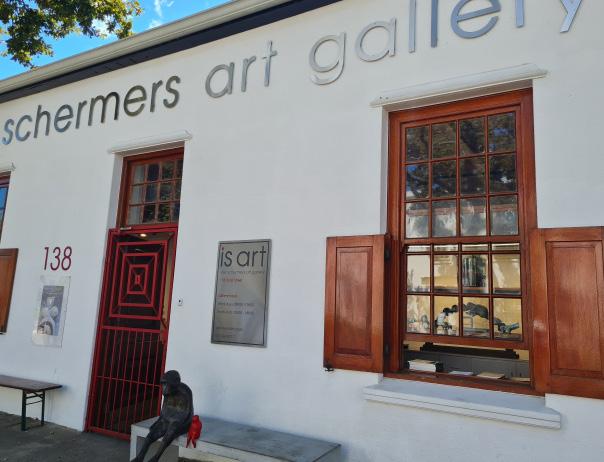
29 Church St and 138 Dorp St, Stellenbosch Central
The Ilse Schermers Art Gallery, cu rated by Ilse Schermers-Griesel, is a well-established contemporary art gallery, which is unmistakably marked by the monkery on the bench at its entrance.
Schermers says, “A significant part of our role as a gallery is to offer everyone the chance to learn more about what is happening within the art scene and explore their interests.”
RUPERT MUSEUM Stellentia Rd, Stellenbosch Central
Situated just outside the buzz of Stellenbosch University (SU), the Rupert Museum is a captivating space filled with South African art from the 19th–21st century. From installations to paintings, there is something to interest anyone with an appreciation for masterpieces.
Curator Eliz-Marie Schoonbee says, “Students are also invited to make use of the library space for either study or small group pro jects. Free wifi is available, and the space lends itself to thinking cre atively [whilst] being surrounded by artworks [as well as] architec tural and natural beauty.”
She adds, “It’s the ideal
The art of South Africa is vast and diverse, much like its population. Art on Church Gallery, which is situated within walking distance from campus, is open and welcom ing to any visitor who wishes to appreciate the works within.
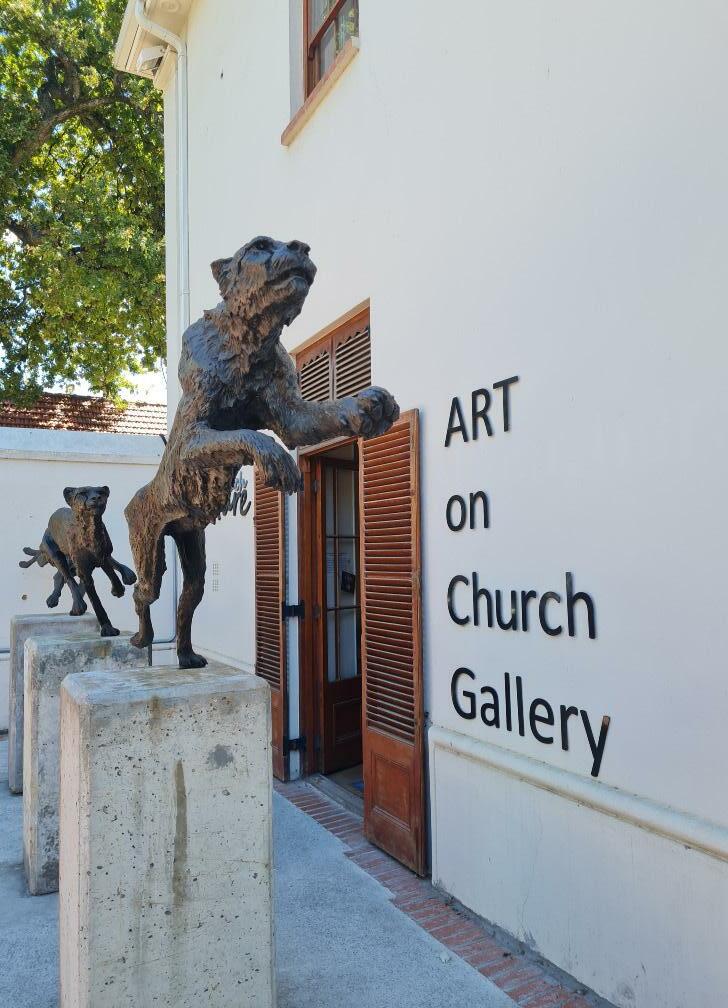
At Art on Church Gallery, vis itors can expect to be inspired by “an informative collection of bronze sculptures and paintings, all by local artists . . . each with its own unique story,” according to Salome White, a representative from the gallery.
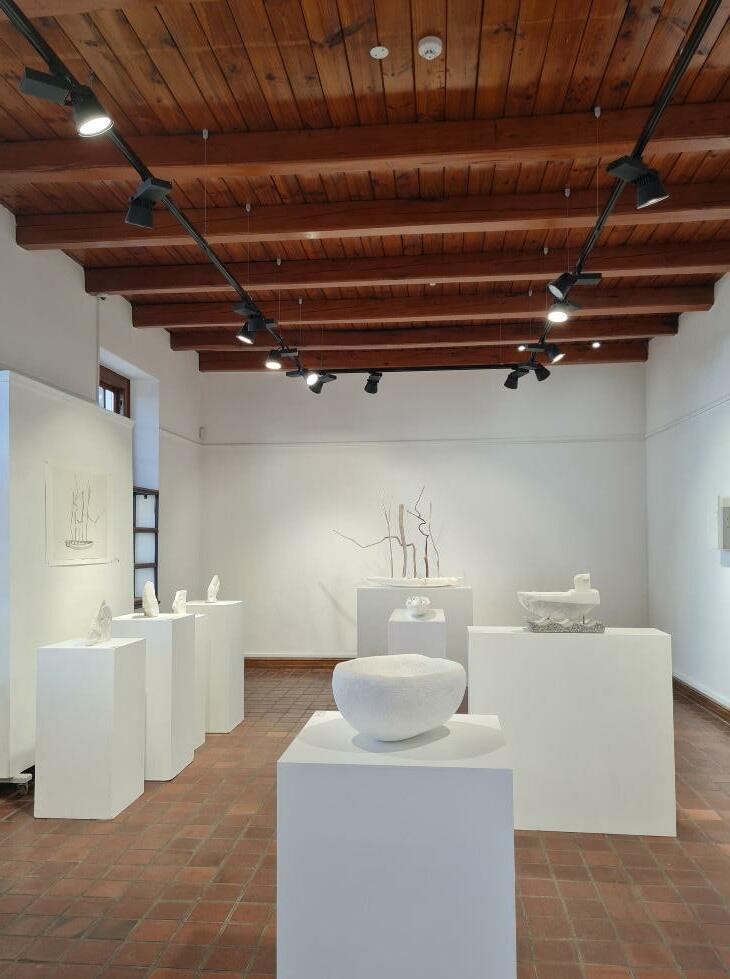
The gallery aims to “inspire and encourage students to see the beauty in artwork as expressed by the different artists and to show them that art is for everyone”.
White excitedly shares, “We are moving to the premises just next door at the beginning of April, which will feature a beauti ful courtyard setting with life-size sculptures and then smaller sculp tures and paintings in the beautiful
CAMPUS QUOTES
Another space for contemporary artists is SMAC Gallery, which fea tures work from local and interna tional artists. Currently, there is a Hyporealism exhibition on show by the artist Callan Grecia, running until 22 March.
GAVIN COLLINS GALLERY
36 Church St, Stellenbosch Central

South African artist Gavin Collins has a permanent, constantly up dated exhibition in a cosy space on Church Street.

MONKEY MADNESS “You can sit with us if you want.” Photo: Skyla Thornton
A recent exhibition, Hailing the Mothership: New Translations from the Mothership, which was open until 28 February, featured marble and sandstone sculptures by Jacky Lloyd.
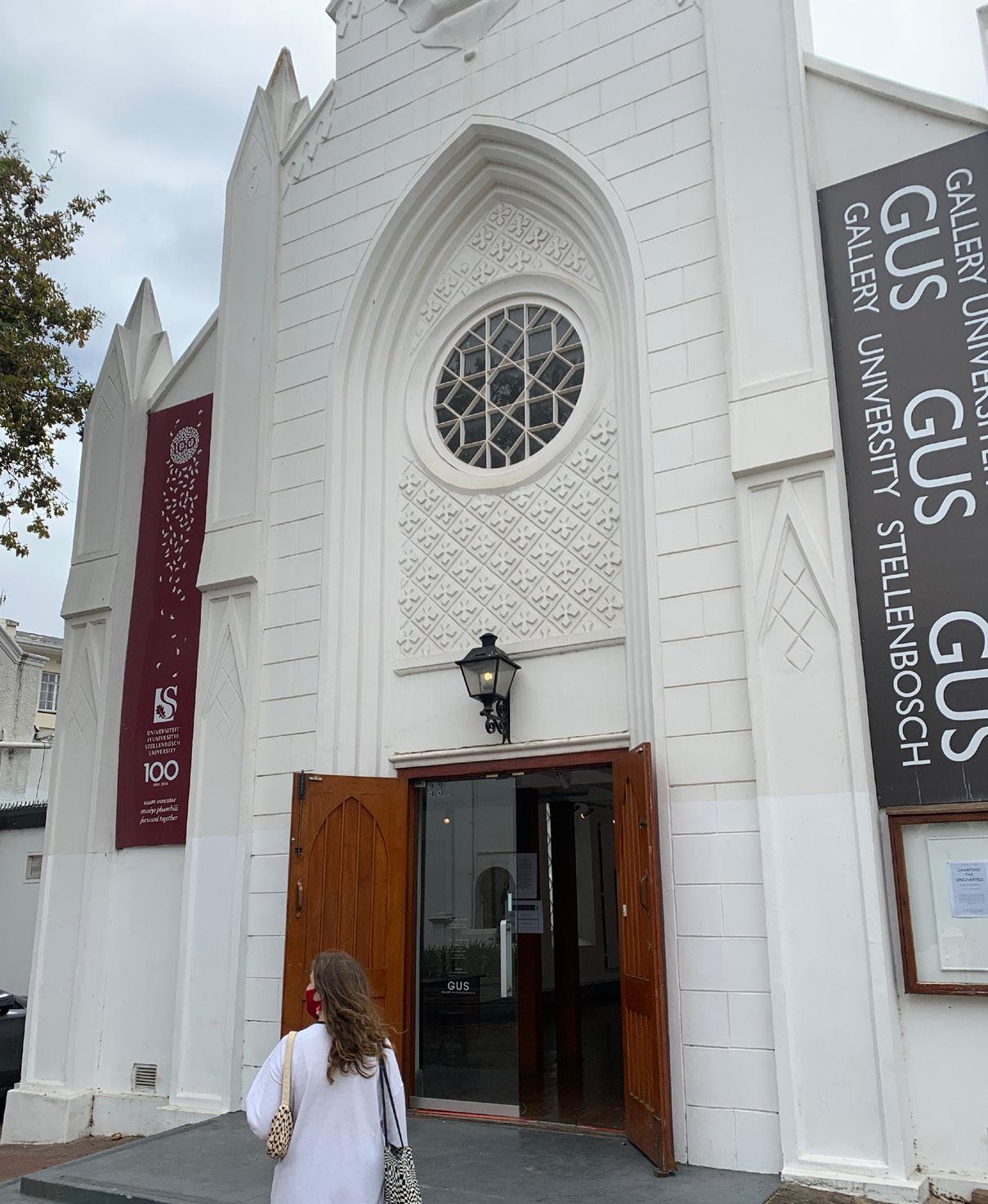
As an extension to the Visual Arts department, GUS is a beautiful building that exhibits the works of SU students.
Currently running until 27 March is a group exhibition cu rated by Clara Babette, named Charting the Uncharted. This ex hibition is a collaboration between historians and artists, and seeks to communicate the stories of those excluded from the conventional stories within history in a digesti ble way.
CITYSCAPE “Edges of Contrast”, a cityscape of New York by Gavin Collins. Photo: Supplied
“Ek sê mos altyd, as jy nie her nie dan kom jy nie ver nie.”
- Finalejaarstudent se uitkyk op die akademiese jaar na sy eerste terugvoeringsessie
“I’ve had a very long degree. Now I’m tired.”
- Postgraduate student avoiding taking on any extra responsibilities
According to Carolin-Fij Schermers, an assistant at the gal lery, Lloyd’s work “discusses a va riety of significant topics, such as climate change and the socio-eco nomic environment that the world is faced with.”
“My brain has left the chat.” - Tired honours student
“Menseregte is ‘n keuse.” - Een manskoshuisstudent aan ‘n ander een tydens ontgroening
“The hinges have been unned.” - Tired editor the evening after publication
The art scene in Stellenbosch is vibrant, and the importance of supporting and celebrating local artists cannot be overstated. Per haps students planning their next bar-hopping expedition can swap out the bars for galleries instead.
“My punte reflekteer nie my dream walk doelwitte nie.”
“Jy het nie kos in joy yskas of geld in jou rekening nie, wees slim en gaan op die date.”
- Honneursstudent aan haar pap sak kamermaat
4 STUDENT LIFE
THE CHARTER “The Charter” by Sethembile Msezane, at Any Given Sunday exhibition at Rupert Museum Photo: Supplied
FELINE FEATURES Leaping leop ards mark the entrance to Art on Church. Photo: Skyla Thornton
old building itself. Worth coming to see!”
LOOKING UP GUS stands remarkably tall and proud. Photo: Skyla Thornton
-Moedelose eerstejaar ingewnieur swese-student
GALLERY UNIVERSITY STEL LENBOSCH (GUS) Cnr. Bird and Dorp St, Stellenbosch Central
Will this be recorded?: Students adjust to changing lecture formats
ARSHIA RAMLUCKUN
T
he academic year has officially begun, but it has been anything but smooth sailing for many stu dents. After completing two years online, one would think that Stel lenbosch University (SU) students would be used to it all.
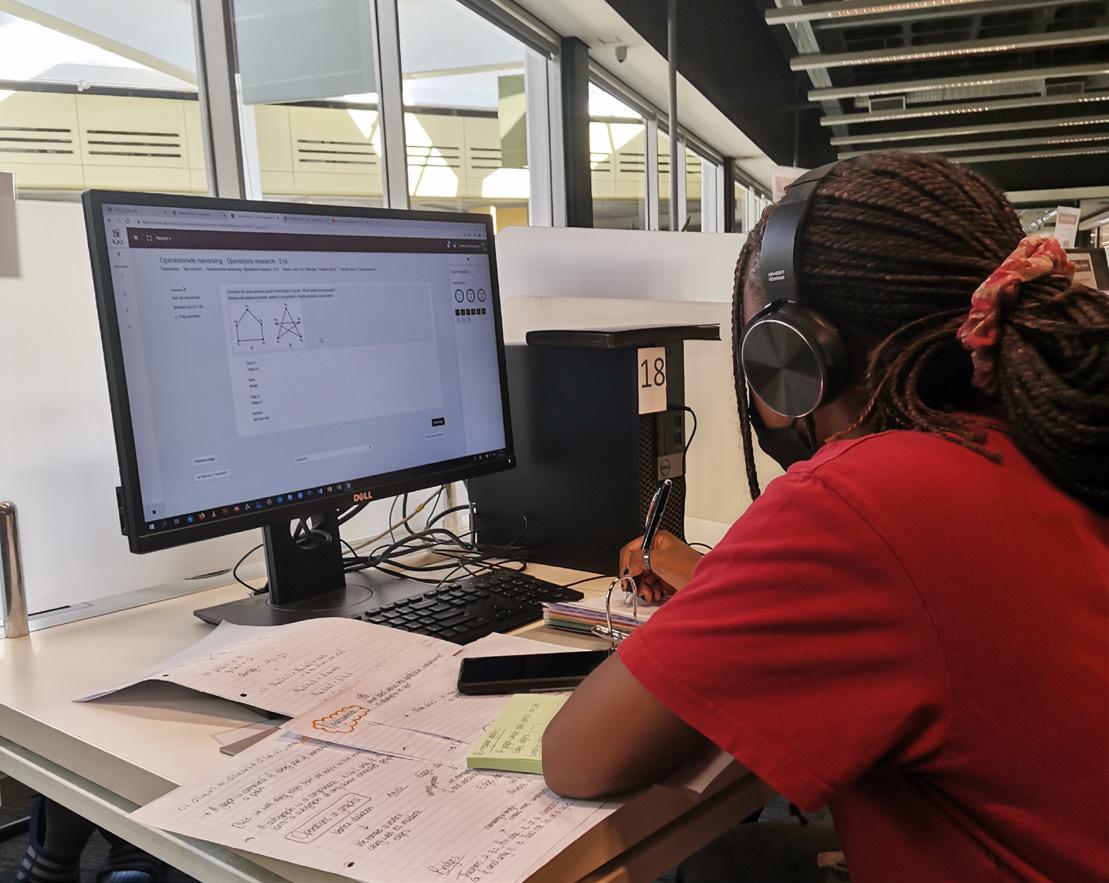
“The first week was hectic be cause the module frameworks were uploaded . . . just before class, and one [hadn’t even been] uploaded after class,” said Rachel Jonker, a third-year BCom (Inter national Business) student, when asked how she found the first week. This sentiment was shared by many other students, who com plained that there was confusion about how modules would be structured this year. For some sen ior students, it might even have felt
as if they were in first year again. In addition to all the difficulties, the methodology used to present some modules has also changed.
Many students enjoyed the lux ury of being able to access record ings of live lectures last year, but this year some lecturers have de cided either not to record lectures or not to upload the recordings when they do.
“My lectures are mostly not re corded unless there [are] technical difficulties in the venue or with the streaming—which happens pretty often. I think a lot of the time my lecturers record but then don’t make the recording avail able or make it available for only a few days,” commented Joshua Pheiffer, a second-year BSc (Com puter Science) student.
“It is frustrating, but I watch
videos on YouTube if I don’t un derstand something fully. Howev er, it is not the same as the actual lecture,” stated an engineering stu dent, who asked to remain anon ymous, regarding the matter and their approach to their studies.
When speaking about her ap proach to making non-recorded classes work for her and the ben efits of in-person classes, Jonker said, “I tried to change my mind set a bit. I am not as stressed about missing small details [and] I pay better attention in [face-to-face] classes because I know I have to concentrate, but also because I am there then, so technical difficulties don’t disrupt me. I don’t need to pause and rewind. The 10 minutes of fresh air when changing classes and lecturers sticking to their 50 minutes also [help] a lot.”
Studentenaelsalons gee Stellenbosch kleur
BAIE mense hou daarvan om hulle naels te laat doen. Dit laat hulle netjies en chic voel. Geluk kig is daar verskeie onafhanklike naelsalons tot studente se beskik king presies vir hierdie rede. Telvina Samuels van Gosh Nails , Mia Stols van Groovy Nails by Mia en Jacki Rossouw van Get Nailing is drie sulke vroue.
Om ’n besigheid te bestuur is al klaar ’n beproewing, maar hier die drie vroue studeer almal ter wyl hulle hul besighede bestuur. Samuels het in 2020 aan haar tweede graad begin studeer en sy is tans ’n derdejaar-BRek-stu
graad wat sonder twyfel help met hierdie kreatiewe werk, maar dit is ook baie tydrowend. Sodat sy genoeg tyd vir haar graad maak, verduidelik Stols dat sy ’n rooster gemaak het volgens die rooster wat sy vir haar klasse gebruik.
“Normaalweg doen ek naels in die oggend, want wanneer ek terugkom van klasse af, is ek uit geput,” verduidelik sy. Stols se rooster kan elke dag op haar In stagram-story gevind word. Sy sê: “Ek probeer om myself nie te vol te bespreek of te oorwerk nie, want dit sal veroorsaak dat ek nie soveel aandag aan my stud ies gee nie.”
Verder mag sommige mense die vraag hê, “hoekom naels as ’n besigheid?” Rossouw, ’n mees terstudent in Landbou-ekono mie en -bestuur, verduidelik: “Ek was in Isa Dameskoshuis, so ek was omring deur Soma tologie-studente. [Naels] was ’n klein deel van wat hulle gedoen het, so toe het ek besluit om my klein besigheid na te volg!”
wees. Stols sê: “Toe ek begin het, was dit obviously angswekkend, want jy sien baie meer mense wat jy nie ken nie … ek moes met my vrese tot aangesig kom en drie of
saaklik ’n studentedorp is, is al die naelsalons ingestel op die studentebegroting. Stols se be sigheid bied ’n half-set manicure aan wat bestaan uit ’n onderlaag, ’n bietjie naelkuns en ’n boonste laag sodat daar geen soliede kleur onder dit is nie, en dit is net R70! Rossouw stel iets soortgelyks voor dat ’n mens ’n gel manicure moet kry en sy sê: “Ek voel altyd dat my lewe super agtermekaar is en dat ek enigiets kan doen sodra my naels gedoen is!”
Wanneer daar na die vrouens van Gosh Nails, Groovy Nails by Mia en Get Nailing geluister word, word daar besef hoeveel passie, deursettingsvermoë en liefde elkeen van hulle vir hulle besighede het.
die kliënte ’n goeie ervaring het. Stols sê: “Ek glo vas daaraan dat ek eers iets moet uittoets voordat ek dit [op ’n kliënt] uit probeer ... ek probeer ontwerpe op my en my kamermaat se naels om te sien of ek dit kan doen.”
Samuels noem dat klein be sighede nie onderskat of ver kleineer moet word nie. “Ek bestuur my besigheid al vir vier jaar en dit het my ure, maande en geld geneem om tot die plek te kom waar ek nou is. En, my mot to is: ‘Ek sal jou nooit uit die salon laat loop met naels wat ek nie self sal dra nie.’”
Al drie hierdie besighede wys
ROND EN BONT Mia Stols se gunsteling-manicure op die oomb lik. Foto: Verskaf

dent. Samuels het eers BSc (Mol ekulêre Biologie en Biotegnolo gie) studeer en sy bestuur haar besigheid al van haar tweede jaar op universiteit af. Sy sê: “Elke dag en elke jaar is ’n nuwe leer kurwe oor hoe om [my studies en besigheid] te balanseer, maar dit het al oor die jare verbeter, veral hierdie jaar, soos ek geleer het om persoonlike tyd by my week in te korporeer.”
Stols is in haar derde jaar be sig met BA (Visuele Kunste), ’n
Stols het die mark betree om dat, soos vele ander Stellenbosse studente mee kan vereenselwig, sy dit nie op haar studentebe groting kon bekostig om na eni ge hoofstroomnaelsalons te gaan nie.
“Ek was nog altyd lief vir daar die helder kleure met die detail en kuns, maar ek kon dit nooit bekostig nie ... en toe my kamer maat vir my ’n klein gel masjien vir my 20ste verjaarsdag ge koop het, en al die basiese ger eedskap, het ek begin om haar en my naels te doen en soos die trends aanbeweeg het, het ek begin dink ‘Ek moet regtig dit navolg’ en dit was dit!”
Saam met ’n besigheid kom daar egter bemarking en om ’n mens se naam in Stellenbosch se skoonheid- en naelgemeenskap te kry – dit kan nogal intimiderend
KIES KLEUR ‘n Marmerpatroon met goue stukkies deur Gosh Nails. Foto: @goshnailsstellies op Instagram


vier mense per dag sien en hulle van ’n diens verskaf waarvoor hulle betaal, want jy wil obviously jou beste doen en die kliënt moet gelukkig wegloop.”
Rossouw sluit hierby aan wanneer sy verduidelik dat “dit jou eers ’n bietjie afskrik ... ek glo vas daarin dat ‘hoe meer jy moet doen, hoe meer kry jy gedoen.’ My deursettingsver moë om ’n sukses van elke as pek van my lewe te maak, is wat my motiveer!”
Al drie naelkunstenaars het besluit om Instagram as ’n plat form te gebruik vir hulle be sighede se bemarking, met boeiende en herkenbare handles soos @goshnailsstellies, @groovy nails.bymia en @getnailing.
Aangesien Stellenbosch hoof
Samuels sê: “Iemand het my die ander dag gevra, ‘hoekom hou jy nie net op met Gosh Nails en fokus voltyds op jou studies nie?’ en ek het by myself gedink, ‘ek weet nie wat my lewe sonder Gosh Nails is nie; dit is my lewe en dit is wie ek is.’”
Rossouw se passie is om selfvertroue aan die mense van Stellenbosch te gee. “Ek is mal daaroor om nuwe mense te ont moet en hulle dag beter te maak op die kleinste manier ... en hulle net op te kikker,” noem Rossouw.
Stols geniet dit om haar be sigheid te bestuur, want dit het vir haar geleer hoe om geld te verdien en te spaar sowel as met mense te doen kry. Sy sê: “Om al daardie komplimente van amaz ing meisies te kry wat sê dat die naels wat ek doen so pragtig is, en om verby iemand te loop en dan vra hulle of ek my eie naels gedoen het ... dit gee regtig vir my ’n sprong in my stap!”
Hierdie besighede is voor beelde waarom ’n mens klein be sighede moet ondersteun. Talle ure se werk en toewyding word by die besigheid ingetap sodat
die waarde daarvan om in jouself, jou vaardighede en jou ervaring te glo.
Samuels, Stols en Rossouw werk hard om bekostigbare en pragtige naels aan die mense van Stellenbosch te gee, en dit alles terwyl hulle hul eie veeleisende grade studeer – dit is iets om op trots te wees en waarna elkeen kan strewe.
STUDENTELEWE 52 Maart 2022
NEW NORMAL Students have returned to classes and are making efforts to adjusting to the new “normal”. Photo: Arshia Ramluckun
STELLA JOUBERT (VERTAAL DEUR MIEKE DE WET)
HOU DIT EENVOUDIG Jacki Rossouw se ikoniese gel manicure Foto: Verskaf
Final-years say, ‘We’ve been there, so just trust us.’
ALISON HERMANUS
S
o, you’ve just started your first year at Stellenbosch University (SU), now what?
You may be thinking that you are experiencing this alone, but all the older Maties have been in your shoes before. Students who have completed their first year know how it feels to be new to this whole “being in university” thing, and the people who know it best are final-year students. That is why Die Matie has asked final-year students from various faculties to give some advice to all the incoming firstyears. Take these words of wisdom from those who have experienced first year before.
2. Attend all the lectures. Yes, also the 4 pm Introduction to Law on a Friday.
3. Don’t believe anyone’s horror stories. It’s not as bad as it sounds (if you attend class).
have to adapt to, you need to be aware about them at all times. That’s how you are built into being an engineer.
One other thing: learn to be comfortable with not being comfortable. That’s the holy grail to being disciplined. And enjoy the journey. It’s important that you do.
it and feel fear for the unknown. Things are going to be a bit confusing in the beginning. You might not know exactly how your modules fit together, or how to divide your time, or which study methods work for you in certain scenarios. But with time, it gets better.
So be patient; cut yourself some slack; be open to failure, and just hang in there. You’ll do great!
is your best friend, it gives you structure and compartmentalises the content which helps a tonne.
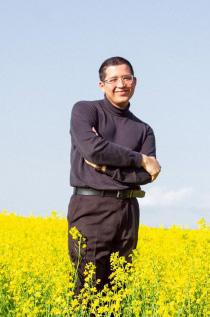 ZOË CURRAN, BA (HUMANITIES)
Go out of your comfort zone! Make friends with people you never thought were your vibe. This is the time where you make most of your lifelong friends so don’t be shy and always be yourself! Never be afraid to drop a module. This isn’t high school anymore and no one is going to judge you for your choices! Remember your mental health comes first over anything and if a module becomes too demanding to a point where you can no longer prioritise other modules anymore, make the necessary change to put your peace first.
CERÉT GOOSEN, BED (INTERMEDIATE PHASE)
Looking back at my first year in 2019, it was a bit of a rollercoaster. One thing I was sure of, was that BEd (Intermediate Phase) is what I want to study. Some advice I can give you as a new first year, specifically for this course, is manage your time well. Studying education is very demanding academically because there’s always something that needs to get done. Some advice I would’ve given myself then, now that I look back, is every bit of effort you put in counts towards the next three or four years you’ll be at this university. Set yourself up to achieve greatness from the get-go.


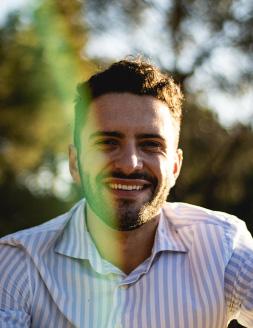
AIDAN FORBES, BMUS
My bit of advice to newcomer music students is this: don’t feel pressured to know what you want to do with your degree going into it. In studying music, numerous different paths are put before you–whether to go into performance, education, composition, et cetera–and it is so easy to forget that that choice will only have to be made in the distant future.
It took me a whole degree change (BA (Music) to BMus) and a change in specialisation (performance to composition) before I realised what I wanted out of my degree, and what my degree wanted from me. Take your time and explore the fields of music and yourself as a musician. And if you’re like me and you only find out what you want out of this degree by third year, rejoice in knowing that you were open to take the journey and were granted your destination.
ANRI VAN HELSDINGING, BA (DRAMA AND THEATRE STUDIES)

Three years go by so fast. I know it sounds cliché[d] and you probably hear that a lot but it’s so true. Make the most of everything. Get out and meet as many people as you can, and do it with an open mind–you’ll be surprised. There is so much you can learn from people.
IRVING DE SWART, BDIV
No one can tell you what it will be like to study theology, because God alone will determine the nature of your journey. However, you can be at peace and excited for it is precisely God who calls you to study theology.
My experience testifies about God’s intellectual miracles. It is an honour to examine God’s majesty and experience His presence for a living.
BERNARD OOSTHUIZEN, BACCLLB
1. If a lecturer suddenly prescribes a case not on the module framework, study it, it might be a 17-mark long question.
YINHLA MAKONDO, BENG (MECHANICAL)
In this engineering journey, acquiring the engineering skills is as important as building character. It’s a journey that builds a character, so one must pay close attention to detail about their character.

Your character complements your success as an engineering student. There are certain traits you’ll have to leave behind [and] traits you’ll
This is a big transition and it’s natural to feel a bit anxious about
GRETCHEN JEFTA, BSC (MOLECULAR SCIENCE)

I feel like [I] was very stressed out because everything I needed to do was all on me so I would say try to be okay with not having things all figured out to the tee. No one really has everything figured out.
Also, the workload initially feels like a lot to manage, with multiple deadlines all at once but if you work through / read through module content daily things tend to fall into place.
Lastly, the module framework
GRACE DEWRANCE, BCOM (INTERNATIONAL STUDIES)

Don’t be afraid to ask for help or advice (mentally, financially or even just in terms of uni work).
Uni work and life in general is difficult, so don’t bottle things up. Most students actually go through similar situations (even if it doesn’t look like it) and really don’t mind helping, so don’t be afraid to reach out!
If you can help it, don’t fall behind on work or assignments. If you do, catch up as fast as possible!
Actually study! Uni is nothing like high school.
DANUSHA
AMBRAHAMS, BACC
6 STUDENT LIFE
Koelkop in Stellenbosch
No shiny object syndrome for Cuban Fourth
Wanneer die temperature in Stellen bosch styg na ’n folterende hitte, vind sommige studente dit moeilik om op hulle studies te fokus of om enigiets anders te doen as om oor die hitte te kla.
Daar is egter talle aktiwiteite waarmee studente hulleself kan besig hou ge durende hierdie warm somersdae.
GENIET ’N DAG BY DIE COETZENBURG-DAMME
Die twee Coetzenburg-damme is die beste plekke binne loopafstand van kampus af waar jy kan gaan swem en af koel. Die nuutste (en skoner) dam, Ertjieskloof, blink net soos ’n turkoois oase vir dié studente wat terug op kampus is.
Anne Hall, ’n HonsBSc (Sportweten skap)-student sê: “’n Warm dag in Stellies vir ’n student ... sal altyd water insluit, en moenie vergeet om by die vrugtesmous en die drankwinkel te stop op pad na die Coetz-dam toe nie!”
SOEK ’N VRIEND MET ’N SWEM BAD
Nie baie studente is gelukkig genoeg om toegang tot ’n swembad te hê nie, maar as jy ’n vriend ken wat een het, dan is dit ’n bonus op ’n warm dag. Jy kan boonop sake verbeter deur ’n braai en ’n partytjie te reël.
HOU ’N PIEKNIEK ONDER JAN MARAIS NATUURRESERVAAT SE BOME
’n Piekniek is ’n goeie manier om die skaduwee van die pragtige bome in Stel lenbosch te geniet. Jy kan ook ’n speletjie of kaarte saam met eetgoed bring om die hele ervaring meer stimulerend te maak.
Jan Marais Natuurreservaat is die per fekte plek vir ’n piekniek, maar daar is ander skadukolle in Stellenbosch soos die Drie Susters se grasperk, die rugbyvelde by Coetzenburg-stadion en die Universi teit Stellenbosch se Botaniese Tuine.
WAG VIR SOMER OM TE EINDIG
Aangesien daar in die meeste geboue op kampus lugversorging en waaiers is, is die beste ding wat jy kan doen om ’n ys koffie te koop en net te wag vir somer om tot ’n einde te kom.
“Ek kan dit nie genoeg sê nie; dit is so warm en droog in Stellenbosch dat dit maar die beste is om in jou kamer te sit en te wag tot somer eindig,” sê Brendan du Plessis, ’n tweedejaar-BA (Visuele Kunste)-student.
So onverdraaglik soos ’n warm dag in Stellenbosch is, is dit moontlik om dit te oorleef. Daar is aktiwiteite waarmee jy jouself besig kan hou, so verken hierdie opsies wanneer die tempera ture weer styg.
A desire to create an af fordable and easily accessi ble luxury brand for young people is what drove two Stellenbosch University (SU) students to start Cuban Fourth. Final-year BAcc student and Simonsberg Residence prim Simeon Sep tember, and Matie BAcc grad uate Tirivashe Chimbetete (who has since moved back to Zimbabwe) started this on line jewellery and accessories store in November 2020.
Just over a year later, the brand venture has garnered nearly 14 000 followers on Instagram (@cubanfourth) and a diverse variety of consumers both in and out side of the Stellenbosch area. Notable consumers of the brand include Love Island South Africa finalist Xavier Haupt and comedian Ley thon van Graan, who is also an SU student.
“I really enjoy wearing accessories and jewellery. I realised that there was nev er really a place I could go to that was renowned for making jewellery and acces sories for young men, and that drove me to combine
my passion for jewellery and business to create something of my own,” said September.
Beyond passion and dedication, the online busi ness has aimed to priori tise community in all of its endeavours, including its
believe in what you’re sell ing or if they don’t see that you care about them and look after them as custom ers, they will go to the oth er business that will do that for them,” he said.
September has de scribed his journey of ven turing into the world of startup businesses as being “up and down” but has expressed gratitude for the lessons that Cuban Fourth has taught him thus far. “It has been a very good jour ney and one that I am taking a lot of lessons from. Even if it isn’t my jackpot one day, it has definitely been some thing that has propelled my entrepreneurship and that kind of thinking inside of me to start other ventures,” he said.
marketing and its choice of ambassadors. Cuban Fourth’s choice of ambassa dors ranges from high-end influencers, like Van Graan, to people who do not necessari ly have a large social media following, yet have a form of influence in their friend groups.

“At the end of the day, if people around you don’t
In Cuban Fourth’s short time, it has taught Sep tember the importance of purpose over profit. “There will be times where it feels like nothing is working, but you have to stay dedicated to the vision and focus on the impact you would like to make, so in more than a monetary sense. If your focus is only on the money, you will always fall short.”
We all scream for affordable ice cream!
KEZIAH MEYER AND ALISON HERMANUS
PICTURE this: it’s a typical Stel lies summer day; the sun is beat ing down on you as you walk across the Rooiplein; and you have a sudden ice cream craving. Luckily, not far from campus, there are three ice cream shops that could help satisfy your crav ing.
KRISTEN’S KICK-ASS ICE CREAM
Kristen’s Kick-Ass Ice Cream, lo cated on the corner of Bird and Church Street, is a new and vi brant artisan ice cream shop that is perfect for a quick escape.


The bright, lively décor is remi niscent of childhoods spent on the playground, and creates an invit ing and nostalgic atmosphere.
The aesthetic, which is catered towards a younger demographic, draws in young customers accord ing to the manager, Wilma van Wyk.
“I really think [the owner’s] branding is very funky and up to date, and it’s young and hip.”
The shop, which is the fifth addi tion to the locally owned franchise and owned by ice cream enthusiast Kristen Buttress, prides itself on its handcrafted ice cream. “All her ice cream is artisan, handmade and re ally thought through.
“She’s extremely passionate about the process of artisan ice cream, so we’re continually bring ing in new flavours. She’s forever developing new flavours,” Van Wyk added about Buttress and her ice cream.
There is no lack of variety, with options for everyone, from their ice cream to their handmade waffle cones.
GELATO MANIA
Located on Andringa street, this Stellenbosch staple is a well-known spot for students and is perfect for a little taste of Italy.
Gelato Mania pride themselves on their artisanal gelato imported straight from Italy. “Our gelato is special because it’s Italian, and we stock our products from over seas,” says employee Olwethu Khayingana, who has been work ing at Gelato Mania since 2019.
With a wide range of flavours, including vegan and dairy-free options, customers never have to
worry about options, and the aes thetic of this shop is the perfect backdrop for an Instagram post with their iconic neon wings and “Instagram room”.
Their gelato is “the perfect com bination of smoothness and cream iness” according to Khayingana, who highly recommends her per sonal favourites: salted butter cara mel and chocolate brownie.

CRÈME DE LEVAIN
Lastly, there is Crème de Levain, which is a relaxed, floral ice cream shop. While Gelato Mania is a slice of Italy in Stellenbosch, Crème de Levain is a scoop of France. This shop is situated on Church Street and has an inviting exterior and interior with cherry blossom décor and floral wallpaper. Thanks to their design, the shop has a feeling of spring in Paris.
swapped] out daily. We’ve got some insane flavours—I mean Turkish delight, white choco late and basil—anything under the sun,” says Webster.
There are also vegan and dairy-free options available.
“Our sorbets are all dairy-free. They do use egg whites, so they’re not vegan, but I always
DOUBLE DECKER Happi
ness in a cone: a double scoop of Kristen’s ice cream in one of their famous sugar cones.
“We always have between two to four vegan flavours either in the 5oo ml tub or you can buy it in the scoops and then we have a ve gan cone. We also have sugar-free [and] dairy-free ice cream, and we only use Xylitol and natural fruits to sweeten our ice creams that are sugar-free,” said Van Wyk.
This new shop is sure to cap ture the hearts of locals and Maties alike!
“I think what makes this place special is, number one, the dé cor—I mean, even if people aren’t in the mood for ice cream, I do get a lot of people coming past com menting on the décor. Some peo ple even walk all the way up to the counter to say ‘hey the place looks cool’,” says Benedict Webster, who is the manager at Crème.
Another notable feature of Crème is the music that appeals to listeners of all ages and is an in viting part of a visit to this store.
The main appeal of this ice cream store, however, is, of course, the ice cream. “Our [flavours are
Photo: @cremedelevain on Instagram have at least one vegan flavour at any given time,” he adds.
So, whether you’re an ice cream fanatic or a casual con sumer, rest assured that one—if not all—of these spots will ful fil all your ice cream needs and then some.
STUDENTELEWE 72 Maart 2022
LATE NIGHT SCOOP Gelato Mania is open until 22:30 daily. Photo: @gelatomaniact on Instagram
FLAVOUR FRENZY Crème de Levain has 21 handmade gourmet flavours to choose from.
FLAVIA DAVIDS
CREATORS Simeon Sep tember [front] and Tirivashe Chimbetete [back] pictured. Photo: Imraan Titoti
SKYLA
THORNTON (VERTAAL DEUR MIEKE DE WET)
DAG&NAG
Psych rock: Live and loud
and Lourens Swart on keyboard and synth.
New generation psychedelic rock band Moskitos will be dropping their debut EP, Adieu Or Die, on 17 March. Inspired by their mutual love for 60s sound and early psychedelia, this Stellenbosch trio is producing a sound that touches on new and distant places. Their music will take their listeners to the golden age of psychedelic rock but will pull them right back to the modern psych rock that is emerging today.

After meeting at a party and having a few experimental jams, Pieter Labuschagne (lead vocalist), Albert le Roux (bassist and vocalist), and Danie Holtzhausen (drummer) combined their talents to form Moskitos. They are also joined by two backup members, Hanno Jansen van Vuren on percussion
When asked about their unique sound, Le Roux said, “It’s . . . psychedelic rock, but we try to incorporate a lot of influences from [the present] and the past, but all heavily 60s-influenced. We also have a flirt with progressive rock sometimes and rhythmbased things.”
These experimental rockers have been jamming since 2019 and have graced the stages of The Daisy Jones Bar, Aandklas, Evol and many others.

Moskitos recently released their first single, “Speed Unknown” (taken from their debut EP), which is streaming on all major platforms. This single is an ode to the golden era with a splash of garage and progressive rock.
“I just want people to feel . . . a feeling that they haven’t felt before. We found our sound
within the songs of this EP,” says Labuschagne.

With their debut EP being released later in March, Labuschagne commented on the name Adieu Or Die. “I stole the
name from a song [by the Beach Boys] that really means a lot to me. The whole EP is supposed to comment on personal growth . . . a journey from bad to better. ‘Adieu or die’, meaning ‘goodbye
or die’, refers to saying goodbye to the negative thoughts and the old self, so that you can be free and be the self you want to be,” said Labuschagne.
Moskitos are going all out with the release of their EP, various live performances, and a music video on the horizon. “But we are not hanging up our bootstraps after this,” says Le Roux.
“The next thing for us would be hopefully to play [at] some festivals . . . [in order] to collaborate with people that are a bit outside of our niche . . . [and] to be involved with international artists,” added Labuschagne.
Moskitos are letting loose this Saturday, as they will be playing along with another local band, Los Sueños, at Evol in Cape Town.
Tickets are available on Quicket. For more information on Moskitos, visit their Facebook and Instagram pages at @moskitos_.
Die Simonsberg Met sing 60 in die somerson
SIMONSBERG-manskoshuis se ikoniese Metropolitan (oftewel Met) het dié jaar sy 60ste bestaansjaar gevier. Dit was die eerste, en moontlik een van die grootste, koshuisgeleenthede van die jaar. “Die Withuis” het die eerste week van klas ingelui met gesogte stokperde en rooi lewensredderbroekies regoor kampus. Die nuwe Met Dames het egter die voortou geneem om die hooibaal-resiesbaan.
Die Met het op die eerste Vrydag van die akademiese jaar, ná ’n week van feestelikhede, plaasgevind. Met COVID-19maatreëls en maande van reëlings tref met die munisipaliteit, ’n privaat sekuriteitsmaatskappy wat alkohol by die ingang verbied, en ’n lighartige gevoel van “normale” studentelewe, het toeskouers die afgebakende voorgras van Simonsberg-manskoshuis ingevaar.
Janko van der Walt, ’n finalejaarBRekLLB-student en een van die HK-lede in beheer van Met Week, meen dat hierdie jaar se Met meer as net ’n belangrike mylpaal in terme van jaartal getref het. Ná laas jaar se Met wat beperk was tot ’n interne geleentheid as gevolg van strenger COVID-19-maatreëls, wou Simonsberg verseker dat een van hulle bekendste tradisies voortleef.
“Ek kan nie verwag dat elke persoon die geskiedenis van Met ken nie … maar op hierdie stadium was dit net om die event terug te kry in die publiek se oë,” sê Van der Walt. “Tot daai dag [volgende jaar se Met wat beraam is vir 16
Februarie], as jy Met noem, wil jy graag hê almal … moet weet wat Met is. Dit was maar die doel van dié jaar gewees.”
Kaartjies na die geleentheid was reeds die dag voor die tyd uitverkoop en die venue was met ongeveer 1 600 gaste op volle kapasiteit.
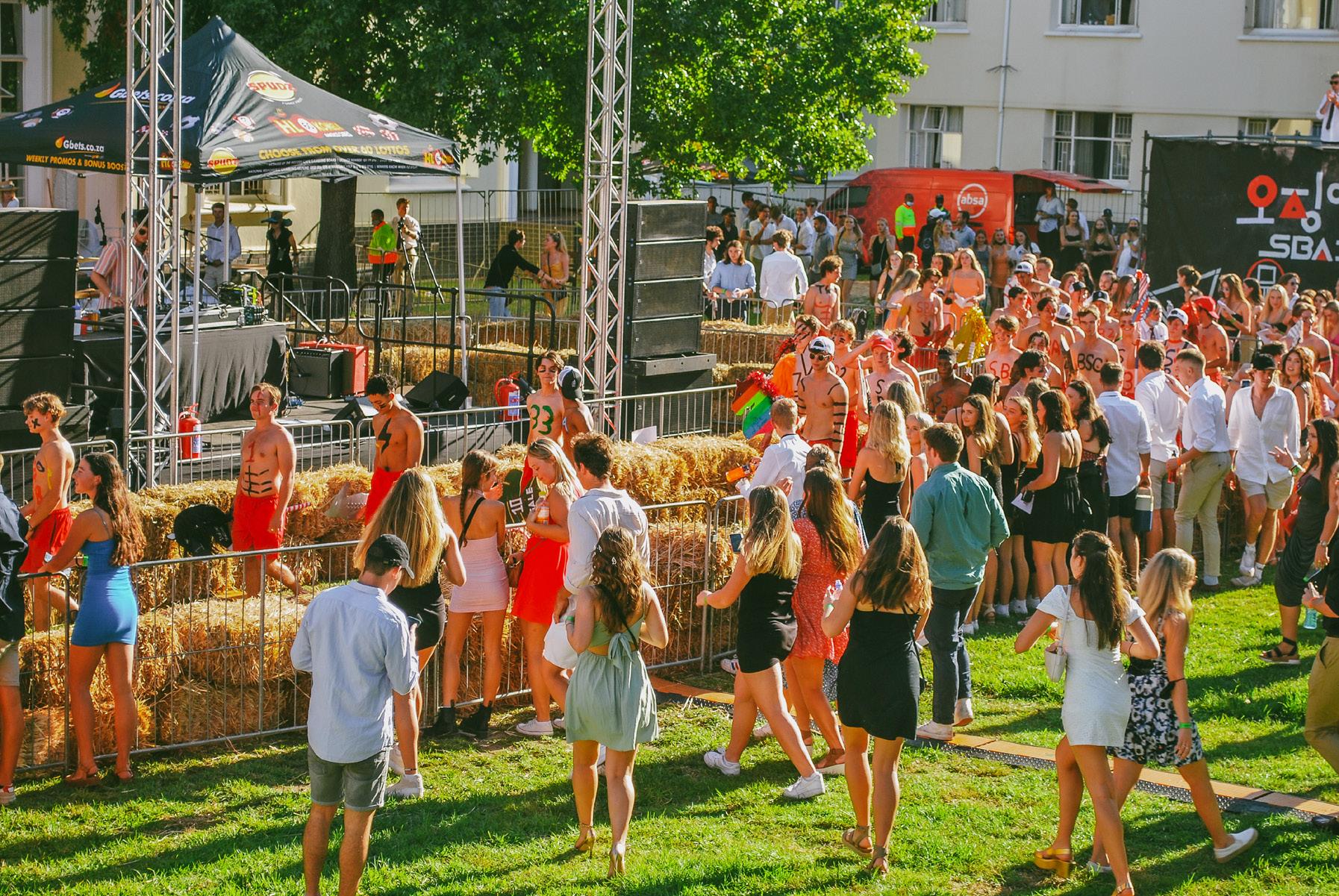
Die eerstejaars van Simonsberg-manskoshuis, ook gesamentlik genoem “Blou”, maak jaarliks hulle eie stokperde vir die perdewedrenne waar hulle kompeteer vir die eersteplek met weddingskappe wat op hulle geplaas word.
Vir Simonsbergers het dié jaar se Met Week ’n gholfdag vir seniors en alumni, ’n gala-ontmoeting met ’n vrouekoshuis, die befaamde Met Dag, asook die finale Met Dans ingesluit, maar die aanstelling van dié jaar se Met Dames was die grootste verandering aan hierdie langstaande tradisie.
Minette Pieters, wat besig is met ’n nagraadse diploma in bemarkingsbestuur, is Simonsbergmanskoshuis se strategiese adviseur en was vasbeslote dat die konvensionele rol van die “Met Dame” aangespreek moes word.
“Ek het vir [die HK] gesê as hulle dit nie meer intentional maak nie, dan gaan ek nie saamstem dat ons [Met Dames] doen nie,” sê Pieters.
Pieters kom vanuit ’n familie waarvan byna al die mans op ’n tyd in Simonsberg was, en as volwaardige HK-lid is sy ook nou deel van die Simonsberg-gemeenskap.
Toe dit tyd is om die Met Dames te kies, het Pieters haar perspektief gebied om te verseker dat hulle vir meer as net pret en gees gekies word, maar ook vir ’n doel.
“[Die Met Dames] is nou basies my komitee wat my gaan help met
[eksterne betrekkinge], so basies ‘wat sê kampus van Simonsberg’,” sê Pieters, wat dan die insig kan lewer aan die Simonsberg-HK om relevant te bly tot die brëer studentegemeenskap.
Die ander doel van die nuwe Met Dames sal wees om Pieters te help met verskeie projekte in samewerking met die res van die HK se portefeuljes soos Sosiale Impak, Vrouebemagtiging en Kritiese Gesprekvoering, ensovoorts.
Pieters is van mening dat haar en die Met Dames se teenwoordigheid kan help om ’n leidende mansgemeenskap soos Simonsberg-manskoshuis hulle meer positief te laat verbind aan die vroue in hulle omgewing en om die koshuis ’n veiliger ruimte te maak vir gaste.
“Ek probeer so veel as moontlik in Simonsberg wees: ek eet een keer ’n week saam met hulle lunch, ek probeer na al hulle events gaan sodat daar heeltyd ’n vrou present is,” sê Pieters. “Hulle weet ek’s in ’n leierskapsposisie daar en hulle is baie respekvol teenoor my, wat iets is wat ek wil hê moet deursyfer na ander vrouens wat present is in die Simonsberg spasie.”
Ná die vermaaklikhede, insluitend ’n optrede van ’n oudSimonsberger se band, het die bekende musiekgroep Desmond
& The Tutus ook die skare bekoor met sommige van hulle treffers soos “Pretoria Girls”. Die dag was vol sonskyn, uitbundige geselskap by die vyf eksklusiewe klubstalletjies en studente wat met Pump-waterbottels in die hand die hitte trotseer.
8 DAG & NAG
TIAAN BOOYENS
DIE WITHUIS Kampus se grootste koshuisgeleentheid tot dusver die jaar. Foto: Aurelia Mouton
SIBELLA
SWANEPOEL
ROCK IS ALIVE Psychedelic rock band, Moskitos, jamming at The Daisy Jones Bar. Photo: Inus Grobler
KUNS EN VERMAAK • ARTS AND ENTERTAINMENT
A tourist in your own town
STELLA JOUBERT
DROSTDY THEATRE
M
any people often find themselves growing tired of their daily routine and in need of a new activity to do, spot to visit, or path to walk. Luckily, Stellenbosch has many places that can scratch this itch of adventure and change! From museums to galleries to gardens, Stellenbosch has many student tourist spots for newcomers to visit during the day.
There are a few places in particular that every student should tick off their “must see” list:
This spot is perfect for the thespians of Stellenbosch, as it showcases plays and performances throughout the day. From skits and one-person shows to musical acts and stand-up comedy, you are bound to find something worthwhile to watch with friends.
JAN MARAIS NATURE RESERVE
Another place to go for leisurely walks and a chance to see the beauty of the town’s nature is Jan Marais Nature Reserve. This
reserve is at the very top of Victoria Street. One often sees many cyclists, runners and walkers frequenting this reserve, as it is both safe and secluded.
COETZENBURG DAM
If you are still craving a natureinspired tourist spot, Coetzenburg Dam is a good place to quench this thirst. Many students visit the dam to cool off from the Stellenbosch summer heat or just for a lunchtime swim. The walk up to the dam is also very tranquil and scenic, and is a good place for Instagram photos.
GALLERY OF THE UNIVERSITY OF STELLENBOSCH (GUS)
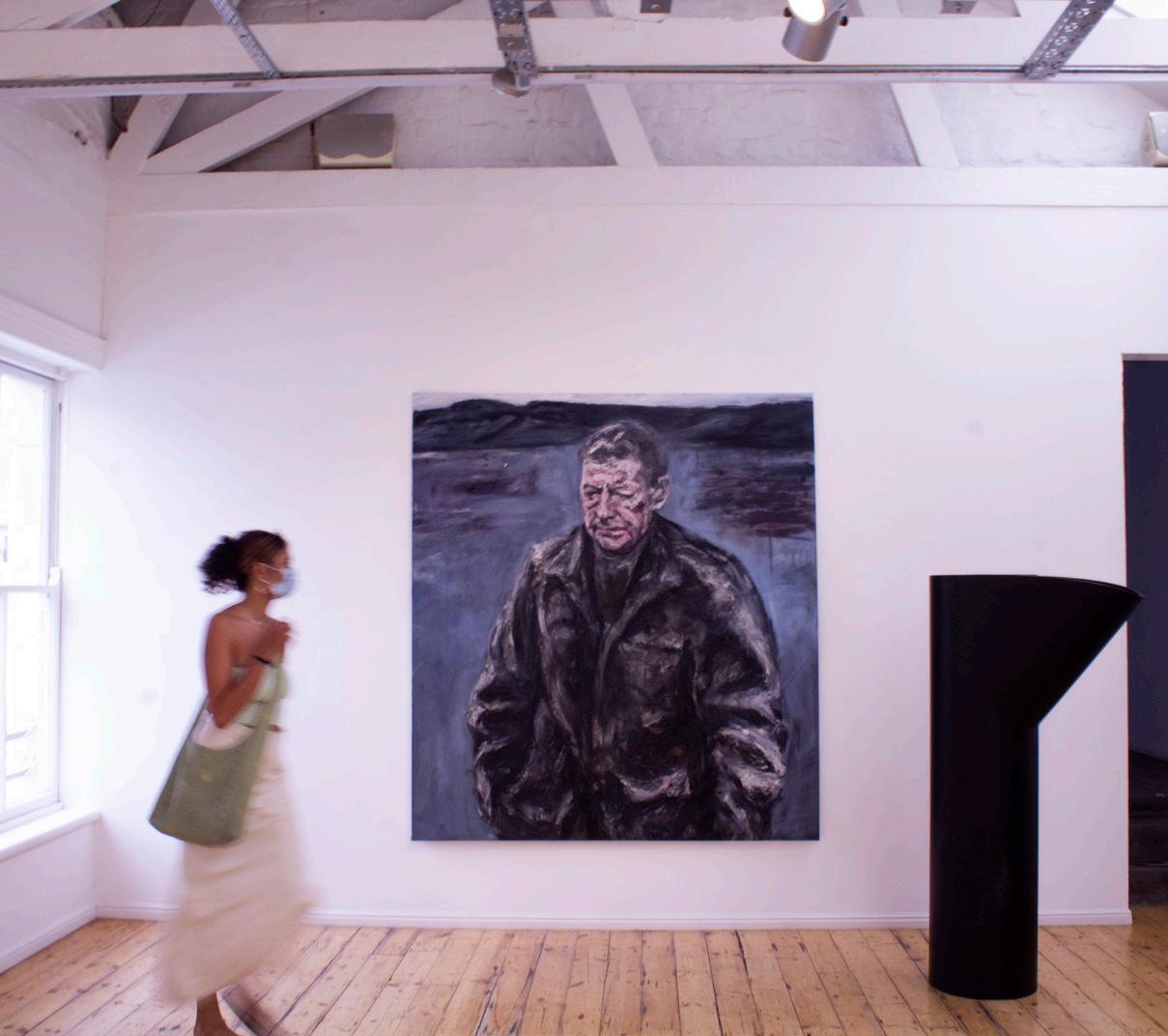
With regard to artistic tourist spots, the GUS is a quintessential Stellenbosch attraction. It is situated on Bird Street and hosts a multitude of different artists. Much like GUS, both SMAC and Rembrandt van Rijn boast a multitude of artists and works, which makes them prime spots to visit when in Stellies. These are situated on Church Street (in the De Wet Centre) and on Dorp Street, respectively.
THE THIRSTY SCARECROW
If you are looking for a lighthearted tourist spot or activity, strawberry picking at the Thirsty Scarecrow on the R44 is just the thing for this. It is a welcoming, wholesome space that, provides both an enjoyable activity and fun bonding experience for its visitors.
DORP STREET MARKET
The Dorp Street market is one of the most frequented daytime tourist attractions in Stellenbosch. It is packed full of different vendors, such as thrifters, bakers and jewellers. The market often boasts live music and is full of
hustle and bustle from 09:00 to 15:00 every Sunday.
Stellenbosch has so much to offer in the way of daytime tourist attractions. See this as your chance to take advantage of all of them and become a tourist in your own town!
Vino-lovers can now enjoy new varieties
JEAN-MARIE UYS
IT is no secret that wine culture has long been an integral part of the Stellenbosch experience. The charming streets of the old town welcomed new hangouts to indulge in a glass (or a few) at the beginning of this year, such as Qbar Wine Bar, The Stellenbosch Wine Bar and The Wine Glass Stellenbosch.
QBAR WINE BAR
De Wet Centre Courtyard, Church Street
Hidden in the De Wet Square courtyard with an atmosphere reminiscent of Europe, vino-lovers can relax in all that is green and gold at Qbar Wine Bar. The bar was opened on 23 December with the aim of bringing the tastes of Quoin Rock Wine Estate and the Knorhoek Valley to town.
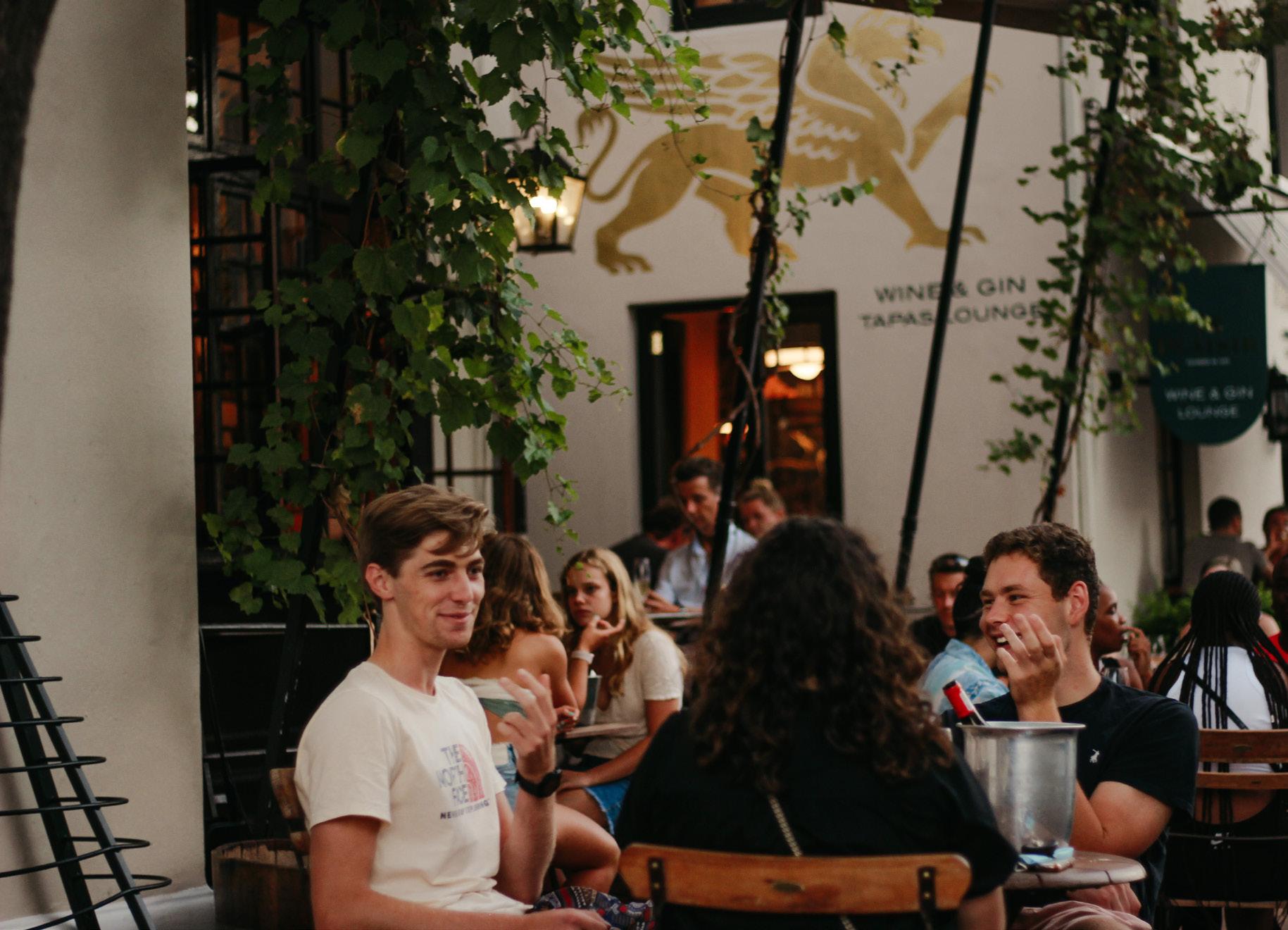
The wine bar’s selection includes, but is not limited to, multi-award-winning Namysto Shiraz Cabernet Sauvignon, Quoin Rock Black Series Méthode Cap Classique (MCC), and Knorhoek Chenin Blanc.
Qbar also offers Knorhoek’s pink and clear craft gins for the not-so-vino-lovers. These can be enjoyed as is or as part of one of their unique cocktails.
THE STELLENBOSCH WINE BAR Church Street
Owner of Guardian Peak and Rust and Vrede wines Jean Engelbrecht opened The Stellenbosch Wine Bar’s doors last year on 15 December.
“We only serve wine, water and coffee, so our main focus is our wine [which] is our owner’s portfolio wines. All of the wines that we serve here are specifically Jean Engelbrecht[’s] wines, and that’s also quite a niche,” said Christine Stapelberg, assistant manager at The Stellenbosch Wine Bar.
Stapelberg further explains how the bar is 100% European, an element that is apparent from the space’s design to the food presentation.
“There are quite a few [wine bars] that just opened up as well, but I think for us it’s just that we have excellent service. We’ve got great wines and great food here,” said Stapelberg.
THE WINE GLASS Ryneveld Street
With branches both in Hermanus and (since 1 February) Stellenbosch, The Wine Glass takes pride in offering a wide variety of local award-winning wines,
bubbly and beers.
The Wine Glass Stellenbosch is a third-party restaurant considered to be a “varietal wine farm representative of the Stellenbosch terroir as well as the Stellenbosch wine region,” said Greg Lorimer,
front-of-house manager of the restaurant.
“You can classify [our food] as Mediterranean. We’ve got oysters as well as steaks and everything with a Mediterranean undertone,” said Lorimer. Patrons can also
enjoy tapas, chef plates, main courses at lunch and dinner, as well as varietal tastings ranging from premium to entry-level options.
“Towards the beginning of March we’ll open for breakfast as well,” said Lorimer.
92 Maart 2022 DAG & NAG
GALLERY UNIVERSITY STELLENBOSCH The GUS along Dorp Street. Photo: Sibella Swanepoel
ADMIRATION A Peaceful outing admiring the art at SMAC. Photo: Chéyenne Britten
WINEBARS POPPING UP Students enjoying a glass of wine in the street. Photo: Carmi Wentzel
Kobus. spoeg en plak sy songs
TIAAN BOOYENS

Sommer só oor ’n somervakansie in die slaapkamer van sy kinderjare het Kobus Erasmus, oftewel Kobus. met ’n punt, sy nuwe Verlengde Speeltyd (VS) Stopstraat aanmekaar geslaan en vrygestel.
Dié eerstejaar-BA (Taal en Kultuur)-student se eksperimentele viersnit-projek praat Afrikaans op ’n nuwe manier.
Erasmus het grootgeword met name soos Lucas Maree, Zinkplaat, Klopjag en Karen Zoid wat oor sy ou iPod Shuffle sou speel. Hy het al lank ’n passie vir musiekmaak, maar het eers in graad 10, vyf jaar ná hy leer kitaar speel het, begin om oorspronklike musiek te maak.
“Toe koop ek ’n mikrofoon, en ’n dingetjie om my kitaar by my rekenaar te kan inplug. Dit het maar net alles saam evolve. Ek’s ook baie lief vir skryf. Musiek is net soos die ideale ding om alles van daai te incorporate,” sê Erasmus.
In die eerste snit “Lente” word
’n afwagting geskep en luisteraars mag dalk wonder hoe die res van die VS gaan klink. Dié afwagting is vanweë die VS se hiper-pop
neigings, ’n synth atmosfeer en somber ondertone wat dan deur die tweede song op die VS vervul word. Die openingswoorde van
“Weerlig!”, wat vanuit Koos Kombuis se onderhoud in Voëlvry: The Movie kom, verduidelik die doel van Erasmus se projek.
“Ek wil Afrikaanse musiek vorentoe propel. [Koos Kombuis] praat [aan die begin van ‘Weerlig!’] oor die Voëlvry-beweging, en hoe hulle net wou afwyk van die mainstream. Ek dink dis presies wat ek ook wil doen.”
Ná die voorlaaste snit, “Tussenspel”, tel die laaste snit die tempo op met sagte rock-invloede vir sy sorgelose swanesang.
Erasmus sê dat “Woorde Vir Die Void” hom nie noodwendig as persoon beskryf nie, maar dit kom voor asof hy wel uitroep na die groot wêreld daar buite met die selfvertroue van ’n jong kunstenaar.
“Ek was lus om daardie tipe
elektroniese klanke in Afrikaanse musiek uit te beeld,” sê Erasmus oor sy gunsteling internasionale musiekgroepe soos The 1975 en Lany. Vir hom is daar ’n tekort aan dié genre van musiek in Afrikaans.
“Dis die tipe musiek waarvan ek hou om te luister, en niemand anders het dit gemaak nie.”
Erasmus skryf, sing en mix al sy musiek self, en begin gewoonlik skep met ’n nuwe ritme en oneliners vanuit die notas op sy selfoon.
Alhoewel dit baie intimiderend is om homself op te neem, het hy al baie geleer sedert sy eerste projekte, wat ’n snit oor sy liefde vir lemoene insluit.
Die volgende stap vir Kobus. is live optredes en ’n opkomende album. Kyk uit, Stellenbosch! Hy mag dalk nie groot note uitroep nie, maar sy roerende songs oor die studentetoestand sal jou moontlik tot ’n stop bring. Nes ’n stopstraat.
Luister nou na Kobus. se nuwe VS beskikbaar op Spotify, Apple Music en YouTube.
Bohemia band nights are back!
THE infamous Bohemia band nights are making their comeback post COVID-19 lockdown.
Thursday-evening band nights at Bohemia may seem like a distant memory to the older Stellenbosch students, but fear not, Bohemia is ready to put the rock back in your roll with a fantastic March lineup. Bands set to play include Stellies


fan favourites like Uncle Spike and many more. For some bands in the lineup, it will be their first time on Bohemia’s black stage. Due to the COVID-19 lockdown in 2020 and the restrictions that followed, band nights could not continue. However, as society slowly steps into a more “normal” scene, manager Henry Doyle and his colleague, Pierre Rommelaere (who are both in charge of curating
the band nights) have decided to bring the initiative back. This will be the first series of band nights to occur since mid-March 2020, Doyle confirmed.
“We started February 2020 with our live bands season, and if I remember correctly, we stopped in the middle of March. We also had to cancel the lineups for the following two months,” said Doyle.
The lineup features crowd favourites that have graced the Bohemia stage many times before, as well as some fresh faces ready to introduce themselves to the Stellies student scene. Doyle confirmed this, saying, “We tried to give some of the old favourites (those we had to cancel in 2020) another go. Also, we added a few new bands who will be performing at Bohemia for the first time.” He also added that he is most excited about Indika Black’s performance on 17 March.
Doyle further stated that the venue is currently only allowed to host 120 people due to capacity regulations. He states that he would be eager to see lines forming outside the venue on band nights and that he cannot help but be reminded about the days where band nights had no capacity limitations. “It would obviously be ideal if we could pack Bohemia to the rafters like the good old days.”
The managers have even managed to ignite the excitement in long-time customer and more recent waiter Stehan Odendaal, who is currently a third-year BA (Humanities) student at
Stellenbosch University. “I haven’t been to a Bohemia band evening yet! It’s my first time too, so I’m very excited,” said Odendaal. He expressed that he is looking forward to seeing Uncle Spike’s performance on 24 March and added that he is excited to work and experience the rush on a band night.
Odendaal strongly advises that customers grab a seat early on the day, as the event is free and will run on a first-come-first-served basis. He says that Bohemia will have Klipdrift specials running all day too. “I’m confident that there are going to be queues on band nights, so as a waiter, I strongly advise all students to come early to claim [their] spot!”
It’s not only the staff who are eager for the lineups in March! Bohemia local Caterina Lourens, who is currently studying BAHons (Social Anthropology), attended her first band night in 2018, saying, “I can’t wait for those tequila-filled nights [of] rocking out with your closest friends and getting to do it all over again on the next band night!”
10 DAG & NAG
LINKS: UIT ‘N ANDER HOEK Kindertydse slaapkamerkunstenaar Kobus. in sy element. Foto: Kobus Erasmus
MIA VAN DER MERWE
CAPTIVATED CROWD The Man Motels playing a gig at Bohemia.
Photo: Pierre Rommelaere.
PLAY
ON The
Man Motels’s fans rocking along. Photo: Pierre Rommelaere
LIT MATIE
It has been two years since LitMatie has graced the printed pages of Die Matie with moving poetry by students. This section of the newspaper is dedicated to all Maties who want to capture their meaningful moments with a pen and paper—potentially a glass of wine too—and then share it with the rest of the campus. If you are passionate about poetry and would like to be published in the next edition of Die Matie, send your poems to swanepoelsibella@gmail.com.

skaduwee
MIKYAL HARRIS
dit volg jou jy kamma probeer om weg te haloep, weg te kruip of om te koes dit sal altyd daar wies ek het dit nog nooit verstaan nie: die klompie pille wat jy aanmekaar drink, maar nou verstaan ek te goed dit help ‘n man jy kan miskien nie van die ewige volgeling ontslae raak nie maar jy kan hom dood lewe jy ennie pille ek het my altyd opgekyk aan die skaduwee en die sterk vrou wat hom vooruit loep hy kon nog nooit by bly nie, maar net soe nou en dan het hy jou ingehaal en dan kon die pille nie help nie, want hy wil gehoor word en hy demand om gesien te word, want hy is jou se skaduwee iewers op ‘n kol moet iets gee, maar dit hou nie lank nie hy bly by jou, maar hy kom en gaan en wag dan tot dat jy weer alleen is en dan vriet hy jou weer van voor af op, stukkie-vir-stukkie jy kan try help soek, maar dit gatie baat nie want net jy kan dit sien glo my ek sal weet, want daai skaduwee wat soe by mammie spoek is nou my se skaduwee oek.
the meteor
AURELIA MOUTON
the meteor will crash through orbit and rain shooting stars and land somewhere in suburbia where no one knows what meteors are i am out of breath, out of luck
my face feels wrong for this scene and i don’t think i am adventurous enough don’t tell anyone though keep it between us two imposters at the afterparty for the cool kids

DAG & NAG 112 Maart 2022
THE MAN MOTELS AT AANDKLAS The Man Motels share the stage with The Tazers on their Outer Space Razers Tour on the 26th of February. Photo: Pierre Rommelaere
Caring about others: Our responsibility as students
There is such a thing as beingoverwhelmed by goodness.
The Rooiplein, amongstother places on campus, hasseen crowds of students return to a hustle and bustle that feels reminiscent of life before the pandemic. Except formasks, student life seems to be shaking off the reluctantlyadopted “new normal” inexchange for something a bitmore worn and comfortable.
Once again, there arequeues lining up for coffeein the Neelsie; Die Matie has regular access to tidbitsof overheard conversations from passers-by; and everynow and then, senior students have chance encounters with familiar faces—some of whom they haven’t seen since theirfirst year during Vensters.
For many students whohad become accustomed to
simply clicking a link to anhour-long session of screentime, heading to an in-personlecture is almost guaranteedto be an assault on the senses.
Two years into a differentmode of teaching andlearning, technical difficultiespersist, and most studentsstruggle with a loweredlecture hall stamina. Lecturers would run the risk of puttingstudents to sleep were it notfor the occasional absurdityand human connection of inperson classes. One English318 class had the honour of a wake-up call in the form of arandom student yelling “alleswat lekker is!” into a lecture hall of delightedly confusedstudents.
Another change is thatstudents are swapping onlineevents for a chance at social intimacy and heading to
town. Some days, Matieland’sfavourite local establishments, and a few new ones, fill upto the brim even before the beating summer sun hasset. Bohos’s band nights aremaking a comeback; studentsin maroon are flocking toDorp to catch the Mondaynight game happening atDanie Craven; and residence newcomers are proudlysporting their merchandiseon nights out. Since the endof the national curfew, this university town has seen a lotof students substituting sleepfor socialising or studying—sometimes at the same time.
It is no wonder that some Maties feel slightlyoverwhelmed. Even goodthings can be overwhelmingwhen they happen all atonce and feel all over the place. The student condition
GORRELKOP
Die kommentaar waarvoor almal bang is. Gorrel is nie verantwoordelik vir enige ongerief veroorsaak nie.
GE-VAX VIR VARSITY CUP
Maandagaand toe Gorrel ná ’n baie lang jaar uiteindelik weer na Coetzenburg kon terugkeer om te kyk hoe die uitgekose vyftiental van Matieland op die veld uitdraf, het Gorrel amper uitgebars van die lag. Daar buite die hekke op die bult in ons Februarie-son het ’n groepie getroue super-
ondersteuners gesit. Dit is toe nou die willie-vaksies, die antivaxers wat nie die stadion mag binnegaan nie, maar nog steeds daar is vir ’n lekker tyd met lekker mense.
Gorrel sal dan nou nie verstaan hoekom ‘n mens jou lewe so moeilik sal maak net oor jy nie ’n wapenrusting vir jou immuunstelsel wil aantrek nie.
Dit is tog nou baie lekkerder om in die stadion te sit met ’n louwarm flat Coke as iewers op ’n bult.
OP HETE KOLE
Dit is nou al lankal nie meer snaaks nie. Hierdie allerverskriklikste hitte. Gorrel moet nou in Gorrel se plakkies slaap omdat die goed aan sy voete vasgesmelt het. Dit nou ná ’n vinnige drafstappie oor die Rooiplein op pad IT-hub toe om die twee-en-sewentigste Eduroam-klag in te dien oor ’n foutiewe internetverbinding (meer hieroor later). Boonop voel dit vir Gorrel asof Gorrel se waaier eerder bydra tot die hittegolwe as wat dit enigsins verligting bring. Gorrel wens egter net dat sy verhouding met Gorrelina so warm was soos hierdie uiterste
is that of constantly beingbusy until you’re not, andthen falling behind beforeyou can find your feet again.
Navigating an environmentthat simultaneously causes youa lot of excitement and stress requires a bit of slowing downand taking a breath.
It’s easy to lose yourself inthe hype of Stellenbosch untilyou realise that life happensoutside of this microcosm.
Like many others, after havingbeen too scared and anxious to fall into an unending spiralof doomscrolling, I have beencowardly avoiding updates oncurrent invasion of Ukraine occuring in Europe; however,you can only avoid your moralduty to care for so long.
Our privilege as universitystudents to enjoy our beautifulsurroundings and all thatstudent life has to offer comes at
Stellenbosch-somersweer.
VERMIS: EDUROAM
Gorrel voel asof Gorrel op The Amazing Race is, ’n avonturier opsoek na ’n verlore skat.
Die skat: ’n stabiele Eduroamverbinding.
Gorrel dink nie eens dat Sherlock Holmes of Bennie Griesel hierdie raaisel sou kon oplos nie.
Net soos jy dink jy het hom, die verligting van drie wonderlike Wi-Fi strepies, verdwyn hulle soos mis voor die son en is Gorrel weer alleen in die skadu’s van ’n muwwerige biblioteekhoekie met slegs ’n verdwaalde kakkerlak as geselskap.
Daarom dink Gorrel die Universiteit kan maar koppe en ‘n paar tegnici bymekaar sit om
the cost of caring about others.
We are in a position whereour voices sometimes have to quieten down and makeroom for those who reallyneed to be heard. As I’m writing this, students acrosscampus communities anddifferent leadership structuresare putting their personalmatters aside to gather on theRooiplein.
This particular crowd isdeafiningly silent as they holda vigil in support of peoplewho are being stripped of theirfundamental human rights.Some are Ukrainian. Some have family in Kyiv. All of themunderstand that their gatheringmeans something in the biggerscope of things.
Being a student meansbeing overwhelmed, but thenstill deciding to care aboutwhat really matters.
hierdie ongerief op te los.
FYN GESNY
Gorrel se bene is al stompies gehardloop. Hoekom vra jy dalk? Wel, Gorrel moet binne tien kort minute (soms vyf) van die gemak van ’n koshuiskamer hardloop na die boonste vloer van een of ander universiteitsgebou.
Dit alles net om op die nippertjie betyds te wees vir die volgende verpligte lesing wat sal bepaal of Gorrel uiteindelik ná etlike lang jare graad sal vang. Om die kersie op die koek te sit, is daar nog party dosente wat dink dit is oulik om hulle lesings ó ór die aangeduide lesingstyd te laat gaan.
COMPLAINTS PROCEDURE AND REPORTING ERRORS
Die Matie is onderhewig aan ’n gedragskode wat by die SR-lid vir Media beskikbaar is.
Alle klagtes word deur ’n regsdosent ondersoek, waarna
Die Matie voor die Mediaraad kan verskyn. Klagtes moet volgens die uiteengesette prosedure binne veertien dae ná publikasie aanhangig gemaak word.
Die Matie subscribes to the South African Press Code that prescribes news that is truthful, accurate, fair and balanced.


If we don’t live up to the code,
please contact the Ombudsman.
You may also lodge an internal complaint or report factual

the
Also following the procedure
above.
Die Matie is accountable to
readers
necessary.
will correct
any complaints
TEKSREDIGERING Rentia Meyer Nina Krüger Slade van Rooyen Siwaphiwe Bam Tehillah Truter DRUKWERK Novus Print MEDEWERKERS E-POSADRES diematie75@gmail.com WEBADRES www.diematie.com FACEBOOK www.facebook.com/diematie POSADRES Langenhoven Studentesentrum Privaatsak X1 Universiteit Stellenbosch Matieland 7602 OPLAAG 5 000 VOLGENDE UITGAWE 18/03/2022 SPERDATUM 16/03/2022 ADVERTENSIES Emma Cochrane, diematieads@gmail.com ARGIEF Vorige Die Matie-uitgawes is in die biblioteek / op hul webtuiste beskikbaar. HOOFREDAKTEUR Tiaan Booyens INHOUDSREDAKTEUR Maryna Adshade UITLEGREDAKTEUR Mareli Swart AFRIKAANSE SUBREDAKTEUR Mieke de Wet ENGLISH SUB-EDITOR Jessica Garschagen ONLINE EDITOR Lesedi Mnisi NUUS Karla van der Merwe STUDENTELEWE Karla de Bod DAG & NAG Sibella Swanepeol SPORT Jan-Hendrik Pretorius BEDRYFSREDAKTEUR Tadiwanashe Mutibura ADVERTENSIES Emma Cochrane FOTOREDAKTEUR Vicky Hendrikz TESOURIER Marco Marais HOOFVERSLAGGEWER Aurelia Mouton HOOFREDAKSIE KONTAK ONS / CONTACT US
errors by contacting
SRc member for Media.
explained
its
and
errors where
Please send
to the paper’s ombudsman/ public editor, George Claassen at gnclaassen@sun.ac.za or 083 543 2471.
12 REDAKSIONEEL
Students in solidarity with Ukraine


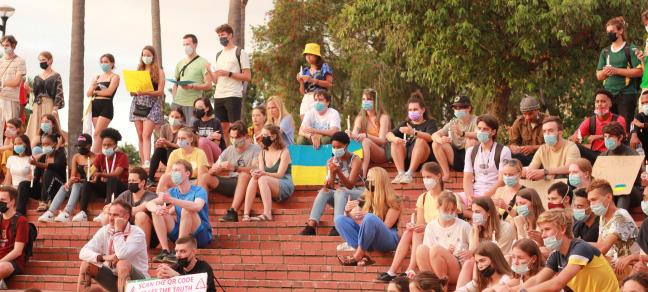


PHOTO PAGE 132 Maart 2022
SOLIDARITY ON THE ROOIPLEIN’S STEPS Stellenbosch University (SU) gathered on the steps of the Rooiplein to show solidarity with those affected by the Russian invasion of Ukraine. The March For Ukraine was organised by the United Nations Association of South Africa (UNASA) Stellenbosch Chapter in collaboration with UNASA University of Cape Town Chapter, the Palestinian Solidarity Forum, Amnesty Stellenbosch and the Societies Council SU. Photo: Carmi Wentzel
NO TO WAR Members of the March for Ukraine walking down Victoria Street. Photo: Carmi Wentzel
POSTERS PROTESTING FOR PEACE The Rooiplein was filled with bright yellow and blue in solidarity with Ukraine. Photo: Carmi Wentzel
HUMAN RIGHTS ACTIVISM The UNASA Human Rights executive member speaking about the human rights violations caused by the invasion in Ukraine. Photo: Jamie Venter
A CLEAR MESSAGE Members of the March for Ukraine call for peace.
Photo: Ben Wiese
Rasieleiers reg om die gees te bring!
ANÉ HAVENGA
Daar is net iets magies aan rasieleiers (cheerleaders), veral met hulle danspassies en gees. Amerikaanse flieks het ons natuurlik blootgestel aan die wonderlike kultuur daarvan. Wie kan nou Bring it on of High School Musical se rasieleiers, wat hand aan hand geloop het met Troy se basketbalspan, vergeet? Min mense weet dit dalk, maar dit is nie net op televisie waar die rasieleiers ons bekoor nie. Maties se eie rasieleierspan bring gees van hulle eie waar ook al hulle hulself bevind.

Vicki Steenkamp, ’n derde jaar-BA (Geesteswetenskappe)student, is hierdie jaar Maties se rasieleierkaptein en maak dit duidelik: “Dis vir my ’n bitter
groot voorreg.”
Maties se eie rasieleierspan maak gebruik van die Ameri kaanse rasieleidingstyl. Dit veroorsaak dat elke optrede en oefening vol pret is en sy sê: “Ons maak gebruik van talle lifts, splits en flips.”
Met die Varsitybeker rugbytoernooi uiteindelik terug voor lewendige toeskouers, sien Steenkamp vreeslik uit om weer by hierdie wedstryde op te tree. Steenkamp vertel opgewonde: “Ons sien uit om weer stunts voor lewendige gehore te doen en om al die rugbyspelers aan te moedig. Dit is ons werk om die gees hoog te hou!”
Op die oomblik is hulle fokus op die Varsitybeker, maar hulle tree ook by sosiale geleenthede vir ander op en doen advertensies
vir verskillende handelsmerke. Steenkamp maak seker dat elke geleentheid van top gehalte is en sy kommunikeer self met al die handelsmerke. Die groot kompetisie van die jaar is The South African Majorette and Cheerleading Association (SAMCA) se nasionale kampioenskappe.
Steenkamp sien uit om met haar span vir die jaar te werk. Veral die twee bene daarvan, die gemengdespan en haar vrouespan. Die gemengde span bevat 44 lede met 40 op die mat en vier as reserwes. Die vrouespan bestaan uit 28 lede met 25 op die mat en drie reserwes. Steenkamp rig albei spanne self af en maak seker dat die standaard hoog bly deur oudisies te hou.
Dynamic Maties hockey duo to represent South Africa in Junior World Cup
aquainted with one another, both on and off the field.
STELLENBOSCH University (SU) and South Africa (SA) will be represented in the upcoming Junior World Cup by star Maties hockey players Laylaa Davids and Caylin Maree.

Davids and Maree were recently selected for the u. 21 Africa Women Cup of Nations (AFCON) team, which is set to participate in the International Hockey Federation (FIH) Junior World Cup hosted in Potchefstroom from 1 to 12 April. The team is set to play against the United Kingdom, Ukraine and Ireland.
Davids, a third year BCom (Marketing Management) student, and Maree, a second year BA (Humanities) student, are well
They have been playing against each other since 2017 and were brought together as a duo when they both played in the SA u. 21 team in the Dutch Series tournament, which took place in 2020. In the time that they have known each other, they have become good friends and incredibly supportive of each other.
“What I love most about playing with one of my friends is that we don’t only have a relationship on the field, but we have a great relationship off the field as well, and we can take that into our game,” said Maree.
Davids said that she has built many good friendships over the years through playing hockey,
and it has taught her valuable life skills such as teamwork and communication.
They have both shown great versatility as players. Davids can play either midfielder or link on the astro turf, whilst Maree can play striker, midfielder and, “when push comes to shove”, she can play defence too.
Their achievements have given both players the opportunity to reflect on what hockey means to them and how it has shaped their lives. “I like that I get to express myself freely on the field. It’s like a breakaway from reality for me and it maintains the balance in my life,” said Davids.
Upon hearing that she was selected to participate in the tournament, Davids experienced
mixed emotions. Her initial response was that of shock and then overwhelming gratitude. “I was humbled that I got the opportunity to participate in this tournament. [Being selected] motivated me to work extra hard and put in even more effort,” said Davids.
Similar sentiments ring true for Maree, who said that she burst into tears when she found out that she had been selected for the team.
She has expressed how grateful she is for the opportunity to represent her country at this high a level. “I love that we have the privilege of being the host country.
I’m keen to see how we will perform as a team, and I think that we will make our country proud,” said Maree.
Despite their immense
achievements and enthusiasm, the duo’s road to the Junior World Cup is not without obstacles. They are currently unable to finance their trip to Windhoek to participate in the tournament in which teams from all over the continent will be competing.
In order to participate, Davids and Maree need to raise R35 500 to cover the estimated costs of participating in the tournament. They hope to have the opportunity to represent SA, as well as to be exposed to different styles of hockey and to build friendships with their teammates.
If anyone would like to assist Caylin and Laylaa financially, more information is available on their Instagram accounts (@caylin. maree and @laylaadavids).
14 SPORT
LENTE IN MATIELAND Maties se rasieleiers is reg vir Varsitybeker!
Foto: Verskaf
FLAVIA DAVIDS
PROTEAS BLOOMING Laylaa Davids (centre) and Caylin Maree (right) in action on the astro. Photo: Supplied.
Campus is healing: The ‘Tamaties’ have returned




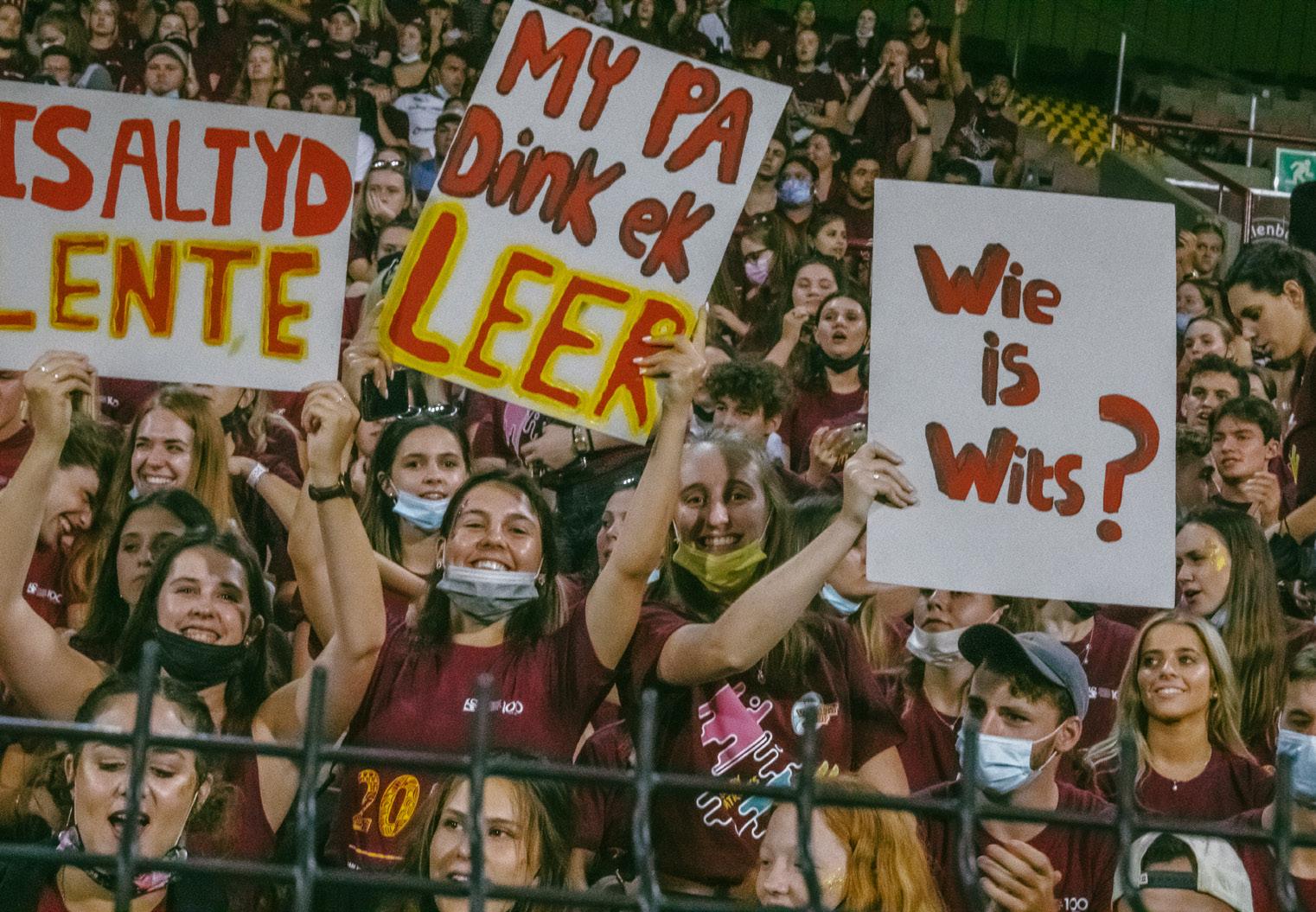
Supporters have populated
the Danie Craven Stadium
for the first time in two years. Die Matie gathered some of the best
moments
of the momentous evening SPORT 152 Maart 2022
CELEBRATION The stands go wild after Maties score. Photo: Aurelia MoutonMATIE MADNESS Interesting posters at the match. Photo: Aurela Mouton
MAROON MACHINE FNB Maties locked in unity. Photo: Aurelia Mouton
BITTERSWEET MOMENT Vernon Matongo was awarded the Player that Rocks. Matongo received the award on his father’s birthday. He passed away a few years ago. Photo: Aurelia Mouton
STUDENTE SONDER SENTE Danie Craven Stadium main stand filled with a wave of maroon. Stellen bosch University students could enjoy the Varsity Cup for the first time in what feels like an eternity. Photo: Aurelia Mouton
SPORT
Maties boys bounce back in Wits battle
For the first time since March 2020, the Maroon Machine kicked off at home in the historic Danie Craven stadium. The Maties team took on FNB Wits in their third game of this year’s Varsity Cup on Monday night. Quickly gaining momentum, Maties’ Mike Mavovana scored the first try of the match only a few minutes in.

Wits retaliated with a try moments later, but that was the last time they could match Maties on the scoreboard. By half-time, Maties had an 18 – 5 advantage.
experience was vastly different from previous years, supporters enjoyed being able to show up for their team. Tickets were limited, with just grandstand seating available. A few cameramen populated the surrounding pavilions where hundreds of fans and refreshment tents used to be.
Carmi Wentzel, a second-year BA (Law) student, said, “I knew about Varsity Cup, everyone hypes it up. I have to admit that it was a lot of fun even though I don’t have anything to compare it to.
“Generally, it was a very positive experience for me and if I can get a hold of tickets again I will
definitely do it again”.
This impressive lead followed last week’s game against the University of the Free State’s FNB Shimlas in which Maties suffered a surprising 50 – 28 loss. FormerSpringbok-turned-Maties-coach for this year’s Varsity Cup, Norman Jordaan, commented, “I think the boys showed some effort and intensity [tonight]. That’s exactly what we lacked against Shimlas.”
Last week’s defeat only seemed to fuel the team, and with a crowd of eager supporters cheering them on, Maties closed the game with a very convincing victory, beating their opponents with 37 – 10.
attributes this win to the team’s focus on discipline and technique.
“The past two weeks were difficult, but we’re very glad that we could turn things around tonight,” he said. “I think we realised we’ve been playing against ourselves for the past two weeks.
“I think we made fewer mistakes tonight, so it already went a lot better.” He continued by saying, “We will enjoy tonight, but we know that the hard work begins again tomorrow.”
The FNB Player that Rocks award of the night went to Vernon Matongo. Jordaan praised Matongo
Avo has something for everyone!
Avo by Nedbank has everything you need to do life differently. Enjoy convenient, secure online shopping and services, all in one super app!

for his intensity during the match. “He settled our scrums quite well. He’s a youngster. I think he’s only 20 years old, so there’s still a big future laying ahead for him.”
After receiving his award, Matongo commented, “Today is such a special day to me. My father passed away a few years ago and today is his birthday, so I had to just dig deep and do it for him. Whenever I felt tired, I knew why I was doing this. That’s the reason I started playing this game.”
WOENSDAG 2 MAART | GRATIS
Download Avo today!
Captain Adriaan van der Bank
The FNB Maties will take on the University of Johannesburg’s team at the Danie Craven Stadium on 7 March.
MARDENE VAN SCHALKWYK
ROCKING AND ROLLING Vernon Matongo, Monday’s Player that Rocks, powering through Wits’s defences.
Photo: Francois Lombard
