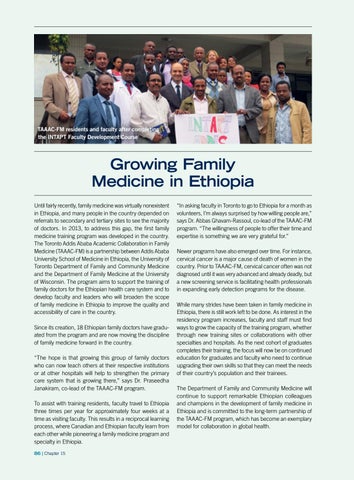
TAAAC-FM residents and faculty after completing the INTAPT Faculty Development Course
Growing Family Medicine in Ethiopia Until fairly recently, family medicine was virtually nonexistent in Ethiopia, and many people in the country depended on referrals to secondary and tertiary sites to see the majority of doctors. In 2013, to address this gap, the first family medicine training program was developed in the country. The Toronto Addis Ababa Academic Collaboration in Family Medicine (TAAAC-FM) is a partnership between Addis Ababa University School of Medicine in Ethiopia, the University of Toronto Department of Family and Community Medicine and the Department of Family Medicine at the University of Wisconsin. The program aims to support the training of family doctors for the Ethiopian health care system and to develop faculty and leaders who will broaden the scope of family medicine in Ethiopia to improve the quality and accessibility of care in the country. Since its creation, 18 Ethiopian family doctors have graduated from the program and are now moving the discipline of family medicine forward in the country. “The hope is that growing this group of family doctors who can now teach others at their respective institutions or at other hospitals will help to strengthen the primary care system that is growing there,” says Dr. Praseedha Janakiram, co-lead of the TAAAC-FM program. To assist with training residents, faculty travel to Ethiopia three times per year for approximately four weeks at a time as visiting faculty. This results in a reciprocal learning process, where Canadian and Ethiopian faculty learn from each other while pioneering a family medicine program and specialty in Ethiopia. 86 | Chapter 15
“In asking faculty in Toronto to go to Ethiopia for a month as volunteers, I’m always surprised by how willing people are,” says Dr. Abbas Ghavam-Rassoul, co-lead of the TAAAC-FM program. “The willingness of people to offer their time and expertise is something we are very grateful for.” Newer programs have also emerged over time. For instance, cervical cancer is a major cause of death of women in the country. Prior to TAAAC-FM, cervical cancer often was not diagnosed until it was very advanced and already deadly, but a new screening service is facilitating health professionals in expanding early detection programs for the disease. While many strides have been taken in family medicine in Ethiopia, there is still work left to be done. As interest in the residency program increases, faculty and staff must find ways to grow the capacity of the training program, whether through new training sites or collaborations with other specialties and hospitals. As the next cohort of graduates completes their training, the focus will now be on continued education for graduates and faculty who need to continue upgrading their own skills so that they can meet the needs of their country’s population and their trainees. The Department of Family and Community Medicine will continue to support remarkable Ethiopian colleagues and champions in the development of family medicine in Ethiopia and is committed to the long-term partnership of the TAAAC-FM program, which has become an exemplary model for collaboration in global health.