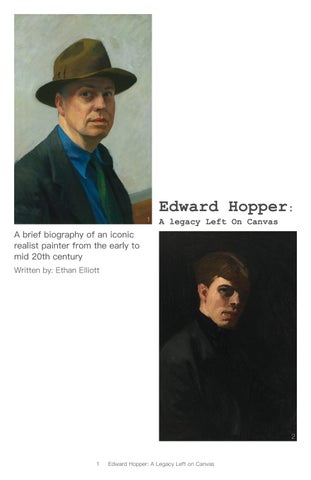
A brief biography of an iconic realist painter from the early to mid 20th century
Written by: Ethan Elliott


Edward Hopper was an American painter and printmaker who specialized in realism paintings. He was born to Elizabeth Griffiths Smith and Garret Henry Hopper on July 22nd, 1882 in Nyack, New York, a town on the Hudson River north of New York City. Hopper’s interest in producing art appeared at a young age, and his parents encouraged his learning by supplying him with art supplies and instruction books. He began signing illustrations at the early age of 10; these works were mostly geometric shapes or everyday items, like boxes, vases,
and cups. By his teens, Hopper was becoming experiences in other mediums, such as pen and ink, watercolor, and oil paints. He would produce his first signed oil paint by the age of 13 years old.

After graduating from Nyack High School, Hopper would attend the Parsons School of Design in New York. He studied at Parsons for six years, where he was instructed in multiple art mediums, though most notably oil painting. In 1905, Hopper landed a part-time job at an advertising firm, at which he created cover designs for magazines. He hated his job but needed the money, and had to work there until the mid 1920’s. During this job he would take three trips to Europe, specifically Paris, France, to study the current art scene. During these trips, he grew an affinity toward Rembrandt Harmenszoon van Rijn, a Dutch painter and printmaker. Influenced by Rembrandt’s paintings, which often included people and landscapes, Hopper began to compose paintings of urban scenes, using a dark palette
early on, but shifting to a brighter palette later in his career. The choice of bright colors allowed Hopper to use contrast to create vast differences between light and shadow, making his paintings have a distinct visual ‘pop’. The same attention to light and dark values in his paintings can be seen early in his work, all the way back to the vases and boxes he illustrated in his childhood and early teenage years.


" I believe that the great painters with their intellect as master have attempted to force this unwilling medium of paint and canvas into a record of their emotions."
- Edward Hopper, 1959


Hopper’s success was far from linear, turning to freelance painting, in addition to his job as an illustrator. During these years, he rented a studio in New York, but still found himself feeling stuck in his career. He sold his first painting, Sailing (1911), in 1913, where he earned $250. In 1915, Hopper would turn to etchings after growing bored with his oil paintings that had proved unsuccessful up to that point. By 1923, Hopper had produced 70 pieces, most of which were etchings. In the early
1920’s, his etching work had gained some public recognition, and the aspiring artist began finding his style. During this period, he painted the first two of his “window paintings,” a composition style he would continue practice throughout his career.
In 1923, Hopper became friends Josephine Nivision, a fellow art student whom he would marry a year later. She encouraged him to come out of his shell and helped him produce
numerous watercolor scenes of Gloucester, MA. Six of his watercolor paintings were put on display at the Brooklyn Museum, who bought his painting, The Mansard Roof (1923) for $100. His watercolor was well received by critics. A year later, he would sell all his watercolor pieces and would finally be able to move on from illustration.
Hopper would become known for his oil paintings, despite having a large portfolio of etching works and watercolor pieces. He would utilize his distinctive realism style, depicting slow, quiet moments, rarely showing action. Many of his notable paintings involve few subjects in a scene, usually showcasing a balance of urban architecture and serene landscapes. When compared to other realism painters at the time, his work appeared simplified, focusing

on form, construction, and color rather than extensive attention to detail. He would break down scenes into basic geometric shapes, using highlights, cast shadows, and vivid color contrast to create beautiful scenes.
Edward Hopper’s simple and serene paintings would continue to gain popularity toward the end of his life, and beyond. Now, Hopper’s art is showcased all around the United States, in significant museums, including the Museum of Modern Art and Whitney Museum of American Art, New York, NY., the Museum of Fine Arts in Boston, MA., and the Yale Art Gallery in New Haven, CT. Generations of art critics and amateur art enthusiasts alike cherish Hopper’s calming scenes that hark back to a slower time in history, praising his ability to capture the day-to-day in an elegant and timeless fashion.