1
2
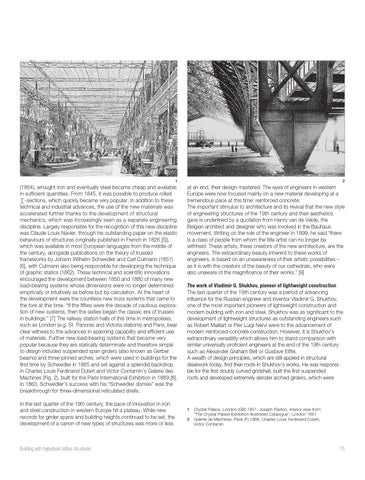
(1864), wrought iron and eventually steel became cheap and available in sufficient quantities. From 1845, it was possible to produce rolled ⌶-sections, which quickly became very popular. In addition to these technical and industrial advances, the use of the new materials was accelerated further thanks to the development of structural mechanics, which was increasingly seen as a separate engineering discipline. Largely responsible for the recognition of this new discipline was Claude Louis Navier, through his outstanding paper on the elastic behaviours of structures (originally published in French in 1826 [5]), which was available in most European languages from the middle of the century, alongside publications on the theory of trussed frameworks by Johann Wilhelm Schwedler and Carl Culmann (1851) [6], with Culmann also being responsible for developing the technique of graphic statics (1862). These technical and scientific innovations encouraged the development between 1850 and 1880 of many new load-bearing systems whose dimensions were no longer determined empirically or intuitively as before but by calculation. At the heart of the development were the countless new truss systems that came to the fore at this time. “If the fifties were the decade of cautious exploration of new systems, then the sixties began the classic era of trusses in buildings.” [7] The railway station halls of this time in metropolises, such as London (e.g. St. Pancras and Victoria stations) and Paris, bear clear witness to the advances in spanning capability and efficient use of materials. Further new load-bearing systems that became very popular because they are statically determinate and therefore simple to design included suspended span girders (also known as Gerber beams) and three-pinned arches, which were used in buildings for the first time by Schwedler in 1865 and set against a splendid backdrop in Charles Louis Ferdinand Dutert and Victor Contamin’s Galerie des Machines (Fig. 2), built for the Paris International Exhibition in 1889 [8]. In 1863, Schwedler’s success with his “Schwedler domes” was the breakthrough for three-dimensional reticulated shells.
at an end, their design mastered. The eyes of engineers in western Europe were now focused mainly on a new material developing at a tremendous pace at this time: reinforced concrete. The important stimulus to architecture and its revival that the new style of engineering structures of the 19th century and their aesthetics gave is underlined by a quotation from Henry van de Velde, the Belgian architect and designer who was involved in the Bauhaus movement. Writing on the role of the engineer in 1899, he said “there is a class of people from whom the title artist can no longer be withheld. These artists, these creators of the new architecture, are the engineers. The extraordinary beauty inherent to these works of engineers, is based on an unawareness of their artistic possibilities – as it is with the creators of the beauty of our cathedrals, who were also unaware of the magnificence of their works.” [9]
In the last quarter of the 19th century, the pace of innovation in iron and steel construction in western Europe hit a plateau. While new records for girder spans and building heights continued to be set, the development of a canon of new types of structures was more or less
Building with hyperbolic lattice structures
The work of Vladimir G. Shukhov, pioneer of lightweight construction The last quarter of the 19th century was a period of advancing influence for the Russian engineer and inventor Vladimir G. Shukhov, one of the most important pioneers of lightweight construction and modern building with iron and steel. Shukhov was as significant to the development of lightweight structures as outstanding engineers such as Robert Maillart or Pier Luigi Nervi were to the advancement of modern reinforced-concrete construction. However, it is Shukhov’s extraordinary versatility which allows him to stand comparison with similar universally proficient engineers at the end of the 19th century such as Alexander Graham Bell or Gustave Eiffel. A wealth of design principles, which are still applied in structural steelwork today, find their roots in Shukhov’s works. He was responsible for the first doubly curved gridshell, built the first suspended roofs and developed extremely slender arched girders, which were
1 2
rystal Palace, London (GB) 1851, Joseph Paxton, interior view from C “The Crystal Palace Exhibition Illustrated Catalogue”, London 1851 Galerie de Machines, Paris (F) 1889, Charles Louis Ferdinand Dutert, Victor Contamin
15