Roberto Gonzalo Rainer Vallentin Planning and design of energy-efficient buildings
Passive House Design ∂ Green Books
Imprint
Authors: Roberto Gonzalo, Dr.-Ing. Architekt Rainer Vallentin, Dr.-Ing. Architekt Co-author (building services): Wolfgang Nowak, Prof. Dr.-Ing. Project management and editorial work: Jakob Schoof, Dipl.-Ing. Editorial work and layout: Jana Rackwitz, Dipl.-Ing. Jakob Schoof, Dipl.-Ing. Illustrations: Ralph Donhauser, Dipl.-Ing. (FH) Cover design: Cornelia Hellstern, Dipl.-Ing. (FH) Translation: Sharon Heidenreich, Dipl.-Ing. (FH) English proofreading: J. Roderick O’Donovan, B. Arch.
This work is subject to copyright. All rights are reserved, whether the whole or part of the material is concerned, specifically the rights of translation, reprinting, recitation, re-use of illustrations and tables, broadcasting, reproduction on microfilms or in other ways, and storage in data banks. Duplication of this publication is only permitted under the provisions of the German Copyright Law in its current version. A copyright fee must always be paid. Violations are liable for prosecution under the German Copyright Law.
DTP & layout: Roswitha Siegler Reproduction: ludwig:media, Zell am See Print: GCC Grafisches Centrum Cuno, Calbe 1st edition 2014 Institut für internationale Architektur-Dokumentation GmbH & Co. KG Hackerbrücke 6, D-80335 München Telephone: +49/89/38 16 20-0 Telefax: +49/89/39 86 70 www.detail.de © 2014 Institut für internationale Architektur-Dokumentation GmbH & Co. KG, Munich A specialist book from Redaktion DETAIL ISBN: 978-3-95553-220-8
The FSC-certified paper used for this book is manufactured from fibres proved to originate from environmentally and socially compatible sources.
Contents
Introduction Principles Concept approach: energy efficiency Definition of the Passive House standard Passive House components How does a Passive House work at different times of the year? Thermal comfort and wellbeing Scope and field of application Economy Energy-related sustainability and climate protection
6 8 8 8 8 10 12 14 16
Urban design Impact of energy-related aspects on the urban design Design principles of compact and solar building Model urban design guidelines Reference projects Completed Passive House developments
68 68 69 72 73 74
18
Non-residential building 76 Passive House principles in non-residential buildings 76 Energy balance 77 Features of different building typologies 80
Passive House planning Main principles and comparison with other standards Passive house criteria Passive House Planning Package (PHPP) Certified building components Certification of Passive House buildings Certified Passive House designers EnerPHit standard Minergie-P standard 2000-Watt Society – SIA D 216 Net-zero energy standard
22
Reference buildings – non-residential
22 22 24 28 28 28 28 30 31 31
Passive House refurbishment 100 Conditions for an energy efficiency refurbishment 100 Refurbishment standards and strategies 102 Energy balance and individual measures 103 Outlook 105
Design and planning principles General design issues Passive House design principles Principle of thermal envelope and form factor Principle of homogeneity Solar building design in Passive Houses The importance of window placement Basic principles of Passive House building services Design-based energy balance Impact of regional and urban climate Coordination of individual aspects Residential projects
32 32 34 34 36 38 40 42 44 46 46 46
Reference buildings – residential
48
Reference buildings – Passive House refurbishments
84
106
Building envelope components 126 Significance of the building envelope 126 Opaque envelope constructions 126 Transparent components 129 Other construction elements and special components 131 Building methods and construction systems 132
Building services 134 Ventilation 134 Space heating 139 Heat supply concepts 140 Energy-efficient cooling systems 143 Outlook
144
Appendix
146
Introduction
Designing energy efficiency This book is all about the design of Passive House buildings. Unlike many other books published, the design concept is considered not only from the viewpoint of construction technology, energy efficiency or building physics, but deliberately takes a holistic approach from the viewpoint of an architect and urban planner. On the other hand, the book is not intended to be a complete and academic design tool for energy-efficient building. Instead it is designed to illustrate how theoretical and practical experience with Passive House buildings can help contribute to the clarification of as yet unresolved issues. In this context, it is particularly interesting to determine the extent as to which design principles of solar and energy-efficient building are expedient or, as individual features, even mandatory to meet Passive House standard. Naturally, these considerations question the principles and even provoke the assessment of improvement strategies in the design process. One aspect, in particular, has become apparent in the short period of approximately 20 years in which the Passive House standard has been around: the design and planning strategies have always been closely linked to the energy-efficient technologies available at the time of construction. The further development of these technologies has invariably affected the corresponding design approach. And yet, a large variety of design strategies can lead to successful outcomes so long as the overall energy-related target is kept in mind, which is to design urban quarters, residential housing estates and buildings that are sustainable from an energy point of view – also in terms of the long-term, very ambitious climate protection goals. 6
Target groups There is an increasing interest in Passive Houses, also among architects. However, this is not due to clever marketing, but simply because it is one of the most scientifically sophisticated and practical energy efficiency standards for buildings currently available. This book is therefore addressed to all architects, urban and specialist planners who want to find out more about the Passive House concept or who are just about to design their first Passive House dwelling or Passive House housing estate. The contents will also provide new insight for those architects and planners already familiar with the Passive House standard. Among other things, it includes the future assessment of Passive House buildings with regard to their energy sustainability, and explains the impact this has on design. Clients interested in the topic will find the many reference projects and insights into the design work of architects and specialist planners very worthwhile reading. Passive House concept and design The Passive House concept is based on very clear and well-established energyrelated requirements and the verification thereof using the specially developed assessment tool: the Passive House Planning Package (PHPP). The concept is designed to give architects a high degree of flexibility as to how target values can be reached, since precise rules are deliberately avoided. It is fascinating to see how designers, step by step, have taken advantage of this freedom and gradually extended the scope of application. And, in our opinion, it is precisely this exploration of possibilities that makes the architects’ contribution towards the further development of the Passive House standard so substantive.
Strict criteria One question that often arises in the context of Passive Houses is whether the limit imposed on the space heat demand – it should be no greater than 15 kWh / m2a – must really be quite so strict. There are several ways to answer this question: • The target values of the Passive House standard and the constructional and technical approaches have proven successful in practice. Together they provide a well-balanced mix of high comfort and performance in terms of building physics, which is reflected in economic and functional efficiency. • The space heat demand is the most important value in defining the energy performance of a building. It follows that it also evaluates the architectural design in terms of the overall energy efficiency achieved. • The principal design features and properties of Passive House buildings are based on the extremely low space heat demand and the very small heat load. Among these are excellent thermal comfort in winter, the elimination of draughts and very good indoor air quality, the absence of otherwise required radiators beneath windows, as well as the simple arrangement of building services in a core zone. • User behaviour also varies quite considerably in Passive House homes. Different residents require different room temperatures, ranging from 18 to 24°C; some like to open windows in winter to air the interior. The space heat demand measured in identical dwelling units can therefore vary between 3 and more than 40 kWh/m²a. Thus, the building services concept of Passive House buildings should be designed in such a way that even very different user
Energy-efficient building design
demands can be fulfilled in terms of heating performance and perfect comfort. If one were to increase the space heat demand to, for example, 20 kWh / m²a, the very basic heating system, commonly used in Passive House buildings, would no longer suffice to meet the demands. Open approach versus “laissez faire” This book takes a very open approach to the design of energy-efficient buildings. The energy balance, using certified calculation programs and simulations, has been identified as the only really reliable tool. Those who verify their design using this tool but, at the same time, for good reasons, extend, replace or dispense with the undoubtedly very effective planning principles are very welcome to do so. However, this procedure requires a great deal of discipline, because each creative exceedance demands a sound knowledge of principles and their implications. This approach is therefore the exact opposite of a “laissez faire” attitude. Simply because of its low reserve capacity, the Passive House is less tolerant than buildings with lavishly dimensioned heating and cooling systems. Book contents The structure of this book is based on the planning process of a Passive
House. It starts with an explanation of fundamental aspects including the definition of standards, project design, building physics and building services. The topical focus is on architecturerelated design issues. This is followed by insights into the application of Passive House principles in urban planning, since this is regarded as the basis for the meaningful development of energyefficient buildings. A separate chapter focuses on non-residential buildings completed according to Passive House standard. In this field especially, there is an increasing variety of typologies, ranging from schools, to museums and indoor swimming pools. The weighting of factors in the energy balance varies according to type and use. Nevertheless, in the case of these buildings, too, the design and construction have a significant impact on the overall efficiency. In recent times, energy efficiency upgrades have become an important field of application for Passive House components. However, the difficult circumstances often encountered in these schemes mean that not all elements can be improved sufficiently to meet the Passive House standard of a new build. Further limitations are frequently added, such as the sensitivity of a scheme (building conservation), issues concerning space and building approval, as
well as demands to perform refurbishments in stages rather than in a single step. With the introduction of the EnerPHit standard, the Passive House Institute has developed a fine-tuned and practical planning concept for energy efficiency upgrades. Passive House projects A range of completed Passive House projects in this book illustrate the exemplary implementation of the principles for energy-efficient and solar building. The projects have generally been built with an average budget and ordinary user requirements. The selected examples present a wide range of building typologies, spatial configurations and structural concepts, as well as different solutions concerning building services. The Passive House standard referred to in this book is the “classic” Passive House concept as determined by the German Passive House Institute. In order to present the Passive House developments taking place in other countries (e.g. the Swiss Minergie-P standard), the projects selected also include some buildings that marginally exceed Passive House standard. 1.1 Residential estate in Frankfurt am Main (D) 2008, Stefan Forster Architekten. Development of a building with a mixed-use concept, including living, shopping and dining, on the former site of a tram depot in the city centre.
1.1
7
Principles • Concept approach: energy efficiency • Definition of the Passive House standard • Passive House components • How does a Passive House work at different times of the year? • Thermal comfort and wellbeing • Scope and field of application • Economy • Energy-related sustainability and climate protection
Concept approach: energy efficiency The Passive House concept is based on a scientific, objective method and is characterised by consistency and transparency. Its energy-related targets define a clearly determined framework within which the design of the Passive House takes place. How the targets are actually met is quite purposely left to the designer. Thus, there are no predetermined design principles, construction methods or building services solutions. The only crucial factor is the energy performance of the building and its constructional and technical components. The criteria are simple and wellfounded. Complicated interdependencies of the target values between, for example, the size and compactness of the building or the type of building are deliberately avoided. The overriding concept is extremely simple: nobody is interested in a wasteful consumption of energies and resources as an end in itself. Everybody is far more interested in the result and comfort that can be achieved through its consumption. Among the energy services expected are, for example, a comfortable workplace or home which is warm in winter and sufficiently cool in summer. There should always be an adequate supply of fresh air in the interior without, however, having to sit in a draught. Furthermore, we need facilities in buildings for washing, bathing and showering, for washing and drying laundry, storing and preparing food and the opportunity to call on these according to our daily routines, which can occasionally be very spontaneous. It must also be possible to compensate for a lack of daylight, either in a room or at a certain time of day, by providing a suitable amount of artificial light in order to perform each and every task at any time. 8
This list more or less includes our entire sphere of life and all of the economic, public and private activities involved. Most of these services can be rendered with a much lower use of energy than is usual practice today. The Passive House concept is designed to implement this efficiency standard consequently in the proposal, planning, development and operation of buildings. For economic and practical reasons, it begins with components that are generally required in every building anyway. These are further developed in such a way that, in relation to the small additional constructional and technical effort required, superior results and comfort are achieved in total.
Definition of the Passive House standard To begin with, the energy consumption in a Passive House is reduced with passive measures to such a low level that the building hardly requires any heating, cooling, humidification or dehumidification to meet the predetermined climate and comfort conditions. Among the passive measures, the most substantial contribution is made by the thermal insulation of the building. Most of the heat demand in winter can be covered by passive heat sources, such as the sun, the occupants, office or household appliances and the heat extracted from the exhaust air. The thermal insulation also helps to reduce heat gains inside a building in summer. Further passive measures, such as shading devices, natural ventilation, easily accessible storage mass, as well as a systematic reduction of internal heat loads, either suffice to keep the building cool on their own or are able to reduce the cooling load sufficiently so that it can
be covered with the use of very little energy. The application of technical equipment is therefore limited to the active ventilation of the interior space. This should include heat recovery and possibly also the recovery of moisture. Furthermore, the Passive House concept is designed to provide a controlled supply of the very small space heat demand, and if necessary also cooling demand, according to the individual requirements of the residents or users.
Passive House components The Passive House concept represents the state-of-the-art technical solution for energy-efficient building. The aim has been to improve the constructional and building services components in building,s in terms of their energy efficiency, to such a degree that the heating system can be downsized considerably. The main components of a Passive House building include: Excellent thermal insulation The most obvious feature of a Passive House building is the excellent thermal insulation of the entire building envelope. The opaque elements (exterior walls, roofs, ground and ceiling slabs) have, depending on the form factor of the building and the quality of the other constructional and technical components, U-values ranging between 0.08 and 0.18 W / m2K. In order to provide a high level of thermal comfort, the U-values of the windows are below 0.80 W / m2K. This requires insulated frames and the use of triple thermal protection glazing. Avoiding thermal bridges; air and windtight construction of the building envelope Good thermal insulation includes excellent detailing of all junctions. This is nec-
Passive House components
essary not only from an energy point of view but also in terms of building physics (fig. 2.4, p. 10): • In order to avoid the thermal insulation of plane surfaces simply ending at junctions, it is necessary to make sure that all thermal bridges are prevented or at least minimised. • An airtight construction of the building envelope is necessary to eliminate draughts, leak-induced damage and ventilation heat loss. • The wind-tight construction of the building envelope avoids the thermal insulation from being wind-washed, i.e. air penetrating into and around the insulation, and thus reducing its effectiveness. Coordinated passive solar components High solar contributions to the heating can be made by using Passive Housesuitable windows and glazing systems. And this does not even require an excessively large solar aperture area, i.e. even a moderate window area can suffice. The size and number of glazed areas can be selected according to other aspects, such as daylight autonomy, the desired indoor/outdoor connection or designrelated considerations. The solar gain through windows can only provide a substantial contribution towards the space
heating if the heat loss of the window frames and window panes is kept to an absolute minimum. For summer conditions, it is essential, like in all buildings, to limit the solar aperture to the size necessary in terms of lighting and the connection to the exterior space, or to provide controllable shading devices. Depending on the design of the building, different window quantities (e.g. window sizes) and qualities (U-value of the window and g-value of the glass) must be checked and assessed according to the impact they have on the performance both in summer and winter conditions. Alongside affecting the energy balance, these considerations have a significant impact on the appearance and the user friendliness of the building. High-performance ventilation unit Alongside the reduction of transmission heat loss, the minimization of ventilation heat loss, through the installation of a mechanical ventilation unit with a heat recovery system, is a key aspect of a Passive House building’s low space heat demand. All rooms within the thermal envelope of a Passive House are therefore provided with fresh air using a comfort ventilation system with heat recovery and a controlled supply and extraction of
air. The main aspect here is to ensure the air exchange necessary from a hygiene point of view. The effective heat supply rate of the mechanical ventilation unit should be at least 75 % in order to provide a suitable degree of efficiency and comfort. Adapted heating and cooling systems A Passive House requires heating and cooling systems that are suitable to match the low heating and cooling demands of the building. Generally speaking, any conventional type of heating system can be used. In many cases, though, Passive House buildings can be heated using the supply air only. Additional heating surfaces, if at all required, do not necessarily have to be placed beneath windows, which was previously the case. This has the effect of simplifying and reducing the installation work, which frees up the additional expenditure for the heat recovery system of the mechanical ventilation unit. These aspects have a considerable impact on the economic efficiency of the Passive House concept.
2.1 School for speech correction in Griesheim (D) 2011, Ramona Buxbaum Architekten. The new build includes three separate, compact pavilions built as timber frame structures.
2.1
9
Principles
20 °C
-5°C 35 W/m2
U = 1.40 W/m2K
Building stock
8 W/m2
U= 0.30 W/m2K
EnEV
3 W/m2
U= 0.12 W/m2K
Passive House 2.2
outside outside air air outside air 0°C 0°C 0°C
extract extract air air extract air 20 °C 20 °C 20 °C
How does a Passive House work at different times of the year?
Heat exchanger exchanger Heat Heat = ηHRexchanger = 90 90 % % η = 90 % ηHR HR
exhaust air air exhaust exhaust air 3°C 3°C 3°C
supply air air supply supply air 18 °C 18 °C 18 °C
2 22 Annual Annual space space heat heat demand demand [kWh/m [kWh/m Annual space heat demand [kWh/m a]a]a]
2.3 35 35 35 30 30 30
28.2 28.2 28.2
25 25 25 19.8 19.8 19.8
20 20 20 15 15 15
17.1 17.1 17.1
Passive Passive House House limit limit Passive House limit
15.0 15.0 15.0
13.5 13.5 13.5
10 10 10 5 5 5
2 22 Primary Primary energy energy (non-renewable) (non-renewable) [kWh/m [kWh/m Primary energy (non-renewable) [kWh/m a]a]a]
0 0 0
3.0 3.0 3.0
150 150 150 120 120 120 100 100 100
1.5 1.5 1.5
1.0 0.6 0.3 1.0 0.6 0.3 n50 pressure pressure test0.3 factor 1.0 n 0.6 test factor n50 pressure test factor 50 2.4 household household household electricity electricity electricity aux. aux. power power Passive House limit aux. power Passive House limit hot Passive House limit hot water water hot water heating heating heating 90 90 90 50 50 50
50 50 50
15 15 15
10 10 10
25 25 25
25 25 25
25 25 25 5 5 5 25 25 25
20 20 20 improved improved improved
20 20 20 efficient efficient efficient
20 20 0 20 0 0 average power average power average power efficiency efficiency today today efficiency today
10
Energy-efficient electrical installations The use of power-efficient devices, work or household appliances and lighting, as well as all other service facilities (e.g. elevators) and electronic devices (e.g. communication technology) is a fundamental aspect of the Passive House concept (fig. 2.5). However, the implementation of this aspect is often disregarded by architects and consultants since it is not considered to be within the scope of normal services. Its impact on the primary energy balance, the greenhouse gas emissions and comfort conditions in summer is quite considerable though. It is for this reason that all power consumers are accounted for and assessed in the electricity balance of the primary energy criterion.
2.5
The functional principles of a Passive House are explained below. The exemplary illustrations are based on a singleunit dwelling in a Central European climate and take into account the residents’ lifestyle. The ventilation concept and performance, which is adapted to the corresponding season, is of central importance. Winter Fresh outside air is drawn into the building through a central opening or structure with an integrated filter and transported to the core element of the mechanical ventilation unit, the heat exchanger, with the help of energy-saving fans. At the same time, a second fan extracts waste air from rooms where moisture and pollutants are most often generated (e.g. kitchen, bathroom, utility room). The heat contained in the extract air is transferred to the outside air in the heat exchanger (fig. 2.3). The preheated air is continuously supplied to the living spaces (e.g. living room, bedrooms). A high quality of supply air is ensured by the steady and permanent exchange of air. While it is not necessary to open windows for ventilation purposes, this can be done if required, for example in the case of a party or where cooler bedrooms are preferred at night. The excellent insulation of the building envelope and the controlled air exchange provided by the mechanical ventilation unit with heat recovery reduce the heat loss to a minimum. The high quality glazing even ensures high solar heat gain in the middle of winter. The
remaining heat demand can be covered solely by the preheated supply air, and possibly a few additional, carefully placed radiators. It is also possible to completely separate the ventilation and heating system and control them individually. The heating period in a Passive House lasts from November to March and is therefore much shorter than that of a conventional building. In-between seasons In the in-between seasons, autumn and spring, the Passive House does not need to be heated, provided the heat recovery system of the mechanical ventilation unit is still being operated. It is fairly easy to adjust the temperature in the interior of a Passive House by opening the windows for short periods of time to get rid of excess heat due to, for example, undesirable solar heat gains. Because of the high radiation of the low standing sun, the use of shading devices and glare control is especially important on very sunny days. Summer In summer, Passive House buildings are very similar to conventional buildings of similar construction. Contrary to popular belief, the very good thermal insulation actually helps to keep rooms cool. This is especially true for attic storeys, which are often uncomfortable to use in summer due to overheating. By using windows with forced ventilation and adjustable shading devices at the most important openings, the residents have some very effective passive cooling strategies at their disposal. However, the conditions for their installation must already be made at the design stage, including the perfect arrangement of windows to provide cross ventilation, possibly involving several storeys, as well as the integration of shading devices. The mechanical ventilation unit is often also operated in summer purely to provide better thermal comfort. In this case, however, the heat recovery system must be circumvented, either by installing a bypass or by exchanging it for a summer casette. The use of energy-efficient electrical appliances is fundamental for good comfort conditions in summer since this prevents the build up of critical heat loads in the interior space. Opening of windows in Passive Houses In contrast to the common misconception that you are not allowed to open windows in a Passive House, window
100
space heating
90
internal heat gains
solar heat gains
transmission
Frequency of overtemperature h (δ > 25 °C) [%]
Annual space heating energy balance [kWh/m2a]
How does a Passive House work at different times of the year?
ventilation
without ventilation heat recovery without ground heat exchanger
80 70 ventilation heat recovery 80% ground heat exchanger 20%
60 50
5.9 13%
40
23.2 50%
30
40.4 87%
8.1 18%
20 10
24.5 35 %
29.2 42 %
8.5 12 % 40.4 58 %
36.6 53 %
15 32%
0
25
20
15
10
5
0
Gains
Losses Passive House
Gains Losses Passive House without heat recovery 3
frequent
average
infrequent
2.6
2.7
6 1
4 2
5 25
21 22
23
24
13
20 8
18
9
17 16
supply air
21
supply air
7 19
waste air 19
10 15 12
11
14
26
2.2 Heat flow through an exterior wall dependent on the U-value of the construction 2.3 Performance of the highly efficient heat recovery system (with hHR = 90 %) 2.4 Annual space heat demand of a Passive House dependent on the airtightness measured by the blower door pressure test 2.5 Primary energy value of a Passive House dependent on the efficiency of electrical systems (household appliances, communication electronics, lighting, pumps, fans) 2.6 Impact of ventilation heat recovery on the energy balance of a Passive House. The annual space heat demand would rise from 15 to almost 40 kWh/m2a without heat recovery. 2.7 Impact of residents opening windows for ventilation purposes to improve summer ther-
mal comfort (frequency of indoor temperature rising above 25 °C). 2.8 Overview of the most important Passive House components and their interaction in a schematic section. 1 air intake with filter (F 7 filter) 2 frost protection coil 3 heat exchange chamber 4 support fan (intake duct) 5 support fan (exhaust duct) 6 exhaust air outlet (e.g. deflector hood) 7 fireproof dampers 8 supply air terminal in dwelling unit 9 secondary heating coil 10 waste air fan 11 bathroom radiator 12 optional additional heating surface
2.8 13 central core with fire resistant ventilation ducts (F 90) 14 sanitary rooms arranged around the central core 15 waste air filter 16 insulated exterior wall 17 wind-tight layer (e.g. external rendering) 18 airtight layer (e.g. internal plastering) 19 Passive House window with triple glazing 20 blind box integrated into insulation layer 21 fixed overhang (e.g. balcony slab) as a shading device for the south-facing facade 22 balcony set in front of the structure (only point-fixed to building) 23 window ventilation (tilt position) 24 window ventilation (cross ventilation in summer) 25 roof overhang to provide shading of south facade 26 bottom block course made of aerated concrete
11
Design and planning principles 20°C Solid construction with composite thermal insulation system
20°C 20°C –10°C –10°C –10°C
Unfavourable window position psi-value of installation (Y): 0.104 W/mK Uw-value (installed): 1.074 W/m2K surface temperature frame/ wall: 17.1 °C Space heat demand for standard building with Passive House insulation and energy-efficient ventilation unit: single-family home: 18.6 kWh/m2a multi-family home: 16.1 kWh/m2a
Favourable window position psi-value of installation (Y): – 0.007 W/mK Uw-value (installed): 0.755 W/m2K surface temperature frame/ wall: 18.6 °C Space heat demand for standard building with Passive House insulation and energy-efficient ventilation unit: single-family home: 12.8 kWh/m2a multi-family home: 12.4 kWh/m2a
Brettstapel wall with lightweight, insulated cladding
20°C
–10°C
Unfavourable window position psi-value of installation (Y): 0.062 W/mK Uw-value (installed): 0.935 W/m2K surface temperature frame/ wall: 17.5 °C Space heat demand for standard building with Passive House insulation and energy-efficient ventilation unit: single-family home: 17.6 kWh/m2a multi-family home: 15.1 kWh/m2a
Favourable window position psi-value of installation (Y): 0.002 W/mK Uw-value (installed): 0.778 W/m2K surface temperature frame/ wall: 17.5 °C Space heat demand for standard building with Passive House insulation and energy-efficient ventilation unit: single-family home: 13.9 kWh/m2a multi-family home: 13.0 kWh/m2a 4.16
a
b
4.17
a
b
4.18
40
The importance of window placement The development of detail solutions for windows and other glazed openings has a significant impact not only on the appearance of the building. The way in which they are fitted also affects aspects of construction and building physics. Choice of window frame Due to the large variety of window products and other glazing systems (e.g. framed glazing), the initial step in the detailing of openings should include which kind of frame and, more precisely, which product is best suited to the task. The depth and the width of the frame, including the profile, are fundamental aspects that determine the overall appearance of the window in its opening. The amount of solar gain is also dependent on the frame. Furthermore, the design of the frame determines the extent as to which the window can be wrapped in insulation (either on the rear side or on the top of the frame). In terms of creative, ecological and technical viewpoints, the frame material and surface finish are also important aspects. The energy performance values are also of great importance when choosing the window product since they have a considerable impact on the energy balance. These include the U-value of the frame and the glazing, the g-value of the glass and the psi-value of the spacer. Window position According to the principle of homogeneity, the windows in Passive House buildings should always sit in the same layer as the insulation, since this is the only way to ensure a good continuation of the insulation plane. The ideal position in the middle of the wall insulation is however fairly difficult to accomplish due to the window brackets. In the case of solid masonry walls, a solution, now established as common practice in Passive House buildings, is to fit the window immediately in front of the exterior wall. This involves structurally supporting the window either with steel angles and/or a bottom bracket using either a timber batten or high strength insulation board, which can function as a fixing base. The heat loss rises considerably if the window is positioned in the same plane as the masonry wall (fig. 4.16). The same applies to timber constructions; however, in this case, the position of the window can be determined more freely since the actual fixing is not limited to a single position. The detailing of the
The importance of window placement
wooden jamb, header and subsill (I-shaped, glulam or composite insulated beams), determine which position is best for fixing the window and connecting up to the insulation plane. Nevertheless, depending on the intention of the design, it is also possible to set the window on the inside of the wall (e.g. within the installation plane of a timber frame wall) or very far on the outside, even flush with exterior wall surfaces (fig. 4.17). In all of these cases, it is necessary to determine the thermal bridge value at the window edges and enter it into the PHPP window worksheet. When the windows are set flush with the exterior wall surface, protection against driving rain has to be considered. The position of the window in the wall is closely related to the amount of shade created by the reveal. Setting the window deep into the reveal leads to a considerable reduction of solar gain - this may however be desirable in summer. The opposite occurs if an exterior position is chosen. However, the reduced depth may be cause for a creative conflict if the necessary shading device is to be integrated into the wall. The space for a suitable connection of the insulation is simply not available in these circumstances.
Window reveal design In order to ensure a continuous layer of insulation around the building, the outside of the window frame should be wrapped with insulation. In refurbishment projects this detail solution changes the position and appearance of the reveal considerably. If the openings are set out on a grid, displacements occur in the facade layout, which are frequently difficult to put right. Angled window reveals on the inside and outside can improve the solar gain and daylight conditions. There is great leeway in this regard since the isothermal lines are diverted towards the window here anyway (fig. 4.19 b). The systematic use of this strategy provides new opportunities for the facade design (fig. 4.19 a). Integration of solar shading systems The development of the window details should also include the constructional and creative integration of shading devices. There is a range of ready-made system solutions for some situations. In some of these, the position of the shading device forms the basis for the further development of independent design elements, such as the window frame (fig. 4.20).
4.16 Comparison between an unfavourable (left side) and a favourable (right side) position of a Passive House window in a solid construction (top) and a lightweight timber construction (bottom) 4.17 Refurbishment of a single-family dwelling in Kolding (DK) 2010, Sofie Thorning. The building, including the roof, has been wrapped in a new skin made of glass fibre reinforced PVC panels. The same material has been used for the frames that are set flush with the exterior walls; fixed glass is used in all other transparent surface areas. a elevation b detail section, scale 1:20 4.18 Multi-family dwelling in Wolfurt (A) 2001, Gerhard Zweier. Solid construction with facades made of prefabricated timber frame elements; the windows are placed in the installation zone, flush with the interior surface. The window frames are made of wood; the casement has a core insulation of PUR recyclate. a elevation b detail section, scale 1:20 4.19 Refurbishment of an office building in Bozen (I) 2006, Michael Tribus Architecture. The angled window reveals are a creative measure to improve the light conditions inside. The windows are installed in the insulation plane. The thermal bridge at the window-to-wall junction is minor despite the reduction of the insulation thickness. a elevation of the facade b detail section c illustration of isotherms 4.20 Town terrace houses in Munich (D) 2006, Rainer Vallentin. The window frames protruding from the facade are not only a special feature, they are also designed to incorporate a roller blind without reducing the thickness of the thermal insulation. There are no thermal bridges at the windows. a elevation of the facade b detail section c illustration of isotherms
20°C
-10°C a
b
c
4.19
c
4.20
20°C 20°C -10°C -10°C a
b
41
Design and planning principles
Basic principles of Passive House building services The spatial arrangement of building services systems, such as the location of plant rooms and the layout of vertical and horizontal distribution systems, is primarily the architect‘s task. The spatial integration of building services requires the development of a system similar to that of the construction or the internal circulation of the building. The actual technical design, on the other hand, should be prepared by specialist planners.
a 1
2 3
1 roof top 2 extension 3 basement b
load-bearing structure thermal envelope plant room, shafts and ducts air supply ducts
4.21
transfer zone extract zone supply air zone enoz refsnart enoz ria ylppus enoz tcartxe 4.22
a
b
42
4.23
Location of the plant rooms within or close to the thermal envelope The location of the building services is closely related to the principle of the thermal envelope. A general decision has to be made as to whether the technical systems (e.g. mechanical ventilation unit, heat generator, cooling system) are to be placed inside or outside the building envelope. In a Passive House, it makes sense to install the technical equipment inside the thermal envelope, for example in an insulated basement room (fig. 4.21 and 4.24): • The airtightness concept is fairly simple because only a few penetrations need to be made airtight, such as those for the services connections, the fresh air and waste air ducts and possibly brine pipes. Complicated penetrations for cables can also be avoided. • The heat loss through heat generation, storage and distribution is much lower when the heating system is placed inside the thermal envelope. • If the plant room is located close to a vertical shaft the lengths of the horizontal runs can be reduced considerably. If the conditions above cannot be met, the plant room should at least be positioned close to openings in a vertical shaft in order to minimise the lengths of horizontal runs outside the thermal envelope. Plant rooms that are not inside the thermal envelope can either be placed in the basement, next to the building as a kind of extension or on the roof as a superstructure. Principle of short runs In Passive House buildings, it is usually not necessary to place radiators beneath windows. The ventilation valves do also not necessarily have to be fitted close to the facade. As a consequence, all vertical and horizontal distribution runs for the heating and ventilation units can be
placed in the core of the building. The short runs of the distribution lines and ducts resulting from this arrangement are beneficial not only with regard to costs and space but also energy loss and the requirement for auxiliary power. Because the PHPP does not allow default values for pipe runs and heat loss through distribution, these potentials for improvement are easily perceived in the energy balance. This is a fairly significant aspect of the Passive House standard. If this were not the case, the high energy efficiency of the thermal envelope and the primary building services would be hampered by the secondary services involving the supply of heat, i.e. storage, distribution and transfer. Air zones Initially, the separation of the building into air zones is a sorting procedure which is very much dependent on the user and the layout of space: • All rooms that require a direct supply of fresh air are assigned to the supply air zone. In a residential building, these should include all living and dining rooms, recreation space and bedrooms. • The extract zone includes all rooms where there is a need to remove moisture and smells, such as kitchens, bathrooms, toilets, shower and utility rooms. • The intermediate or transfer zones are the areas or rooms through which the air is drawn, i.e. between the supply air zone and the extract zone. There are no special requirements for these rooms. The air flow is achieved through transfer paths, such as gaps beneath doors, at the door head or through overflow valves. The aim is to ensure an even supply of fresh air throughout all rooms and at the same time remove smells and moisture close to where they occur most. The layout of air zones forms the basis for designing the air duct system (fig. 4.22). Cascade ventilation system The ventilation concepts tried and tested in Passive House buildings have become simpler and more low-tech in recent years. Supply air is now, for example, only supplied to individual rooms and bedrooms, whereas the living and dining rooms are considered as extended transfer zones. As a consequence, it has been possible to reduce the duct runs, the air volume and the power consumed by fans without changing the indoor air quality. However,
Design principles for Passive House building services
Served and servant rooms The bundling of building services in the floor plan affects the spatial principle of served and servant rooms. The objective is to free all of the main rooms (served rooms) from technical equipment. This design principle can be implemented by making use of different zones or servant elements, such as independent room segments (e.g. sanitary cells, shafts), which function as a kind of anchor in the floor plan (fig. 4.23). Ventilation and heating concept The development of a ventilation and heating concept in coordination with clients, architects and specialist planners is a requirement for every Passive House building. The following issues need to be considered in this regard: • Which rooms are to be assigned to which air zone and how are the air volumes to be balanced efficiently? • Is the building to be heated by the supply air exclusively or should radiators be added for an extra supply of heat?
Or, is it necessary or possibly preferable to completely separate the two systems, ventilation and heating? • Which criteria are most important in regard of the building services concept, such as preferred energy carrier, available reserve capacities, low investment, operation or maintenance costs? Concept of power efficiency In Passive House buildings, clients, architects and specialist planners are jointly responsible for the successful implementation of the power efficiency concept. It includes fitting out the building with lowpower electrical appliances, cookers, work equipment (e.g. computers, servers, monitors, printers), lighting, cooling systems and all building services systems (e.g. pumps, fans, automatic control). By choosing suitable components, it is usually possible to reduce the power demand, in comparison to the average level today, by a factor of 1.5 – 5. Alongside the immediate impact on the primary energy demand, the effects of power consumption on the thermal conditions of the building in summer and winter demand that preliminary investigations be made (fig. 4.25): • The summer climate of the building is
Specific heat loss [kWh/(m2TFA·a)]
14
EnEV 2002/2009 Passive House Passive House + solar collector plant (50–60 % heating of DHW)
12 10 8 6
very much dependent on the number of internal heat sources. The consumption of electricity has a great impact in this regard, since a large proportion of the power consumed is dissipated into the rooms as waste heat. The concept of power efficiency is therefore a prerequisite for all passive cooling strategies. This is even more pronounced when an energy-efficient active cooling system is required, as is frequently the case in non-residential buildings. • On the other hand, the internal heat gains of a Passive House contribute immensely towards heating the building in winter. The heat load of Passive House buildings will presumably rise, in particular due to the more efficient use of electricity. This means that, in future, it will be necessary to provide the corresponding reserve capacities. • A high degree of power efficiency is required to cover the high self-coverage rate and future in-house storage facilities when striving for a zero-energy concept. • In particular situations, it is possible to achieve synergy by using the waste heat from spatially concentrated appliances with a high power demand (e.g. server rooms, refrigerated counters). 24h average in summer [W/m2]
this concept requires a separation of the building’s heating and ventilation system, which is, in actual fact, recommended anyway.
6
appliances lighting persons evaporation
4
2
4 0 2 0
14
Specific heat loss [kWh/(m2TFA·a)]
a
courtyard house
detached house
terrace house end
terrace house middle
EnEV 2002/2009 Passive House Passive House + solar collector plant (50 –60 % heating of DHW)
12
block 4 units per floor
bar-shaped house
Passive House + compact ventilation unit Passive House + compact ventilation unit + solar collector plant
10 8 6 4 2 0 courtyard house
b
detached house
terrace house end
terrace house middle
block 4 units per floor
bar-shaped house 4.24
-2 conventional
improved
efficient 4.25
4.21 Location of the plant room in relation to the thermal envelope a inside b outside, as close as possible to the vertical shaft 4.22 Comparison of traditional air zone layout (left apartment) and simplified, so-called cascade ventilation system, on the right. Fresh air is only supplied to the bedrooms. 4.23 Principle of served and servant rooms a building services zone/main room zone b sanitary unit 4.24 Distribution and storage heat loss from: a positioning the plant room outside the thermal envelope b positioning the plant room inside the thermal envelope 4.25 Amount of internal heat gain in accordance with the efficiency of electrical appliances
43
Required Um,opaque [W/m2K]
Design and planning principles
0.4
Design-based energy balance
0.3
0.2
0.12 0.1
0
2 Space Spaceheat heatdemand demand[kWh/m [kWh/m2a] a]
0
0.5 1.0 1.5 2.0 2.5 3.0 3.5 4.0 4.5 Form factor A/TFA [–] 4.26
20 20
15 15
15.0 15.0 13.4 13.4
12.4 12.4
14.7 14.7 12.2 12.2
13.0 13.0 11.2 11.2
10 10
5 5
Reduction Reductionfactor factorfor forovershadowing overshadowing
0 0
a a
b b
c c
1 1 0.9 0.9
d d
south south
e e
ff
east/west east/west
g g 4.27 north north
0.8 0.8 0.7 0.7 0.6 0.6 0.5 0.5 0.4 0.4 0.3 0.3 0.2 0.2 0.1 0.1 0 0
0 0
1 1
2 2
3 3
4 4
5 5
6 7 8 6 7 8 Proportion Proportion D/H D/H 4.28
4.26 Required average U-value of the opaque, insulated surfaces (roof, exterior wall, basement ceiling) to meet Passive House standard (space heat demand = 15 kWh/m2a). First figures for the main volume of the town terrace houses in Munich (see pp. 56ff.) 4.27 Comparison between different designs for the town terrace houses project in Munich using the preliminary PHPP tool a as built b north-facing window surface area halved c without insulation-wrapped window frames d no overshadowing through balcony e without annexes at end terrace houses f basement and plant room outside thermal envelope g better ventilation unit (separate heat pump) 4.28 Calculation of the overshadowing factors of shading devices consisting of horizontal battens in accordance with the D/H ratio (depth/height) of the gap and their orientation
44
The first steps in designing a building characterise not only the development of the architectural proposal but also that of the energy concept. Nevertheless, experience has shown that using the Passive House Planning Package (PHPP) at an early design stage usually involves too much effort and consequently this is rarely done. Moreover, much of the information that is necessary to complete a comprehensive energy balance is not yet available at this point in time [22]. It therefore makes more sense to use a graded system of design tools and calculation methods, which adapt to the greater detail of information during the course of the design process. For this purpose, the author of this book has developed not only a basic design tool but also a brief Excel spreadsheet, which can be used to prepare simple annual energy balances, even if some of the design parameters have not yet been determined [23]. The time required to enter the data is negligible (a maximum of five to ten minutes per design), and there is no need to make any presettings. All energy-relevant parameters are entered by the user. This method is designed to encourage a greater understanding of energy balances and promote the significance of important design features. The process of using the design-based energy balance is illustrated here by the town terrace houses in Munich, which are presented in this book on page 56: Preliminary design – initial dimensions The plot specified on the fairly small site in the development plan was for a southoriented, three-storey terrace measuring 10.5 m in depth and 44 m in length. Due to the small distance between this terrace and the neighbouring ones, a floor space index (FSI) of 1.0 is achieved – a high density for terrace houses. With a distance to height ratio of 1.6, the overshadowing of the main south-facing facade by the neighbouring building is quite significant. Initial calculations for the Passive House envelope were made based on these given facts (volume, orientation and overshadowing) (fig. 4.26 and 6.9, p. 72). The form factor for the terrace is A weighted / TFA = 1.6. The necessary mean U-value of the opaque, insulated surfaces identified in the diagram for the case “south, overshadowed” is approximately 0.12 W / m2K. Only a few assumptions, in line with those used as a basis for the diagrams, are made for the energy factors of
the mechanical ventilation unit and the windows, including their distribution. Preliminary design – first energy balance The main emphasis of this design phase is on the development of an abstract layout of space. The overlapping of zones, which also involves the exterior space and elements set outside the thermal envelope (porch, balcony, terrace), is considered a special feature of this design (fig. 4.33). First of all, using the preliminary energy balance tool, the information was used to calculate the space heat demand for one basic unit. Then some of the more important design parameters were varied systematically (fig. 4.27): • size of north-facing windows • window frame covered with insulation yes/no • no overshadowing through balconies • annex buildings at both ends of the terrace yes/no • basement and plant rooms outside the thermal envelope • heating and ventilation system (separate heat pumps instead of compact unit) This process identified the extent to which these parameters affect the space heat demand and the heat load. In many cases, there was reason not to choose the most energy-efficient solution. For example, the north-facing windows on the upper floors are the same size as the south-facing windows simply to ensure sufficient daylight inside. Given that much of the garden is communal, the overshadowing created by balconies and trellises was deemed acceptable as they provide a semi-private area close to the house. And the request of the families moving into the end terrace houses to build an annex was granted. All of these concessions needed to be balanced in another way, for example by improving the quality of the roof insulation. The incorporation of the basement and the plant room into the thermal envelope is especially beneficial for the primary energy balance due to the low distribution and storage heat loss. Final design – planning with the PHPP Not until the design was almost complete, was the PHPP incorporated in the planning process. Most of the data could be entered fairly swiftly since a lot of the parameters could simply be adopted or adjusted from comparable reference projects. However, calculating the impact of
Design-based energy balance
Use phase – monitoring On completion of the building, the consumption figures were read once a month in all eight terrace houses. By comparing the readings, it was possible to detect faults in technical components, for example faulty gravity breaks in the solar thermal collector plant or accidentally changed settings on the compact unit. Experience has shown that this aftercare is indispensable, particularly as regards building services. Due to the low reserve capacities, it is much easier to detect faults or system problems in a Passive House than in a conventional building. All in all, the technical devices work well and are reliable in all houses. This is confirmed by the low consumption figures, which are well in line with the values calculated in the PHPP.
5.0 4.5 4.0 3.5 3.0 2.5 2.0 1.5 1.0 0.5 0
generated PV power Primary energy (non-renewable) [kWh/m2a]
Construction phase Based on the various concepts for the insulation, air and wind-tightness of the building, the production information included the development of all necessary construction details for the thermal envelope. Thermal bridges were identified at the junction between the interior basement walls and the ground slab and at the base of the building. Some of the energy parameters (e.g. the windows) could not be fully determined until the tenders had been returned and the contracts with the contractors signed. It was not until even later – after the blower door pressure test had been carried out – that the air leakage rate could be calculated in the PHPP. Due to the excellent n50value of 0.36 h-1, compared to the average value of 0.60 h-1, the space heat demand could be reduced by approximately 1.2 kWh/m2a.
4.29 household appliances
building services Power consumption (meter) [kWh/(m2·month)]
the overshadowing on the energy performance, created by elements set in front of the facades, such as the balcony, trellises and porch (fig. 4.28 – 4.30), was fairly complicated. After intensive research on building services, a compact ventilation unit with a small integrated heat pump was chosen, which enables the inclusion of solar collectors, but also the separation of a hot water circuit. The data concerning the technical aspects of the PHPP were entered by the specialist planner based on the building services plans. The manufacturer of the compact ventilation unit provided the parameters required for the technical worksheet once they had been cleared with the certification institute and adjusted accordingly.
1
2
3
4
5
6
7
8
9 10 11 12 Month 4.31
100 90
4.30 gas (cooking)
PHPP calculation: 83 kWh/m2a
80 70 60 50 40 30 20 10 0 -10
2006
2007
2008 4.32
footpath terrace
porch
bedroom
shaft
stairs bedroom 4.34
terrace
balcony
vegetable patch
communal garden bench raised bed 4.33
4.29 S outh facade of the terrace houses in Munich; the facade is overshadowed by the balcony, trellises and the deep window reveals. 4.30 North facade overshadowed by porch and deep window reveals 4.31 Terrace houses in Munich: monthly power consumption (separated according to building services and household appliances) in 2006 4.32 Town terrace houses in Munich: primary energy consumption for the years 2006 to 2009 and comparison to the PHPP-calculated value. The measured and calculated values coincide. 4.33 Functional diagram of one town terrace house with the different zones, the elements set outside the thermal envelope, the main window areas and the central shaft, the so-called “anchor”, in the floor plan 4.34 Axonometric view of the south facade including the elements that are responsible for overshadowing
45
Reference buildings – residential
Single-family home Dorfen, D 2010 Client: Family Gührs, Dorfen Architect: Architekturwerkstatt Vallentin, Dorfen Building services: Ingenieurbüro Güttinger, Kempten
5.1
Opinions on the building of single family homes differ fundamentally. Some simply refuse to plan and construct them because they are neither ecological nor sustainable due to their high demand for space and mobility; others try to meet the majority‘s desire for an individual habitat with greater independence from neighbours and other disturbances for more or less pragmatic reasons and, in the best case, to enrich it with new features and qualities. The fact is, however, that the development of residential buildings, except possibly in large cities, is drifting away from multi-sto-
rey buildings, despite the criticism voiced by architects, town and regional planners against urban sprawl. The project presented here is in numerous ways trend-setting since it was undertaken with the objective of building a free-standing, compact Passive House that would be very economic in terms of investment, resources and energy. The house is located in a new development area of a small town within walking distance of the station. It is a clearly defined structure with a saddle roof, which is distinguished by the sloped angle of the ridge and the eaves. The
openings – one each per facade and storey – are individualised and provided with colour-contrasting, angled reveals. The same design methodology has been applied to the covered terrace. The skin features a mixture of larch cladding, red facade panels and corrugated aluminium sheet in the roof zone. Not until the relationship between the open-plan layout and the use of space has been fully grasped is it possible to appreciate the composition of volumes, openings and interior fit-out as an intelligent play of freely placed elements.
5.2
48
Single-family home in Dorfen
5.3
5.1 North elevation with carport 5.2 South elevation 5.3 Section a – a, scale 1:200 5.4 Site plan, scale 1:1000 5.5 1st floor floor plan, scale 1:200 5.6 Ground floor plan, scale 1:200 1 entrance 2 bathroom 3 plant room 4 kitchen 5 dining / living 6 terrace 7 carport 8 infiltration trench 9 living /bedroom 5.7 Interior spaces
a 3
2
5.4
9
a 5.5
7
3 1
2 4
5
6
8
5.6
5.7
49
Reference buildings – residential
5.8 South elevation before installing the windows and fixing the exterior cladding 5.9 Vertical section north facade, scale 1:20 1 roof: 18 mm corrugated aluminium sheet 60 mm battens 30 mm counter-battens waterproofing membrane 15 mm wood fibreboard, open to diffusion 400 mm cellulose fibre insulation/timber web joists 22 mm OSB board, interior finish 2 2≈ 40 mm laminated timber, screwed 3 window: triple glazing in wood frame 4 reveal sheathed with veneer plywood, painted 5 facade: 25 mm larch timber cladding 40 mm counter-battens 20 mm battens fabric membrane, protection against driving rain 15 mm wood fibreboard, open to diffusion 60/270 mm perimeter beam, laminated timber (BS 11) 400 mm cellulose fibre insulation 60/270 mm perimeter beam, laminated timber (BS 11) 22 mm OSB board, interior finish 6 first floor floor slab: 15 mm OSB board, floor covering 60 mm screed 20 mm impact sound insulation 30 mm thermal insulation 140 mm Brettstapel floor panel 7 ground floor slab: 15 mm OSB board, floor covering 60 mm screed 20 mm impact sound insulation 160 mm PUR insulation board 10 mm waterproofing membrane 250 mm reinforced concrete slab 2≈ 120 mm XPS perimeter insulation 60 mm blinding layer 560 mm frost protection layer, gravel 5.10 Section with energy and building services concept, scale 1:150 5.11 Floor plans with energy and building services concept, scale 1:150 a ground floor b first floor (section) 5.12 Building data
1
2
4 3
6
5
7
5.8
50
5.9
Single-family home in Dorfen
Construction Due to their low degree of compactness, free-standing single-family homes place high demands on the energy performance of constructional and technical components. The U-values of the thermal envelope must be around 0.1 W/m2K, or sometimes even lower. In this project, these demands have been fulfilled at very low cost and in combination with a very simple standard in the fit-out. A reinforced concrete ground slab with load-bearing perimeter insulation below forms the base of the building. All other structural elements were built as a lightweight timber construction. Since a decision was made to construct the exterior walls without an installation cavity, the wood frame elements were very inexpensive owing to the small number of layers. Instead, the electrical installations have been incorporated in the insulation plane. To meet the high requirements concerning airtightness, the wall elements were equipped with airtight sockets and installation pockets before arriving on site. These work processes required a great deal of experience and accuracy, as it would have been extremely difficult to remedy any leakages determined during the blower-door pressure test after having erected the walls. The floor is a Brettstapel panel with a conventional screed finish. For cost reasons OSB panels, which would have been required anyway for stiffening purposes, have been used for the interior fit-out. Because the same material has been used for the flooring, the appearance of the interior is extremely uniform and only interrupted by the door and window openings. Building services The building services are located inside the thermal envelope in two small plant rooms stacked on top of each other in the north-eastern corner. A gas condensing boiler was installed with a solar collector plant to provide domestic hot water and support the heating system. The mechanical ventilation unit with a heat recovery system uses a brine heat exchanger for frost protection purposes in winter. A ground heat exchanger would have been very expensive without the construction of a basement storey. Due to the open layout, the air ducts have only been incorporated in the ancillary rooms. The heat is supplied to the rooms through a heating water circuit and radiators. This means that the air volume can be set and controlled independently from the heating.
3
6 4
5
3 5
2 5 5
1
6 5.10
3 1
6
2
5
5 5
5
5
a
b 4 solar collectors for the provision of hot water and heating 5 radiators 6 brine heat exchanger
1 gas boiler 2 500 l buffer heat store 3 comfort ventilation unit with heat recovery
— — — — —
outside air supply air extract air exhaust air heating 2 1
5.11
5
Building data Use residential Areas 161 m2 113 m2 409.3 m2
floor space index (FSI) gross volume (V) A / V ratio A weighted /TFA
0.36 611.7 m3 0.67 3.11
roof ground slab glazing-to-floor area ratio (glazing/TFA)
0.1 W/m2K 0.07 W/m2K 0.213
wall 5 window: Uw-value g-value
0.1 W/m2K 0.708 W/m2K 0.61
Energy performance data
PHPP
space heat demand primary energy heat supply rate GWP (CO2 equivalent)
13.8 kWh/m2a 115.5 kWh/m2a 86 % 28.2 kg/m2
heat load ventilation system blower-door test 1/h (50 Pa)
10.3 W/m2 central 0.29
Heat supply system
gas condensing boiler
energy carrier photovoltaic plant
natural gas not installed
solar collector plant (coverage rate)
49 %
gross floor area (GFA) treated floor area (TFA) thermal envelope area (A)
5
U-values [W/m2K]
Particularities frost protection layer with brine circuit 5.12
51
Urban design • Impact of energy-related aspects on the urban design • Design principles of compact and solar building • Model urban design guidelines • Reference projects • Completed Passive House developments
Impact of energy-related aspects on the urban design Today catchwords, such as “solar city” or “energy-efficient urban development”, are being used to highlight the increasing significance of energy-related issues with new model and design concepts in town planning schemes. More often than not in these cases the space/energy-related interdependencies are given priority and demanded as design principles without taking into consideration the effects of their unilateral application on an urban and social level. In response to these conflicts and the complex nature of the interdependencies, many “traditional” town planners are trying to keep energyrelated issues out of the urban design process. The aim of the following contents is to bring together the two perspectives in such a way that the energy-related issues become an essential component of the urban design without dominating the process in a one-sided manner. A variety of studies and already completed residential housing estates have shown that the Passive House concept is capable of offering suitable and practical solutions in this respect.
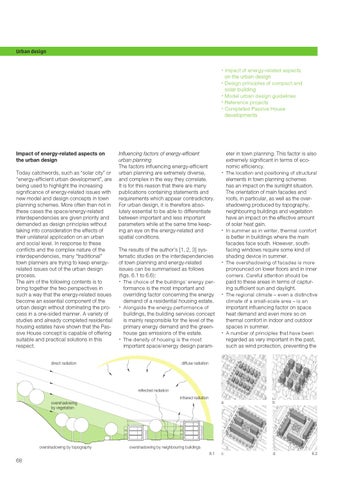
Influencing factors of energy-efficient urban planning The factors influencing energy-efficient urban planning are extremely diverse, and complex in the way they correlate. It is for this reason that there are many publications containing statements and requirements which appear contradictory. For urban design, it is therefore absolutely essential to be able to differentiate between important and less important parameters while at the same time keeping an eye on the energy-related and spatial conditions. The results of the author’s [1, 2, 3] systematic studies on the interdependencies of town planning and energy-related issues can be summarised as follows (figs. 6.1 to 6.6): • The choice of the buildings’ energy performance is the most important and overriding factor concerning the energy demand of a residential housing estate. • Alongside the energy performance of buildings, the building services concept is mainly responsible for the level of the primary energy demand and the greenhouse gas emissions of the estate. • The density of housing is the most important space/energy design param-
direct radiation
eter in town planning. This factor is also extremely significant in terms of economic efficiency. • The location and positioning of structural elements in town planning schemes has an impact on the sunlight situation. The orientation of main facades and roofs, in particular, as well as the overshadowing produced by topography, neighbouring buildings and vegetation have an impact on the effective amount of solar heat gain. • In summer as in winter, thermal comfort is better in buildings where the main facades face south. However, southfacing windows require some kind of shading device in summer. • The overshadowing of facades is more pronounced on lower floors and in inner corners. Careful attention should be paid to these areas in terms of capturing sufficient sun and daylight. • The regional climate – even a distinctive climate of a small-scale area – is an important influencing factor on space heat demand and even more so on thermal comfort in indoor and outdoor spaces in summer. • A number of principles that have been regarded as very important in the past, such as wind protection, preventing the
diffuse radiation
reflected radiation infrared radiation overshadowing by vegetation
overshadowing by topography
b
c
d
overshadowing by neighbouring buildings 6.1
68
a
6.2
In urban planning the spatial determinants, such as the position and distance of buildings, the number of storeys, the depth of the building and the vegetation, have a considerable impact on the energy demand of a residential housing estate. Based on these influencing parameters, it is possible to establish design principles for a compact and/or solar urban design. If the space heat demand is selected as the most important criterion, the parameters can either refer to the heat loss properties of the estate – the specific surface-to-volume ratio, A / V or A weighted /TFA (fig. 6.2) – or the amount of heat that can be captured on the estate – the specific solar gain [4]. The application of these principles in town planning procedures must always be weighed with other urban considerations, and any conflicting goals must be resolved.
6.1 Schematic diagram of the sunlight situation in a residential housing estate. The residential housing estate and its solar aperture receive solar radiation in the form of direct, diffuse and reflected radiation. In order to assess the overall situation in terms of solar energy, the radiation received by the solar aperture surfaces must be calculated for each different type of radiation independent of orientation, inclination and overshadowing (e.g. by neighbouring buildings and vegetation). The long-wave radiation exchange is also of significance (e.g. radiation exchange with the cold night sky). 6.2 Abstract residential estate typologies as a basis for energy-efficient urban design studies: a single family home housing estate b detached apartment blocks c linear blocks all with south orientation d perimeter block development
80 70 60 50
Passive House, 20 % window area Passive House, 30% window area Low Energy House, 20% window area Low Energy House, 30% window area EnEV, 20% window area EnEV, 30% window area
40 30 20
Annual space heat demand [%] based on south-oriented design
90
160
Passive House Low Energy House EnEV (each with 30 % window area)
150 140 130 120 110
10 100
0 a
east
160
north west Orientation
south
linear apartment blocks detached apartment blocks single-family homes perimeter block development
150 140 130 120
north
b Annual space heat demand [%] based on south-oriented design
north
130 120
100
90 c
south
west north Orientation
north west Orientation
140
100
east
south
linear apartment blocks detached apartment blocks single-family homes perimeter block development
150
110
north
east
160
110
90 north
east
d
south
west north Orientation 6.3
140 120 residential dwellings acc. to EnEV 100 80 60 Low Energy Houses 40
Reduction factor for overshadowing
Design principles of compact and solar building
100
Annual space heat demand [%] based on south-oriented design
The interaction of the above-mentioned influencing factors can be assessed by performing special urban energy studies. The aim is to draw up an energy balance of a housing estate and the individual buildings while taking into consideration the energy performance of the buildings and the urban spatial conditions of the environment. There is a range of special simulation programs for this purpose, for example GOSOL, which even highlights the potential for improving performance and, hence, the results (form factor, reduced solar heat gain in relation to perfect orientation and minimum overshadowing).
Annual specific space heat demand [kWh/m2a]
formation of cold air pools or the use of fully-glazed buffer rooms, take a back seat today due to the airtight and very well insulated construction of the building envelope.
Annual space heat demand [kWh/m2a]
Design principles of compact and solar building
1.0 0.9 0.8 0.7 0.6 0.5 0.4 0.3 row of trees block terrace courtyard
0.2
20 Passive Houses
0 0
0.5 1.0 1.5 2.0 2.5 3.0 3.5 4.0 4.5 Form factor Aweighted /TFA 6.4
6.3 Studies concerning the energy impact of orientation on the annual space heat demand according to the energy standard of the building, the window surface area and the type of development. Conclusion: it is not possible to make a general statement about building orientation. The energy impact is very much dependent on the boundary conditions. a annual space heat demand of a terrace house estate according to the orientation of the main facade and the energy standard b like a, however, in this case, the assessment of the relative differences is based on southfacing buildings (= 100 %) c relative impact of the orientation on the annual space heat demand for different types of developments with Passive House standard. The ratio of window surface area to treated floor area is 30 %. In comparison to all other
0.1 0.0 0.0 0.5
1.0
1.5
2.0 2.5 3.0 3.5 4.0 Distance-to-height ratio 6.5
facades, the window surface area in the main facade is increased by a factor of 1.5. d like c, however, in this case, the ratio is 20 % and the distribution of windows is equal throughout the facades. 6.4 Annual space heat demand for a variety of building types or buildings with differing form factors according to different energy standards EnEV: German Energy Performance of Buildings Directive (EnEV 2002) LEH: Low Energy House PH: Passive House 6.5 Reduction factor for overshadowing dependent on the distance-to-height ratio (D/H ratio, distance between buildings in relation to the height of the building or vegetation/trees) for a singlefamily home estate, a terrace or road situation, courtyard housing or a row of broadleaf trees set in front of the south facade.
69
0.50 0.45
south, no overshadowing west, no overshadowing south, overshadowing west, overshadowing west, extreme overshadowing
multi-family dwellings
0.40
0.35 0.30
terrace houses
0.25 single-family homes
0.20 0.15
courtyard houses
0.10 0.05 0.00
Req. average U-value (opaque components) [W/m2K]
0 0.60
Density [FSI module]
Req. average U-value (opaque components) [W/m2K]
Urban design
5.0
0.5
1.0
1.5
2.0
2.5
3.0
multi-family dwellings
0.55 0.50 0.45
4.5 3.5 4.0 Form factor A weighted/TFA 6.9 south, no overshadowing west, no overshadowing south, overshadowing west, overshadowing west, extreme overshadowing
0.40 terrace houses
0.35 0.30 0.25
single-family homes
0.20 courtyard houses
0.15 0.10 0.05 0.00 0
0.5
1.0
1.5
2.0
2.5
3.0
3.5 4.0 4.5 Form factor A weighted/TFA 6.10 dense apartment blocks apartment blocks detached housing estate (offset) detached housing estate terrace housing estate courtyard housing estate single-family home estate
4.5 4.0 3.5 3.0 2.5 2.0 1.5 1.0 0.5 0 0.6 0.8
1.0
1.2
1.4
1.6
1.8
2.0
2.2
6.9 Required average U-value of the opaque, insulated surfaces (roof, exterior wall, basement ceiling) in order to meet Passive House standard (space heat demand = 15 kWh/m2a) for buildings with different orientations and degrees of overshadowing in relation to their form factor (A weighted /TFA). For further information see [1], pp. VIII – 42ff. The following conditions were used for the calculations: • U-value of window: 0.8 W/m2K • g-value of glazing: 0.50 • energy-equivalent air change rate nl: 0.08 h-1 • window surface area: 20 % of TFA 6.10 like fig. 4.9, but with better quality Passive House components (windows + ventilation unit): • U-value of windows: 0.60 W/m2K • g-value of glazing: 0.55 • energy-equivalent air change rate nl: 0.06 h-1
72
2.4
2.6
2.8
3.0
3.2
3.4 3.6 3.8 4.0 4.2 Form factor A weighted/TFA 6.11
6.11 Relationship between the energy-related form factor and achievable density. These are the results from a study that analysed 1800 residential housing estates with different types of buildings. One of the first observations that can be made is that there is no direct relation between the density and the energy-related form factor. Provided that solar-optimised building distances are applied, the density achieved is low even if very compact building configurations are used. On the other hand, it is true that high densities can generally be achieved with compact building structures. Courtyard housing estates are an exception: despite their low to average form factors, they can achieve densities comparable to those of multi-storey buildings. For further information see [1], pp. XI–13ff.
Model urban design guidelines Systematic research into Passive House estates has shown that the significance of solar strategies in urban design is very much dependent on the density and compactness of buildings (fig. 6.9 – 6.11): • Dwellings and residential housing estates that are neither dense nor compact (single-storey buildings and small single-family homes) generally require a great deal of effort and expense to meet Passive House standard. Improvements in terms of solar performance (south orientation, minimum overshadowing) are absolutely essential for these building types. • In the case of dwellings and residential housing estates with an average degree of compactness (multi-storey single-family homes, terrace housing, small multi-family homes), the urban design and energy-related parameters, form factor, orientation and overshadowing, have a considerable impact on costs. However, unfavourable conditions can be compensated for with justifiable expenditure. • In terms of the requirements imposed on the building envelope, extremely compact dwellings and residential housing estates are comparable with typical low-energy constructions. Situations with unfavourable orientation and overshadowing can be improved with only a moderate amount of extra effort. • Thus, Passive House buildings are also suitable for inner city locations with a high density and unfavourable sunlight conditions. • As a consequence of the technological advances in the area of Passive House components (windows, glazing, mechanical ventilation units), opportunities for the implementation of Passive Houses in cities are increasing. This is especially true for borderline cases with a fairly low degree of compactness. Design tool The urban design principles are also suitable to make some first design-related assessments concerning the performance and capacity of Passive House components. To begin with, it is really only necessary to determine the form factor of the buildings and make some rough estimates of the solar situation (orientation, overshadowing). According to this, urban design and energy-related studies are a suitable tool for looking into strategic design issues – also in terms of ensuring cost-efficient developments.
Reference project
Reference project This reference project is designed to illustrate how climate protection strategies can be applied to a specific urban development scheme. Here it is the conversion of the former barracks Prinz Eugen Kaserne in Munich into a new urban district for 5000 residents with 1800 apartments, school and child care facilities, office buildings and a central square with local amenities. • The proposal is based on the idea of creating a densely built, mixed-use quarter with several development blocks or pockets, which are able to function as independent neighbourhoods (fig. 6.12 a and b). • The public space and the residential courtyards are characterised by clear urban features with differentiated proportions. The school, as one of the components, is also incorporated into this basic structural concept. • All buildings meet Passive House standard. However, the constructional and technical input to meet the energy criteria differs according to the form factor, orientation and overshadowing of the individual buildings (fig. 6.12 d). • The majority of buildings face south. In particular, in the case of the less dense configurations with semi-detached and terrace housing, all main facades are oriented south. • Areas for photovoltaic panels are provided on south-facing roofs. • Heating is supplied by a district heating system using a low-temperature network (Low-EX). The main network is kept to a minimum by incorporating only one substation per block and then using so-called mini networks. The higher temperature required for domestic hot water is achieved by installing waste water heat pumps (fig. 6.12 c). • The mobility concept is based on good public transportation services (tram, bus) with stops at the central square, car sharing services and good facilities to use electric vehicles (bicycles, city cars) in every neighbourhood. The urban design is deliberately not dominated by an energy-based approach. The successful implementation of climate protection strategies is rather due to the energy performance of all buildings completed according to Passive House standard and the energy supply concept. The solutions applied have hardly any, or no, impact on the urban appearance of the new residential housing district.
a
b
d
c
6.12
6.12 Urban design scheme for the conversion of the former barracks Prinz Eugen Kaserne in Munich, design competition, architects: Matthias Kroitzsch, Elisabeth Notter, Alexander Reichmann, Rainer Vallentin a siteplan b urban design /landscape concept c district heating system d Passive House requirements (for conditions see fig. 6.9). The average U-value of the opaque, insulated building envelope of the highlighted buildings is: 0.08 – 0.10 W/m2K 0.10 – 0.12 W/m2K 0.12 – 0.15 W/m2K 0.15 – 0.20 W/m2K > 0.20 W/m2K
73
Urban design
Passive House developments The following housing estates illustrate in a number of different ways how the Passive House concept can be incorporated in the design of an urban district.
a
b
a
b
c
d
6.13 Passive House housing estate in Lystrup (DK) 2009; architects: Schmidt Hammer Lassen; construction design: Olav Langenkamp; energy concept: passivhus.dk a photo b site plan 6.14 Passive House infill development in Fellbach (D) 2011; architects: Brucker Architekten; energy concept: ebök a photo b site plan with surroundings c model d site plan 6.15 Urban district built according to Passive House standards, Bahnstadt in Heidelberg (D) 2012;
74
6.13
6.14
urban design concept: Trojan+Trojan, energy concept: ebök a model b schematic diagram c urban design 6.16 Two Passive House housing estates: Lodenareal and Youth Olympic Village in Innsbruck (A) 2009/2011, architects: Architekturwerkstatt dina4, teamk2 architects, Reitter Architekten a aerial view of Lodenareal b Lodenareal site plan c perimeter block development: Lodenareal (phase 1) d detached apartment blocks: Olympic Village (phase 2)
Terrace housing estate in Lystrup (DK) Denmark’s largest housing estate designed according to climate protection targets is located in Lystrup near Aarhus. The development incorporating 32 terrace houses features an urban design with a serial character using very traditional south-facing terrace houses. The buildings have been erected by a property developer using a timber construction method and without basements. Narrow footpaths provide access to the individual homes; roads and car parking facilities, on the other hand, have been positioned on the site boundary. The development is complemented by a community house, which forms a social and cultural meeting point within the estate. The tower-shaped elements, accommodating the two-storey-high main living rooms, create a rhythm in the terraces, which has become a very characteristic feature of the development. Passive House development in Fellbach (D) The City of Fellbach bought the site of a former garden centre close to the town centre to develop a Passive House housing estate. Designed to shield the interior space from the main road, the project features a comb-shaped development in the east with a staggered roof line. The short terraces on the west side are slightly offset from the development in the east. The buildings adopt the small-scale configuration of the neighbourhood. Despite the somewhat low density, the Passive House estate could be developed in a cost-efficient way using standard solid construction methods. Two housing estates in Innsbruck (A) The largest Passive House housing estate in Austria is distinguished by two different building typologies – a perimeter block development and detached apartment blocks. As a consequence, it has been possible to directly compare the different design approaches in terms of open space and building typology. The first construction phase (Loden areal), based on a competition design, did not provide ideal conditions to implement the Passive House concept due to the continuous balconies with integrated loggias and the elaborate ventilation sys-
Completed Passive House developments
5
tem. The learning process triggered by these results meant that the extra costs for Passive House standard in the detached apartment blocks (Olympic Village), in comparison to a conventional development, could be reduced to almost 5 % and thus more than halved. Bahnstadt Heidelberg (D) Germany’s largest Passive House district with a dense and mixed-use concept is currently being completed in Heidelberg. The new district Bahnstadt is being developed on the former grounds of a freight station. A new urban layout with blocktype structures has been created by transforming former railway lines into elegantly curved urban spaces and adopting the alignment of roads ensuing from the river Neckar and the city centre. The urban features structure the district and create new visual links to the landscaped park, Pfaffengrund. Public spaces with different functions, sizes and shapes are located at the intersections of the urban fabric. The energy concept derived by the engineering practice ebök is based on the fact that all buildings are built according to Passive House standard. This has been set out in the property purchase agreements between the City of Heidelberg and potential buyers and will be monitored by the building authority on receiving the building permission applications, which must be submitted together with energy calculations and documents completed according to the PHPP. The energy supply is provided by a district heating system and so-called mini networks, which are responsible for distributing the heat within the individual blocks. Because of the high density in the district and the obligation to connect to the district heating system, the network-based heat supply is reasonable and sustainable despite the low heat demand of the Passive House buildings. The acceptance of this energy supply system is being supported by subsidy schemes, information and consultation programmes initiated by the City of Heidelberg.
2
4 2
1
6 + 7
2
2 1
3 5 + 6
0
a
1 housing 2 service facilities 3 business park 4 specialised trade b
c
8 1000 m 5 culture 6 public supplies 7 transportation hub 8 special use
6.15
a
b
c
d
Notes [1] Vallentin, Rainer: Energieeffizienter Städtebau mit Passivhäusern. Göttingen 2011 [2] Vallentin, Rainer: Städtebauliche Spielräume und Grenzen beim Entwurf von Passivhäusern. Protocol Volume No. 5, Passive House conference 2001, p. 29 – 42 [3] Vallentin, Rainer: Passivhäuser – Impulse zur Wei terentwicklung städtebaulicher Themen. Protocol Volume No. 2, Passive House conference 1998, p. 207 – 232 [4] ibid, p. 210 [5] Twarowski, Mieczyslaw: Sonne und Architektur. Munich 1962, pp. 107ff. [6] see note 1, pp. VII – 41ff. 6.16
75
Reference buildings – non-residential
University extension Kuchl, A 2009 Client: Weco FH Holztechnikum, Kuchl Architect: Dietrich � Untertrifaller Architekten, Bregenz Building physics: Horst Lukas and Wolfgang Graml, Wals close to Salzburg Building services: Axel Burggraf, Salzburg
1
2
8.15
The extension to the Holztechnikum at Salzburg University of Applied Sciences is intended to present the potential of modern timber construction together with the very best standard of energy efficiency in an exemplary way and thus put into practice the science of timber engineering. Together with the existing building, the three-storey new build forms an L-shaped complex. Fully glazed corridors connect the two buildings at every level. The elongated, cube-shaped new build appears to float on top of the solid basement storey. Narrow lines and an architectural design that has been restricted to
a few visible elements underline the impression of lightness. Almost the entire building has been conceived as a timber construction. The staircase, which for fire protection purposes is made of concrete, is the only exception. However, its structure is also required to stiffen the new build with the help of the two fully closed end walls. All the main rooms face northeast, whereas the access corridor and the staircase are accommodated on the south-west side of the building. The classroom for drawing on the ground floor is the only room that stretches the entire depth and therefore receives daylight
from two sides. Because the seminar rooms on the upper floors are fairly deep, they are provided with an extra portion of daylight from the wide and fully glazed access corridor through transom windows positioned high up in the interior walls. The favourable surface area-to-volume ratio of the new build is the key to meeting Passive House standard. The uniform compact structure allows for an uninterrupted layer of insulation with a thickness of up to 35 cm. Building construction In contrast to the closed end walls made
8.16
88
University extension in Kuchl
10 4
4
4
4
4
9 10 4
8.15 S ite plan, scale 1:5000 1 existing building 2 extension 8.16 View from north-east 8.17 South-west facade of extension; original building is on the left 8.18 First floor plan, scale 1:400 1 library 2 photo laboratory 3 project room 4 seminar room 5 connecting passageway 8.19 Section a-a 8.20 Ground floor plan, scale 1:400 6 foyer 7 classroom for drawing 8 entrance (existing building) 8.21 View from one of the seminar rooms 8.22 View into access corridor
9
5
5
8.17 1
2
3
4
1
2
3
4
5
5
a
8.18
8.19
a
4
6
7
4
6
7
8.21 5
a
5
a
8
8
8.20
8.22
89
Reference buildings – non-residential
8.23 V ertical section north-east facade scale 1:20 1 flat roof with overhang: 50 mm pebbles, filter fleece bitumen waterproofing membrane, 2 layers 72 mm three-ply cross laminated timber 60 – 50 mm timber substructure 60/24 mm panelling, white pine, untreated 2 flat roof: 50 mm pebbles, filter fleece bitumen waterproofing membrane, 2 layers 330 –200 mm mineral wool insulation, 1° slope bitumen vapour barrier 240 mm Brettstapel panel 250 mm substructure 50 mm mineral wool, acoustic fleece 15 mm laminated veneer lumber, birch, oiled 3 120/275 – 280 mm laminated timber beam 4 300/260 mm laminated timber beam 5 HEB 240 steel section 6 window: triple glazing 6 mm SSG + 18 mm cavity + 6 mm SSG + 18 mm cavity + 6 mm SSG in 100/100 mm aluminium/white pine (untreated) post and rail facade 7 200/300 mm laminated timber post 8 300/100 mm bracing against buckling, laminated timber with 70/70/3 mm steel section, sunken and screwed 9 window parapet: 8 mm SSG glass element, rear side enamelled 14 mm cavity ventilation, wind paper 350 mm mineral wool insulation vapour barrier, 2≈ 12.5 mm gypsum fibreboard fixed with anti-vibration ceiling hangers 24 mm laminated veneer lumber, birch, oiled 10 floor slab: 24 mm ash mosaic block flooring, oiled 60 mm cement screed, PE foil 30 mm impact sound insulation, mineral wool 24 mm loose sand infill 10 mm separating ply 40 mm laminated veneer lumber panel 100/400 mm laminated timber beam with 11 100 mm mineral wool infill 40 mm laminated veneer lumber panel 280 mm substructure, acoustic fleece, 30 mm mineral wool 15 mm laminated veneer lumber panelling, 12 birch, oiled, partially hole punched 11 170/60/3130 mm fixed sun shading lamellae, white pine with water drip, glue-fixed M 15 threaded bolt 12 ¡ 80/40/4 mm stainless steel tube, micaceous iron oxide finish 13 ¡ 80/12 mm flat steel, stainless steel 14 4 mm steel flashover protector, micaceous iron oxide finish 8.24 View fron north 8.25 First floor plan with building services, scale 1:400 8.26 Ground floor plan with building services, scale 1:400 8.27 Building data
1
1
2
3
3
4
4
6
6
7
7
5
8
9
9
2
5
8
10
10
11
12
13
14 13
14
8.23
90
University extension in Kuchl
— o —
8.24
ir supply ducts a air supply outlets air extract ducts 8.25
of cross laminated timber, the long sides of the building facing north-east and south-west are almost entirely glazed. The framed facade, set out in horizontal window ribbons and made of a composition of aluminium and untreated white pine, incorporates Passive House-certified windows with triple glazing. The parapets in between are conceived as highly insulated timber components (fig. 8.23). An exterior-mounted structure made of horizontal, untreated white pine battens is designed to provide shading for some parts of the glass facade. Even though it filters the sunlight, the view out onto the forecourt can still be enjoyed (fig. 8.17, p. 89). However, the distribution of battens in the facade is based on formal and compositional aspects, rather than the requirements for solar protection. Unfortunately, the fixed lamellae also reduce solar heat gain on the south- facing facade in winter. Due to the strong winds, the remaining glazed surfaces are without exterior-mounted shading devices. Interior roller blinds have been fitted instead, despite the fact that they are less efficient. Building services The heating system is run on renewable energy, in the form of wood chip. The heat is distributed exclusively by the supply air, without additional radiators. A mechanical ventilation unit with a heat recovery system complements the Passive House concept. The central unit with a zone and speed controlled mechanism is accommodated in the basement. In addition to filtering the air and distributing the heat, the mechanical ventilation unit, fitted with an evaporation cooler, is designed to humidify the air in winter and cool it in summer. The air ducts are concealed by a suspended, perforated ceiling structure, which also fulfil the acoustic requirements for sound absorption.
8.26
Building data Use Education: University of Applied Science Areas 1886 m2 1510 m2 1633 m2
floor space index (FSI) gross volume (V) A / V ratio
0.92 7940 m3 0.21
roof base slab glass-to-area ratio (glass/TFA)
0.110 W/m2K 0.100 W/m2K 39 %
wall window: (Uw-value)
0.120 W/m2K 0.850 W/m2K
Energy performance data
alternative calculation method
space heat demand primary energy heat provision ratio
10 kWh/m2a 117.2 kWh/m2a 85 %
heat load ventilation system blower-door test 1/h (50 Pa)
16.02 W/m² central 0.6
district heat/biomass –
solar collectors (coverage rate)
–
gross floor area (GFA) treated floor area (TFA) thermal envelope area (A) U-values [W/m2K]
Heat supply system energy carrier photovoltaic plant
8.27
91
Reference buildings – Passive House refurbishments
Apartment block refurbishment Freiburg im Breisgau, D 2011 Client: Freiburger Stadtbau, Freiburg i. Br. Architect: Roland Rombach, Kirchzarten Building services: Ingenieurbüro Lenz, Umkirch Building physics: Fraunhofer Institute for Solar Energy Systems, Freiburg i. Br.
10.14
The 16-storey building in Freiburg is the first high-rise residential building ever to have been refurbished according to Passive House standard. The apartment block was completed in 1968 using a serial construction method with precast concrete elements typical of that time. Having been in use for 40 years, the building was in need of refurbishment. The layouts of the large apartments no longer suited the needs of the residents. Furthermore, the long and narrow, loggialike balconies without thermal breaks were the cause for severe thermal bridges and a lack of daylight in the apartments (fig. 10.19). It was for this reason that the client decided to totally restructure the floor plans, which meant that the building could not be lived in during the 18-month construction period. All tenants who wanted to return after the modernisation were moved into temporary replacement accommodation. Now, after the refurbishment, each level contains not six, but nine apartments with improved layouts, but less floor area. Among these are 30 barrier-free units. Due to the reduction of floor area and cut in heating costs, the all-inclusive rent per unit is lower now than it used to be before the modernisation. The circulation area in the building has been reduced and the former loggias enclosed so that thermal bridges are no longer an issue and the overall living area has been increased by 900 m2. This has had the effect that the layouts are now even deeper than before. However, the sanitary and ancillary rooms are located in the inner darker zones; the bedrooms and living areas, on the other hand, are positioned on the window side. Building construction Due to the high degree of compactness the tall structure is very beneficial in terms of energy efficiency. Nevertheless, 110
10.15
Apartment block refurbishment in Freiburg
10.16
10.14 Site plan, scale 1:5000 10.15 View from south-west 10.16 Section a – a, scale 1:1000 10.17 Standard floor plan before the refurbishment, scale 1:400 10.18 Standard floor plan after the refurbishment, scale 1:400 10.19 Refurbished block immediately next to identical, not yet refurbished building 10.20 Entrance area 10.21 View of apartment interior; vertical supply shaft on the left
10.19
10.17
a
10.20
a 10.18
10.21
111
Reference buildings – Passive House refurbishments
10.22 Vertical section punctuated facade scale 1:20 1 floor slab: 10 mm floor covering 60 mm cement screed separating foil 60 mm thermal insulation levelling coat 25 mm original screed 9 160 mm reinforced concrete floor 9 slab (original) 2 exterior wall upper levels: 10 mm facade rendering 200 mm mineral thermal insulation 175 mm exterior wall, aerated concrete, inner joints sealed (wind tightness) 10 mm internal plastering 3 window: triple glazed PVC window 4 additional insulation behind roller shutter box: 52 mm microporous silica insulation (aerogel) 5 floor slab between ground floor and basement: 10 mm floor covering 60 mm cement screed, separating foil 60 mm thermal insulation, levelling coat 25 mm original screed 160 mm reinforced concrete floor slab (original) 200 mm mineral thermal insulation 10 mm internal plastering 6 basement window: double glazed PVC window (Uf = 1.1 m2/K) 7 exterior wall, plinth: 10 mm natural stone cladding 200 mm mineral thermal insulation 10 200 mm concrete exterior wall (original) 10 100 mm mineral insulation 10 mm internal plastering 10.23 Vertical section facade/balcony scale 1:20 8 balcony: 140 –160 mm new reinforced concrete balcony element suspended from protruding side walls, sloped top surface Ø 100 mm balcony drain pipe 9 2 mm cover sheet, stainless steel 10 microporous silica insulation (aerogel) 10.24 Horizontal section facade/balcony scale 1:20 11 10 mm facade rendering 160/200 mm mineral thermal insulation 10.25 Detail view of balconies 10.26 Standard floor plan (Type 5) with building services concept scale 1:150 10.27 Layout of mechanical equipment floor scale 1:400 10.28 Energy balance 10.29 Building data
1 2
4
3
5
6
7
8 8
9 9
8 8
10 10
10.22
10.23
11 11
10.24
112
Apartment block refurbishment in Freiburg
— — — — —
through the Passive House refurbishment, energy savings of almost 80 % have been achieved. The facades have been upgraded with Passive House-certified windows and a composite thermal insulation system with 20 cm-thick mineral wool. Aerogel insulation ( l = 0.013 W/mK) has been used to prevent thermal bridges and compensate for the reduced thickness of insulation at the balcony connections and behind the roller shutter boxes (fig. 10.22 and 10.23). The original balconies and exterior concrete wall supports are now incorporated within the building envelope and no longer cause thermal bridging in the facade. In replacement, all apartments now feature new exteriormounted balconies, which are supported by the protruding, but thermally separated, parapet elements made of reinforced concrete. By enclosing the loggias, the windows receive more direct sunlight, which increases not only the solar heat gain but also the amount of natural daylight.
10.26
10.27 Final/ primary energy [kWh/m2a]
Building services The restructuring of the apartments provided an opportunity to replace all building services. Two central mechanical ventilation units with heat recovery have been accommodated in a new roof structure (fig. 10.27). The distribution of air is limited to vertical ducts (fig. 10.26). The system is designed to supply an air change rate of 0.4 per hour; however, the residents can increase it by 50 % if required. In order to support the successful accomplishment of the retrofit, residents are given instructions on how to use their Passive House unit and live an energysaving lifestyle before moving in. The results of the pilot project are being monitored closely; the intention is to use the research, among other things, as a basis for the refurbishment of two identical buildings in the neighbourhood.
fresh air supply air extract air exhaust air heating
200 180 160 140 120
30 81
28.75
100
20
80
25
heat loss DHW heating
56.7
21
60
104.1
40
primary energy, electricity primary energy, heat electricity (grid) district heat
70
20
22.5 10 20
48.9
15
0 Final energy unrefurbished
Primary energy unrefurbished
Final energy refurbished
Primary energy refurbished 10.28
Building data Use residential Areas 11,319 m2 8582 m2 6977 m2
floor space index (FSI) gross volume (V) A / V ratio
1.53 29,211 m3 0.24
roof base slab glass-to-area ratio (glass/TFA)
0.207 W/m2K 0.255 W/m2K 20 %
wall window (Uw-value)
0.177 W/m2K 0.830 W/m2K
Energy performance data
PHPP
space heat demand primary energy demand heat provision ratio
15.2 (before 68) kWh/m2a heat load 107.0 kWh/m2a ventilation system blower-door test 1/h (50 Pa) 83 %
11.1 W/m2 central 0.22
district heat/CHP(gas) 23.7 kWp
–
gross floor area (GFA) treated floor area (TFA) thermal envelope area (A) U-values [W/m2K]
Heat supply system energy carrier photovoltaic plant 10.25
solar collectors
10.29
113
Building envelope components
a
b
c
d
e
f
g
h
i
130
j
Window frames Window frames commonly feature Uf-values of 1.5 – 2.0 W/m2K. If the aim is to remove the need for a heat source below the window, without restricting comfort levels close to the facade, high-performance frames with Uf-values of 0.8 to 0.7 W/m2K are required to achieve a wholewindow installed U-value of less than or equal to 0.85 W/m2K. In developing Passive House-compliant frame systems, there are various strategies which help achieve good results (fig. 11.13): • installation of insulation strips into the frame profile • instead of insulation strips, hollow cavities in the frame profile can also help to reduce heat loss through the frame • window frames that are not insulated can be upgraded to meet the requirements of Passive House windows by wrapping the outside the window frame with a thick layer of insulation on site. Since it is not possible to wrap the bottom edge of the frame with insulation, due to the position of the window sill and the vents for the supply and extraction of air to the glazing rebate, this part of the window always tends to be the weakest point in this frame. All new Passive House windows developed over the last years feature minimised frame widths in order to improve solar heat gain and daylight performance. The visible frame width is sometimes even well below that of conventional frames. In the case of some products, the window sash appears to be integrated into the frame with the effect that the window looks less fussy and more pleasing to the eye. Meanwhile, more than 80 window frames have been certified. The frames tend to be finished in wood, PVC, aluminium or fibreglass; sometimes a combination of materials is used for a different appearance inside and outside.
11.13
Element facades and framed glazing Framed glazing systems can be used to create large glass surface areas with a mixture of opening sashes and insulated opaque elements. These systems have been available in Passive House standard for some time now. Some manufacturers have even succeeded in developing very narrow, Passive House-compliant systems with a minimum visible frame depth of only 50 mm. These facade systems are more expensive than conventional constructions due to their complicated profiles. In the case of certified products, the heat loss caused by screw fittings and
glazing gaskets has also been reduced to a minimum (fig. 11.13 h). Solar shading Effective solar shading devices are generally also required in Passive House buildings. Since they should not substantially reduce the solar heat gain in winter, fixed systems are not always suitable. Large, accurately dimensioned overhangs in south-facing facades, however, are an exception. For aesthetical reasons, facade integrated shading devices are nowadays often preferred to systems that are fixed to the exterior of the building envelope. However, in order to provide the necessary space for the solar shading element, the thickness of the wall insulation has to be reduced. The position in the wall also makes it difficult to wrap the frame with insulation. The thinner the exterior wall insulation, the more serious this conflict becomes. Some manufacturers now provide ready-made insulated elements with integrated boxes for roller shutters or Venetian blinds suitable for use in Passive House buildings. The integration of shading devices tends to be more straightforward in the case of timber constructions since the necessary cavities can be provided in the load-bearing plane and it is easier to accommodate the additional insulation or add an appropriate structure of battens. Sliding doors The construction of sliding doors for Passive House buildings is particularly challenging due to the weight of the glazing units and the requirements concerning airtightness. However, there are a few window manufacturers who offer Passive House-certified sliding doors (fig. 11.13 j). In order to ensure their good working order, the deformation of the door lintel should be limited to a value well below what is usually determined in structural calculations. Rooflights Due to their position beyond the insulation plane, Passive House-compliant rooflights require not only high-performance glazing units and frames but also special systemdesigned solutions to provide a good connection to the roof insulation. Special criteria has been developed by the Passive House Institute for the certification of rooflights. A few certified products with ready-made insulated surrounds, as well as special glazing units and coatings, are available.
Other construction elements and special components
Other construction elements and special components In the meantime, standard components are available for an increasingly large range of special applications. In some fields, construction elements are still in their infancy stage, for example products for fire protection or special components for use in energy efficiency refurbishments performed to meet the EnerPHit standard. Main entrance doors The intensive use and the demanding requirements concerning security, weatherproofness, thermal protection and airtightness mean that main entrance doors designed to meet Passive House standard are high-performance components in terms of construction and stability. Some window manufacturers now offer certified doors, which frequently also satisfy additional requirements, such as burglar and noise protection, temperature stability and resistance to pelting rain. In the case of large non-residential buildings with public business hours, solutions including a porch or draught lobby at the main entrance are recommended. The air exchange caused by their use is then generally no longer an issue. Openings with special requirements Due to the demanding requirements for airtightness in Passive House buildings, it is best to avoid vents that are constantly open to the outside air. In conventional buildings these include, for example, chimneys, exhaust flues, elevators and vent stacks. There are alternative solutions for some of these situations: • room air-independent air supply ducts to combustion chambers that are positioned inside the building envelope • chimney stacks with flaps or Passive House-certified exhaust air systems • stack vents with gravity valves, which can occasionally be used as an alternative to roof stack vents [2] • installation of insulated and darkened openings for the provision of smoke and heat extraction and elevator shaft ventilation. If an elevator is planned, the staircase and elevator should ideally use a single smoke and heat extraction vent, which should be opened on demand only. Structural penetrations and fixtures extending through the insulation plane Thermal bridges are always an issue in areas where structural loads penetrate
the thermal envelope. In these situations, it is common practice to use products with a low thermal conductivity, but a high load-bearing capacity, or to distribute the load of the necessary structural fixture over a few high-strength point-fixed connections. The following list includes a selection of certified standard components: • offset blocks made of aerated concrete, foam glass or recycled polyurethane • mechanical fixings made of plastic or stainless steel with a sophisticated structural system for facade cladding or connections with horizontal point loads (fig. 11.14) • pre-fabricated systems made of stainless steel with integrated insulation for balconies, open access corridors and roof parapets (fig. 11.15) • cylindrical thermal insulation pads or load-bearing brackets for the thermalbridge-free fixture of smaller loads in connection with composite thermal insulation systems, such as railings or similar members
11.14
11.15
In most of these situations, it should be possible to develop thermal-bridge free constructions. In the case of very high loads, though, it is often only possible to achieve constructions with reduced thermal bridging. These then have to be taken into consideration in the energy balance. Airtightness systems In order to provide airtight connections, junctions and penetrations through the building envelope caused by pipes, cables, fixtures or other members, some manufacturers have developed airtightness systems, which are designed to meet a wide range of different applications (fig. 11.16): • airtight sheet and sealing membranes • airtight tapes and sealing compounds to produce airtight junctions between different materials and surface structures • airtight grommets to produce airtight exit points of cables and ducts • airtight sockets and service cavities Not-yet-available components Alongside special components for energy-efficiency upgrades, there is a severe lack of certified fire protection components. Ideally, these should make it possible to fulfil not only Passive House but also fire protection requirements at difficult junctions (e.g. junctions at fire division and party walls).
11.16
11.13 Frame profiles of Passive House windows scale 1:20 a wood/aluminium window b wood window c PVC/aluminium window d wood/aluminium window e aluminium window f wood/GRP window with narrow mullion g GRP window with very narrow frame h pressure plate glazing system, visible frame width 50 mm i main entrance door j push-up sliding door with wooden frame 11.14 Thermally broken bracket for the fixture of a suspended, rear-ventilated facade 11.15 Pre-fabricated, insulated balcony reinforcement connectors 11.16 Different airtightness products: vapour and airtightness membrane, airtightness tape, airtight grommet for the sealing of cable/pipe penetrations
131
Building envelope components
Building methods and construction systems In the case of every design, the decision about the construction method determines the basis for the structural detailing of the whole project. Sometimes it seems that architects regard the question concerning the type of building not as a choice between almost equal options, but, as a matter of principle, as a controversial issue. On closer examination, however, there are good arguments in favour and against all types of constructions. And when developing constructions and detail solutions to meet Passive House standard, these demand particular consideration. In any case, most buildings are in fact completed as mixed constructions, each with a different emphasis. Sequencing as a design issue Every building can be interpreted as a configuration of layers [3]. The building envelope incorporates several functional layers, whereby a single one can sometimes fulfil more than one function (fig. 11.17). Figures 11.18 – 11.20 illustrate a variety of building methods as schematic constructional sections to compare the different configurations. The layers providing thermal insulation, airtightness and wind-tightness have been highlighted in different colours. The task of detailed design is to arrange the functional layers according to their principles, without interruptions in the building envelope and, at the same time, taking into account the various junctions and transition points. The aim is to find a perfect agreement between constructional needs and the basic intention of the design. Solid construction In solid constructions, the load-bearing structure, and usually also the non-loadbearing elements, are made of solid 1
protection / cladding (poss. rear ventilation)
2
wind tightness
3
insulation /load-bearing structure
4
airtightness services cavity
5
protection/finish 11.17
132
building materials, such as reinforced concrete, cavity brick masonry, sand-lime brick or aerated concrete. These are either incorporated as panel elements (wall, roof and floor slabs) or broken down into point bearings (columns and beams). The insulation is generally added to the exterior using a thermal insulation composite system or in the cavity of rearventilated facade cladding. Special masonry blocks with insulation-filled cavities, either using mineral wool or perlite, are available today; however, their application in Passive House buildings is limited (see p. 127f.). Airtightness in new builds is provided by the internal plastering. In the case of energy efficiency refurbishments, it is sometimes more suitable to use the external rendering as the airtight layer. Any installations integrated into components of the building envelope require special attention (e.g. installation of airtight sockets) since they usually penetrate the airtight layer of plaster. Concrete, in contrast, is already airtight in itself; however, if prefabricated elements are being used, the junctions have to be sealed with airtight tape. When using exterior insulation, it is important to ensure a wind-tight construction in order to prevent the insulation from being windwashed. In solid constructions, it is sometimes difficult to avoid thermal bridges in areas where load-bearing elements penetrate the insulation plane, for example, at the base of the building if the level below ground is not insulated, where balcony slabs protrude beyond the facade, and at the tie-in areas of exterior and interior walls in situations where the top side of the basement ceiling slab has been insulated. Effective solutions to avoid thermal bridges in these circumstances include using materials with a lower thermal conductivity in the bottom brick course or breaking down the load-bearing structure into a few point bearings with a suitable layer of insulation in between. So long as the thermal mass remains accessible in the interior and is not covered up, solid buildings are easier to keep cool in summer than lightweight constructions. Timber constructions In the case of timber constructions, the load-bearing structure, including most of the non-load-bearing elements, is made of lightweight materials, such as solid timber members, I-beams or other wood materials. The insulation is usually added
in a space-saving way as infill insulation between the load-bearing timber components. However, it is also possible to add insulation to the outside of solid loadbearing panel-shaped elements. A services cavity is often included on the inner side of these exterior walls to provide space for electrical installations and to allow for the fixing of airtight tapes, for example at panel joints, behind angle brackets and tie bars. In timber construction, it is possible to combine panelshaped elements (e.g. solid timber or timber-framed constructions) with wooden posts and beams, the elements of a timber stud structure. From an economic viewpoint, timber construction methods are therefore ideally suited for designs with large openings. The stiffening board on the inside of lightweight constructions is often used to provide airtightness. The joints between the adjacent boards must, in this case, be sealed with airtight tape. Alternatively, it is possible to use vapour barriers or tearproof foils to provide airtightness. Windtightness is ensured by cladding the framework on the exterior with boarding that is open to diffusion (e.g. plywood sheathing, compressible bitumen-impregnated fibreboard), or using a diffusionopen facade system. If the details at junctions are planned accurately, there is no danger of thermal bridges in timber constructions. In some cases, it is worth calculating the thermal bridges individually, since the result may be a significant bonus which can be used to reduce the insulation thickness of standard building components. The lack of available building mass in lightweight constructions is a disadvantage in summer. Double layers of boarding on the inside of walls, solid screed floors and solid timber floor slabs (e.g. Brettstapel or laminated veneer timber floors, possibly with an additional layer of concrete or a gravel infill) are recommended to provide better thermal comfort in summer. Mixed construction methods The benefits of solid and lightweight building practices are combined in mixed construction methods. In these buildings, it is usually the interior load-bearing structure that is built using solid components and the building envelope (e.g. exterior walls and roofs) that is completed using lightweight ones. It is common to use timber construction elements in solid constructions (e.g. in the case of roofs) and solid members in
Building methods and construction systems
wind-tight layer airtight layer wind-tight layerwind-tight layer wind-tight layer insulation airtight layer airtight layer airtight layer nsulation insulation insulation
11.18
11.19
11.20
timber constructions (e.g. floor slabs, basement). In practice, mixed construction methods tend to be the rule, rather than the exception. The junctions where the two types of construction meet require special attention. • The airtight seals at the junctions between solid and lightweight components must also take into consideration all secondary leakage paths. This significantly increases the lengths of joints. Furthermore, it is important to make sure that the airtight tape used is suitable for both material worlds. The insulation filling the hollow spaces at junctions, including their respective airtight configuration, is a fundamental aspect for noise and fire protection.
• The fire protection requirements specified for standard components also apply to all junctions and other transition points in the construction. This frequently requires more detailed planning in the design and construction phase. • In lightweight constructions, thermal bridges often occur at the tie-in points of solid components, such as floor slabs and walls. The lengths of these junctions are fundamental to reducing thermal bridging heat loss and thus achieving Passive House standard. This especially applies to buildings that are not quite so compact. • The thermal conditions in summer of a mixed construction type building are very similar to those of a solid building.
Notes [1] Borsch-Laaks, Robert: Tauwasserschutz von Flachdächern aus Holz. DETAIL 1-2/2012, pp. 76ff. [2] In some cases, it is necessary to clarify the use of these devices with the building services planner. They cannot be used, for example, in combination with wastewater lifting systems. [3] The concept of sequencing was derived by Heinz Ronner and Emil Rysler (comp. Ronner, Heinz et al.: Baustruktur: Baukonstruktion im Kontext des architektonischen Entwerfens. Basel/Berlin/Boston 1995) 11.17 The concept of sequencing is used to interpret the configuration of functional layers with each fulfilling a different task. In some cases, a single layer may even be responsible for several functions simultaneously. 11.18 Schematic section of a Passive House building with a solid construction 11.19 Schematic section of a Passive House building with a lightweight timber construction 11.20 Schematic section of a Passive House building with a mixed construction
133